
Araçariguama Sighting
On the night of March 4, 1946 — Carnival Monday — a 44-year-old farmer named João Prestes Filho returned home from fishing on the Tietê River to an empty house in Araçariguama, a small gold-mining town roughly 70 km west of São Paulo, Brazil. Moments after he began bathing and changing his clothes, he was struck by what he and later witnesses described as a yellowish beam or flash of light. He suffered severe burns, remained conscious and reportedly pain-free for hours, and died that same night. This case file was commissioned to replace a "Coming Soon" queue placeholder crediting the case to "Joao Prestes" and describing "severe tissue disintegration leading to death." Two-pass research for this case file confirms a real, extensively documented event matching the placeholder's date and location almost exactly — unlike some other placeholders this site has had to remove outright as unverifiable — but finds the placeholder's own framing needs two corrections: the victim's full name, in every primary and secondary source located, is João Prestes Filho ("Filho," meaning "Junior," distinguishes him from his own father of the same name), not simply "Joao Prestes"; and the case's own official 1946 death certificate records "generalized first- and second-degree burns," a real but considerably less catastrophic injury than the placeholder's "tissue disintegration" — a dramatic characterization that does appear in one later witness's 1974 recollection, but which conflicts with other family witnesses' own, more modest descriptions. This file presents the real case in full, including that contradiction and the 25-year gap before anyone outside the family treated it as a UFO report at all.
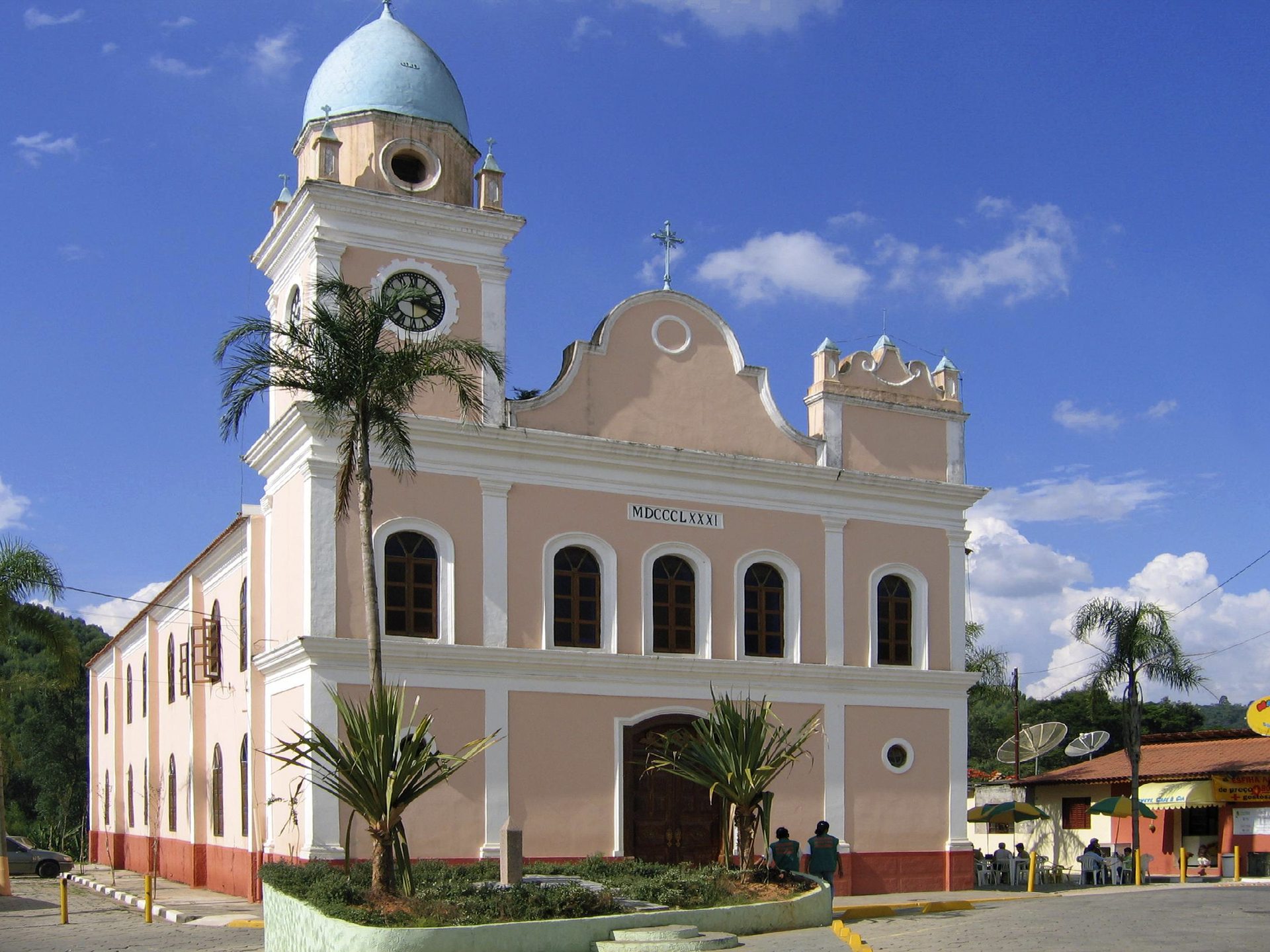
Pictured: the Igreja Matriz de Nossa Senhora da Penha, the historic parish church (originally built 1648, repeatedly reformed since) at the center of Araçariguama, São Paulo. This is not a photograph of João Prestes Filho, his farmhouse, or any scene from the night of March 4, 1946 — no photograph of any kind connected to the case is known to survive; 1946 rural Brazil had no press coverage of the death at the time, and it went entirely undocumented outside the family for 25 years. This image is offered only as an honest, geographically-accurate illustration of the small town itself.
Theoretical Alignment
This case sits in an unusual position for this site's theoretical alignment framework, because no witness at any point, in any generation of testimony, ever described seeing a craft, a light performing maneuvers, or any object at all — only a beam or flash of light striking a man inside his own home. The Extraterrestrial Hypothesis reading is therefore modest and draws entirely on the "directed-energy beam causing severe, otherwise-unexplained burns" motif that recurs across a genuine, if thin, cluster of similarly-described Brazilian and international cases discussed in this file's Historical Precedents section, plus the specific claim (made by later international ufologists, most notably Spanish researcher Antonio Ribera) that the injuries are consistent with an alien energy weapon or propulsion exhaust. The Interdimensional Hypothesis has essentially nothing to attach to here beyond the case's general strangeness; nothing in any account invokes portals, missing time, or other IDH-specific signatures. The Psycho-Social/Mundane reading carries the most real weight of the three for a specific, disclosed reason: this case's central and most dramatic details were not recorded by anyone outside the family until 1971, a full 25 years after João Prestes Filho's death, and the single most severe description of his injuries — flesh visibly separating from bone — comes from one witness's 1974 recollection, 28 years removed from the event, in direct tension with other family members' own, less catastrophic accounts of "toasted" or "roasted" skin. A quarter-century (and, for some testimony, half a century) of retelling within a family and a regional folk culture that already had its own established fireball legend (the Boitatá, discussed below) is a well-documented mechanism for narrative amplification, and this case file treats that possibility as seriously as it treats the anomalous reading.
Background
Araçariguama is a small municipality in the interior of São Paulo state, roughly 70 km west of the state capital and about 13 km from the larger town of São Roque, from which it was administratively separated in 1874. Its history runs back to 1590, when the bandeirante Affonso Sardinha is recorded as having found alluvial gold near the Morro do Vuturuna, making the area one of the earliest gold-mining sites in what would become São Paulo state; a company called Saint George Gold Mine held rights to work the deposit as late as 1926, extracting an average of roughly 45 kg of ore per month. By 1946, Araçariguama was still a modest farming and mining community straddling the Tietê River, connected to the wider region by dirt roads and largely dependent on horse- and ox-drawn transport — a setting with no local newspaper, no resident physician with forensic training, and no telephone or telegraph infrastructure that would have allowed news of an unusual death to travel quickly beyond the immediate family and its neighbors.
The date of the incident, March 4, 1946, fell on Carnival Monday that year — one of Brazil's most significant annual holidays, during which entire families customarily leave their homes for street celebrations ("blocos") in the evening. This detail matters directly to the case: on this specific night, João Prestes Filho's wife, Silvina Nunes Prestes, and their five or six children (sources differ on the exact number) had gone to Carnival festivities, variously described across different secondary accounts as either a local street celebration or a trip to the neighboring town of São Roque, leaving João's house empty when he returned. Whatever happened to him that night, it happened to a man alone, with no other adult present to serve as a first, contemporaneous witness — a structural feature of the case, disclosed here plainly, that shapes everything that follows: every account of what actually struck him rests on his own reported statements to family members who reached him afterward, not on any independent observation of the event itself.
Brazilian ufology as an organized field did not exist in any meaningful sense in 1946; the country's oldest civilian UFO research groups, including Dr. Walter K. Bühler's Sociedade Brasileira de Estudos sobre Discos Voadores (SBEDV), were not founded until 1957 at the earliest, more than a decade after João Prestes Filho's death. This is the central reason the case has the evidentiary shape it does: there was no organized research body, no government UFO-reporting apparatus, and, as best this case file's research could determine, no contemporary newspaper coverage of any kind treating a farmer's death by unexplained burns as newsworthy in 1946 rural São Paulo state. The case survived for a quarter-century purely as local oral history — a story told and retold within the Prestes family and their Araçariguama neighbors — until Brazilian ufologists began actively documenting it in 1971, a gap this case file's own research treats as the single most important fact shaping how much weight any of the case's specific details can bear.
Complete Timeline
| Date | Event |
|---|---|
| 1590 | Bandeirante Affonso Sardinha records finding gold near the Morro do Vuturuna, marking the historical origin of the settlement that becomes Araçariguama. |
| 1648 | The chapel that becomes the town's Igreja Matriz de Nossa Senhora da Penha is built, later repeatedly reformed (notably 1772, 1833, and 1965–67). |
| 1874 | Araçariguama is elevated to a village and separated from the Municipality of São Roque by provincial law. |
| March 4, 1946, evening | The incident: João Prestes Filho, 44, returns from fishing on the Tietê River with companion Salvador dos Santos to find his house empty; while bathing and changing clothes, he is struck by what he and later witnesses describe as a yellowish beam or flash of light. |
| March 4, 1946, night | Prestes flees his house, reportedly barefoot and wrapped in a blanket, running several kilometers to reach relatives in the town center; he is transported by cart toward Santana de Parnaíba, past the Padaria Ema bakery, and reaches the Santa Casa hospital there. |
| March 4, 1946, 22:00 hrs (per death certificate) | João Prestes Filho dies. His death certificate (Cartório de Santana de Parnaíba, doc. #2397) records the cause as cardiac collapse with generalized first- and second-degree burns, certified by Dr. Luiz Caligiuri. |
| 1947 | João's brother, Emiliano Prestes, reportedly encounters two "fireballs" near the Ibaté cemetery outside Araçariguama — the first of several later-reported regional fireball sightings researchers would connect to the case. |
| Early 1970s | Max Berezovsky, president of APEX (Associação e Pesquisas Exológicas), travels to Araçariguama with ufologists Guilherme Wirz and João Evangelista Ferraz; one family member offers a conflicting account attributing the death to an accidental kerosene-lamp fire. |
| September 1971 | Ufologist Irineu Silveira and Professor Felipe Machado Carrion first publicly document the case as a possible UFO-related death at the II National Symposium on Extraterrestrial Life, 25 years after the event. |
| 1971 | The case receives its first international coverage when the French magazine Phénomènes Spatiaux runs a story on it. |
| September 28, 1974 | APEX researcher Fernando Grossmann tape-records an interview with Araci Gomide, the family friend who attended Prestes in his final hours — 28 years after the event, and the source of the case's most severe injury description. |
| 1975 | Grossmann and Luiz Braga publish "Nova luz sobre o Caso Araçariguama" ("New Light on the Araçariguama Case") in APEX's own Informativo bulletin, concluding the death involved "an unknown, non-flame thermal energy source of short duration." |
| 1978 | Dr. Walter Bühler, publicly skeptical of hostile-UFO interpretations generally, continues to favor a mundane kerosene-lamp accident explanation for the case in SBEDV circles. |
| April 1980 | French-American astrophysicist and ufologist Jacques Vallée travels to Brazil and prioritizes cases involving injury or death from the UFO phenomenon, including the "Máscaras de Chumbo" (Lead Masks) case; Brazilian secondary sources place the Prestes case within this same category of Vallée's field research, though this case file's own research could not independently locate a specific Vallée publication naming Prestes by name. |
| Late 1990s | Historian and ufologist Cláudio Tsuyoshi Suenaga, working with Spanish researcher Pablo Villarrubia Mauso, travels to Araçariguama, interviews surviving relatives including 92-year-old cousin Vergílio Francisco Alves, and recovers the original 1946 death certificate from the Santana de Parnaíba civil registry. |
| May 2001 | Suenaga and Villarrubia Mauso publish their findings, including the recovered death certificate, as João Prestes y las crónicas del misterio (Madrid). |
| 2011 | Revista UFO (Brazil) publishes a retrospective marking 65 years since the case, drawing on Suenaga's documentary research. |
| 2023 | Ufology outlet OVNI Hoje republishes a detailed account of the case for a new generation of Brazilian readers. |
| 2026 | This case file is published, correcting the "Coming Soon" queue's placeholder name ("Joao Prestes") to the case's real, universally sourced full name, João Prestes Filho, and disclosing the gap between the placeholder's "tissue disintegration" framing and the death certificate's own, more modest "first- and second-degree burns." |
The Night of March 4, 1946
By every account this case file's research located, João Prestes Filho spent Carnival Monday, March 4, 1946, fishing on the Tietê River roughly two kilometers from his home, in the Cotiano area on Araçariguama's outskirts, together with a companion identified across sources as Salvador dos Santos. His wife, Silvina, and their children had gone into town or to neighboring São Roque for Carnival festivities, expecting João to return late. When he arrived home that evening, ahead of his family, he found the house empty and dark. According to the account his relatives would later relay, he went to bathe and change out of his fishing clothes — and it was at this point, inside his own home, with no other person present to see it happen, that he was struck by what multiple family accounts describe as a "yellowish ray" or beam of light that illuminated the room.
What is consistent across every version of the story this case file's research found is that João himself, in the time he remained conscious afterward, described the light as sudden and intensely hot, and that he was unable to open his own bedroom door properly, apparently because of the injury to his hands. Cousin Vergílio Francisco Alves's account, recorded decades later, has João running barefoot from the house, by some versions wrapped in a blanket, covering several kilometers on foot to reach relatives in the town center — a considerable physical feat for a man in the condition every account agrees he was in, and one this case file flags as a detail worth treating with some caution precisely because of how demanding it is, though nothing in the record offers an alternative explanation for how he otherwise reached help. He arrived at the home of his sister, reported across sources only as "Maria," and it was there, according to family testimony, that he made the statement that has been quoted in nearly every subsequent retelling of the case: that whatever struck him "was not from this world," and that it had been itself invisible.
From there, João was transported by horse- or ox-drawn cart toward medical help, with at least one detailed local account specifically noting the cart's route past a bakery, "Padaria Ema," a landmark evidently well remembered by townspeople decades later. He was brought to the Santa Casa hospital in Santana de Parnaíba, a larger town some distance from Araçariguama, arriving with what witnesses describe as first Delegate Malaquias, the local police authority, and then, at the hospital itself, Dr. Luiz Caligiuri attending him. Every family account collected by researchers agrees on one striking clinical detail: João remained lucid throughout, was specifically asked whether he had been drinking alcohol and denied it, and reported feeling no pain despite the visible severity of his injuries — a detail some later ufological writers have treated as itself anomalous (severe burns are ordinarily extremely painful), though this case file notes that shock and nerve damage from severe burns can, in some real clinical circumstances, blunt pain perception, meaning this detail, while genuinely striking, does not on its own require an exotic explanation.
He died that night. His death certificate — recovered decades later and discussed in full in the Material Analysis section below — records the time as 22:00 hrs, March 4, 1946, meaning that if the incident occurred in the early evening as most accounts suggest, he survived for perhaps two to five hours after being struck, not the "nine hours" figure repeated in some later ufological retellings, which appears to conflate the certificate's own timestamp with a separately estimated interval between the injury and his arrival at the hospital.
What the Investigation at the Time Found
According to family accounts collected decades afterward, police experts — described in the secondary literature as drawn from Osasco, Barueri, and Santana de Parnaíba — examined João's house in the aftermath and found no physical evidence of fire, accident, or crime anywhere in the structure. Specifically, and repeated across multiple independent secondary accounts, a kerosene lamp ("lampião") in the house was found unlit, with its fuel reservoir still full — a detail that, if accurately remembered and reported, weighs directly against the single most obvious mundane explanation, a lamp accident, discussed at length in this case file's Conventional Explanation Candidate section below. Araci Gomide, who examined João closely while attending him, is reported to have specifically stated she detected no smell of kerosene, alcohol, or any other combustible fuel on his body or clothing. No source located by this case file's research indicates that any physical sample — of his burned skin, his clothing, or any material from the house — was preserved, tested, or photographed at the time; the entire "investigation" that occurred in 1946 appears to have been a routine police inquiry into an unexplained death, not any kind of forensic or scientific examination, and its findings survive today only through decades-later family recollection rather than any surviving police report this case file's research could locate.
The Contradiction at the Center of the Case: What Exactly Did João's Body Look Like?
This case file's research identified a specific, significant, and unresolved contradiction between the two most detailed surviving descriptions of João Prestes Filho's actual physical condition — a contradiction this file discloses in full rather than smoothing over in favor of whichever version is more dramatic, in keeping with this site's practice on every other case where witness testimony genuinely disagrees.
Araci Gomide's account, given to APEX researcher Fernando Grossmann on tape on September 28, 1974 — 28 years after the event — is by far the most severe and the most frequently quoted in later ufological retellings. She described João as appearing "literally cooking, as if scalded in boiling water," with flesh separating from the bone, particularly at the extremities; other secondary summaries of her account add that pieces of flesh reportedly began falling from his fingers, exposing bone. She specifically maintained, however, that his hair, eyebrows, and clothing showed no sign of burning or scorching whatsoever, and that she detected no odor of any combustible fuel — the detail underpinning much of the case's anomalous framing.
Set against this is the testimony of family members interviewed by Suenaga and Villarrubia Mauso in the late 1990s, more than half a century after the event. Cousin Vergílio Francisco Alves, then 92 years old, described João's skin as "toasted, brownish, as if roasted" — a serious burn injury, but one that does not involve flesh detaching from bone. Nephew Luiz Veronezzi Prestes similarly described a "ball of fire" entering through a window and burning João, without describing anything resembling exposed bone or separated flesh. Luis Prestes (son of João's brother Roque) is quoted in yet another secondary account stating plainly that João's burns were severe and dark but that no body part or flesh was actually missing or detached.
These are not minor discrepancies in emphasis; they describe two meaningfully different degrees of physical injury. This case file's own research could not resolve which account is more accurate, and treats that inability honestly rather than defaulting to Gomide's more dramatic version simply because it is more widely repeated in popular ufological writing. Two explanations seem equally plausible on the available evidence: either Gomide, as the witness who spent the most direct time attending to João's actual wounds at close range, had genuinely superior first-hand knowledge of his true condition that the other, more distant family witnesses lacked or later downplayed; or her account, given 28 years after the fact and elaborated further in every subsequent retelling since, reflects the kind of narrative amplification common to traumatic family memories recounted repeatedly over decades — a phenomenon well documented in psychological research on long-term eyewitness memory, and one this case file's Theoretical Alignment section above treats as a real, live possibility rather than a dismissive aside. Compounding this uncertainty is the same witness's disagreement over the time of death itself: Gomide's 1974 recollection reportedly placed João's death at around 3 or 4 a.m. on March 6, two days after the event, directly conflicting with the death certificate's own recorded time of 22:00 hrs on March 4 — the certificate being the one piece of contemporaneous documentary evidence in the entire case, and the detail this case file weights most heavily wherever it conflicts with a much later verbal recollection.
The Silence Years and the 1971 Rediscovery
Perhaps the single most consequential fact about this case, and one this case file treats as inseparable from any assessment of its credibility, is that nothing about it was documented, published, or investigated by anyone outside João Prestes Filho's own family and immediate community for 25 years. No 1946 newspaper article, police report, or medical record beyond the death certificate itself has ever been located by any researcher, including Suenaga's own dedicated archival search decades later. The story survived purely as oral history within the family and, evidently, spread informally enough within the wider Araçariguama community that decades later a bakery landmark on the route his cart took, and a gravedigger's own secondhand knowledge of the story, were both still recoverable by researchers.
The case entered the written record for the first time in September 1971, when ufologist Irineu Silveira and Professor Felipe Machado Carrion presented it at the II National Symposium on Extraterrestrial Life, and separately (or relatedly) when the French magazine Phénomènes Spatiaux ran a story on it the same year, introducing it to an international ufological audience. This 25-year gap is not, on its own, proof that the case is fabricated or without merit — oral history in isolated rural communities can preserve a genuinely accurate account of a real death for a long time, particularly one as traumatic and locally memorable as this one evidently was — but it is a real, structural limitation on how confidently any of the case's more specific, dramatic details can be treated as historically reliable, since every single one of them, without exception, reached documented form only after 25 years or more of unrecorded retelling.
APEX's Field Investigations, 1970s
The Associação e Pesquisas Exológicas (APEX), a São Paulo civilian ufology research group, conducted the case's first organized field investigations. Its president, Max Berezovsky, traveled to Araçariguama in the early 1970s with fellow researchers Guilherme Wirz and João Evangelista Ferraz, but this initial visit produced a genuinely conflicting account: at least one family member reportedly told them the death resulted from an ordinary kerosene-lamp fire, an account that directly contradicts the "no burned materials in the house, lamp found unlit and full" version collected by other researchers at other times from other family members — itself a further, disclosed layer of the case's internal inconsistency.
A more thorough return visit came in September 1974, when Fernando Grossmann and Luiz Braga located and interviewed additional witnesses, most significantly Araci Gomide. Their findings, published the following year in APEX's own Informativo bulletin under the title "Nova luz sobre o Caso Araçariguama," reached a deliberately non-committal conclusion: that João's death involved "an unknown, non-flame thermal energy source of short duration." Grossmann and Braga are also reported, in some secondary accounts, to have floated a comparison to radiation-burn injuries resembling those documented after a nuclear detonation — a comparison this case file notes was speculative even by APEX's own account, resting on general similarity of appearance rather than any actual radiological measurement, since no Geiger counter or dosimetry of any kind was ever applied to João, his house, or any physical evidence connected to the case.
Dr. Walter Bühler, the physician who founded and led Brazil's SBEDV, took a different, more skeptical position within Brazilian ufology circles, consistent with his broader, well-documented reluctance to characterize UFO encounters as hostile or fatal to humans (a stance rooted in his own Adamski-influenced view of a benevolent "cosmic brotherhood"). Bühler favored the mundane kerosene-lamp accident explanation for the Prestes case specifically — the same explanation the conflicting 1970s family account had offered, and the same explanation this case file's Conventional Explanation Candidate section below evaluates directly against the "unlit, full lamp" detail reported by other witnesses.
Suenaga and Villarrubia Mauso's Documentary Recovery, 1990s–2001
The case's most important single evidentiary advance came a generation later, when Brazilian historian and ufologist Cláudio Tsuyoshi Suenaga, working with Spanish researcher Pablo Villarrubia Mauso, undertook a fresh field investigation in the second half of the 1990s. The two traveled to Araçariguama and located several surviving relatives and community members, including 92-year-old cousin Vergílio Francisco Alves, nephew Luiz Veronezzi Prestes (born 1937), local historian Hermes da Fonseca (born 1927), and cemetery caretaker Nelsom de Oliveira, then 53, who separately reported his own, much more recent sighting of a round, aluminum-colored object over the cemetery roughly eight years before Suenaga's visit — a detail treated in this case file's Historical Precedents section as a distinct, later, and far less corroborated report, not as further evidence about the 1946 death itself.
Suenaga's most consequential single contribution, however, was archival rather than testimonial: he located and obtained a copy of João Prestes Filho's actual original 1946 death certificate from the civil registry (Cartório) of Santana de Parnaíba — document number 2397. This is the only contemporaneous written record connected to the case that has ever been recovered, and its recovery, decades after the fact, is what allows this case file to state the official cause of death, the certifying physician's name, and the certified time of death with genuine documentary confidence, rather than relying entirely on family recollection for even the case's most basic facts. Suenaga and Villarrubia Mauso published their combined findings, including the certificate, as João Prestes y las crónicas del misterio (Madrid, May 2001), a book that remains the single most thoroughly documented published account of the case in any language.
Regional Fireball Folklore and the "Boitatá"
No account of this case is complete without its immediate cultural context: the region around Araçariguama, and rural Brazil generally, has a long-standing folkloric tradition of the Boitatá, a fire-serpent or fireball spirit said to appear at night, particularly near old mining sites, cemeteries, and marshland — precisely the kind of terrain surrounding Araçariguama's own historic gold workings. A related local figure, the "Lagartão" ("great lizard" or fire-dragon), is also referenced in the area's folklore, said in some tellings to originate from the Morro do Saboão or from the old gold mine itself along the Castelo Branco highway corridor.
This case file's research located several other "fireball" or unidentified-light reports from the same immediate region and extended family, spanning decades before and after João's death, that researchers investigating the Prestes case have folded into the same broader pattern. In 1947, the year after João's death, his own brother, Emiliano Prestes, reportedly encountered two fireballs near the Ibaté cemetery. In 1955, multiple workers at a cement factory's cable-car construction site reportedly observed an aluminum-plate-like object that disappeared when Brazilian Air Force (FAB) jets arrived in the area. In 1960, bus driver Celso Gomide reported a red light that caused his vehicle to stall for roughly 20 minutes. None of these later reports involves any injury, and none has anywhere near the documentary anchor (a death certificate) that the Prestes case itself has; they are presented here, as the researchers who compiled them intended, as evidence of a genuinely persistent local reporting pattern around unusual aerial lights in this specific area — a pattern that this case file's own research treats as cutting both ways theoretically. It lends some genuine, if circumstantial, support to the idea that something real and recurring, whatever its ultimate nature, has been observed in this specific area across multiple generations; but it equally supports the alternative reading that a small rural community with an existing, centuries-old fireball folklore tradition (the Boitatá) would be primed, culturally, to interpret an unexplained tragedy in exactly these terms, and to keep reinterpreting and re-elaborating the story along familiar lines with each retelling.
Key Witnesses
Every witness in this case, without exception, is a family member or close family friend of the victim, and every account beyond João's own reported dying statements was recorded at least 25 years, and in most cases closer to 50 years, after the event itself. This case file discloses that structural limitation plainly rather than treating any individual witness's account as independently corroborating in the way a truly unconnected, contemporaneous witness would.
João Prestes Filho
A 44-year-old farmer, struck by an unidentified beam or flash of light while alone inside his own home. His own reported statements — that whatever struck him "was not from this world" and was itself invisible — survive only through his family's secondhand retelling, since he did not live to give any account to an investigator or outside party. He remained lucid, denied intoxication, and reported no pain in his final hours, per every family account collected.
Araci Gomide
A family friend with informal nursing experience who attended João through his final hours and gave the case's single most detailed — and most severe — description of his injuries, describing flesh separating from bone. Her account, recorded 28 years after the event, also places his death two days later than the official death certificate, a direct, unresolved contradiction discussed above.
Vergílio Francisco Alves
Described João's skin as "toasted, brownish, as if roasted," his hands twisted, but did not describe flesh separating from bone, a meaningfully less severe account than Gomide's. Also recalled that João had reportedly encountered "Boitatá" fireballs years earlier as a young muleteer, tying the case directly into the region's existing fireball folklore.
Luiz Veronezzi Prestes
Described a "ball of fire" entering through a window and burning João, and specifically maintained that João was fully lucid and had not been drinking, addressing directly the alcohol-intoxication explanation some skeptics have floated.
Hermes da Fonseca
Confirmed the basic outline of João's return from fishing and his burning upon arriving home, and separately recalled the detail of João's body being transported by cart past the Padaria Ema bakery — a small but specific local detail that lends some texture of genuine community memory to the case, distinct from the family's own retelling.
Cláudio Tsuyoshi Suenaga
Not a witness to the 1946 event itself, but the researcher responsible for the case's single most important documentary contribution: locating and recovering João Prestes Filho's original death certificate from the Santana de Parnaíba civil registry, decades after the fact, and co-publishing the case's most thorough documented account.
The Five Observables Assessment
The Five Observables framework, drawn from the Pentagon's own AATIP-era analytical criteria, is applied here to the behavior described by João Prestes Filho and his family:
Assessment: This case aligns poorly with the Five Observables framework, and does so for a reason distinct from most other cases on this site: no witness, at any point across 80 years of retelling, ever described observing a craft, object, or light performing any flight behavior whatsoever. Anti-Gravity Lift, Instant Acceleration, Hypersonic performance, and Trans-Medium travel are all rated Absent because there is simply no reported flight behavior of any kind to assess — the entire phenomenon, as described, consists of a stationary man being struck by a beam or flash of light while indoors. Low Observability is rated Speculative only in the narrow sense that no source of the light was ever visually identified or located by any witness, which is consistent equally with a genuinely undetected, low-observable source and with there having been no discrete "craft" involved at all, only an unexplained (and, on the mundane reading, potentially misremembered or narratively embellished) burn injury. This case file states plainly that it is one of the weakest matches in this site's catalog to the Five Observables framework specifically, regardless of how its overall credibility is ultimately assessed.
Evidence Assessment
Supporting Anomalous Origin
- A real, documented death occurred, anchored by a genuine, decades-later-recovered official death certificate — this is not a case built purely on secondhand rumor with no underlying documentary record at all
- Multiple, independently interviewed family witnesses across two separate research generations (the 1970s and the 1990s) agree on the basic outline: João was burned by a sudden light while alone and died the same night or shortly after
- Several witnesses specifically and consistently report that his hair, eyebrows, and clothing showed no burning whatsoever despite his severe skin injuries — a genuinely unusual detail if accurately remembered, since ordinary flame burns severe enough to be fatal would typically be expected to damage nearby hair and fabric as well
- Investigators at the time reportedly found no burned material anywhere in the house and found the household's kerosene lamp unlit and full of fuel, weighing against the most obvious single mundane explanation
- No definitively confirmed mundane cause has ever been produced with documentary or physical proof; the leading conventional explanation (a lamp accident) rests on one conflicting family account from the 1970s that is itself contradicted by other witnesses
Supporting Conventional Explanation
- Nothing about the case was documented by anyone outside the family for 25 years; every specific detail beyond the bare fact of a death by burns rests on oral retelling collected decades after the fact, not contemporaneous investigation
- The case's two most detailed witness accounts — Gomide's 1974 recollection and the family testimony collected by Suenaga in the 1990s — directly contradict each other on the actual severity of João's injuries and even on the date of his death
- No autopsy was ever performed, and no photograph, physical sample, or instrumented measurement of any kind was taken at the time or has ever been produced since; the official death certificate itself records a comparatively mundane medical cause (cardiac collapse from first- and second-degree burns) that does not, on its own medical terms, require any exotic explanation
- The region has a well-documented, centuries-old folkloric tradition (the Boitatá fireball legend) that could plausibly shape how an unexplained tragedy gets remembered and retold within the same community and family across generations
- At least one family account collected in the 1970s specifically attributed the death to a mundane kerosene-lamp accident, directly conflicting with the "no burned materials, lamp found unlit and full" version favored by other researchers and other family members
- No non-family, disinterested witness of any kind has ever come forward at any point in the case's 80-year history
Why "Disputed"
This case earns a DISPUTED classification with a credibility score of 34/100. It sits below this site's Woomera Rocket Range Sighting calibration case (Disputed, 52), which had the benefit of a contemporaneous, independently-plotted radar track corroborating a simultaneous visual sighting and contemporaneous written statements filed within days — a documentary immediacy this case entirely lacks, since nothing about the Araçariguama case was written down by anyone for 25 years. It also sits below this site's Thomas Mantell calibration case (Disputed, 38), which involved multiple ground witnesses and radio communication logged in real time, even though Mantell, too, has a strong documented mundane explanation. This case does score meaningfully above this site's John Sheppard Sighting (Disputed, 30): unlike that single-family, single-night case, this one involves a genuine, tragic, and independently documented death (a real recovered official death certificate, not merely a witness's own account of what they saw), decades of field research by more than one distinct generation of credentialed civilian investigators (APEX in the 1970s, Suenaga and Villarrubia Mauso in the 1990s), and enough physical detail in the record (the unburned hair and clothing, the unlit and full kerosene lamp) that a simple, fully satisfying mundane explanation has not, in fact, been definitively established either. What keeps the score this low, rather than higher, is the combination of a 25-year documentation gap before any outside investigation began at all, direct and significant contradictions between the case's own most detailed witnesses on both the severity of the injury and the actual date of death, a total absence of any physical evidence, photograph, or instrumented measurement from 1946 itself, and a specific, well-documented local folkloric tradition (the Boitatá) that provides a genuinely plausible alternative account of how the story's more dramatic elements could have taken shape over decades of retelling within a single extended family and community.
Sensor & Instrumentation Detection Profile
This case has no instrumented data of any kind, at any point in its history. No radar, no photograph, no audio recording, no thermometer or dosimeter reading, and no medical instrument beyond a certifying physician's own visual examination and clinical judgment (recorded only as a cause-of-death classification on the surviving death certificate, not as detailed clinical notes) exists anywhere in the record this case file's research could locate. Even the era's own limited forensic capabilities — a formal autopsy, for instance, which was available in 1946 São Paulo state, at least at major urban hospitals — were never applied to João Prestes Filho. The single closest thing to an "instrumented" finding is the reported absence of any combustible-fuel odor, per Araci Gomide's own recollection, and the reported absence of any burn damage to the house itself, per the family's later account of the 1946 police inquiry — both genuinely informative details, but both resting entirely on unaided human sensory judgment reported decades after the fact, not on any preserved sample, photograph, or contemporaneous written report.
Environmental & Geospatial Context
Araçariguama sits in the interior of São Paulo state on the Tietê River, in a historically gold-mining region with the kind of terrain (old mine workings, marshland, remote farmland) that Brazilian folklore has long associated with the Boitatá fireball legend. No specific meteorological record for the evening of March 4, 1946 survives in any source this case file's research located; Carnival falls in early autumn in the Southern Hemisphere, meaning the evening would have been warm but past the peak of the Brazilian summer. The incident occurred entirely indoors, inside João's own home, which somewhat limits the relevance of broader atmospheric or astronomical context (moon phase, cloud cover, etc.) that this site's other, outdoor-observation case files typically weigh heavily — there was, on every account, no outdoor sky-watching involved at any point in this specific case.
Observer Credibility & Occupational Profile
João Prestes Filho was, by every account, an ordinary rural farmer with no documented connection to ufology, no history of hoaxing, and no evident motive to fabricate an elaborate story in his own final hours of life — a genuine, if modest, positive credibility signal this case file weighs seriously, in the same way it credits John Sheppard's own unpracticed, non-performative demeanor in that separate case. Every subsequent witness is likewise a private family member or community member with no professional training in medicine, forensics, or aviation, and, unlike this site's higher-scoring cases (a trained radar operator, a credentialed pilot, a multiply-corroborated military flight crew), no witness in this case brought any occupational expertise to bear on assessing what actually happened. The one figure in the record with genuine relevant professional standing, certifying physician Dr. Luiz Caligiuri, left behind only the bare, formulaic cause-of-death classification on the death certificate itself, not any expanded clinical notes, observations, or opinion about the injury's origin — meaning even this case's single most credentialed participant offers no direct testimony about whether he found anything about João's burns unusual or inconsistent with an ordinary accidental cause.
Physical & Material Assays
No physical trace evidence of any kind survives from this case, and, as best this case file's research could determine, none was ever collected in the first place. No sample of João's burned tissue, no fragment of his clothing, no soil or material sample from his house, and no photograph of him, his injuries, or the scene exists in any archive, private collection, or publication this case file's research located. The 1946 police inquiry's own reported finding — that nothing in the house itself showed fire damage, and that the household's kerosene lamp was found unlit and full — survives only as later family recollection of what investigators supposedly found, not as a surviving police report, inventory, or photograph from the inquiry itself. This total absence of any preserved physical evidence, 80 years on, is one of the case's most fundamental and disclosed limitations.
Historical Precedents & Archive Matches
Researchers investigating the Prestes case, from APEX in the 1970s through more recent Brazilian ufology writers, have consistently placed it within a small international cluster of cases involving severe, medically unusual burns attributed to a UFO-related light or beam with no accompanying craft ever clearly observed. The comparisons most frequently cited include the November 1957 Forte Itaipu case in São Vicente, São Paulo, in which two Brazilian Army sentries were reportedly burned by an orange light from a circular object while their uniforms remained undamaged; the August 1952 Sonny DesVergers case in Florida; a June 1954 F-94 Starfire jet encounter over New York; the November 1957 Rene Gilham case in Indiana; an August 1958 incident at a Brazilian Army ammunition depot in Deodoro, Rio de Janeiro; and the March 1968 Gregory Wells and October 1973 Eddie Doyle Webb cases in Ohio and Missouri, respectively. This site's own Falcon Lake Incident (Manitoba, Canada, May 1967) — in which forestry surveyor Stephen Michalak suffered a documented, medically examined burn pattern after an encounter with a landed object — is the single closest and best-corroborated parallel available on this site, and stands as a useful contrast: Michalak's injuries were medically photographed and examined within days by physicians with no prior connection to him, producing a far stronger contemporaneous documentary record than anything that exists for the Prestes case, whose nearest equivalent examination came 28 years after the fact from a family friend rather than an independent physician.
Within Brazil specifically, this site's own Colares / Operation Prato case file (Pará state, 1977) documents a much later, larger-scale, and officially investigated wave of reported light-beam injuries (the "chupa-chupa" phenomenon) that Jacques Vallée's own 1980 field research also covered, and which shares the Prestes case's basic structural claim — an unexplained light causing physical injury with no clearly observed craft — on a far larger and more officially documented scale, including an actual Brazilian Air Force field investigation (Operação Prato) that the 1946 case never received. This site's Antônio Vilas-Boas Abduction case file (Minas Gerais, 1957) offers a different kind of Brazilian precedent: another case where the most significant medical evidence (Bühler's own later claim of Dr. Olavo Fontes's Geiger-counter radiation finding) surfaced only years after the fact and was never independently corroborated, illustrating a recurring pattern in mid-20th-century Brazilian ufology of dramatic medical claims emerging well after the events they describe, exactly as happened here with Gomide's 1974 account of separated flesh.
Material Analysis
There is no physical object, debris, or trace sample connected to this case in any archive this case file's research could locate; "material" here refers instead to the case's actual surviving evidentiary substrate — a single 1946 civil death certificate, recovered decades after the fact, and the accumulated body of family testimony collected across two separate research generations — since that is the entirety of the tangible record.
The Death Certificate
The one genuinely contemporaneous document connected to this case is João Prestes Filho's death certificate, filed with the Cartório (civil registry) of Santana de Parnaíba as document number 2397 and certified by Dr. Luiz Caligiuri. It records his death at 22:00 hrs on March 4, 1946, and lists the cause as "colapso cardíaco, queimaduras generalizadas de 1º e 2º graus" — cardiac collapse, generalized first- and second-degree burns. This document was not part of the case's original 1971 introduction to ufology; it was located and recovered only in the late 1990s by Cláudio Tsuyoshi Suenaga, more than 50 years after it was filed, from the same registry office that had held it, unremarked upon, the entire time. Its recovery is significant for two distinct reasons that pull in opposite directions: it is genuine, hard documentary confirmation that a real man really died on a real, specific date from burns of a certified degree — something this case file treats as far stronger footing than the many purely oral-history UFO cases with no surviving official record at all — but its actual medical language ("first- and second-degree burns") is considerably less dramatic than "tissue disintegration" or "flesh separating from bone," meaning the certificate itself does not corroborate the case's most sensational later descriptions, and in fact sits closer to the more modest injury accounts (Vergílio Francisco Alves's "toasted, brownish" skin) than to Araci Gomide's account of exposed bone.
What This Case File Could Not Verify
This case file's own research could not independently examine the original death certificate itself, relying instead on Suenaga and Villarrubia Mauso's own published transcription and description of it, plus later Brazilian ufology press summaries of the same document. No 1946 police report, hospital admission record, or any note from Dr. Luiz Caligiuri beyond the bare certificate classification was located. No source located by this case file names or further identifies Salvador dos Santos, João's fishing companion, beyond his name, meaning even the one potential non-family witness to any part of the evening's events (João's return from fishing, though not the burning itself, which occurred after dos Santos and João had presumably parted ways) was never, as far as this research could determine, directly interviewed by any researcher across 80 years of investigation — a genuine, disclosed gap in a case that has otherwise been investigated in real depth.
Supporting Non-Terrestrial or Unexplained Origin
- A real, officially certified death by burns is documented, not merely claimed — the recovered 1946 death certificate is genuine contemporaneous evidence that something serious and fatal actually happened on the stated date
- Multiple family witnesses, interviewed independently across two separate research generations (1970s and 1990s), consistently describe unburned hair and clothing alongside severe skin burns, a combination that resists an obvious single mundane explanation
- Investigators at the time reportedly found the household's kerosene lamp unlit and full and found no fire damage elsewhere in the house, weighing against the leading proposed mundane cause
Supporting Terrestrial or Mundane Origin
- The death certificate's own official medical language describes considerably more modest injuries (first- and second-degree burns) than the case's most dramatic popular retellings (flesh separating from bone, "tissue disintegration")
- No autopsy, photograph, or physical sample was ever taken; every descriptive detail beyond the certificate's bare classification rests on family recollection recorded decades after the fact
- At least one 1970s family account specifically attributed the death to a mundane kerosene-lamp accident, directly conflicting with the account favored by other researchers
- The region's well-documented Boitatá fireball folklore provides a plausible cultural mechanism for how an unexplained tragedy could be narratively shaped and re-elaborated toward an anomalous-light framing across successive generations of retelling
The Conventional Explanation Candidate (CEC)
This case generated several distinct proposed explanations across its 80-year research history, ranging from a specific mundane accident to a directed-energy interpretation of the beam itself. None has ever been definitively confirmed with physical or documentary proof, and this case file evaluates each on its own specific, disclosed merits and weaknesses.
Accidental Kerosene Lamp Fire
Favored by Dr. Walter Bühler and consistent with at least one family account collected by APEX researchers in the early 1970s, this theory holds that João was burned in an ordinary domestic lamp accident, a mundane and unfortunately common cause of severe burns in rural households of the period that relied on kerosene lighting. Its central, specific weakness is direct and repeated: multiple other family witnesses and the reported findings of the 1946 police inquiry itself state that the household's kerosene lamp was found unlit, with its fuel reservoir still full, and that no burn damage of any kind was found elsewhere in the house — details that, if accurately remembered and reported, are difficult to reconcile with a lamp having caused the fire that burned João. Araci Gomide's specific recollection of detecting no combustible-fuel odor on his body further weighs against this explanation.
An Unknown, Non-Flame Thermal Event (APEX's Own 1975 Conclusion)
Grossmann and Braga's own published finding, after their 1974 field investigation, deliberately avoided endorsing either a fully mundane or a fully extraterrestrial reading, concluding only that João's death involved "an unknown, non-flame thermal energy source of short duration." This case file treats this as the single most intellectually honest conclusion available in the case's own research history — it acknowledges the genuine oddity of unburned hair and clothing alongside severe skin burns without overreaching into a specific causal claim the evidence cannot actually support, whether mundane or anomalous.
Extraterrestrial Craft or Directed-Energy Beam
The reading favored by most popular ufological retellings since 1971, and the one this site's own placeholder queue entry implicitly assumed with its "tissue disintegration" framing. Proponents, including Spanish ufologist Antonio Ribera in later international writing, have proposed the beam was a weapon, sensor, or propulsion exhaust from an unseen craft. This reading's central weakness is structural rather than evidentiary in the usual sense: it rests almost entirely on the absence of a fully satisfying mundane explanation rather than on any positive, independent evidence of a craft, since no witness at any point ever reported observing one.
Testimony Drift and Folkloric Amplification Across a 25-Year Documentation Gap
This case file's own reading, offered alongside rather than in place of the three above: given the region's pre-existing Boitatá fireball folklore, the 25-year gap before any outside documentation, and the specific, disclosed escalation between Vergílio Francisco Alves's more modest "toasted skin" account and Araci Gomide's considerably more severe "flesh separating from bone" account recorded 28 years after the fact, it is plausible that a real, tragic, and genuinely unexplained death by burns has been narratively shaped and intensified through decades of retelling within a family and community with an existing cultural template for exactly this kind of story. This does not require anyone to have lied; traumatic family memories retold across generations are well documented to shift and intensify over time even in entirely good faith. This reading explains the case's internal contradictions better than either the pure-accident or pure-ETH readings do, though it does not, on its own, explain away the underlying, certified fact of a real man's death by burns under genuinely unresolved circumstances.
Accidental Kerosene Lamp Fire
ImplausibleIMPLAUSIBLE. Directly contradicted by multiple witnesses' and the original police inquiry's own reported finding that the household lamp was unlit and full, and by Gomide's account of no combustible-fuel odor.
Unknown Non-Flame Thermal Event
InconclusiveINCONCLUSIVE. APEX's own deliberately non-committal 1975 conclusion, honestly reflecting what the evidence can and cannot support without overreaching in either direction.
Extraterrestrial Craft or Directed-Energy Beam
InconclusiveINCONCLUSIVE. The dominant popular reading since 1971, but resting on the absence of a confirmed mundane cause rather than any positive evidence of a craft, which no witness ever reported observing.
Testimony Drift & Folkloric Amplification
PlausiblePLAUSIBLE as a partial explanation for the case's specific internal contradictions in injury severity and timing, though it does not on its own explain the underlying certified death.
Related Cases
No Confirmed Government Documents Located
This case was never investigated by any government or military body as a UFO report; the only official document connected to it is a routine 1946 civil death certificate, recovered decades later from the Santana de Parnaíba civil registry, and any 1946 police inquiry into the death itself survives only through later family recollection rather than a located surviving report. This absence is stated here explicitly, in keeping with this site's practice of disclosing genuine gaps in a case's paper trail rather than implying an official file exists when this case file's research could not locate one. Researchers interested in Brazilian Air Force UFO investigations more broadly — a real and separate body of official material connected to other Brazilian cases such as this site's own Colares and Brazil's Official Night of UFOs case files — can consult the archives below directly.
Search Government & Military Archives Directly
Further Reading — Recommended Literature
Confrontations: A Scientist's Search for Alien Contact
Vallée's own field-investigation account of his April 1980 trip through Brazil examining cases involving UFO-related injury and death, the broader research context Brazilian sources place the Prestes case within.
The UFO Encyclopedia: The Phenomenon from the Beginning
The standard English-language reference work for cross-checking individual UFO cases against the wider documented history of the field, useful context for situating a thinly-international-sourced case like this one.
Passport to Magonia: From Folklore to Flying Saucers
Vallée's foundational study of the overlap between UFO reports and pre-existing regional folklore, directly relevant to this case's own Boitatá fireball-legend context.
UFOs: Generals, Pilots, and Government Officials Go on the Record
A survey built around credentialed, on-the-record witnesses, useful contrast material for a case like this one, whose entire witness pool is composed of family members recalling events decades after the fact.
UFO Sightings: The Evidence
A skeptically-minded, case-by-case application of the scientific method to UFO reports, directly relevant to this case's own competing kerosene-lamp and folkloric-amplification explanations.
Essential Viewing
No Videos Available
Sources
- "O arrepiante encontro mortal com OVNI de João Prestes Filho." OVNI Hoje, Mar. 18, 2023. ovnihoje.com
- "Relembrando o Caso João Prestes Filho, 65 anos depois." Revista UFO. ufo.com.br
- "O enigma de Araçariguama: Ufologia e folclore se misturam." Revista UFO. ufo.com.br
- "Um diálogo com o historiador Cláudio Tsuyoshi Suenaga." Revista UFO. ufo.com.br
- "Jornalista reabre investigação sobre o incrível Caso Prestes." Portal Vigília. vigilia.com.br
- "El enigma de João Prestes y la luz que mató al hombre de Araçariguama." Prensa Mercosur, Jan. 16, 2026. prensamercosur.org
- Suenaga, Cláudio Tsuyoshi. Entrevista com Araci Gomide, "que socorreu João Prestes, queimado por uma luz mortal em Araçariguama." claudiosuenaga.com.br
- Suenaga, Cláudio Tsuyoshi & Villarrubia Mauso, Pablo. João Prestes y las crónicas del misterio (Madrid, 2001) — preview chapter. reader.digitalbooks.pro
- "Boiled Alive by UFO Rays, or a Terrible Incident in Brazil: The Aracariguama Incident." UFOAC. ufoac.com
- "The Bone-Chilling Deadly UFO Encounter Of Joao Prestes Filho." UFO Insight. ufoinsight.com
- "O Caso João Prestes Filho, O Horror De Araçariguama." Oberhalb Thoth. oberhalbthoth.blogspot.com
- "João Prestes Filho foi 'derretido' por uma luz em Araçariguama." Mega Curioso. megacurioso.com.br
- "Horror em Araçariguama-1946." Extraterrestres.no.comunidades.net. extraterrestres.no.comunidades.net
- Vallée, Jacques. Confrontations: A Scientist's Search for Alien Contact (1990) — consulted for context on Vallée's April 1980 Brazilian field research into UFO-related injury and death cases. archive.org
- IBGE (Instituto Brasileiro de Geografia e Estatística). "Araçariguama — História." cidades.ibge.gov.br
- Prefeitura de Araçariguama. "Turismo — Conheça Araçariguama." aracariguama.sp.gov.br
- Wikimedia Commons. File:Igreja matriz de Araçariguama.jpg, photographer OS2Warp, public domain. commons.wikimedia.org
- Geografos.com.br. "Coordenadas Geográficas de Araçariguama, São Paulo." geografos.com.br
- "Araçariguama." Wikipedia. en.wikipedia.org
- "Sociedade Brasileira de Estudos sobre Discos Voadores." Referenced via this site's own Walter Bühler key-figures entry for Brazilian ufology organizational context.
See something inaccurate? Have additional information or sources?
Suggest an Edit →Last Updated: August 2026