
John Sheppard Sighting
Just before midnight on June 4, 2014, John Sheppard, a camper from Moncton, New Brunswick, was putting out a bonfire with his wife at Twin Shores Campground near Kensington, Prince Edward Island, when he noticed a diamond-shaped arrangement of flashing lights hovering low over the Gulf of St. Lawrence. He filmed roughly eight minutes of it on his cellphone and submitted the footage to the Mutual UFO Network of Canada (MUFON), which investigated it as Case #57090 and closed it as an Unknown — one of the organization's own "Top 10" Canadian sightings of 2014. This case file was commissioned to replace a "Coming Soon" queue placeholder describing a "photographer" who "captures and files [a] clear image sequence of [a] high-speed glowing craft." Two-pass research for this case file confirms the placeholder's date, location, and witness name are genuinely correct — a real match, unlike some other placeholders this site has had to correct outright — but its characterization of the evidence is not: Sheppard shot video, not a still "image sequence"; MUFON's own investigator described the footage as limited by a "low res iPhone camera" rather than "clear"; and the object was consistently described as hovering and slowly changing shape, not moving at "high speed." This file presents the real, honestly thin case behind the placeholder, including the specific skeptical explanations Canadian media aired against it and MUFON's own pushback.
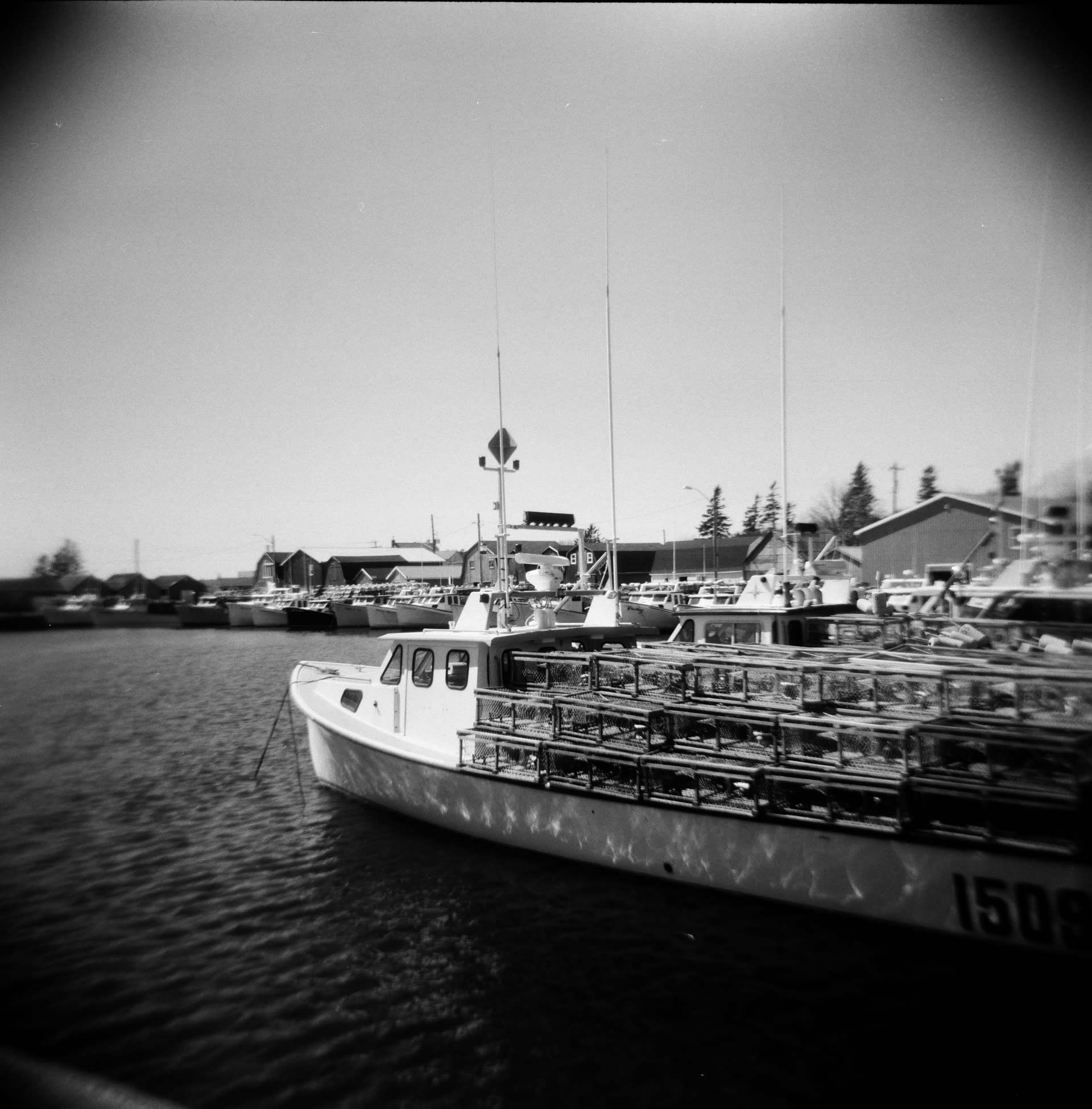
Pictured: lobster boats moored in Malpeque Bay, a few kilometres from Kensington and the Twin Shores Campground on Prince Edward Island's North Shore. This is not a photograph of Darnley Beach or the stretch of the Gulf of St. Lawrence where the June 2014 sighting actually occurred, and it is certainly not a photograph of the object itself — John Sheppard's own eight-minute cellphone video is the only visual record of this case, and it remains the property of MUFON and the witness rather than a rights-clear image this site can host. No public-domain or Creative Commons–licensed photograph of Darnley Beach or Twin Shores Campground specifically was located during this case file's research; this Malpeque Bay image is offered only as an honest, geographically-adjacent illustration of the general North Shore coastline the case is set on.
Theoretical Alignment
This is one of the thinner-evidenced entries in this site's Canadian catalog, and its theoretical alignment reflects that honestly rather than splitting the difference for the sake of appearing balanced. The Extraterrestrial Hypothesis reading draws what little support it has from MUFON's own formal "Unknown" classification and from Geoff Genge's assessment that the witness's account and footage were internally consistent and not obviously fabricated — but MUFON is a volunteer civilian organization using consumer astronomy software, not a government or scientific body with instrumented data, and it reached that classification specifically because it could not identify a cause, not because it positively ruled every mundane cause out. The Interdimensional Hypothesis has essentially nothing to attach to here; nothing about a hovering, flashing light invokes any behavior beyond a physically ordinary, if unidentified, light source. The Psycho-Social/Mundane reading carries the most real weight of the three, not as a claim that Sheppard fabricated or hallucinated anything, but because this case sits at the exact intersection of several well-documented mundane phenomena — night-time misjudgment of a distant light's true distance and altitude over open water, and at least two specific, dated, real-world candidate sources (a scheduled airliner and a military training exercise) that Canadian skeptics identified almost immediately once the story reached a wider audience.
Background
The Mutual UFO Network (MUFON) is a United States–based, all-volunteer nonprofit organization founded in 1969 that investigates civilian UFO reports through a network of unpaid regional and national "Field Investigators," most of whom hold no formal scientific or aviation credential beyond MUFON's own internal training. MUFON Canada, referenced throughout this case as the body that handled Sheppard's report, functions as the organization's Canadian branch, staffed by its own volunteer directors and investigators. A MUFON field investigation typically consists of a witness interview, a review of any submitted photo or video evidence, a site visit where practical, and a check of astronomical and satellite-tracking data — commonly using Stellarium, a free, open-source planetarium program capable of reconstructing exactly what stars, planets, and predictable satellite passes would have been visible from a given location at a given date and time. This is a genuinely useful first-pass filter for ruling out the single most common category of misidentified "UFO" (Venus, Jupiter, the International Space Station, and similar bright, moving or twinkling points of light), but it cannot rule out man-made aircraft, drones, flares, or other terrestrial vehicles, all of which require separate, case-specific investigation that depends heavily on the diligence and access of whichever volunteer happens to be assigned.
Twin Shores Campground sits on Lower Darnley Road in the community of Darnley, on Prince Edward Island's Gulf of St. Lawrence "North Shore," a few kilometres northwest of the town of Kensington and close to the mouth of Malpeque Bay. The campground markets itself around nearly four kilometres of coastline across three beaches, and like much of PEI's North Shore, it faces open Gulf of St. Lawrence water with no islands or other obstructions for tens of kilometres in most directions — a setting that, as this case file's Sensor & Instrumentation and Environmental & Geospatial sections below discuss in more detail, makes it very difficult for an unaided observer to judge the true distance, altitude, or speed of a light source over the water at night, since there are no intervening landmarks to provide scale.
John Sheppard was, by every account located for this case file, an ordinary camper rather than a public figure, a trained observer, or anyone with a prior connection to ufology: a visitor from Moncton, New Brunswick, camping at Twin Shores with his wife in early June 2014. Nothing in the record suggests he sought out MUFON as anything other than a genuinely puzzled private citizen looking for an explanation after the fact. This case file treats that ordinariness as a real, disclosed feature of the evidence rather than glossing over it: an unpracticed, non-expert witness's night-time video of distant lights over water is a fundamentally weaker category of evidence than a trained radar operator's contemporaneous written report or a credentialed pilot's on-the-record account, even when, as here, nothing in the witness's own conduct or statements raises any specific credibility concern.
Prince Edward Island itself has a comparatively thin documented UFO record relative to the rest of Canada. Chris Rutkowski's Canadian UFO Survey, the country's longest-running annual compilation of UFO reports (assembled from MUFON, Ufology Research, and provincial investigator networks), consistently records the bulk of Canada's reported sightings in Ontario, British Columbia, and the Prairie provinces, with the four Atlantic provinces together contributing a small fraction of the national total in most years. This case file's own research did not locate any other individually well-documented PEI UFO case from any era to sit alongside this one as a direct in-province precedent — a genuine gap in the record disclosed here rather than papered over, and one this case file's Historical Precedents section below returns to.
Complete Timeline
| Date | Event |
|---|---|
| June 4, 2014, ~2300 hrs | John Sheppard, extinguishing a bonfire with his wife at Twin Shores Campground, first notices a diamond-shaped arrangement of lights over the Gulf of St. Lawrence. |
| June 4–5, 2014, overnight | Sheppard films approximately eight minutes of the object on his cellphone as it hovers, flashes, and appears to change shape; the object hovers for an estimated 15 minutes before Sheppard loses sight of it, then reportedly reappears closer to shore, at which point he wakes his wife. |
| June 5, 2014 (per Sheppard's own account) | A large military aircraft makes several low passes over the campground area the following day — a detail Sheppard volunteered to CBC News and that skeptics later cited in support of a military-exercise explanation. |
| 2014 (exact submission date not documented) | Sheppard submits his video to the Mutual UFO Network of Canada. |
| 2014 | Canadian Field Investigator Geoff Genge investigates the report as MUFON Case #57090, using Stellarium to rule out stars, planets, and predictable satellite passes, and closes the case as an Unknown. |
| Late 2014 | MUFON Canada includes the Kensington sighting on its own internal "Top 10" list of the year's best-investigated Canadian cases. |
| January 12, 2016 (approximate) | CBC News reports on the case for the first time — roughly a year and a half after the sighting itself — under the headline "'This is a really serious sighting': National UFO group confirms P.E.I. sighting," after becoming aware of it via MUFON's own recirculated year-end list. |
| January 2016, shortly after | CBC News publishes a follow-up article, "A drone? A plane? P.E.I.'s UFO sighting disputed," after readers wrote in with alternative explanations, featuring astronomer Paul Gray's Air Canada flight theory and former park employee Hugh McCormack's military-flare theory. |
| January 2016, same period | MUFON Canada assistant director Stu Bundy defends the case's Unknown classification to CBC News, citing the assessment of MUFON's British Columbia director (also an astronomer and former pilot) that the object did not resemble an aircraft on approach. |
| 2016 onward | The case is picked up and re-summarized by a series of international listicle and aggregator outlets (Inquisitr, Reader's Digest, Yahoo, and others), several of which compress or slightly alter details from the original CBC reporting. |
| 2026 | This case file is published, replacing a "Coming Soon" queue placeholder that had mischaracterized the case's evidence as a "clear image sequence" of a "high-speed" craft. |
The Night of June 4, 2014
According to Sheppard's own account, given first to MUFON and later, in briefer form, to CBC News, he and his wife were camped at Twin Shores and were in the process of putting out their bonfire for the night when he noticed a light out over the water. What held his attention, by his own description, was that it did not behave like a boat light, a star, or a plane on a steady course: it appeared to hover, roughly 200 to 300 feet above the sea's surface by his estimate, at a distance he judged to be about a mile offshore — a distance he attempted to sanity-check in the moment by confirming he could also see an ordinary boat on the water at what he took to be a comparable range, and by noting that he was aware of no oil rig or other fixed structure in that stretch of the Gulf that could account for a stationary light. As he watched, the light resolved into what he described as a diamond-shaped arrangement of several individual points, flashing on and off; narrating over his own cellphone video, he can be heard saying it reminded him of "a dreidel or a spin top — very big, very bottom-heavy too," and separately reasoning aloud that "it's not a ship, because we would see a bottom to it."
Sheppard began filming on his phone once it became clear the light was not behaving like anything he recognized, ultimately capturing approximately eight minutes of continuous footage. Partway through, he tried shining a flashlight toward the object, later telling interviewers it made "not really" any difference to what he could see. He reported hearing "a hum in the air" during the encounter and described feeling increasingly unsettled as adrenaline built, at one point deliberately positioning himself close to a bush so as not to be seen by whatever he was watching — a detail that speaks candidly to his own state of mind but that this case file treats as exactly that: a witness's subjective reaction, not independent evidence about the object's actual nature. By his own account and MUFON's summary of the case, the object hovered for an estimated fifteen minutes before he lost track of it, and then either the same object or a second one reappeared later, closer to the shore, at which point Sheppard woke his wife. Beyond that, no detailed, independently published account of what she specifically observed exists in any source this case file's research located; she is referenced only as having been woken and, implicitly, as having also seen something once roused, not as a witness who gave her own separate statement to MUFON or to any journalist.
No other campers at Twin Shores are recorded anywhere as having come forward with their own account of the same phenomenon, despite the campground's substantial capacity (nearly 700 sites) and the object's reported fifteen-plus minutes of visibility. This case file treats that absence as a genuine, disclosed limitation rather than an incidental detail: a sustained, unusual light display over the water, visible for a quarter of an hour or more from a busy oceanfront campground in early June (a period when Twin Shores would have had at least a partial seasonal occupancy), would reasonably be expected to draw more than one household's attention if it were as visually striking as Sheppard's own narration suggests. It is possible other campers simply were not looking in the right direction, were already asleep, or saw it and never thought to report it; it is equally possible the object's visibility was more localized or subtle than the video's own darkness-amplified appearance suggests. This case file's research could not resolve which explanation is more likely and discloses the ambiguity rather than resolving it in either direction.
What the Footage Actually Shows
This case file's own review of secondary descriptions of the video — it could not independently obtain and re-examine Sheppard's original footage, relying instead on journalists' and the MUFON investigator's own characterizations of it — consistently describes the visual record as underwhelming relative to the drama of Sheppard's narration. One secondary account describes the footage as showing, for much of its runtime, little more than "two tiny specks of light against complete darkness," with no discernible structure, edges, or surface detail resolvable at typical viewing distance. Geoff Genge, the MUFON investigator who examined the original files directly, is reported to have written that Sheppard's "video and photos are compelling and descriptions are good," while separately noting that a "low res iPhone camera" limited how much genuine object detail the footage could reveal. Those two observations are not actually in tension — a witness's verbal description and real-time narration can be detailed and internally consistent even when the visual recording of the same event is poor — but this case file flags the distinction explicitly because the placeholder queue entry this file replaces described "a clear image sequence," a characterization that does not match any description of the actual footage located anywhere in this research. Cellphone cameras of the mid-2010s era, shooting handheld at night with no external stabilization or magnification, are a genuinely poor instrument for capturing fine detail on a distant point source of light; the resulting footage being visually thin is exactly what should be expected regardless of what the object actually was, and should not, on its own, be read as either confirming or undermining Sheppard's own account.
MUFON's Investigation and the "Unknown" Classification
MUFON Canada assigned Canadian Field Investigator Geoff Genge to the case shortly after Sheppard's submission. Genge's investigation, as summarized in press coverage and by MUFON's own online case listing, involved reviewing the submitted video and photographs, interviewing Sheppard about the specifics of his observation, and running Stellarium against the date, time, and location to check for any bright star, planet, or predictable satellite pass that might explain a stationary or slow-moving light. That check came back negative: nothing in the sky chart for that specific time and place corresponded to a known astronomical body positioned where Sheppard described the object. MUFON's own internal drone specialist was also consulted and reportedly judged a consumer drone explanation implausible for this specific case, citing (per later press summaries of MUFON's reasoning) the roughly 20 km/h wind conditions that night as a challenge to sustained, stable hovering at that range from shore, the total observed duration relative to typical 2014-era consumer drone battery life, and the detail that two separate light clusters or reappearances were reported rather than one continuously observed object.
Having ruled out the specific alternative explanations it actively checked, MUFON closed the case as an Unknown — the organization's standard disposition for a report its investigator could not attribute to any specific identified cause, not a formal finding that the object was necessarily non-terrestrial or of anomalous origin. MUFON went on to list the Kensington case among its own "Top 10" Canadian sightings for 2014, a designation that reflects the organization's own internal assessment of how well-documented and thoroughly investigated a case was relative to the rest of that year's submissions, not an external, independent verification standard. This distinction matters for how this case file weighs the "Unknown" classification: MUFON is a genuine, decades-old volunteer research organization whose investigators generally do make real efforts to identify mundane explanations before closing a case as Unknown, but it is not a government agency, an aviation authority, or a scientific body with access to radar data, air traffic control logs, or military exercise schedules — all resources that, had they been available, might have resolved this specific case's two leading skeptical theories one way or the other.
CBC News, the "Serious Sighting" Story, and the Skeptical Backlash
The case would likely have remained confined to MUFON's own internal case files and website indefinitely had CBC News, Canada's public broadcaster, not picked it up in January 2016 — roughly a year and a half after the sighting itself, apparently after becoming aware of it through MUFON's own recirculated "Top 10" list. CBC's first article, headlined "'This is a really serious sighting': National UFO group confirms P.E.I. sighting," presented the case largely from MUFON's own perspective: it quoted assistant director Stu Bundy describing the extent of Genge's investigation and MUFON's Stellarium-based methodology, and reported the object's reported altitude, distance, and duration largely as Sheppard and MUFON had described them.
That framing drew a swift, specific response. Multiple readers wrote to CBC News proposing alternative, mundane explanations, prompting a second article within days: "A drone? A plane? P.E.I.'s UFO sighting disputed." Paul Gray, the Halifax Centre president of the Royal Astronomical Society of Canada and a self-described 27-year amateur astronomer with a personal track record of debunking Maritime Canadian UFO reports, proposed that Sheppard had most likely observed a scheduled Air Canada or Air Canada Jazz commercial flight on approach to the Îles-de-la-Madeleine airport in Quebec's Magdalen Islands, arguing that the airport's runway alignment placed its final approach path directly along Sheppard's own sightline from PEI's North Shore, and pointing specifically to an 11:42 p.m. scheduled arrival as a close match to the timing Sheppard described. Separately, Hugh McCormack, who had worked at Prince Edward Island National Park in the mid-1980s, told CBC he believed the lights were more likely parachute flares dropped by Canadian military aircraft during a search-and-rescue or routine training exercise, a phenomenon he said he had personally witnessed multiple times in his own park career. Both explanations are discussed, and weighed against their own specific weaknesses, in the Conventional Explanation Candidate section below.
Stu Bundy did not concede the point. Responding to the skeptical follow-up, he maintained that "every effort was made to explain" what Sheppard had captured, and specifically cited the view of MUFON's own British Columbia provincial director — described as also holding credentials as both an amateur astronomer and a former pilot — that the footage did not, in that director's professional-adjacent judgment, resemble an aircraft on final approach. This is a real, if institutionally self-interested, piece of countervailing expert opinion, and this case file treats it with the same weight it would give any single expert's visual assessment of secondhand footage: a meaningful data point, but not a conclusive one, especially since that director's own assessment (like this case file's own research) appears to rest on descriptions and possibly the video itself rather than a direct, on-site re-observation of the actual event.
Key Witnesses
This case has no witnesses with an independent public reputation for expertise or credibility in the way a trained pilot, radar operator, or scientist might carry; its central witness is a private individual with no prior connection to ufology, and its most substantive named participants beyond him are the volunteer investigator who examined his evidence and the two named skeptics who later challenged MUFON's conclusion. This is disclosed here plainly rather than compensated for with invented detail.
John Sheppard
A camper from Moncton, New Brunswick, with no documented prior interest in UFOs, who filmed roughly eight minutes of the object on his cellphone and narrated his observations in real time, later submitting the footage to MUFON. His own account — "it reminds me of a dreidel or a spin top" — is the single most quoted description of the object's appearance. No independent, non-family corroboration of his account has ever surfaced.
Sheppard's Wife (Unnamed)
Present throughout the encounter and reportedly woken by Sheppard when the object (or a second object) reappeared closer to shore later the same night. No source consulted for this case file names her, quotes her directly, or documents that she gave MUFON or any journalist her own independent statement describing what she personally observed.
Geoff Genge
The volunteer investigator assigned to the case, who interviewed Sheppard, reviewed the video and photographs, ran a Stellarium sky-chart check, consulted MUFON's own drone specialist, and ultimately closed the case as an Unknown. His own characterization — that Sheppard's "descriptions are good" but the footage itself was limited by a "low res iPhone camera" — is one of the most evenhanded, specific pieces of testimony in this case's record.
Paul Gray
An amateur astronomer with a public track record of debunking Maritime Canadian UFO reports, who proposed to CBC News in 2016 that Sheppard's footage most likely showed a scheduled Air Canada flight on approach to the distant Îles-de-la-Madeleine airport.
Hugh McCormack
A former park employee who, drawing on his own recollection of military search-and-rescue exercises from the mid-1980s, proposed to CBC News that the lights were parachute flares dropped during a training exercise — a theory Sheppard's own account of hearing aircraft beforehand and a military plane the next day lends some independent support to.
The Five Observables Assessment
The Five Observables framework, drawn from the Pentagon's own AATIP-era analytical criteria, is applied here to the behavior Sheppard described and MUFON's investigation summarized:
Assessment: This case aligns poorly with the Five Observables framework, and this case file states that plainly rather than stretching the evidence to manufacture alignment. Anti-Gravity Lift is rated N/A because no witness described the object taking off, landing, or otherwise demonstrating lift behavior of any kind — it was observed already hovering. Instant Acceleration and Hypersonic performance are both rated Absent: every account, including the placeholder queue entry's own inaccurate "high-speed" characterization notwithstanding, describes an object that hovered in place for an extended period and moved slowly, if at all, between its two observed positions. Low Observability is rated Speculative only because the object's exact structure was never resolved on camera — it is impossible to say whether that reflects a genuinely low-observable object or simply the well-documented limits of a 2014-era cellphone camera shooting a distant point source of light at night. Trans-Medium travel is rated Absent, since nothing in this case involves any transition into or out of water. Taken together, this is one of the site's clearest examples of a case whose reported behavior — a stationary or slow-moving light hovering for an extended period — simply does not resemble the high-performance flight characteristics the Five Observables framework was designed to flag, regardless of how the case is ultimately classified for credibility purposes.
Evidence Assessment
Supporting Anomalous Origin
- A named, identifiable witness with no documented prior interest in ufology gave a detailed, internally consistent real-time narration alongside roughly eight minutes of contemporaneous video, rather than a vague after-the-fact recollection
- A trained (if volunteer) MUFON field investigator who reviewed the original footage directly, rather than only secondhand descriptions of it, found the witness's account credible and could not identify a specific cause after a genuine, if limited, investigation
- MUFON's own internal drone specialist considered and rejected a drone explanation specifically for this case, citing wind conditions, likely battery-life limits, and the two-object detail
- The witness's estimate of the object's distance and altitude was not made in a vacuum; he attempted to calibrate it in the moment against a visible boat at what he judged to be a comparable range, a reasonable if fundamentally imprecise night-time distance-estimation method
- No single conventional explanation has been definitively confirmed; both leading skeptical theories (an approaching airliner, dropped flares) remain proposed rather than proven, each with its own specific unresolved weaknesses discussed below
Supporting Conventional Explanation
- The sole primary witness is a private individual with no training in night-sky observation, distance estimation, or aircraft identification, and no independent, non-family witness has ever corroborated his account
- Secondary descriptions of the actual video consistently describe it as visually unremarkable — "two tiny specks of light against complete darkness" — a far cry from the placeholder queue's inaccurate description of a "clear image sequence"
- Two specific, real, dated conventional explanations exist and were never conclusively excluded: a scheduled 11:42 p.m. commercial flight on approach to a distant airport whose runway alignment plausibly matches the sightline, and a military training exercise that the witness's own account of hearing aircraft beforehand and observing a large military plane the next day lends some independent support to
- Human night-time distance and altitude perception over open water with no intervening landmarks is a well-documented source of error; a distant light can very easily be misjudged as far closer and lower than it actually is
- The investigating body (MUFON) is a volunteer civilian organization without access to radar data, air traffic control records, or military exercise schedules that might have definitively resolved either leading skeptical theory
- The case took roughly a year and a half to reach any wider public or journalistic scrutiny, during which time no attempt appears to have been made to formally request Nav Canada radar data or Air Canada/Air Canada Jazz flight logs for the relevant window
Why "Disputed"
This case earns a DISPUTED classification with a credibility score of 30/100. It sits well below this site's Thomas Mantell calibration case (Disputed, 38): Mantell involved a trained military pilot, multiple ground witnesses, and radio communication logged in real time by other personnel, whereas this case rests on one family's private, unaided observation with no professional training in play at any point. It sits further still below this site's Woomera Rocket Range Sighting (Disputed, 52), which had the benefit of an independent radar track corroborating a simultaneous, separately-positioned visual sighting, contemporaneous written statements preserved in a classified government archive, and a senior defence scientist's later official review — none of which has any analogue here. What keeps this case from scoring even lower is that it is not, on the evidence available, a hoax or a case built on a witness whose credibility is specifically in question: Sheppard's account has remained consistent across MUFON's investigation and later press interviews, MUFON's own investigator found nothing to suggest fabrication, and the case was investigated, however imperfectly, by a real (if volunteer) organization using a real, replicable methodology rather than simply taken at face value. What drives the score this low is the combination of a single family-unit witness with no independent corroboration, visually thin evidence that does not match the drama of the witness's own narration, an investigating body without access to the kinds of records (radar, ATC logs, military schedules) that could have actually settled the case, and two specific, dated, unrejected conventional explanations that fit the reported time and place about as well as an "Unknown" classification does.
Sensor & Instrumentation Detection Profile
This case has no instrumented data of any kind — no radar, no FLIR, no independent camera, and no audio recording beyond whatever ambient sound made it onto Sheppard's own cellphone video track. The entirety of the physical record is that single smartphone video, described by MUFON's own investigator as limited by a "low res iPhone camera," plus whatever accompanying still photographs Sheppard also submitted. This case file's research found no indication that anyone — MUFON, CBC, or any of the skeptics who proposed alternative explanations — ever formally requested Nav Canada air traffic control radar data for the relevant airspace and time window, nor Department of National Defence records of any search-and-rescue or training exercise scheduled for that specific night. Either record, had it been sought and obtained, could plausibly have resolved this case's two leading conventional explanation candidates definitively; that neither appears to have been pursued is itself a notable, disclosed gap in the investigative record rather than a detail this case file can resolve on its own.
Environmental & Geospatial Context
Twin Shores Campground sits directly on Prince Edward Island's Gulf of St. Lawrence North Shore, facing open water with no intervening islands for a very long distance in most directions — precisely the kind of setting in which human night-vision is least able to reliably judge a light source's true distance, altitude, or speed, since there are no fixed reference points (trees, buildings, ridgelines) against which to calibrate the observation. No detailed meteorological log for the specific night of June 4–5, 2014 was located in any source consulted for this case file; the one specific atmospheric detail on record is MUFON's own citation, in evaluating and rejecting the drone hypothesis, of roughly 20 km/h wind that night. Astronomically, the Moon on June 4, 2014 was a waxing crescent, approximately 43% illuminated as of 11:00 p.m. Eastern time — providing only modest ambient illumination, consistent with the video's own reported near-total darkness apart from the object's own lights.
Observer Credibility & Occupational Profile
John Sheppard's occupation is not documented in any source this case file's research located; he is identified consistently only as a camper from Moncton, New Brunswick. Nothing in the record suggests any training relevant to night-sky observation, distance estimation, or aircraft/aviation identification, and no source indicates a prior interest in UFOs that might raise (or, conversely, that might specifically allay) concerns about motivated reporting. His own conduct as recorded — narrating cautiously and uncertainly in real time, testing a flashlight rather than assuming what he was seeing, and specifically reasoning through what the object was not ("it's not a ship, because we would see a bottom to it") — reads as a genuinely puzzled, non-performative witness rather than someone building a dramatic narrative for an audience, which this case file treats as a mild positive credibility signal. Against this, the case entirely lacks the kind of occupational credibility — a pilot's, radar operator's, or scientist's trained eye — that anchors this site's higher-scoring cases; Geoff Genge's own investigation is the closest thing to a trained assessment in the record, and his own training is MUFON's internal volunteer curriculum, not a professional aviation, military, or scientific credential.
Physical & Material Assays
No physical trace evidence of any kind exists for this case. The object was never reported to have landed, approached the ground, or come close enough to any surface to leave a trace; its entire documented interaction with the physical world consists of Sheppard's visual observation and his own cellphone's video/audio recording. See Material Analysis below for a full discussion of the surviving documentary and video record itself.
Historical Precedents & Archive Matches
This case file's research found no other individually well-documented Prince Edward Island UFO case to serve as a direct in-province precedent — a genuine, disclosed gap in the record rather than an oversight. The nearest useful regional comparisons instead come from elsewhere in Maritime and Northern Canada. This site's own Shag Harbour Incident (Nova Scotia, October 1967) remains the Maritimes' single best-documented case, anchored by multiple independent civilian and RCMP witnesses and an official Canadian military search — a far stronger evidentiary profile than this case's single family-unit witness, useful mainly as a contrast in what real multi-witness, officially-investigated Maritime Canadian corroboration looks like. This site's Yellowknife Lights case (Northwest Territories, January 2023) offers a closer structural parallel: another modern Canadian sighting of dancing, hard-to-classify lights, though with the added evidentiary weight of professional commercial pilot witnesses that this PEI case entirely lacks. This site's Vancouver Starlink Satellite Train Sighting (British Columbia, August 2022) illustrates the opposite outcome from the same broad category of case — a widely-witnessed light phenomenon that was subsequently matched with confidence to a specific, dated, mundane cause — and stands as a reminder of what a fully-resolved version of a case like this one would look like, which this PEI case, lacking any equivalent radar or scheduling confirmation, has not achieved either way.
Material Analysis
There is no physical object, debris, or trace sample connected to this case; "material" here refers instead to the case's actual surviving evidentiary substrate — the cellphone video and photographs Sheppard submitted, and MUFON's own case file summarizing its investigation — since that is the only tangible record this case file's research was able to assess, and even then only through secondary descriptions rather than direct re-examination of the original files.
The Surviving Video and Case Record
The primary surviving record is Sheppard's own roughly eight-minute cellphone video, submitted to MUFON and logged as Case #57090, along with accompanying still photographs referenced by investigator Geoff Genge in his own case notes. MUFON's YouTube channel has published video documentation of the case under the title "Case 57090 - Kensington, Prince Edward Island, Canada - June 4, 2014" (verified live via YouTube's oEmbed API for this case file, see Essential Viewing below), making this one of the relatively few cases in this site's catalog where the organization that investigated a report has also made at least some of its own case documentation directly and publicly viewable, rather than surviving only through secondhand journalistic description.
What This Case File Could Not Directly Verify
This case file's own research was not able to obtain and independently re-examine the full, original, unedited eight minutes of Sheppard's footage frame by frame; its account of what the video shows rests on journalists' and Genge's own published characterizations of it, not on this case file's own direct analysis. Likewise, no Nav Canada radar data, air traffic control recording, or Department of National Defence exercise schedule for the relevant airspace and date was located, requested, or examined by anyone this case file's research could identify — MUFON, CBC, or the skeptics involved — meaning neither of the two leading conventional explanation candidates below can be checked against the one category of hard record that could plausibly settle the question either way.
Supporting Non-Terrestrial or Unexplained Origin
- A real video and accompanying photographs survive and remain publicly referenced by the investigating organization, rather than the case resting purely on unrecorded verbal testimony
- A trained volunteer field investigator who reviewed the original files directly found the witness's account internally consistent and could not identify a specific mundane cause after applying MUFON's standard methodology
- No definitive, records-confirmed conventional explanation (a specific matched flight, a documented flare drop) has ever been produced for this exact night and location
Supporting Terrestrial or Mundane Origin
- Secondary descriptions of the actual footage consistently describe it as visually unremarkable and difficult to resolve any structural detail from, undermining the placeholder queue's inaccurate "clear image sequence" framing
- No radar, ATC, or military-schedule records were ever sought or obtained by any party to this case, leaving the two leading conventional explanations neither confirmed nor excluded rather than genuinely ruled out
- This case file's own research could not directly re-examine the original video and photographs, relying instead on secondary descriptions — an unavoidable additional layer of interpretive distance from the primary evidence
- The investigating organization is a volunteer civilian body without the institutional access (radar, ATC logs, military records) that would be needed to truly close out either skeptical theory
The Conventional Explanation Candidate (CEC)
Unlike many of this site's older, government-file-based cases, this one generated two specific, named, dated conventional explanation candidates almost immediately once it reached a wider audience — a genuine strength of this case's record, even though, as discussed throughout this file, neither candidate was ever checked against the radar or scheduling records that could have definitively confirmed or excluded it.
Scheduled Commercial Flight to Îles-de-la-Madeleine Airport
Paul Gray's theory rests on a genuinely specific claim: an 11:42 p.m. Air Canada or Air Canada Jazz flight on final approach to the Îles-de-la-Madeleine airport (CYGR) in Quebec's Magdalen Islands, whose runway alignment he said placed its approach path directly along Sheppard's own sightline from PEI's North Shore. Using each location's own published coordinates, this case file's own calculation puts the straight-line distance between Twin Shores Campground and CYGR at approximately 170 km (roughly 105 miles) across open Gulf of St. Lawrence water — a real, checkable geographic fact, though not on its own a decisive objection to Gray's theory. Human night-time perception of a distant light over water with no intervening landmarks is a well-documented source of exactly this kind of misjudgment: a light that is, in reality, a large aircraft's landing lights and strobes, tens of kilometres away and thousands of feet up, can very plausibly be misjudged by an untrained observer as a much smaller, closer, lower object — which is, if anything, a point in favor of Gray's theory rather than against it. What the theory does not comfortably explain is the specific reported behavior: a steady final approach does not typically present as a "diamond-shaped" cluster that appears to hover in place for a quarter of an hour before reappearing elsewhere, and MUFON's own British Columbia director (also a pilot) is on record as not finding the footage consistent with an aircraft on approach. No flight log, radar track, or other records-based confirmation that a specific flight was actually in that airspace at that specific time has ever been produced by anyone on either side of this dispute.
Dropped Military Training Flares
Hugh McCormack's theory has a different kind of support: not a scheduling coincidence, but Sheppard's own volunteered account of hearing aircraft shortly before the lights appeared and observing a large military plane make several passes over the campground the following day. Parachute flares, which burn brightly while slowly descending under a small parachute, can genuinely appear to an untrained eye to "hover" or "dance" for an extended period, and a training exercise dropping more than one flare in succession could plausibly account for the object's reported reappearance after the first observation ended. This theory does not, however, explain why no formally logged Canadian Forces search-and-rescue or training exercise for that specific night at that specific location has ever been produced or cited by name, despite the theory circulating publicly since 2016; it remains McCormack's own informed inference from his prior park experience, not a documents-confirmed match.
Consumer Drone
A drone explanation was raised and specifically investigated by MUFON's own internal specialist, who judged it implausible for this case on three grounds: the roughly 20 km/h wind conditions that night would have made stable, sustained hovering difficult for a typical 2014-era consumer drone at that distance from shore; the reported duration (fifteen-plus minutes, across two separate observation periods) exceeds what contemporary consumer drone batteries could plausibly sustain without a landing and battery swap; and the report of two separate light clusters, rather than one continuously tracked object, is harder to square with a single drone than with either an aircraft or multiple dropped flares.
Genuine Unidentified Aerial Phenomenon
MUFON's own formal position, reached by a trained volunteer investigator who reviewed the primary evidence directly and could not match it to any specific cause after a real, if resource-limited, investigation. This case file's own position is that this reading deserves to be recorded honestly as MUFON's conclusion, while noting plainly that it rests on the absence of a confirmed explanation rather than the presence of any positive, instrumented evidence of anomalous performance — no radar contact, no measured speed, no confirmed physical characteristic beyond a witness's own uncalibrated visual impression of a distant light over water at night.
Scheduled Flight to Îles-de-la-Madeleine
InconclusiveINCONCLUSIVE. A specific, dated theory consistent with well-documented night-time distance misjudgment over open water, but never confirmed against an actual flight log or radar track, and disputed by MUFON's own pilot-astronomer reviewer.
Dropped Military Training Flares
InconclusiveINCONCLUSIVE. Genuinely supported by the witness's own account of hearing aircraft and seeing a military plane the next day, but no specific, named training exercise for that night has ever been documented or confirmed.
Consumer Drone
ImplausibleIMPLAUSIBLE. Directly assessed and rejected by MUFON's own drone specialist on wind, battery-duration, and two-object grounds specific to this case.
Genuine Unidentified Aerial Phenomenon
InconclusiveINCONCLUSIVE. MUFON's own formal conclusion, reached by a trained volunteer investigator, but resting on the absence of a confirmed mundane cause rather than any positive instrumented evidence.
Related Cases
No Confirmed Government Documents Located
Unlike many of this site's older cases, this one was never investigated by any government, military, or aviation-safety body. This case file's research found no evidence that Transport Canada, the Department of National Defence, or Nav Canada was ever asked for — or produced — air traffic control, radar, or military exercise records for the relevant airspace and date. The entire investigative record consists of MUFON's own volunteer case file and subsequent CBC News reporting. This absence is stated here explicitly, in keeping with this site's practice of disclosing genuine gaps in a case's paper trail rather than implying an official file exists when this case file's research could not locate one.
Search Government & Military Archives Directly
Further Reading — Recommended Literature
The Canadian UFO Report: The Best Cases Revealed
The standard English-language survey of Canadian UFO cases, compiled by the country's most methodical UFO researcher; useful context for how thin Prince Edward Island's own documented case record is relative to the rest of the country.
Canada's UFOs: Declassified
Rutkowski's own guided tour of declassified Canadian government UFO files from 1947–1980, useful for contrasting this case's total absence of any government paper trail with cases that do have one.
A World of UFOs
A broader survey of global UFO reporting patterns by the same researcher, useful for situating a small-scale, single-witness case like this one within the much larger body of similarly thin, unresolved reports worldwide.
UFO Sightings: The Evidence
A skeptically-minded, case-by-case application of the scientific method to UFO reports, directly relevant to this case's own unresolved competing mundane explanations (aircraft, flares, drone).
UFOs: Generals, Pilots, and Government Officials Go on the Record
A survey built specifically around credentialed, on-the-record witnesses — useful contrast material for a case like this one, whose sole witness is a private citizen with no aviation or scientific training.
Essential Viewing
Sources
- "'This is a really serious sighting': National UFO group confirms P.E.I. sighting." CBC News, Jan. 2016. cbc.ca
- "A drone? A plane? P.E.I.'s UFO sighting disputed." CBC News, Jan. 2016. cbc.ca
- "UFO sighting in P.E.I. backed by national group." Yahoo News Canada, republishing CBC News reporting. ca.news.yahoo.com
- "UFO sighting in P.E.I. disputed." Yahoo News Canada, republishing CBC News reporting. ca.news.yahoo.com
- "Did the CBC Just Confirm the Existence of Aliens?" Vice. vice.com
- "Video: Canadian witness says UFO hovered at 200 to 300 feet." Open Minds UFO News (openminds.tv), summarizing MUFON Case #57090. openminds.tv
- "UFO Sighting On Prince Edward Island Among 'Best UFO Sightings' In Canadian Maritimes." The Inquisitr. inquisitr.com
- "15 Most Chilling UFO Sightings Ever Recorded." Reader's Digest, syndicated via Yahoo Entertainment. yahoo.com
- Mutual UFO Network. "Case 57090 - Kensington, Prince Edward Island, Canada - June 4, 2014." YouTube (@MUFONHQ). youtube.com
- YouTube oEmbed API verification for video ID NvnvIdLUmR0 (title, author, and thumbnail confirmed live). youtube.com
- Royal Astronomical Society of Canada. "Paul Gray" (speaker profile, Halifax Centre). rasc.ca
- Rutkowski, Chris A. Canadian UFO Survey, annual report archive. canadianuforeport.ca (consulted for general Canadian UFO reporting trends and regional distribution; this case's own specific file was not located within the publicly available survey PDFs)
- Twin Shores Camping Area, official site (campground location and description). twinshores.com
- Tourism PEI. "Twin Shores Camping Area." tourismpei.com
- NAV CANADA / OurAirports. Îles-de-la-Madeleine Airport (CYGR) runway data, cited in evaluating the Air Canada flight explanation. ourairports.com
- TheSkyLive. "Moon Phase on June 4, 2014." theskylive.com
- Wikimedia Commons. File:Malpeque (27133444932).jpg, photographer "brownie camera guy," CC BY-SA 2.0, sourced via Flickr. commons.wikimedia.org
- "Kensington, Prince Edward Island." Wikipedia. en.wikipedia.org
- "Mutual UFO Network." Wikipedia. en.wikipedia.org
- "Îles-de-la-Madeleine Airport." Wikipedia. en.wikipedia.org
See something inaccurate? Have additional information or sources?
Suggest an Edit →Last Updated: August 2026