
Yellowknife Lights
Late on the night of Sunday, January 29, 2023, the two-person flight crew of Canadian North Flight 5071 — an ATR 42-500 turboprop, callsign "Arctic 5071," on a charter run from Fort McMurray, Alberta to Yellowknife, Northwest Territories — reported two unidentified white lights "dancing" in a circular pattern roughly 3,000 feet above their aircraft during the full descent and landing approach to Yellowknife Airport. Yellowknife Tower confirmed, in real time and on the open radio channel, that nothing corresponding to the lights appeared on primary or secondary radar, and the aircraft's own traffic-collision-avoidance system (TCAS) registered nothing either. The exchange was formally logged, a CIRVIS report was filed, and the occurrence appeared in Transport Canada's public CADORS database roughly two weeks later — the same eventful stretch of North American airspace history that included the Chinese high-altitude balloon and, days afterward, three further unidentified-object shootdowns. No photograph, video, or radar track of the lights has ever surfaced, and neither the flight crew nor the controller has ever been publicly named.
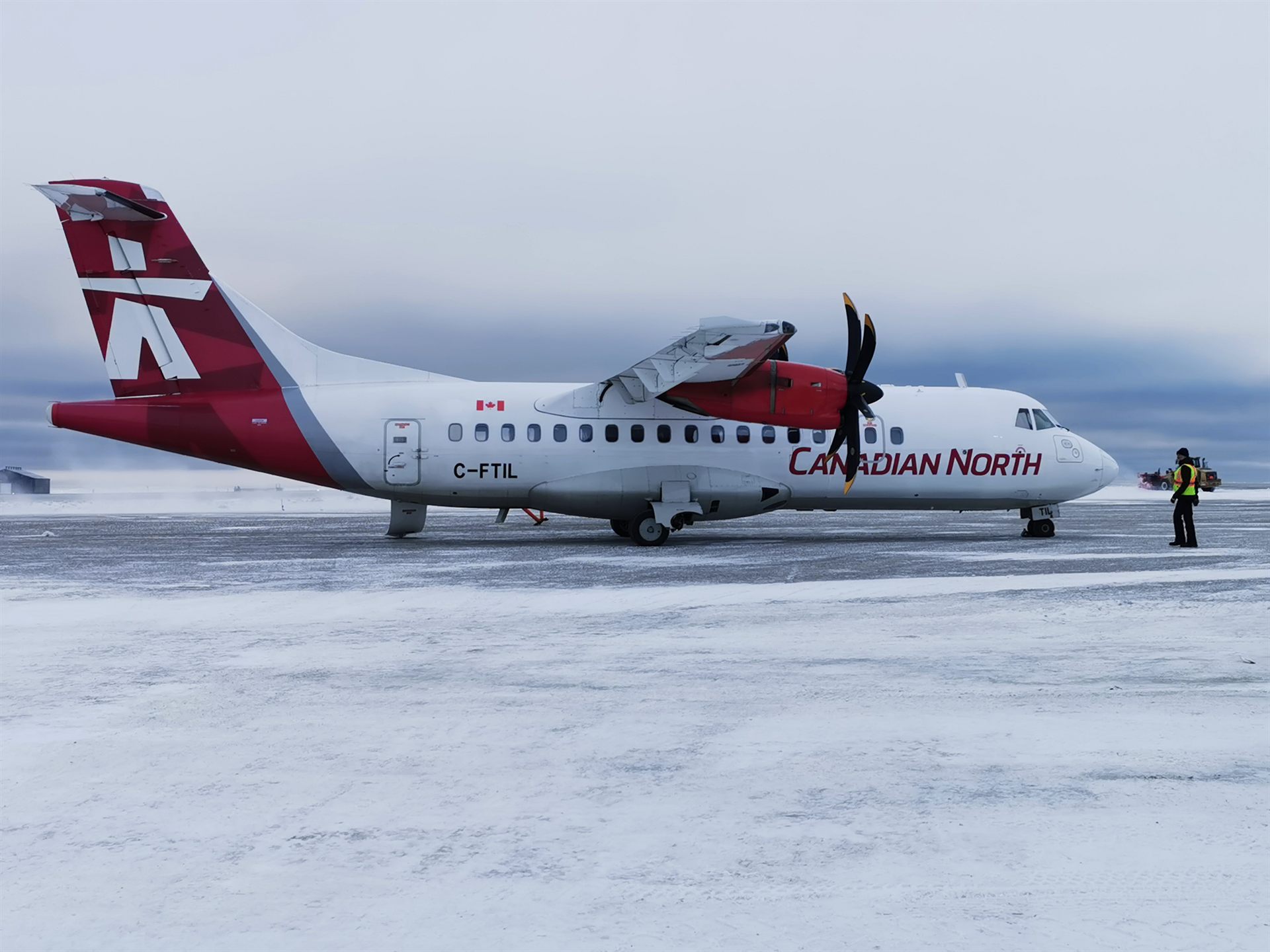
Pictured: a Canadian North ATR 42-500 turboprop, registration C-FTIL — the same aircraft type and airline that operated Flight 5071 on the night of the sighting. This is not a photograph of the flight involved or of the lights themselves; no photograph, video, or radar image of the January 29, 2023 sighting has ever surfaced. The entire evidentiary record consists of archived ATC radio audio and CADORS filings, since no camera was ever pointed at the lights the crew described.
Theoretical Alignment
Assessment: The Extraterrestrial Hypothesis is scored moderate-low: two credible, corroborating professional observers describing sustained, structured, non-random motion is exactly the kind of report that keeps a case open rather than dismissed, but no morphology, structure, or trans-medium behavior was ever reported — only lights. The Interdimensional Hypothesis finds no support whatsoever in the record; nothing about a null radar return with a plainly visible optical light source is diagnostic of a trans-dimensional event rather than an ordinary detection gap. This file scores the Psycho-Social/Misidentification framework highest, not because deception or panic is suspected of two professional aviators and a tower controller who all sound calm, matter-of-fact, and mutually confused on the recovered audio, but because the case's specific profile — a distant, high-altitude, sub-Arctic winter night sighting of ambiguous point-source lights with no independent second aircraft, no ground witness, and a radar system that would plausibly miss a small, distant, or low-radar-cross-section mundane object just as easily as it would miss something genuinely anomalous — is the textbook shape of an honest, professionally reported misidentification, without that possibility ever having been definitively confirmed or ruled out by any follow-up investigation.
Background
Yellowknife, the capital of Canada's Northwest Territories, sits on the northern shore of Great Slave Lake and functions as the primary air-transportation hub for a vast, sparsely populated stretch of Canada's Arctic and sub-Arctic interior. Canadian North, the airline operating the flight at the center of this case, is a regional carrier formed from the 2019 merger of First Air and the original Canadian North, specializing in exactly this kind of scheduled and charter service linking Northern communities and resource-industry hubs like Fort McMurray, Alberta — itself the center of Canada's oil-sands industry — to territorial capitals such as Yellowknife. The route flown by Flight 5071 on the night of January 29, 2023 was, in every operational respect, routine: a short charter hop on a small turboprop, of a kind flown many times a week across Canada's North.
What made the night unusual arrived only in its final minutes. As the ATR 42-500 descended from a cruising altitude of 24,000 feet toward a landing on runway 34 at Yellowknife Airport, the flight crew radioed Yellowknife Tower to report two bright white lights, positioned roughly 3,000 feet above their own aircraft and approximately 10 nautical miles to the northwest of the field, moving in a manner they repeatedly described as "dancing" and "moving in a circular pattern." The lights remained visible to the crew continuously through the rest of the approach and landing, at one point appearing to shift position from east of the airfield to northwest of it as the aircraft closed the distance — though whether that apparent shift reflected the lights' own movement, the aircraft's changing vantage point, or some combination of both was never independently resolved. Yellowknife Tower checked both its own local radar and, per later reporting, coordinated with Edmonton Area Control Centre's broader regional radar picture; neither showed any corresponding target. The aircraft's own TCAS, designed to flag nearby transponder-equipped traffic, showed nothing either — a genuinely puzzling combination the controller and crew discussed candidly, and with evident bewilderment, on the open frequency in real time.
Complete Timeline
| Date | Event |
|---|---|
| Jan. 28, 2023 | A Chinese high-altitude surveillance balloon is first publicly reported over Montana — the beginning of an unusually eventful several weeks for North American high-altitude airspace attention, though its own tracked path ran well west and south of the Yellowknife area. |
| Jan. 29, 2023, ∼11:15 PM MT | The sighting. Canadian North Flight 5071 (callsign "Arctic 5071"), an ATR 42-500 en route from Fort McMurray, Alberta to Yellowknife, NT, descends from 24,000 ft toward runway 34. The flight crew reports two white lights approximately 3,000 ft above the aircraft, roughly 10 NM northwest of the field, moving in a circular "dancing" pattern. |
| Jan. 29, 2023 (same exchange) | Yellowknife Tower checks local and regional (Edmonton Centre) radar and reports no corresponding target; the aircraft's TCAS shows nothing. The lights remain visible to the crew through the entire descent and landing, apparently shifting from east to northwest of the field as the aircraft closes in. Crew and controller discuss the anomaly candidly and with evident confusion on the open radio channel. |
| Late Jan. – early Feb. 2023 | A CIRVIS (Communications Instructions for Reporting Vital Intelligence Sightings) report is filed per standard North American aviation protocol for an anomalous sighting of this kind. |
| Feb. 4, 2023 | The Chinese high-altitude balloon is shot down off the coast of South Carolina by a U.S. Air Force F-22 — unrelated to the Yellowknife sighting, but part of the same historically unusual season of North American high-altitude-object attention. |
| Feb. 10, 2023 | The first public CADORS (Civil Aviation Daily Occurrence Reporting System) entry for the Yellowknife occurrence appears in Transport Canada's online database. Separately and unrelated, a second unidentified high-altitude object is shot down over Alaska the same day. |
| Feb. 11, 2023 | A cylindrical unidentified object is shot down by a U.S. F-22 over the Yukon Territory near Dawson City, roughly 700 km west of Yellowknife — see this site's Yukon UAP Shootdown case file. Unrelated to the January 29 sighting, but occurring in the same general Canadian Arctic airspace during the same eventful window. |
| Feb. 12, 2023 | A fourth unidentified high-altitude object of the season is shot down over Lake Huron; none of the three post-balloon objects (Alaska, Yukon, Lake Huron) is ever recovered or identified. |
| Feb. 13, 2023 | Public disclosure. CBC News publishes "Pilots reported mysterious lights 'dancing' over Yellowknife last month," the first public report of the sighting, including the archived ATC audio. The same day, DefenseScoop publishes NORAD Commander Gen. Glen VanHerck's account of NORAD's radar "velocity gate" recalibration, undertaken to improve detection of smaller, slower objects. |
| Feb. 14, 2023 | A second CADORS entry documenting the occurrence appears in the public database. |
| Feb. 17, 2023 | CTV News (syndicated via KTVZ) publishes "'We're not crazy': Listen to a flight report unusual lights near Yellowknife in January," further amplifying the story and audio nationally. |
| Following weeks, 2023 | Cabin Radio, Canadian Aviator Magazine, and Anomalien.com each publish their own coverage. NAV CANADA, Transport Canada, the Department of National Defence, and Canadian North decline to offer any further public explanation beyond the CADORS filing itself; no formal follow-up investigation is ever publicly announced. |
The Radio Exchange
What survives of this case is unusually direct: not a secondhand summary, but the flight crew and controller's own voices, preserved on the ATC recording and later archived via LiveATC.net, then reported on by CBC News. The crew's own words, as reported: "We're looking at two lights dancing around here, to the east of your field... They're above us, about, I don't know what. We're not seeing them on TCAS. But we can see the lights moving around." Later in the same exchange: "...two of them there moving around, in a circular pattern." The controller's response registers genuine puzzlement rather than routine acknowledgment: "I'm really wondering what you're seeing there." After checking the radar picture, the controller reports back: "We've got nothing. That's quite strange." The crew's own reaction, as paraphrased in Anomalien.com's account of the audio, was blunt: "We're not crazy." Nothing in the recorded exchange suggests either the crew or the controller treated the moment as anything other than a genuine, unresolved anomaly worth formally documenting — not alarm, not a joke, and not an attempt to build a public case, since neither party had any reason at the time to expect the exchange would ever become public at all.
A Formal Report in an Extraordinary Week
The sighting was not simply passed along informally. Per standard North American civil/military aviation protocol, a CIRVIS (Communications Instructions for Reporting Vital Intelligence Sightings) report was filed — a decades-old, Cold War-era reporting channel, still referenced in the FAA's Aeronautical Information Manual, specifically intended for exactly this kind of anomalous aerial sighting rather than routine air-traffic business. Separately, the occurrence was logged in Transport Canada's CADORS (Civil Aviation Daily Occurrence Reporting System), populated with NAV CANADA data, with entries appearing in the public online database on February 10 and February 14, 2023. CADORS' own standard occurrence-category tagging includes a routine, multi-option checklist — "weather balloon, meteor, rocket, CIRVIS/UFO" — and this file states plainly that those are candidate categories offered to the reporting controller as options, not a determination of cause; no specific CADORS report or occurrence number has been located in available public sourcing, and this file cites the entries by their confirmed publication dates rather than inventing a number that cannot be verified.
The timing gave the case a resonance it would not otherwise have had. It surfaced publicly in the same week NORAD Commander Gen. Glen VanHerck was explaining, on the record, that NORAD had adjusted its radar "velocity gates" — filters that had previously screened out slow-moving clutter such as birds and balloons — specifically to improve detection of smaller, slower anomalous objects, a real and separately documented policy change. In the days immediately following, U.S. and Canadian fighters shot down three further unidentified high-altitude objects: over Alaska on February 10, over the Yukon Territory near Dawson City on February 11 under joint Trudeau/Biden authorization, and over Lake Huron on February 12 — none of which was ever recovered or identified. The Yellowknife sighting predates all three shootdowns and the radar-gate adjustment itself, and this file presents it as an early, separate data point from the same eventful season of North American airspace attention rather than as part of the same detection chain; nothing in any published account connects the Yellowknife lights mechanically to the balloon, the shootdowns, or the radar recalibration, and this file declines to imply a causal link the record does not support.
Key Witnesses
Canadian North Flight 5071 Flight Crew
The two-person, professionally certificated flight crew reported the two lights during descent from 24,000 ft, tracked them visually through the entire approach and landing, and discussed them candidly with Yellowknife Tower on the open radio channel. Their account survives as their own unrehearsed, real-time voice recording rather than a secondhand summary. Neither the captain nor the first officer has ever been named in any published account by CBC News, Cabin Radio, CTV News, Canadian Aviator Magazine, or any other outlet — a genuine and notable structural gap this file states honestly rather than filling with an invented name.
Yellowknife Tower Air Traffic Controller
The controller checked both local Yellowknife radar and, per reporting, the broader Edmonton Area Control Centre picture, confirming in real time that neither showed any target corresponding to the crew's report, and separately confirmed the aircraft's TCAS was returning nothing. The controller's own recorded reaction — "I'm really wondering what you're seeing there" and "We've got nothing. That's quite strange" — registers as genuine puzzlement rather than routine reassurance. Like the flight crew, the controller has never been publicly named.
The Five Observables Assessment
The Five Observables framework is applied to the performance characteristics reported in this case:
Assessment: The reported "circular, dancing" motion is scored as speculative evidence of anti-gravity-style lift rather than confirmation of it: no instrumented measurement of the lights' true motion exists, and unaided visual estimation of a distant point-source light's actual path, at night, with no fixed reference object, is a known source of apparent but non-real movement. Instant acceleration and hypersonic velocity are both absent from the record — no witness described sudden, extreme, or velocity-defying movement, only slow circling. Low observability is the case's single most genuinely puzzling feature, and this file scores it speculative rather than present for a specific reason worth stating plainly: the lights were easily visible to the naked eye for several minutes, which is not what "low observability" ordinarily means in the Five Observables framework, yet they produced zero radar return — a real tension, but one this file declines to treat as automatically anomalous, since a small, distant, or simply low-radar-cross-section mundane object (a distant aircraft's position lights, a weather balloon, or an ice-crystal optical phenomenon) can likewise fail to register on a regional airport's radar without being anomalous in any other respect; over-weighting a routine detection gap as if it were evidence of deliberate stealth would overstate what the record actually supports. Trans-medium travel is absent — nothing in any account describes any transition between mediums, only aerial movement above the aircraft's own altitude.
Evidence Assessment
Supporting Anomalous Origin
- Two trained flight crew and one trained air traffic controller — three separate professional observers — converged on "unexplained" in real time, with no opportunity to coordinate a story afterward
- The exchange survives as an unedited, contemporaneous audio recording, not a reconstructed or embellished after-the-fact account
- The lights were tracked continuously across the entire descent and landing rather than glimpsed briefly
- A formal CIRVIS report was filed and the occurrence was logged in the official CADORS record, reflecting institutional seriousness rather than dismissal
- Neither radar system nor TCAS detected anything, ruling out at least one mundane explanation (another transponder-equipped aircraft sharing the airspace)
Supporting Conventional Explanation
- No radar, photographic, video, or physical evidence of any kind exists — the entire record is testimony plus a negative instrumentation result
- A null radar return is also exactly what a small, distant, or low-radar-cross-section mundane object (a weather balloon, a distant aircraft's lights, an optical phenomenon) would produce
- The Arctic winter setting at nearly 62.5°N is a well-documented environment for ice-crystal optical phenomena capable of mimicking "dancing" lights
- None of the three witnesses has ever been named or independently interviewed in the years since, preventing any follow-up verification of specific bearings, distances, or duration
Why "OPEN"
The Yellowknife Lights case is classified OPEN rather than credible, disputed, or verified, because its evidentiary profile does not cleanly fit any of those categories. On the strength side, this file holds something genuinely uncommon: a real-time, unedited audio recording of two separate professional roles — a certificated commercial flight crew and a NAV CANADA air traffic controller — independently converging on the same conclusion, "we don't know what that is," as the event unfolded, with a formal CIRVIS filing and an official CADORS record documenting the occurrence rather than leaving it as an undocumented anecdote. That combination of institutional process and unrehearsed, contemporaneous corroboration is meaningfully stronger than a single uncorroborated civilian account.
Set against that is a complete absence of anything beyond testimony: no radar return on two independent systems, no TCAS detection, no photograph, no video, and no physical trace of any kind, plus the fact that none of the three witnesses has ever been publicly named, meaning no outlet has been able to press them on specific bearings, distances, or duration in the years since. Multiple plausible mundane explanations — an ice-crystal optical phenomenon given Yellowknife's extreme sub-Arctic winter conditions, a misjudged-distance light source over unlit terrain, or an unidentified balloon during a season of unusually elevated high-altitude-object activity — were never formally investigated or ruled out by NAV CANADA, Transport Canada, the Department of National Defence, or Canadian North, all of which declined to offer any further public comment beyond the routine CADORS filing. A case with genuinely strong, real-time professional corroboration but zero instrumented or physical confirmation, and with no follow-up investigation ever published to close the gap either way, belongs in this site's Open category: neither dismissed nor confirmed, and unlikely to move in either direction without new evidence that, more than three years on, has not surfaced.
Sensor & Instrumentation Detection Profile
This case's defining technical fact is a triple-instrumented null: neither Yellowknife Tower's own radar, Edmonton Area Control Centre's regional radar coverage, nor the aircraft's own onboard TCAS — a system specifically designed to detect transponder-equipped traffic in the surrounding airspace — registered anything corresponding to the two lights the crew was actively watching and describing over the radio. That three-way null is significant for ruling out one specific class of explanation (another transponder-equipped aircraft sharing the airspace) but does very little to rule out several others: TCAS has no ability to detect a non-transponder-equipped object at all, and regional secondary/primary radar at extreme range, low elevation, or against ground clutter routinely fails to resolve small, slow, or low-radar-cross-section returns — the same detection gap NORAD Commander Gen. Glen VanHerck would publicly describe, in the very same week this case became public, as a long-standing radar "gate" limitation the U.S. and Canadian air-defense network had only just begun deliberately adjusting for. No FLIR, infrared, or other imaging sensor was ever brought to bear on the sighting; the entire technical record consists of a negative radar/TCAS result and the unaided visual account of the flight crew, preserved only because the ATC audio channel itself was recorded and later archived via LiveATC.net.
Environmental & Geospatial Context
Yellowknife sits at roughly 62.45°N, 114.37°W on the northern shore of Great Slave Lake in Canada's Northwest Territories — deep sub-Arctic boreal terrain, more than 400 km north of the Alberta border, where late-January nights are long, air temperatures routinely fall well below −20°C, and the sky is dark enough, far enough from major light pollution, that Yellowknife is itself a globally known aurora-viewing destination. That combination of extreme cold, low humidity, and frequent ice-fog or ice-crystal suspension in the lower atmosphere is directly relevant to this file's Conventional Explanation Candidates section below: high-latitude winter air is a well-documented breeding ground for atmospheric optical phenomena — light pillars, halos, and parhelia — produced by ground lighting or aircraft/vehicle lights refracting through suspended ice crystals, phenomena capable of producing bright, position-shifting points of light with no physical object present at all. The approach corridor to runway 34 also passes over largely unlit wilderness and lake terrain northwest of the airport, meaning the crew had comparatively few fixed ground-light reference points against which to judge the true distance, altitude, or motion of what they were seeing. No solar or geomagnetic storm activity is noted in any published account of the night, and the broader continental context — a Chinese high-altitude surveillance balloon first reported over Montana the day before, its own tracked path well to the south and west of Yellowknife — is a coincidence of timing this file, following CBC's own reporting, declines to treat as an established connection.
Observer Credibility & Occupational Profile
The witnesses here are occupationally about as strong as an unnamed source can be. The primary observers were the two-person flight crew of a scheduled Canadian North charter — a captain and first officer, both certificated commercial airline pilots trained and evaluated specifically on distinguishing genuine air-traffic conflicts from ambiguous visual phenomena, actively flying an instrument approach to landing at the moment of the report. Their account is not a secondhand recollection: it survives as their own real-time, unrehearsed voice on the open ATC frequency, describing what they were seeing as it happened, correcting themselves, and explicitly registering their own surprise ("we're not crazy") rather than offering a rehearsed or embellished narrative. The Yellowknife Tower controller functions as a second, independent, professionally trained observer of the exchange itself, even though the controller's own contribution was instrumented rather than visual — confirming, in real time, that the reported lights had no corresponding radar signature and audibly registering the same puzzlement as the crew ("I'm really wondering what you're seeing there... we've got nothing. That's quite strange"). This is a meaningfully different credibility profile from a single, self-selected civilian witness: two trained aviators and one trained controller, in three separate professional roles, independently converged on "we don't know what that was" in real time, with no opportunity to coordinate a story after the fact. Set against that strength is a real limitation this file states plainly: none of the three individuals has ever been named in any published account, meaning no outlet has been able to independently interview them, verify their specific flight experience, or ask follow-up questions about exact bearings, distances, or duration — the professional credibility here rests entirely on their institutional role and the unedited audio record, not on any subsequent named, on-record testimony.
Physical & Material Assays
None exist, and none could realistically have been collected. This was an airborne, at-altitude, in-flight sighting of distant lights during a landing approach; at no point did anything described in any account approach the aircraft, land, or leave any trace accessible to investigators on the ground. No debris, no soil or vegetation anomaly, no electromagnetic-interference report affecting the aircraft's own systems, and no physiological effect on the crew has ever been claimed in connection with this case. This is consistent with the sighting's basic profile — a purely visual, distant, aerial nocturnal-lights report — but it also means, as with many cases in this category, that the entire evidentiary record rests on testimony and negative instrumentation (the radar/TCAS null) rather than any independently testable physical evidence.
Historical Precedents & Archive Matches
Within this site's own catalog, the closest structural analogue is the RB-47 Bomber Chase of July 17, 1957 — another case built entirely around a trained aircrew's real-time account set against ambiguous or partial instrumentation, rather than photographic or physical evidence. The Stephenville Lights Sighting of January 8, 2008 offers a comparable theme from the opposite instrumentation direction: multiple ground witnesses and a radar track that was itself disputed and hedged by the military, mirroring the same "official radar record doesn't cleanly resolve the question either way" dynamic seen here. More broadly, "trained aircrew reports something visually anomalous that regional radar does not corroborate" is one of the most durable and recurring categories in the international aviation UFO literature, precisely because commercial and military aircrew occupy one of the very few observer positions that combines a wide, unobstructed sky view with real, evaluable professional training — and because radar's own known blind spots for small, slow, or distant returns make a null result far weaker evidence of "nothing was there" than laypeople often assume. Within the specific geographic and temporal window of this case, the Yukon UAP Shootdown of February 11, 2023 sits barely two weeks later and roughly 700 km to the west, in the same general Canadian Arctic airspace, during the same historically unusual stretch of North American high-altitude-object attention — a temporal proximity this file treats as a striking coincidence of a genuinely eventful season for Canadian airspace, not as evidence of a shared cause. CTV News also reported a separate, unrelated instance of pilots over Quebec describing strange lights at some point in 2023, a reminder that aircrew-reported light anomalies were not unique to the Yellowknife event even within that single calendar year.
Material Analysis
No physical, photographic, or video evidence of any kind exists for this case, and this file states that plainly rather than working around it. Every element of the record — the description of the lights, their reported motion, their reported altitude and bearing — comes from testimony and the negative instrumentation result (radar and TCAS both null), not from any independently testable material. Unlike cases built on recovered debris, soil anomalies, or metallurgical assays, there is no physical-science discipline available here to corroborate or falsify any specific claim; the entire evidentiary weight rests on how much confidence the two-witness professional testimony and the archived audio recording itself can bear.
The audio record. The single piece of primary evidence that does survive is the ATC radio exchange itself, recorded as a matter of routine air-traffic-control practice, later archived via LiveATC.net, and first reported publicly by CBC News roughly two weeks after the fact. Unlike a witness's after-the-fact recollection, this is a contemporaneous, unedited record of what the crew and controller said to each other as the event was unfolding — a genuinely higher-quality form of testimonial evidence than a later interview would be, since it cannot have been shaped by two weeks of retelling, media attention, or leading questions. Its limitation is equally real: it captures what the crew said they were seeing, not the lights themselves, and no independent recording device, camera, or second aircraft's own sensor ever corroborated the visual content of that description.
The absence of any follow-up technical investigation. No published account describes NAV CANADA, Transport Canada, the Department of National Defence, or Canadian North conducting or releasing any dedicated technical review of this specific occurrence beyond the routine CADORS entry itself — no radar-log deep dive, no request for other pilots on frequency that night, no formal statement addressing what the lights might have been. That silence is itself informative: it means none of the conventional explanations discussed below has ever been affirmatively confirmed by an investigating authority, but equally, none has ever been ruled out.
Supporting a Genuine, Still-Unresolved Sighting
- Two independent professional roles (flight crew and air traffic controller) corroborated the same real-time event on an unedited audio recording
- The lights remained continuously visible across the full descent and landing, not a brief or ambiguous glimpse
- A formal CIRVIS report was filed, and the occurrence was logged in the official CADORS database — not merely a private anecdote
- No follow-up technical investigation was ever conducted or published that might have definitively closed the case one way or the other
Supporting a Mundane or Unresolved Misidentification
- Zero radar return on two independent radar systems (Yellowknife Tower and Edmonton Area Control Centre) plus a null TCAS result
- No photograph, video, or any physical trace of any kind exists
- CADORS' own routine occurrence tagging includes "weather balloon, meteor, rocket" as candidate categories alongside "CIRVIS/UFO"
- The sub-Arctic winter setting is conducive to ice-crystal optical phenomena capable of producing bright, apparently moving lights with no physical object present
- No independent second aircraft or ground-based witness ever corroborated the sighting from a different vantage point
The Conventional Explanation Candidate: Ice-Crystal Optical Phenomenon
Ice-Crystal Optical Phenomenon
InconclusiveYellowknife's late-January nights combine extreme cold, low humidity, and frequent suspended ice crystals in the lower atmosphere — precisely the conditions that produce light pillars, halos, and parhelia, optical phenomena in which ground lighting or a distant light source refracts and scatters through airborne ice crystals into what can appear, at a distance and at night, as a bright, structured, even position-shifting light with no physical object actually present at the apparent location. This candidate is strengthened by Yellowknife's well-documented high-latitude atmospheric conditions and by the fact that such phenomena are a routine, non-exotic occurrence in the region; it is weakened by the absence of any independent ground observer or photograph that might have confirmed a specific light source and ice-crystal geometry consistent with the crew's reported bearing and altitude.
Distant Aircraft or Ground Lighting, Misjudged in Range and Altitude
InconclusiveA second, non-exclusive candidate is that the crew was observing the lights of another aircraft, a ground installation, or vehicle traffic at a much greater distance than judged, with the lack of intervening reference points over largely unlit wilderness terrain making an accurate range and altitude estimate unusually difficult at night. This candidate is strengthened by the specific approach geometry — a largely dark, unlit corridor northwest of the airport with few fixed points of comparison — and weakened by the crew's specific, repeated description of circular, "dancing" motion, which a simple misjudged-distance explanation does not on its own account for as cleanly as it accounts for a misjudged position.
High-Altitude Balloon (Weather or Otherwise)
InconclusiveGiven that the sighting occurred one day after the first public reports of a Chinese high-altitude surveillance balloon over Montana, and during a season in which North American air-defense attention to slow-moving high-altitude objects was already unusually elevated, a weather or other high-altitude balloon is a real candidate explicitly included in CADORS' own routine tagging for the occurrence. This candidate is weakened specifically by geography: the tracked path of the January 2023 Chinese balloon ran well south and west of Yellowknife, and no other specific balloon has been identified as being in the area that night; a generic, unidentified balloon (weather, research, or otherwise) drifting through the region remains plausible but unconfirmed.
Related Cases
Honest Assessment: No Standing Case File, No Located Occurrence Number
This is not a case with a declassified NARA, CIA, or FBI Vault paper trail. What exists is a routine Canadian civil-aviation occurrence record: an entry in Transport Canada's CADORS (Civil Aviation Daily Occurrence Reporting System), populated with NAV CANADA data, with public-database entries dated February 10 and February 14, 2023, plus a separately filed CIRVIS (Communications Instructions for Reporting Vital Intelligence Sightings) report — a real, decades-old North American civil/military aviation protocol still referenced in the FAA's Aeronautical Information Manual. No specific CADORS report or occurrence number has been located in available public sourcing, and this file cites the record via its publication dates and the consistent secondary press reporting that first surfaced it (CBC News, Cabin Radio, and CTV News among them, detailed fully in Sources) rather than inventing a document number or presenting a link to a specific case file that cannot be verified to exist.
Standard occurrence-category tagging for the entry includes the multi-option candidate list "weather balloon, meteor, rocket, CIRVIS/UFO" — a routine checkbox-style set of possibilities offered to the reporting controller, not a determination of cause. This file states that distinction explicitly rather than letting the tag be read as an official finding.
REFERENCED VIA CONTEMPORARY PRESS REPORTING (no independently verified primary document link located)A Cold War-era North American civil/military reporting channel for anomalous aerial, maritime, or ground sightings, still referenced in current Aeronautical Information Manual guidance. Its filing is referenced in secondary reporting on this case; the report's own contents have not been publicly released.
REFERENCED VIA CONTEMPORARY PRESS REPORTING (no independently verified primary document link located)Search Government & Aviation Archives Directly
Further Reading — Recommended Literature
UFO: The Inside Story of the US Government's Search for Alien Life Here—and Out There
Published the same year as this case, Graff's book directly covers the February 2023 balloon-and-shootdown period this file situates the Yellowknife sighting within, making it useful background for the broader season of North American high-altitude-object attention discussed above.
In Plain Sight: An Investigation into UFOs and Impossible Science
An investigative journalist's survey of contemporary military and aviation UAP reporting, relevant context for evaluating a case built entirely on trained aircrew and air-traffic-control testimony rather than physical evidence.
UFOs: Generals, Pilots, and Government Officials Go on the Record
The classic collection of professional pilot and official testimony this case fits squarely into — a useful framework for weighing what a certificated aircrew's real-time, on-the-record account is and is not worth as evidence.
Skinwalkers at the Pentagon: An Insiders' Account of the Secret Government UFO Program
An insider account of official U.S. government UAP investigation methodology, useful for contrasting how a resourced government program approaches an anomalous sighting against the essentially unresourced, unfollowed-up handling this Canadian case actually received.
Canada's UFOs: Declassified
Rutkowski runs the long-running annual Canadian UFO Survey and has written extensively on Canadian government UFO files specifically, making this the most directly relevant, country-specific reference for a case that plays out entirely within Canadian civil aviation and NAV CANADA's own reporting systems.
Essential Viewing
No Videos Available
Despite a reasonable search effort, no YouTube video or other video specifically and solely about the January 29, 2023 Yellowknife sighting could be confirmed to exist. Per this site's editorial standard, a video is not included here merely to fill the section — this file states the gap honestly rather than attaching an unrelated, off-topic, or fabricated video ID to the case.
Sources
- CBC News. "Pilots reported mysterious lights 'dancing' over Yellowknife last month." Feb. 13, 2023. The original public disclosure, including the archived ATC audio and flight/route details. cbc.ca
- CBC News. "Pilots reported mysterious lights 'dancing' over Yellowknife last month." Feb. 13, 2023 — cited separately for the specific transcribed radio quotes ("we're looking at two lights dancing around here"; "I'm really wondering what you're seeing there"; "we've got nothing, that's quite strange"). cbc.ca
- Cabin Radio. "Canadian North crew reports 'lights in sky' over Yellowknife." Local follow-up coverage with flight number, aircraft type, and altitude/distance detail. cabinradio.ca
- CTV News / KTVZ. "'We're not crazy': Listen to a flight report unusual lights near Yellowknife in January." Feb. 17, 2023. National amplification of the story and audio. ctvnews.ca
- Canadian Aviator Magazine. "More Reports of UFOs – Near Yellowknife." Aviation-trade-press coverage situating the sighting within routine Canadian air-operations context. canadianaviator.com
- Anomalien.com. "Canadian pilots report two 'dancing UFOs' flying over Yellowknife." Source for the crew's paraphrased "we're not crazy" reaction to the audio. anomalien.com
- DefenseScoop. "NORAD adjusts radar 'gates' to sharpen detection of anomalous objects as UFO recovery intensifies." Feb. 13, 2023. Source for Gen. Glen VanHerck's public account of NORAD's radar velocity-gate recalibration. defensescoop.com
- DefenseScoop. "NORAD adjusts radar 'gates' to sharpen detection of anomalous objects as UFO recovery intensifies." Feb. 13, 2023 — cited separately for the specific "zero speed up to, say, 100" velocity-gate technical detail. defensescoop.com
- Wikipedia. "List of high-altitude object events in 2023." Background timeline for the balloon and three shootdown events referenced in this file's Historical Precedents and Complete Timeline sections. en.wikipedia.org
- Transport Canada. Civil Aviation Daily Occurrence Reporting System (CADORS) public search database. Consulted for the occurrence's Feb. 10 and Feb. 14, 2023 publication dates. tc.gc.ca
- Transport Canada. "Civil Aviation Daily Occurrence Reporting System (CADORS) Manual (TP 4044)." Official program description and occurrence-category tagging methodology. tc.canada.ca
- NAV CANADA. Official corporate site, consulted for the organization's role supplying occurrence data to CADORS and operating Canadian civil air traffic control, including Yellowknife Tower and Edmonton Area Control Centre. navcanada.ca
- Federal Aviation Administration. Aeronautical Information Manual (AIM) — background reference for CIRVIS (Communications Instructions for Reporting Vital Intelligence Sightings), a Cold War-era North American civil/military reporting protocol still referenced in current guidance.
- Encyclopaedia Britannica. "Yellowknife." Background reference for the city's location, latitude, and sub-Arctic geography. britannica.com
- CTV News. Coverage of a separate, unrelated 2023 report of pilots over Quebec describing strange lights, cited as general background on aircrew-reported light anomalies in Canadian airspace that same year. ctvnews.ca
- LiveATC.net. Air-traffic-control audio archive service; the source through which the Jan. 29, 2023 Yellowknife Tower exchange was preserved and later obtained by journalists. liveatc.net
- Wikipedia. "Canadian North." Background on the airline operating Flight 5071, its 2019 merger history, and its regional Northern Canada route network. en.wikipedia.org
See something inaccurate? Have additional information or sources?
Suggest an Edit →Last Updated: August 2026