
Vancouver Starlink Satellite Train Sighting
On the night of August 19, 2022, hundreds of residents across Metro Vancouver and Vancouver Island filmed a slow, silent line of bright lights crossing the sky in close single file, asking each other in real time — on camera — whether it was a plane, a UFO, or "somebody towing something." It was neither: it was 53 SpaceX Starlink internet satellites, launched from Cape Canaveral roughly nine and a half hours earlier and still flying in the tight post-deployment formation that gives a fresh "satellite train" its unmistakable, and unmistakably strange-looking, appearance.
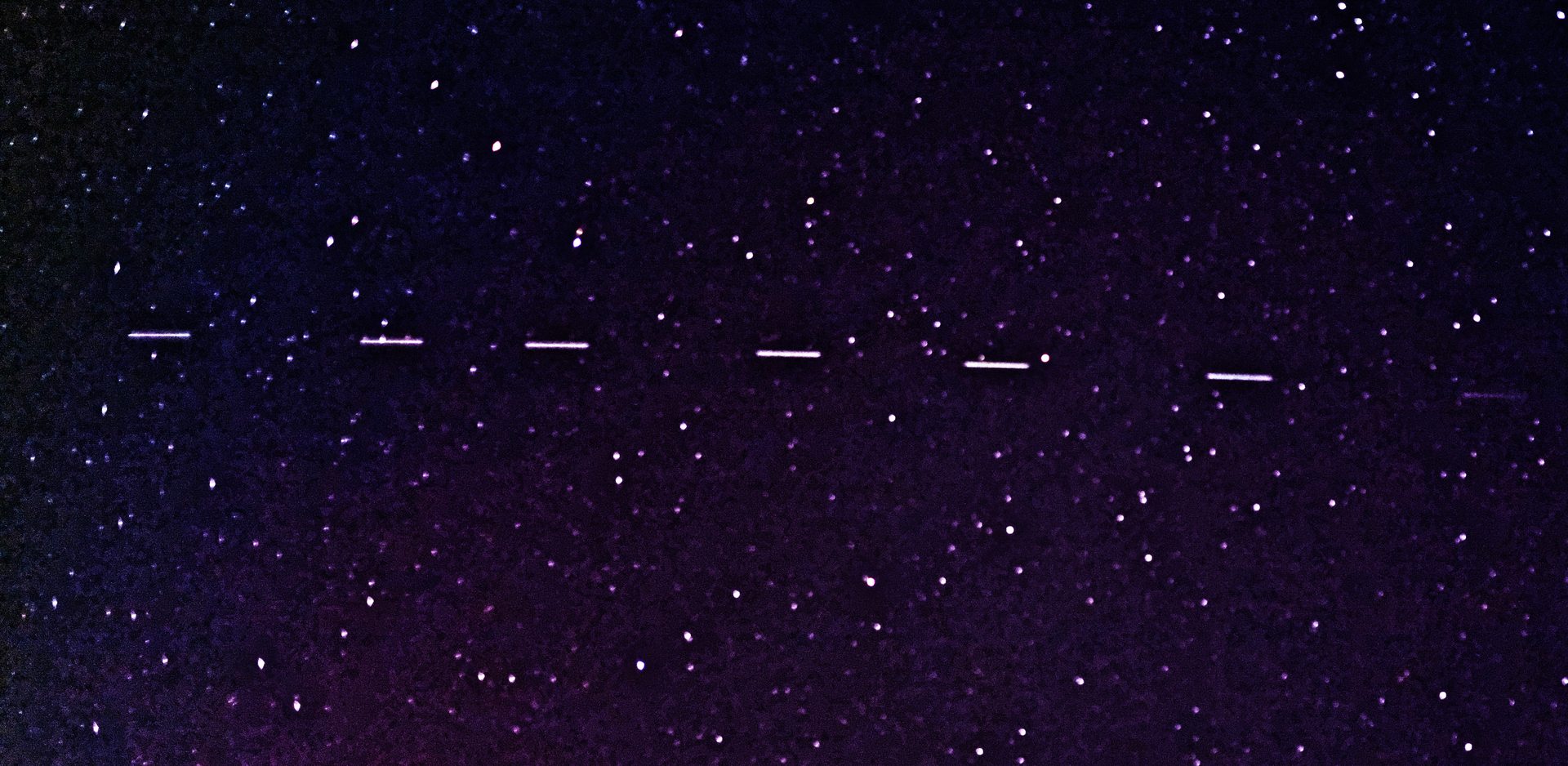
Pictured: a genuine photograph of a freshly-deployed Starlink "train" — six to seven satellites still moving in close single-file formation, photographed over the U.S. state of Georgia on April 28, 2020 by amateur astrophotographer Jud McCranie. This is not a photograph of the specific August 19, 2022 Vancouver sighting itself — no rights-clear photograph or video frame from that exact night has been located for republication — but it documents the identical visual phenomenon: the same SpaceX deployment pattern, the same slow single-file drift, and the same sunlit-satellite-against-a-dark-sky appearance witnesses across Metro Vancouver and Vancouver Island described and filmed that night. (Credit: Jud McCranie, CC BY-SA 4.0, via Wikimedia Commons.)
Theoretical Alignment
This case is a near-textbook fit for the Psycho-Social Hypothesis framework in its narrowest, most defensible sense: a real, shared, non-fabricated visual stimulus (dozens of independent cameras recorded the same phenomenon the same night) filtered through an interpretive vacuum. The witnesses were not lying, hallucinating, or hoaxing — they were looking at an unfamiliar man-made object they had no prior context for, in the specific narrow twilight window that makes it look most anomalous, and reaching for the most available cultural label ("UFO," "alien," "towing something") in the absence of any better one. Once the SpaceX Starlink 4-27 launch manifest, orbital deployment mechanics, and expert astronomer testimony are applied, the alignment with any actual extraterrestrial or interdimensional technology collapses to near zero; nothing about the case requires, or is even consistent with, non-human origin.
Background
By August 2022, SpaceX's Starlink satellite-internet constellation was no longer a novelty; it was, by a wide margin, the largest satellite system ever operated by a single company. Starlink began as a project publicly unveiled by SpaceX founder Elon Musk in 2015, with the U.S. Federal Communications Commission granting the company's first major authorization to construct, deploy, and operate a "Gen1" constellation of up to 4,425 low-Earth-orbit broadband satellites on March 29, 2018 (Memorandum Opinion, Order and Authorization, 33 FCC Rcd 3391). The first 60 operational-prototype satellites launched in May 2019, and by the time of the Starlink 4-27 mission in August 2022, SpaceX had launched 3,108 individual Starlink spacecraft across 56 dedicated missions, with roughly 2,313 operating in their final orbital "shells" providing commercial broadband service to customers in dozens of countries. The pace of launches in the summer of 2022 was extraordinary even by SpaceX's own standards: Starlink 4-27 was the company's third dedicated Starlink mission in under two weeks, its fourth Falcon 9 launch that August alone, and part of what would become, by the company's own later account, a streak of at least nine consecutive Starlink missions planned over roughly six weeks.
Every one of those missions shares a distinctive, and distinctively UFO-like, visual signature at one specific stage of its life cycle. Starlink satellites of the "v1.5" design flown in 2022 are flat, roughly 260–295 kg (573–650 lb) single-panel spacecraft that stack directly on top of one another inside the Falcon 9's payload fairing without a conventional dispenser structure — up to 60 at a time for the earliest design, 53 for the slightly heavier v1.5 satellites used on this mission. After the rocket's upper stage releases them roughly 15 minutes into flight, the entire stack separates from a set of retention rods essentially simultaneously, and the individual satellites drift apart from one another at very low relative velocity — typically well under a few meters per second. For the first several hours to days after deployment, before onboard krypton-fueled Hall-effect ion thrusters gradually raise, circularize, and spread each satellite into its own independent orbital slot, the entire batch continues to travel together as a tight, visually continuous line: a "satellite train." Viewed from the ground during the narrow twilight window when the ground is dark but the satellites, still low and catching direct sunlight, remain illuminated, that train appears as a slow-moving, perfectly ordered, silent procession of equally bright points of light — a visual signature genuinely unlike anything most sky-watchers, including many who consider themselves reasonably astronomy-literate, had ever seen before Starlink began mass-producing the phenomenon starting in 2019.
Vancouver and Vancouver Island, sitting almost exactly astride the 49th parallel, occupy close to the worst-case latitude band for this specific effect, and had already experienced at least one well-documented near-identical episode (April 2022) in the months immediately preceding this case. The stage, in other words, was set well before August 19, 2022 for a recognizable, recurring, entirely mundane phenomenon to once again present itself to a public that, for the most part, still did not know what a "satellite train" was or that Starlink launches were now happening roughly weekly.
Complete Timeline
| Date / Time (PDT unless noted) | Event |
|---|---|
| Apr. 30, 2022, ~10:30 PM | A closely analogous Starlink-train sighting is filmed near Vancouver (Porteau Cove Provincial Park and elsewhere), later identified by Dr. Aaron Boley via CTV News — an early precedent for what would recur four months later. |
| Aug. 19, 2022, 9:30 AM (13:30 UTC) | U.S. Space Force Space Launch Delta 45 issues its launch-weather forecast for that afternoon's mission, rating conditions a 50% chance of "GO." |
| Aug. 19, 2022, 12:21:20 PM (3:21:20 PM EDT / 19:21:20 UTC) | Liftoff. A SpaceX Falcon 9 rocket (booster B1062, flying for the 9th time) launches from Space Launch Complex 40, Cape Canaveral Space Force Station, Florida, carrying 53 Starlink v1.5 satellites — mission "Starlink 4-27." |
| Aug. 19, 2022, ~12:23 PM (T+2:28) | First-stage main engine cutoff (MECO) and stage separation; the second stage ignites and continues toward orbit. |
| Aug. 19, 2022, ~12:30 PM (T+8:49) | Falcon 9's first stage lands successfully on the drone ship A Shortfall of Gravitas, roughly 656 km downrange in the Atlantic Ocean. |
| Aug. 19, 2022, ~12:36 PM (T+15:15) | The 53 Starlink satellites separate from the Falcon 9 second stage into an initial 232-by-336 km elliptical orbit at 53.22° inclination, immediately beginning their characteristic slow post-deployment drift as a single-file "train." |
| Aug. 19, 2022, 8:20 PM | Sunset in Vancouver, BC. Civil twilight ends 8:55 PM; nautical twilight ends 9:38 PM; astronomical twilight ends 10:27 PM. The Moon, a waning gibbous approaching Last Quarter, remains below the horizon and does not rise until close to midnight. |
| Aug. 19, 2022, ~9:45–10:00 PM | The sighting. The still-tightly-grouped satellite train passes over the Lower Mainland and southern Vancouver Island, still low enough in altitude to remain sunlit against a fully dark sky. Residents across Metro Vancouver film and photograph the "train" of lights; on at least one recorded video, onlookers can be heard asking "What could that be?" and remarking "It's like somebody is towing something." |
| Aug. 19, 2022, same window | Independently, residents across Greater Victoria, Metchosin, and Ladysmith on Vancouver Island — roughly 70–100 km southwest of Vancouver — report and film the same phenomenon; CHEK News receives numerous tipster emails, including guesses of "UFO" and "comet shower." |
| Aug. 20, 2022, morning onward | Reports "trickle in" on social media across British Columbia through Saturday, with residents publicly asking whether the lights were a plane, a train, a UFO, or "aliens." |
| Aug. 20, 2022, 11:13 AM | CHEK News publishes the first identification article, quoting Peter Vogel and Jim Todd and tracing the sighting directly to the previous day's Starlink 4-27 launch. |
| Aug. 22, 2022 | Glacier Media's BC news network (Castanet, Vancouver Is Awesome, North Shore News, and other outlets) publishes a detailed identification piece by reporter Alanna Kelly, quoting Dr. Aaron Boley at length on both the immediate explanation and the broader astronomical concerns it raises. |
| Aug. 22, 2022 | Bleeping Computer publishes international technology coverage of the same "train of lights," compiling social-media reactions from Seattle, Ontario, and elsewhere alongside the confirmed SpaceX launch data. |
What Vancouver Saw
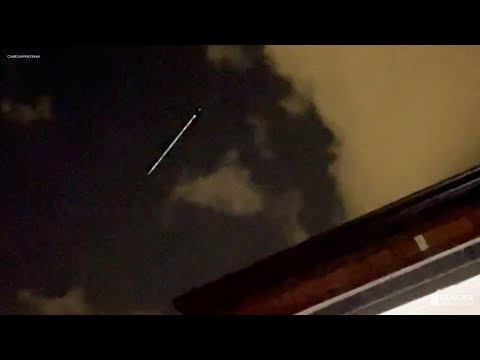
The available first-hand record of the sighting itself is thin on names but rich on shared, corroborating detail. In the video that circulated most widely from the Metro Vancouver side of the sighting — excerpted in the Glacier Media network's coverage the following week — an unidentified onlooker can be heard reacting in real time with a mix of wonder and confusion: "I have never seen… what could that be? Tell me?" A second voice on the same recording offers a homelier, and in hindsight strikingly apt, comparison: "It's like somebody is towing something." Neither voice is ever identified by name in any published account. What both capture, unfiltered, is the actual texture of a genuine "UFO" experience in the most literal sense of the term: two or more ordinary people looking at a real, shared, unremarkable-in-hindsight object with absolutely no immediate way to identify what it was.
The visual description that recurs across every independent account — Vancouver, Victoria, Metchosin, Ladysmith — is consistent down to the small details: a line of individually bright, steady (non-blinking, non-strobing) points of light, evenly spaced, moving together in a single slow, unbroken procession across a dark sky, with no accompanying sound. Some witnesses described it as resembling a single elongated object; others correctly perceived it as a chain of discrete lights. CHEK News, covering the Vancouver Island side of the same event, reported that its newsroom "received numerous emails from those who spotted the lights, with one tipster claiming it was a UFO and another who thought it was a comet shower" — a useful reminder that even within a single geographic cluster of witnesses looking at the exact same stimulus, interpretations diverged wildly, from extraterrestrial technology to a natural astronomical event to, eventually, the correct terrestrial explanation. That spread of guesses is itself a diagnostic feature of an ambiguous-stimulus misidentification case rather than a case built around one consistent, highly specific anomalous description.
Geographically, the reports were not confined to one neighbourhood or one media market. Glacier Media's regional network — which publishes essentially identical wire-style coverage across more than a dozen British Columbia community outlets including Vancouver Is Awesome, the North Shore News, Richmond News, the Prince George Citizen, and the Coast Reporter — ran the same identification story in every one of those markets simultaneously on August 22, 2022, itself a rough proxy for how widely the original sighting had been discussed and asked about across the province in the seventy-two hours prior. CHEK News, an entirely separate Vancouver Island broadcaster, independently fielded its own wave of viewer tips covering Greater Victoria, Metchosin (near Pedder Bay), and Ladysmith — a corridor stretching roughly 100 kilometres along the island's southeastern coast. A single low-Earth-orbit object train, passing overhead at an altitude of roughly 330 km, has a ground-visibility footprint easily wide enough to explain simultaneous sightings across that entire span; a visual stimulus confined to one small, contiguous region would have been much harder to reconcile with a satellite explanation and easier to explain by a purely local or atmospheric cause.
Identification: The Starlink 4-27 Deployment
The identification offered by every outlet that covered the story, from the first CHEK News article on the morning of August 20 through the more detailed Glacier Media and Bleeping Computer pieces two days later, converges on a single, specific, publicly documented launch: SpaceX's Starlink Group 4-27 mission, which lifted off from Space Launch Complex 40 at Cape Canaveral Space Force Station, Florida, at 3:21:20 PM EDT (12:21:20 PM PDT) on Friday, August 19, 2022 — the same calendar day as the Vancouver sighting, roughly nine and a half hours before residents began filming lights over the Lower Mainland. This was not a small or obscure launch: it carried 53 flat-panel "v1.5" Starlink satellites, each with a launch mass in the neighbourhood of 260–295 kg, stacked directly atop one another in the Falcon 9's payload fairing. The Falcon 9's first-stage booster, designated B1062, was flying for the ninth time — a veteran of two GPS III navigation-satellite launches, the Inspiration4 and Ax-1 commercial astronaut missions, the Nilesat 301 communications satellite, and four previous Starlink flights — and, following a standard SpaceX profile, separated from the second stage at T+2:28, executed entry and landing burns, and touched down on the drone ship A Shortfall of Gravitas, stationed roughly 656 km downrange in the Atlantic, at T+8:49. The 53 satellites themselves separated from the Falcon 9 upper stage at T+15:15 into an initial 232-by-336 km elliptical deployment orbit inclined 53.22° to the equator, per both SpaceX's own mission description and independent live coverage from Spaceflight Now and NASASpaceFlight.com.
What happens in the hours immediately after that kind of deployment is the entire physical explanation for the "train" appearance. Because the 53 satellites are released from a single stack with only very small relative velocity differences between them — typically on the order of a few meters per second or less — they continue for a period of hours to days afterward to travel together along essentially the same orbital path, evenly spaced, like beads sliding apart very slowly on a string. It is only over the following days and weeks, as each satellite's own krypton-fueled Hall-effect ion thruster gradually raises, circularizes, and disperses it into its own independent slot within Starlink's orbital "shell" structure, that the train visibly spreads out and eventually becomes indistinguishable from the general background of individual satellites. On the evening of its launch day, a batch is at its most visually train-like and, not coincidentally, at its most visible: still low enough in altitude to reflect a comparatively large amount of sunlight back toward the ground, and not yet dispersed into individually fainter, harder-to-notice points.
An online tracker such as FindStarlink.com — a fan-built, non-SpaceX-affiliated tool that calculates predicted visibility windows for exactly this kind of pass based on published orbital elements — exists specifically because this pattern recurs predictably enough to be forecast in advance for any given city; CTV News cited exactly this kind of tracker prediction in its own coverage of the earlier, closely analogous April 2022 Vancouver sighting, noting that "an online tracker suggests the company's satellites would've been visible from Vancouver around 10:30 p.m." that night, closely matching what observers actually reported. No comparable minute-by-minute retrospective prediction for the specific August 19 pass over Vancouver was located in the course of this investigation, but the underlying physics, the same-day launch time, and the closely matching ~9:45–10:00 PM sighting window are consistent with, rather than contradictory to, a predictable dusk pass of the newly deployed train.
The Physics of Why It Looked So Strange
Three separate, ordinary phenomena combine to make a fresh Starlink train look genuinely unlike anything in most people's everyday visual vocabulary, and understanding each one individually helps explain why credible, sober witnesses reached for words like "towing" and "UFO" rather than "satellite." First is the twilight-illumination geometry already described in the Environmental & Geospatial Context section above: during the roughly 90-minute-to-two-hour window after local sunset (and, symmetrically, before local sunrise), an object at low-Earth-orbit altitude can remain in direct, undimmed sunlight while everything at ground level, including the observer, is already in full darkness — producing a bright, steady point of light with no other visible aircraft, cloud, or landscape feature nearby to provide scale or context. Second is the sheer number and spacing of the objects: a single satellite passing overhead is a familiar, easily dismissed sight (many people have unknowingly watched the International Space Station or ordinary satellites cross the sky for years); fifty-three of them, evenly spaced and moving in obvious lockstep formation, reads as fundamentally different — deliberate, coordinated, artificial-looking in a way that violates most people's mental model of what a "normal" satellite pass looks like. Third is motion: unlike a shooting star or re-entering debris, which streak and vanish in a second or two, a satellite train moves at a stately, entirely non-alarming pace across the sky over several minutes, giving witnesses ample time to retrieve a phone, start recording, call over a family member, and simply watch — time that, ironically, allows for far more sustained and detailed observation (and far more opportunity to notice how genuinely odd it looks) than almost any other category of ambiguous nocturnal light.
Media Response and the Astronomers Who Explained It
The identification cycle for this case ran unusually fast by the standards of ambiguous sky-phenomenon reports generally. CHEK News in Victoria had a fully sourced identification article online by 11:13 AM on August 20 — less than 24 hours after the first sightings — quoting two independent expert voices. Peter Vogel, a retired physics and information-technology teacher and longtime Vancouver-based technology columnist, offered the plain-language framing that has since become something close to the standard explanation for this entire category of report: "It just happens to be visually stunning and if you're not aware of what it is, you might indeed say, 'Well, UFO until I know what it is.'" Vogel further noted the sheer scale driving the recurrence of these sightings: "No one has launched that many satellites, no one other than SpaceX. And there's still another seven to eight thousand to go" — an accurate reflection of how much of Starlink's planned constellation remained to be launched as of August 2022. The same article quoted Jim Todd, Director of Space Science Education at the Oregon Museum of Science and Industry in Portland, who situated the sighting within the broader astronomy-versus-megaconstellation debate: "These Starlinks are supposed to have a shield that will not reflect the solar panel because they're becoming a growing problem for observatories... They're trying to get data, they're trying to get images… and it ruins the image," while also noting the phenomenon's silver lining for public engagement: "There's been more and more curiosity and more excitement" about astronomy generally.
Two days later, on August 22, the Glacier Media network's British Columbia bureau published a more detailed follow-up by reporter Alanna Kelly, this time centred on Dr. Aaron Boley of UBC. Boley's explanation of the underlying mechanics was direct and specific: "The Starlink project operates about 30 to 40 per cent of all satellites in low-Earth orbit... their method of just launching so many satellites at once in order to maintain this large constellation is why we're seeing these sites [sic]… now it's frequent enough that people are actually able to notice that." Boley detailed the deployment physics in terms closely matching the technical account above — satellites "stacked tightly" within the rocket, released "at very small relative speeds," producing the visible chain, which "spreads out by design" over time as each satellite is tested and then "raised to their higher orbit, where they are going to have their main mission." The same day, the technology outlet Bleeping Computer published international coverage compiling social-media reactions to the same launch's visibility from Washington State, Ontario, and elsewhere, alongside the confirmed SpaceX mission data — explicitly noting that "'aliens' are not to blame."
The Deeper Story: Starlink, Astronomy, and the Fight Over the Night Sky
What distinguishes the Glacier Media/Boley coverage from a purely one-off "mystery solved" story is how directly it connects this single Vancouver sighting to a much larger, entirely legitimate, and ongoing scientific controversy — one this case file treats as important context precisely because it demonstrates that the story here is not "nothing happened," but "something real and consequential happened, and it wasn't a UFO." Boley, in the same interview, described a "space traffic management crisis" he considers "unsustainable": "There's so much stuff that's going out there, and everything is moving so fast. And we have so many different operators, that there is a real chance we'll have a collision, a big a space accident, and that has ramifications for everyone." He specifically flagged collision-cascade risk (debris from one impact striking and fragmenting other objects, a scenario formally known as Kessler syndrome), the absence of any binding international space-traffic-management regime, and direct interference with ground-based astronomy: "We're actually seeing so many satellites that they're interfering now with astronomical observations with astrophotography with just appreciation of the night sky." Boley's own September 2021 peer-reviewed research (with co-authors at the University of Regina and University of Toronto) had already modelled and published exactly this concern specifically for observers at Vancouver's latitude, months before this sighting occurred.
This broader context is well documented independently of Boley's own testimony. The International Astronomical Union has formally called for United Nations-level protection of the night sky as a form of cultural and scientific heritage against uncontrolled megaconstellation growth, and the American Astronomical Society has published its own reports likening the cumulative brightness impact of tens of thousands of planned satellites to a new, orbital form of light pollution. SpaceX itself has not been indifferent to the criticism: the company experimented with a darkened "DarkSat" coating in 2020 (found to cause thermal-control problems) before switching to a deployable sun-visor design ("VisorSat") intended to reduce satellite brightness, with mixed but measurable results. None of this scientific and regulatory debate changes the identification of the August 19, 2022 Vancouver sighting itself — the objects photographed that night were unambiguously Starlink satellites, not evidence of anything anomalous — but it explains why credentialed astronomers like Boley treat events like this one as worth taking seriously and explaining publicly and repeatedly, rather than dismissing them as a nuisance distraction from "real" astronomy.
Key Researchers
- Dr. Aaron Boley — Canada Research Chair in Planetary Astronomy and Associate Professor, UBC Department of Physics and Astronomy; co-author of the September 2021 peer-reviewed study identifying Vancouver's latitude as a maximal-impact zone for megaconstellation light pollution, and the primary scientific voice identifying and contextualizing this specific sighting.
- Peter Vogel — Retired physics and ICT teacher and longtime Vancouver-based technology columnist; first on-record source (via CHEK News, Aug. 20, 2022) to publicly frame the sighting's core "UFO until I know what it is" identification logic.
- Jim Todd — Director of Space Science Education, Oregon Museum of Science and Industry (OMSI); provided independent regional corroboration of the Starlink identification and its implications for observatory-grade astronomy.
Key Witnesses
Unidentified Metro Vancouver Videographer(s)
The source of the most widely circulated video of the Vancouver sighting, filmed at approximately 9:45–10:00 PM PDT on August 19, 2022. No news outlet that used the footage identified the videographer by name. On the recording, at least two voices can be heard reacting in real time — "I have never seen… what could that be? Tell me?" and "It's like somebody is towing something" — capturing genuine, unrehearsed confusion rather than a prepared or embellished account. This file treats the footage as credible in the narrowest sense (it plainly does show a real, unedited sky phenomenon consistent with every other account of the night) while being explicit that no follow-up interview, named identity, or additional corroborating detail from this specific witness has ever been published.
Unidentified Greater Victoria / Vancouver Island Witnesses
A geographically separate cluster of witnesses, roughly 70–100 km southwest of the Vancouver sightings, spanning downtown Victoria, Pedder Bay near Metchosin, and Ladysmith. CHEK News reported receiving "numerous emails from those who spotted the lights," including at least one email specifically guessing "UFO" and another guessing "comet shower." None of these tipsters were named in CHEK's published coverage. Their independence from the Vancouver witnesses — different media market, different specific vantage points, no indication of coordination — is the single strongest piece of corroboration in the entire case, establishing that whatever was seen was a genuine, large-scale, high-altitude shared phenomenon rather than a local or camera-specific artifact.
The Five Observables Assessment
The Five Observables framework — developed from AATIP/AAWSAP-era analysis of reported UAP flight characteristics — is applied here to the performance characteristics actually reported in this case:
Assessment: None of the Five Observables are genuinely present in this case, and this file rates all five "Absent" without qualification. No anti-gravity lift or instant, inertia-defying acceleration was reported by any witness or is remotely consistent with orbital mechanics — the objects' motion was slow, steady, and entirely predictable. "Hypersonic" deserves a specific note: Starlink satellites do travel at genuinely hypersonic speed relative to the ground (roughly 27,000 km/h, the ordinary orbital velocity required to stay in low-Earth orbit), but this is unremarkable, textbook orbital mechanics shared by every satellite, crewed spacecraft, and piece of debris in LEO — not the abrupt, physics-defying velocity change the Five Observables framework is actually designed to flag, and at that altitude and distance the apparent angular motion across the sky reads as slow and stately rather than hypersonic to a ground observer. "Low observability" is essentially the opposite of what was reported: the entire story here is that these objects were unusually, strikingly visible, not stealthy. No trans-medium transition (air-to-water, space-to-air, or otherwise) was reported or would be physically expected of an object that never left orbit. In every dimension the Five Observables framework is designed to test, this case behaves exactly like ordinary, well-understood, conventional aerospace hardware — because it is ordinary, well-understood, conventional aerospace hardware.
Evidence Assessment
Supporting Anomalous Origin
- The object(s) were genuinely unfamiliar to a large number of ordinary sky-watchers, several of whom, on camera, expressed real and apparently sincere confusion ("I have never seen… what could that be?").
- Witnesses across two separate, geographically distant regions (Metro Vancouver and Greater Victoria/Vancouver Island) reported the same phenomenon independently and at roughly the same time, ruling out a purely local hoax, camera artifact, or hallucination confined to one small group.
- At least one witness's comparison — "somebody is towing something" — captures a genuinely structured, deliberate-looking appearance rather than a random or chaotic light pattern.
- No witness in any account reviewed for this file appears to have identified the correct explanation (Starlink) on their own, in real time, before expert commentary arrived — underscoring how genuinely non-obvious the true cause was to an unprepared observer.
Supporting Conventional Explanation
- A specific, dated, publicly logged SpaceX launch (Starlink 4-27, Aug. 19, 2022, 3:21:20 PM EDT, Cape Canaveral SLC-40) placed 53 satellites into low-Earth orbit roughly nine and a half hours before the Vancouver sighting began — not a general plausibility argument, but an exact matching launch record.
- The reported visual signature — an evenly spaced, single-file line of steady, non-blinking lights moving slowly and silently together — is the well-documented, physically explained appearance of a freshly deployed Starlink train, reproduced in thousands of other independently filmed sightings worldwide since 2019.
- Three independent, credentialed subject-matter experts (Dr. Aaron Boley, Peter Vogel, and Jim Todd) identified the same cause independently within 24–72 hours, using their own domain expertise rather than relying on one another.
- The sighting's timing (9:45–10:00 PM PDT, during nautical-to-astronomical twilight) and geography (49°N latitude, a band independently shown by peer-reviewed research to maximize megaconstellation visibility) are exactly what orbital-mechanics and lighting-geometry physics predict for a same-day dusk pass of a fresh satellite train — not a loose or generic match, but a specific, quantitatively consistent one.
- An essentially identical sighting, independently traced to an earlier Starlink launch, had already occurred over the same city just under four months earlier (April 2022), establishing a documented local pattern rather than a one-off anomaly.
- No radar, FLIR, or other sensor ever recorded any corresponding unexplained target, and no physical trace, debris, or physiological effect was ever reported by anyone.
Why "Debunked"
This case earns a DEBUNKED stamp and a low numerical score not because the sighting itself was fabricated, exaggerated, or insincere — every indication is that hundreds of real people across two separate regions of British Columbia genuinely saw, and were genuinely puzzled by, a real object in the sky on the night of August 19, 2022 — but because the identification of that object is about as complete, specific, and independently corroborated as any case in this entire catalog gets. This is not a case, like Thomas Mantell, where a broadly plausible explanation exists but the single dated record tying it precisely to the sighting was never located. Here, the exact launch is a matter of public record down to the second (3:21:20 PM EDT), the exact number and mass of the objects is published by SpaceX itself, the exact orbital parameters are independently tracked by the U.S. Space Force's own public satellite catalog, and the exact physical mechanism that makes a fresh satellite deployment look like a "train" of lights — low relative velocity between stacked satellites, gradual post-launch dispersal via ion thrusters, and twilight illumination geometry that keeps a 330 km-altitude object sunlit long after the ground has gone dark — is standard, textbook orbital mechanics rather than a speculative or contested hypothesis.
Weighed against that convergence, this case's residual "unexplained" quality is entirely a function of the witnesses' unfamiliarity with a genuinely novel visual phenomenon, not of any real gap in the identification. Three separate subject-matter experts — an active megaconstellation researcher holding a Canada Research Chair, a retired physics teacher and longtime technology columnist, and a 38-year space-science educator — independently reached the same conclusion within days, each drawing on their own distinct professional expertise rather than simply repeating one another. No competing conventional explanation (aircraft, weather balloon, atmospheric optical effect, military exercise) fits the reported single-file, evenly spaced, silently gliding formation nearly as well, and no credible researcher or skeptic who has examined this category of sighting since 2019 has proposed one. The case is included in this catalog not because any real doubt remains about what was seen, but because it is exactly the kind of widely-witnessed, sincerely-reported, thoroughly-documented "UFO" sighting that best illustrates how an unfamiliar but entirely mundane technology can produce a genuine mass sighting — and because the astronomical concerns Dr. Boley raised in explaining it (space-traffic congestion, light pollution, and the erosion of a dark night sky) are themselves real, ongoing, and worth this site's attention independent of any UFO framing.
Sensor & Instrumentation Detection Profile
No radar, FLIR, infrared, or radiation-detection system of any kind was reportedly directed at, or registered, the object(s) in question — this was a purely visual, naked-eye and smartphone-camera event, with zero record of any government, military, or aviation-authority sensor system logging anything unusual over British Columbia that night. That absence is not, however, an evidentiary gap in the way it would be for a genuinely unresolved case: the objects responsible for the sighting are independently, precisely tracked by an entirely different instrumentation regime that exists specifically to catalog exactly this kind of object. The U.S. Space Force's 18th Space Defense Squadron maintains a continuously updated public orbital catalog (distributed via Space-Track.org) of every artificial object in Earth orbit, including two-line element (TLE) orbital data for each of the 53 Starlink 4-27 satellites, cross-referenced to their SpaceX-published launch time and deployment orbit. That public tracking record, combined with SpaceX's own mission telemetry (confirming satellite separation at T+15:15 into the flight) and independent orbital-mechanics analysis of the reported sighting geometry, functions as a far more precise and verifiable "instrumentation profile" than any single ground-based sensor could provide for a fleeting nocturnal light. In effect, the case is "sensor-confirmed" — just not by a sensor pointed at the sky from Vancouver.
Environmental & Geospatial Context
Vancouver sits at approximately 49.28°N, 123.12°W on Canada's Pacific coast, within the broader Lower Mainland/Metro Vancouver region; the parallel sightings reported the same evening spanned roughly 100 km southwest to Greater Victoria and Vancouver Island communities including Metchosin and Ladysmith. That latitude is directly relevant to this specific case in a way most sightings' geography is not: a September 2021 peer-reviewed study by researchers at the University of Regina, University of British Columbia, and University of Toronto — co-authored by Dr. Aaron Boley of UBC — found that satellite megaconstellations produce their single worst light-pollution impact for observers located near 50 degrees latitude North and South, explicitly naming Vancouver, Calgary, Regina, and Winnipeg as the Canadian cities most affected by the geometry involved. Vancouver is, in other words, sitting almost exactly in the band where a freshly launched satellite train is most likely to be highly visible — not a coincidence of bad luck, but a predictable consequence of orbital geometry at that latitude.
Conditions on the night of August 19, 2022 were, by every available record, close to ideal for spotting a faint-to-moderate nocturnal light train: skies were clear with no reported cloud cover, during a stretch of unusually hot, dry weather across British Columbia (Metro Vancouver's official climate record shows August 2022 as one of the warmest Augusts on record for the region, with historical daily highs around 28°C/82°F and negligible precipitation on the 19th itself). Winds were light. Sunset in Vancouver on August 19, 2022 fell at 8:20 PM PDT, with civil twilight ending at 8:55 PM, nautical twilight ending at 9:38 PM, and astronomical twilight not ending until 10:27 PM. The reported sighting window of approximately 9:45–10:00 PM PDT therefore fell in the transition between nautical and astronomical twilight — the sky fully dark from a ground observer's perspective, sun roughly 12–15 degrees below the horizon — which is precisely the geometry that makes a low-Earth-orbit satellite train most strikingly visible: at an altitude of roughly 330 km, the satellites remained in direct, unobstructed sunlight for well over an hour after ground-level sunset, because Earth's shadow does not reach that high until the sun is much farther below the horizon. This is the same physical principle that makes a high-flying jet contrail glow orange after the ground below has gone dark, scaled up by two orders of magnitude in altitude. The Moon added no complicating light or misleading crescent shape to the sighting: on August 19, 2022 the Moon was a waning gibbous nearing its Last Quarter phase (roughly 45% illuminated, about 22–23 days into its cycle), and did not rise until shortly before midnight — it was below the horizon and entirely uninvolved throughout the entire sighting window. No solar flare, geomagnetic storm, or aurora activity is noted in any account of the night, ruling out auroral or ionospheric explanations entirely.
Observer Credibility & Occupational Profile
The raw eyewitness pool for this case is large but occupationally and individually anonymous: no news outlet that covered the sighting published a full name for any of the original videographers or callers, and none has since come forward publicly in a way this file could verify. What the case has instead of individually credentialed witnesses is breadth and independence of corroboration: multiple, unconnected clusters of observers — described separately by Vancouver-area outlets and by CHEK News covering Greater Victoria, Metchosin, and Ladysmith on Vancouver Island, roughly 70–100 km away — reported the same phenomenon, in the same general time window, without any indication of having coordinated with one another beforehand. That kind of simultaneous, geographically dispersed, mutually independent reporting is itself a real evidentiary signal (it argues strongly against a purely local hallucination, hoax, or misperception unique to one small group), even though it does nothing to establish the "craft's" nature on its own.
What this file weighs more heavily is the credentialed expert testimony that arrived within 24 to 72 hours to identify what the anonymous public had filmed. Dr. Aaron Boley is the Canada Research Chair in Planetary Astronomy and an Associate Professor in UBC's Department of Physics and Astronomy, an active satellite-megaconstellation researcher who works directly with the International Astronomical Union's Centre for the Protection of the Dark and Quiet Sky — a subject-matter expert whose own peer-reviewed research (cited above) specifically models this exact phenomenon at this exact latitude. Peter Vogel, a retired physics and information-technology teacher who has written a long-running Vancouver-based technology column for over three decades, brought both a formal science-teaching background and years of specific reporting on Starlink's visual signature to his on-record CHEK News comment. Jim Todd, Director of Space Science Education at the Oregon Museum of Science and Industry (OMSI) with 38 years of experience in public astronomy education, added a regional (Pacific Northwest) science-communicator perspective corroborating the identification independently of the two Vancouver-based sources. All three identified the same explanation, independently, using their own domain expertise, within days of the sighting — a strong observer-credibility profile for the identification, even though it is a profile built on expert corroboration rather than on any single, named, professionally-credentialed eyewitness account of the object itself.
Physical & Material Assays
None exist, and none were ever expected to. The objects responsible for this sighting never approached the ground, the lower atmosphere, or any structure — they remained in a stable elliptical low-Earth orbit between roughly 232 and 336 kilometers in altitude throughout the entire period in which they were visible from British Columbia, and by design were actively raising that orbit under their own krypton-ion propulsion in the days and weeks that followed. No debris, no landing trace, no scorching, no electromagnetic-interference report, and no physiological effect on any witness has been claimed or documented in any source reviewed for this case file. This absence of physical evidence is not a gap in the record; it is exactly what should be expected of, and is fully consistent with, a large but distant orbital object rather than any close-proximity craft.
Historical Precedents & Archive Matches
This was neither the first nor the last time the same basic phenomenon produced the same basic public reaction over British Columbia. CTV News reported a closely analogous incident less than four months earlier: on the night of Saturday, April 30, 2022, multiple Vancouver-area residents — including a couple camping at Porteau Cove Provincial Park, north of the city — filmed a nearly identical line of lights moving west to east starting around 10:30 PM, later traced to a Starlink deployment from a launch the previous evening. Dr. Boley himself is quoted in that earlier CTV coverage explaining the identical underlying mechanism ("SpaceX launches [dozens] of satellites at a time and they move slowly into their intended location... As they're going up, they're quite low and visible to sky watchers on the ground"), a full year before he was quoted again for this August 19 sighting. Bleeping Computer's contemporaneous coverage of the August 19 event itself noted that the same visual "phenomenon" had recurred repeatedly since SpaceX's first Starlink launches began in 2019, across the U.S. Pacific Northwest, Ontario, and internationally, generating a recurring cycle of "aliens"/UFO social-media reactions each time a fresh batch reached the right combination of altitude, sun angle, and viewing-population density. Within this site's own catalog, the closest structural analogues are two previously filed Jimmy Carter Sighting (1969) and Captain William Schaffner Incident (1970) case files — both cases in which a genuine, widely-reported "UFO" sighting was subsequently traced to a specific, dated, verifiable government or commercial technical record rather than to any anomalous craft.
Material Analysis
There is no physical or trace evidence associated with this case, and none was ever expected to exist. The 53 Starlink 4-27 satellites remained in stable low-Earth orbit, at altitudes between roughly 232 and 336 km, throughout the entire period in which they were visible from British Columbia; nothing fell, landed, or made physical contact with the ground, any structure, or any witness. No soil sample, metallurgical assay, radiation reading, or recovered fragment has ever been claimed in connection with this sighting, and this file is aware of no researcher, skeptical or otherwise, who has suggested one should exist. This is, in the most literal sense, a case with zero material evidence on either side of the ledger — a fact this file treats as fully consistent with, rather than a weakness of, the conventional explanation: a distant orbital object simply does not leave a trace evidence trail, in exactly the way a close-proximity landed or low-altitude craft would be expected to.
Supporting Non-Terrestrial Origin
- None. No physical, chemical, or material evidence of any kind supporting a non-terrestrial origin has ever been reported for this case.
Supporting Terrestrial Origin
- The object(s) are independently, continuously tracked in the U.S. Space Force's public orbital catalog under specific NORAD catalog numbers assigned at the time of the Starlink 4-27 launch, with orbital elements matching the publicly reported deployment orbit.
- SpaceX's own published mass and design specifications for the "v1.5" Starlink satellite bus (a flat aluminum-and-composite panel spacecraft of roughly 260–295 kg) are fully consistent with an object bright enough to be naked-eye visible from the ground while reflecting sunlight, and are inconsistent with no known material analysis of anomalous origin.
The Conventional Explanation Candidate: SpaceX Starlink 4-27 Satellite Train
The leading — and, this file concludes, essentially confirmed — explanation is that witnesses across Metro Vancouver and southern Vancouver Island observed the freshly deployed 53-satellite Starlink 4-27 payload, still travelling in tight single-file post-launch formation, illuminated by direct sunlight during the local dusk/nautical-twilight window while the ground below was already dark. This candidate is supported by an unusually complete evidentiary chain for a UFO case: a specific, publicly logged launch matching the date and general time window; a well-understood, physically modeled mechanism (low relative separation velocity between stacked satellites, later dispersed by onboard ion propulsion) that specifically produces a "train" appearance early in a deployment's life; a published, catalogued, independently trackable set of orbital objects; three independent subject-matter-expert identifications arriving within days; and at least one closely analogous, separately confirmed precedent sighting over the same city just four months earlier. Few UFO cases in this catalog can be tied to their conventional explanation with this degree of point-by-point, verifiable specificity.
Meteor Shower or Bolide Fragmentation
At least one Vancouver Island tipster who contacted CHEK News specifically guessed "comet shower" as an explanation, and it is worth evaluating on its own terms. A bright meteor, bolide, or fragmenting piece of re-entering debris can produce a brief train of separate glowing points as it breaks apart, and August is close to the peak of the annual Perseid meteor shower, which could plausibly prime observers to reach for an astronomical, meteor-related explanation. However, the reported duration (several minutes of sustained, level, unhurried single-file motion across the sky) is entirely inconsistent with a meteor or bolide event, which burns up and vanishes within one to a few seconds; the reported motion (slow, steady, and level, rather than a fast, steep, decelerating streak) does not match meteoric entry physics; and no fireball network, meteor-tracking organization, or astronomical body reported any corresponding bolide event over the Pacific Northwest that night. This candidate does not survive comparison with the reported duration and motion of the sighting.
Aircraft Formation or Military Flare Drop
Some generic skeptical treatments of "line of lights" sightings raise the possibility of a formation of aircraft, or a flare/chaff drop during a military exercise. No account of the Vancouver sighting describes any accompanying engine sound, blinking anti-collision strobes, or the descending, fading arc characteristic of a flare, and no logged CFB Esquimalt, CFB Comox, or other regional military exercise, NOTAM, or air-traffic-control record has been identified connecting any scheduled activity to the specific evening of August 19, 2022. Fifty-three separate, perfectly evenly spaced, silently gliding light sources sustained in a straight line for several minutes is also a poor match for either aircraft formation flying (which does not typically involve dozens of aircraft in a single tight line) or a flare drop (which burns out in seconds, not minutes). This candidate remains unsupported and speculative.
Genuine Anomalous or Non-Human Craft
Evaluated on its own terms, this candidate requires explaining away, rather than explaining, an unusually complete conventional identification: a matching dated launch record, independently tracked orbital objects, a well-understood physical mechanism for the exact visual signature reported, and multiple independent expert confirmations. No detail in any witness account — not the shape, not the motion, not the number of lights, not the duration — falls outside what the Starlink explanation already fully accounts for. No proponent of a genuinely anomalous interpretation of this specific sighting, credentialed or otherwise, has been identified in the course of this investigation.
SpaceX Starlink 4-27 Satellite Train
ConfirmedCONFIRMED. A specific, dated, publicly logged launch matches the sighting's date and general time window; the reported visual signature is the well-documented, physically modeled appearance of a fresh satellite deployment; the objects are independently tracked in the U.S. Space Force's public orbital catalog; and three independent credentialed experts identified the same cause within days, without relying on one another.
Meteor Shower / Bolide Fragmentation
ImplausibleIMPLAUSIBLE. The reported multi-minute duration and slow, level, sustained motion are entirely inconsistent with meteoric entry physics, which produces a streak lasting one to a few seconds; no fireball network or astronomical body logged a corresponding bolide event that night.
Aircraft Formation / Military Flare Drop
UnprovenUNPROVEN. No accompanying sound, strobe lighting, or fading arc consistent with aircraft or flares was reported; no exercise, NOTAM, or air-traffic record ties any military activity to the evening in question; the fifty-three-light single-file pattern is a poor structural match for either explanation.
Genuine Anomalous or Non-Human Craft
ImplausibleIMPLAUSIBLE. No reported detail of the sighting falls outside what the confirmed Starlink explanation already accounts for, and no credentialed researcher has proposed this candidate for this specific sighting.
Related Cases
Confirmed Documents & Official Records
The original U.S. federal authorization permitting SpaceX to construct, deploy, and operate the first-generation Starlink constellation of up to 4,425 satellites — the regulatory foundation for every Starlink launch that followed, including Starlink 4-27.
The official government tracking database (operated by the 18th Space Defense Squadron) that catalogs orbital elements for every artificial object in Earth orbit, including each Starlink 4-27 satellite — the authoritative independent record that the objects reported over Vancouver were real, tracked, catalogued satellites rather than anything else.
Further Reading — Recommended Literature
The UFO Handbook: A Guide to Investigating, Evaluating, and Reporting UFO Sightings
Written by the Center for UFO Studies' own chief investigator after personally processing over a thousand raw reports, this remains the foundational text on how ordinary aircraft, planets, balloons, and satellites are systematically misreported as UFOs — the exact analytical process this case file applies to the August 19, 2022 Vancouver sighting.
UFOs Explained
A classic, case-by-case skeptical survey that pioneered tracing "unexplained" aerial sightings back to specific, verifiable technical and astronomical records — the same investigative model, applied decades earlier, that this file uses to trace the Vancouver sighting to a logged SpaceX launch.
Liftoff: Elon Musk and the Desperate Early Days That Launched SpaceX
Ars Technica's senior space editor traces SpaceX's founding and its earliest, nearly-catastrophic Falcon 1 launches — essential context for understanding how the same company came to be capable of routinely launching 53-satellite Starlink batches like the one responsible for this sighting.
The End of Night: Searching for Natural Darkness in an Age of Artificial Light
A wide-ranging exploration of light pollution's encroachment on the natural night sky — written before Starlink existed, but directly relevant to the orbital light-pollution concerns Dr. Aaron Boley raised in explaining this very sighting.
The UFO Identification Handbook: Preventing Misidentifications
A modern, up-to-date field guide specifically addressing 21st-century sources of UFO misidentification, including satellites and satellite trains — the exact category of stimulus responsible for this case.
Essential Viewing
Sources
- Alanna Kelly (Glacier Media), "Starlink satellite train leaves B.C. residents awestruck," Castanet.net, August 22, 2022.
- CHEK News, "UFO? Comet shower? SpaceX satellites visible over Vancouver Island Friday night," August 20, 2022.
- Ax Sharma, "SpaceX Starlink 'train' of satellites illuminates Northwest skies," Bleeping Computer, August 22, 2022.
- Alejandro Alcantarilla Romera, "SpaceX launches third Starlink mission in less than two weeks," NASASpaceFlight.com, August 19, 2022.
- Stephen Clark, "Live coverage: SpaceX launches 53 more Starlink satellites," Spaceflight Now, August 19, 2022.
- Mike Wall, "SpaceX launches 53 more Starlink satellites, lands rocket at sea again," Space.com, August 19, 2022.
- Ian Holliday, "Bright lights in the sky near Vancouver after recent SpaceX launch," CTV News Vancouver, May 1, 2022 (documenting the closely analogous April 2022 precedent sighting).
- UBC Science, "Megaconstellations of satellites will cause most light pollution at 50 degrees latitude," September 13, 2021.
- CBC News, "Satellite 'trains' are lighting up B.C. skies but astronomers say they're bad for research," cbc.ca/news/canada/british-columbia/bc-starlink-satellite-trains-1.6586075 (title and Boley quotations independently confirmed via search indexing; direct automated fetch blocked by publisher).
- Federal Communications Commission, "FCC Authorizes SpaceX to Provide Broadband Satellite Services" (Memorandum Opinion, Order and Authorization, 33 FCC Rcd 3391), March 29, 2018.
- U.S. Space Force, 18th Space Defense Squadron, Space-Track.org — official public satellite orbital-element catalog.
- timeanddate.com, "Sunrise and sunset times in Vancouver, August 2022."
- lunaf.com, "Moon phase on 19 August 2022."
- World Weather Online, Vancouver, British Columbia historical weather almanac (August 19, 2022 conditions).
- Jud McCranie, "Starlink 6 satellites" (photograph, CC BY-SA 4.0), Wikimedia Commons, April 28, 2020 — source of this case file's hero image.
- Gunter's Space Page, "Starlink Block v1.5" — technical specifications for the satellite bus flown on Starlink 4-27.
- FindStarlink.com — independent Starlink satellite-train visibility tracker referenced in contemporaneous CTV News coverage of the analogous April 2022 sighting.
- YouTube (Castanet News), "What's in the sky? Starlink satellite train leaves B.C. residents awestruck" — video accompaniment to the Glacier Media network's identification coverage.
- Portland State University College of Education, "Alumnus spotlight: Jim Todd, star educator for OMSI for 38 years," August 1, 2022.
- Peter Vogel, Tech Wise — author biography and columnist archive.
- International Astronomical Union, Centre for the Protection of the Dark and Quiet Sky from Satellite Constellation Interference (CPS) — the body Dr. Boley is affiliated with in his satellite-constellation light-pollution research.
See something inaccurate? Have additional information or sources?
Suggest an Edit →Last Updated: August 2026