
Jimmy Carter Sighting
Around 7:15 p.m. on January 6, 1969, Jimmy Carter — a private citizen and former Georgia state senator who had lost the 1966 governor's race and was quietly laying the groundwork for a second run — was standing outside the Leary, Georgia Lions Club with roughly ten fellow members, waiting for a 7:30 meeting to start. For ten to twelve minutes, the group watched a self-luminous object, "about the size of the moon," hang low in the western sky, cycle from blue to red to white, and drift toward and away from them before receding into the distance. The sighting went unreported for four years until Hayden C. Hewes, director of the International UFO Bureau, asked Governor Carter to file a formal account; Carter did so on September 18, 1973, misremembering the date as October 1969. The case became one of the most-cited "credible witness" sightings in UFO literature purely because of who its witness later became — yet the best available research points not to an unexplained anomaly but to two well-quantified mundane candidates: the planet Venus, and, more precisely, a documented U.S. Air Force barium-cloud rocket release from Eglin Air Force Base, Florida, whose logged launch time, altitude, and geometry match Carter's own description with striking specificity.
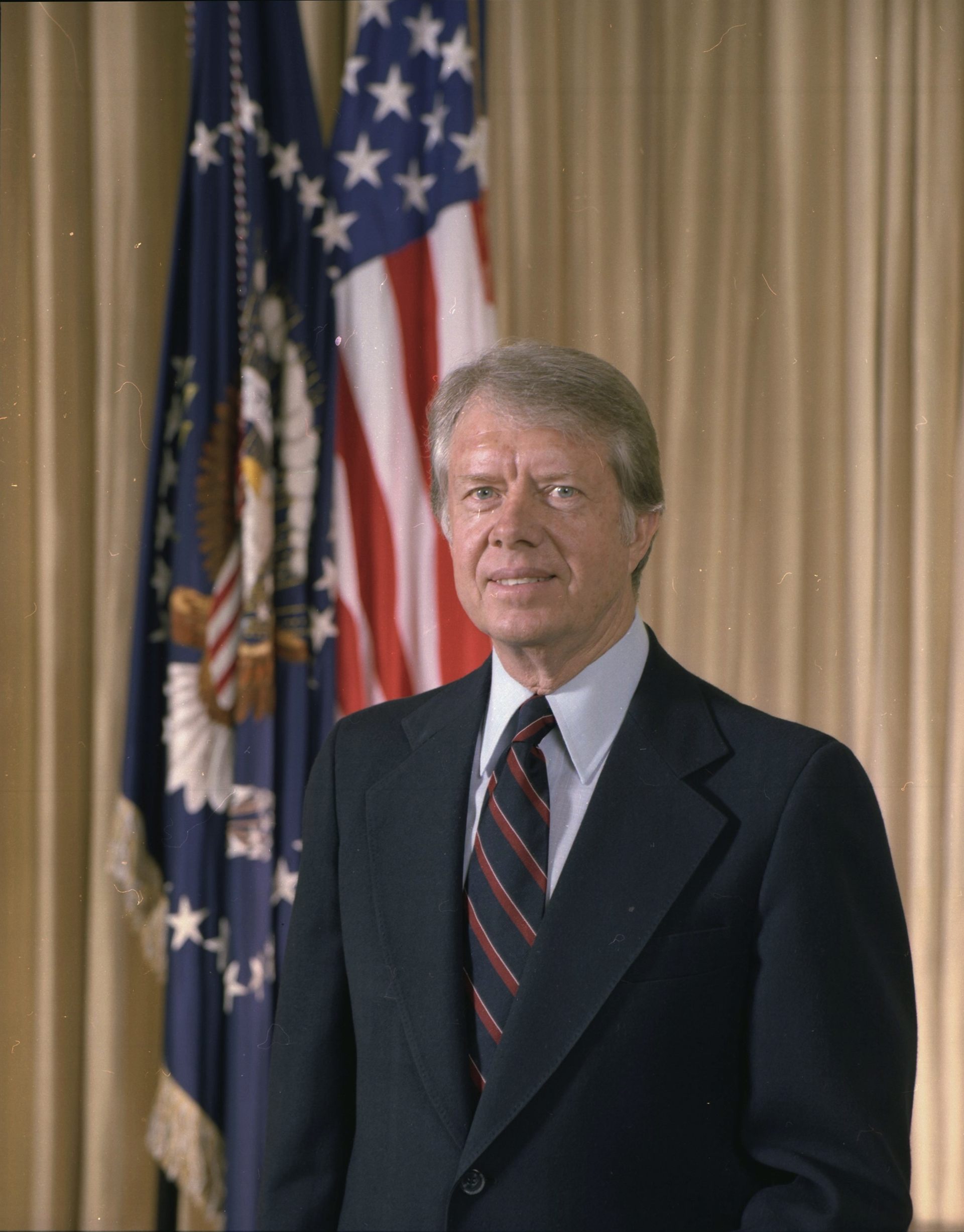
Pictured: the official White House portrait of Jimmy Carter, taken during his presidency (1977–1981) by a White House staff photographer — not a photograph of the 1969 sighting itself, which was witnessed at ground level at night by a group standing outside a small-town Lions Club with no camera in hand, and for which no photograph, sketch, or film of any kind is known to exist. This is a genuine, public-domain U.S. government photograph of the witness whose later prominence is the central reason this case is still discussed today. (Public domain — work of a U.S. federal government employee acting in an official capacity; National Archives and Records Administration, Identifier 179156, via Wikimedia Commons.)
Theoretical Alignment
The case aligns weakly with the Extraterrestrial Hypothesis and barely at all with interdimensional frameworks: the object displayed no structure, no discrete maneuvering behavior beyond a slow approach-and-recede, and no interaction with the environment of the kind that would argue for a physically piloted craft. It aligns far more strongly with the Psycho-Social Hypothesis — not in the dismissive sense of implying Carter or his fellow Lions Club members fabricated anything, but in the specific, well-documented sense that an ordinary astronomical or atmospheric stimulus, viewed by a group primed by each other's reactions and later filtered through years of retelling and a four-years-delayed, single-witness-drafted written report, produced an account whose surface details (color-cycling, apparent approach and retreat, "moon-sized" brightness) map unusually well onto two identifiable, dateable, mundane phenomena rather than onto any known aerospace or exotic-technology signature.
Background
James Earl "Jimmy" Carter Jr. was born October 1, 1924, in Plains, Georgia, and grew up on his family's farm nearby. He graduated from the U.S. Naval Academy in 1946 and served seven years as a naval officer, including a stint in the Navy's demanding nuclear submarine program under the notoriously exacting Admiral Hyman Rickover — an experience Carter later credited with instilling much of his lifelong emphasis on technical precision and self-discipline. When his father died in 1953, Carter resigned his commission and returned to Plains to take over the family's peanut-farming and warehouse business. Political ambition followed: he won a Georgia State Senate seat in 1962, serving until 1967, and ran for governor in 1966, losing the Democratic primary to segregationist candidate Lester Maddox. By January 1969, Carter was neither a sitting officeholder nor yet the governor-in-waiting of popular memory; he was a private businessman and former state senator quietly building toward a second, ultimately successful, gubernatorial campaign in 1970.
It was in this in-between period, as an ordinary private citizen with no political office to protect or promote, that Carter accepted an invitation to address the Lions Club in Leary, a small farming town in Calhoun County roughly forty miles from Plains. Lions Club International is a civic-service fraternal organization, and small-town chapter meetings of the kind Carter was attending that evening were, and remain, routine local social and charitable gatherings rather than anything unusual or high-profile. He arrived before the scheduled 7:30 p.m. start time and, per his own account, stepped outside with a number of the assembled members — a mix of local farmers, businessmen, and other Calhoun County residents — to wait for the meeting to begin. It was during this ordinary, unplanned interval, looking west across the flat Georgia farmland, that the group's attention was drawn to an unusual light in the sky.
Complete Timeline
| Date / Time | Event |
|---|---|
| Feb 1963 – Jan 1967 | Jimmy Carter serves in the Georgia State Senate, representing the 14th District. |
| 1966 | Carter loses the Democratic primary for Governor of Georgia to Lester Maddox; he returns to private life running the family peanut business in Plains. |
| Jan 6, 1969, ~7:15 PM EST | Waiting outside the Leary Lions Club with roughly ten fellow members ahead of a 7:30 meeting, Carter and the group spot a bright, self-luminous light low in the western sky. |
| Same evening, ~7:35 PM EST | Per later research, U.S. Air Force rocket AG7.626 releases a high-altitude barium vapor cloud from Eglin Air Force Base, Florida, reaching approximately 152 km altitude — the time, altitude, and 234 km distance from Leary would place the cloud at roughly 33° elevation in the WSW sky. |
| Same evening, ~7:15–7:27 PM EST | The group watches the light for an estimated 10–12 minutes as it changes from bluish to reddish to white, appears to approach and recede, and finally moves off into the distance and disappears. |
| 1970 | Carter is elected Governor of Georgia; he is inaugurated January 12, 1971. |
| Sept 14, 1973 | Hayden C. Hewes, director of the International UFO Bureau in Oklahoma City, writes to Governor Carter at the State Capitol in Atlanta, having seen press mentions of Carter's earlier sighting during that year's nationwide UFO flap, and asks him to file a formal report. |
| Sept 18, 1973 | Carter completes and signs a handwritten sighting-report form, describing the object and, mistakenly, dating the incident to "October 1969." |
| Sept 20, 1973 | The completed report is mailed to the International UFO Bureau. |
| 1976 | During Carter's presidential campaign, a field investigation attempts to locate corroborating Leary witnesses; only Fred Hart, the Lions Club's 1969 president, is found, offering a faint, uncertain recollection of "a blue light" he compared to "some kind of weather balloon." |
| Jan 20, 1977 | Carter is inaugurated as the 39th President of the United States, having pledged during the campaign to release government UFO information if elected — a pledge he did not fulfill in office, later citing national-security concerns. |
| Feb 1977 | The National Investigations Committee on Aerial Phenomena (NICAP) reprints Carter's 1973 IUFOB report, a reprint sometimes mistakenly cited afterward as if it were a NICAP-originated document rather than Hewes' bureau's. |
| Jul–Aug 1977 | Skeptic Robert Sheaffer publishes "President Carter's 'UFO' Is Identified as the Planet Venus" in The Humanist, matching Carter's reported elevation and direction to Venus's calculated position that evening. |
| 2005 | In a GQ interview with Wil Hylton, Carter reaffirms his account, disputes the Venus explanation, and states he does not believe the object was an extraterrestrial spacecraft on physical grounds. |
| 2016 | Atmospheric scientist Carl G. "Jere" Justus, who had worked on the Air Force's actual Eglin-based upper-atmosphere barium-release research program, proposes the barium-cloud explanation, publishing his analysis via Sheaffer's Bad UFOs blog. |
| 2020 | Justus expands the analysis, citing independent, same-night regional sightings from across the Southeast as corroboration that a genuinely widespread, high-altitude luminous phenomenon — not an isolated local misperception — was visible that evening. |
| Dec 29, 2024 | Jimmy Carter dies at his home in Plains, Georgia, at age 100. |
The Sighting: Ten Minutes Outside the Lions Club
Carter's own account, drawn from his September 1973 report and later interviews, describes an ordinary evening interrupted by something genuinely striking to everyone present. Standing outside the Leary Lions Club building with, by his own count, ten other members, he noticed a bright light in the western sky. In his words, reconstructed from his report and later retellings: "There was a bright light in the sky ... it got closer and closer to us. And then it stopped ... it changed color to blue, and then it changed to red, then back to white." Elsewhere he described the object as "bluish at first — then reddish — luminous — not solid," phrasing that recurs, with only minor variation, across every version of his account from 1973 onward — a genuine point in the report's favor, since the core color sequence never shifted no matter how many times Carter retold it over the following decades.
He put the object's apparent brightness "about the same as the moon, maybe a little smaller," self-luminous rather than reflecting an external light source, and positioned roughly 30 degrees above the horizon in the west. On the estimated distance, Carter's report gives a figure of 300 to 1,000 yards — a number worth flagging honestly rather than treating as a hard data point. Distance estimation to an unfamiliar point or disc of light against a featureless night sky, with no landmarks, parallax cues, or known reference object to judge scale against, is one of the least reliable elements of any visual sighting; it is a limitation documented extensively in the broader UFO literature by researchers on both the proponent and skeptical sides (Hynek, Klass, and Sheaffer among them), precisely because human depth perception has nothing to anchor to when the only visible feature is an isolated light source. Carter's elevation angle and compass direction — quantities tied to the fixed geometry of where he was standing and where he was looking, not to a subjective judgment about how "close" the light seemed — are inherently more trustworthy than his distance guess, and it is exactly those two figures, elevation and direction, that both leading conventional candidates were later found to match closely.
The reported behavior was not a simple static glow: the object seemed to advance toward the group, halt short of some pine trees at the edge of the field of view, then recede, before finally receding permanently into the distance and vanishing. Carter and the assembled Lions Club members watched this unfold, by his estimate, over ten to twelve minutes — some later retellings stretch the figure to as much as fifteen — with no accompanying sound of any kind: no engine noise, no rushing air, nothing that would suggest a nearby mechanical craft. Carter later remarked specifically on this silence as one of the details that struck him as unusual.
Carter's Own Words on What It Was Not
Carter has been consistent for more than three decades in declining to identify the object as extraterrestrial in origin, even while insisting he saw something genuinely unexplained. In his 2005 interview with GQ's Wil Hylton, he put it in explicitly technical terms: "I don't claim that it came from outer space ... I know enough physics to know that you can't have vehicles that are tangible in nature flying from Mars, looking around, and then flying back." Asked more simply what he believed he had seen, Carter's own summary was characteristically restrained: "unidentified, it was flying, and it was an object." He has, at various points, said he was "convinced that UFOs exist because I have seen one" — a line frequently quoted in isolation by UFO proponents, though in its fuller context Carter consistently paired it with an explicit refusal to speculate about alien visitation, framing "UFO" in its narrowest literal sense (an unidentified object that flew) rather than as a claim about its origin.
Carter also pushed back specifically and repeatedly on the one identification skeptics raised earliest: the planet Venus. He told Hylton he was "thoroughly familiar with Venus," owned his own amateur telescope, and did not believe an experienced observer of the night sky could mistake one for the other. This is a genuinely relevant objection and is addressed directly in the Conventional Explanation Candidate section below — but it is also worth noting that Carter's self-assessment of his own observational reliability is, by definition, not independent evidence; every witness in the history of misidentified-Venus sightings has been equally certain, in the moment, that they knew what they were looking at.
The 1973 Report: Hayden Hewes and a Four-Year Gap
The sighting went entirely unreported for more than four years. It resurfaced only because 1973 happened to be one of the largest nationwide UFO "flap" years of the entire Cold War era, generating enough press coverage that a passing mention of Carter's earlier, private sighting reached Hayden C. Hewes, director of the International UFO Bureau (IUFOB), a small private UFO-research organization Hewes had founded in Oklahoma City as a teenager in 1957 and had by the 1970s built into an organization with contacts among police, media, and a network of civilian researchers across the country and internationally. On September 14, 1973, Hewes wrote directly to Governor Carter at the State Capitol in Atlanta, requesting that he formally document the sighting reporters had referenced.
Carter responded quickly and, by all accounts, in good faith. On September 18, 1973 — four days after Hewes' request — he completed a handwritten sighting-report form, describing the object in the same terms that would recur in every later retelling: "bluish at first — then reddish. Luminous. Not solid." He estimated ten witnesses beyond himself, an elevation of roughly 30 degrees, a duration of ten minutes or so, and, crucially, dated the incident to "October 1969" — a date that would stand unchallenged in the UFO literature for more than four decades before researchers cross-referencing Leary Lions Club attendance and speaking-engagement records determined the sighting had actually occurred on January 6, 1969, the date used throughout this case file. The completed report was mailed to the International UFO Bureau on September 20, 1973. The original handwritten document is preserved today at the Jimmy Carter Presidential Library in Atlanta; a typed reproduction also circulated through UFO research channels, and in February 1977 the National Investigations Committee on Aerial Phenomena (NICAP) reprinted the report — a reprint that has since led some secondary sources to describe it, imprecisely, as a "NICAP report" rather than the International UFO Bureau document it actually was.
The Nine-Month Date Correction
Because Carter's own handwritten 1973 report is the case's founding document, and because it gives an explicit month and year, "October 1969" propagated through UFO literature, encyclopedia entries, and press coverage for decades as the sighting's accepted date — including, until this file was researched and corrected, this site's own "Coming Soon" placeholder listing. It is incorrect. Leary Lions Club attendance records place Carter's actual speaking visit on January 6, 1969, nearly nine months earlier than the date on his own report. The error is an entirely understandable one: Carter was writing from memory in September 1973, nearly five years after an evening with no particular significance to him at the time, recalling a routine civic speaking engagement rather than a milestone event he had any reason to have anchored precisely in his mind. The corrected January date is not merely an antiquarian footnote; it is the single detail that made the barium-cloud identification possible at all; researchers were only able to locate a specific, matching rocket-launch log entry once the true date was established, since no Eglin AFB barium release matching the object's description took place in October 1969. This case file uses January 6, 1969 as the incident date throughout, including in the site's case index, while preserving Carter's own "October 1969" phrasing in the Sources section below, where it remains directly relevant as a citation to the primary report document itself.
The Search for Corroborating Witnesses
Carter's own report and subsequent public statements consistently describe a group sighting — "10 other members" in the 1973 report, "about twenty" in some later retellings, and as many as "approximately 25" in secondhand journalistic accounts of the evening. That witness-count inconsistency is itself informative: none of Carter's own figures are internally reconciled with one another across the various tellings, which is the expected signature of an honestly reconstructed but imprecise memory rather than a deliberately fabricated one. What is more consequential for the case's evidentiary weight is what happened when researchers actually tried to locate those additional witnesses. During Carter's 1976 presidential campaign, when renewed press interest in the sighting prompted a field investigation of Leary residents and Lions Club members, investigators were able to identify and speak with only one person who recalled anything at all: Fred Hart, the club's 1969 president. Hart's recollection was faint and heavily qualified: "It seems like there was a little — like a blue light or something or other in the sky that night — like some kind of weather balloon they send out or something ... it had been pretty far back in my mind." No other Leary resident or Lions Club member from that era has, in the fifty-plus years since, come forward with an independent, first-hand corroborating account matching Carter's description in any detail beyond Hart's vague color memory.
This absence should be weighed carefully rather than dismissed either as proof of fabrication or as irrelevant. A routine Lions Club meeting more than fifty years ago, involving members who were, even at the time, unremarkable local residents rather than public figures with any reason to preserve their own memories of the evening, is exactly the kind of event that fades from ordinary human recollection within years, long before any UFO researcher thinks to ask about it — Hart's own comment that the memory had been "pretty far back" in his mind is a textbook description of ordinary long-term memory decay, not evidence of concealment. At the same time, the failure to locate even a second clearly corroborating account, out of a claimed pool of ten to twenty-five people, materially weakens the case's claim to genuine multi-witness independence; what survives is, in practical evidentiary terms, closer to a single well-documented account (Carter's) with one faint, non-specific secondary recollection (Hart's), rather than the robust, cross-checked group sighting the "ten to twenty-five witnesses" framing implies.
Jimmy Carter: Later Career and Public Statements on UFOs
Carter's political trajectory after the sighting is, of course, well known independent of this case: he was elected Governor of Georgia in 1970, serving from 1971 to 1975, and won the presidency in 1976, serving as the 39th President of the United States from January 1977 to January 1981. His UFO sighting became, unusually for a presidential candidate, a matter of public record and periodic press interest throughout that campaign and presidency. During the 1976 campaign, Carter pledged that, if elected, he would work to make available to the public any government information about UFOs that did not compromise national security — a promise widely reported at the time and one UFO researchers and proponents continued to invoke for years afterward. As president, Carter did not follow through on any specific new UFO-information disclosure initiative; when later pressed on the gap between the campaign pledge and his administration's actual record, associates and later commentary attributed the reversal to the same national-security classification concerns that had constrained every administration's public UFO posture since the Air Force's Project Blue Book era. Carter continued to discuss the sighting periodically and consistently for the rest of his life, including in the detailed 2005 GQ interview, without ever retracting or materially altering his account, and without ever endorsing an extraterrestrial interpretation of it. He died at his home in Plains, Georgia, on December 29, 2024, at the age of 100, having outlived every other person directly connected to the case, including Hayden Hewes, who died in Oklahoma City on September 13, 2017.
Key Researchers
- Hayden C. Hewes — Founder and director of the International UFO Bureau, whose September 1973 letter to Governor Carter directly prompted the only formal, signed documentation of the sighting that exists.
- Robert Sheaffer — Skeptic and CSICOP UFO subcommittee vice-chairman whose 1977 Humanist article first proposed the Venus identification, and whose 2016–2020 Bad UFOs blog posts published and expanded Carl Justus's barium-cloud research.
- Carl G. "Jere" Justus — Atmospheric scientist affiliated with the Georgia Institute of Technology, formerly involved in the actual Eglin AFB barium/sodium upper-atmosphere release research program, who identified rocket AG7.626 as the specific, dated match for Carter's sighting.
- Allan Hendry — Chief investigator for the Center for UFO Studies (CUFOS) and author of The UFO Handbook, who independently corroborated Sheaffer's Venus-position calculations.
- Wil S. Hylton — Journalist whose in-depth 2005 GQ interview with Carter is the most detailed later first-person account of his views on the sighting and on UFOs generally.
Key Witnesses
Jimmy Carter
The case's sole primary source and its entire reason for enduring interest. Carter watched the object for its full estimated 10–12-minute duration, later reconstructing his account with the aid of a tape recorder, and formally documented it in a signed report to the International UFO Bureau on September 18, 1973 — misdating the incident by roughly nine months in the process. He has been remarkably consistent on the object's core color sequence (blue, then red, then white) across every retelling from 1973 through 2005, while remaining inconsistent on peripheral details such as the exact witness count. He has explicitly and repeatedly declined to endorse an extraterrestrial origin, while disputing the leading skeptical Venus explanation on the basis of his own amateur-astronomy background.
Fred Hart
The only Leary resident located by a 1976 field investigation who recalled the evening at all. His recollection was faint and non-specific — "a blue light or something ... like some kind of weather balloon" — offered as his own tentative guess rather than a confirmed identification, and he stated the memory had been "pretty far back" in his mind before being asked about it. His account corroborates that something was seen that night by more than Carter alone, but adds little independent detail to what Carter himself already described.
Unnamed Leary Lions Club Members
Carter's own report and later statements describe between ten and roughly twenty-five additional people present outside the Lions Club that evening, all of whom he states also saw the object. None of these additional witnesses has ever been individually named in any source reviewed for this case file, and a dedicated 1976 field investigation was unable to locate any of them beyond Fred Hart. Their existence rests entirely on Carter's own recollection.
The Five Observables Assessment
Assessment: None of the Five Observables are meaningfully present in this case. The object's reported "approach and stop" is a slow, gradual apparent motion unfolding over minutes, not the abrupt, physics-defying maneuver the anti-gravity-lift and instant-acceleration observables describe, and it has a well-understood mundane counterpart in both leading candidate explanations: ordinary atmospheric scintillation and autokinesis for a bright, low-elevation point source (Venus), or the genuine, gradually evolving illumination geometry of an expanding, sunlit high-altitude gas cloud drifting on upper-atmosphere winds (the barium-cloud candidate). No extreme velocity of any kind was reported or implied — the entire event unfolded over ten to twelve minutes, the opposite of a hypersonic transit. Low observability is explicitly absent: the object was, by every account, extremely bright and easily seen by everyone present without difficulty. No trans-medium transition of any kind was reported.
Evidence Assessment
Supporting Anomalous Origin
- The primary witness was, by any measure, an exceptionally credible and high-profile individual who had every incentive, once he became a national political figure, to distance himself from a claim that could invite ridicule — and never did
- Carter formally documented the sighting in a signed report, a step the overwhelming majority of UFO witnesses never take
- His description of the object's color sequence (blue → red → white) has remained essentially unchanged across every retelling from 1973 through 2005
- At least one additional witness, Fred Hart, independently recalled seeing an unusual light that same evening, corroborating that Carter was not simply the only person who noticed something
- Carter, an experienced amateur astronomer by his own account, specifically and repeatedly rejected the Venus explanation on direct-observation grounds
- Carter maintained the account consistently for the rest of his life without embellishment, sensationalizing it, or claiming an extraterrestrial origin, a pattern of restraint some researchers read as a marker of sincerity
Supporting Conventional Explanation
- The report was filed four years after the event, based entirely on Carter's own memory, and contains a nine-month date error on the one detail that should have been easiest to get right
- A dedicated 1976 field investigation, working from a pool of ten to twenty-five claimed witnesses, was able to locate only one person (Hart) with any recollection at all, and his account was faint and non-specific
- No photograph, radar contact, or physical trace of any kind exists to test the testimonial account against
- Carter's own distance estimate (300–1,000 yards) is not considered a reliable data point, since human depth perception cannot reliably judge distance to an isolated light source against a night sky with no reference cues
- The reported elevation (~30°), direction (west/WSW), duration, brightness, and color-transition sequence all closely match a specific, independently documented U.S. Air Force barium-cloud rocket release from Eglin AFB that same evening
- The same elevation and direction independently match the calculated position of the planet Venus, which was near maximum brightness in the WSW sky that night
Why "Debunked"
The Jimmy Carter sighting earns a DEBUNKED rating not because anyone doubts that Carter and at least one other person genuinely saw something unusual in the sky on January 6, 1969, but because the case's real, honestly assessed strengths — an unusually prominent and personally credible witness, a formally filed and signed report, and at least one faint secondary corroboration — are outweighed by just how specifically and quantitatively two independent conventional explanations account for what was described. This is not a case, like Thomas Mantell, where a plausible balloon program is proposed but the single dated launch tying it to the exact sighting was never conclusively located. Here, researchers found the actual logged launch: rocket AG7.626, a real U.S. Air Force barium-cloud release from Eglin Air Force Base, timed and positioned in a way that places it within a few degrees of Carter's own reported elevation, in the exact compass direction he reported, at an hour of the evening consistent with his account, producing a color-transition sequence that plausibly explains his most distinctive and consistently repeated detail. That candidate is independently reinforced, not undermined, by a second, separately calculated conventional match — the planet Venus, at near-maximum brightness in nearly the same part of the sky that same evening — and by contemporaneous press reports of similar sky phenomena from multiple other locations across the Southeast the same night, which argue against the sighting being an isolated, purely local misperception while simultaneously arguing against it being a genuinely unique, unexplained event.
Weighed against that convergence, the case's evidentiary foundation is genuinely thin in ways easy to overlook given the witness's later fame: a report filed four years after the fact, containing a nine-month date error on the incident's own timing; a claimed pool of ten to twenty-five witnesses of whom a dedicated 1976 investigation could locate only one, with a recollection too faint to add independent detail; and zero photographic, radar, or physical evidence of any kind. Carter's own personal conviction that he saw something genuinely unexplained, and his specific, repeated rejection of the Venus explanation, are treated in this file with the seriousness a witness of his caliber deserves — but a witness's sincerity and prominence, however real, are not themselves evidence against a well-documented, independently corroborated conventional identification. When the specific numbers in the Air Force's own 1970 launch record line up this closely with the specific numbers in the witness's own contemporaneously reconstructed account, and when that match is reinforced by a second independent astronomical calculation and by same-night reports from elsewhere in the region, the honest editorial conclusion is that this is a well-explained case whose enduring fame rests on the identity of its witness rather than on the strength of its evidence.
Sensor & Instrumentation Detection Profile
No instrumentation of any kind was tasked on the object. This was a purely visual sighting by a group of private citizens standing outside a small rural building in the dark, with no camera, telescope, binoculars, or radar available or requested. Carter's own report notes he used a tape recorder afterward to help him accurately reconstruct and later write down what he had seen — a genuinely useful step for preserving detail, but one that captured his own after-the-fact narration, not the event itself. No contemporaneous Federal Aviation Administration, military, or civil radar log has ever been located that corresponds to the sighting, and none was sought at the time; unlike cases such as the Coyne helicopter incident four years later, there is no instrument reading of any kind to independently cross-check testimonial recollection against. The only "instrumentation" brought to bear on this case at all came decades later, and it was applied backward: researchers cross-referencing the U.S. Air Force's own barium-cloud rocket launch logs and calculated planetary ephemerides for Venus against Carter's stated time, elevation, and azimuth — a retrospective reconstruction rather than a real-time detection.
Environmental & Geospatial Context
Leary is a small farming town in Calhoun County in southwestern Georgia's coastal plain, roughly forty miles from Carter's hometown of Plains and about twenty-four miles southwest of Albany. In January 1969 its population was around 600; today it is closer to 500. The town sits in flat, low-relief agricultural terrain with generally unobstructed western sightlines, consistent with a low-elevation object being visible clear of any nearby ridgeline. Sheaffer's 1977 research into the case notes clear regional skies that evening, with no storm system or unusual cloud cover on record for southwestern Georgia on January 6, 1969, conditions favorable to observing both a bright planet near the horizon and any illuminated high-altitude phenomenon. Geospatially, the case's defining feature is not Leary itself but what lies roughly 234 kilometers (about 145 miles) to the west-southwest, across the Florida state line: Eglin Air Force Base's Gulf Test Range in the Florida Panhandle, one of the U.S. Air Force's primary rocket-launch and upper-atmosphere research facilities during this period, and the site identified by later research as the true source of the light Carter and his companions watched that evening.
Observer Credibility & Occupational Profile
This case is discussed at all, more than half a century later, almost entirely because of who its primary witness later became. In January 1969, Jimmy Carter held no public office: his single term in the Georgia State Senate had ended in 1967, his first bid for governor had failed in the 1966 Democratic primary, and he was working the family peanut-warehouse business in Plains while privately preparing for a second gubernatorial run in 1970. He was, in other words, a private citizen with a background in local elected politics and small-business management — not yet the trained military and technical observer some retellings imply, though he did bring one genuinely relevant credential: five years of active-duty U.S. Navy service (1946–1953), including nuclear submarine training under Admiral Hyman Rickover, and a long-standing personal interest in astronomy that extended to owning his own telescope. It is precisely that background Carter invoked decades later when he pushed back on the planet Venus as an explanation, telling GQ's Wil Hylton in 2005 that he was "thoroughly familiar with Venus" and knew what it looked like. That claim carries real but limited weight: Carter's naval training was in nuclear propulsion and submarine operations, not astronomy or visual object identification under operational conditions, and owning a telescope establishes general familiarity with the night sky rather than the kind of disciplined, professionally calibrated observing background that made witnesses like astronomer Clyde Tombaugh unusually hard to second-guess on a comparable point. Carter's own retellings across 1973, the mid-1970s campaign trail, and 2005 were also notably inconsistent on basic particulars — witness counts ranging from "10" to "about 20" to "approximately 25," and the sighting date itself misremembered by nine months on the one document that mattered most, his own signed report. None of this suggests dishonesty; it is exactly the kind of drift ordinary human memory produces over years, and it is the central reason this case's evidentiary value rests so heavily on what independent research can reconstruct rather than on the witness's own recollection, however sincerely held.
Physical & Material Assays
No physical evidence of any kind is associated with this case. Nothing was recovered, no ground trace was reported or would be expected from a sighting confined entirely to the sky, and no photograph, sketch, or film survives from the evening itself. The sole documentary artifact is Carter's own handwritten sighting report, completed four years after the fact and now held at the Jimmy Carter Presidential Library in Atlanta. That report is a testimonial record, not physical evidence in any forensic sense — it establishes what Carter believed he remembered in September 1973, not verified data about the object itself.
Historical Precedents & Archive Matches
This case belongs to a small, specific category of UFO literature: sightings whose entire enduring interest derives from a witness's subsequent, unrelated prominence rather than from the strength of the sighting's own evidence. It bears a structural resemblance to the Clyde Tombaugh sighting of 1949 in that both rest on a single family- or group-anchored account with no independent instrumentation, though Tombaugh's professional astronomical credentials and Project Blue Book's formal "Unknown" designation give that case a stronger evidentiary floor than Carter's. It is more directly comparable to cases built around a well-quantified, launch-logged conventional explanation, such as the Thomas Mantell crash, where a specific Skyhook balloon program is the leading candidate but the exact dated launch tying it to the precise sighting was never conclusively nailed down. The Carter case inverts that shortfall: researchers have located the actual dated, timed rocket-launch log entry, which is a rarer and stronger form of documentary support than most "balloon" or "aircraft" explanations in the wider UFO literature can claim. The case is also part of a small cluster of U.S. presidential and vice-presidential UFO connections the site has documented elsewhere, alongside Stephenville Lights (linked to President George W. Bush's nearby ranch) and the 2023 airspace shootdowns ordered by President Biden — though of that group, Carter's is unique in being a firsthand personal sighting reported years before he held national office, rather than an incident that happened to occur near or under a sitting president's authority.
Material Analysis
There is no physical or material evidence associated with this case in any conventional sense — no soil disturbance, no recovered fragments, no metallurgical or isotopic samples, and no claimed physical interaction with the ground or environment at any point. The sighting was purely visual, took place entirely in the sky at an estimated 30-degree elevation, and involved no landing, no close approach to the witnesses, and no reported aftereffects of any kind, physical or physiological, on Carter or anyone else present. The absence of any trace evidence is itself a data point worth stating plainly: it means the case's entire evidentiary weight rests on testimonial recollection, drafted four years after the fact by a single primary author, with nothing external available to independently corroborate or falsify the specific details of color, motion, and duration.
Supporting Non-Terrestrial or Genuinely Anomalous Origin
- The complete absence of any recovered debris or ground trace is at minimum consistent with an object that never approached the ground, rather than being direct evidence against the sighting itself
- Carter's description of the object as "not solid" is, if taken at face value, at least self-consistent with a non-conventional, non-structural phenomenon rather than a claimed metal craft
Supporting Terrestrial or Misidentification Origin
- Both leading conventional candidates — a planet and a high-altitude gas cloud — are, by definition, phenomena that would leave no physical trace whatsoever, which is exactly what the record shows
- Without any photograph, radar plot, or physical sample, there is no way for modern researchers to test Carter's specific testimonial details against any independent instrument record
The Conventional Explanation Candidate
Because two distinct, independently researched, and unusually well-quantified conventional candidates exist for this case — one astronomical, one a documented military atmospheric-research rocket release — this section evaluates each on its own merits, in the order they were actually proposed by researchers, alongside the weaker candidates raised informally elsewhere in the case's popular coverage.
Venus Misidentification
The first serious skeptical analysis of the case came from Robert Sheaffer, then vice-chairman of the UFO subcommittee of the Committee for the Scientific Investigation of Claims of the Paranormal, published as "President Carter's 'UFO' Is Identified as the Planet Venus" in The Humanist (July–August 1977, p. 46). Sheaffer calculated Venus's position for the evening of January 6, 1969 and found it in the west-southwest sky at an altitude of approximately 25 degrees, azimuth 237 degrees — closely matching Carter's own estimate of roughly 30 degrees elevation in the west. Venus was shining at magnitude −4.3 that evening, near its maximum brightness and nearly one hundred times brighter than a typical first-magnitude star, easily bright enough to be mistaken, at first glance and without a reference object nearby, for an approaching light rather than a fixed point at astronomical distance. Sheaffer's calculations were independently corroborated by Allan Hendry, chief investigator for the Center for UFO Studies and author of The UFO Handbook, a researcher with no particular skeptical agenda who reached a similar conclusion working the numbers separately. Venus low on the horizon is also one of the single most common sources of UFO misidentification in the entire literature, prone to dramatic atmospheric scintillation (rapid twinkling and apparent color-shifting caused by turbulent air near the horizon) and to autokinesis, a well-documented optical illusion in which a stationary point of light, stared at against a featureless dark background with no surrounding reference points, appears to drift or move — a phenomenon that could plausibly account for Carter's reported "approach and recede" without requiring the object to have moved at all.
The Venus hypothesis has two real, unresolved weaknesses. First, Carter has directly and specifically disputed it, citing his own amateur-astronomy background and telescope ownership; while witness self-assessment is not independent evidence, an observer familiar with Venus's typical steady, non-flickering appearance might reasonably notice something different about a genuinely anomalous object appearing in the same part of the sky. Second, and more significantly, Venus is a fixed point at effectively infinite distance and does not physically change color on any timescale relevant to a ten-minute observation; the reddish-to-blue-to-white sequence Carter describes would have to be attributed entirely to atmospheric scintillation and refraction near the horizon, an explanation that is physically real and well documented but asks a considerable amount of a single low-altitude viewing angle to produce such a specific, repeatable three-color sequence.
Barium Cloud Release from Eglin Air Force Base (Rocket AG7.626)
The stronger and more specific candidate emerged decades later from a researcher with direct, first-hand relevant expertise: Carl G. "Jere" Justus, an atmospheric scientist affiliated with the Georgia Institute of Technology who had personally worked, in the late 1960s and early 1970s, on the U.S. Air Force-sponsored upper-atmosphere research program that used rocket-launched releases of glowing chemical vapor — commonly sodium and barium — to study high-altitude wind patterns and atmospheric structure. These releases were launched from Eglin Air Force Base's Gulf Test Range in Florida's Panhandle and were specifically timed for the narrow twilight window shortly after local sunset (or before sunrise), when the ground below is already dark but the cloud, at 100+ kilometers of altitude, remains illuminated by direct sunlight — the same basic geometry that makes a high-flying jet contrail glow orange after sunset while the ground below is in shadow. This is precisely why such a cloud can be strikingly visible from hundreds of kilometers away at exactly the hour Carter described.
Checking the official U.S. Space Science Program Report to COSPAR, 1970 (Appendix I, p. 154), Justus located a specific, dated, timed launch-log entry: rocket AG7.626, launched from Eglin AFB, released a barium vapor cloud at 7:35 p.m. EST on January 6, 1969 (0035 UTC, January 7), reaching an altitude of approximately 152 kilometers. Leary, Georgia sits approximately 234 kilometers (about 145 miles) west-southwest — the same general compass direction Carter reported for the object — of Eglin AFB. Given that distance and altitude, simple trigonometry places the cloud at an elevation of approximately 33 degrees above Leary's horizon, closely matching Carter's own estimated 30 degrees. The color sequence Justus proposed is grounded in real barium-release physics: a freshly released, still-neutral barium cloud characteristically glows with a bluish or greenish tint from resonance-scattered sunlight, and as solar ultraviolet radiation progressively ionizes the barium atoms over the following minutes, portions of the expanding cloud shift toward a reddish or violet emission — a sequence Justus, drawing on his own direct experience observing these releases, described as consistent with Carter's own report of "bluish at first — then reddish." Justus further noted that a cloud of this kind, viewed from Leary's distance, would easily have been bright enough to be visible and would plausibly have been described, at first glance by an unprepared observer, as "about the size of the moon."
The 2020 expansion of Justus's analysis strengthened the case further by identifying independent, same-night regional press coverage of unusual sky phenomena reported from locations across the southeastern United States on the evening of January 6, 1969, including a January 8, 1969 item in South Carolina's Greenville News and a contemporaneous entry in the A.P.R.O. Bulletin describing a wave of widely separated reports that night. A high-altitude barium cloud, illuminated while still in direct sunlight and visible across a viewing radius of hundreds of kilometers, is exactly the kind of stimulus capable of generating simultaneous, independent reports from multiple states at once — a pattern far better explained by one very large, very high, genuinely shared visual stimulus than by dozens of unconnected individual instances of misidentifying Venus. Sheaffer himself, revisiting his own original Venus identification in light of Justus's research, wrote that the convergence of independent regional sightings that same evening "pretty well settles the matter" in his own assessment, favoring the barium-cloud explanation as the stronger of the two candidates specifically because of that wider corroboration.
The barium-cloud hypothesis carries two genuine, unresolved objections of its own. First, Carter's report describes the object as "sharply outlined" — language that sits awkwardly with an expanding, diffuse gas cloud, which would be expected to show soft, gradually fading edges rather than a crisp boundary, particularly ten or more minutes after release as the cloud continues to expand and dilute. Second, and more fundamentally, the match between Carter's sighting and rocket AG7.626 is entirely geometric and circumstantial — a matter of the numbers lining up closely after the fact — rather than a direct, instrumented link. No contemporaneous radar, photograph, or independent timed observation ties Carter's specific sightline to this specific rocket in the way a matched flight-tracking record might; the identification rests on how well two independently reconstructed sets of figures (Carter's memory-based estimates and the Air Force's launch log) happen to agree, which is compelling but not conclusive proof.
Weather Balloon
The only conventional explanation to emerge from within the case's own record, rather than from outside researchers, was fellow witness Fred Hart's own tentative 1976 guess that the light resembled "some kind of weather balloon they send out." A standard weather balloon does not glow, does not cycle through blue-red-white coloration, and does not remain visible as a moon-bright object for ten to twelve minutes while appearing to approach and recede — none of Hart's own comparison holds up against the physical behavior of an ordinary radiosonde balloon, and no specific matching balloon launch from any nearby station has been documented. This candidate does not survive serious scrutiny.
Nearby Military Activity (Fort Benning)
Some popular retellings of the case note Fort Benning's general proximity to southwestern Georgia and raise the possibility of a flare, searchlight, or other training exercise as an explanation. Fort Benning sits roughly sixty miles from Leary, and no specific flight log, exercise record, or witness account tying any Fort Benning activity to the evening of January 6, 1969 has been located in any source reviewed for this case file. This remains an unsupported, speculative candidate rather than a documented one.
Barium Cloud Release (Eglin AFB Rocket AG7.626)
Highly PlausibleHIGHLY PLAUSIBLE. A specific, dated, timed rocket-launch log entry matches Carter's reported elevation, direction, brightness, and color-transition sequence with real quantitative precision, and is further corroborated by independent same-night regional sightings across the Southeast. Weakened only by the "sharply outlined" description and the inherently circumstantial (not instrumented) nature of the geometric match.
Venus Misidentification
PlausiblePLAUSIBLE. Venus's calculated position, brightness, and direction that evening closely match Carter's report, independently confirmed by two researchers. Undermined by Carter's own specific, repeated rejection of this explanation and by the difficulty of attributing a genuine three-color sequence entirely to horizon scintillation.
Weather Balloon
ImplausibleIMPLAUSIBLE. An ordinary balloon does not glow, does not cycle color, and does not remain visible as a moon-bright light for ten-plus minutes with apparent approach-and-recede motion; no matching launch record exists.
Nearby Military Activity (Fort Benning)
UnprovenUNPROVEN. Raised informally in some popular coverage on the basis of general regional proximity; no specific supporting flight log, exercise record, or witness account has been located.
Related Cases
Confirmed Documents & Official Records
Carter's original handwritten UFO sighting report, submitted to the International UFO Bureau while he was Governor of Georgia, is held within the Library's archival holdings; the Library's research services page describes how to request access.
UNCLASSIFIED (public archival record)The official U.S. government report to the international Committee on Space Research logging rocket AG7.626's barium-cloud release from Eglin AFB at 7:35 PM EST on January 6, 1969 — the primary documentary basis for the barium-cloud explanation. No stable public digital copy was located; its contents are cited here via Carl Justus's published analysis (see Sources).
UNCLASSIFIED (archival government report)Search Government Archives Directly
Further Reading — Recommended Literature
UFO Sightings: The Evidence
Sheaffer's own skeptical survey of notable UFO cases, including a dedicated chapter on the Jimmy Carter sighting alongside the Hill abduction and other landmark cases — the single most relevant book-length treatment of this case from the researcher who first identified the Venus explanation.
His Very Best: Jimmy Carter, a Life
The definitive modern biography of Carter's full life and career, providing the fullest available portrait of who he was in January 1969 — a private citizen between political offices — and the personal character that shaped how he later handled the UFO question in public life.
Watch the Skies!: A Chronicle of the Flying Saucer Myth
An aerospace historian's history of the flying-saucer phenomenon covering nearly every major case since 1947 with its investigation and probable explanation, situating the Carter case within the broader pattern of high-profile misidentifications.
The UFO Encyclopedia, 4th Edition
The definitive modern UFO reference work, situating the Carter sighting among the small set of "presidential" cases the field has long treated as carrying outsized public interest relative to their evidentiary strength.
Above Top Secret: The Worldwide U.F.O. Cover-Up
A proponent-side survey of government and political UFO connections worldwide, including Carter's 1976 campaign disclosure pledge and its aftermath — useful as a counterpoint to the skeptical sources above.
Essential Viewing
Sources
- Gross, Patrick. "Jimmy Carter's UFO Sighting." UFOs at Close Sight. ufologie.patrickgross.org
- UFO Evidence. "President Jimmy Carter's UFO Sighting — Leary, Georgia, United States — January 6, 1969." ufoevidence.org
- Sheaffer, Robert. "President Jimmy Carter's Sighting of a UFO (and Rosalynn's of a Ghost)." The Debunker's Domain. debunker.com
- Sheaffer, Robert. "Jimmy Carter's UFO Sighting — Was it Venus, or a Space Cloud?" Bad UFOs: Skepticism, UFOs, and The Universe, January 2017. badufos.blogspot.com
- Sheaffer, Robert. "Widespread Sightings Clinch that Jimmy Carter's UFO Sighting was a 'Space Cloud.'" Bad UFOs: Skepticism, UFOs, and The Universe, June 2020. badufos.blogspot.com
- Sheaffer, Robert. "President Carter's 'UFO' Is Identified as the Planet Venus." The Humanist, July–August 1977, p. 46 (print citation).
- Justus, Carl G. "Jere." Barium-cloud rocket AG7.626 analysis, cited in and expanded via Sheaffer's Bad UFOs blog (2016, 2020); underlying primary data from U.S. Space Science Program Report to COSPAR, 1970, Appendix I, p. 154 (print citation).
- Wikipedia contributors. "Jimmy Carter UFO incident" (used lightly, for orientation and to trace primary citations; not relied on as a primary source). en.wikipedia.org
- International UFO Bureau. "The Jimmy Carter Report." internationalufobureau.com
- Ross, Ashley. "In 1969, Jimmy Carter saw a UFO in Georgia. Here's what happened." FOX 5 Atlanta. fox5atlanta.com
- All That's Interesting. "Inside Jimmy Carter's UFO Sighting In Georgia Just A Few Years Before He Became President." allthatsinteresting.com
- HISTORY.com Editors. "Jimmy Carter files report on UFO sighting." This Day in History, September 18. history.com
- Cush, Andy. "President Jimmy Carter Really Did See A UFO, Technically." Kotaku. kotaku.com
- Jimmy Carter Presidential Library and Museum (NARA). "Archives & Research." jimmycarterlibrary.gov
- Wikimedia Commons. "File: Official portrait of Jimmy Carter - NARA - 179156.jpg" (image source and licensing record). commons.wikimedia.org
- Wikipedia contributors. "Leary, Georgia" (used lightly, for location/population orientation). en.wikipedia.org
- Podcast UFO. "Hayden Hewes and the International UFO Bureau." podcastufo.com
- Hylton, Wil S. "The Gospel According to Jimmy." GQ, 2005 (Carter's fullest later first-person account, including his rejection of the Venus explanation).
- NewsNation. "Journalist recalls Jimmy Carter's 'openness' when talking about UFOs." NewsNation Prime. youtube.com
See something inaccurate? Have additional information or sources?
Suggest an Edit →Last Updated: August 2026