
Clyde Tombaugh Sighting
Around 10:45 p.m. on August 20, 1949, Clyde W. Tombaugh — the astronomer who discovered the planet Pluto nineteen years earlier and, by 1949, was directing the optical tracking telescopes at White Sands Proving Ground — was in the backyard of his Las Cruces, New Mexico home with his wife Patricia Tombaugh and his mother-in-law, admiring what he called a sky of "rare transparency." He spotted an array of pale yellowish-green, rectangular, window-like lights — six to eight of them, locked in a rigid geometric formation as if set into the side of a single dark object — racing silently from the zenith toward the southeast. He watched it for about three seconds before it faded from view roughly 35° above the horizon; his wife caught roughly the last second and a half of it. Tombaugh, a professional astronomer with two decades of expert, disciplined sky-watching behind him, concluded it was unlike anything produced by aircraft, meteors, or any other phenomenon he recognized, but stopped well short of calling it a spacecraft — he favored, without ever confirming, an exotic optical reflection off a temperature-inversion layer. The U.S. Air Force's Project Blue Book never resolved the case at all: it remains catalogued, to this day, as an official Unknown. A year or two later, alone at a White Sands-area observatory, Tombaugh watched a second, far brighter object — magnitude −6, some four times brighter than Venus at its best — execute what he described as the same behavior.
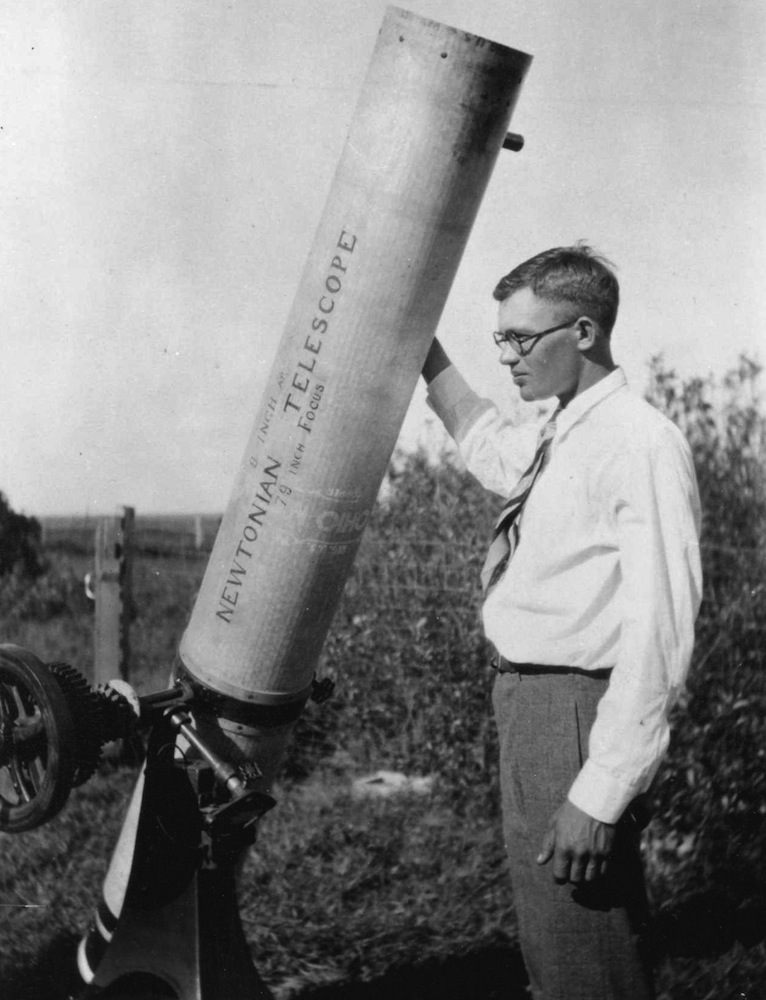
Pictured: Clyde W. Tombaugh, circa 1930, with the homemade 9-inch telescope whose optical quality helped win him his position at Lowell Observatory — not a photograph of the 1949 sighting itself, since no camera was in hand in his own backyard that night and no photograph of the event is known to exist. This is a genuine, public-domain photograph of the witness whose professional credentials are the central evidentiary asset of this case. (Public domain, published in the U.S. before 1964 without a renewed copyright notice; Wikimedia Commons, cropped from Popular Science Monthly, June 1930.)
Theoretical Alignment
The case aligns only weakly with the Extraterrestrial Hypothesis, and the record is unusual in that the witness most central to the case — Tombaugh himself — explicitly argued against it, laying out a probabilistic case that interstellar visitation within any given human lifetime was staggeringly unlikely given the distances and timescales involved. What keeps any ETH alignment above zero is simply that Tombaugh, despite that stated skepticism, never identified a confirmed conventional cause either, and stressed that in a lifetime of expert sky-watching he had "never seen anything like it before or since." It aligns even more weakly with Psycho-Social explanations: this was not a case of ambiguous misperception by an untrained observer but a specific, geometrically precise report from a professional astronomer whose entire career depended on making exactly these kinds of careful visual distinctions, corroborated within a second and a half by two family members who were not primed or coached beforehand.
Background
By the summer of 1949, Las Cruces, New Mexico was marking its centennial as a town, with a season of parades and a pageant staged at the football stadium of the New Mexico College of Agriculture and Mechanic Arts — the institution that would not become New Mexico State University in name until 1960, but whose grounds and community Tombaugh's family was already deeply embedded in. Tombaugh himself had arrived in New Mexico three years earlier, in 1946, after being let go from Lowell Observatory in Flagstaff, Arizona for what the observatory described as financial reasons, following fifteen years there during which he had done far more than discover a single planet. He joined White Sands Proving Ground, established the previous year as a proving ground for captured German V-2 rockets under Wernher von Braun's team, as Chief of Optical Measurements, responsible for developing and operating the tracking telescopes that photographed the flight paths of America's earliest guided-missile and rocket tests.
The wider skies over southern New Mexico had already become a subject of official anxiety in the months before Tombaugh's own sighting. Beginning in December 1948, a series of brilliant green fireballs had begun appearing with unusual frequency over the Los Alamos–Albuquerque–White Sands corridor — close enough to American nuclear-weapons research and storage facilities that both the Air Force and the Atomic Energy Commission treated the pattern as a live security concern rather than a routine astronomical curiosity. Lincoln La Paz, a University of New Mexico meteor specialist with direct Air Force Office of Special Investigations backing, led the resulting classified investigation, ultimately organized as Project Twinkle in 1950. It was against this specific backdrop — an unusually well-instrumented, unusually closely watched stretch of American sky, already generating one classified anomaly investigation — that Tombaugh had his own encounter.
On the night of August 20, 1949, Tombaugh, his wife Patricia, and his mother-in-law were in the backyard of the Tombaugh home, simply enjoying what Tombaugh would later specifically describe as a sky of "rare transparency" — the kind of exceptionally clear, low-turbulence night that a professional visual observer notices and values in its own right, independent of any plan to search for anything unusual. There is no suggestion in any account that the three had gone outside expecting to see anything out of the ordinary; they were, by every surviving description, simply enjoying the sky as astronomers and their families in the arid Southwest often did.
Complete Timeline
| Date / Time | Event |
|---|---|
| Feb 18, 1930 | Clyde Tombaugh, a 24-year-old self-taught telescope maker working at Lowell Observatory, discovers the planet Pluto by comparing photographic plates with a blink comparator — the achievement that establishes his lifelong professional and public identity as an astronomer of the first rank. |
| 1946 | Tombaugh, dismissed from Lowell Observatory the previous year, joins White Sands Proving Ground as Chief of Optical Measurements, developing and operating the tracking telescopes used to photograph V-2 and early guided-missile test flights. |
| Dec 1948 | The first of the "green fireballs" begin appearing with unusual frequency over the Los Alamos–White Sands corridor of New Mexico, drawing direct Air Force and Atomic Energy Commission security concern. |
| May 12, 1949 | Naval guided-missile liaison officer Commander Robert McLaughlin writes to physicist James Van Allen relaying that Tombaugh had told him of a bright flash he observed on Mars on August 27, 1941 — an offhand, explicitly speculative aside Tombaugh had by then come to associate with the possibility of an atomic detonation, unrelated in substance to the sighting later that August. |
| Aug 20, 1949, ~10:45 PM | In the backyard of his Las Cruces home, Tombaugh spots an array of pale yellowish-green rectangular lights moving rapidly southeast and calls it to the attention of his wife Patricia Tombaugh and his mother-in-law. |
| Same moment, ~3 seconds total | The array — six to eight rigid, window-like rectangles arranged in a fixed geometric pattern, subtending roughly 1° of sky — crosses an estimated 50–60° of sky from near the zenith, foreshortening and dimming as it descends, and vanishes roughly 35° above the southeastern horizon. No sound is heard at any point. Tombaugh's wife sees roughly the final second and a half and reports a faint glow she thought connected the individual rectangles. |
| c. 1950–1951 (exact date undocumented) | Alone at a White Sands-area observatory, Tombaugh observes a second, far brighter object of roughly magnitude −6 — about four times brighter than Venus at its most brilliant — crossing from the zenith to the southern horizon in about three seconds, executing what he describes as the same behavior as the 1949 object. |
| Nov 27, 1951 | Project Twinkle, the Air Force's classified green-fireball investigation led by La Paz, issues its final report, recommending no further funding and specifically citing Tombaugh as having "never observed an unexplainable aerial object despite his continuous and extensive observations of the sky" — a characterization seemingly in tension with his own, separately and consistently documented reports. |
| June 1952 | Project Blue Book scientific consultant J. Allen Hynek secretly surveys fellow astronomers at a convention; Tombaugh and Lincoln La Paz are among five who describe personal sightings, and Tombaugh offers the Air Force use of his telescopes for UFO photography if properly alerted in advance. |
| 1955 | Tombaugh joins the faculty of the New Mexico College of Agriculture and Mechanic Arts in Las Cruces (renamed New Mexico State University in 1960), where he builds what becomes one of the nation's leading university astronomy programs. |
| Jan 1957 | An Associated Press article in the Alamogordo Daily News, "Celestial Visitors May Be Invading Earth's Atmosphere," again quotes Tombaugh; he confirms he has observed phenomena he cannot explain but has seen none personally since 1951 or 1952, describing them as appearing "directed" and "unlike any other phenomena I ever observed." |
| 1956 | Capt. Edward J. Ruppelt, former head of Project Blue Book, gives the case one of its earliest and most detailed published tellings in The Report on Unidentified Flying Objects (pp. 47–56). |
| 1963 | Harvard astronomer Donald H. Menzel and Lyle G. Boyd give the case its most detailed skeptical treatment in The World of Flying Saucers (pp. 266–270), reproducing Tombaugh's own preference for a temperature-inversion optical explanation. |
| Jan 17, 1997 | Tombaugh dies in Las Cruces at age 90; astronomer and biographer David H. Levy's obituary, circulated by the American Astronomical Society's Division for Planetary Sciences and archived by UFO Evidence, reaffirms the sighting as part of the public record of his life. |
| 2001–present | Researcher Brad Sparks' Comprehensive Catalog of Project Blue Book UFO Unknowns, maintained and hosted by NICAP, lists the case as Unknown entry #269, still formally unresolved. |
The Sighting, Second by Second
What makes the Tombaugh case unusual in the UFO literature is not its length or its drama — measured in raw duration it is one of the briefer entries in the entire Project Blue Book Unknown file — but the precision with which its central witness was able to describe an event that, by his own account, lasted no more than three seconds. Tombaugh was the one who first noticed the lights, high overhead, and had perhaps a second or two of advance warning over his wife and mother-in-law before he called out; his wife's own window of observation, by contrast, covered only the final second and a half or so of the object's visible transit, meaning she caught it already well along its path and fading. This detail matters for how the case should be read: it is not two independent three-second observations that happen to agree, but one continuous three-second event witnessed by Tombaugh from beginning to end and corroborated, for its final third or so, by two family members reacting to his call.
The object itself was described with unusual specificity for so brief a sighting. Rather than a single point of light or an amorphous glow, Tombaugh described a rigid formation of six to eight individual rectangles of light, "window-like" in appearance — his own word, chosen because the effect strongly suggested illuminated openings set into the side of a solid, dark structure, the way lit windows read against the dark hull of a passing ship or aircraft at night, rather than free-floating or independently moving points. The color was pale yellow shading toward green — described elsewhere in the primary Project Blue Book catalog record as "faint bluish-green" — a description all three witnesses' recollections broadly agreed on. The rectangles held a fixed, symmetric geometric arrangement relative to one another throughout the sighting; nothing in Tombaugh's account suggests the individual lights moved independently or changed their relative positions, which is itself informative, since it argues against a loose formation of independently piloted or independently drifting light sources and toward either a single rigid structure or a single, coherent optical phenomenon being observed as a unit.
The array's motion was equally specific. It appeared to originate near the zenith — directly, or nearly directly, overhead — and crossed an estimated 50 to 60 degrees of sky toward the southeast in the space of about three seconds, a rate of angular motion far too fast to be explained by any conventional aircraft of the period at any plausible altitude, and, as both Tombaugh and later analysts pointed out, considerably too slow and too smoothly continuous to be explained by a meteor. As it moved, the array foreshortened — the apparent spacing between the rectangles compressed, consistent with the object's presenting an increasingly oblique, edge-on aspect to the observers as it moved away from directly overhead toward the horizon — and dimmed steadily, vanishing from view at approximately 35 degrees of elevation above the horizon rather than continuing down to the horizon itself. Applied together, the foreshortening and the fading are the two details most frequently cited by researchers weighing whether the object was receding into the distance (consistent with dimming due to increasing range) or whether it was instead an optical phenomenon — a reflection off some atmospheric boundary — whose visibility simply depended on geometry between the observers, the reflecting layer, and whatever light source it was reflecting.
Throughout, the sighting was completely silent. Given the implied angular velocity, any conventional aircraft producing the same apparent motion at a plausible altitude would have been traveling at a speed and proximity that should have produced audible engine noise; its complete absence was one of the specific details Tombaugh cited in ruling out aircraft. Brad Sparks' Project Blue Book catalog entry for the case offers a purely hypothetical scale calculation, explicitly marked as conditional: if the object had passed directly overhead at an altitude of roughly one mile, its implied physical size would have been on the order of 100 feet and its implied velocity roughly 1,700 miles per hour — supersonic, though this figure depends entirely on an assumed altitude that was never actually measured or confirmed, and should be read as illustrative of the object's apparent angular speed rather than as an established physical fact about the object itself.
Tombaugh's Own Words and His Own Skepticism
The single most quoted sentence from the case is Tombaugh's own reaction, given in his own later written account: "I doubt that the phenomenon was any terrestrial reflection, because... nothing of the kind has ever appeared before or since... I was so unprepared for such a strange sight that I was really petrified with astonishment." Read in isolation, the quote is often presented as evidence that Tombaugh believed he had witnessed something genuinely extraordinary — and in the narrow sense that he could not identify a satisfying conventional cause, that reading is accurate. But the full context of his own writing on the subject complicates any simple "credible witness confirms UFO" framing, in a way that is itself part of what makes the case valuable rather than something to gloss over.
Tombaugh explicitly and repeatedly declined to endorse the extraterrestrial-spacecraft interpretation that has often been attached to his name in popular UFO literature. He laid out his own reasoning in plain, quantitative terms: "From my own studies of the solar system I cannot entertain any serious possibility for intelligent life on other planets, not even for Mars... The logistics of visitations from planets revolving around the nearer stars is staggering. In consideration of the hundreds of millions of years in the geologic time scale when such visits may have possibly occurred, the odds of a single visit in a given century or millennium are overwhelmingly against such an event." Instead, he proposed his own preferred natural explanation, one grounded specifically in the physics of the sighting he had just described: "A much more likely source of explanation is some natural optical phenomenon in our own atmosphere. In my 1949 sightings the faintness of the object, together with the manner of fading in intensity as it traveled away from the zenith towards the southeastern horizon, is quite suggestive of a reflection from an optical boundary or surface of slight contrast in refractive index, as in an inversion layer."
Yet even having proposed that explanation himself, Tombaugh did not claim to have confirmed it, and he was careful to note how genuinely unusual the underlying event remained to him personally: "I have never seen anything like it before or since, and I have spent a lot of time where the night sky could be seen well. This suggests that the phenomenon involves a comparatively rare set of conditions or circumstances to produce it, but nothing like the odds of an interstellar visitation." That combination — a specific, physically plausible natural explanation offered by the best-qualified person in the room to offer one, paired with an explicit admission that he had never personally observed the necessary conditions for that explanation to occur under any other circumstance, in a career built substantially on exactly that kind of sustained sky observation — is the honest core of the case's continuing evidentiary puzzle. It is neither a confident "I saw a spacecraft" claim nor a confident "I saw a known optical artifact" claim; it is a genuinely unresolved, self-aware account from the single most qualified witness available to give one.
The Second Sighting: White Sands, c. 1950–1951
The 1949 Las Cruces event was not, by Tombaugh's own account, an isolated experience. A year or two later — the surviving record gives no more precise date, though Tombaugh's own 1957 statement that he had observed nothing further personally "since 1951 or 1952" brackets the event to sometime in 1950 or early 1951 — Tombaugh was alone at an observing post associated with his work at White Sands when he saw a second anomalous object. This one was considerably brighter than the 1949 array: Tombaugh estimated its magnitude at roughly −6, a professional visual-astronomy judgment meaning the object was, to the naked eye, approximately four times brighter than the planet Venus at Venus's own most brilliant. For comparison, Venus at maximum brightness reaches roughly magnitude −4.7, itself bright enough to be visible in full daylight to a careful observer who knows where to look; an object at magnitude −6 would have been strikingly, unmistakably bright against the night sky, impossible to confuse with any star or planet.
The object's reported behavior closely echoed the first sighting: it crossed from near the zenith to the southern horizon in approximately three seconds — the same extreme angular rate as the 1949 array — and Tombaugh described it as executing "the same maneuvers" as the earlier object. Beyond that comparison, however, the surviving documentation of the second sighting is considerably thinner than for the first. It survives principally through a secondhand account published by researcher Brad Steiger in his 1976 book Project Blue Book, rather than through a detailed contemporaneous statement of Tombaugh's own comparable to the 1949 account preserved by Ruppelt and by Menzel and Boyd. No third-party witnesses are documented for the second event; so far as the public record shows, Tombaugh was alone when it occurred.
Evaluated on its own, the second sighting adds real but limited evidentiary weight to the case as a whole. Its principal value lies in showing that the 1949 event was not a singular, never-repeated anomaly in Tombaugh's own experience of the sky — the same witness, using the same professional observational skills, reported a structurally similar phenomenon (extreme angular speed, a transit from zenith toward the horizon, no confirmed conventional identification) on a second, separate occasion, at a different location, roughly one to two years apart. That repetition is difficult to explain as ordinary misperception, since Tombaugh was, by definition, exactly the kind of observer least likely to mistake a plane, balloon, or bright planet for something else on a single occasion, let alone twice. At the same time, the second sighting is single-witness, imprecisely dated, and known to researchers today largely at second hand, which limits how much independent weight it can responsibly carry beyond corroborating that the category of experience recurred.
Green Fireballs, Project Twinkle, and a Documentary Contradiction
Tombaugh's UFO reports did not end with the two rectangular-light and bright-object sightings. He also later reported having personally observed three of the "green fireballs" that began appearing over New Mexico in December 1948 and continued at least into the early 1950s — a phenomenon distinct in character from the 1949 array (fireballs were typically described as brilliant green meteor-like streaks rather than structured formations of rectangular lights) but occurring in the same place, over the same years, and reported by many of the same class of trained observers, including Lincoln La Paz, who led the Air Force's classified investigation into them.
That investigation, organized in 1950 as Project Twinkle and built around fixed observing posts intended to triangulate and photograph the fireballs using standard astronomical techniques, ultimately recorded few confirmed observations before its funding lapsed. Its final report, dated November 27, 1951, recommended against further funding and is notable for one specific, citable detail directly relevant to this case: the report describes Tombaugh as a control data point supporting the argument that the fireballs might not represent a genuine unexplained phenomenon at all, stating that "Clyde Tombaugh, discoverer of the planet Pluto and now engaged in activities at White Sands, never observed an unexplainable aerial object despite his continuous and extensive observations of the sky." This is worth stating plainly rather than glossing over, because it sits in real, documented tension with Tombaugh's own, separately and repeatedly recorded statements — the 1949 sighting, the White Sands sighting a year or two later, and his own account of personally seeing three green fireballs. The most likely honest reading is not that either account is fabricated, but that the Project Twinkle report's author was drawing a narrower distinction than the plain language suggests: treating Tombaugh's own, self-described optical-phenomenon hypothesis for the 1949 sighting as placing it outside the category of a confirmed "unexplainable" object by the report's own internal definition, even though Tombaugh himself never actually confirmed that explanation. Whatever the explanation for the discrepancy, it is a genuine, documented inconsistency in the official-adjacent record, not an invention of later UFO researchers.
Public Statements, the Hynek Survey, and the Near-Earth Satellite Search
Tombaugh's sightings became, over the following years, a recurring and consistent thread in his public statements, never sensationalized and never retracted. In June 1952, astronomer J. Allen Hynek, serving at the time as Project Blue Book's scientific consultant, quietly surveyed colleagues at an astronomy convention about their own UFO experiences and attitudes — a survey conducted discreetly precisely because open interest in the subject carried real professional risk for a working astronomer. Tombaugh and four other astronomers, including La Paz, told Hynek about sightings they could not fully explain. Tombaugh went further than simply reporting his own experience: he told Hynek that his telescopes at White Sands were available to the Air Force for photographing UFOs, if he were given adequate advance notice — a concrete, practical offer from a working scientist rather than a rhetorical gesture.
That offer appears to have fed directly into a genuine, if little-remembered, Cold War-era research program. Beginning in late 1953, the Army Office of Ordnance Research sponsored a search, involving Tombaugh, for natural satellites that might already be orbiting the Earth — a real scientific question in the years before Sputnik, since no artificial satellite yet existed and the presence or absence of a natural one mattered for future space-station planning. The program became entangled, without any real basis, in contemporaneous rumors relayed by NICAP founder Donald Keyhoe that classified radar had already detected one or two such objects; a 1954 Aviation Week article repeated the claim, and it spread through several major newspapers before both La Paz and Tombaugh issued clear, on-the-record public denials that anything had been found. Tombaugh's own final report on the search, issued in 1959, confirmed that nothing had been discovered. The episode is a useful data point in assessing Tombaugh's overall credibility as a witness: faced with a highly publicized rumor that would have been easy to simply let stand, or to use to draw further public attention to his own UFO sightings, he instead moved quickly and consistently to correct the record — the behavior of a scientist protecting the integrity of a specific factual claim, not someone inclined toward exaggeration.
Tombaugh's most extensive later public statement on his sightings came in January 1957, in an Associated Press wire article published in the Alamogordo Daily News under the headline "Celestial Visitors May Be Invading Earth's Atmosphere." He again confirmed he had personally observed celestial phenomena he could not explain, but was careful to note he had seen nothing further himself since 1951 or 1952 — consistent with the White Sands sighting having occurred in that narrow window. He offered a broader, speculative reflection on the statistical likelihood of life on other worlds, while returning to a specific, physically grounded description of what had made his own sightings stand out: "These things, which do appear to be directed, are unlike any other phenomena I ever observed. Their apparent lack of obedience to the ordinary laws of celestial motion gives credence." That final phrase — motion inconsistent with "the ordinary laws of celestial motion" — is Tombaugh speaking in his own professional register: not claiming to know what he saw, but stating precisely, as an expert in celestial motion, what it was not.
Clyde Tombaugh: Life and Scientific Credentials
Because this case's evidentiary weight rests overwhelmingly on the character and competence of a single witness, that witness's full biography is not background color but the central exhibit. Clyde William Tombaugh was born February 4, 1906, in Streator, Illinois, and grew up on family farms in Illinois and, after 1922, Kansas, following financial setbacks that ended his family's hope of sending him to college in any conventional way. He developed an early, self-directed passion for astronomy, and beginning around 1926 he taught himself to grind telescope mirrors and lenses by hand, eventually building a series of homemade reflecting telescopes of genuinely superior optical quality — going so far as to excavate an eight-by-seven-by-twenty-four-foot pit on the family farm specifically so he could test his mirrors under stable, controlled temperature conditions, a level of self-taught rigor unusual in an amateur of any era.
In 1928, with no formal astronomical training and no college degree, Tombaugh sent a set of his own detailed telescopic sketches of Jupiter and Mars to Lowell Observatory in Flagstaff, Arizona, simply hoping for professional feedback. Observatory director V. M. Slipher was impressed enough by the quality of the work to offer the 22-year-old farm boy a paid position operating Lowell's new 13-inch photographic telescope, built for one specific purpose: systematically searching the sky for the trans-Neptunian "Planet X" that Lowell Observatory's founder, Percival Lowell, had spent the final years of his own life trying and failing to find. Tombaugh's job was to photograph pairs of sky plates on different nights and then examine them, one after another, on a blink comparator — a device that rapidly alternates between two images of the same star field, making any object that has shifted position between exposures appear to "blink" against the fixed background of more distant stars. It is exacting, repetitive, eye-straining work, and Tombaugh, within his first year on the job, redesigned the observing program itself for greater efficiency.
On February 18, 1930, examining a pair of plates centered on the star Delta Geminorum, Tombaugh spotted a faint, fifteenth-magnitude point of light shifting position between the two exposures exactly as a distant, slow-moving trans-Neptunian planet should. Lowell Observatory announced the discovery to the world on March 13, 1930 — deliberately chosen as both the anniversary of Uranus's 1781 discovery and Percival Lowell's own birthday — and the new planet was formally named Pluto on May 1, 1930, a name proposed by an eleven-year-old English schoolgirl, Venetia Burney, in part because its first two letters honored Percival Lowell's initials. Tombaugh was 24 years old, had never attended a day of college, and had just made one of the most significant astronomical discoveries of the twentieth century using equipment and techniques he had substantially helped design himself.
The discovery of Pluto was, by Tombaugh's own account and by every biographer's, the beginning of his career rather than its capstone. He continued searching Lowell's plates for another fifteen years, ultimately discovering hundreds of asteroids — beginning with 2839 Annette in 1929, named decades later for his own daughter — along with a periodic comet, several open star clusters, a globular cluster, and what he identified as evidence of a vast supercluster of galaxies stretching from the Andromeda constellation toward Perseus, an early observational contribution to what astronomers now call cosmic large-scale structure. In 1932 he discovered a nova in the constellation Corvus that had actually exploded a year earlier; the object, later designated TV Corvi, would not be properly recognized as a recurrent nova system until decades of further archival work by his own biographer, David H. Levy, in 1989 and 1990. While pursuing this research, Tombaugh also completed the formal education his family's early hardship had denied him, earning a bachelor's degree in astronomy from the University of Kansas in 1936 and a master's degree in 1938 or 1939, while continuing his observing work at Lowell during summers. It was at the University of Kansas, in 1934, that he married fellow student Patricia "Patsy" Edson, who would remain his wife for the rest of his life and who stood beside him in his own backyard fifteen years later when the 1949 sighting occurred.
Tombaugh's departure from Lowell Observatory in 1945, after a wartime interval teaching naval navigation, was officially attributed to financial constraints at the observatory rather than to any failing of his own; within a year he had moved his family to New Mexico and begun the White Sands work already described. In 1955 he joined the faculty of what was then the New Mexico College of Agriculture and Mechanic Arts in Las Cruces, and over the following years built its astronomy program into what several contemporaries and later historians of American astronomy would describe as one of the strongest in the country, formalized as a standalone Department of Astronomy in 1970 and marked by the 1972 dedication of the Clyde W. Tombaugh Observatory on campus. His signature project there, the Planetary Patrol, produced systematic long-term observations that helped determine the rotation period of the planet Mercury and tracked the long-term behavior of Jupiter's Great Red Spot. He retired in 1973 but remained scientifically and publicly active for another two decades, touring the country between 1985 and 1990 to raise funds for the Tombaugh Scholars program at his university.
His honors accumulated across his career: the Royal Astronomical Society's Jackson-Gwilt Medal in 1931, recognizing the Pluto discovery within a year of the announcement; an honorary doctorate from Northern Arizona University; induction into the International Space Hall of Fame in 1980, the same year he co-authored the memoir Out of the Darkness: The Planet Pluto with British astronomer Patrick Moore; and the American Academy of Achievement's Golden Plate Award in 1991, presented by Nobel laureate Glenn T. Seaborg. In 1965, veteran observational astronomer Robert S. Richardson singled Tombaugh out, alongside Percival Lowell himself, as one of the two greatest living visual observers of the era — a judgment offered specifically about the acuity and reliability of his eye, the same faculty at the center of the 1949 sighting nearly two decades later. Those who knew him personally, including his biographer and close friend David H. Levy, remembered him as an unusually engaging, quick-witted presence, famous among colleagues for his puns and his precise command of English, right up to his death in Las Cruces on January 17, 1997, at age 90.
Tombaugh's connection to Pluto did not end with his death. His ashes were cremated, and a small portion was carried aboard NASA's New Horizons spacecraft, launched in 2006, inscribed with a dedication identifying him as "discoverer of Pluto and the Solar System's 'third zone.'" When New Horizons became the first spacecraft to fly past Pluto on July 14, 2015, mission scientists named the heart-shaped bright plain at the center of their first close-up images "Tombaugh Regio" in his honor — a fitting postscript for a man whose entire adult identity, professional reputation, and this case's evidentiary weight rested on the same trained, careful, skeptical eye he first turned on the night sky as a self-taught Kansas farm boy.
Key Researchers
- Capt. Edward J. Ruppelt — Former head of Project Blue Book, whose 1956 book The Report on Unidentified Flying Objects gave the Tombaugh case one of its earliest and most detailed published treatments (pp. 47–56), drawing directly on official Air Force case files.
- Dr. Donald H. Menzel — Harvard astronomer and the era's most prominent professional UFO skeptic, whose 1963 book (with Lyle G. Boyd) The World of Flying Saucers devoted several pages (266–270) to the case, reproducing and endorsing Tombaugh's own temperature-inversion hypothesis at length.
- Dr. J. Allen Hynek — Project Blue Book's scientific consultant, who secretly surveyed Tombaugh and fellow astronomers about their UFO sightings in June 1952 and later developed the Nocturnal Light classification under which this case is filed.
- Dr. Lincoln La Paz — University of New Mexico meteor-astronomy specialist who led the Air Force's Project Twinkle investigation into the concurrent green-fireball phenomenon and, alongside Tombaugh, was one of the astronomers who described a personal sighting to Hynek in 1952.
- Brad Sparks — UFO researcher and statistician whose ongoing Comprehensive Catalog of Project Blue Book UFO Unknowns, hosted by NICAP, catalogs the Tombaugh sighting as Unknown case #269, preserving the Air Force's own unresolved classification.
- David H. Levy — Astronomer, prolific comet discoverer, and Tombaugh's close friend and biographer, whose 1991 biography Clyde Tombaugh: Discoverer of Planet Pluto and 1997 obituary remain primary sources for Tombaugh's life and character independent of the UFO case itself.
Key Witnesses
Clyde W. Tombaugh
Primary witness to both sightings and the case's entire evidentiary foundation. A professional observational astronomer with two decades of expert sky-watching experience by 1949, Tombaugh watched the six-to-eight-light rectangular array for its full roughly three-second duration and, a year or two later, alone observed the far brighter magnitude −6 object at White Sands. He explicitly rejected an extraterrestrial-spacecraft interpretation of his own sighting while also declining to fully confirm his own preferred natural-optical explanation, stating plainly that he had "never seen anything like it before or since" in a career built on exactly that kind of sustained observation.
Patricia Tombaugh
Corroborating witness to the 1949 sighting, alerted by her husband's call and catching roughly the final second and a half of the object's transit before it faded from view — independently reporting what she took to be a faint glow interconnecting the individual rectangles of light, a detail her husband's own account does not claim to have seen himself. A University of Kansas philosophy graduate who married Tombaugh in 1934, she went on to a long career as a Las Cruces elementary school teacher and was a founding member of the city's Unitarian Universalist congregation.
Tombaugh's Mother-in-Law
The third witness present in the Tombaugh backyard on the night of August 20, 1949, alerted alongside Patricia Tombaugh by Clyde Tombaugh's call and reported to have seen the object in the same brief final window before it faded from view. No source reviewed for this case file identifies her by name; she is referenced in every account, from Tombaugh's own to the official Project Blue Book catalog entry, only by her relationship to the primary witness.
The Five Observables Assessment
Assessment: Neither sighting reported anything resembling a hover, a sudden reversal, or a sustained stationary phase, so anti-gravity lift and instant acceleration are both classified as absent rather than merely unconfirmed — the object's motion, however fast, was described as a single continuous transit in both 1949 and c.1950–51. Hypersonic velocity is classified as speculative rather than present or absent: the object's angular rate implies a very high true velocity only under an assumed altitude that was never independently measured, so any specific speed figure — including the catalog's own illustrative ~1,700 mph estimate — remains conditional rather than confirmed. Low observability is explicitly absent: the object was self-luminous or clearly reflective and was seen without any difficulty by every witness who looked, however briefly. No trans-medium transition of any kind was reported in either sighting.
Evidence Assessment
Supporting Anomalous Origin
- The primary witness was among the most qualified visual sky-observers alive in 1949 — a professional astronomer who had discovered a planet and spent two decades correctly distinguishing real celestial and man-made objects from artifacts and misidentifications
- Tombaugh explicitly and by profession ruled out aircraft, meteors, and known astronomical objects, the categories he was best positioned of any witness on record to correctly rule out
- Two additional family witnesses independently confirmed seeing the object in the same brief window, one of them reporting a specific detail (an interconnecting glow) Tombaugh's own account does not claim
- The object's behavior — a rigid, symmetric formation of lights, unaccompanied by sound despite an extreme angular rate — has no straightforward conventional analogue for 1949
- A second, far brighter object was independently observed by the same witness a year or two later, exhibiting comparable behavior, arguing against a one-off misperception
- Project Blue Book never assigned any specific conventional identification to the case; it remains formally catalogued as an Unknown to this day, entry #269 in the most comprehensive available Blue Book Unknowns compilation
- Tombaugh's own statement that he had "never seen anything like it before or since" despite a lifetime of expert sky-watching is a specific, checkable claim about the rarity of the event from the one witness best positioned to judge it
Supporting Conventional Explanation
- Tombaugh himself never endorsed an anomalous or extraterrestrial origin, and proposed his own natural-optical explanation unprompted, grounded in the object's specific fading and foreshortening behavior
- The sighting's extreme brevity (~3 seconds) sharply limits how much detail even a trained observer could reliably register, and leaves essentially no margin for follow-up observation or instrumentation
- Corroboration comes only from family members standing in the same yard reacting to the same call, not from independent, differently situated observers
- No photograph, radar contact, or physical trace exists for either sighting to test the testimonial account against
- The Project Twinkle final report specifically characterized Tombaugh as never having observed an "unexplainable" aerial object, suggesting at least one contemporaneous official assessment treated his sightings as consistent with a natural explanation
- The case is now more than 75 years old, and no further evidence, witness, or documentation has surfaced since Tombaugh's own last public statements in the 1950s
Why "Disputed"
The Tombaugh sighting earns a DISPUTED rating because it is, honestly, exactly what that label describes: a case where the available evidence genuinely does not resolve cleanly in either direction, and where the single most qualified voice in the record — the witness himself — never resolved it either. Clyde Tombaugh brought a level of individual observational credibility to this sighting that few witnesses anywhere in the UFO literature can match: professional astronomer, discoverer of a planet, and by occupation the officer responsible for distinguishing real tracked flight paths from artifacts at White Sands. His explicit, specific rejection of aircraft, meteors, and known astronomical objects carries real evidentiary weight precisely because ruling out those categories was his actual professional competence. That credibility is reinforced by two family corroborating witnesses, by an official Project Blue Book Unknown designation that has never been overturned or replaced with a specific conventional finding, and by a credible second sighting of comparable character a year or two later.
Weighed against that is a case that remains, in the most literal sense, thin: three seconds of observation in 1949, roughly the same in the second sighting, no independent witnesses beyond Tombaugh's own household, and absolutely no instrumented, photographic, or physical evidence of any kind to test the testimony against — a real contrast with cases like Red Bluff, which at least briefly had an independent radar cross-check, however quickly retracted. Most importantly, this case lacks the specific feature that has elevated other testimonially-anchored sightings on this site into the Credible tier: a demonstrably flawed official explanation for skeptics to point to and for researchers to independently refute. No such explanation was ever issued here — Blue Book simply left the case as an Unknown, and Tombaugh himself proposed and half-endorsed a specific, physically reasonable natural explanation without ever confirming it. A case whose own best witness remains genuinely undecided, sitting between "I doubt it was a terrestrial reflection" and "a much more likely source of explanation is some natural optical phenomenon," is not a case the Omni Ledger's editorial standard can respectably file as resolved in either direction. That combination — extraordinary individual witness quality, a real and unresolved official Unknown status, and an honest absence of the corroborating instrumentation or the collapsed official explanation that would push it higher — places the Tombaugh sighting solidly at the upper end of the Disputed tier, immediately adjacent to, but not quite across the line into, Credible.
Sensor & Instrumentation Detection Profile
No instrumentation of any kind was tasked on the object in either sighting. The 1949 event took place in Tombaugh's own residential backyard, not at a tracking station, and no telescope, camera, or radar set was in operation or in hand at the moment the lights appeared — the entire event, start to finish, lasted about three seconds, far too brief a window for even a trained observer to reach for equipment. Unlike the Red Bluff case four years later, no radar station was contacted that night and no radar log exists to check the account against. The single meaningful "instrumentation" present was Tombaugh's own trained visual estimation faculties: as a professional astronomer who spent his working life estimating stellar magnitudes, angular separations, and rates of motion by eye, his description of the object's ~1° angular size and its transit of 50–60° of sky in roughly three seconds carries more calibrated precision than an equivalent estimate from an untrained witness would. The undated second sighting at a White Sands-area observatory a year or two later is similarly uninstrumented in the surviving record, though it occurred at an actual observing post rather than a private backyard; no telescope was reportedly trained on the object either time, and Tombaugh's magnitude −6 estimate for that second object is again a trained naked-eye judgment, not a photometer reading.
Environmental & Geospatial Context
Las Cruces sits in the Mesilla Valley of the Rio Grande in south-central New Mexico, a farming and college town roughly forty miles north of the main cantonment area of White Sands Proving Ground and a comparable distance from Holloman Air Force Base near Alamogordo. The valley offers wide, largely unobstructed sightlines in most directions, framed by the Organ Mountains to the east. Tombaugh's own account stresses that the sky that night was exceptionally clear — he used the specific phrase "rare transparency," a professional astronomer's term of art for unusually low atmospheric turbidity, the kind of night serious visual observers watch for and remember. No clouds, haze, or other obscuring conditions are mentioned in any surviving account of either sighting. The region was, at the time, one of the most instrumented and closely watched patches of sky in the country: White Sands Proving Ground had been testing captured German V-2 rockets since 1946 under a team that included Wernher von Braun, and the same broad region was, simultaneously, the epicenter of the "green fireball" phenomenon that had begun appearing over New Mexico only eight months earlier, in December 1948, and that had already drawn direct Air Force and Los Alamos National Laboratory security interest given the area's proximity to nuclear-weapons research and storage.
Observer Credibility & Occupational Profile
This case exists, and is discussed at all nearly eight decades later, almost entirely because of who its primary witness was. Clyde W. Tombaugh was not an amateur stargazer or a passing member of the public: by August 1949 he had spent more than two decades as a professional, internationally recognized observational astronomer, had personally discovered the planet Pluto in 1930 using exactly the kind of painstaking, skeptical, error-checking visual and photographic comparison work that UFO investigators would spend the following decades wishing more witnesses possessed, and was at that moment professionally employed by the U.S. Army at White Sands Proving Ground as Chief of Optical Measurements — the officer directly responsible for the tracking telescopes photographing the flight paths of the earliest American guided missiles and captured V-2 rockets. Few people on Earth in 1949 had spent more cumulative hours deliberately watching the sky for small, fast-moving points of light and correctly distinguishing planets, meteors, satellites of no kind yet existed, aircraft, and instrumental artifacts from one another than Tombaugh had. This is precisely the professional skill set most directly relevant to correctly identifying — or correctly failing to identify — an anomalous aerial object, and it is why this case is cited as often as it is in the UFO literature's ongoing argument about whether witness training matters.
It is equally important, in the interest of the same rigor Tombaugh himself practiced, not to overstate what that credibility does and does not establish. Tombaugh's expertise made him an unusually reliable reporter of what he saw — the apparent shape, color, angular size, and rate of motion of the array of lights — and an unusually reliable judge of what it was not (a plane, a balloon, a satellite, a simple meteor). It did not give him privileged access to what the object actually was, and Tombaugh never claimed otherwise. He was, if anything, the single most publicly cautious available voice on his own case: he explicitly rejected the extraterrestrial-spacecraft interpretation that has often been attached to his name in later retellings, offered his own preferred natural-phenomenon explanation unprompted, and grounded his skepticism about interstellar visitation in a specific, quantitative argument about the astronomical odds involved. His wife, Patricia Tombaugh, held a philosophy degree from the University of Kansas and went on to a long career as an elementary school teacher and community leader in Las Cruces; she is not documented as having independently characterized the object beyond confirming what she saw in her briefer window of observation, roughly a second and a half. Tombaugh's mother-in-law, the third witness, is not named in any source reviewed for this file. The result is a witness pool of exceptional quality at its center but limited independence: two of the three observers were the same person's spouse and mother-in-law, standing in the same yard, alerted to look by the same call, rather than unrelated observers at separate vantage points of the kind that strengthen cases like Lubbock Lights or Red Bluff.
Physical & Material Assays
No physical evidence of any kind exists for either sighting. Nothing was recovered, no ground trace was reported (nor would one be expected from an object that never approached the ground), and no photograph, sketch, or film is known to survive from either the 1949 Las Cruces event or the c.1950–51 White Sands event, despite Tombaugh's own professional access to cameras and telescopes — the sightings were simply too brief, at roughly three seconds apiece, for any equipment to be brought to bear. The case rests entirely on testimonial recollection, first given close to the event and repeated with notable consistency by Tombaugh himself across public statements spanning 1949 through at least 1957.
Historical Precedents & Archive Matches
The Tombaugh case sits inside a small, specific category the UFO literature calls "astronomer sightings" — reports from professional, credentialed sky-watchers, a group researchers have generally weighted more heavily than average civilian reports precisely because of occupational training, and a group that is numerically tiny. Tombaugh was not the only professional astronomer active in New Mexico in this period to report anomalous aerial phenomena: Dr. Lincoln La Paz, the University of New Mexico meteor-astronomy specialist who led the Air Force's official investigation into the green fireballs, independently regarded that phenomenon as inconsistent with any known natural process. In June 1952, astronomer J. Allen Hynek, then serving as Project Blue Book's scientific consultant, secretly surveyed colleagues at an astronomy convention about their own UFO sightings and attitudes; Tombaugh and La Paz were two of five astronomers who told Hynek about personal sightings they could not explain. Two years after the Tombaugh sighting, the same general region produced the White Sands radar-visual-photographic sighting of July 1951, involving trained Army radar operators. A closer structural match is the Lubbock Lights case of August 1951, in which a formation of lights crossing the night sky was independently reported by a group of Texas Technological College science professors — another instance of a formation-of-lights report anchored by unusually credentialed witnesses. The case is formally preserved in the most authoritative available compilation of Project Blue Book's unresolved files: Brad Sparks' Comprehensive Catalog of Project Blue Book UFO Unknowns, hosted by NICAP, lists the Tombaugh sighting as entry #269, drawing on the AFOSI-La Paz catalog of May 1950 and the Saunders/FUFOR case index, and it remains catalogued there as an Unknown to this day — unlike many Blue Book cases, no specific conventional identification was ever formally assigned to it, favorably or unfavorably.
Material Analysis
There is no physical or material evidence associated with either the 1949 Las Cruces sighting or the c.1950–51 White Sands sighting in any conventional sense — no soil disturbance, no recovered fragments, no burn marks, no metallurgical or isotopic samples of any kind. Both events were purely visual, lasted only a few seconds, and involved no landing, no close-range approach, and no claimed physical aftermath to the witnesses or the surrounding terrain. Unlike cases in which a professional witness's equipment happened to be trained on the sky at the critical moment, Tombaugh's own telescopes and cameras — genuinely available to him both as a private citizen and through his White Sands post — were not in use during either sighting; both occurred as brief, unplanned events witnessed with the naked eye. The absence of any physical trace or instrumented record is itself a meaningful, if unglamorous, data point: it means the case's entire evidentiary weight sits on testimonial recollection, however unusually well-credentialed that testimony is, with nothing external available to corroborate or contradict it.
Supporting Non-Terrestrial or Genuinely Anomalous Origin
- The complete absence of any conventional debris, trace, or wreckage is at minimum consistent with an object that never approached the ground or interacted physically with the environment, rather than evidence against the sighting itself
- Tombaugh's own writings on the case were produced and repeated consistently across public statements from 1949 through at least 1957, without embellishment or escalation over time
Supporting Terrestrial or Misidentification Origin
- A purely optical or atmospheric phenomenon — Tombaugh's own preferred hypothesis — would by definition leave no physical trace of any kind, which is exactly what the record shows
- Without any photograph, radar plot, or independent instrument reading, there is no way for modern researchers to test the original testimonial account against any external data source
The Conventional Explanation Candidate
Because the case's central witness offered his own candidate conventional explanation, this section evaluates his hypothesis on its own honest terms alongside the other leading alternatives — the Omni Ledger's standard approach is to weigh the best available conventional case exactly as seriously as the anomalous one, regardless of who is proposing it.
Temperature-Inversion Optical Reflection (Tombaugh's Own Hypothesis)
Tombaugh's own preferred explanation was that the array of lights resulted from a reflection off "an optical boundary or surface of slight contrast in refractive index, as in an inversion layer" — a real, physically well-understood atmospheric phenomenon in which a sharp temperature gradient between two air layers can bend or reflect light in ways that mimic solid, structured objects, and one Tombaugh, as a professional observer, would have had genuine reason to consider carefully rather than reach for reflexively. It fits several specific details of his own account reasonably well: the object's fading in brightness and foreshortening in apparent shape as it moved from the zenith toward the southeastern horizon is broadly consistent with a reflection whose visibility depends on the changing viewing angle between the observer, the inversion layer, and whatever light source it was reflecting, rather than with a solid object simply receding into greater distance at constant altitude. What keeps this from rising above an inconclusive rating is that Tombaugh never identified what light source such a reflection would have been reflecting, no specific inversion layer was independently measured or logged over Las Cruces that night, and Tombaugh himself, despite proposing the idea, stated plainly that he had never observed anything resembling it before or since in a career spent specifically watching for exactly this kind of atmospheric artifact.
Meteor or Bolide Fragment Train
New Mexico's skies in this period were, independently, the site of genuine and well-documented anomalous fireball activity, and any bright, fast-moving nighttime light naturally invites comparison to a meteor. But Tombaugh — a witness with direct professional experience distinguishing meteors from other phenomena — explicitly judged the object's motion too slow for a meteor, and the sustained roughly three-second duration, the complete silence, and above all the rigid, structured, multi-light rectangular formation have no analogue in ordinary meteoric fireballs, which present as a single streak or a scattering fragment trail rather than a fixed geometric array of separate lights.
Aircraft Formation or Searchlight-Illuminated Aircraft
A formation of lit aircraft windows is the most intuitive reading of Tombaugh's own "window-like" description, and deserves to be taken seriously precisely because the witness chose that comparison himself. It does not survive contact with the rest of the account: no aircraft or formation of aircraft in 1949 could cross 50 to 60 degrees of sky in three seconds at any plausible altitude without producing an angular speed far beyond period aircraft performance, and any aircraft moving at the proximity implied by that speed would have been audible, which none of the three witnesses reported. Tombaugh, whose White Sands post specifically involved distinguishing aircraft and missile flight paths from other phenomena, explicitly ruled this out himself.
Reflected Searchlight off High-Altitude Ice Crystals or Cloud
A related possibility, sometimes proposed for comparable Blue Book-era "Unknowns," is that a ground-based searchlight beam reflected or refracted through high-altitude ice crystals or a thin, otherwise invisible cloud layer could produce a moving, structured light pattern. No specific searchlight source at White Sands, Holloman, or elsewhere in the region is documented as having been in operation on the night of August 20, 1949, and Tombaugh's own account emphasizes the sky's unusual clarity rather than the presence of any cloud or ice-crystal layer needed for such a reflection — but the absence of a specific ruled-out source, rather than a demonstrated absence of the phenomenon itself, keeps this candidate inconclusive rather than fully eliminated.
Temperature-Inversion Optical Reflection (Tombaugh's Hypothesis)
InconclusiveINCONCLUSIVE. Physically plausible and consistent with the object's fading/foreshortening, and proposed by the best-qualified person to propose it — but never confirmed, with no specific inversion layer or reflected light source independently documented, and explicitly described by Tombaugh himself as unlike anything he had otherwise observed.
Meteor or Bolide Fragment Train
ImplausibleIMPLAUSIBLE. Explicitly judged too slow by the trained witness best positioned to make that call, and the sustained rigid multi-light formation has no analogue in ordinary meteoric fireballs.
Aircraft Formation or Searchlight-Illuminated Aircraft
ImplausibleIMPLAUSIBLE. No 1949 aircraft could match the implied angular speed without being audible at the implied proximity, and the witness with direct professional aircraft-tracking experience explicitly ruled it out.
Reflected Searchlight off High-Altitude Ice Crystals
InconclusiveINCONCLUSIVE. A genuine period-appropriate mechanism, but no specific searchlight source is documented for that night, and the witness's own account stresses clear-sky transparency rather than the cloud or ice-crystal layer the mechanism requires.
Related Cases
Confirmed Documents & Official Records
The National Archives' finding aid for the full Project Blue Book collection (1947–1969), within which the Tombaugh case is catalogued among the roughly 12,600 reports the Air Force investigated.
UNCLASSIFIED (declassified)The most comprehensive available compilation of Project Blue Book's officially unresolved cases, listing the Tombaugh sighting with its original coordinates, duration, and witness count as recorded in period sources.
Private archive (non-government), sourced from official Air Force microfilmThe Air Force's classified green-fireball investigation's closing report, which specifically references Tombaugh's continuous White Sands-area sky observations while assessing the fireball phenomenon.
UNCLASSIFIED (declassified)Search Government Archives Directly
Further Reading — Recommended Literature
Clyde Tombaugh: Discoverer of Planet Pluto
The definitive biography, written by Tombaugh's close friend and fellow astronomer based on direct interviews, covering his self-taught rise from a Kansas farm to the Pluto discovery and his decades-long career — the fullest account available of the scientific credentials at the center of this case.
Out of the Darkness: The Planet Pluto
Tombaugh's own memoir of the twenty-five-year search for "Planet X" and its discovery, co-written with British astronomer Patrick Moore — the primary witness's account of the career that made his later UFO testimony carry the weight it does.
The Report on Unidentified Flying Objects: The Original 1956 Edition
Written by Project Blue Book's own former chief, this book gave the Tombaugh case one of its earliest and most detailed published treatments (pp. 47–56), drawn directly from official Air Force files.
The World of Flying Saucers
The era's leading professional skeptic's detailed treatment of the case (pp. 266–270), reproducing Tombaugh's own temperature-inversion hypothesis at length — essential reading for the strongest available skeptical framing.
The UFO Encyclopedia, 4th Edition
The definitive modern UFO reference work, situating the Tombaugh sighting among the small set of "astronomer sightings" the field has long treated as carrying unusual evidentiary weight.
Essential Viewing
No Videos Available
Sources
- UFO Evidence. "Astronomer Clyde Tombaugh UFO Sighting (Astronomer Who Discovered Pluto) — Las Cruces, New Mexico, United States — August 20, 1949." ufoevidence.org
- Levy, David H. "Obituary: Astronomer Clyde W. Tombaugh (1906–1997) — UFO Witness," archived by UFO Evidence. ufoevidence.org
- UFO Evidence. "UFO Cases Directory: Sightings by Astronomers." ufoevidence.org
- Sparks, Brad (compiler). Comprehensive Catalog of 2,200 Project Blue Book UFO Unknowns, Case #269, hosted by NICAP. nicap.org
- NICAP. "The Nuclear Connection Project: The New Mexico Sightings." nicap.org
- Project 1947 (Jan Aldrich, compiler). "Final Report of Project Twinkle," November 27, 1951. project1947.com
- McLaughlin, Robert. Letter from Robert McLaughlin to James Van Allen, May 12, 1949, hosted by Roswell Proof. roswellproof.com
- New Mexico State University Library. "Clyde W. Tombaugh, 1906–1997" online exhibit. libexhibits.nmsu.edu
- Linda Hall Library. "Clyde Tombaugh," Scientist of the Day. lindahall.org
- New Mexico Museum of Space History. "Clyde W. Tombaugh," International Space Hall of Fame inductee page. nmspacemuseum.org
- Wikipedia contributors. "Clyde Tombaugh" (used lightly, for orientation and to trace primary citations to Menzel & Boyd, Steiger, and Clark below; not relied on as a primary source). en.wikipedia.org
- Menzel, Donald H., and Lyle G. Boyd. The World of Flying Saucers: A Scientific Examination of a Major Myth of the Space Age, Doubleday, 1963, pp. 266–270.
- Ruppelt, Edward J. The Report on Unidentified Flying Objects, Doubleday, 1956, pp. 47–56.
- Steiger, Brad (ed.) Project Blue Book, Ballantine Books, 1976, p. 280 (White Sands sighting) and pp. 268–285 (Hynek astronomer survey).
- Clark, Jerome. The UFO Encyclopedia, Vol. 2, Omnigraphics, 1997, p. 896.
- Levy, David H. Clyde Tombaugh: Discoverer of Planet Pluto, University of Arizona Press, 1991.
- U.S. National Archives and Records Administration. "Project BLUE BOOK: Unidentified Flying Objects." archives.gov
- City of Las Cruces / lascruces.com. "Las Cruces History: Fascinating Facts Since 1849" (1949 centennial celebration context, used only for the town's own history, not case narrative). lascruces.com
- Tombaugh, Clyde W., and Patrick Moore. Out of the Darkness: The Planet Pluto, Stackpole Books, 1980 (Tombaugh's own memoir of the Pluto discovery and career, used for biographical orientation).
- Findagrave.com. "Patricia Irene 'Patsy' Edson Tombaugh (1912–2012)" memorial page (biographical dates for Patricia Tombaugh, used only for confirming dates, not case narrative).
See something inaccurate? Have additional information or sources?
Suggest an Edit →Last Updated: August 2026