
Red Bluff UFO Incident
Just before midnight on August 13, 1960, California Highway Patrol officers Charles A. Carson and Stanley Scott were driving Hoag Road east of Corning, California, when what looked like an airliner about to crash reversed its dive in mid-air, climbed to several hundred feet, and hovered — glowing, oblong, and lit with red beacons at each end. Twice it bore down on their patrol car and swept the ground with a huge red beam; twice the officers, sidearms drawn, held their position. A sheriff's deputy phoned the Air Force radar station at Red Bluff and was told, that night, that the object was on the scope. By the next afternoon the Air Force denied it. Project Blue Book's eventual explanation — a refraction of Mars, Aldebaran, and Betelgeuse — named two stars that were not above the horizon at the time, a discrepancy independently confirmed by NICAP's astronomical reviewer and by atmospheric physicist Dr. James E. McDonald.
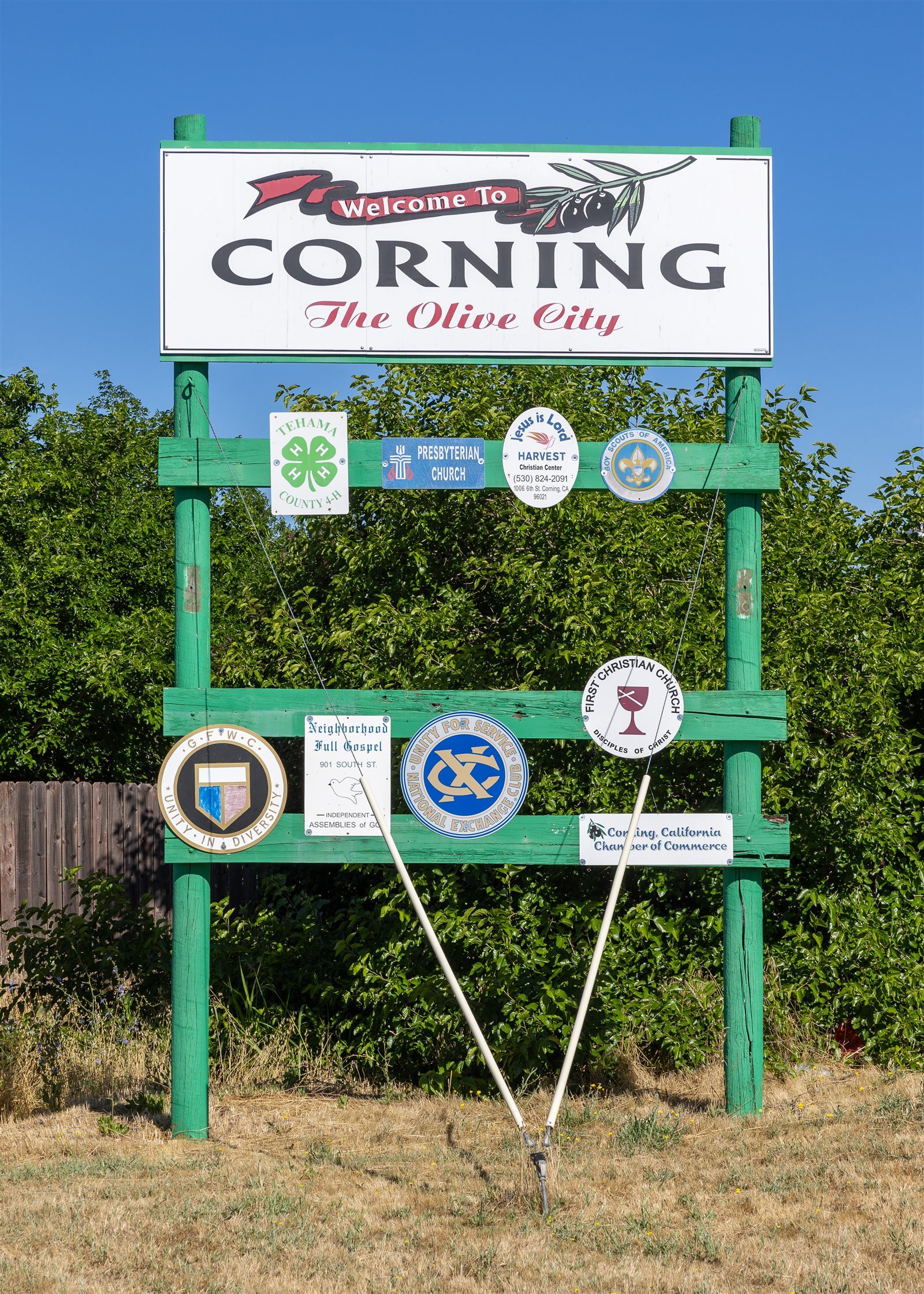
Pictured: the "Corning, The Olive City" welcome sign in Corning, Tehama County, California — not a photograph of the incident itself, which occurred after 11 PM on a rural county road and left no photographic record. No public-domain or rights-clear photograph of Hoag Road, the patrol car involved, or the Red Bluff Air Force Station radar room as they existed in August 1960 is known to survive; this is a real, rights-clear photograph of the actual town the officers were patrolling east of that night. (CC BY-SA 4.0, Frank Schulenburg, Wikimedia Commons.)
Theoretical Alignment
The case aligns most readily with the Extraterrestrial Hypothesis insofar as it describes a structured, controlled, apparently intelligently-guided object performing maneuvers (an arrested dive, a sustained hover, repeated directed approaches toward the patrol car) inconsistent with any natural phenomenon and only weakly consistent with 1960-era aircraft. It aligns poorly with Psycho-Social explanations because the two primary witnesses were on-duty, trained law-enforcement officers who did not know each other's account would be independently corroborated by three more witnesses at the sheriff's substation within the hour, and because the sighting recurred, with different observers, on the following night.
Background
By the summer of 1960, the California Highway Patrol was fourteen years removed from Kenneth Arnold's 1947 "flying saucer" sighting and deep into a decade in which the U.S. Air Force's Project Blue Book — then under the nominal direction of Major Robert Friend, with astronomer J. Allen Hynek serving as its scientific consultant — had settled into a pattern that critics were increasingly willing to challenge in public: attributing the large majority of reports to misidentified aircraft, balloons, and astronomical objects, while a persistent minority of cases resisted those categories entirely. Tehama County, in the upper Sacramento Valley roughly 130 miles north of Sacramento, was unremarkable ground for a major UFO case: an agricultural county built around rice, olives, and cattle, its county seat of Red Bluff home to a Cold War-era Air Defense Command radar station, one of dozens ringing the continental United States as part of the SAGE early-warning network built in direct response to the perceived Soviet bomber threat. It was against this backdrop — ordinary farm country, watched over by an ordinary radar station built for an entirely different purpose — that two patrolmen on a routine graveyard shift encountered something neither could explain.
Officer Charles A. Carson and Officer Stanley Scott were working the Corning beat out of the CHP's Red Bluff-area office, a routine assignment on a clear summer night. Their patrol car, like all CHP vehicles of the era, carried a red overhead spotlight for traffic stops and emergency signaling — a piece of standard-issue equipment that would, within the hour, become an unplanned instrument in one of the most detailed close encounters of the entire Blue Book period.
The organization that would ultimately do the most to keep the Red Bluff case in circulation, the National Investigations Committee on Aerial Phenomena (NICAP), had been founded only three years earlier, in 1956, and by 1960 had grown into the country's leading civilian UFO research body under the direction of retired Marine Corps Major Donald Keyhoe. NICAP's model depended on exactly the kind of witness Red Bluff would produce: not an anonymous tip, but a named, credentialed, on-duty government employee willing to put a detailed account in writing and stand behind it in later correspondence. When Carson's report reached the organization's field investigators later that year, it fit a profile NICAP prized above almost any other — sworn law enforcement testimony, obtained close to the event, with no evident motive to fabricate.
Complete Timeline
| Date / Time | Event |
|---|---|
| Aug 13, 1960, ~11:00–11:50 PM | Officers Charles A. Carson and Stanley Scott, driving east on Hoag Road east of Corning, spot a large, brilliantly lit object descending directly ahead of them and initially believe they are witnessing an airliner about to crash. |
| ~11:50 PM | At an altitude of roughly 100–200 feet, the object abruptly reverses its steep descent “at high speed” and climbs back to approximately 500 feet, where it stops and hovers motionless. The officers stop the patrol car and get out. |
| Shortly after | The object resolves into a round or oblong shape surrounded by a glow, with a definite red light at each end and, intermittently, roughly five white lights visible between them. |
| Over the next ~2 hours | On two separate occasions the object flies directly toward the patrol car; each time, it turns and sweeps the area with a large red beam of light, repeating this maneuver approximately six or seven times in total. When Officer Scott aims the patrol car's own red spotlight at the object, it moves away. |
| Same period | Carson and Scott draw their sidearms and debate whether to fire as the object closes distance; radio static coincides with the object's closer approaches, hampering their ability to call for backup. |
| ~12:30–1:00 AM | The officers radio the Tehama County Sheriff's Office. Deputy Clarence Fry telephones the U.S. Air Force radar station at Red Bluff (859th Aircraft Control and Warning Squadron); the radar operator on duty confirms an unidentified target is visible on the scope, and relays that confirmation back through Fry to the officers. |
| ~1:00 AM | A second, similar object arrives from the south and joins the first; both hover together, occasionally sweeping red beams, before the pair departs slowly toward the eastern horizon and out of sight, ending the primary sighting near the Vina Plains Fire Station after a total observation of approximately two hours and fifteen minutes. |
| ~1:15 AM | Back at the Tehama County Sheriff's substation, Carson and Scott learn that Deputies Fry and Max Montgomery and the on-duty night jailer had independently observed the same object from a separate vantage point in town, without prior knowledge of the officers' encounter. |
| Aug 14, ~12:30 AM | Deputies Fry and Montgomery, following up on the prior night's activity, drive southeast to a hillside near Los Molinos and independently observe four objects crossing the western sky from south to north in a straight line. |
| Aug 14, daytime | Carson and Scott drive in person to Red Bluff Air Force Station to speak with the radar operator who had confirmed the target. The station's commanding officer now states that nothing unusual appeared on the radar scopes that night, directly contradicting what the operator told Deputy Fry only hours earlier. |
| Aug 14, evening | A further sighting near Corning is independently witnessed by Deputies Fry and Montgomery together with an on-duty Corning police officer. |
| Following days | Additional, similar reports are logged across north-central and northwestern California as regional press coverage of the CHP officers' encounter spreads. |
| Autumn 1960 | Project Blue Book issues its official finding: the sightings resulted from atmospheric refraction of the planet Mars and the stars Aldebaran and Betelgeuse, compounded by a temperature inversion and smoke haze from regional wildfires. |
| Nov 14, 1960 | Carson writes a detailed letter to NICAP investigator Walter N. Webb, enclosing his original report and drawings of the object and stating plainly that "no one will ever convince us that we were witnessing a refraction of light." |
| 1964 | NICAP publishes the case, compiled by Richard H. Hall, in The UFO Evidence, its landmark documentary survey of unexplained sightings. |
| Challenged, undated | After NICAP's astronomical reviewer points out that Mars, Aldebaran, and Betelgeuse were not above the horizon at the time of the sighting, the Air Force revises its explanation to substitute the star Capella for Aldebaran and Betelgeuse — a star which, while genuinely visible that night, was in the wrong part of the sky and does not account for the object's reported descent, reversal, or approach behavior. |
| 1966–1967 | Dr. James E. McDonald independently checks U.S. Weather Bureau records for the night in question and finds no evidence supporting the temperature-inversion conditions Dr. Donald Menzel had cited in defense of the refraction explanation. McDonald features Red Bluff prominently in his widely delivered lecture "UFOs: Greatest Scientific Problem of Our Times?" |
| 1977 | J. Allen Hynek includes the case in The Hynek UFO Report (pp. 92–94), classifying it within his Nocturnal Light (NL) category. |
The Sighting Begins
Officers Carson and Scott were driving east on Hoag Road, a rural county road east of Corning, when they saw what both initially took for an airliner in trouble — a large, brightly lit shape descending steadily toward the ground directly ahead of their patrol car. Airliner traffic was not unusual over the upper Sacramento Valley, and for the first several seconds neither officer had reason to think otherwise. What broke that assumption was the object's behavior at the bottom of its dive: at an estimated 100 to 200 feet above the ground — low enough that a genuine aircraft in that condition would have been seconds from impact — the object reversed its descent "at high speed" and climbed back to roughly 500 feet, where it came to a dead stop and hovered. No civilian or military aircraft of 1960 could reverse a steep dive into a stationary hover in the open air, and both officers immediately understood they were looking at something else.
With the object now stationary, its true shape became visible: round or oblong, wrapped in a soft glow, with a distinct red light fixed at each end. Between the red lights, intermittently, the officers counted roughly five white lights. Carson would later describe the light as internally generated rather than reflected — "not a reflection of other lights," in his own words to NICAP — and likened the object's outline to a football shape. The officers stopped their car and got out for a clearer view, standing in the open on Hoag Road with the object hovering several hundred feet above open farmland.
The Standoff: Approaches, the Red Beam, and Drawn Sidearms
What followed was not a passive sighting but an extended, apparently interactive encounter. On two separate occasions the object left its hovering position and flew directly toward the patrol car. Each time, rather than continuing its approach, the object turned and swept the ground and surrounding sky with what Carson described as a huge red beam of light — by one detailed secondhand account, roughly six feet in diameter, and notable to the officers because the beam itself did not seem to pivot or traverse independently; the entire object had to move in order to redirect where the beam pointed. Over the course of the encounter the officers counted approximately six or seven of these red sweeps.
At one point Officer Scott responded in kind, aiming the patrol car's own roof-mounted red emergency spotlight up at the object. The object immediately moved away — the clearest single moment in the entire case suggesting the object was not merely present but actively responding to the officers' own actions. Carson later wrote to NICAP that the object "seemed aware of us," and that the officers found they had more success drawing it closer by remaining still and letting it approach than by trying to close the distance themselves: "We made several attempts to follow it, or I should say get closer to it, but the object seemed aware of us and we were more successful remaining motionless and allow it to approach us, which it did on several occasions."
As the object closed distance during its direct approaches, both officers drew their sidearms and, by their own later account, seriously debated whether to open fire if it came any closer — a detail that appears consistently across secondary accounts of the case, though the specific type of ammunition each officer carried that night is not independently documented in the primary sources reviewed for this file and is not asserted here. Throughout the closer approaches, the officers also noted radio static and interference severe enough to hamper their ability to reach dispatch for backup, a detail they considered significant given that CHP radios of the era were otherwise reliable on that stretch of road.
Radar Corroboration and the Air Force's Reversal
Unable to raise dispatch directly amid the interference, the officers eventually radioed the Tehama County Sheriff's Office, which dispatched the report onward. Deputy Clarence Fry took the report and placed a call to the U.S. Air Force radar station at Red Bluff, home to the 859th Aircraft Control and Warning Squadron and its SAGE-integrated height-finder and search radars. The operator who answered Fry's call did not equivocate: an unidentified object was visible on the station's radar scope at that time, tracking in a manner consistent with what the officers were describing. Fry relayed the confirmation back to Carson and Scott in the field — for a brief window, the case had exactly what most UFO reports lack: an independent, technically credentialed second data source, obtained in real time, from personnel with no reason to fabricate a corroborating account for two patrolmen they had never met.
That window closed within twenty-four hours. The following day, Carson and Scott drove to Red Bluff Air Force Station in person to meet the radar operator and discuss what had been tracked. Instead, they were met by the station's commanding officer, who stated flatly that nothing unusual had appeared on the scopes the previous night — directly contradicting what the operator on duty had told Deputy Fry only hours earlier. No explanation for the reversal was offered to the officers, and no radar log or printed track was ever produced publicly to settle which account — the operator's or the commanding officer's — reflected what the equipment had actually recorded. The pattern is a familiar one in Blue Book-era cases with military radar involvement: an initial, unguarded confirmation from operations-level personnel, followed by an official denial once the report moved up the chain of command. Carson's own skepticism of the reversal, and of the explanations that followed it, only hardened over the following months.
The Object's Reported Behavior in Detail
Beyond the broad strokes of the encounter, Carson's later correspondence and drawings preserve a number of specific behavioral details that recur across the secondary literature on the case and that are worth setting out precisely, since they are what most sharply distinguish Red Bluff from a routine light-in-the-sky report. The red sweeping beam, per Carson's description, appeared to be fixed in its orientation relative to the object itself rather than independently aimable — that is, the entire object had to physically reorient in order to redirect where the beam pointed, rather than the beam swiveling on its own axis the way a searchlight or spotlight would. This is a mechanically specific claim that a fabricating or simply mistaken witness would have little reason to invent, since it adds a constraint to the story rather than a flourish. Scott, separately, described the object's terrain-following movement during part of the encounter as discontinuous rather than smooth — appearing to "jump" over the crest of a rise in the land rather than following a continuous flight path across it, a detail with no obvious conventional analogue in either aircraft or natural-phenomenon behavior. Carson also insisted, when pressed, that the light he observed was not a reflection of some other light source but was self-generated by the object itself — a distinction he was careful enough about to draw explicitly in his own account, and one that bears directly on whether any refraction or mirage-based explanation could apply to what he was actually describing, since refraction can distort or duplicate an existing light source but cannot manufacture directional, apparently deliberate beam-sweeping behavior from a star or planet.
Subsequent Nights and Independent Corroboration
The case did not end with the primary sighting. Returning to the Tehama County Sheriff's substation after the object finally departed east near the Vina Plains Fire Station, Carson and Scott learned that Deputies Fry and Max Montgomery, together with the night jailer on duty, had independently watched an object matching their description from a separate vantage point in town — a account given without any coordination with the two patrolmen, since Carson and Scott had been out of radio contact for much of the encounter. The following night, Fry and Montgomery followed up on their own initiative, driving to high ground near Los Molinos southeast of Red Bluff, where at approximately 12:30 AM they watched four objects cross the western sky from south to north in a single straight line. That same evening, a further, separate sighting near Corning was witnessed by Fry and Montgomery together with an on-duty Corning police officer — a third independent group of trained observers reporting broadly consistent phenomena within 24 hours of the original encounter. In the days that followed, additional reports of unusual aerial activity were logged across north-central and northwestern California as regional newspapers picked up the CHP officers' account.
The Case in the Broader Blue Book Controversy
Red Bluff arrived at a pivotal moment for Project Blue Book's public credibility. Throughout the late 1950s, a small but increasingly vocal group of scientists — most prominently the atmospheric physicist James E. McDonald — had begun arguing publicly that Blue Book's explanations were being generated to close cases rather than to genuinely account for them, and that military and law-enforcement witnesses in particular were being given the same generic, low-effort explanations as any other report regardless of their training or the specificity of their account. Red Bluff became one of McDonald's signature examples of exactly this pattern: a case with two credentialed, government-employed observers, a same-night radar cross-check, and an official explanation that, when actually tested against public astronomical data, did not hold up. McDonald would go on to testify before the U.S. House Committee on Science and Astronautics on July 29, 1968, arguing more broadly that Blue Book's scientific rigor did not match the seriousness of its best-documented cases — testimony in which he cited multiple radar-visual and law-enforcement encounters, of which Red Bluff was among the most procedurally clean, since it involved no classified military hardware, no chain-of-command incentive to suppress an embarrassing story, and a witness (Carson) willing to keep corresponding with outside investigators for months after the event.
The skeptical counterweight to McDonald came chiefly from Harvard astronomer Dr. Donald Menzel, who had built much of his public career since the early 1950s on optical and atmospheric explanations for UFO reports, and who defended the Air Force's refraction-based account of Red Bluff specifically. The exchange between Menzel and McDonald over Red Bluff was, in miniature, the same debate that would eventually shape the 1966 Condon Committee: whether the scientific establishment should treat well-corroborated, professionally witnessed cases as genuinely anomalous and worth resolving, or whether any case could in principle be explained away given a sufficiently creative combination of atmospheric conditions. That the specific conditions Menzel invoked for Red Bluff — a multi-layer temperature inversion — could not be located in the actual weather record for that night, while the specific celestial bodies the Air Force cited could not be located in the actual sky, gave McDonald's side of that argument an unusually concrete, checkable foundation that many contemporaneous "explained" cases did not offer.
Key Researchers
- Dr. James E. McDonald (1920–1971) — Senior physicist at the Institute of Atmospheric Physics and University of Arizona professor who independently investigated Red Bluff, checked U.S. Weather Bureau records against Dr. Menzel's claimed temperature inversion and found no support for it, and featured the case in his widely delivered congressional-era lecture "UFOs: Greatest Scientific Problem of Our Times?" McDonald personally interviewed hundreds of witnesses across dozens of cases during the 1960s, applying his atmospheric-physics training specifically to test proposed optical and meteorological explanations against real weather and astronomical data rather than accepting them on the Air Force's authority — the same method he applied to Red Bluff's refraction claim. His July 1968 testimony before the U.S. House Committee on Science and Astronautics remains one of the most detailed scientific critiques of Blue Book's investigative standards ever delivered to Congress.
- Richard H. Hall — NICAP's principal compiler, who documented the case in the organization's 1964 landmark survey The UFO Evidence.
- Walter N. Webb — Hayden Planetarium astronomer and NICAP field investigator who corresponded directly with Officer Carson, obtaining his original report, diagrams, and a detailed follow-up letter dated November 14, 1960.
- Dr. Donald Menzel — Harvard astronomer, director of the Harvard College Observatory, and the era's most prominent professional UFO skeptic, whose books through the 1950s and 1960s built the case that essentially all UFO reports could be traced to optical, atmospheric, or psychological causes. He defended Blue Book's refraction explanation for Red Bluff by citing an alleged multiple temperature-and-humidity inversion — a claim McDonald's independent weather-record review did not support, making Red Bluff one of the more direct, documented exchanges between the two men's opposing positions on how rigorously Blue Book's explanations should be tested.
- J. Allen Hynek — Project Blue Book's scientific consultant, who later classified the case as a Nocturnal Light (NL) and included a detailed account of it in his 1977 book The Hynek UFO Report.
Key Witnesses
Officer Charles A. Carson
Primary witness and, by far, the best-documented voice in the case. Carson gave a detailed original incident report, corresponded at length with NICAP investigator Walter N. Webb in a signed letter dated November 14, 1960, and supplied hand-drawn diagrams of the object's shape and lighting. His account is notable for its restraint and its explicitly professional framing: he compared the credibility of the official explanations offered to him — northern lights, a weather balloon, and finally atmospheric refraction — to evidence he would refuse to bring into court, telling investigators he would "hate to try to take one of my cases into court with such weak arguments." He maintained, without wavering across later interviews, that "no one will ever convince us that we were witnessing a refraction of light."
Officer Stanley Scott
Co-witness to the entire encounter and the officer who, in the case's single most striking interactive detail, aimed the patrol car's own red emergency spotlight at the hovering object — after which it moved away. Scott's account of the object's terrain-hugging movement, appearing to "jump" over the crest of a slope rather than fly a continuous path, is one of the more unusual performance details in the entire Blue Book-era literature. Scott corroborated Carson's description of the object's shape, lighting, and repeated red-beam sweeps in full.
Deputy Clarence Fry
The deputy who placed the critical call to Red Bluff Air Force Station and obtained the radar operator's verbal confirmation of an unidentified target — the case's only piece of instrumented corroboration, however briefly it stood before being contradicted. Fry was also, independently of Carson and Scott, a direct witness to the object from the sheriff's substation in town that same night, and returned to the field the following night with Deputy Montgomery to observe a second, separate set of objects near Los Molinos, and again the night after that alongside a Corning police officer. Across three consecutive nights, Fry personally witnessed unusual aerial activity on at least three separate occasions.
Deputy Max Montgomery
Corroborating witness alongside Fry at the sheriff's substation on the night of the primary sighting, and Fry's companion for the follow-up observation of four objects near Los Molinos on the night of August 14. A trained deputy with no connection to Carson and Scott's chain of command, Montgomery's account independently reinforces both the original sighting and the pattern of continued activity in the days that followed.
The Five Observables Assessment
Assessment: The object's arrested dive and stationary hover imply a form of lift with no visible means of propulsion, but because the encounter is testimonial rather than instrumented, this is classified as speculative rather than confirmed. The reversal from a near-ground dive to a stable 500-foot hover happened quickly enough that both officers described it as instantaneous, but again without radar or photographic timing data this is speculative rather than a hard-confirmed instant-acceleration event. No hypersonic speeds were reported at any point — the object's movements, aside from the dive reversal, were described as deliberate and at times slow. Low observability is explicitly absent: the object was brightly self-illuminated and visually tracked without difficulty for over two hours by multiple observer groups. No air-to-water or other trans-medium transition was reported.
Evidence Assessment
Supporting Anomalous Origin
- Two independent, on-duty, professionally trained law-enforcement officers gave detailed, consistent, and court-conscious testimony
- Three additional trained witnesses (two deputies and a night jailer) independently corroborated the sighting from a separate location the same night, without prior coordination
- A fourth independent group (two deputies plus a Corning police officer) witnessed further unusual activity the following night
- An Air Force radar operator verbally confirmed an unidentified target on scope at the time of the sighting — corroboration the officers did not solicit or expect
- The object's reported performance (silent, near-instant dive reversal into a stable hover, apparent responsiveness to the patrol car's spotlight) has no straightforward conventional analogue for 1960
- Project Blue Book's own official explanation is independently demonstrable as astronomically incorrect (see Conventional Explanation Candidates, below), which is itself evidence the case was never adequately resolved
- Dr. James E. McDonald's independent review of Weather Bureau data found no support for the temperature-inversion conditions the skeptical explanation required
- Carson's November 1960 letter and diagrams to NICAP were produced under his own name, with nothing to gain and professional risk to lose by fabricating a report
Supporting Conventional Explanation
- The radar confirmation was retracted within 24 hours by the responsible commanding officer, and no printed track was ever produced to settle the dispute either way
- No physical evidence, photograph, or instrumented recording of any kind exists
- The officers' initial impression — a descending airliner — shows that even trained observers can misjudge an unfamiliar light source at night, at least in the first moments of a sighting
- Regional wildfire smoke haze, a genuine environmental condition that night, is a documented source of optical distortion for bright celestial and terrestrial light sources alike
- The case is now 65+ years old, and no further physical or documentary evidence has surfaced since the original NICAP correspondence to test the account against
Why "Credible"
Red Bluff earns a CREDIBLE rating on the strength of its witness base rather than any physical or fully instrumented evidence, which keeps it out of the "Verified" tier reserved for cases with hard, retained data. Two independent, professionally trained, on-duty law-enforcement officers gave a detailed, internally consistent, multi-hour account of a structured object performing maneuvers with no conventional explanation, and did so under circumstances — drawn sidearms, radio interference, direct approaches by the object — that argue against casual misperception. That account was independently corroborated, within the same night, by three additional trained witnesses who had no opportunity to coordinate their story with the officers beforehand, and again the following night by a fourth independent witness group. A same-night verbal radar confirmation from a military radar station, though retracted the next day without ever being resolved by a released track, is a genuine, if incomplete, second channel of corroboration that most testimonial-only cases lack entirely. Weighed against this is the case's real limitation: there is no surviving physical evidence, no photograph, and no preserved instrument record, and the radar corroboration was withdrawn rather than confirmed. What tips the case above the mid-range "Disputed" tier is the unusual clarity of the skeptical failure here — unlike cases such as Thomas Mantell, where the leading conventional candidate (a Skyhook balloon) is strong and merely lacks one confirming document, Blue Book's own official explanation for Red Bluff is independently, checkably wrong about where three named celestial objects actually were in the sky that night — a flaw confirmed separately by NICAP's own astronomical reviewer and by Dr. James E. McDonald, one of the era's most credentialed scientific UFO investigators. A case whose best official rebuttal collapses on contact with a straightforward, reproducible astronomical check, while its witness base remains multiply corroborated and professionally credentialed, sits solidly in the Credible tier rather than the lower end of Disputed.
Sensor & Instrumentation Detection Profile
The only instrumented data associated with the case is a single verbal radar confirmation. Deputy Clarence Fry telephoned the USAF's Red Bluff Air Force Station, home of the 859th Aircraft Control and Warning Squadron (redesignated the 859th Radar Squadron, SAGE, that same year), and was told by the radar operator on duty that an unidentified target was in fact visible on the station's scope at the time of the sighting. Red Bluff AFS in 1960 operated AN/FPS-6 and AN/FPS-6A height-finder radar alongside an AN/MPS-11 search set, feeding the Semi-Automatic Ground Environment (SAGE) air-defense network — instrumentation built and staffed specifically to distinguish real airborne targets from noise. That confirmation was never released as a printed track or logged plot; it survives only as the operator's spoken word to Fry, repeated by Fry to the officers, and it was contradicted the next day by the station's commanding officer. No airborne intercept, gun-camera, or photographic sensor recorded the object at any point.
Environmental & Geospatial Context
Hoag Road runs through open ranch and orchard country in the Sacramento Valley east of Corning, Tehama County — flat, sparsely lit farmland bounded by the Sacramento River to the west and the foothills of the southern Cascade Range to the east, with wide unobstructed sightlines to the horizon in every direction. The night was clear with a waning gibbous moon roughly 58% illuminated, several days past the August 7 full moon. The Air Force's later explanation cited smoke haze from regional wildfires, a genuine feature of the 1960 Northern California fire season, though McDonald's independent review found no contemporaneous U.S. Weather Bureau data supporting the specific temperature-inversion layer the explanation required. Red Bluff Air Force Station sat roughly fifteen miles north-northwest of the sighting location, well within radar and visual range of the reported activity, and the officers themselves ended the primary sighting near the Vina Plains Fire Station, several miles east of Corning, after trailing the object as it moved slowly eastward.
Observer Credibility & Occupational Profile
The case's evidentiary weight rests almost entirely on the training and occupational standing of its witnesses. Charles A. Carson and Stanley Scott were sworn, on-duty California Highway Patrol officers — observers trained to give precise, court-defensible testimony about vehicles, distances, and unfolding roadside events, and whose professional credibility depended on not filing exaggerated or unreliable reports. Carson later underscored this himself in correspondence with NICAP, remarking that he would "hate to try to take one of my cases into court with such weak arguments" as the ones offered to explain what he had seen. The corroborating witnesses were similarly credentialed: Tehama County Sheriff's Deputies Clarence Fry and Max Montgomery, plus an on-duty night jailer, independently observed the object from a separate vantage point in town without having compared notes with Carson and Scott beforehand, and Fry and Montgomery went on to independently observe a second, distinct set of objects from a hillside near Los Molinos the following night, joined that time by a Corning police officer. No single account rests on an uncorroborated or untrained witness.
It is also worth being precise about what CHP training in 1960 did and did not select for. Highway Patrol officers of the era were trained and evaluated specifically on their ability to give clear, defensible verbal and written accounts of fast-moving, ambiguous roadside events — the exact skill set most relevant to correctly perceiving and later describing an unfamiliar aerial object under stress. They were not, by contrast, trained aviators or radar operators, and neither Carson nor Scott ever claimed specialized expertise in aircraft recognition beyond what any patrol officer would pick up recognizing civil air traffic over a rural beat. This cuts in the case's favor on the reliability of the raw observation — two officers whose job depended on accurate incident reporting gave a detailed, mutually consistent account — while leaving open, and properly so, a degree of uncertainty about whether either officer could have reliably distinguished a genuinely novel craft from an unfamiliar but conventional one. What the record does not support is any suggestion that either man was an unreliable or untrained observer; every documented critique of the case attacks the Air Force's proposed explanations, not the officers' competence to report what they saw.
Physical & Material Assays
No physical trace evidence exists in this case. Nothing was recovered from the ground, no debris or landing traces were reported, and no photograph or film of the object is known to survive. The only quasi-physical record is the verbal radar return described above, which itself was never preserved as a printed track and was retracted rather than confirmed in writing. The absence of any material evidence is itself a meaningful data point: unlike cases with alleged trace evidence of contested origin, Red Bluff has never generated a competing chain-of-custody dispute, because there was never any physical object to dispute.
Historical Precedents & Archive Matches
Red Bluff belongs to a small but recognizable category of Blue Book-era "police pursuit" or "radar-visual" cases in which trained officers, rather than private citizens, provided the primary testimony — a category researchers have generally treated as carrying more evidentiary weight than average civilian reports precisely because of witness training. The location itself has an earlier, unconnected sighting on record: on August 19, 1952, a Ground Observer Corps spotter near Red Bluff reported two fast-moving, bullet-shaped objects in level flight, a case cataloged separately in Blue Book's files and unrelated in substance to the 1960 encounter beyond sharing a town name. More directly comparable in structure — multiple trained observers, an independent radar detection, and a subsequently disputed official explanation — are cases such as the RAF Lakenheath–Bentwaters radar-visual case of 1956 and the RB-47 intercept of 1957, both of which Dr. James E. McDonald also personally investigated and cited as part of the broader pattern he argued Blue Book was systematically under-explaining.
The broader wave of "police officer" UFO cases that Red Bluff helped inaugurate would recur throughout the following decade, most famously in the 1966 Portage County, Ohio pursuit involving multiple sheriff's deputies across two states, and in numerous smaller, less-publicized reports from highway patrol and municipal police officers across the country through the late 1960s and 1970s. Researchers cataloging these cases have repeatedly noted the same structural pattern first visible at Red Bluff: an initial, unguarded confirmation from an on-duty government employee (a radar operator, a second patrol unit, a dispatcher), followed by a more cautious or flatly contradictory statement once the report worked its way up an institutional chain of command. Whether that pattern reflects a genuine, if informal, policy of institutional caution around embarrassing reports, or simply reflects that duty operators without supervisory review are more likely to speak plainly, remains an open and explicitly unresolved question in the literature — but Red Bluff is one of the clearest, best-documented early instances of it on record.
Material Analysis
There is no physical or material evidence associated with the Red Bluff case in any conventional sense — no soil disturbance, no recovered fragments, no burn marks, no metallurgical or isotopic samples of any kind. The event was, from beginning to end, a visual and (briefly) radar-based encounter with no landing, no close-range material interaction, and no claimed physical aftermath to the witnesses or the surrounding terrain. The single quasi-material record generated by the case is the Red Bluff Air Force Station's radar return itself, which functioned analogously to physical evidence in that it was, for a matter of hours, an independently generated instrument record existing outside the witnesses' own testimony — and which was then effectively withdrawn from the record when the station's command declined to release or confirm any printed track. Carson's hand-drawn diagrams, submitted to NICAP alongside his November 1960 letter, constitute the closest thing to a durable, physical case artifact: not evidence of the object itself, but a contemporaneous, witness-authored visual record created within three months of the sighting, before the passage of decades could reasonably be blamed for memory drift.
Supporting Non-Terrestrial or Genuinely Anomalous Origin
- The radar return, however briefly confirmed, was an independent instrument detection consistent with the visual account, obtained before any denial was issued
- Carson's diagrams and letter are a preserved, dated, witness-authored primary record rather than a decades-later reconstruction
Supporting Terrestrial or Misidentification Origin
- The complete absence of any physical trace, sample, or recovered material is consistent with a purely optical or atmospheric phenomenon, which by definition leaves nothing behind
- Without a preserved radar track, the "confirmation" cannot be independently re-examined by modern researchers the way an archived Blue Book case file often can
The Conventional Explanation Candidate
Project Blue Book's official position, and the two most commonly proposed alternatives to it, deserve full and honest evaluation on their own terms — the Omni Ledger's editorial standard is to weigh the best available conventional case exactly as seriously as the anomalous one, not to wave it away because the case is a favorite of ufology.
Astronomical Refraction (Mars, Aldebaran & Betelgeuse, later revised to Mars & Capella)
The Air Force's formal explanation attributed the sightings to atmospheric refraction of the planet Mars together with the bright stars Aldebaran and Betelgeuse, distorted by a temperature inversion into the appearance of a maneuvering, glowing craft. This is the explanation that deserves the most scrutiny precisely because it was the one the government actually committed to in writing. When NICAP's astronomical reviewer checked the claim against the actual positions of those three objects for the date, time, and location of the sighting, none of the three was above the horizon at 11 PM in mid-August from Tehama County — Aldebaran and Betelgeuse, both members of the winter constellations Taurus and Orion, do not rise into the pre-dawn Northern California sky until roughly 3 AM in early-to-mid August, several hours after the primary sighting had already ended, and Mars's own position that season placed it poorly for the described behavior as well. Confronted with this, the Air Force revised the explanation to substitute the star Capella for Aldebaran and Betelgeuse — but as both NICAP and Dr. James E. McDonald separately pointed out, Capella was rising, not descending, during the relevant window, the opposite of the plunging, reversing motion both officers described, and its position in the sky did not correspond to where the object was actually reported. This is not a matter of interpretation: it is a checkable astronomical fact, independently confirmed by two separate reviewers working from public ephemeris data, and it means Blue Book's signature explanation for the case cites celestial bodies that could not have produced what Carson and Scott described. Separately, prominent Blue Book-era skeptic Dr. Donald Menzel defended the refraction theory by invoking what McDonald characterized as "fantastic multiple inversions of temperature and humidity" — a claim McDonald tested directly against contemporaneous U.S. Weather Bureau records and found unsupported.
Aircraft or Balloon Misidentification
The officers' own first impression was that they were watching an airliner in distress, which is worth taking seriously: it shows that even trained observers can misjudge an unfamiliar light source in the first seconds of an unusual event. But the aircraft explanation does not survive contact with the rest of the sighting. No aircraft of 1960 could arrest a steep, high-speed dive at 100–200 feet and climb silently back to a stationary hover; no aircraft could sustain a motionless hover for the better part of two hours; and no aircraft could plausibly explain the repeated, apparently deliberate approaches toward the patrol car followed by a sweeping red beam, nor the object's retreat when Officer Scott aimed the car's own spotlight at it. A weather balloon, meanwhile, cannot execute directed movement, reverse a dive, or sweep a beam of light at all, and Carson explicitly and specifically rejected the weather-balloon explanation when it was informally offered to him.
Signal/Radar Anomaly or Ground-Radar Misread
A plausible, narrower explanation for the radar component alone is that the Red Bluff operator misread a transient anomalous propagation return, a ground clutter artifact, or an unrelated aircraft track, and that his subsequent retraction — rather than a cover-up — reflected an honest correction once the scope data was reviewed more carefully in daylight. This is a genuinely plausible partial explanation for the radar leg of the case specifically, and it is the most defensible conventional account on offer: 1959-vintage height-finder and search radar was capable of transient false returns, and a duty operator relaying an unconfirmed contact to a sheriff's deputy over the phone, without the benefit of a supervisor's review, is a realistic scenario. It does not, however, extend to or explain the visual sighting itself, which was witnessed independently by seven named or described individuals across two nights using only their own eyes.
Astronomical Refraction (Mars/Aldebaran/Betelgeuse → Mars/Capella)
ImplausibleIMPLAUSIBLE. Independently checkable astronomical positions show the originally cited stars were below the horizon, and the revised substitute star does not match the object's reported motion or position either.
Aircraft or Balloon Misidentification
ImplausibleIMPLAUSIBLE as a complete explanation. Plausible only for the officers' first few seconds of misperception before the object's actual behavior became clear; cannot account for the hover, the directed approaches, or the responsive red-beam behavior.
Ground-Radar Anomaly or Misread
Inconclusive (radar leg only)INCONCLUSIVE, and the single most defensible conventional candidate on offer — but it addresses only the radar confirmation, not the extended, multi-witness visual sighting that anchors the case.
Related Cases
Confirmed Documents & Official Records
The National Archives' finding aid and overview page for the full Project Blue Book collection (1947–1969), within which the Red Bluff case file is catalogued chronologically among the roughly 12,600 reports the Air Force investigated.
UNCLASSIFIED (declassified)NICAP's original case summary, drawn from Officer Carson's report and correspondence, as published in The UFO Evidence (1964).
Private archive (non-government)NICAP's directory entry cross-referencing the case against Richard Hall's original report and Dr. McDonald's later commentary.
Private archive (non-government)Search Government Archives Directly
Further Reading — Recommended Literature
The Hynek UFO Report
Project Blue Book's own longtime scientific consultant devotes a detailed section (pp. 92–94) to the Red Bluff case, situating it within his Nocturnal Light classification and the broader pattern of Blue Book cases he came to believe were inadequately explained.
Firestorm: Dr. James E. McDonald's Fight for UFO Science
The definitive biography of the atmospheric physicist whose independent weather-record review directly undercut the temperature-inversion defense of Blue Book's Red Bluff explanation, and who championed the case as an example of Blue Book's scientific shortcomings.
The UFO Evidence
NICAP's landmark 1964 documentary survey, the first publication to compile the Red Bluff case in full alongside hundreds of other reports, organized by evidentiary category rather than narrative anecdote.
UFOs Explained
A contemporaneous, rigorously skeptical treatment of Blue Book-era radar and visual cases from the era's most prominent professional debunker, useful as the strongest available counterweight to the anomalous reading of cases like Red Bluff.
The UFO Encyclopedia, 4th Edition
The definitive modern UFO reference work, with an extensively cross-referenced entry situating Red Bluff among the small set of Blue Book-era cases anchored by trained law-enforcement testimony and a same-night radar confirmation.
Essential Viewing
Sources
- Hall, Richard H. (compiler). "The Red Bluff Case." NICAP, 1960–1964. nicap.org
- NICAP. "Red Bluff UFO Case Directory," cross-referencing Hall's report and McDonald's commentary. nicap.org
- McDonald, James E. Comments on the Red Bluff case from "UFOs: Greatest Scientific Problem of Our Times?" (1967 presentation), archived by NICAP. nicap.org
- Gross, Loren E. (compiler). "UFOs at Close Sight: Red Bluff Case, USA, August 1960 — by James E. McDonald." Patrick Gross UFO History archive. patrickgross.org
- Gross, Loren E. (compiler). "UFOs at Close Sight: Red Bluff Case, USA, August 1960 — by About.com." Patrick Gross UFO History archive. patrickgross.org
- Patrick Gross UFO History archive. "UFOs at Close Sight: Red Bluff Case, USA, August 1960" (case index page). patrickgross.org
- UFO Evidence. "Red Bluff Incident — Red Bluff, California, United States — August 13, 1960," Case 107. ufoevidence.org
- UFO Casebook Files. "Red Bluff Incident." ufocasebook.com
- Hynek, J. Allen. The Hynek UFO Report, Dell Publishing, 1977, pp. 92–94.
- Hall, Richard H. (ed.) The UFO Evidence, National Investigations Committee on Aerial Phenomena, 1964, p. 61.
- Druffel, Ann, with Jacques Vallee (foreword). Firestorm: Dr. James E. McDonald's Fight for UFO Science, Wild Flower Press, 1998/2003.
- Klass, Philip J. UFOs Explained, Random House, 1974 (contemporaneous skeptical treatment of Blue Book-era radar/visual cases).
- U.S. National Archives and Records Administration. "Project BLUE BOOK: Unidentified Flying Objects." archives.gov
- NICAP. "The Project Blue Book 'Unknowns'" (comparison list; the 1952 Red Bluff Ground Observer Corps sighting is a distinct, earlier case at the same place-name). nicap.org
- Wikipedia contributors. "Red Bluff Air Force Station" (859th Aircraft Control and Warning Squadron; radar equipment and station history, used only for orientation on the station's known, uncontested operational facts). en.wikipedia.org
- California State Military Museum. "Red Bluff Air Force Station." militarymuseum.org
- Calendar-12.com. "Moon Phases Calendar for August 1960" (lunar illumination data for the night of the sighting). calendar-12.com
- Tutiempo Network. "Lunar Calendar, Moon Phases August 1960." tutiempo.net
- Star Walk. "Astronomical Events: Orion and the Winter Stars' Return to the Pre-Dawn August Sky" (used to independently corroborate that Aldebaran and Betelgeuse are not visible at 11 PM in mid-August from mid-latitude Northern California, only rising a few hours before dawn). starwalk.space
- Corning, California entry, Wikimedia Commons (location/coordinate reference for the hero photograph; used only for the photo caption's geographic facts, not for case narrative). commons.wikimedia.org
See something inaccurate? Have additional information or sources?
Suggest an Edit →Last Updated: August 2026