
The Ellsworth AFB Sighting
Shortly after dark on August 5, 1953, Mrs. Phyllis Killian, a trained Ground Observer Corps volunteer posted at Black Hawk, South Dakota, telephoned Ellsworth Air Force Base to report a stationary red light that shot straight up, reversed course, and began drifting toward Rapid City. A duty radar controller found a matching target on his height-finder scope — "well defined, solid, and bright" — at 16,000 feet, and three airmen sent outside independently watched a bluish-white light race across the sky. An F-84 Thunderjet already airborne on patrol was vectored onto the target, closed to within three miles, and then watched it accelerate away and hold that exact three-mile buffer for a 120-mile chase north into North Dakota before fuel forced the pilot home. As that jet landed, a second F-84 piloted by Lieutenant Needham scrambled, spotted the object below him at 15,000 feet, and pursued it through a series of white-to-green color changes up to roughly 26,000 feet, rolling his aircraft and killing his cockpit lights to rule out a reflection before achieving a radar-gunsight lock that the Air Force later attributed to equipment malfunction. Captain Edward J. Ruppelt, Project Blue Book's first director, was woken before dawn by a colleague's phone call, flew to South Dakota on standing emergency orders, and personally interviewed every witness within days. He would later call it the best UFO report in the Air Force's files — a verdict the 1969 Condon Report tried, and this file argues never fully managed, to explain away.
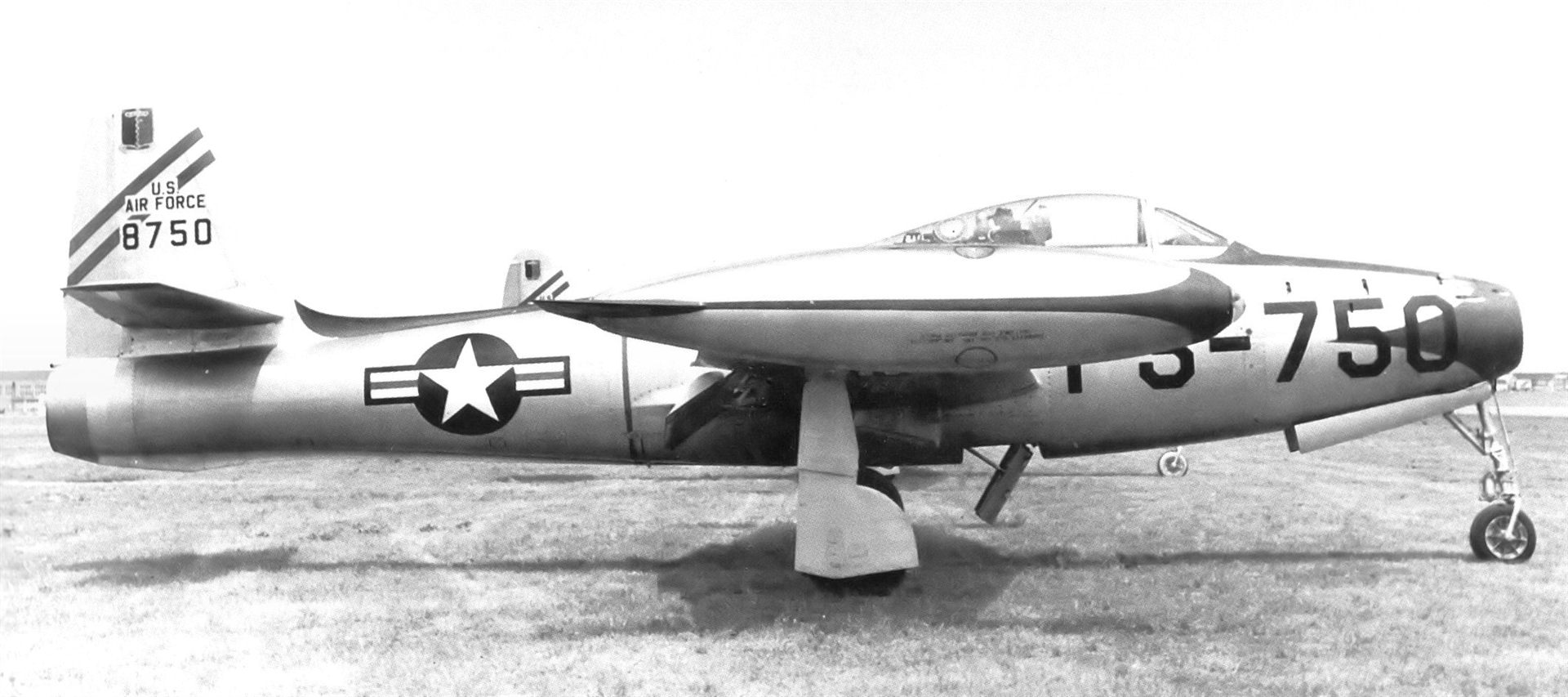
Pictured: a Republic F-84D Thunderjet, serial 48-750 of the 78th Fighter Group, photographed on the ground circa 1950 — the same production block and type of jet flown by the 54th Fighter-Interceptor Squadron pilots who scrambled from Ellsworth AFB on the night of August 5–6, 1953. This is not either of the two actual aircraft flown that night, nor the object they pursued; no photograph of the specific interceptors or the object itself is known to exist.
Theoretical Alignment
Ellsworth earns a higher-than-average ETH alignment for this catalogue's early Cold War cases because of the sheer density of independent, credentialed corroboration packed into a single four-hour window: a trained civilian spotter, three military airmen, a ground radar controller, and two separate interceptor pilots all reported mutually consistent behavior — a light that reversed course, shot upward, and then held a constant evasive buffer from pursuing jets — without any of them being able to coordinate their accounts beforehand. The Psycho-Social component is elevated not because of embellishment (this file found comparatively little of the kind of secondary mythology that inflates cases like Kinross) but because the case became, and remains, a genuine institutional flashpoint: Project Blue Book's own first director rated it his best file, while a federally funded university study fifteen years later tried to explain it away with a chain of at least four separate, simultaneous misidentifications by different trained witnesses — a pattern of institutional disagreement that is itself part of the case's evidentiary record. The Interdimensional Hypothesis finds essentially no support: nothing in any witness account describes materialization, portals, or any behavior outside ordinary three-dimensional flight, however extreme. What keeps this file from rating the case higher still is the same gap that limits every 1950s radar-visual case in this archive: no photograph, gun-camera frame, or radarscope image survived either intercept, so the case's strength rests entirely on testimony and log data, however well-corroborated.
Background
Ellsworth Air Force Base had existed under that name for barely six months by the time of the August 1953 sighting. Originally established during the Second World War as Rapid City Army Air Base and later Weaver Air Force Base, the installation was officially redesignated Rapid City Air Force Base and then, on February 16, 1953, renamed Ellsworth Air Force Base in honor of Brigadier General Richard E. Ellsworth, commander of the 28th Strategic Reconnaissance Wing, who had been killed less than a month earlier, on March 18, 1953, when his RB-36 reconnaissance bomber crashed near Nut Cove, Newfoundland. President Dwight D. Eisenhower personally traveled to the base on June 13, 1953 — not quite two months before the UFO sighting — to dedicate it in Ellsworth's memory, underscoring how prominent and freshly staffed a facility it was at the moment the case unfolded. The base's air-defense apparatus was equally new: the 54th Fighter-Interceptor Squadron had been reactivated there on December 1, 1952, absorbing personnel and aircraft from a North Dakota Air National Guard unit called to Korean War service, and initially flew propeller-driven F-51D Mustangs before converting to Republic F-84D Thunderjets returning from Korean combat duty in July 1953 — meaning the squadron had been operating its jet-age interceptor for barely a month when it was scrambled against the August 5 target. The 740th Aircraft Control and Warning Squadron, the ground radar unit almost certainly responsible for the case's radar detection, had itself only activated at the base on February 1, 1953, under the 31st Air Division of Air Defense Command, before the squadron transferred to the 29th Air Division on the same day the base was renamed.
The Ground Observer Corps, the civil-defense network that put Phyllis Killian at her post that evening, had been reorganized in 1950 and expanded dramatically after the Soviet Union's 1949 atomic bomb test sharpened American anxiety about an undetected bomber approach across exactly the kind of sparsely radar-covered northern prairie terrain surrounding Rapid City. By early 1952 the GOC counted more than 200,000 trained civilian volunteers staffing some 8,000 observation posts nationwide under an effort nicknamed Operation Skywatch, filling the geographic gaps between the Air Force's still-incomplete permanent radar fence. Volunteers were trained in aircraft silhouette recognition and instructed to report anything unusual through a dedicated filter-center phone line directly to the nearest Air Defense Command facility — the exact channel Killian used to reach Ellsworth's radar controller within minutes of first seeing the light. The GOC would not be deactivated until January 1959, once the Distant Early Warning radar line rendered ground-based visual spotting obsolete, meaning in August 1953 the network was at the height of its operational significance and its volunteers were, by design, precisely the trained, procedurally disciplined observers this site's credibility framework rates most highly.
Complete Timeline
| Date | Event |
|---|---|
| 1942–1947 | The installation later known as Ellsworth Air Force Base is built as Rapid City Army Air Base and later renamed Weaver Air Force Base, then Rapid City Air Force Base. |
| December 1, 1952 | The 54th Fighter-Interceptor Squadron is reactivated at Rapid City AFB, flying propeller-driven F-51D Mustangs, assigned to the 31st Air Division. |
| February 1, 1953 | The 740th Aircraft Control and Warning Squadron activates at the base, providing the ground radar coverage later used to detect the August 5 target. |
| February 16, 1953 | Rapid City Air Force Base is officially redesignated Ellsworth Air Force Base; the 54th FIS transfers to the 29th Air Division. |
| March 18, 1953 | Brig. Gen. Richard E. Ellsworth, the base's incoming namesake, is killed when his RB-36 crashes near Nut Cove, Newfoundland. |
| June 13, 1953 | President Dwight D. Eisenhower personally dedicates the base in Ellsworth's honor. |
| July 1953 | The 54th Fighter-Interceptor Squadron re-equips with Republic F-84D Thunderjets returning from Korean War combat duty. |
| August 5, 1953, ~8:05 PM MST | Phyllis Killian, a Ground Observer Corps spotter at Black Hawk, SD, sees a stationary red light, then watches it shift roughly 30 degrees, shoot straight up, move back left, return to its original position, and begin drifting toward Rapid City; she reports it by phone directly to Ellsworth AFB's radar duty controller. |
| Shortly after 8:05 PM | The duty controller locates a matching target on height-finder radar at 16,000 feet, describing it as "well defined, solid, and bright"; three airmen sent outside independently see a bluish-white light moving north to south at high speed. |
| ~8:15–8:30 PM | An F-84 Thunderjet already on combat air patrol is vectored onto the target; the pilot closes to roughly three miles and describes a light "brighter than the brightest star I've ever seen"; the object accelerates away and holds a consistent ~3-mile buffer as the chase runs north. |
| ~9:00–10:30 PM | The pursuit continues roughly 120 miles north toward the North Dakota line, radar and visual contact maintained the entire way; the pilot checks his fuel and turns back, the object still visible on radar as he departs the area. |
| ~10:30–11:00 PM | A second F-84, piloted by Lieutenant Needham, scrambles from Ellsworth; climbing through roughly 15,000 feet, Needham spots the object below and to his right. |
| ~11:00–11:40 PM | The object changes color from white to green and climbs; Needham pursues to roughly 26,000 feet, rolls his aircraft and shuts off his cockpit lights to rule out a reflection, and confirms the light's position against a backdrop of three fixed stars before activating his radar-ranging gunsight, which achieves a lock within seconds. |
| ~11:42 PM | With the object still holding a five-to-ten-mile lead and climbing beyond his aircraft's performance envelope, Needham — by his own account, genuinely afraid despite World War II and Korean combat experience — requests and receives permission to break off the pursuit. |
| Overnight, Aug. 5–6 | The Ground Observer Corps filter center continues plotting an irregular track as additional bluish-white light reports extend the event's footprint north toward Bismarck, ND, and as far as Fargo, ND. |
| ~12:23 AM MST, Aug. 6 | The night's sequence of reports concludes; the gunsight lock-on light aboard Needham's F-84 reportedly continues blinking intermittently on the return flight, though the unit is not confirmed to have been inspected by maintenance afterward. |
| ~2:00 AM, August 11, 1953 | Max Futch of the Air Technical Intelligence Center telephones Capt. Edward Ruppelt, telling him, "you know that for a year I've read every flying saucer report that's come in and that I never really believed in the things... But you should read this wire." |
| Mid-August 1953 | Ruppelt uses standing emergency travel orders to fly to Rapid City and personally interviews the radar duty controller, both F-84 pilots, and Phyllis Killian within days of the event. |
| 1956 | The U.S. Air Force's Project Blue Book Status Report No. 12 formally lists the Ellsworth case among its "Unsolved" files (pp. 226–229); Ruppelt's own memoir, The Report on Unidentified Flying Objects, devotes a detailed chapter to the case. |
| July 29, 1968 | Physicist James E. McDonald cites the case in testimony before the U.S. House Committee on Science and Astronautics as a "famous combined radar-visual case," noting it was "far too long and complex to recapitulate" in full. |
| 1969 | The Condon Report's field-case chapter, written by physicist Gordon D. Thayer, proposes that Killian saw a radio-tower warning light, the airmen saw a meteor, the first pilot chased a star with a temperature-inversion "ghost" radar echo, and Needham mistook a star with a malfunctioning gunsight. |
| 1978 | J. Allen Hynek calls it "one of the most puzzling cases I have studied" in The Hynek UFO Report. |
| 2000s–2020s | NICAP archivist Francis Ridge and researcher Brad Sparks republish the declassified Blue Book documentation and catalogue the case within Sparks's broader radar-UFO compendium; the case remains a recurring reference point in discussions of Blue Book's strongest instrumented files. |
A Red Light Over Black Hawk
The case began, as so many of this catalogue's strongest files do, with a single trained observer doing exactly what she had been trained to do. Phyllis Killian, a volunteer spotter for the Ground Observer Corps stationed at Black Hawk, South Dakota, noticed a stationary reddish light low on the evening horizon shortly after dark on August 5, 1953. She watched it for several minutes before it did anything: then, by her account relayed to Ellsworth's radar controller in close to real time, it shifted roughly thirty degrees to one side, shot straight upward, moved back the other direction, and settled again into its original position — a sequence of discrete, non-ballistic movements that does not resemble the smooth, single-direction transit of a conventional aircraft, balloon, or celestial body. Killian did not sit on the observation; she immediately telephoned it in through the GOC's dedicated filter-center line to Ellsworth Air Force Base, describing the light's movements to the duty controller as they happened. When the object began drifting toward Rapid City, she relayed that too, giving the controller a real-time narration that let him cross-check her account against his own scope as the minutes passed.
Confirmation on the Scope
What happened next is the detail that elevates this case above a typical single-witness light-in-the-sky report: the radar controller did not simply take Killian's word for it. Searching his height-finder radar at the position and bearing she had described, he located a target that matched — not a vague, drifting return of the kind ground clutter or a temperature inversion typically produces, but one he described to investigators as "well defined, solid, and bright," fixed at approximately 16,000 feet. He had enough experience with the station's equipment, he told Ruppelt, to know how weather and atmospheric conditions could distort or smear a radar return, and this was not that. To further verify the sighting independently of both Killian's phone call and his own scope, the controller sent three airmen outside to look for themselves. They too reported a bluish-white light, moving at high speed on a roughly north-to-south heading — a third, independent visual confirmation, from trained military personnel with no coordination with Killian, of essentially the same phenomenon she had already described.
The First Intercept: A 120-Mile Chase
With three independent lines of confirmation — a trained civilian spotter, a solid radar return, and direct military eyewitnesses — Ellsworth's air-defense apparatus escalated to an actual intercept. An F-84 Thunderjet already airborne on a routine combat air patrol was vectored onto the target's position. The pilot, whose name does not survive in any source available to this file, closed to within roughly three miles and got his own clear look: a light he described as "brighter than the brightest star I've ever seen," silvery in color and varying in intensity as he watched. Rather than holding position or fleeing outright, the object began a pattern that would define the rest of the night: it accelerated away from the closing F-84 and then leveled off at almost exactly the distance it had been when the pilot first noticed it reacting — roughly three miles. As Ruppelt would later put it, describing the pattern to readers of his own book, "it was just as if the UFO had some kind of an automatic warning radar linked to its power supply... The separation distance always remained about 3 miles." The chase ran north for approximately 120 miles, deep into North Dakota, with both the F-84's own instruments and Ellsworth's ground radar tracking the pursuit continuously. Eventually the pilot's fuel gauge forced the issue: "When the UFO and the F-84 got about 120 miles to the north, the pilot checked his fuel; he had to come back," in Ruppelt's account. The object remained visible on radar even as the exhausted interceptor turned for home.
Lieutenant Needham's Pursuit
As the first F-84 came in to land, a second interceptor scrambled to take its place, piloted by Lieutenant Needham, a combat veteran of both the Second World War and the Korean War with documented experience against German Me-262 jets and Soviet MiG-15s. Climbing through roughly 15,000 feet, Needham spotted the object below and to his right, "considerably brighter than a star." As if registering his approach, the object began behaving erratically, changing color from white to green as it moved, then began climbing itself — and once it had climbed above his own altitude, Needham gave chase, eventually reaching roughly 26,000 feet in pursuit. Unwilling to trust a single sensory impression, Needham ran through a deliberate sequence of tests: he turned off his own cockpit instrument lighting and rolled the aircraft to rule out the possibility that he was simply chasing a reflection off his own canopy, and he checked the light's position against a background of three specific, identifiable fixed stars to confirm it was genuinely moving relative to the celestial background rather than being one of those stars himself. Satisfied that something physically real was in front of him, Needham activated his F-84's radar-ranging gunsight — not to fire, but, per Ruppelt's own account, specifically "to confirm that something solid was definitely in front of him." Within several seconds the gunsight indicated a lock. Even with radar confirmation, the object continued to out-climb and out-distance him, holding what multiple accounts describe as a five-to-ten-mile lead as it continued upward beyond his aircraft's performance envelope. Needham, by his own admission, was afraid — a genuinely striking detail from a pilot with real air-combat experience against jet aircraft — and requested, and received, permission to break off the pursuit.
The Malfunctioning Gunsight and the Missing Film
The Air Force's later, official response to Needham's radar lock was to attribute it to equipment malfunction, pointing to reports that the lock-on indicator light continued blinking intermittently on his return flight to base. This file treats that explanation as plausible but incompletely verified rather than as a settled fact: no source available here indicates that maintenance personnel ever actually inspected the unit after the flight to confirm a genuine hardware fault, which means the "malfunction" explanation rests on the same kind of after-the-fact inference the Air Force applied to several other elements of this case rather than on a documented technical finding. Compounding the problem, both of the night's two cameras — the ground radar station's own scope camera and the second F-84's gun camera — reportedly failed to produce usable images, leaving the case's most decisive potential evidence, a literal photograph of either the radar return or the gunsight lock, entirely undocumented. Camera failures of exactly this kind were a genuine, recurring operational problem at under-equipped, newly stood-up 1950s Air Defense Command stations, and this file does not treat either individual failure as inherently suspicious; it is the coincidence of both failing on the same consequential night, at the exact moments photographic evidence would have been most valuable, that this file flags as a real, unresolved evidentiary gap rather than either proof of concealment or grounds to dismiss the witnesses' testimony.
Ruppelt's Investigation
News of the sighting did not reach Project Blue Book immediately. It was not until roughly two o'clock in the morning on August 11, 1953 — nearly a week after the events themselves — that Max Futch, a colleague at the Air Technical Intelligence Center, telephoned Edward Ruppelt at home with a priority wire about the case. Futch, who by his own account had spent the better part of a year reading UFO reports without ever being genuinely persuaded by any of them, told Ruppelt plainly: "you know that for a year I've read every flying saucer report that's come in and that I never really believed in the things... But you should read this wire." That kind of unprompted reversal from a skeptical colleague was, by Ruppelt's own later account, unusual enough on its own to warrant immediate action. Ruppelt invoked Blue Book's standing emergency travel authority, caught the first available flight to Rapid City, and personally interviewed every principal witness — the radar duty controller, both F-84 pilots, and Phyllis Killian herself — within days of the sighting, while memories were still fresh and before any secondhand retelling could distort the record. That personal, on-site, near-contemporaneous investigative rigor is precisely what distinguishes this case from the vast majority of 1950s sightings, which Blue Book typically evaluated only from written field reports mailed in weeks or months after the fact.
"The Best UFO Report in the Air Force Files"
Ruppelt's assessment of what he found, after running down every conventional lead his investigation could generate, was unambiguous. In his own book, published three years later, he wrote of the case in the starkest terms he applied to any single Blue Book file: "This was an unknown — the best." That verdict is the origin of the characterization now widely and consistently attached to this case across the UFO research literature — that Ruppelt considered it, in substance, the best UFO report in the Air Force's files. It is worth being precise about what that claim actually rests on: not a single spectacular detail, but the accumulation of independently corroborating sources — ground visual, ground radar, airborne visual from two separate pilots, and airborne radar — converging on the same basic sequence of events without any of those witnesses having had the opportunity to compare notes beforehand. Physicist James E. McDonald, testifying before Congress fifteen years later, echoed that assessment when he described Ellsworth as one of the "famous combined radar-visual" cases in the UFO literature, telling the House Committee on Science and Astronautics the case was "far too long and complex to recapitulate" in the time available to him — itself a kind of tribute to how much genuinely corroborated detail the case contained. J. Allen Hynek, Blue Book's own long-serving scientific consultant, later called it "one of the most puzzling cases I have studied" in his 1978 book The Hynek UFO Report, specifically citing the caliber of the witnesses involved.
The Case in Blue Book's Own Records
Unlike many of this catalogue's most contested cases, Ellsworth's status within Project Blue Book's own paper trail is not ambiguous or later disputed by the Air Force itself. Project Blue Book Status Report No. 12, the Air Force's own official 1956 summary of its investigative caseload, formally lists the Ellsworth sighting among its "Unsolved" files, devoting several pages (226 through 229 in that report's pagination) to a technical summary of the radar and visual data. That contemporary, in-period classification — made by the same organization that had investigated the case firsthand, using investigators who had personally interviewed every witness within days — stands in direct and largely unaddressed tension with the very different conclusion a federally commissioned university study would reach more than a decade later, using no new witness testimony of its own and relying entirely on the same written record Blue Book itself had already examined and declined to explain.
The Condon Report's Retroactive Explanations
In 1969, the University of Colorado's federally funded UFO study — formally titled Scientific Study of Unidentified Flying Objects and commonly known as the Condon Report after its director, physicist Edward U. Condon — revisited the Ellsworth case as part of its broader review of historical Blue Book files. The chapter analyzing the case, written by physicist Gordon D. Thayer, did not propose a single unifying conventional explanation but rather a bundle of four separate, simultaneous misidentifications: that Killian had actually seen a radio-transmitter tower's warning light rather than anything moving at all; that the three airmen had independently seen an unrelated meteor; that the first F-84 pilot had chased the star Mirfak (in some renderings of the report, Capella) while his radar picked up an unrelated "ghost" echo generated by a temperature inversion; and that Needham had likewise mistaken a star for the object, with his gunsight's lock-on attributed to a hardware fault. NICAP archivist Francis Ridge has specifically flagged what this file considers the theory's most serious internal weakness: the Condon Report's discussion never engages with Needham's own explicit, deliberate test — his observation that the light moved relative to a background of three fixed stars, precisely the kind of check a pilot would perform to rule out exactly the star-misidentification theory the report itself proposes for his sighting. A theory that requires four different trained observers, working with three different sensory and instrumental methods, to have each independently misidentified an unrelated mundane phenomenon at the same time, in mutually reinforcing but factually unconnected ways, is not impossible — but it is a considerably heavier evidentiary lift than a single unified conventional explanation, and this file treats it accordingly as the weakest structural feature of the Condon reassessment rather than as a decisive rebuttal.
Circumstantial Evidence
- Four independent categories of witness — a trained civilian GOC spotter, three military airmen, a radar duty controller, and two separate interceptor pilots — all reported mutually consistent behavior without any documented opportunity to coordinate their accounts beforehand.
- The radar controller explicitly distinguished the target's presentation from the kind of smeared, intermittent return a weather artifact typically produces, describing it instead as "well defined, solid, and bright."
- The object's defining behavior — holding an almost constant separation distance from pursuing aircraft regardless of their speed or heading — was independently observed across two entirely separate intercepts, hours apart, by two different pilots.
- Lieutenant Needham performed deliberate, methodical tests (extinguishing cockpit lights, rolling the aircraft, checking the object's position against fixed stars) specifically designed to rule out reflection and star misidentification before concluding something genuinely anomalous was present.
- Project Blue Book's own contemporary 1956 status report classified the case as "Unsolved" after Ruppelt's personal, on-site investigation — not a later, secondhand reassessment, but the in-period judgment of the agency that interviewed every witness directly.
- The 1969 Condon Report's rebuttal requires four separate, simultaneous misidentifications by different trained witnesses using three different sensory/instrumental methods, and its author's own analysis does not address Needham's specific star-background test.
- Both the ground radar's scope camera and the second F-84's gun camera reportedly malfunctioned during the case's two most consequential moments, leaving no photographic record to independently settle the dispute either way.
Key Researchers
- Capt. Edward J. Ruppelt (1923–1960) — Project Blue Book's first director, who personally flew to Rapid City to interview every witness within days of the event and later called the case "the best" unknown in his own 1956 book.
- J. Allen Hynek (1910–1986) — Blue Book's longtime scientific consultant, who cited Ellsworth as "one of the most puzzling cases I have studied" in his 1978 book The Hynek UFO Report, specifically praising the witnesses' training.
- James E. McDonald (1920–1971) — Senior physicist at the University of Arizona's Institute of Atmospheric Physics, who cited the case as a "famous combined radar-visual case" in his July 29, 1968 testimony before the U.S. House Committee on Science and Astronautics.
- Gordon D. Thayer — Physicist and contributor to the 1969 Condon Report, whose chapter "Optical and Radar Analyses of Field Cases" proposed the case's principal later conventional counter-explanation.
- Brad Sparks — UFO researcher who catalogued the case within his long-running radar-UFO case compilation, situating it among the strongest instrumented military sightings of the early Cold War period.
- Francis Ridge — NICAP web archivist who republished the case's declassified Blue Book documentation and specifically identified the Condon Report's failure to address Needham's fixed-star test.
Cultural Impact
Ellsworth has never achieved the broad public name recognition of Roswell or the McMinnville photographs, in part because, like Kinross, it generated no surviving photograph or physical artifact for popular media to reproduce, and in part because it unfolded far from any major population center. Within the specialist UFO research community, however, it has endured for seven decades as a touchstone example of what a maximally well-corroborated 1950s radar-visual case actually looks like on paper: not a single dramatic photograph, but a dense, cross-checked convergence of independent trained testimony that a contemporary federal investigator personally verified and rated as his career's strongest file. The case appears repeatedly in the serious UFO-research literature specifically as a benchmark against which other radar-visual sightings are measured — cited by James McDonald before Congress, catalogued by Brad Sparks among the strongest entries in his radar-case compendium, and revisited by Francis Ridge and NICAP's archival project as one of the clearest available illustrations of the gap between Blue Book's own contemporary, on-site investigative conclusions and the very different verdicts a later, secondhand reassessment sometimes reached using the same underlying record.
Key Witnesses
Mrs. Phyllis Killian
A trained civil-defense spotter who first noticed a stationary red light on the evening of August 5, 1953, and watched it execute a series of abrupt directional changes — a 30-degree shift, a straight-up climb, a return to its original position — before it began moving toward Rapid City. She reported the sighting in real time by phone directly to Ellsworth AFB's radar duty controller, whose own scope confirmed a matching target within minutes, setting the entire multi-hour intercept in motion.
Lieutenant Needham
A World War II and Korean War combat veteran who piloted the second interceptor scrambled that night, pursuing the object through a series of white-to-green color changes to roughly 26,000 feet. He deliberately rolled his aircraft and killed his cockpit lights to rule out a reflection, confirmed the light's motion against a fixed-star background, and achieved a radar-gunsight lock before the object out-climbed him. He requested permission to break off the chase after admitting genuine fear despite his combat record.
The Radar Duty Controller (unnamed)
The experienced controller who located a target on height-finder radar at exactly the position and altitude Killian had described, describing the return as "well defined, solid, and bright" and explicitly distinguishing it from the kind of smeared, intermittent echo a weather artifact typically produces. He subsequently coordinated both F-84 intercepts from the ground.
Capt. Edward J. Ruppelt
Alerted by a colleague's urgent phone call nearly a week after the sighting, Ruppelt used standing emergency travel orders to fly to Rapid City and personally interviewed every principal witness within days of the event. His resulting assessment — recorded in his own 1956 book as "This was an unknown — the best" — is the origin of the case's enduring characterization as the strongest UFO report in the Air Force's files.
The Five Observables Assessment
The Five Observables framework, developed by former AATIP director Luis Elizondo, is used to classify UAP encounters by performance characteristics exceeding known technology of their era. Ellsworth offers an unusually rich behavioral record for a 1953 case, combining sustained ground and airborne visual observation with two independent forms of radar data.
Assessment: Anti-Gravity Lift is rated present: Killian's initial description — a stationary light that shot straight upward, reversed direction, and returned to its original position — describes exactly the kind of instantaneous, non-ballistic vertical maneuvering this observable is meant to capture, independently echoed later in the night by the object's rapid climbs during both intercepts. Instant Acceleration is rated present on the strength of the case's single most consistently reported behavior: the object's ability to hold an almost perfectly constant separation distance from two separate pursuing jets across an hours-long chase, accelerating in apparent direct response to how closely the F-84s approached, a pattern Ruppelt himself compared to "an automatic warning radar linked to its power supply." Hypersonic Velocity is rated speculative rather than present because, while one compiled secondary account gives an estimated speed of roughly 960 mph during part of the chase — faster than any operational American fighter of 1953 — that figure is a derived estimate rather than a confirmed radar-photographed measurement, and it falls well short of true hypersonic (Mach 5+) performance even if accurate. Low Observability is rated absent: the object was, if anything, unusually conspicuous, remaining visible to the naked eye for hours and tracked continuously on both ground and airborne radar. Trans-Medium travel is rated absent; no transition between air, water, or space was ever reported by any witness.
Evidence Assessment
Supporting Anomalous Origin
- Four independent categories of trained witness — civilian GOC spotter, military airmen, radar controller, two interceptor pilots — converged on a mutually consistent account without any documented opportunity to coordinate beforehand.
- An experienced radar controller explicitly distinguished the target's radar presentation from a typical weather artifact, describing it as "well defined, solid, and bright."
- The object's signature behavior — holding a near-constant buffer distance from pursuing jets — was independently observed across two separate intercepts hours apart by two different pilots.
- Lieutenant Needham performed specific, deliberate tests (killing cockpit lights, rolling the aircraft, checking against fixed stars) to rule out mundane explanations before his own radar gunsight achieved a lock.
- Project Blue Book's own 1956 status report, compiled after Ruppelt's personal on-site investigation, formally classified the case "Unsolved" rather than resolving it — a contemporary, in-period conclusion, not a later reassessment.
Supporting Conventional Explanation
- No photograph, gun-camera frame, or radarscope image survives from either intercept, leaving the case's strongest possible evidence entirely undocumented.
- 1950s ground radar and airborne fire-control radar were both genuinely susceptible to false returns, ground clutter, and temperature-inversion "ghost" echoes, a documented recurring limitation of the era's equipment.
- The 1969 Condon Report specifically proposed that the case's various observers separately misidentified a radio-tower light, a meteor, and two different stars — each individually a real, common, and well-documented source of UFO reports.
- The Air Force attributed Needham's radar-gunsight lock-on to equipment malfunction, citing the indicator light's intermittent blinking on the return flight as corroborating evidence.
- The first F-84 pilot's identity does not survive in any available source, and much of the night's most dramatic detail rests on Ruppelt's own retrospective narrative rather than independently published verbatim witness statements.
Why "Disputed"
This file rates the Ellsworth AFB Sighting DISPUTED rather than "Credible" or "Debunked" because it exhibits, in unusually concentrated form, both the strongest kind of multi-sensor military corroboration this catalogue tracks and a genuine, still-unresolved later government counter-explanation that has never been definitively settled either way. What is not seriously in dispute: four independent categories of trained witness reported mutually consistent behavior within the same few hours; an experienced radar controller found a solid, well-defined target at the exact position a civilian spotter had already described; two separate F-84 pilots, hours apart, independently observed the same signature evasive-distance behavior; and Project Blue Book's own director judged it, after personally interviewing every witness, to be the best UFO report in the Air Force's files — a verdict the Air Force's own contemporary 1956 status report backed by formally leaving the case "Unsolved" rather than resolving it. What remains genuinely, concretely open is whether the 1969 Condon Report's later, more elaborate conventional explanation — a bundle of four separate, simultaneous misidentifications by four different trained observers using three different methods — actually accounts for the full behavioral record, or whether, as NICAP's own analysis has argued, it conspicuously fails to engage with Needham's specific star-background test and asks readers to accept a considerably heavier evidentiary burden than a single unified explanation would require. A case with this combination — extraordinarily strong, credentialed, multiply-corroborated testimony and genuine instrumented radar data on one side, and a real but structurally strained later official rebuttal that has never fully answered the case's own strongest details on the other — is precisely the kind of unresolved status this site's "Disputed" rating exists to describe.
Sensor & Instrumentation Detection Profile
Ellsworth is one of the more thoroughly instrumented Air Defense Command cases of the early Blue Book era, combining ground radar, airborne radar, and sustained multi-witness visual observation within a single continuous event. The Ellsworth AFB radar station — almost certainly operated by the newly activated 740th Aircraft Control and Warning Squadron, stood up at the base on February 1, 1953 under the 31st Air Division — picked up a target with its height-finder radar at the exact position Phyllis Killian had just described by phone, fixing its altitude at 16,000 feet. The duty controller, a warrant officer who had worked the scope for years, told investigators he understood how weather could produce false or fuzzy returns, but that this particular target was, in his words, "well defined, solid, and bright" — a description consistent with a genuine solid-object return rather than the smeared, intermittent echoes typical of atmospheric artifacts. Independently of the ground radar, the second intercepting F-84's onboard AN/APG-30 radar-ranging gunsight achieved what pilots and controllers both described as a clean lock-on within seconds of activation, a second, airborne instrument corroborating that something physically present and radar-reflective occupied the position the pilot was visually tracking. One compiled secondary account gives an estimated target speed on the order of 960 miles per hour during part of the chase — well beyond the roughly 613 mph top speed of the F-84D Thunderjet itself and faster than any operational American interceptor of 1953 — though this file treats that figure as a single derived estimate rather than an independently confirmed measurement, since no radar-scope photograph survives to verify it directly. Both the ground radar station's scope camera and the pursuing F-84's gun camera reportedly malfunctioned during the events of the night, leaving the case's actual radar and gunsight imagery entirely undocumented despite the instruments themselves functioning well enough to produce the readings pilots and controllers described in real time.
Environmental & Geospatial Context
Black Hawk, South Dakota sits in the rolling prairie and pine foothills just east of the Black Hills, a few miles northwest of Rapid City and roughly ten miles from Ellsworth Air Force Base. The sighting unfolded on a clear, moonless summer evening with no weather system, front, or unusual atmospheric layering noted in any surviving account — a detail this file treats as significant, since temperature-inversion radar ducting, one of the conventional explanations later proposed for the case, typically correlates with specific, documentable atmospheric conditions that no contemporaneous witness or investigator recorded that night. Geospatially, the case sits squarely inside the Air Defense Command infrastructure the Air Force had only just finished building out across the northern Great Plains: Ellsworth's own 740th Aircraft Control and Warning Squadron had stood up barely six months earlier, the base itself had been renamed from Rapid City Air Force Base to Ellsworth AFB less than six months before the sighting, and the 54th Fighter-Interceptor Squadron's F-84D Thunderjets — the aircraft scrambled that night — had only begun arriving back from Korean combat duty the previous month. The chase itself covered a genuinely enormous stretch of open Great Plains terrain, with the first F-84's pursuit alone extending roughly 120 miles north across the South Dakota–North Dakota line before fuel forced a return, and later reports of associated lights extending the event's geographic footprint as far as Fargo, North Dakota, several hundred miles from Black Hawk.
Observer Credibility & Occupational Profile
Nearly every primary witness in this case held a formal, trained observational role rather than being an incidental civilian bystander, a credentialing profile this site weighs heavily. Phyllis Killian was not a random passerby but a certified Ground Observer Corps spotter, part of a nationwide civil-defense network whose volunteers were specifically trained in aircraft silhouette recognition and instructed to report anything they could not immediately identify through a dedicated military phone line rather than to the press or the public — precisely the behavior she followed. The three airmen the duty controller sent outside to visually check the radar target were active-duty Air Force personnel performing an assigned verification task, not spectators. The radar controller himself was a warrant officer with enough scope experience to explicitly rule out routine weather artifacts based on the target's presentation before ever calling for an intercept. Lieutenant Needham, the second pilot, was a combat veteran of both the Second World War and the Korean War with documented experience against German Me-262 jets and Soviet-built MiG-15s — a pilot whose professional judgment about what does and does not resemble a conventional aircraft or missile carried unusual weight, and who by his own admission felt genuine fear despite that combat record, a detail several investigators, including J. Allen Hynek, later cited as evidence the witnesses were reacting to something they judged authentically anomalous rather than performing for effect. Layered on top of all of them is Edward Ruppelt himself, whose personal, on-site, within-days interviews of every principal witness give this case an investigative rigor most 1950s sightings never received. The case's central credibility limitation is that the first F-84 pilot's name does not survive in any source available to this file, and that no photographic or radarscope record exists to independently verify any witness's account against an instrument trace.
Physical & Material Assays
No physical debris, trace residue, or recovered artifact of any kind is associated with this case, and none has ever been claimed by any source; the object at no point approached the ground or made contact with any structure, aircraft, or terrain. The case's one recurring evidentiary frustration is photographic rather than physical: both principal instruments capable of producing a permanent visual record of the encounter — the ground radar station's scope camera and the second F-84's gun camera — reportedly malfunctioned during the relevant portions of the night, a coincidence this file treats with the same caution applied to comparable equipment failures elsewhere in this archive, such as Redmond's conveniently idle all-sky camera. Camera and instrument failures were a genuinely common, well-documented operational problem for under-resourced 1950s Air Defense Command stations and aircraft, and this file does not treat the malfunctions themselves as suspicious in isolation; what makes the pattern worth flagging is simply that it recurred on both platforms during the same night, removing what would otherwise have been the case's most decisive form of independent verification. Needham's own radar-gunsight lock-on light reportedly continued blinking on and off intermittently during his return flight to base, a detail the Air Force later cited as evidence of equipment malfunction, though no source available to this file indicates the unit was ever actually inspected by maintenance personnel afterward to confirm that diagnosis.
Historical Precedents & Archive Matches
Ellsworth belongs to the same dense wave of early Cold War Air Defense Command radar-visual intercept cases that also produced the Kinross Incident, barely three months later and involving the same F-89/F-84-era generation of interceptor aircraft, and it shares its combined ground-radar/airborne-radar/multi-witness-visual profile with the later Redmond, Oregon sighting of 1959 and the still-earlier White Sands radar-visual-photographic case of 1951. Within Project Blue Book's own institutional history, the case occupies an unusually well-documented position: unlike Kinross, whose Air Technical Intelligence Center file later could not even be located, Ellsworth was formally logged, investigated on-site by Blue Book's own director, and published as "Unsolved" in the Air Force's official Project Blue Book Status Report No. 12 in 1956 — a contemporary, in-period verdict that stands in direct tension with the very different conclusion the 1969 Condon Report would later reach using no new witness testimony of its own. Researcher Brad Sparks has catalogued the case within his long-running radar-UFO case compilation alongside other 1950s multi-sensor military intercepts, and physicist James E. McDonald cited it in 1968 testimony before Congress as one of the discipline's "famous combined radar-visual" cases — placing Ellsworth in a comparatively small tier of Cold War sightings that combined instrumented detection with sustained, named, professionally credentialed witness testimony rather than resting on either alone.
Material Analysis
No physical debris, trace residue, or recovered artifact of any kind is connected to the Ellsworth sighting, and none has ever been claimed by any source consulted for this file. The object never approached the ground, never landed, and never made contact with any structure, terrain, or aircraft — its closest documented approach to any observer was Lieutenant Needham's pursuit to within a reported five-to-ten-mile radar range at altitude, not a ground-level encounter. The case's single most consequential material absence is photographic rather than physical: despite two separate cameras being technically capable of recording the two most decisive moments of the night — the ground radar station's scope camera during the initial detection, and the second F-84's gun camera during Needham's gunsight lock-on — both reportedly malfunctioned, leaving no image of either instrument reading for independent verification. This file treats that pattern with the same measured caution applied to comparable equipment failures elsewhere in this archive, such as the idle all-sky camera in the Redmond, Oregon case six years later: camera and instrument failures were a genuine, well-documented, recurring operational limitation of under-resourced 1950s Air Defense Command units, not, on their own, evidence of concealment. What makes the coincidence worth flagging specifically here is that it recurred on two separate platforms during the same single night, at precisely the moments photographic evidence would have been most valuable to either confirming or refuting the witnesses' testimony.
Supporting a Genuine, Undocumented Anomaly
- The absence of photographic evidence reflects documented equipment failures on two separate platforms, not an absence of trained personnel or investigative effort.
- Needham's radar-gunsight lock-on was never confirmed by an actual maintenance inspection to have been a genuine hardware malfunction, leaving the Air Force's stated explanation unverified.
Supporting Caution / Non-Verification
- With no photograph, radarscope image, or physical trace of any kind, the case's most dramatic details ultimately rest on witness memory and Ruppelt's own retrospective narrative rather than independently testable material evidence.
- 1950s airborne and ground radar systems were genuinely prone to false returns and equipment glitches, and a malfunctioning gunsight lock-on remains a plausible, if unconfirmed, mundane explanation for that specific detail.
The Conventional Explanation Candidate: The Condon Report's Compound Misidentification Theory
The Condon Report's Compound Misidentification Theory
InconclusiveThe most detailed official conventional explanation ever offered for this case is the one assembled by the 1969 Condon Report, which proposed that the night's various sightings were not one continuous phenomenon at all but four separate, unrelated mundane events that happened to occur in rough sequence: Phyllis Killian's initial light was actually a radio-transmitter tower's warning beacon; the three airmen's high-speed light was an unrelated meteor; the first F-84 pilot's target was the star Mirfak (or, in some versions of the analysis, Capella), with his radar apparently picking up an unrelated atmospheric "ghost" echo generated by a temperature inversion; and Needham's pursuit was of another star, with his gunsight's lock-on attributed to equipment malfunction. This deserves serious consideration on its individual merits: radio-tower lights, meteors, star misidentification, and radar ducting from temperature inversions are all real, well-documented, and individually common sources of UFO reports throughout this catalogue and the wider literature.
Its central structural weakness is exactly that compounding: rather than one mundane phenomenon explaining the whole night, it requires four separate coincidences among four different trained observers using three different sensory and instrumental methods, none of which independently corroborates any of the others under this theory — a considerably heavier evidentiary burden than a single unified conventional explanation would carry. More specifically, as NICAP's Francis Ridge has pointed out, the theory's account of Needham's sighting never directly addresses his own explicit, deliberate test: his observation that the light moved relative to a background of three fixed stars, precisely the kind of check that should have prevented, and that the theory does not explain away, a genuine star misidentification. The theory also does not fully account for why an experienced radar controller, understanding the signature of weather-related returns, specifically distinguished this target's presentation as "well defined, solid, and bright" before any intercept was ever launched — a judgment made independently of, and prior to, any pilot's visual account.
Errant Weather or Research Balloon
InconclusiveA narrower, separate candidate considered and effectively set aside within the Air Force's own contemporaneous investigation was an errant weather or research balloon. Investigators checked launch records from Lowry Air Force Base in Denver for balloons released around 8:00 PM Mountain Time on the night in question and found none within the sighting area, though the same records separately noted that two balloons launched from Lowry around that period had been lost track of and could theoretically have drifted into the region. This candidate is undercut by the same basic physics that limits it in comparable cases across this archive: a free-floating balloon does not execute the kind of discrete, reversing directional changes Killian first described, nor can it sustain a sequence of altitude changes and speed bursts that outpace a pursuing jet fighter across a multi-hour, multi-intercept chase.
Anomalous Radar Propagation (Temperature Inversion Ducting)
InconclusiveA third, more technically narrow candidate addresses the radar returns specifically rather than the visual sightings as a whole: that a temperature inversion or unusual atmospheric layering caused the ground and airborne radar systems to register false "ghost" targets through anomalous propagation, a genuine and well-documented limitation of the era's radar technology. This candidate is attractive because it would not require assuming any witness was lying or grossly mistaken, only that the instruments themselves briefly misbehaved. It struggles against the case's own environmental record, however: no contemporaneous witness, investigator, or weather log from that night documents the kind of pronounced temperature inversion or unusual atmospheric layering that reliably produces this effect, and the radar controller's own contemporaneous assessment specifically ruled out a weather-related presentation before the intercept was launched — a judgment made in real time, not in retrospect, by someone experienced enough with the equipment to draw that distinction.
Each of the three candidates addresses a genuine, real-world phenomenon capable of generating a UFO report in isolation, and each was specifically considered, in whole or in part, by either the Air Force's own contemporaneous investigators or the later Condon Report. None of them, individually or combined, has ever been shown to fully account for the complete, cross-corroborated behavioral record — the discrete directional reversals, the sustained multi-hour pursuit with a consistently held buffer distance, the independent radar-gunsight lock, and Needham's own explicit star-background test — which is the same evidentiary gap that keeps this case rated "Disputed" rather than either "Debunked" or fully "Credible."
Related Cases
Confirmed Documents & Official Records
The Air Force's own declassified UFO document archive, hosting the original field report and witness statement enclosures generated in the days following the sighting.
UNCLASSIFIED (declassified)National Archives finding aid for the Project Sign, Project Grudge, and Project Blue Book records transferred from Wright-Patterson AFB (Record Group 341), the broader collection holding the Ellsworth case's original Blue Book file.
UNCLASSIFIED (declassified)Official National Archives history of Project Blue Book's origins, staffing, and recordkeeping practices during the exact 1951–1953 period Ruppelt directed the investigation of the Ellsworth case.
UNCLASSIFIEDSearch Government Archives Directly
Further Reading — Recommended Literature
The Report on Unidentified Flying Objects
The primary source for this entire case: Blue Book's first director's own chapter-length account of his personal investigation, including the interviews and the verdict — "This was an unknown — the best" — that gave the case its enduring reputation.
UFOs and Government: A Historical Inquiry
A scholarly, four-year research effort by a team of veteran UFO historians documenting the U.S. government's handling of UFO reports from World War II onward, including the Air Defense Command intercept culture that produced cases like Ellsworth.
Project Blue Book Exposed
A detailed case-by-case review of Blue Book's most significant files by a veteran Air Force intelligence officer, useful for situating Ellsworth's "Unsolved" classification within the wider pattern of Blue Book's own institutional record-keeping.
Watch the Skies!: A Chronicle of the Flying Saucer Myth
A rigorously documented, skeptically minded history of American UFO cases that situates Ellsworth within the broader early-1950s wave of radar-intercept "unknowns" generated by Air Defense Command's rapidly expanding Cold War radar network.
The UFO Encyclopedia, 4th Edition
The definitive UFO reference work, with an extensively cited entry on the Ellsworth case that separates the documented 1953 record from later secondary retelling and situates it among Blue Book's strongest instrumented files.
Essential Viewing
No Videos Available
A genuine search turned up no video content specifically and primarily about this case. Several general documentaries and local news retrospectives touch on Ellsworth Air Force Base's broader Cold War history, and at least one podcast episode covers the sighting in audio form, but none of the video content located is centrally and primarily focused on the August 5–6, 1953 radar-visual case itself, so none are included here per this site's standard against padding with mismatched content.
Sources
- NICAP. "UFO Report: Ellsworth AFB / Rapid City, South Dakota, August 5, 1953" (case directory, document index). nicap.org
- NICAP. "Detailed Case Summary," by Brad Sparks. nicap.org
- NICAP. "The Ellsworth Case," excerpted from Capt. Edward J. Ruppelt's account. nicap.org
- NICAP. "Unsolved" — Project Blue Book Status Report 12, pages 226–229 & transcripts. nicap.org
- NICAP. Blue Book Documentation Group 1, Blue Book Archives (Francis Ridge). nicap.org
- NICAP. Blue Book Documentation Group 2, Blue Book Archives (Francis Ridge). nicap.org
- NICAP. "Comments/Rapid City AFB," Joel Carpenter. nicap.org
- ufologie.patrickgross.org. "UFOs at Close Sight: Ellsworth AFB 1953, a Radar Multiple Visual Case." ufologie.patrickgross.org
- UFO Evidence. "Ellsworth Air Force Base UFO Incident, South Dakota, August 5, 1953." ufoevidence.org
- thinkaboutitdocs.com. "1953 Ellsworth AFB UFO — Radar-Visual Pursuit Over South Dakota." thinkaboutitdocs.com
- UFO Insight. "The 1953 Ellsworth Air Force Base UFO Sighting." ufoinsight.com
- Scott Prentice. "The Ellsworth AFB UFO Incident." scottprentice.com
- Enigma Labs. "Ellsworth Air Force Base Incident." enigmalabs.io
- U.S. Air Force / Secrets Declassified. Declassified 1953 Ellsworth AFB UFO intelligence file. secretsdeclassified.af.mil
- South Dakota Historical Society Foundation. "Is It an Airplane, Star, or Flying Saucer?" (South Dakota History monthly article, August 2021). sdhsf.org
- Sign Oral History Project. "1953: August–December," UFOs: A History, by Loren E. Gross. sohp.us
- Wikipedia. "Ellsworth Air Force Base." en.wikipedia.org
- Wikipedia. "Richard E. Ellsworth." en.wikipedia.org
- Wikipedia. "54th Fighter Squadron" (unit lineage, 1952–1953 Rapid City AFB activation and F-84D conversion). en.wikipedia.org
- Wikipedia. "740th Aircraft Control and Warning Squadron." en.wikipedia.org
- Wikipedia. "Republic F-84 Thunderjet." en.wikipedia.org
- Wikipedia. "Ground Observer Corps." en.wikipedia.org
- Wikipedia. "Blackhawk, South Dakota." en.wikipedia.org
- Sign Oral History Project / Project 1947. "UFO Symposium 1968: James E. McDonald Statement" (testimony before the House Committee on Science and Astronautics, July 29, 1968). project1947.com
- Wikimedia Commons. "78th-fighter-group-F-84D-48-750.jpg" (U.S. Air Force photograph, public domain). commons.wikimedia.org
- Ruppelt, Edward J. The Report on Unidentified Flying Objects, Doubleday, 1956 (primary chapter-length account of the case, based on Ruppelt's own on-site 1953 interviews).
- Hynek, J. Allen. The Hynek UFO Report, Sphere Books, 1978 (case commentary, "one of the most puzzling cases I have studied").
- Clark, Jerome. The UFO Encyclopedia, 4th Edition, Visible Ink Press, 2023 (Ellsworth AFB case entry).
- Randle, Kevin D. Project Blue Book Exposed, Barnes & Noble Books, 1996 (Blue Book case-file review, institutional context).
- Peebles, Curtis. Watch the Skies!: A Chronicle of the Flying Saucer Myth, Smithsonian Institution Press, 1994 (early-1950s Air Defense Command intercept case context).
See something inaccurate? Have additional information or sources?
Suggest an Edit →Last Updated: August 2026