
The Redmond UFO Sighting
Shortly before dawn on September 24, 1959, Redmond, Oregon police officer Robert Dickerson watched a large, brilliantly glowing object fall out of the sky like a meteor, stop abruptly, and hover roughly 200 feet above the city — low enough that nearby juniper trees appeared to glow in its light. Dickerson drove straight to the Federal Aviation Administration office at Redmond Airport, where Flight Service Specialist Laverne Wertz and other FAA personnel watched the object through binoculars for the better part of an hour as it changed color, relocated, and eventually took on a mushroom-like shape. The FAA logged the report at 5:10 a.m. and relayed it through Seattle Air Route Traffic Control Center to Hamilton Air Force Base in California, which scrambled six F-102 Delta Dagger interceptors and diverted a B-47 Stratojet and an F-89 Scorpion already airborne nearby. Ground and airborne radar tracked the target intermittently for roughly two hours at altitudes ranging from about 5,000 to 52,000 feet, while pilots making diving passes reported the object suddenly flaring and rocketing straight up through their formation, its wake turbulence nearly costing two interceptors control of their own aircraft. Project Blue Book opened a file that would eventually run to more than fifty documents, interviewing ground witnesses, pilots, and FAA and control-center personnel over the following days. On October 1, 1959, the FAA publicly attributed the whole affair to the planet Venus — the last stop in a rotating cast of official explanations that had already included flatly denying the radar contact, a weather balloon, and a stationary radar echo bouncing off a mountainside antenna — an identification NICAP and the case's own FAA paper trail have disputed for more than sixty years.
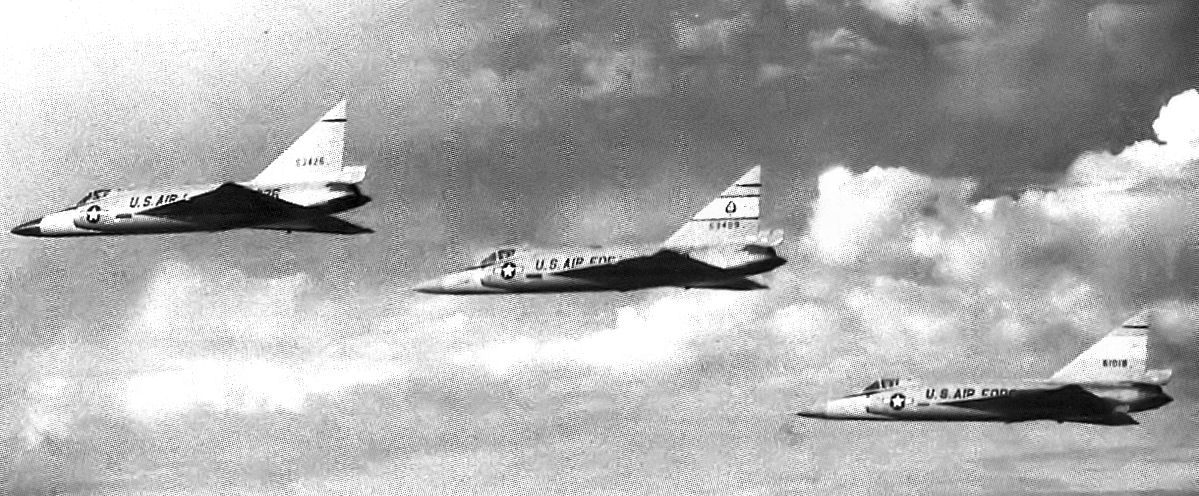
Pictured: a three-ship formation of Convair F-102A Delta Dagger interceptors, the same type flown by the 460th Fighter-Interceptor Squadron out of Portland Air Force Base — not the actual interceptors scrambled to Redmond in 1959. No photograph of that specific intercept, the pursuing F-102s, or the object itself is known to exist; the case rests on radar and pilot-witness testimony rather than imagery.
Theoretical Alignment
Redmond earns a moderate ETH alignment not from any structured-craft description — no witness ever described windows, an interior, or occupants — but from the combination of an instant, physically dramatic stop-and-hover from what had looked like a falling meteor, and a genuinely multi-instrument correlation (sustained ground visual, airborne visual, and two independent radar sources) that the case's own government paper trail never managed to explain with a single consistent story. The Psycho-Social component is elevated above a token score because the Air Force's own shifting account — from denying radar contact, to a balloon, to a stationary antenna reflection, to Venus — is itself a well-documented case study in how an investigating agency's public messaging can generate as much confusion and suspicion as the original sighting, independent of what the object actually was. The Interdimensional Hypothesis finds essentially no support: nothing in any contemporaneous account describes materialization, dematerialization, or portal-like behavior. What ultimately keeps this file in "Disputed" territory rather than pushing it toward either extreme is the same tension found in this catalogue's other strong Cold War intercept cases: credentialed, sustained, multi-witness testimony and real instrumented radar data on one side, and the total absence of a physical artifact, photograph, or film frame on the other.
Background
Redmond, Oregon was incorporated in 1910, named for early settler Frank T. Redmond, and by 1959 was a small Central Oregon farming and ranching community of a few thousand residents whose most significant piece of infrastructure was its airport. Built in the 1920s as a grass airstrip and expanded during World War II into a U.S. Army Air Forces training field for B-17 and P-38 crews, the airport — known historically as Roberts Field and today as Redmond Municipal Airport — had been sold back to the city for a nominal sum after the war and by 1959 hosted scheduled service from two regional carriers, West Coast Airlines and United Air Lines, along with a Federal Aviation Administration Flight Service Station providing weather briefings and flight-following for pilots across Central Oregon. That FAA station, staffed that pre-dawn morning by Flight Service Specialist Laverne Wertz, is the fixed point around which the entire case pivots: it was the destination Officer Robert Dickerson chose to drive to rather than simply continuing his patrol, and it was the facility with both the trained personnel and the direct institutional line to Seattle Air Route Traffic Control Center needed to escalate a police officer's roadside sighting into a formal Air Defense Command response within minutes.
The case unfolded a little less than two years after the Soviet Union's October 1957 launch of Sputnik, at a moment of genuine and widely shared American anxiety about what might be moving through domestic airspace undetected. Air Defense Command's radar-fence and interceptor network, of which both the Klamath Falls-area GCI station and Portland's F-102 squadron were a part, had been substantially built out over the preceding decade specifically to close exactly this kind of detection gap in the Pacific Northwest, a region considered a plausible polar approach corridor for Soviet bombers. Hamilton Air Force Base, the installation Seattle's air traffic controllers turned to once Redmond's report reached them, had been an Air Defense Command facility since January 1, 1951, and by 1959 was in the process of having its runways upgraded to handle the newer F-101 and F-104 fighters then entering service — a base squarely inside the Cold War interceptor infrastructure the Redmond report activated within minutes of being logged.
Complete Timeline
| Date | Event |
|---|---|
| 1910 | Redmond, Oregon is incorporated in Deschutes County, Central Oregon. |
| 1920s–1940s | Redmond's airfield is built, then expanded during World War II as an Army Air Forces training base; it is sold back to the city after the war and becomes Roberts Field, later Redmond Municipal Airport. |
| October 4, 1957 | The Soviet Union launches Sputnik, sharply intensifying American public and military anxiety about undetected activity in domestic airspace. |
| January 1, 1951 | Hamilton Air Force Base, California, is assigned to Air Defense Command, beginning the chain of command that would later route the Redmond scramble order. |
| May 1958 | The 460th Fighter-Interceptor Squadron at Portland Air Force Base, Oregon, transitions to the Convair F-102A Delta Dagger, the aircraft type later scrambled against the Redmond object. |
| September 24, 1959, ~4:55–5:00 AM PST | Redmond police officer Robert Dickerson, on patrol, sees a bright object descending like a falling meteor; it stops abruptly and hovers roughly 200 feet above the ground, illuminating nearby juniper trees. |
| ~5:00–5:10 AM | Dickerson drives to the FAA office at Redmond Airport; Flight Service Specialist Laverne Wertz, who has just finished a routine weather observation, and other FAA personnel begin observing the object through binoculars, describing it as round and flat with intermittent "tongues of flame" from its rim. |
| 5:10 AM PST (1310Z) | The FAA formally logs the sighting and reports it to Seattle Air Route Traffic Control Center. |
| Shortly after 5:10 AM | Seattle ARTCC relays the report to Hamilton Air Force Base, California; Hamilton issues the order to scramble interceptors and diverts a B-47 Stratojet and an F-89 Scorpion already airborne on routine flights to join the response. |
| ~5:15–5:30 AM | Six F-102 Delta Dagger interceptors, almost certainly of the Portland-based 460th Fighter-Interceptor Squadron, launch from Portland Air Force Base under Ground Control Intercept vectoring. |
| ~5:30–6:30 AM | As interceptors close from the southwest, ground observers report the object relocating roughly 10 miles northeast of the airport at an estimated 3,000 feet, then appearing to take on a mushroom-like shape with a trailing flame as F-102s make diving, head-on passes; the object "emits fire" and rockets upward with enough wake turbulence that two of the intercepting jets nearly lose control; one pilot banks sharply to avoid collision, and another pursues the object to roughly 30,000 feet before losing contact. |
| ~5:30–7:00 AM | Ground and Ground Control Intercept radar (Redmond FAA and the Klamath Falls-area GCI station, logged under track designator "JB 129") intermittently track the target for roughly two hours, with altitude readings ranging from about 5,000 to 52,000 feet; the object is briefly reported hovering some 25 miles south of the airport before contact fades. |
| Following days | Project Blue Book, then headed by Maj. Robert J. Friend, opens a formal investigation, interviewing Dickerson, FAA control-center personnel, and (per later accounts) interceptor pilots; broadcast journalist Hal Starr reports that the Air Force initially will not confirm that the FAA's own log shows radar contact was established. |
| Late September 1959 | The Air Force's explanation shifts in quick succession from an unconfirmed/denied radar contact, to a weather balloon, to a stationary radar echo bouncing off a "gap filler" antenna reportedly mounted on a mountain at roughly the 8,010-foot level — an explanation immediately undercut by the fact that the ground radar return attributed to the antenna never moved, while ground observers had watched the visual object relocate to a new position miles away. |
| October 1, 1959 | FAA technical field office chief Boyd Wolfe publicly attributes the sighting to the planet Venus, the explanation that becomes the case's lasting official identification. |
| Early 1960s | National Investigations Committee on Aerial Phenomena (NICAP) researchers, after obtaining FAA logs and correspondence through a formal January 15, 1960 FAA letter and subsequent requests, challenge the Venus explanation as inconsistent with the object's reported behavior; the Air Force's position shifts again, to "insufficient data." |
| 1963 | Queried again, the Air Force reverts to the Venus explanation as its final public position on the case. |
| 1973 | Donald Keyhoe publishes a detailed account of the case, including the interceptor pilots' reported encounter, in his book Aliens From Space. |
| 1970s | Ground Saucer Watch petitions the CIA under the Freedom of Information Act for documents related to Redmond and other cases, part of the broader wave of FOIA-driven UFO document requests of the decade. |
| 1989 | Mutual UFO Network (MUFON) researchers obtain additional case documentation, later summarized in MUFON UFO Journal #257. |
| 2000s | The case's Project Blue Book file, comprising more than fifty individual documents, is catalogued and cross-referenced by researchers including Dan Wilson and Vicente-Juan Ballester Olmos. |
| 2008 | Central Oregon hosts the first "Project Blue Book Festival," created in part to commemorate Redmond's own documented 1959 encounter. |
| 2020s | The case remains a recurring subject of Central Oregon regional journalism and UFO literature, cited by several later writers as among the strongest instances of corroborated military pilot testimony in the Blue Book era. |
A Falling Light Over the Juniper
By every surviving account, the sighting began as something that looked, for a moment, entirely ordinary. Robert Dickerson, a Redmond police officer on overnight patrol, watched what he first took to be a bright meteor descending toward the ground north of the airport. What made it remarkable was what happened next: rather than burning out or continuing to fall, the object stopped its descent abruptly and settled into a stationary hover roughly 200 feet above the ground, low enough that the light reportedly caused nearby juniper trees to glow. Dickerson's own later account, preserved in regional retrospective reporting, is spare and unembellished: "It came close to the ground and it stopped. And at that time, I pulled over the side of the road and stopped the car and watched it." That instinct — to stop, watch, and then seek a second trained observer rather than simply filing a routine report — is what turned a solitary roadside sighting into a multiply corroborated case with an institutional paper trail.
Corroboration at the FAA Office
Dickerson drove directly to the Federal Aviation Administration's field office at Redmond Airport, arriving to find Flight Service Specialist Laverne Wertz, who had just completed a routine weather observation and had noticed nothing unusual moments before. Alerted by Dickerson, Wertz and other FAA personnel stepped outside and located the object, examining it through binoculars for what several accounts describe as close to an hour. Their description, preserved in the case's FAA correspondence and later NICAP summaries, was specific: the object appeared "round and flat," with "tongues of flame" periodically extending from its rim, and its color shifted over the course of the observation from bright white to reddish-orange; other secondary accounts describe an even wider color range, including green, yellow, crimson, and blue. At some point during this extended ground observation, the object relocated roughly ten miles northeast of the airport, hovering at an estimated 3,000 feet, before later being tracked still farther out, some 25 miles to the south. This is the detail that most directly undercuts the case's eventual official explanation: a fixed astronomical object simply does not change apparent position by tens of miles over the course of an hour the way a Central Oregon observer's own line of sight to a genuinely close, low-altitude object would.
The Chain of Command: Redmond to Seattle to Hamilton
At 5:10 a.m. PST — logged in official records as 1310 Zulu time — the FAA formally reported the sighting to Seattle Air Route Traffic Control Center, the regional facility responsible for coordinating high-altitude air traffic across the Pacific Northwest. Seattle's controllers, following standard Air Defense Command liaison procedure for an unidentified target that could not be readily correlated with known air traffic, relayed the report to Hamilton Air Force Base in Marin County, California — an Air Defense Command installation whose area of institutional responsibility, as part of the broader San Francisco Air Defense Sector command structure, extended well up the West Coast and covered exactly the kind of gap between Portland's and Klamath Falls' local radar and interceptor coverage that the Redmond sighting fell into. It was Hamilton, not a closer Oregon-based command post, that issued the order to scramble interceptors, a detail that has occasionally confused later retellings of the case but reflects a perfectly ordinary feature of how 1950s Air Defense Command's regional sector structure actually worked: operational authority for a given patch of sky did not always sit with the geographically nearest base.
Six Delta Daggers Scrambled
Acting on Hamilton's order, six Convair F-102A Delta Dagger interceptors launched from Portland Air Force Base, Oregon — at the time home to the 460th Fighter-Interceptor Squadron of the 337th Fighter Group (Air Defense), the only active-duty unit flying the F-102 from that base in 1959, and a squadron that would go on to win the F-102 category at that year's William Tell gunnery meet. As the jets launched, the Air Force also radioed a B-47 Stratojet bomber and an F-89 Scorpion all-weather interceptor already airborne nearby on routine flights, ordering both to divert and join the response; Keyhoe's 1973 account adds a ninth aircraft, an H-19 helicopter, to the total response. Nine U.S. Air Force aircraft, across four distinct types, converging on a single small-city sighting within perhaps twenty minutes of the initial FAA report is, by the standards of this catalogue's other Cold War intercept cases, an unusually large and rapid mobilization — comparable in scale to the Washington, D.C. flap's jet scrambles rather than to a routine single-aircraft intercept.
The Intercept
What happened as the F-102s closed on the object is the case's most dramatic and most frequently retold sequence. As the fighters made diving, head-on passes at what witnesses on the ground described as a stationary, glowing object, it reportedly "emitted fire from the edges" and rocketed straight upward directly into the jets' flight path with enough force that the wake turbulence nearly caused two of the intercepting aircraft to lose control. One pilot is reported to have banked hard to avoid an outright collision; a second, caught in the churning air behind the ascending object, came close to departing controlled flight entirely. At least one pilot is described as pursuing the object as it climbed, following it to roughly 30,000 feet before losing both visual and radar contact as it continued upward and out of range. None of the individual pilots involved are named in any source available to this file; their reported experiences survive chiefly through Donald Keyhoe's 1973 book Aliens From Space and the secondary UFO-research literature that has drawn on it since, rather than through directly attributable interview transcripts — a limitation this file treats as a genuine evidentiary gap even while crediting the broader event as institutionally documented through the FAA logs and Blue Book's own file on the case.
"Perhaps the Best Pilot Eyewitness Testimony Ever"
Several later secondary sources, including a widely circulated UFO Digest article and an independent blog post by researcher "Docvega," have characterized the Redmond intercept as offering "perhaps the best pilot eyewitness testimony ever" produced by a UFO case. It is worth being precise about what that claim actually rests on, since the framing can be read as overstating what survives in the documentary record. It does not rest on named, individually interviewed, on-the-record pilot testimony of the kind that makes cases like the 1948 Gorman Dogfight or the 2004 "Tic Tac" encounter analytically strong; no F-102, B-47, or F-89 crew member's name has surfaced in any source this file could verify. What the claim more precisely rests on is the fact that the pilots' encounter was not a fleeting, ambiguous visual glimpse but a physically consequential one — real, aircraft-endangering wake turbulence that nearly caused a loss of control, reported through official Air Defense Command and Project Blue Book channels rather than surfacing only in a post-hoc civilian retelling. That is a genuinely unusual category of evidence: not eyewitness description of an object's appearance, but instrumented-by-consequence confirmation that something with real aerodynamic wake characteristics was present and behaving in a way ordinary Cold War-era aircraft did not. This file treats the "best pilot testimony" framing as a defensible characterization of that specific, narrow claim, while declining to extend it to a broader assertion of unimpeachable, fully attributable pilot testimony that the surviving public record does not actually support.
Two Hours on the Scope: Klamath Falls and Redmond Radar
Independent of the visual chase, the object — or, per the Air Force's shifting later accounts, a target attributed to it — remained intermittently visible on radar for roughly two hours. Ground Control Intercept radar covering the region operated from the Klamath Falls area, then home to the 827th Radar Squadron's station (administratively folded into what became Keno Air Force Station that same February), part of Air Defense Command's coverage built specifically to fill the detection gap between the Portland and San Francisco radar networks. That station, together with radar assets at Redmond Airport itself, logged the target — referenced in researcher Loren Gross's chronology under the track designator "JB 129" — moving through a wide altitude band, with compiled figures ranging from roughly 5,000 to 52,000 feet (a small number of secondary sources give slightly different bounds, such as 6,000 or 54,000 feet, reflecting minor transcription variance across the decades of retelling rather than a substantive dispute about the underlying FAA and Air Force logs). One compiled account describes the radar return itself as unusually large for a single aircraft, on the order of 300 to 400 feet across — a detail that, if accurately transcribed from the original logs, sits uneasily with virtually every conventional identification later offered for the case, since neither Venus, a weather balloon, nor a fixed ground antenna would be expected to generate a radar return of that reported size.
The Air Force's Shifting Story
What makes Redmond an unusually well-documented case study in institutional messaging, independent of what the object itself actually was, is how many different official explanations the case moved through in the space of about a week. The first official posture, per contemporaneous broadcast reporting by journalist Hal Starr, was not an identification at all but a flat refusal to confirm the sighting: "The Air Force will not confirm reports that the Federal Aviation Agency log shows radar contact was established," Starr reported, even though the FAA's own internal log plainly recorded exactly that. The second explanation offered was a weather or research balloon — a candidate quickly strained by the object's reported instant stop-and-hover from a rapid descent and its later high-speed ascent, behavior no free-floating balloon exhibits. The third, and most technically specific, explanation held that the ground radar return was not a genuine airborne target at all but a stationary echo bouncing off a "gap filler" antenna reportedly mounted on a mountainside at approximately the 8,010-foot level, installed as part of the radar network's effort to close low-altitude coverage gaps between primary search radars. This explanation collapsed on its own internal logic: the radar return the Air Force attributed to the antenna did not move for the entire period in question, flatly contradicting the independent, sustained ground-witness testimony that the visual object relocated to different positions miles apart over the course of the encounter. Only after this sequence of explanations had each been raised and effectively abandoned did the Air Force settle on its fourth and final identification.
Venus, Announced
On October 1, 1959, FAA technical field office chief Boyd Wolfe publicly attributed the Redmond sighting to the planet Venus, then a bright pre-dawn object low on the eastern horizon. The explanation had the advantage of institutional finality — it required no further investigation, cited a real and verifiable astronomical body, and matched the case's early-morning timing. It had the disadvantage of explaining almost none of the case's specific, multiply-corroborated behavioral details. Venus does not descend; it does not stop and hover 200 feet above the ground; it does not relocate ten or twenty-five miles across the sky within an hour; it does not cause treetops to glow; and, most decisively, it does not generate a radar return that a Ground Control Intercept station can track fluctuating between roughly 5,000 and 52,000 feet. Former Redmond Spokesman writer Trish Pinkerton later summarized the core problem succinctly: "Venus would have behaved very strangely if the people who saw it were reporting accurately." The explanation's credibility was further undercut by an ironic detail this file's research turned up: Wolfe, the same FAA official who announced the Venus identification, also held administrative oversight of a nearby International Geophysical Year all-sky camera station — automated equipment built specifically to continuously photograph the sky and capture exactly this kind of event — whose filming had, by several secondary accounts, inexplicably stopped roughly an hour before the sighting began. The FAA's public statement, notably, never addressed the radar contact at all, focusing exclusively on the visual sighting and leaving the case's strongest and most difficult-to-explain evidentiary component — two hours of ground and airborne radar tracking — conspicuously unaddressed.
NICAP's Rebuttal and the 1963 Reversal
The National Investigations Committee on Aerial Phenomena, then the most institutionally credible civilian UFO research organization in the country, did not let the Venus explanation stand unchallenged. Drawing on a formal FAA letter dated January 15, 1960, and subsequent document requests — part of a broader pattern, documented in NICAP's own case files, of FAA personnel (including some who were themselves NICAP members) providing the organization with official logs and internal correspondence — NICAP assembled and presented the FAA and Air Force with witness accounts and radar logs that directly contradicted both the balloon and Venus identifications. Confronted with its own documentation, the Air Force's position shifted once more, this time to a formal rating of "insufficient data" — neither confirming an exotic origin nor standing fully behind Venus. That position did not hold permanently: when researchers queried the case again in 1963, the Air Force reverted to Venus as its final, lasting public explanation, the identification that has appeared in most subsequent official references to the case since. Donald Keyhoe, NICAP's founder, gave the case its fullest early published account in his 1973 book Aliens From Space, framing the Air Force's shifting explanations and its reluctance to publicly engage with the radar data as part of the broader pattern of institutional evasiveness that had animated his UFO research and advocacy since the early 1950s.
Circumstantial Evidence
- Two independent, on-duty government witnesses — a police officer and an FAA Flight Service Specialist — corroborated the same sighting through direct, sustained observation, including nearly an hour of continuous binocular viewing.
- The sighting was reported through official channels within minutes and independently corroborated by two separate radar systems (FAA/Redmond and USAF Ground Control Intercept at Klamath Falls) tracking the same general target for roughly two hours.
- The military response — six F-102 interceptors plus a diverted B-47 and F-89, nine aircraft in total — was large and rapid enough to indicate the Air Force itself, at the operational level, treated the initial report as credible and urgent rather than dismissible.
- Multiple interceptor pilots reported a physically consequential encounter (aircraft-endangering wake turbulence) rather than a purely visual impression, a stronger and harder-to-fabricate category of corroboration.
- The Air Force's own explanation cycled through at least four distinct, mutually inconsistent identifications (denied contact, balloon, stationary antenna reflection, Venus) within roughly a week, with the gap-filler-antenna explanation specifically falsified by its own internal inconsistency with the ground-witness testimony.
- The FAA's final public Venus statement never addressed the radar tracking data at all, leaving the case's strongest evidentiary component formally unexplained even in the government's own closing account.
- NICAP's documentary challenge, built on FAA's own internal logs and correspondence, was substantial enough to force the Air Force to briefly abandon Venus for "insufficient data" before reverting to it in 1963 under renewed inquiry.
Key Researchers
- Donald Keyhoe (1897–1988) — Retired Marine Corps major and NICAP founder whose 1973 book Aliens From Space gave the case its fullest early published account, including the interceptor pilots' reported encounter.
- Loren Gross — Independent UFO historian based in Fremont, California, and a founding member of the Sign Historical Group, whose decades-long, privately published chronological history of early ufology documents the Redmond case (including the "JB 129" radar track designator) in unusual day-by-day detail.
- Jerome Clark — UFO historian whose reference work, The UFO Encyclopedia, catalogues the Redmond case within the broader documentary record of the late Blue Book period.
- Kevin Randle — Retired military intelligence officer whose Project Blue Book Exposed documents the broader pattern of shifting and contradictory official explanations of which Redmond's sequence (denied contact, balloon, antenna reflection, Venus) is a particularly well-documented single-case example.
- Richard Dolan — UFO historian whose research on Cold War-era national-security handling of UFO reports situates the Redmond scramble within the broader pattern of Air Defense Command interceptor responses to unidentified radar targets.
- Vicente-Juan Ballester Olmos and Dan Wilson — Researchers whose independent cataloguing and cross-referencing of Redmond's Project Blue Book file (more than fifty individual documents) is cited in NICAP's own case-directory summary of the sighting.
Cultural Impact
Redmond has never achieved the broad name recognition of Roswell or the McMinnville photographs, but within Central Oregon it has become a genuine piece of local historical identity rather than a forgotten footnote. Regional retrospective journalism, including a dedicated "Little Did I Know" feature by Central Oregon Daily and a Source Weekly cover story titled "UFOregon," has revisited the case repeatedly for new generations of readers, and Central Oregon began hosting an annual "Project Blue Book Festival" beginning in 2008, created in part specifically to commemorate Redmond's own documented 1959 encounter. The case has also become something of a touchstone in later UFO-research writing specifically for its pilot-encounter element, cited by multiple independent sources — UFO Digest and the "Docvega" research blog among them — as an example of unusually consequential, aircraft-endangering interceptor testimony from the Blue Book era, a framing this file treats with the caveats discussed above regarding the lack of directly attributable named pilot accounts.
Key Witnesses
Robert Dickerson
On overnight patrol shortly before dawn on September 24, 1959, Dickerson watched a bright object fall like a meteor, stop abruptly, and hover roughly 200 feet above the ground, close enough that nearby juniper trees appeared to glow. Rather than simply continuing his patrol, he drove directly to the FAA's Redmond Airport office to seek a second, technically equipped observer — the decision that turned a solitary roadside sighting into the multiply corroborated, officially escalated case this file documents.
Laverne Wertz
On duty at the Redmond FAA Flight Service Station, Wertz had just completed a routine weather observation, noticing nothing unusual, when Officer Dickerson arrived reporting the object. Wertz and other FAA personnel then observed it directly through binoculars for close to an hour, describing it as round and flat with intermittent flame-like projections from its rim. Wertz's formal report to Seattle Air Route Traffic Control Center at 5:10 a.m. set the entire military response in motion.
The F-102, B-47, and F-89 Aircrews (unnamed)
Six F-102 Delta Dagger pilots, together with a diverted B-47 Stratojet crew and an F-89 Scorpion crew, converged on the object as it hovered and then climbed. Making diving, head-on passes, at least two pilots nearly lost control of their own aircraft in the object's wake turbulence as it accelerated away; one pilot pursued it to roughly 30,000 feet before losing contact. None of the individual crew members are named in any source available to this file; their accounts survive chiefly through Donald Keyhoe's published research.
Boyd Wolfe
Not a witness to the sighting itself, but the FAA official whose October 1, 1959 public statement attributing the case to the planet Venus became its lasting official explanation. Wolfe's own administrative oversight of a nearby International Geophysical Year all-sky camera — whose automated filming had reportedly stopped about an hour before the sighting — is one of the case's more pointed unresolved details.
Donald Keyhoe
The retired Marine Corps major and prominent UFO researcher gave the Redmond case its fullest early published account in his 1973 book Aliens From Space, including the interceptor pilots' reported near-loss-of-control encounter, and used the case as an example of the Air Force's pattern of shifting, evasive public explanations.
The Five Observables Assessment
The Five Observables framework, developed by former AATIP director Luis Elizondo, is used to classify UAP encounters by performance characteristics exceeding known technology of their era. Redmond offers an unusually rich behavioral record for this framework relative to most 1950s cases, because the object was both visually observed at length and independently radar-tracked, rather than relying on one form of evidence alone.
Assessment: Anti-Gravity Lift is rated present: the object's reported transition from a rapid, meteor-like fall to an abrupt, motionless hover at roughly 200 feet, sustained for nearly an hour, is precisely the kind of instant-arrest-of-momentum behavior this observable is meant to capture, and it was independently witnessed by both Dickerson and the FAA personnel who joined him. Instant Acceleration is rated present on the strength of the interceptor encounter: multiple pilots reported the object rocketing upward with enough force to generate aircraft-endangering wake turbulence as the F-102s made their passes, a physically consequential (not merely visual) form of corroboration. Hypersonic Velocity is rated speculative rather than present because, while the object outpaced supersonic F-102 interceptors and climbed beyond a pursuing pilot's engagement envelope by roughly 30,000 feet, no source preserves a precise calculated speed or Mach figure, so this file declines to claim a specific hypersonic value the record does not actually support. Low Observability is rated absent: the object was, if anything, unusually conspicuous — continuously visible to the naked eye for extended periods and tracked on radar by two independent stations for roughly two hours. Trans-Medium travel is rated absent; no transition between air, water, or space was ever reported.
Evidence Assessment
Supporting Anomalous Origin
- A trained police officer and an FAA aviation professional independently and jointly observed the object at close range for nearly an hour, describing specific, consistent behavioral details (color shift, relocation, shape change).
- Two independent radar systems, one civilian FAA and one military Ground Control Intercept, reportedly tracked a target through a wide altitude band for roughly two hours — a genuinely difficult correlation for any single conventional explanation to account for.
- Military interceptor pilots reported a physically consequential encounter (near loss of aircraft control in wake turbulence), a stronger form of evidence than a purely visual account.
- None of the Air Force's four successive official explanations accounts for the full set of independently corroborated behavioral details; each explains at most one facet of the case while leaving others (especially the radar altitude data) unaddressed.
- The Venus explanation's own messenger, Boyd Wolfe, held oversight of an automated sky camera that inexplicably stopped filming roughly an hour before the sighting, removing the one instrument best positioned to independently settle the matter.
Supporting Conventional Explanation / Non-Corroboration
- No named interceptor pilot testimony, photograph, or film frame of the object survives in any source available to this file, despite nine aircraft and numerous ground personnel being involved.
- Radar targets in 1950s Ground Control Intercept systems were genuinely and frequently subject to false returns, temperature-inversion ducting, and ground-clutter artifacts, all mundane phenomena the era's technology struggled to distinguish reliably from real targets.
- Venus was, as a matter of astronomical fact, a genuinely bright object in the pre-dawn eastern sky that morning, and bright-planet misidentification is a well-documented, recurring source of UFO reports throughout this catalogue and the broader literature.
- The most vivid single details of the case — pilots nearly losing control, the object "emitting fire" — are preserved chiefly through Donald Keyhoe's 1973 secondhand published account rather than through directly attributable, contemporaneous pilot statements, leaving room for exaggeration in retelling.
- The FAA and Air Force did ultimately investigate the case formally through Project Blue Book, generating a substantial documented file rather than simply ignoring the report, which is itself consistent with an agency working through a genuinely difficult but ultimately mundane identification rather than concealing a confirmed anomaly.
Why "Disputed"
This case earns a DISPUTED classification because its evidentiary core is genuinely strong by the standards of this catalogue — sustained, close-range, multi-witness ground observation by two categories of trained government personnel, a real and rapid nine-aircraft Air Defense Command response, a physically consequential pilot encounter, and roughly two hours of dual-source radar tracking — while the government's own official resolution of the case is demonstrably incomplete rather than merely unwelcome. What is not seriously in dispute: Robert Dickerson and Laverne Wertz both observed an unusual object at close range for an extended period; the FAA logged and escalated the report through Seattle ARTCC to Hamilton Air Force Base within minutes; six F-102s plus a B-47 and F-89 genuinely launched in response; and Project Blue Book generated a substantial formal investigation file. What remains genuinely, concretely open is the fit between the object's reported behavior and any single conventional identification the Air Force actually offered. Each of the four explanations advanced in succession — denied contact, balloon, gap-filler antenna reflection, and finally Venus — accounts for at most a narrow slice of the record while leaving other independently corroborated details unaddressed; the gap-filler-antenna explanation was specifically undercut by its own internal inconsistency with ground-witness testimony, and the Venus explanation, whatever its astronomical accuracy for that particular morning, was never reconciled with the radar altitude data at all. A case with this combination — strong, credentialed, multiply-corroborated testimony and instrumented radar data, paired with an official explanation that a civilian research organization was able to substantively challenge using the government's own documents — is precisely the kind of unresolved status this site's "Disputed" rating exists to describe: not debunked, because no single conventional explanation has ever actually accounted for the full behavioral and radar record; and not fully credible, because no named pilot testimony, photograph, or physical evidence exists to independently corroborate the case's most dramatic details beyond secondary published accounts.
Sensor & Instrumentation Detection Profile
This is fundamentally a radar-visual case with an unusually long observation window for the era. Two distinct radar systems reportedly tracked the object: ground radar coordinated through the FAA's Redmond and Seattle facilities, and U.S. Air Force Ground Control Intercept radar operated from the Klamath Falls area — almost certainly the 827th Radar Squadron's station, then in the process of being renamed Keno Air Force Station in February 1959, which provided GCI coverage for the gap in Air Defense Command's radar fence between Portland and San Francisco. According to researcher Loren Gross's chronology of the case, the target was logged under the radar track designator "JB 129." Multiple secondary compilations describe the tracked target's altitude fluctuating between roughly 5,000 and 52,000 feet over a period of about two hours, with minor variance across sources (some give 6,000 feet as the lower bound, others 54,000 as the upper bound) — a spread this file treats as evidence of imprecise later transcription of the original FAA/USAF logs rather than a meaningful factual dispute. One compiled account describes the ground radar return itself as unusually large, on the order of 300 to 400 feet across. Visual detection ran in parallel throughout: continuous ground observation by Dickerson, Wertz, and other FAA personnel at Redmond Airport, and direct visual contact by the F-102, B-47, and F-89 aircrews as they closed on the target. No photographic or film evidence is known to have been produced by any observer that morning, a significant gap given how many trained, equipped personnel were involved.
Environmental & Geospatial Context
Redmond, Oregon sits in the high desert of Central Oregon, roughly 13 miles north of Bend, a landscape of juniper and sagebrush flats at about 3,000 feet elevation. The city's airport, historically known as Roberts Field and now Redmond Municipal Airport, had served as a regional hub since the 1920s and hosted an FAA Flight Service Station whose personnel provided weather observation and flight-following services for the two commercial carriers then flying into Redmond, West Coast Airlines and United Air Lines. The pre-dawn sky over the high desert in late September is typically clear and dark, conditions the surviving FAA correspondence confirms were unremarkable that morning — no storm activity, no unusual atmospheric layering, and nothing in the record suggesting degraded visibility contributed to the sighting. Geospatially, the case sits inside a genuinely dense slice of Cold War air-defense infrastructure: Klamath Falls' Ground Control Intercept radar roughly 130 miles to the south, Hamilton Air Force Base's Air Defense Command chain of command roughly 400 miles to the south in California, and Portland Air Force Base's fighter-interceptor squadron roughly 130 miles to the north — meaning the object appeared almost precisely in the coverage seam between two major West Coast air-defense radar and interceptor networks, a fact that helps explain why the response ultimately routed through Hamilton rather than a closer facility.
Observer Credibility & Occupational Profile
The case's witness roster is built almost entirely from on-duty government personnel performing their ordinary professional functions, not incidental civilian bystanders. Robert Dickerson was a sworn municipal police officer on routine overnight patrol, trained to observe and accurately report unusual activity as a basic function of the job; his decision to drive directly to the FAA office rather than simply filing a report afterward reflects a level of engagement consistent with someone who judged the sighting significant enough to seek independent, technically equipped corroboration in real time. Laverne Wertz, as an FAA Flight Service Specialist, held a professional aviation-weather and flight-following role that required the ability to distinguish celestial objects, aircraft, weather phenomena, and genuine unknowns as a matter of daily practice — precisely the kind of trained-observer profile this site's credibility framework weighs most heavily, comparable to the air traffic controllers at the center of the Washington, D.C. flap seven years earlier. Layered on top of the ground witnesses are the F-102, B-47, and F-89 aircrews, military pilots whose entire profession depended on accurately identifying aircraft, weather artifacts, and instrument anomalies under pressure; their reports of near-losing control in the object's wake turbulence are not the kind of detail an untrained witness would be positioned to observe or describe convincingly. The case's principal credibility weakness is that none of the interceptor pilots are named in any source available to this file — their observations survive only in secondhand published accounts, chiefly Donald Keyhoe's, rather than as directly attributable, individually verifiable testimony.
Physical & Material Assays
No physical debris, trace residue, or recovered artifact of any kind is associated with this case, and none has ever been claimed by any source. Unlike ground-trace cases such as Delphos or Trans-en-Provence, the Redmond object never landed or touched anything; its closest approach to the ground was the reported 200-foot hover, close enough to illuminate treetops but not close enough to leave any tested trace. The case's one tantalizing near-miss with physical documentation is the International Geophysical Year all-sky camera then operating in the region under the technical oversight of FAA field office chief Boyd Wolfe — equipment built specifically to continuously photograph the sky and capture exactly this kind of transient aerial phenomenon. By multiple secondary accounts, that camera had inexplicably stopped filming roughly an hour before the sighting began, meaning the one piece of automated optical instrumentation positioned to settle the matter was, by simple bad timing or something less innocent, not running when it mattered.
Historical Precedents & Archive Matches
Redmond sits within the same late-1950s wave of Air Defense Command interceptor scrambles against unidentified radar targets that also produced the Kinross Incident (1953) and echoes the earlier Gorman Dogfight (1948), sharing with both the basic structural pattern of a ground-radar detection triggering a fighter-interceptor response against a target that outperformed or outmaneuvered the intercepting aircraft. It differs from Kinross in one crucial respect that materially strengthens its evidentiary profile: where the Kinross object was never visually observed by anyone, the Redmond object was watched continuously, at close range, by name-identified ground witnesses for the better part of an hour before any aircraft ever launched. NICAP's own period case-indexing work classified Redmond under the same "Aircraft/UFO Radar-Visual" category used for the small number of 1959-era cases judged to combine credible radar data with credible independent visual corroboration, placing it in a comparatively small, higher-confidence tier within that year's reporting. The case's evolving official explanation — three distinct conventional identifications offered in succession before the Air Force settled on Venus — also has a documented institutional precedent: Project Blue Book's own internal correspondence throughout the late 1950s shows repeated instances of field-level personnel proposing an initial mundane explanation that a closer records check later contradicted, a pattern researcher Kevin Randle's audit of the Blue Book files documents extensively across dozens of unrelated cases.
Material Analysis
No physical debris, trace residue, or recovered artifact of any kind is associated with the Redmond sighting, and none has ever been claimed by any source consulted for this file. The object's closest reported approach to the ground was its roughly 200-foot hover over the city, close enough to illuminate treetops but never close enough to leave a tested physical trace of the kind documented in cases like Delphos or Trans-en-Provence. The case's single most consequential absence in this domain is photographic: despite nine military aircraft, a police officer, and multiple FAA personnel all reportedly viewing the object at various points, no photograph or film frame of it has ever surfaced in any source this file could verify, and the one piece of automated optical instrumentation positioned nearby specifically to capture exactly this kind of transient sky event — the International Geophysical Year all-sky camera under Boyd Wolfe's technical oversight — had, by several accounts, stopped filming roughly an hour before the sighting began. This file treats that gap as a genuine, unresolved evidentiary hole rather than either proof of concealment or grounds for dismissal; camera and instrument failures of exactly this mundane kind were a real and recurring operational problem for under-resourced 1950s monitoring programs, documented extensively in the parallel history of Project Twinkle's green-fireball camera network in New Mexico during the same decade.
Supporting a Genuine, Undocumented Anomaly
- The absence of photographic evidence reflects a documented equipment failure at the one facility positioned to capture it, not an absence of witnesses or effort.
- The reported radar return's unusually large size (roughly 300–400 feet, per one compiled account) is not readily explained by any of the Air Force's four successive conventional identifications.
Supporting Caution / Non-Verification
- With no physical evidence and no photograph of any kind, the case's most dramatic details ultimately depend on witness memory and secondary published accounts rather than independently testable material.
- 1950s FAA and Air Force radar logs are not infallible instruments; return size and altitude figures transcribed decades later through several layers of secondary compilation carry real, acknowledged uncertainty.
The Conventional Explanation Candidate: The Planet Venus
The Planet Venus
InconclusiveThe Air Force and FAA's final, lasting explanation holds that Robert Dickerson, Laverne Wertz, and other observers mistook the planet Venus, genuinely bright and low on the pre-dawn eastern horizon that morning, for an unidentified object. This deserves serious consideration on its own astronomical merits: Venus was real, was visible, and bright-planet misidentification is one of the single most common, well-documented sources of UFO reports throughout this catalogue and the wider literature, particularly in the disorienting minutes just before dawn when a stationary light low on the horizon can appear to move relative to foreground terrain or clouds as an observer's own position or attention shifts.
Its central weakness is that it explains, at most, one narrow slice of a much larger and more specific behavioral record. Venus cannot descend rapidly and then stop; it cannot hover 200 feet above the ground; it cannot relocate ten and then twenty-five miles across the sky within roughly an hour, as the object was independently reported doing; it cannot illuminate nearby treetops; and it categorically cannot generate a radar return that Ground Control Intercept operators can track fluctuating between roughly 5,000 and 52,000 feet over a two-hour period. The FAA's own October 1, 1959 public statement, tellingly, addressed only the visual sighting and never engaged with the radar data at all — an omission this file reads as evidence the explanation's authors recognized, at least implicitly, that Venus could not account for the case's strongest instrumented evidence.
The Gap-Filler Antenna Radar Reflection
InconclusiveA second, more technically specific candidate, floated by the Air Force before it settled on Venus, held that the ground radar return was a stationary echo bouncing off a "gap filler" antenna reportedly mounted on a mountainside at roughly the 8,010-foot level, part of the era's effort to plug low-altitude radar coverage gaps between primary search stations. This candidate is attractive because such reflection artifacts were a real, documented limitation of 1950s ground radar systems. It fails on its own internal evidence, however: the radar return the Air Force attributed to the antenna reportedly did not move for the entire period in question, directly contradicting the independent, sustained ground-witness testimony that the visual object relocated to markedly different positions over the course of the encounter — a mismatch specific and concrete enough that the Air Force itself appears to have abandoned this explanation relatively quickly in favor of Venus.
Weather or Research Balloon
InconclusiveA third candidate, also raised and then dropped by the Air Force before the balloon explanation gave way to the gap-filler-antenna theory, holds that Dickerson and Wertz observed a high-altitude weather or research balloon, whose reflective skin and erratic apparent motion under shifting winds could account for the color changes and positional drift described. This candidate is undercut by the same detail that weakens it in comparable cases across this catalogue: it does not explain the object's reported instant stop-and-hover from a rapid, meteor-like descent, nor its subsequent high-speed vertical ascent under interceptor pressure, both behaviors well outside a free-floating balloon's physical capabilities.
Each of the three candidates the government itself formally proposed accounts for a genuine, real-world phenomenon that could plausibly contribute to a UFO report in isolation, and each was, in turn, either contradicted by the case's own witness and radar record or simply left major elements of that record unaddressed. No single conventional explanation currently on offer accounts for the full combination of an instant stop-and-hover, a sustained hour-long, close-range, multi-witness visual observation with reported relocation across many miles, a physically consequential interceptor encounter, and roughly two hours of fluctuating-altitude radar tracking — the same evidentiary gap that keeps this case rated "Disputed" rather than either "Debunked" or fully "Credible."
Related Cases
Confirmed Documents & Official Records
National Archives finding aid for the Project Blue Book records transferred from Wright-Patterson AFB (Record Group 341), the broader collection within which Redmond's more-than-fifty-document case file falls.
UNCLASSIFIED (declassified)Official National Archives history of Project Blue Book's origins, staffing, and recordkeeping practices during the 1958–1963 period when Maj. Robert Friend directed the program and the Redmond file was compiled.
UNCLASSIFIEDSearch Government Archives Directly
Further Reading — Recommended Literature
Aliens From Space: The Real Story of Unidentified Flying Objects
The book that gave the Redmond intercept its fullest early published account, including the F-102 pilots' reported near-loss-of-control encounter and the Air Force's shifting public explanations.
The Report on Unidentified Flying Objects
Written by Project Blue Book's first chief, essential background on how the Air Force's investigative apparatus and Ground Control Intercept liaison procedures — the same institutional machinery Seattle ARTCC and Hamilton AFB relied on in 1959 — actually functioned during this era.
Project Blue Book Exposed
A case-by-case audit of Blue Book's investigative record by a veteran military intelligence officer, useful for placing Redmond's own sequence of shifting official explanations within the wider, documented pattern of Blue Book inconsistency.
Watch the Skies!: A Chronicle of the Flying Saucer Myth
A rigorously documented, skeptically minded history of American UFO cases that situates Redmond within the broader late-1950s wave of Air Defense Command radar-intercept "unknowns."
The UFO Encyclopedia, 4th Edition
The definitive UFO reference work, with a cited entry on the Redmond case that situates it within the broader documentary record of the late Project Blue Book period.
Essential Viewing
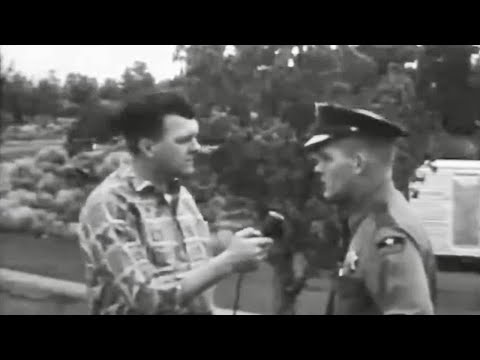
Police Officer Robert Dickerson on Witnessing a UFO in Redmond, Oregon, September 24, 1959
Archival KGW-TV footage of Robert Dickerson describing his own encounter, republished by the archival-television channel Eyes On Cinema.
The Central Oregon UFO Sighting of 1959 | KGW Vault
Portland station KGW's own news archive retrospective on the Redmond case, drawing on the station's original 1959 coverage and later reporting.
Sources
- ufologie.patrickgross.org. "UFOs at Close Sight: The Redmond UFO Incident, September 24, 1959, USA." ufologie.patrickgross.org
- ufologie.patrickgross.org. "The Redmond UFO Incident, September 24, 1959, USA — NICAP Summary." ufologie.patrickgross.org
- ufologie.patrickgross.org. "The Redmond UFO Incident, September 24, 1959, USA — MUFON Summary." ufologie.patrickgross.org
- NICAP. "Aircraft/UFO Radar-Visual Cases, 1959" (Redmond, Oregon case entry). nicap.org
- NICAP. "UFO Report: Redmond, Oregon, September 24, 1959" (case directory, document index). nicap.org
- UFO Digest. "The 1959 Delta Daggers vs. UFO Sighting: Perhaps Best Pilot Eye Witness Testimony Ever." ufodigest.com
- Docvega's Blog. "1959 UFO Sighting Perhaps Best Evidence of Eye Witness Testimony Ever." docvega.wordpress.com
- Central Oregon Daily. "The Day UFOs Hovered Over Redmond — and the Air Force Scrambled Jets" (Little Did I Know series). centraloregondaily.com
- The Source Weekly (Bend, Oregon). "UFOregon." bendsource.com
- Sign Oral History Project. "UFOs: A History / The Fifth Horseman of the Apocalypse," by Loren E. Gross — 1959 July–September index (Redmond, OR; Robert Dickerson; Laverne Wertz; Track "JB 129"). sohp.us
- Eyes On Cinema (YouTube). "Police Officer Robert Dickerson on Witnessing a UFO in Redmond, Oregon, September 24, 1959" (archival KGW-TV footage). youtube.com
- KGW News (YouTube). "The Central Oregon UFO Sighting of 1959 | KGW Vault." youtube.com
- Wikipedia. "Roberts Field" (Redmond Municipal Airport history). en.wikipedia.org
- Wikipedia. "Redmond, Oregon." en.wikipedia.org
- Wikipedia. "Hamilton Field (Hamilton AFB)." en.wikipedia.org
- Wikipedia. "San Francisco Air Defense Sector" (Hamilton AFB's Cold War command structure). en.wikipedia.org
- Wikipedia. "Convair F-102 Delta Dagger." en.wikipedia.org
- Cave Tigrim! The 460th FIS in the Cold War. "The Deuce Years" (460th Fighter-Interceptor Squadron, Portland AFB, F-102 service history). 460fis.wordpress.com
- Wikipedia. "Kingsley Field Air National Guard Base" (Klamath Falls-area Ground Control Intercept radar history, 827th Radar Squadron/Keno AFS). en.wikipedia.org
- Wikipedia. "Mount Hebo Air Force Station" (regional Oregon Air Defense Command radar network context). en.wikipedia.org
- Wikimedia Commons. "47th Fighter-Interceptor Squadron three-ship F-102 formation 1959.jpg" (U.S. Air Force photograph, public domain). commons.wikimedia.org
- Keyhoe, Donald E. Aliens From Space: The Real Story of Unidentified Flying Objects, Doubleday, 1973.
- Clark, Jerome. The UFO Encyclopedia, 4th Edition, Visible Ink Press, 2023 (Redmond, Oregon case entry).
- Randle, Kevin D. Project Blue Book Exposed, Barnes & Noble Books, 1996.
- Peebles, Curtis. Watch the Skies!: A Chronicle of the Flying Saucer Myth, Smithsonian Institution Press, 1994 (late-1950s Air Defense Command intercept case context).
See something inaccurate? Have additional information or sources?
Suggest an Edit →Last Updated: August 2026