
The Captain William Schaffner Incident
On the stormy night of September 8, 1970, USAF exchange pilot Captain William Schaffner was scrambled from RAF Binbrook, Lincolnshire, in English Electric Lightning F.6 XS894, callsign "Foxtrot 94," to intercept a radar contact over the North Sea. He never returned. His aircraft was recovered from the seabed weeks later, largely intact, its ejector seat unfired and Schaffner's body never found — a genuine, still-unresolved human tragedy. It is not, however, a UAP case in any meaningful sense. The declassified 1972 RAF Board of Inquiry report — kept restricted for three decades under routine flight-safety classification and finally released in 2003 after BBC pressure — contains no mention of unidentified flying objects at all. It identifies the radar contact Schaffner was vectored onto as an RAF Avro Shackleton playing the role of a simulated intruder in a NATO Tactical Evaluation exercise, and attributes his fatal crash to spatial disorientation during a low-level night shadowing maneuver he had little specific training for. The "UFO interception" narrative that now dominates popular retellings of this case did not exist in 1970. It was invented, whole cloth, by an anonymous source in a 1992 regional newspaper series, more than two decades after Schaffner died, and has been progressively embellished ever since by writers with no access to — and, it turns out, no interest in reconciling their claims with — the actual official record. This file honors Schaffner's death as the real tragedy it was while being honest about what the primary documentation actually shows: not a close encounter, but a fatal training accident later hijacked by a fabricated story.
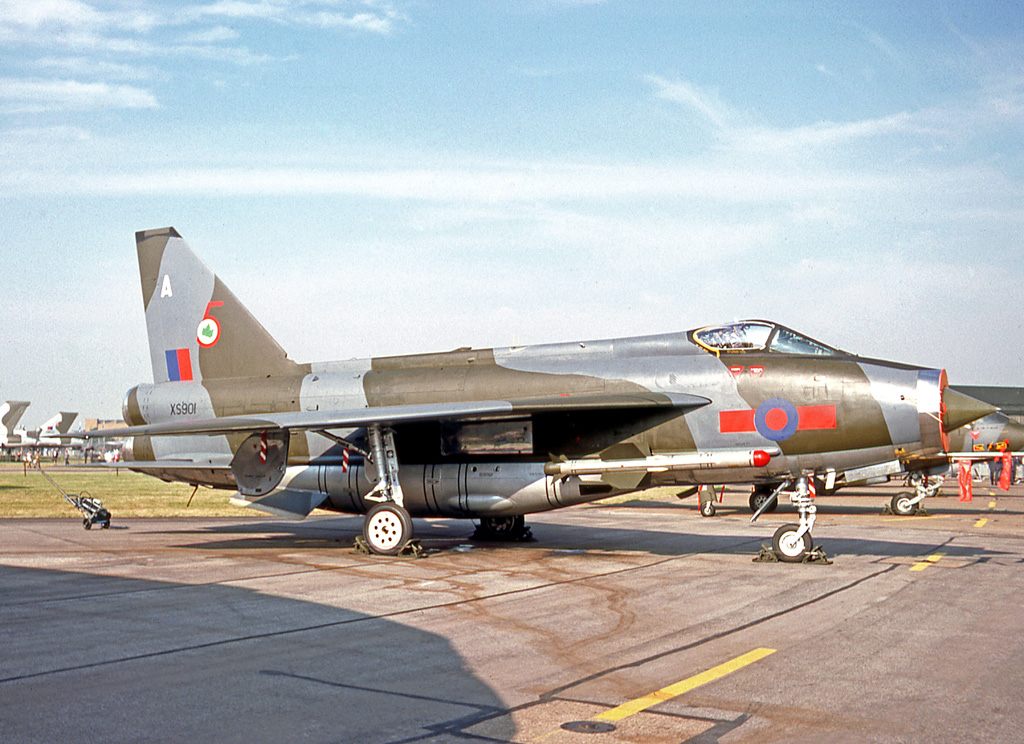
Pictured: English Electric Lightning F.6 XS901, marked "A" of No. 5 Squadron RAF — the same squadron, base, and mark of aircraft Schaffner flew, photographed July 30, 1977. This is not a photograph of XS894, the actual aircraft Schaffner was flying the night he disappeared, nor of the September 8, 1970 incident itself. No photograph of XS894 in RAF service, nor of the wreck-recovery operation, is known to be freely licensed; this sister aircraft is the closest rights-clear image that accurately represents the type, squadron, and livery involved.
Theoretical Alignment
Stripped to its primary sourcing, the Schaffner case contains nothing an exotic-craft framework can meaningfully engage with: no witness, contemporary or otherwise, ever described a structured object, and the only "performance characteristics" attached to it — a claimed 17,400 mph radar-plot speed — appear exclusively in an unverified 1992 newspaper account, not in any primary radar log or official document. The comparatively high Psycho-Social score does not reflect anything about the events of September 8, 1970 themselves, which the declassified file shows unfolding as an unremarkable, if fatal, training exercise. It reflects the case's real subject: how a specific, unverifiable tabloid story, published 22 years after a young pilot's death, was able to graft a dramatic UFO-interception myth onto a genuine tragedy and have that myth outrun, in public memory, the sober official record that directly contradicts it. Few cases in this catalogue illustrate the psycho-social mechanism of UFO-narrative construction as cleanly, or as documentably, as this one.
Background
Captain William Schaffner was born September 11, 1941, and grew up in Ohio before his family later moved to Texas. He joined the United States Air Force and flew two combat tours in Vietnam in the Convair F-102 Delta Dagger, a demanding all-weather interceptor, before being selected for an exchange posting with the Royal Air Force — a standard Cold War-era arrangement under which American and British fighter pilots swapped services for a tour to build interoperability between NATO air forces. He arrived at RAF Binbrook in Lincolnshire in July 1970 to fly the English Electric Lightning, Britain's Mach-2-capable, purpose-built interceptor, with No. 5 Squadron, one of two Lightning squadrons (alongside No. 11 Squadron) that shared Binbrook's Quick Reaction Alert (QRA) commitment — keeping armed interceptors on permanent standby to respond to unidentified aircraft approaching UK airspace, a genuine and constant Cold War responsibility. By early September, only about eight weeks into the posting, Schaffner had logged roughly 121 hours on the Lightning, a fraction of his F-102 experience, and only about 18 of those hours at night; his qualification status was recorded as "Limited Combat Ready." He was married to Linda Schaffner, and the couple had three young sons — David, Glennon, and Michael.
The night of September 8, 1970 was not, in itself, unusual by Cold War standards: it was the occasion of a NATO Tactical Evaluation (TACEVAL), a periodic, deliberately unannounced exercise designed to test a station's real readiness to detect and respond to a simulated hostile incursion, exactly the scenario Binbrook's QRA posture existed to rehearse. For that night's exercise, an RAF Avro Shackleton MR.3 — a large, slow, four-engined maritime patrol aircraft, serial WR981 — was tasked to fly a low-level, deliberately non-cooperative track off the Lincolnshire and Yorkshire coast, playing the role of a "hostile" intruder for the exercise controllers to detect and for QRA fighters to intercept, exactly the kind of drill British air defence ran routinely throughout the period. It was this aircraft, not any unidentified craft, that Schaffner's Lightning was vectored onto that night.
Complete Timeline
| Date | Event |
|---|---|
| September 11, 1941 | William Schaffner is born in Ohio; his family later relocates to Texas. |
| 1960s | Schaffner joins the United States Air Force and flies two combat tours in Vietnam in the Convair F-102 Delta Dagger. |
| July 1970 | Schaffner arrives on RAF exchange duty at RAF Binbrook, Lincolnshire, to fly the English Electric Lightning with No. 5 Squadron. |
| September 8, 1970, evening | A NATO Tactical Evaluation (TACEVAL) exercise begins; an RAF Avro Shackleton MR.3 (WR981) flies a low-level, non-cooperative track off the Lincolnshire/Yorkshire coast to play the role of a simulated intruder. |
| ~21:30–22:00 GMT | Ground radar controllers at RAF Patrington and RAF Staxton Wold track the contact and a first Lightning is scrambled from Binbrook, making four practice approaches on the Shackleton before departing the area. |
| 22:06 GMT, September 8, 1970 | Schaffner takes off from Binbrook in Lightning F.6 XS894, callsign "Foxtrot 94," armed with two Red Top air-to-air missiles, to begin a second interception approach on the same contact. |
| Shortly after takeoff | Schaffner reports "Contact with a set of lights in that area – closing" and that he will need to "manoeuvre to slow her down a little bit" — ordinary interceptor phraseology for closing on and matching speed with a slower aircraft's navigation lights, not a description of anything unconventional. |
| Minutes later | Schaffner's Lightning breaks off to starboard during its approach on the Shackleton and never re-establishes contact; Patrington's controller radios "you are dark on me this time – check target's heading," receiving no reply. |
| Later that night | The Shackleton crew, unaware anything is wrong, assumes the Lightning has simply returned to base; Uxbridge (the UK Air Defence command centre) alerts them on the guard frequency and tasks them with beginning a search under the callsign "Playmate 51." |
| September 9, 1970 onward | An extensive air-sea search for Schaffner is conducted over the following days; no trace of the pilot is found. |
| October 7, 1970 | Royal Navy divers locate the wreckage of Lightning XS894 on the seabed roughly five miles off Flamborough Head, Yorkshire. |
| Weeks later, 1970 | The wreckage is recovered, found remarkably intact; the canopy is closed but unlatched, the ejector seat is still in the aircraft and had never fired. Schaffner's body is never recovered. |
| 1972 | The RAF Board of Inquiry completes its report, concluding the accident was most likely caused by spatial disorientation during a low-level night shadowing maneuver, and identifying the radar contact as the Shackleton. The report contains no mention of any unidentified object and is classified "restricted," the routine classification for RAF flight-safety accident reports of the period. |
| October 1992 | Grimsby Evening Telegraph assistant editor Pat Otter publishes a series titled "The Riddle of Foxtrot 94," based on an anonymous phone caller claiming to have served on the original RAF crash investigation team, introducing dramatic UFO-interception claims absent from any prior record of the case. |
| 1999 | Author Tony Dodd's book Alien Investigator expands the story further, adding unsupported claims of White House and NORAD involvement. |
| 2002 | The BBC regional programme Inside Out investigates the case and pressures the Ministry of Defence, which had initially claimed the Board of Inquiry file had been destroyed. |
| 2003 | The Ministry of Defence releases the declassified 1972 Board of Inquiry report, official photographs, and the authenticated radio transcript, confirming the radar contact was the Shackleton and that the report contains no reference to UFOs. |
| 2005 | Schaffner's youngest son, Michael, travels to the MoD Main Building in London to personally read the declassified report for the first time. |
| September 2014 | A retired RAF Squadron Leader writes to FlyPast magazine, identifying the Shackleton (WR981) and its crew's own side of the exercise, corroborating the declassified file in independent detail. |
| May 30, 2014 | Researcher David Clarke publishes "Foxtrot 94 — A Cold War Mystery Solved," synthesizing the declassified file and the FlyPast letter into the most complete public account of the case to date. |
| May 2023 | Author John Nichol publishes Eject! Eject!, including an extensively researched chapter on the Schaffner case built on interviews with Schaffner's widow and sons, concluding plainly that "the UFO story is just that – a story." |
The Exercise and the Scramble
To understand what actually happened on September 8, 1970, it helps to start with what a Tactical Evaluation was for. TACEVALs were unannounced, deliberately stressful drills NATO ran periodically against every front-line air-defence station, designed to test whether a squadron could genuinely detect, scramble against, and intercept a simulated hostile aircraft under real time pressure — not a tabletop exercise, but a live one, flown with real aircraft playing real roles. RAF Binbrook's Quick Reaction Alert commitment, shared with RAF Coningsby's Phantom squadrons, existed precisely for nights like this: armed interceptors sitting ready, pilots and ground crew on call, prepared to scramble against an unidentified or unresponsive contact approaching the coast. For this particular TACEVAL, the "hostile" was an RAF Avro Shackleton MR.3, serial WR981, deliberately flying a low, slow, radio-silent track off the coast to give the exercise's radar controllers and interceptor crews a genuine target to detect and respond to, exactly as a real intruder might behave on its final approach.
Ground radar controllers at RAF Patrington's Ground Controlled Interception station, corroborated by the early-warning radar at RAF Staxton Wold, picked up the contact and scrambled Binbrook's QRA Lightnings in response, precisely as the exercise was designed to test. A first Lightning flew out, made four practice interception approaches on the Shackleton, and returned to base without incident — the exercise, up to that point, unfolding exactly as scripted. Captain William Schaffner then took off from Binbrook at 22:06 GMT in Lightning F.6 XS894, callsign "Foxtrot 94," armed with two Red Top air-to-air missiles — standard QRA loadout, not evidence of any perceived extraordinary threat — to fly a second approach on the same target.
The Intercept and Loss of Contact
What survives of Schaffner's actual radio transmissions that night is strikingly ordinary. According to the authenticated transcript later released with the declassified Board of Inquiry file, Schaffner reported: "Contact with a set of lights in that area." Asked to repeat, he confirmed: "Set of lights in that area – closing." He went on to say he would need to "manoeuvre to slow her down a little bit" — the ordinary language of a much faster interceptor closing on a slower aircraft's navigation lights and needing to reduce speed and adjust position to shadow it, exactly what a Lightning pilot closing on a Shackleton at night would say and see. Nothing in the authenticated transcript describes a shape, a maneuver, an acceleration, or any characteristic outside normal aviation experience.
Minutes into the approach, Schaffner's Lightning broke off to starboard and never re-established contact with the ground controllers. Patrington's controller radioed, "you are dark on me this time – check target's heading" — routine phraseology noting the aircraft had dropped off radar, not alarm at anything unusual — and received no reply. The Shackleton crew, who had seen nothing untoward from their own aircraft, initially assumed the Lightning had simply broken off and returned to Binbrook, a routine outcome for an exercise approach. It was only later, when Uxbridge — the UK's Air Defence command and control centre — alerted them over the guard frequency and tasked them, under the callsign "Playmate 51," to begin a search, that anyone realized Schaffner had not returned.
The Search and the Empty Cockpit
An extensive air-sea search was mounted in the days following September 8, 1970, but found no trace of Schaffner. It was not until October 7, 1970 — roughly a month later — that Royal Navy divers located the wreckage of Lightning XS894 on the seabed approximately five miles off Flamborough Head, Yorkshire. The aircraft was recovered in the weeks that followed and found, to investigators' evident surprise, remarkably intact for a high-speed impact: the airframe had suffered only comparatively minor damage. The wreckage was returned to RAF Binbrook for investigation rather than to the standard accident-investigation authority at the time, the Royal Aircraft Establishment's Crash Investigation Branch at Farnborough (the forerunner of today's Air Accidents Investigation Branch) — a procedural departure that later UFO writers seized on as suspicious, though no primary document indicates it reflects anything beyond routine variation in how service accident wreckage was sometimes handled in this period.
The detail that most fueled decades of speculation was simple and stark: the cockpit was empty. The canopy was found closed, though not latched. Schaffner's body was never recovered, despite the aircraft otherwise being in good enough condition that investigators could examine its systems in detail. To a public encountering this fact stripped of context — as most people who have heard of this case have, thanks to the way it was later reported — an intact aircraft with a missing pilot and a still-closed canopy sounds inexplicable. Examined against the aircraft's own instrument findings, it is not: it is explained by a specific, identifiable mechanical failure in the Lightning's ejection sequence, discussed in detail below.
The Failed Ejection
The English Electric Lightning's ejection seat, like most of its era, was mechanically interlocked with the canopy: the canopy had to be jettisoned first, by an explosive cartridge fired an instant ahead of the seat's own rocket, so the pilot would not be fired straight through solid Perspex and metal. Investigators examining the recovered wreckage found that this canopy-jettison cartridge had been improperly installed during a prior servicing — a documented maintenance fault, not evidence of sabotage or anything more exotic — and had failed to detonate when Schaffner pulled the ejection handle. Because the seat's own firing sequence was interlocked to the canopy's departure, the seat itself never launched; it was recovered still in the cockpit, unfired, exactly where it would be if a pilot had pulled the handle and nothing had happened.
The most likely reconstruction, consistent with everything the Board of Inquiry examined, holds that Schaffner — whether after striking the water at low speed and low altitude while shadowing the Shackleton, or in the last seconds before impact — attempted to eject, had the sequence fail on him, and then manually forced the canopy open by hand to escape the sinking aircraft rather than remain trapped inside it. Without a functioning ejection and without the specialized cold-water immersion suit that Lightning QRA pilots did not routinely wear on training sorties of this kind, Schaffner would have been exposed directly to a North Sea in September — water cold enough, combined with a rough, stormy sea state, to bring on incapacitating hypothermia within roughly an hour for someone not recovered into a life raft. That his body was never found, despite an extensive search, is tragic but unsurprising given those conditions and the month that passed before the wreckage itself was even located. In the narrow, forensically accurate sense this file is careful to state precisely: the ejection seat itself was never used — it never fired, and it came up from the seabed still bolted in place — even though the physical evidence indicates Schaffner did attempt to use it.
The Board of Inquiry
The RAF convened a standard Board of Inquiry into the loss, as it did for any fatal service accident, and completed its report in 1972. Declassified decades later, the file (catalogued at the National Archives as DEFE 71/95, alongside a companion accident record) is unambiguous on the central UFO question: it makes no reference whatsoever to an unidentified flying object, an anomalous craft, or any inexplicable performance characteristic. Its actual conclusion is procedural and human: Schaffner, tasked with a low-level night shadowing approach on the Shackleton at the edge of both his personal experience (only around 18 night hours on type) and the Lightning's demanding low-speed handling characteristics, most likely struck the sea directly — investigators' working reconstruction has the tail touching the water first, Schaffner selecting reheat in an attempted recovery, and the aircraft then "planing" across the surface before going in — in darkness over a stormy sea with no discernible horizon, the textbook environment for spatial disorientation, a well-understood and frequently fatal hazard of low-level night flight that has nothing to do with UFOs and has killed pilots in broadly similar circumstances throughout the history of military aviation.
The Board could not be fully definitive about the precise sequence of Schaffner's final seconds — the Lightning of this era carried no flight data recorder or cockpit voice recorder, and Schaffner did not survive to describe what happened — and it is entirely fair, and consistent with this site's usual practice, to note that gap honestly rather than pretend the mechanical reconstruction is airtight in every detail. What the report does establish beyond reasonable dispute is the two facts that matter most for evaluating the UFO claims specifically: the radar contact Schaffner was vectored onto had a known identity (the Shackleton, WR981), and no evidence of any kind, from any witness or instrument, describes an unconventional object. Whatever remains genuinely uncertain about the accident's precise mechanics is a question about spatial disorientation and cold-water survival, not about UAPs.
Classified for Three Decades
Like most RAF flight-safety Board of Inquiry reports of its era, the Schaffner file was marked "restricted" on completion — a routine classification applied broadly to service accident investigations, primarily to protect operational details, training deficiencies, and next-of-kin sensitivities, not because of any exceptional or exotic content. That the file sat unseen by the public for roughly thirty years is, in retrospect, precisely the kind of ordinary bureaucratic opacity that later gives conspiratorial narratives room to grow: with no official account publicly available, a vacuum existed for over two decades in which no one outside the RAF and Schaffner's immediate service circle could check any claim made about the case against the actual record. It was into exactly that vacuum that the UFO narrative was introduced in 1992.
The Riddle of Foxtrot 94: How the UFO Story Began
In October 1992, Pat Otter, then assistant editor of the Grimsby Evening Telegraph, published a series of articles under the title "The Riddle of Foxtrot 94." Otter was not an outsider to the story: as a junior reporter in 1970, he had covered Schaffner's original disappearance when it happened, giving him a genuine personal connection to the case that later lent his 1992 claims an air of authority they had not earned on their own merits. By his own later account, the new material originated from a single phone call — from a man who claimed to have served on the original RAF crash investigation team, speaking anonymously and never publicly identified before or since. Otter has since stated plainly that he found the caller's account "far-fetched" and did not fully believe it, but published the story anyway, judging it too compelling not to run.
The version of events that emerged from that anonymous call bears almost no resemblance to the authenticated record later declassified in 2003. In it, Schaffner allegedly described a glowing, bluish-yellow "conical shape," a "haze of light," and a dramatic final exchange — "Wait a second, it's turning…coming straight for me…I'm taking evasive action" — along with a claim that the radar target had briefly accelerated to an impossible 17,400 mph. None of this appears in the actual radio transcript recovered from the Board of Inquiry file, which shows Schaffner calmly describing "a set of lights" and needing to slow down to shadow a slower contact. The 1992 version is not a differently worded account of the same underlying event; it describes a fundamentally different night. No named military source, no radar log, and no corroborating account from any of the other personnel actually on duty that evening — the Patrington and Staxton Wold controllers, the Shackleton crew, or the first Lightning pilot who made the earlier practice approaches — has ever surfaced to support it.
The Transcript That Wasn't
Researchers examining the widely circulated 1992-derived "transcript" in the years since have flagged further internal problems with it beyond its simple mismatch against the real declassified file. Discussion among current and former RAF personnel reviewing the document have noted that its purported operator call-numbers use digits inconsistent with how Lightning callsigns were actually structured in this period, that its distances are expressed in feet rather than the yards standard to RAF radio procedure of the time, and that it lacks the standard acknowledgment terminology ("Roger," and similar) that would appear throughout an authentic exchange of this kind. None of these are the kind of details a hoax author steeped in real RAF radio discipline would be likely to get wrong, and they are exactly the kind of details a writer working from imagination and general aviation-thriller conventions would be likely to miss — textual evidence, on top of the direct documentary contradiction, that the circulated "transcript" is not an authentic official record.
Amplification: Tony Dodd and the Deepening Myth
Otter's 1992 series might have remained a regional curiosity had it not been picked up and substantially amplified seven years later. In 1999, author Tony Dodd's book Alien Investigator expanded the Foxtrot 94 story further, adding claims that the White House and President Nixon personally had been briefed on the interception and that NORAD had been directly involved in tracking the object — assertions with no documentary support whatsoever, sourced to no named individual, and flatly unaddressed by anything in the declassified British file, which as a domestic RAF flight-safety report would have had no occasion to reference White House briefings even if such a thing had happened. Dodd's book helped move the story from regional English tabloid folklore into the wider international UFO literature, where it has circulated largely unchallenged ever since, repeated by successive authors and websites who cite one another rather than the primary record.
Declassification and the BBC Investigation
The case that finally forced the real record into public view began not with UFO researchers but with journalism aimed squarely at getting a straight answer for a grieving family. In 2002, the BBC's regional current-affairs programme Inside Out (Yorkshire and Lincolnshire edition) investigated the Schaffner case and pressed the Ministry of Defence for access to the Board of Inquiry file. The MoD's initial response — a claim that the file had been destroyed — proved untrue, and only sustained pressure from the BBC's journalists led to its eventual location and release. By 2003, the Ministry of Defence had declassified the full 1972 Board of Inquiry report, official accident-scene photographs (including images of the recovered, empty cockpit), and the authenticated radio transcript. The released material confirmed, without ambiguity, what David Clarke and other researchers with access to the file have since documented in detail: the radar contact was the Shackleton, and the official investigation never entertained, let alone concluded, that Schaffner had encountered anything unidentified.
What the Family Learned
Perhaps the most human detail in this case's long afterlife is what happened once the file was actually opened to the people who had the most reason to want the truth. In 2005, Schaffner's youngest son, Michael, traveled to the Ministry of Defence's Main Building in London to read the Board of Inquiry report himself — one of the first members of the family to see the actual official account of his father's death, thirty-five years after losing him. Schaffner's widow, Linda, was reportedly never told the inquiry's full findings at the time and later remarried and settled in Chicago, having lived for decades without access to the same record now available to any researcher. When Michael's father's old USAF colleagues were asked, in later years, about the UFO version of events that had grown up around the case, their assessment was blunt: "utter hokum…just a bunch of made-up junk." Author John Nichol, who interviewed Schaffner's widow and sons at length while researching his 2023 book Eject! Eject!, reached the same conclusion after his own independent review of the record: "the UFO story is just that — a story."
Key Researchers
- David Clarke — Journalist, academic, and former UK Ministry of Defence UFO-desk-adjacent researcher whose "Foxtrot 94 — A Cold War Mystery Solved" (2014) remains the single most thorough public synthesis of the declassified Board of Inquiry file, the authenticated transcript, and independent corroboration from the Shackleton crew's own account.
- BBC Inside Out (Yorkshire & Lincolnshire) — The 2002 regional current-affairs investigation whose sustained pressure on the Ministry of Defence led directly to the 2003 declassification of the Board of Inquiry file, after the MoD's initial claim that the file had been destroyed proved false.
- John Nichol — Former RAF navigator, Gulf War POW, and bestselling military-history author whose 2023 book Eject! Eject! includes an extensively researched account of the Schaffner case built on direct interviews with Schaffner's widow and sons, concluding that "the UFO story is just that — a story."
- M.S. Morgan — A retired British police Senior Investigating Officer and RAF-history author whose 2022 book Foxtrot 94: Fatal Accident or UFO Conspiracy? is devoted entirely to methodically weighing the RAF, MoD, USAF, Air Accidents Investigation Board, lifeboat, and media records against the popular UFO claims.
- Nick Pope — Former head of the Ministry of Defence's UFO investigation desk (1991–1994), who reviewed the Foxtrot 94 claims during his own tenure and has since described Morgan's book as a definitive account of the case's real, non-anomalous history.
- Pat Otter — The journalist whose October 1992 Grimsby Evening Telegraph series, based on a single unverified anonymous source, introduced the UFO narrative to the public in the first place, more than two decades after the crash it purports to describe.
Cultural Impact
Despite resting on documentably fabricated central claims, the Schaffner/Foxtrot 94 story has become one of the most durable entries in British UFO folklore, repeated across decades of books, websites, and television specials that rarely engage with the 2003 declassification at all. Its staying power owes less to the strength of its evidence — which, as this file documents, does not exist in any primary source — than to the genuine emotional pull of its real elements: a young husband and father lost at sea, an aircraft raised from the deep with an empty, sealed cockpit, and a government file kept secret for thirty years. Those elements are all true, and they are exactly the kind of details that make a story feel like it must be hiding something larger, whether or not it actually is. The case stands, within this catalogue, as a clear illustration of how a real tragedy with ordinary bureaucratic secrecy around it can be colonized by an entirely separate, fabricated narrative — and of how difficult it can be, once that narrative has a twenty-plus-year head start in the public imagination, for the actual declassified truth to catch up. Schaffner's own sons, who lived that gap personally and eventually read the real file for themselves, are the case's most credible witnesses to exactly how wide that gap became.
Key Witnesses
Capt. William Schaffner
A USAF exchange pilot with two Vietnam combat tours in the F-102 Delta Dagger, Schaffner had been flying the Lightning for only about eight weeks when he was scrambled to intercept a TACEVAL exercise contact on the night of September 8, 1970. His own authenticated radio transmissions describe nothing more than "a set of lights" he needed to slow down to shadow — language entirely consistent with closing on a Shackleton's navigation lights, not with any anomalous object. He died in the crash that followed; his body was never recovered.
RAF Patrington GCI Controller
The ground controller managing Schaffner's intercept via radio, whose final recorded transmission to Foxtrot 94 — "you are dark on me this time – check target's heading" — is the last exchange in the authenticated transcript before contact was lost. Nothing in the controller's own recorded words describes anything beyond a routine, if ultimately fatal, loss of radar contact during a training exercise.
Crew, Avro Shackleton MR.3 WR981
The aircrew flying the Shackleton that played the exercise's "hostile" role that night saw nothing untoward from their own aircraft and initially assumed Schaffner's Lightning had simply broken off its approach and returned to Binbrook, until alerted by Uxbridge to begin a search under callsign "Playmate 51." A retired RAF Squadron Leader associated with this crew corroborated the account publicly in a September 2014 letter to FlyPast magazine, describing the exercise's sequence of approaches in detail from the "target" aircraft's own perspective.
Pat Otter
The journalist responsible for introducing the UFO narrative to the public in October 1992, more than two decades after the crash, based on a single anonymous phone call from a man claiming to have served on the RAF's investigation team. Otter has acknowledged he found the caller's account "far-fetched" but published the story regardless. No named source, no radar log, and no corroborating witness has ever substantiated his account, which directly contradicts the authenticated transcript declassified in 2003.
Michael Schaffner
The pilot's youngest son, who traveled to the Ministry of Defence's Main Building in London in 2005 to personally read the declassified Board of Inquiry report — among the first family members to see the actual official account of his father's death. His and his brothers' cooperation with subsequent researchers, including author John Nichol, has been central to reconstructing an accurate, humane account of the case grounded in fact rather than the tabloid myth that grew up around it.
The Five Observables Assessment
The Five Observables framework, developed by former AATIP director Luis Elizondo, is used to classify UAP encounters by performance characteristics exceeding known technology of their era. Applied to the Schaffner case, the framework returns a result as one-sided as any case in this catalogue — not because the case is weak evidence of anomalous technology, but because, once the fabricated 1992 transcript is set aside, there is no anomalous-technology claim in the primary record to assess at all:
Assessment: Every category is rated absent. Anti-Gravity Lift and Low Observability are absent because the tracked contact was a large, conventional, four-engined maritime patrol aircraft flying a known profile, not a stealthy or gravity-defying object. Instant Acceleration and Hypersonic Velocity are rated absent, not merely unconfirmed, because the sole claim of extreme speed — the "17,400 mph" figure attached to the case — traces to the unverified 1992 anonymous source and appears nowhere in the authenticated 1970 radar log or Board of Inquiry file; it is not a data point this file can treat as evidence of anything except the embellishment process itself. Trans-Medium travel is absent; no transition between air, sea, or space was ever reported by any primary source. Taken as a whole, the Five Observables data confirms what the documentary record already shows: this is not a case with weak or ambiguous anomalous evidence, but a case with no anomalous evidence in its authenticated primary sourcing at all.
Evidence Assessment
Supporting Anomalous Origin
- The precise sequence of Schaffner's final seconds — exactly how and when the aircraft struck the water — could not be fully reconstructed by the Board of Inquiry, since the Lightning of this era carried no flight data or cockpit voice recorder and Schaffner did not survive to describe it.
- The MoD's initial, false claim to BBC journalists in 2002 that the file had been "destroyed" delayed disclosure and, however unintentionally, fed decades of suspicion that something was being concealed.
- The decision to return the wreckage to RAF Binbrook rather than the standard Crash Investigation Branch at Farnborough remains an unexplained procedural departure, even if no evidence connects it to anything beyond routine variation.
- Schaffner's body was never recovered despite an extensive search, leaving a genuine, permanent gap in the human record of what happened to him personally in his final minutes.
Supporting Conventional Explanation
- The declassified 1972 Board of Inquiry report identifies the radar contact by name, serial number, and unit — RAF Avro Shackleton MR.3 WR981, flying a scripted TACEVAL role — and contains no reference to any unidentified object.
- The authenticated radio transcript shows Schaffner describing only "a set of lights" and the need to slow down and shadow a slower aircraft, language wholly inconsistent with any anomalous encounter.
- The Shackleton's own crew corroborated the exercise's sequence of events independently, in a 2014 letter to FlyPast magazine, from their side of the intercept.
- The specific 17,400 mph "acceleration" and the dramatic "conical shape" description exist in exactly one place: an anonymous, never-identified 1992 newspaper source, contradicted point for point by the authenticated 1970 record and flagged by researchers for internal inconsistencies with real RAF radio procedure.
- The empty cockpit and unfired ejector seat are fully explained by a documented mechanical fault — an improperly serviced canopy-jettison cartridge — combined with cold-water immersion, entirely independent of any UFO explanation.
- Every subsequent independent researcher with direct access to the declassified file — David Clarke, the BBC's own investigative team, and author John Nichol working from family interviews — has reached the same conclusion: no UFO, a tragic training accident.
Why "Debunked"
This file rates the Schaffner case DEBUNKED rather than "Disputed" because the specific claim at the center of its popular fame — that Captain William Schaffner was lost while intercepting a genuinely unidentified, high-performance object — has been directly and specifically contradicted by primary government documentation, not merely offered a plausible conventional alternative. That distinction matters, and this file draws it carefully rather than defaulting to a harsher rating than the evidence supports. A case like Thomas Mantell earns "Disputed" because its most probable conventional explanation, while strong, still lacks a single, dated document unambiguously tying it to the event. Schaffner's case does not have that gap: the declassified 1972 Board of Inquiry report names the radar contact, its serial number, and its unit; the authenticated radio transcript records Schaffner's own mundane words in real time; and the aircrew who flew the "intruder" role that night have independently corroborated the account from their own side of the exercise. Every element of the dramatic UFO version — the glowing conical shape, the impossible 17,400 mph acceleration, the desperate "evasive action" radio call — exists nowhere in that authenticated record. It exists in exactly one place: a single, never-identified, anonymous phone call to a regional newspaper twenty-two years after the fact, from a source whose account its own publisher later admitted he had found "far-fetched."
None of that diminishes the real tragedy this case is actually about. A 28-year-old pilot, new to a demanding aircraft and flying a genuinely hazardous night profile in poor conditions, died doing his job during a routine Cold War training exercise, and his family waited more than three decades for an honest, complete account of what happened to him — something the RAF's own ordinary secrecy around flight-safety files, not any UFO conspiracy, is what actually delayed. This file's low score is a judgment about the UFO claim specifically, which the primary record does not support in any particular, not a judgment about the seriousness of Schaffner's death or the genuineness of the mystery his family lived with for a generation. Cases in this catalogue are rated on the strength of the anomalous claim being made about them; measured that way, this one does not hold up, and saying so plainly is the more honest tribute to what Schaffner and his family actually went through than repeating a story invented decades after his death by someone who never met him.
Sensor & Instrumentation Detection Profile
The only radar returns in this case's authenticated primary record are entirely mundane: ground-controlled interception (GCI) radar at RAF Patrington and the early-warning station at RAF Staxton Wold tracked a slow, low-flying aircraft — the Shackleton assigned to play the exercise's simulated intruder — and vectored Schaffner's Lightning onto it in the ordinary course of a scripted NATO Tactical Evaluation (TACEVAL). Schaffner's own onboard radar and the ground controllers' scope both, per the declassified transcript, tracked a single, slow, low-level contact consistent with a Shackleton's known flight profile, not an unconventional target. Separately, an uncited and unfootnoted claim — repeated in some later secondary sources, including for a time on Wikipedia, but absent from David Clarke's document-based reconstruction of the case — holds that the contact was additionally tracked by the Ballistic Missile Early Warning System station at RAF Fylingdales, by the USAF radar base at Thule, Greenland, and by NORAD's Cheyenne Mountain Complex in Colorado. No primary document in the declassified Board of Inquiry file supports that claim, and its total absence from Clarke's sourced account — despite his direct access to the file — is itself a data point: it reads as a later embellishment layered onto the story rather than a documented fact.
Environmental & Geospatial Context
The single most consequential environmental fact in this case is also the most mundane: September 8–9, 1970 was a dark, stormy night over the North Sea, with a rough sea state and no discernible horizon at low altitude. The RAF Board of Inquiry treated this explicitly as a contributing cause, not incidental detail — low-level flight over open water in darkness, without visual reference, is a well-documented trigger for spatial disorientation, a hazard that has killed military and civilian pilots in broadly similar circumstances throughout the jet era, entirely independent of any UFO phenomenon. Geospatially, the exercise played out over the East Coast air-defence corridor Lincolnshire and Yorkshire's Cold War-era radar and interceptor stations were built to cover: RAF Binbrook to the west, the coastal GCI chain at Patrington and Staxton Wold, and the open North Sea itself — the same stretch of water NATO used repeatedly through the 1950s–70s to rehearse against a hypothetical Soviet air incursion.
Observer Credibility & Occupational Profile
This is an unusual case for the "Observer Credibility" framework because there is, in the strict sense, no eyewitness testimony to assess: Schaffner did not survive, no other aircrew saw an anomalous object, and the ground controllers at Patrington and Staxton Wold were reading a radar scope showing a known participant in a scripted exercise, not reporting a sighting of their own. Captain William Schaffner himself was, by any measure, a credentialed and experienced military aviator — a USAF officer who had flown two combat tours in Vietnam in the Convair F-102 Delta Dagger before arriving on RAF exchange duty with No. 5 Squadron at Binbrook in July 1970 — but he was new to the Lightning specifically, with roughly 121 total hours on type and only about 18 of those at night, and had been in the squadron only about eight weeks. His limited night experience on an unfamiliar aircraft, tasked with a demanding low-level shadowing profile in the dark, is directly relevant to the accident's cause; it has no bearing on the UFO narrative, which rests entirely on an anonymous source who has never been identified, whose claims have never been corroborated, and whose account directly contradicts the authenticated transcript of Schaffner's own final radio calls.
Physical & Material Assays
No physical evidence connected to any anomalous object exists, and none has ever been formally claimed by any government investigator — only by the unverified 1992 newspaper account and the popular literature built on it since. The only physical evidence generated by this case is Schaffner's own aircraft: Lightning XS894, located on the seabed by Royal Navy divers on October 7, 1970 and recovered largely intact roughly two months after the crash. Investigators found the canopy closed but unlatched and the ejector seat still in the cockpit, unfired — the servicing fault behind that failure, and what it means, is examined in detail below. No debris, residue, or material of any kind connected to an "intruder" craft was ever recovered, logged, or described in any official document, consistent with the intruder simply being a Shackleton that landed safely back at its own base once the exercise, and the subsequent search for Schaffner, concluded.
Historical Precedents & Archive Matches
The Schaffner case sits in an unusual position within this catalogue: structurally, it echoes the real tragedy at the heart of the Thomas Mantell case — a credentialed military pilot dies pursuing an unidentified radar or visual contact, and a conventional explanation eventually emerges — but evidentially, it is much closer to a case like Maury Island, where a documentably fabricated account was grafted onto a real event years after the fact. Cold War-era RAF night-interception cases recur across this site's British files — the Lakenheath–Bentwaters incident and the RAF Boulmer sighting both involve QRA-era Lightning or Venom crews vectored onto radar contacts under broadly similar Cold War air-defence procedures — but both of those cases retain genuinely puzzling, multiply-corroborated radar-visual elements that have never been fully explained. Schaffner's case, once its primary documentation is examined, has no such element: the "bogey" has a name, a serial number, and a flight crew who wrote about the exercise themselves.
Material Analysis
No physical material connected to any anomalous object was ever recovered, claimed, or described by any official source in this case — a fact this file states without qualification, since it is one of the clearest ways the Schaffner case differs from a genuinely contested UAP file. The only physical evidence the case generated is the wreckage of Schaffner's own aircraft, Lightning XS894, recovered from the seabed roughly five miles off Flamborough Head in the weeks following its October 7, 1970 location by Royal Navy divers. Investigators found the airframe remarkably intact for a high-speed crash, the canopy closed but unlatched, and the ejector seat still bolted in place, unfired. Detailed examination traced that failure to a specific, documented maintenance fault: the canopy-jettison cartridge, which should have blown the canopy clear an instant before the seat itself fired, had been improperly installed during a prior servicing and failed to detonate when Schaffner pulled the ejection handle. Because the Lightning's seat was mechanically interlocked not to fire through a still-attached canopy, the seat never launched. No radiation, no unusual metallurgy, no unexplained material of any kind was ever reported connected to the wreckage — the entire physical record is consistent with a conventional, if tragic, mechanical failure compounding a difficult night flying accident.
Supporting a Genuinely Unusual Stimulus
- The precise final seconds of the flight, before impact, cannot be perfectly reconstructed given the absence of any flight data or cockpit voice recorder and the loss of the only witness who could describe them.
Supporting a Mundane Mechanical/Human-Factors Origin
- The Board of Inquiry identified a specific, documented maintenance fault (an improperly installed canopy-jettison cartridge) fully explaining the unfired ejector seat and closed-but-unlatched canopy, without any need to invoke an anomalous object.
- The radar contact Schaffner was vectored onto is identified by name, serial number, and unit in the declassified file, with independent corroboration from the "intruder" aircraft's own crew.
- No physical trace of any kind connected to an anomalous craft was ever recovered, logged, or claimed by any government investigator at any point in the fifty-plus years since the crash.
The Conventional Explanation Candidate: A TACEVAL Shadowing Accident and Spatial Disorientation
The explanation this file treats as established, not merely favored, is the one in the RAF's own declassified 1972 Board of Inquiry report: Schaffner, flying a low-level night shadowing approach on a known exercise participant (the Shackleton, WR981) at the edge of his personal night experience on an unfamiliar aircraft, lost visual and instrument reference over a dark, stormy, featureless sea and struck the water, most likely after an episode of spatial disorientation compounded by the demanding low-speed handling characteristics of a shadowing maneuver in a Lightning — an aircraft designed for high-speed interception, not slow, close-formation night work. This explanation deserves to be treated as effectively conclusive, not merely plausible, because it is drawn directly from a primary government document that names the "target" aircraft by serial number and unit, is corroborated independently by that aircraft's own crew, and is consistent with Schaffner's own authenticated final radio transmissions, which describe nothing beyond ordinary interceptor procedure.
The Fabricated UFO Narrative (Pat Otter, 1992)
The competing "explanation" — that Schaffner was lost while pursuing a high-speed, unidentified aerial object — has no standing as a serious alternative once the sourcing is examined. It originates entirely in a single anonymous phone call to a regional newspaper twenty-two years after the crash, introduces details (a glowing conical shape, an impossible 17,400 mph acceleration, dramatic "evasive action" radio calls) found nowhere in the authenticated primary record, and has been directly contradicted by every subsequent researcher with access to the declassified file. This file does not treat it as a live competing hypothesis; it treats it as the subject of its own investigation — a documented case of how a UFO myth was manufactured, not a candidate explanation for what actually happened.
Cold-Water Immersion and Loss of the Body
A secondary, narrower question this file treats as its own conventional-explanation candidate is simply why Schaffner's body was never recovered, since that fact alone has done much of the work of making the case feel unresolved. The explanation requires no anomalous element: a failed ejection followed by a manual, forced exit from a sinking aircraft into a cold, rough North Sea at night, without the specialized immersion suit that would have been needed to survive more than roughly an hour in the water, fully accounts for a loss of the body during an extensive but necessarily imperfect air-sea search — a grim but unremarkable outcome that has recurred in other North Sea aviation losses of the same era, entirely independent of this case's UFO mythology.
TACEVAL Shadowing Accident / Spatial Disorientation
PlausiblePLAUSIBLE, effectively CONFIRMED by primary declassified documentation and independent crew corroboration.
UFO Interception Hypothesis
ImplausibleIMPLAUSIBLE, directly contradicted by the authenticated primary record.
Related Cases
Confirmed Documents & Official Records
The catalogue record for the declassified RAF Board of Inquiry report into Schaffner's crash, including accident-scene photographs, held at The National Archives, Kew.
UNCLASSIFIED (declassified 2003)A companion National Archives catalogue record for the same accident file, cross-referencing Schaffner's name and the squadron's own accident report.
UNCLASSIFIEDThe BBC regional investigation whose pressure on the Ministry of Defence led directly to the 2003 declassification of the Board of Inquiry file, after the MoD's initial claim the file had been destroyed proved false.
UNCLASSIFIEDSearch Government Archives Directly
Further Reading — Recommended Literature
Foxtrot 94: Fatal Accident or UFO Conspiracy?
A dedicated, methodical case study weighing the RAF, MoD, USAF, Air Accidents Investigation Board, lifeboat, and press records directly against the popular UFO claims, by a retired police Senior Investigating Officer.
Eject! Eject!
A history of the ejection seat that includes an extensively researched chapter on Schaffner's case, built on direct interviews with his widow and sons, concluding "the UFO story is just that — a story."
Out of the Shadows: UFOs, the Establishment and Official Cover-Up
A rigorous history of official British UFO investigation by the researcher who did the most thorough public work reconstructing the Schaffner case from declassified sources.
The UFO Files: The Inside Story of Real-Life Sightings
Drawing directly on National Archives holdings, this official-record-based history situates cases like Schaffner's within the wider pattern of how British UFO stories interact with real declassified government files.
Open Skies, Closed Minds
A firsthand account from the former head of the Ministry of Defence's UFO investigation desk, providing institutional context for how cases like Schaffner's were, and were not, handled by British officialdom.
Essential Viewing
RAF Lightning UFO Mystery 1970
A direct overview of the case, the popular UFO version of events, and the declassified Board of Inquiry account that contradicts it.
USAF Pilot Vanishes | Over North Sea — UFO Mystery of 1970
A narrative walkthrough of Schaffner's disappearance, the empty cockpit, and the competing accounts of what he was sent to intercept.
US Pilot Who Disappeared While Chasing 'Mysterious Lights'
A focused account of the "mysterious lights" Schaffner reported closing on — the ordinary navigation lighting of the Shackleton he was shadowing.
Sources
- Clarke, David. "Foxtrot 94 — A Cold War Mystery Solved," drdavidclarke.co.uk, May 30, 2014. drdavidclarke.co.uk
- Clarke, David. "Captain Schaffner's Last Flight," drdavidclarke.co.uk (Secret Files series). drdavidclarke.co.uk
- Clarke, David. "Foxtrot 94 and the UFO That Never Was," Substack, 2024 (reprint/expansion of the 2014 investigation with additional detail on Michael Schaffner's 2005 file review). drclarke.substack.com
- "William Schaffner," Wikipedia (includes the article's own long-standing accuracy/neutrality dispute tag, itself illustrative of the case's tangled sourcing). en.wikipedia.org
- Aviation Safety Network. "Accident English Electric Lightning F6 XS894, Tuesday 8 September 1970." aviation-safety.net
- The National Archives (UK). "Board of Inquiry: accident to Lightning XS 894; 5 Squadron, RAF Binbrook, on 8 September 1970" (DEFE 71/95). discovery.nationalarchives.gov.uk
- The National Archives (UK). "Lightning F6 XS894, 5 Squadron: Captain William Shaffner USAF; accident report for 8 September 1970." discovery.nationalarchives.gov.uk
- BBC. "Inside Out (Yorkshire & Lincolnshire) — Alien Abduction," September 2002. bbc.co.uk
- Fear of Landing. "The Mysterious Disappearance of Foxtrot 94." fearoflanding.com
- Mystery Ink. "The Empty Cockpit Mystery," August 30, 2016. mysteryinksite.wordpress.com
- Blurppy. "Did A UFO Cause The Mysterious Disappearance of Lightning XS894?" November 4, 2011. blurppy.wordpress.com
- Key.Aero Forum. "Captain Schaffner story, Binbrook 1970's (Merged thread)," Historic Aviation. key.aero
- PPRuNe Forums. "Schaffner Lightning incident in news," Military Aviation, discussing John Nichol's Eject! Eject! research. pprune.org
- PPRuNe Forums. "Missing US Lightning pilot – RAF incident in the North Sea 1970" (archive thread). pprune.org
- Grimsby Live (Grimsby Telegraph). "Did UFOs over Grimsby bring down fighter jet?" retrospective on Pat Otter's 1992 "Riddle of Foxtrot 94" series. grimsbytelegraph.co.uk
- Grimsby Live (Grimsby Telegraph). "'I have found my dad and got him back' – son joins reunion of RAF Lightning experts." grimsbytelegraph.co.uk
- "No. 5 Squadron RAF," Wikipedia. en.wikipedia.org
- "RAF Binbrook," Wikipedia. en.wikipedia.org
- "English Electric Lightning," Wikipedia. en.wikipedia.org
- FlyPast magazine, September 2014 issue, p. 102 (letter from a retired RAF Squadron Leader identifying Avro Shackleton WR981 as the exercise "intruder" aircraft).
- Nichol, John. Eject! Eject!, Simon & Schuster, 2023 (chapter on the Schaffner case, drawing on interviews with Schaffner's widow and sons).
- Morgan, M.S. Foxtrot 94: Fatal Accident or UFO Conspiracy?, 2022 (independent case-by-case weighing of RAF, MoD, USAF, AAIB, and lifeboat records against the popular UFO claims).
- Wikimedia Commons. "EE Lightning F.6 XS901 A 5 Sqn FINN 30.07.77.jpg," photograph by RuthAS, CC BY 3.0 (hero image source, same squadron and aircraft type as XS894). commons.wikimedia.org
See something inaccurate? Have additional information or sources?
Suggest an Edit →Last Updated: August 2026