
The Maury Island Incident
On the afternoon of June 21, 1947, Tacoma harbor patrolman Harold Dahl claimed six doughnut-shaped objects hovered over his boat off Maury Island in Puget Sound, one of them showering the vessel with hot metallic "slag" that damaged the boat, injured his son, and killed his dog. His supervisor, Fred Crisman, claimed a follow-up sighting of his own and produced physical debris. Weeks later, fresh off his own now-famous June 24 sighting near Mount Rainier, Kenneth Arnold was hired to investigate — and grew suspicious almost immediately. Within days the FBI, alarmed that two Army Air Forces intelligence officers had just been killed in a B-25 crash after collecting the alleged evidence, opened its own inquiry and concluded the entire episode was fabricated. Nearly eighty years of research since has not overturned that finding: the physical "evidence" was ordinary industrial slag, the story's authors approached publishers hoping to sell it, and no credible independent witness ever corroborated the sighting. What is not in dispute, and what keeps this case from being a simple internet-era hoax like the 2011 Temple Mount video, is that Capt. William L. Davidson and 1st Lt. Frank Brown really did die when their B-25 caught fire and crashed near Kelso, Washington, in the early hours of August 1, 1947 — the first fatalities in the history of American UFO investigation, and the tragic, still-resonant core of a story built on a lie.
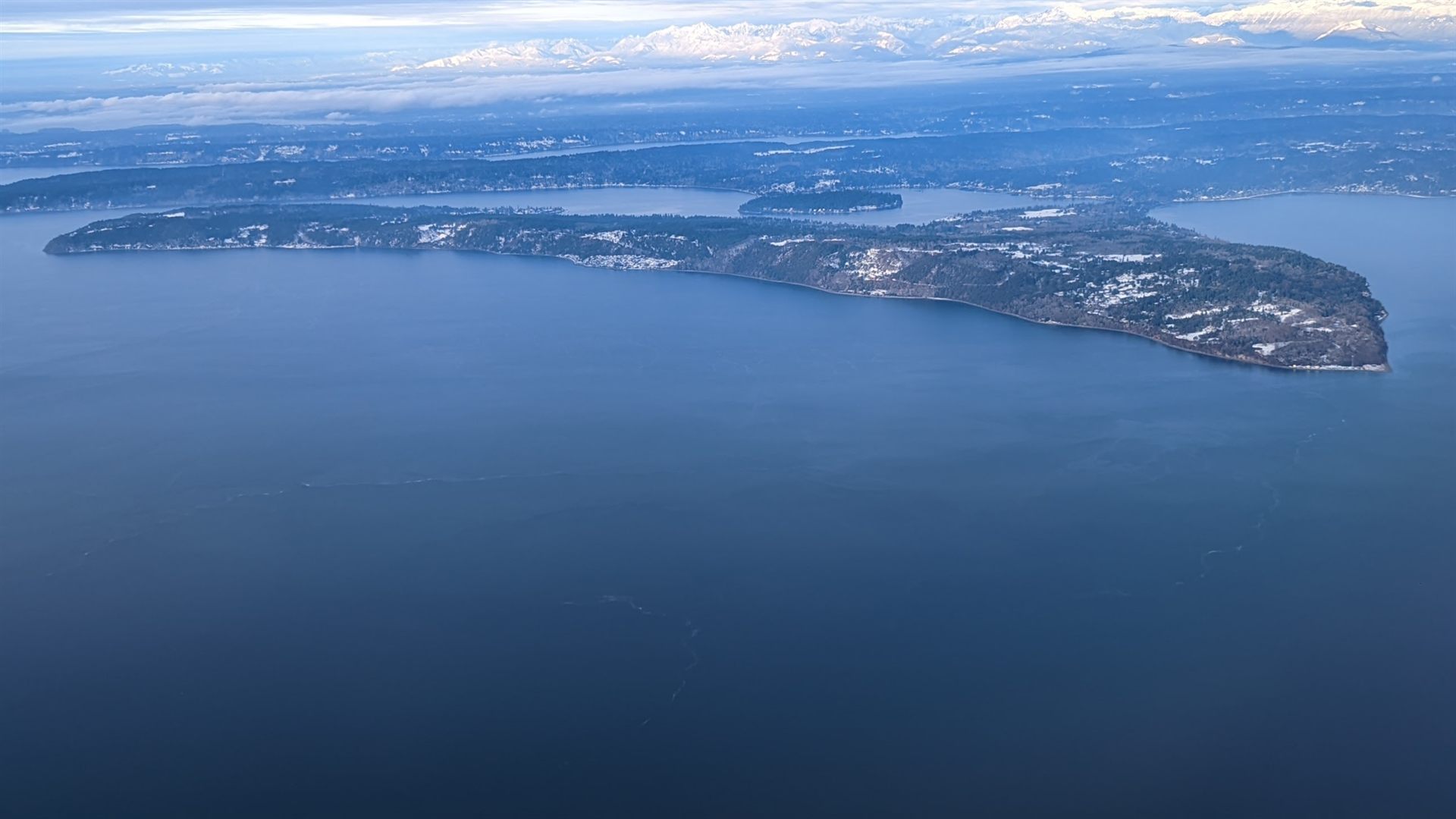
Pictured: a modern aerial photograph of Maury Island itself, looking west across Puget Sound — the real place central to Harold Dahl's claim, not documentation of the alleged sighting or the "slag" debris. No photograph of the six alleged objects has ever existed; the FBI's own investigation concluded the story was fabricated, and no camera was ever pointed at anything beyond ordinary industrial slag Dahl and Crisman presented as evidence.
Theoretical Alignment
Maury Island is one of the clearest cases in this archive for the Psycho-Social Hypothesis, used here in its broadest sense — not as "collective misperception of an ambiguous stimulus," which is how PSH usually applies, but as a documented, profit-motivated fabrication that used the vocabulary of the new "flying saucer" phenomenon to attract magazine money. The FBI's contemporaneous file, the physical material's mundane identity, and the complete absence of any independent witness all point the same direction. The residual ETH and IDH scores are not zero only because the file must account for the small, genuinely irreducible uncertainty in any decades-old case built on since-deceased witnesses' private statements rather than a single smoking-gun confession recorded on tape. This is a different, much weaker basis for uncertainty than in this archive's genuinely disputed cases, and the file's editorial judgment reflects that difference plainly rather than manufacturing false balance.
Background
By the summer of 1947, the United States was two years removed from the end of World War II and deep into the earliest anxieties of the Cold War, a climate in which reports of mysterious aircraft carried real strategic weight rather than mere curiosity value. Tacoma, Washington, sat at the industrial heart of Puget Sound, its economy built around shipping, timber, and the massive ASARCO copper smelter across the water at Ruston. Harold Dahl and Fred Crisman ran a small, informal boat operation on the Sound, salvaging logs and doing odd marine work; Dahl worked under Crisman, who held himself out as the senior man of the two. Neither had any documented law-enforcement authority, military intelligence background, or scientific training, despite the "harbor patrol" label that attached itself to their story almost immediately and has stuck in popular retellings ever since.
Three days after Dahl's claimed encounter, on June 24, 1947, an entirely separate and much better-documented event would change the trajectory of the whole story: Kenneth Arnold, a private pilot and Boise, Idaho businessman, reported seeing nine crescent-shaped objects near Mount Rainier moving, in his own words, "like a saucer if you skip it across water" — the phrase that gave the world "flying saucers" and ignited a genuine nationwide wave of sightings within days. Arnold's account, independently reported and widely covered before he had ever heard of Dahl or Crisman, is treated on its own terms in this archive's separate case file on his sighting. It is Arnold's sudden, unwanted celebrity as the world's most credible living UFO witness that made him, weeks later, the obvious person for Ray Palmer to send to Tacoma when Palmer heard that two harbor patrolmen there claimed to have actual physical fragments of a flying disc.
Palmer was the editor of Amazing Stories, a Chicago-based pulp science fiction magazine published by Ziff-Davis, and would shortly co-found Fate magazine in 1948 specifically to capitalize on the new "flying saucer" craze. He was already corresponding with Arnold about publishing Arnold's own Mount Rainier account when word of the Tacoma debris story reached him. Recognizing a much bigger story — actual physical evidence, rather than just an eyewitness account — Palmer wired Arnold $200 in late July 1947 to fly to Tacoma and investigate Dahl and Crisman's claims in person, setting in motion the chain of events that would, within days, draw in two military intelligence officers and end in a fatal plane crash.
Complete Timeline
| Date | Event |
|---|---|
| June 21, 1947, ~2:00 PM | Harold Dahl claims six doughnut-shaped objects appeared over his boat in the East Bay off Maury Island, WA, one of them ejecting hot metallic debris that damaged the vessel, injured his teenage son's arm, and killed the family dog. |
| June 22, 1947 | Dahl claims he was visited by a man in a black suit driving a new black 1947 Buick, who warned him not to discuss the sighting — the origin point of the "Men in Black" legend in UFO folklore. |
| Late June 1947 | Fred Crisman, Dahl's supervisor, travels to Maury Island, claims his own sighting of a similar craft, and collects slag fragments from the beach. |
| June 24, 1947 | Kenneth Arnold reports nine crescent-shaped objects near Mount Rainier, coining the term "flying saucer" and launching the modern UFO era, entirely independent of the Dahl/Crisman claim. |
| July 28, 1947 | Amazing Stories editor Ray Palmer wires Arnold $200 to travel to Tacoma and investigate the harbor patrolmen's debris claims. |
| July 29, 1947 | Arnold arrives in Tacoma and interviews Dahl directly at length. |
| July 29–30, 1947 | Arnold recruits United Airlines Capt. E. J. Smith, himself a July 4, 1947 UFO witness, to assess the debris. Crisman shows both men the material; Smith and Arnold find it unremarkable and inconsistent with Dahl's original description. |
| July 31, 1947 | Arnold notifies Army Air Forces intelligence. Capt. William L. Davidson and 1st Lt. Frank Brown fly from Hamilton Field, CA, to McChord Field, meet Arnold at Tacoma's Winthrop Hotel, interview Dahl and Crisman late into the night, and collect samples and transcripts. Privately, both officers conclude the story is almost certainly a hoax. |
| August 1, 1947, ~2:12 AM | Davidson and Brown depart McChord Field in a B-25 Mitchell bomber bound for Hamilton Field with the collected samples aboard. |
| August 1, 1947, ~2:30 AM | The B-25's left engine catches fire roughly 15–30 minutes into the flight. Two other crewmen parachute to safety; Davidson and Brown stay with the aircraft until the wing tears away, and the plane crashes near Kelso, WA, killing both officers. |
| August 1947 | The FBI opens a formal investigation into Dahl and Crisman's claims, driven in part by the deaths of two AAF officers connected to the case; Director J. Edgar Hoover takes a direct personal interest. |
| August 1947 | FBI interviews find Dahl unwilling to fully retract the story but stating he would call it a hoax if formally pressed; agents learn both men had separately approached publishers, including a Chicago pulp outlet, hoping to sell the account for profit. |
| August 8, 1947 | The Roswell "flying disc" story breaks in New Mexico — unrelated to Maury Island, but occurring within the same extraordinary six-week window that opened the modern UFO era. |
| 1952 | Arnold and Palmer publish The Coming of the Saucers, devoting a chapter to a dramatized retelling of the Maury Island affair — the first print appearance of the "man in black" concept — even as Arnold privately maintained he had been deceived. |
| 1956 | Edward J. Ruppelt, first head of Project Blue Book, writes in The Report on Unidentified Flying Objects that Maury Island was "the first, possibly the second-best, and the dirtiest hoax in the UFO history." |
| 1956 | Gray Barker's They Knew Too Much About Flying Saucers popularizes the "Men in Black" concept for a mass audience, citing Dahl's account as an origin point. |
| 1960s | Fred Crisman is drawn into New Orleans District Attorney Jim Garrison's investigation of the JFK assassination; he testifies before the Orleans Parish grand jury in the case against Clay Shaw. |
| 1978–1979 | The House Select Committee on Assassinations compares photographs of Crisman to the "three tramps" arrested in Dealey Plaza on November 22, 1963, finding a resemblance but concluding he was not present, citing an employment alibi in Rainier, Oregon. |
| December 10, 1975 | Fred Crisman dies, age 56. |
| 1984 | Kenneth Arnold dies, having spent decades searching for a conventional explanation for his own 1947 sighting while publicly maintaining he had been deceived at Maury Island. |
| 2017 | The Washington State Senate passes Senate Resolution 8648 marking the 70th anniversary of the incident. |
| 2022 | Regional press marks the 75th anniversary of the case; annual "Men in Black Bash" celebrations continue in Des Moines, WA. |
Six Doughnuts Over Puget Sound: Dahl's Original Claim
According to his own later account, Harold Dahl was patrolling the east bay of Maury Island at roughly two o'clock in the afternoon on June 21, 1947, with two crewmen, his fifteen-year-old son, and the family dog aboard, when he says he noticed six very large, doughnut-shaped aircraft in the sky. Five, he said, circled steadily around a sixth that appeared to be in some kind of distress. That sixth object then began, in Dahl's words, "spewing forth what seemed like thousands of newspapers" from an opening near its center — material that turned out to be a lightweight white metal, along with darker, heavier fragments that fell like lava rock. The falling debris allegedly struck the boat, injured the boy's arm, and killed the dog; Dahl claimed he ran the boat aground to shelter under nearby cliffs until the objects departed. It is a vivid, cinematic account, and it is worth stating plainly at the outset of this file's narrative section: no part of it beyond Dahl and Crisman's own testimony has ever been independently corroborated by any other witness, instrument, or piece of physical evidence.
Fred Crisman's Follow-Up and the "Man in Black"
Dahl told his supervisor, Fred Crisman, about the encounter; Crisman, by his own later account, traveled to the island, reported briefly witnessing a similar craft himself, and collected debris from the beach to bring back as evidence. The following morning, June 22, Dahl claimed a stranger visited his home: a large man, over six feet tall, wearing a black suit and driving a new black 1947 Buick, who told him bluntly, "Don't pass this around. You don't even know what you saw," and left Dahl with the impression — never made explicit — that harm might come to his family if he talked. Taken at face value, this is the single most dramatic beat in the entire story. Taken in context, it is also the detail on which the case's most durable cultural legacy rests: this encounter is now widely credited, including by Arnold and Palmer's own 1952 book, as the origin of the "Men in Black" trope that would go on to become one of UFO folklore's most enduring inventions, later mass-popularized by Gray Barker's 1956 book They Knew Too Much About Flying Saucers. No investigator, then or since, has ever identified the man, confirmed the Buick, or found any evidence of the visit beyond Dahl's word.
Ray Palmer, Amazing Stories, and the Call to Kenneth Arnold
Ray Palmer, editor of the pulp science fiction magazine Amazing Stories, learned of the Tacoma debris story in the weeks after Dahl's claimed sighting. Palmer had made his career publishing sensational, reader-engaging content, most famously the so-called "Shaver Mystery" — a series of stories claiming to be true accounts of an underground race of malevolent beings, published as nonfiction and wildly popular with a subset of the magazine's readers despite having no basis in fact. The Tacoma story, with its promise of physical wreckage rather than just an eyewitness account, was exactly the kind of material Palmer's business model was built to monetize. On July 28, 1947, he wired Kenneth Arnold $200 — a substantial sum at the time — to fly to Tacoma and investigate on his behalf, reasoning that Arnold's own recent celebrity and credibility as a witness made him the ideal person to lend the story legitimacy. It is one of the case's genuine ironies that the man hired specifically because his own reputation could authenticate the story became, within two days of arriving, its most effective skeptic.
Arnold's Investigation in Tacoma
Arnold arrived in Tacoma on July 29, 1947, checked into the Winthrop Hotel, and interviewed Dahl at length, hearing the full account of the sighting, the debris, and the man in black. Uneasy about the story almost immediately, Arnold sought a second, more technically credentialed opinion and recruited Capt. E. J. Smith of United Airlines, a working commercial pilot who had reported his own unidentified sighting on July 4, 1947 and whose professional judgment Arnold trusted. When Crisman produced the physical debris for both men to examine, neither found it convincing: the material was heavy, dark, and rock-like, bearing little resemblance to the lightweight metal Dahl had originally described fluttering down "like thousands of newspapers." Arnold, in his later writing, recorded his and Smith's shared suspicion that they were being shown ordinary material dressed up as extraordinary evidence. Rather than simply walking away, Arnold — conscious of the story's potential military significance if there were any chance it was genuine — contacted Army Air Forces intelligence at Hamilton Field, California, setting the next and most consequential phase of the case in motion.
The Winthrop Hotel Meeting and the Debris Handoff
On July 31, 1947, two Fourth Air Force intelligence officers, Capt. William L. Davidson and 1st Lt. Frank M. Brown, flew from Hamilton Field to McChord Field near Tacoma and met Arnold and the others at the Winthrop Hotel. What followed was a long, careful, and by all surviving accounts entirely professional interview process: the officers questioned Dahl and Crisman at length, examined the debris, and by evening had privately reached much the same conclusion Arnold and Smith already held — that the story did not hold together. Contemporary and later accounts describe the officers as notably reluctant to handle the physical fragments directly, a detail some later researchers have read as evidence they already suspected the material was worthless. Whatever their private judgment, Davidson and Brown treated the matter with full procedural seriousness, collecting samples of the debris and copies of the interview transcripts to carry back to Hamilton Field for further evaluation — the routine, unremarkable final step of a routine, if ultimately unremarkable, intelligence inquiry.
The B-25 Crash Near Kelso
In the early hours of August 1, 1947 — at approximately 2:12 AM — Davidson and Brown departed McChord Field aboard a B-25 Mitchell bomber bound for Hamilton Field, the debris samples and transcripts aboard. Roughly fifteen to thirty minutes into the flight, the aircraft's left engine caught fire. Two other crewmen aboard, a crew chief and a sergeant, parachuted to safety and were later found unharmed. Davidson and Brown remained with the burning aircraft — whether attempting to control it, retrieve the material, or simply run out of time is not established in the surviving record — until the left wing tore away entirely. The out-of-control bomber went down in a pasture near Rose Valley, roughly fifteen miles east of Kelso, Washington, at around 2:30 AM. Both officers were killed. Brown's body was found some five hundred feet from the main wreckage with a partially deployed parachute, suggesting he had attempted to bail out too late; Davidson was found still strapped into his seat, feet on the rudder pedals, having apparently stayed at the controls to the end. They were the first fatalities directly connected to a UFO investigation in American history, and their deaths remain, to this file's assessment, the single most genuinely weighty and least disputable fact in the entire Maury Island record.
Rumor, Sabotage, and the Official Cause
Given the timing — two intelligence officers dead within hours of collecting evidence connected to a UFO report — it is unsurprising that rumors began circulating almost immediately that the aircraft had somehow been "shot down" or deliberately sabotaged to suppress the material aboard, some contemporary and later accounts even describing anonymous phone calls claiming the plane was carrying "saucer fragments" that had been targeted. No part of this theory has ever been substantiated. The official investigation attributed the crash to a conventional in-flight engine fire, consistent with documented maintenance issues in B-25 airframes of that production era, and no evidence of sabotage, mechanical tampering, or hostile action has ever surfaced in the seventy-plus years since. The genuinely striking element of the crash is not that it was mysterious in cause — mechanically, it was a well-understood and, for the type, not uncommon failure mode — but that its timing, immediately following a hoax investigation, was coincidental in the most literal and tragic sense: two men died in an ordinary aviation accident that happened, by chance, to follow directly on the heels of an entirely fabricated story.
The FBI Investigation and the Confession That Wasn't Quite a Confession
The deaths of Davidson and Brown transformed what might otherwise have remained a minor regional curiosity into a matter serious enough to draw the direct, personal attention of FBI Director J. Edgar Hoover. The Bureau opened a formal investigation into Dahl and Crisman's claims within days, and its findings, later released and cited by researchers across the political and credulity spectrum, are unambiguous: agents concluded the entire episode was fabricated. The precise nature of the men's own admissions, however, is more nuanced than popular retellings often suggest, and this file treats that nuance carefully rather than flattening it. The FBI's own file does not record either man delivering a clean, unqualified confession. Instead, it records that Dahl "did not admit that his story was a hoax but only stated that if questioned by the authorities he was going to say it was a hoax because he did not want any further trouble over the matter" — a hedge, not an admission, though one that most researchers, including this file, read as functionally equivalent to one. A separate detail from the Bureau's contemporaneous notes is more vivid still: during one interview, Dahl's own wife reportedly interrupted and pleaded with her husband to "admit the entire story was a plain fantasy which he had dreamed up." FBI agents further determined that neither man held any legitimate harbor patrol commission, that their actual occupation was a small salvage operation, and that both had separately approached several publishers — including one identified in the file as Chicago's Fantasy Magazine — hoping to sell the story for profit once its notoriety had built. Taken together — the hedge, the wife's plea, the mundane material, the sales pitch to competing publishers — the FBI's file amounts to about as complete a case for fabrication as a 1947 investigation lacking modern forensic tools could realistically produce.
No Prosecution, and Ruppelt's Verdict
Despite the strength of its findings, the government ultimately declined to pursue criminal charges. Edward J. Ruppelt, who would go on to head the Air Force's Project Blue Book and later write the first insider account of the era, recorded that "the government had thought seriously of prosecuting the men. At the last minute it was decided, after talking to the two men, that the hoax was a harmless joke that had mushroomed." Ruppelt's own summary judgment on the case, published in his 1956 book The Report on Unidentified Flying Objects, remains the single most quoted line in the case's entire historiography: "The whole Maury Island Mystery was a hoax. The first, possibly the second-best, and the dirtiest hoax in the UFO history." Ruppelt's assessment carries particular weight in this file's evaluation because it comes from an Air Force insider with direct access to the government's own investigative files and no evident motive to protect Dahl and Crisman's reputations — if anything, an institutional incentive to find something more interesting than a mundane hoax, had the evidence supported one.
The Birth of the Men in Black
Whatever its evidentiary weaknesses, Maury Island's cultural afterlife has been genuinely significant, and this file treats that legacy on its own terms rather than as a footnote. Dahl's claimed visit from a large man in a black suit, driving a black Buick and warning him into silence, is broadly credited as the founding account of the "Men in Black" trope in American UFO folklore — a motif that would recur across decades of UFO literature, inspire Gray Barker's influential 1956 book, and eventually reach mainstream pop culture entirely detached from its origins in a debunked 1947 hoax. Arnold and Palmer's own 1952 book The Coming of the Saucers, which devotes a full chapter titled "The Tacoma Affair" to a dramatized retelling of the case, is credited by researchers as the first print publication of the concept. It is a striking measure of how thoroughly a fabricated detail can outrun its own debunking: the "man in black" survives in popular culture today far more vividly than the specific, discredited claim that produced him.
Ray Palmer's 1952 Retelling and Arnold's Discomfort
The Coming of the Saucers, co-authored by Arnold and Palmer and published in 1952, remains a genuinely awkward document in the historical record precisely because of what it reveals about the tension between its two authors. Palmer's chapter on the Tacoma affair plays the mystery for maximum suspense, hinting at possible cover-up and government suppression in the commercially proven style that had made the Shaver Mystery profitable for his magazine years earlier. Arnold's own later comments and interviews, by contrast, consistently describe him as having concluded on the ground in 1947 that he had been deceived, and as having taken no further compensation from the story once its true nature became clear to him. Air Force investigator Edward Ruppelt, reviewing the book years later, was blunt about its reliability generally, writing that "the true facts have been warped, twisted, and changed" and noting discrepancies between Arnold's book account and what he had told Air Force investigators in 1947. This file treats The Coming of the Saucers as a genuine and useful primary artifact of how the case was marketed, while explicitly not treating its more suspenseful framing as evidence of anything beyond Palmer's own commercial instincts.
Fred Crisman's Strange Second Act: The JFK Investigation
The single strangest, best-attested footnote in the entire Maury Island file belongs to Fred Crisman, and this file treats it with particular care given how much unreliable material circulates online about it. Roughly two decades after the hoax, Crisman became entangled in New Orleans District Attorney Jim Garrison's investigation into the assassination of President John F. Kennedy — the only criminal prosecution ever brought in connection with the case, against local businessman Clay Shaw. Crisman was called to testify before the Orleans Parish grand jury in the Shaw matter, and some researchers, Garrison among them, floated the theory that Crisman was one of the "three tramps" photographed in police custody in Dealey Plaza on the day of the assassination, November 22, 1963. When the House Select Committee on Assassinations reinvestigated the case in 1978–79, its analysts compared photographs of the tramps against several individuals, including Crisman, E. Howard Hunt, and Frank Sturgis, and found that "only Crisman resembled any of the tramps" — but the same Committee concluded he had not actually been in Dealey Plaza that day, citing an employment alibi tied to a high school in Rainier, Oregon, where he was reportedly working at the time. In other words: a genuine physical resemblance, a real grand jury appearance, and a real, official government conclusion that the more sensational theory did not hold up. This file states plainly that Crisman's presence in the Garrison investigation is well documented and verifiable, that his identification as one of the "three tramps" was specifically investigated and rejected by the HSCA, and that no reliable source establishes any substantive causal link between the 1947 hoax and the 1963 assassination beyond the coincidence of the same unusual man appearing, once again, at the edge of a major American mystery.
Circumstantial Evidence
- The FBI's contemporaneous 1947 investigation, opened at the direct personal interest of Director J. Edgar Hoover, concluded the claims were fabricated.
- Neither Dahl nor Crisman held any genuine harbor patrol commission; their actual occupation was a small private salvage boat operation, undermining the "trained observer" framing attached to the story ever since.
- The physical "slag" evidence was identified as ordinary industrial or foundry material, plausible and unremarkable in an area sitting directly downwind of one of the era's largest copper smelters.
- Both men separately approached publishers, including a named Chicago pulp magazine, hoping to sell the story for profit — a financial motive documented in the FBI's own file.
- Dahl's wife reportedly interrupted an FBI interview to plead with her husband to admit the story was invented.
- Kenneth Arnold himself, the investigator with the strongest independent credibility in the entire case, concluded on the ground in 1947 that he had been deceived, and said so publicly rather than protecting the story's commercial value.
- No independent witness, photograph, radar return, or third-party account has ever corroborated any element of the sighting beyond Dahl and Crisman's own testimony.
Key Researchers
- Kenneth Arnold (1915–1984) — The investigator whose on-the-ground skepticism, formed within days of arriving in Tacoma, remains the case's single strongest contemporaneous credibility check; later co-authored The Coming of the Saucers (1952) with Ray Palmer.
- Edward J. Ruppelt (1922–1960) — First head of the Air Force's Project Blue Book, whose 1956 book The Report on Unidentified Flying Objects delivered the case's most quoted assessment: "the dirtiest hoax in the UFO history."
- Brian Dunning — Host of the Skeptoid podcast, whose Episode #820, "Maury Island: The Government's Alien Artifacts," compiled and cross-checked the FBI file material, the debris analysis, and the crash record in one of the most detailed modern skeptical treatments of the case.
- Jerome Clark — UFO historian whose UFO Encyclopedia entry on Maury Island is a standard reference point separating the documented 1947 record from decades of later embellishment.
- Curt Collins — Researcher and author of the Blue Blurry Lines UFO history blog, whose detailed profile of Davidson and Brown as "the first casualties of ufology" is among the most carefully sourced accounts of the B-25 crash itself.
Cultural Impact
Maury Island's afterlife has proven far more durable than the truthfulness of the original claim. The "man in black" motif it produced went on to shape decades of UFO literature and eventually mainstream film and television, entirely detached in the popular imagination from its origins in a debunked 1947 salvage-boat hoax. The debunked "Majestic-12" documents, themselves widely regarded by researchers as forgeries, later folded Maury Island into their own mythology, claiming the recovered fragments were secretly nuclear reactor components — a layer of invented material stacked on top of an already invented story, and a useful illustration of how thoroughly discredited claims can continue generating new discredited claims indefinitely. Locally, the case has become a point of civic and historical pride rather than embarrassment: the Washington State Senate formally marked its 70th anniversary in 2017, the Vashon-Maury Island Beachcomber covered its 75th anniversary in 2022, the Museum of Flight has hosted public programming on the case built from declassified FBI records, and the town of Des Moines, WA holds an annual "Men in Black Bash" complete with commissioned public art. A 2019-era short documentary, produced by filmmakers Steve Edmiston and Scott Schaefer, examines the case as serious regional history rather than paranormal advocacy — a framing this file shares.
Key Witnesses
Harold Dahl
Tacoma harbor-area boat operator who claimed six doughnut-shaped craft appeared over his vessel near Maury Island on June 21, 1947, and that debris from one damaged his boat, injured his son, and killed his dog. The FBI's investigation found his claim unsubstantiated; Dahl himself never fully retracted the story but told investigators he would call it a hoax under formal questioning "because he did not want any further trouble."
Fred Crisman
Crisman claimed his own follow-up sighting near Maury Island and personally produced the slag debris shown to Kenneth Arnold and Army investigators. FBI files describe him and Dahl approaching publishers to sell the story. Decades later, Crisman was called before the grand jury in Jim Garrison's JFK assassination investigation; the House Select Committee on Assassinations found he resembled one of the "three tramps" but had an alibi placing him elsewhere on November 22, 1963.
Kenneth Arnold
Hired by Ray Palmer to investigate the Tacoma debris claim on the strength of his own recent, widely credited Mount Rainier sighting. Arnold interviewed Dahl directly, examined the physical debris alongside Capt. E. J. Smith, and grew suspicious within days. His willingness to publicly acknowledge he had been deceived, rather than protect the story's commercial value, is treated by this file as a genuine credibility marker.
Capt. William L. Davidson & 1st Lt. Frank M. Brown
Dispatched to Tacoma to formally investigate the claims, both officers privately concluded the story was almost certainly a hoax after interviewing Dahl and Crisman on July 31, 1947. Hours later, their B-25 caught fire and crashed near Kelso, Washington, killing them both — the first fatalities in the history of American UFO investigation.
Ray Palmer
Learned of the Tacoma debris story and paid Kenneth Arnold $200 to investigate it, hoping to publish physical proof of a flying disc. Co-authored the 1952 book The Coming of the Saucers with Arnold, which dramatized the case and introduced to print the "man in black" concept that would go on to outlive the hoax that spawned it.
Capt. E. J. Smith
A working commercial airline pilot and independent July 4, 1947 UFO witness whom Arnold recruited in Tacoma to help assess the physical debris. Smith's professional judgment that the material was unremarkable reinforced Arnold's own growing suspicion that the story did not hold together.
The Five Observables Assessment
The Five Observables framework, developed by former AATIP director Luis Elizondo, is used across this archive to classify UAP encounters by performance characteristics exceeding known technology of their era. Applying it to Maury Island requires an unusual caveat up front: because the underlying sighting is assessed by this file, in line with the FBI's own 1947 conclusion and the near-unanimous verdict of subsequent researchers, as a fabrication rather than a genuine encounter, there is no real phenomenon whose performance characteristics can be meaningfully evaluated. What follows rates Dahl and Crisman's narrative claims on their own terms — not because this file considers them credible, but for methodological consistency with every other case in this catalogue.
Assessment: Anti-Gravity Lift is rated speculative only because Dahl's narrative described one object hovering, apparently stationary, directly above his boat while the alleged debris fell — a claim consistent with lift of some kind if taken literally, though entirely uncorroborated and now assessed as invented. Instant Acceleration is rated absent: neither Dahl's nor Crisman's account describes any specific departure velocity or maneuver rate that would qualify. Hypersonic Velocity is rated absent for the same reason — the narrative simply does not include a documented high-speed transit. Low Observability is rated absent: the objects were allegedly seen in clear daylight, at close range, for an extended period by multiple people aboard the same boat, the functional opposite of a low-observable encounter. Trans-Medium travel is rated absent; no air-to-water or other medium transition was ever claimed. Taken as a whole, even a maximally credulous reading of Dahl and Crisman's own narrative does not describe technology clearly beyond conventional understanding in the way this framework is built to flag — a further, independent reason, on top of the FBI's finding and the material evidence, that this case does not present a genuine anomaly for the framework to evaluate.
Evidence Assessment
Points Sometimes Raised for a Genuine Underlying Event
- Two independent men (Dahl and Crisman) told broadly consistent accounts, and Crisman claimed his own separate sighting rather than simply endorsing Dahl's.
- Two Army Air Forces intelligence officers investigated the claims with full procedural seriousness rather than dismissing them out of hand, and genuinely died shortly afterward.
- The "Men in Black" claim, while unverifiable, was reported before it became a widely known trope that a hoaxer could simply borrow from existing UFO literature.
Supporting the Hoax Conclusion
- The FBI's formal 1947 investigation, backed by the Bureau's full authority and Director Hoover's personal interest, concluded the story was fabricated.
- The physical debris was identified as ordinary industrial slag/rock, not any exotic or unexplained material, and was inconsistent with Dahl's own original description.
- Neither man held any genuine law-enforcement or scientific credential; their actual occupation was a small private salvage operation.
- Both men approached publishers seeking to profit from the story, a documented financial motive absent from genuinely reported sightings with no commercial angle.
- Dahl hedged rather than denied when formally questioned, and his own wife reportedly urged him to admit fabrication.
- Kenneth Arnold, the case's most credible independent investigator, concluded he had been deceived and said so publicly.
- The B-25 crash's official cause — a conventional in-flight engine fire — has never been credibly challenged by any evidence of sabotage in over seventy-five years.
Why "Debunked"
This file rates the Maury Island Incident's central claim — that anomalous craft appeared over Puget Sound and discharged debris — as DEBUNKED, the same stamp this archive applies to the 2011 Temple Mount video, and for closely related reasons: a formal, contemporaneous investigation by a credentialed authority (here, the FBI; there, independent forensic video analysts) reached a specific, well-documented fabrication finding that has never been seriously overturned by subsequent research, and the case's own strongest independent witness — Kenneth Arnold, whose credibility exceeds that of Dahl or Crisman by any reasonable measure — concluded the same thing on the ground, in person, within days. The physical evidence was ordinary, the financial motive was documented, and no independent corroboration of any kind has surfaced in nearly eighty years. This is not a case where the file is forcing a resolution the evidence does not support; it is one where the evidence is unusually one-sided for a 1947-era claim. What separates Maury Island's file, and its score, from a pure like-for-like match with Temple Mount is the presence of a real, undisputed, and permanently unresolved-in-detail tragedy layered directly on top of the hoax: two Army officers genuinely died investigating a story that turned out to be false, the FBI's real involvement and Director Hoover's real personal interest are matters of documented government record rather than internet lore, and Fred Crisman's later, well-documented entanglement in the Garrison JFK investigation adds a second, independently strange thread to an already unusual case. None of that surrounding history makes the original sighting claim any more credible — it does not — but it does mean this file is not simply cataloguing an isolated, victimless fraud. It is cataloguing ufology's earliest instructive example of how a fabricated story can trigger real institutional consequences, including the loss of two lives, entirely independent of whether the story itself was ever true.
Sensor & Instrumentation Detection Profile
No radar, camera, or other instrument of any kind recorded anything at Maury Island. The entire "sighting" rests on the testimony of two men, and the only physical exhibit — the alleged slag fragments — was collected after the fact from a beach, not captured or measured during the claimed event itself. This absence of instrumentation is itself part of the case's evidentiary profile: unlike Kinross or Washington, D.C., where multiply-corroborated radar data forces a genuinely difficult evidentiary judgment, Maury Island offers nothing beyond two witnesses' word, one of whom was the other's subordinate at work.
Environmental & Geospatial Context
Maury Island is a small, low-lying island in Puget Sound, tied to the larger Vashon Island by a narrow land bridge, a short boat ride from Tacoma's industrial waterfront. In 1947 the area was a working harbor and fishing economy, and it sat in the shadow of one of the region's largest industrial operations: the American Smelting and Refining Company's (ASARCO) copper smelter at nearby Ruston, which had operated continuously since 1890 and produced enormous volumes of black, glassy, lava-like slag as ordinary industrial byproduct — material that was so common in the area it was routinely used as fill and ballast on regional beaches and roadbeds. This detail matters directly to the case's material evidence, discussed below: a lightweight, exotic-looking "flying saucer fragment" claim made in a place where heavy, dark, lava-textured industrial slag genuinely littered the shoreline is a very different proposition than the same claim made somewhere with no plausible mundane source at all.
Observer Credibility & Occupational Profile
Harold Dahl and Fred Crisman are frequently described in casual retellings as "harbor patrol officers," a credential that reads, at a glance, like the kind of trained-observer status this site weighs heavily elsewhere (radar controllers, airline pilots, military pilots). The credential does not survive scrutiny. Both men in fact operated a small private salvage and log-towing boat operation on Puget Sound, not a sworn law-enforcement or Coast Guard billet; "harbor patrol" describes their informal occupation, not an official post with training standards, oversight, or institutional accountability. Crisman, in particular, was a man of documented, colorful, and independently unverifiable personal claims well before 1947, including wartime stories about escaping cave-dwelling creatures in Burma that were never substantiated and are broadly treated by researchers as fabrication consistent with a lifelong pattern. Weighed against this is Kenneth Arnold's own occupational profile, which is considerably stronger: an experienced commercial pilot and businessman whose own June 24, 1947 sighting is treated separately and on its own merits in this archive's dedicated file, and whose skepticism toward Dahl and Crisman's story, formed on-site and in person, is itself one of the strongest pieces of evidence against the sighting's authenticity.
Physical & Material Assays
The only physical exhibit in the entire case was a quantity of dark, heavy, glassy rock fragments Crisman produced as debris from the alleged craft. Multiple contemporary and later examinations, though the record is not perfectly consistent about which specific laboratory ran which test, converged on the same conclusion: the material was ordinary slag, consistent with industrial smelter waste or common beach rock and pumice, showing gas-pocket and crystalline surface features typical of cooled slag rather than any exotic, unearthly, or metallurgically unusual composition. It bore no resemblance to Dahl's original description of lightweight material fluttering down "like thousands of newspapers." No chain of custody, no controlled collection procedure, and no independent laboratory report survives in a form that would satisfy modern forensic standards — the material was, in the plainest sense, picked up off a beach and handed to visitors as proof.
Historical Precedents & Archive Matches
Maury Island belongs to the extraordinary six-week window that opened modern UFO history: Kenneth Arnold's Mount Rainier sighting on June 24, 1947, coined the term "flying saucer" and triggered a nationwide wave of reports, and the Roswell debris story broke in New Mexico barely six weeks later, on July 8, 1947. Maury Island is distinctive within that founding wave for being, by the verdict of virtually every serious researcher who has examined it since — including Arnold himself — not a genuine anomalous report at all, but a fabrication that happened to occur during the same summer and to briefly entangle two of the era's most consequential figures, Arnold and Ray Palmer. Structurally, it also anticipates a recurring later pattern this archive has catalogued elsewhere: a viral or sensational claim that does not survive forensic or investigative scrutiny, most directly comparable to the 2011 Temple Mount video, another case this site rates "Debunked." What separates Maury Island from that later case, and from most hoaxes in this archive, is the presence of real, undisputed, fatal consequences — a distinction explored fully below.
Material Analysis
The physical record in this case is unusually thin for how much cultural weight the story has carried. The alleged debris — the only tangible exhibit ever produced — consisted of dark, heavy, glassy rock fragments that examiners at the time and researchers since have consistently identified as ordinary slag: industrial or foundry byproduct, or common beach rock and pumice, showing the gas-pocket and crystalline surface textures typical of cooled slag rather than anything metallurgically unusual. This matters most in context: Maury Island sits directly across the water from Ruston, Washington, site of the ASARCO copper smelter, one of the largest industrial metal-processing operations in the Pacific Northwest, continuously active since 1890 and still operating in 1947. Slag from smelting operations of this kind was, by the era's own environmental record, so common a byproduct in the local landscape that it was routinely used as fill material on regional beaches and roadbeds — meaning a "flying saucer fragment" claim staged in this specific location had an unusually convenient, unusually mundane real-world source sitting a short boat ride away. No chain of custody survives for the samples handed to Arnold, Smith, and later Davidson and Brown, and no modern isotopic or metallurgical re-analysis has ever been possible because the original material's final disposition after the B-25 crash was never publicly documented.
Supporting Non-Terrestrial Origin
- No systematic, modern forensic re-analysis of the original material has ever been possible, since its whereabouts after the 1947 crash were never documented — a genuine, if narrow, gap in the record.
Supporting Terrestrial Origin
- Contemporary and later examinations consistently identified the material as ordinary slag or beach rock, inconsistent with Dahl's own original description of lightweight metal.
- The immediate area sat directly downwind of one of the region's largest active copper smelters, providing an unremarkable, readily available real-world source for exactly this kind of material.
- No independent laboratory report from a credentialed materials scientist has ever supported an exotic or unexplained composition for any Maury Island sample.
The Conventional Explanation Candidate: Fabrication for Profit
Fabrication for Profit
Highly PlausibleThe explanation supported by essentially every strand of surviving evidence — the FBI's own 1947 file, Kenneth Arnold's on-site assessment, the mundane material identity, and the documented approach to publishers seeking payment — is that Harold Dahl and Fred Crisman invented the Maury Island story, in whole or in significant part, hoping to sell it to a magazine for profit. This explanation deserves to be stated as the file's leading candidate not because it is the most dramatic but because it is the one every independent line of evidence converges on, rather than one requiring any single piece of evidence to carry disproportionate weight. It also has genuine, if narrower, objections worth stating plainly: no audio-recorded or signed confession from either man survives, meaning the fabrication finding rests on circumstantial convergence rather than a single dispositive admission, and Dahl in particular never explicitly and permanently retracted the story in his own words for the historical record. It is supported by convergent documentary, testimonial, and material evidence, with only the absence of a single recorded confession preventing an unqualified certainty rating.
Genuine Misperception of a Natural or Industrial Event
InconclusiveA second, more charitable possibility holds that Dahl witnessed some real but mundane event — a meteor airburst, unusual cloud or smoke formation, or a distant industrial mishap near the smelter — and that the story grew more elaborate in the retelling, whether through honest embellishment, suggestion, or simple time-compressed memory distortion, before Crisman and the two men's shared financial incentive pushed it the rest of the way toward outright invention. This candidate is attractive because it does not require assuming Dahl acted in complete bad faith from the very first moment, and some researchers have floated a bright natural event (a meteor, in particular) as a plausible seed for an account that later grew embellishments. It struggles against the specificity and internal consistency of Dahl's original account — six distinct, structured, doughnut-shaped objects is a considerably more elaborate claim than a single ambiguous natural phenomenon would typically generate, and the debris handoff itself, which both men participated in staging, is difficult to explain as an honest misunderstanding.
A Genuine Anomalous Encounter
ImplausibleThe remaining possibility — that Dahl and Crisman witnessed something genuinely anomalous and that the FBI's hoax finding was itself mistaken or incomplete — is the one this file's own research found the least support for among primary sources. It would require dismissing not just the FBI's formal 1947 conclusion but also the independent, on-site skepticism of Kenneth Arnold, whose credibility in this specific case exceeds that of every other participant, and it would require explaining why the only physical evidence produced consisted of material indistinguishable from ordinary regional industrial slag. No researcher cited in this file's sourcing, credulous or skeptical, has mounted a serious modern case for this explanation; even UFO literature sympathetic to other 1947-era cases has generally treated Maury Island as an outlier best set aside rather than defended.
Related Cases
Confirmed Documents & Official Records
The FBI's released UFO-related files include the Bureau's 1947 investigative material on Dahl and Crisman's claims, including the interview notes documenting Dahl's hedged non-denial and the wider 1947 "flying disc" reporting wave that Maury Island occurred within.
UNCLASSIFIED (declassified)National Archives finding aid for the Project Sign, Project Grudge, and Project Blue Book records transferred from Wright-Patterson AFB, the broader Air Force UFO-investigation record set within which the 1947 "flying disc" summer — including Maury Island — is filed.
UNCLASSIFIEDOfficial state legislative resolution marking the 70th anniversary of the incident, summarizing the documented timeline including Dahl's public hoax claim and the FBI's finding that the recantation was itself an evasion rather than a full retraction.
PUBLIC RECORDSearch Government Archives Directly
Further Reading — Recommended Literature
The Coming of the Saucers
The original, dramatized first-person account of the Maury Island affair by the two men most directly involved in investigating and publicizing it — essential as a primary artifact, even where its framing plays up the mystery its own co-author privately doubted.
The Report on Unidentified Flying Objects
Written by the first head of Project Blue Book, this remains the essential primary source for the case's most quoted verdict — "the dirtiest hoax in the UFO history" — from an Air Force insider with direct access to the government's own file.
Project Blue Book Exposed
A detailed case-by-case review of the Air Force's UFO files by a veteran intelligence officer and researcher, useful for situating Maury Island within the wider 1947 "flying disc" wave and the government's early investigative response to it.
Watch the Skies!: A Chronicle of the Flying Saucer Myth
A rigorously documented, skeptically minded history of American UFO cases that traces how the Maury Island hoax intersected with Ray Palmer's commercial instincts and the broader birth of "flying saucer" media culture in 1947.
The UFO Encyclopedia, 4th Edition
The definitive UFO reference work, with an extensively cited entry separating the documented 1947 record of the Maury Island case from decades of later embellishment, including the Majestic-12 forgeries that later absorbed it.
Essential Viewing

The Maury Island Incident: Unraveling a 1947 UFO Mystery
A detailed walkthrough of Dahl's claim, Crisman's involvement, the FBI investigation, and the fatal B-25 crash, from research channel UAP Press.
"The Maury Island Incident" — Official Trailer
Trailer for the award-winning short documentary by filmmakers Steve Edmiston and Scott Schaefer, built from declassified FBI records.
The Maury Island Incident
A regional-history overview of the case, its Puget Sound location, and its enduring local legacy.
Sources
- "Maury Island incident," Wikipedia (comprehensive incident summary with citations to Arnold, Ruppelt, and FBI file material). en.wikipedia.org
- HistoryLink.org. "Dahl and Crissman report a June 21, 1947, explosion of a flying saucer over Maury Island." historylink.org
- Washington State Legislature. Senate Resolution 8648, "Maury Island Incident" (70th Anniversary), 2017. lawfilesext.leg.wa.gov
- Vashon-Maury Island Beachcomber. "Time & Again: 75th Anniversary of The Maury Island Incident." vashonbeachcomber.com
- The Museum of Flight. "The Maury Island Incident" (public program page, declassified FBI records). museumofflight.org
- Dunning, Brian. "Maury Island: The Government's Alien Artifacts," Skeptoid Episode #820. skeptoid.com
- Historic Mysteries. "The Maury Island Incident: Debris from a UFO?" historicmysteries.com
- MuckRock. "FBI's real-life 'X-Files' documents strange connection between UFOs and the JFK assassination." muckrock.com
- "Three tramps," Wikipedia (HSCA photographic comparison of Fred Crisman and the Dealey Plaza "tramps"). en.wikipedia.org
- "The Coming of the Saucers," Wikipedia (1952 Arnold/Palmer book, contents and reception). en.wikipedia.org
- Cascade PBS. "How Washington gave the world flying saucers and 'men in black.'" cascadepbs.org
- Collins, Curt. "Capt. William Davidson & Lt. Frank Brown, 1st Casualties of Ufology," Blue Blurry Lines. blueblurrylines.com
- NW Legends Museum. "Maury Island UFO Incident." nwlegendsmuseum.com
- Bureau of Aircraft Accidents Archives. "Crash of a North American TB-25J-32-NC Mitchell near Kelso: 2 killed." baaa-acro.com
- Ruppelt, Edward J. The Report on Unidentified Flying Objects (1956), full text. gutenberg.org
- Think About It Docs. "1947: Maury Island Incident." thinkaboutitdocs.com
- "The Maury Island Incident" (documentary film, Steve Edmiston & Scott Schaefer, official site). mauryislandincident.com
- Wikimedia Commons. "File:2022 Maury Island.jpg" (photograph by Mark Yasuda, CC BY-SA 4.0). commons.wikimedia.org
- National Archives (NARA). "Project Blue Book Records Research Guide." archives.gov
- Washington State Department of Ecology. "Maury Island Gravel Mining Impact Studies" (regional industrial/geological context). apps.ecology.wa.gov
- Arnold, Kenneth, and Raymond Palmer. The Coming of the Saucers, 1952 (primary first-person account, "The Tacoma Affair" chapter).
- Clark, Jerome. The UFO Encyclopedia, 4th Edition, Visible Ink Press, 2023 (Maury Island Incident entry).
- Randle, Kevin D. Project Blue Book Exposed, Barnes & Noble Books, 1996.
- Peebles, Curtis. Watch the Skies!: A Chronicle of the Flying Saucer Myth, Smithsonian Institution Press, 1994 (1947 "flying disc" summer context).
See something inaccurate? Have additional information or sources?
Suggest an Edit →Last Updated: August 2026