
Port-Gentil, Gabon UFO Sighting
At 2:40 a.m. on June 1, 1952, the second officer of an unnamed merchant vessel anchored in the roadstead off Port-Gentil, then a timber-export port in French Equatorial Africa, watched a silent light approach from inland, stop, reverse course, and stop and reverse a second time — the last turn directly above the ship — before he telephoned the captain. The captain then tracked it through binoculars for three minutes: an extremely bright, phosphorescent, circular orange-red glow, moving at very high speed on a roughly straight course before accelerating out to sea. Twenty days later, the Marseille daily Le Méridional printed the captain's account on its front page. Sixty-nine years after that, France's official government UAP investigation unit, GEIPAN, formally classified the case — catalogued under its own reference, PORT-GENTIL (GA.8), procès-verbal n°38 — as D1: a genuinely strange phenomenon, unexplained despite investigation. This file was commissioned to replace a "Coming Soon" queue placeholder describing "a cargo ship's crew" watching "a luminous orange disc." Two-pass research confirms a real, officially unresolved event at the right place and the right date — but the object was never described as a disc by either witness or by GEIPAN's own structured case data, and no source consulted identifies the vessel as a cargo ship, or by name, or either witness by name. This case file presents the real, thinly documented record honestly rather than reshaping it to match the placeholder's language.
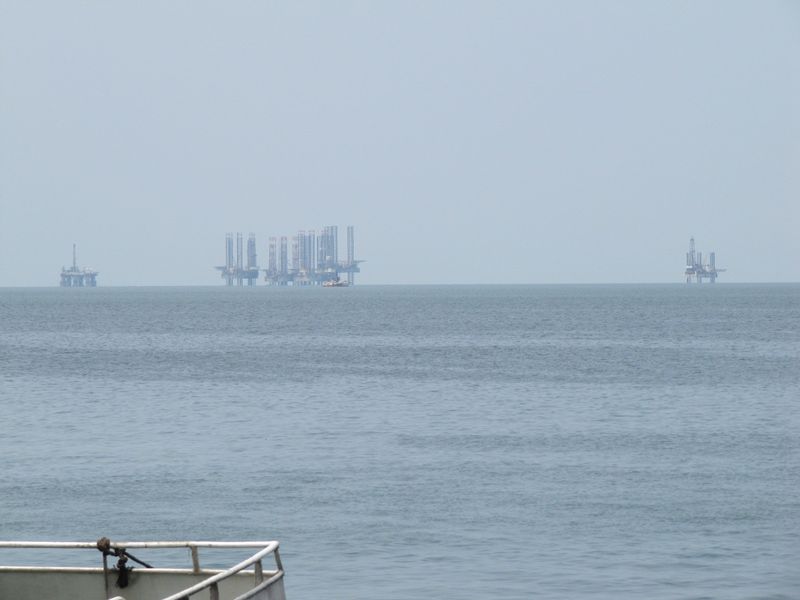
Pictured: the Atlantic waters off Port-Gentil, Gabon, photographed in 2010 (Barada-nikto, Wikimedia Commons, CC BY-SA 4.0). This is not a photograph of the 1952 event, the unidentified vessel, or its crew, and the offshore installations visible in this modern image postdate the sighting by several years — Gabon's offshore petroleum industry did not begin until the mid-1950s. No photograph of the ship, either witness, or the phenomenon itself is known to exist in any archive consulted for this case file; this image is included only to show the general stretch of open Atlantic anchorage named in both the original 1952 newspaper account and GEIPAN's official case file.
Theoretical Alignment
This case's theoretical alignment leans toward the mundane end of this catalogue's spectrum, and this file presents that honestly rather than inflating it to match the placeholder's "disc" framing. The Extraterrestrial Hypothesis reading draws some real support from GEIPAN's own formal conclusion — a residual "strangeness" score high enough, after investigation, to warrant an official D1 classification — and from the reported behavior of stopping and reversing course twice with no visible turning arc, a profile that does not obviously fit any single known natural phenomenon. But that support is tempered heavily by the object's own described appearance: a fuzzy, halo-like, roughly circular glow rather than any defined structure, wings, or solid outline, closer to an intensely bright light source than to a craft. Interdimensional Hypothesis alignment is low: nothing in the account suggests trans-dimensional behavior, only an unusually persistent and directionally erratic light. The Psycho-Social/Mundane reading carries the most weight here specifically because GEIPAN's own investigators raised, without being able to confirm, both a bolide (fireball meteor) and a missile-launch hypothesis for exactly this kind of luminous, moving light — and because the case rests on a single formally recorded witness, a twenty-day gap between the event and its only surviving press account, and no second independently filed testimony, a much thinner evidentiary base than several of this site's other 1952-wave cases.
Background
Port-Gentil sits on Mandji Island in the delta of the Ogooué River, on Gabon's Atlantic coast. French colonial administrators signed a treaty with the local Orungu people in 1873, and the settlement itself was named in 1900 for Émile Gentil, a French colonial administrator and explorer of the wider Congo-Gabon region. Through the first half of the twentieth century, Gabon formed one of four constituent territories — alongside French Congo, Ubangi-Shari, and Chad — of French Equatorial Africa, a federation of colonies administered from Brazzaville and governed, in 1952, by an appointed governor answering to a Governor-General rather than by any elected local body. Port-Gentil's own economy in this period was built first on rubber and ivory, then increasingly on timber, above all okoumé, a softwood prized for plywood manufacturing that made the port one of the busiest timber-export harbors on the West African coast by the interwar period. Its population had grown only modestly by mid-century — from roughly 4,500 residents in 1947 to 21,000 by 1960 — a fraction of the size it would reach decades later once the discovery of offshore oil, beginning with exploration by the Elf group in the mid-1950s, transformed it into Gabon's "economic capital." In June 1952, in other words, Port-Gentil was still fundamentally a colonial timber port: a working harbor with a steady traffic of merchant vessels loading okoumé logs for export, exactly the kind of setting in which an anonymous ship's captain and second officer, rather than a named public figure, would be the ones positioned to witness anything unusual in the pre-dawn sky.
1952 itself was, independent of anything happening at Port-Gentil specifically, one of the most intensely reported UFO years anywhere in the world. The United States Air Force logged a record 1,501 case investigations that year, a wave that would culminate seven weeks after this sighting in the widely publicized 1952 Washington, D.C. UFO incident of July 19–20. That American wave has an easily overlooked colonial-Africa counterpart: this site's own Flying Saucers Over the Belgian Congo Uranium Mines case file documents a March 29, 1952 sighting at Elisabethville, in the neighboring Belgian Congo, roughly two months before the Port-Gentil event; and this site's UFO Sightings Over Morocco and French West Africa case file documents a cluster of reports from French Morocco and Dakar, French West Africa, in the first two weeks of July 1952, roughly five weeks after it. Read together, these three cases — Belgian Congo in March, Port-Gentil in June, Morocco and Dakar in July — suggest 1952's global reporting wave had a genuine, if thinly documented, francophone-and-Belgian colonial-Africa dimension running in parallel with the far better-known American one, a pattern this case file's own Historical Precedents section revisits in more detail below.
Complete Timeline
| Date | Event |
|---|---|
| 1873 | French colonial administrators sign a treaty with the Orungu people covering the Mandji Island area at the mouth of the Ogooué River. |
| 1900 | The settlement is named Port-Gentil, after colonial administrator Émile Gentil. |
| 1910 | Gabon is incorporated into the newly formed federation of French Equatorial Africa, administered from Brazzaville. |
| March 29, 1952 | A separately documented sighting occurs at Elisabethville, Belgian Congo — see this site's Belgian Congo Uranium Mines case file. |
| June 1, 1952, before 2:40 a.m. | The second officer of an unnamed merchant vessel, anchored in Port-Gentil's roadstead, sees a light coming from inland; it stops, turns right, and resumes course — twice, the second time directly above the ship. |
| June 1, 1952, ~2:40 a.m. | The second officer telephones the captain, who observes the phenomenon through binoculars for approximately three minutes: a circular, extremely bright, phosphorescent orange-red glow, silent, moving at very high speed on a roughly straight course at an estimated 3–4 km altitude, before accelerating seaward. |
| June 21, 1952 | The Marseille daily Le Méridional publishes the captain's account on its front page under the headline "Un commandant de navire et son équipage ont vu un engin mystérieux dans le ciel d'Afrique noire." |
| Early July 1952 (5 weeks later) | A separate, unconnected wave of sightings is reported across French Morocco and Dakar, French West Africa — see this site's Morocco and French West Africa case file. |
| July 19–20, 1952 | The 1952 Washington, D.C. UFO incident becomes the year's most widely publicized American sighting, part of the same global wave year. |
| 1977 | France establishes GEPAN (later GEIPAN) under the national space agency CNES to investigate unidentified aerospace phenomena reports; the Port-Gentil account is among the older cases eventually entrusted to it by official channels. |
| 2015 | GEIPAN publicly releases its analysis of 21 of its oldest cases, spanning 1937 to 1959 (1954 was reserved for a separate release given the sheer volume of that year's reports). |
| June 23, 2021 | GEIPAN's own case-file entry for PORT-GENTIL (GA.8) records its most recent technical update, formally classifying the case D1. |
| 2026 | This case file is published, correcting the "Coming Soon" queue's "disc" description and its unconfirmed "cargo ship" framing against the real, GEIPAN-documented record. |
The Night of June 1, 1952: What the Record Actually Shows
Unlike many of this site's better-known 1950s cases, the Port-Gentil sighting survives through only two independent documentary channels, and both trace back to the same two-person crew: a contemporaneous newspaper account and, decades later, an official French government case file drawing on the same underlying testimony. Read together, the two sources agree closely enough on the sequence of events that this case file treats them as describing a single real incident rather than two competing versions, while disclosing every point where their details diverge.
According to GEIPAN's own structured case data, the vessel's second officer was the first to notice anything unusual, some minutes before 2:40 a.m. local time. He saw a light coming from the direction of the mainland — that is, approaching the anchored ship from over land rather than from the open Atlantic behind it. The light stopped, turned to the right, and resumed its original course. It then repeated the same stop-turn-resume sequence a second time, this second reversal occurring directly above the ship itself. It was only at this point — after two abrupt, unexplained directional reversals, the second one immediately overhead — that the second officer judged the sighting significant enough to telephone the ship's captain rather than continuing to watch alone.
The captain's own observation, which both GEIPAN's case file and the Le Méridional article treat as the sighting's primary evidentiary record, began once he came on deck and raised his binoculars. For approximately three continuous minutes, he watched a phenomenon he described, in the newspaper's own transcribed wording, as "une grande lueur orangée extrêmement lumineuse et phosphorescente" — a large, orange, extremely luminous and phosphorescent glow. GEIPAN's structured data independently corroborates this description in its own terms: a single object, fuzzy and halo-like in form, circular in its two-dimensional apparent shape, orange-red in color, with an apparent diameter comparable to a bright planet low on the horizon. Both sources agree the phenomenon moved at very high speed along a substantially straight, rectilinear trajectory, that it produced no sound of any kind, and that the captain estimated its altitude at roughly three to four kilometers — a high-altitude estimate for a purely visual, unaided-by-instrument judgment, and one this case file's own research treats as a rough order-of-magnitude impression rather than a measured figure. After its three minutes of continuous visibility, the phenomenon accelerated away from the ship out over the Atlantic and was lost from view.
Two details in the captain's account, as preserved by Le Méridional, carry particular weight for evaluating conventional explanations. First, the captain stated explicitly that no aircraft had been reported flying over Port-Gentil that night — a claim this case file's research could not independently verify against any surviving 1952 Gabonese or French Equatorial African air-traffic log, but one the captain, as a professional mariner routinely required to track and report vessel and aircraft traffic, was in a reasonable position to assess for his own immediate vicinity. Second, he stated his own considered view that the phenomenon was neither a known celestial object nor any conventional aircraft type he could identify — a judgment call this case file's research treats as a genuine, informed professional opinion, while still disclosing that it remains one man's subjective assessment rather than an independently corroborated finding.
A Single Formal Witness, Not a Full Crew
This is the single most important nuance this case file's research uncovered, and one the "Coming Soon" queue's "a cargo ship's crew watches" framing obscures. GEIPAN's own case-file summary explicitly records only one formal witness for this case — the captain, whose testimony constitutes the surviving procès-verbal (PV n°38) on which the entire official file rests. The second officer's earlier observation survives only as a detail reported secondhand within the captain's own account, not as an independently taken or separately filed statement from the second officer himself. This case file's research found no indication that any French colonial gendarmerie, naval authority, or other official investigator ever directly interviewed the second officer, or any other crew member beyond the captain, at the time. That does not mean the second officer's observation is false; it means the case's formal evidentiary record rests on one man's testimony, corroborated only by that same man's own secondhand relay of what a colleague told him — a materially thinner witness base than the "crew" plural implied by the placeholder queue's description, and a limitation this case file's own credibility scoring below treats as significant.
Correcting the Placeholder: "Cargo Ship" and "Disc" Against the Real Record
This case file was commissioned to replace a "Coming Soon" queue placeholder describing "a cargo ship's crew" watching "a luminous orange disc perform high-speed maneuvers near their anchored vessel before departing." Genuine, multi-pass research — checking the GEIPAN official case database directly, the original French-language press coverage, and English- and French-language UFO chronologies and case catalogs covering both 1952 generally and French Equatorial Africa specifically — confirms a real event matching the placeholder's date (June 1, 1952) and location (Port-Gentil, Gabon) precisely, and matching its general shape (an anchored vessel's crew observing a luminous orange phenomenon performing maneuvers before moving off) closely. This case file's own assessment is that the placeholder is a recognizable, broadly accurate summary of a real, still-unresolved case — not a fabrication — but two of its specific word choices do not survive contact with the actual sources and are corrected here rather than smoothed over.
The word "disc" appears in no source consulted for this case file. Both the original 1952 newspaper transcription and GEIPAN's own structured case-file fields describe the phenomenon as a fuzzy, halo-like, roughly circular glow with no defined solid edge or outline — language closer to describing an intensely bright, diffuse light source than a solid, structured craft with a disc-like silhouette. This is a real and disclosed discrepancy, though a modest one: "roughly circular" and "disc-shaped" describe visually similar impressions, and it is easy to see how a later summary compiler, working from a brief description, might have compressed "circular glow" into "disc." This case file's research nonetheless presents the more precise, sourced description rather than the placeholder's word.
The phrase "cargo ship" is a plausible inference, not a confirmed fact. Port-Gentil in 1952 was overwhelmingly a timber-export harbor, and the great majority of vessels anchored in its roadstead at any given time would indeed have been cargo or general merchant ships loading or awaiting okoumé log shipments — a passenger liner or naval vessel calling there in this era would have been comparatively unusual. But no source located by this case file's research — not the GEIPAN case file, not the Le Méridional article, and no secondary compilation this research could find — states the vessel's type, name, flag, tonnage, or owner, nor either witness's name. "Cargo ship" survives in this case file's own title and description only as a reasonable, disclosed inference from Port-Gentil's known 1952 shipping patterns, not as a documented fact, and this file does not invent a ship name, captain's name, or vessel type to manufacture false specificity where the sources are genuinely silent.
Two elements of the placeholder's description do hold up precisely against the real record: the phenomenon genuinely did perform maneuvers (the second officer's reported stop-turn-resume sequence, repeated twice) in the immediate vicinity of the anchored vessel — the second reversal occurring, per GEIPAN's own data, directly above the ship — and it genuinely did depart, accelerating seaward after the captain's three-minute observation ended. This case file's own conclusion is that the placeholder queue entry describes a real event reasonably faithfully in its broad strokes, while getting the object's specific shape wrong and asserting a vessel type the sources do not actually confirm.
GEIPAN, Procès-Verbal n°38, and the 2015 Release of France's Oldest UFO Cases
This case's survival into the modern record runs through an unusually institutional channel for a colonial-era sighting: France's own government UAP investigation body, rather than a private ufology archive alone. GEPAN (Groupe d'Étude des Phénomènes Aérospatiaux Non-identifiés), the predecessor to today's GEIPAN, was established in 1977 under the French national space agency CNES specifically to investigate reports of unidentified aerospace phenomena. Shortly after its founding, GEPAN received a body of older observation reports — the Port-Gentil case among them — entrusted to it through official channels rather than submitted directly by the original witnesses, whose report by that point was already a quarter-century old. GEIPAN's own historical case-review project eventually formally analyzed and classified 21 of its oldest cases, spanning 1937 through 1959 (1954, given the sheer number of reports from that single exceptionally active year, was reserved for a separate publication), applying the agency's modern A/B/C/D classification methodology retroactively to reports that predated the agency itself by decades. The Port-Gentil case's own file, catalogued internally as PORT-GENTIL (GA.8), rests on procès-verbal n°38 (dossier reference 1952309833) — the surviving written record of the captain's testimony — and includes a hand-drawn sketch of the phenomenon whose author is not identified in the file. GEIPAN's public case-file page for this incident records its most recent technical update as June 23, 2021, consistent with a broader modernization and republication of the agency's historical case database around that period.
GEIPAN's classification methodology, as the agency itself describes it, rests on evaluating two independent variables after investigation: residual "strangeness" (a 0-to-1 scale measuring how far the observation, once investigated, still departs from any known natural or human explanation) and "consistency" (a measure of the quantity and reliability of the supporting information). Cases scoring above 0.5 on strangeness are classified D, split further into D1 ("strange," of only medium consistency — typically a single witness, without photographic or video corroboration) and D2 ("very strange," of strong consistency — multiple independent witnesses and/or photographic, video, or physical trace evidence). Port-Gentil's own case-file entry classifies it specifically as D1: a formal acknowledgment, from the same national agency responsible for evaluating France's UFO reports for nearly half a century, that the case remains genuinely unresolved after investigation — while its "medium consistency" tier is itself a direct, structural acknowledgment of the single-witness limitation this case file's own research independently identified above. Per GEIPAN's own investigative notes, hypotheses of a bolide (a bright meteor or fireball) and of a missile launch were both proposed as possible conventional explanations and were not substantiated — a finding this case file's own Conventional Explanation Candidate section below examines in detail.
The Wider 1952 Wave: Congo, Senegal, Morocco, and a World Watching the Sky
Port-Gentil's sighting did not occur in isolation, either globally or regionally. Globally, 1952 stands as one of the single most intensely reported UFO years of the entire Cold War era, driven above all by the American wave that peaked in the widely publicized Washington, D.C. sightings of July 19–20, 1952, but extending across dozens of countries and producing a record 1,501 Air Force case investigations that year alone. Against that backdrop, a single anonymous ship's account from a remote colonial port, reported only in a regional French newspaper three weeks after the fact, is exactly the kind of case that would have received essentially no attention outside its immediate region at the time — and, per this case file's research, appears to have received none, surviving today only because a regional paper printed it and because GEIPAN's later historical case-review project happened to include it among the reports entrusted to the agency after 1977.
Regionally, within French and Belgian colonial Africa specifically, the Port-Gentil sighting sits within a documented cluster of 1952 reports this site has separately catalogued. On March 29, 1952, roughly two months before Port-Gentil, a fighter pilot at Elisabethville airfield in the neighboring Belgian Congo — an entirely separate colonial administration, but a case that reached the same broader Central African news environment — reported pursuing two fiery, discus-shaped objects over the district housing the Shinkolobwe uranium mine, closing to within roughly 120 meters of one before it departed toward Lake Tanganyika at an estimated 1,500 km/h; this site's own Belgian Congo Uranium Mines case file documents that incident in full, including its unusual survival path through a CIA intelligence report rather than through any French ufology channel. Roughly five weeks after Port-Gentil, in the first half of July 1952, a cluster of reports emerged from French Morocco and from Dakar, French West Africa — elongated, flame-wreathed discs reported by colonial police officers, dock workers, and townspeople, folded by CIA analysts into a declassified intelligence digest compiled from foreign press and colonial-police channels; this site's own UFO Sightings Over Morocco and French West Africa case file covers that cluster. None of these three cases — Belgian Congo, Port-Gentil, and Morocco/Dakar — shares witnesses, investigators, or documented cause with any of the others, and this case file does not claim they are causally connected. But their shared year, shared colonial-African setting, and shared thinness of surviving documentation (a single newspaper account or intelligence digest apiece, no radar, no photograph, minimal named witnesses) form a genuine regional pattern within 1952's global wave that this catalogue's own coverage now spans in reasonable depth.
Key Witnesses
This case's witness roster is the smallest and least individually documented of any case in this catalogue's 1952 coverage: exactly two people, neither named in any source this case file's research could locate, and only one of whom — the captain — contributed a formal, independently surviving statement.
The Ship's Captain (Unnamed)
The case's sole formally documented witness. Roused by his second officer's telephone call, the captain came on deck and observed the phenomenon continuously through binoculars for approximately three minutes, producing the specific description — a circular, extremely bright, phosphorescent orange-red glow, silent, moving at high speed on a roughly straight course at an estimated 3–4 km altitude — preserved in both Le Méridional's June 21, 1952 article and GEIPAN's official case file (procès-verbal n°38). He is the case's only individually assessable witness for occupational-credibility purposes, and the only one whose account was apparently taken down as a formal statement. No source consulted for this case file preserves his name, nationality, the vessel's name, or its flag.
The Ship's Second Officer (Unnamed)
The first person aboard to notice the phenomenon, some minutes before the captain's own observation began. He watched it approach from inland, stop, turn, and resume course twice — the decisive detail that prompted him to telephone the captain rather than continue watching alone. Critically, his own observation survives only as reported secondhand within the captain's later statement; this case file's research found no indication he was ever separately interviewed or gave his own independent formal account, a limitation this file's credibility assessment treats as significant rather than glossing over.
The Five Observables Assessment
Assessment: Anti-Gravity Lift is rated Absent: neither witness described any hovering or vertical maneuvering distinct from the reported directional reversals, which read as abrupt lateral turns rather than a demonstration of unsupported lift. Instant Acceleration is rated Present, and is this case's single strongest observable: the second officer's account of the phenomenon stopping and reversing course twice, with the second reversal occurring directly above the ship, describes exactly the kind of no-visible-transition directional change this framework treats as anomalous, assuming the account is accurate. Hypersonic is rated Speculative rather than Present or Absent, because neither source consulted for this case file supplies any quantified speed figure — only the qualitative description "moving at very high speed" — leaving this observable genuinely unassessable rather than confirmed. Low Observability is rated Absent: far from evading detection, the phenomenon's defining characteristic in both sources is its extreme brightness and visibility, "extremely luminous and phosphorescent," the opposite of a low-observable signature. Trans-Medium is rated Absent, as no transition into water, ground, or any other medium is reported at any point in the account.
Evidence Assessment
Supporting Anomalous Origin
- France's own official government UAP investigation agency, GEIPAN, formally classified this case D1 — genuinely strange and unresolved after investigation — rather than closing it as identified, despite having decades and a stated institutional methodology available to do so if a conventional explanation had actually fit
- Two independently proposed conventional explanations — a bolide (meteor) and a missile launch — were specifically considered by investigators and neither was substantiated, per GEIPAN's own case notes
- The second officer's account of two abrupt, no-visible-arc directional reversals, the second occurring directly above the ship, describes behavior this case file's own research could not straightforwardly match to any single known natural phenomenon
- The captain, as a professional mariner with an occupational responsibility to track vessel and aircraft traffic in his vicinity, stated no aircraft had been reported over Port-Gentil that night and that the object matched no aircraft type or celestial object he could identify
- The case survives through two independent documentary channels — a contemporaneous regional newspaper and a later official government case file — that corroborate each other's core details closely
Supporting Conventional Explanation
- The case rests formally on a single witness (the captain); the second officer's own observation was never independently recorded, leaving the case's most dramatic detail — the stop-and-reverse maneuvers — resting entirely on secondhand relay within one man's account
- No photograph, film, sketch by a named author, physical trace, or instrumented reading of any kind exists; GEIPAN's own case file includes only a sketch of unidentified authorship
- A twenty-day gap separates the event from its only surviving contemporaneous account, introducing real risk of memory drift, embellishment, or transcription error before the story was ever set down in print
- A diffuse, halo-like, colored aerial light, observed only visually and without instrumentation, is a textbook description matched by multiple mundane candidates (a fireball meteor, an unusual aircraft light source, an atmospheric optical effect), several of which GEIPAN's own investigators explicitly raised without being able to rule in or out
- The vessel's name, flag, and the witnesses' own names and nationalities are unrecorded in every source consulted, precluding any independent modern follow-up investigation, corroborating interview, or archival verification of the witnesses' backgrounds
Why "Disputed"
This case earns a DISPUTED classification with a credibility score of 33/100. That places it below every other 1952-wave case in this catalogue with a numeric score, including Mantell (Disputed, 38) and John Sheppard (Disputed, 30) on the low end, reflecting a genuine, disclosed evidentiary gap between what the "Coming Soon" queue's language implied and what this case file's research actually found: not a crew's worth of witnesses but two, only one of them formally documented; not a defined disc but a diffuse glow; not a named vessel or captain but an entirely anonymous one; and no radar, photograph, or physical trace of any kind, at any point in the case's seven-decade paper trail.
What keeps this case from scoring even lower — and what distinguishes it from a purely uncorroborated personal account — is the specific, real weight of GEIPAN's own institutional involvement. Unlike a claim that survives only through a witness's own later retelling or a single tabloid clipping, this case was formally entrusted to France's national UAP investigation agency, assigned its own case reference and procès-verbal number, evaluated against a stated and consistently applied classification methodology, and formally found, after that evaluation, to remain genuinely unresolved rather than closed as a probable meteor or aircraft. That is a real, if modest, institutional credibility signal this case file's scoring credits accordingly. Set against it: GEIPAN's own D1 tier is explicitly defined as "medium consistency," a structural acknowledgment that a single witness without photographic or video corroboration is inherently a weaker evidentiary base than the multi-witness, multi-instrument cases that anchor the higher end of this catalogue's scoring range. A case this institutionally documented, and yet this thin in independently corroborated witness testimony and this devoid of any physical or instrumented evidence, is exactly the profile this site's "Disputed" rating at the low end of its range exists to describe.
Sensor & Instrumentation Detection Profile
No instrumented detection of any kind exists for this case. Both witnesses relied entirely on unaided or binocular-assisted naked-eye observation; Port-Gentil in 1952, as a colonial timber port rather than a military installation, possessed no ground radar, air-defense tracking, or comparable sensor infrastructure that could plausibly have registered an aerial phenomenon, and no such record is claimed to exist in any source consulted for this case file. The captain's own binoculars — standard maritime optical equipment used for observing distant vessels, coastlines, and signals, not a specialized astronomical or tracking instrument — represent the only technological aid involved in the entire three-minute observation. This case file's research located no meteorological station log, aviation traffic-control record, or any other instrumented data source for Port-Gentil on this specific date, consistent with the port's civilian, non-military character in this era.
Environmental & Geospatial Context
Port-Gentil sits on Mandji Island in the Ogooué River delta, on a low-lying stretch of Gabon's Atlantic coastline just south of the Equator, with the open Atlantic to the west and the Gabonese mainland — the direction from which the second officer first saw the phenomenon approaching — to the east. No specific meteorological record for the early hours of June 1, 1952 was located in any source consulted for this case file; the sequence of events as documented — an unbroken three-minute binocular sighting of a phenomenon the captain could track continuously against the night sky — implies conditions clear enough for sustained visual observation, though this case file's research could not confirm cloud cover, humidity, or any temperature-inversion data that might bear on the atmospheric-optical or anomalous-refraction candidates this file's Conventional Explanation Candidate section considers below. June sits within Gabon's long dry season (roughly May through September), when skies along this stretch of coast are, on average, comparatively clearer than during the equatorial wet season, a general climatological pattern consistent with, though not independent confirmation of, the clear-sky conditions the sighting itself implies. Geospatially, the case's most notable feature is precisely its remoteness from any instrumented observation network: unlike this site's Cold War military-base cases, Port-Gentil in 1952 sat entirely outside any radar coverage, air-defense network, or organized meteor-watch program, leaving two ship's officers' unaided eyes as the sighting's only possible sensor of any kind.
Observer Credibility & Occupational Profile
Both witnesses held occupational positions built substantially around accurate visual observation and traffic awareness at sea: a ship's captain and second officer are professionally responsible for maintaining a continuous watch for other vessels, navigational hazards, coastal features, and, in this era, aircraft, particularly while anchored in a working roadstead with active harbor traffic. This case file's research treats that occupational background as a genuine, if modest, positive credibility signal — broadly comparable in kind, though not in scale of corroboration, to the trained-observer weight this catalogue assigns to military radar operators and control-tower personnel in its other case files. The captain's own considered judgment that the phenomenon matched no aircraft or celestial object he recognized, and his claim that no aircraft had been reported over Port-Gentil that night, both draw on exactly the kind of routine professional awareness his role would have required him to maintain.
Set against this is a significant, disclosed limitation unique among this site's 1952-wave cases: neither witness is identified by name, nationality, rank beyond "captain" and "second officer," or any verifiable biographical detail in any source this case file's research could locate, and the vessel itself is never named. This precludes any of the standard credibility checks this catalogue applies elsewhere — cross-referencing a witness's service record, confirming their presence at the location via a ship's manifest or port log, or locating any later interview or restatement of their account. The captain's status as the case's sole formally recorded witness, with the second officer's corroborating observation surviving only secondhand within that same account, further concentrates the entire case's evidentiary weight onto a single, anonymous individual. This case file's credibility assessment treats the witnesses' occupational training as a real positive signal while treating their total anonymity, and the absence of any second independently recorded voice, as an equally real and disclosed limitation.
Physical & Material Assays
No physical or material evidence of any kind was ever collected, tested, or assayed in connection with this case, and this case file's research located no indication that any laboratory, colonial administration, or GEIPAN investigator ever attempted to do so. There is no debris, no soil or seawater sample, no metallurgical fragment, and no recovered object of any description — the sighting ended with the phenomenon accelerating out over the Atlantic and passing from view, leaving nothing behind at the anchorage for anyone to examine. The single item in GEIPAN's own case file with any claim to being a "physical" artifact is the hand-drawn sketch preserved alongside procès-verbal n°38, and even that cannot support any material analysis: its author is not identified in the file, meaning it cannot be authenticated as a contemporaneous witness rendering, dated, or forensically compared against any other source, and GEIPAN's own published case-summary fields do not describe testing it in any way. Consistent with GEIPAN's own D1 "medium consistency" rating — explicitly defined as a case resting on a single witness without photographic, video, or physical corroboration — the agency's structured case data records no isotopic, spectrographic, radiological, or trace-chemical finding of any kind for Port-Gentil, because no sample or artifact ever existed for such a finding to be made about. This is a case that produced two paper documents and nothing else; a genuinely evidence-thin outcome this case file discloses plainly rather than manufacturing a material-evidence discussion the record does not support.
Historical Precedents & Archive Matches
Within French Equatorial Africa specifically, this case file's research located no other GEIPAN-catalogued or independently documented UFO report from Gabon in 1952 beyond Port-Gentil itself, making this an isolated data point within its own specific territory rather than part of a locally repeating pattern. Its closest genuine precedents instead lie in the neighboring colonial territories discussed above: the March 29, 1952 Belgian Congo Uranium Mines sighting at Elisabethville, roughly two months earlier and several hundred miles to the east, and the early-July 1952 cluster documented in this site's UFO Sightings Over Morocco and French West Africa case file, roughly five weeks later and considerably farther north. None of the three shares a common witness, investigating authority, or documented cause, but together they establish that colonial francophone and Belgian Africa produced its own small, genuine cluster of reports within 1952's broader global wave — a pattern visible only once these individually thin cases are read side by side, exactly the kind of cross-case correlation this catalogue's Master Correlation Network is designed to surface.
Within GEIPAN's own archive, Port-Gentil's closest institutional precedent is procedural rather than geographic: it is one of the 21 pre-1960 cases the agency formally analyzed and classified as part of its historical case-review project, first substantially released to the public in 2015. That project's broader finding — that 1950s-era reports, drawn from military-origin sources "of highly reliable" provenance alongside civilian accounts like this one, produced a meaningful number of cases the agency's own modern methodology still classifies D1 or D2 decades after the fact — situates Port-Gentil within a documented pattern of genuinely unresolved older French cases, rather than treating its own unresolved status as unique or anomalous within GEIPAN's wider archive.
Material Analysis
No physical object, debris, or trace sample is connected to this case at any point in its seven-decade documentary history; "material" here instead refers to the case's own surviving evidentiary substrate — a single period newspaper clipping and a single official government case file — since that paper trail is the only tangible thing this case file's research was able to examine.
The Surviving Documentary Record
Two documents anchor this entire case. The first is the original Le Méridional article of June 21, 1952, a Marseille regional daily that printed the captain's account on its front page under the headline "Un commandant de navire et son équipage ont vu un engin mystérieux dans le ciel d'Afrique noire" ("A ship's captain and his crew saw a mysterious craft in the sky over Black Africa"), twenty days after the reported event. That article has been preserved and transcribed by French ufology researcher Patrick Gross as part of his long-running documentary catalog of African UFO press coverage. The second is GEIPAN's own official case file, catalogued as PORT-GENTIL (GA.8) and resting on procès-verbal n°38 (dossier 1952309833), which contains the structured witness-testimony summary this case file's research has drawn on throughout, plus a sketch of the phenomenon whose author is not identified. This case file's own research was able to directly access GEIPAN's public case-summary page for this file, but could not fully render the underlying scanned PV document itself, which exceeded standard web-retrieval size limits; every specific figure and quotation in this case file traces back to GEIPAN's own published case-summary fields and to Patrick Gross's transcription of the original press article, not to this case file's own independent reading of every page of the underlying scanned procès-verbal.
What Does Not Survive
No photograph or film of the phenomenon is known to exist in any archive consulted for this case file. The sketch preserved in GEIPAN's own case file is explicitly of unidentified authorship, meaning it cannot be treated as a contemporaneous witness rendering with any confirmed provenance. The vessel's name, flag, tonnage, and ownership are unrecorded in every source located, as are both witnesses' names, ages, and nationalities. No French colonial gendarmerie report, port authority log, or Gabonese archival record specific to this incident was located independent of the newspaper account and GEIPAN's later case file, suggesting the report may never have generated a formal colonial-administration investigation at the time, only a press account that GEPAN/GEIPAN inherited and re-examined decades afterward through channels this case file's research could not further trace. No meteorological, astronomical, or air-traffic record specific to Port-Gentil for this date was located to independently corroborate or challenge either witness's account.
Supporting Non-Terrestrial or Unexplained Origin
- An official French government investigation agency, applying its own stated methodology decades after the fact, classified the case D1 — genuinely strange and unresolved — rather than closing it under any conventional heading
- Two specific conventional hypotheses (bolide, missile launch) were considered by investigators and explicitly not confirmed, per GEIPAN's own case notes
- The reported stop-and-reverse maneuvering, with no visible transitional arc, describes behavior that does not straightforwardly match the simple ballistic trajectory of a meteor or the fixed flight path of a missile
Supporting Terrestrial or Mundane Origin
- The case rests on a single formally documented witness and no independently recorded second account, GEIPAN's own explicit basis for rating it only "medium consistency"
- No photograph, properly attributed sketch, or physical trace exists to permit any independent modern re-analysis
- A bright, colored, silently moving aerial light with no defined solid structure is a description compatible with several known mundane phenomena, and this case file's own research could not fully rule any of them out
- A twenty-day gap between the event and its only surviving press account leaves real room for memory drift or embellishment before the story was ever recorded
The Conventional Explanation Candidate (CEC): Bolide, Missile, or Genuine Anomaly
GEIPAN's own investigators, applying decades of accumulated case-evaluation experience to this file well after the original 1952 report, explicitly considered two conventional hypotheses for the Port-Gentil phenomenon and were unable to confirm either — a finding this case file's research treats as the most authoritative existing assessment of the case's conventional-explanation landscape, while still independently weighing each candidate on its own merits below.
Bolide (Meteor / Fireball)
A bright fireball meteor, or bolide, is in several respects a strong surface match for parts of this sighting: bolides can appear as an extremely bright, colored (often orange, yellow, or green), roughly circular glow, are frequently silent to ground observers because their sound, if any reaches the surface at all, typically arrives many seconds after the visual event or not at all, and can be genuinely spectacular in apparent brightness, easily rivaling the captain's "extremely luminous and phosphorescent" description. This candidate accounts comfortably for the phenomenon's color, brightness, and silence. It accounts far less comfortably for its reported behavior and duration: a bolide is, physically, a meteoroid burning up during atmospheric entry along an essentially fixed ballistic trajectory, typically visible for at most a few seconds and never plausibly for a continuous three minutes, and cannot stop, reverse course, and resume — twice, no less, with the second reversal occurring directly over a specific, stationary ship — a maneuver profile fundamentally incompatible with ballistic meteor physics. This case file's own research finds the bolide hypothesis genuinely capable of explaining isolated elements of the witnesses' description in isolation, but structurally unable to account for the sighting's central, decisive detail: the two reported directional reversals.
Missile or Rocket Launch
GEIPAN's investigators also raised, and could not confirm, a missile-launch hypothesis. This case file's own research found no evidence of any missile, rocket, or guided-ordnance test program operating in or anywhere near French Equatorial Africa in June 1952. France's own early rocket-development program in this period was based at Colomb-Béchar and the Hammaguir range in French Algeria, more than 4,000 kilometers north of Gabon across the Sahara, and did not begin substantial launch activity until several years after 1952; no test facility, launch site, or missile program of any kind existed in French Equatorial Africa itself at any point in the colonial era. Absent any identified launch program within remotely plausible range, this case file rates the missile-launch candidate as unsupported by any positive evidence located during this research, though it cannot be entirely excluded on the strength of a single, anonymous, decades-old witness account alone.
Misidentified Aircraft with Unusual Lighting
An aircraft carrying unfamiliar or unusually arranged lighting, viewed at night and at a distance sufficient to obscure its structural silhouette, remains a plausible if unconfirmed candidate. Colonial Gabon in 1952 had only minimal air traffic, and no surviving flight-plan or air-traffic record for the specific night was located to test the captain's own claim that no aircraft were reported over Port-Gentil. This candidate accounts reasonably for a colored light moving through the sky, but sits less comfortably against the phenomenon's described appearance — a fuzzy, halo-like glow rather than distinct point-source position or beacon lights — and against the two abrupt, no-visible-arc directional reversals, behavior that would represent an extraordinarily aggressive maneuver for any conventional 1952-era aircraft, particularly one making no audible engine sound while passing directly over an anchored ship at a reported altitude of only a few kilometers.
Genuine Unidentified Phenomenon
This reading is, in a narrow but real sense, the position GEIPAN's own formal D1 classification already holds: after applying its stated methodology, the agency's residual "strangeness" assessment for this case exceeded the 0.5 threshold that defines an officially unexplained result, and neither of the two specific conventional candidates it considered could be confirmed. This case file's own research neither overturns nor independently re-derives that finding, but notes it rests on a materially thin evidentiary base — one formally recorded witness, no instrumentation, no photograph, and a twenty-day reporting gap — that GEIPAN's own "medium consistency" tier explicitly acknowledges. A genuinely unconventional aerial phenomenon remains one honest reading of this record; so does an unresolved but ultimately mundane one that happened to occur in a setting too poorly documented, at the time, for anyone to pin down which mundane cause was responsible.
Bolide (Meteor / Fireball)
ImplausibleIMPLAUSIBLE as a complete explanation. Accounts for the phenomenon's brightness, color, and silence, but a meteor's fixed ballistic trajectory and sub-few-second duration cannot account for two reported course reversals over a three-minute observation.
Missile or Rocket Launch
ImplausibleIMPLAUSIBLE. No missile, rocket, or test-launch program of any kind is documented anywhere in French Equatorial Africa in this period; the nearest French rocket-development site lay thousands of kilometers away in Algeria and was not yet actively launching in 1952.
Misidentified Aircraft with Unusual Lighting
InconclusiveINCONCLUSIVE. Plausible given minimal 1952 colonial air traffic and no surviving flight record to test the captain's claim, but sits uneasily against the phenomenon's halo-like appearance and its two abrupt, no-visible-arc course reversals.
Genuine Unidentified Phenomenon
InconclusiveINCONCLUSIVE. The position GEIPAN's own official D1 classification holds, supported by the failure of the two specific conventional candidates investigators actually considered, but resting on a single witness, no instrumentation, and a twenty-day reporting gap.
Related Cases
Confirmed Documents & Official Records
France's official government UAP investigation agency's public case-summary page for this incident, including its formal D1 classification and structured witness-testimony data.
CLASSIFICATION: D1The scanned original witness-testimony document underlying this case's official file, linked directly from GEIPAN's own case page.
PRIMARY SOURCE DOCUMENTThis case file's research could not fully render the scanned procès-verbal PDF above, which exceeded standard web-retrieval size limits; the specific figures and quotations presented in this case file are drawn from GEIPAN's own published case-summary fields and from Patrick Gross's transcription of the original 1952 press coverage, not from this case file's own independent line-by-line reading of the underlying scanned document.
Search Government & Official Archives Directly
Further Reading — Recommended Literature
Wonders in the Sky: Unexplained Aerial Objects from Antiquity to Modern Times
A global historical catalog of anomalous aerial-light reports, useful context for situating a thinly documented, pre-instrumentation maritime sighting like Port-Gentil within the much longer worldwide pattern of similar accounts.
UFOs and Government: A Historical Inquiry
A scholarly, multi-author history of official government UAP investigation programs worldwide, including a dedicated country chapter on France's GEPAN/GEIPAN — the agency responsible for this case's own D1 classification.
The UFO Controversy in America
A rigorous history of American UFO reporting through the early 1970s, with substantial coverage of 1952's record-setting wave year, the global context this Gabon sighting occurred within.
The UFO Encyclopedia, 4th Edition (2-Volume Set)
The standard comprehensive reference for cataloged UFO cases, useful for situating this obscure colonial-African case within the broader documented pattern of 1950s worldwide UFO reporting.
Historical Dictionary of Gabon
A detailed reference on Gabonese history, including the French Equatorial Africa colonial period and Port-Gentil's development as a timber-export port — the real-world setting behind this case.
Essential Viewing
No Videos Available
This case file's research located no video, documentary segment, or news report found to be genuinely, primarily about this specific June 1, 1952 Port-Gentil incident, as opposed to generic overviews of Gabon, general GEIPAN explainer content, or unrelated modern sightings. Consistent with this site's video verification standard, no off-topic or recycled video has been substituted in its place.
Sources
- GEIPAN (CNES). "PORT-GENTIL (GA.8) 01.06.1952" official case file, classification D1. geipan.fr
- GEIPAN (CNES). Procès-Verbal n°38, dossier 1952309833 (scanned primary source document). geipan.fr
- GEIPAN (CNES). "La méthodologie de classification au GEIPAN" (classification methodology, A/B/C/D1/D2). cnes-geipan.fr
- GEIPAN (CNES). "Publication des plus anciens cas d'observation soumis au GEPAN" (2015 release of 21 oldest cases, 1937–1959). cnes-geipan.fr
- Gross, Patrick. "Les OVNIS vus de près: rapports d'observations d'OVNIs en Afrique" (catalog entry, Port-Gentil, June 1, 1952). ufologie.patrickgross.org
- Gross, Patrick. Transcription of Le Méridional, June 21, 1952, "Un commandant de navire et son équipage ont vu un engin mystérieux dans le ciel d'Afrique noire." ufologie.patrickgross.org
- Wikipedia. "UFO sightings in Africa." en.wikipedia.org
- Wikipedia. "GEIPAN." en.wikipedia.org
- Wikipedia. "Port-Gentil." en.wikipedia.org
- Wikipedia. "French Equatorial Africa." en.wikipedia.org
- Wikipedia. "1952 Washington, D.C. UFO incident." en.wikipedia.org
- NICAP. "The 1952 Sighting Wave" chronology (for 1952 global wave context; contains no Gabon-specific entry). nicap.org
- This site's own case file, "Flying Saucers Over the Belgian Congo Uranium Mines" (March 29, 1952), for the closest regional colonial-African precedent. The Omni Ledger
- This site's own case file, "UFO Sightings Over Morocco and French West Africa" (July 1952), for the following month's regional colonial-African cluster. The Omni Ledger
- This site's own case file, "Washington D.C. UFO Flap" (July 1952), for the year's most widely publicized case and global wave context. The Omni Ledger
- Vallée, Jacques, and Chris Aubeck. Wonders in the Sky: Unexplained Aerial Objects from Antiquity to Modern Times (2010).
- Swords, Michael, Robert Powell, et al. UFOs and Government: A Historical Inquiry (2012).
- Jacobs, David Michael. The UFO Controversy in America (1975).
- Clark, Jerome. The UFO Encyclopedia, 4th ed. (2 vols.).
- Gardinier, David E., and Douglas A. Yates. Historical Dictionary of Gabon.
- Wikimedia Commons. "File:Port-gentil-gabon-2010.jpg," photograph by Barada-nikto (CC BY-SA 4.0), source of this case file's hero image. commons.wikimedia.org
See something inaccurate? Have additional information or sources?
Suggest an Edit →Last Updated: August 2026