
Flying Saucers Over the Belgian Congo Uranium Mines
A declassified CIA intelligence report — translated from a Vienna newspaper article that ran on March 29, 1952 — describes two fiery, discus-shaped objects observed maneuvering over the uranium-mining district of Elisabethville in the southern Belgian Congo, in the immediate vicinity of the Shinkolobwe mine that had supplied roughly two-thirds of the uranium ore used in the Manhattan Project. The account's only named source, a fighter pilot identified only by rank and first name as Commander Pierre of the Elisabethville airfield, pursued the objects for some fifteen minutes, closing to within about 120 meters of one before giving up as both discs departed toward Lake Tanganyika at an estimated 1,500 km/h (932 mph). No radar, photograph, or second witness ever corroborated his account; the case survives at all only because Austrian correspondent Fritz Sitte filed it to a Vienna daily, and because a CIA reports officer, working in an agency already running a covert "controlled source" inside the same mining district for entirely unrelated strategic reasons, thought a foreign saucer story about America's most sensitive wartime uranium supplier was worth typing up and filing away.
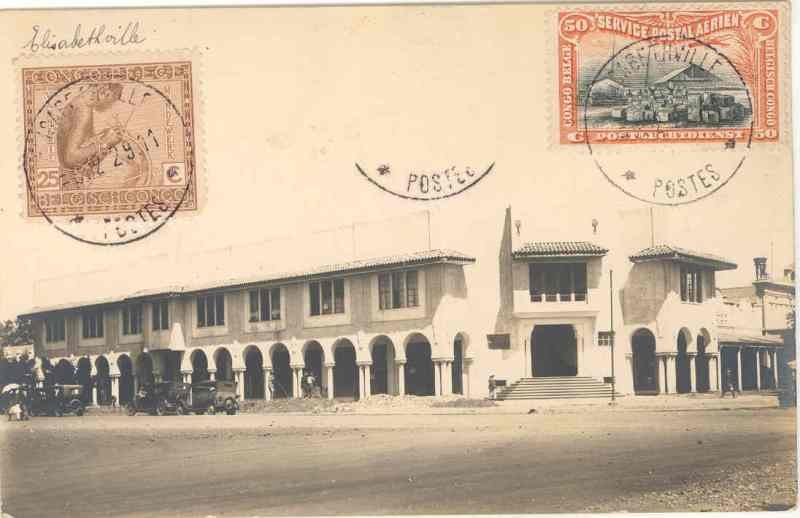
Pictured: a circa-1960 postcard view of colonial-era municipal buildings in Elisabethville, Belgian Congo (present-day Lubumbashi, DR Congo) — the town whose small airfield Commander Pierre flew from during the pursuit described in the CIA report. This is not a photograph of the discs, of the Shinkolobwe mine itself, or of the actual 1952 streetscape; no photograph of the sighting is known to exist, and no rights-clear period photograph specifically of the Shinkolobwe mine site could be sourced at usable quality for this file. The postcard postdates the sighting by roughly eight years but depicts the same colonial-era townscape from which the pursuit was flown.
Theoretical Alignment
The case's evidentiary profile — one named witness, no corroboration, no instrumentation, and a technically detailed but entirely uncheckable performance description — aligns most comfortably with a mundane-misidentification or embellished-retelling framework, tempered by the genuine difficulty of ruling that framework in without a second witness or any physical data to test it against. It retains slightly more nominal alignment with the Extraterrestrial Hypothesis than a typical single-witness case of this kind only because the CIA's own contemporaneous paperwork treated the report, however briefly, as worth filing rather than discarding outright — a data point about the report's institutional handling, not about what actually flew over the mine that day.
Background
To understand why a single foreign newspaper story about "flying saucers" over an obscure corner of central Africa ended up as a typed, report-numbered document in the files of the United States' foreign intelligence service, it is necessary to understand what, exactly, sat on the ground beneath those discs. The Shinkolobwe mine, roughly 120 km northwest of Elisabethville in Belgian Congo's mineral-rich Katanga province, was not merely another colonial-era copper-and-cobalt claim. Opened in 1921 by the Belgian mining consortium Union Minière du Haut-Katanga after its discovery six years earlier, Shinkolobwe's uranium ore assayed as high as 65–75% uranium oxide by weight — a purity with no rival anywhere else on Earth then known, compared with ore as dilute as 0.02% in contemporary American and Canadian deposits. For two decades the uranium that came up alongside Shinkolobwe's more commercially useful radium was treated as waste rock, discarded because no one yet had a use for it valuable enough to justify the extraction cost.
That changed permanently in 1939, when Union Minière's managing director, Edgar Sengier, acting on nothing more than an informed hunch that uranium might soon matter to a world sliding toward war, shipped roughly 1,000 tons of Shinkolobwe ore to the United States for safekeeping. When officials connected to the nascent Manhattan Project contacted Sengier in 1942, he sold them his entire stockpile, and after the mine was refurbished and reopened between 1942 and 1944, Union Minière supplied roughly 30,000 additional tons. By most later historical accounting, some two-thirds of the fissile material that went into the first American atomic weapons — including the bombs dropped on Hiroshima and Nagasaki on August 6 and 9, 1945 — traced back to this one mine in a Belgian colony most Americans could not have located on a map. From 1943 to 1945, the U.S. Office of Strategic Services (OSS), the Central Intelligence Agency's wartime predecessor, posted intelligence officers to the Congo specifically to secure Shinkolobwe's export route — by rail to Elisabethville, onward to Kolwezi, then by rail again to the Angolan port of Lobito for shipment to the United States — and to watch for any attempt by Nazi Germany to divert or smuggle the ore, a mission chronicled in historian Susan Williams's Spies in the Congo.
Peacetime did nothing to diminish Shinkolobwe's strategic weight; if anything, the onset of the Cold War increased it. The Soviet Union's first successful atomic test, in August 1949, sharply escalated Washington's anxiety over the security of its uranium supply, and the Congo remained the single largest source: by 1951, of the 3,686 tons of uranium the United States had obtained to that point, 2,792 tons — more than three-quarters — had come from Katanga. The Joint Chiefs of Staff drew up contingency plans for the forcible American seizure of "critical areas" of the Congo in the event Soviet forces overran Western Europe, approved roughly $7 million in military equipment for Belgian colonial troops stationed in Katanga, and the CIA itself established what a later historical account terms a "controlled source" — an intelligence asset planted specifically in the mining district — to provide early warning of any threat to the mine, alongside contingency planning for covert counter-sabotage operations. Belgian colonial authorities, for their part, would tighten physical security around Shinkolobwe dramatically by 1954, when a formal decree authorized shooting on sight anyone found within the mine's boundaries without authorization, sealed the surrounding roads, and subjected anyone entering the nearby town of Jadotville to identity checks; NATO, with substantial American backing, built a major air base at Kamina, roughly 200 miles from the mine, explicitly for "the defence of Central Africa against international Communism."
This is the actual, well-documented Cold War backdrop against which two "fiery discs" were reportedly seen maneuvering over exactly this district in the early months of 1952 — a year, and a place, in which American, Belgian, and Soviet intelligence services were all, for entirely earthly reasons, already paying very close attention to the airspace above Shinkolobwe. It also happened to be an extraordinary year for the broader UFO phenomenon worldwide: 1952 produced more American reports to the U.S. Air Force than any other single year of Project Blue Book's existence, cresting that July with the multiply radar-tracked Washington, D.C. UFO Flap, and extending into a substantial European and African wave that included a near-simultaneous run of sightings across French colonial Morocco and West Africa (already cataloged on this site as the Morocco and French West Africa case), Tunisia, Spain, and West Germany. By early 1953, the volume and profile of these reports — including, per the CIA's own later account, the Belgian Congo case among them — prompted the Agency to convene a scientific advisory panel, chaired by physicist H.P. Robertson, to formally review the "Unidentified Flying Object Problem." That panel's now-famous verdict was blunt: its members were "impressed by the lack of sound data in the great majority of case histories," a description that, as later sections of this file will show, applies to the Belgian Congo report about as precisely as it does to almost any other case the CIA's foreign-intelligence apparatus swept up that year.
Complete Timeline
| Date | Event |
|---|---|
| 1921 | Union Minière du Haut-Katanga opens the Shinkolobwe mine, discovered six years earlier by geologist Robert Rich Sharp. |
| 1939 | Union Minière director Edgar Sengier ships roughly 1,000 tons of Shinkolobwe uranium ore to the United States, anticipating wartime demand. |
| 1942–1944 | The Manhattan Project purchases Sengier's stockpile and an additional ~30,000 tons from a refurbished Shinkolobwe; OSS officers are posted to the Congo to secure the export route. |
| Aug. 6 & 9, 1945 | The Hiroshima and Nagasaki bombs are detonated, built substantially from Congolese-sourced uranium. |
| Aug. 1949 | The Soviet Union's first atomic test sharply raises U.S. strategic anxiety over uranium-supply security. |
| 1951 | The Congo has supplied 2,792 of the 3,686 total tons of uranium obtained by the United States to date — the single largest national source. |
| Early 1952 (exact date undocumented) | Two fiery discs are reportedly sighted maneuvering over the uranium-mining district near Elisabethville; Commander Pierre pursues them by fighter plane for roughly fifteen minutes. |
| Mar. 29, 1952 | Vienna daily Die Presse publishes Austrian correspondent Fritz Sitte's account of the sighting — the earliest fixed date anywhere in the case's documentary record. |
| Jul. 6, 1952 | The CIA drafts intelligence report 00-W-23602, an English-language translation and summary of Sitte's article, roughly three months after it first appeared in print. |
| Jul. 19–20, 1952 | The Washington, D.C. UFO Flap produces radar-and-visual sightings over the U.S. capital, the highest-profile case of the entire 1952 wave. |
| Aug. 16, 1952 | The CIA internally distributes report 00-W-23602 under the "Unevaluated Information" marking. |
| Jan. 1953 | The CIA convenes the H.P. Robertson-chaired scientific advisory panel to review the "Unidentified Flying Object Problem," later citing a "lack of sound data in the great majority of case histories." |
| 1954 | Belgian colonial authorities impose a shoot-on-sight decree and sealed exclusion zone around Shinkolobwe; NATO activates Kamina Air Base roughly 200 miles away. |
| Oct. 5, 1978 | The CIA declassifies and releases report 00-W-23602 to its public reading room under the Freedom of Information Act, filed as Document No. 0000015463. |
| Jan. 2016 | The document resurfaces in wider press coverage (Fox News, Live Science) of the CIA's declassified UFO holdings, timed to a Fox "The X-Files" reboot. |
The Sighting: Two Discs Over the Mining District
Every substantive detail of what was actually seen over the Katanga uranium district traces back to a single paragraph of translated newspaper prose. According to that account, two fiery discs appeared over the uranium-mining region "east of the Luapula River" — in the CIA's own English rendering, a river said to connect "the Meru and Bangweolo lakes." This is almost certainly a transliteration of Lake Mweru (also spelled Lake Moero), which the real Luapula River does in fact link to Lake Bangweulu in the actual regional hydrology of the Katanga–Zambia borderlands; the surrounding geography, in other words, checks out even where a single proper noun did not survive translation intact. Within this district, the two discs "glided in elegant curves and changed their position many times," so that observers on the ground saw them, depending on the viewing angle presented as the objects banked and turned, alternately as flat plates, ovals, or simple lines. After some ten to twelve minutes of this maneuvering, both discs suddenly hovered in place before departing in what the source account calls "a unique zigzag flight to the northeast," accompanied by "a penetrating hissing and buzzing sound" audible to onlookers below.
The account gives no indication of how many people beyond the pilot actually witnessed this initial ten-to-twelve-minute phase, nor any names, occupations, or independent statements from anyone on the ground. This matters enormously for how the case should be weighed: unlike mass sightings such as the Florence Stadium Sighting, where thousands of named and unnamed spectators converged on the same fifteen-minute event, the Belgian Congo report offers no crowd, no named secondary witness, and no indication that Sitte's newspaper account was built from more than a single retold conversation, however detailed, with the one participant who did go on record.
Commander Pierre's Pursuit
The case's one named witness is identified in the source document only as "Commander Pierre," a pilot based at the small airfield at Elisabethville. On learning of, or personally spotting, the discs over the mining district, Pierre "immediately set out in pursuit with a fighter plane." On his first approach, he claimed to have closed to within roughly 120 meters of one of the two objects — close enough, by his own account, to make out considerable structural detail. He estimated the disc's diameter at 12 to 15 meters and described it as discus-shaped, with a central "knob" or core that remained "absolutely still" while a surrounding rim, "completely veiled in fire," rotated at what he judged to be enormous speed. He reported the object's metal finish as resembling aluminum, and noted several small openings visible around the stationary central section.
Pierre's account credits the discs with striking vertical performance: changes in elevation of 800 to 1,000 meters accomplished, in his estimate, within a few seconds, alternating with passes that brought the objects down to within about 20 meters of the treetops. He is quoted as doubting the discs could be crewed at all, reasoning that the combination of erratic, high-speed motion and the evident heat of the fire-wreathed rim would make it impossible for an occupant to remain inside a stable, livable compartment — an early and reasonably sophisticated bit of applied skepticism from the one witness in the case, even as he continued to describe the objects as physically genuine and non-terrestrial in origin. After roughly fifteen minutes of pursuit, Pierre broke off the chase as both objects, now producing "a loud whistling sound" audible even over his own aircraft's engine noise, departed in a straight line toward Lake Tanganyika. He estimated their speed during this final withdrawal at approximately 1,500 km/h (932 mph) — a supersonic figure, notably, for an aircraft type Belgian colonial forces did not themselves operate in 1952, and one Pierre had no independent means of measuring beyond his own visual impression from the cockpit of a considerably slower fighter.
The CIA's own translated report offers one piece of source-credibility framing that later retellings have consistently preserved: Pierre "is regarded as a dependable officer and a zealous flyer," who "gave a detailed report to his superiors which, strangely enough, in many respects agreed with various results of research" — an oblique, uncited line that appears to gesture at some contemporary technical speculation about disc propulsion without specifying what "results of research" it means. No Belgian Air Force personnel file, squadron record, or independent Belgian source corroborating Pierre's identity, rank, or this incident has been located in the course of this research; "Commander Pierre" survives in the historical record purely as a rank-and-first-name attribution inside a secondhand, translated newspaper account.
Elisabethville's own airfield — Luano, which remains the city's civil airport today under the same name — is real and well documented, which lends the account a degree of concrete geographic grounding even where the pilot's own identity cannot be confirmed. What is genuinely harder to pin down is what kind of aircraft "a fighter plane" could actually refer to in the Belgian Congo of early 1952. Available histories of the Force Publique's colonial air arm describe its inventory through the 1950s as consisting of light liaison, transport, and training aircraft rather than dedicated combat types; by most accounts, the colony's first true armed aircraft — a handful of weapons-modified AT-6/Harvard trainers — were not introduced until 1962, during the Katanga secession crisis a full decade after this sighting. That does not make Pierre's account impossible: Sabena, the metropolitan Belgian airline, maintained a substantial civil aviation presence throughout the colony, private mining-company aircraft flew regularly out of Katanga's airfields, and "fighter plane" may simply be a loose journalistic rendering, filtered through German and then English translation, of any fast single-seat aircraft rather than a precise military type designation. It is, however, a genuine and so far unresolved gap in the record: this file could not identify what specific aircraft type, registration, or operating unit Pierre would actually have flown that day.
The Technical Sketch and Its Openly Conjectural Origins
Sitte's original article was accompanied by a diagram purporting to show the "construction principle" of the flying saucers, and the CIA's translators reproduced it faithfully, captions and all. The sketch depicts a stationary central core containing an "explosive" element (labeled SP) and equipment for "radar steerage" (R), fitted with catapult knobs (KZ), antennae (AN), and a counter-pressure housing (GD); around this core, an outer rim carries jets (D) on its upper and lower faces plus fuel chambers (DB), riding on a roller bearing (L) and launched, per the caption, "at a sharp angle in the manner of a discus throw," with the rim itself estimated to spin at roughly 22,000 revolutions per minute.
Crucially, the document is explicit that this schematic is not reportage of anything Pierre or anyone else actually observed in mechanical detail from 120 meters away. The captions, in the source article's own words, are "in part, purely conjecture, based on reports by pilots who pursued the disks," and "in part... learned from secret research institutions" — an admission, on the face of the document itself, that the diagram is speculative engineering guesswork dressed in the vocabulary of hard intelligence. This kind of framing was not unique to the Belgian Congo case; it echoes a wider and better-documented strand of early-1950s European saucer folklore, popularized by figures such as Italian aviation writer Renato Vesco (whose separate "angel hair" naming convention is discussed on this site's Florence Stadium Sighting case file), in which flying discs were explained as secret, captured, or reverse-engineered German Wunderwaffe technology rather than as anything genuinely extraterrestrial. Whether or not Sitte or his editors were consciously drawing on that specific tradition, the sketch's own self-described mix of pilot report and unnamed "secret research" is a textbook example of how a single ambiguous sighting could, by the time it reached print, acquire a wholly invented technical apparatus that no primary witness ever actually described seeing.
From a Vienna Newsroom to a CIA File Drawer
The full documentary chain behind this case is unusually well preserved for a report this obscure, and it is worth tracing in full, because it explains almost everything about why the file exists at all. The origin point is a single bylined article by Fritz Sitte, published in the Vienna daily Die Presse on March 29, 1952. Sitte, then in the early years of a career that would eventually make him one of Austria's best-known war and crisis correspondents — he began traveling internationally as a journalist in 1951 and would go on to report from Yemen, Angola, Chad, and Sudan for outlets including Life, Time, Paris Match, and Stern — was, in early 1952, still a relatively junior foreign correspondent, and this Congo dispatch appears to be among his earliest recorded international filings. Die Presse is, and was, a mainstream Austrian daily based in Vienna, not a tabloid; its coverage of a Belgian colonial territory almost 8,000 km away is unremarkable for a European paper with wire-service and stringer access to francophone colonial Africa, and there is nothing internally inconsistent about an Austrian paper running a story datelined from the Congo. (At least one later English-language secondary account of this case — a 2016 Live Science article on the CIA's declassified UFO files — describes Die Presse inaccurately as "the local newspaper," which misstates both the paper's nationality and its distance from the event; this file treats the CIA's own translated header, which correctly identifies Die Presse as a Vienna daily, as authoritative.)
The CIA's own report carries three distinct dates that, read together, sketch a plausible bureaucratic timeline rather than a discrepancy: the underlying article's publication on March 29, 1952; the Agency's own intelligence report, numbered 00-W-23602, drafted on July 6, 1952 — roughly three months after the article ran, a processing lag entirely consistent with a low-priority foreign press item routed through a field station and a translation desk before reaching a report writer's desk; and the report's internal distribution date of August 16, 1952, five weeks after drafting. The report itself carries the flat, honest classification marking "THIS IS UNEVALUATED INFORMATION" — a formal designation meaning exactly what it says: the material had been collected and translated, not vetted, verified, or assessed for accuracy by any CIA analyst. It sat in Agency files, marked "U" for an unclassified handling level, until it was formally declassified and released into the CIA's public FOIA reading room on October 5, 1978, where it is catalogued today as Document Number 0000015463, part of the Agency's "UFOs: Fact or Fiction?" collection.
Read end to end, this paper trail describes routine Cold War-era intelligence housekeeping, not an investigation. Nothing in the report indicates that any CIA officer traveled to Elisabethville, interviewed Pierre, requested a Belgian colonial or Sûreté file on the incident, or cross-checked the sighting against Belgian, British, or French air-traffic or air-defense records for the region. The report is, transparently and by its own internal marking, a translated clipping — filed, in all likelihood, less because of any operational interest in flying saucers than because of where the story was set. A report officer scanning European wire and press traffic in mid-1952 for anything touching the Congo's uranium districts would have had every institutional reason to flag this one for the file, given that the CIA was simultaneously running its own human intelligence "controlled source" in exactly that district for entirely unrelated strategic-security reasons. A strange story about aerial activity over America's most sensitive foreign uranium supplier was the kind of item a competent Africa desk would rather have on record than not, irrespective of whether anyone believed the saucers themselves were real.
Part of a Global Wave: Africa's Place in the Saucer Summer of 1952
The Belgian Congo report did not surface in isolation. It was one of a cluster of foreign press UFO stories the CIA's field stations and translation desks swept up across 1952, a year that produced, by a wide margin, the largest single-year volume of UFO reports the U.S. Air Force's Project Blue Book ever recorded, capped by the radar-and-visual Washington, D.C. UFO Flap of July 19–20, 1952. The same year and the same intelligence-monitoring apparatus that produced the Belgian Congo file also produced translated reports on a strikingly similar West German case — former mayor Oscar Linke's report of two men and a "flying frying pan" near Hasselbach, complete with its own freshly-dug ground marking — and on a run of French colonial African sightings across Morocco and Dakar, French West Africa, already documented on this site as the UFO Sightings Over Morocco and French West Africa case, plus additional 1952 reports from Sousse, Tunisia, and a witnessed smoke-trail sighting over Barcelona, Spain. All of these reports reached the CIA the same way the Belgian Congo case did: not through direct agency investigation, but through the routine, low-cost work of monitoring and translating whatever foreign press was already covering the story locally.
The West German case is worth pausing on for comparison, because it illustrates just how much weaker the Belgian Congo file is on its own terms. Oscar Linke, the 48-year-old former mayor of Gleimershausen, reported that his 11-year-old daughter Gabriella first spotted the object near Hasselbach, and that after it departed he personally located a freshly dug, precisely saucer-shaped depression in the ground where it had stood — a claimed physical trace that, whatever one makes of it, at least offered later investigators something concrete to inspect. Linke also testified about the sighting to a West German judge, placing his account on a kind of quasi-legal record no version of the Congo case ever received. The Belgian Congo report has no equivalent: no ground trace, no second witness, no judicial or institutional record of any kind beyond the newspaper article itself and the CIA's own translation of it. Two reports collected by the same intelligence apparatus in the same year, in other words, can carry very different amounts of underlying evidentiary weight even before either is assessed for plausibility.
This pattern is directly relevant to how much evidentiary weight the Belgian Congo case can bear. The CIA's own scientific advisory panel, convened under physicist H.P. Robertson in January 1953 substantially in response to 1952's volume of reports, reviewed a broad cross-section of that year's case files and concluded that its members were "impressed by the lack of sound data in the great majority of case histories" — a judgment the panel reached looking at cases that, unlike this one, frequently included multiple witnesses, instrument readings, or at least a domestic investigator's own follow-up interview. If that assessment held for the Robertson Panel's stronger cases, it applies with even greater force to a file that was never more than a single translated newspaper paragraph in the first place.
Key Witnesses
Commander Pierre
The case's only named eyewitness, identified in the CIA's translated report solely by rank and first name. Pierre pursued the two discs by fighter plane for roughly fifteen minutes, closing to an estimated 120 meters of one object and providing the case's entire physical-description record — diameter, coloring, rotating rim, and estimated speed. The CIA's own report describes him as "a dependable officer and a zealous flyer," but no surname, service record, or independent Belgian corroboration of his identity or account has been located; his testimony stands entirely uncorroborated by any second witness.
Fritz Sitte
Not an eyewitness, but the journalist whose March 29, 1952 dispatch in the Vienna daily Die Presse is the sole original source for this entire case, including the technical sketch of the discs' purported construction. Sitte went on to a long career as one of Austria's most prominent war and crisis correspondents, reporting internationally for outlets including Life, Time, and Paris Match; this Congo dispatch appears to date from very early in that career, roughly a year after he began traveling abroad as a journalist in 1951.
The Five Observables Assessment
The Five Observables framework is applied to the performance characteristics described in Pierre's account:
Assessment: Pierre's account, taken at face value, describes climbs of 800–1,000 meters "in a few seconds" and abrupt transitions between treetop-skimming passes and high-altitude maneuvering, which would qualify as genuine anti-gravity-lift and instant-acceleration observables if independently confirmed — but both ratings here are marked speculative rather than present precisely because "if independently confirmed" cannot be satisfied by a single, uncorroborated witness recalling his own visual impressions from a cockpit. The estimated top speed of 932 mph, while fast for 1952 propeller or early jet aircraft, falls short of hypersonic thresholds and was itself only a rough visual estimate. Far from demonstrating low observability, the objects were reportedly visible for ten to twelve minutes to unspecified ground observers, audibly hissing and buzzing, and then whistling loudly enough to be heard over a chasing fighter's own engine — the opposite of a stealthy signature. No trans-medium transition of any kind is claimed.
Evidence Assessment
Supporting Anomalous Origin
- An internally detailed, technically specific witness account — diameter, coloring, structural features, rotational behavior — rather than a vague light-in-the-sky report
- The CIA's own contemporaneous assessment of the sole witness as "a dependable officer and a zealous flyer," rather than as someone known to fabricate or exaggerate
- A genuine close-range pursuit is claimed, with the witness closing to an estimated 120 meters — a materially closer approach than most contemporary daylight-disc reports
- The sighting occurred over one of the most closely monitored and strategically sensitive patches of airspace on Earth in 1952, a period of intense, real (if unrelated) intelligence activity in exactly this district
Supporting Conventional Explanation
- Exactly one named witness exists; no second observer, ground witness statement, or Belgian colonial record of any kind has ever surfaced to corroborate the account
- No photograph, radar return, film, or physical trace of any kind accompanies the sighting
- The entire case survives through a single layer of newspaper reporting and a single layer of CIA translation — two documented opportunities for embellishment, compression, or error before the account ever reached its current form (a later English-language secondary source, for instance, demonstrably mischaracterizes even the source newspaper's own nationality)
- The accompanying technical sketch is explicitly labeled in the original source as "purely conjecture" mixed with unnamed "secret research" — a self-described speculative addition, not eyewitness reportage, that closely echoes a wider and separately documented 1950s European folk-genre of "secret Nazi saucer" explanations
- The CIA's own report is marked "UNEVALUATED INFORMATION" and shows no sign of independent agency investigation, interview, or verification of any element of the story
- 1952 was, by a wide margin, the single busiest year in the modern UFO era for both reports and press coverage, a climate demonstrably conducive to exaggerated retelling and eager publication of thinly sourced accounts
Why "Open"
This case is classified OPEN rather than "Disputed" or "Debunked" because the record here is too thin to support either an active, evidence-based argument between competing camps, or a confident conventional identification. A "Disputed" classification, as used elsewhere on this site, generally describes cases where two well-developed positions genuinely contend over a substantial shared body of evidence — a same-day chemical analysis, multiple named witnesses, a documented military deployment. None of that scaffolding exists here. What exists is one secondhand, twice-translated newspaper account, filed by an intelligence bureaucracy that itself never evaluated it, describing a technically detailed but entirely unverifiable pursuit by a pilot who cannot be independently identified today.
That does not make the case worthless, and it would be dishonest to score it as a probable hoax when nothing in the record actually indicates fabrication; the CIA's own characterization of Pierre as reliable, whatever it is actually worth eight decades later, is a real, if thin, positive signal. But a single uncorroborated witness, a document explicitly marked "unevaluated," a technical diagram its own source calls conjecture, and a total absence of independent investigation by any government body leave this case without enough evidentiary weight to resolve in either direction. It remains open not because two sides are fighting over it, but because there is simply not enough here to close.
Sensor & Instrumentation Detection Profile
No radar, photographic, film, or other instrumented record of any kind exists for this sighting. The only documentation is a single witness's retrospective verbal account, filtered through a newspaper journalist and then a CIA translator; no Belgian colonial air-defense, civil-aviation, or Union Minière security record referencing the incident has been located.
Environmental & Geospatial Context
The Katanga plateau sits at an elevation of roughly 1,200–1,300 meters, within a subtropical highland climate zone; the source document specifies no weather conditions for the sighting itself. The uranium-mining district lies within the Luapula–Mweru drainage basin near the modern Zambian border, an area of savanna woodland punctuated by open-pit and underground mine workings, roughly 120 km from the Luano airfield at Elisabethville from which Pierre's pursuit was flown. Lake Tanganyika, the water body the discs reportedly departed toward, lies a considerably greater distance to the northeast — on the order of several hundred kilometers from the mining district itself — meaning the account's claimed 1,500 km/h withdrawal speed, taken at face value, would have carried the objects across that entire remaining distance in well under half an hour, a detail no source consulted for this file appears to have previously flagged or attempted to reconcile against the map.
Observer Credibility & Occupational Profile
The case rests entirely on the credibility of one individual: a colonial-era Belgian military or civil aviation pilot, described by the CIA's own translated report as "a dependable officer and a zealous flyer" who filed a formal report to his own superiors. A trained pilot is, in general terms, a more disciplined visual observer than an untrained bystander, and Pierre's account is notably more analytically self-aware than many contemporary saucer reports — he explicitly reasons through why he doubts the object could be crewed, rather than simply asserting an exotic interpretation. Set against this is the complete absence of any independent verification of who Pierre actually was: no surname, no service record, no Belgian institutional confirmation, and no way, eighty years on, to test the CIA's secondhand characterization of his reliability against anything beyond the newspaper article it was itself built from.
Physical & Material Assays
No physical trace, debris, or material sample of any kind is associated with this case; nothing is reported to have been recovered, and no laboratory or forensic assay of any evidence exists or could exist on the present record. This section is included for structural completeness rather than because material evidence is available to assess.
Historical Precedents & Archive Matches
The Belgian Congo report sits inside the same 1952 global UFO wave that produced the Washington, D.C. UFO Flap, the Morocco and French West Africa sightings, and a broader run of European and African cases the CIA's own field stations translated and filed that same year, including the West German "flying frying pan" report and sightings over Tunisia and Spain. Two years later, the autumn 1954 European wave would produce the Florence Stadium Sighting, another case in which a technically detailed physical description (there, a chemically analyzed physical sample; here, a pilot's close-range visual account) sits alongside a genuinely unresolved central sighting. No prior or subsequent UFO report specifically tied to the Shinkolobwe mining district or the Elisabethville area has been identified in this research.
Material Analysis
No physical trace, debris, or recovered material of any kind is associated with this case — no fallen substance, no ground marking, no metal fragment. The only quasi-material artifact in the entire record is not a specimen but a drawing: the technical sketch appended to Fritz Sitte's original article, purporting to lay out the discs' internal construction. Because it is the closest thing this case has to a physical-evidence exhibit, it is worth assessing on its own terms rather than skipping this section outright.
What the Sketch Actually Claims
The diagram depicts a stationary central core housing an explosive charge and radar-steerage equipment, ringed by a rotating outer rim carrying jets and fuel chambers on a roller bearing, spinning at an estimated 22,000 revolutions per minute and launched "at a sharp angle in the manner of a discus throw." Rendered as engineering schematic, complete with labeled components, it presents visually as a document built from wreckage, telemetry, or at minimum a detailed technical debrief — the kind of exhibit that, if genuine, would constitute the strongest physical evidence in the entire case file.
Why It Cannot Be Treated as Physical Evidence
The source article itself forecloses that reading. Its own caption states the schematic is "in part, purely conjecture, based on reports by pilots who pursued the disks," and "in part... learned from secret research institutions" — an explicit admission that the diagram is speculative reconstruction dressed in technical vocabulary, not a transcription of anything Commander Pierre or any other named source actually observed in mechanical detail from a moving fighter cockpit. No wreckage, no recovered component, and no verified "secret research institution" source is named or exists in the public record. The sketch is best understood as contemporary editorial illustration in the same tradition as the 1950s European "secret Nazi saucer" folklore discussed elsewhere in this file — a genuine period artifact worth preserving and citing, but not physical evidence of the craft it purports to describe.
Supporting Non-Terrestrial or Unexplained Origin
- The witness's own described details — a motionless central core inside a rotating, fire-veiled outer rim — are internally consistent and mechanically coherent enough that they were not obviously invented on the spot by a non-technical observer
- No chain-of-custody irregularity or contamination is alleged, because no physical sample was ever claimed to exist in the first place — the account is at least free of the fabricated-evidence problems that undermine some other physical-trace cases
Supporting Terrestrial (Conjecture/Embellishment) Origin
- The one artifact resembling physical evidence — the technical sketch — is explicitly self-labeled as conjecture and secondhand speculation, not observation or recovered material
- No debris, residue, ground trace, or recovered component of any kind was ever reported, despite a claimed close approach to within 120 meters
- The sketch's blend of "pilot report" and unnamed "secret research institutions" matches a documented, separate 1950s European folk-genre of captured/reverse-engineered Wunderwaffe saucer explanations, rather than any known engineering or intelligence source
The Conventional Explanation Candidate
Because the case rests on so little independently checkable material, no single conventional explanation can be confirmed with the confidence available in, say, the Florence case's chemically analyzed physical sample. What follows are the most genuinely plausible mundane candidates given what the record does and does not contain, evaluated honestly against the limits of the available evidence.
Single-Witness Testimony, Filtered Through Press and Translation
The most parsimonious explanation requires no exotic misidentification at all: a real, ambiguous aerial event — almost certainly involving one or more aircraft, given the fighter-pursuit response it provoked — was witnessed by one pilot under adrenaline-charged, high-workload conditions (flying his own aircraft while trying to observe another object at speed), then related verbally to a foreign correspondent, written up in a language other than the witness's own for a Vienna daily, and finally translated a second time into an English-language intelligence report. Every one of those stages is a documented opportunity for compression, dramatization, or simple error, and this file has already identified one clear instance of exactly that kind of drift: a 2016 English-language secondary source getting the source newspaper's own nationality wrong. There is no need to posit deliberate fabrication by Pierre, Sitte, or the CIA translator for the account to have accumulated real distortion by the time it reached its current form.
Misidentified Aircraft or Aerial Survey Activity
Airborne radiometric and scintillation-counter surveying — flying low, methodical search patterns with radiation-detection instruments to locate uranium-bearing ore bodies — was a well-established, globally used prospecting technique by the early 1950s, employed in Australia, Canada, the Soviet Union, and the United States, and Union Minière had every commercial incentive to conduct exactly this kind of aerial work over its own concession in the Katanga copperbelt. An unfamiliar survey aircraft, flying an unusual low-altitude search pattern with instrumentation and lighting a ground observer had never seen before, is a genuinely plausible source of a "maneuvering, hovering, then departing" visual impression. This file was not able to independently confirm that a specific Union Minière or Belgian government aerial radiometric survey was underway over Shinkolobwe on the actual date of this sighting, which remains itself undocumented — the same honest evidentiary gap this site's Florence case file encountered when it could not confirm CICAP's specific chaff-exercise dates against independent naval records. This candidate also intersects with the unresolved aircraft-identity question raised above: if Pierre was not flying a true combat fighter at all, but rather a liaison, training, or civil mining-company aircraft pressed into an improvised pursuit, the entire episode could plausibly have involved two mundane aircraft — a survey plane and an amateur interceptor — misreading one another's unfamiliar flight profiles under real time pressure, rather than either party observing anything genuinely anomalous.
Cold War Reconnaissance Overflight
Given the genuinely documented, intense American, Belgian, and (feared) Soviet intelligence interest in Shinkolobwe during precisely this period — the CIA's own "controlled source" in the district, Joint Chiefs contingency planning, and the sensitivity that would culminate in 1954's shoot-on-sight security decree — an unannounced, unfamiliar reconnaissance or liaison aircraft overflying the mine is not an implausible candidate on its face. No flight record, radar log, or declassified reconnaissance-tasking document placing any specific aircraft over Shinkolobwe on the sighting date has been located, however, leaving this candidate suggestive rather than demonstrated.
Genuine Unidentified Craft
Having weighed the candidates above, this file cannot responsibly rule out that Pierre saw something genuinely unexplained. Nothing in his account is internally self-contradictory, nothing about it reads as a knowingly invented hoax, and the CIA's own contemporaneous assessment of him as reliable, however secondhand and however little that assessment can be independently tested today, is a real data point rather than nothing. What keeps this candidate at the same "inconclusive" evidentiary floor as the others, rather than elevating it above them, is simply that the case offers no way to move past that floor: no second witness to corroborate the account, no radar return to cross-check the claimed speed and altitude figures, and no physical trace to examine. A genuine anomaly and an honestly unresolved single-witness misidentification would, on the surviving record, look identical from where this research necessarily has to stand eight decades later.
Single-Witness Testimony & Press/Translation Drift
PlausiblePLAUSIBLE. Requires no exotic misidentification, only an ambiguous real event relayed through two documented layers of retelling and translation, each a proven point of distortion elsewhere in this case's own record.
Misidentified Aerial Survey Aircraft
InconclusiveINCONCLUSIVE. Aerial radiometric uranium prospecting was a real, globally established technique by 1952 and Union Minière had clear motive to conduct it over its own Katanga concession, but no specific survey flight on this exact, undocumented date could be confirmed.
Cold War Reconnaissance Overflight
InconclusiveINCONCLUSIVE. The district's real, well-documented strategic sensitivity makes an unfamiliar reconnaissance aircraft plausible in principle, but no declassified flight record or tasking order has been found to confirm one on the sighting date.
Genuine Unidentified Craft
InconclusiveINCONCLUSIVE. Cannot be ruled out on the available record, but the case offers no corroboration, instrumentation, or physical evidence of any kind to move this candidate beyond the same evidentiary floor every other explanation here is also limited to.
Related Cases
Confirmed Documents & Official Records
The centerpiece document of this case: CIA Report No. 00-W-23602, a four-page English translation and summary of Fritz Sitte's March 29, 1952 Die Presse article, marked "THIS IS UNEVALUATED INFORMATION," internally distributed August 16, 1952, and declassified for public release on October 5, 1978. Includes the full witness account attributed to Commander Pierre and the article's own explicitly conjectural technical sketch of the discs' purported construction.
No Belgian colonial government record, Union Minière security log, or independent Belgian, British, or French air-defense document referencing this sighting has been located. Unlike Project Blue Book cases in the United States, this was a foreign civilian event monitored secondhand through press translation rather than investigated directly by any government body.
Search Government & Intelligence Archives Directly
Further Reading — Recommended Literature
Spies in the Congo: America's Atomic Mission in World War II
The definitive account of the OSS's wartime mission to secure Shinkolobwe's uranium export route — the same district, and the same strategic stakes, that this case's CIA report was quietly filed alongside a decade later.
The Making of the Atomic Bomb
The Pulitzer Prize-winning history of the Manhattan Project, including the global scramble for uranium ore that made Shinkolobwe's exceptionally high-grade Congolese deposit strategically indispensable.
The Report on Unidentified Flying Objects (Original 1956 Edition)
Written by the Air Force officer who headed Project Blue Book through the exact 1951–1953 window this case falls within, and coined the term "UFO" — essential context for how contemporary military and intelligence officials actually processed the era's reports.
Watch the Skies!: A Chronicle of the Flying Saucer Myth
A skeptical aerospace historian's case-by-case chronicle of the flying-saucer era from 1947 onward, useful for situating this obscure 1952 African report within the same wave that produced the far better-known Washington, D.C. flap.
The UFO Encyclopedia, 4th Edition
The definitive English-language UFO reference work, useful for cross-referencing this case's place within the broader, exceptionally well-documented 1952 global sighting wave.
Essential Viewing
No Videos Available
A reasonable search effort turned up no video coverage genuinely and primarily dedicated to this specific case — an obscure, single-witness 1952 report that predates video documentation of UFO cases by decades and has never been the subject of dedicated broadcast or online coverage, as distinct from brief mentions inside general roundups of the CIA's 2016 declassified-document trove. Consistent with this site's video sourcing standard, no off-topic or recycled video content has been substituted in its place.
Sources
- Central Intelligence Agency. "Flying Saucers Over Belgian Congo Uranium Mines" (Report No. 00-W-23602, Document No. 0000015463). cia.gov/readingroom
- "Flying saucers over Belgian Congo uranium mines" (full transcription). Wikisource. en.wikisource.org
- Ghose, Tia. "The Real 'X-Files'? CIA Reveals Weirdest UFO Stories." Live Science, Jan. 27, 2016. livescience.com
- "Shinkolobwe." Wikipedia — general orientation on the mine's history and Manhattan Project role. en.wikipedia.org
- Williams, Susan. "How a rich uranium mine thrust the Congo into the centre of the Cold War." The Conversation, Sept. 1, 2016 (adapted from Spies in the Congo). theconversation.com
- "The Manhattan Project: The Congo and the Quest for Uranium." Cold War Studies, Aug. 8, 2023. coldwarstudies.com
- Williams, Susan. Spies in the Congo: America's Atomic Mission in World War II. PublicAffairs, 2016.
- "A (Radioactive) Cut in the Earth That Will Not Stay Closed." Scientific American. scientificamerican.com
- "Uranium Security in the DRC." James Martin Center for Nonproliferation Studies. nonproliferation.org
- "Shinkolobwe Mine, Shinkolobwe, Kambove Territory, Haut-Katanga, DR Congo." Mindat.org. mindat.org
- "Fritz Sitte." AustriaWiki im Austria-Forum. austria-forum.org
- "Fritz Sitte." Wikipedia (German). de.wikipedia.org
- "Journalist und Abenteurer Fritz Sitte gestorben." Der Standard. derstandard.at
- Ruppelt, Edward J. The Report on Unidentified Flying Objects. Doubleday, 1956.
- Central Intelligence Agency. "Unidentified Flying Objects" — Robertson Panel background summary. CIA FOIA Reading Room, "UFOs: Fact or Fiction?" collection. cia.gov/readingroom
- "1952 in the Belgian Congo." Wikipedia — general chronological orientation only. en.wikipedia.org
- "File: Flying saucers over Belgian Congo uranium mines, CIA report.pdf." Wikimedia Commons. commons.wikimedia.org
- "File: Elisabethville, asset I1QOVSRNXbqaMJOGVXWiD6Ht.jpg." Wikimedia Commons, from the collections of the MAS Museum aan de Stroom, Antwerp (CC0). commons.wikimedia.org
- Case File: Washington, D.C. UFO Flap — The Omni Ledger.
- Case File: UFO Sightings Over Morocco and French West Africa — The Omni Ledger.
- Case File: Florence Stadium Sighting — The Omni Ledger.
See something inaccurate? Have additional information or sources?
Suggest an Edit →Last Updated: August 2026