
UFO Sightings Over Morocco and French West Africa
Between June and July 1952, French colonial police officers, dock workers, and townspeople across French Morocco and Dakar, French West Africa reported elongated, flame-wreathed discs streaking through their skies — a wave the CIA quietly folded into a declassified intelligence digest, compiled from foreign press and colonial-police channels just weeks before its own analysts were consumed by the far more famous flap breaking out over Washington, D.C.
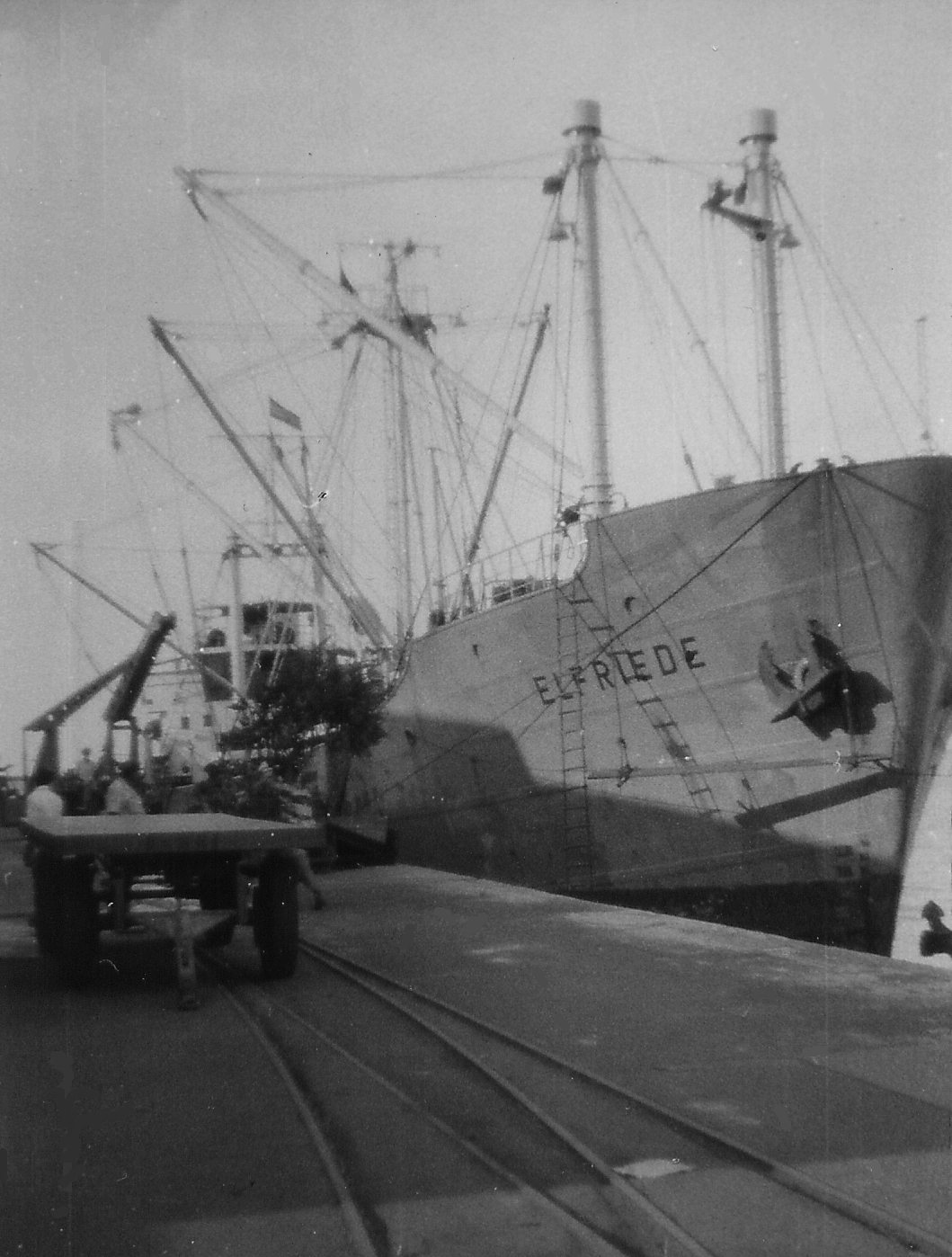
Pictured: the Port of Dakar in 1956, four years after the case — not a photograph of the object itself, which no known photograph or period image documents. No contemporaneous 1952 photograph of Dakar, Casablanca, or any of the other Moroccan sighting towns is known to survive in a rights-clear archive; this image is used to show the genuine location and era rather than the phenomenon reported there.
Theoretical Alignment
The remaining probability weight in this assessment sits outside all three frameworks above, in ordinary terrestrial misidentification (meteors, unfamiliar military aircraft, and atmospheric electrical phenomena — detailed in the Conventional Explanation Candidate section below). Of the three theoretical frameworks this site tracks, the case aligns most with the Psycho-Social Hypothesis: the reports cluster inside the exact several-week window in which Life magazine's widely circulated April 1952 feature "Have We Visitors From Space?" and mounting international press coverage were already priming the public to notice, interpret, and report ambiguous night-sky phenomena as "flying saucers," immediately before the far larger and more heavily reported Washington, D.C. flap broke out. A modest Extraterrestrial Hypothesis alignment remains because a genuine residue of the pattern — particularly the paired, hovering discs at Marrakech and the flame-wreathed Dakar object — is not fully accounted for by any single conventional or psychosocial candidate individually.
Background
In the summer of 1952, French Morocco and French West Africa were both, on paper, integral parts of the French colonial empire — but each was also entering its own distinct period of strain. Morocco had been a French protectorate since 1912, nominally ruled by Sultan Mohammed V but administered in practice by a French Resident-General; by mid-1952 that post was held by General Augustin Guillaume, who had taken office in August 1951. Nationalist sentiment, organized chiefly through the banned Istiqlal (Independence) Party, was rising toward a crisis point: five months after the last of the case's dated sightings, riots in Casablanca on December 7–8, 1952 — triggered by the French-linked assassination of Tunisian labor leader Farhat Hached — would leave hundreds of Moroccans dead or wounded and set in motion the chain of events that led to Mohammed V's August 1953 exile. French West Africa (Afrique Occidentale Française, or AOF), by contrast, was a federation of eight territories — including Senegal, French Sudan, French Guinea, Côte d'Ivoire, Dahomey, Niger, Upper Volta, and Mauritania — governed from Dakar under High Commissioner Bernard Cornut-Gentille, who had taken up the post the year before; Senegal itself had just held Territorial Assembly elections in March 1952, the kind of incremental political liberalization Paris was cautiously extending to its West African possessions even as it moved toward outright repression in Morocco.
Overlaying both territories was a rapidly intensifying Cold War military build-up that receives virtually no mention in the popular retellings of this case but is directly relevant to any serious evaluation of it. Under a 1950 Franco-American basing agreement, the U.S. Air Force's Strategic Air Command began constructing a trio of major air bases on Moroccan soil — Nouasseur, Sidi Slimane, and Ben Guerir — intended as forward staging fields for B-36 and B-47 bombers rotating toward the Soviet Union. Sidi Slimane's first American jets, six F-84E fighters of the 36th Fighter-Bomber Wing, landed there on July 13, 1951, and by the following summer all three fields were under active construction or newly operational, introducing unfamiliar jet aircraft, engine sounds, and running lights into North African skies that had never hosted anything like them before. The day after that first landing, as part of Bastille Day celebrations, the USAF's own "Skyblazers" aerial demonstration team performed precision aerobatics over Casablanca and Nouasseur — a vivid illustration of just how new and publicly visible high-performance American jet flight had suddenly become in Moroccan skies barely a year before the sightings this file documents began. SAC's 5th Air Division, activated in January 1951 at Offutt Air Force Base in Nebraska, relocated to Rabat-Salé that same May specifically to oversee this build-up, and the 118th Aircraft Control and Warning Squadron arrived at Nouasseur in December 1951 to establish early-warning radar coverage across the region. Meanwhile, in the United States, the April 7, 1952 issue of Life magazine carried "Have We Visitors From Space?" — a long, serious feature many UFO historians credit with reigniting national and, through wire-service syndication, international interest in flying saucers just as the summer's reporting season began.
It was against this backdrop — French colonial administrations already straining under nationalist pressure, unfamiliar new military aircraft filling Moroccan skies, and a globally primed public newly re-attuned to "flying saucer" stories — that a scattered series of aerial sightings began working their way through French colonial police stations, local newspapers, and eventually American diplomatic and intelligence channels between June and July 1952. Unlike the domestic American wave, which the U.S. Air Force's Project Blue Book investigated directly, no French or American body appears to have sent an investigator to interview any of the Moroccan or Senegalese witnesses in person. Instead, the reports survive today only because someone inside the Central Intelligence Agency — most likely compiling foreign press clippings and colonial administrative reporting rather than conducting original fieldwork — gathered them into a short internal document, "Unidentified Flying Objects Over Morocco and French West Africa," later folded into a broader regional digest covering Spain and Africa through October 1952, and eventually declassified decades later into what is now the CIA's CREST archive.
Complete Timeline
| Date | Event |
|---|---|
| April 7, 1952 | Life magazine publishes "Have We Visitors From Space?", widely credited with reigniting global public interest in flying saucers ahead of the summer's reporting wave. |
| June 11, 1952 | Two witnesses near Meknes, Morocco report a flying disc departing "at lightning speed" near a local airfield, trailing white smoke and making no sound. |
| June 15–16, 1952 | Dock workers at the port of Taourirt, French Morocco watch a disc of white flame ringed by two circular strands hover for roughly 30 seconds before vanishing rapidly, trailing white smoke. |
| June 16, 1952 | Former pilot André Assini reports a flying saucer over Casablanca; his account is reportedly checked against Meteorological Bureau records, which turn up no conventional match. |
| July 3, 1952, 6:08 AM | A witness at Dakar, Senegal reports a flat, tapered saucer wreathed in bluish and reddish flame, flying south at roughly 1,500 meters altitude and high speed as the stars fade from view around it. |
| July 12, 1952 (night) | Two policemen on patrol at Had Kourt, Morocco see two elongated, white-light-trailing discs cross the sky from north to south at high speed. |
| July 13, 1952, 11:45 PM | Residents of Fedala (present-day Mohammedia), Morocco watch a blue-green, ball-shaped object streak past at high speed, leaving a trail of light. |
| July 14, 1952, ≈9:00 AM | A couple traveling between Ifrane and Meknes, Morocco observes an unidentified flying object for approximately 30 seconds. |
| July 12–29, 1952 | The far larger, internationally reported Washington, D.C. UFO flap unfolds in the United States, dominating American press and CIA institutional attention. |
| July 16, 1952 | "Many people" in Marrakech, Morocco watch a large luminous disc move with a "leaping and bounding" motion; a second disc joins it and both hover for about a minute before departing (recorded in the CIA's companion regional digest). |
| August 2, 1952, 8:45 PM | A red-centered, blue-edged object is reported over Moulay Bousselham, French Morocco, crossing from southeast to northwest in roughly 20 seconds (companion digest). |
| Late September 1952 | A tourist-flight pilot reports flying saucers around his aircraft over the Casablanca–Tangier corridor (companion digest). |
| September 2, 1952 | The CIA compiles "Unidentified Flying Objects Over Morocco and French West Africa" as an internal document. |
| November 24, 1952 | The CIA compiles the broader companion digest, "Sightings of Unidentified Flying Objects Over Spain and Africa, July–October 1952," folding the Moroccan and Senegalese reports into a wider regional pattern. |
| January 14, 1953 | The CIA-sponsored Robertson Panel convenes in Washington to review the 1952 wave broadly; it does not appear to examine the African reports individually, but its general conclusion — that reasonable explanations could be found for most 1952 sightings — is later applied retrospectively to the wider global wave, including this file. |
| October 5, 1978 | "Unidentified Flying Objects Over Morocco and French West Africa" is declassified and released under the Freedom of Information Act, later entering the CIA's CREST archive. |
The June Reports: Meknes, Taourirt, and Casablanca
The earliest dated incident in the CIA's compiled file comes from Meknes, an imperial city in Morocco's Middle Atlas foothills, roughly 130 kilometers northeast of Rabat. On June 11, 1952, two witnesses near a local airfield reported watching a flying disc "set off at lightning speed," trailing a plume of white smoke and making no discernible sound — a description that, notably, does not match the loud, propeller-driven military aircraft that would have been the most familiar unusual sight in Moroccan skies at the time, though it leaves open the possibility of a distant jet whose engine noise had not yet reached the observers. Four or five days later, on June 15–16, 1952, dock workers at the port of Taourirt on Morocco's Mediterranean coast watched a disc-shaped mass of white flame, ringed by what witnesses described as two circular strands, hover motionless for approximately 30 seconds before vanishing rapidly, leaving a trail of white smoke behind it. The multiple, simultaneous vantage points of the dock workers give this account more internal corroboration than a lone-witness report would carry, even though none of them are individually named in the surviving document.
The same date, June 16, 1952, produced the case's single most individually credentialed witness. André Assini, a Casablanca resident and former pilot, reported his own flying-saucer sighting to the local press. According to the contemporary account, his report was specifically checked against the French Meteorological Bureau's own records — presumably to rule out a stray weather balloon or a known atmospheric phenomenon — and the Bureau reportedly found nothing in its data to explain the sighting away. This is the closest the entire file comes to any kind of independent, third-party verification step, though the underlying Meteorological Bureau documentation itself has not surfaced separately from the secondary press account describing the check. Assini's aviation background, while it does not automatically make his report more accurate, at least establishes that the witness had some baseline familiarity with aircraft silhouettes, flight behavior, and typical Moroccan air traffic against which to judge something as genuinely anomalous.
The Dakar Sighting, July 3, 1952
Seventeen days after the Casablanca report, and roughly 2,300 kilometers to the southwest, the case's anchor incident occurred. At 6:08 AM local time on July 3, 1952, a witness at Dakar — the administrative capital of the entire French West Africa federation, sitting at the western tip of the Cap-Vert peninsula — reported a flying saucer described as flat and tapered in shape, moving south at great speed and altitude of roughly 1,500 meters, wreathed in bluish and reddish flame described as "quite long and very clearly visible." The witness specifically noted that as the object passed, the stars in that portion of the sky faded from view — an observational detail suggestive either of genuine light intensity bright enough to wash out background starlight, or of a psychological effect of visual attention narrowing onto a single bright, moving light source, a well-documented feature of night-sky misidentification more broadly. The pre-dawn timing is itself notable: at 6:08 AM in early July at Dakar's latitude (roughly 14.7°N), morning civil twilight would already be well underway, meaning the sky was not fully dark and any bright planet, meteor, or aircraft landing light would have been viewed against a lightening sky rather than a black one — a detail bearing directly on the case's Conventional Explanation Candidate analysis below.
No second witness to the Dakar sighting is recorded in the surviving CIA document, and no name is attached to the report. Given Dakar's role as a critical refueling stop on the transatlantic commercial and Military Air Transport Service air corridor of the era, ordinary aircraft traffic in the pre-dawn hours would not have been unusual in itself — though the specific combination of shape, color, altitude, and flame trail described goes beyond what a conventional aircraft's running lights would typically produce.
The Moroccan Police Reports: Had Kourt and Fedala
The following week produced the case's most procedurally interesting incident. On the night of July 12, 1952, two policemen on patrol at Had Kourt, a small town in what is now Sidi Kacem Province in Morocco's Gharb plain, reported watching two elongated, white-light-trailing discs cross the sky from north to south at high speed. That these witnesses were on-duty law enforcement officers — rather than private citizens with no particular occupational reason to be watching the sky — is one of the few genuine credibility strengths in the file, even though, as with nearly every other witness in this case, they are never named in the declassified text. The following night, July 13, 1952 at 11:45 PM, residents of nearby Fedala (renamed Mohammedia in 1960, after Moroccan independence) watched a blue-green, ball-shaped object streak past at high speed, trailing a visible line of light — a morphologically distinct description (round rather than elongated, colored rather than flame-wreathed) from the Had Kourt sighting the previous night, suggesting either two genuinely different phenomena within 24 hours in adjacent towns, or two independent misidentifications of unrelated ordinary objects (a bright meteor is a reasonable candidate for a rapid, colored, trailing light of this kind). On the morning of July 14, 1952, at approximately 9:00 AM, a couple traveling the road between Ifrane, a Middle Atlas hill town, and Meknes reported a final, brief sighting lasting about 30 seconds — the last dated incident inside the specific window covered by the CIA's primary Morocco/French-West-Africa document.
The Wider Wave: Marrakech, Moulay Bousselham, and Beyond
The Moroccan and Senegalese reports did not stop at mid-July, and the CIA's own record-keeping reflects that: a second, broader digest, "Sightings of Unidentified Flying Objects Over Spain and Africa, July–October 1952," folds the earlier reports into a wider regional pattern extending well past the primary file's own July 14 cutoff. On July 16, 1952, "many people" in Marrakech reportedly watched a large, luminous disc move with what witnesses described as a "leaping and bounding" motion across the sky; a second disc joined it shortly after, and the pair hovered together for roughly a minute before departing — the only description in the entire file of two objects behaving in apparent formation rather than a single object in transit. On August 2, 1952 at 8:45 PM, a red-centered, blue-edged object was reported over Moulay Bousselham on Morocco's Atlantic coast, crossing from southeast to northwest in about 20 seconds. By late September 1952, a tourist-flight pilot reported flying saucers around his own aircraft somewhere along the Casablanca–Tangier corridor — notable as the only aviation-professional witness in the broader wave besides Assini, though, again, unnamed in the surviving record. The companion document places these Moroccan reports alongside a wider constellation of contemporaneous sightings across Spain (Barcelona, May 21; Sousse, Tunisia, June 4) and, by autumn, Algeria and Greece as well — part of what CIA reviewers of the era's estimated 1,000–2,000 total 1952 international sightings later characterized, in aggregate, as substantially "phoney," with reasonable conventional explanations available for most, even as no report-by-report accounting singles out any specific Moroccan or Senegalese incident for a named explanation.
How Washington Learned of It: From Colonial Police Blotter to CIA Digest
It is worth being precise about what kind of document actually preserves this case, because it shapes how much evidentiary weight it can fairly bear. Unlike the domestic American sightings of the same summer, which the U.S. Air Force's Project Blue Book investigated through direct interviews, on-site visits, and (in the Washington case) live radar cross-referencing, nothing in the declassified record indicates that any American or French investigator ever traveled to Meknes, Taourirt, Casablanca, Dakar, Had Kourt, Fedala, Ifrane, or Marrakech to interview a single witness in person. Instead, the pattern that emerges from the document's own structure — a short compilation of dated, one-paragraph incident summaries with no investigator's notes, no follow-up correspondence, and no analytical conclusion — is consistent with a foreign press-and-police-blotter monitoring product: local French colonial newspapers and administrative channels reported these sightings as regional news and curiosities, and someone within the CIA's early Directorate of Intelligence, tracking foreign press reactions to the flying-saucer phenomenon as part of a broader watch on how the story was playing internationally, translated and compiled the reports into an internal record. This is precisely the same institutional posture the CIA took with several of its other declassified 1952 international UFO digests, including the companion Spain/Africa report and its separate "Flying Saucers Over Belgian Congo Uranium Mines" compilation — foreign-press monitoring, not field investigation.
The Agency doing this compiling was itself barely five years old in the summer of 1952, having been established by the National Security Act of 1947, and its formal apparatus for systematically tracking a phenomenon like "flying saucers" was still taking shape in real time alongside the wave itself. Viewed this way, the Morocco/French West Africa file reads less like a targeted investigation into a specific mystery and more like a byproduct of a much larger, routine intelligence function: watching how a story was circulating in the foreign press of countries where the United States maintained a diplomatic and, increasingly in Morocco's case, a growing military presence. That the reports survive at all, translated and organized by location and date rather than simply noted in passing, suggests the CIA's press-monitoring apparatus took the volume and geographic spread of the North African sightings seriously enough to warrant a dedicated file — even if "seriously enough to compile" is a considerably lower bar than "seriously enough to investigate."
The Robertson Panel and the Wave's Aftermath
The 1952 wave's institutional endpoint came six months later, in January 1953, when the CIA convened the Robertson Panel — a group of physicists and intelligence officers chaired by physicist and Defense Department consultant Howard P. Robertson — to review the U.S. Air Force's UFO investigation program in the wake of that summer's unprecedented reporting volume, especially the Washington, D.C. events. The panel's membership included physicist and radar expert Luis Alvarez, CIA officer Frederick C. Durant (who served as secretary), nuclear physicist Samuel Goudsmit, astrophysicist and radar specialist Thornton Page, physicist Lloyd Berkner, and astronomer J. Allen Hynek in a consulting capacity. Over four days, the panel examined 23 of the Air Force's then-2,331 cataloged cases, including filmed sightings from Utah and Montana, and concluded that reasonable, conventional explanations could be found for the great majority, that the phenomenon posed no direct threat to national security, and that the greater risk lay in saturating air-defense communications with false reports during a genuine crisis — leading to its now-famous recommendation for a public "debunking" campaign, reportedly even floating the idea of enlisting the Disney corporation, to reduce popular interest in the subject. The panel's review extended beyond domestic cases: CIA analysts reportedly searched the Soviet press for UFO reports as part of the same broader study and found essentially none, concluding the absence itself likely reflected deliberate Soviet government policy rather than a genuine lack of sightings — underscoring that the Agency was already treating foreign press coverage of flying saucers, of exactly the kind that produced this Morocco/French West Africa file, as a subject worth systematic monitoring in its own right.
Nothing in the Robertson Panel's own declassified findings singles out the Moroccan or Senegalese reports specifically; its scope was overwhelmingly domestic and American, and the panel met more than five months after the last dated sighting in this file. But the panel's broader judgment about the era's international reporting climate is echoed in how CIA reviewers characterized the parallel European and African wave the companion Spain/Africa digest documents — as a mixture of genuine misidentification, media contagion, and a comparatively small residue of unresolved reports, this file's seven Moroccan and Senegalese sightings among them. No published Robertson Panel record or later CIA study appears to have singled out any individual Moroccan or Senegalese incident for a specific, named conventional explanation the way it did for several of the domestic Blue Book cases it reviewed directly.
The Washington Flap in Parallel: A Study in Contrasts
The single most useful comparison for evaluating this case's evidentiary weight is the Washington, D.C. UFO flap, which unfolded in the United States over the very same weeks. Beginning July 12, 1952 and running through July 29, the Washington events centered on two consecutive weekends — July 18–19 and July 26–27 — during which air traffic controller Edward Nugent at Washington National Airport tracked seven unidentified objects on radar roughly 15 miles south-southwest of the city, senior controller Harry Barnes confirmed the returns crossed multiple radar scopes simultaneously, and Capital Airlines pilot S.C. Pierman independently reported matching visual sightings while in live radio contact with Barnes. Radar operators calculated apparent speeds as high as 7,000 miles per hour. The scale of public reaction was immense: the Air Force logged over 717 new reports in this period alone, compared to 615 total reports across the preceding four years combined, and 148 of the nation's leading newspapers ran more than 16,000 separate items about flying saucers over a six-month span. The event alarmed President Truman personally and produced the largest Pentagon press conference since the end of World War II, on July 29, 1952, at which Air Force officials attributed the radar returns to a temperature-inversion effect distorting normal radar propagation — an explanation multiple radar operators and at least some Air Force officers at the time considered incomplete.
Set against that record, the Moroccan and Senegalese sightings look almost deliberately modest: no radar corroboration of any kind, no simultaneous instrument and visual cross-reference, no named professional witnesses beyond a single former pilot, no press conference, and no formal investigation by any government body. Yet the two waves are not unrelated coincidences of timing. Both emerged from the same charged global media environment that Life magazine's April 1952 feature helped ignite, both were ultimately filtered through the same young Central Intelligence Agency (founded barely five years earlier, in 1947) as it worked out how seriously to take the "flying saucer" phenomenon, and both fed into the same Robertson Panel review process the following January — even though only the Washington case received the Panel's direct, named scrutiny. The comparison illustrates a broader pattern worth stating plainly: American domestic sightings with institutional stakes (protected airspace over the nation's capital) received rigorous, multi-sensor, high-profile investigation, while foreign colonial sightings with no comparable stakes for Washington were, at best, quietly filed away.
Key Witnesses
André Assini
The only individually named witness in the entire case file. On June 16, 1952, Assini reported a flying-saucer sighting over Casablanca. Contemporary press accounts state his report was checked against French Meteorological Bureau records, which turned up no conventional explanation. As a former pilot, Assini had some baseline familiarity with aircraft behavior and appearance that a purely civilian witness would not, making him — despite the very thin surviving documentation — the case's single strongest individual witness on paper.
Had Kourt Police Patrol
On night duty in Had Kourt on July 12, 1952, two officers reported watching two elongated discs, each trailing white light, cross from north to south at high speed. Their occupational status as on-duty law enforcement is a modest credibility strength — they were presumably experienced at describing events for an official report — though neither officer is named in the surviving CIA document, precluding any independent follow-up.
Taourirt Dock Workers
A group of dock workers at the French Moroccan port of Taourirt reported, on June 15–16, 1952, a disc of white flame ringed by two circular strands that hovered for roughly 30 seconds before departing rapidly. Their account is one of only two in the file (alongside Marrakech) describing a stationary, hovering object rather than one simply transiting the sky, and their simultaneous group vantage offers some internal corroboration despite the total absence of names.
Fedala Residents
Residents of Fedala (present-day Mohammedia) reported a blue-green, ball-shaped object streaking past at high speed and trailing light at 11:45 PM on July 13, 1952 — the night immediately following the Had Kourt police sighting in a nearby town, though describing a visually distinct phenomenon.
Meknes Airfield Witnesses
The earliest dated report in the file: on June 11, 1952, two witnesses near a Meknes airfield described a flying disc departing "at lightning speed" with a white smoke trail and no audible sound — a detail that, if accurate, complicates a simple contemporary-jet-aircraft explanation for this specific incident, since 1950s-era jets were not silent at close range.
The Five Observables Assessment
The Five Observables framework is applied to the performance characteristics reported in this case:
Assessment: None of the seven incidents describe a maneuver or capability that can be confidently classified as physically anomalous rather than a subjective visual impression. Witnesses repeatedly describe "great speed" or objects departing "at lightning speed," which is the basis for the Instant Acceleration and Hypersonic ratings above — but no instrument ever measured a velocity, and unaided human estimation of the speed of a distant, unfamiliar light source is notoriously unreliable, so both remain speculative rather than confirmed. Anti-Gravity Lift is rated speculative on the same basis: the Taourirt and Marrakech accounts describe genuine hovering, but hovering alone does not require an anti-gravitic explanation over a conventional one (a distant aircraft banking, a slow-moving balloon, or simple observer misjudgment of an object's actual motion). Low Observability is rated absent: every single object in this case was seen easily, by multiple independent witnesses across seven separate incidents, with no report of radar transparency, sudden invisibility, or any other stealth-like characteristic — if anything, the flame trails and light trails described made these objects unusually visually conspicuous. Trans-Medium capability is rated absent, since no account describes any transition between air, water, or space.
Evidence Assessment
Supporting Anomalous Origin
- Seven distinct incidents across two countries and six towns within a five-week window (extending to nine incidents across five months when the companion regional digest is included), with broadly consistent morphological themes: elongated or discoid shape, flame or light trailing, and high apparent speed.
- At least two incidents — Had Kourt and the paired Marrakech discs — involved multiple simultaneous witnesses rather than a single lone observer, and the Taourirt sighting involved a group of dock workers watching together.
- Occupational witnesses are represented in the file, including two police officers on active duty at Had Kourt and a former pilot, André Assini, at Casablanca — individuals with at least some baseline observational training or aviation familiarity.
- The Assini account was, per contemporary press reporting, specifically checked against French Meteorological Bureau records, and no conventional match (balloon, aircraft, weather phenomenon) was reportedly found.
- The reports were taken seriously enough by French colonial administrative and press channels, and later by the U.S. intelligence apparatus, to be compiled, translated, and preserved in a dedicated internal government document rather than dismissed outright at the local level.
Supporting Conventional Explanation
- No radar, photographic, or physical evidence exists for any of the seven incidents; every account rests entirely on unaided, uncorroborated human visual perception, often at night, at dawn, or for durations as short as 20–30 seconds — conditions poorly suited to reliable range, altitude, or speed estimation.
- The reports cluster inside the same several-week window in which Life magazine's widely read April 1952 feature and mounting global press coverage were actively priming the public toward exactly this kind of pattern-seeking sky-watching, immediately preceding the much larger, internationally reported Washington, D.C. flap.
- Nearly every witness in the file is either anonymous or identified only by occupation or circumstance ("dock workers," "a couple," "many people"), precluding any independent follow-up, re-interview, or credibility check by later researchers — a stark contrast to the named, individually vetted witnesses available for the site's better-documented American cases from the same year.
- Substantial, well-documented USAF Strategic Air Command jet-base construction and flight activity was actively underway in French Morocco at exactly this time (Nouasseur, Sidi Slimane, and Ben Guerir), introducing unfamiliar aircraft types, engine sounds, and lighting into regional skies that civilian and police witnesses alike would have had no prior frame of reference for.
- The CIA's own Robertson Panel review of the broader 1952 wave concluded months later that reasonable, conventional explanations could be found for the substantial majority of that year's international sightings, a judgment later applied in general terms to the wider European/African wave this file's reports are folded into.
Why "Open"
This case earns an "Open" stamp rather than "Disputed," "Credible," or "Debunked" because neither side of the ledger can be closed with any confidence. On one hand, this is a genuine, authenticated declassified U.S. government document describing a real, internally consistent pattern: seven separately dated, separately located sightings across two countries, several involving multiple simultaneous witnesses and at least two involving occupationally trained observers (police officers, a former pilot), compiled and preserved by the CIA rather than dismissed at the local level. That is more institutional weight than a rumor or an urban legend carries. On the other hand, the case's evidentiary floor is genuinely low: there is no radar, photographic, or physical evidence of any kind; nearly every witness is anonymous, foreclosing the re-interview and biographical vetting this site can perform for better-documented cases; the surviving document is a passive foreign-press-and-police compilation rather than a field investigation, meaning no French or American investigator ever appears to have interviewed a single witness in person; and the sightings fall inside a documented period of heightened, press-driven "flying saucer" attention worldwide, alongside genuine, contemporaneous, unfamiliar military jet activity in exactly the region where most of the Moroccan sightings occurred. No single conventional explanation — meteor, misidentified aircraft, or media contagion — convincingly accounts for the full pattern across all seven incidents, and no debunking of any specific report has ever been published. It would be a mistake, in either direction, to treat this file as more resolved than it is: it is not a smoking-gun case for anomalous craft, given how thin and anonymous the underlying testimony is, but it is equally not a debunked or discredited one, since nobody in the 74 years since has actually done the work of matching a specific dated meteor, aircraft flight, or weather event to any of the seven individual sightings. The case remains, honestly, neither confirmed nor resolved: open.
Sensor & Instrumentation Detection Profile
None. Every account in the CIA's compiled digest rests on unaided human vision alone. No radar station, gun-camera, aircraft intercept, photographic plate, or any other instrument is referenced anywhere in either the primary CIA document ("Unidentified Flying Objects Over Morocco and French West Africa") or its companion regional digest ("Sightings of Unidentified Flying Objects Over Spain and Africa, July–October 1952"). This distinguishes the case sharply from the concurrent Washington, D.C. flap, where Air Route Traffic Control Center and Andrews Air Force Base radar returns were cross-corroborated with pilot visual sightings; nothing comparable exists for any of the seven Moroccan and Senegalese incidents. The single closest approach to independent corroboration is the Casablanca report, in which the witness's account was reportedly checked against Meteorological Bureau weather-balloon and atmospheric records — a records check, not sensor data, and one whose underlying documentation has not surfaced independently of the secondary press account describing it. This is a genuine limitation on how confidently any of the seven objects' true speed, altitude, or size can be assessed: without a radar return or timed photographic exposure, every numeric detail in the file — Dakar's "roughly 1,500 meters," the various references to "great speed" — is a witness's subjective visual estimate rather than a measured value, and should be read with that caveat throughout this case file.
Environmental & Geospatial Context
The reports span two very different physical settings roughly 2,300 kilometers apart. Dakar sits at the western tip of the Cap-Vert peninsula on Senegal's Atlantic coast, then the administrative capital of the entire French West Africa federation and a critical refueling waypoint on the transatlantic air corridor used by both commercial airlines and U.S. Military Air Transport Service flights — a detail relevant to any assessment of ordinary air traffic misidentification there. The Moroccan sightings cluster instead across the country's Atlantic coastal plain and the Middle Atlas foothills: Casablanca and Had Kourt sit within roughly 150 kilometers of three U.S. Strategic Air Command bases — Nouasseur, Sidi Slimane, and Ben Guerir — then actively under construction or newly operational (detailed in Background, below). No solar flare, geomagnetic storm, or documented meteor-shower peak is recorded for this specific date range in the available astronomical literature; the closest major annual shower, the Perseids, does not peak until mid-August, five weeks after the Dakar sighting. The surviving CIA document records no barometric, wind, or cloud-cover data for any of the seven incidents.
The Dakar sighting's specific timing deserves closer geospatial attention than the source document itself gives it. At 6:08 AM local time in early July, at Dakar's latitude of roughly 14.7 degrees North, the sun would not yet have risen but civil twilight would already be well underway, meaning the witness was observing against a lightening pre-dawn sky rather than full darkness — a lighting condition under which a bright planet near the horizon, a contrail catching early sunlight at altitude, or a genuine aircraft's landing and anti-collision lights can all produce unusually vivid, colored visual impressions difficult for an untrained observer to correctly parse. The Moroccan sightings, by contrast, split between full night (Had Kourt, Fedala, Marrakech) and clear daylight or near-daylight hours (Meknes morning, the Ifrane–Meknes couple at 9:00 AM) — a genuinely wider range of lighting conditions than a single simple explanation (for instance, "everyone saw the planet Venus") could plausibly cover, which is itself evidence against any single blanket astronomical misidentification accounting for the whole file.
Observer Credibility & Occupational Profile
The witness pool is genuinely mixed in occupational standing but overwhelmingly anonymous in the surviving record. Two incidents (Had Kourt) are attributed specifically to police officers on night patrol — an occupational category the site elsewhere treats as a meaningfully trained observer class, though these particular officers are never named in the declassified text. The Taourirt sighting is attributed to dock workers, a group whose simultaneous, multi-person vantage lends some corroborative weight despite their anonymity. The single named, individually identifiable witness in the entire file is André Assini, a Casablanca resident and former pilot, whose aviation background is the closest thing to a relevant technical credential anywhere in the case. Every other witness — the Meknes pair, the Fedala residents, the Ifrane-to-Meknes couple, the "many people" of Marrakech — is described only by number or circumstance, never named, which forecloses any possibility of later re-interview, cross-examination, or biographical vetting of the kind this site is able to perform for better-documented American cases from the same year.
This near-total anonymity is itself a structural feature of how the case survives, not necessarily a reflection of how thoroughly the original French colonial police or press outlets identified their sources. Colonial-era North African newspapers routinely reported ordinary local incidents — crime, accidents, civic events — without naming private citizens involved unless they held some public position, and it is plausible that fuller names existed in the original French-language press clippings or police blotters that fed into the CIA's compiled digest, but were simply not carried forward into the condensed English-language intelligence summary that survives today. That possibility does not restore the missing credibility information, but it is a more charitable reading than assuming the witnesses were anonymous by original design.
Physical & Material Assays
None exist. No debris, residue, scorch mark, electromagnetic aftereffect, or any other trace evidence is recorded, claimed, or alleged in connection with any of the seven original incidents, nor in the broader regional wave the companion CIA digest documents through October 1952. Every account describes an object that departed the area at speed and was never approached, recovered, or physically examined by any witness, colonial official, or investigator. This absence is unremarkable rather than suspicious for a mid-century civilian visual-sighting wave of this kind, and it is stated here explicitly rather than implied. No later researcher, French or American, appears to have returned to any of the seven sites — Meknes, Taourirt, Casablanca, Dakar, Had Kourt, Fedala, or the Ifrane–Meknes road — to conduct even a retrospective search for corroborating material, meaning the absence of physical evidence reflects the case never having been investigated in the first place rather than a search that came up empty.
Historical Precedents & Archive Matches
This case is one of the earliest documented UFO waves originating on the African continent, and its closest analogue on this site is temporal rather than geographic: the concurrent Washington, D.C. flap of July 12–29, 1952, which began just nine days after the Dakar sighting and swallowed nearly all American press and CIA institutional attention that summer, leaving the Moroccan and Senegalese reports as a comparative historical footnote despite being compiled into their own dedicated government document. Structurally, the case also echoes The Swedish Ghost Rockets of 1946 and the CIA's own declassified "Flying Saucers Over Belgian Congo Uranium Mines" digest — all three are instances of a Western intelligence service passively compiling a foreign, press- and police-driven sighting wave into an internal document without conducting its own field investigation, a materially different evidentiary posture than the Air Force's direct, on-scene Project Blue Book casework inside the continental United States. It also shares its exact calendar year with the site's Nash-Fortenberry Sighting of July 14, 1952, in which two Pan American pilots reported eight glowing discs maneuvering over Chesapeake Bay — a reminder that 1952's global reporting wave produced cases across a very wide spectrum of witness quality, from Nash and Fortenberry's named, credentialed, professional-pilot testimony down to this file's largely anonymous colonial reports, all compiled within the same twelve-month period.
Material Analysis
No physical or trace evidence of any kind exists for this case. None of the seven original incidents, nor any of the additional sightings recorded in the companion regional digest through October 1952, describe debris, scorching, electromagnetic aftereffects on nearby equipment, or any physical trace left behind after an object departed. No witness reported approaching, touching, or recovering any part of any object. This is, on its own, unremarkable rather than suspicious — the vast majority of 1950s visual UFO reports worldwide, including the domestic Washington, D.C. sightings the same summer, produced no physical evidence either — but it does mean this case's evidentiary weight rests entirely on the internal consistency and volume of the testimony, with nothing external to corroborate it.
Supporting Non-Terrestrial Origin
- None available. No debris, residue, or trace evidence was recovered, described, or claimed in connection with any of the seven original incidents or the broader regional wave.
Supporting Terrestrial Origin
- The total absence of physical evidence is exactly what would be expected of routine visual misidentification (aircraft, meteors, atmospheric phenomena, or media-driven pattern-seeking) rather than any physically anomalous craft.
- Every object described departed the area rapidly under its own power, in every case leaving witnesses with no opportunity to approach or examine anything — consistent with a distant light source (aircraft, meteor, or planet) rather than a landed or low-altitude physical object.
The Conventional Explanation Candidate
No single conventional explanation accounts for all seven incidents in this file, but at least three well-documented, genuinely contemporaneous candidates plausibly explain a meaningful subset of them.
Meteors / Bolides
InconclusiveA bright, fast-moving meteor or fireball plausibly explains the brief, high-speed, flame- or light-trailing sightings — particularly Dakar (flame-wreathed, moving south at "great speed"), Fedala (a ball-shaped object trailing light), and Moulay Bousselham (a 20-second transit). No documented meteor shower peaks in this exact date range, but sporadic fireballs occur year-round and require no shower association. This candidate does not, however, explain the two accounts describing genuine hovering — Taourirt and Marrakech — since a meteor cannot pause mid-transit.
Unfamiliar Military/Test Aircraft
Plausible for a SubsetThe U.S. Air Force's Strategic Air Command was actively constructing or newly operating three major jet bases in French Morocco — Nouasseur, Sidi Slimane, and Ben Guerir — during exactly this period, introducing aircraft types, lighting, and flight patterns no Moroccan civilian or colonial police officer had ever seen before. This plausibly explains several of the Moroccan sightings (Meknes, Had Kourt, Casablanca, Fedala all sit within roughly 150 kilometers of these fields) but cannot explain the Dakar, Senegal sighting, some 2,300 kilometers away with no comparable new air base nearby, and it sits awkwardly against the Meknes witnesses' specific claim that their object made no sound, since 1950s-era jet aircraft were not silent at close range.
Media Contagion / Psychosocial Wave Effect
Plausible as a Contributing FactorThe entire wave falls inside the same several-week period in which Life magazine's April 1952 feature and mounting international wire-service coverage of flying saucers were measurably increasing public sky-watching and pattern-seeking worldwide, directly preceding the much larger Washington, D.C. flap. Heightened attention to the night sky, combined with a newly available cultural vocabulary ("flying saucer") for describing ambiguous lights, is a well-documented contributor to reporting waves of this kind. This does not fully explain the specific, independent detail in the occupational witness accounts (the Had Kourt police patrol, Assini's Meteorological Bureau check), but it plausibly accounts for the wave's overall volume and timing.
Ball Lightning / Atmospheric Electrical Phenomena
InconclusiveA rare but scientifically documented atmospheric electrical phenomenon, ball lightning could account for a brief, round, glowing object such as the Fedala sighting or the Moulay Bousselham report. However, ball lightning events are typically measured in seconds and travel only short distances before dissipating, making them a poor fit for objects described as covering many kilometers of sky at "great speed" or hovering for a full 30 seconds, as at Taourirt.
Astronomical Misidentification (Dakar Only)
Inconclusive, Case-SpecificSpecific to the July 3, 1952 Dakar sighting alone: at 6:08 AM local time, civil twilight was already underway rather than full darkness, a lighting condition under which a bright planet low on the horizon, or the sun's own light catching a high-altitude contrail or aircraft, can produce a vivid, colored visual impression. This candidate is offered narrowly for Dakar's specific pre-dawn timing and altitude description and does not extend to the Moroccan night-time or full-daylight sightings, which occurred under lighting conditions where a planet low on the horizon is a far weaker candidate.
Each candidate above plausibly accounts for a subset of the seven incidents, but no single explanation — nor any combination proposed here — has been rigorously matched to a specific sighting the way, for example, a dated Skyhook balloon launch has been proposed for the Mantell case. The Conventional Explanation Candidate for this file therefore remains a genuine, unresolved open question rather than a confidently solved one.
Related Cases
Confirmed Documents & Official Records
The primary source document for this case file: a short CIA-compiled record of the seven Moroccan and Senegalese sightings from June–July 1952, drawn from foreign press and colonial administrative reporting rather than original CIA field investigation.
The companion regional digest that extends the Moroccan wave through October 1952, adding the Marrakech, Moulay Bousselham, and Casablanca–Tangier reports alongside contemporaneous Spanish and Tunisian sightings.
The CIA-sponsored scientific panel convened in January 1953 to review the entire 1952 UFO wave, including the international reporting climate this case is part of, recommending a public debunking campaign.
Further Reading — Recommended Literature
Watch the Skies! A Chronicle of the Flying Saucer Myth
A skeptical aerospace historian's chronology of the entire UFO phenomenon since 1947, including detailed coverage of the 1952 wave's origins, the Life magazine feature, and the Robertson Panel's aftermath — essential context for weighing this file's evidentiary weaknesses.
UFOs and Government: A Historical Inquiry
A large-format, multi-author historical study of government UFO responses worldwide, including chapters on France and other countries beyond the U.S. — useful for understanding how a foreign colonial administration's sighting reports could end up inside an American intelligence file.
UFOs and the National Security State: Chronology of a Cover-up, 1941–1973
A detailed chronological history of the national-security dimensions of the UFO phenomenon, working from declassified records, with substantial treatment of the 1952 wave, the Robertson Panel, and the CIA's institutional posture toward foreign UFO reporting.
Anatomy of a Phenomenon: Unidentified Objects in Space
An early, methodical scientific appraisal of the UFO phenomenon by a French-born astronomer/computer scientist, notable for treating international and non-American reports — of exactly the kind this Moroccan/Senegalese file represents — as seriously as domestic U.S. cases.
The Emergence of a Phenomenon: UFOs from the Beginning Through 1959
Volume two of Clark's exhaustive UFO Encyclopedia, covering the entire period this case falls within; a standard academic-adjacent reference work for cross-checking how the 1952 wave's individual incidents, including international ones, have been catalogued by researchers.
Essential Viewing
No Videos Available
A reasonable, multi-angle search turned up no video — documentary, news segment, or otherwise — genuinely and primarily dedicated to the 1952 Morocco/French West Africa sightings specifically, as distinct from generic compilations or the far more heavily covered concurrent Washington, D.C. flap. Per this site's editorial standard, no off-topic or recycled video content has been substituted in its place.
Sources
- Central Intelligence Agency, Unidentified Flying Objects Over Morocco and French West Africa, 1952 (declassified October 5, 1978). CIA FOIA Reading Room
- Central Intelligence Agency, Sightings of Unidentified Flying Objects Over Spain and Africa, July–October 1952, November 24, 1952. CIA FOIA Reading Room
- Central Intelligence Agency, Robertson Panel Report, 1953 (declassified 1966). CIA FOIA Reading Room
- Gerald K. Haines, "CIA's Role in the Study of UFOs, 1947–90," Studies in Intelligence, Central Intelligence Agency, 1997. Federation of American Scientists
- "What We Learnt About the CIA's Declassified UFO Files," Shortlist. shortlist.com
- "1952 CIA Memo Tracks Unidentified Aircraft Across Europe & North Africa," Unredacted.info. unredacted.info
- "UFO Sightings in Africa," Wikipedia, citing the CIA's 1952 Morocco/French West Africa document directly. en.wikipedia.org
- "1952 Washington, D.C. UFO Incident," Wikipedia. en.wikipedia.org
- "Casablanca Uprisings of 1952," Wikipedia. en.wikipedia.org
- "Had Kourt," Wikipedia. en.wikipedia.org
- "Bernard Cornut-Gentille," Wikipedia. en.wikipedia.org
- "Augustin Guillaume," Wikipedia. en.wikipedia.org
- "Nouasseur Air Base," Wikipedia. en.wikipedia.org
- "Sidi Slimane Air Base," Wikipedia. en.wikipedia.org
- Donald R. Norland (oral history), "French Colony to Sovereign State: Moroccan Independence," Association for Diplomatic Studies and Training. adst.org
- C.L. Sulzberger, "The French Accomplishment in Morocco," Foreign Affairs, July 1952.
- "French West Africa," Encyclopaedia Britannica.
- "Mohammedia," Encyclopaedia Britannica.
- "Morocco — The French Zone," Encyclopaedia Britannica.
- "Robertson Panel," Wikipedia. en.wikipedia.org
- "1952 Senegalese Territorial Assembly Election," Wikipedia. en.wikipedia.org
- Wikimedia Commons, "Cargo Ship Is Loaded at the Port of Dakar 1956" (photograph, CC BY-SA 3.0). commons.wikimedia.org
See something inaccurate? Have additional information or sources?
Suggest an Edit →Last Updated: August 2026