
The Nash-Fortenberry Sighting
At roughly 8:12 PM on July 14, 1952, Pan American World Airways First Officer William B. Nash and Second Officer William H. Fortenberry, flying a Douglas DC-4 over Chesapeake Bay near Newport News, Virginia, watched six — then eight — flat, glowing red-orange discs streak toward their aircraft in a tight echelon formation, flip on edge in unison, reverse their own internal order, and depart at a speed the Air Force's own investigating officer called "fantastic to contemplate." Within thirty to forty-five minutes, at least seven independent ground observers across the Hampton Roads area reported similar red or amber lights, and two nights later a Langley Field aerodynamicist watched an eerily similar performance from the ground. Project Blue Book's Pentagon liaison reportedly called it one of the most detailed and reliable reports the Air Force had received; the file was stamped Unidentified and has never been revised. Harvard astronomer Donald Menzel spent a decade constructing and revising an optical-refraction explanation that Nash rebutted point by point in print, and mirage researcher Steuart Campbell later proposed a mirage of Venus — neither has displaced the case's standing as one of the most carefully documented commercial-pilot sightings of the entire 1952 wave.
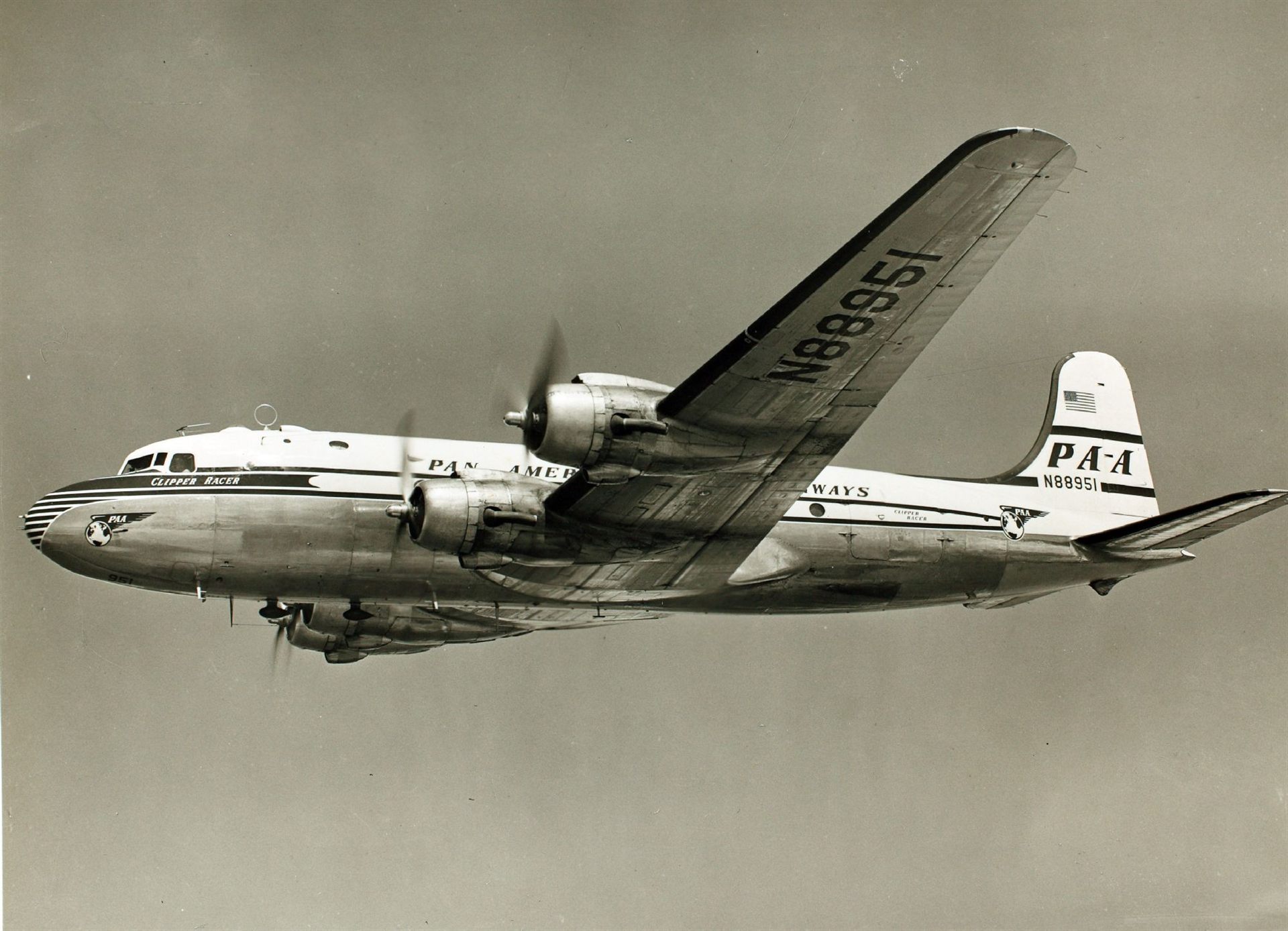
Pictured: a Pan American World Airways Douglas DC-4 of the same type Nash and Fortenberry were flying that night, not the specific aircraft N-number or a photograph of the discs themselves. Neither pilot had a camera in the cockpit, and none of the seven-plus ground witnesses across Hampton Roads is known to have photographed the lights either, so no direct image of the sighting exists; this file uses the aircraft type to illustrate the vantage point from which the crew observed the formation.
Theoretical Alignment
Nash-Fortenberry sits near the strong end of the Extraterrestrial Hypothesis for a purely visual case, for reasons that are specific rather than generic: two independently trained, aircraft-recognition-schooled pilots gave immediate, mutually consistent, professionally documented testimony that survived a rigorous separate USAF interrogation the very next morning, and their account was corroborated — loosely but genuinely — by at least seven other observers scattered across Hampton Roads within the same evening, plus a formally credentialed NASA aerodynamicist two days later a few miles away. That breadth of independent, same-region, same-week corroboration is unusual even among the era's best "classic" cases. At the same time, the Psycho-Social Hypothesis retains real force here, understood narrowly as "an ordinary but startling optical phenomenon misperceived as structured and mechanical": the entire evidentiary record rests on unaided visual perception and after-the-fact dead-reckoning calculation, with zero radar, photographic, or physical trace evidence of any kind, and two independently developed, non-trivial optical explanations — Donald Menzel's refraction theory and Steuart Campbell's Venus-mirage theory — exist precisely because a sky full of ground lights, haze layers, and a very bright planet is also a real, if strained, way to generate exactly this kind of report. Interdimensional framing finds no support in the record at all.
Background
By July 1952, the American "flying saucer" phenomenon was five years old and building toward the most intense summer of sightings the country had yet seen. The U.S. Air Force's investigative office, reorganized that March as Project Blue Book under newly promoted Capt. Edward J. Ruppelt, had inherited a program still finding its footing after the smaller, more dismissive Project Grudge years, and was about to be overwhelmed by a nationwide surge of reports that would peak, spectacularly, in the Washington radar sightings later that same month.
Pan American World Airways' flight crew that evening consisted of Captain F. V. Koepke, First Officer William B. Nash, and Second Officer William H. Fortenberry, flying a Douglas DC-4 on the New York–Miami leg of a longer scheduled run, carrying ten passengers. Capt. Koepke was off the flight deck in the passenger cabin at the moment of the sighting, leaving Nash at the controls in the left seat and Fortenberry beside him in the right, with the autopilot engaged and a position report over a radio range station due in a few minutes. Because it was Fortenberry's first run on this particular course, Nash was in the middle of orienting him to the ground references along the route — he had just pointed out the lights of Newport News and, farther on, Cumberland — when, low against the horizon beyond Newport News, an unexpected red-orange brilliance appeared.
Complete Timeline
| Date | Event |
|---|---|
| January 1948 | Capt. Thomas Mantell dies pursuing an unidentified object over Kentucky, one of the Air Force's first "classic" UFO cases. |
| July 24, 1948 | Eastern Air Lines pilots Clarence Chiles and John Whitted report a wingless, cigar-shaped object near Montgomery, Alabama — the template for a credentialed dual-pilot "classic" case. |
| August 25, 1951 | The Lubbock Lights are observed over Texas: a loose formation of fast-moving lights witnessed by multiple independent parties. |
| March 1952 | The Air Force reorganizes its UFO investigation as Project Blue Book under Capt. Edward J. Ruppelt. |
| July 14, 1952 — ~8:12 PM EST | First Officer William B. Nash and Second Officer William H. Fortenberry, flying Pan American's DC-4 at 8,000 feet over Chesapeake Bay near Newport News, see six glowing red-orange discs approaching in echelon formation. |
| July 14, 1952 — ~8:12 PM | The formation flips on edge, reverses internal order, flattens again, and departs at extreme speed on a sharp course change; two additional discs join from beneath the aircraft before all eight blink out. Total observed duration: approximately 12 seconds. |
| July 14, 1952, that evening | Nash radios Norfolk approach control: "Two pilots of this flight observed eight unidentified objects vicinity Langley Field; estimate speed in excess of 1,000 mph; altitude estimated 2,000 feet." Within roughly 30–45 minutes, at least seven independent ground observers across Hampton Roads report similar red, amber, or white lights maneuvering at high speed. |
| July 14, 1952, later that night | On landing in Miami, Nash and Fortenberry find an operations message appended with the note "Advise crew five jets were in area at the time" — an explanation they immediately reject, since they observed eight objects and were trained to distinguish jet aircraft on sight. |
| July 15, 1952 — 7:00 AM | USAF Wing Intelligence officer Maj. John H. Sharpe and four officers of the 7th District Office of Special Investigations interview Nash and Fortenberry separately for one hour forty-five minutes each, then jointly for thirty minutes, using pre-prepared questions and map overlays. |
| July 16, 1952 | NASA-Langley aerodynamicist Paul R. Hill independently observes two, then four, amber-colored objects performing tight rotational maneuvers near Langley Field, a few miles from the pilots' sighting. |
| July 16, 1952 | The Miami Herald publishes "Miami Pilots Spot 8 Saucers Flying in Formation," breaking the story nationally. |
| July 19–27, 1952 | The Washington, D.C. radar-visual flap unfolds over the same general mid-Atlantic region, becoming the climax of the 1952 wave. |
| October 1952 | Nash and Fortenberry co-author "We Flew Above Flying Saucers" for True magazine, their own detailed first-person account. |
| 1959 | Project Blue Book's own contemporaneous review confirms no conventional aircraft, including the "five jets" explanation floated the night of the sighting, accounts for the report; the case remains filed as Unidentified. |
| 1962–1963 | Harvard astronomer Donald Menzel corresponds directly with Nash and publishes an optical-refraction explanation in The World of Flying Saucers (1963); Nash rebuts it in a published exchange. |
| 1969 | Project Blue Book closes permanently, having logged roughly 12,618 reports; Nash-Fortenberry remains among the small percentage never assigned a conventional explanation. |
| November 8, 1957 | Fortenberry, serving as Second Officer and navigator, is lost when Pan Am Flight 7, the "Clipper Romance of the Skies," disappears over the Pacific Ocean en route to Honolulu; his body is never recovered. |
| 1977 | Nash retires from Pan American World Airways after roughly three decades of commercial flying, including some fifteen years on the Berlin corridor routes. |
| 1990 | Paul R. Hill dies; his manuscript on UFO aerodynamics remains unpublished. |
| 1994 | Researcher Steuart Campbell proposes a mirage of the planet Venus as an alternative explanation in The UFO Mystery Solved. |
| 1995 | Hill's Unconventional Flying Objects: A Scientific Analysis is published posthumously, citing his July 16, 1952 sighting as the origin of his lifelong technical study of the phenomenon. |
| 2002 | An elderly Nash gives a retrospective interview reaffirming his account without change: "We just knew that they were not from this planet." |
| 2020 | Fortenberry's son, Ken Fortenberry, publishes Flight 7 Is Missing: The Search for My Father and discusses both the 1957 crash and the 1952 sighting on the Podcast UFO program. |
| 2020s | Researcher Thomas Tulien of the Sign Historical Group publishes a detailed archival re-analysis, "Revisiting One of the Classics: The Nash/Fortenberry UFO Sighting." |
The Sighting: Twelve Seconds Over Chesapeake Bay
Six Objects in Echelon
Nash had just pointed out the lights of Newport News, and beyond it Cumberland, when a red-orange brilliance appeared low against the horizon. "Almost immediately," Nash later wrote, "we perceived that it consisted of six bright objects streaking toward us at tremendous speed" — each one, in his description, "perhaps twenty times more brilliant than any of the scattered ground lights" beneath them. The objects maintained what both pilots independently described as a narrow echelon formation: a stepped-up line tilted slightly to the right, with the lead object at the lowest point. Their color was, in Nash's words, uniform and specific — "the red-orange color was uniform over the upper surface of each craft" — and their edges were, he insisted, sharply defined: "Their shape was clearly outlined and evidently circular. The edges were well-defined, not phosphorescent or fuzzy in the least." Both men would later emphasize that a decade of naval aircraft-recognition training under brief, timed exposure conditions was exactly the professional background that let them describe the objects with this level of specificity rather than as a vague blur of light.
As the formation closed to within roughly half a mile of the DC-4 and an altitude the pilots placed at about 2,000 feet — slightly more than a mile below their own 8,000-foot cruising altitude — something changed. The lead object appeared to slow abruptly; the five objects trailing it wavered and nearly overran the leader, as though the whole formation had hit an invisible wall. Then, in a maneuver neither pilot had ever seen an aircraft perform, all six objects flipped simultaneously onto their edges, exposing a dark, unlit undersurface roughly fifteen feet thick. While edge-on, the trailing five objects slid past the original leader, reversing the formation's internal order from front to back, before flipping back flat and darting off westward on a sharp course change of roughly 150 degrees — a maneuver Nash could only compare to "a ball ricocheting off a wall."
The Ricochet Maneuver and the Two Latecomers
The objects dimmed perceptibly as they executed the turn, then brightened again as they leveled out on their new heading. Almost immediately, two additional identical discs darted out from behind and beneath the DC-4's right side, joining the original six to briefly reform a complete formation of eight. All eight objects then blinked out entirely, reappeared moments later climbing away in a graceful arc, "oscillated up and down" as they climbed, and finally blinked out for good, vanishing from view. Nash and Fortenberry's best reconstruction placed the entire encounter, from the first appearance of the glow to the final disappearance, at approximately twelve seconds — a figure they arrived at only after landing, when they physically re-enacted the sequence of movements seven separate times using the DC-4's own cockpit stopwatches, timing themselves against the remembered pace of the formation's movements. Their official report to investigators conservatively rounded the duration up to fifteen seconds, but none of the seven re-enactments themselves exceeded twelve. Using the Dalton Mark 7 dead-reckoning computer standard to airline cockpits of the era, and a conservative distance estimate of fifty miles of ground track covered by the objects (their own less conservative estimate ran closer to ninety), the pilots calculated an average speed in the neighborhood of 200 miles per minute — roughly 12,000 miles per hour — for the encounter as a whole. The investigating Air Force officer, Maj. John H. Sharpe, went further in his own written characterization of the sharpest single maneuver, describing it as occurring at "a speed fantastic to contemplate" — a phrase later researchers have calculated corresponds to a rate approaching 27,000 miles per hour if the reported distance and near-instantaneous course reversal are taken at face value.
Neither pilot heard any sound over the DC-4's own engine noise, and the aircraft experienced no turbulence, buffeting, or systems disturbance of any kind as the objects passed roughly a mile below and to the side. Nash immediately radioed Norfolk approach control with a preliminary report: "Two pilots of this flight observed eight unidentified objects vicinity Langley Field; estimate speed in excess of 1,000 mph; altitude estimated 2,000 feet." When the DC-4 landed in Miami later that night, the crew found their transmission had been appended, apparently by ground personnel, with the note: "Advise crew five jets were in area at the time." Nash and Fortenberry rejected the explanation outright — they had counted eight objects, not five, and both men's wartime training made them confident they could distinguish a formation of jet aircraft from what they had just watched.
Ground Witness Corroboration
What sets Nash-Fortenberry apart from many single-aircraft sightings of the era is the density of independent corroboration that surfaced from the ground within the same evening. When Air Force investigators sat down with the two pilots the following morning, they told Nash and Fortenberry they had already logged seven additional reports of similar objects from persons in the same area within roughly thirty minutes of the pilots' own sighting. A witness in the Stockley Gardens neighborhood of Norfolk described "seven or eight altogether," noting that "the first three [were] white and the others were yellow and red," and reported watching them circle overhead before heading north. An unnamed Navy Lieutenant Commander and his wife separately reported a formation of red discs traveling at high speed and executing immediate directional changes with no discernible turning radius — language that closely echoes the pilots' own description of the edge-flip maneuver. A naval officer aboard the cruiser USS Roanoke, in a letter later published in the Norfolk Virginian-Pilot, reported eight red lights near Old Point Comfort that moved in a straight line and then vanished at approximately 8:55 PM — roughly forty minutes after the pilots' own sighting, but squarely within the same evening's cluster of reports across Hampton Roads.
The most professionally significant corroboration came two days later and a few miles away. On July 16, Paul R. Hill, a NASA-Langley aerodynamicist with more than a decade of aeronautical research experience at that point, watched two amber-colored objects approach from the south, turn west directly overhead, and begin to "revolve around a common center" before switching to vertical-plane maneuvers; after a few revolutions, two more nearly identical objects joined the original pair. Hill, a trained engineer with no prior interest in UFOs, found the experience professionally unsettling enough that he spent much of the rest of his NASA career quietly collecting and analyzing sighting reports for their physical, aerodynamic, and propulsion implications. He later distilled the experience in a single, frequently quoted line: "There is a lot of truth in the old saying, 'It's different when it happens to you.'" His posthumously published 1995 book, Unconventional Flying Objects: A Scientific Analysis, argued at length that reported UFO behavior, however extraordinary, appeared to "obey, not defy, the laws of physics" — a technical, non-mystical framing that grew directly out of his July 16 sighting near the site of the pilots' own encounter.
The Air Force Investigation
Project Blue Book, only four months into its post-Grudge reorganization under Capt. Edward J. Ruppelt, was by mid-July 1952 receiving roughly twenty new reports a day with a permanent staff of only nine analysts — a crush of casework that would, across the full year, produce the highest annual sighting total (over 700) and, by some contemporaneous estimates, an unidentified rate approaching forty percent for reports filed that month. Despite that overload, the Nash-Fortenberry case received unusually prompt and thorough attention. At 7:00 AM the following morning, USAF Wing Intelligence officer Maj. John H. Sharpe and four officers from the 7th District Office of Special Investigations interviewed Nash and Fortenberry separately for one hour and forty-five minutes each, then jointly for a further thirty minutes, using pre-prepared questions and map overlays specifically designed to test the consistency of their independent recollections. Investigators were, in the pilots' own later description, "skilled and thorough." The official Weather Bureau report the investigators obtained — 3/8 cirrus clouds at 20,000 feet, no inversion, unusually good visibility — matched the pilots' own description of the conditions and, crucially, offered no support for the temperature-inversion mechanism Donald Menzel would later need for his optical explanation.
Blue Book quickly and explicitly ruled out the "five jets" explanation appended to the pilots' own radio message, after checking against known Langley-based flight activity and finding no aircraft movement that matched the reported position, count, or behavior. The case was filed as Unidentified. Major Dewey Fournet, the Air Force officer who would go on to serve as Blue Book's own Pentagon liaison during the Washington flap five days later, is on record in multiple secondary accounts characterizing the Nash-Fortenberry report as one of the most detailed and reliable the Air Force had received to that point — a notable assessment from an officer whose later Washington-case work made him, if anything, a cautious evaluator of anomalous testimony rather than an enthusiast. Blue Book's formal classification of the case has never been revised in the seven decades since.
Circumstantial Evidence
- Two independently interviewed, aircraft-recognition-trained commercial pilots with roughly two combined decades of flight and naval aviation experience gave immediate, consistent testimony that survived a rigorous, separately-conducted USAF interrogation the very next morning.
- At least seven independent ground observers across Hampton Roads, Virginia — including a naval officer, a Lieutenant Commander and his wife, and a civilian in the Stockley Gardens neighborhood — reported red or amber lights performing sharp, high-speed directional changes within roughly thirty to forty-five minutes of the pilots' sighting.
- A formally trained NASA aerodynamicist, Paul R. Hill, independently witnessed a similar maneuvering light formation two days later and a few miles away, an event serious enough to reorient a significant portion of his subsequent NASA career.
- Air Force investigators explicitly checked and ruled out the only conventional explanation offered internally — five jets reportedly in the area — after reviewing Langley-based flight activity.
- Major Dewey Fournet, who later served as Blue Book's own Pentagon liaison during the Washington flap, is on record describing the case as one of the most detailed and reliable the Air Force received.
- The case has remained formally classified Unidentified in Air Force files for more than seven decades without revision, despite two independently developed skeptical re-analyses in the decades since.
- Nash's own published correspondence with Donald Menzel directly and specifically rebutted each of Menzel's sequential explanations, a documented technical exchange rather than a one-sided dismissal.
Donald Menzel's Optical Explanations and Their Critics
No skeptic engaged with Nash-Fortenberry more directly, or for longer, than Harvard College Observatory director Donald Menzel, who corresponded personally with Nash and ultimately published his analysis in the 1963 book The World of Flying Saucers: A Scientific Examination of a Major Myth of the Space Age. Menzel's explanation evolved considerably across that correspondence. He first proposed the sighting might be a reflection inside the DC-4's own cockpit windows — an explanation Nash rejected on straightforward geometric grounds, pointing out that the objects were observed to the west of the aircraft, between the plane and the setting light of dusk, and that they appeared sequentially through three physically distinct cockpit windows (the front windshield, the curved side panel, and the right window) as the pilots' relative position to the formation changed, something a single internal reflection source could not plausibly reproduce. Menzel next suggested the light might have come from inside the cabin — a hostess's lit cigarette was one specific hypothesis he floated — which Nash dismissed just as directly: no flight attendants were on the flight deck, neither pilot was smoking, the cockpit door was closed, and the formation's edge-flip reversal was observed through the right-side window at a position below the aircraft's own level, inconsistent with any interior light source. Menzel himself conceded both of these early explanations were unlikely.
His final and most fully developed theory proposed that a distant searchlight, or a bright ground light source, shining through a series of hazy atmospheric layers created by an undetected temperature inversion, could produce exactly the visual effect described: "a sharply focused searchlight, shining at night through a series of such hazy layers, will show up as a series of discs. As the searchlight moves, the discs will appear to spread out, exhibit perspective" and, as the light source turned, seem to "ricochet." The explanation required Menzel to construct a hypothetical inversion layer despite the Weather Bureau's own contemporaneous report showing none present that night — a gap researcher Thomas Tulien and others have flagged as the theory's single biggest evidentiary problem. Physicist James E. McDonald, the University of Arizona atmospheric scientist who separately challenged the Air Force's temperature-inversion explanation for the 1952 Washington radar sightings, reviewed the Nash-Fortenberry case in his own written notes and dismissed Menzel's mechanism as "an almost entirely ad hoc assumption" that failed to account for the objects' specific amber-red coloration, their sharply defined edges, or their final climbing departure. McDonald concluded that "rapid motion, abrupt course-reversal, and the change from negative to positive angles of elevation…seem to preclude any meteorological-optical explanation," and separately ruled out ball lightning, meteors, and balloons as candidates.
Several further objections to Menzel's refraction theory recur across the case's re-analysis literature. The formation's own described geometry — an echelon with the leader at the lowest point — implies any light source would have to sit behind the aircraft rather than ahead of it, contrary to what Menzel's coastal-searchlight model required. A genuine searchlight reflecting off a horizontal haze layer at an oblique angle would be expected to produce a gradual, continuous elongation of the disc image as the geometry shifted, not the sudden, synchronized edge-on flip and formation-order reversal both pilots described. The theory offers no mechanism at all for the two additional discs that emerged from beneath and behind the aircraft to rejoin the formation. And the apparent speeds calculated for the sharpest phase of the maneuver — which Maj. Sharpe himself, the investigating Air Force officer, called "fantastic to contemplate" — sit uncomfortably with an explanation built entirely from a stationary or slowly panning light source. Nash's own closing rebuttal to Menzel, preserved in their published exchange, challenged the skeptic's underlying assumption of an excitable, unreliable witness directly: "That is why there is no evidence that the pilots considered that what they saw was a reflection…Again, Doctor, pilots do not excite easily."
A second, later and independent skeptical explanation came from Scottish researcher Steuart Campbell, whose 1994 book The UFO Mystery Solved argued that a wide range of "inexplicable" UFO reports, including Nash-Fortenberry, could be explained as atmospheric mirages of bright celestial objects. Campbell proposed the pilots had seen a mirage of the planet Venus. The theory faces an immediate structural problem that neither Campbell's book nor its reviewers have fully resolved: Venus is a single, fixed point of light, and a mirage of a single object — however distorted by atmospheric layering — offers no obvious mechanism for producing six, then eight, independently maneuvering discs that pass each other in formation, reverse their own internal order while edge-on, and then split into two groups that rejoin from different directions. Where Menzel's theory at least attempted, however unsuccessfully, to account for the formation's specific choreography, Campbell's mirage explanation largely does not engage with it at all.
Key Researchers
- Dewey Fournet — USAF officer who, per multiple secondary accounts, characterized Nash-Fortenberry as one of the most detailed and reliable reports Blue Book received; later served as the program's Pentagon liaison during the 1952 Washington flap.
- Donald H. Menzel (1901–1976) — Harvard astronomer who corresponded directly with Nash and developed the case's most fully worked-out optical-refraction explanation in his 1963 book The World of Flying Saucers.
- James E. McDonald (1920–1971) — Atmospheric physicist who reviewed and rejected Menzel's explanation as inadequate to the reported maneuvers, in comments preserved by NICAP.
- Steuart Campbell (b. 1937) — Scottish researcher and mirage specialist who proposed a Venus-mirage explanation in his 1994 book The UFO Mystery Solved.
- Paul R. Hill (1909–1990) — NASA-Langley aerodynamicist whose own July 16, 1952 sighting near the same location led to a career-spanning technical study of UAP propulsion physics.
- Thomas Tulien — Contemporary researcher with the Sign Historical Group whose detailed archival re-analysis, drawing on the declassified Blue Book microfilm, remains the single most thorough modern treatment of the case.
Legacy and Cultural Impact
Nash and Fortenberry's decision to write their own account for True magazine that October — "We Flew Above Flying Saucers," published under their actual names and ranks — put the case in front of a mass national readership at the height of the 1952 wave, only weeks after the Washington flap had made UFOs a genuine front-page story across the country. Unlike many contemporaneous reports, the case's central witnesses were willing, articulate, and professionally credentialed enough to engage publicly and in detail with the leading skeptical explanation of their day, producing a rare documented back-and-forth between a witness and a scientist rather than a one-sided dismissal on one side or an unchallenged claim on the other. That exchange, preserved in the Blue Book microfilm and later republished by researchers, is one of the reasons the case remains a frequently cited "best evidence" file in NICAP, CUFOS, and independent ufological literature into the 2020s.
The case acquired a second, more somber layer of legacy in 1957, when Fortenberry was lost aboard Pan Am Flight 7, the "Clipper Romance of the Skies," a Boeing 377 Stratocruiser that disappeared over the Pacific Ocean en route to Honolulu with the loss of all forty-four aboard; the wreck was never conclusively recovered and the cause was never officially determined. Fortenberry's son, Ken Fortenberry, who was six years old at the time, spent much of his adult life investigating his father's death, culminating in the 2020 book Flight 7 Is Missing: The Search for My Father and a lengthy discussion of both the 1957 crash and the 1952 UFO sighting on the Podcast UFO program that June — work that has kept the elder Fortenberry's name, and the case that first brought it to public attention, in circulation for a new generation of researchers.
Key Witnesses
First Officer William B. Nash
William B. Nash flew patrol bombers for the Naval Air Transport Service during World War II, searching the African and South American coastlines for German submarines, and underwent intensive naval aircraft-recognition training. Occupying the left seat and orienting a new co-pilot to the route's landmarks at the exact moment of the sighting, Nash spotted the initial glow, coordinated the pilots' post-event dead-reckoning speed calculations, gave a detailed formal statement to Air Force investigators the next morning, co-authored the pilots' own account for True magazine that October, and personally rebutted Donald Menzel's optical explanations in a published exchange — never materially altering his account through a 2002 retrospective interview, decades after retiring from Pan Am in 1977.
Second Officer William H. Fortenberry
William H. Fortenberry brought two years of experience in the U.S. Navy's air experimental wing to the flight deck. Flying this particular route for the first time, he independently confirmed Nash's sighting from the right seat and gave his own separate statement to Air Force investigators, which was consistent with Nash's account on the objects' size, color, formation, and maneuvers. Fortenberry was lost five years later, on November 8, 1957, when Pan Am Flight 7 disappeared over the Pacific Ocean; his body was never recovered.
Capt. F. V. Koepke
Capt. F. V. Koepke held overall command of the flight but was in the passenger cabin, off the flight deck, at the moment of the sighting, and did not personally witness the objects. The original Air Force intelligence cable reporting the incident identified the flight by his name as the aircraft commander of record, even though Nash and Fortenberry were the actual eyewitnesses at the controls.
Paul R. Hill
Paul R. Hill (1909–1990), a Berkeley-trained mechanical engineer who had worked for NACA and its successor NASA since 1939, independently witnessed maneuvering amber-colored objects near Langley Field on July 16, 1952, two days after and a few miles from the pilots' encounter. A trained aerodynamicist with no prior UFO interest, Hill spent much of the next quarter-century quietly analyzing sighting reports for their physical and propulsion implications, culminating in his posthumously published 1995 book Unconventional Flying Objects: A Scientific Analysis.
The Five Observables Assessment
The Five Observables framework, developed by former AATIP director Luis Elizondo, is used to classify UAP encounters by performance characteristics exceeding known technology of their era:
Assessment: The pilots' described near-instantaneous 150-degree course reversal, executed without any visible turning radius and characterized by the Air Force's own investigating officer as "fantastic to contemplate," is rated speculative for both Instant Acceleration and Hypersonic velocity rather than present, because the entire calculation rests on the pilots' own post-event distance and timing estimates rather than any independent instrumented measurement — and because a genuinely viable rival explanation (an optical effect rather than a moving physical object) would mean no real acceleration occurred at all. Anti-Gravity Lift is similarly speculative: the edge-flip-and-reverse maneuver strongly suggests powered, controlled flight, but no propulsion mechanism, exhaust, or visible means of lift was ever reported by any witness. Low Observability is rated absent — the objects were, by every account, intensely bright and conspicuous, drawing the pilots' attention from a considerable distance — and Trans-Medium travel is rated absent, since no transition between air, water, or space was ever reported.
Evidence Assessment
Supporting Anomalous Origin
- Two independently trained, aircraft-recognition-schooled commercial pilots gave immediate, mutually consistent, professionally detailed testimony that survived a rigorous separate USAF interrogation the very next morning without contradiction.
- At least seven additional, geographically clustered ground-witness reports surfaced from the same thirty-to-forty-five-minute window across Hampton Roads, independently describing red or amber disc-like objects performing fast, sharp-maneuvering flight.
- A trained NASA aerodynamicist, Paul R. Hill, independently witnessed similar maneuvering lighted objects two days later and a few miles away — an event serious enough to redirect a significant part of his subsequent career.
- USAF investigators quickly and explicitly ruled out the only conventional candidate offered internally (five Langley-based jets) after checking flight logs.
- Blue Book's own Pentagon-connected liaison, Maj. Dewey Fournet, is on record characterizing the case as one of the most detailed and reliable it received.
- The case has remained formally classified Unidentified in Air Force files for over seven decades without revision.
Supporting Conventional Explanation
- No radar, photographic, or physical trace evidence exists — the entire case rests on unaided visual perception and after-the-fact dead-reckoning calculations, not real-time instrumentation.
- Donald Menzel's optical-refraction theory, while heavily contested, offers a mechanism (searchlight or ground-light reflection through hypothetical haze layers) that would require no physical craft at all.
- Steuart Campbell's independent 1994 analysis reached a broadly similar "no physical object" conclusion via an entirely different optical mechanism — a mirage of the planet Venus.
- The calculated speeds (12,000–27,000 mph) derive entirely from the pilots' own post-event distance and time estimates, without any independent instrumented cross-check.
- Ground-witness accounts vary in color and count — some describing three white lights and others yellow and red, versus the pilots' uniform red-orange for six then eight — a level of variation conventional-explanation researchers argue is more typical of independently misperceived light sources than one well-defined physical formation.
Why "Credible"
Nash-Fortenberry earns a CREDIBLE rather than "Verified" or "Disputed" classification because its evidentiary record is unusually broad and internally consistent for a purely visual case, even though it never crosses into hard, instrumented proof. What is not seriously disputed: two independently trained, credentialed commercial pilots reported a detailed, structured formation of objects performing a specific, repeatable maneuver sequence, gave immediate and mutually consistent statements under separate rigorous USAF interrogation, and never wavered from that account for the rest of their lives. What elevates this case above a typical single-aircraft sighting is the density of independent corroboration — at least seven separate ground observations within the same evening across Hampton Roads, plus a professionally credentialed NASA aerodynamicist's own independent sighting two days later a few miles away — combined with the Air Force's own internal characterization of the report as unusually detailed and reliable, and its enduring, unrevised Unidentified classification. What keeps the case from "Verified" is equally real: there is no radar, photographic, or physical evidence of any kind, every quantitative claim about speed and distance derives from the pilots' own post-event estimation rather than measurement, and two independently developed, technically serious optical explanations — Donald Menzel's refraction theory and Steuart Campbell's Venus-mirage theory — exist precisely because unaided visual perception of bright lights against a dark sky is a genuinely difficult category of evidence to fully close the book on, however strong the individual witnesses. That combination — strong, broadly corroborated testimony from credentialed observers, an unresolved official file, and real but ultimately unproven skeptical alternatives — is the textbook profile of "credible" on this site's rating scale.
Sensor & Instrumentation Detection Profile
This is, like most of the "classic" 1952 cases, a pre-instrumentation, unaided-eyewitness case. The DC-4's only onboard sensor was the human eye: First Officer Nash, occupying the left pilot's seat, spotted the initial red-orange glow and was orienting newly assigned Second Officer Fortenberry — flying this particular route for the first time — to the landmark lights of Newport News and Cumberland when the objects appeared. No airborne or ground radar coverage of the encounter itself has ever surfaced in the declassified Blue Book file, in sharp contrast to the multi-site radar tracking that would define the Washington, D.C. flap just five days later. What the pilots did have was methodology: after the objects vanished, Nash and Fortenberry used the DC-4's Dalton Mark 7 dead-reckoning flight computer and their panel stopwatches to physically re-enact the observed sequence seven separate times, cross-checking their timing against known landmark distances along the Chesapeake shoreline to derive a conservative estimate of the objects' speed and the encounter's duration — a disciplined, if entirely post-hoc, substitute for instrumentation that the investigating Air Force officers explicitly credited as more rigorous than a typical civilian report.
Environmental & Geospatial Context
The official Weather Bureau report for the evening, cited directly in the Air Force's own investigation, recorded 3/8 cirrus cloud cover at 20,000 feet, no inversion, and "unusually good" visibility under a clear, moonless summer sky — conditions that matter directly to this case's central dispute, since Donald Menzel's later explanation required inventing an undetected temperature inversion the Weather Bureau's own contemporaneous data does not support. Geospatially, the DC-4 was cruising at 8,000 feet on autopilot on the New York–Miami leg of a longer Pan American run, minutes from a scheduled position report over a radio range station, directly above the mouth of the Chesapeake Bay near Newport News and Norfolk, Virginia — airspace immediately adjacent to Langley Field (now Joint Base Langley-Eustis), then home to Air Force fighter-interceptor squadrons and, within the same week, the independent sighting of NASA-Langley aerodynamicist Paul R. Hill. The proximity to a militarily sensitive airfield is precisely why the Air Force's Office of Special Investigations treated the report with unusual urgency the following morning.
Observer Credibility & Occupational Profile
The primary witness pool is small but exceptionally well credentialed for a purely visual 1952-era sighting. Nash had flown patrol bombers for the Naval Air Transport Service during World War II, searching for German submarines along the African and South American coastlines, and had received intensive naval aircraft-recognition training of the kind that demanded identifying silhouettes from brief timed exposures — training he later invoked directly in his own defense: "In the exams, we had to draw their silhouettes." By 1952 he had logged roughly a decade of commercial flying, and he would go on to fly Pan Am's politically sensitive Berlin corridor routes through Cold War East German airspace for some fifteen years before retiring in 1977. Fortenberry brought two years of experience in the U.S. Navy's air experimental wing and a working familiarity with cutting-edge aeronautical developments of the day, though July 14 was his first run on this particular route, meaning Nash was actively briefing him on ground references at the exact moment of the sighting — a detail that, if anything, argues against simple misidentification of a familiar light source, since Nash was deliberately pointing out known landmarks only seconds before. Independent corroboration came from a geographically and professionally distinct source entirely: Paul R. Hill, a formally trained aerodynamicist with a mechanical engineering degree from Berkeley who had worked at NASA's predecessor, NACA, since 1939, watched a similar maneuvering light formation from the ground on July 16 and found the experience credible enough to redirect a significant portion of the rest of his career toward analyzing the phenomenon.
Physical & Material Assays
No physical debris, trace residue, photograph, or recovered material of any kind is associated with this case, and none has ever been claimed. The entire documentary record is testimonial and procedural: the pilots' independent formal statements to Air Force investigators, their in-flight radio report to Norfolk approach control, the Dalton Mark 7 dead-reckoning calculations performed after the encounter, the multi-page USAF Office of Special Investigations report, and Nash and Fortenberry's own first-person account published in True magazine that October. Those documents, preserved in the declassified Project Blue Book microfilm collection at the National Archives, function as the case's only tangible exhibits — there is no sketch controversy of the kind that complicates the Chiles-Whitted case, since Nash and Fortenberry's independent and joint interviews produced a consistent physical description rather than divergent drawings.
Historical Precedents & Archive Matches
Nash-Fortenberry arrived in the middle of the single most intense UFO wave the United States had yet experienced, four years after the Chiles-Whitted sighting established the template for a credentialed dual-pilot "classic" case, and just five days before the far more famous Washington, D.C. radar-visual flap erupted over the same general region of the mid-Atlantic seaboard. Project Blue Book, newly reorganized under Capt. Edward J. Ruppelt that March, was by mid-July fielding roughly twenty new reports a day with a staff of only nine analysts, and would go on to log more than 700 reports for 1952 alone — the highest annual total of the program's entire twenty-two-year run. The case's echelon-formation morphology also echoes the loose "V" formation of lights reported the previous August over Lubbock, Texas, part of a broader pattern of formation-flying light reports that ran through the early 1950s wave.
Material Analysis
Nash-Fortenberry produced no physical debris, no trace residue, and no recoverable artifact of any kind, and no credible source has ever claimed otherwise. The entirety of the case's documentary record consists of testimony — the pilots' formal Air Force statements, their in-flight radio report, and their own published magazine account — together with the Dalton Mark 7 dead-reckoning calculations they performed after landing. Those calculations function, in effect, as the case's only quantitative exhibit, and their value cuts both ways: they demonstrate the pilots applied a genuine, methodical technique to their estimate rather than simply guessing, but because the underlying inputs (distance and duration) were themselves derived from memory and re-enactment rather than instrumented measurement, the resulting speed figures — 12,000 to as high as 27,000 miles per hour — carry a wide, unquantified margin of error that neither supports nor refutes an exotic origin on its own.
Supporting an Anomalous Physical Object
- Both pilots agreed independently on the objects' size (~100 ft diameter), thickness (~15 ft), uniform red-orange coloration, and specific maneuver sequence, with no divergence of the kind that complicates some contemporaneous "classic" cases.
- Investigators found no conventional aircraft, including the "five jets" explanation floated the same night, that could account for the report after a genuine, documented check of Langley-based flight activity.
- At least seven independent ground witnesses across Hampton Roads reported broadly similar red or amber maneuvering lights within roughly thirty to forty-five minutes of the pilots' own sighting.
Supporting a Non-Physical/Optical Origin
- No debris, radar return, photograph, or any other physical trace consistent with a solid formation of craft passing within roughly a mile of an airliner was ever recovered or recorded.
- Two independent skeptical researchers, working decades apart and using different mechanisms (searchlight refraction and planetary mirage), each concluded the sighting required no physical object at all.
- Ground-witness accounts vary somewhat in color and count from the pilots' own description, a pattern optical-explanation researchers argue is more consistent with independently misperceived light sources than one coherent formation.
The Conventional Explanation Candidate: Optical Refraction of Ground Lights
The most fully developed conventional explanation, offered by Harvard astronomer Donald Menzel after years of direct correspondence with Nash, holds that the pilots saw a bright ground or coastal light source refracted through layered atmospheric haze created by an undetected temperature inversion — a mechanism Menzel argued could produce a "series of discs" that "spread out, exhibit perspective," and appear to "ricochet" as the light source's geometry shifted relative to the aircraft. It deserves serious evaluation because Menzel was a genuinely credentialed astrophysicist who engaged with the specific witness testimony over an extended, documented correspondence rather than dismissing it from a distance, and because optical refraction through haze layers is a real, physically established phenomenon capable of producing multiplied, distorted images of a single light source under the right conditions.
Where the Refraction Theory Falls Short
Its central weakness is evidentiary: the Weather Bureau's own contemporaneous report for the night recorded no temperature inversion, forcing Menzel to hypothesize an undetected one specifically to make his mechanism work. The formation's reported geometry — an echelon with the leader at the lowest point — implies a light source positioned behind the aircraft, which does not match the coastal-searchlight model Menzel proposed. Physicist James E. McDonald's independent review concluded the theory could not account for the objects' specific coloration, sharply defined edges, or the synchronized edge-flip and formation-order reversal, and that "rapid motion, abrupt course-reversal, and the change from negative to positive angles of elevation…seem to preclude any meteorological-optical explanation." The theory also offers no mechanism at all for the two additional discs that joined the formation from beneath and behind the aircraft.
Mirage of the Planet Venus
A second candidate, proposed independently by researcher Steuart Campbell in his 1994 book The UFO Mystery Solved, holds that the pilots saw an atmospheric mirage of the planet Venus. This candidate is comparatively weak on structural grounds: Venus is a single fixed point of light, and Campbell's own broader mirage framework, while it has been applied with some success to other single-light UFO reports, offers no clear mechanism for a single celestial body's mirage to appear as six, then eight, independently maneuvering discs that reverse their own internal formation order while edge-on and then split into groups approaching from different directions.
Conventional Military Aircraft
A third candidate, the explanation floated by ground personnel the same night the pilots landed in Miami, held that five jet aircraft in the area accounted for the sighting. This candidate was checked and explicitly rejected by Blue Book's own investigators after a review of Langley-based flight activity turned up no aircraft matching the reported count, position, or maneuver profile, and both pilots — trained in wartime aircraft recognition specifically to distinguish exactly this kind of misidentification — independently and immediately rejected it as well.
Optical Refraction of Ground Lights
InconclusiveA real, credentialed explanation whose central mechanism requires an atmospheric condition the contemporaneous weather record does not support, and which does not account for the formation's specific choreography.
Mirage of Venus
ImplausibleA single-point light source cannot straightforwardly account for multiple independently maneuvering discs.
Conventional Military Aircraft
ImplausibleExplicitly checked and ruled out by Blue Book's own contemporaneous investigation.
Related Cases
Confirmed Documents & Official Records
National Archives finding aid for the roughly 130,000 pages of Project Sign, Project Grudge, and Project Blue Book case files, the primary repository for the original Nash-Fortenberry case documentation (Record Group 341).
UNCLASSIFIED (declassified)Finding aid for Project Blue Book's 94 rolls of microfilm (T-1206) and related UAP textual holdings, including the six-page 1952 USAF Report of Investigation into the Nash-Fortenberry sighting.
UNCLASSIFIEDCIA Center for the Study of Intelligence historical study documenting the Agency's later involvement in evaluating Air Force UFO investigations, situating the summer 1952 wave — including this case — within the broader institutional timeline.
UNCLASSIFIED (declassified)Search Government Archives Directly
Further Reading — Recommended Literature
The Report on Unidentified Flying Objects
The first serious insider account of official U.S. UFO investigation, written by the Project Blue Book chief whose office fielded and filed the Nash-Fortenberry report during the record-setting 1952 wave.
Unconventional Flying Objects: A Scientific Analysis
Written by the NASA-Langley aerodynamicist whose own July 16, 1952 sighting near the pilots' encounter launched a quarter-century technical study arguing UFOs "obey, not defy, the laws of physics."
The UFO Encyclopedia, 4th Edition
The definitive UFO reference work, with an extensively cited entry on Nash-Fortenberry situating it within the broader 1952 wave and the Menzel-Nash correspondence.
Project Blue Book Exposed
A detailed case-by-case review of Blue Book's most significant files by a veteran researcher, useful for placing this case's investigation and classification within the program's broader institutional record.
Watch the Skies!: A Chronicle of the Flying Saucer Myth
A rigorously skeptical, well-documented history of American UFO cases and the record-setting 1952 wave, useful as a counterweight to more credulous treatments of Nash-Fortenberry.
Essential Viewing

06-16-20 Ken Fortenberry, The 1957 Nash-Fortenberry UFO Sighting
Podcast UFO's Martin Willis interviews William Fortenberry's son Ken about the 1952 sighting and his father's 1957 loss aboard Pan Am Flight 7.
The Nash-Fortenberry Sighting
A focused breakdown of the July 14, 1952 encounter, the pilots' testimony, and the Air Force investigation.
Nash-Fortenberry UFO sighting
A summary overview of the case for viewers encountering it for the first time.
Sources
- "Nash-Fortenberry UFO sighting," Wikipedia (comprehensive summary with citations to primary and secondary sources). en.wikipedia.org
- Tulien, Thomas. "Revisiting One of the Classics: The Nash/Fortenberry UFO Sighting, 14 July 1952," Sign Historical Group / Project 1947. project1947.com
- Tulien, Thomas. "Revisiting One of the Classics" (NICAP mirror). nicap.org
- NICAP. "UFO Report" — directory of primary Nash-Fortenberry documents and reports. nicap.org
- McDonald, James E. "Comments on Case #8" (Nash-Fortenberry analysis). nicap.org
- NICAP. "OSI Document Found — Errors in Document Corrected" (Fran Ridge/Jan Aldrich, original Air Force cable text). nicap.org
- NICAP. "NARA-PBB90-529-540" (Fran Ridge, declassified Blue Book microfilm pages). nicap.org
- NICAP. "MAXW-PBB12-168-241" (Dan Wilson, declassified Blue Book microfilm pages including Menzel-Nash correspondence). nicap.org
- UFO Casebook. "The 1952 Nash-Fortenberry Sighting." ufocasebook.com
- Gross, Patrick. "UFOs at close sight: formation of discs below airliner, Nash and Fortenberry sighting, USA, 1952." ufologie.patrickgross.org
- The UFO Database. "The Miami Herald: 'Miami Pilots Spot 8 Saucers Flying in Formation,' July 16, 1952." theufodatabase.com
- Saturday Night Uforia. "The Pilots' Tale" (newspaper accounts, Air Force reports, Menzel correspondence, and Nash's rebuttal). saturdaynightuforia.com
- Nash, William B., and William H. Fortenberry. "We Flew Above Flying Saucers," True magazine, October 1952 (Project 1947 reprint). project1947.com
- UFOAC. "Inconvenient Questions of the Blue Book — Nash-Fortenberry UFO Sighting." ufoac.com
- "Paul R. Hill," Wikipedia. en.wikipedia.org
- "Pan Am Flight 7," Wikipedia (William H. Fortenberry's 1957 loss). en.wikipedia.org
- "Ken Fortenberry," Wikipedia. en.wikipedia.org
- "Steuart Campbell," Wikipedia. en.wikipedia.org
- Podcast UFO. Episode 408, "Ken Fortenberry" (June 2020; discusses the 1952 sighting and the 1957 Flight 7 crash). podcasts.apple.com
- Wikimedia Commons. "Douglas DC-4 Pan Am.jpg" (hero image source, public domain, San Diego Air & Space Museum Archive). commons.wikimedia.org
- National Archives and Records Administration. "Project Blue Book Records Research Guide." archives.gov
- National Archives and Records Administration. "UAP Textual and Microfilm Records Research Guide." archives.gov
- Haines, Gerald K. "CIA's Role in the Study of UFOs, 1947–90," Studies in Intelligence, Semi-Annual Edition No. 1, 1997. cia.gov
- Ruppelt, Edward J. The Report on Unidentified Flying Objects, Doubleday, 1956 (multiple later editions).
- Menzel, Donald H., and Lyle G. Boyd. The World of Flying Saucers: A Scientific Examination of a Major Myth of the Space Age, Doubleday, 1963.
- Campbell, Steuart. The UFO Mystery Solved, Explicit Books, 1994.
- Hill, Paul R. Unconventional Flying Objects: A Scientific Analysis, Hampton Roads Publishing, 1995.
- Clark, Jerome. The UFO Encyclopedia, 4th Edition, Visible Ink Press, 2023.
- Peebles, Curtis. Watch the Skies!: A Chronicle of the Flying Saucer Myth, Smithsonian Institution Press, 1994.
See something inaccurate? Have additional information or sources?
Suggest an Edit →Last Updated: August 2026