
The Chiles-Whitted Sighting
Just before 3:00 AM on July 24, 1948, Eastern Air Lines Captain Clarence S. Chiles and First Officer John B. Whitted were flying a Douglas DC-3 southwest of Montgomery, Alabama, when a wingless, cigar-shaped object with two glowing rows of windows and a trailing blue-orange exhaust flame closed on their aircraft, banked away at the last instant, and vanished into a cloud bank in a burst of flame. It remains one of the three cases — alongside the Mantell crash and the Gorman dogfight — that Air Force investigator Edward J. Ruppelt later identified as the "classics" that convinced Project Sign's own staff the phenomenon deserved serious study, and it directly fed the classified "Estimate of the Situation" that argued, however briefly, for an extraterrestrial explanation before Air Force Chief of Staff Hoyt S. Vandenberg rejected it. Astronomer J. Allen Hynek and Harvard's Donald Menzel later concluded the pilots had seen an unusually bright fireball meteor during a period of heightened meteor activity, and the Air Force formally adopted that explanation in 1959 — yet physicist James E. McDonald, after personally re-interviewing both pilots in the 1960s, remained convinced they had not. Seventy-plus years on, the case sits exactly where that unresolved dispute left it: a well-documented, professionally credentialed sighting with a genuinely plausible conventional explanation that has never fully closed the file.
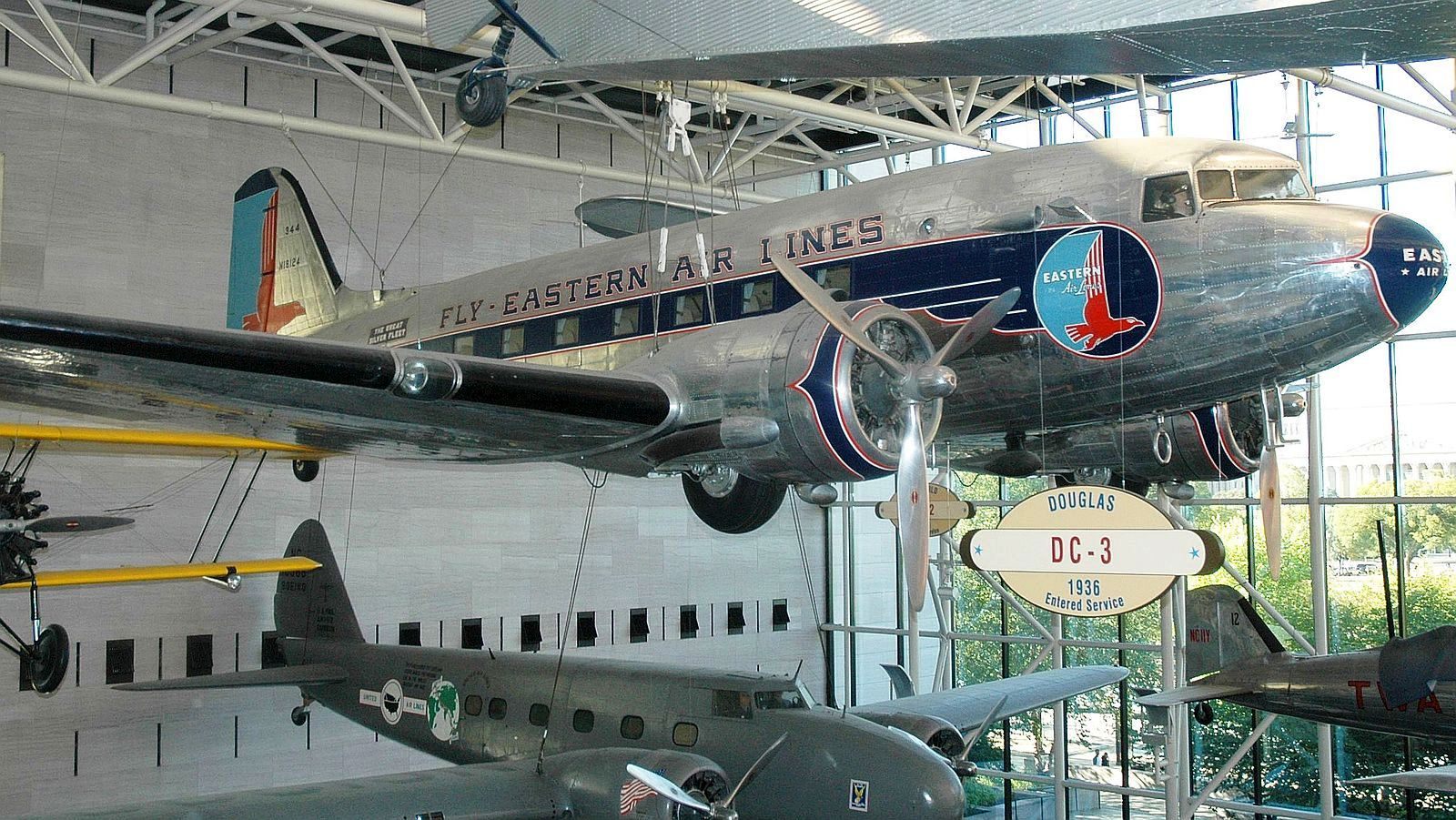
Pictured: a preserved Eastern Air Lines Douglas DC-3 on museum display — the same airline and aircraft type Capt. Clarence Chiles and First Officer John Whitted were flying on the night of July 24, 1948, but not the actual airframe involved in the sighting near Montgomery, Alabama. No photograph of that specific DC-3 in service, nor of the cigar-shaped object the crew reported passing them, is known to survive from the period.
Theoretical Alignment
Chiles-Whitted is a difficult case to align cleanly because its strongest evidence — two trained pilots' detailed, structured description of a windowed, flame-trailing craft — is also the exact kind of testimony a startling nighttime fireball is documented to produce. The Extraterrestrial Hypothesis draws real support from the pilots' consistency over decades and their professional flight experience, but is capped by the fact that neither man's account survived close comparison with the other's: Chiles and Whitted differed sharply on the object's distance (roughly 700 feet versus 2,500 feet) and on basic structural details in their independently drawn sketches. The Psycho-Social Hypothesis, understood here narrowly as "an ordinary but startling natural phenomenon misperceived as structured and mechanical," carries unusually strong weight for this specific case: a very bright bolide crossing the sky during a documented period of elevated meteor activity, glimpsed for ten to fifteen seconds by two startled men at 2:45 in the morning with no instrumentation to correct for parallax or motion perception, is a well-established recipe for exactly this kind of report. Interdimensional framing finds essentially no foothold in the record at all.
Background
By the summer of 1948, the American "flying saucer" era was barely thirteen months old. Kenneth Arnold's June 1947 sighting near Mount Rainier had launched the term into the national vocabulary, and the still-new United States Air Force — independent from the Army only since September 1947 — had stood up its first dedicated investigative office, Project Sign, at Wright-Patterson Air Force Base to make sense of the growing wave of reports. Sign's staff was small, its methods improvised, and its internal culture already showing the split that would define Air Force UFO investigation for the next two decades: a faction, including civilian engineer Alfred Loedding, genuinely willing to entertain an extraterrestrial explanation for the strongest cases on file, and a faction determined to close every report with a conventional label as quickly as possible.
Eastern Air Lines Flight 576 was a routine overnight passenger and mail run, a Douglas DC-3 carrying twenty passengers — all but one asleep at that hour — on a leg that had departed Houston, Texas, bound for Atlanta, Georgia, with Capt. Chiles as chief pilot and First Officer Whitted at the controls beside him. Nothing about the flight had been unusual until, cruising at 5,000 feet in the darkness southwest of Montgomery, Alabama at roughly 2:45 in the morning, Chiles noticed a dull red glow ahead and, thinking little of it, remarked to Whitted, "Look, here comes a new Army jet job." Neither man had any idea, in that moment, that they were about to produce one of the most closely studied UFO reports of the entire Cold War era.
Complete Timeline
| Date | Event |
|---|---|
| June 24, 1947 | Kenneth Arnold's sighting near Mount Rainier launches the modern "flying saucer" era. |
| September 23, 1947 | The U.S. Air Force establishes Project Sign at Wright-Patterson AFB to investigate UFO reports. |
| January 7, 1948 | Capt. Thomas Mantell dies pursuing an unidentified object over Kentucky — the first of Ruppelt's three 1948 "classic" cases. |
| July 24, 1948 — ~2:30 AM | An Eastern Air Lines crew near Blackstone, Virginia observes a brilliant meteor-like light traveling on a southwesterly heading for about three seconds. |
| July 24, 1948 — ~2:44 AM | Air Force crew chief Walter Massey at Robins Air Force Base, Georgia, observes a fiery, cylindrical, wingless object trailing flame — roughly an hour before, and 150 miles from, the main encounter. |
| July 24, 1948 — ~2:45 AM | Capt. Clarence Chiles and First Officer John Whitted, flying Eastern Air Lines Flight 576 at 5,000 feet ~20 miles southwest of Montgomery, Alabama, see a glowing object close rapidly on their DC-3. |
| ~2:45 AM | Chiles banks the aircraft sharply left as the object appears to dive toward them; it passes an estimated 500–700 feet off the right side and roughly 500 feet above, then pulls up "with a tremendous burst of flame" and vanishes into a cloud. Total observation time: 10–15 seconds. |
| ~2:45 AM | Passenger Clarence McKelvie, the only other passenger awake, sees a brief "eerie streak of cherry-red fire" through his cabin window but no structural detail. |
| July 24, 1948, later that morning | Flight 576 lands in Atlanta; Chiles and Whitted report the encounter to Eastern Air Lines management. |
| July 25, 1948 | The sighting breaks in newspapers nationwide. |
| July 26, 1948 | Project Sign investigators Alfred Loedding and an Air Force colonel meet Chiles and Whitted at the Henry Grady Hotel in Atlanta; the pilots are interviewed separately and each produces an independent sketch of the object. |
| July 30, 1948 | Loedding visits Eastern Air Lines' New York office to arrange that any future pilot sightings be reported directly to Air Force intelligence rather than the press. |
| Early August 1948 | Project Sign investigators cross-check more than 250 known flights over the southeastern U.S. on the night of July 23–24 and examine the classified Lockheed XR6O-1 Constitution transport as a possible mundane source; neither line of inquiry produces a match. |
| ~August 5, 1948 | Project Sign completes a classified "Estimate of the Situation," reportedly concluding, per Edward J. Ruppelt's later account, that UFOs "were interplanetary." |
| October 1948 | Air Force Chief of Staff Gen. Hoyt S. Vandenberg rejects the Estimate, judging its evidence insufficient to support its conclusions; the document is later declassified and, per Ruppelt, destroyed. |
| 1949 | J. Allen Hynek, Project Sign's astronomical consultant, concludes the pilots most likely saw an unusually bright meteor. |
| 1953 | Donald Menzel publishes Flying Saucers, arguing in detail that Chiles and Whitted misperceived a fireball meteor amid a documented period of elevated Aquarid meteor activity. |
| 1956 | Ruppelt's The Report on Unidentified Flying Objects documents the case's internal Air Force history, including the Estimate of the Situation, in print for the first time. |
| 1960s | Physicist James E. McDonald personally re-interviews Chiles and Whitted and concludes the meteor explanation does not fit their testimony. |
| 1959 (formalized) | Project Blue Book formally classifies the Chiles-Whitted case as caused by a fireball-type meteor. |
| 1974 | Skeptic Philip J. Klass calls the original Estimate's interplanetary conclusion "grossly in error" in UFOs Explained. |
| 1979 | Allan Hendry publishes The UFO Handbook, documenting bright fireball meteors as one of the single most common sources of high-quality "structured craft" UFO reports. |
| 2016 | Researcher Kevin Randle revisits the case, concluding a bolide remains the most probable explanation while flagging the pilots' sharply differing distance estimates as unresolved. |
The Sighting: Ten to Fifteen Seconds Over Alabama
What Chiles first took for "a new Army jet job" closed on Flight 576 far too fast to be any aircraft either pilot recognized. As the dull red glow resolved into a defined shape, Chiles banked the DC-3 sharply to the left, believing for a moment that a collision was imminent. The object did not simply pass; both pilots described it as diving toward them before leveling and streaking by, missing the airliner by an estimated 500 to 700 feet horizontally and passing roughly 500 feet above — close enough, at the speeds involved, to leave both men rattled. Whitted's own distance estimate ran considerably longer, around 2,500 feet, a discrepancy researchers have returned to repeatedly in the decades since.
In the few seconds it took to close, level, and pass, both pilots absorbed a striking amount of visual detail. The object appeared wingless and tailless — a smooth, elongated fuselage roughly 100 feet long and 25 to 30 feet in diameter, "similar to a B-29 fuselage" in Chiles' own comparison but thicker and without wings, tapering to a pointed or slightly bulbous nose. Along its side ran two parallel rows of square or rectangular openings — "windows" in both men's language — glowing with an intense light Chiles compared to "burning magnesium." A bluish tint played along the object's underside. From its rear, an exhaust of orange-red flame trailed the fuselage, roughly 50 feet long by Chiles' account, brightening perceptibly as the object made its closest approach before it "pulled up with a tremendous burst of flame out of its rear and zoomed up into the clouds," vanishing from view. Neither man heard any sound over their own engines, and the DC-3 experienced no turbulence, wake, or handling disturbance as the object passed — a detail skeptics have long pointed to as inconsistent with a large object passing at close range and high relative speed, and one that fits comfortably with an object that was, in fact, considerably farther away and moving on its own unrelated trajectory.
Only one of the twenty passengers aboard was awake to see any part of the event. Clarence McKelvie, an assistant editor for an educational publisher based in Columbus, Ohio, was seated several rows back on the same side as the object's approach. He described what he saw far more sparsely than either pilot: an "abrupt, brilliant streak of light," burning cherry red with edges fading to yellow flame, moving in a southeasterly direction relative to the aircraft. McKelvie made no claim to having seen windows, a defined fuselage, or any structural detail at all — a genuinely important asymmetry in the record, since it is exactly the kind of undifferentiated, briefly glimpsed streak a fireball meteor is known to produce, observed from a passenger seat without the cockpit's clearer forward sightline and without the two pilots' shared, mutually reinforcing sense that something solid had nearly hit them.
Project Sign Responds
Flight 576 landed in Atlanta later that morning, and Chiles and Whitted reported the encounter to Eastern Air Lines management almost immediately. By July 25 the story had broken nationally in the press — exactly the kind of uncontrolled, pre-empted disclosure that would later push the Air Force toward tighter press-liaison arrangements with the airlines. Project Sign moved quickly. On July 26, civilian engineer Alfred Loedding, a specialist in low-aspect and flying-wing aircraft design who had become one of Sign's most active field investigators, met the two pilots at the Henry Grady Hotel in Atlanta alongside an Air Force colonel from the investigative team. Chiles and Whitted were interviewed separately, each producing an independent hand-drawn sketch of the object — a deliberate methodological choice meant to test whether their accounts, formed under stress in a matter of seconds, would converge or diverge once the men could no longer influence each other's memory.
They diverged in instructive ways. Chiles' sketch depicted the object as a dense field of many small, intensely bright lights forming the shape of a 100-foot rocket, with what he described as a "radar pole" projecting from the nose and an intensely illuminated, transparent cockpit-like section forward — his own comparison again invoked "burning magnesium" brightness. Whitted's sketch instead showed six large, distinct rectangular lighted panels along the fuselage, trailed by orange-red flame, and omitted the nose projection Chiles had drawn. Both men still agreed the object was roughly 100 feet long, still agreed on the wingless, tailless silhouette, and still agreed on the flame-trailing departure — but the specific architecture of the "windows" that has anchored seven decades of retelling was, from the very first formal interview, already inconsistent between the two witnesses closest to the event.
Air Force interest reached well above the investigative staff level almost immediately. According to Ruppelt's later account, senior intelligence officers took a personal interest in the case precisely because it involved two experienced, on-duty commercial pilots — "the first time," in Ruppelt's words, that "two reliable sources had been really close enough to a UFO to get a good look." Investigators spent the following days attempting to rule out every mundane explanation they could think of. They pulled Air Force flight records for more than 250 known aircraft movements over the southeastern United States on the night of July 23–24 and found nothing that matched the reported position, heading, or description. They examined the Navy's secretive Lockheed XR6O-1 Constitution, an enormous, double-decked prototype transport whose stacked "figure-eight" fuselage cross-section could, from a distance, plausibly suggest two rows of windows — but the timeline ruled it out cleanly: the only flying example was engaged in a nonstop transcontinental demonstration flight from California to Maryland the very next day, nowhere near Alabama on the night in question, and Navy records placed both existing Constitution airframes far from the Gulf Coast that week. A secret U.S. rocket or missile program was judged logistically implausible given the state of American rocketry in mid-1948, and Air Force intelligence briefly weighed — and, in a subsequent classified December 1948 assessment, formally addressed and downplayed — the possibility that the Soviet Union might be testing reconnaissance or psychological-warfare capabilities over the United States, a theory with essentially no supporting evidence and no plausible Soviet aircraft or missile of the described performance in 1948.
Eastern Air Lines itself moved cautiously but cooperatively. Loedding's visit to the airline's New York headquarters on July 30 required sign-off from the top: company president Eddie Rickenbacker, the decorated World War I flying ace who had led Eastern since 1938, personally verified Loedding's Air Force credentials before authorizing his pilots to route future in-flight sightings directly to Wright Field intelligence rather than to reporters first. That arrangement — a private airline agreeing to funnel crew reports to military intelligence ahead of the press — became one of the quieter but more consequential administrative legacies of the case, well before the government adopted anything resembling a formal, standardized civilian-pilot reporting channel.
The Estimate of the Situation
Chiles-Whitted did not create Project Sign's extraterrestrial-leaning faction on its own, but Ruppelt's later account makes clear it hit the office harder than any single case before it — in his words, the report "shook them worse than the Mantell Incident." Combined with Mantell's death in January and a steady accumulation of other credible reports through the spring and summer of 1948, the case became one of the central exhibits behind a classified document Project Sign staff compiled that August: the so-called Estimate of the Situation. Ruppelt, who read it personally as Blue Book's later chief, described it in his 1956 book as "a rather thick document with a black cover" stamped TOP SECRET across the front, built from Sign's strongest case files and concluding, in his paraphrase, that the objects "were interplanetary."
It is important to be precise about what is and is not independently documented here, because this story has accumulated a great deal of embellishment in the decades since. No original copy of the Estimate of the Situation has ever surfaced in any public archive; the National Archives' own Project Blue Book finding aids make no reference to a surviving text, and historians rely almost entirely on Ruppelt's secondhand 1956 description, corroborated in broad outline by later accounts from Loedding and other Sign veterans who recalled its existence and its rejection but did not preserve or publish its actual contents. What is comparatively well corroborated across multiple independent sources: that Project Sign compiled a serious internal document favoring the extraterrestrial hypothesis in mid-to-late 1948; that it moved up the Air Force chain of command; and that Gen. Hoyt S. Vandenberg, the Air Force's Chief of Staff, personally rejected its conclusion in October 1948 on the grounds that its evidence did not support so strong a finding. What is not independently documented, and should not be repeated as settled fact, is any verbatim text of the report, any officially confirmed list of which specific cases it cited beyond Ruppelt's own recollection, or Ruppelt's claim — itself secondhand and unconfirmed by any surviving Air Force record — that the physical document was afterward "relegated to the incinerator." Loedding himself, whose expertise and openness to the extraterrestrial hypothesis made him one of the document's most substantial contributors, was by most accounts professionally sidelined within Air Force intelligence circles not long afterward — a career consequence that several UFO historians treat as indirect confirmation the episode was taken seriously enough at the time to matter, even without a surviving copy of the report itself.
Circumstantial Evidence
- Two independently interviewed, professionally credentialed pilots with thousands of combined flight hours and no prior interest in UFOs gave consistent, unretracted core testimony for the rest of their lives.
- A geographically separate witness, Air Force crew chief Walter Massey at Robins Air Force Base, reported a broadly similar fire-trailing object roughly an hour earlier and 150 miles away, on a plausible continuation of the same southwest-moving track.
- A third, independent Eastern Air Lines flight crew near Blackstone, Virginia reported a bright meteor-like light on a similar heading roughly fifteen minutes before the main sighting.
- Project Sign's own field investigators cross-checked more than 250 known flights over the southeastern U.S. that night and found no conventional aircraft that matched the report.
- The case was one of three 1948 incidents Ruppelt later credited with shifting Project Sign's internal culture toward taking the phenomenon seriously enough to draft the classified Estimate of the Situation.
- The two pilots' independently drawn sketches disagree on the specific structure of the object's "windows" and on its distance by a factor of roughly three and a half — a genuine, uncontested internal inconsistency in the case's strongest evidence.
- The Air Force's own formal, if delayed, 1959 classification attributes the sighting to a fireball meteor, a conclusion supported by Hynek, Menzel, and Klass but explicitly disputed by physicist James E. McDonald after his own independent re-interview of the pilots.
The Meteor Explanation and Its Critics
No single explanation for Chiles-Whitted has been offered by more independent, credentialed scientists across more decades than the bright fireball meteor. J. Allen Hynek, then an Ohio State University astronomer serving as Project Sign's scientific consultant, reached the meteor conclusion first, noting that "a large number of bright meteors had been observed by amateur astronomers on the night of July 23–24" and that the object's flaming tail and sudden disappearance were consistent with a meteor's brief atmospheric passage. Hynek was notably candid about the explanation's own limits, writing that "it will have to be left to the psychologists to tell us whether the immediate trail of a bright meteor could produce the subjective impression of a ship with lighted windows" — an admission that the meteor theory required real psychological mechanism, not just astronomical plausibility, to fully account for the pilots' testimony. At least one Project Sign officer at the time disagreed outright, arguing it was "obvious this object was not a meteor," an internal dissent Hynek's own writings preserved even as later researchers largely came around to his position.
Donald Menzel, the Harvard astronomer and best-known public UFO skeptic of the era, built the fullest case for the meteor explanation in his 1953 book Flying Saucers. Menzel pointed out that July 24 "falls into a period of greatly increased meteor activity, when the Earth is moving through the Aquarid streams," and cited a specific amateur observer in Alabama who "counted fifteen meteors in one hour's watching" that same period, along with a large fireball reported over North Carolina and Tennessee just two days later. His conclusion was unequivocal: "there can be no doubt that Chiles and Whitted misinterpreted the appearance of an unusually bright meteor, its body glowing to white and blue incandescence…shooting off flaming gases…and vaporizing from the friction of the atmosphere." Philip J. Klass, the Aviation Week editor and prominent UFO skeptic, agreed in his own 1974 book UFOs Explained, calling Project Sign's original interplanetary conclusion in the Estimate of the Situation "grossly in error."
The most sustained scientific dissent came from physicist James E. McDonald of the University of Arizona, the same rigorous atmospheric physicist who separately challenged the Air Force's temperature-inversion explanation for the 1952 Washington radar sightings. McDonald personally tracked down and re-interviewed both Chiles and Whitted in the 1960s, and came away convinced they had not, in fact, seen a meteor — though the specific technical grounds for his dissent are less fully documented in the surviving secondary literature than his parallel Washington-case critique, and should be read as a serious, credentialed scientific disagreement rather than a settled counter-finding. Allan Hendry, chief investigator for the Center for UFO Studies through most of the 1970s, devoted extensive analysis in his 1979 book The UFO Handbook to documenting how bright fireball meteors are, empirically, one of the single most common sources of high-quality "structured craft" UFO reports across his own database of more than a thousand personally investigated cases — the same underlying misperception dynamic Hynek had proposed for Chiles-Whitted three decades earlier, now backed by a much larger comparative sample. Researcher Kevin Randle, revisiting the case in 2016, concluded a bolide remains "the most likely answer," pointing specifically to the pilots' sharply differing distance estimates as evidence their perceptions had been distorted by viewing a bright object through broken cloud cover — while acknowledging that if the object genuinely maneuvered to avoid a collision, as both pilots insisted, "it was not a meteor and it was under intelligent control." That single unresolved "if" is, in the end, the entire case in miniature.
Key Researchers
- Edward J. Ruppelt (1923–1960) — Later head of Project Blue Book; his 1956 memoir remains the single most important primary account of the case's internal Air Force handling and the Estimate of the Situation.
- J. Allen Hynek (1910–1986) — Project Sign's astronomical consultant; first proposed the bright-meteor explanation in 1949 while candidly acknowledging its psychological gaps.
- Donald H. Menzel (1901–1976) — Harvard astronomer whose 1953 book built the fullest documented case for the meteor explanation, tying it to specific Aquarid meteor-stream activity.
- Philip J. Klass (1919–2005) — Aviation Week senior editor and leading UFO skeptic who defended the meteor explanation and criticized the Estimate of the Situation's original conclusion.
- James E. McDonald (1920–1971) — Atmospheric physicist who personally re-interviewed both pilots in the 1960s and remained unconvinced by the official meteor explanation.
- Allan Hendry — Chief investigator for the Center for UFO Studies through the 1970s; his 1979 UFO Handbook documented fireball meteors as a leading source of structured-craft misperceptions generally.
- Alfred Loedding (1906–1963) — Project Sign field investigator and civilian engineer who personally interviewed Chiles and Whitted and was among the Estimate of the Situation's most substantial contributors.
- Kevin D. Randle — Retired military intelligence officer and author who has published a book-length critique of Blue Book's case files and a dedicated 2016 re-analysis of Chiles-Whitted.
Legacy and Cultural Impact
Chiles-Whitted's lasting significance has little to do with its physical evidence, of which there is none, and everything to do with timing and institutional weight. It arrived at the exact moment Project Sign's staff was deciding, in effect, whether the "flying saucer" phenomenon deserved the same rigor as any other intelligence question or could be dismissed as a wartime-nerves fad — and two sober, on-duty commercial pilots with no ideological stake in the outcome tipped that internal argument, however briefly, toward taking it seriously. The case is inseparable from the Estimate of the Situation precisely because it was one of the strongest files that document drew on, and its rejection by Gen. Vandenberg just weeks later set the tone — skeptical, risk-averse, publicly reassuring — that would define official Air Force UFO policy for the next two decades, through Project Grudge and into the early years of Blue Book itself. It is frequently paired in retrospective accounts with the Mantell crash and the Gorman dogfight as one-third of the "opening act" of the Air Force's modern UFO-investigation era, and it remains, alongside those two, one of the most frequently cited pre-radar "classic" cases in the entire American UFO literature — not because its resolution is certain, but because both the sighting and its investigation were unusually well documented for their time.
When Project Blue Book finally closed for good in December 1969, having logged roughly 12,618 total reports across its full 22-year run, only about 701 remained formally "Unidentified" — Chiles-Whitted was not among that final unresolved tally, since the Air Force had folded it into the "fireball meteor" category by 1959, but the case's outsized presence in nearly every serious history of the program written since shows how little a formal classification actually settles when the underlying witness testimony keeps drawing researchers back to re-examine it. Modern UAP researchers, including AARO's own historical-record reviewers, continue to cite the Chiles-Whitted file as a benchmark example of how a fast-moving, unaided-visual, multi-witness sighting should be documented — independent statements, independent sketches, a documented cross-check against known air traffic — even when the underlying phenomenon itself is ultimately judged more likely natural than not.
Key Witnesses
Capt. Clarence S. Chiles
Clarence Chiles, 31, was a Tennessee-born Army Air Forces veteran who had risen to lieutenant colonel, commanded an Air Transport Command base on Ascension Island during World War II, and logged more than 8,500 flight hours by 1948. He first spotted the object, banked the DC-3 to avoid what he believed was an imminent collision, and gave a detailed formal statement and sketch to Project Sign investigators on July 26, 1948 — an account he never materially altered for the rest of his life.
First Officer John B. Whitted
John Whitted, 30, a North Carolina native with wartime experience flying B-29 Superfortresses, independently confirmed Chiles' sighting from the right seat. His own witness statement and sketch, taken separately from Chiles', agreed on the object's general size and wingless silhouette but described the illuminated "windows" as six large rectangular panels rather than Chiles' field of smaller lights — a divergence researchers still cite as evidence of how quickly even trained, cooperating observers' memories can diverge under a few seconds of stress.
Clarence L. McKelvie
Clarence McKelvie, an assistant editor for an educational publisher in Columbus, Ohio, was the only one of twenty passengers awake at the time. He saw a brief, undifferentiated streak of cherry-red light rather than any structured object — a materially thinner account than either pilot's, and one frequently cited by proponents of the meteor explanation as closer to what an unaided, untrained observer would actually perceive of a fast-moving fireball.
Walter Massey
Walter Massey was on duty at Robins Air Force Base near Macon, roughly 150 miles from the Flight 576 encounter, when he observed a cylindrical, wingless object trailing fire roughly an hour before the main sighting. Massey stated he was certain the object was not a meteor, giving investigators an independent, geographically separated data point that broadly — though not precisely — corroborated the pilots' report the same night.
The Five Observables Assessment
The Five Observables framework, developed by former AATIP director Luis Elizondo, is used to classify UAP encounters by performance characteristics exceeding known technology of their era:
Assessment: The pilots described a sudden climbing departure "with a tremendous burst of flame," which if taken literally could suggest both Instant Acceleration and a burst of genuinely extreme speed — both rated speculative rather than present because that exact behavior (a bright object appearing to streak, flare, and vanish within seconds) is also the textbook signature of a fragmenting bolide meteor entering the lower atmosphere, and no instrumented measurement of the object's actual velocity exists to distinguish the two. Anti-Gravity Lift is similarly speculative: the pilots described a dive-then-climb trajectory consistent with, but not requiring, powered lift, since a meteor's apparent path can also appear to "dive" and "climb" due to parallax as an aircraft banks beneath it. Low Observability is rated absent — the object was, by every account, extremely bright and conspicuous, the opposite of stealthy — and Trans-Medium travel is rated absent, since no transition between air, water, or space was ever reported by any witness.
Evidence Assessment
Supporting Anomalous Origin
- Two independently interviewed, highly experienced military-trained pilots gave detailed, structured descriptions of a defined object with windows and an exhaust, not merely a point of light.
- Project Sign's own investigators, after checking 250+ known flights and the classified Lockheed XR6O-1 Constitution, could not identify any conventional aircraft matching the report.
- Walter Massey's independent Robins AFB sighting roughly an hour earlier and 150 miles away provides broad, if imperfect, corroboration on the same night.
- Ruppelt himself, no credulous UFO advocate, wrote that the case "shook" Project Sign's staff "worse than the Mantell Incident" and treated it as one of three cases that changed the office's internal posture.
- Physicist James E. McDonald, after personally re-interviewing both pilots decades later using rigorous atmospheric-physics methodology, concluded they had not seen a meteor.
- Neither Chiles nor Whitted ever wavered from or embellished their core account across the rest of their careers, a pattern researchers generally treat as evidence against fabrication.
Supporting Conventional Explanation
- The sighting occurred during a documented period of elevated meteor activity (the Southern Delta Aquariid stream), independently confirmed by amateur astronomers across the Southeast that same week.
- The two pilots' sketches and distance estimates diverge substantially from each other on exactly the details — window structure and distance — that would matter most for a solid, structured craft.
- Passenger McKelvie, the only other witness, described an undifferentiated streak of light rather than any structured object, consistent with an untrained observer's briefer, less detailed perception of a bright meteor.
- No turbulence, wake, or handling disturbance was felt aboard the DC-3 despite an object supposedly passing within a few hundred feet at high relative speed — more consistent with an object considerably farther away than either pilot estimated.
- Three astronomers and researchers spanning three decades — Hynek (1949), Menzel (1953), and Klass (1974) — independently converged on the fireball meteor explanation using different lines of evidence.
- The Air Force's own formal 1959 classification adopted the meteor explanation, and no subsequent official U.S. government review has revised that finding.
Why "Disputed"
Chiles-Whitted earns a DISPUTED rather than "Credible" or "Verified" classification because its evidentiary record, while genuinely strong by 1948 standards, contains a real, uncontested internal inconsistency at its core and faces a conventional explanation that carries substantial, independently converging scientific support. What is not seriously disputed: two experienced, credentialed military-trained pilots reported a detailed, structured object at close range; a geographically separate Air Force witness reported something broadly similar roughly an hour earlier; Project Sign's own investigators could not identify any conventional aircraft that matched the report after a genuine search; and the case measurably affected how the Air Force's earliest UFO investigators thought about the phenomenon, feeding directly into the Estimate of the Situation. What remains genuinely, and probably permanently, unresolved is whether that testimony describes a physical, structured craft or an unusually vivid, adrenaline-sharpened misperception of a bright bolide meteor — a phenomenon well documented, independently of this case, to produce exactly this kind of "windows and exhaust" report from startled witnesses. The pilots' own sketches disagreeing with each other on the object's basic window structure, and their nearly fourfold difference in distance estimate, are not minor footnotes; they are the specific kind of internal inconsistency that keeps an otherwise well-corroborated sighting from crossing into "Credible," in exactly the same way the temperature-inversion dispute keeps the Washington, D.C. radar flap from being definitively "Verified." That tension — strong witness credentials paired with a real, contested conventional explanation that has never achieved full consensus even among specialists — is the textbook profile of "disputed" on this site's rating scale.
Sensor & Instrumentation Detection Profile
This is a pre-radar, unaided-eyewitness case in the strictest sense. Neither Montgomery's small municipal airport nor any nearby Air Force installation had radar coverage capable of tracking a fast-moving nighttime target over rural Alabama in 1948, and the DC-3 itself carried no gun camera, flight recorder, or radio transcription equipment. Detection relied entirely on the naked eye: Capt. Chiles first spotted the object from the left seat, First Officer Whitted confirmed it independently from the right, and passenger Clarence McKelvie glimpsed a portion of the same event from a cabin window. The only other instrumented-adjacent data point is negative: Project Sign investigators cross-checked the Air Force's own records of more than 250 known flights operating over the southeastern United States on the night of July 23–24, 1948, and found no aircraft whose position and heading could account for what the pilots reported.
Environmental & Geospatial Context
The night was clear over central Alabama, with a moon four days past full shining through scattered clouds — good visibility, but also exactly the kind of partly obscured sky that can distort an observer's sense of an object's distance, size, and trajectory relative to intervening cloud layers. July 24 fell within a documented period of elevated meteor activity tied to the Southern Delta Aquariid stream, which NASA lists as active from mid-July through mid-August with a peak in the final days of July, several nights after the sighting. Geospatially, Flight 576 was cruising at 5,000 feet on a routine overnight run between Houston, Texas, and Atlanta, Georgia, roughly 20 miles southwest of Montgomery — ordinary commercial airspace, not a restricted military corridor, which is part of why the case reached the public before the Air Force could manage the story the way it later would in incidents like the 1952 Washington radar flap.
Observer Credibility & Occupational Profile
The witness pool is small but unusually well credentialed for a 1948-era sighting. Capt. Chiles, 31, was a Tennessee-born veteran of the Army Air Forces who had risen to lieutenant colonel, commanded an Air Transport Command base on Ascension Island during the war, held over 8,500 flight hours by 1948, and continued to serve as an Air Force Reserve officer while flying for Eastern. First Officer Whitted, 30, a North Carolina native, brought his own wartime experience flying B-29 Superfortresses. Neither man had any prior public interest in UFOs, neither profited from the report, and both maintained their account without material change for the rest of their lives. Passenger McKelvie, an assistant editor for a Columbus, Ohio educational publisher, was a professional writer by trade but by his own account saw far less than the pilots — a difference in detail that later became a genuine point of analytical interest rather than a discrepancy to paper over. Independent partial corroboration came from Walter Massey, an Air Force crew chief on duty at Robins Air Force Base near Macon, Georgia, roughly 150 miles away, who reported a broadly similar cylindrical, fire-trailing object roughly an hour before the Flight 576 encounter and was personally certain it was not a meteor.
Physical & Material Assays
No physical debris, trace residue, or recovered material of any kind is associated with this case, and none has ever been claimed. The only tangible artifacts to survive are testimonial and documentary: the pilots' independently prepared witness statements, taken down by Project Sign investigators within days of the event, and two separate hand-drawn sketches — one by Chiles, one by Whitted — produced at a joint interview session in Atlanta on July 26, 1948. Those sketches are themselves an important piece of evidence precisely because they disagree with each other in specific, checkable ways, discussed in detail below.
Historical Precedents & Archive Matches
Chiles-Whitted did not occur in isolation. It came roughly six and a half months after the fatal Mantell pursuit over Kentucky and about ten weeks before Lt. George Gorman's dogfight with a lighted object over Fargo, North Dakota — together forming the three 1948 "classic" cases Ruppelt credited with shifting Project Sign's internal culture toward taking the phenomenon seriously. It also sits inside a specific, single-night pattern the Air Force's own field investigation documented: an earlier Eastern Air Lines crew near Blackstone, Virginia reported a brilliant meteor-like light on a similar heading roughly fifteen minutes before Chiles and Whitted's sighting, and Massey's Robins AFB observation preceded it by about an hour — three broadly consistent reports strung along a plausible southwest-moving trajectory in a single overnight window, a pattern meteor researchers regard as a textbook signature of a single bright fireball's ground track rather than three unrelated craft.
Material Analysis
Chiles-Whitted produced no physical debris, no trace residue, and no recoverable artifact of any kind, and no credible source has ever claimed otherwise. The entirety of the case's documentary record consists of testimony (the pilots' formal statements and passenger McKelvie's account) and two hand-drawn sketches produced two days after the sighting. Those sketches function, in effect, as the case's only physical exhibits, and their value cuts both ways: they demonstrate that Project Sign took the case seriously enough to use a real evidentiary method (independent, simultaneous sketching to test witness consistency), but the fact that the two sketches disagree on the object's core structural detail is itself a piece of "material" evidence against a single, precisely defined solid craft, and correspondingly supportive of an explanation — a bright, singular light source glimpsed under stress — that different observers could reasonably render differently.
Supporting an Anomalous Physical Object
- Both pilots agreed independently on the object's overall length (~100 feet), wingless silhouette, and flame-trailing departure, despite disagreeing on window structure.
- Investigators found no conventional aircraft, including the secretive Lockheed XR6O-1 Constitution, that could account for the report after a genuine, documented search.
- An independent ground witness (Massey) 150 miles away reported a broadly similar fire-trailing cylindrical object roughly an hour earlier the same night.
Supporting a Natural/Meteorological Origin
- The sighting occurred during a documented, independently verified period of elevated meteor activity affecting the entire southeastern United States that week.
- No debris, scorch mark, radar return, or any other physical trace consistent with a solid craft passing within a few hundred feet of an airliner was ever recovered or recorded.
- The two eyewitness sketches disagree specifically on the structural detail (window shape and count) that would matter most for confirming a single, defined manufactured object.
The Conventional Explanation Candidate: Bright Fireball Meteor
The explanation the U.S. Air Force ultimately adopted, formalized in Project Blue Book's 1959 classification and supported independently by Hynek (1949), Menzel (1953), and Klass (1974), holds that Chiles and Whitted witnessed an unusually large and bright bolide — a fireball-class meteor — entering the atmosphere on a trajectory that, for a few seconds, appeared to approach, pass close to, and then climb away from their aircraft. It deserves serious evaluation because it is supported by real, independently verified astronomical data: July 24, 1948 fell within a documented period of elevated meteor activity tied to the Southern Delta Aquariid stream, corroborated at the time by amateur astronomers across Alabama and the Southeast, and a large fireball was separately reported over North Carolina and Tennessee just two days later. The explanation also accounts naturally for several details that are otherwise puzzling: the total absence of sound, turbulence, or handling disturbance aboard the DC-3; the object's apparent instantaneous "burst of flame" departure; and passenger McKelvie's much sparser, undifferentiated description of a streak of light rather than a structured craft.
Where the Meteor Theory Falls Short
Its central weakness is the one Hynek himself flagged from the beginning: a meteor's physical appearance does not obviously explain two independent, trained pilots' detailed and specific description of parallel rows of windows and an implied enclosed structure, rather than a simple streak or fireball. Kevin Randle's 2016 re-analysis captured the sharpest version of this objection: if the object genuinely maneuvered — diving toward the aircraft, then banking and climbing away, as both pilots insisted — "it was not a meteor and it was under intelligent control," since meteors do not change trajectory under their own power. Physicist James E. McDonald's independent 1960s re-interview of both pilots reached a similar conclusion, finding their testimony inconsistent with what he understood of meteor behavior, though the surviving secondary literature does not preserve the full technical argument behind his dissent.
Secret or Experimental Aircraft
A second candidate, taken seriously enough by Project Sign investigators to warrant a dedicated inquiry, holds that Chiles and Whitted saw a classified American aircraft — most plausibly the Navy's secretive, double-decked Lockheed XR6O-1 Constitution transport, then in flight testing, whose unusual stacked "figure-eight" fuselage cross-section could plausibly suggest a double row of windows when glimpsed briefly at night. This candidate is comparatively weak on close inspection: the timeline rules it out cleanly, since the only flying Constitution airframe completed a nonstop transcontinental demonstration flight from California to Maryland the very next day, nowhere near Alabama on the night of the sighting, and no other American aircraft of 1948 matched the reported size, shape, or flame-trailing propulsion.
Soviet Reconnaissance or Psychological Operation
A third candidate, floated within Air Force intelligence circles and formally, if inconclusively, addressed in a classified December 1948 assessment, held that the Soviet Union might be behind some 1948 sightings as reconnaissance, air-defense probing, or a deliberate effort to undermine American confidence in its atomic monopoly. This candidate has essentially no supporting evidence specific to Chiles-Whitted: no Soviet aircraft or missile system of 1948 possessed anything resembling the reported performance or range to operate over rural Alabama, and no declassified record has ever placed Soviet aerial activity anywhere near the southeastern United States that summer.
Bright Fireball Meteor
Plausible InconclusivePLAUSIBLE — well-supported by independent astronomical evidence (the documented Southern Delta Aquariid meteor stream and corroborating amateur-astronomer reports across the Southeast) and the Air Force's own formal classification. Genuinely INCONCLUSIVE as a complete account of both pilots' detailed structural testimony describing parallel rows of windows and a maneuvering, apparently controlled object.
Secret/Experimental Aircraft
ImplausibleTimeline and aircraft-availability data rule it out: the only flying Lockheed XR6O-1 Constitution airframe completed a nonstop transcontinental demonstration flight from California to Maryland the very next day, nowhere near Alabama that night, and no other American aircraft of 1948 matched the reported size, shape, or flame-trailing propulsion.
Soviet Reconnaissance/Psy-Op
ImplausibleNo supporting technical or intelligence evidence: no Soviet aircraft or missile system of 1948 possessed anything resembling the reported performance or range to operate over rural Alabama, and no declassified record has ever placed Soviet aerial activity anywhere near the southeastern United States that summer.
Related Cases
Confirmed Documents & Official Records
National Archives finding aid for the roughly 130,000 pages of Project Sign, Project Grudge, and Project Blue Book case files, the primary repository for the original Chiles-Whitted case documentation (Record Group 341).
UNCLASSIFIED (declassified)Finding aid for Project Blue Book's 94 rolls of microfilm (T-1206) and related UAP textual holdings, including the Chiles-Whitted case file, one of the collection's most frequently cited pre-radar sightings.
UNCLASSIFIEDCIA Center for the Study of Intelligence historical study documenting the Agency's later involvement in evaluating Air Force UFO investigations, situating Project Sign's 1948 "classic" cases within the broader institutional timeline.
UNCLASSIFIED (declassified)Search Government Archives Directly
Further Reading — Recommended Literature
The Report on Unidentified Flying Objects
The first serious insider account of official U.S. UFO investigation, written by the Project Blue Book chief whose own description of the Estimate of the Situation remains the primary source for that document's existence and rejection.
The UFO Encyclopedia, 4th Edition
The definitive UFO reference work, with an extensively cited entry on Chiles-Whitted situating it within Project Sign's founding years and the broader 1948 wave of "classic" cases.
Watch the Skies!: A Chronicle of the Flying Saucer Myth
A rigorously skeptical, well-documented history of American UFO cases including Chiles-Whitted, useful as a counterweight to more credulous treatments of the sighting and the Estimate of the Situation legend.
Project Blue Book Exposed
A detailed case-by-case review of Blue Book's most significant files by a veteran researcher who has separately published an extended technical re-analysis of the Chiles-Whitted sighting.
The UFO Handbook: A Guide to Investigating, Evaluating, and Reporting UFO Sightings
CUFOS chief investigator Hendry's methodology-focused guide documents, across more than a thousand cases, exactly how bright fireball meteors generate high-quality "structured craft" reports — the core analytical question this case turns on.
Essential Viewing
The Chiles-Whitted UFO Mystery — What Explains the 1948 Sighting?
A focused breakdown of the Flight 576 encounter, the Air Force investigation, and the competing meteor and Estimate of the Situation narratives.
What Flew Past Their Plane? The Chiles–Whitted UFO Encounter
A dedicated retelling of the July 24, 1948 encounter between the Eastern Air Lines DC-3 and the cigar-shaped, windowed object over Alabama.
July 1948: Chiles-Whitted UFO Prompts Estimate
Examines how the Chiles-Whitted sighting, per Project Blue Book supervisor Edward J. Ruppelt, helped drive Project Sign's classified "Estimate of the Situation."

The Chiles-Whitted UFO Sighting
A long-form deep dive into one of 1948's "classic" UFO cases, covering the pilots' testimony and the investigation that followed.
Sources
- "Chiles-Whitted UFO encounter," Wikipedia (comprehensive summary with citations to primary and secondary sources). en.wikipedia.org
- Aldrich, Jan L. "A Ghost Rocket Chronology — The Chiles-Whitted Sighting," Project 1947 (detailed chronology drawn from the original Project Sign/Blue Book case file). project1947.com
- UFO Casebook. "The Chiles/Whitted Sighting." ufocasebook.com
- The Black Vault. "Project Blue Book: The Chiles-Whitted UFO Encounter, July 24, 1948, Montgomery, Alabama" (161-page original Project Blue Book case file). theblackvault.com
- HISTORY. "Two Pilots Saw a UFO. Why Did the Air Force Destroy the Report?" history.com
- My Dark Path. "In 1948, Eastern Airlines pilots Clarence Chiles and John Whitted saw a UFO over Alabama." mydarkpath.com
- Randle, Kevin D. "A Different Perspective: Chiles and Whitted Revisited," January 2016. kevinrandle.blogspot.com
- The UFO Database. "Statement of Captain Clarence S. Chiles" (Project Blue Book original document). theufodatabase.com
- The UFO Database. "Chiles-Whitted Incident: Ground Observer, Robins AFB" (Project Blue Book original document identifying witness Walter Massey). theufodatabase.com
- The UFO Database. "Chiles-Whitted UFO Encounter" (case overview). theufodatabase.com
- Podcast UFO. "The Chiles-Whitted UFO." podcastufo.com
- National Archives and Records Administration. "Project Blue Book Records Research Guide." archives.gov
- National Archives and Records Administration. "UAP Textual and Microfilm Records Research Guide." archives.gov
- Haines, Gerald K. "CIA's Role in the Study of UFOs, 1947–90," Studies in Intelligence, Semi-Annual Edition No. 1, 1997. cia.gov
- "Alfred Loedding," Wikipedia. en.wikipedia.org
- "James E. McDonald," Wikipedia. en.wikipedia.org
- "Lockheed R6V Constitution," Wikipedia (double-deck Navy transport considered and ruled out by Project Sign investigators). en.wikipedia.org
- NASA Science. "Southern Delta Aquariids Meteor Shower" (active period and peak dates). science.nasa.gov
- Ruppelt, Edward J. The Report on Unidentified Flying Objects, Doubleday, 1956 (multiple later editions).
- Menzel, Donald H. Flying Saucers, Harvard University Press, 1953.
- Klass, Philip J. UFOs Explained, Random House, 1974.
- Clark, Jerome. The UFO Encyclopedia, 4th Edition, Visible Ink Press, 2023.
- Peebles, Curtis. Watch the Skies!: A Chronicle of the Flying Saucer Myth, Smithsonian Institution Press, 1994.
- Hendry, Allan. The UFO Handbook: A Guide to Investigating, Evaluating, and Reporting UFO Sightings, Doubleday, 1979.
- Wikimedia Commons. "Eastern Air Lines Douglas DC-3 NC18124 NASM.jpg" (hero image source, CC BY-SA 4.0). commons.wikimedia.org
- National Archives and Records Administration. "Project BLUE BOOK Records" (Roswell/MJ-12 authentication context and Blue Book program overview). archives.gov
See something inaccurate? Have additional information or sources?
Suggest an Edit →Last Updated: August 2026