
The Swedish Ghost Rockets
Beginning in the spring of 1946 and peaking that August, nearly 2,000 rocket- and cigar-shaped objects were reported streaking across the skies of Sweden and, to a lesser extent, Finland, Norway, Denmark, Greece, Portugal, Belgium, and Italy. Roughly 200 sightings were corroborated by military radar, dozens of impacts were reported — several into lakes under intensive Swedish military search — and the wave drew direct, sustained attention from the CIA's wartime predecessor, the Central Intelligence Group, within months of its own founding. Seventy-nine years on, the "ghost rockets" remain one of the first mass unidentified-aerial-phenomena events of the postwar era, and one still genuinely split between a real Perseid meteor peak, a widely suspected but never confirmed Soviet weapons-test program, and a residue of well-witnessed, radar-tracked reports that none of those explanations fully accounts for.
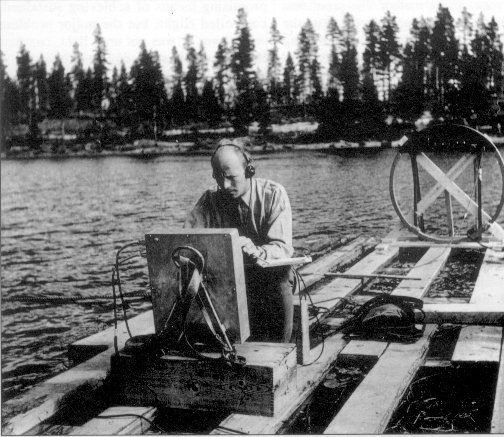
Pictured: a period Swedish military photograph of the actual July–August 1946 search operation at Lake Kölmjärv, led by Lt. Karl-Gösta Bartoll (at right) following the July 19, 1946 impact reported there — not a photograph of the object itself, which no confirmed image is known to exist of. In the public domain in Sweden under SFS 1960:729 §49a as a non-artistic photograph created before January 1, 1976.
Theoretical Alignment
The wave aligns most strongly with a Psycho-Social reading blended with mundane terrestrial technology — genuine Perseid meteor activity, contrails from unfamiliar high-altitude aircraft, and a real, still-unresolved suspicion of covert Soviet rocket testing, all amplified by a population primed by six years of war to interpret unfamiliar lights and sounds as weapons. A residual core of daylight, multi-witness, radar-corroborated reports — particularly the July 19 lake impacts and Lt. Gunnar Irholm's August 14 pursuit — resists full explanation by any single terrestrial category, which is the specific reason the case remains genuinely disputed rather than closed. Extraterrestrial origin was floated at the time (and in a disputed 1948 document, discussed below) but was never the leading contemporary hypothesis among Swedish, American, or British investigators, who focused almost entirely on meteors, Soviet/German weapons, and misidentification.
Background
Sweden emerged from the Second World War as one of only a handful of European states that had avoided direct invasion and occupation, but its neutrality left it acutely exposed to the opening moves of the Cold War. To its east lay a Soviet Union that had, within the preceding eighteen months, overrun and absorbed the Baltic states and installed friendly governments across Poland, Czechoslovakia, Hungary, Romania, and Bulgaria; to its south, across the Baltic, sat the ruins of Peenemünde, the Third Reich's rocket-development complex on the Baltic coast, now under Soviet occupation. German V-1 and V-2 weapons — the world's first operational cruise and ballistic missiles — had been fired in earnest against London and Antwerp only eighteen months earlier, and the technical staff, blueprints, and hardware behind them had been the subject of a frantic, and only partially successful, Western scramble (the American Operation Paperclip) to secure ahead of Soviet forces. It was against this backdrop — not abstract speculation about extraterrestrial visitors, but the very real, very recent memory of German rocket weapons and an urgent uncertainty about what the Soviets had managed to seize from Peenemünde — that the first reports of strange rocket-shaped objects over Scandinavia began.
The phenomenon that would become known as "spökraketer" (ghost rockets) had isolated antecedents as early as February 26, 1946, when Finnish observers reported unidentified aerial objects, but the wave proper is conventionally dated from May 21, 1946, when two independent witnesses near Stora Mellösa outside Örebro reported a rocket- or zeppelin-shaped object to police. The Swedish tabloid Aftonbladet ran the term "spökraket" in a headline within the week, on May 28, and the name stuck. Reports accelerated through June and July, prompting the Swedish Defence Staff to convene a formal "Ghost Rocket Committee," chaired by Colonel Bengt Jacobsson with flight engineer Eric Malmberg as secretary, on July 6, 1946 — before the wave had even reached its peak. By the time reports began tapering off that December, the Committee had held twelve documented sessions weighing radar data, physical debris, and witness testimony against one another, without reaching a conclusion the Swedish government was willing to state with confidence in public.
Complete Timeline
| Date | Event |
|---|---|
| Feb. 26, 1946 | Finnish observers report the first unidentified aerial objects of what would become the ghost rocket wave. |
| May 21, 1946 | Two independent witnesses near Stora Mellösa, outside Örebro, Sweden, report a rocket- or zeppelin-shaped object to police — the conventionally cited start of the Swedish wave proper. |
| May 28, 1946 | Aftonbladet runs the term "spökraket" (ghost rocket) in a headline for the first time. |
| July 6, 1946 | The Swedish Defence Staff convenes the "Ghost Rocket Committee" under Col. Bengt Jacobsson to formally investigate the mounting reports. |
| July 9, 1946 | Photographer Erik Reuterswärd captures a widely reprinted photograph of a luminous streak over Guldsmedshyttan. |
| July 19, 1946 | At least four separate objects are reported striking Swedish lakes within a few hours of one another, including Lake Kölmjärv in Norrbotten (witnessed by Knut Lindbäck and Beda Persson), nearby Kattisträsket (Kurt Larsson), Vassaräjärvi, and Lake Marmen near Söderhamn (Ingrid Hansson). |
| Late July–Aug. 1946 | Lt. Karl-Gösta Bartoll leads a three-week Swedish military search of Lake Kölmjärv, recovering no confirmed debris. |
| Aug. 9 & 11, 1946 | The wave's twin single-day peaks, coinciding with the annual Perseid meteor shower; over 300 reports are logged in the Stockholm area alone on August 11. |
| Aug. 14, 1946 | Swedish Air Force Lt. Gunnar Irholm, piloting a B18A over Dalarna, pursues a fast, finless cigar-shaped object that outruns his aircraft before vanishing into a rainstorm. |
| Aug. 14, 1946 | New York Times reports that the U.S. State Department, under Undersecretary Dean Acheson, has taken a direct interest in the Scandinavian reports. |
| Aug. 20, 1946 | James H. Doolittle and David Sarnoff arrive in Stockholm, ostensibly on private Shell Oil and RCA business, and are briefed on Swedish radar-tracked incidents. |
| Aug. 22, 1946 | Photographer Gösta Skog films a smoking, cigar-shaped object on color movie stock; the footage is later ruined by an aperture error during a military screening. |
| Aug. 22, 1946 | Central Intelligence Group Director Lt. Gen. Hoyt S. Vandenberg sends a Top Secret memo to President Truman, citing a Swedish Air Officer's radar course-plotting as pointing to Peenemünde as the launch site. |
| Aug. 26–27, 1946 | CIG Daily Summaries record both General McNarney's report of renewed Soviet activity at Peenemünde and the U.S. Military and Naval Attachés' competing "unintentional hoax" theory, alongside Swedish anxiety about provoking the USSR by naming a suspect. |
| Sept. 1946 | The wave spreads beyond Scandinavia: reports logged over Greece (Macedonia and Thessaloniki, investigated by physicist Paul Santorini), Portugal, Belgium, and northern Italy. |
| Sept. 4–5, 1946 | Soviet state radio (via Moscow's "New Times") publicly denounces Western coverage of the ghost rockets as an "anti-Soviet campaign" and "fabrication." |
| Sept. 30, 1946 | David Sarnoff tells the American press he is "convinced that the 'ghost bombs' are no myth but real missiles." |
| Oct. 10, 1946 | The Swedish Defence Staff issues its most detailed public statement, confirming radar corroboration but stating the instruments "gave no clue as to the nature of the objects." |
| Nov. 29, 1946 | Defence Staff tally: 225 of nearly 1,000 vetted reports judged observations of "real physical objects," all in daylight. |
| Dec. 3, 1946 | Ghost Rocket Committee memo records nearly 100 reported impacts and thirty examined debris fragments, identified as ordinary slag, coke, or probable meteorite material. |
| Dec. 10, 1946 | The Ghost Rocket Committee holds its twelfth and final documented 1946 meeting; reports taper off sharply through the rest of the year. |
The July 19 Lake Impacts
No single day defines the ghost rocket wave more completely than July 19, 1946, when Swedish authorities logged at least four separate objects striking bodies of water across the country within roughly four hours of one another. At Lake Kölmjärv in Norrbotten, at 11:45 a.m., haymakers Knut Lindbäck and Beda Persson watched a roughly two-meter, ashen-gray object with a blunt nose and pointed stern dive into the lake roughly 1.5 kilometers from where they stood, throwing up a tall column of water. Neither witness reported an explosion or flash of light — only a smashing sound both attributed to the impact of water rather than a detonation. A third witness, fourteen-year-old Frideborg Tagebo, watched the same event from the lake's northern shore and was located and separately interviewed decades later, in 1984, by researcher Clas Svahn, whose account substantially corroborated the original testimony.
Barely fifteen minutes earlier and roughly 30 kilometers away, near the hamlet of Överkalix, eleven-year-old Kurt Larsson was fishing a stream at Kattisträsket when he witnessed a violent water cascade he later compared, in his own words, to "detonating a mine." Farther south that same afternoon, at roughly 3:00 p.m., witnesses near Vassaräjärvi reported a fast-moving object descending toward the water, and at 3:40 p.m., twenty-two-year-old Ingrid Hansson watched an object skip or "bounce" repeatedly across the surface of Lake Marmen near Söderhamn after a violent noise, throwing up a cascade she estimated at roughly twenty meters. Taken individually, each report might be dismissed as a single meteor fragmenting on water entry or a misperceived natural event; taken together, four broadly consistent impact reports across a roughly 400-kilometer north-south span of Sweden, clustered within a few hours of a single afternoon, is the kind of correlated pattern that gave Swedish military investigators genuine pause — and the reason the Defence Staff dedicated its most significant single search operation, at Lake Kölmjärv, to this particular date.
That search, conducted over roughly three weeks in late July and August 1946 under the field command of Lt. Karl-Gösta Bartoll, was by contemporary Swedish standards an intensive operation: divers, sonar-adjacent underwater mapping equipment, and specialist mine-detection apparatus were all reportedly deployed against a small, remote lake far from any population center. It recovered nothing conclusive — no debris, no confirmed foreign material — only a disturbed section of lakebed that Bartoll's official report attributed to an object built from an unusually lightweight alloy that had disintegrated on impact. When Bartoll himself later reflected on the search in a 1984 interview with Clas Svahn, he maintained that despite the search's inconclusive physical result, the underlying witness observations themselves were of "real, physical objects" — a position that neatly captures the wave's central, unresolved tension between credible observation and absent physical confirmation.
The August Peak and the Perseids
Reports intensified sharply through late July and into August, culminating in the wave's two single-day peaks on August 9 and 11, 1946, when more than 300 separate sightings were logged in the Stockholm area alone on the 11th. The timing is not coincidental: the annual Perseid meteor shower, produced by Earth's passage through debris shed by Comet Swift–Tuttle, was active across roughly August 9–14 in 1946 and reliably produces dozens to well over a hundred visible fireballs per hour under clear conditions at its peak — more than enough, on its own, to account for a substantial fraction of the wave's August reports, particularly the briefer, single-witness, nighttime accounts of bright streaking lights. This is the single strongest piece of purely astronomical evidence available to any conventional explanation of the ghost rockets, and it is treated in full, alongside its real limitations, under the Conventional Explanation Candidate analysis below.
Not every August report fits the meteor pattern, however. On the morning of August 14, 1946 — three days after the Perseid peak proper, though still within its broader active window — Swedish Air Force Lt. Gunnar Irholm, flying a twin-engine SAAB B18A over Dalarna with a navigator, spotted a dark, finless, exhaust-free cigar-shaped object at low altitude and gave chase. According to the account preserved in Swedish military and archival records, the object accelerated beyond the B18A's own top speed — a performance envelope inconsistent with a meteor, which does not maneuver or sustain low-altitude horizontal flight, and inconsistent with any Swedish aircraft of the period — before vanishing into a rainstorm within roughly two minutes. Eleven minutes later and a considerable distance to the south, a separate witness near Södertälje independently reported a similar object with small wings and rear bracing, traveling at a comparable estimated speed on a broadly consistent trajectory — the kind of independent, geographically staggered corroboration that is difficult to explain as either a single misidentified meteor or an isolated hallucination.
The Skog Film and the Missing Evidence
Photographic and film evidence from the entire wave is remarkably thin given its scale, and what little exists is compromised in one way or another. Erik Reuterswärd's July 9, 1946 photograph from Guldsmedshyttan, showing a bright streak against the sky, became one of the most widely reprinted images of the wave in the Swedish and international press — but it shows only an ambiguous linear trail, consistent equally with a genuine aerial projectile, a bright daylight meteor, or an aircraft contrail catching the light, and offers no way to distinguish between these possibilities on its own. The wave's one attempt at motion-picture evidence fared worse: on August 22, 1946, Gothenburg photographer Gösta Skog filmed what he described as a smoking cigar-shaped object trailing flame, using color Paillard-Bolex stock and a telephoto lens. When Swedish military officers screened the footage, it proved to have been shot with a miscalibrated aperture and showed nothing but overexposed white frames — and the military, having taken possession of the only copy, never returned it to Skog. Whatever the film actually captured, if anything, is now permanently unrecoverable, leaving the wave without a single piece of surviving photographic or film evidence that unambiguously resolves what any witness saw.
International Spread: Greece, Iberia, and the Low Countries
By September 1946 the phenomenon had spread well beyond Scandinavia. Greek Prime Minister Konstantinos Tsaldaris publicly reported projectiles seen over Macedonia and Thessaloniki on September 1, with similar objects independently reported by British Army units stationed in the region around the same time. The Greek government assigned its own investigation to physicist Paul Santorini, a wartime developer of the proximity fuze and a later patent holder on Nike missile guidance systems — a genuinely credentialed technical investigator by any measure. Santorini later told researchers that the Greek Army's investigation was abruptly halted after Greek officials conferred with U.S. defense officials, and that he had personally been warned to remain silent, on the stated grounds that publicly acknowledging the underlying technology would be tantamount to admitting a threat against which there was "no possibility of defense." Whatever the truth of that specific framing — Santorini's own later public statements are themselves a secondary, decades-removed source rather than a contemporaneous document — the Greek episode is one of the clearest examples in the entire wave of a government investigation being curtailed for reasons its own lead investigator characterized as political rather than scientific.
Similar reports followed through mid-September over Portugal, and reddish-green "balls of fire" were reported over Tangier and linked in Moroccan press coverage to the same wave affecting "Sweden and France." Reports also reached Denmark directly across the Øresund, where Danish state radio described "stratospheric rockets" resembling cigars with flame trailing from their tails, and northern Italy and Belgium saw scattered, less-documented sightings of their own before the wave's international dimension faded along with the Scandinavian core in the closing months of 1946.
Washington Takes Notice
American official interest in the ghost rockets arrived remarkably early relative to the wave's own timeline. By August 14, 1946 — barely three months after the first Swedish reports and while the wave was still near its peak — the New York Times was reporting that the State Department, under Undersecretary Dean Acheson, had taken a direct interest in the Scandinavian reports. Days later, on August 20, celebrated WWII aviator James H. Doolittle, by then a Shell Oil Company executive, and RCA chairman David Sarnoff arrived in Stockholm on ostensibly private business, but were given informal Swedish military briefings on several radar-tracked incidents. Sarnoff's own subsequent public comment, on September 30, that he was "convinced that the 'ghost bombs' are no myth but real missiles," carried real weight with the American public given his stature, even though he offered no technical evidence of his own to support it.
The most consequential American document from this period is a Top Secret memo Central Intelligence Group Director Lt. Gen. Hoyt S. Vandenberg sent President Truman on August 22, 1946, reportedly informed in part by the Doolittle–Sarnoff briefings. Vandenberg's memo held that the "weight of evidence" pointed to Peenemünde, not the Gulf of Finland, as the probable launch site for most of the reported "rockets," citing a claim from the U.S. military attaché in Moscow that a "key Swedish Air Officer" had told him Swedish radar course-plotting supported the same conclusion. The theory assumed the objects were extended-range developments of the V-1, aimed at the Gulf of Bothnia for testing purposes — and it rested on a real, if circumstantial, intelligence finding: a CIG daily summary from four days later, on August 26, 1946, records General McNarney transmitting a "reliable report" of renewed rail traffic, ferry restoration, and a Soviet Technical Commission actively present at Peenemünde that summer, ostensibly restoring facilities ahead of later equipment removals to the USSR.
That same August 26 daily summary, however, also records a directly competing theory from within the same U.S. intelligence apparatus: the Military and Naval Attachés in Stockholm had "jointly developed the theory of a Swedish 'unintentional hoax,'" suspecting the Swedish Defence Staff itself of tacitly sponsoring exaggerated reporting to alert the West against the East and support Sweden's own defense budget. A follow-on summary dated August 27 adds a further layer of nuance still relevant to how the whole affair should be read: the British Chargé in Moscow observed that the Swedes were "very apprehensive of making any statement about the 'ghost rockets' which might provoke the USSR," and that even the Swedish officer who had supplied radar information to the American attaché had done so only under direct interrogation and had refused outright to say "the Russians fired the bombs." In other words, the very cautious, ambiguous public posture that later observers sometimes read as evidence of a cover-up is, in the CIA's own contemporaneous internal reporting, more plausibly explained as a small neutral country's genuine diplomatic fear of naming a nuclear-armed neighbor as a suspect.
The Soviet Union, for its part, did not stay silent. On September 4–5, 1946, Moscow's official "New Times" radio service publicly denounced Western press coverage of the ghost rockets as part of an "anti-Soviet campaign" of "misinformation and calumny," grouping it with separate Soviet complaints about Western reporting on occupied Germany. Modern historical review has broadly vindicated the substance, if not the tone, of the Soviet denial: postwar Soviet rocket records, examined after the Cold War's end, show the USSR had completed only around thirty V-2-derived missiles by October 1946 and had launched none of them — a program still in early, ground-based testing at Kapustin Yar rather than one capable of the sustained, high-frequency overflights the wave's raw sighting numbers would imply, had every report genuinely been a Soviet rocket.
A Disputed Later Document
Ufology literature occasionally cites a Top Secret USAFE (United States Air Force Europe) document, dated November 4, 1948 and reportedly declassified in 1997, in which unnamed "reliable and fully technically qualified people" are quoted concluding that the phenomena behind the ghost rockets were "obviously the result of a high technical skill which cannot be credited to any presently known culture on earth," with the document allegedly declining to "discredit entirely this somewhat spectacular theory" of extraterrestrial origin. This document should not be confused with the genuine, well-documented September 23, 1947 memorandum signed by Lt. Gen. Nathan F. Twining as head of Army Air Forces Materiel Command — the real "Twining memo" concluded only that American "flying discs" were "something real and not visionary or fictitious," made no reference to Scandinavia or 1946, and, per Skeptical Inquirer's own 2020 review of Twining's later writing, shows no sign Twining himself regarded the subject as an ongoing serious concern in the years that followed. The 1948 USAFE document is a separate, considerably less well-sourced item: it circulates almost exclusively through secondary ufology books rather than a citable National Archives or Air Force Historical Research Agency record, and this file's own research was unable to independently trace it to a verifiable primary holding. It is presented here, as it should be treated generally, as a disputed and likely misattributed claim rather than as an established government document on the same footing as the Vandenberg memo or the CIG daily summaries above — a caution worth stating plainly given how often the two categories of document get run together in less careful accounts of this case.
The Committee's Verdict and the Wave's Decline
The Swedish Defence Staff's most substantive public statement came on October 10, 1946, and it is worth quoting in full for how carefully it threads between dismissal and acknowledgment: "Most observations are vague and must be treated very skeptically. In some cases, however, clear, unambiguous observations have been made that cannot be explained as natural phenomena, Swedish aircraft, or imagination on the part of the observer. Echo, radar, and other equipment registered readings but gave no clue as to the nature of the objects." That statement remains, arguably, the single most balanced official assessment the case has ever received — explicit that most reports are unreliable, equally explicit that a genuine unexplained residue exists, and honest that the available instrumentation, radar included, corroborated the presence of something without ever identifying what it was.
By November 29, the Defence Staff's internal tally held that 225 of its nearly 1,000 vetted reports represented observations of "real physical objects," every one of them made in daylight. The Ghost Rocket Committee's internal draft report reportedly went further, concluding that "foreign experimental activity with reaction or rocket weapons had undoubtedly occurred over Sweden" — language considerably more assertive than what the Defence Staff was willing to state publicly, and which was substantially softened in the version actually released. The Committee's final December 3 memo on physical evidence — thirty debris fragments examined, identified as ordinary slag, coke, or probable meteorite material — effectively closed the year's physical-evidence chapter without resolving the underlying question, and reports fell away sharply through the final weeks of 1946 after the Committee's twelfth and last documented 1946 meeting on December 10. The wave never received a single, unified, publicly released final report; what survives instead is a paper trail of committee memos, radio-monitoring transcripts, and American and Greek intelligence reporting, scattered across several countries' archives, each preserving a partial and sometimes contradictory piece of the picture.
Key Witnesses
Knut Lindbäck & Beda Persson
Working the southwestern shore of Lake Kölmjärv at 11:45 a.m. on July 19, 1946, this pair of independent adult civilian witnesses jointly described a roughly two-meter, ashen-gray, blunt-nosed projectile plunging into the lake and throwing up a tall water column. Their mutually corroborating, closely observed account — delivered without any apparent motive to embellish — became the basis for the Swedish military's single most intensive search operation of the entire wave.
Kurt Larsson
Fishing a stream roughly 30 kilometers from Lake Kölmjärv, Larsson reported a violent water cascade just fifteen minutes before and a short distance from the better-known Kölmjärv impact — independent, near-simultaneous corroboration that Swedish investigators treated as evidence more than one object came down in the region that single afternoon.
Ingrid Hansson
Several hundred kilometers south of the Norrbotten incidents, Hansson reported an object skipping repeatedly across Lake Marmen's surface after a violent noise on the same afternoon of July 19, 1946 — one of at least four geographically dispersed lake-impact reports logged by Swedish authorities that single day.
Lt. Karl-Gösta Bartoll
Led the three-week military search of Lake Kölmjärv and authored the official report attributing the absence of recovered debris to a lightweight, self-disintegrating alloy. A 1984 interview by researcher Clas Svahn found Bartoll still maintaining, decades on and with no apparent incentive to do otherwise, that the underlying witness observations were of genuine physical objects.
Lt. Gunnar Irholm
The wave's single strongest witness by occupational credential: a trained military aviator who personally pursued a finless, exhaust-free cigar-shaped object over Dalarna on August 14, 1946, watching it outrun his own aircraft before it vanished into a rainstorm — a performance profile inconsistent with any Swedish aircraft or a meteor's fixed atmospheric trajectory.
Erik Reuterswärd
Captured the wave's single most widely reprinted photograph — a bright streak over Guldsmedshyttan on July 9, 1946 — generally regarded by researchers as the wave's only plausibly authentic (rather than staged or misattributed) image, though its content remains genuinely ambiguous between a projectile and a bright meteor.
Gösta Skog
Attempted the wave's only film record, capturing what he described as a smoking cigar-shaped object on color movie stock on August 22, 1946. A camera error destroyed the footage before independent analysis was possible, and the Swedish military never returned Skog's film to him.
The Five Observables Assessment
The Five Observables framework is applied to the performance characteristics reported across the wave, drawing primarily on Lt. Gunnar Irholm's August 14 pursuit and the July 19 lake-impact cluster as the wave's best-documented individual encounters:
Assessment: No report in the wave describes silent hovering, right-angle turns, or other classic anti-gravity-style maneuvering; the reported flight profiles are overwhelmingly straight-line, high-speed transits consistent with either powered projectiles or meteors, not the abrupt directional changes associated with anti-gravity lift elsewhere in this catalog. Instant acceleration is speculative rather than clearly documented — witnesses like Irholm describe sustained high speed rather than an observed instantaneous velocity change. Hypersonic-adjacent speed is reported repeatedly and credibly, including by trained aircrew, though period estimation methods (unaided visual tracking against an aircraft's own known top speed) leave real room for error. Low observability is speculative: several objects were described as producing no exhaust trail or engine sound, which is unusual for a 1946-era propulsion system but not dispositive on its own. Trans-medium behavior — objects reportedly striking and interacting with water at Lake Kölmjärv and skipping across Lake Marmen's surface — is the wave's most consistently reported observable, though it is equally consistent with a mundane meteor or rocket fragment striking water as with any exotic craft behavior.
Evidence Assessment
Supporting Anomalous Origin
- Roughly 200 of the wave's nearly 2,000 sightings were corroborated by military radar — a scale of instrumented corroboration unmatched by most single-witness UAP cases.
- Lt. Gunnar Irholm's August 14, 1946 pursuit involved a trained military aircrew, in flight, watching an object outperform their own aircraft — independently corroborated eleven minutes later by a separate ground witness near Södertälje on a broadly consistent trajectory.
- The Swedish Defence Staff's own October 10, 1946 statement affirmed that some observations were "clear, unambiguous" and "cannot be explained as natural phenomena, Swedish aircraft, or imagination" — an official, non-sensationalized acknowledgment of a genuine unexplained residue.
- 225 of the vetted November 1946 reports were judged observations of "real physical objects," all recorded in daylight, when misidentification is comparatively less common than at night.
- The July 19, 1946 cluster of at least four independent lake-impact reports across a roughly 400-kilometer span within a few hours resists easy dismissal as a single coincidental misperception.
Supporting Conventional Explanation
- The wave's two sharpest single-day peaks, August 9 and 11, 1946, fall squarely within the annual Perseid meteor shower's active window, a real astronomical event capable of producing large numbers of bright fireballs independent of any secret weapons program.
- No debris recovered anywhere during the wave — despite dozens of search operations and thirty examined fragments — was ever positively identified as anything other than ordinary industrial slag, coke, or probable meteorite material.
- Postwar Soviet archival records confirm the USSR had completed only around thirty V-2-derived missiles by October 1946 and launched none of them, directly undercutting the contemporary Soviet-test-firing theory that many observers assumed at the time.
- U.S. Military and Naval Attachés in Stockholm formally floated a Swedish "unintentional hoax" theory in an August 26, 1946 intelligence summary, suggesting institutional amplification independent of any genuine anomalous stimulus.
Why "Credible"
The Swedish Ghost Rockets earn a Credible rating rather than a higher or lower one because the wave genuinely contains both a large, well-explained majority and a smaller, stubbornly unresolved minority, and honest treatment of the case requires holding both at once. The great bulk of the roughly 2,000 individual reports almost certainly reflects a combination of real Perseid meteor activity concentrated around the August 9–11 peaks, unfamiliar aircraft contrails in skies that had rarely seen high-altitude flight before the war, and a population primed by six years of continent-wide conflict to interpret unfamiliar lights as weapons — a reading the U.S. Military and Naval Attachés' own contemporaneous "unintentional hoax" theory and the Skeptoid analysis of Brian Dunning both independently support. That alone would argue for a Disputed or even lower rating, on the model of a case like Thomas Mantell, where a single strong conventional explanation covers nearly everything. But the ghost rockets are not a single event; they are a year-long wave containing a genuine residue — roughly 200 radar-corroborated sightings, the multiply-witnessed July 19 lake-impact cluster, and above all Lt. Gunnar Irholm's trained-aircrew pursuit of an object that outran his own military aircraft and was independently corroborated eleven minutes later — that neither the meteor explanation nor the hoax theory nor the unconfirmed Soviet-test theory accounts for on its own. The Swedish Defence Staff's own carefully hedged October 10, 1946 statement, affirming both that most reports were unreliable and that some were "clear, unambiguous" and inexplicable, remains the most credible single assessment on record precisely because it does not force the case into a tidier conclusion than the evidence supports. That combination — a real, radar-corroborated, professionally witnessed core that has resisted seventy-nine years of investigation, sitting alongside an equally real conventional explanation for most of the wave's raw volume — is exactly the profile of a Credible rather than Verified or Disputed case.
Sensor & Instrumentation Detection Profile
The ghost rocket wave produced the earliest large-scale radar corroboration of any UAP wave on record: the Swedish Defence Staff's own October 10, 1946 public statement confirmed that "echo, radar, and other equipment registered readings but gave no clue as to the nature of the objects," and researchers who have reviewed the underlying case files, including Clas Svahn, put the number of radar-corroborated sightings at roughly 200 out of the wave's nearly 2,000 total reports. No radar plot, however, has ever been published in a form that allows independent post-hoc analysis of altitude, velocity, or track geometry — the underlying military logs remain in the Swedish national archive rather than in the public domain. Visual instrumentation was limited to two amateur still/movie cameras: Erik Reuterswärd's July 9, 1946 photograph of a luminous streak over Guldsmedshyttan, and Gösta Skog's August 22 color movie film, which was destroyed by overexposure during a military screening before any independent frame-by-frame analysis could occur. No infrared, magnetometer, or radiation-detection instrumentation existed in 1946 in any form applicable to an aerial phenomenon; the debris recovered at several sites was later assessed with contemporary metallurgical and radiological techniques by the Swedish National Defence Research Institute (FOA), discussed under Physical & Material Assays below.
Environmental & Geospatial Context
The wave's geography spans the length of Sweden, from the sub-Arctic forests of Norrbotten (Lake Kölmjärv sits roughly 100 km north of the Arctic Circle) to the densely populated south around Stockholm, with corroborating reports from Finland, Norway, and Denmark and a distinct secondary cluster across Greece, Portugal, Belgium, and Italy in September 1946. The reporting calendar runs from late February through December 1946, but is heavily front-loaded into July and especially August, culminating in twin single-day peaks on August 9 and 11 that sit squarely inside the annual Perseid meteor shower's active window (roughly August 9–14 in 1946, tied to debris from Comet Swift–Tuttle). Scandinavian midsummer skies stay light past midnight at these latitudes, extending the window in which a bright meteor, aircraft contrail, or genuine anomaly would be visually detectable to the public relative to more temperate regions. No solar or geomagnetic storm activity has been identified as coincident with the wave's peak dates in any source consulted for this file; the July 19 lake-impact cluster and the August 14 Dalarna pursuit both occurred under otherwise unremarkable summer weather, per the contemporary Swedish Air Force reports.
Observer Credibility & Occupational Profile
The witness pool is unusually heterogeneous for a single case file, spanning rural civilians with no reason to fabricate a story (haymakers, an eleven-year-old fisherman, a young maid) through to trained military professionals whose testimony carries substantially more evidentiary weight. Lt. Gunnar Irholm, a Swedish Air Force pilot flying a twin-engine B18A, is the wave's strongest individual witness by occupational credential: a trained military aviator, in the air, with an aircrew colleague, pursuing an object that outran his own aircraft's top speed. Lt. Karl-Gösta Bartoll, who led the Lake Kölmjärv search, is not a witness to the object itself but a credentialed investigator whose later 1984 statement to Clas Svahn — that "what people saw were real, physical objects" — carries the weight of someone with no continuing incentive to sustain a story decades after the fact. The Swedish Defence Staff's own November 29, 1946 tally judged 225 of its nearly 1,000 vetted reports to be observations of "real physical objects," every one of them made in daylight rather than at night, when misidentification of ordinary lights is far more common — a detail investigators at the time treated as a meaningful credibility signal.
Physical & Material Assays
Despite nearly 100 reported ground or water impacts and dozens of Swedish military search operations, no fragment recovered during the wave was ever positively identified as originating from a non-terrestrial or unknown-technology source. By December 3, 1946, the Ghost Rocket Committee's own internal memo recorded that thirty pieces of debris had been received and examined by FOA, the Swedish National Defence Research Institute; the material was assessed as ordinary industrial slag or coke, and separately, in later retrospective analysis, as probable meteorite fragments consistent with the same Perseid activity implicated in the August peak. At Lake Kölmjärv, Lt. Bartoll's three-week search recovered no debris at all — only a disturbed lake bottom, which he attributed in his official report to an object "probably manufactured in a lightweight material, possibly a kind of magnesium alloy that would disintegrate easily, and not give indications on our instruments," a conclusion that explains the absence of debris only by assuming a material property convenient to the theory rather than one independently demonstrated. This pattern — extensive, well-resourced physical search efforts consistently returning either mundane material or nothing at all — is treated in detail under Material Analysis below.
Historical Precedents & Archive Matches
The ghost rockets sit at the direct hinge point of modern UFO history: they predate Kenneth Arnold's June 1947 "flying saucer" sighting by roughly a year, making Scandinavia rather than the United States the site of the first genuinely mass postwar unidentified-aerial-phenomena wave, and they were still an active subject of American intelligence reporting when Arnold's case broke and coined the term that would eclipse them in popular memory. They also follow closely on the heels of the WWII "foo fighter" reports from Allied and Axis aircrews in the European and Pacific theaters — unexplained lights and fireballs pacing bomber formations that, like the ghost rockets, were initially assumed by observers to be a wartime adversary's secret weapon before any conventional explanation could be confirmed. Within Scandinavia itself, the phenomenon recurred in a smaller, better-instrumented form more than two decades later in Finland's "Seven Balloons of Pori" incident (1969), in which the Finnish Air Force's only officially acknowledged UAP case involved disc-shaped objects that, much like the 1946 wave, were tracked visually by a trained military pilot before accelerating away. Clas Svahn has separately noted that Swedish folklore recorded unexplained aerial lights ("spökljus," or ghost lights) in the decades before 1946, suggesting the wave was an intensification of an existing regional reporting tradition rather than an entirely novel phenomenon.
Material Analysis
Across the entire wave, the record of physical evidence is one of consistent, well-resourced effort producing consistently mundane or null results. Swedish military search teams responded to a substantial fraction of the nearly 100 reported ground and water impacts logged by year's end, most intensively at Lake Kölmjärv, where Lt. Karl-Gösta Bartoll's three-week operation recovered no material at all despite systematic underwater search methods unusually thorough for a small, remote lake. Where material was recovered elsewhere in the wave, the Ghost Rocket Committee's own December 3, 1946 internal memo records that thirty examined fragments proved to be ordinary industrial slag or coke — not exotic alloy, not confirmed rocket debris — with later retrospective analysis attributing at least some of that material to probable meteorite fragments consistent with the same Perseid activity implicated in the August peak. No isotopic, radiological, or advanced metallurgical assay results from FOA's contemporary 1946 testing have survived in a form accessible for this file's research; what is documented is the conclusion, not the underlying laboratory data.
Supporting Non-Terrestrial Origin
- The disturbed lakebed at Lake Kölmjärv is consistent with a genuine impact by something, even absent recovered debris.
- Bartoll's official explanation for the absent debris — a self-disintegrating lightweight alloy — while unverifiable, was offered by a credentialed field investigator rather than a casual observer.
Supporting Terrestrial Origin
- Every positively identified debris fragment recovered wave-wide was ordinary industrial slag, coke, or probable meteorite material — nothing anomalous.
- The complete absence of confirmed debris at the wave's single most intensively searched site (Lake Kölmjärv) is at least as consistent with a small meteorite that fully vaporized or embedded too deep to recover as with an exotic disintegrating craft.
The Conventional Explanation Candidate: A Mixed Terrestrial Wave
Unlike a single-incident case file, the ghost rockets almost certainly do not have one conventional explanation — the most defensible reading of the full record is that the wave was a genuine mixture of several distinct terrestrial phenomena, reported and amplified together under a single popular label. The three candidates below are evaluated on that basis, as partial rather than mutually exclusive explanations of different segments of the wave's nearly 2,000 reports.
Perseid & Sporadic Meteor Activity
PlausibleThe wave's two sharpest single-day peaks, August 9 and 11, 1946, fall precisely within the Perseid shower's active window, a real, well-understood astronomical event capable of producing dozens to well over a hundred bright fireballs per hour at peak activity. This candidate accounts especially well for brief, single-witness, streak-shaped nighttime and daytime reports — plausibly including Erik Reuterswärd's own July 9 photograph — but does not by itself explain reports of horizontal, sustained flight, maneuvering, or engagement by aircraft, all of which are inconsistent with a meteor's fixed ballistic entry.
Soviet Test-Firing of Captured German Rockets
UnprovenThe theory driving Vandenberg's own August 22, 1946 memo to Truman — that the Soviets were test-firing extended-range V-1 derivatives from occupied Peenemünde toward the Gulf of Bothnia — had real circumstantial support at the time (renewed rail and ferry activity, a Soviet Technical Commission on site) but has never been confirmed by any launch record, and postwar Soviet archives reviewed after the Cold War show the USSR had completed only around thirty V-2-derived missiles by October 1946 and launched none of them. The theory remains unproven rather than disproven outright, since Soviet secrecy around any genuine early tests cannot be entirely ruled out, but it lacks the positive evidence needed to call it more than speculative.
Misidentified Aircraft, Contrails & Wartime-Primed Misperception
Plausible (partial)The US Naval Attaché's own contemporaneous memo (Report R334-46, cited by Skeptoid's Brian Dunning) states plainly that "no US military or naval personnel in Sweden have seen any fragments, photographs, radar tracks, points of impact, or other evidence," and specifically attributes many reports to unfamiliar high-altitude aircraft contrails — including early American reconnaissance flights — being misread as rockets by a Scandinavian public with little prior exposure to contrail-producing aviation. Combined with the US Attachés' own "unintentional hoax" theory and genuine Cold War anxiety, this candidate plausibly accounts for a further meaningful share of the wave's volume, though it does not adequately explain the wave's strongest individual reports, including Lt. Gunnar Irholm's trained-aircrew pursuit.
Related Cases
Confirmed Documents & Official Records
A Central Intelligence Group intelligence report compiling verbatim Scandinavian and European radio-monitoring transcripts of the ghost rocket reports from July through September 1946, including the Soviet government's own on-air denial.
Records the US Military and Naval Attachés' "unintentional hoax" theory alongside Gen. McNarney's report of renewed Soviet activity at Peenemünde — the intelligence basis for the Vandenberg-to-Truman Soviet-launch theory.
Documents the British Chargé in Moscow's observation that Swedish officials feared naming the USSR as a suspect, and that Swedish radar informants had refused to directly blame Soviet forces.
The CIA's own official historical study, published in Studies in Intelligence, confirming that its predecessor agency "monitored reports of 'ghost rockets' in Sweden in 1946."
Further Reading — Recommended Literature
The Ghost Rockets: Mystery Missiles and Phantom Projectiles in our Skies
A focused, dedicated study of the 1946 wave and its aftermath, situating the ghost rockets within the broader history of unexplained aerial phenomena reporting.
The Ghost Rockets of Scandinavia (1946)
A concise survey of the wave's eyewitness accounts, government investigations, and the Cold War tensions that shaped how it was reported and suppressed at the time.
Above Top Secret: The Worldwide U.F.O. Cover-Up
Includes an extended treatment of the ghost rockets alongside facsimile declassified US, UK, and European government documents from the same period.
The UFO Encyclopedia, 4th Edition (2-Volume Set)
The field's standard reference work, with a detailed, well-sourced entry on the ghost rockets situating the wave within the full history of the UFO phenomenon.
UFOs and Government: A Historical Inquiry
An academically-oriented survey co-authored by Swedish researcher Clas Svahn covering how the Swedish, US, and other governments actually responded to the ghost rockets and later UAP reports.
Essential Viewing
Ghost Rockets Documentary Trailer
Official trailer for the 2015 feature documentary Ghost Rockets, which follows UFO-Sweden investigators tracing the 1946 wave's surviving archival record and later Swedish lake searches.

Ghost Rockets — CPH:DOX 2015 Festival Trailer
A second official trailer, hosted by the Copenhagen International Documentary Film Festival (CPH:DOX), where the film premiered internationally.
Sources
- Central Intelligence Group, "Flying Projectiles," Intelligence Report, April 9, 1947 (CIA-RDP78-04864A000100010004-4). CIA FOIA Electronic Reading Room
- Central Intelligence Group, Daily Summary, "Possibility of Hoax 'Ghost Rocket' Reports," August 26, 1946 (CIA-RDP78-01617A005800030030-9). CIA FOIA Electronic Reading Room
- Central Intelligence Group, Daily Summary, "Swedes Apprehensive Over Provoking USSR," August 27, 1946 (CIA-RDP78-01617A005800030029-1). CIA FOIA Electronic Reading Room
- Gerald K. Haines, "CIA's Role in the Study of UFOs, 1947–90," Studies in Intelligence, Vol. 1, No. 1, 1997. Federation of American Scientists
- NICAP, "The Kölmjärv Ghost Rocket Crash, July 19, 1946," case file. nicap.org
- Joel Carpenter, "Sweden: Ghost Rocket Reports, 1946," Project 1947. project1947.com
- Jan L. Aldrich, "1948 UFO Documents: Background," Project 1947. project1947.com
- Center for UFO Studies (CUFOS), "Ghost Rockets." cufos.org
- Brian Dunning, "The Swedish Ghost Rockets," Skeptoid Episode #628, June 19, 2018. skeptoid.com
- UFO-Sweden, "Spökraketerna" (Ghost Rockets). ufo.se
- UFO-Sweden, "Spökraketerna – den största gåtan." ufo.se
- Archives for the Unexplained (AFU), "Clas Svahn." afu.se
- Eric Wojciechowski, "General Nathan F. Twining and the Flying Disc Problem of 1947," Skeptical Inquirer, March 2020. skepticalinquirer.org
- Wikimedia Commons, "File:Ghost rocket search July 1946.jpg" (hero image source and license). commons.wikimedia.org
- Wikimedia Commons, "File:Ghostrocket 7-09-1946.jpg." commons.wikimedia.org
- Wikipedia contributors, "Ghost rockets," used for background orientation and cross-checking only. en.wikipedia.org
- "Ghost Rockets Documentary Trailer," YouTube, GhostRocketsFIlm channel (official). youtube.com
- "Ghost Rockets (Trailer @ CPH:DOX 2015)," YouTube, CPH:DOX (Copenhagen International Documentary Film Festival) channel. youtube.com
See something inaccurate? Have additional information or sources?
Suggest an Edit →Last Updated: August 2026