
T. Townsend Brown & Electrogravitics
Beginning in the early 1920s, working as a teenage lab assistant to physics professor Paul Alfred Biefeld at Denison University, inventor Thomas Townsend Brown observed that a charged asymmetric capacitor produced a small but measurable thrust toward its smaller electrode. He spent the rest of his life — through a modest, genuinely documented U.S. Navy career, a 1952 military propulsion proposal called Project Winterhaven, a brief 1955–56 vogue among major aerospace contractors, and decades of private research — trying to prove that the "Biefeld-Brown effect" was a fundamental new link between electricity and gravity: electrogravitics. The U.S. Navy's own 1952 technical evaluation, and every rigorous vacuum-chamber test conducted since, instead found the effect was ion wind (electrohydrodynamic corona-discharge thrust) — real, measurable, and useful for small "lifter" devices, but not antigravity and not able to work in the vacuum of space. Brown's other lasting, well-documented legacy is his October 1956 founding of NICAP, the National Investigations Committee on Aerial Phenomena, one of the Cold War's most significant civilian UFO research organizations, alongside Donald Keyhoe. Decades after his death, Brown's name was also falsely grafted onto the "Philadelphia Experiment" — a thoroughly debunked legend about the USS Eldridge being rendered invisible in 1943 — by a 1979 popular book, despite there being no primary evidence Brown was ever involved in any such event, which the U.S. Navy itself has repeatedly and explicitly denied ever took place. This file separates, as precisely as the record allows, Brown's solid biography from his contested physics from the outright fabricated mythology that later attached itself to his name.
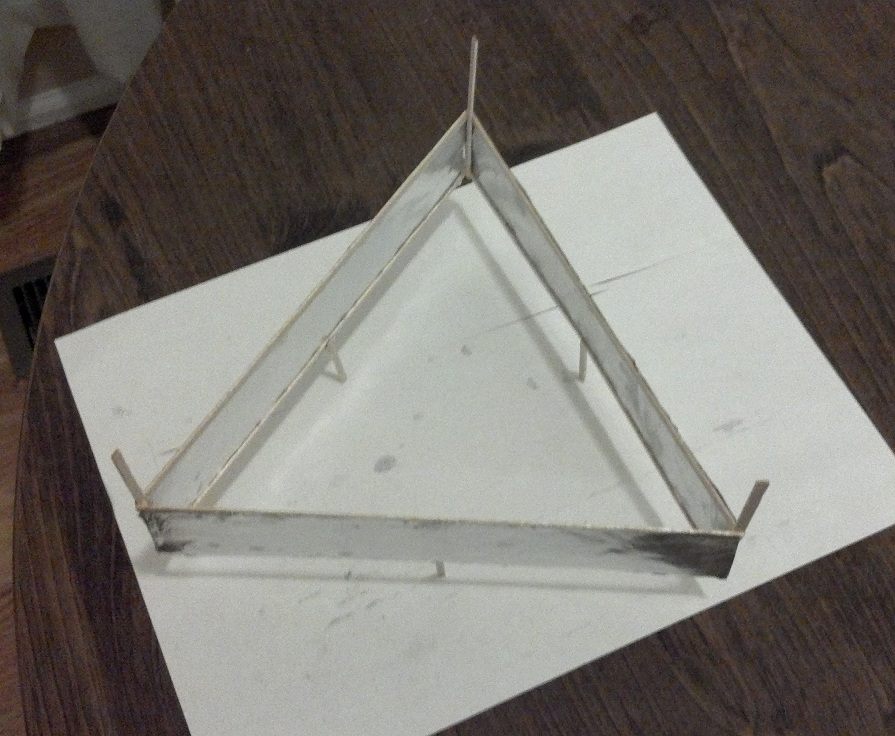
Pictured: a modern amateur-built electrostatic "lifter" — a lightweight asymmetric capacitor of balsa wood, foil, and thin wire that self-levitates under high voltage, built for a community-college engineering program in 2011. This is not a photograph of Thomas Townsend Brown himself, nor of his original 1920s "gravitator" apparatus or his 1950s demonstration discs. No rights-clear photograph of Brown or his original devices has been located on Wikimedia Commons or in any other public-domain archive; his family's own private photo collection, hosted at ttbrown.com and thomastownsendbrown.com, remains outside free-licensing terms. This lifter is included because it demonstrates, in a form any reader can replicate on a kitchen table, exactly the physical phenomenon — corona-discharge ion wind acting on an asymmetric high-voltage capacitor — that is at the center of this entire case file. Photo by Ndelaney9295, licensed CC BY-SA 3.0 via Wikimedia Commons.
Theoretical Alignment
Brown's case earns a place in this catalogue not because he ever reported seeing a UAP, but because his "electrogravitics" has been retroactively adopted by later UAP-propulsion speculation as a candidate mechanism for anti-gravity flight — the low ETH score reflects that this file documents the origin and testing of a proposed propulsion theory, not an observed craft. The Interdimensional score is essentially zero; nothing in Brown's own work or writing invokes higher dimensions or consciousness-linked phenomena. The elevated Psycho-Social score reflects a different, better-supported pattern: decades of enthusiast communities, popular authors, and — as detailed below — outright hoaxers built an increasingly elaborate mythology around a real but modest inventor, culminating in a fabricated connection to a Navy experiment that never happened. This file's purpose is to hold those two very different currents — genuine, patentable 1920s–1960s electrical engineering, and later, unrelated mythology — clearly apart.
Background
Thomas Townsend Brown was born March 18, 1905, in Zanesville, Ohio, into a wealthy family whose construction and coal-mining fortune (his father Lewis K. Brown, his mother Mary Townsend Brown) funded a home laboratory for their electronics-obsessed son from an early age. As a teenager, around 1921, Brown reported that a Coolidge X-ray tube on a sensitive balance scale appeared to change apparent weight depending on how it was oriented and energized — an observation he would spend the rest of his life trying to explain. He attended Doane Academy (a Denison-affiliated preparatory school) in 1922–23, then spent a single year (fall 1923–1924) at the California Institute of Technology before transferring to Denison University in Granville, Ohio, where he was enrolled from September 1924 to June 1925.
At Denison, Brown — never a formally enrolled physics major, and by his own later accounts more of an enthusiastic hanger-on in the department — became close to astronomy and physics professor Paul Alfred Biefeld. He assisted Biefeld with a real, documented piece of astronomical work, photographing the partial solar eclipse of January 24, 1925, and in November 1924 delivered a lecture to the university's Engineering Society titled "Particles of Energy and the Control of Gravitation." It was during this period that Brown and Biefeld built and tested "gravitators" — blocks of dielectric material sandwiched between electrodes and charged to high voltage — that appeared to move toward their positive terminal when energized. Brown named the resulting phenomenon the "Biefeld-Brown effect" after his mentor. Denison University's own archives, however, contain no record of any jointly authored scientific paper by the two men, and Biefeld's son later stated flatly that "my father never did collaborate with Mr. Brown in a scientific sense" — Biefeld talked physics with an eager, unaffiliated undergraduate who spent a lot of time around the department, which is a real and traceable connection, but a considerably more modest one than the "co-discoverer" framing Brown promoted for the rest of his career.
Brown left Denison without a degree in 1925 and spent the following years building his private research program, funded largely by his own family's money and by his September 1928 marriage to Josephine Beale, daughter of a prominent Zanesville family. He filed his first patent application in Britain on August 15, 1927 (issued November 15, 1928, as GB300,311), and in 1929 published a popular-press account of his work, "How I Control Gravitation," in the pulp-science magazine Science and Invention. He pitched his "gravitor" device to General Motors executives in 1930 without success. That same year, seeking steadier institutional footing and access to better laboratory resources, Brown enlisted in the U.S. Navy as an apprentice seaman — the beginning of a genuine, if far more modest than later legend suggests, military career.
Complete Timeline
| Date | Event |
|---|---|
| March 18, 1905 | Thomas Townsend Brown is born in Zanesville, Ohio, to a wealthy construction-industry family. |
| c. 1921 | As a teenager, Brown reports an energized Coolidge X-ray tube appearing to change weight on a balance scale, the observation that would drive his life's work. |
| 1922–1923 | Attends Doane Academy, a preparatory school affiliated with Denison University. |
| Fall 1923–1924 | Attends the California Institute of Technology for one year without graduating. |
| Sept. 1924 – June 1925 | Attends Denison University, works closely with physics/astronomy professor Paul Alfred Biefeld, and builds the first "gravitator" devices; leaves without a degree. |
| Aug. 15, 1927 | Files British patent application for a force/motion-producing device using charged dielectric blocks. |
| Nov. 15, 1928 | British Patent GB300,311 is issued to "T. T. Brown." |
| Sept. 1928 | Marries Josephine Beale of Zanesville, Ohio. |
| 1929 | Publishes "How I Control Gravitation" in the popular magazine Science and Invention. |
| 1930 | Unsuccessfully pitches his "gravitor" to General Motors executives; enlists in the U.S. Navy as an apprentice seaman. |
| March 16, 1931 | Reports for duty at the U.S. Naval Research Laboratory, Anacostia, Washington, D.C. |
| Feb.–March 1932 | Serves as instrument specialist on the Navy-Princeton gravity-survey expedition to the West Indies aboard the submarine USS S-48, working alongside pioneering gravity-measurement scientist Felix Vening Meinesz. |
| 1933 | Assigned to the yacht Caroline for the Johnson-Smithsonian Deep Sea Expedition to the Puerto Rico Trench; loses his NRL position to Depression-era budget cuts and joins the U.S. Naval Reserve. |
| 1937 | Briefly divorces Josephine; re-enlists in the U.S. Navy. |
| 1938 | Promoted to lieutenant. |
| 1939 | Works as a material engineer for the Glenn L. Martin Company in Maryland. |
| Sept. 1940 | Remarries Josephine Beale. |
| Oct. 1940 – March 1941 | Conducts magnetic and acoustic minesweeping research for the Navy's Bureau of Ships in Washington, D.C. |
| May 1942 | Transfers to the Atlantic Fleet Radar School, Norfolk, Virginia. |
| Oct. 1942 | Requests discharge "for the good of the naval service" to avoid a general court-martial; his official record gives no stated reason. His Navy career ends here, well over a year before the alleged October 1943 Philadelphia Experiment date later falsely attached to him. |
| After 1944 | Works as a civilian radar consultant to the Lockheed-Vega Aircraft Corporation. |
| Post-WWII | Moves to Hawaii; briefly consults for the Pearl Harbor Navy Yard after Pacific Fleet commander Admiral Arthur W. Radford takes a curiosity interest in his gravitor concept — a courtesy hearing, not an adopted program. |
| 1952 | Relocates to Cleveland, Ohio, and drafts Project Winterhaven, a formal proposal urging the Joint Services to fund electrogravitic disc-aircraft development. |
| May 3 – Sept. 15, 1952 | The Office of Naval Research commissions physicist Willoughby M. Cady to evaluate Brown's electro-gravity device claims (ONR File #24-185); Cady's report concludes the observed thrust is ordinary "electric wind." |
| Oct. 1952 | The Navy declassifies Cady's evaluation report. |
| 1955–1956 | Brown demonstrates disc-shaped high-voltage devices in the U.S., U.K., and France (working with the French firm SNCASO), generating renewed press and industry interest. |
| Feb. 1956 | The London firm Aviation Studies (International) Ltd. publishes "Electrogravitics Systems" (report GRG-013/56), reporting that roughly ten major U.S. aerospace contractors are researching gravity-control concepts. |
| Oct. 24, 1956 | Brown founds the National Investigations Committee on Aerial Phenomena (NICAP), recruiting Donald Keyhoe and retired Rear Admiral Delmer S. Fahrney to its board. |
| Jan. 1957 | NICAP's board asks Brown to step down as director, citing financial mismanagement concerns and fears that member funds could be diverted into his electrogravity research. |
| Jan. 16, 1957 | Fahrney, now acting director, holds a press conference announcing NICAP's position that UFOs are real and under intelligent control. |
| April 1957 | Fahrney resigns for personal reasons; Donald Keyhoe becomes NICAP's long-term director, later recruiting former CIA Director Roscoe H. Hillenkoetter to the board. |
| July 3, 1957 | Files the U.S. patent application that will become Patent 2,949,550, "Electrokinetic Apparatus," assigned to Whitehall-Rand Inc. |
| Nov. 1957 | Begins consulting for industrialist Agnew H. Bahnson Jr.'s privately funded gravity-research venture in North Carolina. |
| 1958 | The Whitehall Rand Project is formally established in Winston-Salem, NC; Brown forms Rand International Limited; public electrogravitics research across the aerospace industry falls conspicuously silent this same year. |
| May 9, 1958 | Files the U.S. patent application that will become Patent 3,187,206. |
| Aug. 16, 1960 | U.S. Patent 2,949,550 is issued. |
| Early 1960s | Works as a physicist for Electrokinetics Inc. of Bala Cynwyd, Pennsylvania, continuing electrokinetic-thrust research on commercial contract. |
| 1962 | A close research associate dies in a car accident. |
| 1964 | Agnew Bahnson dies, effectively ending hope of reviving the private Whitehall Rand laboratory. |
| June 1, 1965 | U.S. Patent 3,187,206 is issued. |
| Sept. 1964 | Brown and Josephine relocate to Homestead, Florida, where he sets up a private home laboratory. |
| 1970s | Continues independent research in semi-retirement, eventually settling in California; his public profile fades from the aerospace and physics press. |
| 1979 | Charles Berlitz and William L. Moore publish The Philadelphia Experiment: Project Invisibility, whose Chapter 10, "The Force Fields of Townsend Brown," falsely implies Brown's direct involvement in an alleged 1943 Navy invisibility experiment. |
| 1984 | The feature film The Philadelphia Experiment further embeds the fabricated legend, and Brown's name along with it, in popular culture. |
| Oct. 27, 1985 | Thomas Townsend Brown dies in California. |
| Sept. 1996 | The Office of Naval Research issues a formal public statement: "ONR has never conducted investigations on radar invisibility, either in 1943 or at any other time," explicitly denying the Philadelphia Experiment. |
| 2004 | Martin Tajmar publishes "Biefeld-Brown Effect: Misinterpretation of Corona Wind Phenomena" in the AIAA Journal, the most rigorous modern vacuum test yet conducted, finding no thrust once corona wind is physically excluded. |
| 2008 | Biographer Paul Schatzkin publishes The Man Who Mastered Gravity, the fullest existing account of Brown's life drawn from family papers and lab notebooks. |
The Biefeld-Brown Effect: What It Is and What Brown Claimed It Meant
Stripped of interpretation, the Biefeld-Brown effect is straightforward to describe and easy to replicate: when a high DC voltage (typically tens of kilovolts) is applied across an asymmetric capacitor — a thin, positively charged wire electrode positioned near a wider, negatively charged plate or foil electrode, separated by air or another gas — a measurable net thrust appears, directed from the smaller electrode toward the larger one. Brown observed a version of this as a teenager with an energized Coolidge X-ray tube on a balance scale, refined it at Denison with Biefeld's dielectric-block "gravitators," and spent the rest of his career building larger, more elaborate versions: capacitor-plate "gravitors," rotating-arm test rigs, and, by the 1950s, saucer-shaped discs with a positively charged leading edge and a negatively charged trailing skirt, mounted on tethered rotating booms so they would fly in circles around a central pole when energized.
Brown's own interpretation, stated consistently from his 1929 "How I Control Gravitation" article through his final research notes, was that this thrust represented a genuine, previously unknown coupling between strong electric fields and gravitation itself — that a sufficiently large, sufficiently powerful asymmetric capacitor could locally reduce or redirect the pull of gravity on itself, producing propellantless thrust that would work as well in the vacuum of space as it did on a laboratory bench, and that would scale up smoothly to full-sized aircraft. This is the load-bearing claim of "electrogravitics" as a field, and it is the specific claim mainstream physics has tested and rejected, discussed in full in the Conventional Explanation Candidate section below.
Why Mainstream Physicists Were Skeptical Even Before the Vacuum Tests
It is worth being precise about why credentialed physicists doubted Brown's interpretation even in the 1920s-1950s, well before the decisive modern vacuum experiments existed to prove the point empirically. Brown never produced a coherent mathematical theory connecting his observed thrust to general relativity or to any other established framework for gravitation — his own writings describe the effect qualitatively and phenomenologically (what happens when voltage is increased, when electrode geometry changes) without deriving it from, or reconciling it with, the equations that had successfully described every other confirmed gravitational phenomenon since Einstein's 1915 field equations. A force that scales with electrode geometry and applied voltage in exactly the way corona-discharge ionization theory already predicted, using only well-understood 19th-century electrostatics, does not require inventing a new fundamental interaction to explain — physicists generally apply a version of the principle known as Occam's razor here: prefer the simplest theory consistent with all the data, and "ordinary electrostatics acting on air molecules" was already sufficient to explain everything observed without positing an entirely new, otherwise undetected force of nature that just happens to mimic electrostatics' every quantitative prediction. This theoretical gap — not merely institutional gatekeeping or closed-mindedness, as some later accounts frame it — is why Cady's 1952 analytical review could reach a confident conclusion even without dedicated experimental funding: the "electric wind" explanation required no new physics, fit every existing data point, and made testable predictions (vacuum failure, altitude sensitivity) that a genuine field-gravity effect would not make in the same way.
Why the Claim Was Taken Seriously at All
It is worth being fair to why Brown's claim got a genuine hearing rather than being dismissed outright: capacitor thrust is a real, reproducible, measurable phenomenon — it is not a fabrication, an optical illusion, or a fraud in the way some fringe-science claims turn out to be. Anyone with a high-voltage power supply, some balsa wood, aluminum foil, and thin wire can build a "lifter" today and watch it rise off a tabletop, exactly as thousands of hobbyists have done since the early 2000s. The genuinely open scientific question in the 1920s through 1950s was never "does energizing this apparatus produce thrust" — it plainly does — but "what is the underlying physical mechanism," and that question took real laboratory work, spanning decades, to settle conclusively.
The Physics in Detail: How Ion Wind Actually Produces Thrust
Because so much popular writing about Brown either dismisses "it's just ion wind" as a throwaway line or treats it as an evasive cover story, this section explains the mechanism in enough detail to show why physicists consider the question closed rather than merely disfavored. When a thin wire electrode is charged to a high positive potential relative to a nearby, larger negative electrode, the electric field near the wire becomes extremely intense — intense enough, past a threshold called the corona onset voltage, to strip electrons directly off nearby air molecules (chiefly nitrogen and oxygen), a process called corona discharge. The newly created positive ions are then accelerated away from the wire and toward the negative electrode by the same electric field, and as they travel, they collide repeatedly with neutral, un-ionized air molecules, transferring momentum to them through ordinary billiard-ball-style collisions. The net result is a genuine, physical wind of moving air — the "ion wind" or "corona wind" — flowing from the positive electrode toward the negative one. By Newton's third law, if the apparatus pushes a stream of air backward, the apparatus itself is pushed forward: exactly the thrust Brown, and every hobbyist who has built a "lifter" since, observed and measured.
This mechanism makes several specific, testable predictions that a genuine electricity-gravity coupling would not make, which is precisely why it has been possible to distinguish the two hypotheses experimentally rather than simply arguing about interpretation. First, ion-wind thrust should scale with air density and pressure — thinner air means fewer molecules to ionize and push, so thrust should weaken as altitude increases and vanish entirely in a hard vacuum. Second, ion-wind thrust should be directional relative to the electrode geometry, not to the local direction of Earth's gravity — flip the whole apparatus upside down and the thrust still points from the small electrode to the large one, not "down" in the gravitational sense. Third, shielding the moving air (enclosing the electrodes in a sealed housing that stops air from actually flowing away from the device while still allowing the electric field and any hypothetical gravitational effect to persist) should eliminate ion-wind thrust specifically while leaving a genuine field-gravity effect untouched. Every one of these predictions has now been tested, and every test has confirmed the ion-wind model specifically and excluded Brown's own electrogravitic interpretation.
The Modern Hobbyist "Lifter" Movement
Starting in the early 2000s, a large, informal global community of hobbyists and science-fair students — with no institutional funding, security clearance, or connection to aerospace contractors — began independently replicating Brown's basic asymmetric-capacitor apparatus, now generally called "lifters": lightweight frames of balsa wood or foam, aluminum-foil skirt electrodes, and thin wire leading electrodes, powered by high-voltage supplies scavenged from CRT televisions, bug zappers, or dedicated high-voltage modules. French engineer Jean-Louis Naudin's JLN Labs website became the most prominent hub for this community, documenting hundreds of design variations and measured thrust-to-power ratios in full public view — the opposite of a suppressed or classified technology, since anyone with about forty dollars in parts and a well-ventilated room can build a working lifter from published, freely available plans today. This open, worldwide replication is itself informative: if electrogravitics worked as Brown claimed, it would have been rediscovered and demonstrated conclusively by amateur experimenters years ago; instead, every hobbyist lifter behaves exactly as ion-wind theory predicts, including failing to produce any thrust when tested in evacuated chambers by university engineering programs.
The Decisive Vacuum Tests
Three independent experimental programs, spanning sixteen years and increasingly sophisticated apparatus, converge on the same finding. Physicist Thomas B. Talley's 1988 tests, conducted for the Air Force's own Astronautics Laboratory, measured no thrust from Brown-type electrode pairs operating in a 10-6 torr vacuum under steady DC potentials — the only force he detected occurred during moments of electrical breakdown (arcing), which is itself an air/gas-dependent phenomenon, not a demonstration of a gravitational effect. A NASA-sponsored 2004 study of asymmetrical capacitors reached a consistent conclusion. The most methodologically decisive test came the same year from Martin Tajmar, published in the peer-reviewed AIAA Journal: rather than simply testing in vacuum (which removes both the ionizable medium and, some electrogravitics proponents argued, the "aether" a genuine field effect might require), Tajmar's apparatus enclosed the charged electrodes inside a sealed, suspended housing that still permitted the full electric field to exist between the electrodes while physically preventing any bulk air current from escaping the housing and pushing against the outside world. If the electric field itself were creating a genuine propulsive force — gravitational or otherwise — that force should have shown up on Tajmar's suspended-housing thrust balance regardless of whether air could flow freely. It did not: Tajmar measured no linear thrust at all once corona wind was excluded this way, a result specifically designed to distinguish "the field itself pushes the apparatus" from "the field pushes moving air, and the moving air pushes the apparatus" — and the data came down unambiguously on the side of moving air. Separately, the U.S. Army Research Laboratory's Bahder and Fazi published a detailed 2003 theoretical treatment of the forces acting on an asymmetric capacitor, modeling the electrohydrodynamic (ion-wind) contribution in full and finding it sufficient to account for all observed thrust without invoking any new physics.
Where Electrogravitics Advocacy Stands Today
A small but persistent community of electrogravitics researchers and advocacy organizations — most visibly the Integrity Research Institute, founded and directed by electrical engineer Thomas Valone, which has published and republished Brown's original papers alongside modern theoretical arguments for a residual, unexplained "excess" thrust beyond what ion-wind models predict — continues to argue the mainstream verdict is premature. Their strongest technical argument, worth stating fairly, is that a small number of careful measurements have found lifter thrust-to-power ratios that some researchers consider difficult to fully explain by ion-wind momentum transfer alone under certain operating conditions, an active, narrow, and genuinely unresolved question within electrohydrodynamics research rather than settled physics in every last quantitative detail. What this narrow residual-thrust debate does not do, and what proponents typically do not claim it does, is rehabilitate Brown's original, load-bearing "electrogravitics" claim — that the effect represents a fundamental electricity-gravity coupling capable of functioning in vacuum. No experiment, from any source, mainstream or advocacy-aligned, has ever demonstrated thrust from a Brown-type apparatus in the absence of a surrounding gas to ionize, and that single dividing line remains the field's actual scientific bottom line, seven decades after Cady first drew it in 1952.
Patents and the "Gravitator": Verifying the Paper Trail
Because so much writing about Brown ranges from careful to wildly embellished, this file has independently verified his core patent filings directly against the UK Intellectual Property Office's and U.S. Patent and Trademark Office's own records via Google Patents, rather than relying on secondary summaries.
- British Patent GB300,311 — "A Method of and an Apparatus or Machine for Producing Force or Motion," filed August 15, 1927, published November 15, 1928, inventor listed as "T. T. Brown." The patent describes alternating insulating and conducting layers charged to different electrical potentials, claiming a "resultant unbalanced gravitational force" — the original "gravitator" patent, and the clearest documentary statement of Brown's own electrogravitic interpretation. Now expired.
- U.S. Patent 2,949,550 — "Electrokinetic Apparatus," filed July 3, 1957, issued August 16, 1960, assigned to Whitehall-Rand Inc. Describes a negatively charged flat-plate electrode and a positively charged wire electrode in fixed spacing, immersed in a dielectric medium (air), producing thrust; twelve claims cover disc-shaped and other electrode geometries. Notably, this patent's language is more cautious than Brown's public claims — it describes converting "electrical potential directly into mechanical force" without asserting a gravitational mechanism, likely reflecting patent counsel's preference for defensible engineering claims over contested physics.
- U.S. Patent 3,187,206 — "Electrokinetic Apparatus," filed May 9, 1958, issued June 1, 1965. Describes shaped, non-linear electric-field gradients (hemispherical electrodes, tapered dielectrics with embedded conducting particles, annular arrangements) intended to produce directional thrust.
Beyond these three headline patents, Wikipedia's own sourced account credits Brown with a total of seven U.S. and British patents filed between 1928 and 1965, covering variations on electrostatic motors and electrokinetic devices; some popular and enthusiast sources claim considerably higher totals (informally "dozens"), a discrepancy this file could not fully resolve given how many of Brown's later filings are scattered across obscure assignees and abandoned applications — readers should treat "seven verified, core patents" as the documented floor and larger claims as unverified until a complete, primary-source patent search is published. What is not in dispute is that every one of Brown's patents that issued did so on ordinary engineering merit — a novel, working electrode geometry — not on any claim about gravity that the patent office itself evaluated or endorsed; patent examiners assess novelty and enablement, not underlying physical theory.
The U.S. Navy Career: Documented Reality Versus Later Mythology
Brown's actual Navy record, reconstructed from his own service history as summarized in multiple independent biographical accounts, is real, traceable, and considerably more modest than the "top-secret Navy antigravity scientist" image that later attached to him. He enlisted as an ordinary apprentice seaman in 1930 — not as a commissioned scientist — and was assigned to the U.S. Naval Research Laboratory in March 1931, where he performed genuine, low-level technical work. His most substantive documented Navy science contribution came in February–March 1932, serving as an instrument specialist aboard the submarine USS S-48 during a Navy-Princeton gravity-survey expedition to the West Indies — real fieldwork, alongside the actual pioneer of submarine gravity measurement, Dutch geophysicist Felix Vening Meinesz, during which Brown is reported to have helped after a severe earthquake struck Santiago, Cuba. In 1933 he moved to sonic-sounding work aboard the yacht Caroline, on loan to the Smithsonian for a deep-sea expedition to the Puerto Rico Trench — again real, but conventional oceanographic instrumentation work, not gravity-control research.
Depression-era Navy budget cuts cost Brown his NRL position later in 1933, and he spent several years in the Naval Reserve and in unrelated New Deal-era work (soil engineering for the Federal Emergency Relief Administration, administering Ohio's Civilian Conservation Corps) before re-enlisting in 1937. He was promoted to lieutenant in 1938, worked briefly as a material engineer for the Glenn L. Martin Company in 1939, then returned to uniformed service for magnetic and acoustic minesweeping research at the Bureau of Ships (October 1940–March 1941) and radar training duty at the Atlantic Fleet Radar School in Norfolk, Virginia, beginning May 1942. None of this — mine research, radar-school instruction, junior engineering officer duties — constitutes a "classified antigravity program," and no declassified Navy document locates one anywhere in his service file.
The Murky 1942 Discharge
Brown's Navy career did not end with an honorable retirement or a promotion into secret research; it ended abruptly in October 1942, when he requested discharge "for the good of the naval service" specifically to avoid a general court-martial. His discharge paperwork lists no stated reason. This is a genuinely unresolved detail in the documentary record — biographers have speculated about everything from an unauthorized side-research infraction to a personal or disciplinary matter unrelated to his gravity work, but no declassified document confirms any specific cause. What can be stated with confidence is what this discharge is not: it is not evidence of a secret reassignment into black-budget research, and — critically for the mythology addressed later in this file — it places Brown's entire active-duty Navy career more than a full year before the alleged October 1943 Philadelphia Experiment date that popular books would later, falsely, connect him to.
Post-War Consulting: Real, but Informal
After 1944, Brown worked as a civilian radar consultant to the Lockheed-Vega Aircraft Corporation — real defense-industry work, but standard wartime radar contracting rather than exotic propulsion research. Moving to Hawaii after the war, he briefly consulted for the Pearl Harbor Navy Yard after Pacific Fleet commander Admiral Arthur W. Radford took a personal interest in his "Gravitor" concept; period accounts describe the Navy's engagement as treating the device "more as a curiosity than any type of workable device" — a courtesy hearing extended to a well-connected inventor with an interesting idea, not evidence of an operational program. This pattern — brief institutional curiosity followed by non-adoption — recurs throughout Brown's later career, most fully documented in the Project Winterhaven episode below.
Project Winterhaven and the 1952 Office of Naval Research Evaluation
In 1952, now relocated to Cleveland, Ohio, and operating through his own privately organized Townsend Brown Foundation, Brown drafted his most ambitious formal proposal: Project Winterhaven, a detailed pitch urging the U.S. Joint Services to fund a full development program for electrogravitic disc aircraft. The surviving document — digitized and hosted by the Starburst Foundation, an aerospace-education nonprofit — lays out a staged research plan beginning with small charged test discs and building toward crewed, saucer-shaped vehicles capable of, in Brown's framing, silent, vibrationless flight at extreme speed with no moving parts and no combustion. Winterhaven was pitched with the scale and ambition of a Manhattan Project for gravity control, and it explicitly proposed the disc shape — not because Brown had detected any actual UAP disc, but because a circular airfoil was the geometry his own capacitor experiments suggested would generate the most efficient thrust.
The Navy did not simply ignore the proposal — it took it seriously enough to commission a real technical review. Beginning May 3, 1952, the Office of Naval Research assigned physicist Willoughby M. Cady to evaluate Brown's underlying claims. Cady's review was analytical rather than experimental — no separate laboratory testing budget was allocated — but it was a genuine, credentialed physicist's assessment of Brown's own data and apparatus descriptions. His report, filed September 15, 1952, as ONR File #24-185 and declassified the following month, reached a clear and unambiguous conclusion: the thrust Brown had documented was "only electric wind," a known, well-characterized phenomenon, and Cady specifically noted it should be expected to perform worse at higher voltage in thinner air and to disappear entirely in a hard vacuum — the opposite of what a genuine gravity-modification effect would predict. This 1952 finding is, in effect, the same conclusion later, far more rigorous vacuum tests would reach half a century afterward; Cady got the physics right well before the equipment existed to prove it beyond dispute.
The 1955–56 Aerospace Vogue
Winterhaven itself, as the surviving digitized proposal document shows, was structured as a staged, incremental research program rather than a single speculative leap — beginning with small, bench-scale charged test discs to refine the underlying capacitor geometry, then progressing toward a roughly ten-foot instrumented prototype intended to validate scaled performance, and only then, in Brown's own framing, toward a full flight-test vehicle. The document explicitly proposed the disc shape as the most aerodynamically and electrically efficient geometry for distributing charge around a leading edge, described the eventual goal as "silent, vibrationless" ascent with no moving parts and no combustion exhaust, and pitched the whole effort with the scale, budget, and organizational ambition of a dedicated national program — Brown's own Manhattan Project analogy was not incidental marketing but the literal scale he believed the technology's payoff would justify if his interpretation were correct.
Winterhaven's formal rejection did not end institutional interest immediately. Between 1955 and 1956, Brown personally demonstrated tethered, rotating disc devices in the United States, Britain, and France (working briefly with the French aerospace firm SNCASO), and press coverage of these demonstrations coincided with a genuine, if short-lived, wave of publicly acknowledged gravity-control research interest across the American aerospace industry. In February 1956, the London consultancy Aviation Studies (International) Ltd. published a widely circulated intelligence-style report, "Electrogravitics Systems" (report GRG-013/56), followed later the same year by a companion report, "The Gravitics Situation," both claiming that roughly ten major U.S. contractors — including Convair, Glenn L. Martin, Lear, and Sperry — had internal gravity-control research programs of varying seriousness, and speculating that a successful electrogravitic interceptor could theoretically achieve Mach 3 performance with no visible propulsion signature. These reports were commercial intelligence-newsletter products aimed at aerospace-industry subscribers rather than peer-reviewed science, and their claims about the scope and seriousness of each individual contractor's internal work were never independently verified against those companies' own engineering records — a distinction frequently lost in later retellings that treat the reports' claims as if they were confirmed fact rather than industry-newsletter speculation about what various firms might be exploring.
By 1957–58, this entire publicly visible research thread had gone conspicuously quiet across every named contractor simultaneously — a pattern proponents read as evidence of classification and mainstream historians read, more simply, as an entire industry independently reaching the same negative conclusion Cady's ONR review had already reached in 1952, once each company's own engineers ran the same basic tests. No contractor's internal papers, declassified or leaked in the seven decades since, document a surviving operational electrogravitics program, and no successor aircraft, weapons system, or classified program with electrogravitic propulsion has ever been credibly documented in any of the extensive declassification efforts (Freedom of Information Act releases, congressional hearings, or whistleblower testimony with verifiable technical credentials) covering U.S. Cold War aerospace research in the decades since.
The Whitehall Rand Project and Brown's Later Independent Research
Beginning in November 1957, Brown found a new, privately funded patron in Agnew H. Bahnson Jr., a wealthy North Carolina industrialist personally fascinated by antigravity research. Through 1958, Bahnson's company underwrote a formal research program, the Whitehall Rand Project, based at Bahnson's private laboratory in Winston-Salem, North Carolina; Brown worked alongside electrical engineer J. Frank King and a small technical team, and formed his own affiliated company, Rand International Limited, the same year. This period — Brown's most consistently funded stretch of independent research since Project Winterhaven — produced the two later U.S. patents (2,949,550 and 3,187,206) and, according to surviving lab notebooks later digitized and made publicly available online, a range of scaled-up thruster experiments conducted under a degree of corporate secrecy that likely explains real gaps in Brown's own documentation from this period, rather than any classified government involvement.
The Whitehall Rand collaboration wound down gradually rather than ending in any single dramatic event. A close research associate died in a car accident in 1962, and Bahnson himself died in 1964, removing both Brown's most committed technical collaborator and his primary funding source; no successor sponsor stepped in to sustain the private lab at the same scale. Brown spent the early 1960s working commercially for Electrokinetics Inc. of Bala Cynwyd, Pennsylvania, then moved his family to suburban Philadelphia briefly (1963–64) so his daughter could finish high school, before relocating to Homestead, Florida, in September 1964, where he set up a modest home laboratory and continued independent research largely outside any institutional or corporate structure for the rest of his life. By the 1970s his public profile in the aerospace and physics press had faded almost entirely; he eventually settled in California in semi-retirement, where he died on October 27, 1985.
Later Life, Death, and Quiet Legacy
Brown's final two decades stand in sharp, almost poignant contrast to the scale of his earlier ambitions. Where the 1950s had brought Navy evaluations, international demonstrations, and press coverage describing him as a scientist on the verge of revolutionizing flight, his 1960s and 1970s were spent largely in private, self-funded research — first commercially at Electrokinetics Inc., then independently from a home laboratory in Homestead, Florida, after 1964, without university affiliation, corporate sponsorship, or government contract. Family biographical accounts describe him continuing to refine and test electrokinetic devices essentially alone, funded by his own modest resources, for the rest of his working life; no major new theoretical development or independently reproduced breakthrough from this period has been documented in the physics literature. He and Josephine eventually settled in California, where Brown died on October 27, 1985, at the age of eighty.
At the time of his death, Brown's public reputation was that of a marginal, largely forgotten figure in mainstream physics and a minor footnote in UFO history for his brief NICAP tenure — the elaborate "suppressed antigravity genius" mythology that surrounds his name today developed almost entirely posthumously, driven first by the 1979 Philadelphia Experiment book and later by a growing internet-era community of electrogravitics enthusiasts, UAP-propulsion theorists, and figures like NASA veteran Tim Taylor who have revived interest in his work in connection with more recent contact and disclosure narratives, as this site's Chris Bledsoe file documents. His daughter and family have since worked, through the ttbrown.com and thomastownsendbrown.com archives and Paul Schatzkin's authorized biography, to preserve a more accurate documentary record — one that, notably, includes its own frank chapter titled "He Made Things Up," directly acknowledging that Brown himself embellished elements of his own story during his lifetime, discussed further below.
An Honest Accounting of Brown's Own Exaggerations
Even setting aside the Philadelphia Experiment mythology entirely fabricated by other authors after his death, a fair treatment of Brown must acknowledge that he himself was not always a reliable narrator of his own career. His authorized biographer, Paul Schatzkin — who had direct access to family papers, lab notebooks, and interviews with people who knew Brown personally, and who is broadly sympathetic to Brown as a subject — devotes an entire chapter of his own biography to cataloguing specific instances where Brown's public claims outran what the documentary record actually supports: the "co-discovery" framing of his relationship with Biefeld, described above, is one clear example, given Denison's own absence of any joint publication and Biefeld's son's direct statement that no real scientific collaboration occurred. Other claims Brown made over the decades about the scale of military and industry interest in his work, the technical performance of his demonstration devices, and the reasons various projects ended, are similarly documented by his own biographer as inflated relative to the surviving paper trail. This does not make Brown a fraud in the sense of deliberately fabricating experimental data — the underlying thrust effect he measured was, and is, entirely real and reproducible — but it does mean readers should treat Brown's own first-person accounts of his career's significance with real caution, exactly the same caution this file applies throughout to popular secondary sources built on those accounts.
NICAP: Brown's Central Role Founding Civilian UFO Research
Separately from his propulsion research, Brown's most historically significant and least disputed legacy is organizational: on October 24, 1956, he founded the National Investigations Committee on Aerial Phenomena (NICAP), which would become one of the two or three most important civilian UFO research organizations of the entire Cold War era. Brown assembled an initial board of governors drawn deliberately from credentialed military and scientific circles rather than fringe enthusiasts — most notably retired Marine Corps Major Donald Keyhoe, already a nationally known flying-saucer author, and retired Rear Admiral Delmer S. Fahrney, former chief of the Navy's guided-missile program — a deliberate strategy to give the new organization institutional credibility that a purely amateur UFO club could never command.
Brown's own tenure as NICAP's director was brief and did not end well. Within about ten weeks of the organization's founding, NICAP's board — alarmed by what several accounts describe as genuine financial mismanagement, and specifically concerned that scarce membership dues might be diverted to fund Brown's own electrogravity experiments rather than UFO investigation — asked him to step down. He did so in early January 1957. Fahrney served as acting director through the spring, holding a January 16, 1957, press conference at which he stated publicly that NICAP believed UFOs were real, under intelligent control, and of neither American nor Soviet origin. Fahrney resigned that April for personal reasons (his wife's serious illness), and Donald Keyhoe took over as NICAP's director — a position he would hold for the next twelve years, building the organization into the movement's leading civilian investigative body, with membership peaking around 14,000 in the early 1960s, a network of state-level field investigators, and a formal partnership structure with Congress-adjacent researchers that no rival organization matched during that period. Keyhoe recruited additional high-credibility board members, most notably former CIA Director Roscoe H. Hillenkoetter, further cementing NICAP's reputation for serious, institutionally connected investigation rather than sensationalism.
It is worth stating plainly what this means for how Brown should be remembered: even though his personal leadership of NICAP lasted only about ten weeks, the organizational template he built — a board of retired flag officers and credentialed professionals, a formal case-investigation methodology, and a stated mission of pressuring the government toward disclosure through respectable institutional channels rather than tabloid sensationalism — shaped the entire subsequent decade of American civilian ufology.
Richard Hall, "The UFO Evidence," and NICAP's Investigative Peak
NICAP's most durable scholarly legacy arrived under Keyhoe's directorship rather than Brown's own brief tenure. Assistant director Richard H. Hall, who joined NICAP's staff in 1958 and would remain its most consistent institutional presence for over a decade, edited the organization's landmark 1964 reference work, The UFO Evidence — a systematic, deliberately conservative compilation of hundreds of cases organized by witness occupation and category of evidence (radar-visual, physical trace, photographic, and so on), explicitly designed to demonstrate to skeptical government and scientific audiences that a meaningful subset of UFO reports came from credentialed, professionally trained observers rather than cranks. The volume became, and to a considerable degree remains, a standard reference cited across the UFO research field for exactly the rigor-over-sensationalism approach NICAP's founding board — assembled by Brown specifically to include figures like Fahrney and, later, Hillenkoetter — had been built to project. NICAP's field-investigator network and subcommittee structure, developed through the early-to-mid 1960s, gave the organization genuine on-the-ground reach that no rival group matched during that period, with membership peaking at roughly 14,000 around 1964.
The Condon Report and NICAP's Decline
NICAP's fortunes turned sharply after the U.S. Air Force-funded, University of Colorado-administered Condon Committee published its final report in January 1969, concluding that continued extensive study of UFO reports was unlikely to yield significant scientific findings — a conclusion NICAP had specifically lobbied for the creation of a serious scientific study to reach, and one whose actual, more skeptical outcome badly undercut the organization's core institutional argument that respectable scientific engagement would validate the phenomenon's significance. Membership fell from its mid-1960s peak toward roughly 5,000 within a year of the report's release. Internal leadership tensions, worsened by the funding pressure of declining membership dues, culminated in a board revolt led by Colonel Joseph Bryan III that forced Keyhoe's retirement as director in December 1969 — a sudden and, to many longtime members, unwelcome end to twelve years of continuous leadership. NICAP disbanded its local chapter network through the 1970s, published its final newsletter around 1980, and formally dissolved that year; its extensive case files and organizational archive passed first to the Center for UFO Studies and were later relocated to Albuquerque, New Mexico, in November 2020, where researchers can still access the organization's original investigative case files today. Brown's own name faded from NICAP's later public story almost entirely — a case where founding a lasting institution and being remembered for it turned out to be two separate things.
The Philadelphia Experiment: How a Debunked Legend Attached Itself to Brown's Name
No part of Brown's posthumous reputation has done more to obscure his real, documented career than his false association with the "Philadelphia Experiment" — and this file addresses it in full, because getting this specific piece of mythology right is central to treating Brown fairly.
The Origin of the Legend
The story did not originate with Brown, was never claimed by Brown himself during his lifetime, and predates its attachment to his name by roughly a quarter-century. It began in 1955, when a man identifying himself as Carl M. Allen — later also using the name Carlos Miguel Allende — sent an annotated copy of author Morris K. Jessup's 1955 book The Case for the UFO to the Office of Naval Research, its margins covered in handwritten notes discussing UFO propulsion theories in three different colors of ink. Starting in January 1956, Allen sent Jessup a series of increasingly elaborate letters claiming to have personally witnessed a secret October 1943 U.S. Navy experiment at the Philadelphia Naval Shipyard in which the destroyer escort USS Eldridge was rendered invisible, teleported to Norfolk, Virginia, and back, with catastrophic effects on its crew — men allegedly fused into bulkheads, driven insane, or rendered permanently invisible themselves. ONR officers, apparently as an internal curiosity rather than an endorsement, had the annotated Jessup book reproduced in 127 mimeographed copies by the Varo Manufacturing Corporation in 1957 (the "Varo Edition"), which then circulated informally within a small community of UFO researchers and fringe-physics enthusiasts for the next two decades.
How the Story Grew — and Where Brown's Name Was Grafted On
The legend remained a fairly obscure piece of UFO-community lore through the 1950s and 1960s, gaining wider circulation only after writer Vincent Gaddis included it in his 1965 book Invisible Horizons. It reached a mass audience for the first time in 1979, when Charles Berlitz and William L. Moore — the same author pair who would go on to co-write the influential 1980 book The Roswell Incident — published The Philadelphia Experiment: Project Invisibility, marketed and widely read as a factual investigative account rather than a collection of unverified claims. It is specifically Berlitz and Moore's book, in a chapter titled "The Force Fields of Townsend Brown," that first ties Brown's name directly to the alleged 1943 event, describing him as "the experimenter and then-U.S. Navy technician" without producing any primary Navy document, witness statement, or contemporaneous record placing Brown anywhere near the Philadelphia Naval Shipyard in October 1943 — because, as this file's timeline above establishes, Brown's active-duty Navy service had already ended a full year earlier, in October 1942, under the murky circumstances discussed above, and he was not serving anywhere in the Navy at all by the alleged date of the experiment.
Why did Berlitz and Moore's chapter single Brown out specifically, rather than any of the dozens of other Navy scientists or engineers of the period? The most plausible explanation, consistent with how popular conspiracy narratives typically construct false corroboration, is that Brown was a genuinely real, independently verifiable figure whose actual (if modest) Navy service, real physics patents, and real interest in electricity-and-gravity research made him an unusually convenient name to graft onto an already-circulating hoax — attaching a real inventor's real credentials lends a fabricated story a texture of plausibility that inventing a fictional scientist from nothing cannot achieve. This is precisely the mechanism by which mythology accretes onto real historical figures more broadly, and it is worth naming directly: Brown's actual, verifiable electrogravitics work made the false Philadelphia Experiment connection more believable to readers, not less, even though the two things have no documented connection whatsoever.
The Navy's Direct Denial and the Documentary Record Against It
The U.S. Navy has repeatedly and explicitly denied that any such experiment occurred, in terms unusually blunt for an official historical statement. In a September 1996 information sheet, the Office of Naval Research stated: "ONR has never conducted investigations on radar invisibility, either in 1943 or at any other time," further noting that ONR itself was not even established until 1946 — three years after the alleged experiment supposedly took place under its authority, an internal contradiction in the legend that alone should have ended it. The Naval History and Heritage Command's own official history states that its archives have been "repeatedly searched" with no documents located confirming the event or any Navy interest in attempting it, and adds that using force fields to render a ship and crew invisible "does not conform to known physical laws." The claim also fails on simple ship-movement records: the Navy's official Dictionary of American Naval Fighting Ships (DANFS) history of USS Eldridge (DE-173) shows the vessel was commissioned August 27, 1943, and remained in New York and Long Island Sound waters until sailing for Bermuda on September 16, 1943 — it was never in Philadelphia in October 1943 at all, and a 1999 reunion of the ship's actual wartime crew independently confirmed the vessel had never made port in Philadelphia. The entire narrative is best explained, per multiple historians who have traced its origins, as an elaborate hoax originating with a single unreliable letter-writer, mixed with genuine but unrelated wartime research into degaussing (demagnetizing ships' hulls to defeat magnetic mines) that the story's early tellers appear to have misunderstood or deliberately embellished into "invisibility."
The Varo Edition and Two Decades of Underground Circulation
Between Allen's original 1955–56 letters and the story's 1979 mass-market breakthrough lies a two-decade underground incubation period worth understanding, because it shows how thin the original evidentiary thread really was. ONR officers, reportedly out of simple curiosity about an odd piece of unsolicited correspondence rather than any belief in its contents, forwarded the annotated Jessup book to the Varo Manufacturing Corporation, a Texas defense contractor, which produced roughly 127 mimeographed copies in 1957 — the "Varo Edition" — that circulated hand-to-hand within a small community of UFO researchers, fringe-physics enthusiasts, and Fortean collectors for years afterward. Jessup himself grew increasingly troubled by the correspondence and its recipients' behavior; he died by suicide in April 1959, an event some later conspiracy accounts have tried to connect to the Philadelphia Experiment story despite no evidence linking his death to it beyond documented personal and financial struggles. Vincent Gaddis's 1965 book Invisible Horizons was the first mass-market publication to include the tale, but it remained a marginal footnote in UFO literature — not yet involving Brown's name at all — for a further fourteen years.
Popular Culture Cements the Myth
Berlitz and Moore's 1979 book changed the story's scale entirely, benefiting from Berlitz's existing bestseller-author platform (his 1974 book The Bermuda Triangle had sold in the millions) and Moore's reputation, at the time, as a serious-seeming UFO investigator — a reputation that collapsed a decade later when Moore admitted at a 1989 MUFON conference to having knowingly participated in Air Force disinformation operations against researcher Paul Bennewitz, a fact this site's William Moore key-figures entry documents in full. The 1984 feature film adaptation, a modestly budgeted science-fiction thriller, embedded the legend even more deeply into general popular culture, reaching audiences who had never read Berlitz and Moore's book at all and, for many casual viewers, blurring the line between "based on a true story" marketing language and documented history. Subsequent decades produced still more elaborations — sequels, cable documentaries, and internet retellings — each typically adding new unsourced details (secret time-travel components, a connection to the Montauk Project) that move progressively further from anything even Allen's original letters claimed, let alone anything resembling verified history.
Why This Matters for Assessing Brown Fairly
Treating the Philadelphia Experiment/Brown connection with the seriousness it deserves means being completely unambiguous: there is no credible evidence Brown was involved in any Navy invisibility or teleportation experiment, the alleged event itself did not occur according to the Navy's own exhaustively searched records and the ship's own documented movements, and the entire association rests on a single 1979 book's unsourced chapter title written six years after Brown's own Navy career (which had nothing to do with radar invisibility) had ended. This file treats the Philadelphia Experiment connection as debunked fabrication — not merely "disputed" or "unproven," the strongest available rating on this site's credibility scale — while still treating Brown's genuine, if far more modest, documented Navy and electrogravitics career on its own separate and considerably more nuanced merits.
The B-2 Stealth Bomber Speculation: A Second, Separately-Sourced Legacy Claim
A distinct claim, unrelated to the Philadelphia Experiment lineage, has circulated for decades in electrogravitics and UAP-propulsion circles: that the U.S. Air Force's B-2 Spirit stealth bomber secretly uses the Biefeld-Brown effect for lift or drag reduction at high altitude. Unlike the Philadelphia Experiment, this claim has a real, if narrower, documented starting point rather than being invented from nothing — but the leap from that starting point to "confirmed electrogravitic lift" is itself unconfirmed speculation, not an established fact, and this file treats it with the same care applied to every other claim in Brown's story.
What Is Actually Documented
On March 9, 1992, Aviation Week & Space Technology reported that the B-2 electrostatically charges its exhaust stream and the leading edges of its flying-wing airframe — a real, sourced report from a credible aerospace trade publication, later echoed by Jane's Defence Weekly. Separately, Northrop had publicly acknowledged since 1968 that it was investigating high-voltage electrostatic charging on aircraft leading edges. Both of these facts are genuinely documented. Critically, however, the stated purpose of this charging in the original industry reporting is airflow conditioning — reducing drag and managing the plasma/ion sheath the B-2's exhaust and airframe generate at altitude — not lift, and not antigravity.
Where the Antigravity Interpretation Comes From
The reinterpretation of this documented electrostatic charging as evidence of Brown-style electrogravitic lift was made by outside authors after the fact, not by the Air Force or Northrop Grumman. Jane's Defence Weekly's own aviation editor, Nick Cook, popularized the connection in his 2001 book The Hunt for Zero Point, and physicist Paul LaViolette treated the 1992 report as direct confirmation of electrogravitic propulsion in his 2008 book Secrets of Antigravity Propulsion. More recently, YouTube creator Jesse Michels covered Brown's life and the B-2 connection in his American Alchemy documentary "The CIA Scientist Who Built UFOs Before Bob Lazar (Townsend Brown Documentary)" — engaging, well-produced content that presents Brown as a suppressed field-propulsion pioneer, built substantially on the same Cook/LaViolette secondary-source lineage rather than new primary documentation of its own.
Why the Claim Does Not Hold Up as "Confirmed"
Neither the U.S. Air Force nor Northrop Grumman has ever confirmed electrogravitic propulsion aboard the B-2, in any declassified document or official statement this file's research located. Reporting on the aircraft's systems has separately noted that the B-2's electronics are housed in a Faraday cage — shielding that would be an unusual design choice if the airframe itself were meant to generate a coherent, controllable electrogravitic field for lift. Most fundamentally, this claim runs directly against the mainstream physics already established earlier in this file: Martin Tajmar's peer-reviewed vacuum-chamber tests found the Biefeld-Brown thrust effect disappears entirely once ambient air and ion/corona wind are excluded, meaning the effect that would need to be powering a B-2 at altitude has never been shown, under controlled laboratory conditions, to work as an antigravity mechanism at all — only as a corona-wind effect entirely dependent on atmospheric ions. A real, documented engineering fact (electrostatic leading-edge and exhaust charging for drag/plasma management) has been speculatively reinterpreted by secondary authors into an unconfirmed propulsion claim; readers encountering this idea in Michels' video or elsewhere should understand it as a popularized hypothesis built on that speculative chain, not as independently verified history.
Key Figures & Collaborators
Paul Alfred Biefeld
Brown's mentor at Denison University in 1924–25, and the "Biefeld" half of the Biefeld-Brown effect's name. A real, credentialed astronomer who genuinely worked alongside Brown on unrelated eclipse photography and discussed physics with him informally, but whose own family and university have stated no jointly authored scientific paper on the capacitor-thrust effect exists — a more modest connection than the "co-discoverer" framing Brown promoted throughout his career.
Willoughby M. Cady
The credentialed ONR physicist assigned to formally evaluate Brown's Project Winterhaven claims in 1952. His September 15, 1952, report (ONR File #24-185) concluded the observed thrust was ordinary "electric wind" — the first rigorous, independent scientific assessment of Brown's central claim, and one whose conclusion later, far more sophisticated vacuum experiments would independently confirm decades afterward.
Agnew H. Bahnson Jr.
A wealthy North Carolina industrialist who personally funded Brown's most sustained period of independent research from November 1957 until his death in 1964, through the privately organized Whitehall Rand Project in Winston-Salem. Bahnson's death removed Brown's primary source of research funding and effectively ended the last serious institutional attempt to develop his electrokinetic devices.
Martin Tajmar
A modern aerospace physicist whose 2004 AIAA Journal paper, "Biefeld-Brown Effect: Misinterpretation of Corona Wind Phenomena," is the most rigorous and widely cited scientific test of Brown's claims to date. By enclosing test electrodes in a sealed housing that physically excluded corona wind, Tajmar's experiment found no residual thrust at all — strong evidence that ion wind is the complete explanation, not merely the dominant contributor.
Rear Admiral Delmer S. Fahrney, USN (Ret.)
Former chief of the U.S. Navy's guided-missile program, recruited by Brown to NICAP's founding board in 1956 for his institutional credibility. Fahrney served as acting director after Brown's January 1957 removal, publicly stating at a January 16, 1957, press conference that NICAP considered UFOs to be real and intelligently controlled, before resigning that April for personal reasons.
Carl M. Allen ("Carlos Miguel Allende")
A merchant seaman whose 1955–56 letters to Morris K. Jessup, claiming firsthand knowledge of a secret Navy invisibility experiment aboard USS Eldridge, are the documented origin point of the entire Philadelphia Experiment legend. Allen never mentioned Brown by name in his original letters; Brown's association with the story was added over two decades later by other authors.
Morris K. Jessup
An astronomer and popular UFO-era author whose 1955 book prompted Carl Allen's annotated letters to the Office of Naval Research, setting the Philadelphia Experiment legend in motion. Jessup had no documented connection to Brown and died in 1959, two decades before Berlitz and Moore's book grafted Brown's name onto the story he had unwittingly helped originate.
Declassified Government Records
The Five Observables Assessment
The Five Observables framework, developed by former AATIP director Luis Elizondo, is used to classify UAP performance characteristics exceeding known technology. Because this file documents a laboratory propulsion theory rather than an observed craft, every category below is assessed against what Brown's actual devices demonstrated in a controlled setting — not against later speculation about what electrogravitics "might" enable if the underlying physics were real, which it has not been shown to be.
Assessment: Anti-Gravity Lift is rated speculative rather than flatly absent because it is the one category Brown genuinely claimed and built real, working hardware to demonstrate — his capacitors and discs unambiguously produce thrust in air. It is not rated present because the specific mechanism Brown claimed (gravitational modification, functioning identically in vacuum) has been directly tested and not confirmed; every rigorous vacuum trial, from Talley's 1988 work through Tajmar's definitive 2004 study, found the thrust vanishes or disappears entirely once ordinary air-based ion wind is excluded. The remaining four categories are rated absent without qualification: no Brown device, in any documented test, ever exhibited instantaneous acceleration, hypersonic velocity, radar/visual low observability, or the ability to transition between air, water, and space. Every demonstration on record occurred at walking pace or slower, tethered to a rotating boom or a laboratory bench, using ordinary photographable hardware in full public and press view — the opposite, in nearly every respect, of the high-performance signature this framework was built to describe.
Evidence Assessment
Supporting a Genuine Electrogravitic Effect
- Capacitor thrust under high voltage is real, measurable, and independently reproducible — Brown was not fabricating his basic experimental observation.
- Multiple credentialed institutions (the Office of Naval Research in 1952, roughly ten aerospace contractors in 1955–56) took the underlying claim seriously enough to fund or commission real technical evaluations, rather than dismissing it outright.
- Brown was awarded genuine, examined patents on working electrode geometries by both the British and U.S. patent offices, confirming his devices functioned exactly as described.
- No single, fully declassified account of every aerospace contractor's internal 1950s gravity-research findings has been published, leaving a narrow, if unlikely, possibility that some specific internal result remains unaddressed in the open literature.
Supporting the Ion-Wind (Conventional) Explanation
- The Office of Naval Research's own 1952 technical evaluation, by physicist Willoughby Cady, concluded the effect was ordinary electric wind and predicted it would fail in a vacuum — a prediction later experiments confirmed.
- Every rigorous vacuum-chamber test of Brown-type asymmetric capacitors conducted since, including Talley (1988) and Tajmar's definitive, corona-wind-excluding 2004 study, found the thrust disappears once air is removed or ion wind is physically blocked.
- The public, industry-wide "electrogravitics" research wave collapsed simultaneously across every named contractor by 1957–58 with no surviving declassified program — the pattern expected from a shared negative finding, not a shared classified success.
- Brown's own patents, while real, describe electrode geometries and thrust effects without ever offering an independently verified gravitational mechanism, and were granted on ordinary engineering merit rather than confirmed physical theory.
- No electrogravitic device — Brown's own or any successor's — has ever produced thrust outside a gas-filled medium, the single clearest empirical test separating a genuine field-gravity effect from a gas-ionization effect.
Why "Disputed"
This file rates Thomas Townsend Brown's case DISPUTED — not "verified," not "credible," and, on the narrow question of the Philadelphia Experiment specifically, effectively debunked — because the honest picture genuinely splits across three separate tiers that should never be flattened into one another. Solid historical fact, not in dispute: Brown was a real inventor who discovered a genuine, reproducible electrical thrust effect as a teenager; he held real, examined patents in Britain and the United States; he served in the U.S. Navy in a real, if modest and ultimately murkily terminated, capacity; the Office of Naval Research and roughly ten major aerospace contractors genuinely investigated his propulsion claims in the early-to-mid 1950s; and he personally founded NICAP in October 1956, one of the Cold War's most consequential civilian UFO research organizations, even though his own leadership of it lasted only about ten weeks. Genuinely contested science, correctly rated disputed-to-debunked rather than flatly proven false: the underlying "electrogravitics" interpretation of the Biefeld-Brown effect — that Brown had found a real link between electricity and gravity, rather than a mundane air-ionization effect — was directly, repeatedly, and independently tested by credentialed physicists across seven decades, from Cady's 1952 ONR review through Tajmar's definitive 2004 vacuum study, and every single test found against Brown's own interpretation; this file treats that specific claim as scientifically rejected in all but the most technical, everything-is-provisional sense in which no scientific finding is ever absolutely final. Outright fabricated mythology, rated debunked without qualification: Brown's association with the "Philadelphia Experiment" originated in a 1979 popular book written six years after his relevant Navy service had ended, rests on no primary document or credible witness statement, and has been explicitly and repeatedly denied by the U.S. Navy itself, whose own archives and the target ship's own documented movements directly contradict the story on its own terms. Collapsing any two of these three tiers into each other — treating "NICAP founder" as proof electrogravitics works, or treating "electrogravitics didn't pan out" as proof Brown was some kind of huckster, or treating "the Philadelphia Experiment is fake" as reason to doubt Brown's real Navy service — would each be a distinct factual error this file is specifically built to prevent.
Sensor & Instrumentation Detection Profile
Because this is not a sighting case, "instrumentation" here means laboratory instrumentation rather than sensors tracking an aerial object. Brown's own demonstrations relied on torsion balances, hanging-pendulum thrust stands, and — in his 1950s disc work — kilovolt power supplies feeding asymmetric capacitor "airfoils" observed by eye and stopwatch, not on any radar, camera, or telemetry data. The one rigorous instrumented evaluation conducted on his specific apparatus during his lifetime was the U.S. Office of Naval Research's 1952 analytical review under physicist Willoughby M. Cady (detailed below), which found the observed thrust consistent with known electric-wind behavior rather than any new force. Since Brown's death, the most decisive instrumentation has come from independent laboratories: Talley's 1988 thrust-stand tests in a 10-6 torr vacuum found no thrust from Brown-type electrode pairs absent electrical breakdown, and Martin Tajmar's 2004 experiment — which enclosed the electrodes in a sealed, suspended housing specifically to exclude any external air current — found no linear thrust at all once corona wind was physically excluded from the measurement.
Environmental & Geospatial Context
Brown's career unfolded almost entirely indoors, in university physics labs, Navy research facilities, and private company workshops — there is no outdoor "sighting environment" to describe. What is geospatially relevant is the sequence of institutions: Denison University in Granville, Ohio (1924–25, discovery); the U.S. Naval Research Laboratory in Washington, D.C. (1931–33, his only genuine Navy research-laboratory posting); Cleveland, Ohio (1952, Project Winterhaven); and Winston-Salem, North Carolina (1958–59, the privately funded Whitehall Rand project). None of these sites hosted a flight test of any electrogravitic craft — every demonstration Brown ever conducted, including the widely described 1950s "flying discs" on tethered rotating arms, took place on a laboratory bench or in an enclosed room, a detail frequently omitted from popular retellings that imply free, untethered flight.
Observer Credibility & Occupational Profile
Brown himself never completed a physics degree — he left the California Institute of Technology after one year (1923–24) and Denison University after a second (1924–25) without graduating, and his subsequent Navy career was as an enlisted man and junior officer, not as a credentialed research scientist. This matters directly to how his claims should be weighed: Brown was a genuinely talented experimentalist and self-taught engineer whose name appears on real, examined, granted patents, but he lacked the formal training and institutional peer review that would let independent physicists check his theoretical interpretation of what he was observing. The credentialed physicists who did formally evaluate his central claim reached the opposite conclusion from Brown's own: Willoughby Cady for the Office of Naval Research in 1952, and decades later Martin Tajmar and the U.S. Army Research Laboratory's Bahder and Fazi team in the early 2000s. This file weighs Brown's own testimony about what his devices proved considerably lower than it weighs those independent, credentialed evaluations of the same hardware. It is also worth noting what Brown's occupational profile does not include, given how often popular accounts imply otherwise: no security-clearance record placing him inside a classified black-budget program has ever surfaced in any declassification effort; no colleague with independently verifiable credentials has come forward in the seventy years since Project Winterhaven to corroborate a secret, successful continuation of his work; and his own Navy personnel file, so far as biographers have been able to reconstruct it, shows an unremarkable junior-officer career interrupted by an unexplained, disciplinary-adjacent discharge rather than a quiet transfer into deeper secrecy. Occupational credibility assessment in this catalogue generally rewards verifiable training, rank, and institutional standing; Brown's real, if modest, standing supports treating him as a sincere and technically capable amateur experimentalist whose claims deserved the serious hearing they received, not as a suppressed insider whose testimony should be weighted as if it came from inside a classified program that has left no other trace.
Physical & Material Assays
Unlike a crash-retrieval case, this file's physical evidence is not debris but intellectual property: a documented, verifiable trail of patents and one surviving technical report. British Patent GB300,311 ("A Method of and an Apparatus or Machine for Producing Force or Motion," filed August 15, 1927, published November 15, 1928) and U.S. Patents 2,949,550 ("Electrokinetic Apparatus," filed July 3, 1957, issued August 16, 1960) and 3,187,206 ("Electrokinetic Apparatus," filed May 9, 1958, issued June 1, 1965) are all real, independently verifiable documents on file with the UK and U.S. patent offices — this file confirms their numbers, dates, and claims directly against the patent offices' own records rather than secondary summaries. What none of Brown's patents contain is independent third-party confirmation that the described "force" is anything other than the well-understood electric wind his own contemporaries and, later, mainstream physicists identified. A patent examiner evaluates novelty and workability of a described mechanism, not the underlying physical theory of why it works — Brown's patents were correctly granted for genuinely novel electrode geometries that do produce measurable thrust in air; they were never independent proof of "electrogravitics" as a new fundamental force.
Historical Precedents & Archive Matches
Brown's case connects to this catalogue's broader pattern of Cold War-era "black budget" propulsion speculation discussed on this site's Theories pages, and it directly overlaps this site's Chris Bledsoe file, where NASA veteran Tim Taylor "The Dragon" is documented separately promoting renewed interest in Brown's historical electrogravitics claims within the same "Invisible College" aerospace-intelligence research circle this site has tracked across multiple case files. It also matches a recurring institutional pattern this site has documented elsewhere: a period of genuine, publicly acknowledged 1950s-60s military and aerospace-industry interest in a fringe propulsion idea (paralleling classified balloon programs like Skyhook, discussed in this catalogue's Thomas Mantell file), followed by public silence that enthusiasts read as suppression and skeptics read as the ordinary, undramatic result of a negative technical finding. Brown's 1956 founding of NICAP additionally places him at the direct historical root of the organizational lineage this site documents across its Cold War-era case files — NICAP's later leadership under Donald Keyhoe shaped how the U.S. government, press, and public engaged with UFO reports for the following decade.
Material Analysis
The only "material evidence" this case produces is the surviving hardware and paper trail from Brown's own laboratories: his patents, his lab notebooks (later digitized and made publicly available via the Internet Archive by his family), and the physical lifter-style devices his effect continues to inspire hobbyists to build today. No metallurgical, isotopic, or soil sample analysis applies to this file, because no crash site, debris field, or recovered craft exists — every device Brown built remained a laboratory or demonstration apparatus. The single closest thing to independent material testing is exactly the physics literature discussed throughout this file: controlled bench and vacuum-chamber measurement of thrust output under varying pressure, voltage, and shielding conditions, which is the correct and only meaningful "material assay" for a propulsion claim of this kind.
Supporting a Non-Terrestrial or Novel-Physics Origin
- No complete, unified theoretical model has ever definitively ruled out every possible micro-contribution from a genuinely novel field effect at the margins of measurement uncertainty in the highest-precision recent tests.
- Brown's own conviction, sustained across six decades and considerable personal financial sacrifice, that he had found a real gravity-electricity coupling reflects at minimum a serious, sustained, good-faith research effort rather than casual fraud.
Supporting an Entirely Terrestrial, Conventional Origin
- Every rigorous vacuum test conducted on Brown-type apparatus, from Cady's 1952 analytical review through Tajmar's 2004 sealed-housing experiment, is consistent with pure electrohydrodynamic (ion wind) thrust and inconsistent with any gravitational effect.
- The thrust scales and behaves exactly as corona-discharge theory predicts (worsening at higher altitude/lower pressure, vanishing in vacuum) rather than as a gravity-modification theory would predict (constant or improving performance regardless of medium).
- No electrogravitic device of any design, from Brown's era through the present hobbyist "lifter" community, has ever produced thrust in the absence of a surrounding gas to ionize.
The Conventional Explanation Candidate: Ion Wind (Corona-Discharge Electrohydrodynamic Thrust)
The central scientific question this case file exists to answer is not whether Brown's devices produced thrust — they demonstrably did, and still do, every time a hobbyist builds a modern "lifter" — but what physical mechanism produces that thrust, and whether it constitutes the new link between electricity and gravity Brown spent his life trying to prove. The scientific literature has converged on a clear answer.
Ion Wind / Corona-Discharge Electrohydrodynamic Thrust
Highly PlausibleThe mainstream physics explanation: the sharp, thin, highly charged electrode ionizes surrounding air molecules (corona discharge), and these ions are accelerated toward the oppositely charged, larger electrode, transferring momentum to neutral air molecules along the way and producing a genuine, measurable "ionic wind" that pushes the whole apparatus in reaction. This fully accounts for thrust direction, thrust magnitude, and — critically — the observed failure of the effect in vacuum, where there are no air molecules left to ionize or push. Confirmed by Cady's 1952 ONR analysis, Talley's 1988 vacuum trials, NASA's 2004 asymmetrical-capacitor study, and definitively by Tajmar's 2004 sealed-housing experiment, which excluded corona wind directly and found no residual thrust whatsoever.
Genuine Electrogravitic Coupling (Brown's Own Interpretation)
ImplausibleBrown's own claim — that strong electric fields directly and locally modify gravitational attraction, in a way that would work identically in the vacuum of space and scale to full-sized aircraft — makes a specific, falsifiable prediction: thrust should persist, or even strengthen, in a vacuum where ion wind cannot exist. Every vacuum test ever conducted has instead found the opposite: thrust collapses to nothing once air is removed. This is about as clean a falsification as fringe physics claims ever receive, which is why this file rates the claim implausible rather than merely "unconfirmed."
Classified Military Antigravity Program (Suppression Claim)
Unproven / No Supporting EvidenceA recurring claim among Brown's later admirers holds that the simultaneous 1957–58 industry-wide silence on electrogravitics reflects successful classification of a working technology rather than a shared negative finding. No declassified document, leaked program record, whistleblower account with verifiable credentials, or aerospace-industry internal history published in the intervening seven decades supports this — the far simpler explanation (every contractor's own engineers independently reached Cady's 1952 conclusion once they ran their own tests) requires no unproven classified infrastructure and matches every piece of surviving public evidence.
Related Cases
Confirmed Documents & Official Records
The Navy's own formal, on-the-record denial that any Philadelphia Experiment invisibility trial ever took place, explicitly noting ONR itself was not established until 1946 — after the alleged 1943 event.
UNCLASSIFIEDThe Navy's official service history of USS Eldridge, documenting the ship's real 1943–46 movements and confirming it was never in Philadelphia during the alleged October 1943 experiment date.
UNCLASSIFIEDOfficial Navy historical summary tracing the legend's 1955 origin in Carl Allen's letters to Morris Jessup and explaining why the Navy's own archives contain no confirming record.
UNCLASSIFIEDBrown's core electrokinetic thrust patent, independently verified against the official USPTO record via Google Patents, confirming filing date, issue date, and full claim text.
PUBLIC RECORDSearch Government Archives Directly
Further Reading — Recommended Literature
The Man Who Mastered Gravity: A Twisted Tale of Space, Time and The Mysteries In Between
The fullest existing biography of Brown, drawn from family papers and lab notebooks by an author with direct access to the Brown family archive; the essential starting point for his life story, told with genuine sympathy but real reporting.
The Hunt for Zero Point: Inside the Classified World of Antigravity Technology
A Jane's Defence Weekly editor's investigation into Cold War antigravity research places Brown's 1950s electrogravitics vogue in its full aerospace-industry context, including the 1956 "Electrogravitics Systems" reports.
The UFO Encyclopedia, 4th Edition
The definitive UFO reference work, with detailed, carefully sourced entries on both Brown and NICAP's founding and institutional history under Keyhoe.
Watch the Skies!: A Chronicle of the Flying Saucer Myth
A rigorously documented, skeptically minded history of American UFO cases and organizations that situates NICAP's founding and the broader 1950s "flying saucer" institutional landscape in careful historical context.
The Philadelphia Experiment: Project Invisibility
Included here specifically as the primary source of the false Brown/Philadelphia Experiment connection this file debunks — essential reading to understand exactly how and where the fabricated mythology originated, not as an endorsement of its claims.
Essential Viewing
Mark Bean on Townsend Brown & Electrogravitics
From the reputable Eyes On Cinema channel: a detailed discussion of Brown's electrogravitics work and Project Winterhaven, presented alongside related propulsion-history topics.
1958 Mike Wallace Interview with Donald Keyhoe
Full archival broadcast interview with NICAP's long-serving director, recorded on the reputable Eyes On Cinema channel, providing primary-source context for the organization Brown founded.
Do Antigravity Devices Really Work? | MythBusters
The official MythBusters channel puts asymmetric-capacitor "antigravity" claims to a hands-on empirical test, directly illustrating the ion-wind mechanism this file's Conventional Explanation Candidate section documents.

UFO Documentary: The Flying Saucer Mystery (1950)
A period archival documentary featuring Donald Keyhoe six years before he joined Brown's newly founded NICAP board, illustrating the civilian UFO-research climate NICAP was created to organize.

In Pursuit of Antigravity: Research Report I
Tech Valley Science Centre's own replication research into Brown's lifter effect and its historical electrogravitic claims, presented as an educational institution's documented findings.
Sources
- "Thomas Townsend Brown," Wikipedia. en.wikipedia.org
- "Biefeld–Brown effect," Wikipedia. en.wikipedia.org
- "National Investigations Committee On Aerial Phenomena," Wikipedia. en.wikipedia.org
- "Philadelphia Experiment," Wikipedia. en.wikipedia.org
- "USS Eldridge," Wikipedia. en.wikipedia.org
- Naval History and Heritage Command. "Philadelphia Experiment" (topic page). history.navy.mil
- Naval History and Heritage Command. "Philadelphia Experiment: ONR Information Sheet" (Sept. 1996). history.navy.mil
- Naval History and Heritage Command. "Eldridge (DE-173)," Dictionary of American Naval Fighting Ships. history.navy.mil
- Tajmar, M. "Biefeld-Brown Effect: Misinterpretation of Corona Wind Phenomena," AIAA Journal, Vol. 42, No. 2, 2004. arc.aiaa.org
- Tajmar, M. Full-text preprint of the above (TU Dresden Institute of Aerospace Engineering). tu-dresden.de
- Bahder, T. B. & Fazi, C. "Force on an Asymmetric Capacitor," U.S. Army Research Laboratory Technical Report ARL-TR-3005, 2003 (arXiv preprint). arxiv.org
- U.S. Patent and Trademark Office (via Google Patents). US2949550A, "Electrokinetic Apparatus," T.T. Brown. patents.google.com
- U.S. Patent and Trademark Office (via Google Patents). US3187206A, "Electrokinetic Apparatus," T.T. Brown. patents.google.com
- UK Intellectual Property Office (via Google Patents). GB300311A, "A Method of and an Apparatus or Machine for Producing Force or Motion," T.T. Brown. patents.google.com
- Starburst Foundation. "Project Winterhaven: A Proposal for Electro-Gravitic Research" (digitized original 1952 proposal document). starburstfound.org
- Denison University Archives and Special Collections. "Brown, Thomas Townsend (subject files)" finding aid. denisonarchives.libraryhost.com
- Encyclopedia MDPI. "Thomas Townsend Brown" (peer-reviewed reference entry). encyclopedia.pub
- HandWiki. "Biography: Thomas Townsend Brown." handwiki.org
- UAPedia. "Thomas Townsend Brown: The Inventor Who Tried to Give UAP a Drive Train." uapedia.ai
- UAPedia. "NICAP: The US Civilian UAP Investigative Group of the Cold War." uapedia.ai
- Encyclopedia.com. "National Investigations Committee on Aerial Phenomena (NICAP)." encyclopedia.com
- The UFO Trail. "The Birth of NICAP" (Aug. 2021). ufotrail.blogspot.com
- Official NICAP website. nicap.org
- Schatzkin, Paul. "The Biefeld-Brown Effect," Chapter 10, The Man Who Mastered Gravity (serialized biography). ttbrown.com
- Schatzkin, Paul. "He Made Things Up," Chapter 11, The Man Who Mastered Gravity — a critical assessment of Brown's exaggerations, by his own authorized biographer. ttbrown.com
- Schatzkin, Paul. "NICAP and The Many Myths of T. Townsend Brown." ttbrown.com
- Schatzkin, Paul. "Brown, Keyhoe and NICAP." ttbrown.com
- Valone, Thomas. "History of Electrogravitics," in Gravitoelectromagnetic Theories, Integrity Research Institute, ISBN 978-1-62808-210-4 (chapter preprint). researchgate.net
- Musha, T. "Electrokinetics as a Propellantless Propulsion Source," Physics Procedia, Vol. 38, 2012. sciencedirect.com
- Canning, F., Melcher, C., & Winet, E. "Asymmetrical Capacitors for Propulsion," NASA/CR-2004-213312, 2004. scirp.org
- Naudin, Jean-Louis. "The Lifters Experiments Home Page," JLN Labs. jnaudin.free.fr
- Wikimedia Commons. "Static Electricity Team Lifter 1.jpg" (CC BY-SA 3.0, uploaded by Ndelaney9295). commons.wikimedia.org
- Clark, Jerome. The UFO Encyclopedia, 4th Edition, Visible Ink Press, 2023 (entries on Brown and NICAP).
- Peebles, Curtis. Watch the Skies!: A Chronicle of the Flying Saucer Myth, Smithsonian Institution Press, 1994.
- Cook, Nick. The Hunt for Zero Point: Inside the Classified World of Antigravity Technology, Broadway Books, 2001.
- Berlitz, Charles & Moore, William L. The Philadelphia Experiment: Project Invisibility, Grosset & Dunlap, 1979 (cited as the primary source of the false Brown connection this file debunks).
See something inaccurate? Have additional information or sources?
Suggest an Edit →Last Updated: August 2026