
The 2018 Irish Airspace UFO Sightings
Shortly after 6:47 AM on November 9, 2018, in the last minutes before sunrise, the flight crew of British Airways Speedbird94, a Boeing 787 inbound from Montreal, radioed Shannon Air Traffic Control to ask whether military exercises were underway off the southwest Irish coast — the captain had just watched an extremely bright light race up the left side of her aircraft and vanish to the north at a speed she could not explain. Within minutes, the crew of Virgin Atlantic's Virgin76, a Boeing 747 out of Orlando, and a Norwegian Air International 737 inbound from New York independently reported strikingly similar lights along the same stretch of oceanic airspace. Shannon Control found nothing on primary or secondary radar. The Irish Aviation Authority opened a formal, if confidential, occurrence investigation, and the raw radio exchange — later published by LiveATC.net — turned three ordinary transatlantic radio calls into one of the most widely reported airline-pilot UAP cases of the decade. It also arrived, within hours, with an unusually well-timed conventional explanation: Astronomy Ireland's own fireball-reporting network logged a bright, fragmenting, greenish meteor crossing the same sky, seen independently by observers on the ground at almost exactly the same moment.
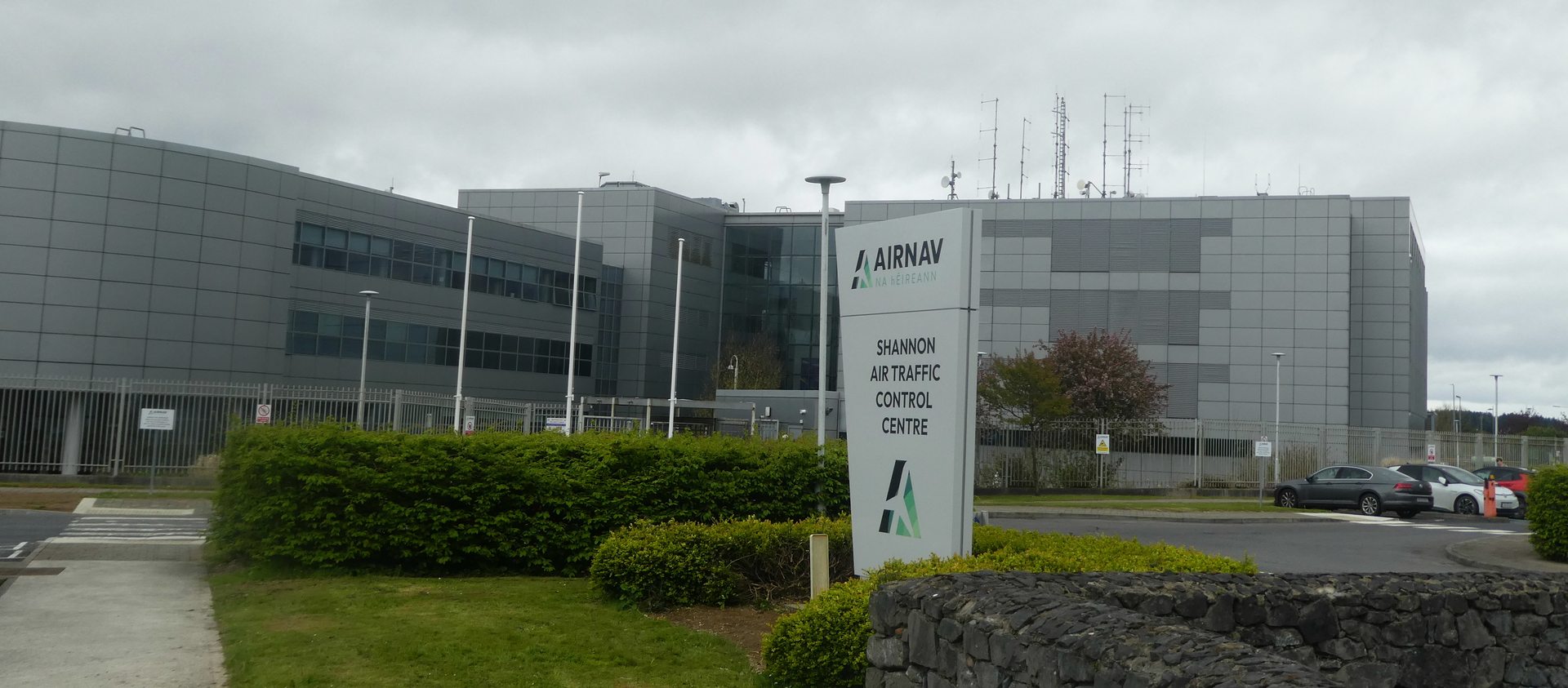
Pictured: the Shannon Air Traffic Control Centre in Ballycasey, Co. Clare — the facility whose controllers took the pilots' radio reports on the morning of November 9, 2018, not a photograph of the incident itself. No photograph of the object(s) the pilots described is known to exist; the case's primary evidence is the recorded ATC radio exchange itself, not any image.
Theoretical Alignment
The case aligns most strongly with a mundane misperception framework rather than any exotic hypothesis: trained but non-astronomer observers, moving at 500+ knots inside a pressurized cockpit with no external reference points, independently misjudged the range, altitude, and true nature of what the weight of the ground-based evidence indicates was very likely a bright, fragmenting meteor entering the atmosphere along a similar bearing to their flight paths. The Extraterrestrial Hypothesis draws some interest only because the witnesses were professional aircrew rather than casual observers, but the case offers no structured craft, no maneuvering behavior inconsistent with a ballistic atmospheric entry, and no physical or instrumented trace consistent with a controlled vehicle. The Interdimensional Hypothesis finds essentially nothing to engage with here — there is no reported high-strangeness element, missing time, or physiological effect of the kind IDH proponents typically point to. The comparatively high Psycho-Social alignment does not imply fabrication; rather, it reflects a well-documented aviation phenomenon in which a genuinely bright, fast-moving celestial event, seen edge-on from a moving high-altitude platform with no fixed reference points, is reflexively parsed by a startled human observer as a nearby object on a "collision" or "intercept" trajectory rather than a distant, harmless atmospheric event many miles above and beyond the aircraft.
Background
By November 2018, Ireland had no dedicated government body for evaluating unidentified aerial phenomena, and had never really had one. The state's engagement with the subject had always been ad hoc: a 1981 Dáil statement from then-Minister for Transport Albert Reynolds acknowledged eight reported UFO sightings since 1962, each passed along to whichever combination of An Garda Síochána, the Air Corps, and the state meteorological service seemed most relevant, with none confirmed as anomalous. Responsibility for aviation-adjacent UFO reports had, by default, settled on the Irish Aviation Authority (IAA), the statutory body responsible for air traffic control and civil aviation safety oversight across Irish airspace, including Shannon Air Traffic Control's oceanic and domestic sectors covering the eastern edge of the North Atlantic Track system used by the great majority of transatlantic flights between North America and Europe.
Friday, November 9, 2018 began as an entirely ordinary morning across that airspace. Dozens of westbound and eastbound transatlantic flights were converging on and diverging from Irish controlled airspace in the pre-dawn hours, as they do every day, at the cruising altitudes — generally above Flight Level 240, or roughly 24,000 feet — where oceanic traffic transitions to domestic European air traffic control. Among them that morning were British Airways' Speedbird94, a Boeing 787 Dreamliner inbound from Montreal–Trudeau International Airport to London Heathrow; Virgin Atlantic's Virgin76, a Boeing 747 inbound from Orlando International Airport to Manchester; and a Norwegian Air International Boeing 737 inbound from Stewart International Airport in New York's Hudson Valley to Shannon Airport itself. None of the three crews had any connection to one another beyond sharing, for a few minutes that morning, the same general stretch of sky under the same air traffic controller's watch.
Sunrise on Ireland's southwest coast in early November falls close to 7:40 AM local time, meaning the first radio call at the center of this case, logged at approximately 6:47 AM, occurred in genuine pre-dawn darkness — the specific lighting condition, combined with a clear, largely cloud-free sky that morning, under which a bright meteor is most dramatically visible and most likely to be mistaken by a startled observer for something far closer and far stranger than a rock burning up in the upper atmosphere many miles away.
Complete Timeline
| Date | Event |
|---|---|
| 1962 – 1981 | Ireland logs a handful of UFO reports handled informally by An Garda Síochána, the Air Corps, and the meteorological service; then-Transport Minister Albert Reynolds tells the Dáil in 1981 that eight such reports exist, none confirmed. |
| November 7, 2018 | NATO's Exercise Trident Juncture 2018, the largest NATO exercise in decades, concludes its live field phase across Norway, the North Atlantic, and the Baltic — the most significant contemporaneous military activity in the wider North Atlantic theatre, though not in Irish-controlled airspace. |
| November 9, 2018 — approx. 06:47 GMT | The captain of British Airways Speedbird94 (Boeing 787, Montreal–Heathrow) radios Shannon Air Traffic Control to ask whether military exercises are scheduled in the area, describing a very bright light that came up the aircraft's left side, "moving so fast," before rapidly veering north and disappearing at high speed. |
| November 9, 2018 — moments later | Shannon Control checks both primary and secondary radar and reports "nothing showing on either primary or secondary radar" along the reported bearing, and confirms no military exercises are scheduled in the airspace. |
| November 9, 2018 — shortly after | The crew of Virgin Atlantic Virgin76 (Boeing 747, Orlando–Manchester) independently radios Shannon Control, reporting "multiple objects following the same sort of trajectory," describing "two bright lights at 11 o'clock" that "banked over to the right and then climbed away at speed," and speculating the objects could be "a meteor or another object making some kind of re-entry." |
| November 9, 2018 — same window | A Norwegian Air International 737 (Stewart, NY–Shannon) becomes a third aircraft to confirm unusual bright light activity along a similar bearing to Shannon Control, bringing the total to three separate commercial crews reporting broadly similar phenomena within a short window. |
| November 9, 2018 — same morning | Astronomy Ireland's independent fireball-reporting network separately logs observer reports, including from Ireland's west coast, describing a "massive fireball" — greenish, with a long tail, moving comparatively slowly across the sky before fragmenting into several pieces on a northwest-to-southeast trajectory — at approximately the same time as the pilots' reports. |
| November 12–13, 2018 | The Shannon ATC audio recording, captured and published by LiveATC.net, begins circulating publicly; Irish and international media (RTÉ, The Journal, Irish Examiner) report the story, and the Irish Aviation Authority confirms it has "filed a report" that "will be investigated under the normal confidential occurrence investigation process." |
| November 13, 2018 | Aviation journalist Gerry Byrne tells Irish media the sighting was "in all probability" meteorites entering the atmosphere at a low trajectory; astronomer Apostolos Christou of the Armagh Observatory tells the BBC the pilots likely saw a piece of rock or dust — "commonly called shooting stars" — possibly no larger than a walnut or an apple. |
| November 13–15, 2018 | The story is picked up internationally by CNN, CBS News, NBC News, Newsweek, Time, the Washington Post, and dozens of other outlets; Prof. Michael Garrett of the Jodrell Bank Centre for Astrophysics tells the Irish Examiner a fragmenting meteorite is "a more reasonable explanation" than an unidentified craft, while stressing the pilots' reports merit genuine investigation. |
| 2018 – ongoing | No public findings from the IAA's confidential occurrence investigation have ever been released; under the IAA's standard occurrence-reporting protocol, such investigations are conducted for aviation-safety learning purposes and are not designed to produce a public verdict on the object's identity. |
| July 2023 | A tranche of Irish government records released under Freedom of Information law and reported by The Irish Times ("Ireland's X-Files") reveals ongoing internal confusion among Irish civil servants over departmental responsibility for UFO/UAP reports, citing the 2018 Shannon case among the incidents that renewed public interest. |
| 2020s | An Oireachtas Committee on Public Petitions considers a proposal informally known as "Project Morrigan" to position Ireland as a hub for scientific UAP study, a development frequently linked back to the public profile the 2018 Shannon case gave Irish UFO reporting. |
"Is There Any Military Activity in the Area?": The First Call
The recorded exchange that made this case famous begins, appropriately for a case about professional pilots doing their jobs, in the flattest possible procedural language. At approximately 6:47 AM, the captain of British Airways Speedbird94 — a Boeing 787 Dreamliner roughly two-thirds of the way through its overnight crossing from Montreal to London Heathrow, cruising above 24,000 feet in the final hour of darkness before sunrise — keyed her radio and asked Shannon Control a simple, safety-first question: was there any military activity scheduled in the area? It is the natural first question a professional aviator asks when she has just seen something unexplained and fast-moving near her aircraft, because an unscheduled military exercise or unannounced fast-jet transit is, statistically, by far the most likely mundane explanation for exactly this kind of report.
Pressed by the controller for more detail, she described what she had seen: an intensely bright light that had come up along the aircraft's left-hand side, then "rapidly veered to the north" before vanishing "at a very high speed." She was not describing a structured, hovering, or clearly craft-like object — by her own account, the entire event consisted of a light appearing, moving, and disappearing, all within a matter of seconds. Shannon Control checked its instruments in real time and delivered the reply that would become the case's most quoted line: "There is nothing showing on either primary or secondary radar." No military exercise was scheduled. No other traffic was showing on the controller's scope along the reported bearing.
Virgin76 and the Norwegian Air Confirmation
What transformed a single, easily dismissed pilot report into a genuine multi-witness case was what happened next: within a short window of the British Airways call, the crew of Virgin Atlantic's Virgin76, a Boeing 747 flying the transatlantic Orlando-to-Manchester route along a broadly similar corridor, radioed Shannon Control entirely independently, with no indication in the recorded exchange that the crew had heard the earlier BA transmission. Their description shared the core elements of brightness and speed but differed in detail in ways a genuine, physically confusable natural phenomenon would predict: rather than a single light, the Virgin76 crew described "multiple objects following the same sort of trajectory," specifying "two bright lights at 11 o'clock" that "seemed to bank over to the right and then climb away at speed." Strikingly, it was this second crew, not the first, that volunteered the explanation that would ultimately prove most durable: unprompted, a Virgin76 crew member suggested to Shannon Control that the objects might be "a meteor or another object making some kind of re-entry."
A third aircraft, a Norwegian Air International Boeing 737 approaching Shannon Airport itself from Stewart International Airport in New York, corroborated the general timing and character of the activity, bringing the total number of independently reporting commercial flight crews to three — a detail widely (if sometimes imprecisely) summarized in contemporary press coverage as "three commercial airlines" or, counting individual crew members across the three cockpits, "at least four pilots." One pilot, whose exact identity was not specified in the released transcript excerpts, offered the case's single most quoted line of hyperbole: that the object's speed was "astronomical. It was like Mach 2 or something" — twice the speed of sound, a figure repeated in nearly every subsequent news account of the case, even though, as later commentary would point out, a genuine meteor entering the atmosphere typically travels at tens of times the speed of sound, making "Mach 2" a strangely modest estimate for a natural fireball and a data point cited by some as evidence the pilots saw something closer and slower than a meteor, and by skeptics as further evidence that visual speed estimation of a distant light with no fixed reference point is simply unreliable in either direction.
The Astronomy Ireland Fireball Reports
The detail that would prove most consequential for how this case is ultimately assessed did not come from the cockpit at all. Astronomy Ireland, the country's largest astronomy interest organization and the operator of a long-running public fireball-reporting network, separately logged observer accounts — including, according to contemporary reporting, from witnesses on Ireland's west coast — describing a bright fireball crossing the sky at approximately the same time as the pilots' reports. The ground-based description, as later summarized in Irish press coverage citing Astronomy Ireland's own account, was of a "massive fireball," greenish in color, trailing a long tail, moving relatively slowly across the sky compared to the "instantaneous" flash the pilots described, and fragmenting into several distinct pieces as it traveled on a roughly northwest-to-southeast trajectory before, in the assessment offered at the time, most likely falling into the sea.
The apparent contradiction between "instant, blinding light that vanished at Mach 2" (the pilots' framing) and "fireball that moved comparatively slowly and broke into several visible pieces" (the ground observers' framing) is not, on close examination, actually a contradiction — it is close to the textbook signature of the same underlying physical event described from two very different vantage points. A bright meteor entering the atmosphere and fragmenting genuinely does move relatively slowly across the sky when judged against a fixed horizon from the ground at a safe distance, over a duration of one to several seconds, exactly matching an observer with time to watch it fragment. The same event seen edge-on, at much closer range, from inside a moving aircraft with no fixed horizon reference and startled attention only catching the tail end of the event, would very plausibly register as a single, blindingly bright flash that seemed to move at extraordinary speed relative to the aircraft and then simply vanish — precisely the "rapidly veered and disappeared" language both cockpit crews used. The multiple bright lights the Virgin76 crew described, moreover, align closely with a fragmenting bolide breaking into several glowing pieces, rather than with a single coherent craft.
The Irish Aviation Authority's Investigation and Its Limits
Once the recorded audio began circulating publicly in mid-November 2018, the Irish Aviation Authority issued a brief, carefully worded confirmation rather than a full public statement: "Following reports from a small number of aircraft on Friday 9th November of unusual air activity, the IAA has filed a report. This report will be investigated under the normal confidential occurrence investigation process." That single sentence has done a great deal of interpretive work in subsequent UFO-community discussion of the case, frequently cited as evidence of an "official investigation" implying institutional seriousness about the possibility of a genuine anomaly. In practice, the IAA's occurrence-reporting system is a standard, globally used civil-aviation-safety mechanism — the same confidential process used to log and review bird strikes, near mid-air collisions, weather encounters, and equipment malfunctions, designed to extract aviation-safety lessons rather than to adjudicate the metaphysical identity of an unidentified light. No version of the IAA's findings, if any final determination was ever reached, has been made public, and no subsequent Freedom of Information release has surfaced a completed report specifically on this incident, leaving the confidential occurrence file's actual conclusions — if it reached one at all — outside the public record to this day.
Public Release of the ATC Audio
Unlike many historic UFO cases that rely entirely on after-the-fact witness recollection, this case is unusual in having its primary evidence exist as a contemporaneous, unedited audio recording rather than a later retelling. LiveATC.net, a long-running volunteer network that streams and archives live air traffic control radio communications from airports and control centers worldwide (including Shannon), captured the exchange as it happened and made the recording publicly accessible, exactly as it does for tens of thousands of hours of routine aviation radio traffic daily. It was the circulation of that specific clip — rather than any press release, whistleblower account, or UFO-organization investigation — that turned three routine radio calls into international news within days. This detail matters for assessing the case's credibility: the core testimony was never filtered through memory, media paraphrase, or a UFO investigator's transcription before reaching the public; the raw words, tone, and phrasing of the crews and controllers are preserved exactly as spoken, which is both a genuine evidentiary strength (no distortion through retelling) and a genuine evidentiary limit (the recording captures only what the crews chose to say over the radio in the moment, not a full debrief of everything they observed).
Ireland's Uneasy Institutional Relationship with UFO Reports
The 2018 Shannon case did not occur in an institutional vacuum, and understanding it requires understanding just how little institutional infrastructure Ireland has ever had for this category of report. Unlike the United States (which has had, at various points, Project Blue Book, AATIP, and now AARO) or the United Kingdom (which maintained a dedicated Ministry of Defence UFO desk for decades), Ireland has never operated a standing government office tasked with investigating unidentified aerial phenomena. The 2023 tranche of internal Irish government correspondence obtained under Freedom of Information law and reported by The Irish Times under the headline "Ireland's X-Files" laid this institutional gap bare in unusually candid terms: civil servants across multiple departments were shown attempting to redirect UFO-related public inquiries to one another, with one official in the Department of Transport writing "Ah here, you can't push that one on to us! You know exactly how much involvement we have in space," while the Department of Defence redirected matters toward the Irish Aviation Authority and the aviation-services division in turn tried to decline involvement. This is the same institutional landscape the 2018 Shannon pilots' reports landed in: an aviation regulator equipped to log and privately review the incident as a safety occurrence, but no scientific body, defense body, or dedicated UAP office with either the mandate or the expertise to conduct — let alone publish — a rigorous public investigation into what the pilots actually saw.
Key Witnesses
Captain, British Airways Speedbird94
The pilot whose radio call opened the case, asking Shannon Control whether military exercises were scheduled after watching an intensely bright light come up the aircraft's left side, veer sharply north, and vanish at high speed. Her identity was never publicly released by British Airways or Irish media, consistent with standard airline practice of not naming crew members in incident coverage absent their own consent. Her transmission is the case's clearest single piece of primary evidence, preserved on the LiveATC.net recording exactly as spoken.
Captain and Crew, Virgin Atlantic Virgin76
Radioing Shannon Control independently and shortly after the British Airways report, this crew described "multiple objects following the same sort of trajectory" and "two bright lights at 11 o'clock" that banked and climbed away at speed. A member of this crew was also the first to volunteer, unprompted, that the objects might be "a meteor or another object making some kind of re-entry" — the explanation that would ultimately gain the most expert support in the days that followed.
Crew, Norwegian Air International 737
The third independently reporting flight crew, approaching Shannon Airport itself on a transatlantic service from Stewart International Airport in New York's Hudson Valley. Their corroborating report, made along a broadly similar bearing and within the same general window as the other two, is what elevated the case from a single anomalous report to a genuine multi-witness pattern spanning three separate airlines.
Dr. Apostolos Christou
A near-Earth-asteroid specialist with more than two decades at Armagh, Christou told the BBC in the days after the story broke that the pilots most likely saw dust or rock entering the atmosphere at high speed — ordinary "shooting stars" possibly no larger than a walnut or an apple — and that the pilots' high-speed vantage point made it extremely difficult to correctly judge the true distance and scale of what they saw.
Prof. Michael Garrett
A radio astronomer and SETI researcher who directs one of the world's most prominent radio-astronomy institutions, Garrett told the Irish Examiner that a meteorite breaking apart high in the atmosphere "would also be travelling at speed and it would break into multiple components," calling it "a more reasonable explanation" than an unidentified craft, while explicitly stating the pilots' reports deserved to be taken seriously and investigated rather than dismissed.
Gerry Byrne
An experienced aerospace journalist and author of the air-crash investigation book Flight 427: Anatomy of an Air Disaster, Byrne was among the first commentators quoted in Irish media stating the sighting was "in all probability" meteorites, noting that meteorites commonly enter the atmosphere at a low trajectory that can easily be mistaken by a fast-moving observer for a much closer object.
Astronomy Ireland (Fireball-Reporting Network)
Ireland's largest astronomy organization operates an ongoing public fireball-reporting service through which members of the public, including witnesses on the west coast, independently logged a bright, greenish, fragmenting fireball at approximately the same time as the pilots' reports — the single most important piece of independent, ground-based corroboration for the meteor explanation, gathered without any knowledge of the simultaneous cockpit reports.
The Five Observables Assessment
The Five Observables framework, developed by former AATIP director Luis Elizondo, is applied to the performance characteristics reported in this case:
Assessment: Anti-Gravity Lift is rated absent: no witness, in any account, described hovering, sudden directional reversal, or any lift-against-gravity behavior — every description is of linear, ballistic-looking motion consistent with an object simply passing through the field of view. Instant Acceleration and Hypersonic Velocity are both rated speculative rather than present or absent, because the "Mach 2" and "disappeared at very high speed" impressions rest entirely on unaided visual estimation from a fast-moving aircraft with no fixed reference point — exactly the circumstance in which a distant meteor's true angular velocity is most easily mistaken for a much closer object's linear velocity, in either direction. Low Observability is rated absent: every account describes the object(s) as extremely, almost blindingly bright, the opposite of a low-observable or stealthy platform. Trans-Medium travel is rated absent/not applicable, as no witness reported any transition between air, water, or space.
Evidence Assessment
Supporting Anomalous Origin
- Three independent, professionally credentialed commercial flight crews (British Airways, Virgin Atlantic, Norwegian Air International) reported broadly similar phenomena within a short time window and along a similar bearing, with no evidence any crew heard another's transmission before making its own report.
- All primary witnesses were type-rated Airline Transport Pilots subject to recurrent medical and competency evaluation, with no known prior public interest in UFOs and no apparent motive to fabricate or embellish a report made in the flat, procedural language of a routine radio call.
- The core testimony exists as an unedited, contemporaneous audio recording rather than after-the-fact recollection, eliminating memory drift or media paraphrase as a source of distortion in what was actually said.
- Some described behavior — a light "veering" sharply and multiple lights maneuvering on slightly different apparent bearings — is not perfectly explained by the simplest possible meteor model, in which all fragments of a single bolide should appear to move along closely parallel tracks.
- The Irish Aviation Authority treated the reports as serious enough to warrant a formal, if confidential, occurrence investigation rather than dismissing them outright.
Supporting Conventional Explanation
- Astronomy Ireland's independent fireball-reporting network logged ground-based witnesses, including on Ireland's west coast, describing a bright, greenish, fragmenting fireball at approximately the same time as the pilots' reports — corroboration gathered independently of, and without knowledge of, the cockpit reports.
- The sighting falls within the multi-week activity window of the Taurid meteor shower, historically associated with an elevated rate of bright fireball events across the UK and Ireland in late October and November.
- Shannon Air Traffic Control found nothing on either primary or secondary radar, and no scheduled military activity — consistent with a natural atmospheric event rather than a solid, radar-reflective craft.
- Multiple named experts — astronomer Apostolos Christou, radio astronomer Michael Garrett, and aviation journalist Gerry Byrne — independently converged on a meteor/meteorite explanation within days, without evidence of coordination between them.
- No photograph, video, radar track, or physical trace of a structured craft has ever surfaced from any of the three cockpits, any other aircraft in the area, or any ground observer, despite significant subsequent media attention.
- None of the witnesses were trained astronomical observers, and cockpit windows at high speed and cruising altitude are a poor platform for accurately judging the true range, altitude, or absolute speed of a distant light with no fixed reference frame.
Why "Disputed"
The 2018 Irish Airspace UFO Sightings earn a DISPUTED rating on this site's scale because the case combines a genuinely strong witness pool with an unusually well-timed, independently corroborated conventional explanation — the two pull in opposite directions, and neither fully resolves the case. On the strength side: three separate, professionally credentialed commercial flight crews reported broadly similar phenomena independently and within a short window, using the flat, safety-first language of pilots reporting a possible traffic conflict rather than the excited language of a UFO sighting, and the entire core testimony survives as an unedited contemporaneous recording rather than a retold anecdote. That is a genuinely higher bar of multi-witness corroboration than the great majority of "lights in the sky" reports ever clear. Weighing heavily against an anomalous reading, however, is the Astronomy Ireland fireball corroboration: independent ground-based witnesses, with no knowledge of the simultaneous cockpit reports, logged a bright, fragmenting, greenish meteor crossing the sky at essentially the same time and along a broadly consistent trajectory — a level of independent, dated, physically specific corroboration for the mundane explanation that most disputed pilot-UFO cases simply do not have. Radar found nothing, no military activity was scheduled, no photograph or physical trace of any kind exists, and three credentialed astronomers/journalists converged independently on the same meteor explanation within days. The case is not confidently solved — the IAA's own confidential investigation never published a public conclusion, the "Mach 2" speed estimate sits awkwardly with a simple meteor model, and the precise correlation between the ground fireball reports and the specific cockpit sightings has never been rigorously, quantitatively established rather than asserted by timing alone — but the balance of genuinely independent evidence leans meaningfully toward a natural, if dramatic, atmospheric event rather than an unexplained craft, placing the case in disputed rather than credible territory.
Sensor & Instrumentation Detection Profile
No airborne or ground-based sensor system of any kind corroborated the presence of a structured craft. Shannon Air Traffic Control checked both its primary (skin-paint) and secondary (transponder-interrogation) radar returns in direct response to the British Airways crew's query and reported nothing showing on either system along the reported bearing. This negative result is genuinely ambiguous rather than exculpatory: civil en-route radar of the kind Shannon Control operates is not designed to detect small, fast-moving natural objects at extreme altitude any more than it is designed to detect a stealthy craft, so the absence of a radar return is equally consistent with "nothing physically present to reflect a radar pulse" (a meteor, which is largely plasma and small ablating rock rather than a solid radar-reflective target at that range) and with "an object with genuinely low radar cross-section." No FLIR, weather radar imagery, cockpit camera footage, or onboard flight-data-recorder trace of the object has ever been published or referenced in any account of the case. The case's only recorded "instrument" in the broad sense is the Shannon ATC audio log itself and the routine flight-tracking data (aircraft type, callsign, route, and approximate position) each carrier confirmed for its own flight.
Environmental & Geospatial Context
The sightings occurred in the final hour before sunrise on a clear, cloud-free November morning over the North Atlantic Track corridor southwest of Ireland — a heavily trafficked stretch of oceanic and domestic airspace under Shannon Control's jurisdiction, roughly along the path of the County Kerry coastline, at cruising altitudes above 24,000 feet where high-altitude visibility is typically excellent and unobstructed by cloud or ground light pollution. This same pre-dawn darkness-with-clear-sky combination is precisely the condition under which a bright fireball is most visible and most strikingly out of place to an observer expecting only city lights, other aircraft beacons, or the gradually brightening horizon. Geospatially, the date falls within the broad, weeks-long activity window of the annual Taurid meteor stream, a lesser but historically fireball-rich shower active through October and November whose parent comet (2P/Encle) sheds unusually large, slow-moving debris capable of producing exceptionally bright bolides; UK and Irish meteor-monitoring networks log an elevated rate of fireball reports in this exact window most years. No unusual solar or geomagnetic activity, and no scheduled military exercise in Irish-controlled airspace, has ever been documented for the morning in question — Shannon Control explicitly ruled out military activity when asked in real time, and NATO's large Trident Juncture 2018 exercise, the most significant contemporaneous military activity in the wider North Atlantic theatre, had already concluded its live field phase in Norwegian and Baltic airspace two days earlier, on November 7.
Observer Credibility & Occupational Profile
The case's evidentiary strength rests almost entirely on the professional status of its witnesses rather than on any physical or instrumented corroboration. All primary observers were type-rated commercial airline captains and first officers — the British Airways Speedbird94 captain flying a Boeing 787 Dreamliner, the Virgin Atlantic Virgin76 crew flying a Boeing 747, and the Norwegian Air International crew flying a Boeing 737 — each holding an Air Transport Pilot Licence, each subject to recurrent medical and simulator-based competency checks, and each professionally accustomed to distinguishing aircraft lights, weather phenomena, and celestial objects from genuine traffic conflicts as a routine, safety-critical part of the job. None of the crews had any known prior public interest in UFOs, none sought media attention (the audio became public through a third-party recording service rather than any crew member's own initiative), and their radio phraseology throughout is the flat, procedural language of professional aviators reporting a possible traffic conflict, not a UFO sighting — the British Airways captain's opening question was specifically whether military exercises were scheduled, the most mundane and safety-relevant explanation a pilot would reach for first. Working against the case's evidentiary weight, however, is that none of these witnesses were trained astronomical observers, all were traveling at high speed with no fixed external reference points, and cockpit windows at cruising altitude offer a poor platform for judging the true distance, size, or trajectory of a bright light many tens of miles away and far above the aircraft's own altitude — exactly the misjudgment astronomer Apostolos Christou would later point to in his own assessment of the case.
Physical & Material Assays
No physical evidence of any kind is associated with this case, and none has ever been claimed. No debris, fragment, or recovered material linked to the sighting has been located, examined, or submitted for laboratory analysis — consistent with either a meteor that fully ablated in the upper atmosphere over open ocean (where any surviving fragment would be effectively unrecoverable) or with a genuine unidentified craft that departed the area under its own power. The case's entire evidentiary record consists of recorded aural testimony (the ATC radio exchange) and second-hand press reporting of pilot and expert statements; no photograph, video frame, or other visual capture of the object(s) themselves has ever surfaced from any of the three flight crews, from any other aircraft in the vicinity, or from any ground-based observer, despite widespread subsequent media interest and the well-documented existence of independent ground witnesses who separately reported a fireball at the same time.
Historical Precedents & Archive Matches
The case belongs to a recognizable and recurring sub-genre of UAP reporting: the multi-aircrew, radio-corroborated "bright light" sighting over open ocean or remote terrain, in which independent professional witnesses describe broadly similar phenomena within a short window but no radar, camera, or physical evidence exists to adjudicate between a genuine anomaly and a shared misperception of a natural or conventional event. Structurally, it echoes both the 1986 Japan Air Lines Flight 1628 case, in which a cargo-747 captain over Alaska reported a large object pacing his aircraft and, unusually, obtained a partial radar correlation from Anchorage air traffic control, and the 1978 Kaikōura Lights case off New Zealand, in which a cargo-aircraft crew and a television film crew jointly documented mysterious lights that a later government-sponsored scientific review concluded were most likely misidentified planets, squid-boat lights, and meteors. Within Ireland specifically, the case sits inside a long but thin official record: then-Minister for Transport Albert Reynolds told the Dáil in 1981 that eight UFO reports had been logged and examined by An Garda Síochána, the Air Corps, and the meteorological service since 1962, none of which was confirmed as anomalous, and a 2023 tranche of Irish government records obtained under Freedom of Information legislation and reported by The Irish Times revealed ongoing internal confusion among Irish civil servants over which department, if any, actually bears responsibility for UFO/UAP reports — with the Department of Transport, the Department of Defence, and the Irish Aviation Authority each having, at various points, attempted to redirect inquiries elsewhere. As of this case file's publication, an Oireachtas committee petition informally referred to as "Project Morrigan" has proposed establishing Ireland as a dedicated hub for scientific UAP study, a development this 2018 case is frequently cited as having helped inspire.
Material Analysis
No physical or trace material of any kind has ever been recovered or associated with this case, and none has ever been claimed by any witness, investigator, or agency — that absence is itself informative. If the leading meteor/fireball hypothesis is correct, the object almost certainly ablated fully in the upper atmosphere or, per Astronomy Ireland's own contemporary assessment, most likely fell into the open Atlantic well off the Irish coast, placing any surviving fragment beyond practical recovery. If a genuinely unidentified craft was involved, it departed the area under its own power with no reported debris, emission signature, or landing trace of any kind. Either way, the case's evidentiary record is entirely testimonial and acoustic (the ATC recording) rather than physical, which meaningfully limits how conclusively it can ever be resolved in either direction — there is no sample to date, test, or isotopically analyze, and no metallurgical or chemical assay has ever been possible.
Supporting Non-Terrestrial Origin
- No recovered fragment has ever been positively matched to a known meteorite fall, leaving the meteor explanation's physical chain of evidence formally incomplete.
- The apparent discrepancy between the pilots' "instantaneous, Mach 2" impression and the ground observers' "slower-moving, several-second" fireball description has never been rigorously reconciled with a single quantitative trajectory model published by any astronomical body.
Supporting Terrestrial Origin
- An open-ocean impact zone, consistent with Astronomy Ireland's own assessment of the fireball's likely trajectory, is exactly the condition under which a genuine meteorite fall would be expected to leave no recoverable terrestrial fragment.
- The complete absence of any debris, landing trace, or recovered material is equally consistent with (and arguably more probable for) a natural meteor that fully burned up over the sea than with a controlled craft, which would not necessarily be expected to leave physical evidence either.
- No credible claim of recovered material inconsistent with a meteorite has ever surfaced from any source connected to this specific case.
The Conventional Explanation Candidate: A Fragmenting Meteor / Fireball
The leading conventional explanation, advanced independently within days by astronomer Apostolos Christou, radio astronomer Michael Garrett, and aviation journalist Gerry Byrne, holds that the pilots observed a bright meteor or fireball entering the atmosphere and breaking apart, most likely associated with the Taurid meteor stream's known fireball-rich activity window in late October and November. It deserves serious evaluation because it is the only candidate explanation with genuinely independent, ground-based, dated corroboration: Astronomy Ireland's public fireball-reporting network separately logged witnesses, including on the west coast, describing a bright, greenish, fragmenting fireball at essentially the same time as the cockpit reports — evidence gathered by people with no knowledge of what the pilots had radioed to Shannon Control. The described fragmentation into "multiple objects" and "two bright lights" tracking similar courses, reported independently by the Virgin76 crew, is a natural and expected signature of a bolide breaking apart during atmospheric entry, and the general northwest-to-southeast ground track reported by Astronomy Ireland is broadly compatible with an object passing near the aircrafts' reported bearings off the southwest Irish coast.
The Taurid complex itself is an unusually apt candidate for a bright, fragmenting fireball rather than an ordinary faint meteor. Sourced from debris shed by short-period comet 2P/Encke, which completes an orbit of the Sun roughly every 3.3 years and has produced one of the largest known debris streams in the inner solar system, the Northern and Southern Taurid sub-streams are active across a multi-week window spanning late October through late November and are disproportionately associated with large, slow-moving fragments capable of producing exceptionally bright bolides rather than the faint, fast streaks typical of showers like the Perseids or Geminids — a pattern that has earned the Northern Taurids the nickname "the Halloween fireballs" among meteor astronomers, particularly following an unusually intense, internationally observed fireball outbreak in 2005 tied to the stream's periodic encounters with a denser resonant "swarm" of debris trapped in a 7:2 orbital resonance with Jupiter, with further enhanced returns documented around 2008 and 2015. November 2018 was not among the specific years flagged in advance by meteor astronomers as a heightened Taurid swarm encounter, and no scientific paper has retroactively identified it as such; the Taurids' ordinary annual background activity, however, still reliably produces an elevated rate of bright fireball reports across the UK and Ireland in this exact window most years, independent of whether a given year coincides with the denser resonant swarm.
Unscheduled Military Activity or Aircraft
A second candidate — that the pilots encountered an unscheduled military aircraft, drone, or other conventional airborne platform — was the very first explanation the British Airways captain herself considered, prompting her initial question to Shannon Control. It deserves consideration precisely because it was the pilots' own first instinct, and because military and government drone activity over the North Atlantic approaches has occasionally gone unlogged with civil air traffic control in other documented incidents. It is substantially weakened, however, by Shannon Control's real-time confirmation that no military exercise was scheduled in the airspace, by the fact that NATO's major regional exercise that autumn (Trident Juncture 2018) had already concluded its live field phase two days earlier and was centered on Norwegian and Baltic airspace rather than the Irish Atlantic approaches, and by the reported "very high speed" and abrupt disappearance, which does not match the sustained, trackable flight profile a conventional aircraft or drone would present to three separate crews across a period of several minutes.
Space Debris or Satellite Re-Entry
A third candidate sometimes raised in general discussion of bright pre-dawn aerial fireballs is uncontrolled re-entry of a rocket body or defunct satellite, which can produce a similarly bright, fragmenting, slow-moving light disintegrating across the sky. This candidate does not hold up well against the specific facts of this case: no cataloged rocket-body or satellite re-entry has ever been publicly identified as occurring over the North Atlantic on the morning of November 9, 2018, in contrast to well-documented re-entry-linked UAP reports elsewhere that are tied to a specific, named object and orbital decay prediction. It is worth noting explicitly, given how often this candidate is raised for 2018-era sightings, that no Starlink-constellation connection is plausible here: SpaceX's Starlink satellite launches did not begin until May 2019, some six months after this sighting, and the two 2018 SpaceX "Tintin" prototype test satellites that did precede Starlink were not associated with any documented reentry event near this date. Absent a specific, cataloged object and decay time to test against the reported sighting window, this candidate remains unsupported by any evidence beyond general plausibility.
Fragmenting Meteor / Fireball
PlausibleIndependently corroborated by Astronomy Ireland's ground-based fireball network at essentially the same time, consistent with the known Taurid activity window, and consistent with the fragmentation and multi-light behavior reported by the Virgin76 crew — though the pilots' own "Mach 2" impression has never been formally, quantitatively reconciled with a specific meteor trajectory model.
Unscheduled Military Activity / Aircraft
ImplausibleExplicitly ruled out in real time by Shannon Control, which found no scheduled exercise and nothing on radar; the nearest major regional exercise had already concluded two days earlier in a different theatre entirely.
Space Debris / Satellite Re-Entry
ImplausibleNo cataloged re-entry event has ever been identified for this specific date and location, and the case significantly predates the Starlink constellation's first launches by roughly six months, leaving this candidate without any specific supporting evidence.
Related Cases
Confirmed Documents & Official Records
The IAA is the statutory Irish body that confirmed filing a formal occurrence report on the November 9, 2018 sightings, to be handled under its standard confidential occurrence-investigation process. No public version of any resulting findings has been released.
PUBLIC STATEMENT ONLYSearchable record of Dáil debates, including then-Minister for Transport Albert Reynolds's 1981 statement on Ireland's eight historic UFO reports, and any later parliamentary questions or petition committee discussion (including "Project Morrigan") touching on UAP policy.
PUBLIC RECORDSearch Government Archives Directly
Further Reading — Recommended Literature
UFOs: Generals, Pilots, and Government Officials Go on the Record
An investigative journalist's compilation of aviation-witness UAP reports from credentialed pilots and officials worldwide, useful context for evaluating how much weight professional flight-crew testimony like that in this case should carry on its own.
Project Delta: A Study of Multiple UFO
A NASA-trained scientist's methodical study of pilot-reported multiple-object UAP sightings, directly relevant to a case involving three separate aircrews independently reporting similar phenomena within minutes of each other.
Conspiracy of Silence: UFOs In Ireland
Written by the co-founders of UFO and Paranormal Research Ireland, this remains the primary book-length survey of Irish UFO cases, situating the 2018 Shannon sightings within Ireland's own longer, thinly documented sighting history.
Meteor Showers: An Annotated Catalog
A rigorous astronomical reference on meteor showers, including the Taurid stream implicated in this case's leading conventional explanation, useful for readers who want to independently evaluate the fireball hypothesis's astronomical plausibility.
The UFO Encyclopedia, 4th Edition
The definitive UFO reference work, useful for situating this case within the broader historical pattern of multi-witness commercial-aircrew "light in the sky" reports and their typical range of conventional and unconventional explanations.
Essential Viewing
![[REAL ATC] Several aircraft witness a UFO RIGHT OVER IRELAND!](/images/thumbs/pv7x4dRye3U.jpg)
Sources
- Perrigo, Billy. "Irish Authorities Are Investigating UFOs Reported By 3 Commercial Pilots on a Single Night." Time, November 13, 2018. time.com
- "'Moving so fast': UFO sighting under investigation by Irish Aviation Authority." TheJournal.ie, November 12, 2018. thejournal.ie
- "Update: UFO seen off Irish coast 'in all probability, were meteorites.'" Irish Examiner, November 13, 2018. irishexaminer.com
- "Astronomer says reported 'UFO' was probably a meteorite." Irish Examiner, November 13, 2018. irishexaminer.com
- Guy, Jack. "Airline Pilots Report UFOs Near Ireland Moving at 'Astronomical' Speeds." Newsweek, November 13, 2018. newsweek.com
- "Pilots report seeing UFO 'moving so fast' off coast of Ireland." CBS News, November 12, 2018. cbsnews.com
- "Pilots spot UFO over Ireland skies. Here's why it's not aliens." Deseret News, November 15, 2018. deseret.com
- "UFO sightings by pilots are being investigated by Ireland's Aviation Authority." CNBC, November 13, 2018. cnbc.com
- "Unidentified flying object investigated by the Irish Aviation Authority." NBC News, November 13, 2018. nbcnews.com
- Puckett, Jessica. "Ireland's Aviation Authority Is Investigating UFO Sightings by Pilots." The Points Guy, November 13, 2018. thepointsguy.com
- Rosenblatt, Kalhan (NBC News). "Reports of UFO probed by Irish Aviation Authority." Euronews, November 13, 2018. euronews.com
- "Multiple Airline Pilots Report Seeing UFOs Off Irish Coast." Vice, November 2018. vice.com
- Cummins, Nicholas. "Both British Airways and Virgin Atlantic Pilots Encounter UFO's Whilst Flying Over Ireland." Simple Flying, November 13, 2018. simpleflying.com
- Clark, George. "Investigation Follows UFO Sightings Over Ireland." Flying Magazine, November 20, 2018. flyingmag.com
- "What was UFO seen off the Irish coast?" The Week, November 2018. theweek.com
- Gallagher, Conor. "Ireland's X-Files: Records reveal Government confusion over UFOs." The Irish Times, July 16, 2023. irishtimes.com
- Wikimedia Commons. "File: Shannon Air Traffic Control Centre.jpg" (photograph by Rex and Fido, CC BY-SA 4.0, April 2023) — hero image source. commons.wikimedia.org
- National Aviation Reporting Center on Anomalous Phenomena (NARCAP). "A Preliminary Study of 57 Selected Pilot Sighting Reports." NARCAP Technical Report 3, 2001 (methodological background on evaluating pilot UAP testimony). narcap.org archive
- Exercise Trident Juncture 18 Media Resources. North Atlantic Treaty Organization (NATO), October 25, 2018. nato.int
- Irish Aviation Authority. Official Website. iaa.ie
- LiveATC.net. Air traffic control audio archive and recordings service (source of the publicly circulated Shannon ATC recording). liveatc.net
- Astronomy Ireland. National astronomy organization and public fireball-reporting network. astronomy.ie
- Armagh Observatory and Planetarium. Staff profile, Dr. Apostolos Christou. armagh.space
- Jodrell Bank Centre for Astrophysics, University of Manchester. Staff profile, Prof. Michael Garrett. jodrellbank.manchester.ac.uk
See something inaccurate? Have additional information or sources?
Suggest an Edit →Last Updated: August 2026