
The Kaikōura Lights
Over two separate nights in December 1978, cargo aircraft flying the night mail run between Blenheim, Wellington and Christchurch encountered unidentified lights above the Kaikōura coast of New Zealand's South Island. On December 21, Safe Air Ltd pilots Vern Powell and Ian Pirie watched a brilliant object pace their Argosy freighter while Wellington air traffic control simultaneously tracked it on radar. Nine nights later, an Australian television crew led by reporter Quentin Fogarty and cameraman David Crockett boarded a follow-up flight hoping to film background footage — and instead captured roughly fourteen minutes of colour 16mm film of glowing objects that were, again, corroborated in real time by ground radar. The resulting footage aired around the world, drew personal attention from Prime Minister Robert Muldoon, and prompted an official DSIR investigation that reported to the United Nations in January 1979 that the objects would remain classified as "UFOs until identified."
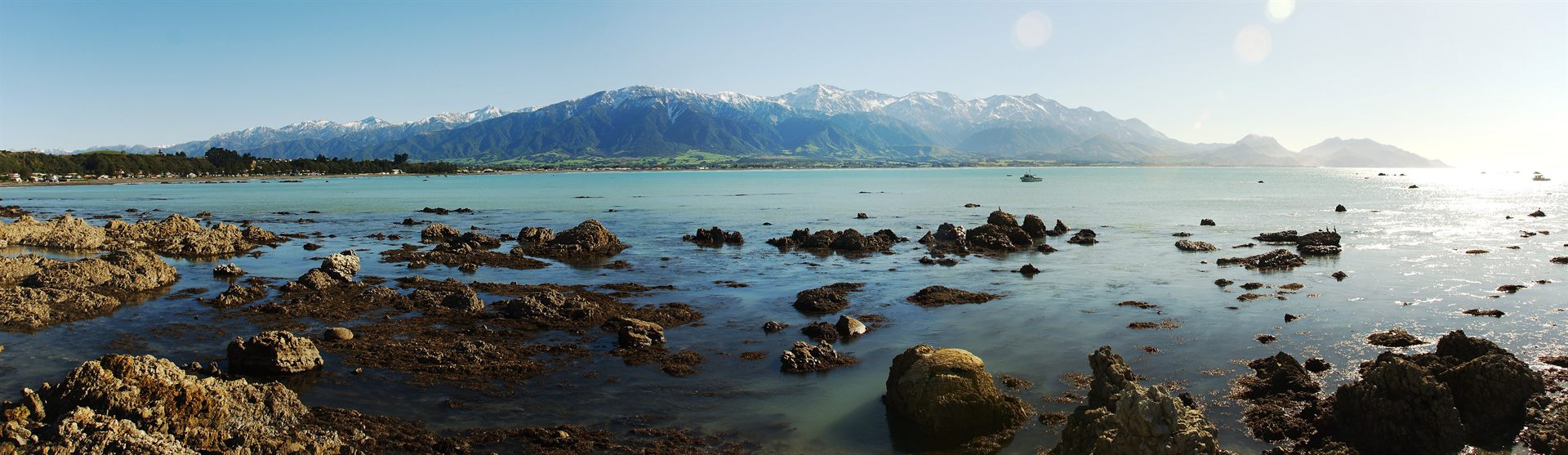
Pictured: the Seaward Kaikōura Range viewed from the Kaikōura coastline — the actual mountain range and coastal airspace above which both encounters occurred, not a photograph of the lights, the aircraft, or the film footage itself. No public-domain or rights-clear photograph of the original 16mm film frames, the Argosy ZK-SAE in period livery, or the incident aircraft's cockpit is known to exist; the surviving footage remains held by the New Zealand principals and TV1/Network Ten rather than freely licensed.
Theoretical Alignment
The Kaikōura case earns a modest but non-trivial ETH alignment on the strength of its unusually broad instrumented record — simultaneous ground radar, airborne radar, direct visual observation by professional pilots, and roughly fourteen minutes of colour film — a combination optical physicist Bruce Maccabee called among the most "instrumented" civilian sightings on record. It scores lower than that instrumentation alone might suggest because New Zealand's own official investigators never actually endorsed an exotic origin; the DSIR's own working conjecture leaned toward mundane light sources, even as it declined to fully close the file. The Psycho-Social Hypothesis scores moderately: the Kaikōura area's well-documented Japanese and Korean squid-boat fishing fleets, combined with a genuinely startling first sighting on December 21 that primed the television crew's expectations nine nights later, create real conditions under which ambiguous lights could have been amplified into a dramatic narrative by professionals already anticipating a story. The Interdimensional Hypothesis finds essentially no support in the record; nothing beyond unusual lights, radar returns, and film artifacts was ever reported.
Background
Safe Air Ltd, originally founded in 1950 as Straits Air Freight Express, operated New Zealand's main overnight air-freight network from a base at Woodbourne Airport outside Blenheim, at the northern tip of the South Island. By the late 1970s the airline's workhorse aircraft was the Armstrong Whitworth AW.650 Argosy, a twin-boom, four-engined turboprop freighter originally designed for British European Airways in the early 1960s; Safe Air's own Argosy fleet flew nightly newspaper, mail, and general freight runs linking Wellington, Blenheim, and Christchurch, a route that regularly took crews low over the Kaikōura coast in the small hours of the morning. It was an unglamorous, tightly scheduled operation, and its pilots were not the kind of witnesses inclined toward exaggeration or publicity-seeking; a strange report from a Safe Air crew carried a different institutional weight than one from a member of the public precisely because it threatened to complicate, rather than enhance, an otherwise routine working night.
December 1978 was already an unusually active month for unexplained aerial reports in the Tasman Sea region. Two months earlier, on October 21, 1978, Australian pilot Frederick Valentich had vanished over Bass Strait after reporting a large object pacing his light aircraft, a case that drew heavy Australian press coverage and left both the flying public and Melbourne newsrooms primed for further reports from the region. In New Zealand itself, scattered independent sightings had already been logged around the Marlborough Sounds and Kaikōura coast in the weeks before December 21, feeding local rumour and setting the stage for what was about to become one of the most thoroughly covered UFO stories in New Zealand history. Against that backdrop, an RNZAF officer on a routine overnight watch at Woodbourne, followed within hours by two commercial cargo pilots on their scheduled freight run, would together produce the case's first, and in some ways most dramatic, night of sightings.
Complete Timeline
| Date / Time | Event |
|---|---|
| Dec. 21, 1978, ~11:30 PM | RNZAF officer Ian Uffindall, on the tarmac at Woodbourne, sees a light he first mistakes for an approaching aircraft; it reverses direction, becomes three lights, and executes what he later describes as geometric manoeuvres while shining beams toward the ground. |
| Late evening, Dec. 21 | Wellington air traffic control begins logging unidentified radar returns in the vicinity of the reported sightings; controllers alert nearby Safe Air Ltd crews operating in the area. |
| ~Midnight–2:00 AM, Dec. 21–22 | Safe Air Ltd pilots Vern Powell and Ian Pirie, flying an Armstrong Whitworth Argosy from Blenheim toward Christchurch, observe a bright object emerge from cloud and pace their aircraft at close range. Pirie later recalls it as "so close it was almost frightening…the size of a house, burning in the sky." The object remains on both the aircraft's own radar and Wellington's ground radar intermittently through the encounter, with press accounts at the time citing radar operators clocking one return covering roughly 24 kilometres in about five seconds. |
| Following days, Dec. 1978 | New Zealand press coverage of the December 21 sighting spreads nationally and reaches Australian newsrooms, including Melbourne's Channel 0 (later part of Network Ten). |
| Dec. 30, 1978, ~11:30 PM–12:30 AM | A Channel 0 television crew — reporter Quentin Fogarty, cameraman David Crockett, and sound recordist Ngaire Crockett — boards a Safe Air Argosy at Wellington, piloted by Bill Startup and Bob Guard, for a scheduled newspaper-and-freight run to Christchurch, intending only to film routine background footage for a story on the earlier sightings. |
| Early hours, Dec. 31 | Approaching the Kaikōura coast, the pilots alert the crew to strange lights; Startup later describes "a huge, bright white light with a red tinge to it" moving above, below, and in front of the aircraft. Crockett begins filming; Wellington air traffic control, monitoring the flight, radios that an unidentified object appears to be trailing the aircraft on radar. |
| Early hours, Dec. 31 | One object — a large glowing sphere with a brightly lit lower half and a dimmer, rounded top — paces the aircraft for close to fifteen minutes, filmed continuously by Crockett while Fogarty narrates live, including his now widely quoted remark, "let's hope they're friendly." The Argosy's own radar shows a return matching the object's apparent position. |
| ~2:16 AM, Dec. 31 | The aircraft lands at Christchurch to reload newspapers; a shaken Ngaire Crockett elects not to continue, and TV1 journalist Dennis Grant joins the return leg in her place. |
| ~2:20–3:00 AM, Dec. 31 | On the return flight toward Blenheim, at roughly 2,000 feet, the crew again encounters multiple small bright lights and a large lit orb; the object paces the aircraft for a further stretch of the flight, again filmed and again corroborated by radar. |
| ~3:00 AM, Dec. 31 | The Argosy lands safely at Woodbourne Airport, Blenheim. Fogarty interviews the pilots on the tarmac before the crew disperses. |
| Dec. 31, 1978–Jan. 1, 1979 | Fogarty and Crockett return to Melbourne; the footage airs on Channel 0's prime-time news and is rapidly syndicated across Australasian and international broadcasters, breaking as a global news story. |
| Early January 1979 | Prime Minister Robert Muldoon, taking a close personal interest in the case amid mounting media coverage, directs the RNZAF to prepare a full report and asks specifically to be shown its conclusions. |
| January 1979 | Channel 0 producer Leonard Lee carries a copy of Crockett's film to the United States to optical physicist Bruce Maccabee of the U.S. Naval Surface Weapons Center for independent analysis; Maccabee later also travels to New Zealand and Melbourne to interview witnesses directly. |
| January 23, 1979 | New Zealand's Department of Scientific and Industrial Research (DSIR) cables a classified "Savingram" briefing to all New Zealand diplomatic posts, including its United Nations mission, describing its provisional film and radar analysis and concluding the "prospect of extra terrestrial intervention being proved is regarded as extremely remote," while the objects "remain classified as UFOs until identified." |
| 1979 | Maccabee's peer-reviewed photometric analysis, "Photometric Properties of an Unidentified Bright Object Seen Off the Coast of New Zealand," appears in Applied Optics, Vol. 18, No. 15. |
| 1979 | The RNZAF's own report, "Report on Unidentifiable Visual and Radar Sightings," authored by Wing Commander J. B. Clements, concludes that "almost all" of the sightings can be explained by natural but unusual phenomena, including an unusually bright Venus, squid-boat lighting, and anomalous radar propagation, while acknowledging some elements remain difficult to fully account for. |
| 1980–1982 | Startup, with co-author Neil Illingworth, publishes The Kaikōura UFOs (1980); Fogarty publishes Let's Hope They're Friendly (1982), each giving a first-person account of the respective flights. |
| 1982 | The BBC science documentary series Horizon examines the case in "The Case of the UFOs," featuring interviews with several of the New Zealand principals. |
| 2000 | Former DSIR scientist William Ireland publishes a retrospective optical re-analysis in the New Zealand Skeptic, arguing the December 30–31 footage is consistent with distant squid-boat lighting rigs rather than an unconventional object. |
| December 2010 | The RNZAF publicly releases its full declassified Kaikōura file (series AIR 1080/6/897) alongside New Zealand's wider archive of UFO-related defence records. |
| 2021 | A separate tranche of declassified Ministry of Foreign Affairs correspondence with New Zealand's UN posts, including the January 1979 DSIR Savingram, is reported on by RNZ and the New Zealand Herald, revealing officials privately struggled to fully debunk the TV1 network's copy of the footage even after discrediting Crockett's original film as a product of window-glass distortion. |
First Light: The December 21 Sighting
The case that would become known across New Zealand simply as "the Kaikōura lights" began, in its earliest documented moment, with a single RNZAF officer standing on the tarmac at Woodbourne air base outside Blenheim. Around 11:30 PM on December 21, 1978, Ian Uffindall noticed a light in the night sky that he initially took for an aircraft on approach. Instead of continuing on a landing trajectory, the light reversed direction and, in Uffindall's own later account, "became three lights, which then executed geometric manoeuvres" while apparently shining beams of light toward the ground below — behaviour distinctly unlike any conventional aircraft he was accustomed to observing from that vantage point. Uffindall's report reached Wellington air traffic control, whose radar operators soon began registering their own unidentified returns in the same general area, prompting controllers to alert nearby Safe Air Ltd aircrews who might be positioned to get a direct look.
That alert reached Vern Powell and Ian Pirie, flying their scheduled Armstrong Whitworth Argosy freight run from Blenheim toward Christchurch. What followed was, by any measure, an extraordinary night for two working cargo pilots. A brilliant object emerged from cloud on the aircraft's flank and began pacing it at what both men described as uncomfortably close range. Pirie's own recollection, given years later to documentarian Paul Davidson, is unambiguous about the encounter's emotional impact on a pilot with no prior interest in the subject: the object was "so close it was almost frightening," he said — "it was the size of a house, burning in the sky." Powell and Pirie maintained both visual and intermittent radar contact with the object for a substantial stretch of the flight, a duration later accounts have placed at several hours across the full encounter, with contemporary press coverage citing radar operators describing at least one target as covering some 24 kilometres in roughly five seconds — a closure rate, if taken at face value, wildly beyond any known 1978-era aircraft, though one this file treats with the appropriate caution given it survives chiefly in secondary press accounts rather than a primary radar log.
Wellington Radar and the First Official Response
What set December 21 apart from an ordinary anomalous-light report was the presence of a second, independent data stream corroborating the pilots' account in something close to real time. Wellington air traffic control's radar scopes registered unidentified returns broadly consistent, in position and timing, with what Powell and Pirie were separately describing over the radio from the cockpit — a ground-radar/aircrew-visual correlation that immediately elevated the report above the great majority of UFO sightings, which typically rest on visual testimony alone. News of the encounter spread through New Zealand aviation and press circles within days, feeding a wave of follow-up public sighting reports around the Marlborough and Kaikōura region and setting in motion the chain of events that would bring an Australian television crew to New Zealand just over a week later specifically to investigate it. Notably, even at this early stage, the case already displayed the pattern that would recur nine days later and would go on to frustrate investigators for years afterward: a striking radar correlation that, on closer official examination, did not cleanly line up in every detail with what pilots and ground witnesses independently reported seeing.
A Television Crew Boards the Midnight Run
The December 21 sighting's rapid spread through the New Zealand press reached Melbourne's Channel 0 (a forerunner of today's Network Ten) within days, at a moment when Australian newsrooms were already primed for aviation-related UFO coverage by the still-unresolved October 1978 disappearance of pilot Frederick Valentich over Bass Strait. Reporter Quentin Fogarty and a small crew — cameraman David Crockett and his wife, sound recordist Ngaire Crockett — flew to New Zealand with what was, by every account since given, a modest and largely unglamorous assignment: ride along on one of Safe Air's regular overnight cargo runs, film some atmospheric background footage of the route the earlier sightings had occurred along, and produce a segment about the December 21 story rather than expecting to witness anything themselves. On the night of December 30, 1978, the crew boarded a Safe Air Argosy at Wellington for the airline's routine midnight-to-1:00 AM newspaper and freight run to Christchurch, flown by pilots Bill Startup and Bob Guard. None of the five people aboard the flight deck and cabin that night expected the assignment to become the most consequential few hours of any of their professional careers.
As the aircraft approached the Kaikōura coast in the early hours of December 31, the pilots alerted the television crew to strange lights becoming visible outside the cockpit. Startup later described "a huge, bright white light with a red tinge to it," which appeared to move above, below, and in front of the aircraft in a manner inconsistent with any conventional air or sea traffic he was aware of in the area. Crockett, working quickly in the cramped confines of the Argosy's flight deck, began filming on his 16mm colour camera while simultaneously listening, through his headset, to the pilots' running commentary and to radio traffic from Wellington air traffic control — who were, at that same moment, independently tracking an unidentified object on their own ground radar in a position consistent with what the crew was watching out the window. Cameraman Crockett later described the layered tension of that convergence of channels bluntly: "with the conversation coming through my headphones from the pilots and radar from Wellington, it all started to get very scary." Sound recordist Ngaire Crockett, working alongside her husband, later recalled being able to see "bright light coming and going" directly through the cabin window, and watching Fogarty visibly shaking as he narrated the encounter live for the microphone.
Fourteen Minutes on Film: The December 30–31 Encounter
The most sustained and, in evidentiary terms, most significant phase of the encounter came as one object in particular — a large, glowing sphere with a distinctly brighter lower half and a dimmer, rounded upper section — began to pace the aircraft closely enough, and for long enough, that Crockett was able to keep it in frame almost continuously for nearly fifteen minutes. Throughout that stretch, the Argosy's own onboard weather and ground-mapping radar displayed a return in a position consistent with the object's apparent bearing outside the aircraft, giving the crew a fourth, independent line of corroboration — their own instrument, not merely Wellington's distant ground radar — for what they were filming. It was during this extended pass that Fogarty delivered what would become the case's single most quoted line, murmured half to himself and half to the open microphone as the object continued to track the aircraft: "let's hope they're friendly." The remark, equal parts gallows humour and genuine unease from a professional broadcaster who had arrived that night expecting nothing more dramatic than backdrop footage, would go on to furnish the title of his 1982 book about the case.
The aircraft landed at Christchurch at approximately 2:16 AM to complete its scheduled cargo transfer. The encounter had visibly unsettled the crew: Ngaire Crockett chose not to continue on the return leg, and TV1 journalist Dennis Grant, who had been alerted to the unfolding story, joined the flight in her place for the trip back toward Blenheim. It was a decision that would matter for the case's later evidentiary record, since it meant the return flight's footage was shot with a different complement of witnesses aboard, adding yet another independent observer to the case's total roster without disrupting the continuity of Crockett's own camera operation.
Landing, Departure, and the Second Pursuit
The return leg toward Woodbourne produced a second, distinct encounter rather than a mere continuation of the first. At an altitude the crew placed at roughly 2,000 feet, the aircraft again picked up multiple small bright lights alongside a large, luminous orb, which paced the Argosy for a further extended stretch — press and later documentary accounts place this second pursuit at close to another fifteen minutes — again filmed by Crockett and again, according to the crew's own account, corroborated by both Wellington's ground radar and the aircraft's own onboard set. The Argosy touched down safely at Woodbourne at approximately 3:00 AM on December 31, bringing to a close a flight that had begun as a routine assignment to document someone else's story and ended as the crew's own. On the tarmac afterward, Fogarty conducted brief interviews with Startup and Guard while the adrenaline of the preceding hours was still fresh, securing pilot reactions that would later feature prominently in his own published account of the case. Bob Guard's own later reflection on the experience captured a tension that would recur throughout the case's aftermath among the professional aircrew involved: "we didn't expect to see anything," he recalled of boarding that night, adding decades later that he still did not personally believe in UFOs, but that the professional scrutiny the sighting brought made him reluctant ever to report a similar experience again — "it's not worth the hassle."
The Story Breaks: Melbourne, Sydney, and the World
Fogarty and Crockett returned to Melbourne with roughly fourteen minutes of exposed film and a story far more dramatic than the one they had set out to cover. Channel 0 aired the footage on its evening news bulletin within days, and the segment was rapidly picked up and syndicated by other Australasian broadcasters before spreading into international wire coverage, making the Kaikōura lights, within a matter of weeks, one of the most widely seen pieces of purported UFO film in the world to that point — a distinction that owed as much to the footage's origin aboard a commercial flight crewed by working professionals, filmed by an accredited television news crew rather than an amateur witness, as to the content of the footage itself. Crockett would spend much of the following decades fielding requests to discuss the case, later producing his own documentary treatment and giving public lectures on the sighting; both he and Startup went on to write full-length books about their respective nights, cementing the case's unusually well-documented, multi-perspective published record compared to most sightings of its era.
Prime Minister Muldoon's Government Responds
The scale of public and media interest — arriving as it did on the heels of the already well-publicised December 21 sighting — drew the personal attention of Prime Minister Robert Muldoon, whose National Party government had traditionally kept the RNZAF's engagement with UFO reports deliberately low-key. According to a reporting officer's later account preserved in the declassified files, Muldoon "took a close personal interest in what went on and specially asked he be informed of Defence's conclusions to the study it was undertaking," a level of prime-ministerial engagement the Air Force's own internal correspondence treated as unusual enough to note explicitly, observing that Muldoon "would wish to see a copy of the air staff report" once it was completed. That personal interest, combined with what officials privately described as increasingly "negative" media coverage questioning why the government had not yet offered a public explanation, pushed the RNZAF into a more formal and public posture than it had previously taken on UFO matters, ultimately producing the report authored by Wing Commander J. B. Clements, "Report on Unidentifiable Visual and Radar Sightings." Internally, Air Force officials expressed some frustration that flight crews were reportedly resistant to accepting the Venus explanation being floated for parts of the sighting, and recommended a public-relations statement specifically intended, in the officers' own words, to "tone down much of the wild speculation" building in press coverage.
DSIR's Investigation and the UN Briefing
Parallel to the RNZAF's own inquiry, New Zealand's Department of Scientific and Industrial Research undertook a technical review of the available film and radar data, providing what officials described as backup research services to the Air Force's broader investigation. The results, cabled in a classified "Savingram" from Wellington to all New Zealand diplomatic posts on January 23, 1979 — including its mission to the United Nations, which had received Third World-led proposals in preceding UN sessions urging coordinated international study of UFO reports, a position New Zealand's own delegation had quietly opposed as "not appropriate for discussion in a United Nations context" — laid out the department's provisional findings in unusually candid internal language for a document intended for diplomatic circulation. DSIR reported that "both Crockett's and TV1's films are highly distorted," but drew a sharp distinction between the two: Crockett's own footage, the department concluded, was "now considered unmeritorious because of visual discrepancies produced by filming through an Argosy window," a distortion effect DSIR stated it had itself successfully reproduced in testing "by shining a torch light onto the plane's window." The TV1 network's separately sourced copy of the footage, by contrast, was "proving more interesting," having been shot as "a straight shot free of any distortion produced by filming through glass and plastic" — yet the same briefing conceded that "aberrations are apparent in the film which is making it difficult to analyse," and that DSIR was in the process of converting that footage to a computer readout system specifically in hopes of removing whatever was producing those aberrations.
That distinction — one film debunked to the department's own satisfaction, the other still actively resisting analysis weeks after the sighting — is the detail that later reporting on the declassified files would single out as most revealing about the actual, as opposed to publicly presented, state of official confidence. The same briefing went on to state DSIR's working conjecture that "the objects filmed will turn out to be no more than general illumination (possibly produced by Jupiter or Venus) on the horizon," while separately noting that "atmospheric conditions prevalent at the time of the sightings may have produced spurious radar returns" at both Christchurch and Wellington — returns the department stated explicitly were "not coincident with sightings reported by the pilots of the Argosies nor reported ground sightings," a genuine internal inconsistency between the radar and eyewitness records that the briefing did not claim to have resolved. Its final, and most frequently quoted, conclusion nonetheless stopped well short of endorsing any of the conventional candidates it had just described: "the objects remain classified as UFOs until identified," the cable stated, adding that the "prospect of extra terrestrial intervention being proved is regarded as extremely remote." Read in full rather than in the single most-quoted sentence, the January 1979 briefing reads less like a closed case than an agency candidly working through live uncertainty in a document it did not expect the public to see for more than four decades.
Bruce Maccabee's Optical Analysis
The most technically rigorous contemporaneous scientific examination of the footage came not from a New Zealand government agency but from an American physicist working independently of both the RNZAF and DSIR. Channel 0 producer Leonard Lee carried a copy of Crockett's film to the United States and delivered it to Bruce Maccabee, an optical physicist specialising in laser technology and image analysis at the U.S. Naval Surface Weapons Center in Maryland, who had already built a reputation within American ufology for rigorous, quantitative approaches to photographic and film evidence. Maccabee did not confine his review to a desk analysis of the film alone; he subsequently travelled to New Zealand and Melbourne to interview the pilots and crew directly, a step of first-hand verification relatively few outside scientific reviewers of UFO film evidence have undertaken. His resulting peer-reviewed paper, "Photometric Properties of an Unidentified Bright Object Seen Off the Coast of New Zealand," published in Applied Optics in 1979, calculated that the filmed object's apparent brightness and estimated angular size were difficult to reconcile with a distant point source such as a star or planet, and argued the object's characteristics were not consistent with known conventional explanations then on offer, including ball lightning or simple atmospheric plasma. Maccabee's own later reflections on the case, given in subsequent interviews, expressed a degree of frustration that a sighting he considered among the best-instrumented in civilian UFO history had ultimately been "dismissed and forgotten" by both the New Zealand and international press once the initial news cycle passed, rather than receiving what he regarded as investigation proportionate to its evidentiary quality.
The Squid-Boat Hypothesis and William Ireland's Rebuttal
DSIR's own internal working theory, and the explanation that would eventually anchor the RNZAF's public position, centred on the lights of the substantial commercial squid-jigging fleet — predominantly Japanese and other East Asian vessels — known to operate off the Kaikōura and Banks Peninsula coast at night using intense sodium and incandescent deck lighting rigs, in some cases drawing on hundreds of thousands of watts of combined lamp output, specifically to lure squid toward the surface for netting. Investigators and later commentators noted that such fleets, viewed at an oblique angle through an aircraft window at night, could plausibly account for lights that appeared to hover, brighten, and shift position as an aircraft's own course and altitude changed relative to a stationary vessel far below. Maccabee's own contemporaneous rebuttal to this explanation was direct: he found no independent confirmation that squid boats were actually operating in the specific area and at the specific time in question, and he argued the object's calculated brightness and size were difficult to reconcile with the modest apparent lamp clusters typical of a single distant fishing vessel.
The most detailed and technically serious defence of the squid-boat explanation came two decades later, well after the initial news cycle and official reports had faded from public attention. In 2000, former DSIR scientist William Ireland published a retrospective re-analysis in the journal of the New Zealand Skeptics, working from footage that had resurfaced in the BBC's 1982 Horizon documentary "The Case of the UFOs." Ireland's central technical argument was that Maccabee's original 1979 calculations had assumed an incorrect focal length for the two zoom lenses Crockett had actually used during filming (a 16–100mm and an 80–240mm lens), an error Ireland contended had led Maccabee to significantly overestimate both the apparent size and brightness of the filmed object. Working frame by frame, Ireland identified what he argued were multiple parallel rows of discrete light sources within some of the footage, rather than a single unified luminous body, and used geometric reconstruction to estimate the lights originated roughly six kilometres from the aircraft, arranged in a pattern of rows he found consistent with the twin elevated lamp rigs typical of a 20–25-metre commercial squid boat. Ireland further proposed that condensation on the Argosy's cockpit windows — plausible with several additional people crowded into the flight deck breathing and talking during a tense, sustained observation — could render distant point light sources as the large, diffuse, dome-like discs described in witness accounts and visible in some film frames, and that reflections of the boats' deck lighting off the sea surface below could double the apparent number of light rows, adding to the visual impression of a large, structured, multi-part object. Separately, veteran American UFO skeptic Philip J. Klass had already advanced a broadly similar squid-boat explanation in his 1983 book UFOs: The Public Deceived, arguing the case's dramatic reputation rested more on the emotional impact of a professional television crew's live, audibly frightened commentary than on any genuinely inexplicable underlying stimulus.
Neither Ireland's nor Klass's analysis has gone unanswered. Defenders of the case's anomalous status note that the squid-boat explanation, however carefully argued after the fact, still does not obviously account for the object's reported motion relative to the aircraft — witnesses across both flights consistently described the lights as pacing, overtaking, and repositioning around a moving aircraft rather than remaining fixed as a stationary surface vessel's lights necessarily would, and neither Ireland's geometric reconstruction nor Klass's book directly resolves DSIR's own contemporaneous acknowledgment that the ground radar returns were "not coincident" with what pilots and ground observers were independently reporting at the same moments — a detail that, if the lights really were only distant boats, leaves the underlying radar anomaly itself essentially unaddressed by the squid-boat theory. This file treats the squid-boat hypothesis as a serious, technically argued, and genuinely unresolved candidate explanation for at least the December 30–31 film footage specifically, rather than as either a settled debunking or a explanation that can be dismissed outright.
Declassification: 2010 and 2021
New Zealand's government files on the Kaikōura case remained formally classified for decades after the events themselves. In December 2010, the RNZAF publicly released its full file on the case — series AIR 1080/6/897 — as part of a wider tranche of declassified defence UFO records spanning 1952 to 2009, allowing outside researchers direct access to Wing Commander Clements' original report and supporting correspondence for the first time. A second, separate wave of declassification followed in 2021, when Ministry of Foreign Affairs and Trade correspondence with New Zealand's overseas diplomatic posts — including the January 1979 DSIR Savingram cabled to the country's United Nations mission — was released and reported on in detail by both RNZ and the New Zealand Herald. That reporting drew particular attention to the gap between DSIR's confident public dismissal of Crockett's original footage and its markedly more tentative, unresolved internal language regarding the separately sourced TV1 network film, a nuance that had not been part of the case's public record during the four decades the files remained sealed. Together, the two declassification episodes have given the Kaikōura case an unusually well-documented paper trail on the official investigative side to set alongside its equally well-documented witness, film, and radar record — a rare combination in UFO case studies of any era.
Key Witnesses
Vern Powell
Commanding the Argosy freighter on the night of December 21, Powell and first officer Ian Pirie maintained visual and intermittent radar contact with a bright, house-sized object for an extended stretch of their Blenheim–Christchurch run, while Wellington air traffic control simultaneously logged unidentified returns on ground radar — establishing the radar-visual correlation that would define the case from its opening night.
Ian Pirie
Pirie's own account of the encounter — "so close it was almost frightening…the size of a house, burning in the sky" — remains one of the case's most vivid single pieces of witness testimony, given years later to documentarian Paul Davidson with no apparent softening of the sighting's emotional impact.
Bill Startup
Piloting the Argosy that carried the Channel 0 television crew, Startup first alerted Quentin Fogarty's team to "a huge, bright white light with a red tinge to it" pacing the aircraft, and later co-authored the 1980 book The Kaikōura UFOs with Neil Illingworth, one of the two principal published first-person accounts of the case.
Bob Guard
Startup's co-pilot on the television crew's flight, Guard gave a notably measured retrospective account decades later, stating plainly he did not believe in UFOs while acknowledging the professional strain the sighting's aftermath caused him — a stance this file treats as adding rather than detracting from his credibility as a reluctant, non-advocating witness.
Quentin Fogarty
Dispatched to New Zealand to film routine background footage on the December 21 sightings, Fogarty instead narrated the December 30–31 encounter live on tape, delivering the case's best-known line — "let's hope they're friendly" — and later publishing the 1982 first-person account Let's Hope They're Friendly, one of the case's two principal published narratives.
David Crockett
Crockett's roughly fourteen minutes of 16mm colour film remain the case's single most examined piece of physical evidence, subsequently analysed by physicist Bruce Maccabee and, two decades later, reassessed by skeptic William Ireland. Crockett described the layered tension of filming while monitoring both pilot commentary and Wellington radar traffic through his headset as the encounter unfolded, and spent much of his later career discussing the case publicly.
Ian Uffindall
The case's earliest documented witness, Uffindall observed a light from the Woodbourne tarmac around 11:30 PM on December 21 that reversed course, multiplied into three lights, and appeared to execute deliberate manoeuvres — a sighting that preceded, and helped trigger the alert chain leading to, Powell and Pirie's own encounter later that night.
Robert Muldoon
Took a documented personal interest in the case as public and media attention intensified in early January 1979, directing the RNZAF to formally investigate and specifically requesting to be shown its conclusions — a level of head-of-government engagement that pushed a traditionally low-profile defence matter into a formal, published report.
The Five Observables Assessment
The Five Observables framework, developed by former AATIP director Luis Elizondo, is used to classify UAP encounters by performance characteristics exceeding known technology of their era:
Assessment: Hypersonic Velocity and Instant Acceleration are both rated only speculative rather than present: contemporary press accounts describing a radar return covering roughly 24 kilometres in about five seconds, if accurate, would represent an extraordinary closing speed, but that figure survives chiefly in secondary news coverage rather than a primary, analysed radar log, and DSIR's own declassified technical assessment explicitly questioned whether the ground radar returns genuinely corresponded to the same objects pilots and ground witnesses were describing at all. Anti-Gravity Lift is likewise speculative: witnesses described objects pacing, overtaking, and repositioning around moving aircraft, implying controlled flight of some kind, but no account describes a specific liftoff or hovering moment detailed enough to distinguish deliberate anti-gravity behaviour from conventional aircraft-relative motion illusions. Low Observability is rated absent, since every account describes brightly self-luminous, highly conspicuous objects — the opposite of a stealthy signature — and Trans-Medium travel is rated absent, as no witness ever reported any transition between air, land, or water.
Evidence Assessment
Supporting Anomalous Origin
- Two entirely separate flight crews — four professional cargo pilots in total — independently reported closely matching phenomena nine nights apart on the same commercial route.
- Wellington air traffic control radar registered unidentified returns in general correlation with pilot reports on December 21, and the aircraft's own onboard radar registered a return matching the December 30–31 object's apparent position.
- Roughly fourteen minutes of 16mm colour film were shot by an accredited professional cameraman under conditions of active, contemporaneous radio corroboration from ground control, not reconstructed from memory after the fact.
- Optical physicist Bruce Maccabee's peer-reviewed 1979 Applied Optics analysis found the filmed object's brightness and apparent size difficult to reconcile with known conventional explanations then on offer.
- DSIR's own declassified January 1979 internal assessment, despite actively working to debunk the footage, was unable to fully explain the TV1 network's separately sourced film and explicitly left the case open as "UFOs until identified" rather than issuing a confident conventional resolution.
Supporting Conventional Explanation
- DSIR's own contemporaneous analysis successfully reproduced the visual distortions in Crockett's original footage by shining a torch onto an Argosy window, discrediting that specific film as a shooting artifact.
- The RNZAF's official 1979 report concluded that almost all of the sightings could be explained by natural but unusual phenomena, chiefly an unusually bright Venus and squid-boat fishing-fleet lighting.
- Former DSIR scientist William Ireland's detailed 2000 optical re-analysis argued Maccabee's original calculations used an incorrect camera focal length and that the filmed lights were geometrically consistent with a distant commercial squid boat's twin lamp rigs.
- DSIR's own briefing explicitly stated that the Kaikōura area was "notorious for conditions conducive to" spurious radar returns, offering a specific local atmospheric mechanism for at least some of the radar anomalies.
- The December 21 sighting's heavy local press coverage plausibly primed the December 30–31 television crew's expectations before they ever boarded the aircraft, a documented psychological factor that does not by itself require an anomalous underlying stimulus.
Why "Credible"
The Kaikōura Lights earn a CREDIBLE rating on this site's scale because they combine an unusually broad and professionally credentialed witness pool with a genuinely rare multiply-instrumented evidentiary record, while stopping short of the kind of clean, mutually reinforcing corroboration that would justify a "Verified" rating. On the strength side: two entirely separate commercial flight crews, four pilots in total, independently reported closely matching phenomena over the same air corridor nine nights apart; an accredited Australian television news crew filmed roughly fourteen minutes of colour footage under conditions of live, contemporaneous radio corroboration from ground air traffic control rather than reconstructing the encounter from memory; the Argosy's own onboard radar and Wellington's ground radar both registered returns consistent with what crews were separately describing; and American optical physicist Bruce Maccabee's peer-reviewed 1979 Applied Optics analysis found the filmed object difficult to reconcile with known conventional explanations available at the time. Critically, the case's own official investigators never fully closed the file: DSIR's declassified January 1979 briefing to the United Nations explicitly classified the objects as "UFOs until identified" even while actively working to debunk them, and struggled specifically with the TV1 network's separately sourced copy of the footage even after discrediting Crockett's original film as a shooting artifact.
On the other hand, the case carries real, technically serious grounds for doubt that this file does not minimise: DSIR's own contemporaneous analysis successfully reproduced Crockett's footage's visual distortions using nothing more than a torch and an aircraft window; former DSIR scientist William Ireland's detailed 2000 re-analysis argued Maccabee's original size and brightness calculations rested on an incorrect camera focal length, and reconstructed the December 30–31 footage as geometrically consistent with a distant commercial squid boat's lighting rig; and the RNZAF's own official 1979 report concluded that almost all of the sightings could be explained by natural but unusual phenomena. DSIR's own radar data further complicates rather than clarifies the picture, since the department's declassified assessment explicitly noted the ground radar returns were not coincident with what pilots and ground witnesses were independently reporting at the same moments — a gap in the evidentiary record that cuts against treating the radar and visual accounts as one clean, mutually confirming triangulation. That combination — an unusually credentialed, multiply-instrumented body of evidence, set against a genuinely detailed and still-unresolved conventional counter-explanation and the case's own official investigators' declared uncertainty — places Kaikōura solidly in "credible" territory: one of the most thoroughly documented and internationally significant UFO cases in the Southern Hemisphere, but not a case either side of the debate can honestly claim to have settled.
Sensor & Instrumentation Detection Profile
Few civilian UFO cases anywhere combine as many independent, roughly simultaneous data streams as Kaikōura. On December 21, 1978, Wellington air traffic control radar registered unidentified returns in the same airspace and at approximately the same times that Safe Air Ltd pilots Vern Powell and Ian Pirie were independently reporting a luminous object visually from the cockpit of their Argosy freighter — a ground-radar/aircrew-visual correlation that is itself rare in the broader UFO literature. The December 30–31 flight added a third and fourth channel: the Argosy's own onboard weather/ground-mapping radar recorded a return in the same position as the light the television crew was filming through the cockpit windscreen, while cameraman David Crockett's 16mm colour camera and a cockpit audio recorder captured the encounter on tape in real time rather than relying purely on after-the-fact witness recollection. The DSIR's own January 1979 technical assessment, later declassified, acknowledged that "both Christchurch and Wellington air traffic control registered signals" during the relevant windows, while noting these ground radar returns were "not coincident with sightings reported by the pilots of the Argosies nor reported ground sightings" — a genuine, still-debated discrepancy between what the radar showed and what the human witnesses reported seeing at the same moments, rather than a clean, mutually confirming triangulation.
Environmental & Geospatial Context
The Kaikōura coast sits at the boundary between the Seaward Kaikōura mountain range and a narrow continental shelf that drops away abruptly into one of New Zealand's deepest offshore trenches — a combination of steep terrain, cold ocean upwelling, and rich marine life that has long made the adjacent waters valuable fishing grounds, including for large squid-jigging fleets that worked the area at night using powerful sodium and incandescent deck lighting to attract their catch to the surface. Both flights took place on clear or partly clear nights with scattered low cloud reported at points during the December 30–31 flight; investigators later specifically flagged the local geography and atmospheric conditions as relevant to two entirely separate potential explanations under consideration — anomalous propagation effects that could, under the right temperature-inversion conditions, generate genuine but "spurious" radar returns from ground clutter or ducted signals, and unusually intense sea-level lighting from fishing vessels that could appear to climb, split, and manoeuvre when viewed obliquely through an aircraft window at night. The DSIR's own January 1979 briefing to the United Nations noted plainly that "the Kaikōura area is notorious for conditions conducive to" this kind of spurious return, a geospatial detail the department treated as directly relevant to assessing the case rather than incidental background.
Observer Credibility & Occupational Profile
The Kaikōura witness pool is unusual among UFO cases for combining two entirely distinct categories of trained professional observer, neither of which had any evident motive to fabricate a sighting. The four Safe Air Ltd pilots — Vern Powell and Ian Pirie on December 21, and Bill Startup and Bob Guard on December 30–31 — were commercial cargo aviators flying a routine, unglamorous overnight freight and newspaper run between Blenheim, Wellington and Christchurch, not thrill-seekers or UFO enthusiasts; Guard himself later told the Quentin Fogarty that he did not personally believe in UFOs and would be reluctant to report a similar sighting again given the professional "hassle" it caused. The Melbourne Channel 0 television crew — reporter Fogarty, cameraman David Crockett, and sound recordist Ngaire Crockett — were professional broadcast journalists whose commercial interest, if anything, ran toward producing a compelling but explicable background segment on the December 21 reports, not toward fabricating an encounter that would draw sustained scientific scrutiny of their own equipment and methods. A third category of witness, the Wellington and Christchurch air traffic controllers who logged the radar returns in real time as part of their ordinary operational duties, adds an institutional layer of contemporaneous, non-eyewitness documentation independent of both flight crews' testimony.
Physical & Material Assays
No debris, landing trace, or any form of recoverable physical material was ever associated with the Kaikōura sightings, and no participant in the case has ever claimed otherwise. What the case does possess, unusually for a UFO report of its era, is a substantial body of quasi-physical instrumented evidence in place of recovered material: roughly fourteen minutes of exposed 16mm colour film negative, at least two independent audio tape recordings made during the December 30–31 flight, and the Argosy's own onboard radar log correlated against Wellington's ground radar tapes. Bruce Maccabee's 1979 Applied Optics photometric analysis of Crockett's film remains the case's single most rigorous piece of published technical work, while DSIR's own internal review — declassified decades later — described converting the TV1 network's copy of the film to a computer readout system specifically to try to strip out lens and atmospheric distortion effects for closer measurement. None of this evidence is physical trace material in the conventional forensic sense, but it represents an unusually well-preserved instrumented record for a case of its age, most of which remains available today in archival form rather than resting solely on decades-old witness recollection.
Historical Precedents & Archive Matches
Kaikōura belongs to a small, historically significant cluster of late-1970s radar-visual cases in which trained aviation professionals, rather than members of the public, generated the core sighting reports. It shares its basic evidentiary structure — a commercial or military aircrew reporting an object that ground radar simultaneously corroborates — with the July 1957 RB-47 Bomber Chase over the Gulf Coast and the August 1956 Lakenheath–Bentwaters incident over eastern England, both catalogued elsewhere on this site as multiply-instrumented radar-visual cases from the same broad Cold War-era pattern. Its closest chronological and geographic sibling, however, is the disappearance of pilot Frederick Valentich barely two months earlier, on October 21, 1978, in which a young Australian pilot vanished over Bass Strait after reporting a large unidentified object pacing his light aircraft — a case investigated by many of the same Australian and New Zealand aviation authorities and press outlets that would cover Kaikōura within weeks, and one that Fogarty's own Melbourne newsroom was directly aware of when it dispatched a crew south to New Zealand. New Zealand's own UFO history around this period included a documented wave of independent public reports converging on the Kaikōura and Marlborough region in the weeks before the two flights, feeding directly into the atmosphere of heightened local expectation that both the RNZAF's investigators and later critics such as Philip J. Klass would cite as a contributing factor.
Material Analysis
The Kaikōura case produced no debris, landing trace, or recoverable physical material connected to the objects themselves, and no witness or investigator has ever claimed otherwise. Its evidentiary record instead rests on categories of documented, verifiable secondary evidence unusually rich for a UFO case of its era: roughly fourteen minutes of exposed 16mm colour film negative, at least two independent audio recordings made aboard the December 30–31 flight, and radar logs from both Wellington ground control and the Argosy's own onboard set. Unlike many UFO cases where film evidence has been lost, degraded, or never independently examined, the Kaikōura footage received both a contemporaneous peer-reviewed scientific analysis (Maccabee's 1979 Applied Optics paper) and a detailed, technically serious retrospective critique two decades later (Ireland's 2000 New Zealand Skeptic re-analysis) — giving the case a genuine, still-active scientific literature on both sides rather than resting on a single unchallenged interpretation.
Supporting a Genuine Anomalous Effect
- Maccabee's peer-reviewed photometric analysis found the filmed object's calculated brightness and apparent size difficult to reconcile with a distant point source or known conventional stimulus.
- The film and audio were captured by an accredited professional television crew under active, real-time radio corroboration from ground air traffic control, not reconstructed after the fact from memory.
- DSIR's own declassified internal assessment, despite genuine investigative effort, was unable to fully explain the separately sourced TV1 network copy of the footage weeks after the sighting.
Supporting a Mundane Origin
- DSIR successfully reproduced the specific visual distortions present in Crockett's original film by shining a torch onto an Argosy aircraft window, discrediting that footage as a shooting artifact.
- Ireland's 2000 re-analysis identified a specific, correctable error in Maccabee's original focal-length assumptions and reconstructed the footage as geometrically consistent with a distant squid boat's twin lamp rigs.
- No independent physical sample, debris, or trace evidence was ever recovered or tested in any laboratory, leaving the entire case dependent on optical and radar interpretation rather than direct material analysis.
Conventional Explanation Candidates
Three distinct conventional explanations have been formally or informally proposed for different components of the Kaikōura case, and each deserves separate evaluation on its own terms given the case's two genuinely distinct encounters and multiple evidentiary channels.
Squid-Boat Fishing Fleet Lighting
Partially Plausible, IncompleteThe explanation that has drawn the most sustained technical attention centres on the intense sodium and incandescent deck lighting used by commercial squid-jigging vessels known to operate off the Kaikōura and Banks Peninsula coast at night. Former DSIR scientist William Ireland's detailed 2000 re-analysis, correcting what he argued was an error in Bruce Maccabee's original camera focal-length assumptions, reconstructed the December 30–31 footage as geometrically consistent with distant twin lamp rigs typical of a 20–25-metre squid boat roughly six kilometres from the aircraft, with window condensation and sea-surface reflection plausibly accounting for the diffuse, dome-like appearance and apparent doubling of light rows described in witness accounts. This candidate deserves serious consideration because it is the only explanation to receive a full, technically detailed, peer-adjacent published re-analysis directly engaging with the original photometric calculations rather than merely asserting an alternative. Its central weakness is that it does not obviously account for witnesses' consistent description of the lights actively pacing, overtaking, and repositioning relative to a moving aircraft — behaviour a stationary fishing vessel's fixed deck lighting cannot itself produce — nor does it address DSIR's own contemporaneous acknowledgment that ground radar returns did not clearly coincide with what pilots and ground witnesses were independently reporting.
Astronomical Misidentification: Venus and Jupiter
Partially Plausible, IncompleteDSIR's own January 1979 working conjecture, and a component of the RNZAF's public explanation, proposed that at least part of the sighting could be attributed to general illumination from an unusually bright Venus or Jupiter low on the horizon. Bright planets can, under certain atmospheric conditions, exhibit noticeable scintillation that inexperienced observers occasionally misread as a moving or colour-shifting object, and this candidate deserves consideration as a genuine contributing factor for at least some of the more distant, less detailed reports across the broader December 1978 sighting wave. It fails badly as an explanation for the case's most detailed and corroborated components, however: no planet can appear to pace, overtake, or reposition around a moving aircraft in the manner multiple pilots and the television crew consistently described, nor does it offer any mechanism for the radar returns independently logged by Wellington and Christchurch air traffic control, both of which functioned as instrumented detections entirely independent of any celestial misidentification.
Anomalous Radar Propagation
Partially Plausible, IncompleteDSIR's own declassified assessment separately proposed that atmospheric conditions prevalent at the time of the sightings may have produced "spurious" radar returns at both Christchurch and Wellington, explicitly describing the Kaikōura area as "notorious for conditions conducive to" this kind of anomalous propagation. Temperature-inversion layers and ducting effects are a documented, genuine radar phenomenon capable of producing false or exaggerated returns under specific atmospheric conditions, and this candidate deserves serious evaluation as a partial explanation for the radar component of the case in particular. Its most significant limitation, by DSIR's own admission in the same declassified document, is that the radar returns in question were "not coincident with sightings reported by the pilots of the Argosies nor reported ground sightings" — meaning that even if anomalous propagation genuinely explains some or all of the radar returns, it does not, by the investigating agency's own account, explain what the pilots and television crew were independently seeing and filming at the same time.
Each candidate offers a genuine, technically serious contribution to explaining isolated components of a case that spans two separate nights, multiple witness groups, and several independent evidentiary channels — but no single candidate, nor all three combined, cleanly accounts for the full record: the squid-boat explanation does not address the radar anomalies or the objects' apparent motion relative to the aircraft, the astronomical explanation cannot account for the radar returns at all, and the propagation explanation is explicitly acknowledged by DSIR's own analysis as uncorrelated with what witnesses independently reported seeing, leaving New Zealand's own official investigators' final classification — "UFOs until identified" — the most defensible summary of the case's actual, unresolved evidentiary status.
Related Cases
Confirmed Documents & Official Records
The declassified DSIR briefing cabled from Wellington to New Zealand's diplomatic posts, including its UN mission, detailing the department's provisional film and radar analysis and concluding the objects "remain classified as UFOs until identified."
DECLASSIFIEDA digitized collection of New Zealand's declassified UFO-related defence files, including RNZAF series AIR 1080/6/897, the file covering the December 1978 Kaikōura investigation and Wing Commander J. B. Clements' report.
DECLASSIFIEDSearch Government Archives Directly
Further Reading — Recommended Literature
Let's Hope They're Friendly: True Story of an Encounter with a UFO
The reporter who narrated the December 30–31 encounter live on tape gives the case's most detailed first-person television-crew account, including the origin of the book's now-famous title line.
The NZ Files: UFOs in New Zealand
A history of New Zealand UFO sightings that includes the full official RNZAF report into the Kaikōura case, made public in this book for the first time.
Above Top Secret: The Worldwide U.F.O. Cover-Up
A wide-ranging international survey of government handling of UFO reports that situates Kaikōura among other major radar-visual and film cases worldwide.
The UFO Encyclopedia, 4th Edition
The definitive UFO reference work, situating the Kaikōura case within the broader history of radar-visual and film-documented encounters.
UFOs and Government: A Historical Inquiry
A scholarly study of how governments worldwide handled UFO reports, useful context for understanding DSIR and the RNZAF's parallel, occasionally conflicting, investigations of Kaikōura.
Essential Viewing
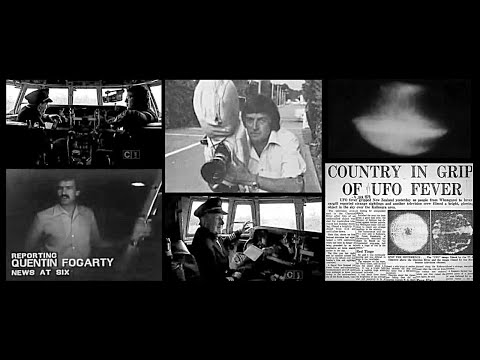
The 1978 Kaikoura UFO Lights Incident Was Caught on Camera and Radar
Eyes On Cinema's case walkthrough covering both flights, the radar corroboration, and the DSIR investigation.
Caught on Camera and Radar: Kaikōura UFO Lights Incident
Curiosity Vault's short documentary treatment of the December 1978 sightings and their aftermath.
Kaikōura Lights: The 1978 New Zealand UFO Sighting
A focused narrative overview of both flights and the resulting international news coverage.
The Kaikōura UFOs — 1978
Marlborough Video Vault's locally-sourced retrospective on the Safe Air Argosy sightings, drawing on regional archival material.
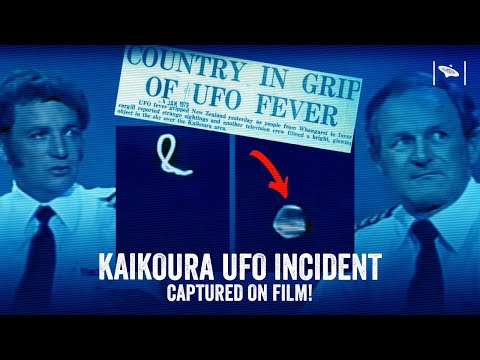
Kaikōura Lights: UFOs Tracked by Radar & Filmed by News Crew
Lehto Files' pilot-perspective analysis of the radar and film evidence from a working aviator's point of view.
Sources
- Wikipedia. "Kaikōura lights." en.wikipedia.org
- RNZ. "Govt Officials Couldn't Explain Kaikōura Lights UFO Sightings, Documents Show," July 31, 2021. rnz.co.nz
- New Zealand Herald. "Declassified Documents: UFO Sightings over Kaikoura Baffled NZ Government." nzherald.co.nz
- New Zealand Herald. "Crew Remember the Day UFO Was Spotted over Kaikōura 40 Years On." nzherald.co.nz
- Otago Daily Times. "Air Force Report Explains Kaikoura 'UFO Sightings.'" odt.co.nz
- Stuff.co.nz / Marlborough Express. "UFOs Were 'All Natural.'" stuff.co.nz
- Archives New Zealand (Flickr). "Kaikōura Lights, 31 December 1978" (declassified DSIR Savingram to NZ's UN mission, Jan. 23, 1979). flickr.com
- Internet Archive. "Declassified New Zealand UFO Documents" (digitized RNZAF UFO file collection). archive.org
- Maccabee, Bruce. "Photometric Properties of an Unidentified Bright Object Seen off the Coast of New Zealand." Applied Optics, Vol. 18, No. 15 (1979), pp. 2527–2528.
- Argosy Trust. "UFO | The Marlborough Argosy ZK-SAE." argosy.org.nz
- Metabunk. "Kaikoura Lights" (discussion thread; skeptical and technical analysis, incl. Philip J. Klass's squid-boat theory). metabunk.org
- Aviation Tours NZ. "'Merchant Enterprise' — Safe Air Argosy ZK-SAE." aviationtoursnz.com
- Wikipedia. "Bruce Maccabee." en.wikipedia.org
- Wikipedia. "Armstrong Whitworth Argosy." en.wikipedia.org
- Wikipedia. "Frederick Valentich." en.wikipedia.org
- Grokipedia. "Kaikoura Lights." grokipedia.com
- Enigma Labs. "Kaikoura Mountains, New Zealand, December 21, 1978." enigmalabs.io
- Startup, Bill, with Neil Illingworth. The Kaikōura UFOs. Hodder & Stoughton, 1980.
- Fogarty, Quentin. Let's Hope They're Friendly: True Story of an Encounter with a UFO. Angus & Robertson, 1982.
- Hassall, Peter. The NZ Files: UFOs in New Zealand. David Bateman, 1998 (includes the full official RNZAF Kaikōura report).
- Klass, Philip J. UFOs: The Public Deceived. Prometheus Books, 1983 (proposes the squid-boat explanation).
- Ireland, William. "The Kaikōura Lights Revisited." New Zealand Skeptic, 2000 (retrospective optical re-analysis).
- BBC. Horizon: "The Case of the UFOs" (1982 documentary featuring New Zealand principals).
- National Library of New Zealand. "The Kaikōura UFOs / Bill Startup, with Neil Illingworth" (catalogue record). natlib.govt.nz
- Archives New Zealand. Arena Collections Search. collections.archives.govt.nz
- Clark, Jerome. The UFO Encyclopedia, 4th Edition. Visible Ink Press, 2023 (entry on the Kaikōura lights).
- Good, Timothy. Above Top Secret: The Worldwide U.F.O. Cover-Up. William Morrow, 1988 (international case survey including Kaikōura).
See something inaccurate? Have additional information or sources?
Suggest an Edit →Last Updated: August 2026