
Japan Air Lines Cargo Flight 1628
Shortly after 5:00 PM on November 17, 1986, a Japan Air Lines Boeing 747-200F cargo freighter carrying French wine from Paris to Tokyo was cruising at 35,000 feet near Fort Yukon, Alaska, when Captain Kenju Terauchi, First Officer Takanori Tamefuji, and Flight Engineer Yoshio Tsukuba began reporting two unidentified light-clustered objects pacing their aircraft, followed by what Terauchi alone described as a colossal, silent "mothership" comparable in size to an aircraft carrier. Over the next fifty minutes, as the crew descended, turned, and changed heading under Anchorage Air Route Traffic Control Center's direction, controllers and an allied military radar facility reported an intermittent, unexplained return tracking the jet's position — at one point, by the controllers' own account, as close as five miles. What distinguishes Flight 1628 from most airline UFO reports is the sheer institutional paper trail it generated: a same-night FAA security interview that pronounced the crew "rational" and free of drug or alcohol involvement, an internal FAA radar review by division chief John Callahan that a decade and a half later became a flashpoint over an alleged CIA confiscation of evidence, a public FAA retraction that called the radar contact an "uncorrelated" split image, and one of the twentieth century's most detailed published skeptical rebuttals. Terauchi was grounded and reassigned to a desk job for speaking to the press without authorization, and was reinstated to flying status years later — a career consequence this file treats as a real, documented fact about the case's aftermath, not proof of what he saw.
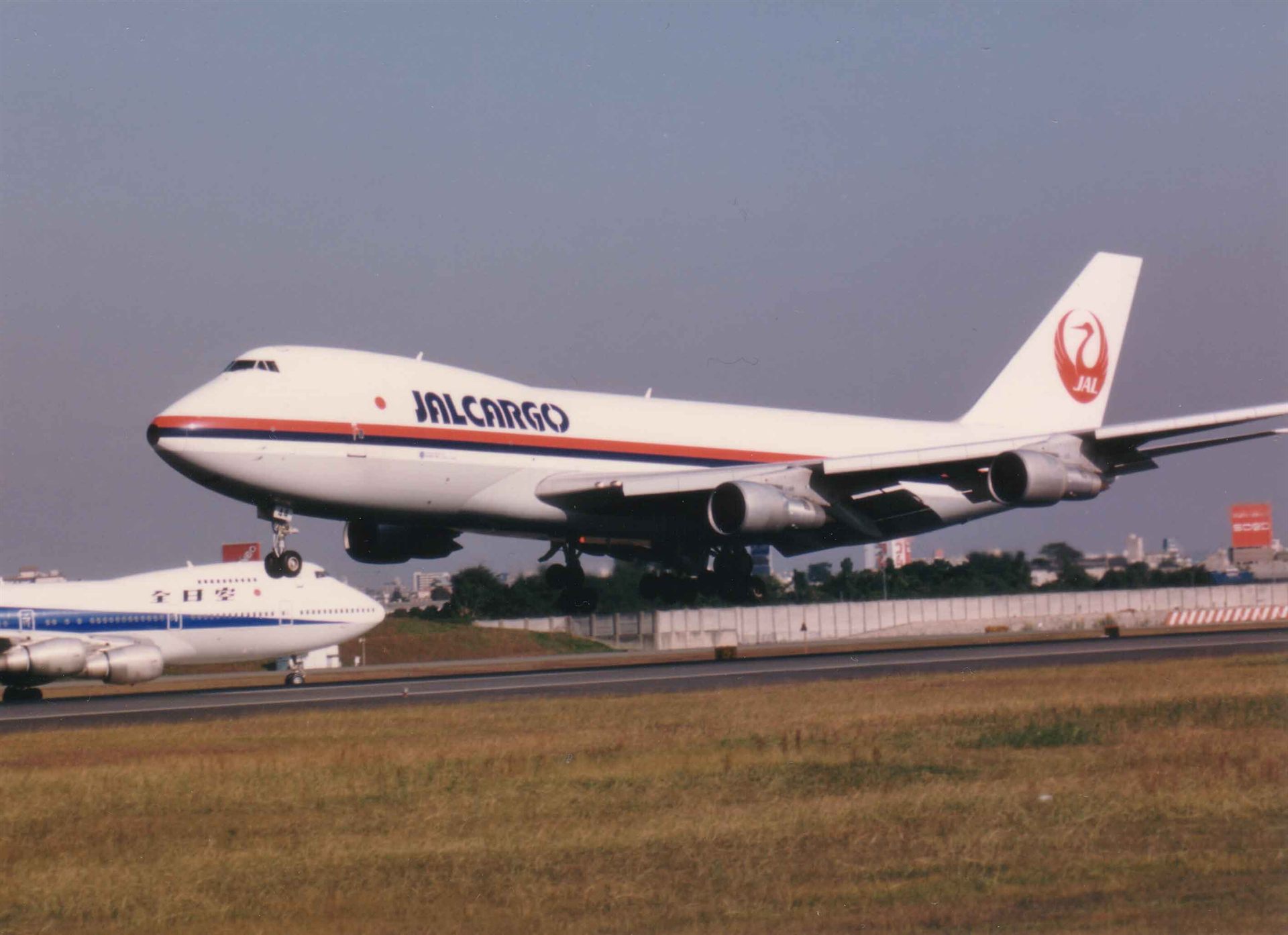
Pictured: a Japan Air Lines Cargo (JAL Cargo) Boeing 747-200F freighter, registration JA8144, photographed at Osaka International Airport circa 1990 — the same operator, aircraft type, and cargo-configured 747-200F variant flown as JL1628, not a photograph of the specific accident aircraft or of the incident itself. No photograph, film, or video of the November 17, 1986 encounter exists; the FAA's own case file consists of radar printouts, ATC voice-tape transcripts, and written witness statements rather than imagery, and no public-domain or rights-clear photograph of the exact aircraft tail number flown that night has been located.
Theoretical Alignment
Flight 1628 is a difficult case for any single theoretical framework to claim cleanly, and this file's alignment scores reflect that difficulty rather than resolve it. The Extraterrestrial Hypothesis scores highest of the three exotic frameworks because the core report — structured, maneuvering objects that appeared to track an aircraft through deliberate course and altitude changes, corroborated by more than one radar system even if only intermittently — is the textbook shape of an ETH-type craft encounter, and the case produced real institutional engagement (FAA security interviews, an internal radar review, a Washington briefing) that most purely anecdotal sightings never receive. It does not score higher than the low-to-mid 30s because the strongest single evidentiary thread in the case — the radar record — was ultimately walked back by the FAA's own public spokesman as an unexplained artifact rather than confirmed as an unknown craft, and because the case's central witness had a documented prior and subsequent history of reporting anomalous lights on the same air corridor. The Interdimensional Hypothesis scores lowest because nothing about the encounter's phenomenology — no landing, no occupants, no high-strangeness folkloric resonance — invites that framework; this is a conventional radar-visual pacing report, not a close encounter. The Psycho-Social Hypothesis scores highest among the three precisely because of what makes this case genuinely contested rather than simply corroborated: a single primary witness whose account (a spacecraft "twice the size of an aircraft carrier") outran what his own crewmates were prepared to describe, a documented pattern of repeat UFO reporting on the same route, and a serious published argument that at least the encounter's opening phase involved two bright planets glimpsed through broken cloud. None of this proves psycho-social misperception occurred, but it is a substantial, evidence-based candidate this file weighs seriously rather than waves away.
Background
On the evening of November 17, 1986, Japan Air Lines Cargo Flight 1628 — a Boeing 747-200F freighter operating the long-haul segment of a Paris–Tokyo cargo run, with an intermediate stop planned at Anchorage, Alaska — was carrying a hold full of French wine westbound across the North Atlantic and Arctic air routes toward Narita International Airport near Tokyo. The flight had already crossed from Paris Charles de Gaulle to Reykjavik, Iceland, and was on the polar-adjacent leg from Reykjavik toward Anchorage when it entered U.S. airspace over eastern Alaska. At the controls was a three-person cockpit crew typical of a 747 freighter of the era: Captain Kenju Terauchi, a 47-year-old JAL veteran and former Japan Air Self-Defense Force fighter pilot with roughly three decades of flying experience; First Officer Takanori Tamefuji, 39; and Flight Engineer Yoshio Tsukuba, 33. Nothing about the flight to that point had been unusual; the crew was cruising at 35,000 feet under the control of Anchorage Air Route Traffic Control Center as they approached the airspace near Fort Yukon, a small community roughly 145 air miles northeast of Fairbanks and just above the Arctic Circle.
Mid-November in interior Alaska brings very short days; by mid-afternoon the sky over Fort Yukon is already fully dark, and the region's extremely low population density means there is essentially no ground lighting for a high-altitude observer to use as a reference or to rule out celestial or astronomical misidentification. It was into this dark, clear, sparsely populated airspace — then, as now, among the most heavily radar-monitored corridors in the state, given its position along a primary Anchorage–Fairbanks–polar air route — that Terauchi first noticed two clusters of lights in the sky ahead and to his left, setting in motion what would become, within weeks, an internationally reported case and a formal three-month Federal Aviation Administration investigation.
Complete Timeline
| Date / Time | Event |
|---|---|
| ~5:09 PM AKST, Nov. 17, 1986 | Anchorage ARTCC contacts JL1628, then roughly 104 miles northeast of Fort Yukon at 35,000 feet, and requests a heading adjustment south of Fort Yukon and Fairbanks. |
| ~5:11 PM AKST | Captain Kenju Terauchi notices two unidentified light clusters ahead and to the aircraft's left and below, initially assuming they are military traffic; the lights begin pacing the aircraft rather than passing. |
| Shortly after | The two objects close to an estimated 500–1,000 feet off the aircraft's nose, assuming level formation; the crew reports the cockpit briefly illuminated and describes a sensation of facial warmth. |
| ~5:19–5:26 PM AKST | Terauchi radios Anchorage Center requesting traffic information; Anchorage relays the report to a military Regional Operations Control Center (ROCC) tied to Elmendorf Air Force Base, which reports a primary radar return at the aircraft's 10 o'clock position, roughly 8 miles out. |
| ~5:31–5:32 PM AKST | With ATC clearance, JL1628 descends from 35,000 to 31,000 feet to test the object's behavior; Terauchi reports it appears to descend "in formation" with the aircraft. |
| ~5:35–5:36 PM AKST | Approaching Fairbanks airspace, the aircraft is given a heading change and then directed through a 360-degree turn to verify whether the contact persists; Fairbanks approach control reports no corroborating radar return of its own. |
| ~5:38 PM AKST | The military ROCC confirms tracking what it describes as "a flight of two" and references additional radar equipment monitoring the area. |
| ~5:44–5:48 PM AKST | The tracked contact is reported shifting from roughly the aircraft's 9 o'clock to 7 o'clock position, still approximately 8 miles distant; Anchorage controllers separately describe a return as close as 5 miles at another point in the sequence. |
| ~5:45 PM AKST | Anchorage Center vectors a nearby United Airlines flight toward the area in an attempt to obtain independent visual confirmation; Terauchi is separately offered, and declines, a military jet intercept, reportedly out of concern about provoking a confrontation. |
| ~5:50 PM AKST | The United Airlines crew reports seeing JL1628 silhouetted against the sky but "no other traffic" nearby. |
| ~5:53–6:00 PM AKST | The crew reports losing visual and radar-adjacent contact with the object(s); JL1628 continues to Anchorage without further incident and lands safely, roughly 50 minutes after the encounter began. |
| Evening of Nov. 17, 1986 | FAA Alaskan Region security manager Jim Derry personally interviews all three crew members at Anchorage International Airport, joined by FAA security investigator Ron Mickle, FSDO investigator Jack Wright, and JAL's Anchorage station manager. |
| December 1986 | Terauchi gives an interview to two Kyodo News journalists, discussing the sighting publicly without JAL's authorization. |
| Dec. 29–31, 1986 | United Press International, after querying the FAA, runs a series of wire stories breaking the case nationally; an on-record Anchorage controller confirms a radar track was observed, while Alaska Air Command spokesman Capt. Robert Morris offers "random clutter" as a possible alternative. |
| Shortly after | Japan Air Lines grounds Terauchi from flight duty for speaking to the press without authorization and reassigns him to ground/desk work. |
| Jan. 6, 1987 | The FAA issues an internal report titled "Chronological Summary of the Alleged Aircraft Sightings," formally documenting the radar and witness timeline. |
| Jan. 11–12, 1987 | Terauchi reports a second, separate sighting of "irregular pulsating lights" on approximately the same Fort Yukon–Fairbanks corridor; investigators later attribute it to village lights diffused through thin ice-crystal cloud. |
| Early 1987 | FAA Division Chief John Callahan, in Washington, compiles and cross-synchronizes ATC voice tapes, radar printouts, and crew statements, and organizes a briefing for FAA Administrator Admiral Donald Engen, which Callahan later said was attended by individuals he identified as CIA, FBI, and White House scientific-staff representatives. |
| March 5, 1987 | The FAA holds a press conference in Anchorage; spokesman Paul Steucke publicly retracts the earlier radar-confirmation framing, describing the return as an "uncorrelated primary target"/split radar image of the 747 itself. |
| March 6, 1987 | The Anchorage Daily News reports on the FAA's press conference and public retraction. |
| Summer 1987 | Skeptic Philip J. Klass publishes his Jupiter/Mars misidentification analysis in the Skeptical Inquirer. |
| March/April 1987 | Optical physicist Bruce Maccabee publishes "The Fantastic Flight of JAL1628" in CUFOS's International UFO Reporter, offering a phase-by-phase analysis of the case. |
| 1988–early 1990s | Terauchi is fully reinstated to flying status after a period on desk duty that secondary sources describe as lasting from several months to roughly two years; he largely avoids further public discussion of the case for the remainder of his career. |
| May 9, 2001 | John Callahan publicly discusses his role in the case at the Disclosure Project press conference at the National Press Club in Washington, D.C., stating that the CIA had confiscated the FAA's evidence and declared the earlier briefing classified. |
| 2010 | Journalist Leslie Kean features the case, including Callahan's account, in her book UFOs: Generals, Pilots, and Government Officials Go on the Record. |
| 2025 | Renewed press coverage, including a detailed retrospective from Japanese outlet TOCANA, revisits the case amid broader U.S. and international UAP-disclosure discussion. |
What the Crew Saw: Two Escorts and a Mothership
Captain Terauchi's account, given first to FAA investigators within hours of landing and repeated with only minor variation across subsequent interviews, begins with two clusters of lights appearing ahead and below the aircraft's left side as JL1628 approached Fort Yukon. His initial assumption, by his own account, was that he was looking at military aircraft — a mundane read he says he expected to confirm with a second glance. Instead, the two objects closed distance and assumed a stable pacing position off the aircraft's nose, each displaying what Terauchi described as two rectangular arrays of amber-white lights he compared to exhaust nozzles, their solid structure obscured by darkness beyond the light sources themselves. At closest approach, Terauchi reported the cockpit briefly illuminated and a sensation of heat on his face — a claim unique to his own testimony among the crew and one this file treats as subjective and unmeasured rather than independently corroborated.
It was only later in the encounter, after the two smaller objects had receded, that Terauchi alone reported the sighting's most dramatic element: a much larger, darker shape he described alternately as walnut-shaped, roughly city-block or aircraft-carrier-sized, and structured with what he took to be panel or turret-like surface features, silhouetted against the ambient sky glow well behind and to the side of the aircraft. First Officer Tamefuji, seated on the aircraft's right side with a structurally more limited view, offered a materially more modest account: he described "too many lights" that were "so luminous" and, when later asked directly whether what he saw differed meaningfully from ordinary stars, answered simply "No" — a specific, on-record qualification this file treats as a genuine, load-bearing data point rather than an incidental detail. Flight Engineer Tsukuba described clusters of lights he compared to the illuminated windows of a passenger aircraft, and separately reported the large primary return on the plane's own weather radar roughly seven to eight nautical miles ahead; he was, in his own later characterization, uncertain whether what he had seen constituted a "UFO" at all. This spread — one crew member describing a structured giant spacecraft, the other two describing lights whose nature they were considerably more equivocal about — is one of the central, recurring tensions this file returns to throughout its credibility assessment.
Course Changes and a Vanishing Radar Track
What elevated Flight 1628 beyond a routine unverifiable sighting was the sequence of deliberate aircraft maneuvers Anchorage Center authorized in an apparent attempt to test whether the contact was real. With ATC clearance, Terauchi descended the aircraft from 35,000 to 31,000 feet; the object, by his account, appeared to descend with the aircraft rather than continuing level. Controllers then issued a heading change followed by a full 360-degree turn, a maneuver specifically intended to determine whether an object still visible to the crew would also remain trackable, and whether it would appear to "follow" a course reversal in a way inconsistent with a fixed celestial object or a stationary ground light. Terauchi reported the object's relative position shifting consistent with the turn; Fairbanks approach radar, monitoring the same airspace independently, reported no corroborating return of its own during this same window — one of several points in the case where different radar facilities produced flatly inconsistent results from the same few minutes of sky. Terauchi was also, at one stage, offered the option of a military jet intercept to visually confirm the object at closer range, and declined it, citing concern that a scrambled intercept could provoke an unpredictable or hostile response from whatever was out there — a decision that, whatever one makes of the underlying sighting, foreclosed what might otherwise have been the case's single strongest possible corroboration.
The radar record itself, reconstructed after the fact from four separate systems, is genuinely mixed rather than uniformly confirmatory. The aircraft's own weather radar produced the return Tsukuba described. Anchorage ARTCC controllers, including controller Sam Rich, reported an intermittent secondary track broadly consistent with the crew's visual account, at one point placing it as close as five miles from the aircraft; Rich remained on record afterward insisting "all three of us thought there was a track," directly contradicting the FAA's later public dismissal. The military ROCC tied to Elmendorf Air Force Base separately reported a primary-only return — meaning a target with no transponder code, consistent with either an unknown aircraft or a radar artifact — near the position the crew described. Fairbanks radar, by contrast, produced nothing throughout. Subsequent technical review found that of these four systems, two produced no usable returns at all, one displayed only a brief momentary glitch, and one briefly acquired and then lost a target matching the reported position — a genuinely partial, contested instrumented record that neither cleanly confirms nor cleanly refutes the crew's account on its own.
Reporting It: Jim Derry's Interview and "Very, Very Believable"
JL1628 landed safely in Anchorage without further incident, and within hours the crew was formally interviewed by Jim Derry, manager of the FAA's Alaskan Region Security Division, joined by FAA security investigator Ron Mickle, Flight Standards District Office investigator Jack Wright, and JAL's own Anchorage station manager. Derry's own later public description of that interview is among the most frequently quoted material in the case's entire secondary literature: he described the crew's physiological state in specific, checkable terms — sweaty palms, dilated pupils — and concluded that all three men were "normal, professional, rational," with no indication of drug or alcohol involvement. In subsequent interviews about the case, Derry went further, stating plainly that the crew "didn't make this up. Something happened that scared them," and describing them as "very, very believable." This file treats Derry's assessment as exactly what it is: a trained federal security investigator's professional judgment about witness sincerity and mental state, made within hours of the event and under no evident institutional pressure to validate an extraordinary claim — a genuinely strong data point about the crew's credibility as observers, even though, as Derry himself would have been the first to note, sincerity and accuracy are not the same thing, and his own assessment says nothing about whether the underlying phenomenon was of anomalous or conventional origin.
The case did not reach public attention immediately. It was not until Terauchi gave an unauthorized interview to two Kyodo News journalists in December 1986 that the story began to circulate, and it broke into the American press proper only after United Press International queried the FAA directly at the end of December 1986, prompting a rapid sequence of wire stories over December 29–31 confirming that an air traffic controller had reported a radar track and that Air Force officials at Alaska Air Command had at least acknowledged picking up "something" near the aircraft, even as Capt. Robert Morris of that command publicly floated "random clutter or weather interference" as an alternative explanation in the same breath.
The FAA's Retraction: Split Image, Uncorrelated Target
The FAA's institutional position on Flight 1628 shifted markedly between the initial wire-service coverage of December 1986 and its formal public statement roughly three months later. On March 5, 1987, at a press conference in Anchorage, FAA spokesman Paul Steucke retracted the agency's earlier suggestion that its radar had independently confirmed the object, characterizing the return instead as an "uncorrelated primary target" — in essence, an unexplained split or ghost image of JL1628's own transponder return, a documented if uncommon artifact of period ATC radar processing. Steucke's own summary of the agency's position, as reported by the Anchorage Daily News the following day, was carefully hedged rather than dismissive: "We are accepting the descriptions of the crew, but are unable to support what they saw." That formulation — crediting the crew's sincerity while declining to validate the phenomenon — became the FAA's lasting official posture on the case, and it is the position most closely associated with Flight 1628 in mainstream secondary coverage to this day.
That public retraction did not go unchallenged from within the agency's own ranks. Anchorage controller Sam Rich's on-record insistence that "all three of us thought there was a track" stands in direct tension with the "split image" framing, since a genuine transponder-echo artifact would not typically be independently and consistently read by multiple working controllers as a distinct, moving secondary target across a thirty-minute window. That internal tension deepened considerably once John Callahan's own, considerably more technical review became public years later, discussed in detail below.
John Callahan, the CIA, and a Meeting That "Never Happened"
The case's most consequential and most independently uncorroborated chapter concerns John Callahan, at the time chief of the FAA's Accidents, Evaluations and Investigations Division in Washington, D.C. Callahan has stated in multiple later interviews, and in his 2001 public remarks at the National Press Club, that within roughly a week of the sighting he assembled and cross-synchronized the case's full radar and voice-tape record — the ARTCC's primary and secondary target printouts, the video recording of the initial radar-scope playback analysis, the crew's written statements, and first-generation copies of the ATC voice communications — into a single, internally consistent technical reconstruction. On Callahan's account, that reconstruction showed a genuine, if intermittent, primary radar target tracking near JL1628's reported position for approximately thirty-one continuous minutes, a far more definitive technical conclusion than the FAA's eventual public "uncorrelated target" framing would suggest.
Callahan has further stated that this reconstruction was significant enough to warrant a briefing for FAA Administrator Admiral Donald Engen, and that the meeting was additionally attended by individuals he identified as representatives of the CIA, the FBI, and a scientific panel connected to the Reagan White House. According to Callahan, a CIA representative at that meeting instructed those present that all material — radar data, paperwork, and videotape — was to be treated as classified, and that the meeting itself "never happened." Callahan says he nonetheless retained personal copies of the underlying data, which were later obtained by independent researchers and archivists via Freedom of Information Act requests. This file treats Callahan's account with the specific caution it requires: he is a genuinely credentialed former federal official whose FAA employment and role have since been independently verified through internal agency correspondence obtained separately by researcher John Greenewald's Black Vault archive, and his retained radar analysis is a real, examinable technical document rather than pure hearsay. At the same time, the central and most sensational claim — that CIA personnel specifically ordered the meeting concealed — rests entirely on Callahan's own later, uncorroborated testimony; no CIA, FBI, or independently authored contemporaneous document confirming that specific meeting or its content has been published, and this file declines to treat a single, decades-later personal account of a classified meeting as established fact, however credible the source.
Grounded for Talking: Terauchi's Discipline and Reinstatement
Terauchi's own career consequences from the case are, unusually for this catalogue, well documented on both ends. After his unauthorized December 1986 interview with Kyodo News journalists brought the case to wide public attention, Japan Air Lines grounded him from flight duty, reassigning him to a ground-based desk role — a disciplinary action multiple secondary sources describe explicitly as punishment for speaking to the press without company authorization rather than for the underlying sighting report itself, an important distinction this file preserves rather than collapses. Secondary sources vary on the length of that reassignment, with estimates ranging from several months to roughly two years, but converge on the outcome: Terauchi was subsequently reinstated to flying status and completed the remainder of his career as an active JAL captain, by most accounts declining to discuss the case publicly again in any comparable detail. Multiple retrospective sources report that in later life, and reportedly before his death, Terauchi continued to maintain privately that the encounter had been real and remained, in his own assessment, unexplained — a position consistent with his testimony throughout the intervening decades but, like the rest of his account, resting on his word alone.
Independent Analysis: Maccabee's Four Phases
The most methodologically careful independent analysis of the case was published by U.S. Navy optical physicist and longtime UFO researcher Bruce Maccabee in the Center for UFO Studies' International UFO Reporter in early 1987, under the title "The Fantastic Flight of JAL1628." Maccabee's central methodological contribution was to refuse treating the encounter as a single, uniform event, instead dividing it into four analytically distinct phases and evaluating each on its own evidentiary merits. In Phase 1, covering the initial distant lights below and left of the aircraft, Maccabee found the sighting unremarkable on its own and noted the FAA had confirmed no known air traffic in the area at the time. In Phase 2, covering the multiple-witness sighting of the two paired light arrays at closer range, Maccabee was considerably more emphatic, writing that the sighting "seems inexplicable," that it "cannot have been a hallucination" given multiple independent observers, and that "there is no natural phenomenon that can account for the rectangular arrangement of lights in horizontal rows" the crew consistently described. In Phase 3, covering the aircraft's own weather-radar echo during the objects' apparent recession, Maccabee allowed that a radar malfunction was possible but judged it "much more likely that there was some object out there." It was only in Phase 4 — Terauchi's solitary sighting of the giant "mothership," unconfirmed by either of his crewmates in comparable detail — that Maccabee's confidence dropped sharply, conceding it "seems at least plausible that he may have misinterpreted oddly lighted clouds" and describing the radar picture for this specific phase as "ambiguous at best" given the non-continuous nature of the tracking. Maccabee's own overall verdict — that JL1628 was genuinely accompanied for part of its flight by "at least two TRUFOS [true unidentified flying objects]" — is frequently cited by proponents of the case as a scientist's endorsement, and this file agrees it deserves to be read that way, but with the qualification Maccabee himself built into it: his strongest confidence was reserved for the multi-witness middle phases of the sighting, not for Terauchi's uncorroborated giant-craft claim that dominates the case's popular retelling.
Skeptical Counter-Arguments: Jupiter, Ice Crystals, and a "UFO Repeater"
The case's most detailed and most frequently cited skeptical treatment comes from Philip J. Klass, the longtime Aviation Week & Space Technology senior editor and the era's most prominent UFO skeptic, published initially in the Skeptical Inquirer in the summer of 1987 and refined in subsequent writing. Klass's first and best-known argument concerned the encounter's opening phase: astronomical charts placed the planet Jupiter, at magnitude roughly −2.6, low on the horizon at almost exactly the bearing and elevation — positioned, in Klass's account, "roughly at his own 35,000-foot altitude" — where Terauchi first reported the initial lights, with Mars also above the horizon nearby; Klass specifically noted that Terauchi never once mentioned seeing either planet despite both being in the sky, which Klass read as consistent with a witness who had already begun interpreting ordinary celestial objects through an anomalous frame. Klass later refined this into a second, complementary theory covering the sighting's more erratic middle behavior: moonlight reflecting off ice crystals within scattered or broken cloud, which he argued could plausibly produce flame-colored, apparently structured light effects that would intermittently appear and vanish as cloud conditions shifted — a mechanism Klass offered specifically to explain why the crew's account included apparent motion and disappearance inconsistent with genuinely fixed planets.
Klass's analysis also leaned heavily on documented inconsistencies between crew members' accounts once investigators interviewed them separately rather than as a group: Tamefuji's direct "No" when asked whether the lights looked different from ordinary stars, and Tsukuba's own stated uncertainty about whether he had seen a "UFO" at all, both cut against the more dramatic structured-craft narrative that dominates Terauchi's individual account and, by extension, most popular retellings of the case. Independent skeptic Robert Sheaffer extended this critique in a detailed 2014 reassessment, concluding flatly that "the bottom line is, Terauchi's own flight crew saw only 'lights,' and other aircraft checking out the situation saw nothing unusual," and specifically flagging Terauchi's status as a documented repeat UFO reporter as "a caution flag for experienced UFO investigators" rather than a neutral biographical detail. Sheaffer and Klass both also emphasized the negative evidence: neither the United Airlines flight nor the U.S. Air Force C-130 vectored toward the area during the encounter's later phase reported seeing anything unusual, a genuine and unresolved gap in the case's corroboration regardless of how one weighs the radar record.
Proponents have not left these arguments unanswered. NASA-affiliated researcher Richard F. Haines argued that the planetary-misidentification theory cannot easily account for reported relative motion of the lights across the crew's field of view — from roughly the aircraft's 12 o'clock to 10 o'clock position over the course of the sighting — behavior inconsistent with the fixed apparent position of a genuinely stationary planet, and noted that all three crew members independently described clusters or groups of lights rather than the single bright point a planet would present. Maccabee's own phased analysis, discussed above, functions as a third position distinct from either extreme: neither a full endorsement of Terauchi's mothership account nor a full acceptance of Klass's planetary explanation, but a phase-by-phase judgment that treats the case's multi-witness middle section as its strongest evidentiary core and its single-witness bookends as its weakest.
Circumstantial Evidence
- Three currently-qualified professional aircrew, including a captain with nearly three decades of flying experience, independently reported unusual lights pacing their aircraft, and FAA security investigators who interviewed them within hours assessed all three as rational, sober, and credible.
- Two independent radar systems — civilian Anchorage ARTCC and a military facility tied to Elmendorf Air Force Base — each reported an intermittent, uncorrelated contact broadly consistent with the crew's reported position, at one point as close as five miles.
- A named, on-record Anchorage controller (Sam Rich) maintained, after the fact and in apparent tension with the FAA's own public retraction, that "all three of us thought there was a track."
- Former FAA Division Chief John Callahan's independent technical reconstruction of the radar and voice-tape record concluded a genuine primary target had been intermittently visible near the aircraft's position for approximately thirty-one minutes.
- Optical physicist Bruce Maccabee's phase-by-phase published analysis found the encounter's multi-witness middle phase "inexplicable" as a natural phenomenon, while explicitly declining to extend that same confidence to the case's single-witness "mothership" claim.
Key Witnesses
Kenju Terauchi
A JAL veteran and former Japan Air Self-Defense Force fighter pilot with roughly 29 years of flying experience and more than 10,000 flight hours, Terauchi was the encounter's primary and most detailed witness, describing two paced escort objects followed by a giant, structured "mothership" he alone observed in detail. FAA investigators assessed him as rational and credible immediately after the event, though his own documented history of two earlier and two later UFO reports on the same air corridor led the agency to later characterize him as a "UFO repeater." He was grounded by JAL for speaking to the press without authorization and later fully reinstated to flying status.
Takanori Tamefuji
Seated on the aircraft's right side with a structurally more limited view than Terauchi, Tamefuji corroborated the presence of unusual, unusually luminous lights but offered a materially more cautious account, telling investigators the lights did not appear meaningfully different from ordinary stars when asked directly. He separately, and specifically, rejected a proposed "weather interference" explanation on the grounds that the sky that night was clear.
Yoshio Tsukuba
Reported clusters of lights he compared to the illuminated windows of a passenger aircraft and identified a large primary contact on the aircraft's own weather radar roughly seven to eight nautical miles ahead. Tsukuba was, by his own later characterization, the most equivocal of the three crew members about whether what he observed constituted a "UFO."
The Five Observables Assessment
The Five Observables framework, developed by former AATIP director Luis Elizondo, is used to classify UAP encounters by performance characteristics exceeding known technology of their era:
Assessment: Anti-Gravity Lift is rated speculative: the crew described objects pacing and matching a large aircraft's altitude and heading changes with no visible conventional propulsion, but with no instrumented flight-dynamics data, this cannot be distinguished from a misperceived aircraft or radar artifact. Instant Acceleration is likewise speculative: Callahan's radar analysis suggested a contact that appeared and vanished abruptly across the encounter's roughly thirty-one minutes of intermittent tracking, but the same pattern is equally consistent with radar-scope clutter or an uncorrelated split target, which is precisely what the FAA's own public statement concluded it was. Hypersonic Velocity is rated absent, since no reliable distance/time data exists from which any true speed could be calculated, and nothing in the account describes velocities exceeding a conventional aircraft's. Low Observability is rated speculative rather than present or absent: the object(s) were intermittently visible on some radar systems and not others across the same time window, a pattern that could reflect genuine low observability, ordinary radar-system limitations, or simple non-existence, and this file does not consider the evidence sufficient to choose among those explanations. Trans-Medium travel is rated absent, as no air/water/land transition was reported at any point.
Evidence Assessment
Supporting Anomalous Origin
- Three professional aircrew, independently and consistently, reported an object or objects pacing their aircraft through multiple deliberate course and altitude changes, a pattern difficult to attribute to a stationary celestial body.
- Two separate ground/airborne radar systems reported an intermittent contact broadly consistent with the crew's account, corroborated by on-record controller testimony maintained even after the FAA's own public retraction.
- FAA security investigators who interviewed the crew within hours of the event, before any public attention or press involvement, independently assessed them as rational, sober, and credible.
- A former FAA division chief's later, more technically detailed radar reconstruction reached a more confident conclusion about a genuine primary target than the agency's own public statement did.
- The encounter generated a genuine, extensive multi-agency documentary record — FAA interviews, radar printouts, ATC voice tapes, and internal reports — rather than resting on eyewitness testimony alone.
Supporting Conventional Explanation
- The FAA's own final public position, delivered at a formal press conference, explicitly retracted the earlier radar-confirmation framing and characterized the return as an unexplained split image of the aircraft's own transponder signal.
- The primary witness, Captain Terauchi, had a documented history of two prior and two subsequent UFO reports on the same air corridor, a pattern the FAA itself cited in labeling him a "UFO repeater."
- The two other crew members' accounts, taken separately, were considerably more equivocal than Terauchi's — one explicitly said the lights did not look different from stars, and the other was unsure whether he had seen a "UFO" at all.
- A specific, published, and astronomically grounded conventional candidate exists (Jupiter and Mars near the horizon, combined with possible moonlit ice-crystal cloud reflection) that accounts for at least the encounter's opening phase.
- Neither of two aircraft specifically vectored toward the area during the encounter — a United Airlines flight and a U.S. Air Force C-130 — reported observing anything unusual.
Why "Disputed"
Flight 1628 earns a DISPUTED rating on this site's scale because it is, in an unusually literal sense, a case the investigating agency itself disputed with its own earlier account. On the strength side, this file weighs heavily: three currently-flying, credentialed aircrew independently reported an object pacing a series of deliberate course and altitude changes; FAA security investigators who interviewed the crew within hours of the event, before any press involvement, assessed all three as rational, sober, and credible; an on-record Anchorage air traffic controller maintained after the fact that a genuine track had been observed, in direct tension with the agency's later public position; and former FAA Division Chief John Callahan's own, more technically detailed radar reconstruction reached a more confident conclusion — a genuine primary target intermittently visible for roughly thirty-one minutes — than the FAA's public spokesman offered at the March 1987 press conference. Optical physicist Bruce Maccabee's careful, phase-by-phase published analysis found the encounter's multi-witness middle section "inexplicable" as a natural phenomenon. On the other hand, this file declines to elevate the case into "credible" or "verified" territory for reasons equally well documented: the FAA's own final, formal public position explicitly retracted radar confirmation and characterized the return as an unexplained split image of the aircraft's own signal, not an independent object; the case's single most dramatic claim — a mothership "twice the size of an aircraft carrier" — rests entirely on Captain Terauchi's uncorroborated testimony, with his own crewmates offering markedly more cautious accounts under separate questioning; Terauchi's documented history of prior and subsequent similar reports on the same corridor is a real, relevant credibility complication rather than an incidental biographical footnote; a specific, published, astronomically grounded conventional explanation exists for at least the encounter's opening phase; and the case's most sensational institutional claim, John Callahan's account of a CIA evidence confiscation, remains entirely uncorroborated by any independent document or second source fifteen years after he first made it public. That combination — genuine multi-witness and partial-instrumented corroboration, set against the investigating agency's own retraction, a real conventional-explanation candidate, and a single-witness dominated dramatic core — places Flight 1628 squarely in "disputed" territory: one of commercial aviation's most thoroughly documented UFO reports, but not, on the FAA's own final public record, a confirmed or closed one.
Sensor & Instrumentation Detection Profile
Flight 1628 is one of the relatively small number of airline UFO cases with a real, if contested, instrumented record rather than testimony alone. Four separate systems were examined in the case's aftermath: the aircraft's own onboard weather radar, which Flight Engineer Yoshio Tsukuba reported showing a large primary return roughly seven to eight nautical miles ahead of the aircraft; the civilian Anchorage Air Route Traffic Control Center (ARTCC), whose controllers — including controller Sam Rich, who remained on record about it afterward — described an intermittent secondary track pacing the jet, at its closest reported as near as five miles; and a U.S. Air Force radar facility tied to Elmendorf Air Force Base's Regional Operations Control Center (ROCC), which independently reported a primary-only return near the aircraft's stated position. Of these systems, contemporaneous FAA technical review found two produced no usable return at all, one displayed only a brief anomalous glitch, and one briefly acquired and then lost a target consistent with the crew's account — a genuinely mixed, partial-corroboration picture rather than a clean multi-radar lock. Years later, former FAA Division Chief John Callahan, working from preserved copies of the original radar printouts and ATC voice tapes in Washington, concluded that a real primary target had appeared in the positions Terauchi described and remained intermittently visible for approximately thirty-one minutes — a conclusion that sits in direct, documented tension with the FAA's own later public statement, delivered by regional spokesman Paul Steucke at a March 1987 press conference, that the return was merely an "uncorrelated primary target," effectively a split radar image of the 747 itself. No photograph, film, video, or magnetometer/EM-field reading exists for any phase of the encounter; the sensor record here is exclusively radar, and even that record is disputed at its own point of origin within the FAA.
Environmental & Geospatial Context
The encounter unfolded over the sparsely populated interior of Alaska between Fort Yukon and Fairbanks, roughly 100–150 miles northeast of Anchorage, in airspace that in mid-November sits in near-total darkness by late afternoon and offers essentially no ground lighting, air traffic density, or terrain features capable of producing routine misidentification at 35,000 feet. The crew and multiple secondary sources describe the sky as clear; First Officer Tamefuji is on record specifically rejecting a later "weather interference" explanation on exactly this basis, telling investigators the sky was clear with no possibility of the kind of atmospheric anomaly some officials had floated. Clear, moonlit or near-moonlit conditions at altitude are also precisely the conditions under which bright planets low on the horizon are most visible and most easily misjudged in scale and distance by an observer without a fixed reference point — a detail directly relevant to the conventional-explanation analysis below. Geospatially, the case is also unusual for how much air traffic infrastructure surrounded it: unlike a rural single-witness sighting, this event occurred inside one of the most heavily monitored corridors in Alaska, within simultaneous range of civilian ARTCC radar, military radar tied to Elmendorf Air Force Base, and, within the hour, two additional aircraft (a United Airlines flight and a U.S. Air Force C-130) diverted specifically to attempt independent visual confirmation — neither of which reported seeing anything unusual near JL1628's position.
Observer Credibility & Occupational Profile
All three primary witnesses were credentialed, currently-flying commercial aircrew rather than casual observers, which is precisely why this case received the institutional attention it did. Kenju Terauchi, 47 years old at the time, was a veteran JAL captain and former Japan Air Self-Defense Force fighter pilot with roughly 29 years of flying experience and more than 10,000 logged flight hours — a background the FAA's own investigators treated as a meaningful credibility factor rather than a reason for dismissal. First Officer Takanori Tamefuji, 39, and Flight Engineer Yoshio Tsukuba, 33, were both active, currently-qualified 747 crew with no independent record of prior anomalous-phenomena reports. FAA Alaskan Region security manager Jim Derry, who personally interviewed all three men within hours of landing, described their physiological state in specific, checkable terms — sweaty palms, dilated pupils — and concluded in his own later words that the crew "didn't make this up. Something happened that scared them," calling them "very, very believable." Set against that baseline credibility, this file also weighs a specific, documented complication unique to this case among this archive's airline-crew reports: Terauchi was, by the FAA's own later characterization, a "UFO repeater," having reported two earlier unrelated sightings before November 1986 and two more on the same general air corridor in January 1987 — one of which investigators subsequently attributed to village lights diffused through thin ice-crystal cloud. That pattern does not by itself establish that any individual sighting, including this one, was a misperception, but it is a real, relevant data point about the primary witness's baseline propensity to interpret ambiguous aerial light sources as anomalous, and this file declines to omit it the way some enthusiastic secondary retellings do.
Physical & Material Assays
Flight 1628 produced no physical or material evidence of any kind. No object, fragment, residue, or trace was recovered from the aircraft, its instruments, or any location on the ground; no injury, burn, or lasting physiological effect was reported by any crew member beyond the transient sensation of facial warmth Terauchi described during the closest approach, a claim that rests solely on his own testimony and was not independently measured. The aircraft itself sustained no detectable damage and completed its flight to Anchorage and, after a stopover, on to Narita without any anomaly in its own systems beyond the ambiguous weather-radar return Tsukuba described. This file's entire physical-evidence assessment for the case is therefore a documentary rather than a material one: FAA interview transcripts, radar printouts, ATC voice-tape recordings, and internal agency correspondence — more than 1,500 pages of which were later obtained via Freedom of Information Act requests and are preserved by independent archivists — constitute the full physical record. That absence of trace evidence is unsurprising for an airborne pacing encounter of this kind and should not by itself be read as diminishing the case's credibility relative to comparable radar-visual reports; it does mean, however, that every claim in this file about the objects' size, structure, or behavior rests on either eyewitness testimony or disputed radar data, with nothing in between.
Historical Precedents & Archive Matches
Flight 1628 belongs to a specific, well-populated sub-genre this catalogue tracks closely: the multi-crew, radar-corroborated commercial or military aircrew sighting, most directly comparable within this archive to the July 1957 RB-47 Bomber Chase, in which an Air Force reconnaissance crew's visual sighting was independently tracked across several distinct ground and airborne radar systems over a much longer geographic run, and to the October 1973 Coyne Helicopter Incident, in which a multi-person Army Reserve crew reported an instrumented anomaly (an unexplained, unrequested altitude climb) alongside their visual sighting. Both of those cases share Flight 1628's core evidentiary shape — multiple trained observers plus some form of instrument or radar data — while differing in the reliability of that instrumented corroboration: Coyne's altimeter anomaly was never seriously disputed by investigators on either side, where Flight 1628's radar record was directly, publicly retracted by the same agency that first reported it. Within Alaska and the broader Pacific commercial-aviation corridor specifically, Flight 1628 is also frequently discussed alongside the 1986 case's own immediate sequel — Terauchi's two additional reported sightings on the same corridor in January 1987 — and against the backdrop of a documented broader pattern of pilot UFO reports collected by researchers including Bruce Maccabee and Richard F. Haines, whose separate multi-witness pilot-sighting casebooks treat this file as one of the best-documented entries in that genre specifically because of its FAA paper trail, not despite the controversy surrounding it.
Material Analysis
Flight 1628 left behind no physical or trace material of any kind, and this file states that plainly rather than padding around it: no object, fragment, or residue was recovered from the aircraft or from the ground beneath the encounter's flight path, no instrument or structural damage was detected on post-flight inspection, and no crew member reported any injury beyond Terauchi's own unmeasured, subjective sensation of facial warmth during closest approach. In a case built entirely on aircrew testimony and disputed radar data, that absence is unsurprising rather than suspicious — a genuinely anomalous craft pacing an aircraft at 31,000–35,000 feet would not be expected to leave a ground trace comparable to a landing case — but it does mean the entirety of this file's "material" analysis is documentary rather than physical: the FAA's own case file, the radar printouts and ATC voice-tape transcripts John Callahan preserved, and the more than 1,500 pages of records later obtained through Freedom of Information Act requests and archived publicly. Those documents are real, examinable, and independently verifiable as authentic federal records; what remains contested is not whether they exist, but what the radar data within them actually shows, a question this file has already addressed at length above and returns to directly in the Conventional Explanation Candidates section below.
Supporting a Genuine Anomalous Effect
- Two independently operated radar systems — one civilian, one military — each reported an intermittent contact broadly consistent with the crew's account, rather than the crew's testimony standing entirely alone.
- A former FAA division chief's later, more technically rigorous review of the preserved radar data reached a more confident conclusion of a genuine target than the agency's own public statement offered.
- The documentary record itself — FAA interviews, internal reports, radar printouts, and voice tapes — is unusually extensive and has been independently verified as authentic through Freedom of Information Act releases.
Supporting a Mundane Origin
- The FAA's own final public statement specifically characterized the radar return as an unexplained artifact of the aircraft's own transponder signal, not an independent target.
- No physical evidence of any kind was recovered, and no instrument other than radar — itself disputed — recorded any anomaly.
- Two of the four radar systems examined afterward produced no return at all, and Fairbanks approach radar specifically failed to corroborate the contact during a maneuver designed to test it.
Conventional Explanation Candidates
Three distinct conventional explanations have been seriously proposed for Flight 1628, and each deserves evaluation on its own terms.
Planetary Misidentification (Jupiter and Mars) with Ice-Crystal Cloud Reflection
Partially Plausible, IncompletePhilip J. Klass's analysis, published in the Skeptical Inquirer, remains the most detailed and most frequently cited conventional explanation for the case. Klass demonstrated through astronomical charting that Jupiter, at a brightness of roughly magnitude −2.6, sat low on the horizon at a bearing and elevation closely matching where Terauchi first reported the initial lights, with Mars also above the horizon nearby; he specifically noted that neither planet was ever mentioned by the crew despite both being visible, which he read as evidence the crew had already begun interpreting ordinary celestial objects anomalously. To account for the sighting's more dynamic middle phase, Klass proposed that moonlight reflecting off ice crystals within broken or scattered cloud could produce flame-colored, apparently structured light effects that would intermittently appear and vanish as cloud conditions shifted — a genuinely specific, checkable mechanism rather than a vague dismissal. This candidate's central weakness, raised most directly by NASA-affiliated researcher Richard F. Haines, is that it does not easily explain reported relative motion of the lights across a substantial arc of the crew's field of view, nor the fact that all three crew members independently described light clusters or arrays rather than the single bright point a genuine planet would present; it also does not, on its own, account for the intermittent radar returns two independent systems reported.
Radar Artifact ("Uncorrelated Primary Target" / Split Image)
Partially Plausible, IncompleteThe FAA's own final public position holds that the radar contact reported by both Anchorage ARTCC and the military facility tied to Elmendorf Air Force Base was an uncorrelated primary target — in effect, a split or ghost image of JL1628's own transponder return, a documented if uncommon artifact of period radar processing software. This candidate deserves genuine consideration because it is the explanation offered by the same technical staff who operated the equipment in question, and because two of the four radar systems examined afterward did in fact produce no usable return at all. Its central weakness is that it sits in direct, documented tension with on-record testimony from Anchorage controller Sam Rich, who maintained after the fact that "all three of us thought there was a track," and with John Callahan's own considerably more technical internal reconstruction, which concluded a genuine primary target had been intermittently visible for roughly thirty-one minutes — a conclusion from within the FAA's own technical staff that the agency's public spokesman did not incorporate into its final statement.
Witness Misperception Amplified by a Documented "Repeater" Pattern
Partially Plausible, IncompleteA third candidate, distinct from either specific astronomical or radar mechanism, holds that Captain Terauchi's own documented history — two UFO reports before November 1986 and two more on the same corridor in January 1987, one of the latter subsequently attributed to village lights diffused through ice-crystal cloud — establishes a baseline individual propensity to interpret ambiguous aerial light sources anomalously, and that this specific sighting should be read in that light rather than in isolation. This candidate's strength lies in its use of the case's own documented biographical record rather than speculation; its weakness is that it cannot, by itself, explain the corroborating radar returns from two independent systems, nor Flight Engineer Tsukuba's independent identification of a target on the aircraft's own weather radar, evidence that does not depend on Terauchi's perception or credibility at all.
Each candidate offers a real, evidence-based partial explanation for isolated elements of the case — planetary misidentification for the opening phase, radar artifact for at least part of the disputed tracking, and a documented repeater pattern for the credibility question surrounding the central witness — but none, individually or combined, accounts for the full record: the corroborating radar returns from two independently operated systems, the FAA's own former division chief reaching a more confident technical conclusion than the agency's public statement, and the multi-witness middle phase of the sighting that even skeptically-inclined analysts like Bruce Maccabee found difficult to dismiss as a natural phenomenon.
Related Cases
Confirmed Documents & Official Records
A public-domain archival collection of the FAA's Japan Air Lines Flight 1628 case file, including incident reports, radar data analysis, ATC transcripts, and crew interview statements.
UNCLASSIFIED / PUBLICAn independently maintained index of over 1,500 pages of FAA documents on the case, including radar printouts, ATC audio-transcript material, and internal FAA correspondence, obtained via Freedom of Information Act requests.
DECLASSIFIED / PUBLICSearch Government Archives Directly
Further Reading — Recommended Literature
UFOs: Generals, Pilots, and Government Officials Go on the Record
Features John Callahan's own account of the JAL 1628 radar analysis and the disputed CIA briefing, alongside dozens of other credentialed witness testimonies.
JAL Flight 1628 — UFO Intercept Over Alaska: The Official Reports
A PARANOIA Research File compilation of the FAA's own scanned original documents on the case, including radar reports and interview transcripts.
Project Delta: A Study of Multiple UFOs
By the former NASA researcher who argued the reported relative motion of the lights across the crew's field of view was difficult to reconcile with a fixed planetary source.
Uninvited Guests: A Documented History of UFO Sightings, Alien Encounters and Coverups
A MUFON/CUFOS-affiliated researcher's documented casebook situating Flight 1628 within the broader history of radar-visual aircrew sightings.
The UFO Encyclopedia, 4th Edition
The definitive UFO reference work, with a detailed entry on Japan Air Lines Flight 1628 and its investigative history.
Essential Viewing
Boeing 747 Followed by a UFO | An Out Of This World Encounter | Japan Air Lines Flight 1628
TheFlightChannel's detailed narrated walkthrough of the flight, the crew's account, and the FAA's investigation.
UFO Sighting at 35,000 Feet | JAL Cargo Flight 1628
Red Web's dedicated case episode covering the crew testimony, the radar dispute, and John Callahan's later account.

INFAMOUS Japan Air Lines UFO Debunked & Explained! (Flight 1628)
A dedicated skeptical case walkthrough covering the Jupiter/Mars and radar-artifact explanations in detail.

JAL Flight 1628 UFO Incident
A concise case-summary overview covering the timeline, the crew's testimony, and the investigation's aftermath.
Sources
- Wikipedia. "Japan Air Lines Cargo Flight 1628." en.wikipedia.org
- United Press International. "The crew of a Japan Air Lines cargo jet…," Dec. 29, 1986. upi.com/Archives
- United Press International. "Controller confirms UFO sighting," Dec. 30, 1986. upi.com/Archives
- United Press International. "JAL pilot describes UFO," Dec. 31, 1986. upi.com/Archives
- United Press International. "A veteran pilot whose UFO sighting was confirmed on…," Dec. 31, 1986. upi.com/Archives
- United Press International. "JAL pilot reports second UFO sighting," Jan. 12, 1987. upi.com/Archives
- Gross, Patrick. "UFOs at Close Sight: Japan Airlines Boeing 747 Meets UFO Over Alaska in 1986" — detailed sourced case archive with ATC timeline reconstruction. ufologie.patrickgross.org
- The Debrief. "What Really Happened to Japan Airlines Flight 1628 in 1986?" thedebrief.org
- American Ghost Walks. "Haunted Alaskan Skies: 1986's Japan Airlines Flight 1628 UFO Encounter." americanghostwalks.com
- Sheaffer, Robert. "JAL 1628: Capt. Terauchi's Marvellous 'Spaceship'" (Bad UFOs), 2014. badufos.blogspot.com
- The Black Vault. "The Vault Files: 1986 Alaska JAL Flight 1628." theblackvault.com
- Federal Aviation Administration. "Japan Air Lines Flight 1628 Records" (FOIA-released case file archive). archive.org
- Klass, Philip J. "FAA Data Sheds New Light on JAL Pilot's UFO Report," Skeptical Inquirer, Summer 1987. centerforinquiry.s3.amazonaws.com (PDF)
- Think About It Docs. "1986: Japan Air Lines Flight 1628." thinkaboutitdocs.com
- TOCANA. "The JAL Flight 1628 UFO Incident: Declassified Files Reveal a 50-Minute Encounter Over Alaska," 2025. en.tocana.jp
- Alaska Commentary. "Unfriendly Skies: The Extraordinary Flight of JAL 1628, Alaska's Best Known UFO Encounter." alaska-commentary.ghost.io
- Maccabee, Bruce. "The Fantastic Flight of JAL1628," International UFO Reporter, Vol. 12, No. 2, Center for UFO Studies, March/April 1987.
- Kean, Leslie. UFOs: Generals, Pilots, and Government Officials Go on the Record. Harmony Books, 2010 (Callahan/JAL 1628 chapter).
- Haines, Richard F. Project Delta: A Study of Multiple UFOs. LDA Press, 1994 (multi-witness pilot sighting analysis).
- Clark, Jerome. The UFO Encyclopedia, 4th Edition, Visible Ink Press, 2023 (entry on Japan Air Lines Flight 1628).
See something inaccurate? Have additional information or sources?
Suggest an Edit →Last Updated: August 2026