
USS Supply Aerial Phenomenon (Schofield Report)
On the evening of February 28, 1904, three luminous, egg-shaped and spherical objects approached the U.S. Navy stores ship USS Supply in echelon formation, arced up through a broken cloud deck, and vanished into the twilight over the open Pacific. The incident was documented in an official letter by (then-)Lieutenant Frank H. Schofield — who three decades later commanded the entire United States Fleet — and published, under the title "Remarkable Meteors," in the Weather Bureau's own scientific journal. It has since become one of ufology's most-cited pre-Roswell cases, and one of its most technically contested.
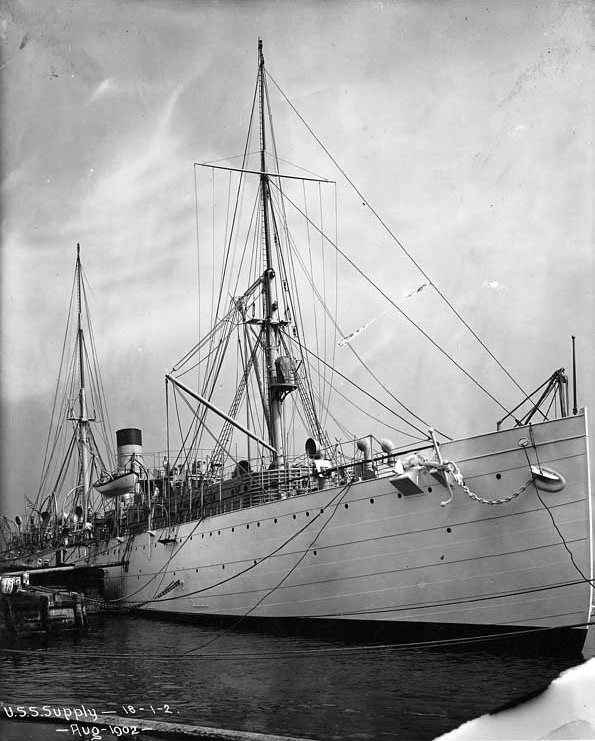
Pictured: USS Supply photographed in dock, August 1902 — roughly a year and a half before the February 28, 1904 sighting, and the same vessel from which Lt. Schofield's report was written (U.S. Navy photograph, public domain, via Wikimedia Commons/Naval Historical Center). No photograph of the sighting itself, and no freely-licensed scan of the original Monthly Weather Review page, is known to survive or be available for reproduction here.
Theoretical Alignment
This case aligns weakly with all three standard frameworks, because its own strongest candidate explanation sits outside them entirely: a natural astronomical event (a fragmenting bolide meteor) misclassified at the time, by its own witnesses, as exactly that — not as a craft. The Extraterrestrial Hypothesis draws only marginal support from the object count, formation-like arrangement, and apparent course change, none of which requires an intelligently controlled craft to explain and all of which have been argued, with real supporting physics, as artifacts of a multi-fragment meteor entry. The Interdimensional Hypothesis has essentially no purchase here; nothing in either Schofield's or Garvey's account suggests teleportation, materialization, or non-linear motion. The Psycho-Social Hypothesis earns a modest weighting not from any contactee or media-contagion pattern (impossible in 1904, decades before "flying saucer" entered public vocabulary) but from a narrower, well-documented human-factors issue: Schofield's own published account was a composite compiled from interviews conducted after he himself arrived on the bridge too late to see most of the event, raising a genuine, sourced question about how much of the report's more striking detail (the sustained echelon spacing through a course change) reflects three excited witnesses' memories being smoothed into one official narrative rather than three independently instrumented observations.
Background
In February 1904, the U.S. Navy iron stores steamer USS Supply was three decades into a long working life. Built in 1873 by William Cramp & Sons of Philadelphia as the commercial liner SS Illinois — a vessel that had briefly gained a measure of fame in 1882 for carrying large numbers of Russian Jewish refugees fleeing pogroms to the United States — she was purchased by the Navy Department from the International Navigation Company on April 30, 1898 for $325,000 and commissioned as USS Supply under Lt. Cmdr. R. R. Ingersoll, in time to serve as the fleet's supply ship in Cuban waters during the Spanish–American War. Recommissioned in August 1902 and reassigned to the Asiatic Station, she spent the following years as the principal supply vessel for the U.S. Asiatic Fleet, running a regular circuit between the Philippines, Japan, Shanghai, and the American naval station at Guam, carrying provisions, coal, and personnel across a Pacific that the Navy had only recently begun to treat as a genuine strategic theater following the 1898 annexation of Guam and the Philippines. She would remain on this Pacific station for well over a decade after the 1904 sighting, only leaving for Manila and Japan in mid-1917 before finally getting underway for the United States on November 28, 1917; after transiting the Panama Canal on January 19, 1918, she arrived at the Charleston Navy Yard and was designated flagship of the Train, Atlantic Fleet, for the remainder of the First World War — a second, entirely unremarkable career chapter with no connection to this case beyond confirming that the vessel from Schofield's 1904 letter was a genuine, long-serving, extensively documented naval auxiliary rather than an obscure or hard-to-verify hulk.
Guam itself was administered not by a civilian governor but by a serving U.S. Navy officer holding the title of Naval Governor, a practice that would continue until 1950. In February 1903 that post had passed to Cmdr. William Elbridge Sewell, an 1871 Naval Academy graduate who had fought at the Battle of Santiago de Cuba during the Spanish–American War (earning a personal commendation from Admiral William T. Sampson) and had previously directed the Mare Island Observatory, responsible for distributing precise chronometer time to the Pacific Fleet. As governor, Sewell pushed through a genuinely substantial reform program for the island: he legalized the licensed manufacture and sale of alcohol, revised the territory's tax and criminal codes, established a court system that would remain in place into the 1930s, repealed several restrictions on traditional Chamorro cultural practices, and oversaw the installation of Guam's first telegraph cable connection to the outside world.
For a brief three-week window in January 1904, Sewell's duties passed temporarily to a junior officer then serving on the island: Lt. Frank H. Schofield, who served as Guam's acting Naval Governor from January 11 to January 28, 1904. Schofield was, at that point in his career, an unremarkable 35-year-old lieutenant fourteen years removed from his 1890 graduation from the Naval Academy — nothing in his record yet hinted that he would go on to become, in 1931, the highest-ranking seagoing officer in the entire U.S. Navy. When Sewell resumed the governorship at the end of January, Schofield's own onward orders placed him aboard USS Supply for her next scheduled run back toward the American mainland — ordinary rotational travel that, within days, would collide with a medical emergency neither man could have anticipated.
Almost immediately after resuming office, Sewell fell seriously ill with an intestinal disorder that rapidly worsened beyond what Guam's limited medical facilities could treat. With his condition deteriorating, Supply was dispatched on an urgent voyage on January 29, 1904, racing to get the stricken governor to proper hospital care in the United States. The ship paused at Honolulu from roughly February 15 to February 20 to take on coal, then continued east across open ocean toward San Francisco — a voyage of mercy with Lt. Schofield, freshly relieved of his brief governorship, aboard as a passenger bound for the same destination. It was on this exact leg of this exact voyage, on the evening of February 28, roughly a day and a half's steaming from landfall, that three crewmen on deck watch saw something neither the ship's log nor the Weather Bureau's flagship journal had a ready category for.
Complete Timeline
| Date | Event |
|---|---|
| Feb 1903 | Cmdr. William E. Sewell becomes the 6th U.S. Naval Governor of Guam. |
| Jan 11–28, 1904 | Lt. Frank H. Schofield serves as acting Naval Governor of Guam while Sewell is away. |
| Late Jan 1904 | Sewell resumes the governorship and almost immediately falls seriously ill with an intestinal disorder. |
| Jan 29, 1904 | USS Supply departs Guam, racing the gravely ill Sewell toward the United States for medical treatment, with Schofield aboard as a passenger. |
| Feb 15–20, 1904 | Supply coals at Honolulu before continuing east across the open Pacific toward San Francisco. |
| Feb 28, 1904, ~6:10 (twilight) | The Officer of the Deck and two crewmen sight three luminous objects approaching from near the horizon below a broken cloud layer. |
| Feb 28, 1904, ~2–3 minutes later | Schofield, summoned by messenger, reaches the bridge roughly 90 seconds into the sighting; by his own account the objects are obscured by cloud for about the last half-minute before he can see them himself. |
| Feb 28, 1904 | Officer Garvey separately records the sighting in the ship's log, in terms that diverge slightly from Schofield's later composite account. |
| Mar 1, 1904 | USS Supply reaches San Francisco; Sewell is rushed to hospital, ultimately transferred to the Mare Island Naval Hospital. |
| Mar 1904 | Schofield compiles a formal composite report from his own observation and interviews with the direct witnesses, and submits it as a letter to the U.S. Weather Bureau. |
| Mid-March 1904 | Governor Sewell dies at Mare Island, still in office, roughly two weeks after the ship's arrival. |
| March 1904 (Vol. 32, No. 3) | Schofield's letter, titled "Remarkable Meteors," is published in the Weather Bureau's Monthly Weather Review. |
| 1904 (later that year) | Schofield is given command of the destroyer USS Perry (DD-11), the first of a long series of increasingly senior commands. |
| Mid-20th century | UFO researchers (NICAP and, later, Jacques Vallee's catalogs and independent analysts) rediscover the 1904 letter and reinterpret it as an early, credentialed formation-UFO sighting rather than a routine meteor note. |
| 2000s–2010s | Analysts Brad Sparks and Bruce Maccabee independently publish competing trajectory reconstructions of the sighting — one arguing for a fragmenting meteor, the other arguing the reported duration and behavior are difficult to reconcile with any meteor. |
The Sighting: Two to Three Minutes on the Bridge of USS Supply
The event itself, as reconstructed from Schofield's published letter and the surviving secondary analysis of it, unfolded quickly. At approximately 6:10 — sources disagree on whether this was rendered as morning or evening in the original convention, and the discrepancy may reflect the Greenwich Civil Time reckoning commonly used in Weather Bureau ship-log reporting of the era rather than the vessel's own local clock — the Officer of the Deck and two enlisted crewmen standing watch noticed three bright, reddish points of light emerge low near the horizon to the north-northwest, apparently below the ship's broken cloud deck. As the lights closed the distance, their shapes resolved: the leading and largest object appeared egg- or pear-shaped, broad end forward, with what Schofield's report described as a "sharp point and ragged edge," and subtended an apparent area roughly six times the visible disc of the sun (on the order of three degrees of arc — six times the sun's own half-degree diameter). The second object, trailing and slightly offset from the first in a diagonal, staggered "echelon" arrangement, appeared roughly twice the sun's apparent size and distinctly rounder; the third and smallest, completing the formation, appeared close to the sun's own apparent size and fully spherical.
The three lights tracked toward the ship for perhaps a minute, intermittently vanishing and reappearing as broken clouds — with genuine blue sky visible in the gaps between them — passed between the objects and the observers' line of sight. Then, while still maintaining their relative echelon spacing, all three appeared to change behavior: rather than continuing on a level or descending path, they "soared," arcing upward through the cloud layer and continuing to climb until they passed out of sight at an estimated elevation of roughly 75 degrees above the horizon — nearly straight up — departing toward the west-northwest. Total time from first sighting to disappearance was estimated at "over two minutes," with some secondary reconstructions placing the full episode closer to three.
Word reached Lt. Schofield by messenger sometime after the Officer of the Deck first raised the alarm, and by his own account in the letter, the first message he received was garbled or unintelligible enough that some time was lost before he made his way to the bridge. When he arrived, the objects had already been obscured by cloud cover for roughly half a minute, and by the time visibility cleared, they were gone or nearly gone. This detail — confirmed across independent summaries of the letter — means Schofield was not, strictly speaking, a primary eyewitness to the bulk of the event he is most associated with; his authority over the case rests instead on his role as the credentialed officer who, immediately afterward, interviewed the direct observers, cross-checked their accounts against each other, and wrote up the result in the sober, methodical language of an official Navy report intended for a scientific readership, not a sensational one.
Lt. Schofield's Composite Report and the Garvey Discrepancy
The analytical literature on this case — most substantially a case evaluation attributed to UFO researcher Brad Sparks, discussed at length in several independent secondary summaries — draws a specific and important distinction between two source documents: Schofield's composite letter, written up after the fact from his own limited observation plus witness interviews, and a separate, contemporaneous entry in the ship's deck log attributed to another officer identified only by the surname Garvey. The two accounts agree on the core facts — three luminous objects, an echelon arrangement, a climb through cloud, and a roughly two-minute duration — but disagree on secondary detail: Schofield's report describes the objects as first appearing in the north-northwest before departing in the west-northwest, while Garvey's log entry reportedly mentions only the west-northwest bearing, without corroborating the initial northerly approach direction.
This is exactly the kind of small, honest discrepancy expected between two independent human accounts of a brief, startling event witnessed under time pressure and excitement — not, on its own, evidence that either man fabricated anything. But it matters for how confidently a modern researcher can reconstruct the objects' precise geometric path, since the north-northwest starting bearing is central to at least one detailed skeptical trajectory analysis of the case. It also matters for a more basic reason: it confirms that at least two Navy officers, working from at least partly independent vantage points and note-taking, agreed closely enough on the phenomenon's core character that the disagreement is confined to a single directional detail rather than the event's basic reality.
A Voyage of Mercy: Governor Sewell and the Race to San Francisco
The sighting's surrounding context is not incidental color; it explains why Supply was in this specific patch of ocean, moving at this specific urgency, on this specific date. Governor Sewell's intestinal illness had progressed to the point that Guam's own medical resources were judged inadequate, and the Navy's response was to get him to the mainland as fast as the ship reasonably could manage — departing January 29, coaling at Honolulu in mid-February rather than lingering, and pushing on toward San Francisco at a pace that, given USS Supply's roughly 9.5-knot designed speed, would only just get her into port by March 1. The February 28 sighting occurred on the last full day of that race, with land still a day and a half away. Sewell's illness proved fatal regardless of the effort: he died at the Mare Island Naval Hospital in mid-March 1904, still technically in office, roughly two weeks after finally reaching American soil. His daughters, Helen Sewell and Marjorie Sewell Cautley, would go on to distinguished careers of their own as, respectively, a celebrated children's book illustrator and a landscape architect — a detail with no bearing on the sighting itself, but one that underscores how thoroughly documented this otherwise minor 1904 naval family actually is in the historical record, a useful check on the reliability of the surrounding biographical facts.
The immediate practical consequence for the case file is this: neither Schofield nor any other officer aboard Supply that evening had any reason to embellish, dramatize, or invent an aerial phenomenon. The ship's whole institutional attention in late February 1904 was focused on a dying governor and a race against time, not on watching the sky for anything unusual. Whatever the three witnesses saw, they saw it as an unplanned, unwelcome distraction from a genuinely grim voyage — a circumstance that, if anything, argues against any motive for fabrication, while doing nothing to settle what the lights actually were.
Publication in the Monthly Weather Review
Monthly Weather Review was, by 1904, already more than three decades old as an American scientific institution. It began publication in January 1873 (with issues later extended back to cover the federal government's fiscal year from July 1872), initially produced under the U.S. Army Signal Corps, which held responsibility for national weather observation in the journal's earliest years. In 1891, that mission — along with the journal itself — transferred to the newly created Weather Bureau under the Department of Agriculture, where it remained until well into the 20th century (NOAA took over publication in 1970, before the American Meteorological Society assumed ownership in 1974, the arrangement that continues today). Long before 1904, the journal had established a practice, common across serious scientific periodicals of the era, of soliciting and publishing short observational letters from credentialed outside contributors — ship captains, military officers, amateur astronomers — as a form of distributed citizen-science data collection, particularly for transient phenomena like bright meteors ("bolides") that professional observatories could rarely catch by chance. Cataloging fireball sightings from scattered, non-professional but trained observers was a genuine, unglamorous but scientifically legitimate 19th- and early-20th-century research activity, feeding into contemporary efforts to understand meteor streams, atmospheric entry physics, and (much later) the broader question of near-Earth object populations.
The journal's editor throughout this entire period, from his appointment in August 1893 through the following two decades, was Cleveland Abbe, the pioneering American meteorologist sometimes called the country's first professional weather forecaster and a founding figure of the U.S. Weather Bureau itself. It would have been Abbe's own editorial desk that received, evaluated, and set Schofield's letter for the March 1904 issue — meaning the report passed through the judgment of a serious, professionally-trained scientist before it ever reached print, rather than an uncritical wire-service rewrite or a magazine editor with no scientific background.
Schofield's letter fits squarely within that genre, and its title — "Remarkable Meteors" — is not incidental framing added later by researchers; it reflects how Schofield and, by extension, the journal's editors themselves classified the phenomenon at the time of publication. This is one of the case's most important and most frequently underappreciated features: nobody involved in 1904 described the objects as a craft, an airship, or anything artificial. The word "meteors" appears in the letter's own title, submitted for a readership of working meteorologists, not offered to a sensational press or a ufological audience — because no such audience yet existed. The reinterpretation of this case as a UFO sighting is entirely a later, retrospective act of 20th-century ufology, performed by researchers working backward from a scientific journal archive rather than forward from a contemporary "unidentified flying object" report.
Rediscovery: From Meteor Footnote to Pre-Roswell Case File
The 1904 letter sat, essentially unremarked, in the bound volumes of a specialist weather journal for decades. Its second life as a UFO case began only once organized American ufology — NICAP prominent among the early groups doing this kind of historical-archive work — began deliberately searching pre-1947 scientific and newspaper literature for anomalous aerial reports that predated the "flying saucer" era, seeking to establish that the phenomenon (whatever it was) had a documented history stretching back well before Kenneth Arnold's 1947 sighting popularized the modern term. Jacques Vallee's long-running project of cataloging historical aerial anomalies, culminating decades later in Wonders in the Sky (co-authored with Chris Aubeck), reflects the same broader research tradition, even though that particular volume's own scope ends at 1879, just before this case. Within that pre-Roswell-hunting tradition, the USS Supply letter stood out for a specific, unusually strong reason: unlike most "old" anomaly reports, which survive only as secondhand newspaper paraphrase or folkloric retelling, this one is a primary document — an officer's own contemporaneous, peer-reviewed-adjacent scientific-journal letter, with a named, later-distinguished author, describing multiple witnesses and specific, quantifiable details (angular size, duration, bearing, elevation). That combination of qualities is precisely why the case keeps recurring in serious ufological literature even a century later, and precisely why it has also attracted the kind of detailed, competing technical re-analysis (discussed fully below) that thinner, less specific reports never receive.
Key Witnesses
Frank H. Schofield
Schofield did not personally witness the bulk of the sighting — he was summoned by messenger after it began and, by his own account, arrived on the bridge to find the objects already obscured by cloud for roughly half a minute. His role instead was to interview the direct observers immediately afterward, cross-check their statements, and compile the resulting composite account into the formal letter published in Monthly Weather Review. His credibility rests less on direct observation and more on his subsequent 47-year Navy career, which culminated in his appointment as Commander-in-Chief of the entire United States Fleet from September 1931 to August 1932 — making him, at the time, the highest-ranking seagoing officer in the U.S. Navy.
Garvey
Identified in the surviving analytical literature only by surname, Garvey made a separate, contemporaneous entry describing the sighting in USS Supply's own ship's log — a document independent of Schofield's later composite report. His account agrees with Schofield's on the core phenomenon (three lights, echelon formation, cloud interaction, roughly two-minute duration) but differs on a secondary point, describing only a west-northwest bearing rather than corroborating Schofield's stated north-northwest approach. No further biographical detail about Garvey's rank, first name, or subsequent career is documented in the sources consulted for this case file.
Beyond these two named officers, the letter's account rests on the direct testimony of the ship's Officer of the Deck and two enlisted crewmen who first raised the alarm — described in the secondary literature as having "carefully observed" the phenomenon and whose accounts, per Sparks' review of the material, "agree as to details" with one another. None of these three initial witnesses is individually named in any source located for this case file, a genuine and honestly-acknowledged gap in the documentary record rather than an assumption.
The Five Observables Assessment
The Five Observables framework is applied to the performance characteristics reported in this case:
Assessment: No instrumented lift, acceleration, or velocity data exists for this case — radar, FLIR, and modern tracking systems were decades in the future in 1904, and the only sensors available were the trained but unaided human eye and a magnetic compass. The reported course change (a "soaring" climb through cloud after a period of level approach) is the closest analog to Instant Acceleration or Hypersonic behavior in the record, but it is described as occurring over many seconds to roughly a minute, not instantaneously, and it is exactly the feature that Brad Sparks' meteor-fragmentation analysis argues is an optical illusion produced by three burning meteoroid fragments receding nearly directly away from the observer while extinguishing — a natural effect that can look like "soaring upward" without any object actually changing its physical trajectory. Low Observability and Trans-Medium travel are simply not applicable or not reported; nothing in either witness account describes the objects disappearing from radar (none existed to disappear from) or transitioning between air, water, or space.
Evidence Assessment
Supporting Anomalous Origin
- Three independent, trained naval witnesses (the Officer of the Deck and two crewmen) reportedly agreed closely on the phenomenon's core details, immediately after the fact and without time to coordinate a story
- A second, independent officer (Garvey) corroborated the sighting in the ship's own contemporaneous log, a document created for navigational record-keeping rather than public consumption
- The report's author, Lt. Schofield, went on to a 47-year Navy career of increasing seniority and responsibility, culminating in command of the entire U.S. Fleet — a track record inconsistent with a habitually unreliable or sensationalizing observer
- The objects' reported total visible duration (over two minutes) is markedly longer than the flight time of any known ordinary meteor, which typically burns for at most a few seconds
- The described maintained echelon spacing through an apparent change of direction is not the behavior expected of independently falling, burning meteoroid fragments, according to the specific rebuttal published by physicist and UFO researcher Bruce Maccabee
Supporting Conventional Explanation
- The witnesses and Schofield's own report explicitly classified the objects as "meteors" at the time — the case's UFO framing is a retrospective 20th-century ufological reinterpretation, not the original witnesses' own conclusion
- A detailed trajectory reconstruction by analyst Brad Sparks calculates a physically plausible meteor geometry — roughly 700 miles distant, roughly 60 miles in altitude, closing at roughly 10 miles per second, consistent with typical meteoric entry velocities — that would produce the reported behavior, including the "soaring" climb, as the fragments burned out and receded nearly directly away from the ship's position
- No physical trace, photograph, radar return, or any instrumented data of any kind exists to corroborate the sighting beyond eyewitness testimony
- Schofield himself did not directly observe most of the event, and his composite report was necessarily reconstructed from separate witness interviews conducted under time pressure, introducing a documented and acknowledged discrepancy (the NNW/WNW bearing disagreement with Garvey's log) into the very record modern researchers must rely on
- 1904 predates any operational heavier-than-air military or civilian aircraft capable of carrying formation lighting over open ocean (the Wright Flyer had made its first powered flight barely three months earlier, and had no naval or oceanic application whatsoever), ruling out a misidentified aircraft explanation entirely and narrowing the realistic conventional-candidate field to natural astronomical or atmospheric phenomena
Why "Disputed"
This case earns a Disputed stamp because it sits at a genuine, still-unresolved fault line between two credible, technically-argued positions, rather than because the underlying testimony is weak. On the corroboration side, it compares favorably to many far more famous cases: three trained naval witnesses whose accounts reportedly agreed closely with one another, a second independent officer's contemporaneous log entry, and a compiling author whose subsequent 47-year career — rising to command of the entire United States Fleet — is about as strong a credibility signal as a 122-year-old case can offer. Weighed against that is the plain fact that the report's own author and its own original publication venue classified the phenomenon as meteoric, not anomalous, and that a specific, quantitatively worked-out meteor-fragmentation trajectory (Brad Sparks' analysis) accounts for the reported geometry with real physical plausibility. Yet that meteor account has not gone unanswered: physicist and UFO researcher Bruce Maccabee's rebuttal raises specific, unresolved objections — the multi-minute duration, the sustained echelon spacing through an apparent course change — that no subsequent researcher on either side of the debate has cleanly closed. Add to this the total absence of any physical evidence or instrumentation (unavoidable for the era), the honest discrepancy between Schofield's and Garvey's accounts, and the fact that Schofield's own authority rests more on compiling others' testimony than on direct extended observation, and the result is a case that is neither confidently explained nor confidently anomalous — the textbook definition of Disputed.
Sensor & Instrumentation Detection Profile
No instrumented sensor of any kind — radar, camera, spectrograph, or otherwise — existed aboard a 1904 Navy stores ship, and none captured any part of this event. The only recording "instruments" available were the trained human eye, the ship's magnetic compass (the source of the reported NNW/WNW bearings), and the vessel's marine chronometer (the source of the reported time and duration estimates). It is worth noting, as a point of institutional context rather than direct evidence, that precise maritime timekeeping was itself a serious, recently-modernized Navy discipline in this exact period: Governor Sewell's own prior posting had been directing the Mare Island Observatory's chronometer-distribution service for the entire Pacific Fleet, the same infrastructure of trained time-and-bearing discipline that would have governed how USS Supply's own watch officers logged the event. This does not make the sighting's directional or timing details instrumented in any modern sense, but it does mean they were recorded by officers drilled in a formal naval tradition of precise dead-reckoning navigation, not casual guesswork.
Environmental & Geospatial Context
The sighting occurred over open ocean, roughly 300 nautical miles west-northwest of San Francisco, with a broken cloud deck reported at an estimated ceiling of around one mile and genuine blue sky visible through the gaps — conditions consistent with typical late-February North Pacific weather along the shipping lane between Hawaii and California, and unremarkable in themselves. No storm activity, fog, or other unusual meteorological event is reported in any source consulted. No major annual meteor shower has a recorded peak near February 28; this is not evidence against the meteor hypothesis, since the great majority of large, dramatic bolide fireballs recorded throughout history are "sporadic" meteors unconnected to any named annual shower, entering the atmosphere from essentially random directions at essentially random times. The vessel's position, roughly a day and a half's steaming from San Francisco on a direct Honolulu-to-California track, places the sighting squarely within one of the busiest turn-of-the-century Pacific steamship corridors, though no other vessel or independent corroborating sighting from a different ship is recorded for this date.
Observer Credibility & Occupational Profile
Every named or described witness in this case was a serving, on-duty U.S. Navy officer or enlisted sailor, standing a formal watch aboard a working naval vessel — a materially different credibility profile than a random civilian sighting. Naval watchstanding of this era already required basic training in estimating bearings, distances, and durations for navigational and lookout purposes, and the Officer of the Deck bore direct professional responsibility for accurately logging anything unusual observed during a watch. Lt. Schofield's own subsequent career provides the case's single strongest credibility data point: a Naval Academy graduate who went on to serve as executive officer of USS Hawk during the Spanish–American War, later commanded the destroyer USS Perry and the battleship USS Texas, served on the Navy's General Board, headed the War Plans Division of the Office of the Chief of Naval Operations (where he was a principal architect of "War Plan Orange," the U.S. Navy's interwar strategic plan for a potential Pacific war against Japan), was promoted to Rear Admiral in 1924, and ultimately served as Commander-in-Chief, Battle Force (1930) and then Commander-in-Chief of the entire United States Fleet from September 1931 to August 1932 — at the time, the single highest active seagoing command in the U.S. Navy. A contemporary 1931 TIME profile, written on his appointment to that post, described him as "a shrewd tactician, an astute little seadog." He was awarded the Navy Cross for staff service under Admiral William S. Sims during World War I, retired in 1933 after 47 years of total service, and is buried at Arlington National Cemetery. This is not the record of a man given to careless or sensational reporting; if anything, it argues that whatever Schofield wrote down in 1904, he wrote down carefully, in the same methodical style that would later define his strategic planning work.
Garvey's individual credentials cannot be independently assessed beyond his identification as an officer aboard the same vessel, since no source consulted preserves his first name, exact rank, or subsequent career. This is a genuine documentary gap, honestly reported rather than filled in with invented biographical detail. The Officer of the Deck and two crewmen who first raised the alarm likewise remain unnamed in the available secondary literature, though their status as on-duty watchstanders — a role with an inherent professional expectation of careful observation — is itself a modest positive credibility signal independent of their individual identities.
Physical & Material Assays
No physical trace evidence of any kind was collected, reported, or is known to exist for this case — unsurprising for a distant, brief, over-water sighting from a moving vessel in 1904, decades before any systematic UFO physical-evidence collection protocol existed. There is nothing to test, and no claim in any source consulted suggests otherwise. See Material Analysis below for a fuller discussion of what this absence does and does not imply.
Historical Precedents & Archive Matches
The USS Supply sighting sits in an unusual gap in the broader history of American aerial-phenomena reporting. It postdates the famous 1896–97 "Great Airship Wave" — a much larger, more culturally prominent episode of mystery cigar-shaped "airship" reports across the American Midwest and West, chronicled in detail by UFO historian Loren Gross — by roughly seven years, and it predates the pre-World War I "phantom airship" or "scareship" waves that would sweep Britain and continental Europe between roughly 1909 and 1913 by half a decade. Unlike either of those episodes, which were driven substantially by newspaper sensationalism, hoaxes, and a cultural fascination with the still-hypothetical technology of powered flight, the USS Supply case was never reported to a general audience at all in 1904; it appeared only in a specialist scientific journal, framed entirely as a meteor observation, and reached a wider public only decades later through deliberate ufological archive research. This makes it a genuinely different kind of historical artifact than the tabloid-driven airship reports of the same general period — a data point that argues, if anything, against treating all "pre-Roswell" aerial reports as belonging to one undifferentiated cultural phenomenon.
Within this site's own catalog, the case's closest analogs are two other credentialed-military, contested-conventional-explanation cases: the Thomas Mantell Crash (1948), in which a trained Air National Guard pilot died pursuing an unidentified object later attributed, with real but incomplete supporting evidence, to a Skyhook balloon; and The Foo Fighters (1944), in which multiple Allied aircrews independently reported small, maneuvering lights that remain formally unexplained. All three cases share a structural pattern this site has documented repeatedly: a credentialed military observer, a sober contemporaneous document, no surviving physical evidence, and a conventional explanation that is plausible without being conclusively proven.
Material Analysis
There is no physical or trace material evidence associated with this case — no recovered fragment, no soil or seawater sample, no metallurgical or spectrographic assay of any kind. The only "material" artifact the case produces is documentary: Schofield's published letter and the ship's own deck log entry. That absence is itself informative, and cuts in a specific direction depending on which hypothesis one favors. If the objects were genuinely artificial craft engaged in some kind of maneuver, the total absence of any debris, radar contact, or subsequent corroborating report from any other vessel along a busy shipping corridor is a real evidentiary gap. If the objects were, as their own witnesses believed, a fragmenting meteor, then the complete absence of any recovered meteorite fragment is entirely unremarkable — the overwhelming majority of even large, bright fireball events observed from the ground (or from a ship, with no ability to search a debris field on the ocean floor) never yield a recovered specimen, since most either burn up completely or fall into inaccessible or unsearched terrain, and a mid-ocean impact site would be functionally unrecoverable by any 1904-era or, frankly, modern technology.
Supporting Non-Terrestrial or Unexplained Origin
- The documentary record (two partly-independent officer accounts plus watch-crew testimony) is unusually rich and specific for a case this old, giving later researchers real quantitative detail (angular size, bearing, duration, elevation) to work with rather than vague impression
- No chain-of-custody or provenance dispute exists for the documents themselves — both the published letter and the underlying case's rediscovery trail are straightforward and well attested
Supporting Terrestrial (Meteor) Origin
- Total absence of any physical fragment, debris, or trace is exactly what a mid-ocean meteor fall would be expected to produce, given the practical impossibility of searching or recovering anything from the open Pacific seafloor
- No modern or contemporaneous instrumentation ever existed to detect, track, or sample the objects, meaning the "absence of anomalous physical evidence" argument cuts no more strongly for the mundane explanation than the "absence of confirming physical evidence" argument cuts against the anomalous one — the case simply predates any technology that could resolve it either way
The Conventional Explanation Candidate: Bolide Meteor Fragmentation
The leading, and effectively only seriously-argued, conventional explanation for this case is that the three lights were a single large meteoroid (or a tight cluster of near-simultaneous meteoroids) fragmenting and burning up in the upper atmosphere — a "bolide" event. This deserves serious evaluation for a reason unique among this site's Conventional Explanation Candidates: it is the explanation the original witnesses and the report's own author reached for first, in real time, before any UFO framework existed to suggest an alternative. The most detailed public version of this analysis, attributed to researcher Brad Sparks, reconstructs a plausible trajectory in which the three objects were roughly 700 miles from the ship and roughly 60 miles in altitude at first sighting, closing at a velocity on the order of 10 miles per second — squarely within the range of ordinary meteoric entry speeds. Under this reconstruction, the "echelon" arrangement is simply the natural visual result of three fragments of a single breaking-up body traveling on near-parallel paths, and the apparent "soaring" climb is not a real change in the objects' physical trajectory at all, but an optical effect: as the fragments burned out while receding nearly directly away from the ship's position, their diminishing brightness and narrowing apparent path would produce exactly the visual impression of objects rising and shrinking into the distance, even though their true motion remained a simple, continuous, high-speed atmospheric entry and burnout.
The Duration and Trajectory Objections
This explanation has not gone unchallenged. Physicist and longtime UFO researcher Bruce Maccabee — a career optical scientist employed by the U.S. Navy, whose specific expertise in luminosity and trajectory analysis of aerial phenomena is well documented independent of this case — constructed his own possible paths for the objects and raised specific, unresolved physical objections to the pure-meteor account. Chief among them: the reported total visible duration, "over two minutes," is dramatically longer than the flight time of virtually any known meteor. Even very large, slow-moving bolides typically remain visible for at most a few seconds to perhaps ten or fifteen seconds at the outside; a sustained two-to-three-minute sighting is exceptional and, on Maccabee's reading, difficult to reconcile with standard meteoric entry physics regardless of the specific distance and altitude assumed. Maccabee also emphasizes that the objects were reported traveling in a sustained, shallow, near-horizontal path below the cloud deck for a meaningful stretch of time before any apparent climb — a very different visual signature than the essentially straight-line, rapidly descending streak that characterizes an actual meteor's brief atmospheric transit.
Human Factors: What the Compiled Account Can and Cannot Tell Us
A second, independent consideration cuts across both the meteor and the anomaly readings without fully resolving either. Because Schofield's own published account was compiled from witness interviews conducted after the fact — rather than from his own continuous, direct observation of the full event — some portion of the report's most specific, physically-loaded detail (the precisely maintained echelon spacing through an apparent course change, the exact elevation angle of disappearance) necessarily passed through the imperfect filter of excited memory, verbal recounting, and one officer's editorial compilation before reaching print. This does not mean the sighting was invented or the details fabricated; Sparks' own review notes that the three original witnesses' accounts "agree as to details" with one another, which argues against wholesale confabulation. But it does mean that a modern researcher attempting to reconstruct the objects' precise geometry to the degree of confidence either the meteor hypothesis or a genuine-anomaly reading would require is working with secondhand, retrospectively-compiled testimony for the majority of the event's duration, not a continuous instrumented or even continuously-observed record — a real, honest limitation on how far any conclusion, in either direction, can be pushed.
Bolide Meteor Fragmentation
InconclusiveINCONCLUSIVE. A specific, quantitatively-worked trajectory (Sparks) fits the reported geometry and matches the witnesses' own contemporary "meteor" framing, and the total absence of any physical evidence is fully consistent with a mid-ocean bolide. But a specific, credentialed rebuttal (Maccabee) raises real, unresolved objections on duration and near-horizontal trajectory that neither side has cleanly closed, and the compiled, after-the-fact nature of the primary report limits how precisely either position can be confirmed.
Related Cases
Confirmed Documents & Official Records
The original federal scientific-journal issue containing Lt. Schofield's "Remarkable Meteors" letter, p. 125, the case's primary source document.
Describes how pre-1941 U.S. Navy deck logs, including any surviving USS Supply log covering February 1904, are archived and requested from the National Archives in Washington, D.C. This research did not independently locate a digitized copy of the specific Supply deck log for this date.
The Navy's own official service history of USS Supply (ex-Illinois), confirming her 1898 acquisition, Asiatic Fleet supply duty, and general early-1900s service pattern.
Further Reading — Recommended Literature
Wonders in the Sky
The definitive scholarly catalog of pre-1880 unexplained aerial phenomena reports; essential context for the broader research tradition of hunting historical archives for anomaly reports that the USS Supply case belongs to, even though this specific case postdates the book's own cutoff.
Admiral Frank H. Schofield: A Portrait in Letters of an American Navy Family (1886–1942)
A biography built from roughly 12,000 surviving family letters, covering this case's central witness — Frank H. Schofield — from his early Navy career through his command of the entire U.S. Fleet; the single best source for evaluating his character and reliability as a documentarian.
The UFO Encyclopedia
A comprehensive, well-sourced reference covering the full span of UFO history including pre-1947 "pre-Roswell" cases, useful for cross-checking how this case is catalogued and cross-referenced within the broader field.
Anatomy of a Phenomenon: Unidentified Objects in Space — A Scientific Appraisal
Vallee's first English-language book, an early attempt to apply rigorous scientific method to historical UFO testimony; representative of the analytical tradition (distinct from tabloid ufology) that later re-examined cases like this one.
The UFO Wave of 1896
A meticulous day-by-day chronicle of the "Great Airship Wave" that preceded the USS Supply sighting by roughly seven years; useful comparative context for understanding what a genuinely mass-mediated, pre-1904 American aerial-phenomena episode looked like, in contrast to this case's quiet scientific-journal origins.
Essential Viewing
No Videos Available
A reasonable search turned up no video content genuinely, primarily dedicated to this specific 1904 case from a reputable source. The results found were either low-effort, generically-narrated clickbait channels that do not meet this site's video-sourcing standard, or broad multi-decade "pre-Roswell" compilation videos that are not primarily about this specific case. For a case this obscure and this old, the absence of quality dedicated video coverage is an honest and unsurprising outcome rather than a gap in research effort.
Sources
- Schofield, Frank H. "Remarkable Meteors" (letter). Monthly Weather Review, Vol. 32, No. 3 (March 1904), p. 125. journals.ametsoc.org
- American Meteorological Society. Monthly Weather Review, Volume 32, Issue 3 (1904) — journal issue archive. journals.ametsoc.org
- NICAP (National Investigations Committee on Aerial Phenomena). "1904 Feb 28 USS Supply" case file, including Brad Sparks' case evaluation. nicap.org
- Netowne.com. "The USS Supply Sighting of 1904." netowne.com
- Stronghold Nation. "The USS 'Supply' Sighting." UFO Case Studies. stronghold-nation.com
- Alien Hub forum. "Remarkable Meteors?... No UFO's.!!" (discussion thread quoting and summarizing Brad Sparks' case evaluation). alienhub.com
- UFO Evidence. "Formation of round UFOs maneuver near ship in 1904 — Pacific Ocean off San Francisco, California." Case 640. ufoevidence.org
- Wikipedia. "Frank Herman Schofield." en.wikipedia.org
- Wikipedia. "USS Supply (1873)." en.wikipedia.org
- Wikipedia. "William Elbridge Sewell." en.wikipedia.org
- Wikipedia. "Monthly Weather Review." en.wikipedia.org
- MacAlpine, Richard S. "The Schofield Letters – Yates County's Admiral." Life in the Finger Lakes. lifeinthefingerlakes.com
- Naval History and Heritage Command. "Supply II (Supply Ship)." Dictionary of American Naval Fighting Ships. history.navy.mil
- National Archives. "Navy Deck Logs Available in the National Archives Catalog." archives.gov
- TIME. "Army & Navy: Schofield for Chase" (on Schofield's 1931 appointment as Commander-in-Chief, U.S. Fleet). content.time.com
- Wikimedia Commons. "File:USS Supply 1873 in dock.jpg" (U.S. Navy photograph, August 1902, public domain). commons.wikimedia.org
- Maccabee, Bruce. Trajectory and duration analysis of the USS Supply sighting, as summarized in Netowne.com and Stronghold Nation secondary reviews (see above).
- Sparks, Brad. Case evaluation and meteor-trajectory reconstruction of the USS Supply sighting, as quoted and summarized in the NICAP and Alien Hub sources above.
- Vallee, Jacques & Aubeck, Chris. Wonders in the Sky: Unexplained Aerial Objects from Antiquity to Modern Times. New York: Tarcher/Penguin, 2010. (General historical-catalog methodology context.)
- Gross, Loren E. The UFO Wave of 1896. Fremont, CA: self-published, 1974. (Comparative context for the preceding American "airship wave.")
- Clark, Jerome. The UFO Encyclopedia, 2nd ed. Detroit: Omnigraphics, 1998. (General reference cross-check.)
See something inaccurate? Have additional information or sources?
Suggest an Edit →Last Updated: August 2026