
Warren AFB Nuclear Silo Intrusion
In the early hours of August 1, 1965, weeks after F.E. Warren Air Force Base's Quebec Flight went operational with new Minuteman IB missiles, an extraordinary sequence of reports reached Project Blue Book from the base itself: base commander Colonel Johnson, Air Force Command Post officers Capt. Snelling and Capt. Howell, security policemen Robert R. Thompson and Terry Stuck, and missile launch officers Jay Earnshaw and Richard Tashner independently described as many as nine unidentified objects maneuvering over the dispersed Minuteman missile field for more than three hours. NORAD's Cheyenne Mountain Complex separately reported tracking eight unknown radar targets hovering near the Quebec Flight launch control facility, and the commanding officer of the nearby Sioux Army Depot reported five more objects at almost the same moment. The entire sequence survives today only because Project Blue Book's civilian scientific consultant, Dr. J. Allen Hynek, published the internal Air Force memorandum documenting it in his 1972 book The UFO Experience. Unlike the later, better-known nuclear-missile incidents at Malmstrom and Minot Air Force Bases, no missile malfunction or launch-system disruption was documented on the night of the sighting itself — that claim, when made about Warren AFB, properly belongs to a genuinely separate communications failure that struck the base's missile field 45 years later, in October 2010, and whose cause the Air Force and researcher Robert Hastings still dispute.
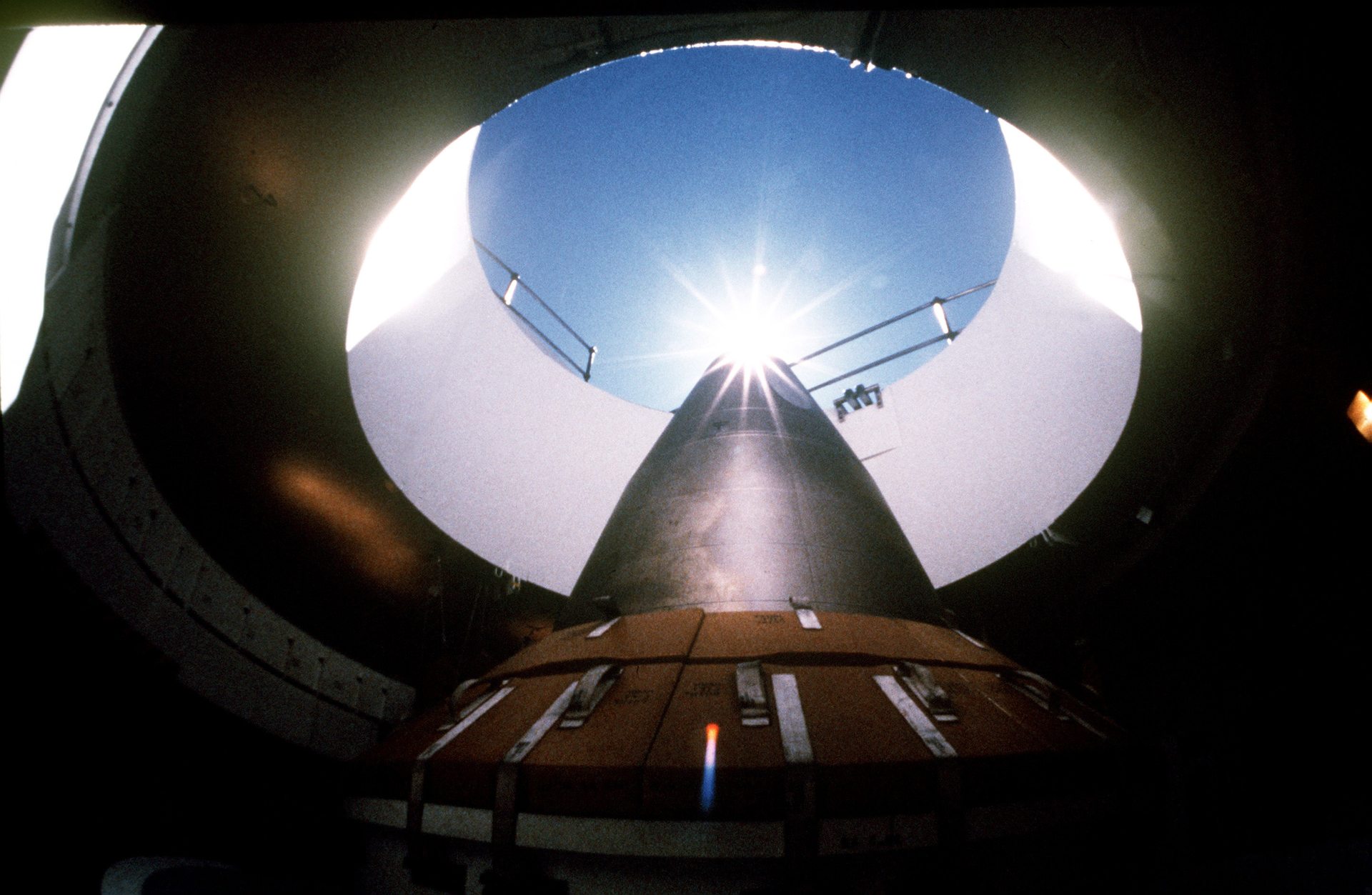
Pictured: an LGM-118A Peacekeeper missile in its silo at F.E. Warren Air Force Base, Wyoming, photographed by the U.S. Air Force on June 1, 1987 — not the actual Minuteman IB missiles or launch facilities involved in the August 1965 sighting, and a later missile generation entirely, but the same base's own underground silo environment. No public-domain or rights-clear photograph of Warren's 1960s Minuteman I launch complex, or of any object from the 1965 sighting itself, is known to exist.
Theoretical Alignment
This case earns a modest ETH score on the strength of its multi-site, cross-institutional corroboration — a base commander, an Army depot commander, and multiple independent Air Force personnel reporting broadly consistent phenomena within the same three-hour window — rather than on any confirmed technological signature. The Psycho-Social component scores unusually high for this file because the August 1965 sighting occurred inside one of the largest UFO waves in Project Blue Book's history, one whose volume the Air Force's own contemporaneous investigators partly attributed to media-driven "flap" psychology (radio call-ins prompting more calls, in a feedback loop later documented in wave sociology generally) even before considering whether any individual report was accurate. Neither framework substitutes for this file's central finding: a real, contemporaneously logged Air Force memorandum documents genuine, radar-corroborated confusion at a nuclear missile base that has never been definitively resolved either as misidentification or as something else, and it is far better documented than most of the anecdotal retellings built on top of it in the decades since.
Background
F.E. Warren Air Force Base is the U.S. Air Force's oldest continuously active installation, originally established in 1867 as Fort D.A. Russell to protect Union Pacific Railroad workers building the transcontinental line through what was then Wyoming Territory. The post was renamed in 1930 to honor Francis E. Warren, Wyoming's last territorial and first state governor and a U.S. Senator for 37 years, and transferred to Air Force control on September 18, 1947. In August 1957 the base was selected as the nation's first operational intercontinental ballistic missile installation; the 706th Strategic Missile Wing began operating 24 Atlas D and E missiles across the surrounding Wyoming, Nebraska, and Colorado countryside starting in 1960. The 90th Strategic Missile Wing activated on July 1, 1963, to receive the newer, solid-fueled LGM-30A Minuteman I, and the Atlas phaseout completed on schedule: the 564th Strategic Missile Squadron inactivated in September 1964, and the 566th Strategic Missile Squadron's Atlas-E missiles were deactivated in March 1965. By 1965 the 90th Strategic Missile Wing was assuming control of 200 Minuteman I silos dispersed across roughly 8,300 square miles — each ten-missile "flight" designated with a phonetic-alphabet letter, mirroring the same Alpha-through-Oscar naming convention later used at Malmstrom. Quebec Flight, assigned to the 400th Strategic Missile Squadron and consisting of a single crewed Launch Control Facility (Q-01) commanding ten unmanned Launch Facilities (Q-02 through Q-11) scattered across the plains north of Cheyenne toward Chugwater, became operational with Minuteman IB missiles in June 1965 — only weeks before the sighting wave that would put its name into the Project Blue Book record.
The immediate national backdrop was itself extraordinary: the summer of 1965 produced one of the largest UFO waves in Project Blue Book's twenty-two-year history, with the August 1965 monthly total of reports exceeded, by Blue Book's own internal count, only by the waves of summer 1952 and November 1957. On the night of July 31, 1965, civilians in Cheyenne itself had already begun reporting objects with red and green flashing lights arranged in V-shaped, echelon, cross, box, and tail-shaped formations, phoning a local radio station in numbers large enough that the station itself became a secondary source the Air Force Command Post had to account for. It was against this backdrop — not a vacuum, and not an isolated local event — that the far more consequential reports from inside Warren's own missile field arrived a few hours later, in the small hours of August 1.
A meaningful, lesser-known precursor had already occurred at the base a year earlier. In August 1964, Airman 1st Class Arthur McEnaney, a security airman with the 809th Combat Defense Squadron, reported a round, brightly shining object hovering over an Atlas missile site (Site 1, Pad 1) while the Atlas force was still active. Interceptor aircraft were scrambled from Denver in response; the Air Force's stated explanation was a weather balloon, though McEnaney and his fellow witnesses reported seeing no aircraft resembling a balloon in the area, and McEnaney later said the men involved "were later told to keep quiet about it as it was national security." This file treats the 1964 sighting as an important but evidentially thinner precursor — its sourcing rests on a single named witness's later recollection rather than a surviving contemporaneous document — establishing that Warren's missile field had already generated at least one reported UAP incident before the much larger, better-documented wave of August 1965.
Complete Timeline
| Date | Event |
|---|---|
| 1867 | Fort D.A. Russell is established near Cheyenne, Wyoming, to protect Union Pacific Railroad construction workers. |
| 1930 | The post is renamed Fort Francis E. Warren; it transfers to Air Force control on September 18, 1947, and is renamed F.E. Warren Air Force Base. |
| August 1957 | Warren AFB is selected as the nation's first operational Atlas ICBM base. |
| 1960 | The 706th Strategic Missile Wing begins operating 24 Atlas D/E missiles across Wyoming, Nebraska, and Colorado. |
| July 1, 1963 | The 90th Strategic Missile Wing activates to receive incoming LGM-30A Minuteman I missiles. |
| August 1964 | Airman 1st Class Arthur McEnaney reports a hovering round object over an Atlas site; Denver interceptors are scrambled; the Air Force cites a weather balloon. |
| September 1964 | The 564th Strategic Missile Squadron (Atlas) is inactivated as the phaseout to Minuteman continues. |
| March 1965 | The 566th Strategic Missile Squadron's Atlas-E missiles are deactivated, completing the Atlas-to-Minuteman transition. |
| June 1965 | Quebec Flight, of the 400th Strategic Missile Squadron, becomes operational with Minuteman IB missiles. |
| July 31, 1965, night | Cheyenne civilians report objects with red and green flashing lights in V-shaped, echelon, and other formations; a local radio station fields numerous calls. |
| August 1, 1965, 1:30 a.m. | Capt. Snelling of the Air Force Command Post telephones Project Blue Book duty officer Lt. Anspaugh at Wright-Patterson AFB, reporting 15–20 radio-station calls describing a large circular, multicolored, silent object over the city. |
| August 1, 1965, ~1:45 a.m. | Base commander Colonel Johnson reports that Colonel Williams, commanding officer of the Sioux Army Depot, has independently observed five objects; two additional UFOs are reported over E Flight. |
| August 1, 1965, overnight | Security policemen Robert R. Thompson and Terry Stuck observe eight stationary lights arranged in four pairs near Quebec Flight's launch control facility; NORAD's Cheyenne Mountain Complex independently reports tracking eight unknown radar targets in the same vicinity. |
| August 1, 1965, overnight (same period) | Missile launch officers Jay Earnshaw and Richard Tashner, on duty in separate underground launch control capsules, independently report objects "stacked up, one on top of the other" and oblong, reddish-orange shapes over the missile field. |
| August 1, 1965, ~4:00–4:05 a.m. | Colonel Johnson telephones Blue Book again, reporting that Q (Quebec) Flight has nine objects in sight — four to the northwest, three to the northeast, two over Cheyenne — and that one object was seen 90 miles east of Cheyenne descending at high speed. Capt. Howell relays a related follow-up call. |
| August 1–2, 1965 | Reports continue intermittently for up to 72 hours per later researcher compilations, ultimately involving over 140 personnel across multiple missile sites, according to Hastings's later-published tally. |
| August 3, 1965 | An Air Force spokesman publicly attributes the broader national wave to misidentified planets (Jupiter) and bright stars (Rigel, Capella, Betelgeuse, Aldebaran); astronomers Walter Webb and Robert Risser publicly note the named bodies were not actually visible in the relevant part of the sky that month. |
| Fall 1965 | The Air Force shifts its public explanation for the wave to temperature inversions, the Aquarid meteor shower, and ground-radar reflections. |
| 1972 | Dr. J. Allen Hynek publishes Lt. Anspaugh's memorandum, summarizing the August 1 telephone reports, in The UFO Experience: A Scientific Inquiry — the only reason the incident is documented at all today. |
| Fall 1973 | 1st Lt. Walter Billings, on duty at Golf LCC, reports a UFO hovering above the India launch facility, triggering security-zone alarms. |
| Late fall 1973 | A six-enlisted, one-officer missile maintenance crew independently reports a close-maneuvering object near a Minuteman III site. |
| Early spring 1974 | A reported landing near Charlie LCC leads to disciplinary scrutiny of an enlisted witness who discussed it. |
| 1976 | Capt. Bruce Fenstermacher reports a cigar-shaped object pacing his missile flight; his Security Alert Team is ordered not to pursue it. |
| September 27, 2010 | Robert Hastings organizes a National Press Club conference; Fenstermacher and six other veterans, including Robert Salas, testify on the record, carried live by CNN. |
| October 23, 2010 | F.E. Warren's missile field loses communications with 50 Minuteman III missiles; the Air Force attributes it to a faulty circuit card, while anonymous technicians later tell Hastings of a much longer, intermittent outage and a large cigar-shaped object over the field — a separately caused, later incident this file does not treat as continuous with the 1965 sighting. |
| March 2024 | The All-domain Anomaly Resolution Office (AARO) publishes its Historical Record Report, Volume I, addressing nuclear-missile-site UAP claims broadly through interviews covering personnel who served between 1966 and 1977 — a window that does not include the August 1965 Warren incident. |
The August 1965 Wave Reaches Warren's Missile Field
The documented core of this case begins at 1:30 a.m. on August 1, 1965, when Capt. Snelling of the Air Force Command Post near Cheyenne telephoned Project Blue Book duty officer Lt. Anspaugh at Wright-Patterson Air Force Base, Ohio, reporting that a local radio station had already fielded fifteen to twenty calls from Cheyenne residents describing "a large circular object emitting several colors but no sound" over the city. This first call establishes an important structural feature of the entire episode: the civilian wave over Cheyenne itself and the far more consequential reports from inside the missile field arrived through the same telephone chain to the same Blue Book duty desk within the same few hours, and Hynek's surviving memorandum does not always clearly separate which specific detail came from which specific site. What is unambiguous is that the reports escalated rapidly in both number and institutional weight over the next two and a half hours.
Snelling, Anspaugh, and the Call to Dayton
Roughly fifteen minutes after Snelling's initial call, base commander Colonel Johnson himself telephoned Blue Book — a detail this file considers genuinely significant. Base commanders overseeing nuclear-armed ICBM forces in 1965 had strong institutional incentive to route unusual reports through subordinate channels and downplay their significance, not to personally call Wright-Patterson at 1:45 in the morning. Johnson reported that the commanding officer of the Sioux Army Depot, Colonel Williams, had independently observed five objects at almost the same moment roughly 40 miles away, and that a further sighting of two objects had been reported over E Flight. A second Command Post officer, Capt. Howell, placed at least one additional follow-up call as the night progressed, part of the same documented call chain.
Eight Lights Over Quebec Flight
The case's most evidentially interesting single detail comes from Quebec Flight, where security policemen Robert R. Thompson and Terry Stuck of the 809th Combat Defense Squadron observed eight stationary lights arranged in four distinct pairs overhead, with one light appearing to move independently among the others. What makes this observation more than an isolated visual report is that NORAD's Cheyenne Mountain Complex, according to the surviving Blue Book memorandum, separately and apparently independently notified Warren that its own radars were tracking eight unknown targets hovering in the immediate vicinity of the Quebec launch control site — the same number, in the same location, reported through an entirely different instrumented channel. Thompson later described his own uncertainty in the moment, and the confirmation that followed: "I wasn't sure what we were seeing until I reported back to the launch commander. When he told me of the report of UFOs from Cheyenne Mountain, I could tell by his voice that he wasn't joking." This file treats the radar/visual correlation at Quebec Flight as the single strongest piece of evidence in the entire case, while noting the important caveat that no primary NORAD radar log has been independently located and examined by this file's own research — the claim is known only through the same secondhand Blue Book memorandum that documents everything else that night.
Stacked Objects: Earnshaw and Tashner
In a separate part of the missile field, missile combat crew commander Jay Earnshaw and launch officer Richard Tashner, each on duty in different underground launch control capsules, later independently confirmed to researcher Robert Hastings that they had observed unidentified objects that night — Earnshaw describing objects "stacked up, one on top of the other," and both men describing oblong or disc-shaped, reddish-orange forms maneuvering over the field. This file weighs their testimony carefully: unlike Thompson's and Stuck's account, which is anchored to the contemporaneous 1965 memorandum via the NORAD radar cross-reference, Earnshaw's and Tashner's specific quoted descriptions reach the documentary record only through Hastings's later interviews, conducted decades after the fact. That does not make their accounts unreliable, but it does mean this file cannot treat them with the same evidentiary weight as the contemporaneously logged elements of the case.
Nine Objects Over Q Flight, and the Culminating Call
By approximately 4:00 to 4:05 a.m., Colonel Johnson placed a further call to Dayton, reporting that Q (Quebec) Flight now had nine objects in sight simultaneously — four to the northwest, three to the northeast, and two directly over the city of Cheyenne — and relaying a separate report of an object seen roughly 90 miles east of Cheyenne, "at high rate of speed and descending." This final entry in the surviving memorandum is the high-water mark of the night's reporting and the detail most often cited by researchers as evidence of a structured, multi-object formation rather than a single misperceived light source repeatedly reported by different observers. The reports did not end with Johnson's final call; per later researcher compilations, sporadic sightings continued intermittently for up to 72 hours, ultimately drawing in, by Hastings's tally, more than 140 personnel across multiple sites — though this file was unable to independently verify that specific personnel count against a primary document, and flags it accordingly as a secondary-sourced figure.
The Air Force's Shifting Public Explanation
Two days after the Warren AFB reports, on August 3, 1965, an Air Force spokesman offered the first public explanation for the broader national wave (of which the Warren sightings were the most institutionally significant, but far from the only, component): the sightings were "astronomical in nature," the product of observers misidentifying the planet Jupiter and several unusually bright stars — Rigel, Capella, Betelgeuse, and Aldebaran — whose azimuth and elevation were said to match reported sighting positions. This explanation collapsed almost immediately under scientific scrutiny. Professor Walter Webb of Boston's Hayden Planetarium and Dr. Robert Risser of the Oklahoma Science and Art Foundation separately pointed out that the named stars and planets were, in fact, positioned on the opposite side of the sky from Earth during early August, making them invisible from the reported observation points at the reported times; a UPI wire reporter covering the story flatly noted that "ordinary radar does not pick up planets and stars," a direct rebuttal to any attempt to extend the astronomical explanation to account for NORAD's Quebec Flight radar track specifically. By that fall, the Air Force had quietly shifted its explanation again, this time to temperature inversions (atmospheric layering said to make stars appear to move and change color), the annual Aquarid meteor shower, and radar reflections from unspecified ground objects — a sequence of at least three materially different official explanations offered within a matter of months, none of which specifically addressed the Warren AFB missile-field reports by name.
Later Incidents at F.E. Warren's Missile Field
Because this case's title refers to F.E. Warren's missile field generally rather than to a single isolated night, it is worth documenting — carefully, and without conflating them with the events of August 1, 1965 — the further incidents researcher Robert Hastings has compiled at the same base across the following four and a half decades. These later reports are genuinely separate events, with their own witnesses, their own dates, and their own evidentiary strengths and weaknesses; this file presents them here as historical pattern evidence, not as corroboration of the 1965 sighting itself.
The Billings Incidents, 1973–74
1st Lt. Walter F. Billings, an ICBM launch officer and training officer who arrived at F.E. Warren in late January 1972, told Hastings of three distinct incidents roughly seven to nine years after the 1965 wave. In the fall of 1973, while on duty at Golf Launch Control Center, Billings's crew observed a UFO hovering above the India launch facility; the sighting triggered both the site's Outer and Inner Security Zone alarms, and a Security Alert Team dispatched to investigate reportedly saw the object directly. Billings has said that as many as nineteen other launch control crews across the wing overheard related radio traffic on the shared UHF channel that night, and that persistent but unconfirmed rumors circulated afterward about erased target tapes on the affected warheads and a subsequent Air Force Office of Special Investigations helicopter survey of the area — details this file flags as unverified secondhand claims rather than established fact. Later that same fall, a second incident involved an entire six-enlisted, one-officer missile maintenance crew, who together watched an object maneuver at close range near a Minuteman site for roughly five minutes. In early spring 1974, a third reported incident described an object landing near Charlie Launch Control Center; a staff sergeant who witnessed it and later discussed the event reportedly faced disciplinary scrutiny, with OSI again said to have been involved. Taken together, the Billings incidents represent this file's second-most-detailed cluster of Warren AFB reports after the August 1965 wave itself, though — like Earnshaw's and Tashner's 1965 testimony — they reach the documentary record only through a Hastings-conducted interview rather than a contemporaneous Air Force document this file could independently examine.
Fenstermacher and the 1976 Cigar-Shaped Object
Two years later, in 1976, Capt. Bruce Fenstermacher, a Minuteman missile combat crew commander, reported that his flight's Security Alert Team observed a large cigar-shaped object hovering low over his launch capsule before it moved, in his account, from missile to missile across the flight at high speed. Fenstermacher has said the security team was given a direct order not to pursue the object, and that his squadron's missile crews were subsequently briefed and told never to discuss the incident with anyone outside their chain of command. Unlike the 1965 witnesses, whose accounts reach the public record only through later interviews, Fenstermacher chose to disclose his own account on the record and in person, appearing at Robert Hastings's National Press Club press conference on September 27, 2010 — the same CNN-streamed event at which Robert Salas discussed the Malmstrom AFB shutdowns, placing a named, on-camera Warren AFB witness alongside the more famous Malmstrom case for the first time.
The October 2010 Communications Disruption — A Separate Case
On October 23, 2010, less than a month after Fenstermacher's press-conference appearance, F.E. Warren's missile field genuinely did experience a documented equipment failure: the base lost communications with 50 Minuteman III missiles. Air Force Global Strike Command's official account, delivered by Lt. Col. John Thomas, attributed the failure to an improperly seated circuit card in a weapons-system processor and stated the outage lasted just under an hour, posing no threat to the public. Hastings has separately reported that three anonymous missile maintenance technicians told him the real outage was intermittent and lasted closer to 26 hours, and that technicians working to restore communications during the crisis observed a large cigar-shaped object, likened by one source to "a WWI zeppelin: long and thin," moving through the missile field. It is essential to this file's honest accounting of the record to state plainly that this 2010 event is the only documented instance in this case's entire history of an actual launch-system or communications malfunction at F.E. Warren coinciding with a reported UFO — and even here, Hastings himself has been explicit that none of his sources claim the object caused the outage, only that it was seen during it. Popular retellings of "the Warren AFB UFO incident" sometimes borrow this 2010 disruption's dramatic hardware failure to describe the 1965 sighting, which had no comparable equipment anomaly of any kind; this file treats that conflation as a real, documented source of public confusion about the case, not as evidence that the 1965 wave itself involved a missile malfunction.
Key Witnesses
Colonel Johnson
Personally telephoned Project Blue Book at Wright-Patterson AFB twice during the night of August 1, 1965, relaying reports from the Sioux Army Depot's commander and, in his final call at approximately 4:00 a.m., reporting nine objects in sight simultaneously over Quebec Flight and the city of Cheyenne. That a base commander made these calls himself is one of the case's most unusual institutional details.
Robert R. Thompson
Observed eight stationary lights in four pairs near Quebec Flight's launch control facility alongside Terry Stuck, a sighting corroborated by an independent NORAD Cheyenne Mountain radar report of eight unknown targets in the same location. Thompson's own account of learning of the radar corroboration — "I could tell by his voice that he wasn't joking" — is one of the case's most-quoted lines.
Terry Stuck
Co-witnessed the Quebec Flight light formation with Thompson, providing a second, independent set of eyes on the same radar-corroborated sighting.
Jay Earnshaw
On duty in an underground launch control capsule elsewhere in the missile field, later described objects "stacked up, one on top of the other" to researcher Robert Hastings — a detail reaching the record only through a post-hoc interview rather than a contemporaneous document.
Richard Tashner
On duty in a separate launch control capsule from Earnshaw, independently corroborated the sighting of oblong, reddish-orange objects over the missile field in a later interview with Hastings.
Colonel Williams
Personally observed five unidentified objects at approximately 1:45 a.m. on August 1, 1965, roughly 40 miles from F.E. Warren AFB — independent corroboration of the same overnight wave from a separate installation under separate command.
The Five Observables Assessment
The Five Observables framework, developed by former AATIP director Luis Elizondo, is applied here to a case with a genuinely unusual profile: strong claimed radar corroboration but essentially no performance data of the kind the framework was designed to evaluate.
Assessment: Anti-Gravity Lift is rated speculative: multiple witnesses describe stationary, hovering lights, but no instrumented altitude or lift data exists beyond the NORAD radar's bare detection of the targets' presence. Instant Acceleration is rated speculative on the strength of the report of an object "descending" at "high rate of speed" 90 miles east of Cheyenne, a detail that is qualitative rather than instrument-measured. Hypersonic Velocity is rated speculative for the same reason — a "high rate of speed" description with no specific figure attached. Low Observability is rated speculative: the objects were visually conspicuous (bright, colored, or lit) rather than stealthy, but their radar signature, if the NORAD account is accurate, was apparently distinguishable from routine air traffic, which Blue Book's own investigators would have been expected to rule out first. Trans-Medium travel is rated absent; no medium transition of any kind was reported. Overall, this case's Five Observables profile is thinner than Minot's genuinely instrumented radar-and-intercept case, but marginally better anchored than Malmstrom's, since the radar detail here is at least referenced within the same contemporaneous document as the visual reports, rather than surviving only as a separately sourced researcher claim.
Evidence Assessment
Supporting Anomalous Origin
- A base commander personally, rather than through a subordinate, telephoned Project Blue Book twice in one night — a strong institutional signal that the reports were taken seriously at the highest local command level, not dismissed as routine noise.
- An independent Army installation roughly 40 miles away, under an entirely separate chain of command, reported objects at almost exactly the same hour, reducing the likelihood of a single localized misperception spreading through one report chain.
- The Quebec Flight sighting is cross-referenced within the same contemporaneous memorandum to an independent NORAD Cheyenne Mountain radar detection of the same number of objects in the same location — a rare instance of a visual report and an instrumented detection being logged together on the night in question, rather than assembled after the fact.
- The incident's central primary document, Lt. Anspaugh's Blue Book memorandum, was preserved and published not by a UFO advocacy group but by Dr. J. Allen Hynek, the Air Force's own credentialed scientific consultant.
- The Air Force's own public explanation for the broader national wave shifted materially at least three times within a few months (astronomical bodies, then temperature inversions/meteor showers/ground radar reflections), and the first explanation was directly and successfully rebutted by independent astronomers on geometric grounds — undermining confidence that the government's contemporaneous account had actually gotten to the bottom of it.
Supporting Conventional Explanation
- No missile guidance, launch-control, or communications malfunction was documented at F.E. Warren on the night of August 1, 1965 — a materially weaker anomalous signature than either Malmstrom's or Minot's flagship nuclear-site cases, both of which involve a genuinely undisputed hardware event.
- The incident occurred inside one of the largest UFO waves in Project Blue Book's history, a wave whose sheer reporting volume was itself partly attributable, by the Air Force's own later account, to media-amplified "flap" psychology rather than to any single underlying phenomenon.
- This file's research was unable to independently locate or examine the underlying NORAD radar log; the claim of radar corroboration rests entirely on a secondhand account within the same 1965 memorandum, not a separately verified Air Defense Command document.
- Several of the case's most specific and vivid witness quotes (Earnshaw's "stacked up" objects, Tashner's reddish-orange shapes) reach the historical record only through researcher interviews conducted decades after the event, raising the ordinary evidentiary concerns about memory drift and retrospective elaboration that apply to any UAP account not anchored to a contemporaneous document.
- No specific Blue Book case-file disposition ("Unidentified," "Insufficient Data," or otherwise) for this precise incident has been located by this file's research, leaving its official evaluative status genuinely unclear rather than confirmed as one of Blue Book's formally unexplained cases.
Why "Disputed"
This file rates the Warren AFB Nuclear Silo Intrusion DISPUTED because it contains a genuinely unusual combination of institutional weight and documentary fragility. On one hand: a nuclear-missile base commander personally telephoned Project Blue Book twice in one night; an entirely separate Army installation corroborated the timing independently; and the case's central claim — NORAD radar tracking the same number of objects the security police were visually reporting at Quebec Flight — appears within the same contemporaneous 1965 document, not assembled after the fact from disparate sources. That is a stronger same-night radar/visual correlation, on its own terms, than many cases this site rates more highly. On the other hand: this file could not independently locate or examine either the original memorandum or the underlying NORAD radar log, relying instead on Hynek's 1972 secondhand publication and later researcher compilations for nearly every specific detail; several of the most vivid witness quotes (Earnshaw's, Tashner's) reach the record only through interviews conducted decades after 1965; the incident sits inside a national wave whose first official explanation was demonstrably wrong and whose second was never specifically applied to this case; and — a point this file considers important enough to state explicitly, given how often this base's incidents are conflated in popular retellings — no missile guidance or launch-control malfunction was documented on the night of August 1, 1965 itself. That kind of hardware anomaly is real and well-documented at Malmstrom and Minot, and separately, in a materially different and disputed form, at Warren itself in October 2010, but it did not occur here. A case with unusually credentialed, multi-institutional testimony and a same-night instrumented cross-reference, sitting alongside a documentary chain this file cannot fully verify at its source and a popular narrative that sometimes borrows drama from a different, later incident at the same base, is precisely what "Disputed" is meant to describe honestly.
Sensor & Instrumentation Detection Profile
The case's strongest evidentiary element is also its most frustratingly indirect: NORAD's Cheyenne Mountain Complex, per Colonel Johnson's and the surviving Blue Book memorandum's own account, notified F.E. Warren that its radars were tracking eight unknown objects hovering in the vicinity of the Quebec Flight launch control facility — a genuine instrumented detection, reported through the chain of command rather than assembled after the fact by a UFO researcher. However, this file's research has not located the underlying NORAD radar log itself, only the secondhand account of it recorded in Lt. Anspaugh's memo and repeated in subsequent retellings; the same limitation applies to Colonel Johnson's report of Q Flight's nine-object sighting (four northwest, three northeast, two over Cheyenne), which is a personnel report of a visual sighting, not an independent sensor return. No photographic, gun-camera, or FLIR data of any kind survives from the incident, and this file found no primary record of any interceptor scramble on the night of August 1, 1965 itself (unlike the August 1964 Atlas-site precursor, which did prompt an interceptor response from Denver).
Environmental & Geospatial Context
F.E. Warren's Minuteman I force was dispersed across roughly 8,300 square miles of high, open plains straddling southeastern Wyoming, western Nebraska, and northeastern Colorado — terrain broadly similar to Malmstrom's Montana missile field, though somewhat closer to a major population center, since Quebec Flight's Launch Control Facility sat only a few miles from Cheyenne itself and the city's own residents were independently phoning a local radio station about the same object described at the base. The surviving memorandum does not record specific weather conditions; early August nights on Wyoming's high plains are typically clear and dry, though this file's research found no contemporaneous meteorological log confirming that for this specific date. The Sioux Army Depot, roughly 40 miles east near Sidney, Nebraska, sits within the same regional airspace, making its commander's independent report of five objects at almost the same hour a meaningful data point about the geographic extent of whatever was being observed that night.
Observer Credibility & Occupational Profile
As with the later Malmstrom and Minot incidents, this case's witness pool is unusually credentialed for the UAP field: every named military witness was an active-duty officer or enlisted specialist performing an assigned nuclear-security or command function, not a chance civilian observer. That the base's own commanding officer, Colonel Johnson, personally telephoned Wright-Patterson AFB to relay the report — rather than routing it through a subordinate public-affairs or security channel — is a genuinely unusual institutional detail; commanders of nuclear-missile bases had every professional incentive to minimize, not amplify, reports that might draw unwanted attention to their command. Robert R. Thompson and Terry Stuck, as 809th Combat Defense Squadron security policemen, were trained to distinguish genuine perimeter threats from false alarms as a matter of daily duty. Jay Earnshaw and Richard Tashner held the same missile-launch-officer qualifications and security clearances that anchor the credibility of Salas, Meiwald, Carlson, and Figel's later Malmstrom testimony. Weighing against this credentialing, uniquely for this case, is chronology: the named witnesses' detailed accounts (Thompson's quote, Earnshaw's and Tashner's descriptions) reach the historical record only through Hastings's interviews conducted decades after 1965, not through contemporaneous sworn statements, which is a real gap this file cannot close.
Physical & Material Assays
No physical trace evidence of any kind — ground disturbance, radiation readings, metallic fragments, or landing marks — has ever been reported at any F.E. Warren missile site in connection with the August 1965 sighting. Unlike Malmstrom's Belt, Montana landing report, this case has no secondary site with recovered material evidence. The only "physical" record connected to the case is documentary rather than forensic: Lt. Anspaugh's contemporaneous Blue Book memorandum itself, a paper artifact whose authenticity is well established (it was published by a credentialed Northwestern University astronomer serving as the Air Force's own scientific consultant) but whose content remains a secondhand transcription of radioed and telephoned reports rather than a directly recorded sensor trace.
Historical Precedents & Archive Matches
This case sits at the early end of the same "UFOs and Nukes" pattern this site catalogs on its dedicated theory page, predating the more famous Malmstrom AFB shutdowns (1967) by roughly eighteen months and Minot AFB's radar-visual case (1968) by more than three years, making Warren's August 1965 wave one of the earliest well-documented nuclear-missile-site sighting clusters in the Project Blue Book archive. It is also a direct precursor to the base's own later history: a smaller 1964 sighting at one of Warren's Atlas sites (witness Arthur McEnaney) preceded it by roughly a year, and further incidents at the same missile field followed in 1973–74 (Walter Billings) and 1976 (Bruce Fenstermacher), establishing F.E. Warren as one of a handful of U.S. nuclear-missile bases with a reported sighting history spanning multiple decades rather than a single incident.
Material Analysis
This case has essentially no physical or material evidence of the kind evaluated elsewhere on this site — no recovered fragments, no ground disturbance, no radiation readings, no metallurgical or isotopic assay of any kind. Its one and only durable "material" artifact is documentary: Lt. Anspaugh's contemporaneous Project Blue Book memorandum, preserved by chance because Dr. J. Allen Hynek chose to publish it in full seven years later. That absence of physical trace evidence is itself informative and should be stated plainly rather than minimized: unlike Malmstrom's Belt, Montana landing site (broken brush, disturbed vegetation) or countless other case files this site catalogs, no landing, close-encounter, or physical-interaction claim of any kind attaches to the August 1965 Warren AFB sighting. It remains, in the taxonomy this site uses elsewhere, a Distant/Radar-Visual case rather than a Close Encounter, and should be evaluated accordingly.
Supporting a Genuine, Unresolved Anomaly
- The one durable document connected to the case — Anspaugh's memorandum — is a genuine, contemporaneously created Air Force record, not a later reconstruction, and its authenticity has never seriously been disputed.
- The memorandum itself references an independent NORAD radar detection matching the visual reports in number and location, a rare same-night cross-reference between two different detection modes.
Supporting a Mundane (if Unidentified) Cause
- No physical trace, landing mark, or recovered material of any kind has ever been connected to this case, in contrast to several other nuclear-site incidents this site catalogs.
- The complete absence of a documented equipment or guidance malfunction at Warren on this date is itself evidence against treating this incident as evidentially equivalent to Malmstrom's or Minot's hardware-anomaly cases, however similar the visual reports may otherwise appear.
The Conventional Explanation Candidate: Astronomical Misidentification and Wave Psychology
The explanation the Air Force itself offered first, and the one with the clearest documented paper trail, holds that the August 1965 wave — including the Warren AFB reports — resulted from ordinary astronomical bodies and bright stars misidentified under unusual atmospheric conditions, compounded by a self-reinforcing "flap" dynamic in which media coverage and radio call-ins prompted further calls regardless of what was actually in the sky. It deserves serious consideration because the national wave's sheer volume of reports genuinely does correlate with widespread contemporaneous press coverage, and because many individual reports within the broader August 1965 wave nationally were later persuasively explained by conventional causes.
Where the Astronomical Explanation Falls Short
Its central weakness is that it was directly, publicly, and successfully rebutted within days by credentialed scientists rather than by UFO advocates: Walter Webb of the Hayden Planetarium and Robert Risser of the Oklahoma Science and Art Foundation demonstrated that Jupiter and the specific named stars were not actually visible in the reported positions during early August, and a wire-service reporter's own observation that "ordinary radar does not pick up planets and stars" directly undercuts any attempt to extend this explanation to the one detail that most distinguishes the Warren AFB case — NORAD's reported radar detection of eight targets at Quebec Flight. An explanation that cannot account for a radar return, whatever its other merits for the broader civilian wave, cannot fully account for this case's most evidentially significant element.
Temperature Inversion, Meteor Shower, and Ground-Radar Reflection
The Air Force's fallback explanation, adopted by that fall, holds that atmospheric temperature inversions caused celestial bodies to appear to move and change color, that the annual Aquarid meteor shower contributed additional bright, fast-moving lights, and that some radar-adjacent reports resulted from reflections off unspecified ground objects. This candidate is more scientifically defensible in the abstract than the first explanation, since temperature inversions and meteor showers are genuine, well-understood phenomena capable of producing at least some of the reported effects. It remains inconclusive as applied specifically to Warren AFB, however, because this file located no document connecting a specific, dated inversion layer, a specific meteor timed to the correct hour, or a specific named ground object to the Quebec Flight radar detection; the explanation was offered for the wave in general, not fitted case-by-case to the missile-field reports.
A Genuine, Unresolved Radar-Visual Anomaly
The remaining candidate holds that some or all of the Warren AFB reports — particularly the Quebec Flight sighting, with its radar cross-reference — represent a genuine sensor-and-eyewitness anomaly that the Air Force's shifting, mutually inconsistent public explanations never actually resolved. This candidate is strengthened by the documented failure of the government's own first explanation and by the multi-institutional, multi-witness character of the reporting (a base commander, an Army depot commander, security police, and missile officers, not a single unreliable observer). It is weakened by the same limitation this file has repeated throughout: the underlying NORAD radar log has not been independently examined, only referenced secondhand within the Blue Book memorandum, leaving the strength of the "radar corroboration" claim genuinely dependent on the reliability of a document this file cannot fully verify beyond Hynek's 1972 publication of it.
Astronomical Misidentification (Jupiter/Bright Stars)
ImplausiblePublicly and successfully rebutted within days by named astronomers on geometric grounds, and cannot account for a radar detection in any case.
Temperature Inversion / Meteor Shower / Ground-Radar Reflection
InconclusiveScientifically plausible in the abstract for parts of the broader national wave, but never specifically fitted to the Quebec Flight radar detection by any document this file located.
Genuine, Unresolved Radar-Visual Anomaly
InconclusiveThe strongest candidate given the documented failure of the government's own first explanation, but held back by this file's inability to independently verify the underlying NORAD radar log.
Related Cases
Confirmed Documents & Official Records
AARO's first comprehensive historical review of nuclear-missile-site UAP claims, based on interviews covering personnel who served between 1966 and 1977 — a window that notably excludes the August 1965 Warren AFB incident this file documents.
UNCLASSIFIED (declassified/public release)National Archives finding aid for the Project Blue Book records transferred from Wright-Patterson AFB, holding roughly 42 cubic feet of documentation across 94 microfilm rolls, including the collection in which Lt. Anspaugh's August 1965 memorandum series originated.
UNCLASSIFIED (declassified)A digitized Project Blue Book case file page indexed specifically under F.E. Warren AFB, Wyoming, part of the broader National Archives Record Group 341 microfilm collection.
UNCLASSIFIED (declassified)Search Government Archives Directly
Further Reading — Recommended Literature
UFOs & Nukes: Extraordinary Encounters at Nuclear Weapons Sites
The definitive reference on the UAP-nuclear connection, drawing on more than 150 military interviews and declassified documents, with dedicated treatment of the Warren AFB 1965, 1973–74, and 1976 incidents alongside Malmstrom and Minot.
The UFO Experience: A Scientific Inquiry
The book in which Project Blue Book's own scientific consultant published Lt. Anspaugh's memorandum — the sole surviving primary document for this case, and Hynek's broader scientific framework for evaluating radar-visual reports like it.
The UFO Controversy in America
An academic history of Project Blue Book and the government's shifting UFO policy, drawing on Air Force documents and interviews, with detailed treatment of the 1965 national wave and the Air Force's contested explanations for it.
Need to Know: UFOs, the Military, and Intelligence
A survey of military and intelligence UFO encounters with a focus on classified communications regarding nuclear-installation intrusions, situating Warren AFB within the broader pattern of missile-site reports.
The UFO Encyclopedia, 4th Edition
The definitive UFO reference work, with an extensively cited entry on the 1965 national wave and the individual case histories of America's nuclear-missile-site sightings.
Essential Viewing

Sources
- rr0.org (Regis Chosson's UFO history archive), reproducing Robert Hastings's compilation "F.E. Warren AFB, Wyoming (1965)," with excerpts from Lt. Anspaugh's Blue Book memorandum. rr0.org
- Sprague, Ryan. "The UFO Incident over F.E. Warren Air Force Base," Medium. medium.com
- HuffPost. "UFO Researcher Claims Air Force Not Revealing Truth About Communication Outage At F.E. Warren Missile Site." huffpost.com
- The UFO Chronicles. "New Reports of UFO Activity Near F.E. Warren AFB's Nuclear Missile Sites" (2012). theufochronicles.com
- The UFO Chronicles. "UFO Activity at Nuclear Weapons Sites" (2012). theufochronicles.com
- UFOs & Nukes (Robert Hastings). "Yet Another Nuclear Missile Launch Officer Talks about UFOs at F.E. Warren AFB" (Walter Billings account). ufohastings.com
- Sign Oral History Project. "A Turning Point in the Controversy," History of the United States Air Force UFO Programs (August 1965 wave, Air Force explanations and their scientific rebuttal). sohp.us
- Live Science. "Did UFOs Disarm Nuclear Weapons? And If So, Why?" (Benjamin Radford's skeptical analysis of nuclear-site UAP claims). livescience.com
- CBS News. "Ex-Air Force Personnel: UFOs Deactivated Nukes" (2010 National Press Club conference coverage). cbsnews.com
- WyoHistory.org. "Wyoming's Nuclear Might: Warren AFB in the Cold War." wyohistory.org
- "Francis E. Warren Air Force Base," Wikipedia (base history, Atlas-to-Minuteman transition, squadron designations). en.wikipedia.org
- The Military Standard. "Minuteman Missile Alert Facility Q-01 / Quebec 01 Launch Control Facility, Chugwater, Wyoming" (squadron structure and activation dates). themilitarystandard.com
- The Military Standard. "F.E. Warren Air Force Base, Wyoming" (base overview and coordinates). themilitarystandard.com
- National Archives (NARA). "Project BLUE BOOK: Unidentified Flying Objects" Records Research Guide. archives.gov
- Fold3. "F.E. Warren AFB, Wyoming," Project Blue Book UFO Investigations, 1947–1969 (digitized case file). fold3.com
- All-domain Anomaly Resolution Office (AARO). "Report on the Historical Record of U.S. Government Involvement with UAP, Volume I" (2024), via Wikisource. en.wikisource.org
- PR Newswire. "Robert Hastings: Unidentified Aerial Object Sighted During October 2010 Nuclear Missile Incident." prnewswire.com
- PR Newswire. "The UFO-Nukes Connection Press Conference: Military Witness Affidavits and Declassified Documents Are Now Available Online" (2010 press-kit materials, including Fenstermacher's Warren AFB account). prnewswire.com
- The Omni Ledger. "UFOs & Nuclear Weapons" theory page (site cross-reference; Warren, Malmstrom, and Minot timeline). omniledger internal
- Wikimedia Commons. "File:Peacekeeper in silo 1987.jpg" (U.S. Air Force photograph, public domain, source for this file's hero image). commons.wikimedia.org
- Hastings, Robert L. UFOs & Nukes: Extraordinary Encounters at Nuclear Weapons Sites, 2nd Edition, Author's Choice, 2008 (revised 2017).
- Hynek, J. Allen. The UFO Experience: A Scientific Inquiry, Henry Regnery Company, 1972 (primary publication of the Anspaugh memorandum).
- Clark, Jerome. The UFO Encyclopedia, 4th Edition, Visible Ink Press, 2023 (F.E. Warren AFB and August 1965 wave entries).
See something inaccurate? Have additional information or sources?
Suggest an Edit →Last Updated: August 2026