
Alexander the Great's "Flying Shields"
A claim repeated across decades of ancient-astronaut literature holds that during Alexander the Great's siege of the island city of Tyre in 332 BCE, his army watched great silvery "flying shields" dive and circle over the battlefield before one fired a beam that shattered the walls. It is one of the most widely repeated "ancient UFO" stories on the internet — and, on direct examination of every surviving ancient historian who wrote about Alexander, it turns out to have no ancient source at all. This file documents that absence in full, and traces the claim instead to its real, fully paper-trailed origin: a 1959 American paranormal book, a 1966 Italian UFO-magazine embellishment, and forty years of secondary writers copying one another without ever locating a primary text.
Theoretical Alignment
Measured against the actual text of every surviving ancient history of Alexander the Great, the "flying shields" story does not merely align weakly with the paleocontact reading — it has no textual basis to evaluate at all. The claim aligns almost entirely with the modern-mythmaking category: a specific, traceable, uncited 1959 assertion that was elaborated by a second uncited writer in 1966 and has been copied forward through ufological secondary literature ever since, with no author at any point in that sixty-five-year chain producing an ancient citation. There is a modest, speculative case that the story is a distorted folk-memory of the real siege's genuinely dramatic and well-documented incendiary weapons — discussed in full below — but even this is offered by this file as a hypothesis about the myth's psychology, not as evidence the myth describes a real aerial phenomenon.
Sensor & Instrumentation Detection Profile
There is no sensor data of any kind for this case, for a reason unlike any other file in this archive: there is no first-hand account to have sensory data attached to it in the first place. Ezekiel's vision (Ancient Record File #001) at least has a single named first-person narrator claiming to have perceived something. The "flying shields" claim has no narrator at all — Frank Edwards, its earliest identified source, wrote in the third person with no citation, and neither he nor anyone who repeated him after 1959 ever named an eyewitness, a unit, or an ancient text as the origin of the description. The claim's "instrumentation" is entirely bibliographic: it exists only in a chain of uncited 20th-century books and magazine articles, not in any report — ancient or modern — of anyone actually seeing anything in 332 BCE.
Environmental & Geospatial Context
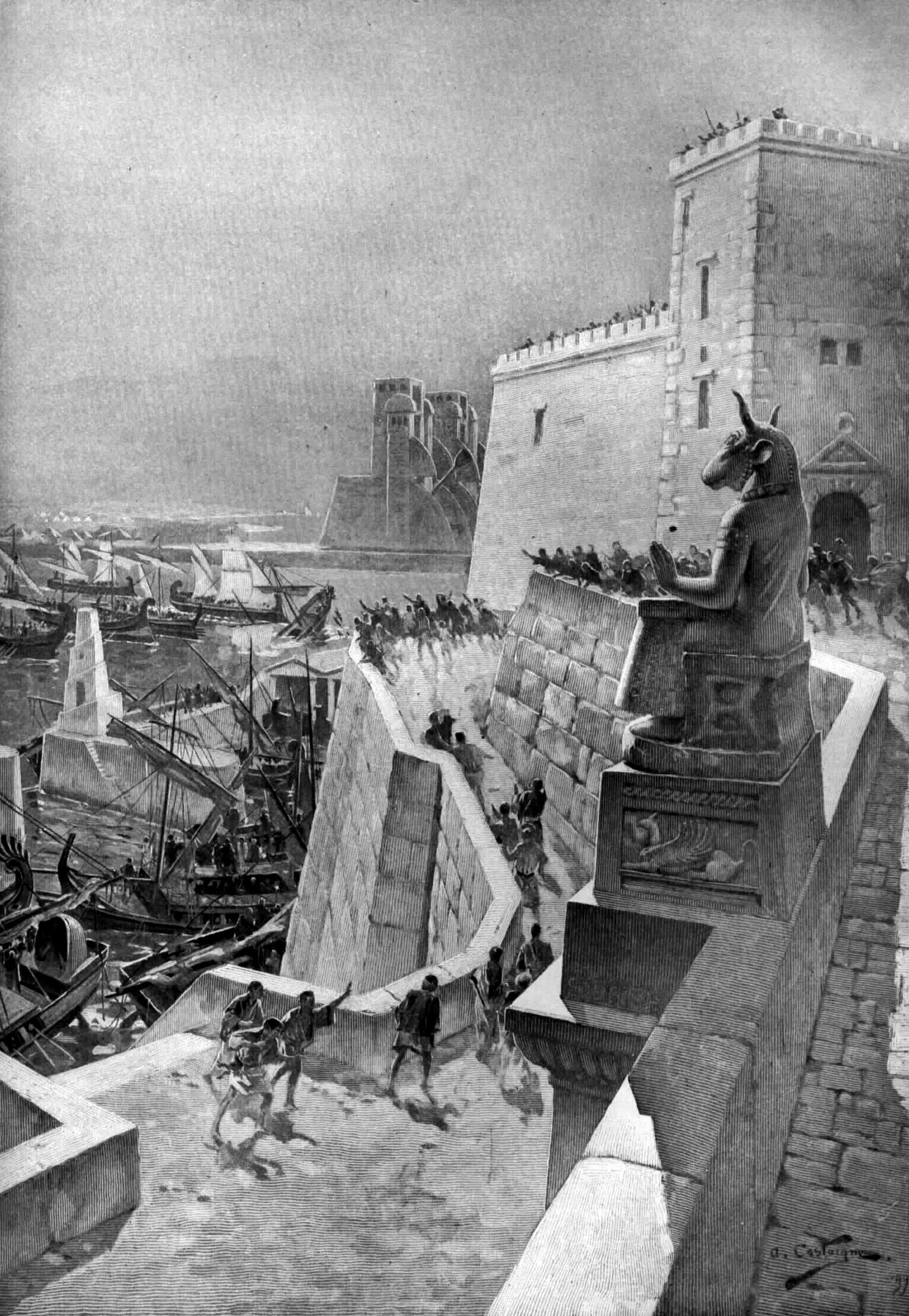
The Siege of Tyre was a real and extensively documented military operation. Tyre was a fortified island city roughly half a mile off the Phoenician coast (in modern Lebanon), protected by walls reported at up to 150 feet high on the seaward side. Alexander's engineers built a causeway (a "mole") of stone and timber roughly 200 feet wide out to the island under constant missile fire, while Tyrian defenders — who had a formidable navy and sophisticated siege-defense engineering of their own — used floating fire-ships, grappling cranes, and the incendiary weapons described below to destroy Macedonian siege works repeatedly over a siege lasting from roughly January to August 332 BCE, called by military historians one of the most difficult sieges of Alexander's career. This is a real, richly attested environment for warfare; it is not, on any surviving account, an environment in which anyone reported an aerial phenomenon.
Observer Credibility & Occupational Profile
The credibility gradient in this file runs entirely in one direction. The four historians whose works are the actual primary sources for Alexander's campaigns — Arrian of Nicomedia (a Roman senator and consul who explicitly based his Anabasis of Alexander on the now-lost eyewitness accounts of Alexander's own general Ptolemy and the engineer Aristobulus), Plutarch (a careful biographer discussed at length in this archive's companion file on Plutarch's Battle of Lucullus), Quintus Curtius Rufus (a 1st-century CE Roman senator-historian), and Diodorus Siculus (a 1st-century BCE universal historian who drew on the contemporary court historian Cleitarchus) — collectively represent the strongest body of surviving classical historiography for any single ancient military campaign. None of the four mentions "flying shields," aerial craft, or any comparable sky phenomenon at Tyre. Against this stands the claim's actual originator, Frank Edwards (1908–1967), an American radio news broadcaster and paranormal-book author with no background in classical history or Near Eastern archaeology, and Italian UFO-magazine writer Alberto Fenoglio, who by the account of the very researchers who investigated his claim is independently documented to have invented other uncited "ancient UFO" stories. Neither man's occupational background included any training that would allow him to identify, transcribe, or translate a genuine ancient source — because, as the analysis below documents, neither ever produced one.
Historical Background: The Real Siege of Tyre
Alexander III of Macedon invaded the Persian Empire in 334 BCE and, after victories at the Granicus River and Issus (333 BCE), moved south along the Levantine coast to secure Persia's Mediterranean fleet bases and open a path to Egypt. Most Phoenician cities submitted without resistance. Tyre, then split between an older mainland settlement and a heavily fortified island city a half-mile offshore, initially offered to remain neutral and admit Alexander for sacrifice to the Tyrian god Melqart (whom Alexander, and later Greek writers, identified with Heracles) — but refused to allow Macedonian troops inside the island fortress itself. Alexander, unwilling to leave an independent, Persian-allied naval power at his rear while he advanced on Egypt, resolved to take the city by force.
What followed was a seven-month siege (conventionally dated January–August/September 332 BCE by modern classical chronology) that ancient and modern military historians alike rank among the hardest-fought operations of Alexander's career. Macedonian engineers built a stone-and-timber causeway across open water to the island under continuous bombardment; when the Tyrians used a fire-ship to destroy the first mole and its siege towers, Alexander rebuilt it wider and summoned Phoenician and Cypriot ships from cities that had already submitted, assembling a fleet large enough to finally blockade Tyre's two harbors. The city fell by direct assault in the summer of 332 BCE after Macedonian ships breached the sea wall; ancient sources report thousands of Tyrians killed in the final assault and thousands more enslaved. Alexander went on to take Egypt without resistance later that same year, where he was received as a liberator and founded the city of Alexandria.
The engineering details of the siege, as recorded by Arrian, Diodorus, and Curtius, are themselves a useful control for evaluating the modern claim: ancient historians describing this exact battlefield were entirely willing to record extraordinary-sounding technical details when their sources actually supplied them. Alexander's engineers are recorded using massive floating siege towers mounted on lashed-together transport ships, protected by wet hides against fire arrows; battering rams swung from ship-mounted cranes; and grappling devices ("crows," in Curtius's translation) designed to tear away the parapets defenders sheltered behind. The Tyrians, for their part, are recorded deploying divers to cut the anchor cables of Macedonian ships, an armored fire-ship packed with combustibles and rigged to explode against the causeway's siege towers, floating booms studded with spikes to keep Macedonian vessels at a distance, and — as quoted at length above — red-hot sand-and-slime-filled bronze shields. Modern military historians treat this as one of the most technically sophisticated siege operations of the ancient world on both sides of the wall. The historians who recorded it in this much granular, willing-to-be-strange detail had every narrative incentive to include a dramatic aerial apparition, had any of their sources reported one; the fact that none of them do is not an incidental gap in an otherwise sparse record, but a specific absence in an unusually rich and specific one.
The primary ancient narrative sources for this campaign are exactly the four historians named above, all writing centuries after the events they describe but drawing (to varying, debated degrees) on earlier, contemporary material: Arrian (2nd century CE) explicitly cites Alexander's companion Ptolemy (later Ptolemy I of Egypt) and the engineer Aristobulus as his principal sources; Diodorus Siculus (1st century BCE) is generally thought to depend heavily on the contemporary court historian Cleitarchus; Quintus Curtius Rufus (probably 1st century CE) drew on a range of now-lost Hellenistic sources with a more dramatic, rhetorical style; and Plutarch (c. 100 CE) wrote a moralizing biography, the Life of Alexander, that draws on a wide range of earlier material including anecdotes not found in the other three. A fifth, official contemporary source once existed and is directly relevant to this claim: Callisthenes of Olynthus, Alexander's own appointed court historian, who accompanied the army and wrote a now-lost work called the Deeds of Alexander — but Callisthenes fell out with Alexander over the introduction of Persian court ceremonial and was executed in 327 BCE on suspicion of involvement in the "Pages' Conspiracy," and his history did not survive antiquity in complete form. As documented in the Textual Analysis section below, this genuine gap in the record — the loss of Alexander's official contemporary historian — is precisely the gap that the 1966 elaboration of this claim tried, without any actual citation, to exploit.
Complete Timeline
| Date | Event |
|---|---|
| 334 BCE | Alexander invades the Persian Empire, crossing the Hellespont into Asia Minor. |
| 333 BCE | Alexander defeats Darius III at the Battle of Issus, opening the Levantine coast to Macedonian advance. |
| Jan.–Aug. 332 BCE | The real Siege of Tyre. Alexander besieges the island city of Tyre for roughly seven months, building a causeway under fire and eventually storming the city by combined land and naval assault. No ancient source records any aerial phenomenon during the siege. |
| 327 BCE | Callisthenes of Olynthus, Alexander's official court historian, is executed after the "Pages' Conspiracy"; his eyewitness history, the Deeds of Alexander, does not survive complete — a real historiographical gap later writers would misuse. |
| 323 BCE | Alexander dies in Babylon. Over the following four centuries, at least four historians whose works survive today — Diodorus, Curtius, Plutarch, and Arrian — compose their accounts of his campaigns, none mentioning aerial phenomena at Tyre. |
| Medieval period | The pseudonymous "Alexander Romance" tradition and forged texts such as the medieval "Letter of Alexander to Aristotle" circulate widely, adding fantastical elements (including, in one branch, a garbled tale set at Venice) to Alexander's legend — a real but separate strand of embellishment later confused with the Tyre claim. |
| 1959 | American broadcaster and paranormal-book author Frank Edwards publishes Stranger than Science (Lyle Stuart), which includes an uncited claim that "two great shining silvery shields, spitting fire around the rims," dove repeatedly at Alexander's army, panicking his elephants near a river crossing. No ancient source is named. |
| 1966 | Italian ufologist Alberto Fenoglio publishes "Cronistoria su oggetti volanti del passato" in the UFO periodical Clypeus (vol. 9), relocating and embellishing the claim to the Siege of Tyre: five triangular-formation "flying shields," the largest firing a lightning bolt that crumbles the walls. Fenoglio cites no source and explicitly notes that the standard 19th-century scholarly history of Alexander, Johann Gustav Droysen's Geschichte Alexanders des Grossen (1833), does not mention it. |
| 1970 | British ufologist Gordon Creighton discusses the claim in Flying Saucer Review, citing Edwards by name and folding in details from Fenoglio, while stating he does not know an original source. |
| 1976 | English writer W. Raymond Drake, in his "Gods and Spacemen" book series, misreads Fenoglio's 1966 article and Creighton's 1970 piece as describing two separate historical incidents (one at Venice, one at Tyre), compounding the confusion in secondary ufological literature. |
| 1968 onward | Erich von Däniken's Chariots of the Gods? and later ancient-astronaut authors, including Zecharia Sitchin, incorporate versions of the Alexander "flying shields" claim into broader paleocontact narratives, again without producing an ancient citation. |
| 2010 | Ufologists Jacques Vallée and Chris Aubeck investigate the claim directly for their sourcebook Wonders in the Sky, confirm that "no book about Alexander the Great contains the account," trace it to Edwards (1959) and Fenoglio's embellishment (1966), and conclude that, absent a located original source, the Tyre army may have "simply witnessed fiery projectiles, some sort of flaming weapon" — i.e., real siege incendiaries, not an aerial craft. |
| 2018 | Ancient-astronaut television personality Giorgio A. Tsoukalos repeats a version of the claim on the BuzzFeed Unsolved episode "The Unexplained Phoenix Lights Phenomenon," reintroducing it to a mass online audience. |
| 2020s | The claim continues to circulate across UFO-interest websites, YouTube videos, and social media listicles, almost universally reproducing Edwards' or Fenoglio's uncited wording rather than citing Arrian, Plutarch, Curtius, or Diodorus directly. |
The Primary Text
This is the section of this file that, in every other Omni Ledger record, quotes the actual ancient primary source in full. There is no such text to quote here, and this file states that plainly rather than paraphrase a claim as though it had documentary support. What follows instead is the actual passage in the actual primary sources for the Siege of Tyre that comes closest to the "shields" imagery in the modern claim — not a description of an aerial craft, but a description of the real, and considerably more grounded, defensive weapon the Tyrians used against Alexander's siege engines. The translation is Peter Pratt's 1809/1821 English rendering of Quintus Curtius Rufus, a public-domain translation:
"Further, the besieged heated brazen targets to a red heat, which, filled with burning sand and boiling slime, they suddenly discharged from the walls. None of their pestiferous devices was more terrible: whenever the burning sand insinuated between the armour and the body, it was impossible to dislodge it; and where the caustic touched, it consumed the flesh: the wretches tortured by it, flinging down their weapons, and tearing off every defensive covering, lay unrevenged, receiving incessant wounds."
Quintus Curtius Rufus, The History of Alexander the Great, Book IV, Chapter III (trans. Peter Pratt, London, 1821) — public domain
Plain-English paraphrase: Tyrian defenders heated bronze shields (Latin clipei/parmae, "targets") red-hot over fires on the city walls, packed them with burning sand and boiling filth, and hurled them down onto the Macedonian soldiers working the siege engines below — a genuinely gruesome and effective anti-personnel weapon that Curtius singles out as the single most feared Tyrian tactic of the siege, because the burning sand would work its way beneath a soldier's armor and could not be shaken or scraped out. Curtius elsewhere (Book VIII) also records that Alexander later decorated the shields of a body of veteran soldiers with silver plating in Persia — the real historical root, described below, of the "Silver Shields" (Argyraspides) name later attached to one of his elite infantry units. Neither passage describes anything airborne, self-propelled, or independent of a human thrower.
Textual Analysis: What the Ancient Historians Actually Say
Because the entire evidentiary question in this file is whether a specific claim exists in specific ancient texts, this section works directly through the surviving sources rather than through a single passage.
Arrian, Plutarch, Curtius, and Diodorus: A Direct Check
Arrian's Anabasis of Alexander (Book II, chapters 16–24) gives the fullest surviving connected narrative of the siege: the diplomatic breakdown, the causeway construction, the fire-ship attack, the naval blockade, and the final assault. Diodorus Siculus (Bibliotheca Historica, Book XVII, chapters 40–46) and Quintus Curtius Rufus (Historiae Alexandri Magni, Book IV, chapters 2–4) both give similarly detailed accounts, including exactly the kind of vivid siege-engineering and siege-defense detail (grappling cranes, fire-ships, the heated-shield weapon quoted above) that a dramatic aerial apparition would be an obvious and irresistible addition to, if any source had recorded one. Plutarch's Life of Alexander treats the Tyre episode more briefly, as one stage in a moralizing biography, but includes its own vivid anecdotes from the siege (including a dream Alexander reportedly had about a satyr, which his seer Aristander punned into a prediction that "Tyre is thine," Tyros/sa Tyre) — demonstrating that Plutarch was not averse to including omens and unusual episodes connected to the siege when his sources supplied them. None of the four texts contains any reference to shields, discs, or any other object moving independently in the sky, in triangular formation or otherwise, at Tyre or anywhere else in Alexander's campaigns.
The Argument from Silence, Addressed Directly
A defender of the claim might object that an argument from silence is inherently weak — perhaps the story appeared in a source that has since been lost, such as Callisthenes' Deeds of Alexander. This is precisely the argument Alberto Fenoglio made in 1966, asserting (again without citation) that "Alexander's historian recorded the event." The objection fails for two independent reasons documented by researchers who have examined it directly. First, Callisthenes' work, while lost in complete form, is extensively quoted and paraphrased by later authors — including Polybius, Strabo, Plutarch, and Arrian himself, who names him directly as a source for other episodes — and none of these secondhand citations of Callisthenes references anything resembling flying shields. Second, and more simply: Fenoglio's claim depends on a source (a supposed record by "Alexander's historian") that neither he nor any subsequent writer has ever produced, quoted, or even correctly identified — his own vague wording conflates the general fact that Alexander had an official historian with a specific, invented claim about what that historian wrote. An argument from silence becomes an argument from active fabrication once a specific, checkable citation is asserted and turns out not to exist.
The Real "Silver Shields": The Argyraspides
One genuine historical thread that appears to feed the modern claim's imagery is real: after his conquest of Persia, Alexander re-equipped a senior corps of his hypaspist (shield-bearer) infantry with silver-plated shields, and this unit — the Argyraspides, literally "Silver Shields" — became one of the most famous elite formations of the Hellenistic world, fighting on into their sixties and seventies in the Wars of the Successors after Alexander's death. Curtius records the silver-plating episode directly (Book VIII); Diodorus and later sources discuss the unit's later, storied history under the Successor generals Eumenes and Antigonus. This is a real "silver shields" story — but it describes ordinary infantry shields carried by ordinary soldiers on the ground, decorated for prestige, with no connection to any aerial phenomenon. It is a plausible, if unproven, contributing thread to why "silver shields" became the specific image Frank Edwards reached for in 1959, alongside the genuinely dramatic heated-shield weapon quoted above.
The Aristotle Letter and the Venice Conflation
Vallée and Aubeck's research identifies a second, genuinely distinct legend that has repeatedly been tangled up with the Tyre claim in secondary ufological literature: a story, attributed to a supposed letter from Alexander to Aristotle, in which an object descends from the sky over Venice and destroys its walls with a beam. This account traces to the medieval "Letter of Alexander to Aristotle," a pseudonymous text within the broader "Alexander Romance" tradition of fantastical medieval elaborations on Alexander's life (famous partly because Dante references it in the Divine Comedy) — and on investigation, the "beam that crumbles walls" element in that specific strand appears to derive from a later, garbled description of gunpowder weaponry retrojected onto Alexander, not from any claim of ancient origin. W. Raymond Drake's 1976 misreading of Fenoglio's Italian text as describing this Venice story and the Tyre story as two independent historical events (rather than one confused modern retelling citing the same non-existent source twice) is a textbook example of how an initial fabrication compounds through successive secondary citation — precisely the failure mode this file exists to document and correct.
Material Analysis: The Paper Trail
Because this claim is a modern print phenomenon rather than an ancient one, "material evidence" here means something different than it does for a genuine ancient text: not a manuscript tradition, but a bibliographic paper trail, and that trail is unusually well documented by researchers who have gone looking for it. Physical and material evidence in the conventional sense used elsewhere on this site — debris, metallurgical residue, an excavated artifact, a chain-of-custody object — does not exist and has never been claimed to exist for this case; no proponent of the "flying shields" story, from Edwards in 1959 to the present day, has ever pointed to a physical object, inscription, or archaeological find of any kind. The entire evidentiary question is bibliographic, not archaeological. The chain runs, without a single gap, from Frank Edwards' uncited 1959 sentence in Stranger than Science, through Alberto Fenoglio's 1966 Clypeus elaboration (which relocated the claim to Tyre and added the triangular formation and lightning-bolt details), through Gordon Creighton's 1970 Flying Saucer Review piece (which combined Edwards and Fenoglio while admitting he had no original source), to W. Raymond Drake's 1976 book (which split the combined claim into two apparently independent "sightings"), and onward into von Däniken- and Sitchin-style ancient-astronaut publishing and, eventually, television and internet content. By contrast, the actual manuscript tradition for the ancient historians who did write about Tyre — Arrian, Curtius, Diodorus, Plutarch — is deep, cross-checked across multiple independent medieval manuscript families, and extensively edited in modern critical editions (Perseus Digital Library, the Loeb Classical Library, and others). That real manuscript tradition contains detailed, internally consistent, and mutually corroborating accounts of causeways, fire-ships, and heated shields hurled by hand — and nothing resembling the modern claim.
No Ancient Manuscript, No Institutional Holding, No Citation
There is no government UFO file to check for an event in 332 BCE, and unlike this archive's genuine ancient-text cases (Ezekiel's Wheel, Livy's prodigy records), there is also no manuscript archive to check, because no ancient manuscript describing this event has ever been identified, catalogued, or cited by chapter and verse by any writer in the claim's sixty-five-year print history. What institutional records do exist are for the real Siege of Tyre and the real ancient historians who described it — and those records confirm the absence rather than filling it.
The standing, searchable scholarly text archive for the surviving Greek and Latin historians of Alexander. Full-text search of the digitized primary sources returns no passage matching the "flying shields" description at Tyre or anywhere else.
Publicly searchableThe official institutional archaeological record for the city of Tyre, Lebanon, including the site's Hellenistic and Roman-period remains. No archaeological or institutional documentation associated with the site references the "flying shields" claim.
Institutional / archaeological recordVerify Directly
The Modern "Flying Shields" Claim
The claim as it circulates today typically runs as follows: during Alexander's campaigns, his army was twice visited by "great shining silvery shields" that dove at his troops and panicked his war elephants and horses; and separately (or, in some retellings, the same event relocated), during the Siege of Tyre, five shield-shaped craft in triangular formation circled the battlefield for hours while thousands of soldiers on both sides watched, before the largest fired a beam of light or lightning that crumbled Tyre's walls and let the Macedonians in. Both versions are typically dated to somewhere in Alexander's Persian and Central Asian campaigns (329–327 BCE, when Alexander was fighting in Bactria and Sogdiana and did possess some war elephants and did cross several rivers) or, in the more commonly repeated Tyre version, to 332 BCE — with the real siege date, real 332 BCE dating, and various invented dates (329 BCE, 330 BCE) used inconsistently across different retellings, itself a symptom of a claim with no fixed original text to check dates against.
As the Timeline above documents, the traceable origin is Frank Edwards' 1959 book Stranger than Science, a collection of paranormal and unexplained-phenomena vignettes written for a popular audience with no scholarly citation apparatus. Edwards provided no ancient source, no historian's name, and no textual reference of any kind for his brief account of two "shields" diving at Alexander's army near a river crossing. Seven years later, Italian ufologist Alberto Fenoglio — independently documented by researchers who have examined his broader body of work as the inventor of at least one other uncited "ancient UFO" story (the "Alençon" case) — relocated and dramatically embellished the claim in the Italian UFO periodical Clypeus, adding the Tyre setting, the triangular five-craft formation, and the wall-destroying lightning bolt. Fenoglio's only gesture toward sourcing was the unverifiable assertion that "Alexander's historian recorded the event," coupled with the explicit acknowledgment that the standard 19th-century scholarly biography of Alexander by Johann Gustav Droysen does not mention it — an admission, buried in his own text, that no scholarly source supported his claim.
From there the claim moved through exactly the kind of citation-laundering chain common to ufological folklore: Gordon Creighton's 1970 Flying Saucer Review article repeated Edwards by name and folded in Fenoglio's embellishments while explicitly stating he had located no original source; W. Raymond Drake's 1976 book misread the combined Edwards/Fenoglio material as two separate historical sightings (Venice and Tyre); and Erich von Däniken and other ancient-astronaut authors incorporated versions of the story into broader paleocontact narratives without independently verifying it. By the time the claim reaches a 2018 BuzzFeed Unsolved episode or a present-day social media listicle, it is being repeated as settled ancient history by writers with no apparent awareness that its entire chain of custody runs back to one uncited 1959 paragraph.
Why This Kind of Claim Persists
Understanding why the "flying shields" claim keeps circulating despite having no ancient textual basis is itself a legitimate historiographical question, separate from the sourcing question already answered above. Several ordinary, well-documented mechanisms of folklore transmission account for it without requiring anything anomalous. First, the claim is attached to one of history's most famous and most-written-about figures: a story that would attract little attention if set among an anonymous garrison becomes instantly shareable when attributed to Alexander the Great, giving it a built-in audience and memorability independent of its truth value. Second, the claim launders its own credibility through citation: each subsequent writer (Creighton citing Edwards, von Däniken citing Fenoglio via Creighton, and so on) implicitly borrows authority from the previous writer's apparent confidence, so that by the third or fourth retelling the claim reads as though it must trace back to something solid, even though no individual link in the chain ever added a genuine ancient citation. Third, the claim survives because it is genuinely difficult for a casual reader to check: verifying that Arrian, Plutarch, Curtius, and Diodorus say nothing about flying shields requires either reading substantial portions of four ancient texts or trusting a secondary source that has actually done so — a much higher bar than simply repeating an already-written paragraph. Finally, platforms that reward engagement over accuracy — UFO-interest websites, video-sharing platforms, and social media listicles — have no structural mechanism that penalizes an uncited historical claim the way an academic press or peer-reviewed journal would, so the claim faces essentially no editorial friction as it spreads. None of these mechanisms requires bad faith on the part of any individual writer in the chain; they are the ordinary conditions under which any catchy, uncited historical claim can travel for decades once it exists in print.
The Historiographical Verdict: No Ancient Source Exists
Every independent researcher who has gone looking for an ancient source for this claim — working from different starting points and with different aims — has reached the same conclusion.
Direct Textual Checks Return Nothing
Classicist and skeptical researchers who have searched the full surviving corpus of Arrian, Plutarch, Curtius, and Diodorus report zero matching passages. This is not a case of an obscure or ambiguous phrase requiring careful interpretation, of the kind that runs through this archive's other ancient files (Ezekiel's difficult chashmal, or the meteor described in the companion file on Plutarch's Battle of Lucullus) — there is simply no passage describing anything shield-shaped, aerial, or independently mobile in any of the four historians' accounts of Tyre or any other campaign.
The Claim's Own Proponents Concede the Absence
Uniquely among ancient-astronaut claims, this one is partly self-debunking in its own primary literature: Fenoglio's 1966 article explicitly names the standard scholarly history of Alexander (Droysen, 1833) and states that it does not contain the story — an admission from the claim's own most detailed source that no scholarly account supports it. Gordon Creighton's 1970 article likewise states outright that he could not identify an original source. When a claim's own chain of transmission repeatedly concedes, in print, that no citation has been located, that is strong internal evidence against treating the claim as an accurately transmitted ancient tradition.
Independent Ufological Researchers Reach the Same Conclusion
Jacques Vallée and Chris Aubeck are directly relevant here precisely because they are sympathetic investigators of historical aerial-phenomena reports, not skeptics debunking ufology from outside — and their sourcebook Wonders in the Sky (2010), a systematic 500-plus-entry catalog of historical sightings compiled specifically to separate well-attested reports from unsourced folklore, examined this claim directly and reached the same negative verdict as the classicist researchers: no ancient book about Alexander contains the account, the story traces to Edwards (1959), and it was Fenoglio (not any ancient historian) who added the Tyre setting and triangular formation. Their own tentative suggestion — that "Alexander's army at Tyre simply witnessed fiery projectiles, some sort of flaming weapon" — points toward the genuinely attested heated-shield weapon quoted in the Primary Text section above, not toward an unattested aerial craft.
Conventional Explanation Candidate — Plausibility Rating: HIGHLY PLAUSIBLE (a 20th-century, uncited literary fabrication, loosely inspired by the real and well-documented heated-shield incendiary weapon and the real "Silver Shields" infantry unit) / IMPLAUSIBLE (a literal ancient encounter with aerial craft, for which no primary source of any kind has ever been produced).
Comparative Analysis
This file's finding — a specific, popular "ancient UFO" claim that traces cleanly to an uncited mid-20th-century paranormal book rather than to any ancient text — is not unique on this site. It sits alongside other cases where careful sourcing work has separated a genuine ancient record from a modern overlay, and against them for contrast with cases where the ancient record genuinely exists.
Historical Precedents & Archive Matches
- The Tulli Papyrus: This archive's file on the Tulli Papyrus documents a structurally similar case — a supposed ancient Egyptian "fiery discs" record whose original document has never been located, examined, or independently confirmed to exist, and whose modern secondary sources (Boris de Rachewiltz, Tiffany Thayer) cannot even agree with each other on the underlying wording. As with Alexander's "flying shields," the honest finding is an absence, not a suppressed or lost positive record.
- The Dropa Stones (forthcoming): A comparable case study in tracing a widely-believed "ancient artifact" myth back to an unverifiable 20th-century origin, on this site's ongoing publication schedule.
- Livy's genuine Roman prodigy records: By contrast, this archive's companion file on Livy's Roman Prodigia Records documents dozens of real, precisely dated, formally logged Roman Senate reports of "shields" and "arms" seen in the sky — genuinely ancient, genuinely textual, and genuinely citable by book and chapter number, in stark methodological contrast to the Alexander claim examined in this file. The contrast is instructive: real ancient "shields in the sky" reports exist and are fully sourceable; this one is not one of them.
- Josephus's "armies in the clouds" (Jewish War, Book 6): Discussed in this archive's Ezekiel's Wheel file, this is a genuine 1st-century CE report, by a named historian, of chariots and armed men seen among the clouds before the fall of Jerusalem — again, a real citable ancient text, unlike the Alexander claim.
- Erich von Däniken's broader pattern: Von Däniken's incorporation of the uncited Alexander claim into Chariots of the Gods? fits a documented pattern across his body of work, discussed in this archive's Tulli Papyrus file, of repeating unverified secondary claims without independently checking primary sources.
Taken together, these comparisons show that this archive does not treat "no ancient source located" as an automatic debunk for every unusual sky-phenomenon claim — Livy's and Josephus's records are treated as credible ancient texts precisely because they check out against the primary sources. The Alexander "flying shields" claim is rated differently not because it describes something extraordinary, but because a direct check of the only sources that could support it returns nothing, while a direct check of its actual claimed transmission history returns a complete, gap-free paper trail leading to a single uncited 1959 paragraph.
Evidence Assessment
Cited in Favor of an Ancient Basis
- Alexander's campaigns did include genuinely dramatic and well-documented aerial-adjacent imagery: incendiary weapons hurled from walls, described by Curtius in vivid detail, and (in the Successor period) massed reflective silver-plated shields carried by the famous Argyraspides.
- A real historiographical gap exists — Callisthenes' contemporary court history does not survive complete — which a motivated researcher could point to as a place a lost original account might theoretically have existed.
- The claim has now been repeated by enough authors, across enough decades, that it has taken on the surface appearance of an established historical tradition to readers unfamiliar with its actual sourcing.
Cited Against an Ancient Basis
- None of the four major surviving ancient historians of Alexander (Arrian, Plutarch, Curtius, Diodorus) mentions the claim, despite all four covering the Tyre siege in significant narrative detail.
- The claim's own earliest identified source (Frank Edwards, 1959) provides no citation of any kind.
- The claim's most detailed elaborator (Alberto Fenoglio, 1966) likewise provides no citation, and explicitly concedes that the standard 19th-century scholarly history of Alexander does not contain the story.
- Secondhand citations of Callisthenes' lost history, preserved in Polybius, Strabo, Plutarch, and Arrian, contain no reference to the claim, closing off the "lost source" defense as anything more than speculation.
- Independent ufological researchers (Vallée and Aubeck) who specifically sought to verify the claim for a sourcebook of historical aerial phenomena reached the same negative conclusion as classicist skeptics.
- The claim's transmission history shows classic signs of citation laundering: each subsequent author cites the previous uncited author rather than an ancient text, and later writers (Drake, 1976) introduce new errors (splitting one confused claim into two) rather than new evidence.
- Basic factual details of the claim are unstable across retellings — the date (329, 330, or 332 BCE), the location (Tyre, a river crossing, or Venice), and the number of craft (two or five) all vary depending on which secondary source is being copied, consistent with a claim with no fixed original text.
Why DEBUNKED
This file is rated DEBUNKED rather than DISPUTED or UNVERIFIED because the central factual question here — does an ancient source describing this event exist? — has a directly checkable answer, and researchers working independently and from different motivations have all reached the same answer: no. This is a stronger finding than this archive's Tulli Papyrus file (rated UNVERIFIED because the alleged original document is merely unlocatable, leaving open the theoretical possibility it once existed) or its Vimana file (rated UNVERIFIED because it separates a genuine ancient literary tradition from a specific 20th-century forgery attached to it). Here, by contrast, the entire claim — not just one disputed detail within an otherwise genuine tradition — has been traced start to finish through its complete modern print history, from one uncited 1959 sentence through a fully identified chain of subsequent authors, none of whom ever located, quoted, or cited an ancient text. DEBUNKED reflects that this is not an open question awaiting a lost manuscript; it is a solved one, with the solution being that the "ancient" claim is a 20th-century literary invention built loosely on a real siege and a real infantry unit's real silver shields.
Key Figures
Frank Edwards (1908–1967)
A well-known mid-century American radio news commentator who wrote several popular books of paranormal and unexplained-phenomena vignettes for Lyle Stuart's publishing house. His brief, uncited account of "shields" diving at Alexander's army is the earliest identified appearance of this claim in any language. Edwards' book was written for a general popular audience and made no claim to scholarly sourcing.
Alberto Fenoglio
The writer who relocated Edwards' vague claim to the Siege of Tyre and added its most memorable details — the triangular five-craft formation and the wall-destroying lightning bolt. Independently identified by later researchers as the author of at least one other invented, uncited "ancient UFO" story (the "Alençon" case), a pattern relevant to assessing his credibility on this one. His own 1966 article concedes that the standard scholarly history of Alexander does not support his claim.
Gordon Creighton
A British ufology writer and longtime editor of Flying Saucer Review who repeated and combined the Edwards and Fenoglio versions in 1970 while explicitly stating that he had not identified an original ancient source — an important documented admission within the claim's own transmission chain.
W. Raymond Drake
Compounded the claim's confusion by misreading Fenoglio's already-embellished 1966 material (via Creighton's 1970 summary) as describing two historically separate sightings, at Venice and at Tyre, rather than recognizing them as a single unsourced claim being retold with different details.
Erich von Däniken
Incorporated versions of the Alexander claim into his bestselling ancient-astronaut manifesto without independently verifying it against primary sources — part of a broader pattern in his work discussed at length in this archive's Tulli Papyrus file. Von Däniken's popularization is the main reason the claim reached a global mass audience beyond specialist ufological print media.
Jacques Vallée & Chris Aubeck
Sympathetic, methodologically careful investigators of historical aerial-phenomena reports who examined this claim directly for their systematic sourcebook and reached the negative verdict quoted throughout this file: no ancient book about Alexander contains the account. Their willingness to rate this claim as unsupported, in a book explicitly compiling historical UFO reports, is itself notable evidence of the claim's weakness — even researchers predisposed to find genuine historical antecedents for the phenomenon could not locate one here.
Giorgio A. Tsoukalos
The most visible modern face of ancient-astronaut theory, whose repetition of a version of the Alexander claim on a 2018 BuzzFeed Unsolved episode reintroduced it to a large online audience decades after Edwards' original book. Like von Däniken before him, Tsoukalos's popularization relied on the existing, uncited secondary-literature chain rather than any new primary-source research.
Jason Colavito
A researcher whose broader body of work documents, catalogs, and translates the actual primary sources cited (and miscited) across ancient-astronaut and fringe-history publishing, providing the general methodological toolkit — checking a popular claim's cited "ancient" source against the real text, and tracing the claim backward through its print history when no such source exists — that this file applies specifically to the Alexander "flying shields" case.
Arrian, Plutarch, Quintus Curtius Rufus & Diodorus Siculus
The four ancient authors whose surviving works are the real documentary basis for everything historically known about the Siege of Tyre. Collectively, their accounts of the siege are detailed, internally consistent on major events, and give no indication that any of their sources — including, for Arrian, the eyewitness accounts of Ptolemy and Aristobulus — recorded anything resembling the modern "flying shields" claim.
The Five Observables Assessment
The Five Observables framework is applied here to the claim as stated in modern ufological retellings, since no ancient description exists to assess directly:
Assessment: None of the Five Observables can be scored as present, because there is no primary-source description to score — every performance detail in the modern retelling (diving flight, triangular formation, a lightning-like beam) originates in Frank Edwards' and Alberto Fenoglio's uncited 20th-century prose, not in any ancient account of an observed craft's behavior.
Further Reading — Recommended Literature
Wonders in the Sky: Unexplained Aerial Objects from Antiquity to Modern Times
The sourcebook whose direct investigation of this exact claim — and its negative conclusion — anchors much of this file's analysis.
Foundations of Atlantis, Ancient Astronauts and Other Alternative Pasts
A sourcebook of 148 documents actually cited by fringe-history writers, translated and annotated — essential context for understanding how claims like this one acquire the appearance of ancient sourcing.
Chariots of the Gods?
The bestselling ancient-astronaut manifesto that helped carry the Alexander "flying shields" claim to a global mass audience, without independent verification of its sourcing.
Alexander of Macedon, 356–323 B.C.: A Historical Biography
A standard modern scholarly biography of Alexander drawing directly and critically on Arrian, Plutarch, Curtius, and Diodorus — the real evidentiary base this file checks the claim against.
The History of Alexander
The modern standard English translation of the source containing the real heated-shield weapon quoted in this file's Primary Text section.
Sources
- "No, Alexander the Great Didn't See Flying Saucers," Tales of Times Forgotten. talesoftimesforgotten.com
- Deliyannis, Yannis. "Did Alexander the Great Really See UFOs?" Chronicon Mirabilium. deliyannis.blogspot.com
- Huneeus, Antonio. "Deconstructing the Alexander the Great UFO Story," Open Minds. openminds.tv
- "329 BC: Alexander the Great records two great 'flying shields'," UFO Evidence. ufoevidence.org
- Vallée, Jacques & Chris Aubeck. Wonders in the Sky: Unexplained Aerial Objects from Antiquity to Modern Times. Jeremy P. Tarcher/Penguin, 2010, pp. 265–266 (full text via Internet Archive). archive.org
- Arrian, Anabasis of Alexander, Book II, chapters 16–24 (siege of Tyre), Perseus Digital Library. perseus.tufts.edu
- Quintus Curtius Rufus, The History of Alexander the Great, trans. Peter Pratt (London, 1821), Book IV. Full text via Internet Archive. archive.org
- Diodorus Siculus, Bibliotheca Historica, Book XVII, chapters 40–46, LacusCurtius (Bill Thayer). penelope.uchicago.edu
- Plutarch, Life of Alexander, LacusCurtius (Bill Thayer). penelope.uchicago.edu
- "Siege of Tyre (332 BC)," Wikipedia. en.wikipedia.org
- "Argyraspides," Wikipedia. en.wikipedia.org
- "Callisthenes," Wikipedia. en.wikipedia.org
- "Epistola Alexandri ad Aristotelem" / "Letter of Alexander to Aristotle," Wikipedia. en.wikipedia.org
- "Alexander Romance," Wikipedia. en.wikipedia.org
- Edwards, Frank. Stranger than Science. Lyle Stuart, 1959 (bibliographic record). archive.org
- "Chariots of the Gods?" Wikipedia. en.wikipedia.org
- "File: A naval action during the siege of Tyre by Andre Castaigne (1898-1899).jpg," Wikimedia Commons (public domain). commons.wikimedia.org
- Colavito, Jason. Foundations of Atlantis, Ancient Astronauts and Other Alternative Pasts: 148 Documents Cited by Writers of Fringe History, Translated with Annotations. McFarland, 2015 (bibliographic record). mcfarlandbooks.com
- Green, Peter. Alexander of Macedon, 356–323 B.C.: A Historical Biography. University of California Press, 1991 (publisher record). ucpress.edu
Essential Viewing
See something inaccurate? Have additional information or sources?
Suggest an Edit →Last Updated: August 2026