
The Utsuro-bune "Hollow Ship"
On the twenty-second day of the second month of Kyōwa 3 — 22 February 1803 — fishermen on the Hitachi coast of eastern Japan are said to have found a round, lidded vessel adrift offshore: rosewood above, iron-banded below, with windows of glass or crystal sealed against the sea, and inside it a young woman with red hair and pale skin who spoke no language anyone recognized and would not let go of a small box. This story is recorded in at least eleven separate Edo-period manuscripts, several of which survive today in named Japanese libraries and can be inspected page by page. That much is documented fact. Whether anything of the kind actually happened on that beach is a completely different question — and mainstream Japanese folklore studies, along with the one researcher who has spent the longest on the archival trail, has generally answered it in the negative.
Theoretical Alignment
The extraterrestrial reading of the utsuro-bune is by some distance the weakest of the four frameworks the record can be tested against, and it fails on the story's own internal evidence rather than on any external prejudice. Nothing in any of the manuscripts describes the vessel doing anything: it does not fly, hover, glow, accelerate, submerge, or manoeuvre. It drifts. It is towed. It is pushed back out. Kazuo Tanaka, the Gifu University professor emeritus who has spent longer inside these documents than anyone else, has made exactly this point in print — the object in the texts simply floats motionless on the water, and calling that a spacecraft is a modern imposition, not a reading of the source. The folklore reading, by contrast, aligns almost perfectly: utsurobune ("hollow boat") is a pre-existing category in Japanese oral tradition, attested in accounts long before 1803 and clustered around a recognizable narrative type — a strange woman arriving from across the sea in a sealed round vessel. The allegorical/satirical reading is strongly supported by the specific historical moment: 1803 sits inside the tightest phase of Japan's sakoku seclusion policy, in the decade before the Russian and British incursions that produced the 1825 Edict to Repel Foreign Vessels, and the story's exotic-but-harmless red-haired foreign woman, promptly shoved back out to sea by villagers who did not want the paperwork, reads to many scholars as a very Edo-period joke about exactly that anxiety. The garbled-castaway reading — that some real, brief, poorly understood coastal encounter with foreigners seeded the tale — remains a genuinely open possibility and is the one Tanaka himself has treated most seriously in recent years, though he frames it as a hypothesis rather than a finding.
Sensor & Instrumentation Detection Profile
There is no instrumentation in this file, and pretending otherwise would be dishonest. Japan in 1803 had no radar, no photography, no telegraph, and no systematic coastal observation network beyond domain-level coastal watch duties (kaibō) that produced administrative reports rather than technical measurements. The only "sensors" that ever engaged with the alleged object were the unaided eyes of an unnamed group of coastal villagers, and their testimony reaches us only third- or fourth-hand, through literate compilers in Edo and elsewhere who were not present and who were writing anywhere from twelve to forty-one years after the fact. What can be instrumented, and has been, is the documentary record itself. The applicable "detection profile" for this case is therefore philological and archival: paleographic dating of manuscript hands and paper, comparative textual criticism across the surviving copies to establish which version is closest to the archetype, provenance tracing through library accession records, and — in the single most productive instance — cross-referencing the place names given in the texts against contemporary cartography. That last method is what produced the case's only genuine forensic result. Tanaka checked the manuscripts' stated landing sites against the coastal survey maps of Inō Tadataka, the pioneering surveyor whose 1800–1801 fieldwork along this very coastline produced the first accurate maps of Japan, and found that the place names given in most versions — "Harayadori," "Haratono-hama" — do not exist. A single manuscript, the Banke bunsho, gives a different name, "Hitachihara Sharihama," which does. That is the closest thing to a corroborated data point this case contains, and it corroborates a beach, not a craft.
Environmental & Geospatial Context
The setting is the Kashima-nada, the long, straight, unusually exposed stretch of Pacific coastline running south from the Kashima Peninsula to the mouth of the Tone River, in what was then Hitachi Province and is now Ibaraki Prefecture. This is not sheltered water. The coast here is a nearly unbroken sand barrier with almost no natural harbours, backed by dunes and pine windbreaks, fronting directly onto the open Pacific where the cold Oyashio current meets the warm Kuroshio. The confluence generates dense sea fog, abrupt weather changes, and — crucially for this file — a well-documented pattern of drift: objects and disabled vessels entering the Kuroshio system from the south and west are carried north-east past exactly this shore, which is why the Kashima-nada beaches have a long recorded history of flotsam, whale strandings, and wrecked coastal traders. Late February, the alleged date, is the tail of the winter monsoon, with strong offshore north-westerlies alternating with onshore easterly gales, water temperatures near their annual minimum, and rough surf. The specific beach identified by Tanaka's 2014 work on the Banke bunsho is Sharihama, in the Hasaki district of present-day Kamisu City, Ibaraki Prefecture — a real place name that appears in Inō Tadataka's coastal survey of the period and survives on maps today, now largely given over to wind-turbine arrays and coastal defence works. No archaeological survey, no dated debris, and no local administrative record of a 1803 stranding has ever been recovered from this stretch of coast, and it should be said plainly that the identification of Sharihama establishes only that one of the eleven manuscripts used a real, locally accurate toponym — a marker of local knowledge on the part of that document's author, not evidence that an object landed there.
Observer Credibility & Occupational Profile
The people in this record fall into three sharply distinct tiers, and the distinction matters more here than in almost any other file in this archive. The first tier is entirely anonymous: the fishermen and villagers of the Hitachi coast who allegedly found the vessel. Not one of them is named in any manuscript. No village is named that can be located. No headman, no domain official, no temple register, no local diary places any identifiable person at the scene. Their credibility cannot be assessed at all, because there is no one to assess — and the complete absence of a named witness in a society that was, by 1803, keeping extraordinarily good written records at village and domain level is itself a significant negative datum. The second tier is the manuscript compilers, and here credibility is high but relevance is limited. Kyokutei Bakin (1767–1848), who recorded the fullest version, was one of the most prolific and respected authors of the late Edo period, a professional writer of enormous output and genuine scholarly curiosity. Yashiro Hirokata (1758–1841), who recorded a parallel version with its own illustration, was a shogunal official and serious antiquarian whose collected miscellany runs to sixty volumes. These men were competent, literate, and honest recorders — but they were recorders of a story that reached them second-hand at minimum, in a genre (the kidan, the "strange tale") whose explicit purpose was the collection and enjoyment of marvels. Bakin's version was compiled for the Tōenkai, a literary club whose members met specifically to exchange odd stories; that context is not a mark against his honesty but it is decisive context for what kind of document we are reading. The third tier is modern scholarship, and here the credentials are real and checkable: Kazuo Tanaka (b. 1947), professor emeritus of optical information engineering at Gifu University, who retired in March 2013 and has published on this legend in Skeptical Inquirer, in Japanese academic bulletins, and in a book-length study; and Kunio Yanagita (1875–1962), the founding figure of Japanese folklore studies (minzokugaku), who examined the utsuro-bune material in the 1920s and returned to it near the end of his life. Neither concluded that anything landed.
Historical & Folkloric Background
To read the utsuro-bune story properly you have to hold two contexts in mind at once: the political context of a closed country nervously watching foreign ships appear on its horizon, and the literary context of a publishing culture that had turned the collection of strange stories into an organized hobby. The tale sits precisely at the intersection of the two, and almost every serious interpretation of it depends on which of those contexts is weighted more heavily.
The political context is sakoku — the Tokugawa shogunate's maritime restriction policy, in force in its mature form from the 1630s. Under it, Japanese subjects were forbidden to leave the country and forbidden to return if they did; foreign trade was funnelled through a handful of tightly controlled channels, most famously the artificial island of Dejima in Nagasaki harbour, where a small Dutch East India Company factory was permitted to operate, alongside licensed Chinese trade, Korean embassies via Tsushima, and Ryukyuan and Ainu contact at the periphery. Direct, unsanctioned contact between ordinary Japanese subjects and Europeans was, for a coastal villager in Hitachi Province in 1803, essentially unheard of. It was also, by that date, becoming steadily less unimaginable. Russian expansion across Siberia and into the Kuriles had already produced contact incidents in the north; in 1804 the Russian envoy Nikolai Rezanov would arrive at Nagasaki seeking trade and be refused after months of waiting, and in 1806–1807 Russian raids on Japanese settlements in Sakhalin and the Kuriles (the Bunka rokō incidents) would harden official attitudes considerably. British and American whalers were pushing further into the north-west Pacific. In 1824 British crewmen came ashore at Ōtsuhama, on this very Hitachi coastline within Mito domain, in an incident that alarmed the domain's scholars and officials, and in 1825 the shogunate promulgated the Ikokusen uchiharai rei, the Edict to Repel Foreign Vessels, instructing coastal domains to drive off foreign ships without negotiation. The utsuro-bune story is set in 1803 and first written down between roughly 1815 and 1844 — which is to say, it was recorded during precisely the decades when "what do we do when a foreigner washes up on our beach?" changed from an abstract question into an urgent administrative one.
The second context is the genre landscape. Late Edo Japan had an enormous appetite for the strange, serviced by a mature commercial publishing industry and by an equally mature manuscript culture in which literate men copied, circulated, and annotated miscellanies (zuihitsu) and collections of odd stories (kidan, kaidan). Bakin's Tōenkai — the "Rabbit Garden Society," from which Toen shōsetsu takes its name — was a club of Edo literati who met to present unusual reports for the group's entertainment and record. A story arriving in such a setting was not fact-checked in any modern sense; it was contributed, admired, and written down. This does not make Edo compilers credulous fools. Bakin himself, as we will see, immediately reached for a comparative explanation, checking the woman's described appearance against a published account of Russian dress. But it does mean the archival trail begins in a venue whose organizing purpose was the collection of marvels rather than the verification of them.
Overlapping both contexts is a third and, for folklorists, the most important one: the hyōryūki or castaway narrative. Because sakoku forbade Japanese subjects from returning after leaving, and because coastal shipping along the Pacific seaboard was constantly at the mercy of the Kuroshio, Japan produced a distinctive and genuinely fascinating body of literature about drift: accounts by, or about, sailors blown off course and carried to Kamchatka, the Aleutians, the American north-west coast, or across the Pacific entirely, and the diplomatic and personal difficulties of their return. The most famous is Daikokuya Kōdayū, whose ship drifted to the Aleutians in 1783 and who eventually reached St Petersburg and was returned to Japan by a Russian mission in 1792; his debriefing was written up by the physician Katsuragawa Hoshū as Hokusa bunryaku ("Brief Account of the Northern Regions," 1794), a document of real ethnographic value about late-eighteenth-century Russia. These narratives were compiled, copied, and read with intense interest precisely because they were the only legal window ordinary Japanese had onto the outside world. One of the manuscripts carrying the utsuro-bune account, Hyōryū kishū, is literally a collection of castaway narratives — the hollow-ship story is filed alongside accounts of real drift voyages. That filing decision tells you how at least one Edo compiler classified it: as a drift story, of the sort his readers already knew, with an unusually exotic passenger.
Finally, "utsurobune" itself was not a term coined for this event. The word (虚舟 or うつろ舟, also given as utsubobune) denotes a hollowed-out or sealed round vessel, and stories of such craft delivering mysterious arrivals from over the sea recur across Japanese tradition — including an account of a girl named Wake-hime discovered in a strange round boat in Iyo Province, and further reported utsurobune incidents in 1681, 1796, and even 1883. The 1803 Hitachi case is the most detailed and most illustrated of these, but it is a member of a set, not a singularity. This is the single most important framing fact in the entire file, and it is the one most consistently omitted from popular retellings.
Complete Timeline
| Date | Event |
|---|---|
| 1630s | The Tokugawa shogunate's maritime restrictions (sakoku) reach their mature form. Foreign contact is restricted to Dejima in Nagasaki and a small number of other controlled channels; Japanese subjects are forbidden to leave or return. |
| 1699 | The Nagoya samurai Asahi Shigeaki records an early "hollow boat" incident at Atsuta in his long-running diary 龂鿛籠中記 (Ōmu rōchūki), describing a woman with red eyebrows found in a sealed vessel — over a century before the Hitachi case, and evidence that the motif predates it. |
| 1783–1792 | The castaway Daikokuya Kōdayū drifts to the Aleutians, reaches St Petersburg, and is repatriated by a Russian mission. His account is written up as Hokusa bunryaku (1794), a landmark of the hyōryūki castaway-narrative genre and one of the few sources of Japanese knowledge about Russian dress and customs. |
| 1796 | The court noble Yanagihara Norimitsu records a related account of a foreign vessel and a female passenger in 間窓自語 (Kansō jigo) — another pre-1803 instance of the narrative type. |
| 1800–1801 | Inō Tadataka conducts his pioneering coastal survey work along the eastern seaboard, producing the mapping against which Tanaka would later test the manuscripts' place names. The toponym "Sharihama" appears in this cartographic record. |
| 22 Feb 1803 | The alleged event. Kyōwa 3, second month, twenty-second day, year of the Ox. Fishermen on the Hitachi coast reportedly tow ashore a round, lidded vessel containing a young woman with red hair and a box she will not surrender. No contemporary administrative, domain, or temple record of the incident has ever been located. |
| c. 1803 | The Mito bunsho (Mito Document), the earliest of the surviving accounts by Tanaka's dating, is written — contemporaneous with the alleged event rather than decades after it. |
| c. 1815 | Komai Norimura compiles 齃宿雑記 (Ōshuku zakki), one of the earliest widely cited written versions, including an ink drawing of the vessel. |
| 1825 | Kyokutei Bakin compiles 兔園小説 (Toen shōsetsu) for the Tōenkai literary society. This is the fullest and most-quoted version, and the one from which nearly all modern retellings ultimately descend. Bakin himself compares the woman's appearance to Russian dress as described in Roshia bunkenroku. |
| 1825 | Yashiro Hirokata records a parallel version with its own hand-coloured illustration in 弘賢随筆 (Kōken zuihitsu / Hirokata zuihitsu), a sixty-volume miscellany now held by the National Archives of Japan. |
| 1825 | The shogunate promulgates the Ikokusen uchiharai rei (Edict to Repel Foreign Vessels), ordering coastal domains to drive off foreign shipping without negotiation. It is repealed in 1842. |
| c. 1835 | An unknown compiler includes the account in 漂流紀集 (Hyōryū kishū), a collection of castaway narratives — classifying the hollow ship alongside documented drift voyages. Now held by Tenri University Library, Nara Prefecture. |
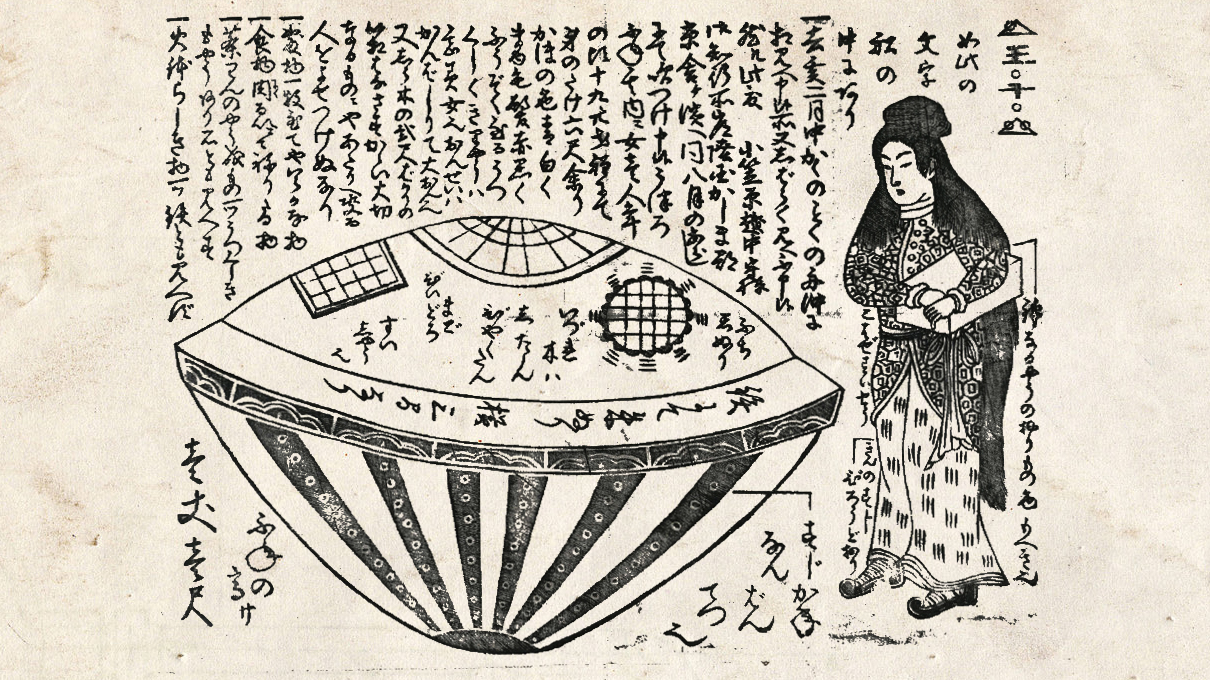
| 1844 | Nagahashi Matajirō includes the story, under the heading "the matter of the empty ship," in 桽の圙 (Ume no chiri), with the widely reproduced illustration used as this file's hero image. Now held by the Iwase Bunko Library. |
| 1925 | Kunio Yanagita, the founder of Japanese folklore studies, examines the utsuro-bune material and situates it within the broader Japanese tradition of visitors arriving from across the sea. |
| 1962 | Yanagita returns to the subject shortly before his death, restating that the accounts are fabrications built on older folktales but that the underlying motif is genuinely traditional — possibly a folk memory of arrival and immigration by sea. |
| 1987 | Masaru Mori's article "The Female Alien in a Hollow Vessel" appears in Fortean Times issue 48 — the key moment at which the legend enters English-language Fortean and UFO literature. |
| 1997 | Kazuo Tanaka begins examining the original manuscripts directly, having come to the subject through teaching critical-thinking courses in the aftermath of the 1995 Aum Shinrikyō attacks. |
| Jul/Aug 2000 | Tanaka publishes his English-language study — "Did a Close Encounter of the Third Kind Occur on a Japanese Beach in 1803?", Skeptical Inquirer 24(4), pp. 37–60 — concluding the tale is a mixture of folklore and invention and identifying the manuscripts' stated place names as fictitious. |
| 2009 | Tanaka publishes the book-length Japanese study Edo "utsurobune" misuteri (江戸「うつろ舟」ミステリー) under the pen name Kamon Shōichi (加門正一). |
| 2010 | Tanaka publishes a Japanese-language account of the legend's origins in the Journal of the Society of Atmospheric Electricity of Japan, vol. 4(2), pp. 30–36. |
| 2010–2012 | Tanaka examines further utsuro-bune documents surfacing from private residences in Mito and Hitachi, Ibaraki Prefecture, expanding the corpus. |
| 26 May 2014 | The Banke bunsho identification. The Ibaraki Shimbun reports Tanaka's finding that a document held by the ninjutsu researcher Kawakami Jin'ichi — part of the Kōka Ban family papers — names the landing site as "Hitachihara Sharihama," a real toponym corresponding to Sharihama in the Hasaki district of Kamisu City. This is a research announcement and newspaper report, not a peer-reviewed 2014 journal article; see the note under Textual & Iconographic Analysis. |
| 2019 | Tanaka's 2009 book is published in English translation as The Mystery of Utsuro-bune: Ancient UFO Encounter in Japan?, under the same pen name, bringing his full archival argument to an English readership for the first time. |
| 2022 | Satō Hideki publishes a monograph with Miyai Shoten examining the authenticity of Bakin's Toen shōsetsu accounts, arguing among other things that the "unknown script" on the vessel corresponds to European alchemical notation of the kind circulating among Japanese rangaku (Dutch studies) scholars. |
| 2023 | Tanaka publishes "The hidden Konjiki-hime sericulture code in the Hitachi Province utsuro-bune tale" in Bunka Kagaku Kenkyū (文化科学研究) vol. 34, pp. 93–108 — arguing the story encodes a local silk-cultivation legend. |
| 28 Feb – 13 Mar 2026 | The National Archives of Japan places the original Kōken zuihitsu volume containing the utsuro-bune illustration on public display in Tokyo — a rare exhibition of the physical manuscript rather than a digital surrogate. |
The Primary Text
An honest caveat has to come first. There is no public-domain English translation of the Edo-period utsuro-bune manuscripts comparable to the King James Bible or a Loeb classical text. The primary sources exist only in early modern Japanese manuscript form; the fullest and best-known English rendering is a modern copyrighted translation by Zack Davisson — a professional translator of Japanese folklore and manga, best known for his English editions of Mizuki Shigeru — published on his site Hyakumonogatari Kaidankai in 2014, and explicitly presented by him as translated and adapted from Toen shōsetsu, Hyōryū kishū, Ume no chiri and other sources rather than as a diplomatic edition of a single manuscript. What follows therefore quotes only brief, precisely attributed phrases from that translation and gives the substance of the account in paraphrase. Where popular websites present long, uniform, unattributed "quotations" from "the ancient text," readers should be aware that these are almost always recycled from this same modern translation or from paraphrases of it, and that the wording differs meaningfully between the underlying manuscripts.
"On the 22nd of February, in the 3rd year of Kyowa (1803), in the Year of the Ox, a strange object that looked like a small boat was spotted off the shore…" The vessel, the account continues, "measured about 3.30 meters tall and 5.45 meters wide. It was round as a ball, and resembled a covered incense burner." Of the woman inside: "Her face was a pale pink color, and her hair and eyebrows were vivid red." Of the box she carried, that "she would not release her grip on it for an instant." And of the ending, that the villagers resolved "to put the girl back into her hollow boat and return her to the sea."
Short excerpts from Zack Davisson's translation of Toen shōsetsu and related manuscripts, Hyakumonogatari Kaidankai, 9 June 2014. Quoted briefly for identification; full text at the source.
Plain-English paraphrase of the fullest version (Toen shōsetsu, 1825): On a winter day in early 1803, fishermen working the Hitachi coast see something unfamiliar offshore and tow it in. It is not a boat in any shape they recognize. It is round — roughly five and a half metres across and three and a third metres tall — and closed, like a lidded incense burner or a covered rice-cake. The upper section is built of rosewood finished with red lacquer, fitted with panels of glass or crystal set and sealed with a resin or pitch so that the interior is watertight; the lower section, the part that sits in the water, is faced and banded with iron plates, which the villagers assume is why it survived being battered on the rocks. There is no rudder, no mast, no oar, and no visible means of propulsion or steering.
Inside is a young woman, judged to be between eighteen and twenty years old and about a metre and a half tall. Her skin is described as pale, tending to pink; her hair and eyebrows are red, and her hair is worn long with white extensions said to be made of fur or of some thread or fibre. Her clothing is of a material and cut nobody recognizes. She speaks, but nobody understands a word of it, and she cannot understand the villagers either. She is calm rather than distressed. She holds a square box, roughly sixty centimetres across, and she will not let anyone touch it or put it down — a detail every version of the story preserves and none of them explains.
The interior of the vessel is furnished: two carpets or bed-sheets of an unfamiliar weave, a bottle of water, some kind of cake or prepared food and a portion of what is described as kneaded or ground meat, and a decorated drinking vessel. Written on the interior walls are characters in an unknown script, which the compilers reproduce in their illustrations. The villagers deliberate. One line of speculation recorded in the text is that this is a foreign princess, perhaps exiled for an illicit love affair, and that the box may contain the severed head of her lover — a lurid detail that reads, to most modern commentators, as unmistakably literary. In the end the practical consideration wins: reporting a foreign arrival to the domain authorities would be enormously expensive and troublesome for a small coastal community under a shogunate that took an extremely dim view of unauthorized foreign contact. So they put her back inside, push the vessel out, and let the current take it away. Nobody follows it. That is the end of the account.
The variant manuscripts differ in details that matter. Dimensions shift slightly. The place name changes. Some versions render the unknown script differently from others. Ume no chiri files the story under a heading meaning roughly "the matter of the empty ship." Hyōryū kishū places it among genuine castaway accounts and adds the frame that the beach lay within the fief of a Lord Ogasawara — a detail Tanaka found geographically impossible, since the Ogasawara clan's holdings were nowhere near this coast. That kind of internal contradiction across the corpus is exactly what textual criticism is for, and it is the subject of the next section.
Textual & Iconographic Analysis
The utsuro-bune is unusual among the entries in this archive in that its evidentiary base is genuinely rich. Most "ancient UFO" claims rest on a single ambiguous passage, a lost document, or a modern retranslation. This one rests on roughly a dozen independent manuscript witnesses, most of which include a drawing, several of which survive in institutional collections, and all of which can be compared against one another. That is a real corpus and it repays real analysis — which, unfortunately for the paleocontact reading, is precisely what has undermined it.
The Manuscripts Compared
Popular accounts almost invariably say "three period manuscripts." That number is a simplification that has calcified through repetition; Tanaka's work has identified eleven documents relating to the Hitachi incident. The core cluster usually cited comprises: Ōshuku zakki (齃宿雑記, c. 1815), compiled by Komai Norimura, containing an early ink drawing; Toen shōsetsu (兔園小説, 1825), compiled by Kyokutei Bakin for the Tōenkai society, the fullest narrative version and the ancestor of most modern retellings; Kōken zuihitsu (弘賢随筆, 1825), the sixty-volume miscellany of the shogunal official and antiquarian Yashiro Hirokata, containing a hand-coloured illustration titled "the barbarian woman of the hollow ship"; Hyōryū kishū (漂流紀集, c. 1835), an anonymous compilation of castaway narratives; and Ume no chiri (桽の圙, 1844), by Nagahashi Matajirō. To these Tanaka adds the Mito bunsho, which he dates to around 1803 and therefore treats as the earliest witness, and the Banke bunsho, the Ban family document from the Kōka ninjutsu tradition held by Kawakami Jin'ichi, identified in 2014.
A necessary correction on the frequently repeated bibliographic details. The English-language Wikipedia article on the subject, which is the source of most secondary summaries in circulation, states that Ume no chiri is held at "Iwase Bunko library in Nara City." Iwase Bunko is not in Nara. It is in Nishio, Aichi Prefecture, founded in 1908 by the local businessman Iwase Yasuke, and Wikipedia's own separate article on the library says so. Similarly, transliterations of these titles vary widely across English sources — Toen shōsetsu appears as Toen Shosetsu, Tōen shōsetsu, and Toyuen Shosetsu; Hyōryū kishū appears with the characters 漂流紀集 and 漂流記集 in different sources and as Hyōryūki-shū. Readers checking these against Japanese catalogues should expect the discrepancies. The underlying documents are real; the English-language bibliographic apparatus around them is unreliable and should be verified against Japanese institutional records rather than against English aggregator sites.
The Vessel's Design in the Illustrations
The illustrations are the reason this story has the modern life it does. Strip away the text and look only at the drawings, and what you see — in Ume no chiri, in Kōken zuihitsu, in Ōshuku zakki — is a low, circular hull with a smooth domed or rounded upper section, banded around its widest point, with a row of window-like panels around the dome. To a twentieth-century eye it reads instantly as a flying saucer. Tanaka has put the point with admirable directness: the craft depicted in these Edo-period Japanese documents, for whatever reason, looks like a flying saucer, and it does so more than a century and a quarter before Kenneth Arnold's 1947 sighting gave the West that visual vocabulary.
That is a genuinely striking observation and it should not be minimised. But it also has a mundane explanation available, and the manuscripts themselves supply it: the compilers repeatedly compare the vessel to a kōro, a covered incense burner, and to a covered rice-cake or steamed bun (manjū). Those are the shapes an Edo-period illustrator would reach for to draw "a closed round thing that floats," and the resulting silhouette — domed lid on a broad round base — converges on the saucer profile for reasons of ordinary object-design rather than of aerodynamics. The banding around the hull is described in the text as iron plating for structural protection, exactly what you would draw for a reinforced tub. The windows are described as glass or crystal set in resin, which is to say a watertight porthole, which is to say a boat. The illustrations show a vessel with no propulsion, no control surfaces, no landing gear, and no engine of any kind. Every version has it towed or drifting.
The Unknown Script
The characters drawn on the vessel's interior wall are, along with the box, the detail that has generated the most speculation. They are not a known writing system. Several proposals have been made and they differ sharply in seriousness.
The most substantive comes from Satō Hideki, who in a 2022 monograph published by Miyai Shoten examining the authenticity of Bakin's Toen shōsetsu material argued that the symbols correspond to European alchemical notation — specifically identifying marks resembling the standard alchemical signs for copper saffron (crocus of copper), fire, and immersion. This is not a fringe suggestion. Alchemical and chemical sigils circulated in Japan through rangaku, the tradition of Dutch learning that gave Japanese scholars access to European scientific texts via Dejima, and such symbols are documented as having been adopted decoratively, even as personal crests, by Japanese scholars of Dutch studies. If Satō is right, the "unknown alien script" is European chemical shorthand, encountered second-hand, reproduced by someone who did not know what it meant — which is a considerably more interesting finding than "unknown," because it points at a specific channel of cultural contact.
A second, more deflationary proposal notes that the marks resemble the pseudo-Roman lettering that Edo artists sometimes used as decorative border ornament in ukiyo-e prints: meaningless squiggles that signified "foreign" to a Japanese viewer without encoding anything. On this reading the script is set dressing, and the question "what does it say?" has no answer because it was never meant to say anything.
A third claim, which circulates widely online and should be treated with real caution, holds that the utsuro-bune symbols match those reportedly seen on the object in the 1980 Rendlesham Forest incident in England. This comparison is made in popular UFO writing rather than in any scholarly venue; the Rendlesham symbol claims are themselves contested and derive from later witness recollection rather than contemporaneous documentation, and pattern-matching a handful of abstract marks across two entirely unrelated cases two centuries apart is exactly the kind of inference that generates false positives. We note the claim exists and do not endorse it.Unsupported Claim
Reading the Story as Hyōryūki (Castaway Literature)
The most productive scholarly frame treats the utsuro-bune account not as a report but as a member of a literary genre with well-understood conventions. The hyōryūki tradition supplied Edo readers with a standard narrative shape: a vessel appears where it should not be, its occupants cannot be communicated with, officials and villagers must decide what to do about a person who legally should not exist in Japanese waters, and the account dwells at length on unfamiliar clothing, food, utensils, and script. Every one of those beats is present in the utsuro-bune story. The inventory of the vessel's contents — carpets, water bottle, food, drinking vessel — is precisely the ethnographic checklist a hyōryūki compiler would record. The extended attention to the woman's hair, complexion, and dress is the same attention Hokusa bunryaku devotes to Russian appearance. The compiler of Hyōryū kishū did not have to be told to file the story with the castaway accounts; it already reads like one.
What separates it from the genuine drift narratives is the ending. Real hyōryūki end in bureaucracy: the castaways are detained, interrogated, documented, repatriated or executed, and there is a paper trail. The utsuro-bune ends with the villagers pushing the evidence back out to sea, which is to say the story is constructed so that no verification is possible. Tanaka and others have made the point that this ending functions as a narrative self-seal: it explains, within the tale, why no one can go and check. Whether that was deliberate craft or a natural consequence of the anecdote's transmission is not decidable from the evidence, but the effect is the same.
Material Analysis: The Manuscript Evidence
Physical evidence, in the sense this archive uses the term for modern cases — recovered debris, metallurgical assay, isotopic ratios, soil chemistry, chain of custody — does not exist for the utsuro-bune and never has. No fragment of the vessel was retained. No object attributed to the woman survives. No excavation of the Kashima-nada dune systems has produced anything associated with the account, and none has been attempted, because there is no location precise enough to excavate. The physical evidence in this file is entirely documentary, and on that narrower ground it is unusually good.
The Kōken zuihitsu volume containing the hand-coloured "barbarian woman of the hollow ship" illustration is held in the Cabinet Library (内閣文庫) collection of the National Archives of Japan in Tokyo, catalogued under identifier 特095-0004, and has been digitized and published through the National Archives Digital Archive; the original volume was placed on public display in Tokyo in early 2026. This is an institutional custody record of exactly the kind that is absent from most paleocontact claims: an accessioned, catalogued, publicly inspectable physical object with a known provenance running back to a named early-nineteenth-century shogunal official. Hyōryū kishū is held by the library of Tenri University in Tenri, Nara Prefecture. Ume no chiri is held by the Iwase Bunko Library in Nishio, Aichi Prefecture. Toen shōsetsu survives in multiple copies; the version usually cited in English scholarship is associated with the Mukyūkai Library in Machida, Tokyo, and Bakin's text has also been reproduced in modern Japanese scholarly compilations of Edo miscellanies, which is how most researchers actually access it. The Banke bunsho remains in private hands, held by Kawakami Jin'ichi.
What the material record establishes is therefore narrow but solid: multiple physically extant, independently held, datable early-nineteenth-century Japanese manuscripts describe this story, and their illustrations are demonstrably period work rather than modern fabrications. What it does not and cannot establish is that the events described occurred. A well-provenanced 1825 manuscript is excellent evidence of what someone in 1825 wrote down. It is not evidence of what happened in 1803, and the twenty-two-year gap between the alleged event and Bakin's compilation — forty-one years in the case of Ume no chiri — is exactly the interval over which an anecdote acquires detail, illustration, and specificity in transmission. The most valuable use of the material record here has been negative: it is only because the manuscripts physically exist and can be compared that Tanaka was able to show their place names contradict each other and, in most cases, correspond to nowhere at all.
The Paleocontact / UFO Interpretation
The utsuro-bune's career as a UFO case is entirely a twentieth- and twenty-first-century phenomenon, and it is worth being precise about how it happened, because the popular version of that history is itself distorted.
The story circulated in Japan through the nineteenth and twentieth centuries as folklore and as a curiosity of Edo miscellany literature. Yanagita's folklore studies treated it as such. What changed was the arrival of a new interpretive template. Once the flying saucer became a fixed visual icon in global popular culture after 1947, the Ume no chiri and Kōken zuihitsu illustrations acquired a resemblance they had not previously had, because the thing they now resembled did not exist when they were drawn. That resemblance is the entire engine of the modern case. Nothing else about the account — not the woman, not the box, not the script, not the drifting — independently suggests a spacecraft; it is the silhouette, and the silhouette alone, that generates the association.
The key moment for English-speaking audiences was 1987, when Masaru Mori published "The Female Alien in a Hollow Vessel" in Fortean Times issue 48. Fortean Times was and is the leading English-language venue for the collection of anomalous reports, and Mori's article introduced the Japanese material, including the illustrations, to a Western readership that had never encountered it. From there the story propagated through the Fortean and ufological press, onto the early web, and eventually into the standard repertoire of "ancient UFO" content, where it now appears in listicles, podcasts, YouTube documentaries, and at least one line of merchandise sold by the National Archives of Japan itself. Its modern framing is remarkably consistent: a "close encounter of the third kind" 144 years before Roswell, complete with an occupant, a language barrier, artefacts, and a departure.
Within that framing, the specific arguments advanced by proponents are these. First, the shape: a domed disc with windows, drawn in 1825, matching a form not otherwise depicted anywhere until the mid-twentieth century. Second, the occupant: a humanoid of unusual appearance — small, pale, red-haired — who could not communicate and whose clothing was of unknown manufacture, mapping onto the modern "occupant case" template. Third, the artefact: a box she guarded absolutely and would not permit anyone to touch, read as an instrument, a record, or a piece of equipment. Fourth, the script: symbols in no known writing system. Fifth, some proponents reclassify the case as a USO (unidentified submerged object) event rather than an aerial one, on the reasoning that the craft was found in the water and returned to it. Sixth, and most often deployed rhetorically, the sheer number of independent manuscripts is offered as corroboration — eleven documents cannot all be wrong.
That last argument deserves direct treatment because it is the strongest-sounding and the weakest in substance. Eleven documents describing the same story are eleven witnesses only if they are independent. They are not. Textual analysis of this corpus shows a transmission tree, not a set of parallel observations: the accounts share phrasing, share illustration conventions, and in several cases visibly derive from one another — the Ōshuku zakki drawing has been described as a draft of the image that appears in Toen shōsetsu. A story copied eleven times is still one story. The correct inference from the corpus size is that the anecdote circulated widely and interested a lot of educated people in early-nineteenth-century Japan, which is genuinely informative about Edo intellectual culture, and says nothing whatever about whether the underlying event occurred.
The Mainstream Academic / Folklore Interpretation
Japanese folklore studies has never treated the utsuro-bune as an unexplained event, and the reason is not institutional dismissiveness but the availability of a better-fitting explanation from within the discipline's own material. Three distinct scholarly readings have been advanced, and they are not mutually exclusive; most specialists hold some combination of them.
Reading One: A Traditional Motif in Written Dress (Yanagita)
Kunio Yanagita (1875–1962), the founder of Japanese minzokugaku and by any measure the most influential figure in the field's history, examined the utsuro-bune material in 1925 and returned to it in 1962, shortly before his death. His judgement was blunt: the 1803 account was, in his phrase, a tall tale — but a tall tale grown from authentic folkloric soil. Yanagita's key structural observation was that round boats were not exotic in Japan at all; tub-boats and coracle-type craft were ordinary working vessels in various regions, and a circular hull would not by itself have astonished a coastal community. What made the utsuro-bune strange was the accretion of Western-coded details onto that ordinary shape: glass windows, metal plating, a red-haired occupant. Yanagita read these as embellishments added precisely to make an unremarkable round boat sound remarkable and, at the same time, to pre-empt the obvious objection that such a craft could not survive an ocean crossing.
Beneath that, he identified a much older narrative substrate. Japanese tradition is full of marebito — visiting deities or sacred strangers who arrive from beyond the sea, bring a gift or a technology, and depart. Yanagita connected the hollow-ship stories specifically to the Konjiki-hime or "Golden Princess" legend of the Hitachi region, in which a foreign princess arrives by sea and her arrival is credited with the origin of local sericulture. Tanaka has since developed this connection substantially, noticing that the woman's depicted clothing in one of the manuscripts resembles that of a bodhisattva statue at Shōfukuji, a temple in what is now Kamisu, Ibaraki, associated with silkworm cultivation and the Konjiki-hime tradition — and suggesting that local monks may have had an interest in promoting a story that echoed their temple's own legend. Tanaka published a full treatment of this argument in 2023, framing the utsuro-bune tale as encoding the sericulture legend. The folklorist Orikuchi Shinobu, Yanagita's most significant successor, independently theorized that hollow vessels in Japanese tradition functioned as tama no iremono — containers for souls or spirits in transit between worlds — which supplies a religious-symbolic reason for the sealed round form that has nothing to do with hydrodynamics or aerospace.
Conventional Explanation Candidate — Plausibility Rating: HIGHLY PLAUSIBLE. The motif demonstrably predates the 1803 account (the 1699 Atsuta record, the 1796 Kansō jigo account, the Wake-hime tradition), the regional legend it maps onto is independently attested, and no additional entities are required.
Reading Two: Edo Anxiety About Foreigners, Encoded (Tanaka, and the Allegorical Reading)
The second reading takes the story as a document about its own moment rather than about an event. The utsuro-bune woman is, in this reading, the foreigner as the late-Edo imagination could safely handle her: beautiful rather than threatening, silent rather than demanding, arriving alone rather than with a fleet, carrying nothing but a personal mystery, and — critically — removable. The villagers' explicitly stated motive for pushing her back out is bureaucratic self-protection: a report to the authorities would be ruinously costly and dangerous. That is not a folkloric motif. That is a completely realistic account of how a small Tokugawa-era coastal village would actually have reasoned about an unauthorized foreign arrival, and it is the single most historically plausible sentence in the entire narrative.
Red hair reinforces the reading. In Japanese usage of the period, red hair carried a double charge: it was the standard marker of oni and other demons in traditional iconography, and it was simultaneously the stock descriptor for northern Europeans, the "red-haired barbarians" (kōmōjin) of the Dutch trade. A red-haired woman arriving from the sea is therefore an image that reads as supernatural and as foreign at the same time, which is precisely the ambiguity the tale exploits. Bakin's own response to the story is telling on this point: rather than treating it as inexplicable, he immediately reached for the comparative literature available to him, checking the woman's described appearance against Roshia bunkenroku, an account of Russian customs derived ultimately from Daikokuya Kōdayū's 1783–1792 sojourn, and speculating that she might be Russian, British, or American. Tanaka has noted the flaw in Bakin's own reasoning here — the fashion information Kōdayū brought back was already a decade or more out of date by 1803 — but the important point is the reflex. The most sophisticated literary mind to handle this story in the nineteenth century treated it as a puzzle about which foreign country the woman came from, not as a puzzle about whether she came from Earth.
Conventional Explanation Candidate — Plausibility Rating: HIGHLY PLAUSIBLE. The historical anxieties are documented, the narrative's own stated motives are period-realistic, and the reading explains features (the self-sealing ending, the harmless-exotic occupant) that the literal reading cannot.
Reading Three: A Real but Garbled Encounter (Tanaka's Later Hypothesis)
Tanaka's position has evolved, and this is worth stating carefully because his 2000 Skeptical Inquirer conclusion is often quoted as though it were his last word. In that paper he concluded the tale was a literary mixture of folklore and imagination and demonstrated that the manuscripts' place names were fictitious. In later work — particularly after the 2010–2012 discovery of further documents and the 2014 identification of the Banke bunsho — he has taken more seriously the possibility that some real, brief, badly understood coastal sighting lies underneath the accretion. His specific suggestion, given in a 2020 interview with Nippon.com, is that a short-lived encounter may have been conflated with the pre-existing utsurobune folklore, and he has pointed at the 1824 landing of British sailors at Ōtsuhama on this same coast as the kind of event that could have supplied the seed. He distinguishes this case from vaguer UFO reports on the grounds that it has, in his words, a substantive documentary reality — there is something concrete to examine, namely the documents themselves.
It should be stressed that Tanaka does not thereby endorse an extraterrestrial or even an anomalous reading. The hypothesis is that a mundane foreign-contact event, or a rumour of one, entered an existing folk-narrative template and acquired its details there. He has been consistent that the object as described does nothing a boat could not do, and that comparing it to a UFO is far-fetched.
Conventional Explanation Candidate — Plausibility Rating: PLAUSIBLE BUT UNPROVEN. The 1824 Ōtsuhama landing is a documented event on the correct coastline, but it postdates the alleged 1803 incident by twenty-one years, which requires the seed event to have been retro-dated in transmission — possible, but not demonstrated.
Reading Four: Deliberate Fabrication / Edo "Fake News" (Satō)
A fourth line, developed most fully by Satō Hideki, treats the account as closer to deliberate invention than to organic folklore. Satō's 2022 monograph interrogates the authenticity of the material Bakin collected in Toen shōsetsu more generally, and his subsequent work has explicitly framed the utsuro-bune story in terms of misinformation — a manufactured curiosity that circulated because it was entertaining, in a media environment that had no mechanism for and little interest in checking. His identification of the "unknown script" as European alchemical notation supports this: someone with access to rangaku materials, decorating a fiction with symbols borrowed from imported chemical texts, is a specific and testable claim about who wrote the story and what they had on their desk.
Conventional Explanation Candidate — Plausibility Rating: PLAUSIBLE. The alchemical-symbol identification is a concrete, checkable claim; the Tōenkai's function as a strange-tale exchange is documented; but the story's clear continuity with pre-1803 utsurobune folklore means pure fabrication is unlikely to be the whole answer.
A Fifth Candidate, and Why It Fails
For completeness: it has occasionally been suggested that the account describes a misidentified ordinary object — a large drifting tub, a fishing float, a piece of a wrecked ship's hull. This is the weakest of the conventional explanations, not because it is implausible in principle but because it explains too little. It accounts for the round hull and nothing else: not the occupant, not the script, not the furnished interior, not the box. Yanagita's version of the argument is stronger precisely because he does not claim the object was a tub; he claims the story took an ordinary round-boat image and dressed it in exotica. Plausibility Rating: LOW as a complete explanation. And the extraterrestrial candidate, assessed by the same standard: Plausibility Rating: IMPLAUSIBLE — it requires an interstellar craft that neither flies nor manoeuvres, an occupant who requires food, water, bedding and warm clothing in an unpressurized wooden hull, a construction material list consisting of rosewood, lacquer, glass and iron, and a total absence of any corroborating trace, in exchange for explaining one thing (the silhouette) that a covered incense burner explains equally well.
Comparative Analysis
Set beside other entries in this archive, the utsuro-bune occupies an unusual position: it has better documentary hygiene than most historical UFO claims and weaker evidential force. The Tulli Papyrus fails at the first hurdle because the document itself has never been located. The Vaimanika Shastra fails because the "ancient" text turned out to be a twentieth-century composition. Neither of those failure modes applies here: the utsuro-bune manuscripts exist, are dated, are held by named institutions, and can be read. The case fails for a different and more instructive reason — the documents are genuine, and what they genuinely document is a story.
Historical Precedents & Archive Matches
- The Atsuta hollow boat (1699, Ōmu rōchūki): The Nagoya samurai Asahi Shigeaki records in his diary an "empty boat" incident at Atsuta involving a woman with red eyebrows, provisions, and unreadable writing — over a century before Hitachi, with the core elements already assembled. This is the single most damaging comparative datum for the "unique event" framing.
- The Kansō jigo account (1796): The court noble Yanagihara Norimitsu records a foreign vessel with a glass-covered hull and a female passenger, with the woman said to be a political exile. Seven years before the Hitachi case, and containing the exile motif that Toen shōsetsu would later reproduce as village speculation.
- Wake-hime of Iyo: A traditional account of a girl found in a strange round boat in Iyo Province, cited as one of the oldest examples of the utsurobune narrative type in Japanese tradition.
- The Konjiki-hime / Golden Princess legend (Hitachi region): A regional legend in which a foreign princess arrives from overseas and her arrival is credited with the introduction of sericulture. Yanagita identified it as the substrate of the utsuro-bune story, and Tanaka's 2023 paper argues the 1803 tale encodes it directly.
- The hyōryūki corpus generally: Documented drift narratives such as Daikokuya Kōdayū's (recorded in Hokusa bunryaku, 1794) and the many other cases catalogued in Katherine Plummer's study of Japanese sea drifters supply the genre template — strange vessel, incomprehensible occupants, catalogue of unfamiliar objects, official difficulty — that the utsuro-bune account follows almost beat for beat, minus the paperwork.
- The Ōtsuhama landing (1824): British crewmen came ashore on the Hitachi coast within Mito domain, an incident that fed directly into the alarm producing the 1825 Edict to Repel Foreign Vessels. Tanaka has floated this as a candidate seed event for the legend's crystallization — a real foreign landing on the right coast, in the right decade, in living memory of the manuscripts' compilers.
- Cross-cultural "mysterious woman from the sea" motifs: Some commentators have noted resemblance to the Russian folk narrative behind Pushkin's Tale of Tsar Saltan, in which a woman and child are sealed in a barrel and cast into the sea. The parallel is real as a motif but there is no evidence of transmission in either direction, and it is offered here as typological comparison only, not as a proposed source.
The pattern across these precedents is the same one that recurs whenever an "isolated ancient anomaly" is examined closely: it is not isolated. The sealed round vessel, the incomprehensible woman, the guarded object, the return to the sea — each of these elements is independently attested in Japanese tradition before 1803, and their combination in the Hitachi account looks far more like the crystallization of a narrative type at a moment of maximum cultural anxiety about foreigners than like a report of an unprecedented event. It is worth noting the contrast with a modern instrumented case such as the archive's JAL Flight 1628 file, where independent radar and multiple aircrew observations exist to be argued about. Here there is nothing to argue about except the texts, and the texts argue against themselves.
Evidence Assessment
As with every folklore file in this archive, the assessment has to separate two claims that popular retellings routinely collapse. Claim A: that multiple genuine Edo-period Japanese manuscripts record the utsuro-bune story, with illustrations, and survive in identifiable institutional collections. Claim A is true, well documented, and not in dispute anywhere. Claim B: that a physical object of unknown origin, carrying a non-Japanese occupant, actually came ashore on the Hitachi coast on 22 February 1803. Claim B is what the lists below address.
Cited in Favour of the Literal / Anomalous Reading
- An unusually large manuscript corpus for a legend of this kind — roughly eleven documents identified by Tanaka, several with independent illustrations, spanning from around 1803 to 1844.
- The earliest of those documents, the Mito bunsho, is dated by Tanaka to approximately 1803 — contemporaneous with the alleged event rather than a generation later.
- The account is unusually specific for folklore: a precise calendar date, measured dimensions, an itemized inventory of the vessel's contents, and a described construction method.
- The 2014 identification of the Banke bunsho established that at least one version names a genuine, locally accurate toponym (Hitachihara Sharihama) attested in Inō Tadataka's contemporary survey mapping.
- The vessel's depicted profile — domed disc with windows and a banded hull — anticipates the twentieth-century flying-saucer form by roughly 144 years, a genuinely striking coincidence that Tanaka himself has acknowledged as the puzzle that drew him in.
- The script drawn on the vessel's interior has not been conclusively identified, and the competing identifications (alchemical notation, decorative pseudo-lettering) remain unsettled.
Cited Against the Literal / Anomalous Reading
- The manuscripts are not independent witnesses. Textual comparison shows a copying tree, with shared phrasing and illustrations visibly derived from one another; eleven copies of one story remain one story.
- The place names given in most versions — "Harayadori," "Haratono-hama" — do not correspond to any real location, as Tanaka established by checking them against period cartography.
- The Hyōryū kishū version places the beach in the fief of Lord Ogasawara, whose clan holdings were nowhere near this coast — an internal geographical impossibility.
- Not one witness is named in any version. No village, no headman, no domain official, no temple or administrative register places any identifiable person at the scene, in a society keeping detailed local records.
- No contemporary official record of the incident exists. A foreign arrival on a Tokugawa-controlled coastline was a reportable, consequential event; the total absence of administrative documentation is a substantive negative finding, not merely a gap.
- The narrative type demonstrably predates 1803 — the 1699 Atsuta record, the 1796 Kansō jigo account, and the Wake-hime tradition all contain the core elements.
- The object does nothing anomalous in any version. It drifts, is towed, and is pushed back out. It never flies, hovers, glows, submerges under power, or manoeuvres.
- The described construction — red-lacquered rosewood, glass set in resin, iron plating — is a list of early-nineteenth-century materials, not of unknown ones.
- The story's ending removes the evidence from the world, making verification structurally impossible — a hallmark of legend construction.
- The earliest and most literarily sophisticated commentator on the story, Kyokutei Bakin, treated it as a question about which foreign nation the woman came from, comparing her to published Russian descriptions.
- Japanese folklore studies from Yanagita onward has classified the account as legend, and the researcher who has spent the longest in the primary sources concludes it is a mixture of folklore and invention.
Why UNVERIFIED
This file carries the UNVERIFIED stamp rather than DISPUTED, DEBUNKED, or CREDIBLE, and the choice is deliberate. DEBUNKED would be wrong: nobody has shown that the utsuro-bune story is a hoax in the sense the Tulli Papyrus or the Vaimanika Shastra are — the manuscripts are authentic period documents, honestly compiled by identifiable men who believed they were recording something interesting that had been reported to them, and the possibility that some real event lies at the bottom of the accretion has not been eliminated and is taken seriously by the field's leading researcher. DISPUTED would also be wrong, because it implies an active scholarly controversy about whether the event occurred, and there is no such controversy; Japanese folklore studies is not divided on this question. CREDIBLE is plainly unavailable: there is no named witness, no physical trace, no contemporary official record, no independent corroboration, and no anomalous behaviour reported for the object even within the story itself.
UNVERIFIED is the accurate label because it describes exactly the epistemic situation. Something was written down, repeatedly, by real people, in datable documents that survive in real libraries. What was written down cannot be confirmed, cannot be traced to a witness, contradicts itself geographically, follows a pre-existing narrative template, and would — if true — have generated an administrative paper trail that does not exist. That is not a debunking and it is not a mystery. It is an unverifiable legend with an unusually well-preserved documentary history, which is a genuinely valuable thing to have and a genuinely different thing from a verified encounter. Readers who came here hoping for a nineteenth-century Roswell should take the honest version instead: the utsuro-bune is one of the best-documented legends in the entire paleocontact literature, and being a well-documented legend is not the same as being a poorly documented event.
Key Figures
Kazuo Tanaka (田中嘉津夫, b. 1947)
The single most important figure in the modern study of this legend, and a genuinely unusual one: an engineer by training who came to folklore research through teaching critical thinking. Tanaka has said he took up the subject after the 1995 Aum Shinrikyō attacks prompted him to teach scientifically minded students how to evaluate paranormal claims, and that what hooked him was the illustrations — Edo-period Japanese documents depicting something that inexplicably resembles a flying saucer, more than a century before the West had that image. He began examining original manuscripts in 1997 and published his English-language study, "Did a Close Encounter of the Third Kind Occur on a Japanese Beach in 1803?", in Skeptical Inquirer 24(4) in July/August 2000, concluding the tale is a literary mixture of folklore and imagination and demonstrating that most of the manuscripts' place names are fictitious. He published a Japanese book-length study in 2009 under the pen name Kamon Shōichi, translated into English in 2019; a 2010 article in the Journal of the Society of Atmospheric Electricity of Japan; and a 2023 paper in Bunka Kagaku Kenkyū arguing the tale encodes the local Konjiki-hime sericulture legend. In 2014 he identified the Banke bunsho, which supplied the story's only verifiable place name. He retired from Gifu University in March 2013 and remains the field's leading authority. He is a skeptic, but a working one: he has consistently said the object as described does nothing a boat could not do, while continuing to look for the real event that might sit underneath.
Kyokutei Bakin (曲亭馬琴, 1767–1848)
Also known as Takizawa Bakin, one of the most productive and commercially successful authors in Japanese literary history, best remembered for the enormous serialized epic Nansō Satomi Hakkenden. His 1825 compilation Toen shōsetsu was assembled for the Tōenkai, a society of Edo literati who met to exchange strange and noteworthy reports, and his version of the utsuro-bune account is the fullest and most influential — effectively every modern retelling descends from it. Crucially, Bakin did not treat the story as inexplicable: he immediately compared the woman's described appearance against Roshia bunkenroku, a published account of Russian customs ultimately derived from the castaway Daikokuya Kōdayū's 1783–1792 sojourn in Russia, and proposed that she might be Russian, British or American. Tanaka has pointed out that Bakin's comparison relied on fashion information already a decade or more out of date by 1803 — but the reflex is what matters. The most sophisticated literary intelligence to touch this story in the nineteenth century treated it as a geography problem, not a cosmology problem.
Yashiro Hirokata (屋代弘賢, 1758–1841)
A scholar-official in shogunal service and a serious collector of documents and curiosities, whose sixty-volume miscellany Kōken zuihitsu (also read Hirokata zuihitsu) preserves an independent version of the utsuro-bune account together with a hand-coloured illustration of the vessel and its occupant, captioned as the "barbarian woman of the hollow ship." His volume is the single best-provenanced physical witness in the corpus: it entered the shogunal Cabinet Library collection and is today held, catalogued and digitized by the National Archives of Japan, which placed the original on public exhibition in Tokyo in early 2026. Yashiro's involvement is significant because it shows the story was circulating in official-scholarly Edo circles, not merely in popular gossip — and equally significant because even he recorded it as a curiosity rather than initiating any inquiry.
Kunio Yanagita (柔田国男, 1875–1962)
The founding figure of Japanese folklore studies as an academic discipline, whose Tōno monogatari (1910) and subsequent decades of fieldwork established the field's methods. Yanagita examined the utsuro-bune material in 1925 and returned to it in 1962, near the end of his life, concluding that the 1803 account was a fabrication but one grown from authentic traditional roots. His two decisive observations shaped everything after: that round boats were ordinary in Japan and the story's exoticism lay entirely in its added Western-coded details (glass, metal plating, red hair), and that the underlying motif belongs to the wider Japanese tradition of visitors arriving from across the sea — which he connected to the regional Konjiki-hime legend and which he speculated might preserve a distant folk memory of arrival and settlement by sea. His English-language legacy for non-Japanese readers runs mainly through Fanny Hagin Mayer's translation of his index of Japanese folk-tale types.
Zack Davisson
A professional Japanese-to-English translator and writer specializing in folklore and the supernatural, best known for his translations of Mizuki Shigeru's yōkai works and for his own book-length study of Japanese ghost belief. His 2014 translation and adaptation of the utsuro-bune account, published on his site Hyakumonogatari Kaidankai, is the version from which the overwhelming majority of English-language retellings of this story are ultimately drawn — usually without attribution. He is explicit that his text is translated and adapted from several manuscripts together rather than being a critical edition of one, and equally explicit about the limits of the record, describing the case as one of those pieces of history where the real story will probably never be known and noting how much the legend has grown in the retelling. Anyone encountering a long English "quotation from the original 1803 document" online should assume, until shown otherwise, that they are reading a paraphrase of his work.
Masaru Mori
Author of the 1987 Fortean Times article that introduced the utsuro-bune material, including the manuscript illustrations, to an English-speaking readership. This publication is the hinge point in the case's modern history: before it, the story was a Japanese folkloric and antiquarian curiosity; after it, it entered the international Fortean and ufological repertoire and began its long career as "Japan's 1803 UFO." The article is cited in the standard reference literature on the subject and is the earliest widely acknowledged English-language treatment.
Kawakami Jin'ichi (川上仁一)
A researcher and practitioner in the Kōka ninjutsu tradition, and inheritor of the Ban family papers (Banke bunsho). In 2014 Tanaka identified within those papers a version of the utsuro-bune account that, uniquely, gives a real place name for the landing site — "Hitachihara Sharihama," corresponding to Sharihama in the Hasaki district of present-day Kamisu City, and attested in Inō Tadataka's contemporary coastal survey. That identification, reported by the Ibaraki Shimbun on 26 May 2014, is the most concrete forensic result the case has produced. It is worth restating precisely what it establishes: that this one document's author knew the local geography. It does not establish that anything landed there.
Five Observables Assessment
Assessment: The utsuro-bune scores lower against the Five Observables framework than almost any other entry in this archive, and it does so on the evidence of its own primary sources rather than on external skepticism. Four of the five observables are flatly absent from every manuscript version: the object does not lift, does not accelerate, does not travel at speed, and is not in any sense difficult to observe — the entire narrative consists of people looking at it closely, measuring it, opening it, and cataloguing its contents. The fifth, trans-medium travel, is scored speculative only because some modern proponents reclassify the case as a USO event on the reasoning that the craft was found in water; no period source describes it entering or leaving the water under its own power, or indeed moving under its own power at all. This is worth dwelling on, because it inverts the usual structure of a paleocontact claim. Cases like Ezekiel's Wheel are argued from behaviour — something in the text moves in a way the arguer finds hard to explain. The utsuro-bune is argued purely from appearance. Remove the illustrations and the case evaporates entirely: what remains is a story about a sealed round boat that washed up, sat on a beach, and was pushed back out to sea.
Related Cases
No Government UFO File Exists for This Case
The alleged event predates Project Blue Book by 145 years, the Japan Air Self-Defense Force by 151, and AARO by 219. There is no FOIA-releasable investigation to request and no Japanese government UFO inquiry to cite — and, significantly for this file, no Tokugawa-era domain or shogunal administrative record of the incident has ever been located either, despite the fact that an unauthorized foreign arrival on a controlled coastline would have been a reportable event. What does exist, and what stands here in place of a government record, is a genuine institutional custody trail for the manuscripts themselves: accessioned, catalogued, digitized and in one case publicly exhibited by the National Archives of Japan and by named Japanese university and private research libraries. These are real, checkable custodial records for the documents — not evidence for the events they describe.
The hand-coloured illustration and account preserved in Yashiro Hirokata's sixty-volume miscellany, held in the shogunal Cabinet Library collection and digitized for public access. This is the best-provenanced physical witness in the entire corpus.
PUBLIC (freely accessible digital surrogate)Official notice of the display of the original Kōken zuihitsu volume containing the utsuro-bune material at the National Archives in Chiyoda, Tokyo — a rare public showing of the physical document rather than a reproduction.
PUBLIC ANNOUNCEMENTFounded 1908 by the Nishio businessman Iwase Yasuke and now operated as a municipal research library of early modern Japanese books and manuscripts, Iwase Bunko holds Nagahashi Matajirō's Ume no chiri — the source of this file's hero illustration. Note that several English sources incorrectly place this library in Nara.
INSTITUTIONAL ARCHIVEOne of Japan's most important private research libraries, holding the anonymous castaway-narrative compilation in which the utsuro-bune account is filed alongside genuine drift voyages — the classification decision that most clearly reveals how one Edo compiler understood the story.
INSTITUTIONAL ARCHIVEThe principal English-language study of the manuscripts, establishing that the place names in most versions are fictitious and concluding the account is a literary mixture of folklore and invention. Still the single most-cited scholarly treatment in English.
PUBLISHED (subscription archive)Search Japanese Manuscript & Archival Resources Directly
Further Reading — Recommended Literature
The Mystery of Utsuro-bune: Ancient UFO Encounter in Japan?
The English translation of Tanaka's 2009 Japanese book-length study — the only full-length treatment of the manuscript corpus available in English, by the researcher who assembled it. Working through the documents one by one, it is the indispensable source for anyone who wants the actual archival argument rather than the retellings.
The Yanagita Kunio Guide to the Japanese Folk Tale
The English edition of Yanagita's index of Japanese folk-tale types, the product of thirty years of research by the founder of Japanese folklore studies and his students. The essential reference for understanding what a "narrative type" means in this tradition — and therefore why the utsuro-bune reads as one.
The Shogun's Reluctant Ambassadors: Japanese Sea Drifters in the North Pacific
The standard English-language study of the hyōryūki phenomenon: eleven groups of Japanese sailors carried off by the Kuroshio to foreign shores, and what happened when they tried to come home. Read this and the utsuro-bune's genre affiliations become impossible to miss.
The Japanese Discovery of Europe, 1720–1830 (Revised Edition)
The classic account of rangaku, Dutch studies, and how Western knowledge actually reached Japan during the seclusion — the intellectual channel through which European chemical symbols, Russian ethnography and images of red-haired foreigners all entered the world that produced this story.
The Book of Yokai: Mysterious Creatures of Japanese Folklore
An accessible but rigorous academic survey of Japanese supernatural folklore by a leading scholar in the field, including how Edo-period publishing culture collected, catalogued and commercialized the strange — the exact ecosystem in which Bakin's Tōenkai operated.
Sources
- "Utsuro-bune," Wikipedia (English) — manuscript list, narrative details, and reference apparatus. en.wikipedia.org/wiki/Utsuro-bune
- "虚舟" (Utsuro-bune), Wikipedia (Japanese) — Japanese-language manuscript titles, compilers, and scholarly interpretations. ja.wikipedia.org/wiki/虚舟
- Itakura, Kimie. "'Utsurobune': A UFO Legend from Nineteenth-Century Japan," Nippon.com (English) — extended interview and summary of Kazuo Tanaka's research. nippon.com/en/japan-topics/g00879
- "UFOと日本人(1):江戸時代に漂着した謝の美女と円盤型乗り物" — the fuller Japanese version of the Nippon.com Tanaka interview, with the manuscript list and the 1824 Ōtsuhama hypothesis. nippon.com/ja/japan-topics/g00879
- National Archives of Japan Digital Archive — "うつろ舟の蜓女," from Kōken zuihitsu, Cabinet Library, item ref. 特095-0004. digital.archives.go.jp/item/1271371
- National Archives of Japan — exhibition notice for the original Kōken zuihitsu (utsuro-bune) volume, 13 February 2026. archives.go.jp/news/20260213.html
- Davisson, Zack. "Utsuro Bune — The Hollow Ship," Hyakumonogatari Kaidankai, 9 June 2014 — the standard English translation and adaptation of the manuscript accounts. hyakumonogatari.com/2014/06/09/utsuro-bune-the-hollow-ship
- "Unidentified Floating Object: Edo Images of Utsuro-bune," The Public Domain Review — the four principal manuscript illustrations with sources and licensing. publicdomainreview.org/collection/utsuro-bune
- "File:Utsuro-bune.jpg" (Nagahashi Matajirō, Ume no chiri, 1844), Wikimedia Commons — public-domain source of this file's hero image. commons.wikimedia.org/wiki/File:Utsuro-bune.jpg
- "Utsurobune," Yokai.com (Matthew Meyer) — folkloric context, the Wake-hime precedent, and the 1681/1796/1883 utsurobune reports. yokai.com/utsurobune
- "Utsuro-Bune: The Hollow (Space?) Ship," Uncanny Japan podcast (Thersa Matsuura), episode 78 — narrative details and folkloric framing. uncannyjapan.com/podcast/utsuro-bune
- "The Utsuro Bune: Japan's Hollow Boat Mystery That Won't Sink," Discovery UK. discoveryuk.com
- "Utsuro-bune: Japan's Mysterious 1803 UFO Legend," My Modern Met — summary of Tanaka's eleven-document corpus and the pseudo-Roman-lettering hypothesis for the script. mymodernmet.com/utsuro-bune-japan-ufo
- "Iwase Bunko Library," Wikipedia — confirms the library's actual location in Nishio, Aichi Prefecture (correcting a widely copied error). en.wikipedia.org/wiki/Iwase_Bunko_Library
- Tanaka, Kazuo. "Did a Close Encounter of the Third Kind Occur on a Japanese Beach in 1803?" Skeptical Inquirer 24(4), July/August 2000, pp. 37–60. skepticalinquirer.org
- Tanaka, Kazuo (田中嘉津夫). "「常陸国うつろ舟伝説」ミステリーの面白さ" (The fascination of the Hitachi Province utsuro-bune legend mystery), Journal of the Society of Atmospheric Electricity of Japan 4(2), 2010, pp. 30–36 — indexed at CiNii Research. cir.nii.ac.jp
- Tanaka, Kazuo (田中嘉津夫). "「常陸国うつろ舟奇談」に隠された養蚕金色嫁の暗号" (The hidden Konjiki-hime sericulture code in the Hitachi Province utsuro-bune tale), Bunka Kagaku Kenkyū 34, March 2023, pp. 93–108 — indexed at CiNii Research. cir.nii.ac.jp (search: うつろ舟)
- Kamon, Shōichi (加門正一, pen name of Kazuo Tanaka). 江戸「うつろ舟」ミステリー (Edo "Utsurobune" Mystery), Kinokuniya catalogue record, 2009. kinokuniya.co.jp
- Mori, Masaru. "The Female Alien in a Hollow Vessel," Fortean Times 48 (1987), pp. 48–50 — the article that introduced the legend to English-language readers.
- Yanagita, Kunio, and Fanny Hagin Mayer. The Yanagita Kunio Guide to the Japanese Folk Tale. Indiana University Press, 1986 (open-access edition). publish.iupress.indiana.edu
- Satō, Hideki (佐藤秀樹). 曲亭馬琴『兔園小説』の真偵―うつろ舟の蜓女と大酒大食の会. Miyai Shoten, 2022. ISBN 978-4-8382-3397-7 — the alchemical-symbol identification and the authenticity analysis of Bakin's collection.
- Ibaraki Shimbun (茂城新聞), "UFO「うつろ舟」漂着地名浮上," 26 May 2014 — the newspaper report of Tanaka's Banke bunsho identification and the Hitachihara Sharihama place name.
- Kamisu City official newsletter, "舎利湯とうつろ舟" (Sharihama and the utsuro-bune), Kōhō Kamisu no. 409, 1 March 2024 — the municipal account of the identified landing site. city.kamisu.ibaraki.jp (PDF)
- "Kamisu," Wikipedia — geography and coordinates of the modern municipality containing Sharihama. en.wikipedia.org/wiki/Kamisu
- "Inō Tadataka," Wikipedia — the surveyor whose 1800–1816 coastal survey work (published as maps in 1821) supplied the cartographic control against which Tanaka tested the manuscripts' place names. en.wikipedia.org/wiki/Inō_Tadataka
- "Sakoku," Wikipedia — the Tokugawa maritime restriction policy in force at the time of the alleged event. en.wikipedia.org/wiki/Sakoku
- "Edict to Repel Foreign Vessels," Wikipedia — the 1825 Ikokusen uchiharai rei and its 1842 repeal. en.wikipedia.org/wiki/Edict_to_Repel_Foreign_Vessels
- "Daikokuya Kōdayū," Wikipedia — the castaway whose Russian sojourn produced Hokusa bunryaku and the Russian-appearance information Bakin used. en.wikipedia.org/wiki/Daikokuya_Kōdayū
- "Kyokutei Bakin," Wikipedia — biography of the compiler of Toen shōsetsu. en.wikipedia.org/wiki/Kyokutei_Bakin
- "Kunio Yanagita," Wikipedia — biography of the founder of Japanese folklore studies. en.wikipedia.org/wiki/Kunio_Yanagita
- "Utsuro-bune, the Japanese legend about a strange ship and its mysterious passenger," La Brújula Verde, August 2024 — secondary summary with the Yanagita and Tanaka positions. labrujulaverde.com
- "Japan's Ancient UFO: The Tale of Utsuro-bune," All About Japan — popular-level summary of the legend and its modern reception. allabout-japan.com/en/article/10726
- "In 1803, Japan had an encounter with an unidentified floating object," The A.V. Club — an example of the legend's modern English-language popular circulation. avclub.com
Essential Viewing
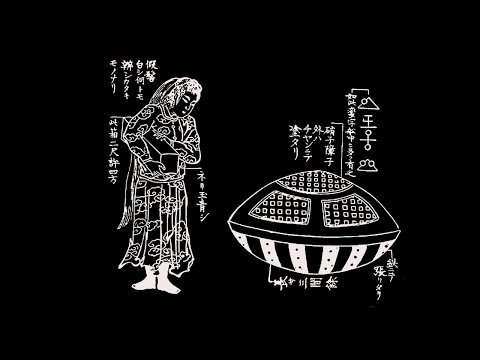
A Japanese UFO? — The Utsuro-Bune Incident of 1803 (TREY the Explainer)
A long-form skeptical walkthrough of the case that works through the manuscript sources, the illustrations, and the folkloric precedents rather than treating the story as an isolated anomaly — the closest thing to a documentary-grade treatment available on YouTube.
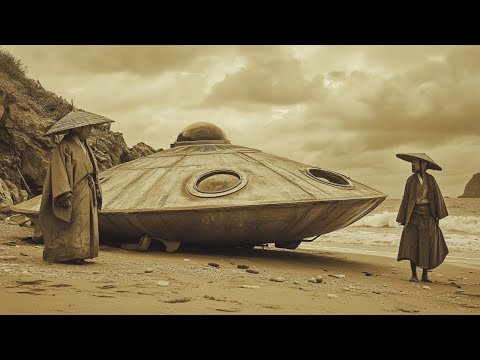
Japan's Utsuro-bune Event: Mysterious Floating Craft of 1803 (Megalithic Marvels)
A survey of the manuscript illustrations and the competing interpretations, presented from a more sympathetic paleocontact perspective — useful as a representative sample of how the case is framed within the UFO-history community.
See something inaccurate? Have additional sources, a manuscript reference, or a translation correction?
Suggest an Edit →Last Updated: August 2026