
Aurora UFO Crash
Before dawn on April 17, 1897, a cigar-shaped "airship" supposedly struck a windmill on the farm of Judge J.S. Proctor on the northern edge of Aurora, Texas, exploded, and scattered wreckage across several acres — its lone "not of this world" pilot recovered and buried the next day in the town cemetery. The entire story rests on a single newspaper article by local correspondent S.E. Haydon, published in the Dallas Morning News two days later. No other 1897 record of the event — no follow-up report, no death certificate, no burial record, no mention in county histories written within the decade — has ever surfaced, and the town's own longtime historian later called it a joke cooked up to save a dying community. Told and retold for more than a century, it stands as the earliest widely known American "crash retrieval" narrative, fifty years before Roswell.
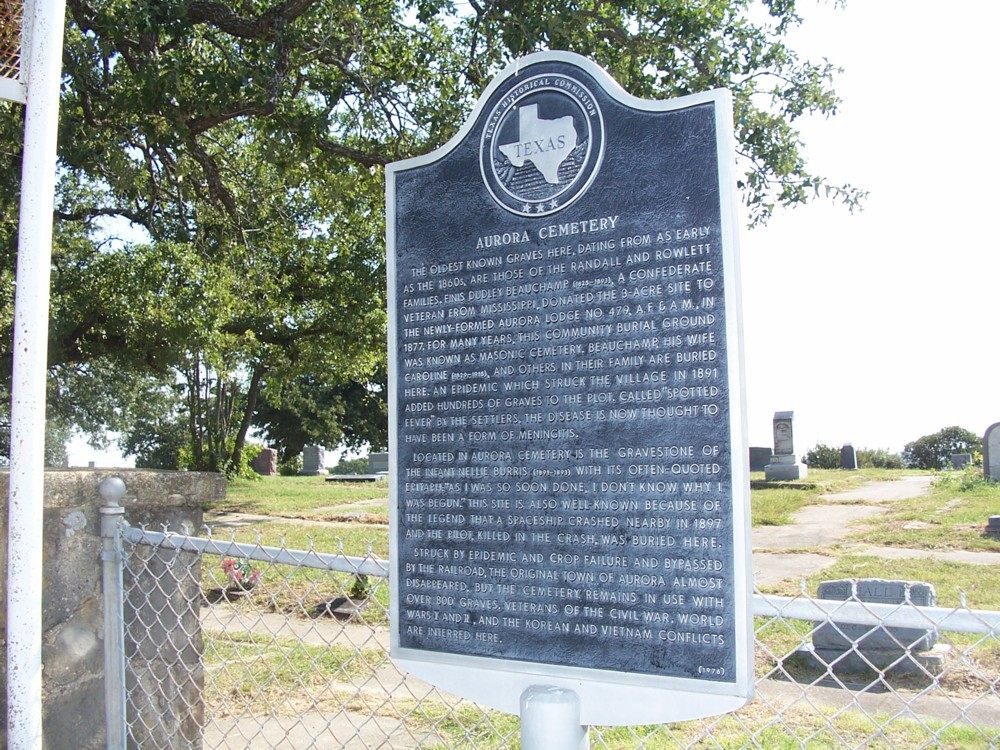
Pictured: the Texas Historical Commission marker at Aurora Cemetery, Wise County — not a photograph of the alleged 1897 crash, the "airship," or its occupant, none of which were ever photographed. No period photograph of the claimed wreckage, windmill damage, or grave is known to survive; this 1976 marker, which references the legend only as local lore, is the closest genuine physical artifact connected to the story.
Theoretical Alignment
Aurora aligns overwhelmingly with the Psycho-Social Hypothesis in its specific "deliberate hoax" mode: a single interested-party author, an explicit, well-documented economic motive, zero contemporaneous corroboration, and a modern historical consensus (Texas State Historical Association included) that the story was invented. The Extraterrestrial Hypothesis registers only as a residual possibility that cannot be mathematically driven to zero, not as a conclusion supported by evidence.
Background
Aurora, Texas began as a rise-of-the-plains farming settlement in the late 1850s in southeastern Wise County, roughly ten miles southeast of the county seat of Decatur. Early settler William O. Stanfield is credited with suggesting the town's name, reportedly because he felt the site marked "the dawn of something luminous and beautiful" for the new settlement. A post office opened in 1873, and the town formally incorporated on August 21, 1882. For its first two decades Aurora prospered rapidly: by the mid-1880s it supported two schools, two cotton gins, two hotels, and roughly fifteen businesses, with a population that contemporary estimates place anywhere between 750 and 3,000 — a boomtown by the standards of rural North Texas.
That prosperity collapsed within a few years, for two compounding reasons that are central to understanding what happened in April 1897. First, an outbreak of "spotted fever" — a term period sources used loosely for febrile illnesses, now generally believed to describe a form of meningitis or a related epidemic disease rather than the tick-borne Rocky Mountain spotted fever the name suggests today — began in the latter part of 1888. It killed a significant number of residents and, by 1889, had triggered a mass exodus driven by fear of contagion. Second, in 1891 the Fort Worth and Denver City Railroad, then extending its line through Wise County, chose a route that bypassed Aurora entirely. Much of the town's remaining population relocated two miles southeast to Rhome, the community the railroad did serve. By the time Aurora lost its post office in 1901, it had shrunk to a fraction of its 1880s peak; the Aurora Cemetery's own 1976 Texas Historical Commission marker later summarized the era bluntly, noting the community was "struck by epidemic and crop failure and bypassed by the railroad."
It was into this specific moment of civic collapse — a once-thriving trading town reduced to a struggling remnant, its future increasingly tied to nearby Rhome and Decatur — that the alleged airship crash arrived in April 1897. The timing is not incidental to the story's modern historical assessment: both the Texas State Historical Association's own published history of the town and its own capsule account of the incident itself explicitly connect the article's appearance to Aurora's need for exactly the kind of attention a sensational story could generate.
The wider backdrop was the American "mystery airship" phenomenon, already in full swing by the time Haydon's article appeared. Beginning in November 1896 near Sacramento, California, and spreading east through the winter and spring of 1897, thousands of witnesses across the Midwest and South reported cigar-shaped or "airship" craft equipped with brilliant searchlights, sometimes described with wings, propellers, or gasbags, moving through the night sky faster and more purposefully than any known contemporary aircraft — six years before the Wright brothers' first sustained, powered flight at Kitty Hawk. Texas experienced a particularly concentrated burst of these reports in the days immediately surrounding the Aurora story: between April 13 and April 17, 1897 alone, newspapers across the state logged 38 separate "airship" sightings spanning 23 counties, with reports concentrated in North Central Texas, the same region as Aurora. Neighboring towns produced their own strange tales in the same week — in Waxahachie, a local judge reportedly claimed to have spoken with an airship's crew who said they had come from the North Pole; in Farmersville, witnesses reported hearing three men aboard an airship singing hymns and dropping temperance literature. Whatever their individual merits, these reports gave Haydon's Aurora story an immediate, ready-made audience: readers across North Texas were already primed to believe an airship might appear over their own town next.
Complete Timeline
| Date | Event |
|---|---|
| Late 1850s | Settlement begins at the site that becomes Aurora, Wise County, Texas; William O. Stanfield suggests the town's name. |
| 1873 | A post office opens in Aurora. |
| August 21, 1882 | Aurora formally incorporates. |
| Mid-1880s | Aurora reaches its peak: two schools, two cotton gins, two hotels, roughly fifteen businesses, and an estimated population between 750 and 3,000. |
| Late 1888 – 1889 | An outbreak of "spotted fever" strikes Aurora, killing residents and triggering a mass exodus driven by fear of the epidemic. |
| 1891 | The Fort Worth and Denver City Railroad routes its line to bypass Aurora; much of the remaining population relocates to nearby Rhome. |
| Nov. 1896 – 1897 | The nationwide "mystery airship" wave begins near Sacramento, California, and spreads east across the Midwest and South through the winter and spring. |
| April 13–17, 1897 | Texas newspapers log 38 separate "airship" sightings across 23 counties, concentrated in North Central Texas, in the days immediately surrounding the Aurora story. |
| April 17, 1897 (~6:00 a.m.) | The claimed crash. Per S.E. Haydon's account only, a cigar-shaped airship "sailing throughout the country" at reduced speed strikes the tower of Judge J.S. Proctor's windmill on the north side of town and explodes, scattering wreckage over several acres and destroying the windmill, water tank, and Proctor's flower garden. The pilot, described as badly disfigured, is said to be recovered from the debris. |
| April 17, 1897 (reported same day) | T.J. Weems, identified in the article as "the United States signal service officer at this place and an authority on astronomy," is quoted opining the pilot "was a native of the planet Mars." Weems is Aurora's town blacksmith. |
| April 17–18, 1897 (claimed) | The unidentified pilot's remains are reportedly given a Christian burial in the Aurora Cemetery; papers found on the body are described as covered in "unknown hieroglyphics" that "cannot be deciphered." |
| April 19, 1897 | The Dallas Morning News publishes Haydon's account, headlined to announce the crash of a "mysterious airship." |
| 1897 (remainder of year) | No follow-up investigation of any kind occurs. Kevin Randle's later research finds no mention of the incident in Wise County histories, including one published within ten years of the event. |
| 1901 | Aurora loses its post office as its population continues to decline; the airship story has generated no lasting local or national attention. |
| 1939 | Construction of State Highway 114 through Aurora likely saves the community from complete extinction. |
| 1960s | Dallas Morning News columnist Frank X. Tolbert investigates the old story for his long-running "Tolbert's Texas" column. |
| 1966 | Oklahoma researcher Hayden Hewes of the International UFO Bureau visits Aurora, interviews elderly residents, and locates a grave marked with a crude, cigar-shaped carving in the cemetery. |
| Early 1970s | Aurora begins a demographic revival as a Fort Worth bedroom community, coinciding with renewed outside interest in the 1897 story. |
| 1972–1973 | Bill Case, aviation writer for the Dallas Times Herald and Texas MUFON director, conducts an extended investigation, interviewing elderly residents including Brawley Oates, who by then owned the Proctor property. |
| June 14, 1973 (reported July 4) | The grave marker MUFON had identified — a stone bearing a crudely incised cigar-shaped design — disappears from the cemetery after the Aurora Cemetery Association denies a certified request to exhume the grave and the Wise County Sheriff posts deputies to guard the site during the dispute. |
| 1973 | MUFON investigators report recovering small metal fragments near the disturbed grave site, later informally analyzed as roughly 95% aluminum and 5% iron with an air-cooled crystalline structure — a claim whose chain of custody was compromised by the marker's disappearance and unsupervised digging. |
| 1976 | The Texas Historical Commission erects an official marker at Aurora Cemetery that references "the legend that a spaceship crashed nearby in 1897," explicitly framing it as local lore rather than established history. |
| 1979 | Longtime Aurora historian Etta Pegues, then 86, is quoted in a widely syndicated interview: "Hayden wrote it as a joke and to bring interest to Aurora. The railroad bypassed us, and the town was dying." She adds, "the judge never even had a windmill." |
| 1980 | Time magazine's "Americana: Close Encounters of a Kind" repeats the Pegues hoax account for a national audience. |
| March 7, 1986 | The Aurora Encounter, a fictionalized feature film starring Jack Elam and loosely inspired by the legend, is released theatrically. |
| 1998 | Dallas station KDFW airs an extended investigative segment; reporters find no conclusive evidence either way. |
| 2008 | A cable-television crew is granted access by property owner Tim Oates (Brawley Oates's relative) to unseal the long-covered well on the former Proctor property; independent news coverage of the resulting tests reports elevated aluminum levels in the well water but no recovered debris of any size, and the on-site discovery of what appears to be an actual windmill base — complicating Pegues's 1979 claim that "the judge never even had a windmill." |
| 2016 | Aurora hosts an "Alien Encounter" community conference; ground-penetrating radar surveys of the cemetery are reported to show an unmarked disturbance consistent with an 1890s-era grave, though radar cannot identify what, if anything, is buried there. |
| Present | No exhumation has ever been performed; the Aurora Cemetery Association continues to decline permission, and the town now markets the legend — nicknaming the alleged pilot "Ned" — as a modest tourism draw even as many residents, including descendants of the principals, regard it as fabricated. |
The Haydon Account: What the Dallas Morning News Actually Printed
The entire case begins and, in an important sense, ends with a single newspaper column. On April 19, 1897, the Dallas Morning News published a short item datelined Aurora, credited to local correspondent S.E. Haydon. Haydon wrote that "the early risers of Aurora were astonished at the sudden appearance of the airship which had been sailing throughout the country," adding that the craft appeared to be malfunctioning: "evidently some of the machinery was out of order, for it was making a speed of only ten or twelve miles an hour and gradually settling toward the earth." According to the account, the craft sailed directly over the public square before, on reaching the north part of town, it "collided with the tower of Judge Proctor's windmill and went to pieces with a terrific explosion, scattering debris over several acres of ground, wrecking the windmill and water tank and destroying the judge's flower garden."
Haydon described the wreckage as composed of "an unknown metal, resembling somewhat a mixture of aluminum and silver," and reported that the pilot — "the only one on board" — did not survive: "while his remains are badly disfigured, enough of the original has been picked up to show that he was not an inhabitant of this world." Papers recovered from the body were, Haydon wrote, "covered with hieroglyphics that cannot be deciphered." The article closed by noting the pilot was to be given a "Christian burial" in the town cemetery the following day, and that "the town today is full of people who are viewing the wreck and gathering specimens of the strange metal from the debris field."
Read closely against what actually followed, the article's own claims are its first problem. A story describing acres of wreckage, crowds of townspeople gathering souvenir metal, and a public funeral for a nonhuman body should have been the most talked-about event in Wise County for years. It generated no known follow-up coverage in 1897 — not in the Dallas Morning News itself, not in any surviving Wise County paper, and, according to researcher Kevin Randle's own investigation, not so much as a passing mention in any Wise County history published within a decade of the event, including one produced by residents with every reason to record something so extraordinary. No death certificate, coroner's record, or burial record for an unidentified body has ever been located for April 1897 in Wise County. No other newspaper correspondent in the area — and North Texas had several actively filing wire and syndicate stories about the broader airship wave that same week — independently reported seeing the wreckage, the crowds, or the funeral Haydon described.
T.J. Weems and the "Martian" Claim
The single detail most responsible for elevating Haydon's story from "airship crash" to "alien pilot" is the quoted opinion of T.J. Weems, whom the article identifies as "the United States signal service officer at this place and an authority on astronomy" and who is quoted concluding the pilot "was a native of the planet Mars." A named authority figure lending scientific and military credibility to an extraordinary claim is exactly the kind of detail that would make a fabricated story more convincing to 1897 readers already primed by the broader airship craze — and it is also, on inspection, the detail that has been most thoroughly and specifically debunked.
Genealogical and local-history research has identified the real T.J. Weems (1842–1925) as a Confederate Army veteran (Wells' Regiment, Texas Cavalry, Company B, 1861–65), former teamster in the Choctaw Nation, and, at the time of the alleged crash, Aurora's working blacksmith — not a Signal Service officer and not a credentialed astronomer of any kind. There is no independent record placing a U.S. Army Signal Service post in Aurora in 1897, and no record of Weems holding any federal military or scientific appointment. If Weems's expert credentials were invented, the single piece of "expert corroboration" anchoring the entire story to an extraterrestrial explanation rather than a garden-variety airship sighting evaporates — and the "Martian pilot" detail becomes, at best, an unverifiable local rumor dressed up with a fabricated title, and at worst, the specific mechanism by which a hoax was made to sound authoritative.
The Grave, the Missing Marker, and the 1973 Investigation
The story lay almost entirely dormant for nearly seven decades. Oklahoma researcher Hayden Hewes of the International UFO Bureau made an early visit to Aurora in 1966, interviewing elderly residents and locating a grave in the Aurora Cemetery marked with a crudely incised stone that some later described as showing a cigar-shaped object. The story received sustained attention only after 1972–73, when Bill Case, an aviation writer for the Dallas Times Herald and the Texas director of the newly formed Mutual UFO Network (MUFON), launched a full investigation. Case interviewed surviving old-timers, including two who described childhood memories of the event — and, notably, Brawley Oates, who by then owned the former Proctor property and its sealed well.
Case's team used metal detectors around the cemetery and reported a positive reading near the grave Hewes had identified; MUFON subsequently sought permission to exhume the site. The Aurora Cemetery Association refused, the Wise County Sheriff posted deputies at the cemetery during the resulting legal dispute, and — in the two-week window while a court petition for exhumation was pending — the grave marker itself vanished. Someone had apparently driven a length of pipe into the ground at the gravesite and removed material before it could be formally examined; MUFON investigators subsequently reported recovering small metal fragments near the disturbed plot, which received an informal metallurgical characterization of roughly 95% aluminum and 5% iron, air-cooled rather than machined. Whatever those fragments actually were, their evidentiary value is fatally compromised: they were not recovered under any controlled, chain-of-custody process, their exact provenance at the gravesite was never independently verified, and no peer-reviewed materials analysis of them has ever been published. A 95%-aluminum, air-cooled alloy is also consistent with a wide range of mundane sources — scrap, cast fittings, or windmill and tank hardware of the kind the story itself says was destroyed on the property in 1897.
No exhumation has ever taken place at Aurora Cemetery. The Cemetery Association has consistently declined permission, citing Texas law's requirement to notify next of kin before disturbing a burial — an practical impossibility for a grave whose occupant, if anyone specific is buried there at all, has never been identified. A 2016 ground-penetrating radar survey reportedly detected a disturbance in the ground consistent with an unmarked, roughly 1890s-era burial near the cemetery's Bledsoe family plot, the area local tradition associates with the story — but radar can only detect that soil has been disturbed, not what, if anything, is buried within it, and it cannot distinguish a human grave from an animal burial, an old cistern, or any other historical excavation.
The 2008 Well Investigation
The other physical-evidence thread involves a sealed well on the old Proctor/Oates property. According to Brawley Oates's own account, relayed by his descendants to investigators over the years, he purchased the property around the mid-1930s and, sometime later, developed a severe case of arthritis he attributed to drinking water from a well he believed contained wreckage debris; he is said to have sealed the well with a concrete slab in the 1940s or 1950s (accounts vary on the exact year) and built an outbuilding over it.
In 2008, property owner Tim Oates — Brawley's relative and the Proctor/Oates land's subsequent owner — granted a television production crew access to unseal the well for testing, an event independently reported afterward by regional news outlets and UFO-research organizations describing the crew's findings rather than the broadcast itself. According to that independent coverage, water drawn from the well tested with an elevated concentration of aluminum relative to typical groundwater, but the well otherwise held no significant debris, and any large metal fragments once present had evidently been removed decades earlier by a previous owner. Investigators reportedly also located what appeared to be the base of an actual windmill near the well site — a detail directly relevant to the hoax debate, since it complicates Etta Pegues's flat 1979 assertion that "the judge never even had a windmill" on the property, even as it does nothing to establish that any windmill present was struck by an aircraft of any kind, let alone an extraterrestrial one.
Elevated aluminum in well water is not, on its own, diagnostic of anything unusual. Aluminum is the most abundant metal in the Earth's crust and one of the most common elements in soil and groundwater generally; wells drilled through clay-rich blackland-prairie soils like those around Aurora can show naturally elevated aluminum without any wreckage involved at all, and aluminum well casings, pumps, fittings, or nearby buried scrap metal — entirely plausible on a working farm property occupied continuously since the 19th century — would produce the same result. No fragment of wreckage large enough to analyze for manufacturing origin, isotopic composition, or metallurgical technique has ever been recovered from the well under controlled conditions. The 2008 findings, whatever their source network, were correctly characterized even by outlets sympathetic to the mystery as inconclusive: consistent with the story, but nowhere close to confirming it, and equally consistent with an ordinary well on an ordinary Texas farm.
Corroboration Deficit
What makes Aurora distinctive among contested historical cases is not merely that its explanation is disputed, but how little there is to dispute in the first place:
- Exactly one named source (Haydon) produced the entire account; no second contemporary reporter, telegraph dispatch, or diary entry from April 1897 describing the crash, the crowds, the wreckage, or the funeral has ever been located.
- The article's single named "expert" corroborating witness (Weems) held no verifiable relevant credential and has since been identified as the town blacksmith.
- No death record, coroner's inquest, or burial record for an unidentified body exists in Wise County for April 1897.
- Kevin Randle's research found no mention of the incident in any Wise County history, including one published within ten years of the claimed event.
- The town's own longtime historian stated the story was invented as a publicity stunt, and named the specific economic motive (the railroad bypass) that modern historians independently cite as well-documented.
- The one piece of period physical evidence anyone claimed to have — the grave marker — disappeared under suspicious circumstances during a legal dispute over examining it, rather than surviving into controlled scientific study.
Key Researchers
- Kevin Randle — Former military intelligence officer and prolific UFO-crash researcher (also central to this site's Roswell Incident case file) who personally investigated Aurora in the early 1970s, interviewed surviving old-timers and the Wise County historian, and later identified the telegraph-wire origins common to many 1897 airship reports. His stated conclusion: "I do not believe that an alien craft crashed at Aurora and, in fact, don't believe that anything crashed there on April 17, 1897."
- Hayden Hewes — Director of the Oklahoma-based International UFO Bureau, whose 1966 visit to Aurora was the first modern outside investigation of the story and who located the grave later examined by MUFON.
- Bill Case — Aviation writer and Texas MUFON director whose 1972–73 investigation produced nearly every specific claim — the metal-detector reading, the grave marker's description, the exhumation request — that later researchers on both sides continue to cite.
- Frank X. Tolbert — Longtime "Tolbert's Texas" columnist for the Dallas Morning News (1946–1984) who investigated the old Aurora story decades before it became a national curiosity, part of the same tradition of Texas local-history journalism that later informed the Texas State Historical Association's own skeptical assessment.
Cultural Impact & Modern Aurora
Whatever actually happened — or did not happen — in April 1897, the Aurora story has had a durable cultural afterlife. It inspired the 1986 feature film The Aurora Encounter, starring veteran character actor Jack Elam, and has been featured repeatedly in UFO-themed television programming over the decades. The town itself now leans into the legend commercially: local businesses reference an "alien" theme, the alleged pilot has been informally nicknamed "Ned" by town officials, and Aurora has hosted community "Alien Encounter" events drawing regional visitors and vendors. This embrace is not universal within the community — town officials involved in promoting the legend have described real internal friction, including city-committee members who have threatened resignation over the town's association with the story — and descendants of the story's own participants remain among its most consistent skeptics.
Historically, Aurora's chief significance to UAP research is structural rather than evidentiary: it is very likely the earliest widely circulated American account combining a crashed craft, a recovered non-human body, and an official burial into a single narrative — the exact template Roswell would apply, with vastly more surviving documentation and witness testimony, fifty years later. Understanding why Aurora fails as a factual account is itself a useful discipline for evaluating every later crash-retrieval claim that follows the same narrative shape.
Key Witnesses & Figures
S.E. Haydon
A cotton buyer who also worked as a part-time local correspondent, Haydon is the only named source for the entire Aurora story; his April 19, 1897 article is the sole primary document the case rests on. He is not described anywhere in his own account as a personal eyewitness in any greater detail than any other unnamed "early riser," and Aurora's own longtime local historian, Etta Pegues, later stated flatly that Haydon "wrote it as a joke and to bring interest to Aurora," adding that he had "a well-known reputation for telling tall tales." No independent 1897 record corroborates any element of his account.
Judge J.S. Proctor
Identified in Haydon's article as the owner of the windmill the airship allegedly struck, and of the flower garden it allegedly destroyed. Proctor left no known first-person statement of his own about the incident. Some later skeptical accounts, including a retrospective by the Dallas Observer, have speculated Proctor may have helped originate or encourage the story alongside Haydon, though this remains unproven. Etta Pegues's own 1979 recollection directly disputed the story's physical premise, stating "the judge never even had a windmill" — a claim later complicated, though not resolved, by the discovery of an apparent windmill base near the property's well during a 2008 site investigation.
T.J. Weems (1842–1925)
Quoted in Haydon's article as "the United States signal service officer at this place and an authority on astronomy" who identified the pilot as a "native of the planet Mars." Genealogical and local records instead document Weems as a Confederate Army veteran and, in 1897, Aurora's working blacksmith, with no evidence of any Signal Service commission or astronomical credential. The apparent fabrication of Weems's expert authority is one of the single strongest pieces of evidence that the story was constructed rather than reported.
Etta Pegues
A lifelong Aurora resident who, in a widely syndicated 1979 interview later repeated nationally by Time magazine, gave the single most consequential piece of skeptical testimony in the case: "Hayden wrote it as a joke and to bring interest to Aurora. The railroad bypassed us, and the town was dying," and, "people wish so hard the story was true they really start believing it. Why, the judge never even had a windmill." Pegues was not old enough in 1897 to have personally witnessed the event's origin as an adult, and her account of Haydon's original motive is oral tradition rather than a documented confession from Haydon himself — a limitation this case file treats honestly rather than glossing over — but her direct, specific, and unhedged characterization of the story as an invented joke, from the town's own most engaged local historian, remains the most-cited single piece of testimony on either side of the debate.
Brawley Oates
Purchased the former Proctor property in the mid-1930s. According to accounts relayed by his family, Oates developed severe arthritis he attributed to drinking water from the property's well, which he came to believe contained dissolved wreckage debris, and had the well sealed with a concrete slab. His account is secondhand as documented (relayed by relatives to later investigators rather than recorded directly from Oates himself in detail), and a medical condition like arthritis has no established causal link to trace metals in drinking water at the levels later measured — but his decision to seal the well is the reason the site remained undisturbed until the 2008 investigation, making him an important custodial link in the case's physical-evidence chain.
Bill Case
A professional aviation journalist who, as Texas director of the Mutual UFO Network, conducted the most extensive on-the-ground investigation the case has ever received, interviewing elderly residents, coordinating the metal-detector search of the cemetery, and pursuing the failed exhumation request in 1973. Case's investigation is the direct source of nearly every specific claim about the grave marker, the metal fragments, and the eyewitness recollections cited by later researchers on both sides of the debate.
The Five Observables Assessment
The Five Observables framework, developed for evaluating modern, instrumented UAP encounters, is applied here for consistency with every other case file on this site — but its application to a single 128-year-old newspaper column with no surviving photograph, sketch, radar return, or physical specimen is necessarily almost entirely speculative and should be read as such.
Assessment: Haydon's own account describes the opposite of high performance — a craft moving at a sluggish "ten or twelve miles an hour," visibly malfunctioning, and losing altitude before an ordinary, low-speed collision with a stationary structure. None of the five observables associated with genuinely anomalous UAP performance are claimed anywhere in the source material; the only observable that could even nominally apply is a speculative implication of some kind of lift mechanism, inferred solely from the fact that the story describes an airborne object, not from any described flight characteristic that exceeds 1897 aeronautical imagination. This is one of the weakest Five Observables profiles of any case in this archive.
Evidence Assessment
Supporting Anomalous Origin
- A named contemporary source (Haydon) did publish a specific, detailed account naming a real local judge and a real local property.
- The broader 1896–97 mystery airship wave was a genuine national phenomenon with thousands of independent reports, establishing that North Texans in April 1897 were actively seeing and reporting unusual aerial phenomena.
- The specific description of "an unknown metal, resembling somewhat a mixture of aluminum and silver" arguably anticipates the 2008 well-water test's elevated aluminum reading, though this could equally be coincidence or a self-fulfilling detail investigators went looking to confirm.
- A 2008 site investigation located what appears to be an actual windmill base on the property, complicating the specific 1979 skeptical claim that "the judge never even had a windmill."
- Ground-penetrating radar in 2016 detected a soil disturbance near the traditional gravesite consistent with an unmarked, roughly period-appropriate burial.
Supporting Conventional Explanation (Hoax)
- Exactly one named source produced the entire account, with no second contemporary reporter, dispatch, or diary entry ever located.
- The article's only named corroborating "expert" (T.J. Weems) has been identified as the town blacksmith, not a Signal Service officer or astronomer — a fabricated credential.
- No death certificate, coroner's record, or burial record exists for an unidentified body in Wise County for April 1897.
- Kevin Randle's research found the incident unmentioned in any Wise County history, including one written within a decade of the event.
- The town's own longtime historian, Etta Pegues, directly and specifically stated Haydon fabricated the story to attract attention to a dying town after the 1891 railroad bypass — a documented economic motive independently confirmed by the Texas State Historical Association's own history of the town.
- The Texas State Historical Association's own published account explicitly characterizes Haydon's story as "fictional."
- The one physical artifact anyone claimed to possess (the grave marker) disappeared under suspicious, unsupervised circumstances rather than surviving for controlled examination.
- A 95%-aluminum, air-cooled metal fragment and elevated well-water aluminum are both consistent with mundane farm-property sources (scrap, fittings, natural soil chemistry) and are not diagnostic of anomalous origin.
- Haydon himself was reputed among contemporaries for "telling tall tales," per the town's own historian.
Why "Debunked"
Aurora earns a DEBUNKED classification, not merely a "disputed" one, because the case fails at the most basic evidentiary level before any competing interpretation of ambiguous evidence is even required. Every other contested case on this site involves multiple independent witnesses, some form of instrumented or physical evidence with an intact chain of custody, or an official investigation that reached a specific, checkable conclusion. Aurora has none of these. It has one named author with a documented local reputation for embellishment, one named "expert" witness whose credentials were fabricated, zero contemporaneous corroboration of any kind, no period death or burial record, and an explicit, on-the-record statement from the town's own historian — not a hostile outside skeptic, but the person best positioned to know the local truth — that the story was invented for a specific, well-documented economic reason.
The 1973 metal fragments and the 2008 well-water aluminum reading are the only findings that keep this case in circulation rather than settling it completely, and both are honestly assessed above as non-diagnostic: consistent with an ordinary farm property, not distinctively consistent with wreckage from a crashed aircraft of unknown origin. Nothing about either finding required an exotic explanation, and neither was recovered under conditions that would satisfy a basic chain-of-custody standard. Weighed against the complete absence of a functioning 1897 paper trail and a direct, specific hoax confession relayed by the town's own historian, the balance of evidence overwhelmingly favors deliberate fabrication. This case file does not, however, claim absolute certainty — a small residual "true story, garbled through retelling" possibility cannot be mathematically excluded, which is why the case is not scored at zero — but every specific, checkable claim in Haydon's original account either cannot be verified or has been actively contradicted by subsequent research.
Sensor & Instrumentation Detection Profile
None exists. The claimed event predates functional radar by roughly four decades and the Wright brothers' first powered flight by six years; no instrument of any kind recorded anything at Aurora in April 1897, and the entire case rests on unaided human recollection filtered through a single newspaper column.
Environmental & Geospatial Context
Aurora sits on a gentle rise in the blackland prairie of southeastern Wise County, roughly ten miles southeast of Decatur and thirty miles northwest of Fort Worth. Haydon's account records no weather detail whatsoever — no wind, no cloud cover, no temperature — an omission skeptics have long noted is unusual for a supposed eyewitness description of a low, slow-moving object at dawn.
Observer Credibility & Occupational Profile
The case's sole primary source, S.E. Haydon, was a cotton buyer and part-time correspondent later remembered by Aurora's own longtime historian as having "a well-known reputation for telling tall tales." The article's only named corroborating "expert," T.J. Weems, was represented as a U.S. Army Signal Service officer and astronomer but has since been identified in local records as Aurora's town blacksmith.
Physical & Material Assays
No 1897 physical evidence of any kind was preserved. A metal fragment reportedly recovered near the grave site during a 1973 investigation, and elevated aluminum readings in a 2008 well-water test, are the only physical claims associated with the case — both are addressed in full, and neither is diagnostic of anything, in the Material Analysis section below.
Historical Precedents & Archive Matches
Aurora belongs to the nationwide "mystery airship" wave of 1896–97 and, within Texas specifically, to a cluster of 38 reported sightings across 23 counties between April 13 and 17, 1897 alone. It is also the most direct 19th-century precedent for the 20th century's "crash retrieval" narrative template later applied to Roswell, and shares its home state with another disputed 1890s Texas airship legend, the Charles Dellschau Sonora Aero Club notebooks.
Material Analysis
Two distinct physical-evidence claims are associated with Aurora, separated by 35 years and neither recovered under scientifically controlled conditions: the 1973 grave-site metal fragments, and the 2008 well-water aluminum test.
The 1973 Grave-Site Metal Fragments
During the 1973 MUFON investigation, after the cemetery association denied permission to exhume the grave and someone subsequently disturbed the site and removed the grave marker itself, investigators reported recovering small metal fragments from the disturbed ground. Informal characterization described the material as roughly 95% aluminum and 5% iron, with an air-cooled rather than machined or forged microstructure. No peer-reviewed metallurgical, isotopic, or trace-element analysis of these fragments has ever been published, and their exact chain of custody from the ground to any laboratory is not independently documented. An aluminum-iron alloy of this composition is unremarkable: it is consistent with common scrap aluminum, cast fittings, or windmill and tank hardware — precisely the kind of material Haydon's own 1897 account claims was destroyed at the site — and offers no basis for distinguishing "debris from an unidentified craft" from "ordinary period farm hardware disturbed by unsupervised digging."
The 2008 Well-Water Test
Independent news coverage of the 2008 investigation of the sealed well on the Oates property reported an elevated aluminum concentration in the water and the discovery of an apparent windmill base nearby, but no recoverable debris of significant size; any larger fragments once present had reportedly been removed by an earlier property owner. Aluminum is naturally abundant in soil and groundwater, particularly in clay-rich prairie soils, and its presence in a well on a continuously occupied 19th-century farm property — complete with metal well casings, pump hardware, and generations of buried scrap — requires no exotic explanation. Multiple news accounts covering the investigation independently described the findings as inconclusive.
Supporting Non-Terrestrial Origin
- Elevated well-water aluminum is at least directionally consistent with Haydon's 1897 description of a metal "resembling somewhat a mixture of aluminum and silver."
- The 1973 fragments' air-cooled aluminum-iron composition has never been definitively traced to a specific mundane manufactured object.
- A windmill base was genuinely found on the property, confirming at least one physical element of the original story.
Supporting Terrestrial Origin
- Neither the 1973 fragments nor the 2008 water sample were recovered under a documented, controlled chain of custody.
- No peer-reviewed materials-science analysis of either has ever been published.
- Aluminum is the most common metal in the Earth's crust; elevated well-water aluminum readings occur naturally and via ordinary farm hardware, with no wreckage required.
- A 95%-aluminum, 5%-iron air-cooled alloy is unremarkable and matches common period scrap and fittings, not a signature of unknown manufacturing origin.
- No fragment large enough for isotopic or manufacturing-process analysis has ever been produced from either investigation.
The Conventional Explanation Candidate: Deliberate Promotional Hoax
The leading, and by far best-supported, explanation for the Aurora story is that S.E. Haydon fabricated it — whether alone or, as some retrospective accounts speculate, with encouragement from Judge Proctor and other locals — specifically to draw outside attention and potential investment to a town in acute economic distress. This explanation deserves serious evaluation, and not merely as a default null hypothesis, because it is directly and specifically supported by named, on-the-record testimony from the person best positioned to know: Aurora's own longtime historian, Etta Pegues, plus independent confirmation of the underlying economic motive (the 1888–89 epidemic and the 1891 railroad bypass) from the Texas State Historical Association's own institutional history of the town, which itself explicitly calls Haydon's article "fictional."
A fabricated story also cleanly explains every specific evidentiary gap in the case: why no second 1897 source ever corroborated it (no second person needed to be in on an invented story), why the "expert" witness's credentials don't check out (an invented authority is easier to fabricate than a real one to recruit), why no death or burial record exists (because, on this explanation, no one died), and why the one physical "artifact" anyone claimed — the grave marker — vanished the moment formal examination became a real legal possibility rather than surviving into controlled study.
Garbled Retelling of a Genuine Mystery-Airship-Wave Sighting
A milder alternative holds that Aurora residents did see something unusual in the sky during the genuine, well-documented April 1897 Texas airship wave — consistent with the 38 sightings logged across 23 counties that same week — and that Haydon then embellished a real but mundane sighting (a bright meteor, an unusual cloud formation, a kite or early experimental craft, or simply an exaggerated retelling of a neighboring county's report) into the specific crash-and-burial narrative that survives today. This explanation is not unreasonable given the genuine regional sighting wave, but it requires its own leap: it does not explain the specific, elaborate fabricated details — a named "astronomer" who never existed as described, a Christian burial with no death record, hieroglyphic papers — any more economically than deliberate invention does, and Randle's total absence of period corroboration applies equally to this softer version of events.
Genuine Extraterrestrial Crash and Recovery
The literal reading of Haydon's account — that an artificial craft of non-terrestrial origin actually crashed at Aurora and its occupant was actually recovered and buried — is the explanation with the least supporting evidence of the three. It requires accepting a single, uncorroborated, secondhand newspaper account from an author with a documented local reputation for embellishment, an "expert" witness now known to have held no real relevant credential, the complete absence of any physical specimen preserved under controlled conditions across 128 years, and a burial with no surviving death or interment record in a county that otherwise kept ordinary vital records. Every specific, checkable claim in the account that can be independently verified has instead pointed toward fabrication rather than confirmation.
Deliberate Promotional Hoax
Highly PlausibleDirectly supported by named local-historian testimony, an independently documented economic motive, and every specific evidentiary gap in the case. The Texas State Historical Association's own institutional history calls the story "fictional."
Garbled Retelling of a Genuine Airship-Wave Sighting
InconclusiveThe broader 1896–97 airship wave was real and active in Texas that same week, but this explanation still requires accounting for specific fabricated details (the fake "astronomer," the missing burial record) that a merely-exaggerated sighting does not obviously produce on its own.
Genuine Extraterrestrial Crash & Recovery
ImplausibleRests entirely on one uncorroborated secondhand account from an author with a documented local reputation for tall tales, a fabricated expert credential, and zero surviving physical evidence recovered under controlled conditions.
Related Cases
Honest Assessment: No Government Investigation Exists
Unlike Roswell (1947) or the Cold War-era sightings catalogued by Project Blue Book (1952–1969), the Aurora incident predates any organized U.S. government UFO-investigation apparatus by more than half a century. No federal agency — military, civilian, or intelligence — has ever opened a file, conducted a field investigation, or issued a public statement on the Aurora crash specifically, at the time or since. There is no FBI memo, no Air Force report, no congressional record, and no Project Blue Book case file referencing Aurora, because no such record was ever created. Readers should treat any secondary source claiming otherwise with the same skepticism this case file applies to the original story. In place of nonexistent federal records, the closest genuine institutional documentation is archival and historical: the contemporary newspaper record, county and state historical-association assessments, and the official Texas Historical Commission marker — itself explicit that it documents a "legend," not a confirmed event.
The only official government-erected marker referencing the incident, sited at Aurora Cemetery. Its text explicitly frames the crash as "the legend that a spaceship crashed nearby in 1897," alongside the cemetery's genuine, documented history (an 1877 Masonic land donation and the 1888–91 epidemic).
PUBLIC HISTORICAL RECORD (not a federal investigation)TSHA's own published town history explicitly characterizes Haydon's 1897 story as "a fictional 'news' story," directly tying its publication to Aurora's economic decline after the 1891 railroad bypass.
STATE-CHARTERED HISTORICAL INSTITUTIONPublic library access point for the digitized Dallas Morning News historical archive (1885–1984), which holds the original April 19, 1897 Haydon article and every subsequent Dallas-area news reference to the case.
PUBLIC LIBRARY ARCHIVE (library card required for full text)Search Government Archives Directly (No Aurora-Specific Records Exist)
Further Reading — Recommended Literature
The Great Texas Airship Mystery
The definitive book-length account of the 1897 Texas airship wave, retelling the sighting reports from across the state — including Aurora — largely in the words of the original 1897 newspaper coverage.
Solving the 1897 Airship Mystery
A national-scope investigation into the broader mystery airship wave that Aurora is part of, researching the real inventors and promoters whose activities may explain the sightings that predate Aurora's own claimed crash.
Texas Obscurities: Stories of the Peculiar, Exceptional & Nefarious
Includes a dedicated chapter on the Aurora incident within a wider collection of overlooked and strange Texas history, situating the story alongside other regional hoaxes and curiosities.
The UFO Encyclopedia, 3rd Edition
The standard scholarly reference work on the UFO phenomenon, with a dedicated, carefully sourced entry situating Aurora within the full history of the 1896–97 mystery airship wave.
The UFO Controversy in America
The foundational academic history of American UFO reporting, with the essential scholarly treatment of the 1896–97 airship wave as the origin point of the entire modern phenomenon Aurora belongs to.
Essential Viewing
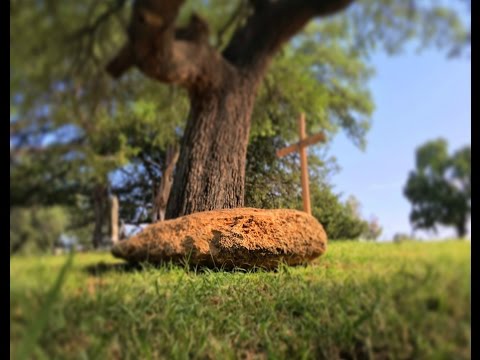
On-Site Visit: Aurora, Texas Crash & Burial Site
A firsthand walkthrough of Aurora Cemetery and the town's historical marker, covering the site's present-day condition and the core facts of the 1897 story.

1897 UFO Incident in Aurora, Texas: Mini-Documentary
A concise historical rundown of Haydon's original account, the windmill collision, and the burial claim, framed within the broader 1890s setting.
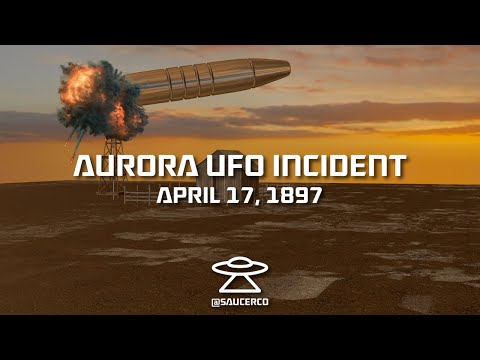
Aurora UFO Incident, April 17, 1897
A dedicated case overview covering the crash claim, the T.J. Weems "Martian" quote, and the grave that followed.
Sources
- Texas State Historical Association. "Aurora, TX (Wise County)," Handbook of Texas Online. tshaonline.org
- Texas State Historical Association. "The Mysterious Airship Crash in Aurora, Texas," Texas Day by Day. tshaonline.org
- Texas State Historical Association. "Frank X. Tolbert: A Legacy in Journalism and Texana." tshaonline.org
- Texas Almanac (Texas State Historical Association). "When Airships Invaded Texas." texasalmanac.com
- Haydon, S.E. "A Windmill Demolishes It," Dallas Morning News, April 19, 1897 (original primary source; archived via Dallas Public Library historical newspaper collection).
- Dallas Public Library. "Dallas & Texas History" research guide (Dallas Morning News historical archive, 1885–1984). dallaslibrary.org
- "Americana: Close Encounters of a Kind," Time, 1979 (Etta Pegues interview). time.com
- "Heavenly Hoax," Dallas Observer. dallasobserver.com
- "The Great Texas Airship Crash: Aurora, Texas, April 17, 1897," Strange History. strangehistory.org
- Randle, Kevin. "UFO Crashes Fifty Years Before Roswell," A Different Perspective (blog). kevinrandle.blogspot.com
- "Nearly 120 Years After Alleged UFO Crash, Small Texas Town Is All About Aliens," KERA News. keranews.org
- "Welcome to Texas: Aurora Alien," CBS News Texas. cbsnews.com
- "Mystery of Reported Alien Crash Lives on in Aurora," NBC 5 Dallas-Fort Worth. nbcdfw.com
- "Aurora, Texas, 'UFO' Crash of 1897 Still Sparking Debate," KVUE. kvue.com
- Mutual UFO Network. "Aurora, TX Crash — 1897," case retrospective. mufon.com
- "Aurora Cemetery Historical Marker" (Texas Historical Commission, erected 1976), The Historical Marker Database. hmdb.org
- Wise County Texas Genealogical Society. "Aurora Cemetery, Wise County, TX." wisecountytexas.info
- Town of Aurora, Texas. "History." auroratexas.gov
- "Extraterrestrial Airship Pilot — 'Little Traveler' Alien" memorial listing, Find a Grave. findagrave.com
- "1890s Alien Gravesite in Aurora," Atlas Obscura. atlasobscura.com
- The Aurora Encounter (1986), directed by Jim McCullough Sr., starring Jack Elam; production/release details. imdb.com
- "Aurora, Texas, UFO Incident," Wikipedia (general orientation and cross-referenced secondary coverage; not relied upon as a primary source). en.wikipedia.org
- "File: Aurora Cemetery Plaque.jpg," Wikipedia (public-domain source image of the 1976 Texas Historical Commission marker used as this case file's hero image). en.wikipedia.org
See something inaccurate? Have additional information or sources?
Suggest an Edit →Last Updated: August 2026