
Sonora Aero Club Secret Society
Between roughly 1850 and 1858, according to the posthumous account of a single man, a secret society of inventors calling itself the Sonora Aero Club met in the Gold Rush boomtowns of Sonora and Columbia, California, and built dozens of gravity-defying "Aero" airships powered by a mysterious fuel called NB Gas. The entire record of this claim comes from Charles A.A. Dellschau (1830–1923), a retired German-born Houston butcher who, in his seventies and eighties — roughly forty to seventy years after the events he described — filled at least twelve hand-bound scrapbooks with nearly 2,500 watercolor, ink, and newspaper-collage drawings of the club's fantastical machines. No contemporary 1850s document, newspaper report, court record, land deed, or gravestone confirming the Sonora Aero Club's existence has ever been located, and genealogists have been unable to place Dellschau himself in California during the years the club supposedly operated. What indisputably does exist is the artwork itself: a major, internationally exhibited body of American outsider art held today by the Menil Collection, the American Folk Art Museum, the Witte Museum, and the San Antonio Museum of Art. This file examines the claim, the art, the artist, and the historiographical debate over where the line between the two actually falls.
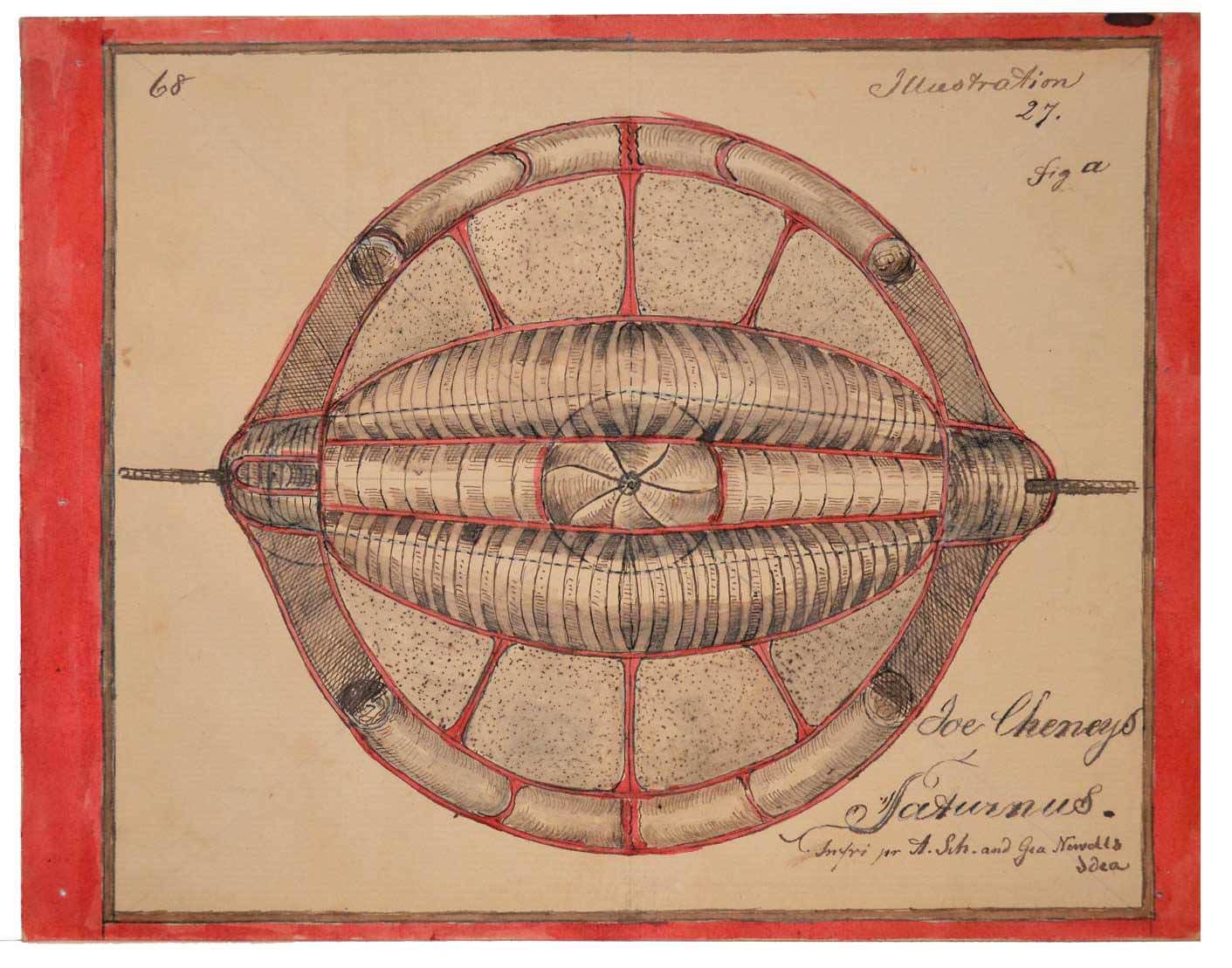
Pictured: "Joe Cheney's Saturnus" (Illustration 27, Fig. a), one of Charles Dellschau's own ink-and-watercolor "Aero" airship designs, inscribed as inspired by "A. Sch. and Geo Newolls' idea." This is a genuine, museum-catalogued Dellschau work — not a photograph of any real machine, since no physical Sonora Aero Club aircraft is known ever to have existed outside his notebooks. Public domain in the United States (unpublished work, author died before 1956), sourced via Wikimedia Commons.
Theoretical Alignment
The Sonora Aero Club has almost no meaningful alignment with the Extraterrestrial Hypothesis — nothing in Dellschau's narrative claims non-human origin for the "Aero" craft or NB Gas; the club's inventors are presented as ordinary immigrant tinkerers. The case aligns strongly with the Psycho-Social Hypothesis framework in its broadest sense: a single imaginative individual's decades-later narrative art, produced in isolation, that has been folded into UFO/UAP discourse by later readers rather than originating as a sighting report. A minority of UFO-community writers have tried to fold the club into "breakaway civilization" or secret-technology narratives (often via the claimed NYMZA backers), but this reading requires accepting the least-supported layer of Dellschau's own mythology and has no independent evidentiary basis.
Background
Charles August Albert Dellschau was born June 4, 1830 (a small number of secondary sources give 1828), in Brandenburg, Prussia. He emigrated to the United States sometime between 1849 and 1853 — sources differ on the exact year — and by his own later account initially made his way to Galveston, Texas. Documentary traces of his early American years are thin and, where they exist, sit awkwardly against the story he would tell sixty years later. A Harris County, Texas record places him there in 1856; a Fort Bend County record places him there by 1860; he married Antonia Hilt, a widow with a young daughter, in Richmond, Texas, in 1861; and he appears to have signed a Confederate amnesty oath in 1865, indicating some form of Civil War-era service, though his specific unit is not established in the surviving record. These are ordinary, unremarkable Texas records of an ordinary immigrant tradesman — and every one of them sits inside the exact window (1850–1858, extending to the club's claimed 1860s dissolution) during which Dellschau would later say he was hundreds of miles away in the California Gold Rush country, working as the official draftsman of a secret airship society.
The couple settled and had three children together: Bertha, Mary, and a son, Edward. In 1877, tragedy struck twice — Antonia and six-year-old Edward both died, leaving Dellschau a widower in his late forties. He continued working as a butcher for some years afterward. By the mid-to-late 1880s (the Handbook of Texas gives 1886; other accounts place it slightly later, closer to 1889) he had relocated to Houston, where he took work as a salesman and clerk at Stelzig's, a well-known local saddlery and leather-goods business, eventually living in an attic room above or near the family's living quarters. He retired around 1899 or 1900, by which point he was approaching seventy years old, widowed, largely obscure, and by neighbors' later recollection a gruff, private, unremarkable old man — five foot three, auburn hair going gray, hazel eyes, a bushy mustache.
It was at this point, in retirement, with decades of ordinary working life behind him, that Dellschau began an extraordinary second act. Starting around 1899 with what he titled "Recollections," and continuing in a long, increasingly elaborate series of at least twelve (by some counts thirteen) large, hand-bound notebooks produced through 1921–1922, he filled roughly 2,500 individual pages with meticulous ink-and-watercolor drawings, dense passages of coded Germanic-lettered text, and collaged clippings from contemporary newspapers, which he called "press blooms." The notebooks' explicit, sustained claim is that they document — from Dellschau's own first-hand memory, as the group's official scribe and draftsman — the activities of a secret society of California Gold Rush inventors called the Sonora Aero Club, active in and around Sonora and Columbia, California, Tuolumne County, roughly between 1850 and 1858, before dissolving in the 1860s. According to Dellschau, the club's members — German-surnamed miners, engineers, and craftsmen — built and test-flew as many as one hundred distinct aircraft, or "Aeros," lifted and propelled by a mysterious, gravity-defeating fuel he called NB Gas (also rendered "Supe," "Suppe," or "Suppa"), decades before any conventional heavier- or lighter-than-air technology made powered flight practical.
No independent trace of any such club, in any record — California or Texas, 1850s newspaper or later — has ever been found. That absence, and what can and cannot be concluded from it, is the actual subject of this file.
Complete Timeline
| Date | Event |
|---|---|
| June 4, 1830 | Birth. Charles August Albert Dellschau is born in Brandenburg, Prussia (a minority of secondary sources give 1828). |
| c. 1849–1853 | Dellschau emigrates from Prussia to the United States, arriving via Galveston, Texas by his own later account. Sources disagree on the precise arrival year. |
| 1850–1858 (claimed) | The Sonora Aero Club's entire claimed active period. Per Dellschau's notebooks written 40–70 years later: a secret society of airship inventors meets and builds "Aero" craft in Sonora and Columbia, California, powered by NB Gas. No contemporary document of any kind corroborates this. |
| 1856 | A documentary record places Dellschau in Harris County, Texas — not California — squarely inside the claimed club's active window. |
| 1860 | Census/citizenship-adjacent record places Dellschau in Fort Bend County, Texas. |
| 1861 | Dellschau marries Antonia Hilt, a widow, in Richmond, Texas. He becomes stepfather to her daughter Elizabeth; the couple later have Bertha, Mary, and Edward together. |
| 1865 | Dellschau signs a Civil War amnesty oath, indicating Confederate-era military or civilian involvement; his specific unit is not documented. |
| 1860s (claimed) | Per Dellschau's later account, the Sonora Aero Club disbands following the death of its central figure and NB Gas inventor, Peter Mennis, who allegedly took the fuel's formula to his grave. |
| 1877 | Antonia Dellschau and six-year-old son Edward both die. Dellschau, in his late forties, is left a widower. |
| c. 1886–1889 | Dellschau relocates to Houston and takes work as a salesman/clerk at Stelzig's saddlery. |
| Nov. 1896 – Apr. 1897 | The great American "mystery airship" wave: tens of thousands of witnesses across California, Texas, and more than a dozen other states report cigar-shaped aerial lights, including sightings around Houston and elsewhere in Texas in April 1897. Most historians, including Brett Holman, argue this media sensation — not any genuine 1850s precedent — is the true cultural source that later fed Dellschau's imagination. |
| c. 1899–1900 | Dellschau retires, in his late sixties/seventy, and begins his first notebook, "Recollections." Over the following two decades he will fill at least twelve hand-bound volumes. |
| 1899–1922 | Dellschau produces roughly 2,500 individual ink-and-watercolor drawings, coded-text passages, and glued newspaper "press bloom" collages, depicting the Sonora Aero Club's ~100 "Aero" designs and the larger claimed backing organization "NYMZA." |
| April 20, 1923 | Death. Dellschau dies in Houston, entirely unknown outside his family; the notebooks remain in the Stelzig family home. |
| c. 1966–1967 | The notebooks are cleared out during a house cleaning and discarded; junk dealer Fred Washington rescues them and sells them through Houston's O.K. Trading Center for roughly $100. |
| 1969 | Art history student Mary Jane Victor recognizes the notebooks' significance at the trading post. Collector Dominique de Menil purchases four of the earliest volumes for $1,500; they are shown almost immediately at an exhibition at the University of St. Thomas, Houston. |
| 1972 | Researcher Pete Navarro begins acquiring additional notebooks (one for $65, then seven more for $500) and starts a decades-long effort to decode Dellschau's cipher text. |
| 1977 | A Rice University exhibition substantially raises Dellschau's public profile in Houston art circles. |
| 1979 | Four notebooks are purchased by the San Antonio Museum Association, later divided between the Witte Museum and the San Antonio Museum of Art. |
| 2000 | A solo exhibition at Ricco/Maresca Gallery, New York, introduces Dellschau to a national contemporary/outsider-art market. |
| 2013 | Marquand Books and D.A.P., in association with the Menil Collection, publish the first full scholarly monograph, Charles A.A. Dellschau, 1830–1923. Rebecca J. Rosen's Atlantic feature and coverage in Slate bring the Sonora Aero Club story to a much wider popular and UFO-adjacent audience. |
| 2018 | The American Folk Art Museum, New York, includes a Dellschau notebook page in its exhibition "Vestiges & Verse: Notes from the Newfangled Epic." |
| 2013–present | Genealogists, historians (notably Brett Holman of Airminded), and Menil Collection researcher William Steen conduct sustained searches of California and Texas records. None finds independent evidence the Sonora Aero Club existed, or that Dellschau lived in California during the claimed period. |
The Club, As Dellschau Told It
Stripped to its outline, Dellschau's story is internally consistent and, by outsider-art standards, unusually elaborate. He presents himself not as an inventor but as the group's official draftsman and scribe — the man responsible for recording the club's meetings and designs, but not, in his own account, a pilot or an engineer himself. The club's central figure is Peter Mennis, described and repeatedly illustrated as a rough, pipe-smoking miner in a red flannel shirt, often accompanied by a small dog, who is credited with discovering the club's signature achievement: a mysterious substance, most often called NB Gas and also referred to as "Supe," "Suppe," or "Suppa," which when combined with water was said to produce a powerful lifting force sufficient to defeat gravity entirely. Mennis's own craft, the Aero Goose, anchors the early narrative. Other named members include Adolf Goetz, pilot of the Aero Goeit (which Dellschau depicts becoming fatally entangled in a giant sequoia), and Jacob Mischer, pilot of the Aero Gander (shown crashing in flames). Later notebooks introduce dozens more named pilots and designs, with aircraft bearing names such as Aero Mio, Aero Trump, Aero Schnabel, Aero Mary, Aero Jourdan, Aero Doobely, Aerocita, and the disc-form Saturnus pictured in this file's hero image.
Per Dellschau, the club was not an isolated backwoods hobby circle but was secretly financed and directed by a much larger, shadowy parent organization he calls NYMZA — described in the notebooks as headquartered in Germany, with investors reaching to New York, and animated by a nationalist ambition connected to German unification politics of the era. Researcher Pete Navarro, who spent roughly three decades attempting to crack Dellschau's roughly 40-symbol cipher alphabet with help from his brother and German-speaking collaborators, claims to have decoded a recurring phrase — rendered elsewhere in the notebooks in plain script as "DM=X" — as a reference to NYMZA, though Navarro has never published a full key or literal line-by-line translation, which means his claimed decipherment cannot be independently checked by other researchers. The story ends, in Dellschau's telling, with the club's dissolution in the 1860s following Mennis's death, when the secret of NB Gas's composition allegedly died with him and was never recovered.
It is worth being precise about what the notebooks are and are not. They are not a single continuous "diary" written day by day during the 1850s. They are a retrospective narrative, composed entirely between roughly 1899 and 1922, in old age, decades after the claimed events, mixing watercolor illustration, invented or remembered dialogue, coded text, and — especially in the later volumes — extensive collaged clippings of real, contemporary (1900s–1920s) newspaper stories about actual aviation news, aircraft disasters, dirigibles, and early aerial warfare. Dellschau himself never claimed the notebooks were being smuggled out of the 1850s; he openly dated and signed pages in the 1910s and 1920s, from Houston. The claim was always that he was recording, from memory, decades after the fact, events he said he had personally witnessed as a young man.
The Aeros: One Hundred Impossible Machines
The illustrated designs are the most visually striking and, to modern UFO-adjacent readers, the most evocative part of the notebooks. Across the surviving volumes Dellschau depicts roughly one hundred distinct airship concepts, rendered with genuine technical care: cutaway views, labeled parts, numbered illustration plates ("Illustration 27, Fig. a" appears on the disc-form Saturnus reproduced as this file's hero image), and recurring motifs — gas envelopes resembling circus tents or ribbed balloons, bicycle wheels, belts, pulleys, propeller-like fans, wicker or metal gondola pods, and in several designs unmistakably saucer- or disc-shaped hulls, decades before "flying saucer" entered the English language. Some Aeros are depicted as elongated, cigar-shaped dirigibles closely resembling the craft described nationally during the real 1896–97 mystery airship wave; others are closer to fanciful ornithopters or rotor-driven discs with little grounding in either 1850s or 1900s aeronautical engineering.
Around many of the finished watercolors, Dellschau built ornate decorative borders — ribbon motifs, painted numerals, small painted mottos — and pasted in his "press blooms," clippings from real newspapers covering real, contemporaneous 1900s–1920s aviation stories: Scientific American features, Zeppelin disaster reports, Houston aviation-meet coverage, and even unrelated local news items he apparently found visually interesting. One recurring inscribed word across multiple notebook pages is simply "Humbug" — a detail several scholars, including the Menil Collection's own researchers, have flagged as potentially significant: either a private joke, an ironic aside about the credulity of contemporary aviation coverage he was clipping, or, more unsettlingly for readers who want to take the club narrative at face value, a wink acknowledging the fictional nature of his own project. No consensus interpretation of the word exists.
Dellschau never claimed to have piloted any Aero himself, and no physical Aero — no engine, no gas-envelope fragment, no tool, no tether line, no crash debris of the kind he illustrates in several of Adolf Goetz's and Jacob Mischer's accidents — has ever been recovered from the Sonora or Columbia area, or anywhere else. The machines exist exclusively as watercolor illustrations.
Two representative pages illustrate how the later notebooks actually work as physical objects. A page dated "Houston, Texas, August 6, 1919" centers a painted copy of a real Scientific American magazine illustration of a biplane dropping incendiary bombs on a forest fire, framed by Dellschau's own painted geometric border and surrounded by genuine clipped news items from that week — "Caproni to Fly for Scouts at Hermann Park," a story about 10,000 Boy Scouts expected at an Ellington Field air demonstration, and an unrelated blimp-crash "Witness" item about a Goodyear engineer. A second page, dated "Houston, Texas, Wednesday, December 3, 1919," frames a watercolor of a dirigible over a harbor beneath the clipped headline "Border Drug Smugglers Use Planes," bordered by real news columns about opium smuggling through Mexicali and closing with Dellschau's own hand-lettered caption, "Maybe." Neither page depicts an "Aero" club design at all — both are 1919 scrapbook pages about real, contemporary 1919 aviation news, decorated in Dellschau's signature painted-ribbon style. They are typical of a large share of the surviving notebook pages, and they underline how thoroughly the physical notebooks are artifacts of Dellschau's Houston retirement, not smuggled fragments of an 1850s original.
Discovery, Provenance, and the Making of a Legend
The notebooks' journey from a Houston attic to major museum collections is itself a remarkable, well-documented story — and one of the few parts of this case with a clean, verifiable paper trail. After Dellschau's 1923 death, the notebooks remained with the Stelzig family, who had employed him for decades, stored largely forgotten in the family home. Sometime around 1966–1967, during a house-clearing, a nurse or family member discarded the twelve battered, shoelace-bound scrapbooks. Junk dealer Fred Washington rescued them from the trash and sold them through Houston's O.K. Trading Center for roughly $100.
In 1969, Mary Jane Victor, then an art history student, recognized their unusual quality at the trading post. Word reached Dominique de Menil, the Schlumberger heiress and one of the most consequential art patrons in Houston's 20th-century history, who purchased four of the earliest volumes for $1,500 and had them exhibited almost immediately at the University of St. Thomas. That single act of patronage is arguably the reason the Sonora Aero Club story exists as a matter of public record at all — without it, the surviving notebooks (which continued changing hands through junk shops and private collectors for several more years) might easily have been dispersed, damaged, or lost entirely.
Researcher Pete Navarro separately acquired eight further notebooks between 1972 and later years, paying as little as $65 for one and $500 for a group of seven, and began the decades-long project of trying to decode Dellschau's cipher. A 1977 Rice University exhibition and a 1979 sale of four notebooks to the San Antonio Museum Association (subsequently divided between the Witte Museum and the San Antonio Museum of Art) established Dellschau's work across three permanent Texas institutional homes. A 2000 solo show at Ricco/Maresca Gallery in Manhattan introduced his work nationally within the contemporary outsider-art market, where individual pages have since sold for as much as $15,000. The 2013 Marquand Books/D.A.P. monograph, produced in association with the Menil Collection and featuring essays by art critic Thomas McEvilley, outsider-art scholar Roger Cardinal, Museum of Everything founder James Brett, Smithsonian aeronautics historian Thomas D. Crouch, and others, remains the single most authoritative published treatment of Dellschau's life and work, and it was this book — alongside contemporaneous coverage in The Atlantic and Slate — that carried the Sonora Aero Club story from a niche art-world curiosity into much broader popular and UFO-community awareness.
Dellschau's institutional footprint has continued to widen since. The Whitney Museum of American Art maintains an artist file and has included his work in group presentations of American self-taught and vernacular art; the American Folk Art Museum in New York included an untitled 1919 notebook page (from "book eight," ink, watercolor, pencil, and collage on paper, roughly 35 by 17 inches) in its 2018 exhibition "Vestiges & Verse: Notes from the Newfangled Epic," a survey of self-taught artists whose work builds long, idiosyncratic sequential narratives. Texas art historian Cecilia Steinfeldt discussed Dellschau within the state's own regional folk-art canon in her 1981 survey Texas Folk Art: One Hundred Fifty Years of the Southwestern Tradition, cited by the Handbook of Texas as the standard bibliographic reference on his work — evidence that, whatever the truth of the Sonora Aero Club specifically, mainstream Texas and American art history has treated Dellschau himself, and the notebooks as objects, as a serious and legitimate subject of study for more than four decades.
The Historicity Problem: Searching for the Sonora Aero Club
Every serious researcher who has tried to independently verify the Sonora Aero Club's existence — art historians, Menil Collection staff, genealogists, and UFO/Fortean researchers alike — has reached essentially the same conclusion: there is no evidence for the club that does not originate in Dellschau's own artwork. This is worth stating precisely, because it is a stronger claim than simply "unproven." The absence spans several independent categories of record that, if the club were real, would be expected to leave at least some trace:
- No period newspaper coverage. Sonora and Columbia both had continuously operating newspapers through the 1850s (Columbia in particular, as one of the larger Gold Rush towns, was well covered by the regional press). None reports an "Aero Club," an airship, an unusual aerial demonstration, or any of the specific fatal accidents Dellschau illustrates (Goetz's craft snagging a sequoia; Mischer's craft crashing in flames) — events that, if they had actually occurred in a small, tightly connected mining town, would have been exactly the kind of sensational local news 1850s papers routinely covered.
- No land, court, tax, or church record. No deed, lease, workshop registration, injury/death report, or estate record tied to an "Aero Club" or its named members has been located in Tuolumne County archives.
- No confirmed matching biography for the club's central figure. A real Peter Mennis has been traced in period records — but he fought in the 1846–48 Mexican-American War and died in 1901, a life story that does not match the Gold Rush-era NB Gas inventor Dellschau says died in the 1860s. Other named members researchers have attempted to trace turn out, where any real person of the same name can be found at all, to be located in the wrong place or wrong decade.
- Dellschau's own California residency is unconfirmed — and may be directly contradicted. Menil Collection researcher William Steen, who has compiled the most careful documentary chronology of Dellschau's actual life, states plainly that he has been unable to place Dellschau in California at all during the 1850s. More pointedly, a Texas record places Dellschau in Harris County as early as 1856 — in the middle of the claimed club's active window, and roughly 1,700 miles from Tuolumne County.
- The technology is decades ahead of any real precedent. The first genuinely powered, controllable airship flight anywhere in the world was Henri Giffard's steam-powered dirigible in France in 1852 — a fragile, barely controllable, three-horsepower craft. Dellschau's Aeros, as illustrated, are dramatically more capable than anything that existed in reality until many decades later, powered by a fictional gas with no known chemical basis for the properties he describes.
- The very concept of an "Aero Club" is anachronistic. Formal "Aero Club" organizations as a recognizable social institution and naming convention did not emerge until the birth of real heavier/lighter-than-air aviation around the turn of the 20th century — the Aéro-Club de France was founded in 1898, the Aero Club of America in 1905. A Gold Rush-era secret society adopting that exact organizational name and framing in 1850 would predate the naming convention it borrows by roughly half a century — but sits precisely inside Dellschau's own adult lifetime of composition.
Historian Brett Holman, whose Airminded blog post "Seeking Sonora" (2013) remains one of the most careful independent treatments of the case, summarized the state of the evidence bluntly: the Sonora Aero Club "pretty much definitely never existed," and there is no evidence for it "that does not appear in Dellschau's artwork." Holman's broader historiographical argument is that the causal arrow almost certainly runs the opposite direction from what UFO-community readers often assume: rather than the 1850s Sonora Aero Club anticipating and inspiring the real 1896–97 American mystery-airship wave, it is far more likely that the well-publicized, widely covered 1896–97 wave (and the subsequent early-1900s aviation boom that Dellschau was actively clipping from newspapers as he worked) supplied the raw cultural material that an elderly, imaginative, retired butcher wove backward into an invented youth adventure.
None of this proves malicious fraud. It is equally possible — and cannot currently be ruled out — that Dellschau knew genuinely eccentric would-be inventors or dreamers at some point in his life (in Texas, if not California) and built an elaborate, decades-later fictionalized tribute around fragments of real memory, consciously or not blurring the line the way an aging person's recollections sometimes blur real events with imagination. The recurring inscribed word "Humbug" across several notebook pages is frequently cited as circumstantial evidence that Dellschau himself may have understood, and even signaled, that his own project was not literal history.
The specific 1897 wave detail researcher Pete Navarro tried hardest to connect to the club is worth examining on its own terms, because it is the single most concrete "corroboration" ever proposed. On April 17, 1897, the Reverend J.W. Smith of Childress, Texas reported a roughly 30-foot, cigar-shaped airship equipped with revolving wheels and sail-like fins — one of dozens of similar Texas sightings clustered in the same week, also reported around Greenville, Lake Charles, Beaumont, Uvalde, Lacoste, and Eagle Pass. Navarro's theory ties these reports to a mystery pilot calling himself "Hiram Wilson," roughly 24 years old, who claimed a design inherited from an uncle — and speculates that the uncle was a surviving Sonora Aero Club member named "Tosh Wilson" who had rediscovered the lost NB Gas formula after Peter Mennis's death. No contemporary 1897 document identifies any "Tosh Wilson," confirms any such uncle-nephew relationship, or otherwise connects "Hiram Wilson" to Dellschau's story in any way; the link exists solely in Navarro's own retrospective interpretation, published more than a century after the sightings and roughly four decades after Dellschau's death. As a piece of evidence, it illustrates the case's general pattern: a genuinely documented historical event (the 1897 Texas sightings, extensively covered in the Texas press of the day) paired with an unverifiable speculative bridge connecting it back to Dellschau's private mythology.
Art historians place Dellschau's project within a recognized, if unusual, category of 20th-century self-taught art: the sustained, private, decades-long invented-world narrative, typically discovered only after the artist's death. The closest and most frequently cited parallel is Henry Darger (1892–1973), a Chicago janitor whose 15,000-page illustrated manuscript "In the Realms of the Unreal" — also found posthumously, also combining traced/collaged imagery with an elaborate invented secret history, also produced by an isolated, untrained older man working entirely alone — is now similarly recognized as a landmark of American outsider art rather than a factual document. A second, earlier parallel sometimes drawn by scholars is the Swiss psychiatric patient Adolf Wölfli (1864–1930), whose vast illustrated "imaginary autobiography" combined real biographical fragments with fantastical invented cosmology and geography. In none of these cases has "is the invented history literally true" turned out to be the right question for evaluating the art's significance — and mainstream Dellschau scholarship, including the Menil Collection's own published position, treats the Sonora Aero Club the same way.
Key Witnesses
Charles A.A. Dellschau
The entire evidentiary basis of the Sonora Aero Club case. Born 1830 in Prussia, worked as a butcher and later a saddlery clerk in Houston, and produced the notebooks describing the club only after retiring around age 70, roughly four to seven decades after the events he claimed to have witnessed. He never sought to publish, sell, or publicize the notebooks during his lifetime — they were found in his family's trash more than 40 years after his 1923 death. See Key Figures for his full profile.
Peter Mennis
The central figure of Dellschau's account — a rough-and-ready miner credited with discovering the fuel that powered every Aero and with piloting the Aero Goose. Researchers have identified a real Peter Mennis in period records, but that individual fought in the 1846–48 Mexican-American War and died in 1901, a biography that does not match Dellschau's Gold Rush inventor who supposedly died decades earlier in the 1860s. Whether Dellschau borrowed a real name for a fictional character, misremembered dates, or is describing a genuinely undocumented third individual cannot currently be resolved. See Key Figures.
Dominique de Menil
The Houston-based Schlumberger heiress and major 20th-century art patron who purchased the earliest four notebooks in 1969 for $1,500 and exhibited them almost immediately, effectively rescuing the collection from further dispersal and establishing Dellschau's place in the outsider-art canon. She described Dellschau as "an eccentric" and preferred the precision of his earlier work to the looser, more expressionistic style of his final volumes.
Pete Navarro
Purchased eight additional notebooks in 1972 and spent roughly three decades trying to decode Dellschau's approximately 40-symbol cipher alphabet, claiming to have identified the phrase "NYMZA" embedded in the coded text. Navarro also proposed a speculative, evidence-thin theory linking the club to "Hiram Wilson," a mystery pilot reported during the 1897 Texas airship wave, on the premise that Wilson's uncle might have been a club member who rediscovered the NB Gas formula. Navarro has never published a complete translation key, so his central decipherment claims remain unverifiable by outside researchers.
William Steen
A frame conservator and researcher for the Menil Collection who compiled the most rigorous documentary chronology of Dellschau's actual, verifiable life — and who has been explicit that he has been unable to place Dellschau in California during the 1850s despite dedicated searching, while still regarding significant portions of the artist's later, better-documented Texas biography as credible and worth further archival work.
The Five Observables Assessment
The Five Observables framework, developed by former AATIP director Luis Elizondo, is used to classify UAP encounters based on flight-performance characteristics that exceed known technology. It is included here for structural consistency across case files, but it does not meaningfully apply to this case: there was never an actual observed flight event of any kind, only decades-later watercolor illustrations of machines their own creator never claimed to have flown himself.
Assessment: NB Gas is claimed, within Dellschau's own narrative, to defeat gravity outright — which would trivially satisfy an anti-gravity-lift observable if it were real. But this claim exists solely as narrated backstory inside 20th-century watercolor illustrations with no instrumented, photographic, physical, or even single independent eyewitness support of any kind. Absent any actual observed flight, sensor return, or physical trace, all five observables are marked N/A rather than "present" or "speculative" — applying the framework to a claim with zero underlying observation would overstate its evidentiary standing.
Evidence Assessment
Supporting the Club's Historical Reality
- Internal narrative consistency across two decades and thousands of pages
- No demonstrated profit motive for fabrication
- Real, matching Gold Rush-era setting with a genuine German immigrant population
- A small number of matching surnames on period Columbia, CA gravestones
- Dellschau's broader, better-documented Texas biography is otherwise mundane and truthful where it can be checked
Supporting the Club's Fictional/Legendary Status
- No 1850s corroborating document of any kind has ever surfaced, despite dedicated genealogical searches
- A documented 1856 Texas residency record for Dellschau directly conflicts with a California Gold Rush sojourn
- The club's central named figure's real-world biographical match does not fit the narrative
- The physical notebooks are firmly dated 40–70 years after the claimed events, by their own internal evidence
- The "Aero Club" naming convention post-dates the claimed 1850 founding by roughly half a century
- NB Gas is chemically and physically impossible as described
- Every independent historian who has examined the case (Holman, Steen, and the Menil Collection's own published position) concludes the club is unproven at best and most likely fictional
Why "Disputed"
The Sonora Aero Club Secret Society is classified DISPUTED rather than "Debunked" or "Credible" because the available evidence supports a strong, well-reasoned academic consensus without amounting to definitive proof either way. Every independent line of inquiry — period press archives, land and court records, genealogical tracing of named members, physical dating of the notebooks themselves, and basic chemistry — points toward the Sonora Aero Club being an elaborate work of retrospective personal mythology rather than a documented historical organization, and the case's own central named figure (Peter Mennis) does not match any real person with a fitting biography. A documented 1856 Texas record for Dellschau sits uncomfortably inside the club's own claimed active window. None of this, however, rises to the level of the kind of decisive, confirmed disproof this site reserves for a "Debunked" stamp (such as a hoaxer's own confession, or a conclusively identified mundane object caught on video) — Dellschau never recanted, no confession or admission of fraud from him or anyone else has ever surfaced, and the absence of corroborating records, while very strong circumstantial evidence, is not the same as affirmative proof of fabrication. What is not in dispute: Charles Dellschau was a real person whose extraordinary, genuine body of art is held today by major American museums; the Sonora Aero Club as a historical organization has never been independently verified by any researcher who has seriously looked; and the case belongs, honestly, in the category of contested American folklore and outsider-art historiography rather than in the category of witnessed UAP encounters.
Sensor & Instrumentation Detection Profile
None. No instrument of any kind — contemporary or modern — ever recorded a Sonora Aero Club flight. There is no radar (radar did not exist), no photograph, no newspaper photoengraving, no telegraph dispatch, and no period sketch independent of Dellschau's own 20th-century hand. The only "instrumentation" applied to this case has been retrospective: art-historical dating of the paper, ink, and glued newsprint in the notebooks themselves (see Material Analysis, below), and genealogical record searches by later researchers.
Environmental & Geospatial Context
Sonora and Columbia, California were real, booming Gold Rush settlements in Tuolumne County in the Sierra Nevada foothills during the exact years the club is claimed to have operated — Columbia alone held an estimated 15,000–20,000 residents at its 1850s peak, a transient, polyglot population of miners that included many German and other European immigrants, which is the only environmental detail lending the story superficial plausibility. No period newspaper published in Sonora or Columbia during the 1850s (several ran continuously through the decade) ever mentioned an "Aero Club," an airship, or any unusual aerial activity. The geography itself — steep, forested mountain terrain at 1,800–2,100 feet elevation — plays no functional role in Dellschau's narrative beyond serving as a backdrop; none of his illustrated test flights, crashes, or workshop scenes are tied to any specific, checkable topographic feature.
Observer Credibility & Occupational Profile
The case rests entirely on one uncorroborated narrator. Charles Dellschau was, by every documented account, an ordinary working man: a butcher, later a retail clerk at a Houston saddlery, with no scientific, engineering, journalistic, or investigative training and no documented reputation for truthfulness or deception either way, since he was a private, obscure figure who never sought publicity for his claims during his own lifetime. He was in his late sixties through early nineties when he produced the notebooks — decades after the events he described, writing partly in a self-devised cipher, and combining his narrative with pasted-in contemporary (1900s–1920s) newspaper clippings about real aviation news, which by itself raises serious source-contamination concerns about how much of the later "history" was shaped by what he was reading in the newspaper the same week he drew it. No second, independent narrator of any kind exists.
Physical & Material Assays
Only the notebooks themselves are physical evidence, and they are evidence of the art object, not of any 1850s aircraft. No airship part, tool, workshop foundation, patent model, or any other physical trace attributable to the claimed club has ever been recovered in California or anywhere else. Full assay of the paper, ink, watercolor, and collage materials appears in the dedicated Material Analysis section below.
Historical Precedents & Archive Matches
The most important archival match is temporal, not aeronautical: Dellschau began his notebooks in 1899, just two to three years after the great American "mystery airship" wave of November 1896–May 1897, when tens of thousands of people across California, Texas, and a dozen other states reported cigar-shaped aerial lights. Historian Brett Holman (Airminded) and other researchers argue it is far more likely that Dellschau's later work was inspired by that well-documented media sensation than that it documents a genuine antecedent to it. A parallel precedent is the broader phenomenon of elaborate, decades-long secret-narrative outsider art — most famously Henry Darger's 15,000-page "In the Realms of the Unreal," also discovered posthumously and also presenting an invented secret history as if factual. Full discussion in Historical Precedents, below.
Material Analysis
Because no physical trace of any 1850s "Aero" craft exists, the only physical evidence in this case is the notebooks themselves — and as physical objects, they have been examined closely by conservators and can be dated with reasonable confidence, even though almost none of that dating supports an 1850s origin for the events they describe.
The Notebooks as Physical Objects
- Construction: Large, hand-bound volumes, crudely sewn together in places with shoelaces or heavy thread, consistent with an amateur, self-taught bookbinder working with whatever materials were on hand rather than a professional bindery.
- Media: Ink and watercolor illustration, graphite underdrawing, and extensive cut-and-pasted "press bloom" newspaper collage, on ordinary period paper stock.
- Internal dating evidence: The glued-in newspaper clippings are themselves dateable, real, identifiable period publications — and they consistently date to the 1900s through early 1920s, not the 1850s. Individual finished pages are frequently signed and dated by Dellschau himself directly in the artwork (for example, one Menil Collection page, "Peter Mennis 'You are not forgotten,'" is dated August 22, 1911, by the artist's own hand). This dating evidence is unambiguous: the physical objects were manufactured 50 to 70 years after the events they depict, which is fully consistent with Dellschau's own claim of writing from memory in old age, but forecloses any reading of the notebooks as contemporaneous 1850s documentation.
- The cipher text: A roughly 40-symbol invented alphabet appears throughout, mixed with plain German- and English-influenced script. Pete Navarro's decades of work claim partial decipherment (including the recurring "NYMZA" reference), but because he has never published a complete, checkable translation key, professional cryptographers and independent researchers cannot verify his readings, and no peer-reviewed linguistic analysis of the cipher has been published.
NB Gas: A Chemical Post-Mortem
Several researchers have taken the fictional "NB Gas" seriously enough to ask what, if anything, in 1850s chemistry could plausibly match Dellschau's description of a substance that, combined with water, produced a gas light enough to lift an airship. One published analysis proposes that the closest real 19th-century candidate would be ammonia gas (NH3), generated by reacting ammonium chloride with a strong base such as sodium hydroxide — both reagents were available in the 1850s, and ammonia (density ~0.769 g/L) is genuinely lighter than air (~1.29 g/L), so the basic chemistry of lift is not impossible in principle. The same analysis, however, does not seriously grapple with ammonia's severe toxicity and corrosivity, which would make sustained use in an open gondola craft of the kind Dellschau illustrates extremely hazardous to any crew, or with the impractical volume of gas such a reaction would need to produce to lift a multi-occupant vehicle. No 1850s chemical process is known that could plausibly produce a gas with genuine anti-gravity properties, because no such gas is chemically possible under any known physics — NB Gas, as described in the narrative (a substance that defeats gravity itself rather than merely displacing air), has no real-world chemical analog at all.
Supporting a (Partially) Genuine Historical Kernel
- Dellschau's narrative is unusually internally consistent across more than 2,500 pages and two decades of production, with a stable cast of named characters and a coherent overarching story
- He never sought money, fame, or publication for the notebooks during his own lifetime, weakening a pure profit-motive hoax explanation
- Sonora and Columbia genuinely were real, bustling, ethnically German-inclusive Gold Rush boomtowns during the exact claimed period, giving the setting surface plausibility
- A handful of gravestones bearing surnames matching some named club members have been found in Columbia's period cemetery, though no direct biographical link to Dellschau's specific characters has been established
- Menil Collection researcher William Steen has stated that, despite his own inability to confirm the club, deeper archival work on Dellschau's biography continues to turn up plausible surrounding detail
Supporting Elaborate Fiction / Outsider-Art Fantasy
- Zero contemporary 1850s documentation of any kind — newspaper, land, court, or church record — has been found for the club or any specific event Dellschau describes
- The one traceable "Peter Mennis" in period records does not match Dellschau's character's claimed biography or death date
- A 1856 Texas record places Dellschau himself outside California during the claimed club's active window
- The physical notebooks are conclusively dated, by their own glued-in newspaper clippings and Dellschau's own signatures, to 1899–1922 — not the 1850s
- The "Aero Club" naming convention itself did not exist until circa 1898–1905, decades after the claimed 1850 founding, but squarely within Dellschau's own compositional lifetime
- NB Gas has no chemical basis; no known 19th-century substance could produce genuine anti-gravity lift
- The recurring inscribed word "Humbug" across multiple pages is widely read as a possible authorial admission
- The pattern closely parallels other well-documented cases of extensive, decades-long invented secret-history narrative art produced in isolation by untrained older artists, most famously Henry Darger's "In the Realms of the Unreal"
Conventional Explanation Candidates
Four broad explanatory frameworks have been proposed for the Sonora Aero Club material. They are not mutually exclusive in every detail, but each makes a distinct central claim about what the notebooks fundamentally are.
Elaborate Personal Mythology / Outsider Art
Highly PlausibleThe mainstream art-historical and historiographical consensus: an isolated, imaginative, elderly man, retired and largely alone, spent two decades building a rich, internally consistent invented history — a documented pattern seen in other major outsider-art cases such as Henry Darger's "In the Realms of the Unreal." This explanation accounts for the internal consistency (a single sustained imagination, not a conspiracy needing many keepers of a secret), the complete absence of independent 1850s corroboration, the notebooks' firm 1899–1922 physical dating, the anachronistic "Aero Club" naming, and the recurring "Humbug" inscriptions. It does not require assuming malicious intent to deceive — Darger, too, seems to have genuinely inhabited his invented world rather than "lying" in any simple sense.
Garbled Kernel of Real Memory
InconclusiveA more charitable reading holds that Dellschau may have known genuine tinkerers, dreamers, or eccentric inventors at some point in his life — possibly in Texas rather than California — and, decades later, wove fragments of real acquaintance and real technical curiosity into a much more elaborate and geographically relocated fictional frame. This cannot be ruled out and is not directly falsifiable, but it also cannot currently be supported with any specific matching evidence; it remains an open, untestable possibility rather than a demonstrated finding.
A Genuine but Undocumented Historical Club
ImplausibleThe literal reading — that a real secret society really built and flew dozens of gravity-defying aircraft in 1850s California and left absolutely no trace in any period record — is difficult to sustain given how many independent categories of evidence (press, legal, genealogical, chemical) would all have had to fail to preserve any trace simultaneously, and given that the technology described has no basis in real 19th-century physics or chemistry. This is the reading most popular in some UFO/Fortean and "breakaway civilization" circles, but it is the explanation with the least support from actual archival research.
Deliberate Hoax for Profit or Notoriety
ImplausibleDellschau never attempted to sell, publish, exhibit, or otherwise profit from the notebooks during his own lifetime; they were made privately, kept privately, and discovered only after being thrown in the trash more than four decades after his death. A hoax executed with no possible payoff to its author, discovered by accident after the author could no longer benefit from or even witness its reception, is a poor fit for a conventional profit- or fame-motivated hoax, even though the content itself may well be fictional for other (non-fraudulent) reasons.
Related Cases
No Government Investigation on Record
This case has never been the subject of any federal, state, or military investigation, FOIA release, or intelligence assessment — and there would be no reason for one, since Dellschau's notebooks were a private artistic project unknown to any authority during his lifetime and never described a contemporary national-security-relevant event. Project Blue Book, AATIP, AARO, and their predecessor programs have no file on the Sonora Aero Club. The only "official" records connected to this case at all are the ordinary 19th-century civil documents (an 1856 Texas locality record, an 1865 Confederate amnesty oath, an 1861 marriage record) used above purely to establish Dellschau's own verifiable biography — not any government inquiry into the claimed club itself. The general-purpose archive links below are provided for readers who want to independently search for any tangential record; none is known to return a substantive result for this case.
Search Government Archives Directly
Further Reading — Recommended Literature
Charles A.A. Dellschau, 1830–1923
The definitive scholarly monograph, produced in association with the Menil Collection. Multiple leading art historians and a Smithsonian aeronautics curator examine the notebooks, the artist's biography, and the historicity question in depth.
The Secrets of Dellschau
The first book-length investigation, co-authored by researcher Pete Navarro, who spent three decades attempting to decode Dellschau's cipher. Presents the case's most sympathetic and detailed "true story" framing, useful precisely because it lets readers evaluate Navarro's claims directly.
The Great Texas Airship Mystery
A thorough, newspaper-sourced account of the real 1897 Texas mystery-airship sightings — the documented cultural phenomenon most historians believe actually shaped Dellschau's later imagination, including the Hiram Wilson reports researcher Pete Navarro tried to connect to the club.
The Great Airship Mystery: A UFO of the 1890s
The standard national account of the broader 1896–97 American mystery-airship wave. Essential context for evaluating Brett Holman's argument that this later, well-documented sensation — not any genuine 1850s precedent — is the true cultural source of Dellschau's Aeros.
The UFO Encyclopedia, 3rd Edition
The standard reference work of the UFO research field, useful here for situating the Sonora Aero Club within the broader landscape of pre-modern aerial-phenomena folklore and distinguishing it from instrumented, multi-witness UAP cases.
Essential Viewing
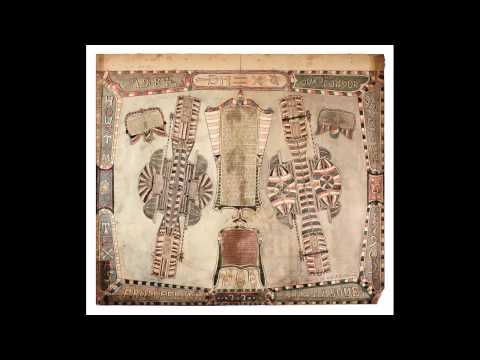
Charles A.A. Dellschau (1830–1923) American Visionary
Uploaded by gallerist and Dellschau curator Stephen Romano, a co-author of the 2013 Marquand Books monograph. A direct look at the notebooks and the artist's biography from one of the field's leading dealers/scholars.
S4 E10: Charles Dellschau, NYMZA, & The Sonora Aero Club
A full-episode walkthrough of the club's claimed history, NYMZA, and the case's unresolved status, from the "That Would Be Rad" podcast/YouTube series.
Sources
- Seeber, Jill S. "C. A. A. Dellschau." Handbook of Texas, Texas State Historical Association, 1995 (rev. 2016). tshaonline.org
- Holman, Brett. "Seeking Sonora." Airminded, March 27, 2013. airminded.org
- Barajas, Michael. "Secrets of the Sonora Aero Club." Houston Press. houstonpress.com
- "Charles Dellschau: The Artist's Scrapbooks Documenting the Sonora Aero Club." Slate, March 2013. slate.com
- The Menil Collection. "Peter Mennis 'You are not forgotten,'" Charles A.A. Dellschau, August 22, 1911 (accession 1969-04.07 DJ D). menil.org
- American Folk Art Museum. "Vestiges & Verse: Notes from the Newfangled Epic" (exhibition, 2018). folkartmuseum.org
- Andrew Edlin Gallery. "Charles A.A. Dellschau" (artist page & exhibition history). edlingallery.com
- Lienhard, John H. "Charles Dellschau." The Engines of Our Ingenuity, No. 1308, University of Houston. engines.egr.uh.edu
- "The Mystery of 'NB Gas' Solved and 'Aero' Airship Flight: A Chemical Perspective." ARGunners Magazine. argunners.com
- Outsider Art Fair. "Charles A. A. Dellschau" (artist profile). outsiderartfair.com
- Whitney Museum of American Art. "Charles Dellschau" (artist page). whitney.org
- Design Observer. "Dreams of the Sonora Aero Club." designobserver.com
- Steinhauer, Jillian. "Early-20th-Century Drawings of Fanciful Flying Machines." Hyperallergic. hyperallergic.com
- American Visionary Art Museum. "Charles Dellschau" (artist profile). avam.org
- Wikimedia Commons. "Charles Dellschau work example 06.jpg" (public domain file record and license documentation, used for this file's hero image). commons.wikimedia.org
- McEvilley, Thomas; Cardinal, Roger; Brett, James; Crouch, Thomas D.; Safarova, Barbara; Morris, Randall; Baker-White, Tracy. Charles A.A. Dellschau, 1830–1923. Marquand Books / D.A.P., 2013 (cited for author/publication details; full citation under Further Reading).
- Crenshaw, Dennis G. & Navarro, P.G. The Secrets of Dellschau: The Sonora Aero Club & the Airships of the 1800s, A True Story. Anomalist Books, 2009 (cited for author/publication details; full citation under Further Reading).
- "Charles Dellschau." Wikipedia (used lightly, for cross-checking basic biographical dates only; primary sources above are preferred wherever a claim could be traced to them). en.wikipedia.org
- Rosen, Rebecca J. "Charles A.A. Dellschau Dreams of Flying: The Amazing Story of an Airship Club That Might Never Have Existed." The Atlantic, March 21, 2013 (cited via secondary summaries; direct fetch of theatlantic.com blocked in this research environment, cross-verified against Slate and Houston Press coverage of the same claims).
- YouTube (oEmbed-verified). Romano, Stephen. "Charles A.A. Dellschau (1830–1923) American Visionary." youtube.com
- YouTube (oEmbed-verified). "That Would Be Rad." "S4 E10: Charles Dellschau, NYMZA, & The Sonora Aero Club." youtube.com
See something inaccurate? Have additional information or sources?
Suggest an Edit →Last Updated: August 2026