
Bonilla Solar Transit Photographs
On the mornings of August 12 and 13, 1883, Mexican engineer-astronomer José Bonilla, director of the newly built Zacatecas Astronomical-Meteorological Observatory, aimed his French-donated telescope at the Sun to check for spots and instead watched hundreds of dark, misty objects stream across the solar disk. Over roughly three and a half hours of usable clear sky spread across the two days, he counted 447 of them and exposed a matching series of wet-collodion photographic plates — a documentation effort unmatched by almost any other 19th-century aerial anomaly report. Published quietly in the French journal L'Astronomie in 1886 and all but forgotten for well over a century, the case resurfaced in October 2011 when a team of UNAM scientists proposed the objects were fragments of a comet that had passed catastrophically close to Earth — a claim mainstream astronomers have since challenged on its own arithmetic, leaving the case's original, more conservative explanation (birds, insects, or debris near the telescope's own lens) still standing as the most-favored account, and the whole affair honestly unresolved.
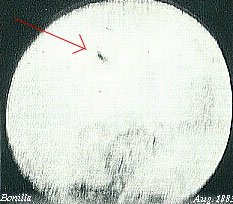
Pictured: a public-domain reproduction of one of Bonilla's original 1883 wet-collodion plates, showing a small dark object (marked with an arrow by a later publisher) against the bright solar disk. This is the same widely reproduced print sourced from Bonilla's 1886 L'Astronomie publication; the original glass plates themselves no longer survive, so every modern reproduction — including this one — derives from period print copies rather than the source negatives.
Theoretical Alignment
This case sits almost entirely outside the standard ETH/IDH framework: Bonilla never described a structured craft, controlled flight, or purposeful behavior — only irregular, drifting motion consistent with either a natural astronomical body or ordinary airborne animals. Its strongest theoretical alignment is Psycho-Social, not because any crowd hysteria occurred (this is a single, sober, credentialed observer), but because the case's entire modern "UFO" framing is a retroactive interpretive overlay: an ambiguous 1883 astronomical puzzle, quietly published and effectively forgotten for well over a century, was rediscovered and re-narrated by 21st-century media and ufological writers as "the first UFO photograph" only after the 2011 comet-fragment paper went viral. The underlying data itself — a solitary witness's photographic silhouettes with no radar, no structured shape, and no repeat appearance — offers no positive evidence for craft of extraterrestrial or interdimensional origin.
Background
José Árbol y Bonilla was born in the city of Zacatecas on February 5, 1853. He trained first as a topographical engineer at Zacatecas's Instituto Literario de García (today the Universidad Autónoma de Zacatecas), then won a state scholarship in 1873 from Governor Gabriel García to attend the Escuela de Minas in Mexico City, where he compressed a three-year civil-engineering curriculum into a single year. For that feat, President Sebastián Lerdo de Tejada personally awarded him the 1875 Premio al Mérito. Bonilla returned to Zacatecas to teach at his old Instituto while pursuing independent scientific study, and in 1878 founded and became first director of the state's Observatorio Meteorológico-Astronómico de Zacatecas — one of the first purpose-built astronomical-meteorological observatories anywhere in Mexico outside the capital.
In 1879 Bonilla traveled to Paris to study celestial photography, joining the scientific circle around Camille Flammarion, the era's most prominent popularizer of astronomy in France. He returned to Zacatecas a trained astrophotographer at a moment of real institutional momentum: the French government had donated a refracting telescope to the state specifically so Zacatecas could take part in observing the December 6, 1882 transit of Venus across the Sun — one of the 19th century's most closely watched international scientific events, timed to help refine the astronomical unit (the Earth–Sun distance). The observatory's new building, atop Cerro de la Bufa, the hill overlooking Zacatecas's colonial center, opened that same December, with Bonilla installed as director and this Venus-transit instrument as its primary telescope.
Eight months later, on the morning of August 12, 1883, Bonilla pointed that same instrument at the Sun for a routine sunspot check. What followed would occupy debate among astronomers, skeptics, and ufologists for the next 140-plus years. The broader scientific backdrop matters here in a way it rarely does for 20th-century UFO cases: 1883 predates radar, powered flight, radio, and any organized meteorological or astronomical monitoring network capable of independently cross-checking a solitary provincial observer's claim. Bonilla's only real-time corroboration option was the telegraph — and he used it, with a result that itself became part of the case's evidentiary record.
The institutional setting also matters. By 1883 Mexico was five years into the long presidency of Porfirio Díaz, whose government actively promoted scientific and technical modernization — new observatories, engineering schools, and international scientific participation such as the Venus-transit collaboration — as a matter of deliberate state policy, part of a broader positivist-influenced push to project Mexico as a scientifically capable nation. A provincial state government funding an astronomical-meteorological observatory, staffing it with a formally trained engineer sent abroad specifically to learn astrophotography, and equipping it with an imported French telescope was itself a product of this national moment, not an isolated local curiosity. That institutional backing is part of why Bonilla's account carries more evidentiary weight than a typical unaffiliated 19th-century witness: he was operating within, and reporting to, a real, internationally connected scientific infrastructure rather than acting alone and unaccountable.
Complete Timeline
| Date | Event |
|---|---|
| Feb. 5, 1853 | José Árbol y Bonilla is born in Zacatecas, Mexico. |
| 1873–1875 | Bonilla completes a three-year civil-engineering program at Mexico City's Escuela de Minas in one year on a state scholarship; President Sebastián Lerdo de Tejada awards him the 1875 Premio al Mérito. |
| 1878 | Bonilla founds and becomes first director of the Observatorio Meteorológico-Astronómico de Zacatecas. |
| 1879 | Bonilla travels to Paris to study celestial photography, joining the circle around astronomer Camille Flammarion. |
| Dec. 6, 1882 | The observatory's new building opens atop Cerro de la Bufa, equipped with a telescope France donated for that day's transit of Venus across the Sun. |
| Jan. 1883 | Flammarion founds the monthly journal L'Astronomie in Paris — the publication that would carry Bonilla's account three years later. |
| Aug. 12, 1883, ~08:00 | While checking the Sun for spots, Bonilla notices the first of many dark objects crossing the solar disk and begins exposing wet-collodion plates. |
| Aug. 12–13, 1883 | Across roughly 25 hours (interrupted by cloud), Bonilla logs 3 hr 25 min of clear-sky viewing, counts 447 individual objects, and telegraphs observatories in Mexico City and Puebla to watch for the same phenomenon; neither reports seeing anything. |
| Jan. 1, 1886 | L'Astronomie publishes Bonilla's account, submitted roughly two and a half years earlier, with an editorial note from Flammarion favoring birds, insects, or dust near the telescope's lens. |
| 1911 | Bonilla steps down from the Zacatecas observatory to direct Mexico City's National School of Arts and Crafts. |
| May 13, 1920 | Bonilla dies in Mexico City at age 67, having authored Mexico's first modern cosmography textbook among his later scientific work. |
| Oct. 12, 2011 | Héctor Javier Durand-Manterola, María de la Paz Ramos Lara, and Guadalupe Cordero Tercero of UNAM post an arXiv preprint proposing the objects were comet fragments that passed within roughly 538–8,062 km of Earth's surface. |
| Oct.–Nov. 2011 | The hypothesis draws international press coverage (MIT Technology Review, Phys.org, AAAS) alongside detailed public rebuttals from astronomers Marco Langbroek and Phil Plait. |
| 2015 | Mexican newspapers Excelsior and El Universal revisit the case; the Zacatecas observatory, still operating for public education, is by this point formally named in Bonilla's honor. |
The Observation
Multiple period and modern accounts agree on the essential shape of what happened, even where exact figures diverge slightly across secondary sources. On the morning of August 12, 1883, Bonilla was using the observatory's telescope to check the Sun's disk for sunspots — ordinary, routine solar-observation work for a 19th-century astronomer. Instead of, or alongside, sunspots, he began seeing small dark shapes drifting across the bright solar background: objects he described in his own account as "fuzzy" or "misty," several trailing what he called "dark tails," dark and roughly round or elongated when silhouetted against the disk, brightening briefly into visible highlights as they crossed the Sun's limb (edge) and left the disk. Bonilla, trained in Paris specifically in astrophotography, recognized the potential significance immediately and began exposing a rapid sequence of wet-collodion photographic plates — a technically demanding process that required each glass plate to be sensitized, exposed, and developed while still wet, meaning Bonilla needed a working darkroom set up at or very near the telescope itself to capture dozens of separate exposures across the observing window.
The phenomenon did not appear continuously. Cloud cover repeatedly interrupted Bonilla's view across roughly a 25-hour span bridging August 12 and 13, and his own log distinguishes total elapsed time from actual clear-sky viewing time: by his own accounting, he had only about 3 hours and 25 minutes of unobstructed observation across the full period, and it was within that narrower window that he counted and individually logged 447 distinct objects crossing the disk. Some secondary sources report this as "over 400," "more than 300," or, in one case, extrapolate outward: the 2011 UNAM reanalysis projected that if objects had continued crossing at the same rate throughout the full, mostly cloud-obscured 25-hour period rather than only the clear intervals Bonilla could actually see, the true total might have approached 3,275 — a extrapolated estimate, not a second directly observed count, and one this case file treats as clearly distinct from the 447 Bonilla actually witnessed and recorded.
One secondary account summarizing Bonilla's own written description quotes him characterizing the objects as "dark-black and perfectly round," with some "more or less elongated when seen against the solar disc," before they "became bright images as they left" the Sun's edge — a specific, internally consistent visual description repeated, with only minor wording variation, across the handful of sources that quote his original account directly rather than paraphrasing it.
One detail recorded in multiple sources is genuinely telling from a technical standpoint: Bonilla reported that refocusing his telescope on the Moon (rather than the Sun) caused the mystery objects to sharpen, while they blurred when he focused back on the distant solar disk — his own contemporaneous argument, in other words, that the objects were relatively near Earth rather than genuinely near the Sun 150 million kilometers away. This single observation is really the seed of every modern "near-Earth object" interpretation of the case, including the 2011 comet-fragment paper; it is also equally consistent with the far more mundane explanation that the objects were simply much closer to the telescope than the Sun is — birds or insects near Zacatecas, not comet debris near the Moon's orbit.
Individual transit times across the solar disk were extremely brief. Multiple accounts describing the 2011 team's own methodology note that each object crossed the roughly half-degree-wide solar disk in well under a second — a detail load-bearing for every subsequent interpretation, mundane or exotic alike, since it is exactly the kind of rapid, near-field transit a bird or insect passing close to the objective lens would produce, and also the kind of transit an extremely fast-moving, extremely close astronomical body would produce. The ambiguity is baked into the data itself, which is precisely why the case has never been definitively closed in either direction.
Bonilla's Own Account and the Failed Corroboration Attempt
What distinguishes this case from the vast majority of historical sky-anomaly reports is that Bonilla did not simply record what he saw and move on — he actively tried, in real time, to get independent confirmation. Recognizing the potential scientific importance of what he was recording, he sent a telegraph message alerting observatories in Mexico City and in Puebla, asking them to look at the Sun and report whether they saw the same phenomenon. Both cities sit a few hundred kilometers from Zacatecas — well within range for a genuinely distant, extremely close-passing astronomical object to also be visible from a different parallax angle, and also well within range for a genuinely local, near-field phenomenon (birds, insects, atmospheric haze) to simply not be present over a different city on the same morning.
Neither Mexico City nor Puebla reported seeing anything unusual on the Sun that day. This negative result cuts in a specific, technical direction depending on which explanation one starts from. For the 2011 UNAM team, the failure of two other Mexican observatories to see the same objects became a load-bearing piece of supporting evidence: if the objects had genuinely been passing extremely close to Earth — hundreds to a few thousand kilometers up — then ordinary parallax alone could explain why observers a few hundred kilometers away, looking at the Sun from a measurably different angle, would see the objects silhouetted against a different, unaffected patch of the solar disk, or miss them from their sightline entirely. For skeptics, the same negative result cuts the opposite way: a genuinely fragmenting comet passing that close to Earth, moving at cometary or near-orbital velocities, would not plausibly stay confined to a debris corridor narrow enough that only one specific city's specific rooftop happened to catch it across more than 25 hours of Earth's own continuous rotation and orbital motion — a geometric objection independent astronomers would later develop in far more technical detail (see Mainstream Astronomical Skepticism, below).
Publication in L'Astronomie and Flammarion's Skepticism
Bonilla did not rush his findings to print. By his own account and by the timeline multiple sources confirm, he first sent his observations and photographic plates privately to Camille Flammarion in Paris — the astronomer under whose circle he had studied celestial photography four years earlier, and by 1883 the founder and editor of the brand-new journal L'Astronomie. Flammarion held the account for roughly two and a half years before finally publishing it in the January 1, 1886 issue.
Flammarion's own editorial judgment, appended directly to Bonilla's report, was skeptical: he suggested the most likely explanation was that Bonilla had photographed birds, insects, or dust passing close to his telescope's objective lens rather than anything genuinely in space near the Sun. This was, notably, the assessment of a working astronomer who had personally examined Bonilla's original plates — not a dismissive armchair guess from someone who had never seen the evidence. Bonilla himself disputed this interpretation in his own writing, evidently believing his training and care as an astrophotographer made a simple insects-on-the-lens mistake unlikely, but he offered no confident alternative explanation of his own either. The case went into print, in other words, already carrying its own internal, unresolved disagreement between the observer and the publisher who vetted him — a genuinely rare structural feature for a 19th-century anomaly report, most of which simply asserted an interpretation rather than preserving a documented dispute between two credentialed parties.
After its 1886 appearance in a French astronomical journal with a modest circulation, the case drew little sustained attention for well over a century. It was occasionally mentioned in later UFO-literature surveys of pre-20th-century "aerial phenomena," but never became a headline case the way 20th-century sightings with radar or multiple named military witnesses did — there was, after all, no structured craft, no repeat appearance, and by the time organized ufology emerged in the late 1940s the case was already six decades old and largely confined to specialist astronomical-history circles.
The 2011 Comet-Fragment Hypothesis
That changed in October 2011, when three scientists at Mexico's Universidad Nacional Autónoma de México (UNAM) — space physicist Héctor Javier Durand-Manterola, science historian María de la Paz Ramos Lara, and geophysicist Guadalupe Cordero Tercero — posted a preprint on arXiv titled "Interpretation of the observations made in 1883 in Zacatecas (Mexico): A fragmented Comet that nearly hits the Earth." Their central claim: the 447 objects Bonilla documented were fragments of a comet that had recently broken apart and was passing extremely close to Earth — not merely close in astronomical terms, but close enough that the encounter would have counted among the most significant near-misses in recorded history had any of the fragments actually struck the planet.
Their methodology worked from the observational data Bonilla himself had painstakingly logged: the timing, apparent angular size, and transit duration of individual objects crossing the solar disk, combined with the negative result from Mexico City and Puebla. Using those transit times and the assumption that the fragments' true distance from Earth could be bounded by the fact that nearby cities failed to see them (an argument from parallax and limited visibility geometry), the team calculated the fragments passed at an altitude of roughly 538 to 8,062 kilometers above Earth's surface — some estimates from secondary press coverage of the same paper cited ranges up to several tens of thousands of kilometers, reflecting the wide uncertainty bands inherent in reconstructing 128-year-old naked-eye/photographic timing data. From the same transit-time data, they derived individual fragment dimensions on the order of 46 to 795 meters wide and 68 to 1,022 meters long, with individual masses estimated between roughly 5.58×10&sup8; and 2.5×10¹² kilograms. Extrapolating to a single parent body, they proposed an original comet mass ranging from about 1.83×10¹² to 8.19×10¹&sup5; kilograms — a range whose upper bound would make the parent comet more massive than Halley's Comet itself, and whose implications, had the debris struck Earth instead of missing it, the authors themselves framed in stark terms: the equivalent of thousands of Tunguska-scale explosions occurring within a 25-hour window, a scenario some coverage of the paper described as being on the scale of a potential mass-extinction event.
The UNAM team's argument for taking Bonilla seriously rested heavily on his own credentials and methodology: a Paris-trained astrophotographer, personally directing a functioning observatory, who logged precise timings and produced a genuinely large photographic data set (447 separate exposures) rather than a single ambiguous account. Their paper explicitly argued it was "doubtful" that such a meticulous, trained observer would have repeatedly mistaken insects on his own lens for 447 separate objects across more than three hours of careful, deliberate photographic documentation — treating Bonilla's own professional rigor as itself a point of evidence against the mundane explanation Flammarion had favored 125 years earlier. Some secondary science coverage additionally described the hypothesis in terms of a possible Kreutz-family sungrazing comet, though this specific sub-classification does not appear explicit in the original 2011 preprint itself and should be read as a later media gloss rather than the authors' own stated claim.
Notably, the 2011 paper has circulated only as an arXiv preprint; this case file's research did not locate evidence that it was ever formally peer-reviewed and published in a standard astronomy journal in the years since. That does not automatically invalidate its reasoning, but it does mean the hypothesis has never passed the kind of independent editorial and referee scrutiny that would normally be expected before an extraordinary historical near-miss claim of this scale is treated as an established finding — a gap that becomes more significant in light of the specific technical rebuttals detailed below.
Mainstream Astronomical Skepticism
The comet-fragment hypothesis drew serious, technically specific pushback from working astronomers almost immediately, distinguishing this from a case where "skepticism" means simple dismissal. Dutch astronomer Marco Langbroek, known for his satellite- and meteor-tracking work at Leiden University, directly challenged the parallax reasoning at the heart of the UNAM paper. He argued that Earth's own rotation and orbital motion during Bonilla's multi-hour observation window meant that, for the fragments to remain genuinely invisible from both Mexico City and Puebla while still being visible from Zacatecas, the debris stream would need to be improbably wide — by his estimate, "at least 20 Earth diameters wide" — which is difficult to square with the same paper's premise that the fragments were narrowly, coincidentally confined to a corridor that happened to pass directly over one specific observatory.
American astronomer and science writer Phil Plait, writing on his widely read "Bad Astronomy" platform (hosted at the time by Discover magazine), raised several additional, more physical objections. Comets that fragment do not confine their debris to a tight cluster: "even when intact, the material surrounding a comet can be tens or even hundreds of thousands of kilometers across," Plait noted, making it hard to reconcile a genuinely fragmenting body with debris packed into only a few thousand kilometers of altitude. He further pointed out that across two days of observation, the objects would collectively have "stretched out along a path that was a million km long at least, yet so narrow that only one observatory on Earth saw them" — essentially the same geometric objection Langbroek raised, independently arrived at. Most damagingly, Plait highlighted the complete absence of any accompanying meteor activity: a genuine, disintegrating, near-Earth cometary mass of the size proposed should have produced meteor displays of "practically biblical" proportions from the dust alone, yet the historical record of the 1883 Perseid meteor shower — occurring in the same general seasonal window — shows nothing unusual; contemporary accounts describe that year's Perseid display as unremarkable, "not... a fine one by any means." No unusual radiant, no elevated fireball reports, and no identified candidate parent comet matching the required orbit have ever surfaced to support the hypothesis. Plait's own favored alternative: Bonilla most likely photographed "flocks of birds" or some other mundane atmospheric phenomenon, while acknowledging that Bonilla genuinely photographed something he could not explain.
Science writer Brian Dodson, summarizing the debate for the American Association for the Advancement of Science's Scientia blog shortly after the UNAM paper's release, reached a similarly cautious conclusion: despite Bonilla's "stellar reputation and properly equipped facility," and despite the UNAM team's serious quantitative effort, the case remained fundamentally unexplained rather than solved by either side's account. UFO researcher and author Kevin Randle, discussing the case on his own blog in 2015, likewise described the comet hypothesis as "a reasonable suggestion, but one, at the moment, that is not proven, just likely" — explicitly declining to endorse it outright even while treating it more charitably than Plait or Langbroek did. Commenters on Randle's post raised further specific technical objections: that a genuine comet fragment moving at typical cometary velocities (on the order of 20 miles per second) would cross the solar disk essentially instantaneously rather than remaining observable, in aggregate, across parts of two separate days, and that the total absence of both an associated meteor shower in any subsequent year and any large fireball reports from the close-approach date itself is difficult to reconcile with a body of the proposed mass. One commenter proposed that an Aten-class near-Earth asteroid — a class of small bodies orbiting entirely within Earth's own orbit — would better fit the observed motion characteristics and ecliptic-plane trajectory than a classic long-period comet, though this remains an informal suggestion raised in blog-comment discussion rather than a peer-reviewed alternative model, and this case file did not locate any published follow-up work developing it further.
The Birds, Insects, and Dust Hypothesis
Set against the comet hypothesis, the case's original 1886 explanation — Flammarion's proposal that Bonilla photographed birds, insects, or dust close to his telescope's objective lens — has aged, on balance, at least as well as its modern rival, and in several mainstream astronomers' assessments (Plait's among them) somewhat better. The core appeal of this explanation is almost entirely negative evidence: the total absence of any corroboration from two nearby observatories that were specifically alerted and asked to look, the total absence of any meteor shower or fireball activity that a genuine close-passing comet mass should have produced, and the sub-second individual transit times, which are fully consistent with a bird or flying insect passing near a telescope's field of view rather than requiring an exotic astronomical explanation at all. This is, in fact, essentially the same phenomenon amateur solar and lunar photographers still document today: birds and aircraft passing near enough to a telephoto or telescope-mounted lens to appear as sharp, fast-moving silhouettes against the Sun or Moon, frequently interpreted by inexperienced observers as much larger or much more distant than they actually are.
The hypothesis is not without its own weaknesses, which is precisely why this case remains open rather than closed in the mundane direction. Bonilla was not an inexperienced observer; he was a specifically Paris-trained astrophotographer who disputed the birds/insects explanation himself and who, on the UNAM team's telling, would have had to overlook or misidentify 447 separate near-lens intrusions across more than three hours of deliberate, careful photographic work — a real, if not conclusive, argument in the other direction. Neither side of this debate has produced a smoking-gun piece of evidence (a recovered bird carcass, a documented local insect swarm, a positively identified comet) that would move the case from "most plausible mundane candidate" to "proven mundane explanation."
The Zacatecas Observatory Today
The observatory building Bonilla directed still stands atop Cerro de la Bufa in Zacatecas, and continues to operate for public astronomical education under the Universidad Autónoma de Zacatecas. By 2015, Mexican press coverage marking the case's resurgence — including a 2015 Excelsior feature quoting Zacatecas Astronomy Society president Alejandro Muñoz and longtime observatory supervisor Gloria Eleana Espinoza Valdéz — noted that the observatory bearing Bonilla's own name still houses a functioning historic telescope with, by that report, "all original brass components," open to the public Monday through Friday evenings for educational viewing. The same coverage noted that present-day Zacatecas hosts two of Mexico's officially recognized astronomical observatories — the Manuel Ríos Herrera Observatory at the Universidad Autónoma de Zacatecas and the José Árbol y Bonilla Observatory itself — a legacy this single 1883 morning, whatever its ultimate explanation, helped put on the map of Mexican scientific history a full century before ufological interest in the case began.
Key Witnesses
José Árbol y Bonilla
The case's sole direct witness and its only source of physical documentation. A credentialed civil engineer who trained specifically in celestial photography in Paris before returning to direct Zacatecas's new observatory, Bonilla brought real technical skill to the observation: he recognized the phenomenon's potential importance in real time, exposed a rapid sequence of technically demanding wet-collodion plates, kept a precise log distinguishing total elapsed time from actual clear-sky viewing time, and immediately attempted independent corroboration by telegraph — a level of methodological care matched by very few 19th-century anomaly reports of any kind. His single greatest evidentiary weakness is structural rather than personal: he was the only witness, and the two observatories he alerted in real time reported seeing nothing.
The Five Observables Assessment
The Five Observables framework is applied to the performance characteristics reported in this case:
Assessment: This case cannot be scored cleanly against the Five Observables because its interpretation is precisely what's in dispute. If the objects were genuinely near-Earth cometary fragments as the 2011 UNAM paper proposes, their implied real velocity (tens of kilometers per second) would register as speculatively hypersonic; if they were birds or insects near the lens, no such velocity is implied at all, since their apparent speed across a magnified telescopic field says nothing about their true airspeed. The same ambiguity applies to Low Observability: the objects were invisible to two nearby, specifically alerted observatories, which is consistent either with a genuinely narrow, close-passing debris corridor or with an entirely mundane, purely local phenomenon that simply wasn't present over a different city that same morning. No instant acceleration, structured maneuvering, or trans-medium behavior of any kind was ever reported, which argues against a controlled or piloted craft under either interpretation.
Evidence Assessment
Supporting an Unresolved/Anomalous Reading
- The sole witness was a credentialed, Paris-trained astrophotographer directing a functioning observatory — not an untrained or anonymous observer
- 447 individually counted objects were logged with precise timing across a documented clear-sky window, a scale and rigor uncommon among 19th-century anomaly reports of any kind
- Actual photographic plates were exposed at the time, not merely a written account produced after the fact
- Bonilla attempted, and documented, real-time independent corroboration by telegraph — a step almost never available to pre-20th-century witnesses
- No specific bird migration record, insect swarm, or dust event from the exact date has ever been positively matched to the observation, leaving the mundane explanation itself formally unproven
- The case has drawn serious, credentialed academic re-analysis (the 2011 UNAM paper) rather than being dismissed outright by every scientist who has examined it
Supporting a Conventional Explanation
- Total absence of corroboration from two nearby observatories that Bonilla himself alerted in real time specifically to check
- No unusual meteor shower, fireball reports, or other second-order astronomical evidence exists from the same period, despite the proposed comet-fragment mass implying dramatic secondary effects
- The editor who personally reviewed Bonilla's original plates (Camille Flammarion, himself a trained astronomer) favored a mundane explanation
- Independent credentialed astronomers (Marco Langbroek, Phil Plait) have identified specific, unresolved geometric and physical problems with the comet-fragment hypothesis's own math
- Sub-second individual transit times are fully consistent with birds or insects near the lens, a phenomenon still documented by amateur solar photographers today
- The 2011 comet-fragment paper remains an unreviewed preprint, never published in a peer-reviewed astronomy journal in the years since it was posted
- The original glass plates no longer survive for any modern re-examination; every analysis on either side works from printed reproductions and Bonilla's written descriptions alone
Why "Disputed"
This case earns a DISPUTED classification because it genuinely resists resolution in either direction, for reasons that have only sharpened with 21st-century scrutiny rather than settling the matter. On one hand, Bonilla was a real, credentialed, methodologically careful observer who produced an unusually rigorous data set for his era — a precise count, exposed photographic plates, and a documented, contemporaneous attempt at independent corroboration — and no one has ever positively identified the specific mundane cause (a particular bird species, a specific insect swarm, a named comet) that would definitively close the case. On the other hand, the single most serious modern attempt to treat the objects as genuinely anomalous — the 2011 UNAM comet-fragment hypothesis — has been met with specific, technically grounded objections from independent astronomers that this case file's research could not find any published rebuttal to: no meteor shower where one should exist, no candidate parent comet, and a geometric problem reconciling "close enough to be invisible from 300 km away" with "narrow enough that only one observatory saw it" across more than a day of Earth's own rotation and orbital motion. A case with a single uncorroborated witness, an explicitly disputed 130-year-old preprint as its leading anomalous explanation, and a conventional explanation (birds/insects/dust) that itself has never been definitively confirmed sits squarely in Disputed territory: too well-documented and too technically serious on both sides to dismiss outright, and too short on independent corroboration or positive physical proof to rate as Credible or Verified.
Sensor & Instrumentation Detection Profile
The only instrumentation involved was Bonilla's own refracting telescope (the same instrument France had donated for the 1882 transit of Venus) and a series of wet-collodion glass photographic plates, reportedly exposed at roughly 1/100-second shutter speeds. No radar, radio, or any other detection system existed in 1883 to independently register the event; the telegraph functioned only as a same-day communication tool for requesting a second visual observation, not as an instrument capable of detecting the objects itself. This remains, even 140 years later, one of the earliest attempts anywhere to document a solar-disk aerial anomaly through instrumented (photographic) means rather than eyewitness testimony alone.
Environmental & Geospatial Context
Zacatecas sits on the southern edge of Mexico's high central plateau; the observatory itself, atop Cerro de la Bufa overlooking the city's colonial center, sits at high altitude in a semi-arid climate that local astronomers have long credited with unusually clear, stable seeing conditions — one contemporary source describes the site's elevation as exceeding 2,800 meters. Bonilla's own log records that cloud cover repeatedly interrupted continuous observation across the roughly 25-hour span bridging August 12 and 13, 1883, leaving only about 3 hours 25 minutes of genuinely clear, usable viewing time in which the 447 counted objects were actually logged. No meteorological instrumentation beyond direct human observation existed at the site to record more granular atmospheric data from the event.
Observer Credibility & Occupational Profile
The case rests entirely on one observer's credibility, which is unusually strong for a single-witness account: José Bonilla was a state-scholarship civil engineer, a Paris-trained astrophotographer, the founding director of a real, functioning government observatory, and later the director of a national vocational school in Mexico City — a career trajectory built entirely on technical credibility rather than showmanship or self-promotion. He published nothing sensationalized about the case himself; his account went through Camille Flammarion's own editorial vetting before reaching print, and he continued a distinguished, unremarkable scientific and administrative career for more than three decades afterward, including authoring Mexico's first modern cosmography textbook, with no evidence of seeking further attention from the 1883 event. Working against this strength is the case's structural weakness: he is the only witness, and his own attempt to secure a second one, by telegraph, came back empty.
Physical & Material Assays
The only physical evidence ever associated with this case is Bonilla's series of wet-collodion photographic plates, exposed across the two observation days. No modern physical or chemical testing has ever been possible because the original glass plates do not survive; every analysis conducted since 1886, including the 2011 UNAM reanalysis, has worked exclusively from the printed reproductions that accompanied the L'Astronomie publication and from Bonilla's own written measurements and descriptions, not from the source negatives themselves. See Material Analysis, below, for full detail on what those surviving reproductions do and do not allow researchers to determine.
Historical Precedents & Archive Matches
The Bonilla case sits within a broader 19th-century pattern of ambiguous aerial phenomena reported across the Americas in the decades bracketing it — a pattern this site catalogs elsewhere, including the Maracaibo UFO Sighting just three years later in Venezuela, and the far more contested Sonora Aero Club claims of secret airship-building in 1850s California, reconstructed decades after the fact from a single artist's account. It also anticipates, in a specifically Mexican context, the country's next major solar-adjacent aerial phenomenon more than a century later: the 1991 Mexico City Eclipse UFO Wave, in which an object was photographed near the eclipsed Sun by numerous independent observers — a case with the multi-witness corroboration this 1883 case conspicuously lacks, and one that helped launch the modern Mexican civilian ufology movement Bonilla's own case would later be absorbed into, retroactively, as an early historical precedent.
Material Analysis
The entirety of this case's physical evidence is a set of 447 wet-collodion photographic exposures made across August 12–13, 1883, of which only a small number of printed reproductions — produced for the 1886 L'Astronomie publication — are known to survive today. This is a genuinely unusual level of documentation for a pre-20th-century aerial anomaly report, most of which rely on written testimony alone, but it is also a fundamentally limited evidentiary base: no original negative has been located by any researcher consulted in this case file's research, meaning every modern claim about the objects' apparent size, shape, or motion derives from period print reproductions and Bonilla's own written transit-time measurements, not from direct re-examination of the source photographic data.
The Wet-Collodion Process and What It Could (and Could Not) Capture
The wet-collodion (wet-plate) photographic process dominant in 1883 required a glass plate to be coated with a light-sensitive collodion emulsion, exposed while still wet, and developed within minutes — meaning Bonilla needed a functioning darkroom set up at or immediately adjacent to the telescope itself to produce a rapid sequence of exposures. One secondary source specifically cites exposure times on the order of 1/100 of a second per plate, fast enough to freeze a rapidly moving near-field object (a bird or insect) as a sharp silhouette, but also fast enough to capture a genuinely distant, extremely fast-moving body without significant motion blur. The technique itself, in other words, cannot by itself distinguish between the competing hypotheses; it only establishes that Bonilla had the real technical capability to produce the kind of rapid-sequence photographic record his written account describes, which lends credibility to the account's basic mechanics even though it says nothing about what, specifically, the plates depicted.
Why the Original Plates No Longer Exist
Nineteenth-century glass photographic plates were fragile, chemically unstable over long storage periods, and rarely prioritized for preservation once a printed reproduction existed for publication purposes. Bonilla's original plates appear to have been lost or destroyed at some point in the 140-plus years since 1883 — a loss common to the vast majority of 19th-century scientific glass-plate collections worldwide, not evidence of any particular suppression or negligence specific to this case. The practical consequence for modern researchers is the same regardless of cause: no electron microscopy, spectral analysis, or high-resolution digital re-scan of the actual exposed emulsion has ever been possible, and none will be, absent the rediscovery of an original plate in some uncatalogued archive.
Supporting a Genuine, Unexplained Phenomenon
- A trained astrophotographer produced a large (447-exposure), methodically logged photographic data set — a rare scale of documentation for any 19th-century sky anomaly
- The specific instrumented technique (telescope-mounted wet-collodion photography) rules out the crudest photographic-hoax methods available in the era
- A credentialed 2011 academic reanalysis derived a physically self-consistent (if disputed) set of distance, size, and mass parameters from Bonilla's own transit-time data, rather than dismissing it out of hand
Supporting a Terrestrial/Mundane Origin
- The original glass plates no longer exist for any modern re-examination; every analysis works from period print reproductions alone
- No physical specimen — a feather, an insect body, any recovered debris — was ever produced to test empirically
- Independent credentialed astronomers have identified specific, unaddressed quantitative problems with the near-Earth interpretation of the same photographic data
- The astronomer who personally examined the original plates before publication reached a mundane conclusion
The Conventional Explanation Candidate
Three genuinely distinct candidate explanations have been seriously proposed for this case since 1886, and this case file evaluates each on its own merits rather than collapsing them into a single verdict.
Migrating Birds, Insects, or Debris Near the Telescope's Objective Lens
This is the case's original explanation, proposed by Camille Flammarion in the very 1886 issue of L'Astronomie that first published Bonilla's account, and it remains the explanation favored by the most prominent modern astronomer to weigh in publicly, Phil Plait. It deserves serious evaluation because it requires no exotic astronomical event, fits the sub-second individual transit times observed, and directly explains the total absence of corroboration from Mexico City and Puebla: a local flock of birds or insect swarm over Zacatecas has no reason to also be present, at the same moment, over cities several hundred kilometers away. Its principal weakness is that Bonilla, a specifically trained astrophotographer who disputed this explanation himself, would have needed to overlook the same basic error 447 separate times across more than three hours of careful, deliberate work — a real, if not fatal, objection the UNAM team raised explicitly in defense of their own alternative.
Fragmented Comet Passing Extremely Close to Earth
Proposed in the 2011 UNAM preprint by Durand-Manterola, Ramos Lara, and Cordero Tercero, this hypothesis treats Bonilla's transit-time data as genuine orbital-mechanics evidence and derives a self-consistent, if wide-ranging, set of distance, size, and mass estimates for a disintegrating cometary body. It deserves serious evaluation because it was produced by credentialed academic scientists working quantitatively from Bonilla's own primary data, rather than dismissing or embellishing it, and because it offers a positive, falsifiable physical model rather than merely asserting that "something happened." Its central weaknesses, raised independently by Marco Langbroek and Phil Plait, are specific and unaddressed as of this case file's research: the geometry required to make the fragments invisible from Mexico City and Puebla while visible from Zacatecas implies a debris corridor difficult to reconcile with a genuinely fragmenting comet's typical spread; no meteor shower or unusual fireball activity of the scale the proposed mass should have produced has ever been documented; and no candidate parent comet matching the required orbit has been identified. The paper itself has also never been published in a peer-reviewed journal in the years since it was posted to arXiv.
A Genuine, Never-Identified Aerial or Near-Earth Phenomenon
Some UFO literature treats the case, on the strength of its enduring lack of full resolution, as evidence of a genuinely unexplained aerial phenomenon in its own right, sometimes framing it as "the first UFO photograph." This case file rates this as the weakest-evidenced of the three candidates: it is defined almost entirely by the shortcomings of the other two explanations rather than by any positive evidence of its own, and even most serious treatments of the case (including the UNAM paper) never describe a structured craft, controlled maneuvering, or any purposeful behavior — only irregular, drifting motion. Genuine scientific uncertainty about which mundane or semi-mundane explanation is correct is not, by itself, positive evidence of a structured, piloted, or otherwise deliberately controlled object.
Birds, Insects, or Dust Near the Lens
PlausiblePLAUSIBLE. Fits the sub-second transit times, fully explains the total lack of corroboration from nearby observatories, and was the assessment of the trained astronomer who personally examined Bonilla's original plates — though it has never been positively confirmed with a specific identified species, swarm, or dust event from the actual date.
Fragmented Comet Near-Miss
InconclusiveINCONCLUSIVE. A serious, quantitatively self-consistent academic model built from Bonilla's own data, but never peer-reviewed, and specifically challenged on geometric and meteor-shower grounds by independent astronomers with no rebuttal located in this case file's research.
Genuine Unidentified Phenomenon
InconclusiveINCONCLUSIVE. The case remains honestly unresolved 140-plus years on, but this candidate rests on the failure of the other two explanations rather than on any positive evidence of a structured or controlled object.
Related Cases
Confirmed Documents & Official Records
No U.S., Mexican, or other government agency is known to have formally investigated the 1883 Bonilla observation — it is a 19th-century civilian scientific report with no defense-ministry, intelligence, or Project Blue Book case file on record. The closest present-day government-affiliated resource relevant to evaluating the 2011 comet-fragment hypothesis is NASA's own near-Earth object tracking program, which monitors and catalogs precisely the class of small cometary and asteroidal bodies the UNAM paper proposes Bonilla photographed.
NASA's official program for tracking and characterizing comets and asteroids that pass close to Earth — the modern scientific infrastructure that did not exist in 1883 and that would be the natural body to evaluate a claim like the UNAM team's were a comparable close-approach event to occur today.
Search Government & Scientific Archives Directly
Further Reading — Recommended Literature
Comet
A lucid, comprehensive account of cometary science, history, and cultural mythology from two of the field's most respected communicators — essential background for evaluating any claim, like the 2011 UNAM hypothesis, that a comet fragment nearly struck Earth.
The Book of the Damned
The founding text of modern anomalistics, compiling historical scientific reports — including numerous 19th-century astronomical observations of unexplained objects and falls — that mainstream science of the era dismissed or ignored; essential context for how a case like Bonilla's sat within its contemporary scientific culture.
The UFO Encyclopedia, 4th Edition
The definitive English-language UFO reference work, useful here for situating the Bonilla case within the broader history of pre-20th-century aerial-phenomena reports and how ufology has treated them.
Rain of Iron and Ice: The Very Real Threat of Comet and Asteroid Bombardment
A planetary scientist's detailed account of the real, documented history and physics of near-Earth comet and asteroid encounters — directly relevant background for assessing whether the 2011 UNAM near-miss hypothesis is physically plausible.
How UFOs Conquered the World: The History of a Modern Myth
A folklore-and-archives-based history of how UFO belief formed and spread, useful for understanding how a quietly published 1886 astronomical curiosity like Bonilla's could be rediscovered and reframed generations later as "the first UFO photograph."
Essential Viewing

Olhar Espacial: A intrigante observação solar de José Bonilla de 1883
A science-journalism explainer from Olhar Digital covering Bonilla's 1883 observation and the modern comet-fragment reinterpretation.
Astronomer's Astonishing Encounter: The Bonilla UFO Observation 1883
A dedicated case retrospective covering Bonilla's original observation, the 1886 publication, and the competing modern explanations.
Sources
- Durand-Manterola, H.J., Ramos Lara, M.P., Cordero Tercero, G. "Interpretation of the observations made in 1883 in Zacatecas (Mexico): A fragmented Comet that nearly hits the Earth." arXiv:1110.2798, Oct. 12, 2011. arxiv.org
- "Bonilla observation." Wikipedia. en.wikipedia.org
- "José Bonilla (astronomer)." Wikipedia. en.wikipedia.org
- "Observación de Bonilla." Wikipedia (Spanish). es.wikipedia.org
- Choi, Charles Q. "Billion-Ton Comet May Have Missed Earth by a Few Hundred Kilometers in 1883." MIT Technology Review, Oct. 17, 2011. technologyreview.com
- "Mexican astronomers suggest Bonilla sighting might have been a very close comet breaking up." Phys.org, Oct. 2011. phys.org
- Dodson, Brian. "Did a comet almost cause Doomsday in 1883?" AAAS Scientia, Nov. 2, 2011. aaas.org
- Plait, Phil. "Did a fragmenting comet nearly hit the Earth in 1883? Color me very skeptical." Discover Magazine (Bad Astronomy), 2011. discovermagazine.com
- "Was the 'First Photographed UFO' a Comet?" Universe Today. universetoday.com
- "Reanalysis of 1883 Observations Suggests a Billion-Ton Comet Buzzed Earth." Space Safety Magazine. spacesafetymagazine.com
- "The day the world nearly ended and nobody — except one Mexican scientist — noticed." Mexico News Daily. mexiconewsdaily.com
- Minjarez, Emerio. "The Bonilla Observation: A Puzzling Event in the History of Astronomy." Medium. medium.com
- Randle, Kevin. "Bonilla's Comet." A Different Perspective, May 2015. kevinrandle.blogspot.com
- "File:Jose Bonilla UFO observation 12 August 1883.jpg." Wikimedia Commons. commons.wikimedia.org
- "Primeras fotos de 'OVNIS' fueron captadas en Zacatecas en 1883." Excelsior, Oct. 8, 2015. excelsior.com.mx
- "Observatorio de Zacatecas tomó primeras fotos de OVNIS." El Universal, Oct. 8, 2015. eluniversal.com.mx
- NASA Jet Propulsion Laboratory. "Center for Near-Earth Object Studies (CNEOS)." cneos.jpl.nasa.gov
See something inaccurate? Have additional information or sources?
Suggest an Edit →Last Updated: August 2026