
Maracaibo UFO Sighting
On the rainy, tempestuous night of October 24, 1886, a family of nine sleeping in a hut a few leagues from Maracaibo, Venezuela was awakened by a loud humming noise and a "vivid, dazzling light" that filled the interior of their home with no accompanying heat, thunder, or detonation. Over the following nine days the occupants developed swelling, blistering, and raw sores resembling radiation burns, while the trees around the hut abruptly withered on the same day the sores broke open. The only record of the event is a letter from Warner Cowgill, the U.S. Consul at Maracaibo, who personally visited the hospitalized victims and wrote up the case for Scientific American — a magazine, not a government inquiry, making this one of the earliest documented "close encounter with injury" accounts on record, nine years before Wilhelm Röntgen discovered the X-ray.
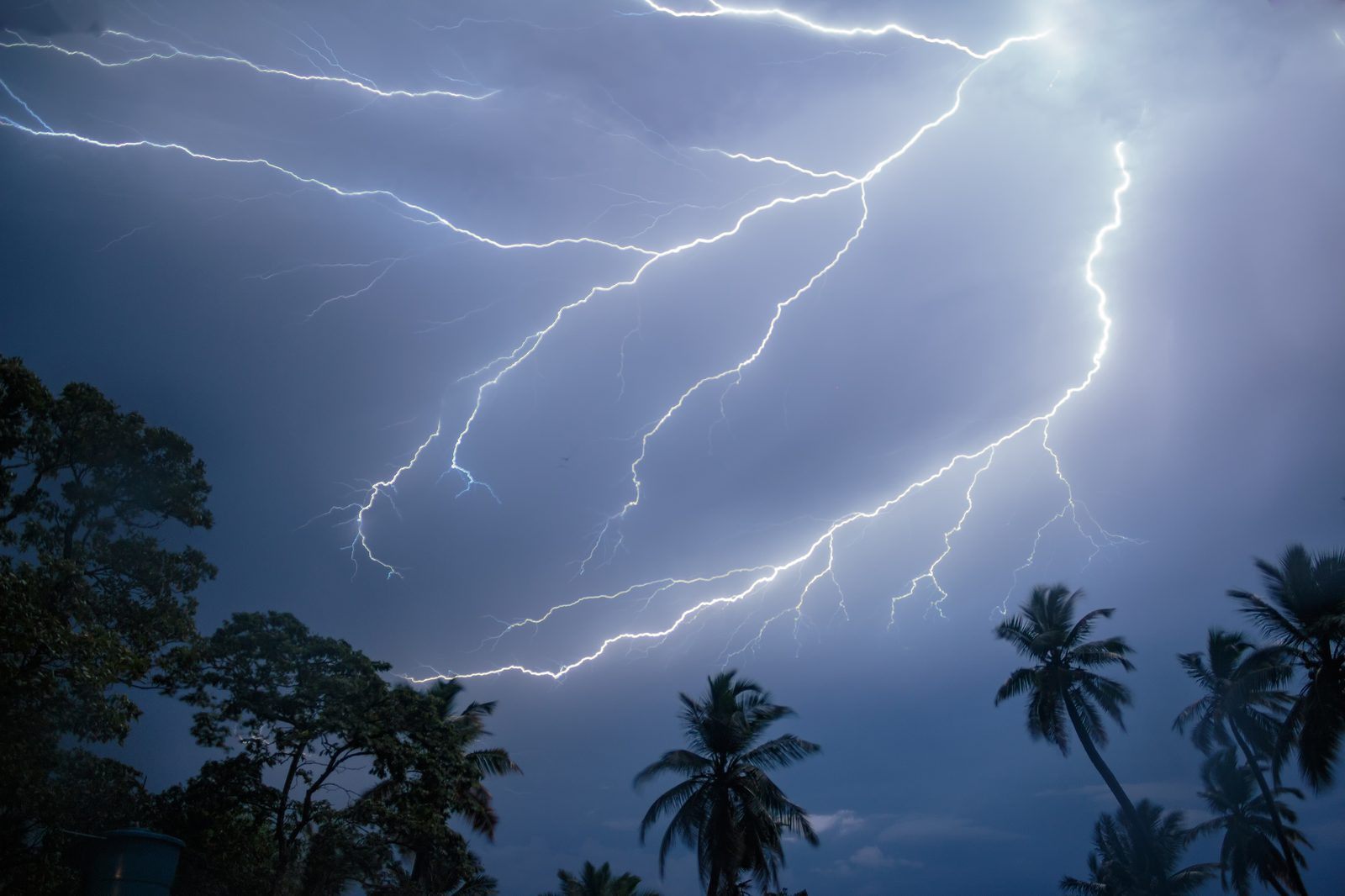
Pictured: the Catatumbo lightning phenomenon over the mouth of the Catatumbo River where it empties into Lake Maracaibo, photographed in 2015 — a real, scientifically documented, and extraordinarily intense electrical storm system that occurs almost nightly in this exact region. This is NOT a photograph of the 1886 incident itself, for which no photograph, sketch, or illustration is known to survive (or was ever claimed to exist); it is included because Catatumbo lightning is the leading conventional explanation candidate discussed in this file, and because the region's genuine, extreme electrical activity is essential context for evaluating Warner Cowgill's account. Photo by Fernando Flores, licensed CC BY-SA 2.0 via Wikimedia Commons.
Theoretical Alignment
The case is most frequently cited in ufological literature as a proto-"close encounter with injury," and its inclusion in modern ETH-leaning compilations reflects retrospective pattern-matching to 20th-century UAP injury cases (see Falcon Lake and Cash-Landrum) more than anything intrinsic to the 1886 account itself, which describes no craft, no occupants, and no directed technology — only a light and a sound. A significant share of its modern "alignment" with ETH is attributable to a century of retelling under headlines like "Alien Visitation," a framing entirely absent from Cowgill's own 1886 letter, which treated the event as an unexplained "electrical eccentricity." The stronger candidate alignment is with mundane atmospheric electricity (ball lightning or a direct strike) occurring in a region now scientifically confirmed to be the most electrically active place on Earth, compounded by the psycho-social and testimonial-degradation factors inherent to a single secondhand account relayed across 140 years of paraphrase, republication, and modern "UFO" framing.
Background
In October 1886, Venezuela was in the final months of a peculiar and unstable arrangement at the top of its government. The caudillo Antonio Guzmán Blanco, who had already dominated Venezuelan politics for a decade and a half across two earlier presidencies (1870–1877 and 1879–1884), had stepped back from day-to-day office in 1884 in favor of a chosen subordinate, General Joaquín Crespo, while continuing to control the government from behind the scenes. Crespo's figurehead presidency ran until September 15, 1886 — just five weeks after the Maracaibo incident — when Guzmán Blanco resumed the presidency outright for a third and final term. This was the political backdrop against which the United States maintained a modest consular presence in Venezuela's port cities, including Maracaibo, then (as now) the country's second city and the commercial hub of the oil-rich, cattle-ranching, and coffee-exporting Zulia region, connected to the Caribbean and to international shipping via the narrow strait linking Lake Maracaibo to the Gulf of Venezuela.
Maracaibo in the 1880s was a modest tropical port city of tens of thousands, still generations away from the discovery of the Venezuelan oil deposits (1917 onward) that would later transform Zulia into one of the wealthiest and most industrially significant regions in South America. Outside the city itself, the surrounding countryside — the "leagues" Cowgill refers to — consisted of scattered rural huts, small farms, and fishing communities, many of them built in the traditional palafito stilt-house style that had led the Spanish explorer Amerigo Vespucci to nickname the entire region "Little Venice" (Veneziola, later Venezuela) upon first encountering it in 1499. This was, and remains, an area of frequent, severe tropical storms, and specifically an area that overlaps with what is today recognized as the most electrically active place on Earth: the Catatumbo lightning zone at the lake's southwestern delta.
Against this backdrop, a family of nine — their names, ages, and occupations never recorded in the surviving literature — was asleep in a rural hut on the night of October 24, 1886, a night Cowgill's own letter describes as "rainy" and "tempestuous." What happened next survives only because Cowgill, in his official capacity, took an interest, visited the hospitalized victims himself, and thought the case significant enough to write up for a serious American scientific readership rather than let it pass as unrecorded local rumor.
Complete Timeline
| Date | Event |
|---|---|
| Sept. 15, 1884 – Sept. 15, 1886 | Gen. Joaquín Crespo serves as figurehead President of Venezuela under the continued political dominance of Antonio Guzmán Blanco — the government in power at the time of the incident. |
| Night of Oct. 24, 1886 | The Incident. A rainy, tempestuous night. A family of nine sleeping in a hut "a few leagues" from Maracaibo is awakened by a loud humming noise and a "vivid, dazzling light" that brilliantly illuminates the interior of the house. No heat is felt from the light; witnesses report only a smoky appearance and a peculiar smell. No lightning, thunder, or detonation is observed by the family. Terrified, the occupants begin to pray. |
| Oct. 24–25, 1886 (same night) | The family experiences violent vomiting and extensive swellings, especially about the face and lips. The house itself — doors and windows shut throughout — sustains no visible damage. |
| Morning of Oct. 25, 1886 | The swellings subside, but leave dark, black-looking blotches on the affected skin. The surrounding trees show no sign of injury at this point. |
| ~Nov. 2, 1886 (ninth day) | The delayed onset. Approximately nine days after the event, the black blotches on the victims' skin peel and transform into raw, open sores. Portions of the victims' hair fall out on the side of the body that had faced the light. On the same day, with no antecedent sign of injury, the trees surrounding the hut suddenly and visibly wither. |
| Early–mid Nov. 1886 | The nine victims are admitted to a hospital in the city of Maracaibo for treatment of their sores/burns. U.S. Consul Warner Cowgill personally visits them there and observes their condition, which he later describes as "truly horrible to behold," though he reports none of the injuries are expected to prove fatal. |
| Nov. 17, 1886 | Cowgill writes his letter describing the case, dated from the U.S. Consulate at Maracaibo, and sends it to the editors of Scientific American in New York. |
| Sept. 15, 1886 | (Concurrent political context) Antonio Guzmán Blanco resumes the presidency of Venezuela for a third term, five weeks before the incident, continuing until 1888. |
| Dec. 18, 1886 | Publication. Scientific American, Vol. 55, No. 25, page 389, publishes Cowgill's letter as "A Curious Phenomenon in Venezuela." This publication date — not the October 24 incident date — is the date that appears in some later secondary compilations and in this site's own prior placeholder listing; see "The Corrected Date" below. |
| 1970s–2000s | The case is picked up by Fortean and UFO-history researchers, including William Corliss's Science Frontiers anomaly-cataloging project and Jerome Clark's UFO Encyclopedia, and begins circulating as an early "close encounter with injury" precedent. |
| 2000s–2020s | The account proliferates widely online, frequently under sensational "alien visitation" or "radiation" headlines that go well beyond Cowgill's own comparatively restrained 1886 framing of an unexplained "electrical" event. NUFORC separately catalogs the case (report S92082) in its historical sightings archive. |
The Night of October 24, 1886
Cowgill's letter is short, plainly written, and free of the embellishment that characterizes almost every later retelling of the case. Stripped to its essentials, the sequence he reports is this: on a rainy, stormy night, nine people asleep in a rural hut near Maracaibo were woken by two simultaneous sensory events — a loud humming noise, and a brilliant light that filled the interior of the house. Critically, Cowgill is explicit that this was not an ordinary lightning strike as the family understood it: there was no accompanying thunderclap, no detonation, and afterward "no trace of lightning could be observed" on or around the structure. The light itself is described as intensely bright but strangely lacking the sensation of heat one would expect from such brilliance, and as having "a smoky appearance and a peculiar smell" — details that, whatever caused them, at minimum indicate the family experienced something outside their frame of reference for an ordinary storm, since they reacted with immediate, visceral terror, beginning to pray rather than simply waiting out what they took to be a nearby lightning strike.
No description of a discrete object, craft, or shape is given anywhere in the original account. There is no report of the light approaching, hovering, moving, or departing — it appears, illuminates the house, and then (implicitly, since the family survives the immediate encounter and is later found in their beds) it ends. This absence of any described object is one of the most consequential facts about the case for classification purposes: everything commonly summarized today as "a UFO hovered over the house" is an inference added by later retellings, not a detail present in the primary source. What Cowgill actually reports is a light-and-sound event with no witnessed craft of any kind, closer in raw content to many historically reported ball-lightning encounters than to a classic "structured craft" UFO sighting.
The Physical Aftermath: A Nine-Day Progression
The medically strangest element of the case is not the light itself but the delayed and staged progression of the victims' injuries, which Cowgill lays out with more specificity than almost any other detail in his letter. The same night as the event, the family suffered violent vomiting and swelling, concentrated "especially about the face and lips" — an acute, immediate reaction. By the following morning the swelling had subsided, but left behind dark, blackened blotches on the skin, which at that stage were not open wounds. For roughly a week, nothing further happened; the family, presumably, believed the worst was over.
Then, on approximately the ninth day after the event, the blotches suddenly broke down: the skin peeled away and the blotches transformed into raw, open sores. Simultaneously — the same day, according to Cowgill — portions of the victims' hair fell out on whichever side of the body had faced the light during the original event, and the trees immediately around the hut, which had shown no sign of injury for over a week, abruptly withered. It was only after this second, delayed phase that the family required hospitalization; Cowgill's hospital visit and subsequent letter (dated November 17) both fall roughly two weeks after this second onset.
This two-stage pattern — an immediate acute reaction, a quiet latency period of roughly a week, and then a delayed, more severe secondary breakdown of tissue accompanied by hair loss — is the detail most responsible for the case's enduring comparison to radiation sickness in modern commentary. Acute radiation syndrome in well-documented 20th-century cases (Hiroshima and Nagasaki survivors, Chernobyl first responders, and various criticality-accident victims) follows a broadly similar arc: an initial prodromal phase of nausea and vomiting, a "latent" period of apparent recovery lasting days to weeks depending on dose, and then, for sufficiently high exposures, a manifest illness phase involving skin breakdown (moist desquamation), hair loss (epilation), and open sores. The parallel is genuinely striking as a matter of symptom sequencing — and it is also, crucially, a parallel that could only be drawn in hindsight. In October 1886, radiation sickness as a recognized medical phenomenon did not exist. Wilhelm Röntgen would not discover X-rays until November 1895, over nine years later; Henri Becquerel would not discover radioactivity until 1896; and the first documented human radiation injuries (from early X-ray researchers' own hands) would not appear in the medical literature until the late 1890s. Cowgill and the Maracaibo doctors who treated the family had no diagnostic category called "radiation burn" available to them, and did not use one — the resemblance is entirely a retrospective observation made by 20th- and 21st-century readers pattern-matching 1886 symptoms against 20th-century medical knowledge that would not exist for another decade.
Warner Cowgill's Letter and Its Publication
Warner Cowgill's letter is dated November 17, 1886 from the United States Consulate at Maracaibo. Scientific American — already, by 1886, a long-established and reputable American weekly science publication, not a sensationalist outlet — printed it under the title "A Curious Phenomenon in Venezuela" in its issue of December 18, 1886 (Vol. 55, No. 25, p. 389), roughly a month after Cowgill wrote it, consistent with ordinary transatlantic/hemispheric mail and print production timelines of the era. The magazine's own framing treated the account as an unexplained natural curiosity submitted by a credible correspondent, not as evidence of anything otherworldly — a framing consistent with the fact that "flying saucers," "UFOs," and the entire interpretive vocabulary now associated with the case would not exist for another six decades. Cowgill's own language is comparatively restrained throughout: he does not speculate about the light's origin or nature, does not use any supernatural or extraterrestrial framing, and confines himself to reporting what he was told and what he personally observed at the hospital.
Cowgill's letter remains, to this day, the entire documentary record of the Maracaibo case. No follow-up article, correction, retraction, rebuttal, or independent confirmation appears in Scientific American's subsequent issues, and no Venezuelan newspaper account of the incident from 1886 has been located by any researcher who has revisited the case in the 20th or 21st century. Beyond his consular post and this one letter, the historical record offers little further biographical detail about Cowgill himself — a gap consistent with the broader observation that most 19th-century U.S. consular officers in secondary ports left comparatively thin paper trails outside their official correspondence.
The Corrected Date: Publication Date vs. Incident Date
Because Cowgill's letter is the only source for this case, and because it was printed as a single dated magazine issue, a persistent and understandable error has crept into secondary and tertiary retellings (and, until this file was researched and corrected, into this site's own "Coming Soon" placeholder listing): treating December 18, 1886 — the date Scientific American went to press — as the date of the incident itself. It is not. December 18, 1886 is the publication date of the magazine issue that carried Cowgill's report; the incident itself, as Cowgill states explicitly and consistently in his own letter, occurred on the night of October 24, 1886, nearly two months earlier. Cowgill's letter is itself dated November 17, 1886 — roughly three and a half weeks after the event, and about a month before the magazine printed it. This case file uses October 24, 1886 as the incident date throughout (including in the site's case index), while preserving the December 18, 1886 Scientific American issue date in the Sources section below, where it remains directly relevant as the citation for the primary source itself.
The Setting: Lake Maracaibo and the Catatumbo Lightning Region
No serious evaluation of this case is possible without understanding exactly where it occurred. Lake Maracaibo and its surrounding basin are not an ordinary tropical setting with occasional storms; they are, by direct modern satellite measurement, the single most electrically active location on the surface of the Earth. The Catatumbo lightning phenomenon — concentrated specifically over the delta where the Catatumbo River empties into the lake's southwestern corner, the same general area described by Cowgill's "a few leagues from Maracaibo" — produces an average of roughly 250 lightning flashes per square kilometer per year according to 17 years of combined data from NASA's Lightning Imaging Sensor (aboard the Tropical Rainfall Measuring Mission satellite) and Optical Transient Detector instruments, occurring on an estimated 140 to 160 nights annually, sometimes for eight or nine hours at a stretch and at rates as high as 28 flashes per minute. Locally the phenomenon has been called "the Maracaibo Beacon" or "the Lighthouse of Maracaibo" for centuries, because ships navigating the Caribbean coast could use its distant glow, visible for hundreds of kilometers, to fix their position at night long before electric lighthouses existed. Indigenous peoples of the region (the Barí, who call it "Catatumbo," meaning roughly "house of thunder," along with the Wayúu and Yukpa) had incorporated the phenomenon into their cosmology for centuries before European contact, and Alexander von Humboldt formally described it to the European scientific community in 1826, sixty years before Cowgill's letter.
The exact physical mechanism generating this level of activity is still an active subject of atmospheric-science research: current studies from Venezuela's Universidad del Zulia and collaborating institutions attribute it to the interaction of the Maracaibo Basin Nocturnal Low-Level Jet (a wind current carrying warm, moisture-laden air north off the Caribbean into the basin) with orographic convection forced upward by the Andes, the Sierra de Perijá, and the Cordillera de Mérida ranges that enclose the lake on three sides, with additional modulation from larger climate patterns including the El Niño-Southern Oscillation and the Inter-Tropical Convergence Zone. What matters for this case file is simpler: any close encounter with an unusual light, humming sound, and severe electrical/burn-type injury reported from within a few dozen kilometers of the Catatumbo delta must be evaluated against the base rate of an already extraordinary, scientifically documented natural electrical phenomenon occurring on the majority of nights in that exact location — a base rate that has no analog anywhere else on the planet, and one Cowgill himself, writing in 1886, had no scientific vocabulary to invoke, since the Catatumbo phenomenon's causes remained entirely unstudied in any modern sense for another century.
Key Researchers & Chroniclers
- William R. Corliss (1926–2011) — Physicist and self-published cataloger of anomalous scientific reports through his long-running Science Frontiers newsletter and Sourcebook Project, which reprinted and contextualized Cowgill's account for a modern anomalies-research audience, explicitly noting the case's chronological priority relative to X-ray and radioactivity discovery. Corliss's broader methodology — mining old scientific journals like Scientific American, Nature, and Monthly Weather Review for reports that did not fit prevailing scientific models, then republishing them without embellishment for other researchers to evaluate — is precisely how the Maracaibo case survived in circulation at all between its 1886 publication and its rediscovery by the internet-era UFO-history community; without Corliss's project, Cowgill's letter would very plausibly have remained buried in bound 19th-century periodical volumes, cited by no one.
- Jerome Clark — UFO historian and author of The UFO Encyclopedia: The Phenomenon from the Beginning, whose comprehensive reference work situates 19th-century "airship" and pre-airship-era anomalous light cases like Maracaibo within the longer documented history of the UFO phenomenon predating the 1947 Kenneth Arnold sighting.
- Jacques Vallée — Astronomer and UFO researcher whose Passport to Magonia established the methodological approach of comparing modern UFO reports against older folkloric and pre-modern anomalous-phenomena accounts, a framework directly applicable to evaluating a pre-1900s case like this one on its own terms rather than through a purely post-Arnold "flying saucer" lens.
- Andrew Zalotocky — Skeptical commentator who has specifically proposed the ground-current/root-damage lightning-strike mechanism discussed above as a complete conventional explanation for the case's most distinctive details.
Key Witnesses
Warner Cowgill
The sole named, identifiable figure in the entire case, and its only source. Cowgill held the official post of U.S. Consul at Maracaibo in 1886, giving him institutional standing and (presumably) some baseline expectation of accuracy in his official correspondence. He was not present for the light-and-humming event itself; his contribution is a secondhand account of what the family described to him or to intermediaries, combined with firsthand, personal observation of the victims' injuries during a hospital visit roughly three to four weeks after the event. He describes the victims' condition as "truly horrible to behold" but states that none of the injuries were expected to be fatal. His letter, dated November 17, 1886, is written in a restrained, non-sensational register, offering no speculation about extraterrestrial or supernatural causes — a framing entirely of later origin. Beyond this one letter and his consular post, no further biographical detail about Cowgill (dates of birth/death, prior postings, later career) has been located in the sources consulted for this file.
The Family of Nine (Unnamed)
The nine people who actually experienced the humming light, the vomiting, the swelling, and the delayed sores are never named in Cowgill's letter or in any source since. Their ages, relationships to one another, occupations, and even their exact number of adults versus children are not specified beyond "a family of nine persons." This total anonymity is a significant, honest limitation on the case's evidentiary weight: modern researchers have no way to interview descendants, verify hospital admission, cross-check the account against any independent record, or assess the family's individual credibility, prior reliability, or possible motive (financial or otherwise) for the story as told. Everything known about their experience passes through exactly one intermediary — Cowgill — and, in turn, through Cowgill's letter passes through Scientific American's 1886 editorial process before reaching any modern reader.
The Five Observables Assessment
The Five Observables framework, developed by former AATIP director Luis Elizondo, is used to classify UAP encounters based on performance characteristics that exceed known technology:
Assessment: None of the Five Observables can be meaningfully assessed as present, because no discrete craft, object, or performance characteristic is described anywhere in the primary source. Cowgill's letter reports a light and a humming sound, full stop — there is no reported approach, departure, maneuver, acceleration, or trajectory of any kind for the framework to evaluate. This is a structurally important point: much of the modern "UFO" framing applied to this case retroactively assumes a hovering craft that the original 1886 account simply does not describe. On performance characteristics alone, the Maracaibo case provides no evidence either for or against non-human technological origin; its entire evidentiary weight rests on the injury and environmental-effects narrative, not on any observed flight behavior.
Evidence Assessment
Supporting an Anomalous Interpretation
- The sole witness of documented credentials — a sitting U.S. Consul — personally visited and examined the hospitalized victims rather than merely relaying rumor at a distance
- Cowgill explicitly states no lightning, thunder, or detonation was observed by the family, distinguishing their account from an obvious, immediately-recognized ordinary lightning strike
- The light was described as producing no sensation of heat despite its brilliance — not a universal property of ordinary lightning or fire
- The delayed, two-stage injury progression (acute reaction, week-long latency, then day-9 breakdown with simultaneous tree death) is a specific and unusual symptom pattern that is difficult to attribute to an instantaneous lightning strike alone
- The case was published in a serious, non-sensationalist scientific journal of record within two months of the event, not decades later via faded memory or oral tradition
- The account predates the entire cultural vocabulary of "flying saucers" and "UFOs" by six decades, reducing (though not eliminating) the likelihood the story was consciously shaped by later UFO tropes at its point of origin
Supporting a Conventional Explanation
- The incident occurred in the Lake Maracaibo basin, scientifically documented by modern satellite data as the single most electrically active location on Earth (Catatumbo lightning, ~250 flashes/km²/year)
- Ball lightning — a real, recognized (if still not fully explained) meteorological phenomenon by 1886 — independently matches several core details: a brief, brilliant, unexplained light with an accompanying hum or hiss, sometimes reported with a smoky appearance or odor and without a conventional thunderclap
- Every detail of the phenomenon itself is secondhand, filtered through the family's own retelling, at least one act of translation, and Cowgill's paraphrase — with no independent party present to corroborate the light, the sound, or the family's stated absence of thunder
- No named witnesses, no surviving hospital records, and no independent Venezuelan source of any kind have ever been located in 139+ years, despite the case's heavy modern circulation
- The "radiation sickness" framing that dominates modern retellings is a retrospective diagnosis applied by later readers; the concept did not exist in 1886 and was never used by Cowgill or by any physician who treated the family
- A direct cloud-to-ground lightning strike near (not through) the hut, as proposed by some skeptical commentators, could independently account for asymmetric ("one side of the body") injury patterns and for delayed tree death via root-system damage rather than instantaneous visible scorching
Why "Disputed"
The Maracaibo case earns a DISPUTED classification, with a credibility score toward the lower end of the scale, because its genuine strengths and genuine weaknesses point in opposite directions almost evenly, and neither side can be resolved with the surviving evidence. On the strength side: this is not an anonymous internet legend invented decades after the fact. It has a named, credentialed, contemporary witness — a sitting U.S. federal diplomatic officer — who personally visited and examined the hospitalized victims and who published his account within two months of the event in a serious, non-sensationalist scientific journal, using restrained, non-speculative language. That combination (official standing, direct medical corroboration of the injuries, and prompt, sober publication) is genuinely stronger sourcing than the large majority of pre-20th-century "high strangeness" reports, most of which survive only as folklore, oral tradition, or retrospective compilations written decades or centuries after the fact.
On the weakness side, however, the case has almost none of the corroborating structure that raises other cases on this site into "credible" territory. There is exactly one witness of any documented identity, and even he did not see the phenomenon itself — only its aftermath. The nine people who actually experienced the event are, and will presumably remain, permanently anonymous. No second witness, no independent record, and no physical evidence of any kind has surfaced in over 139 years despite the case's very wide modern circulation, which is itself unusual: cases with real substance underneath them are frequently strengthened by later research turning up additional records, descendants, or corroborating local accounts (compare Falcon Lake, where Canadian government scientists tested the physical site directly), while Maracaibo has stayed frozen at exactly one source since 1886. And unlike many cases where the leading conventional explanation is weak, speculative, or requires implausible coincidences, the leading conventional explanations here — ball lightning and/or a nearby lightning strike with delayed secondary tissue and root damage — are strong specifically because of where the event occurred: a region now rigorously confirmed, by NASA satellite instrumentation, to be the most electrically active location on the entire planet. A close encounter with an unexplained light and injury occurring almost anywhere else on Earth would be harder to wave away with "the local weather." In the Catatumbo basin, it is a serious, evidence-backed possibility that this case's thin, single-source record cannot rule out.
Sensor & Instrumentation Detection Profile
None. The event predates all forms of instrumented UAP detection by decades — no radar (first operational only in the 1930s-40s), no photographic record, no seismograph or magnetometer data, and no seismic or atmospheric-electricity monitoring network of any kind existed in Zulia state in 1886. The only "instrument" involved was Cowgill's own eyes at the hospital roughly three to four weeks after the event, examining the victims' healing (or still-healing) injuries, and whatever informal account the family gave him or his intermediaries. No contemporaneous meteorological station recorded local conditions for that specific night; the "rainy and tempestuous" weather description comes entirely from Cowgill's letter.
Environmental & Geospatial Context
The incident occurred in the basin of Lake Maracaibo, a 13,512-square-kilometer inland sea in northwestern Venezuela's Zulia state, fed primarily by the Catatumbo River, which enters the lake's southwestern corner from a range of Andean foothills (the Sierra de Perijá and the Cordillera de Mérida). This exact geography produces the Catatumbo lightning phenomenon (locally "Relámpago del Catatumbo"): a nocturnal low-level jet of warm, moisture-laden air off the Caribbean collides with cooler air forced upward by the surrounding mountains, generating some of the most sustained, intense electrical storm activity documented anywhere on the planet — NASA satellite data (Lightning Imaging Sensor and Optical Transient Detector records spanning 17 years) puts the average flash density at roughly 250 strikes per square kilometer per year, concentrated over roughly 140–160 nights annually, with peak nights producing up to 28 flashes per minute for hours at a stretch. Sailors have used the glow as a navigational beacon for centuries, and the phenomenon was already known to European observers by the time Alexander von Humboldt described it in 1826, sixty years before Cowgill's letter. Zulia's climate is hot and semi-arid outside the delta itself, but late October falls within Venezuela's wet season, consistent with Cowgill's description of a "rainy, tempestuous" night. Whether the specific hut lay close enough to the Catatumbo delta's most active lightning corridor to be a plausible strike/ball-lightning site, or was simply within the wider zone of frequent regional thunderstorm activity common across the Maracaibo basin more broadly, cannot be determined from the surviving record, which gives no bearing or distance beyond "a few leagues" (roughly 8–24 km by the most common 19th-century Spanish-league conversion) from the city.
Observer Credibility & Occupational Profile
Warner Cowgill held the official position of United States Consul at Maracaibo in 1886 — a credentialed federal diplomatic officer, not an anonymous correspondent or a hobbyist letter-writer, and one with an institutional obligation to report accurately to Washington and to a scientific readership. He states plainly that he personally visited the injured at the hospital where they were being treated and describes their condition ("truly horrible to behold") from firsthand observation, which is meaningfully stronger corroboration than a pure hearsay retelling: Cowgill is a first-hand witness to the injuries and their documented medical aftermath, even though he was not present for the light/humming event itself. That said, his account of the actual phenomenon — the light, the sound, the family's fear and prayer, the timeline of symptom progression — is entirely secondhand, relayed to him (presumably in Spanish, filtered through at least one layer of translation and retelling) by the family or by local intermediaries whose names, occupations, and reliability are never given. No independent Venezuelan press account, court record, church record, or second investigator's report of this incident has ever surfaced in over 139 years, despite the case's wide modern circulation online. The family itself is never named in any surviving source.
It is also worth situating Cowgill within the ordinary functioning of the 19th-century U.S. consular service, since this shapes how much institutional weight his letter can fairly bear. American consuls stationed in secondary Latin American ports in this period were typically political or commercial appointees rather than career diplomats, tasked chiefly with facilitating trade, shipping documentation, and the welfare of American citizens abroad; the position did not require scientific, medical, or investigative training of any kind, and consuls were under no formal obligation to report on local curiosities to the State Department, let alone to a private science magazine. That Cowgill chose to write up the Maracaibo case at all — on his own initiative, outside his official duties, to a serious publication rather than a sensational one — suggests a personally credible, curious, moderately careful observer. It does not, however, transform him into a trained medical examiner or a forensic investigator, and his account should be weighted accordingly: credible as far as it goes, but never more authoritative than a single interested layman's description of what he was told and what he personally saw during one hospital visit.
Physical & Material Assays
No physical evidence survives or was ever collected in a form available for later testing. Cowgill describes burns/sores on the victims' bodies and describes the hut's structure as undamaged (doors and windows shut, no scorch marks noted on the building itself) and the surrounding trees as withering nine days after the event with no antecedent visible injury. No soil samples, wood samples, hair samples, or medical specimens from the case are known to have been preserved, and no hospital admission records from an 1886 Maracaibo hospital have been located by any researcher who has since revisited the case. Everything known about the "physical" side of this case is descriptive prose in a single secondhand letter.
Historical Precedents & Archive Matches
The Maracaibo case is frequently cited in Fortean and UAP-history literature (William Corliss's Science Frontiers catalog of anomalies; Jerome Clark's UFO Encyclopedia; various online UFO-history compilations) as one of the earliest well-documented accounts resembling a modern "close encounter with injury," predating Kenneth Arnold's 1947 coinage of "flying saucer" by 61 years and the first postwar UFO wave by seven decades. Its closest modern analogues on this site are the Falcon Lake Incident (1967), in which witness Stefan Michalak developed a grid-pattern burn and documented radiation-sickness-like symptoms after a close encounter, and the Cash-Landrum Incident (1980), in which Betty Cash and Vickie Landrum developed severe burns and radiation-sickness-like illness after a close encounter with a bright object. All three cases share the same basic evidentiary shape: physical/physiological injury consistent in a broad, non-specific way with radiation exposure, without any confirmed non-terrestrial cause and with real, unresolved debate over conventional explanations. The National UFO Reporting Center (NUFORC) has separately catalogued the Maracaibo account in its historical archive (report S92082), classifying it informally as a "CE-II" (Close Encounter of the Second Kind, i.e. a close encounter leaving physical traces) — though NUFORC's own catalog entry, like every other modern source, is itself simply a retelling of Cowgill's original letter, not an independent investigation.
Material Analysis
There is, in the strictest sense, no physical evidence to analyze in this case — a fact worth stating plainly rather than working around. No object, fragment, sample, or artifact connected to the Maracaibo incident has ever been produced, tested, or even claimed to exist. What exists instead is a set of described physical effects: the reported condition of the hut (undamaged, doors and windows shut, no scorch marks), the reported absence of any lightning trace afterward, the reported delayed withering of the surrounding trees, and the reported injuries to the nine occupants. None of these effects were examined by anyone with relevant scientific or medical training at the time in a way that produced a surviving report beyond Cowgill's lay description; no arborist inspected the trees, no forensic chemist tested the soil or the hut's timbers, and no physician's case notes from the Maracaibo hospital that treated the family are known to survive.
The most analytically useful "material" detail in the case is negative rather than positive: the explicit statement that no trace of lightning could afterward be observed on or around the hut. If taken at face value, this rules out an obvious, visibly scorched direct strike to the structure itself, which is one reason some researchers favor ball lightning (a phenomenon that does not necessarily leave the same char/scorch signature as a conventional cloud-to-ground bolt hitting a structure) over a simple house strike. However, "no trace observed" is also exactly what an untrained rural family in 1886, working at night in the rain with no forensic training, would report whether or not subtle traces (charring on a nearby tree root, a fulgurite in loose soil, faint discoloration) were actually present but simply never looked for. The absence of evidence here is genuinely ambiguous rather than conclusively pointing toward or away from any single explanation.
Supporting Non-Terrestrial or Truly Anomalous Origin
- The specific combination of a heatless, dazzling light, a humming sound, and a total absence of thunder or a lightning trace does not perfectly match the textbook profile of an ordinary cloud-to-ground lightning strike
- The two-stage, nine-day-delayed injury progression is not the expected pattern for an instantaneous conventional electrical burn, which typically presents its full severity immediately or within hours, not after a week-long apparent recovery
Supporting Terrestrial/Natural Origin
- No physical sample of any kind was ever collected, preserved, or subjected to any test, leaving nothing for modern materials science, radiological, or forensic analysis to evaluate one way or the other
- The region is independently and rigorously documented (via decades of ground observation and 17 years of NASA satellite lightning-imaging data) as experiencing the highest lightning flash density on Earth, providing an extraordinarily strong regional base rate for an intense, unusual-seeming natural electrical event on any given stormy night
- Delayed tissue necrosis and delayed plant death are both independently documented, non-exotic effects of lightning-related ground current and root-system damage, per skeptical analyses of this specific case (see Conventional Explanation Candidates below)
The Conventional Explanation Candidates
Three genuinely distinct terrestrial explanations have been proposed for the Maracaibo case, and each deserves to be evaluated on its own terms rather than treated as interchangeable "skeptic" positions.
Candidate 1: Ball Lightning
Ball lightning — a rare, still incompletely explained atmospheric-electricity phenomenon typically described as a glowing, roughly spherical light appearing during thunderstorms, sometimes accompanied by a hissing or humming sound and a burning or sulfurous smell — was already a recognized (if poorly understood) meteorological phenomenon by 1886, and remains, per specialist researcher Mark Stenhoff's survey of the scientific literature, without a single universally accepted physical explanation even today. It matches several specific details of Cowgill's account with unusual precision: a brilliant light appearing without a normal thunderclap, an accompanying hum, and a "smoky appearance and peculiar smell." Ball lightning reports historically include instances of localized burn injury to people in close proximity, which would fit the case's physiological injury profile better than a simple flash of distant lightning would. Its weakness as a complete explanation is that well-documented ball lightning events are typically brief (seconds, rarely much longer) and localized to a visible sphere, while Cowgill's account describes a light that "brilliantly illuminated the interior of the house" — consistent with, but not conclusively describing, a ball-lightning-scale phenomenon rather than something larger or more diffuse.
Candidate 2: A Direct or Near Lightning Strike, With Delayed Secondary Effects
An alternative skeptical explanation, advanced by commentator Andrew Zalotocky in response to this case, proposes an ordinary cloud-to-ground lightning strike very close to (though perhaps not directly on) the hut. Under this model, ground current ("step voltage") radiating outward from a nearby strike point could account for burns concentrated on one side of the victims' bodies depending on their sleeping position and proximity to the current path, while the apparent absence of a strike on the hut itself is explained by the strike occurring in the ground or in a nearby tree rather than the structure. The delayed, nine-day withering of the surrounding trees is explained under this model not as some mysterious latent effect but as ordinary root-system damage: a lightning strike can destroy or badly damage a tree's root structure while leaving the visible trunk and canopy apparently undamaged for days or weeks, during which the tree survives on water and nutrients already present in its trunk and branches before visibly dying once that reserve is exhausted — a well-documented, mundane arboricultural phenomenon entirely independent of any human injury mechanism. This candidate has the advantage of requiring no exotic physics whatsoever, only ordinary (if severe) lightning behavior combined with delayed but explicable secondary effects in both the human and plant injuries.
Candidate 3: Embellished or Distorted Secondhand Retelling
A third, non-exclusive possibility is that the account as it reaches modern readers has been shaped, exaggerated, or selectively remembered somewhere along its single chain of transmission: from the family, to whatever local intermediaries informed Cowgill, to Cowgill's own written paraphrase, to Scientific American's 1886 editorial process, and finally through 139 years of secondary and tertiary retelling — much of it, in the internet era, published under sensational "alien visitation" and "UFO" headlines that Cowgill's own restrained 1886 letter never uses. Human testimony about a frightening, poorly understood nighttime event, filtered through multiple retellings and at least one translation, is well documented in the psychological and folklore literature to be vulnerable to unconscious elaboration, especially around vivid sensory and medical details. This does not require anyone in the chain to have lied; it only requires ordinary memory drift and retelling effects, compounded by the complete absence of any second, independent witness or record against which the account could ever be checked.
Weighing the three candidates against each other: Ball Lightning and the Direct/Near Strike model are not mutually exclusive — both describe genuine, mundane atmospheric-electricity phenomena occurring in a location scientifically confirmed to have the highest lightning density on the planet, and either (or some combination) could plausibly account for the light, the hum, and at least the acute-phase injuries. The delayed nine-day skin breakdown and simultaneous tree death remain the single hardest detail for any purely conventional model to explain with full confidence, though the root-damage mechanism for the trees is well precedented and a delayed secondary tissue breakdown from an initial thermal/electrical injury (via infection, or via progressive tissue death from initially non-obvious damage) is not implausible either, even if it cannot be confirmed without a surviving medical record. Embellishment in transmission is not a complete alternative explanation on its own, but it is a serious, independent reason for caution about taking every specific numeric and sequential detail (exactly nine days, exactly the same day as the tree death, etc.) as precisely, literally accurate.
Ball Lightning
PlausiblePLAUSIBLE. Matches the heatless brilliant light, the humming sound, the smoky/odor detail, and the region's genuine, extreme electrical activity. Less certain as a complete match for the light's apparent scale ("illuminated the interior of the house") and for the full injury profile on its own.
Direct/Near Lightning Strike (Delayed Secondary Effects)
PlausiblePLAUSIBLE. Requires no exotic physics; ground-current burns and root-damage-driven delayed tree death are both well-documented mundane mechanisms. Requires assuming Cowgill's "no trace of lightning" observation was simply incomplete rather than definitive — a reasonable assumption given the family's lack of forensic training.
Embellished/Distorted Secondhand Account
InconclusiveINCONCLUSIVE as a standalone explanation, but a serious contributing factor given the single unverified chain of transmission, zero independent corroboration in 139+ years, and the total anonymity of all nine primary witnesses. Cannot be confirmed or ruled out from the surviving record.
Related Cases
No Official Government Investigation Exists
Unlike Roswell, Falcon Lake, or Cash-Landrum, the Maracaibo case was never the subject of any formal government inquiry, military report, or intelligence assessment by the United States, Venezuela, or any other government, in 1886 or since. Warner Cowgill's letter was a private communication to a commercial science magazine, written in his personal capacity as an interested, credentialed observer — not an official State Department report, diplomatic cable, or consular dispatch filed through any formal investigative channel. No Project Blue Book, NICAP, CIA, FBI, or AARO file on this case is known to exist, and none would be expected to, since the case predates every 20th-century UAP investigative body by six to eight decades. The closest thing to an official "record" is the original Scientific American issue itself and, in the modern era, NUFORC's informal historical cataloging of the account (a private nonprofit reporting archive, not a government body). The general government-archive search portals below are provided for readers who wish to independently verify this absence or search for any tangentially related consular correspondence from the period.
Search Government Archives Directly
Further Reading — Recommended Literature
The Book of the Damned
Fort's foundational compilation of "excluded" anomalous phenomena reports from 19th- and early 20th-century scientific journals and newspapers — exactly the genre of source material the Maracaibo case belongs to, and the direct ancestor of every modern Fortean anomaly catalog that later preserved it.
Passport to Magonia: On UFOs, Folklore, and Parallel Worlds
Establishes the methodology of reading modern UFO reports against centuries of earlier folkloric and anomalous-phenomena accounts — the correct interpretive lens for a pre-1900s case like Maracaibo, which predates "UFO" culture entirely.
The UFO Encyclopedia: The Phenomenon from the Beginning
The standard scholarly reference work on the full history of the UFO phenomenon, including its 19th-century antecedents; situates Maracaibo within the broader documented history of anomalous aerial reports predating 1947.
The Great Airship Mystery: A UFO of the 1890s
A close study of the American "mystery airship" wave of 1896–1897, the next major documented anomalous-aerial-phenomena episode after Maracaibo and the best-studied case of how 19th-century anomalous sightings actually propagated through contemporary print media.
Ball Lightning: An Unsolved Problem in Atmospheric Physics
The leading scientific survey of ball lightning research, written by a specialist who spent over two decades collecting and analyzing firsthand accounts — essential technical grounding for evaluating the leading conventional explanation candidate in this case.
Essential Viewing
No Videos Available
A reasonable, multi-query search turned up no dedicated, oEmbed-verifiable YouTube documentary, news segment, or analysis video genuinely and primarily focused on the 1886 Maracaibo case specifically (as opposed to generic "top historical UFO cases" compilation videos that briefly mention it alongside dozens of unrelated cases). Per this site's video sourcing policy, no video is listed rather than padding this section with off-topic or loosely-related content.
Sources
- Cowgill, Warner. Letter to the Editor, dated November 17, 1886, U.S. Consulate, Maracaibo, Venezuela. Published as "A Curious Phenomenon in Venezuela," Scientific American, Vol. 55, No. 25, December 18, 1886, p. 389. archive.org (original scanned issue)
- Patrick Gross. "UFOs at Close Sight: Reports from the Past — Venezuela 1886." ufologie.patrickgross.org. ufologie.patrickgross.org
- Corliss, William R. "Curious Phenomena in Venezuela." Science Frontiers, No. 132. science-frontiers.com
- "A Curious Phenomenon in Venezuela — Scientific American, Dec 18th, 1886" (discussion thread reproducing original text, sourced from a university library scan). Physics Forums. physicsforums.com
- National UFO Reporting Center. Historical report S92082: "10/24/1886: Maracaibo (outside of), Venezuela." NUFORC. nuforc.org
- Frazier, Kendrick (ed.) / Scientific American Blog Network. "Aliens and Nazis and Electric History, Oh My!" Scientific American. scientificamerican.com
- Loar, Christopher. "Dude, Where's My Spaceship?" EsoterX, September 29, 2016 (comparative analysis of the case's symptom pattern against documented acute radiation syndrome). esoterx.com
- "One Night in Maracaibo." Strange Company (historical-mysteries blog), September 2022 — includes discussion of Andrew Zalotocky's ground-current/root-damage lightning-strike explanation. strangeco.blogspot.com
- "Vol. 55, No. 25, December 18, 1886 of Scientific American." JSTOR (academic periodical index confirming issue, volume, and page range). jstor.org
- Muñoz, Ángel G., et al. "Seasonal Prediction of Lightning Activity in North Western Venezuela: Large-Scale versus Local Drivers." Atmospheric Research, 172–173 (2016): 147–162.
- Ávila, E.E., et al. "Characterization of the Lightning Activity of 'Relámpago del Catatumbo'." Journal of Atmospheric and Solar-Terrestrial Physics, ScienceDirect. sciencedirect.com
- NASA Earthdata. "The Maracaibo Beacon: Catatumbo Lightning" (feature article on 17-year NASA Lightning Imaging Sensor / Optical Transient Detector satellite study of the Catatumbo lightning phenomenon). earthdata.nasa.gov
- "Catatumbo Lightning." Wikipedia (general orientation on frequency, causes, and history; citations traced to primary atmospheric-science sources above where possible). en.wikipedia.org
- "Lake Maracaibo." Wikipedia (geography and hydrology background). en.wikipedia.org
- Stenhoff, Mark. Ball Lightning: An Unsolved Problem in Atmospheric Physics. Springer/Plenum, 1999 (scientific survey of ball lightning research and reported case characteristics).
- "Antonio Guzmán Blanco." Encyclopaedia Britannica (Venezuelan political context, 1886 presidency transition). britannica.com
- "First Presidency of Joaquín Crespo." Wikipedia (Venezuelan political context for October 1886). en.wikipedia.org
- Clark, Jerome. The UFO Encyclopedia: The Phenomenon from the Beginning, 2nd ed. Omnigraphics, 1998 (reference-work cataloging of pre-1947 anomalous aerial phenomena reports).
- Vallée, Jacques. Passport to Magonia: On UFOs, Folklore, and Parallel Worlds. Contemporary Books, 1969/1993 (methodological framework for evaluating pre-modern high-strangeness accounts).
See something inaccurate? Have additional information or sources?
Suggest an Edit →Last Updated: August 2026