
Broad Haven School Sighting
On the Friday lunch break of February 4, 1977, fifteen children at a small primary school on the Pembrokeshire coast reported watching a silver, dome-topped object and a tall figure in a metallic suit in a field beside their playground. Separated and asked to draw what they had seen, the children produced strikingly similar sketches — a detail that made Broad Haven one of the most cited child-witness UFO cases in British history. Decades later, an academic historian working directly from the school's own contemporary diary established that the drawings were not drawn independently at all, but three days later, after an entire weekend during which the children had every opportunity to compare notes.
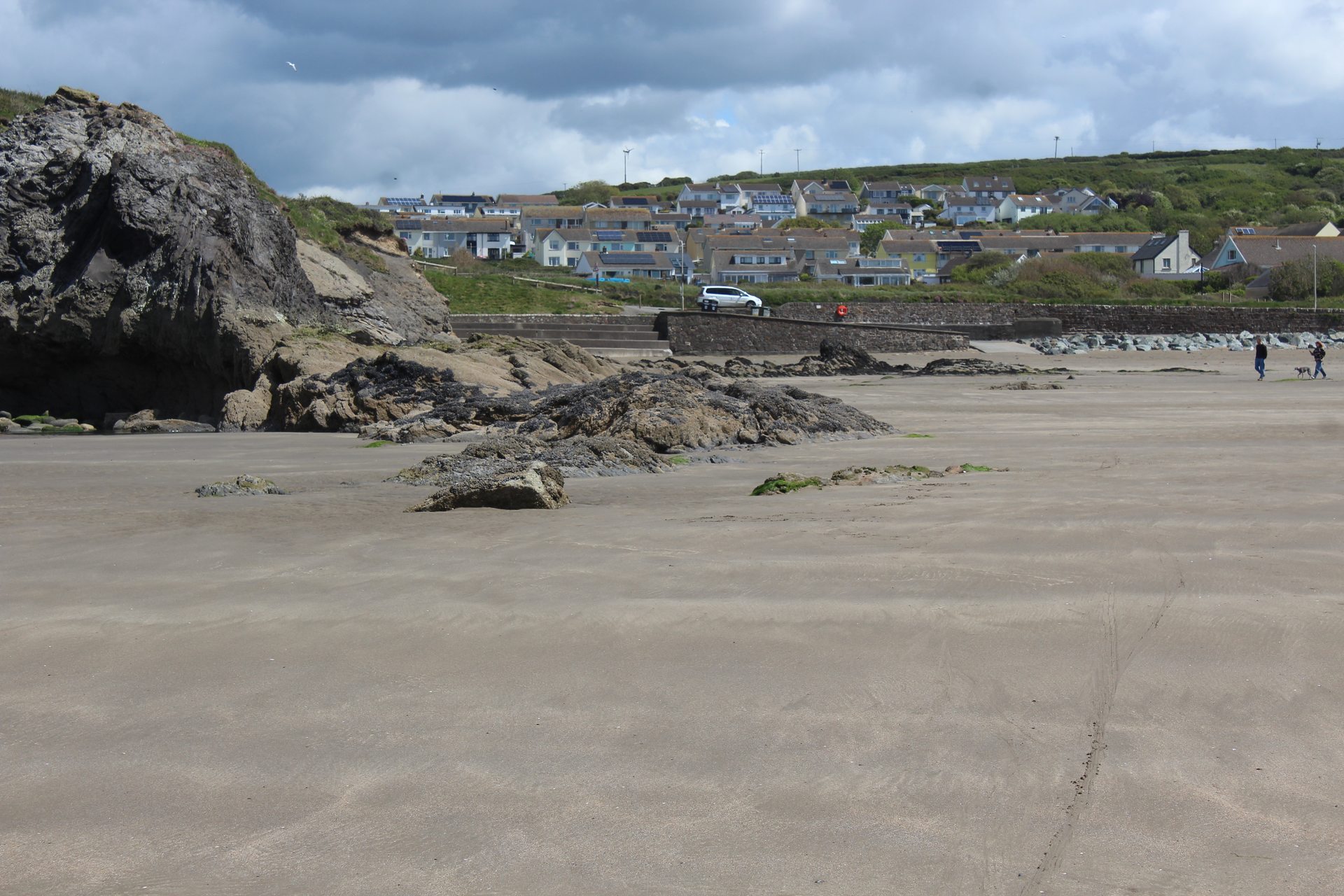
Pictured: the beach at Broad Haven, Pembrokeshire, Wales — the village where Broad Haven Primary School is located, not the school playground or the adjacent field where the sighting occurred, and not the object or occupant the children described. No rights-clear photograph of the school itself, the specific field, or the original 1977 drawings is known to be freely licensed; the children's drawings survive only within the Ministry of Defence's DEFE 24 files at the National Archives and within David Clarke's copyrighted book compilation of them, not as an openly reusable image.
Theoretical Alignment
The case aligns most strongly with the Psycho-Social Hypothesis once the drawing methodology is understood: a genuine group sighting, filtered through a weekend of playground conversation and contemporary science-fiction imagery, then partially explained by a specific, named individual's later confession to impersonating the "silver man" element for a prank. The Extraterrestrial Hypothesis retains a modest, non-trivial residual because the confessed prank accounts only for the humanoid figure, not for the craft the children described, which has never been matched to a specific mundane object.
Background
Broad Haven is a small seaside village on the southeastern shore of St Bride's Bay in Pembrokeshire, southwest Wales, roughly seven miles from the county town of Haverfordwest. A modest Victorian-era resort centered on a west-facing sand-and-shingle beach, Broad Haven in the mid-1970s was, by any measure, an unremarkable place: a scattering of guesthouses, a Baptist church, a small lifeboat station, and Broad Haven Primary School, a single-stream village school serving the surrounding farming community. Nothing about the village's history, geography, or population marked it out as a likely setting for one of the most widely reported UFO cases in British history — and indeed, for the first ten years of the school's existence, nothing at all had.
That changed on the afternoon of Friday, February 4, 1977, when a group of children returning from their lunch break told staff they had watched a silver, cigar-shaped object with a domed top come to rest in a field immediately behind the school, and that a tall figure in a metallic suit had stood beside it. What happened over the following days — a headmaster's careful, if imperfect, attempt to document the children's accounts; a set of drawings that entered national mythology as proof of independent corroboration; and a wave of national and then international press coverage — would make "Broad Haven" a byword for the child-witness UFO case for the next five decades, cited alongside Westall and Ariel School in nearly every serious survey of the phenomenon.
The timing was not coincidental to the broader cultural moment. Nineteen seventy-seven was, nationally, one of the busiest years in the Ministry of Defence's UFO desk's history, arriving in the specific window between the UK broadcast of imported American science-fiction programming, the BBC's own long-running Doctor Who, and the runaway theatrical success of Star Wars, which opened in British cinemas in December of that year — ten months after Broad Haven, but well within a media environment already saturated with cinematic and televised flying-saucer imagery, a point later stressed by academic UFO historian David Clarke in his own analysis of the case. Close Encounters of the Third Kind, whose title supplied the very taxonomic language this file uses to classify the sighting, would not reach British cinemas until 1978, but its American release and surrounding publicity were already generating substantial UK press coverage by the time the Broad Haven children were interviewed.
Broad Haven's February sighting did not occur in isolation for long. Over the following months, reports of unusual aerial phenomena, humanoid figures, and unexplained mechanical and agricultural disturbances spread across a roughly ten-mile radius of the Pembrokeshire coast, most dramatically at Ripperston Farm near the village of St Ishmaels, home to the Coombs family, beginning in April 1977. Local and then national tabloid press dubbed the area the "Broad Haven Triangle" or "Dyfed Triangle," a label consciously modeled on the "Bermuda Triangle" branding already familiar to readers, and the name stuck. The school sighting is, chronologically, the opening event of that wider wave and by far its most thoroughly investigated and most frequently cited single incident — but it is a distinct case from the later Ripperston Farm reports, involving different witnesses, a different kind of claimed evidence, and, crucially, no confirmed connection beyond rough geographic and temporal proximity. This file treats the school sighting itself as its subject, while placing it in the context of the wider wave it touched off.
The area's real defense infrastructure gave the story an added layer of intrigue that outlasted the original sighting. RAF Brawdy, a genuine NATO-linked airfield and signals intelligence facility roughly ten miles north of Broad Haven, and the large Milford Haven oil-refining and tanker terminal complex across St Bride's Bay to the south, both fed persistent (and never substantiated) speculation that military or industrial activity, rather than anything anomalous, lay behind at least some of the wave's reports — a line of explanation Ministry of Defence and RAF personnel themselves floated at the time, as this file's Conventional Explanation Candidate section details.
Complete Timeline
| Date | Event |
|---|---|
| Fri, Feb 4, 1977 — lunchtime | Approximately fifteen children at Broad Haven Primary School, mostly ten-year-old boys, report watching a silver, cigar-shaped object with a domed top come to rest in a field behind the school during their lunch break; six of the group additionally describe a tall figure in a silver suit standing beside it. |
| Fri, Feb 4, 1977 — afternoon | A parent contacts local BUFORA (British UFO Research Association) coordinator Randall Jones Pugh the same day; Pugh, a retired local veterinary surgeon, drives to interview a family connected to the sighting and visits the field that evening, by which time it is dark and raining. |
| Mon, Feb 7, 1977 | Headmaster Ralph Llewellyn interviews the children individually and has them produce written accounts and drawings of what they had seen — three days, and an intervening weekend, after the sighting itself. |
| Feb 1977 | Llewellyn forwards a written account and the children's drawings to Dyfed-Powys Police, who pass copies to Air Traffic Control and, from there, the Ministry of Defence's UFO desk (S4(Air) branch). |
| Feb 1977 | National press and television, including the BBC children's programme Newsround, cover the story; several of the children are interviewed on camera at the school itself. |
| Wed, Feb 16, 1977 | A separate schoolyard UFO report occurs at Rhosybol School on Anglesey, North Wales — unconnected to Broad Haven but part of the same short-lived February 1977 British wave of school sightings. |
| Feb 17, 1977 | A teacher and two canteen staff at Broad Haven Primary report a further, separate sighting from the school grounds, thirteen days after the original event. |
| Apr–Oct 1977 | The wider "Broad Haven Triangle" wave unfolds across a roughly ten-mile radius of the Pembrokeshire coast, most notably the Coombs family's reports at Ripperston Farm beginning in April, plus dozens of further witness accounts collected by Pugh and co-investigator F.W. Holiday. |
| Jun 14, 1977 | The Ministry of Defence's S4(Air) branch requests a "discreet enquiry" from RAF Police into the wider Pembrokeshire reports; the resulting assessment treats a local prankster as a plausible explanation for at least the humanoid-figure element of the wave. |
| 1979 | Pugh and Holiday publish The Dyfed Enigma: UFOs in West Wales, the first book-length account of the school sighting and the wider wave, drawing on their own field interviews. |
| 1979 | Author and self-described former intelligence officer Peter Paget publishes The Welsh Triangle, a more sensationalized account that popularizes speculation about a submerged base beneath St Bride's Bay. |
| 1996 | Local businessman Glyn Edwards publicly confesses that he wore a silver-lined protective suit and walked around the Broad Haven area in 1977 "for a bit of fun," offering a specific, named, first-person account of one plausible source for at least some of the "silver man" sightings reported that year. |
| 2008–2013 | David Clarke serves as external academic advisor to the National Archives' release of Ministry of Defence UFO files, including the DEFE 24 series covering Broad Haven, and subsequently examines the school's own 1977 diary and scrapbook directly. |
| 2017 | The sighting's 40th anniversary is marked with public events at which several of the original child witnesses, including David Davies, speak publicly; all maintain their original accounts. |
| 2018 | David Clarke publishes UFO Drawings from the National Archives, reproducing and discussing the Broad Haven children's drawings alongside other MoD file illustrations, and details the weekend gap between sighting and drawing in an accompanying essay. |
| 2023 | Netflix's documentary series Encounters (Amblin Television) devotes its first episode to the Broad Haven Triangle, reintroducing the case, including the school sighting, to a global streaming audience. |
| 2024 | BBC Three's Paranormal, presented by Sian Eleri, revisits the Pembrokeshire wave as part of a four-part investigative series. |
The Playground Sighting
According to the most consistent published reconstructions — drawing principally on David Clarke's direct examination of Broad Haven Primary School's own 1977 log, written contemporaneously by headmaster Ralph Llewellyn in the third person — the sighting itself took only a few minutes during the school's regular Friday lunch break. A group of children, by most counts around fifteen, mostly boys between the ages of nine and eleven, were in or near the playground when several of them noticed an object partially obscured by trees and hedgerow in the field immediately beyond the school boundary. Descriptions varied in emphasis but converged on a broad shape: a silvery, elongated or cigar-like body, sometimes likened to "two saucers joined rim to rim," topped by a raised dome bearing a light that different children described as orange, red, or green. At least two of the children specifically recalled a flashing light atop the dome. Six of the group additionally reported a tall humanoid figure standing beside the object, described as wearing a metallic or "silverish" one-piece suit; some accounts add unusually long or pointed ears to the figure's description, though this detail does not appear uniformly across every child's testimony.
The children did not approach the object. By their own accounts they watched from a distance at the field's fence line for what several described as no more than a few minutes before the object — in most tellings — departed, though the precise manner of its departure (a sudden vertical climb versus simply passing from view behind trees) is not consistently described across the surviving record. Frightened and excited in roughly equal measure, the children returned to their classrooms and told their teachers what they had seen. The reaction, at least initially, was closer to indulgent skepticism than alarm: this was, after all, a large group of primary-school-aged children reporting a flying saucer, precisely the kind of claim adults in 1977, as in any era, were primed to dismiss as an overactive collective imagination or a game that had gotten out of hand.
The Weekend, and What Happened to the Drawings
What happened next is the single most consequential fact in the entire case, and it is also the fact most consistently omitted or softened in the popular retellings that made Broad Haven famous. The overwhelming majority of secondary accounts of this case — press features, documentary narration, online summaries — describe the children's drawings as having been produced "separately" or "independently," under conditions that prevented them from influencing one another, and treat the resulting similarity between the drawings as strong evidence that the children had genuinely witnessed the same real, external object rather than simply repeating a story that had spread among them.
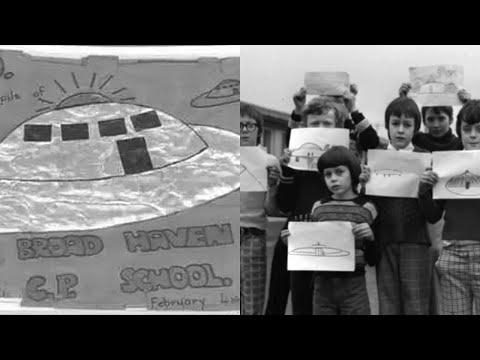
That framing does not survive contact with the school's own contemporary record. David Clarke, the Sheffield Hallam University academic historian who has served since 2008 as external advisor to the National Archives on the release of Ministry of Defence UFO files — and who was one of the millions of British ten-year-olds who saw the original 1977 television coverage of Broad Haven himself — later obtained and read Llewellyn's own school diary and scrapbook directly. What he found was that the children were not interviewed, and did not produce their drawings, on the day of the sighting itself, or even the following school day. The sighting took place on a Friday. Llewellyn separated the children and had them write accounts and produce drawings under what he described as "exam conditions" only the following Monday, February 7 — a full three days later, with an entire weekend intervening, during which the children had unrestricted opportunity to discuss what they had seen with one another, with siblings, with parents, and with anyone else in the small village who had by then heard the story.
This single fact does not, on its own, prove the sighting was fabricated, exaggerated, or contaminated by later discussion — children who had genuinely witnessed the same real event would also produce broadly similar accounts after a weekend of talking about it. What it does do, decisively, is remove the specific evidentiary weight that made Broad Haven's drawings famous in the first place: they were never independent corroboration in the sense the case's own legend claims, because the conditions that would make similarity meaningful — separation from one another before the drawings were made — were never actually in place. Clarke goes further still, noting that several of the drawings bear a notable resemblance to contemporary science-fiction UFO imagery the children would plausibly have encountered on British television in the weeks around the sighting, including Doctor Who and reruns of 1950s productions such as Forbidden Planet — precisely the kind of pre-existing visual template that a weekend of unsupervised discussion, rather than a shared external stimulus, would predict.
Llewellyn's own contemporary assessment, as recorded in his diary and quoted directly by Clarke, was considerably more measured than the case's later popular reputation suggests. After conducting the interviews, the headmaster wrote that, "after allowing for variations and embellishments," he was "loathe to believe that the children are capable of a sustained sophisticated hoax," and that he accepted "that they did see something they hadn't seen before" — while explicitly stating that he himself was "seeking a natural explanation of the incident" and was "prepared to keep an open mind on the subject." That is a headmaster's cautious, non-committal professional judgment about the sincerity of frightened children, not an endorsement of an anomalous craft, and it stands in some tension with the far more assertive language later journalism and documentary coverage frequently attributed to him.
Llewellyn's Investigation and the School Scrapbook
Whatever its limitations as scientific evidence, Llewellyn's Monday investigation was conducted with genuine care by the standards of a rural primary school headmaster with no ufological training. He separated the children, avoided leading questions as best he could, and had each child produce both a written account and a drawing, which he compiled into a school scrapbook alongside his own log entries. Copies of the children's accounts and drawings were passed to Dyfed-Powys Police, who in turn forwarded them to Air Traffic Control at Preston and, from there, into the Ministry of Defence's UFO desk within its Secretariat (Air Staff) branch, generating the paper trail that would eventually surface in the DEFE 24 file series at the National Archives decades later. It is this documentary chain — a headmaster's diary, a school scrapbook, a police report, and a surviving MoD file — rather than any surviving photograph or physical trace, that constitutes the actual primary-source record of the Broad Haven sighting, and it is precisely this chain that later researchers, above all Clarke, were able to trace and re-examine with the benefit of archival access the original 1977 press coverage never had.
Media Explosion: From Newsround to Fleet Street
The story reached a national audience with unusual speed for a rural Welsh primary school incident, first via the BBC's children's news programme Newsround, whose youth-oriented format made it a natural early home for a story centered on child witnesses, and then rapidly through the national tabloid and broadsheet press. Several of the children were interviewed live on camera at the school itself, a level of direct, sympathetic broadcast access rarely afforded to UFO witnesses of any age before or since, and one that gave the sighting an immediacy and apparent sincerity that print coverage alone could not have conveyed. Randall Jones Pugh, the local BUFORA investigator who had been contacted the same afternoon as the sighting, played an active and, by his own later account in The Dyfed Enigma, deliberate role in bringing the case to national and eventually international media attention, fielding press inquiries and helping connect journalists with witnesses and school staff. The resulting coverage, arriving as it did in the same calendar year as the still-building anticipation around Close Encounters of the Third Kind, helped cement Broad Haven's status as one of the defining British UFO stories of the decade, and set the template — group of child witnesses, consistent drawings, national television coverage — that the case's own retellings have relied on ever since.
The Ministry of Defence File
The Ministry of Defence's engagement with Broad Haven is documented across three surviving files in the DEFE 24 series at the National Archives, Kew: DEFE 24/978 ("UFO reports: edited copies," April–September 1977), DEFE 24/1206 ("UFO reports and correspondence: April–October 1977"), and DEFE 24/1205 ("UFO reports and correspondence: October–December 1977"), all originally closed to the public until 2005 and released as part of the National Archives' broader UFO files project, on which David Clarke served as external academic advisor from 2008. The department's engagement was cautious and low-key rather than alarmed: the school sighting itself generated a report forwarded through police and civil air traffic channels rather than a direct military response, and internal MoD assessment consistently found no evidence of a threat to national security or of any airspace incursion requiring an operational response. As the wider Pembrokeshire wave intensified over the following months, the department's Secretariat (Air Staff) branch, designated S4(Air), formally requested that the RAF Police carry out what internal correspondence described as a "discreet enquiry" into the area, dated June 14, 1977 — a request that itself confirms official concern had shifted from any specific security threat toward understanding the wave's mundane origins. The RAF Police assessment that followed treated the possibility that "a local prankster was at work" as a genuinely plausible explanation, specifically noting that the humanoid figure's described "silverish suit" closely matched the type of protective fire-resistant clothing issued at the nearby Milford Haven oil refineries in the event of a plant fire — a mundane, locally available garment that would explain a suited figure walking rural fields at dusk far more economically than any exotic hypothesis. No fuller RAF Police report is known to have survived in the declassified file; the department's ultimate position, consistent across the surviving correspondence, was that the events did not warrant further formal investigation once the immediate security question had been resolved.
The 25-Foot Fuel Tank
One curious and never fully explained footnote from the period, noted in several secondary accounts of the case, is the arrival of a roughly 25-foot military-style fuel tank, delivered to the school playground some two months after the sighting under circumstances that were never clearly documented or attributed to any specific agency or purpose. No official record has surfaced explaining who ordered its delivery or why; it is mentioned here as a genuine documented oddity of the case's aftermath rather than as evidence of anything in particular.
The Silver Suit: Glyn Edwards's 1996 Confession
Nearly two decades after the sighting, in 1996, local businessman Glyn Edwards came forward in a local newspaper interview to state, in his own words, that he had worn a silver-lined protective suit and walked around the Broad Haven area during 1977, describing his motive simply as taking "a stroll around for a bit of fun." Edwards's confession is one of the few pieces of this case in which a specific, named, identifiable individual has taken direct personal responsibility for at least part of what witnesses across the wider wave reported seeing, and it aligns closely with the RAF Police's own contemporary "local prankster" assessment and with the specific "oil refinery fire suit" explanation floated by RAF officers at the time. It is, for that reason, treated seriously in this file's Conventional Explanation Candidate analysis below.
It is equally important, however, to be precise about what Edwards's confession does and does not explain. Even confronted directly with his account, the school's own child witnesses — including David Davies, who has spoken publicly about the case at multiple points including its 40th anniversary in 2017 — have maintained that what they saw involved an object, not merely a figure in a field, and Davies has been explicit in later interviews that he never personally claimed the craft was of extraterrestrial origin, describing it instead simply as "an unexplained and strange aircraft." Edwards's account, taken at face value, plausibly explains a suited figure seen walking rural Pembrokeshire fields at various points during 1977 — a detail reported not only at the school but at several of the later Ripperston Farm-area sightings that year — but it does not, by itself, account for the silver, domed, cigar-shaped object the children described at the school specifically, nor for the light reported atop it. The confession resolves one thread of the wider Pembrokeshire wave without resolving the school sighting's central visual claim.
Beyond the Playground: The Broad Haven Triangle Widens
The school sighting's true legacy lies as much in what it set in motion as in the event itself. Over the months that followed, a loose, informally networked series of further reports accumulated across a roughly ten-mile radius of the Pembrokeshire coast, drawing the attention of the same two local investigators, Randall Jones Pugh and naturalist-author F.W. Holiday, who would go on to co-author the case's first book-length treatment, The Dyfed Enigma, in 1979. The most extensively documented of these later reports centered on Ripperston Farm, an isolated coastal smallholding near St Ishmaels occupied by the Coombs family, beginning in April 1977: a bright hovering light observed by Pauline Coombs; a seven-foot silver-suited, featureless-faced figure reportedly seen at a farmhouse window on April 23 or 24; repeated claims of cattle relocated between fields under circumstances the family could not explain; and persistent, never independently verified reports of television and vehicle electrical failures around the property. Neighboring witnesses added their own accounts across the same period, including hotel owner Rose Granville's report of large, long-limbed figures near the Haven Fort Hotel in Little Haven, and a scattering of further sightings reported by residents across Milford Haven, Herbrandston, and the surrounding parish villages.
It was this accumulation of reports, rather than the school sighting in isolation, that generated the tabloid "Broad Haven Triangle" and "Dyfed Triangle" branding and drew RAF Squadron Leader-level attention to the area, including one officer's direct suggestion to Rose Granville that she had likely seen oil-refinery workers in protective suits rather than anything anomalous — an explanation she rejected. This file's scope is the school sighting specifically; the Ripperston Farm reports, the Coombs family's wider experiences, and the dozens of other individual 1977 Pembrokeshire accounts collected by Pugh and Holiday constitute a related but evidentially distinct body of claims, resting on different witnesses, different investigators, and, in several instances, considerably more extraordinary claimed physical effects than anything reported at the school. They are noted here for the historical and geographic context essential to understanding why Broad Haven became a "Triangle" rather than remaining a single, contained schoolyard report, not as corroboration of the school sighting's own specific details.
Circumstantial Evidence
Points Favoring a Genuine, Unscripted Group Experience
- Fifteen children independently approached staff with a consistent basic account (an object with a dome and light, in the field behind the school) within minutes of returning from lunch break, before any adult had suggested what they might have seen.
- Headmaster Ralph Llewellyn, a professional educator with direct daily knowledge of the children's characters, explicitly judged them incapable of a "sustained sophisticated hoax" in his own contemporary diary.
- Witnesses including David Davies have maintained a consistent account under sustained public scrutiny, media attention, and reported childhood bullying for nearly fifty years, with no recantation.
- A second, independent sighting from the same school grounds was reported by a teacher and two canteen staff on February 17, thirteen days later.
Points Favoring a Conventional or Contamination-Driven Origin
- The children's drawings — the case's single most celebrated piece of "corroborating" evidence — were demonstrably not produced independently, but three days after the sighting, following an unsupervised weekend during which the children could freely discuss and compare accounts.
- Academic historian David Clarke has noted a visual resemblance between several drawings and contemporary science-fiction UFO imagery airing on British television at the time.
- A specific, named individual (Glyn Edwards) has confessed to wearing a silver protective suit and walking the area during 1977, and RAF Police contemporaneously assessed a local prankster as a plausible explanation for the humanoid-figure element.
- No photograph, film, radar contact, or physical trace evidence exists for the school sighting; the entire record is testimonial.
Key Witnesses
David Davies
One of the most consistently quoted and most publicly identified of the fifteen child witnesses, Davies has described watching a silver, "cigar-shaped" object with "a dome covering the middle third" from behind the playground fence. He has spoken about the sighting on multiple occasions across five decades, including in a BBC Radio Wales interview marking the 40th anniversary in 2017 and in a dedicated 2018 episode of the American paranormal-history podcast Astonishing Legends, describing being bullied at school over his account in the years that followed and stating that no proposed explanation, including Glyn Edwards's 1996 confession, has ever matched what he personally witnessed. Davies has been explicit that he never personally claimed the object was of extraterrestrial origin, describing it instead as "an unexplained and strange aircraft."
Ralph Llewellyn
The school's headmaster in 1977, Llewellyn did not personally witness the object but conducted the case's central piece of documentary evidence: separating the children on the Monday following the sighting, taking individual written and drawn accounts, and recording his own contemporaneous, carefully hedged assessment in the school diary later examined directly by David Clarke. His recorded judgment — that he did not believe the children capable of a sustained, sophisticated hoax, while explicitly keeping an open mind toward a natural explanation — is considerably more cautious than the more dramatic language later popular retellings of the case have sometimes attributed to him.
Randall Jones Pugh
A retired Haverfordwest veterinary surgeon and the local coordinator for the British UFO Research Association, Pugh was contacted by a parent connected to the sighting on the very afternoon of February 4, 1977, and drove out to interview witnesses and inspect the field that same evening. He went on to play the single most active investigative and press-liaison role in bringing both the school sighting and the wider Pembrokeshire wave to national attention, and later co-authored the case's first book-length account, The Dyfed Enigma (1979), with naturalist-author F.W. Holiday.
Glyn Edwards
A local businessman who, in a 1996 newspaper interview nearly twenty years after the events, admitted to having worn a silver-lined protective suit and walked around the Broad Haven area during 1977 as a prank. His account offers a specific, named, first-person source for at least part of the "silver man" element reported across the wider 1977 Pembrokeshire wave, though it does not, on its own, account for the object the school's child witnesses described.
The Five Observables Assessment
The Five Observables framework is applied to the performance characteristics reported in this case:
Assessment: The Broad Haven school sighting registers no confirmed anomalous performance characteristic under this framework. Every observable rated above rests entirely on the unaided visual recollection of children aged nine to eleven, gathered three days after the event with no instrumented corroboration of any kind — a fundamentally different evidentiary basis than cases in this catalogue supported by radar returns, gun-camera footage, or trained-pilot cockpit instrumentation. The absence of any claimed hypersonic movement or trans-medium transition is itself notable: the children's account, taken at face value, describes a relatively modest, low-key event (an object at rest in a field, observed briefly at a distance) rather than the dramatic high-performance maneuvering more commonly associated with the strongest UAP cases.
Evidence Assessment
Supporting Anomalous Origin
- Fifteen children reported a broadly consistent core account (a silver, domed object with a light, at rest in the field) within minutes of the event, before adults had any opportunity to shape the narrative.
- Headmaster Ralph Llewellyn, a professional educator who knew the children personally, explicitly judged them incapable of a "sustained sophisticated hoax" in his own contemporary diary.
- A second, independent sighting was reported from the same school grounds by a teacher and two canteen staff on February 17, thirteen days after the original event.
- Central witnesses, above all David Davies, have maintained a consistent account under sustained public scrutiny and reported childhood bullying for nearly fifty years without recanting.
- No individual has ever confessed to fabricating the object itself, as distinct from the confessed humanoid-figure prank.
Supporting Conventional Explanation
- The children's drawings — the case's most celebrated evidence — were produced three days after the sighting, following an unsupervised weekend, not independently as the case's popular retellings routinely claim.
- Academic historian David Clarke has identified visual similarities between several drawings and contemporary science-fiction television imagery.
- Glyn Edwards's 1996 confession to wearing a silver protective suit in the area, combined with the RAF's own contemporary "oil-refinery fire suit" theory, offers a specific, named, plausible mundane source for at least the humanoid-figure element of the wider wave.
- No photograph, film, radar contact, or physical trace evidence exists for the school sighting; the entire record is testimonial.
Why "Disputed"
Broad Haven earns a DISPUTED classification, and a comparatively low numerical score within that tier, because the specific piece of evidence that made the case famous does not withstand scrutiny of its own underlying chronology, while the sighting itself remains genuinely unexplained rather than definitively debunked. On the side that keeps the case from collapsing entirely into "explained": fifteen children gave broadly consistent basic accounts within minutes of the event, before any adult had a chance to suggest a narrative to them; a professional headmaster who knew the children well judged them incapable of a coordinated hoax; a second, independent sighting was reported from the same school grounds by adult staff thirteen days later; and the central witnesses, above all David Davies, have maintained their accounts under decades of public scrutiny, media exposure, and even reported bullying, without ever recanting or profiting meaningfully from continued attention. No individual has ever come forward to claim responsibility for the object itself, as opposed to the humanoid figure. On the side that keeps the case well short of "credible": the drawings that generations of retellings have cited as the case's proof of independent corroboration were, per the school's own contemporary diary as examined directly by academic historian David Clarke, produced three days after the sighting following an unsupervised weekend of exactly the kind of discussion that would be expected to produce convergent, non-independent accounts — this is not a matter of interpretation but a documented fact about the case's own timeline that the popular version of the story consistently omits. A specific named individual has confessed to wearing a silver protective suit in the area that year, matching the RAF's own contemporary and entirely mundane "oil-refinery fire suit" explanation for the humanoid element. Clarke has additionally identified a plausible cultural-contamination pathway through contemporary science-fiction television. And no instrumented, photographic, or physical evidence of any kind exists. That combination — a real, sincerely reported group event whose single most celebrated piece of supporting evidence turns out to rest on a false premise about its own production, alongside a partial but not total conventional explanation — is the textbook profile of a genuinely disputed case, not a hoax and not a confirmed anomaly, but a claim that the available record can neither responsibly endorse nor fully explain away.
Sensor & Instrumentation Detection Profile
No radar, camera, magnetometer, or any other instrument recorded the Broad Haven sighting. The nearest military radar facility of note, RAF Brawdy, roughly ten miles to the north, has no declassified record of a contact correlated with the school sighting's time or location. The entire evidentiary record for the school event consists of human testimony — verbal accounts given to the headmaster and, three days later, drawings made in a classroom — with no instrumented corroboration of any kind.
Environmental & Geospatial Context
Broad Haven Primary School sits in the village of Broad Haven, on the southeastern shore of St Bride's Bay in Pembrokeshire, southwest Wales — a stretch of coast bounded by the Pembrokeshire Coast National Park and, at the time, ringed by a genuine concentration of defense infrastructure: RAF Brawdy's NATO-linked airfield and signals facility to the north, the Milford Haven oil-refining complex across the bay to the south, and restricted danger-area airspace (designated EGD611, encompassing much of St Bride's Bay) used for weapons and range testing. No specific military exercise, aircraft movement, or airspace closure has ever been documented as coinciding with the February 4 sighting. The field in which the object was reported sits immediately adjacent to the school, separated from the playground by a boundary fence and hedgerow, in open, gently sloping coastal farmland typical of the area.
Observer Credibility & Occupational Profile
The primary witnesses were fifteen schoolchildren aged nine to eleven — a witness pool whose youth is itself the central credibility question in this case, cutting in both directions. Child witnesses are frequently praised by investigators (including headmaster Ralph Llewellyn himself) as unlikely to sustain a coordinated hoax and as unfiltered by adult ufological preconceptions; the same youth, however, makes them considerably more susceptible than adult witnesses to suggestion, peer influence, and the blending of a genuine experience with contemporaneous media imagery — a concern David Clarke, the academic historian who later examined the school's own contemporary diary, raised explicitly. Supporting adult testimony is thin: a single teacher and two canteen staff reported a further sighting from the school grounds on February 17, and headmaster Llewellyn's own investigation notes, while describing the children as sincere, stop well short of endorsing an anomalous interpretation. No professionally trained observer — pilot, police officer, radar operator, or military witness — reported seeing the object itself.
Physical & Material Assays
No physical or trace evidence was ever recovered at the Broad Haven Primary School site: no scorch marks, no compressed or displaced vegetation, no soil anomalies, and no photographs of the object or the field immediately afterward. This stands in explicit contrast to some of the later, separate incidents in the same 1977 Pembrokeshire wave — notably the Ripperston Farm events involving the Coombs family several miles away, where witnesses described scorched ground and disturbed livestock — but those claims belong to a different, later-occurring case and were never independently laboratory-tested either. For the school sighting specifically, the entire evidentiary record is testimonial.
Historical Precedents & Archive Matches
Broad Haven sits within a documented February–March 1977 cluster of British schoolyard and playground UFO reports, including a near-contemporaneous account at Rhosybol School on Anglesey in North Wales twelve days later, part of a wider national uptick in UK sightings that year. It is frequently compared by researchers to two other mass child-witness landing cases in the Omni Ledger's own catalogue: the April 1966 Westall Encounter in Victoria, Australia, and the September 1994 Ariel School Encounter in Ruwa, Zimbabwe — both of which likewise involve a large group of schoolchildren, a low-flying or landed silvery object witnessed during a school break, and (in Ariel's case specifically) drawings gathered by an adult investigator as a central piece of evidence. Within the United Kingdom's own Ministry of Defence archive, Broad Haven is the best-documented entry in the Dyfed/Pembrokeshire file series (DEFE 24/978, DEFE 24/1205, and DEFE 24/1206), the same broad run of files that also covers the January 1974 Berwyn Mountains Incident in North Wales, giving Wales an outsized share of Britain's most-cited 1970s UFO cases relative to its population.
Material Analysis
No physical or trace evidence of any kind was recovered at the Broad Haven Primary School site in connection with the February 4, 1977 sighting. Investigators, including local BUFORA coordinator Randall Jones Pugh, who visited the field the same evening, found nothing beyond ordinary farmland; no scorch marks, compressed or discolored vegetation, soil disturbance, or unexplained debris were documented at the school field at any point, and no photograph of the field taken in the immediate aftermath is known to exist. This absence of physical evidence stands in direct and instructive contrast to some of the later, separate 1977 Pembrokeshire reports several miles away — most notably at Ripperston Farm, where the Coombs family and neighboring witnesses described scorched ground and disturbed livestock — but those claims belong to a different case, rest on different witnesses, and were themselves never subjected to independent laboratory testing. For the school sighting specifically, the absence of any physical corroboration is itself informative: whatever the fifteen children experienced, it left no detectable mark on the physical environment, which is consistent equally with a fleeting, non-material misperception, a psychologically real but externally sourced shared experience, or (on the anomalous-origin reading) an object whose reported behavior — brief, at rest, then departing — would not obviously be expected to leave ground traces in the way a genuine landing-and-liftoff event often does in other cataloged cases.
Supporting Non-Terrestrial Origin
- No mundane object matching the children's specific description (a domed, elongated silver object with a colored light) has been definitively identified by any investigator, official or independent, in nearly fifty years.
- The absence of ground traces is consistent with a brief, low-impact event rather than ruling out an anomalous one.
Supporting Terrestrial Origin
- The complete absence of any physical trace, in a field that was inspected the same evening, is precisely what would be expected if no physical craft had ever actually been present.
- No forensic test of any kind was ever performed, because no physical sample was ever collected — the "no evidence of tampering" standard some retellings apply to this case is simply the absence of any evidence to examine in the first place.
The Conventional Explanation Candidate: Prankster in a Protective Suit
The single most specific and best-corroborated conventional explanation available for any part of the Broad Haven case is that at least the humanoid-figure element of the wider 1977 Pembrokeshire wave, and possibly some part of the school sighting itself, originated with a local individual wearing protective clothing as a prank. This is not merely a generic skeptical hypothesis: it is directly supported by two independent lines of contemporary and later evidence. First, the Ministry of Defence's own June 1977 "discreet enquiry," conducted by RAF Police, explicitly identified a local prankster as a plausible source, and specifically noted that the described "silverish suit" closely matched fire-resistant protective clothing genuinely issued at the nearby Milford Haven oil refineries for use in the event of a plant fire — a mundane garment plausibly available to local residents and immediately recognizable to anyone familiar with the refineries' safety equipment. Second, and independently, local businessman Glyn Edwards came forward by name in 1996 to confirm he had done exactly this: worn a silver-lined suit and walked the area during 1977 purely for amusement. Two separate sources, nineteen years apart and with no evident coordination, converge on the same specific mundane explanation for the same specific detail.
Non-Independent, Post-Hoc Drawings and Contamination
A second, distinct conventional-explanation strand concerns not the original sighting but the specific evidence that made it famous. David Clarke's direct examination of Broad Haven Primary School's own 1977 diary established that the children's celebrated drawings were produced three days after the sighting, following an unsupervised weekend, and Clarke has further noted stylistic similarities between several drawings and contemporary science-fiction television imagery airing in Britain at the time. This candidate does not require that the original playground sighting itself was fabricated; it requires only that whatever the children individually or collectively perceived in the field was subsequently shaped, embellished, and made more visually consistent through several days of unsupervised peer discussion before it was ever formally documented — which would fully explain the "remarkably similar drawings" detail without requiring any of the children to have lied about experiencing something.
Misidentified Mundane Object
A third, weaker candidate holds that the object itself, independent of the suited figure, was a misidentified mundane object — agricultural machinery, a weather balloon, or reflective material caught by low winter sunlight in the field's hedgerow-obscured sightline. No specific mundane object has ever been definitively matched to the children's description, and this candidate remains, on the available record, considerably weaker and more speculative than the prankster explanation for the humanoid figure.
Prankster in a Protective Suit
PlausibleDirectly corroborated by two independent sources — the RAF's 1977 assessment and Glyn Edwards's 1996 confession — but explains only the humanoid-figure element, not the object itself.
Non-Independent, Contamination-Shaped Drawings
PlausibleEstablished as documented fact by David Clarke's direct examination of the school's own 1977 diary; fully accounts for the drawings' fame-making similarity without requiring the underlying sighting to be false.
Misidentified Mundane Object
InconclusiveNo specific mundane object has ever been matched to the children's description of the craft itself; remains speculative rather than evidenced.
Genuine Unexplained Aerial Phenomenon
InconclusiveThe object element of the sighting has never been conclusively explained by any candidate above; nearly fifty years on, it remains genuinely unresolved rather than debunked.
Related Cases
Confirmed Documents & Official Records
The core Ministry of Defence Secretariat (Air Staff) file covering the height of the Pembrokeshire/Broad Haven wave, closed until 2005 and now held in the public catalogue at Kew.
The continuation file covering the closing months of the 1977 Pembrokeshire wave's official correspondence.
Edited/redacted copies of UFO reports from the same period, part of the same Defence Secretariat Branches series.
Further Reading — Recommended Literature
The Dyfed Enigma: Unidentified Objects in West Wales
The original book-length account of the Broad Haven school sighting and the wider Pembrokeshire wave, written by the local BUFORA investigator who interviewed witnesses within hours of the events and his naturalist-author collaborator.
The Welsh Triangle
The second contemporary book on the case, more sensationalized than Pugh and Holiday's account, useful as a record of how quickly the story escalated in the popular press and the more speculative theories it generated.
UFO Drawings from the National Archives
Reproduces and analyzes the Broad Haven children's drawings directly from the Ministry of Defence's own files, with Clarke's detailed discussion of the weekend gap between sighting and drawing that this file's Background section relies on.
How UFOs Conquered the World: The History of a Modern Myth
Places Broad Haven within the broader cultural and media history of UFO belief in Britain, including the 1977 media saturation around science-fiction cinema that this file's Background section discusses.
Out of the Shadows: UFOs, the Establishment and Official Cover Up
The fullest published account of how the Ministry of Defence's UFO desk actually handled cases like Broad Haven internally, drawing on the same DEFE file series cited throughout this case file.
Essential Viewing
Sources
- David Clarke, "Close Encounters of the Playground Kind," drdavidclarke.co.uk, September 13, 2017. drdavidclarke.co.uk
- David Clarke, "Close Encounters of the Playground Kind," Four Corners Books feature. fourcornersbooks.co.uk
- David Clarke, "Did the village see aliens?," Dr David Clarke (Substack). drclarke.substack.com
- The National Archives, Kew, "DEFE 24/1206: UFO reports and correspondence, April–October 1977." nationalarchives.gov.uk
- The National Archives, Kew, "DEFE 24/1205: UFO reports and correspondence, October–December 1977." nationalarchives.gov.uk
- The National Archives, Kew, "DEFE 24/978: UFO reports, edited copies." nationalarchives.gov.uk
- Astonishing Legends, "Episode 115: David Davies – Witness to Broad Haven," August 18, 2018. astonishinglegends.com
- UFO Insight, "The Bizarre And Forgotten Broad Haven School UFO Incident Of 1977." ufoinsight.com
- Cambria Stories, "The Pembrokeshire UFO wave." cambriastories.net
- "The Welsh Bermuda Triangle: UFOs and Extraterrestrial Phenomena in 1970s Pembrokeshire," Wales since 1945, November 25, 2023. walessince1945.wordpress.com
- Hyperallergic, "Declassified Drawings from the British Government's UFO Desk." hyperallergic.com
- Yahoo Entertainment, "Encounters episode 1 recap: The Broad Haven Triangle." yahoo.com
- Wikipedia, "Broad Haven, Pembrokeshire" (used for geography/population orientation only; underlying claims traced to primary sources above where possible). en.wikipedia.org
- The Havens Community Council, "Broad Haven" village profile. thehavenscommunitycouncil.gov.uk
- Wikimedia Commons, "Broad Haven beach - sand and rock," photograph by M J Roscoe, CC BY-SA 2.0 (source of this file's hero image). commons.wikimedia.org
- Randall Jones Pugh & F.W. Holiday, The Dyfed Enigma: Unidentified Objects in West Wales, Faber & Faber, 1979.
- Peter Paget, The Welsh Triangle, Sphere Books, 1979.
- David Clarke, UFO Drawings from the National Archives, Four Corners Books, 2018.
- David Clarke, How UFOs Conquered the World: The History of a Modern Myth, Aurum Press, 2015.
- David Clarke & Andy Roberts, Out of the Shadows: UFOs, the Establishment and Official Cover Up, Piatkus, 2002.
- YouTube (Eyes On Cinema), "School kids on witnessing a landed UFO at their school in Broad Haven, Wales, February 4, 1977." youtube.com
- Netflix, Encounters, Season 1, Episode 1, "The Broad Haven Triangle," Amblin Television, 2023.
- BBC Three, Paranormal, presented by Sian Eleri, 2024 (Pembrokeshire/Broad Haven Triangle investigation).
- Ministry of Defence Secretariat (Air Staff) branch correspondence, S4(Air), RAF Police "discreet enquiry" request, June 14, 1977 (within DEFE 24/1206, cited above).
See something inaccurate? Have additional information or sources?
Suggest an Edit →Last Updated: August 2026