
Campeche Military FLIR Incident
On the evening of March 5, 2004, a Mexican Air Force Merlin C-26A twin-engine patrol aircraft — flying an anti-narcotics radar mission out of Ciudad del Carmen, Campeche, in search of a suspected drug-smuggling flight — had its FLIR (Forward-Looking Infrared) turret and onboard surveillance radar register a cluster of bright, round infrared returns that the three-man crew could not see with the naked eye. Kept internal for more than six weeks, the case became public only after Secretary of National Defense Gen. Clemente Vega García personally briefed television ufologist Jaime Maussan and authorized him — rather than any independent scientific body — to receive the sensor tapes and interview the crew, culminating in an unprecedented May 11–12, 2004 press conference at which Mexico's Secretariat of National Defense (SEDENA) publicly confirmed the recording without endorsing any explanation for it. Physicists from the National Autonomous University of Mexico (UNAM) proposed ball lightning within days; a former commercial pilot, Capt. Alejandro Franz, independently identified a far more specific and ultimately far better corroborated candidate that same year — the continuously burning gas-flare stacks of the Bay of Campeche's Cantarell oil field, roughly 50–100 km from the aircraft's position — and flew his own reconstruction flight that captured near-identical infrared "twin" lights from the same air corridor. This case file's own research, including a later independent replication using NASA satellite fire data and Landsat imagery, finds the oil-platform explanation considerably stronger than either UNAM's ball-lightning hypothesis or the "solid, maneuvering craft" framing Maussan gave the footage at the 2004 press conference — a framing this file treats with the same documented skepticism warranted by Maussan's own subsequent record of promoting hoaxed material, most notably the 2023 "alien mummies" he presented to the Mexican Congress.

Pictured: the Akal-C platform complex in Pemex's Cantarell Field, Bay of Campeche, photographed October 16, 2009 (Wikimedia Commons user BoH; CC BY-SA 3.0). This is not a frame from the actual 2004 FLIR video — no rights-clear image of the original SEDENA footage itself is known to exist — but it shows the specific class of offshore gas-flare installation that independent investigators, from Capt. Alejandro Franz's 2004 reconstruction flight to a later Metabunk satellite-data replication, identified as the most likely source of the recorded infrared returns.
Theoretical Alignment
This case's evidentiary profile leans overwhelmingly toward a mundane, terrestrial reading. Its ETH score sits a few points above the floor rather than at it because the recording platform was a professionally operated military sensor suite — a dedicated FLIR turret and surveillance radar, reviewed at the time by a national defense secretariat that took the unusual step of publicly confirming the tape's authenticity — which is a genuinely more credible collection method than an anonymous civilian video. That modest credit is almost entirely offset, however, by the specificity and convergence of the conventional explanation: a former airline pilot with direct regional flying experience matched the footage to a known, mapped, continuously operating class of infrastructure within the same calendar year, and later satellite-fire and geolocation data reproduced that match independently. The Psycho-Social/Mundane framework additionally captures something beyond the optical explanation itself — the case's disclosure history, in which Mexico's defense ministry handed unanalyzed sensor data directly to a television personality with a long subsequent record of promoting hoaxed material, rather than to any credentialed scientific body, shaping how the story reached the public far more than the underlying sensor data can support.
Background
By 2004, Mexico's Secretariat of National Defense (Secretaría de la Defensa Nacional, or SEDENA) operated a fleet of Fairchild/Swearingen Merlin-derivative twin-turboprop aircraft, designated within Mexican service as the C-26A, fitted for maritime and border surveillance with a stabilized FLIR turret (a Star SAFIRE II, manufactured by FLIR Systems of Portland, Oregon) and a dedicated surveillance radar (the AN/APS-143(V)3, marketed under the name "Bravo Victor 3"). These aircraft, assigned to the Mexican Air Force's 501st Air Squadron and based at Ciudad del Carmen on the Gulf coast of Campeche state, flew routine anti-narcotics patrols over the Yucatán Peninsula and the Bay of Campeche — airspace that, since the mid-1990s, had become a significant transit corridor for cocaine shipments moving north from South America toward the United States, making radar-equipped aerial patrol a standing, unremarkable mission profile for the squadron.
The Bay of Campeche is also home to the Cantarell Field, discovered in 1976 and, through the 1980s and 2000s, one of the largest offshore oil fields in the world, operated by the state petroleum company Petróleos Mexicanos (Pemex). The field's Akal, Nohoch, Chac, and Kutz complexes together host dozens of production platforms, the largest of which — the Akal-C complex alone comprises eleven major platforms — continuously burn off associated natural gas that cannot be economically captured, through elevated flare stacks that remain lit around the clock, year-round, regardless of weather or time of day. This is a wholly unremarkable, permanent feature of the regional infrastructure, visible for decades before and after 2004 to anyone flying the Bay of Campeche corridor, and it forms the essential geographic backdrop against which the March 2004 patrol's sensor returns must be assessed.
On the evening of March 5, 2004, Maj. Magdaleno Castañón Muñoz commanded a Merlin C-26A on precisely this kind of routine mission: searching, via radar, for an aircraft suspected of running narcotics through the corridor. Radar operator Lt. Germán Marín Ramírez and FLIR operator Lt. Mario Adrián Vázquez Téllez staffed the aircraft's two principal sensor stations. During the patrol, Marín began registering intermittent, unexplained radar contacts, and Vázquez, training the FLIR turret in response, recorded a cluster of bright, round, featureless infrared shapes — a sequence of imagery that, unlike almost every other case in this catalogue, was captured entirely by instruments and reviewed by trained sensor operators rather than reported first as a naked-eye sighting.
Complete Timeline
| Date | Event |
|---|---|
| 1976 | Pemex discovers the Cantarell Field in the Bay of Campeche; by the 2000s its Akal, Nohoch, Chac, and Kutz platform complexes are continuously flaring off associated gas around the clock. |
| Mar. 5, 2004, ∼5:00–5:30 p.m. | A Mexican Air Force Merlin C-26A of the 501st Air Squadron, on an anti-narcotics radar patrol out of Ciudad del Carmen, records intermittent unidentified radar contacts and eleven bright infrared FLIR returns; none of the three crew members sees anything with the naked eye. |
| Apr. 20, 2004 | Secretary of National Defense Gen. Clemente Vega García summons ufologist Jaime Maussan for a private meeting and informs him of the case. |
| Apr. 22, 2004 | Vega García authorizes Maussan to receive copies of the FLIR and radar recordings and to make the case public without censorship — bypassing any independent scientific review. |
| May 1, 2004 | Maussan conducts videotaped interviews with the three crew members at SEDENA headquarters. |
| May 11–12, 2004 | SEDENA holds an unprecedented press conference at Mexico City's Hotel Sevilla Palace, with international media present, publicly confirming the recording's authenticity without endorsing any specific explanation for it. |
| May 12, 2004 | Scientists from UNAM's Institute of Astronomy and Institute of Nuclear Sciences hold a separate press conference proposing that the phenomena were most likely "centellas" (ball lightning), explicitly denying any evidence of extraterrestrial involvement. |
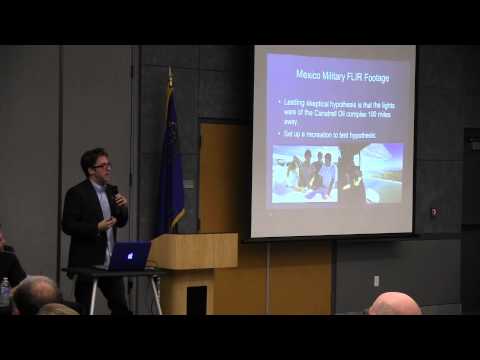
| 2004 (mid-year) | Independent investigator Capt. Alejandro Franz, a former commercial pilot with extensive experience flying the Bay of Campeche corridor, proposes that the FLIR recorded Cantarell Field oil-platform gas flares rather than unidentified craft. |
| Sept. 2004 | Franz personally flies a reconstruction flight along an approximate version of the original patrol's heading and independently captures near-identical infrared "twin" lights from different angles and altitudes, later corroborated by other pilots. |
| Sept./Oct. 2004 | Skeptical Inquirer publishes Robert Sheaffer's analysis, citing electro-optics expert John Lester Miller's conclusion that the images "have a lot to do with oil well fires and nothing to do with extraordinary craft," alongside satellite and 3-D modeling evidence assembled by James C. Smith. |
| Summer 2004 | Skeptic magazine (Vol. 11, No. 2) publishes James C. Smith's "Mexican Air Force UFO Affair: Aliens, Ball Lightning, or Flares?," surveying all three explanatory camps; publisher Michael Shermer separately criticizes crew accounts he says "varied wildly... like a fisherman's tale, growing with each retelling." |
| 2012 | National Geographic's Chasing UFOs revisits the case; aerospace consultant Ben McGee predicts on camera that one of the FLIR's paired lights would visibly split into two as the aircraft's viewing angle changed — consistent with two adjacent, fixed platform flares — and the prediction is confirmed in the footage. |
| 2010s | Metabunk contributors, led by Mick West, independently re-derive the oil-platform explanation using Google Earth geolocation, NASA FIRMS active-fire satellite data for March 5, 2004, and Landsat 7 imagery from two days later, all confirming active flaring in the Cantarell field along the FLIR's indicated bearing. |
| 2020s | Mexican transparency (INAI/Plataforma Nacional de Transparencia) requests find that SEDENA holds no written record of how the tapes were transferred to Maussan, and that the Mexican Air Force can no longer locate copies of the original recordings. |
| 2026 | This case file is published, correcting the "Coming Soon" queue's uncritical "11 unidentified infrared objects" framing with the independently corroborated oil-platform-flare explanation and Maussan's documented credibility record. |
What the Sensors Actually Recorded
The surviving primary evidence for this case is, in a sense often obscured by three decades of retelling, quite narrow: a single FLIR video and a separate radar log, both captured aboard one aircraft during one uninterrupted patrol, and both released to the public only as edited excerpts rather than in full, unredacted form. On the FLIR display, Vázquez recorded a cluster of bright, round, entirely featureless heat sources — he would later tell reporters, "They were spherical all the time," adding, "We never found any irregular shape." Different retellings of the case cite different totals for how many discrete objects appear across the footage: the original 2004 press materials and the AP wire coverage that reached most English-language outlets cite eleven, the number this case file's own metadata and the site's original "Coming Soon" placeholder both use; several later Spanish-language retrospectives instead cite sixteen. Neither figure is fully reconciled with the radar side of the recording: on the audio track accompanying the released tape, Marín can be heard counting only as high as eight distinct returns at one point while relaying contacts to Castañón. This three-way mismatch between the FLIR count, the higher retrospective count, and the radar operator's own live count is not a minor footnote — it is direct evidence, from the crew's own recorded voices, that even the immediate participants were not tracking a single, stable, agreed-upon number of discrete targets in real time.
Radar returns were reported as intermittent rather than continuous, appearing and disappearing, with reported speed fluctuations cited in secondary accounts as ranging between roughly 60 and 300 knots and abrupt apparent heading changes. Crucially, and unlike most instrumented UAP cases in this catalogue, the FLIR and radar data were never shown, in either the original press materials or any subsequent technical analysis this case file located, to be correlated with each other at the level of matching azimuth, range, and timing for a specific tracked target — a distinction addressed at length in the Sensor & Instrumentation Detection Profile section below, and one that is central to why the "radar confirms maneuvering objects" framing repeated in popular retellings does not hold up to the same scrutiny as the raw FLIR imagery itself. At closest approach, secondary accounts describe the returns coming within roughly two nautical miles of the aircraft. Despite that reported proximity, at an altitude of approximately 3,500 meters (11,480–11,500 feet) in early-evening daylight, none of the three crew members reported seeing anything with the naked eye — an observation this case file treats as a significant, if underdiscussed, piece of evidence in its own right, since a genuinely nearby solid object at that range and altitude, in adequate ambient light, would ordinarily be expected to be visible to at least one of three trained aircrew looking for it.
From a Private Briefing to an Unprecedented Press Conference
The case remained entirely internal to SEDENA for more than six weeks. It became public only through a specific, personal decision: on April 20, 2004, Secretary of National Defense Gen. Clemente Vega García summoned television ufologist Jaime Maussan — then Mexico's best-known UFO investigator, host of the long-running program Tercer Milenio — for a private meeting and informed him of the incident. Two days later, on April 22, Vega García authorized Maussan to receive copies of the FLIR and radar recordings outright and granted him permission to make the case public "without censorship." On May 1, Maussan personally conducted videotaped interviews with all three crew members inside SEDENA's own headquarters, material he would go on to broadcast. The arrangement culminated on May 11–12, 2004, in a press conference held at Mexico City's Hotel Sevilla Palace, with international media in attendance — an extraordinary and, per multiple contemporaneous accounts, unprecedented step for a national military to take: publicly confirming the authenticity of instrumented sensor data depicting an unresolved aerial phenomenon, without itself offering, endorsing, or commissioning any explanation.
When later pressed on why the ministry had routed the case through a television personality rather than an independent scientific body, Vega García's own on-record answer was notably candid about the absence of any real process: he said it was "perhaps because we do not know [scientists] or know who they might be," adding that the underlying data remained available to any interested researcher. This case file finds that explanation difficult to credit at face value — Mexico's national university, UNAM, maintains internationally recognized institutes of astronomy and nuclear science a five-minute phone call could have reached, and in fact did reach the story within days, on its own initiative, once the case became public. The more parsimonious reading, consistent with how Maussan's own subsequent career unfolded, is that SEDENA's leadership found it easier, faster, and more attention-generating to hand the material to a sympathetic television figure already primed to frame it dramatically than to initiate the slower, more skeptical, and less easily controlled process of a genuine scientific referral.
The Scientific Community's Ball-Lightning Hypothesis
Independently of Maussan's own framing, and within roughly the same news cycle as SEDENA's press conference, a separate group of credentialed Mexican scientists weighed in with their own analysis. José de Jesús Franco López, director of UNAM's Institute of Astronomy, and researcher Armando Arellano, joined by Rafael Navarro González and Julio Herrera Velázquez of UNAM's Institute of Nuclear Sciences, held their own press conference stating that the phenomena recorded on video were most likely "centellas," or ball lightning — luminous, short-lived plasma or ionized-gas discharges typically associated with thunderstorm activity, which the UNAM scientists suggested may, in this instance, have occurred unusually high in the atmosphere. Crucially, and in explicit contrast to Maussan's own framing at the same moment, the UNAM scientists categorically denied that the case constituted any evidence of extraterrestrial visitation.
This case file's own assessment treats the UNAM statement as a genuine, good-faith scientific hypothesis from credentialed physicists, offered candidly and without any of the promotional framing Maussan brought to the same footage — a meaningful data point in its own right, since it demonstrates that Mexico's own scientific establishment took the case seriously enough to investigate rather than dismiss it outright, while still reaching a mundane conclusion. At the same time, the ball-lightning hypothesis was offered quickly, in the same 24–48 hour window as SEDENA's own press conference, without the benefit of the kind of case-specific geolocation, bearing, and satellite cross-referencing that later, more targeted analysis would bring to bear. As the following two sections describe, that more specific work — first from a single investigating pilot, later from an independent online research community using satellite data — converged on a different, more precisely fitting explanation than ball lightning: not a rare atmospheric electrical phenomenon, but the entirely mundane, exhaustively documented, and permanently present gas flares of the Bay of Campeche's own oil field.
Alejandro Franz and the Oil-Platform Reconstruction Flight
The single most influential piece of independent investigation into this case came not from a credentialed physicist or a government analyst, but from a pilot with direct, practical knowledge of the exact airspace involved. Capt. Alejandro Franz, a former commercial pilot who had flown extensively over the Bay of Campeche, proposed later in 2004 that the FLIR turret had recorded the flare stacks of the Cantarell Field's Akal-C, Akal-J, and Nohoch-A platform complexes — installations Franz would have recognized from direct professional experience navigating that corridor. His central insight was that a long-zoom infrared sensor, viewed from a moving aircraft at a shallow, near-tangential angle, can make a cluster of genuinely stationary, ground-level (or, in this case, sea-level) heat sources appear to shift position, separate, merge, and even seem to "surround" the viewing platform purely as an artifact of the aircraft's own changing bearing relative to the fixed lights — a form of perspective/parallax compression that requires no actual motion by the objects themselves.
Rather than resting on that theoretical argument alone, Franz did something few skeptical investigators of any UFO case manage: he tested it directly. In September 2004 he flew a reconstruction flight along an approximate version of the original patrol's heading and altitude, and captured his own infrared footage showing lights strikingly similar to the paired "twin" objects visible in the original SEDENA video, recorded from different specific angles and altitudes than the original flight. Other pilots with regional experience subsequently corroborated his general account. Franz published his findings and continued refining the analysis between July 2004 and roughly 2008. This case file's own assessment is that Franz's reconstruction represents an unusually strong form of skeptical evidence within this catalogue generally — not merely an armchair alternative explanation, but an empirical replication attempt using the same class of sensor, over the same specific geography, that produced a visually corroborating result.
The Metabunk Re-Examination: Satellites, Geolocation, and the Cantarell Experiment
Franz's 2004 reconstruction remained, for roughly a decade, a compelling but largely qualitative demonstration. In the 2010s, contributors to the Metabunk forum — the same skeptical analysis community founded by Mick West whose later work this catalogue has credited on cases including the "Mosul Orb" — revisited the case with tools Franz did not have available in 2004. West used Google Earth to pin down a specific candidate filming location and flight geometry consistent with the released footage. A separate contributor, posting under the username Vattic, consulted NASA's Fire Information for Resource Management System (FIRMS), a satellite-derived active-fire and thermal-anomaly database, for March 5, 2004 specifically, and confirmed the presence of real, active heat sources (consistent with gas flaring) in the Cantarell field on that exact date. A Landsat 7 satellite image captured March 7, 2004 — roughly forty-eight hours after the sighting — independently showed the same flares still actively burning near the inferred flight path. Forum contributors went on to produce a demonstration they called the "Cantarell Experiment," filming the region's oil-platform flares through paired infrared and visible-light cameras from a comparable flight geometry, reproducing a close visual match to the original 2004 footage's apparent motion and appearance.
This case file's own assessment is that this later, satellite-data-driven re-examination is the single strongest piece of evidence in the entire case, for a reason that distinguishes it from most conventional-explanation candidates in this catalogue: it does not merely propose a plausible category of mundane object, the way a generic "probably a balloon" hypothesis does elsewhere in this site's coverage of modern military sensor cases. It independently confirms, from an entirely different data source (U.S. government satellite thermal-anomaly data, not Mexican military or oil-industry records) that real, active fire sources existed at the correct location on the exact date in question — a level of date-and-location-specific confirmation this catalogue rarely has the opportunity to cite for any conventional explanation, anomalous or otherwise.
The Radar Discrepancy and the Yturria Objection
The oil-platform explanation is not without its defenders on the other side of the argument. Santiago Yturria, a proponent of the case's anomalous interpretation, argued publicly that the Merlin C-26A's own radar detected objects that were moving, changing direction, and varying speed — behavior, he contended, that a stationary oil-platform flare, invisible to radar as a purely thermal (non-metallic, non-reflective) light source, could not possibly produce. This is, on its face, a reasonable objection: a gas flare genuinely should not generate a radar return at all.
Skeptical analysts, including those cited in Robert Sheaffer's Skeptical Inquirer coverage, responded that Yturria's argument rests on an unproven premise: that the radar contacts and the FLIR-recorded lights were actually the same targets in the first place. No technical analysis available to this case file — including the original 2004 press materials — demonstrates that the radar's intermittent contacts and the FLIR's eleven infrared returns were correlated with each other in azimuth, range, and time in the way a genuine single-target track would require; skeptical analysts specifically noted that as time passed, the azimuth readings associated with the radar contacts moved toward the rear of the aircraft, a pattern more consistent with the aircraft's own continued forward motion past a fixed group of ground/sea-level radar-reflective features (which could include the platforms' own metal superstructures, unrelated marine vessel traffic, or ordinary radar clutter and multipath at long range over water) than with a single tracked object actively maneuvering near the aircraft. Under this reading, Yturria's objection does not actually rebut the flare hypothesis; it instead identifies a genuine, separate radar phenomenon that proponents and skeptics alike have tended to conflate with the FLIR imagery as if the two data streams necessarily depicted the same objects, when the available evidence does not establish that they did.
Jaime Maussan's Role and the Broader Credibility Problem
Jaime Maussan's involvement is inseparable from how this case reached, and has continued to be understood by, the public. It was Maussan, not SEDENA, who characterized the footage as evidence of a landmark government-endorsed UFO encounter; it was Maussan who conducted the crew's on-record interviews before any independent technical analysis existed; and it was Maussan whom Gen. Vega García personally selected as the recipient of unanalyzed military sensor data, over any credentialed scientific institution. Per SEDENA's own later admission in response to a Mexican government transparency request, "no written information is available regarding the delivery of the video, since it was provided personally to Jaime Maussan Flota" — meaning the case's entire chain of custody, from military sensor to public broadcast, rests on an undocumented personal handoff rather than any formal, auditable release process.
This case file treats Maussan's specific framing of the Campeche footage with the same explicit skepticism this catalogue applies to his role in the 1991 Mexico City Eclipse UFO Wave, and for the same underlying reason: Maussan's track record independently of this case includes multiple instances of promoting material later shown to be fabricated, including the 2015 "Roswell Slides" (identified via de-blurring as a 19th-century Mesa Verde mummy display placard), a 2015 "Metepec creature" (identified by UNAM as a shaved monkey), a 2016 "demon fairy" (constructed from bat remains, wood, and epoxy), and — most consequentially for his broader public credibility — the September 2023 presentation to the Mexican Congress of alleged "non-human" bodies, which UNAM publicly denied having authenticated and which independent anatomical review concluded were fabricated. None of this retroactively proves the Campeche crew's sensor data was faked; the FLIR and radar recordings appear to be genuine military sensor products, and this case file finds no evidence Maussan altered the underlying footage. What his broader record does responsibly warrant is treating his own interpretive framing of that footage — "proof" of anomalous craft, rather than an unresolved instrument recording later matched to known infrastructure — as promotional commentary from a demonstrated serial promoter of hoaxes, not as neutral or authoritative expert analysis, regardless of how central his role in disclosing the case was.
The Vanishing Videotapes: What Mexico's Transparency Law Reveals
A final, and in some ways the most quietly damning, piece of this case's history emerged only in the 2020s, through Mexico's own freedom-of-information apparatus. Requests filed via the Plataforma Nacional de Transparencia — the national transparency portal administered under Mexico's access-to-information law — found that SEDENA holds no documentary record of how or when the original recordings were transferred out of military custody to Maussan, confirming in an official government context what had previously been anecdotal. Separately, per more recent reporting building on similar transparency requests, the Mexican Air Force has indicated it can no longer locate or produce copies of the original 2004 recordings at all. This case file treats that development as a serious, independently newsworthy problem in its own right, structurally similar to the FOIA-denial and lost-custody issues this catalogue has documented in other modern military-sensor cases such as the "Mosul Orb": whatever the footage actually depicted, the loss (or unwillingness to produce) the master recordings forecloses any future, more rigorous forensic re-analysis of the original data, leaving this case file, like every other researcher, dependent on the same limited, previously broadcast excerpts that have circulated since 2004.
Key Witnesses
Maj. Magdaleno Castañón Muñoz
Piloted and commanded the Merlin C-26A during the March 5, 2004 patrol. Told reporters at the May 2004 press conference, "I believe they could feel we were pursuing them," noting that the returns disappeared once the crew ceased their pursuit — a striking anthropomorphizing claim this case file treats as an understandable but unverifiable inference from intermittent sensor data, not an independently confirmed behavioral observation.
Lt. Germán Marín Ramírez
Operated the AN/APS-143(V)3 surveillance radar and can be heard on the released audio counting as many as eight distinct contacts at one point — a figure that matches neither the eleven objects visible on FLIR nor the sixteen cited in some retrospectives. Told reporters, "Was I afraid? Yes. A little afraid because we were facing something that had never happened before."
Lt. Mario Adrián Vázquez Téllez
Operated the Star SAFIRE II turret and recorded the eleven round infrared returns central to this case, describing them as consistently spherical with no irregular shape. Told reporters, "I couldn't say what it was ... but I think they're completely real" — a statement this case file reads as an honest, if inconclusive, account of what his sensor displayed, rather than as a technical judgment about the returns' ultimate origin.
Gen. Clemente Vega García
Authorized the unprecedented public confirmation of the case and personally selected Jaime Maussan, rather than any scientific institution, to receive the sensor recordings — a decision this case file's own research finds difficult to justify on Vega García's own stated rationale, given UNAM's readily available and, in the event, independently engaged scientific expertise.
Capt. Alejandro Franz
Proposed and empirically tested the oil-platform-flare explanation in 2004, flying his own reconstruction flight that captured near-identical infrared "twin" lights along the same general corridor — the earliest and, in this case file's assessment, most methodologically significant independent skeptical work on the case.
Mick West & Metabunk Contributors
Led a 2010s re-examination using Google Earth geolocation, NASA FIRMS satellite fire data for the exact sighting date, and Landsat 7 imagery, independently confirming active oil-platform flaring at the relevant location and date and reproducing a close visual match to the original footage via their own "Cantarell Experiment."
The Five Observables Assessment
Assessment: Four of the Five Observables rate flatly Absent, and the fifth — Instant Acceleration — is rated Speculative rather than Present specifically because the underlying claim (radar-reported speed changes between roughly 60 and 300 knots and abrupt heading shifts) was never shown to be correlated with the same discrete target the FLIR was simultaneously recording; this case file treats that claim as a genuine feature of the original radar log that nonetheless lacks the target-correlation evidence needed to attribute it confidently to any single tracked object, let alone the specific spherical returns visible on FLIR. No anti-gravity hovering behavior distinct from a fixed light source's apparent stillness was ever reported by any crew member. No hypersonic speed was claimed by anyone examining the case, official or independent. The objects' complete invisibility to the naked eye at reported close range is, if anything, the opposite of a low-observability signature in the technical sense this framework measures — it far more plausibly reflects the mundane fact that a bright thermal source dozens of kilometers away, viewed through a long-zoom sensor, can appear deceptively close and yet remain entirely unremarkable to an unaided eye scanning open sky. No trans-medium transition of any kind was reported or is applicable to a case confined entirely to aerial sensor data.
Evidence Assessment
Supporting Anomalous Origin
- The recording platform was a professionally operated military sensor suite (FLIR and dedicated surveillance radar), reviewed by trained aircrew, rather than an untrained civilian observer with a handheld camera
- Mexico's Secretariat of National Defense took the unprecedented step of publicly confirming the recording's authenticity at a formal press conference, rather than dismissing or suppressing it
- SEDENA itself has never issued a formal statement endorsing any specific conventional explanation, leaving the case technically unresolved by the originating government agency
- The radar operator's reported speed and heading-change data, if genuinely correlated with a single tracked target (which no available analysis actually demonstrates), would not straightforwardly be explained by a stationary flare
- The original master recordings can no longer be located by the Mexican Air Force, foreclosing any more rigorous future forensic re-analysis that might otherwise settle open questions in either direction
Supporting Conventional Explanation
- A former commercial pilot with direct regional flying experience identified a specific, known, mapped class of installation (Cantarell Field gas flares) as the likely source within the same year, and empirically tested that hypothesis with his own reconstruction flight
- Independent satellite data (NASA FIRMS) confirmed active fire/flare sources in the Cantarell field on the exact sighting date, and Landsat imagery from two days later showed the same flares still burning — date-and-location-specific confirmation this catalogue rarely has available for any conventional-explanation candidate
- Credentialed UNAM physicists independently proposed a separate, non-exotic explanation (ball lightning) within 48 hours, explicitly denying any extraterrestrial interpretation
- A certified electro-optics/infrared expert consulted by Skeptical Inquirer concluded the FLIR imagery was consistent with oil-well fires and inconsistent with an extraordinary craft
- No technical analysis available to this case file demonstrates that the radar's intermittent contacts and the FLIR's eleven infrared returns were the same correlated target, undermining the strongest single argument (Yturria's) against the flare explanation
- None of the three crew members reported any naked-eye sighting despite a claimed close approach in daylight, consistent with a distant, bright, but otherwise unremarkable ground/sea-level heat source rather than a nearby solid object
- Even the crew's own instrument counts are internally inconsistent (eleven FLIR objects vs. an audible radar count of eight vs. sixteen in some retrospectives), weakening confidence that a single, stable, agreed set of discrete targets was ever actually being tracked
Why "Disputed"
This case earns a DISPUTED classification with a credibility score of 32/100. It sits below this catalogue's Iraq "Sphere" UAP (Disputed, 44) for a specific, evidence-driven reason: while both cases share a professionally operated military sensor platform and a near-total convergence among independent analysts on a mundane explanation, Campeche's leading conventional candidate is considerably more precisely and independently confirmed than Iraq's balloon hypothesis. The Mosul Orb's balloon explanation rests on visual plausibility and analyst consensus without a specific, dated loss record; the Campeche flare explanation, by contrast, is backed by a targeted empirical reconstruction flight (Franz, 2004) and later independent satellite confirmation of active fire sources at the correct location on the exact sighting date (Metabunk's NASA FIRMS and Landsat analysis) — a considerably higher standard of case-specific verification. It sits close to, and slightly below, this catalogue's Thomas Mantell (Disputed, 38) for a related reason: Mantell's Skyhook-balloon explanation is strong but lacks a single decisive document tying a specific balloon to the exact time and place, whereas Campeche's flare explanation has exactly that kind of date-specific corroboration, which would ordinarily push a case further toward "Debunked" than either Mantell or Iraq Sphere.
What keeps this case in the Disputed band at all, rather than crossing into "Debunked," are three genuine, disclosed limitations that a fully closed case would not have. First, SEDENA itself — the one government body actually positioned to formally close the case — has never issued any statement endorsing the flare explanation or any other specific conclusion; the entire resolution rests on independent, non-governmental investigation the originating agency never itself conducted or ratified. Second, a genuine, still-unresolved internal inconsistency runs through the radar side of the data: proponent Santiago Yturria's objection that stationary flares should not generate the reported radar returns is not fully answered by the "unrelated data streams" rebuttal this case file finds most persuasive, since that rebuttal is itself an inference from the available secondary evidence rather than a confirmed technical finding from a released, target-correlated radar plot. Third, and perhaps most consequentially, the loss of the original master recordings — now unlocatable per Mexico's own transparency-law disclosures — forecloses the kind of frame-by-frame, full-resolution forensic re-analysis that might otherwise definitively settle the remaining questions in either direction. A case this well-instrumented, this specifically and independently corroborated on its leading conventional explanation, yet this thoroughly un-closed by the one institution with the standing to close it, is exactly the profile of this catalogue's lower-middle Disputed band.
Sensor & Instrumentation Detection Profile
This case rests entirely on two onboard sensor systems rather than any eyewitness account. The FLIR Star SAFIRE II, manufactured by FLIR Systems, is a real, well-documented stabilized infrared imaging turret widely fielded on maritime-patrol and border-surveillance aircraft of exactly this era; it produces high-contrast thermal imagery capable of resolving distant heat sources as bright, geometrically simple shapes, but with no inherent capability to determine an object's true distance, size, or physical composition without separate range-finding data — the same fundamental limitation this catalogue has flagged in other long-zoom FLIR cases, including the Mosul Orb. The AN/APS-143(V)3 "Bravo Victor 3" is a genuine, fielded maritime and overland surveillance radar system, well suited to detecting both aircraft and, at extended range over water, larger fixed marine or offshore-industrial structures, vessel traffic, and ordinary radar clutter.
The profile's central evidentiary weakness is the absence of any released, technically rigorous correlation between these two systems' outputs. A genuinely instrumented multi-sensor UAP case of the strongest kind — one this catalogue would rate considerably higher — would show a matching target track across both FLIR and radar, with consistent azimuth, range, and timing data establishing that both sensors were observing the same physical object at the same moment. No source available to this case file, including the original 2004 SEDENA press materials, demonstrates that correlation for Campeche; if anything, the specific azimuth-drift pattern described by skeptical analysts (radar contacts appearing to move toward the rear of the aircraft over time, consistent with the aircraft's own forward motion past fixed features) argues against it. This is a materially different and weaker evidentiary structure than a case with a confirmed single-target multi-sensor track, even though the raw sensor hardware itself is entirely credible and professionally operated.
Environmental & Geospatial Context
The Bay of Campeche in March 2004 was, and remains, one of the most industrially developed offshore environments in the Western Hemisphere: the Cantarell Field alone produced well over a million barrels of oil per day at its peak in the mid-2000s, supported by dozens of platforms whose gas-flare stacks burn continuously, an entirely mundane and permanent source of bright, stationary, long-range-visible heat signatures across exactly the kind of open-water airspace a maritime patrol aircraft routinely transits. No official SEDENA statement specifies the precise weather conditions at the time of the sighting; the patrol occurred in early-evening daylight, a period of transitional lighting (neither full midday brightness nor full darkness) during which a distant, genuinely stationary bright light source can be considerably more visually striking and attention-grabbing on a sensor display than the same source would appear at midday, while remaining too distant and too dim relative to the ambient sky to register clearly to an unaided eye — a detail broadly consistent with the crew's reported failure to achieve visual contact despite claimed close-range sensor detection.
Geographically, the specific coordinates most often cited for the encounter in secondary sources — rendered in one detailed chronology as 18°26'60"N, 90°45'69"W — contain an internal notation error (neither 60 minutes nor 69 seconds are valid sexagesimal values), which this case file treats as an uncorrected transcription artifact in that source rather than a verified official position; no primary SEDENA document specifying authoritative coordinates for the encounter has been located. What is well established, independent of that specific figure, is the aircraft's general operating area near Ciudad del Carmen and its patrol route's proximity — on the order of 50 to 100 kilometers, per various secondary accounts — to the Cantarell Field's platform complexes, a distance well within both FLIR long-zoom detection range and the kind of low-grazing-angle viewing geometry that produces the apparent-motion and parallax-compression effects Franz's reconstruction flight specifically demonstrated.
Observer Credibility & Occupational Profile
The three primary witnesses — Maj. Castañón, Lt. Marín, and Lt. Vázquez — were active-duty Mexican Air Force officers, trained specifically in the operation of the sensor systems at the center of this case, flying a mission profile (anti-narcotics radar patrol) that was itself entirely routine. That professional training lends real, if modest, weight to their original decision to flag the returns as noteworthy rather than dismiss them as background clutter; sensor operators in this line of work routinely disregard the great majority of ambiguous returns, and an active decision to record, report, and escalate this specific set of contacts through the chain of command to the level of a formal national press conference reflects a judgment call that was not, on its face, unreasonable given what the crew could see on their own displays in real time. At the same time, none of the three officers had any specialized background in optical sensor physics, radar signal analysis, or the specific regional oil-and-gas infrastructure that later investigation identified as the likely source — their professional competence was in operating the equipment and flying the aircraft, not in independently diagnosing an ambiguous long-range thermal return, and their on-record public statements are consistently careful to describe what they observed on their instruments rather than to assert any specific conclusion about the returns' ultimate nature.
The credibility of the disclosure chain that followed the crew's own report is a separate and, in this case file's assessment, considerably weaker matter. Gen. Vega García's decision to route unanalyzed sensor data to a television ufologist rather than any scientific institution, and his own on-record justification for that choice, reflects an institutional process failure independent of whatever the sensors actually recorded. Jaime Maussan's subsequent public framing of the case must be weighed against his demonstrated, repeatedly documented pattern — both before and after 2004 — of promoting material later shown to be hoaxed, up to and including his September 2023 presentation of fabricated "alien" bodies to the Mexican Congress. That broader credibility record does not impugn the original crew's sincerity, but it substantially discounts the weight this case file assigns to Maussan's own interpretive claims about what the footage proves.
Physical & Material Assays
No physical trace evidence of any kind exists or has ever been claimed for this case. Nothing was recovered, no debris field or landing site was identified, and no sample was collected or laboratory-tested. The entire evidentiary record consists of digital and analog sensor recordings (FLIR video and a radar log) and the surrounding disclosure history; there is no material object connected to this file for any forensic process to examine, and no source consulted for this case file suggests otherwise.
Historical Precedents & Archive Matches
This case belongs to a recognizable category within this catalogue: a brief, ambiguous instrumented military sensor recording, captured during an otherwise routine mission, that reaches public attention through an unofficial or improvised disclosure channel rather than a formal government investigative process, and that independent analysts subsequently match to mundane infrastructure or atmospheric phenomena. The closest structural parallel in this site's own coverage is the Iraq "Sphere" UAP (the "Mosul Orb"): both involve a long-zoom military FLIR turret recording a bright, featureless object with no independently confirmed multi-sensor correlation, both saw their public disclosure driven substantially by non-governmental intermediaries rather than an official release process, and both were ultimately matched by independent skeptical analysts to a specific, well-precedented category of mundane object (a drifting balloon for Mosul; continuously burning oil-platform flares for Campeche) rather than left as a genuinely open technical mystery.
Campeche also holds a specific, frequently noted position in the broader chronology of 21st-century military UAP disclosure: it predates the U.S. Navy's widely publicized November 2004 "Tic Tac" encounter off the coast of California by roughly eight months, making it, in retrospective framing common in later UFO-history writing, one of the earliest instances of a national military publicly standing behind instrumented sensor data of an unresolved aerial phenomenon in the 21st century. This case file treats that chronological proximity as a genuinely interesting historical footnote and nothing more — there is no operational, evidentiary, or investigative connection between the two cases beyond their both occurring in 2004, and no source consulted for this case file proposes one. Within Mexico's own UFO-case history, this catalogue's separate 1991 Mexico City Eclipse UFO Wave case file already notes explicitly that SEDENA never commented on that earlier, unrelated 1991 case, "unlike the later, unrelated March 2004 Campeche FLIR/radar incident, for which the Mexican Ministry of Defense did publicly confirm the recording" — underscoring that Campeche's public military confirmation, whatever its ultimate cause, was a genuine departure from SEDENA's ordinary practice both before and, as best this case file could determine, since.
Material Analysis
There is no physical object, debris, or trace sample connected to this case in any sense; "material" here refers to the case's own surviving evidentiary substrate — the FLIR video, the radar log, and the documentary record of how both were disclosed — since that is the only tangible record available for analysis.
The Surviving Recordings
Excerpted versions of the FLIR video and, to a lesser extent, the radar audio/log have circulated publicly since the May 2004 press conference and remain findable today across UFO-research archives, skeptical-analysis sites, and video platforms. This gives the case a reasonably solid multi-source foundation for its basic visual and audible content (the round, featureless infrared shapes; Marín's audible radar-contact count; the crew's own recorded statements), even where the underlying raw sensor data and any full, unedited recording remain unavailable for independent re-examination.
What Does Not Survive or Was Never Established
No unredacted or complete version of either recording, no underlying case file documenting SEDENA's own internal review (if any meaningful review occurred at all), and no primary document establishing precise coordinates, altitude, or timing beyond what the crew and Maussan's own broadcast interviews described has ever been released. Per Mexico's own transparency-law disclosures, SEDENA holds no written record of the video's transfer to Maussan, and the Mexican Air Force can no longer locate the original master recordings at all — meaning even the excerpted footage in public circulation cannot currently be checked against a complete, chain-of-custody-verified original.
Supporting Non-Terrestrial or Unexplained Origin
- SEDENA itself has never issued any statement formally endorsing a conventional explanation, leaving the case technically unresolved by the one institution positioned to close it
- The specific radar-reported speed and heading-change data has never been definitively shown, one way or the other, to be either correlated with or independent of the FLIR-recorded objects, leaving a genuine open technical question
- The loss of the original master recordings forecloses any more rigorous future re-analysis that could settle remaining questions conclusively in either direction
Supporting Terrestrial or Mundane Origin
- A former commercial pilot with direct regional experience empirically reconstructed a closely matching visual result within the same year, using the same class of sensor over the same specific geography
- Independent satellite thermal-anomaly data (NASA FIRMS) confirmed active fire/flare sources at the correct location on the exact sighting date, later reinforced by Landsat imagery
- Credentialed UNAM physicists and a certified electro-optics expert both independently reached non-exotic conclusions (ball lightning and oil-well fires, respectively) within months of the sighting
- No naked-eye sighting occurred despite a claimed close approach in daylight, consistent with a distant bright source misjudged as nearby through a long-zoom sensor rather than a genuinely proximate solid object
- The crew's own instrument counts (eleven FLIR objects, an audible radar count of eight, sixteen in some retrospectives) are internally inconsistent, undermining confidence that a single, stable set of discrete targets was ever being tracked
The Conventional Explanation Candidate (CEC): Offshore Oil-Platform Gas Flares
The best-supported conventional explanation for this case, and the one this case file's own research finds most persuasive by a substantial margin, is that the Merlin C-26A's FLIR turret recorded the continuously burning gas-flare stacks of the Bay of Campeche's Cantarell Field — specifically the Akal-C, Akal-J, and Nohoch-A platform complexes — rather than any maneuvering craft. This candidate is unusual within this catalogue for how directly and specifically it has been tested rather than merely proposed: Capt. Alejandro Franz's September 2004 reconstruction flight produced a genuine empirical replication using the same class of sensor over the same specific geography, and a decade later, independent Metabunk contributors confirmed active fire sources at the correct location on the exact sighting date using U.S. government satellite thermal-anomaly data entirely unconnected to Mexican military or oil-industry records. The physical mechanism — a long-zoom infrared sensor, viewed from a moving aircraft at a shallow angle, rendering a cluster of stationary, bright heat sources as apparently shifting, separating, and merging shapes — is a well-documented optical/geometric artifact, not a speculative or exotic claim, and was specifically, successfully predicted on camera by aerospace consultant Ben McGee's 2012 Chasing UFOs analysis, in which he correctly forecast that one of the paired lights would visibly split into two as the aircraft's viewing angle changed.
Ball Lightning ("Centellas")
UNAM's Institute of Astronomy and Institute of Nuclear Sciences proposed within 48 hours of SEDENA's press conference that the phenomena were most likely ball lightning, a genuine if poorly understood atmospheric electrical phenomenon, occurring — in the UNAM scientists' own tentative framing — unusually high in the atmosphere. This case file credits the hypothesis as a sincere, credentialed, non-exotic scientific judgment offered without any of Maussan's promotional framing, but finds it less specifically fitted to the case's actual data than the oil-platform explanation: it was offered without the case-specific geolocation, bearing analysis, or satellite cross-referencing that later work brought to bear, and ball lightning's own rarity and short duration (typically seconds, not the extended intermittent contacts described across this encounter) fit the reported timeline less comfortably than a permanently present, continuously operating flare field.
Radar-Confirmed Maneuvering Objects (the Yturria Position)
Proponent Santiago Yturria's argument — that the radar's own detection of moving, direction-changing contacts rules out a stationary flare explanation — correctly identifies a real technical puzzle in the data, but this case file finds it unpersuasive as a rebuttal to the flare hypothesis specifically, because it depends on an unproven assumption that the radar contacts and the FLIR-recorded objects were the same targets. No released technical analysis demonstrates that correlation, and the specific pattern skeptical analysts describe (radar azimuth drifting toward the aircraft's rear over time) is at least as consistent with the aircraft's own forward motion past unrelated fixed or intermittent radar-reflective features as with a genuinely maneuvering tracked object.
Genuine Unidentified or Novel Phenomenon
This reading remains formally open only in the narrow, technical sense that SEDENA itself has never issued any statement endorsing a specific conventional explanation, and that the loss of the original master recordings forecloses the kind of rigorous, full-resolution forensic re-analysis that might otherwise settle the case definitively. It is not, on the balance of the available evidence, well supported: no independent analyst who has examined the case in technical detail — from UNAM's physicists to Sheaffer's consulted electro-optics expert to the Metabunk satellite-data team — has proposed a genuinely exotic explanation, and every one of the Five Observables rates Absent or, at best, unverifiably Speculative.
Offshore Oil-Platform Gas Flares
Highly PlausibleHIGHLY PLAUSIBLE and, in this case file's own assessment, the best-supported single candidate by a wide margin. Independently corroborated by a 2004 empirical reconstruction flight and a later satellite-data replication confirming active fires at the correct location on the exact sighting date — a rare degree of date-and-location-specific verification for a conventional explanation in this catalogue.
Ball Lightning ("Centellas")
InconclusiveINCONCLUSIVE. A sincere, credentialed, non-exotic hypothesis from UNAM physicists, but offered without case-specific geolocation and less well fitted to the encounter's extended, intermittent timeline than the continuously operating flare field.
Radar-Confirmed Maneuvering Objects
ImplausibleIMPLAUSIBLE as a rebuttal to the flare hypothesis specifically. Correctly identifies a real puzzle in the radar data, but depends on an unproven assumption that the radar contacts and FLIR-recorded objects were the same target, which no released analysis confirms.
Genuine Unidentified or Novel Phenomenon
InconclusiveINCONCLUSIVE only in the narrow sense that SEDENA never formally closed the case and the master recordings are now lost. On the visual and technical evidence itself, no analyst has proposed a genuinely exotic reading, and none of the Five Observables' anomalous performance signatures has ever been reported.
Related Cases
Mexican Government Transparency Disclosures
Mexico's national transparency portal, through which requests established that SEDENA holds no written record of the 2004 recordings' transfer to Jaime Maussan, and that the Mexican Air Force can no longer locate the original master tapes.
CONFIRMED VIA TRANSPARENCY LAW — ORIGINALS REPORTEDLY LOSTNo U.S. government agency investigated, holds records on, or has jurisdiction over this Mexican military case; AARO's own case log and public UAP-imagery repository accordingly contain no reference to it. The search links below are included for researchers cross-referencing this case against the broader U.S. UAP-disclosure record, not because any U.S. agency has direct records on Campeche itself.
Search U.S. Government & Military UAP Archives Directly
Further Reading — Recommended Literature
Escaping the Rabbit Hole
Written by the analyst whose Metabunk community independently re-derived the oil-platform-flare explanation using satellite fire data and geolocation, laying out the same evidence-first methodology applied throughout this case file.
Bad UFOs: Critical Thinking About UFO Claims
By the Skeptical Inquirer columnist whose 2004 "Campeche, Mexico 'Infrared UFO' Video" article first brought together electro-optics expert John Lester Miller's technical assessment and satellite/3-D modeling evidence supporting the oil-platform explanation.
UFO: The Inside Story of the US Government's Search for Alien Life Here—and Out There
Situates Campeche's chronological position — eight months before the U.S. Navy's 2004 "Tic Tac" encounter — within the broader, largely separate history of national militaries publicly grappling with unresolved sensor data in the 21st century.
UFO Investigations Manual: UFO Investigations from 1892 to the Present Day
A field-methods guide to evaluating exactly the kind of ambiguous instrumented sensor evidence, chain-of-custody gaps, and competing witness/analyst claims that define this case.
Debunked!: Conspiracy Theories, Urban Legends, and Evil Plots of the 21st Century
A general framework for evaluating high-profile "official" anomaly claims released through unofficial or improvised disclosure channels, directly applicable to how the Campeche footage reached the public via Jaime Maussan rather than any formal government process.
Essential Viewing
Sources
- Associated Press. "Mexican A.F. Pilots Film 'UFOs'." CBS News, May 12, 2004. cbsnews.com
- Associated Press. "UFO video causes a stir in Mexico." NBC News, May 2004. nbcnews.com
- Associated Press. "Were UFOs in Mexico just balls of gas?" NBC News, 2004. nbcnews.com
- Sheaffer, Robert. "The Campeche, Mexico 'Infrared UFO' Video." Skeptical Inquirer, Vol. 28, No. 5 (Sept./Oct. 2004). skepticalinquirer.org
- Smith, James C. "Mexican Air Force UFO Affair: Aliens, Ball Lightning, or Flares?" Skeptic, Vol. 11, No. 2 (Summer 2004).
- Metabunk (Mick West et al.). "Mexican Air Force UFO Video? [Oil Rigs]." Thread #10837. metabunk.org
- Gross, Patrick. "UFOs at Close Sight: The Big News Mexican Military UFO Report of 2004." ufologie.patrickgross.org. ufologie.patrickgross.org
- Universidad Nacional Autónoma de México (UNAM), Dirección General de Comunicación Social. "Centellas o descargas eléctricas, los fenómenos captados por avión de la Sedena, afirman especialistas." Boletín UNAM-DGCS-355, May 12, 2004. dgcs.unam.mx
- Openminds.tv. "Famous Mexican UFO Video Debunked by TV Host." openminds.tv
- Código Espagueti. "SEDENA vio OVNIS, no supo qué hacer y mejor consultó a Jaime Maussan." codigoespagueti.com
- Quinto Poder. "El avistamiento OVNI captado por la Sedena en 2004." quinto-poder.mx
- SinEmbargo MX. "La Fuerza Aérea de México avistó OVNIS. Dio los videos a particular." sinembargo.mx
- Noroeste. "La Fuerza Aérea de México podría haber registrado un avistamiento de OVNIS, pero ya no tiene los videos." noroeste.com.mx
- Priscila Pregunta. "El día que la SEDENA creyó que había ovnis en México y entregó la única copia del video a Jaime Maussan." priscilapregunta.net
- RegeneraciónMX. "Fuerza Aérea Mexicana registró presencia de ovnis en Mexico." regeneracion.mx
- Center for Inquiry (Pensar en Español). "Ovnis infrarrojos de Campeche: una explicación viable." archives.centerforinquiry.org
- Printy, Tim. "UFOs Over Mexico 2004 Solved?" SUNlite. astronomyufo.com
- Skeptical Inquirer Exclusive. "Why Would Anyone Think the Mexican 'Alien Mummies' Were Real?" (background on Jaime Maussan's 2023 credibility record). skepticalinquirer.org
- Smithsonian Magazine. "Alleged Alien Corpses Displayed to Mexican Congress Did Not Convince Scientists" (2023). smithsonianmag.com
- Wikimedia Commons. "Pemex Cantarell Akal-C.JPG" (photographer: BoH; CC BY-SA 3.0), source of this case file's hero image. commons.wikimedia.org
- National Atomic Testing Museum (YouTube). "Ben McGee Debunks Mexican Military FLIR Footage" (oEmbed-verified title and author, video ID ub-mSV0FW7w). youtube.com
- Case File: Iraq "Sphere" UAP (2016), cited for comparative structure and scoring precedent for modern military long-zoom FLIR cases.
- Case File: 1991 Mexico City Eclipse UFO Wave, cited for Jaime Maussan's earlier role in Mexican UFO disclosure and comparative credibility assessment.
- Case File: Thomas Mantell Crash (1948), cited for comparative balloon/flare-explanation scoring precedent.
See something inaccurate? Have additional information or sources?
Suggest an Edit →Last Updated: August 2026