
The CFS Falconbridge Radar/Visual Incident
In the pre-dawn hours of November 11, 1975, Sudbury, Ontario police began fielding calls about darting, hovering lights in the sky. Within hours the report had reached Canadian Forces Station Falconbridge, a NORAD Pinetree Line radar station 14 miles north of the city, where station commander Major Robert Oliver and five other personnel watched an object through binoculars while the base's own search and height-finder radar tracked a target oscillating between roughly 26,000 and 80,000 feet for nearly six hours. Seven Ontario Provincial Police officers and Sudbury city police reported sightings of their own, independently, and NORAD's 22nd Region scrambled two F-106 Delta Dart interceptors from Selfridge Air National Guard Base, Michigan — later joined, according to a declassified Defense Department memo, by Air National Guard and Strategic Air Command helicopters — none of which produced a positive identification. NORAD issued a press release acknowledging the incident, and a CINCNORAD message dated the same day named Falconbridge alongside four American Strategic Air Command bases as sites of a coordinated wave of "suspicious object" sightings that had begun two weeks earlier, making it the only Canadian entry in one of the Cold War's most substantially documented UFO flaps.
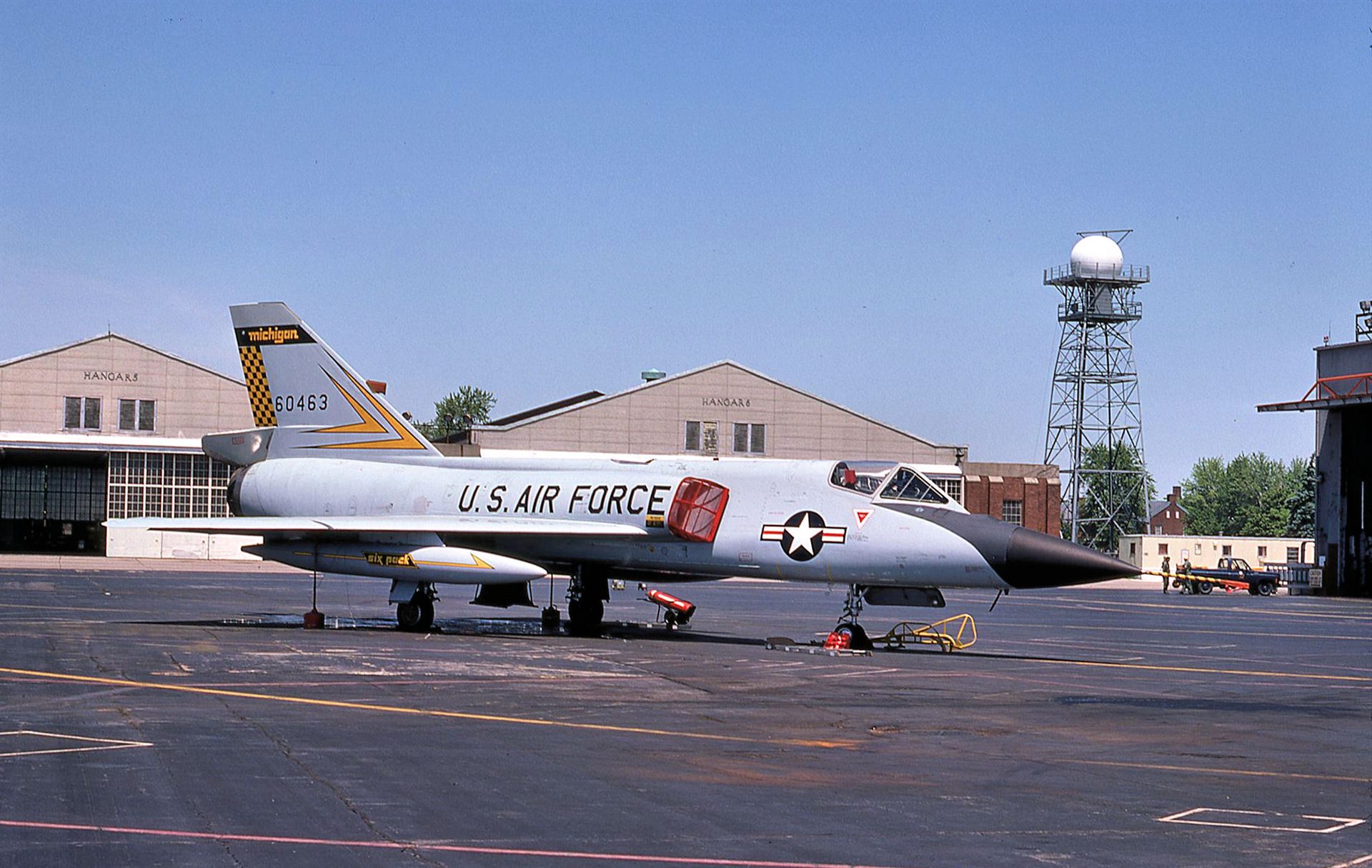
Pictured: a Convair F-106A Delta Dart of the 171st Fighter-Interceptor Squadron, 191st Fighter-Interceptor Group, Michigan Air National Guard — the same squadron, based at Selfridge, that scrambled two F-106s toward the Falconbridge contact. This is not a photograph of the incident itself: no photograph, film, or radar-scope image from the November 1975 sighting has ever been publicly released, despite contemporary reports that Major Oliver took three snapshots on a personal Brownie camera; their fate is unknown. CFS Falconbridge's own radar building and radomes were demolished after the station's 1986 closure, and no rights-clear photograph of the station as it appeared in 1975 is known to survive online.
Theoretical Alignment
The case draws its modest ETH weight from real institutional facts rather than from any resolved physical evidence: a NORAD-run military radar tracked a discrete target through a large, repeated altitude oscillation, and NORAD's own chain of command — not a civilian UFO group — treated the report seriously enough to scramble interceptors and circulate it internally as one of five connected "suspicious object" sightings. Its higher Psycho-Social weight reflects the case's less flattering half: a fast-moving rumor mill (Sudbury police "in hot pursuit," a National Enquirer cover story eight months later), a chain of secondhand relayed reports, and eyewitness descriptions — a 100-foot sphere with visible "craters" resolved by handheld binoculars at 25 to 30 nautical miles — that strain well past what unaided optics can plausibly deliver at that range. Interdimensional framing finds no support anywhere in the primary record.
Background
Canadian Forces Station Falconbridge began life as RCAF Station Falconbridge, one of 33 primary Pinetree Line radar stations built jointly by Canada and the United States in the early 1950s to give North America early warning of a Soviet bomber attack over the pole. Construction started in late 1950 on a site 14 miles north of Sudbury, Ontario, in what is now the Nickel Centre area of Greater Sudbury, and the station opened in August 1952 under the operational designation No. 33 Aircraft Control and Warning Squadron, later renamed No. 33 Radar Squadron. Falconbridge was a genuinely self-contained community, complete with 101 married-quarters homes, a school, a church, an infirmary, and its own recreational facilities, and it operated under NORAD's binational command structure once that organization formed in 1958. By the mid-1960s, as NORAD shifted air-defense scanning to computerized systems, Falconbridge was redesignated a radar scanning station; following the 1968 unification of the Canadian Armed Forces it became simply CFS Falconbridge. In the early-to-mid 1970s the base took on an additional role as a training facility for Air Defence Technicians, and in 1974, when the nearby Pinetree Line station CFS Foymount closed, Falconbridge absorbed some of its radar-scanning duties — part of a broader mid-1970s contraction of the aging Pinetree network that left fewer stations covering more airspace.
The wider geopolitical backdrop was the last serious decade of Cold War strategic-bomber anxiety before ICBMs and submarine-launched missiles fully eclipsed the manned-bomber threat in planning priority, and NORAD's binational command structure — with American and Canadian officers serving side by side at regional control centers such as CFB North Bay, headquarters of the 22nd NORAD Region — meant that a report at a Canadian radar station could, and in this case did, trigger an American interceptor scramble within hours, exactly as the underlying treaty structure intended. Nineteen seventy-five was also, independently, an unusually active year for Canadian UFO reporting generally: researcher Chris Rutkowski has documented more than 2,000 pages of UFO case files logged with Canada's National Research Council from that year alone, spanning a large civilian wave earlier in 1975 that was already well underway by the time the Falconbridge incident began that November.
Chronology of Events
| Date / Time (GMT) | Event |
|---|---|
| ~08:00 GMT, Nov 11 (~3:00 AM EST) | First calls to Sudbury police. Civilians report strange, bright lights low in the sky. Two officers see four objects — three appearing to hover, one moving in a circular pattern; two other officers independently observe a cylinder-shaped object through binoculars and track it until roughly 7:00 AM EST. |
| 10:40 GMT (5:40 AM EST) | The 22nd NORAD Region Combat Operations Center at CFB North Bay receives a call reporting that Sudbury police are in pursuit of two UFOs, and asks whether air traffic control radar is picking up the same targets. |
| 11:18 GMT (6:18 AM EST) | CFS Falconbridge calls the Region to report a UFO over the base itself, described as resembling "a gem with coloured lights around it," and a second object reportedly over the Ontario Provincial Police building in downtown Sudbury. |
| ~11:15–11:29 GMT (6:15–6:29 AM EST) | Station commander Major Robert Oliver observes two UFOs with brilliant lights — one bearing 200° from the base, the other at 180° and considerably further away. He takes three photographs on a personal Brownie camera and watches the closer object through binoculars "rising vertically at tremendous speed." |
| 11:47 GMT (6:47 AM EST) | Oliver phones his report in to the Region. The base's height-finder radar has by this point recorded the target first at 44,000 feet, then at 72,000 feet — readings taken from the instrument, not estimated by eye. The object is described as circular, well-lit, with two dark spots visible near its center. |
| 13:24 GMT (8:24 AM EST) | Sudbury radio station CKSO calls requesting information; NORAD declines to comment on specifics at this stage. |
| 17:27 GMT (12:27 PM EST) | Colonel G.W. Patterson, at NORAD Headquarters in Colorado Springs, is advised the object remains in view; Selfridge Air National Guard Base, Michigan is notified and asked to prepare an intercept. |
| 17:50 GMT (12:50 PM EST) | Scramble. Two F-106 Delta Dart interceptors of the 171st Fighter-Interceptor Squadron launch from Selfridge under NORAD direction. |
| 18:53 GMT (1:53 PM EST) | The F-106 crews report searching from 8,000 to 30,000 feet with no radar or visual contact on any object; both aircraft return to base. |
| Later Nov 11 (time not logged) | Per a declassified Defense Department memo covering the broader wave, Air National Guard and Strategic Air Command helicopters join the search effort; none produces a positive identification. |
| 07:10 GMT, Nov 12 (2:10 AM EST) | Master Corporal Kreutz reports that two police officers and one other witness near the base are again observing objects — a pulsating, brilliant white light moving in a "jerky" fashion at cloud height. A report is prepared for National Defence Headquarters, Ottawa; the surviving log entry ends here. |
| August 1976 | The National Enquirer publishes "Air Defense Chiefs Admit: We Tracked UFO on Radar and Scrambled Fighter Jets to Intercept," naming Major Oliver and Captain Hilchie on the record roughly eight months after the event. |
| 1995 | A file marked "Secret," containing pages of the 22nd NORAD Region Air Traffic Control Log Book covering November 11–12, 1975, is declassified for researcher and author Palmiro Campagna under Canada's Access to Information framework. |
| 1997 | Campagna publishes the log book's contents and his own analysis as Chapter Nine, "Into the Present," of The UFO Files: The Canadian Connection Exposed. |
| 2018 onward | Roughly 8,000 pages of declassified Canadian UFO documents, including material originating from CFS Falconbridge's own files, become freely available through the Internet Archive and Library and Archives Canada's public UFO database. |
The First Calls: Sudbury, Three in the Morning
The chain of events that would eventually reach NORAD's Colorado headquarters began, as far as the surviving record can reconstruct it, with ordinary telephone calls to Sudbury police headquarters at around 3:00 AM local time on November 11, 1975. Residents reported unexplained bright, white lights hovering over the city. Two Sudbury or Ontario Provincial Police officers who responded described seeing four separate objects: three appeared to hover in place while a fourth moved with a distinct circular motion. A second pair of officers, observing independently through binoculars, described something different in shape — a cylinder — and kept it under observation for roughly four hours, until about 7:00 AM. Additional officers across the wider Sudbury area, from Garson to Capreol, reported bright objects of their own. Local retrospectives on the case, drawing on family recollections decades later, describe at least one Sudbury Regional Police officer pursuing the lights by squad car — the detail that would become the National Enquirer's memorable framing eight months afterward, though the contemporary log book itself does not use the word "chase."
What makes the Sudbury half of the case distinct from a typical civilian UFO flap is the professional composition of its witnesses. These were not random passersby glancing up once; they were on-duty police officers, several of whom used binoculars and sustained their observation for hours, operating under institutional reporting requirements that gave their accounts a paper trail independent of the military side of the story unfolding at the radar station 14 miles to the north.
The Base Responds: Major Oliver's Sightings
By mid-morning the report had reached CFS Falconbridge itself. At 11:18 GMT the base called the 22nd NORAD Region to report a UFO directly over the station, described in the log as resembling "a gem with coloured lights around it," alongside a second reported object over the Ontario Provincial Police building in downtown Sudbury. Half an hour later, at 11:47 GMT, station commander Major Robert Oliver phoned in his own account. Between roughly 11:15 and 11:29 GMT he had personally observed two objects with brilliant lights — one at a bearing of 200 degrees from the base, the other at 180 degrees and considerably further away — and had watched the closer of the two through binoculars as it went, in his own description, "rising vertically at tremendous speed." Five other CFS Falconbridge personnel corroborated the sighting independently, giving the base's own account a same-morning, multi-witness institutional backing rather than resting on one officer's word.
Oliver also took three photographs on a personal Brownie camera during the observation — a detail that never appeared in contemporary press coverage and that researcher Palmiro Campagna surfaced only after reviewing the declassified 1995 log book. What became of those three exposures is, as far as this file's research could determine, entirely unknown: no negative, print, or later-released scan connected to them has ever surfaced in any archive, book, or news account examined for this file. Their absence does not prove they were suppressed — consumer Brownie cameras of the era were notoriously unreliable for handheld night or low-light photography of a distant point source, and the images may simply have come back blank or unusable — but it leaves a real, unresolved gap in a case that is otherwise better-documented on its radar and radio side than on its visual side.
Height-Finder Radar: Six Hours of Oscillation
The case's most distinctive evidentiary feature is the sustained radar track itself. Once alerted, CFS Falconbridge's height-finder set — a purpose-built radar type distinct from the base's general search radar, designed specifically to resolve a target's altitude rather than just its bearing and range — picked up a target 25 to 30 nautical miles south of the station. The instrument's own readings, not eyeball estimates, first recorded the target at 44,000 feet and then at 72,000 feet; subsequent press statements from the 22nd NORAD Region's public affairs office, drawing on the fuller radar record, described the target's altitude excursions as running from roughly 26,000 feet up to 45,000 feet, pausing, and then climbing again toward 72,000 to 80,000 feet — near the practical display limit of the height-finder set itself. Contemporary and later accounts converge on a total observation window of approximately six hours, an unusually long sustained radar engagement with a single unresolved target by the standards of any UFO case in this catalogue. Base personnel, watching the same behavior visually, described the object as circular, well-lit, and marked with two dark spots near its center — a description offered independently of, and roughly consistent in general character with, the radar's own altitude data, though nothing in the surviving record cross-correlates the visual and radar observations frame-by-frame the way the 1956 Lakenheath case's radar-visual convergence was documented.
Lieutenant Colonel B. Wooding, Director of the 22nd NORAD Region Control Centre, later gave reporters a technically detailed account of why radar does not always confirm a UFO report cleanly, one directly relevant to evaluating Falconbridge's single-station track: a target moving too slowly, too quickly, constructed of radar-absorbent material, or simply outside a given set's tuned frequency band can be missed by one radar while another, differently configured set nearby registers something. Search radar, Wooding noted, is optimized to detect aircraft-type targets, while height-finder radar exists specifically to resolve altitude once a target has already been found — different instruments built for different jobs, a distinction that helps explain why not every radar installation in the region that morning reported the same contact. Wooding's explanation cuts in more than one direction: it is offered as a reason radar can miss a real return, but it equally supports the more mundane possibility that ordinary atmospheric or clutter effects, birds, or temperature-inversion ducting could themselves generate a spurious, non-physical return on one radar without appearing on any other — a genuine ambiguity this file returns to in the Conventional Explanation Candidate section below.
NORAD Scrambles the Interceptors
By early afternoon GMT, the report had traveled up the full binational NORAD chain of command. At 17:27 GMT, Colonel G.W. Patterson — the 22nd NORAD Region's Chief of Staff of Operations for the Air Defence Group and Deputy Commander of Operations, who happened to be at NORAD's Combat Operations Center in Colorado Springs that day rather than at his home station of CFB North Bay — was advised the object was still being tracked, and Selfridge Air National Guard Base in Michigan was notified. At 17:50 GMT, two F-106 Delta Dart interceptors of the 171st Fighter-Interceptor Squadron, 191st Fighter-Interceptor Group, Michigan Air National Guard — the same "Six Pack" squadron that had converted from the F-101 Voodoo to the F-106 only three years earlier — launched under NORAD control. Roughly an hour later, at 18:53 GMT, the crews reported back: they had searched the airspace between 8,000 and 30,000 feet and found nothing, neither visually nor on their own onboard AN/APG-25/26 fire-control radar. Both aircraft returned to Selfridge.
The mismatch between the interceptors' search ceiling and the radar's own reported target altitude is one of the case's more concrete, non-speculative loose ends: the F-106s covered up to 30,000 feet, while the height-finder's own readings placed the target as high as 72,000 to 80,000 feet at points during the six-hour window — an altitude gap of more than 40,000 feet. It remains genuinely unclear from the surviving record whether the target had already descended back into the F-106s' search band by the time they arrived, whether it had left the area entirely, or whether an aircraft the size and performance class of an F-106 (itself capable of exceeding 50,000 feet in a zoom climb, though not as a sustained search altitude) was simply never vectored high enough to have a chance of finding it. No document reviewed for this file resolves that ambiguity one way or the other.
SAC and Air National Guard Helicopters Join the Search
The Falconbridge case connects to the broader wave through more than a shared NORAD chain of command. A declassified Defense Department memorandum from the same period, obtained via a later Freedom of Information Act request and covering the wave's overall handling, records: "To date efforts by Air Guard helicopters, SAC helicopters and NORAD F-106s have failed to produce positive ID" of the objects being reported. That language does not specify which individual incident each search asset responded to, and helicopter search efforts are documented in the clearest primary detail for Loring Air Force Base in Maine, where a federalized Army National Guard UH-1 Huey, crewed by Chief Warrant Officers Bernard Poulin and Eugene Herrin with Royal Canadian Mounted Police and Maine State Police personnel aboard, flew repeated night search missions in late October 1975 without ever visually confirming the intruder its own ground personnel were simultaneously reporting by radio — a case documented in full in this catalogue's own dedicated Loring AFB file. Whether a helicopter search specifically covered Falconbridge's own airspace that November morning, in addition to the two F-106s, is not confirmed by any single document this file's research located — but the memo's own wording, referring collectively to "Air Guard helicopters, SAC helicopters and NORAD F-106s" as a combined, multi-asset response that failed across the board, is consistent with the same institutional pattern of scramble-and-fail search efforts documented in detail at the American bases named in the same CINCNORAD message.
The Press Breaks the Story
Local coverage began within hours: the North Bay Nugget ran a report on the sighting that included a photograph taken by one of its own staff reporters, and Sudbury radio station CKSO called the Region for comment as early as 13:24 GMT, though it received no specifics at that stage. The story did not reach a national audience until eight months later, in August 1976, when the National Enquirer published a feature under the headline "Air Defense Chiefs Admit: We Tracked UFO on Radar and Scrambled Fighter Jets to Intercept." Unlike many tabloid UFO stories of the era, the Enquirer's account held up well against the later-declassified primary record: Major Oliver spoke to the paper on the record, describing his own sighting and the base's institutional practice of reporting "the more serious reports" to both Canadian and American authorities, and Captain Gordon Hilchie, the 22nd NORAD Region's Director of Public Affairs, confirmed the radar's altitude figures on the record rather than declining comment. Researcher Palmiro Campagna, reviewing the 1995 declassified log book two decades later, concluded that "the Enquirer article was essentially correct" — an unusual outcome for a supermarket-tabloid UFO story, and one this file treats as a genuine, if narrow, point in favor of the case's overall documentary reliability, even as it does not resolve what the object actually was.
Two Official Explanations
NORAD and Canada's Department of National Defence did not leave the case formally unexplained. Two conventional explanations circulated in official and press channels in the weeks that followed, though secondary accounts of the case are not perfectly consistent about which was offered when or by whom: 22nd NORAD Region officials attributed at least some of the visual sightings to the planet Jupiter, described in period coverage as unusually bright that particular morning, while a second, more generic explanation cited "atmospheric phenomena." A separate later summary of the incident, drawing on a different secondary source, instead lists Venus, clouds, and weather balloons among the explanations offered — a discrepancy this file cannot fully resolve from the sources available, and one that itself says something about how loosely "an explanation was given" gets reported once a story has passed through several retellings. What none of the official statements addressed, according to at least one detailed retrospective on the case, was the broader pattern: neither explanation made any reference to the six other Strategic Air Command base incidents reported in the same two-and-a-half-week window, even though the CINCNORAD message that named Falconbridge alongside those bases had already circulated internally the same day.
Colonel G.W. Patterson offered the most technically detailed account on the record, suggesting that unusual atmospheric effects — comparable in principle to the aurora borealis — could produce a UFO-like illusion, and separately raising the possibility of lenticular cloud formations magnifying the apparent brightness of a star or planet. Astronomer Ian Halliday of the National Research Council, consulted directly on the visual sightings at Sudbury, agreed that unusual atmospheric phenomena could be involved, noted that observers with no fixed point of reference commonly misjudge both the distance and altitude of a light source, and pointed out that witnesses might in some cases have been watching an ordinary aircraft whose engine noise was carried away from the ground by atmospheric refraction effects rather than toward it — a real, physically grounded phenomenon, though one Halliday offered as a general possibility rather than a specific finding about this case.
The 1995 Declassification and Campagna's Analysis
The case's evidentiary picture sharpened considerably two decades after the fact. In 1995, a file marked "Secret" was declassified for Palmiro Campagna, a professional engineer with Canada's Department of National Defence and an independent UFO researcher, under Canada's Access to Information framework. The file contained pages from the 22nd NORAD Region's own Air Traffic Control Log Book covering November 11–12, 1975 — the primary document this case file's chronology draws on directly, now held by the National Archives of Canada. Campagna published its contents, alongside his own analysis, as Chapter Nine of his 1997 book The UFO Files: The Canadian Connection Exposed. His central conclusion, reached after comparing the log book against the contemporary press coverage, was double-edged in exactly the way this file's own credibility rating reflects: the primary record corroborated the broad outline of what had been reported at the time, while also surfacing new, previously unpublicized details — Oliver's photographs chief among them — that neither confirm nor resolve what the object actually was. Campagna also flagged what he considered the single strongest piece of evidence against a purely conventional explanation: the near-simultaneous visual and radar corroboration of a rapid vertical ascent, a combination he argued would tend to rule out planets, stars, and ordinary temperature-inversion effects, even as he stopped well short of endorsing an exotic origin. More recently, a substantial portion of Canada's declassified UFO archive — some 8,000 pages in total, including material originating directly from CFS Falconbridge's own station files — has become freely searchable online through the Internet Archive and Library and Archives Canada's own public UFO database, discussed further in the Declassified Government Records section below.
Circumstantial Evidence
- A NORAD-operated height-finder radar independently corroborated a large, multi-stage altitude excursion consistent with the visual reports of an object "rising vertically at tremendous speed."
- Two entirely separate institutional witness groups — CFS Falconbridge military personnel and Ontario Provincial Police/Sudbury officers 14 miles away — reported broadly compatible anomalous activity on the same morning.
- A same-day CINCNORAD message formally connected the sighting to a documented, multi-base pattern already under active NORAD review, rather than treating it as an isolated local report.
- NORAD's own public affairs office confirmed the radar's altitude figures on the record, and a 1995 declassification later corroborated the broad outline of that same contemporary account.
- No second, independent radar installation ever confirmed the same target, and the three photographs reportedly taken of the object were never entered into the public record.
Key Witnesses
Maj. Robert Oliver
Watched two brilliant objects through binoculars from the base itself, described one as "rising vertically at tremendous speed," and phoned his own report directly into the 22nd NORAD Region chain of command. Took three photographs on a personal Brownie camera whose fate remains unknown, and later spoke on the record to the National Enquirer, telling the paper he believed both Canadian and American authorities investigated the more serious reports of this kind.
Five Unnamed CFS Falconbridge Personnel
Corroborated Major Oliver's sighting of three objects independently, per his own account to the National Enquirer. Their individual names do not appear in any source reviewed for this file, a common gap in Cold War-era military UFO reports where junior personnel are rarely quoted by name in either official logs or press coverage.
Seven Ontario Provincial Police Officers
Reported the case's most detailed civilian-side visual accounts: two officers saw four objects, three hovering and one moving in a circular pattern, while two others tracked a cylinder-shaped object through binoculars for roughly four hours, until about 7:00 AM local time. Their names do not appear in the primary sources reviewed for this file.
M/Cpl Kreutz
Filed the final entry in the surviving 22nd NORAD Region log book, reporting at 07:10 GMT on November 12 that two police officers and one other witness near the base were again observing a pulsating, brilliant white light moving in a "jerky" fashion at cloud height — the last documented sighting connected to the incident before the log record ends.
Capt. Gordon Hilchie
Confirmed the radar's own altitude figures to the press on the record — a target tracked 25 to 30 miles south of the station, climbing from roughly 26,000 to 45,000 feet, pausing, then to 72,000 feet — rather than declining to discuss specifics. His willingness to cite instrument data directly is a large part of why researcher Palmiro Campagna later judged the National Enquirer's 1976 account "essentially correct."
Col. G.W. Patterson & Lt. Col. B. Wooding
The Region's senior operations officers, interviewed together by the press about why radar does not always confirm a UFO report. Patterson raised possible atmospheric-illusion and lenticular-cloud explanations for the visual sightings; Wooding explained the technical differences between search and height-finder radar and the specific conditions — target speed, material, frequency mismatch, clutter — under which a real target can be missed by one set while registering on another.
The Five Observables Assessment
The Five Observables framework, developed by former AATIP director Luis Elizondo, is used to classify UAP encounters by performance characteristics exceeding known technology of their era. Applied to Falconbridge, the framework highlights exactly where this case's evidence is strong (a sustained, instrumented altitude record) and where it is weak (no continuous velocity or acceleration data, and no confirmed morphology beyond secondhand binocular impressions):
Assessment: Anti-Gravity Lift is rated speculative: witnesses described hovering and pausing behavior, both on radar (stationary intervals within the six-hour track) and visually, but no witness described any visible means of support or propulsion, structured or otherwise. Instant Acceleration is rated speculative on the strength of Oliver's "rising vertically at tremendous speed" description and the radar's own jump between recorded altitudes, but the surviving log gives no precise rate-of-climb figure comparable to the second-by-second data available in more heavily instrumented cases, so this file cannot elevate the rating to "present." Hypersonic Velocity is rated speculative for the same reason: a climb from roughly 26,000 to 72,000–80,000 feet implies a substantial vertical rate if it happened quickly, but no elapsed-time figure for that specific segment survives in the documents reviewed. Low Observability is rated absent: the target was tracked continuously by radar for nearly six hours and was visible to more than twenty witnesses across two separate institutional groups, the opposite of a stealthy or radar-evading profile. Trans-Medium travel is rated absent; no transition between air, water, or space was ever reported. Taken as a whole, Falconbridge's Five Observables profile is defined less by any single dramatic performance claim than by a real but frustratingly incomplete instrumented record — enough radar data to establish that something anomalous was tracked, not enough to establish how it moved.
Evidence Assessment
Supporting Anomalous Origin
- A NORAD-operated height-finder radar tracked a discrete target through a large, multi-stage altitude oscillation — roughly 26,000 to 45,000 to 72,000–80,000 feet — over a sustained window of nearly six hours, not a brief or ambiguous blip.
- Two entirely independent institutional witness groups — military personnel at the base and civilian/police witnesses in Sudbury, 14 miles away — reported anomalous lights on the same morning without any indication of having coordinated their accounts.
- A same-day CINCNORAD message formally linked the Falconbridge sighting to a documented, multi-base pattern of "suspicious object" reports the U.S. and Canadian militaries were already tracking as a connected phenomenon, rather than treating it as an isolated local report.
- NORAD's own public affairs office confirmed the radar's altitude figures to the press on the record, and a 1995 declassified log book later corroborated the broad outline of that same press account — an unusually strong documentary chain for a UFO case of this era.
- The interceptor scramble, the F-106s' failure to find anything despite a real-time NORAD vector, and the reported later involvement of Air National Guard and SAC helicopters all indicate the U.S. and Canadian militaries treated the contact as a genuine unresolved target, not dismissed it from the outset.
Supporting Conventional Explanation
- Jupiter had reached opposition roughly four weeks earlier and remained near peak brightness and visible for most of the night in mid-November 1975, a documented astronomical condition that any nighttime "bright light" account must be weighed against.
- The "100-foot sphere with visible craters" description, reportedly resolved through handheld binoculars at a range of 25 to 30 nautical miles, describes a level of surface detail difficult to reconcile with the optical limits of ordinary field binoculars at that distance.
- Lieutenant Colonel Wooding's own on-the-record explanation of how search and height-finder radar can be fooled by clutter, birds, or atmospheric propagation effects applies as readily to a spurious Falconbridge return as it does to a genuine one, and the case has only a single radar station's data, with no second independent set cross-confirming the same track.
- No physical evidence, confirmed photograph, or independently reviewed instrument recording beyond the radar log itself has ever been produced, despite three photographs reportedly having been taken.
- Secondary accounts of the case are inconsistent about which conventional explanation NORAD actually offered — Jupiter and generic "atmospheric phenomena" in some sources, Venus, clouds, and weather balloons in others — a level of retelling drift that itself weakens confidence in any single official account as the last word.
Why "Disputed"
This file rates the CFS Falconbridge incident DISPUTED rather than "Credible" or "Verified" because its genuine institutional strengths and its genuine evidentiary weaknesses sit closer to parity than in almost any other radar-visual case in this catalogue. On the strength side: this is not a case built on a single uncorroborated witness or a rumor that grew in the retelling. A functioning NORAD military radar station tracked an unresolved target through a documented, multi-hour altitude excursion; that data reached the top of the binational NORAD chain of command within hours; two F-106 interceptors were scrambled and, per a separately declassified memo, joined later by helicopter search assets; and the whole episode was folded into an internal CINCNORAD message connecting it to four American Strategic Air Command bases experiencing the same pattern of unexplained incursions in the same two-and-a-half-week window. A 1995 declassification corroborated the broad outline of contemporary press reporting that had, unusually for a tabloid-sourced story, held up well. On the weakness side: the case rests on a single radar station with no independent second radar cross-check; its most vivid visual detail — a 100-foot sphere with resolvable craters, seen through binoculars at 25 to 30 nautical miles — describes a level of optical resolution genuinely difficult to credit at that range, regardless of how credible the observer; the three photographs that might have settled the visual question were never developed for the record, or if they were, have vanished from it; and NORAD's own explanations, offered close to the time, were neither internally consistent across the secondary sources that report them nor ever squared against the radar's own instrumented altitude data. A case with this much genuine institutional weight behind it, and this much unresolved ambiguity still sitting inside its own best evidence, is precisely what this site's "Disputed" rating exists to describe.
Sensor & Instrumentation Detection Profile
Detection rested on a single radar installation: CFS Falconbridge's own search and height-finder radar sets, part of the Pinetree Line early-warning chain and feeding data directly into the 22nd NORAD Region Combat Operations Center at CFB North Bay. Unlike the four independently cross-checked radar systems in the 1956 Lakenheath–Bentwaters case, Falconbridge offers no second, physically separate ground radar confirming the same track — the height-finder readings of 44,000 and then 72,000 feet (with press accounts of the U.S. Air Force's own public affairs office later citing a climb to 80,000 feet, the effective limit of the set) come from one station's own equipment. A second sensor did participate but failed to register anything useful: the airborne intercept radars aboard the two scrambled F-106 Delta Darts, which searched between 8,000 and 30,000 feet and reported no contact. Visual sensors were exclusively human eyes and handheld optics — 7x50-class military binoculars at the base, binoculars used independently by at least two Ontario Provincial Police officers, and the naked eye for the great majority of civilian and police witnesses in Sudbury. Major Oliver's three photographs, taken on a personal Brownie camera rather than any service-issue equipment, were never developed for the public record or, if they were, have never surfaced; no negative, print, or digital scan is held in any archive this file's research was able to locate.
Environmental & Geospatial Context
No meteorological log from the night survives in the declassified material this file draws on, an evidentiary gap the case shares with a number of Cold War-era radar files. What can be inferred is indirect but reasonably solid: witnesses at the base and in Sudbury reported unobstructed views of a light source at extreme range through both binoculars and the naked eye for a continuous span of hours, and the height-finder radar tracked its target cleanly to an indicated 72,000–80,000 feet without any noted loss of signal to weather. Both facts point toward a generally clear November night sky rather than overcast or precipitating conditions, though this file cannot state that as a documented certainty. Astronomically, the timing is notable: Jupiter had reached opposition on October 13, 1975, roughly four weeks before the incident, meaning the planet was near its yearly peak brightness (magnitude roughly −2.4 to −2.5) and visible for most of the night throughout early-to-mid November — a detail directly relevant to one of the conventional explanations NORAD itself later offered, discussed in full below. Geospatially, CFS Falconbridge sat inside the resource-industry landscape of the Sudbury Basin, one of the world's largest nickel-mining districts, a detail with no established bearing on the sightings but frequently noted in local retrospectives on the case.
Observer Credibility & Occupational Profile
The witness pool is unusually institutional for a UFO case: nearly every primary observer held an active military or police role directly relevant to the report, not a chance civilian glance skyward. Major Robert Oliver, the station's commanding officer, watched the object through binoculars and reported it through the chain of command in real time rather than describing it after the fact; five other CFS Falconbridge personnel corroborated his sighting independently. Seven Ontario Provincial Police officers, engaged in what press accounts described as active pursuit of the lights by patrol car, and additional Sudbury city police officers, added a second, entirely separate institutional witness stream with no obvious motive to coordinate a story with the military side. On the explanatory side, the case is unusual in that its skeptical voices were equally credentialed: Captain Gordon Hilchie, the 22nd NORAD Region's Director of Public Affairs, gave the press the radar's own altitude figures rather than a vague denial; Colonel G.W. Patterson and Lieutenant Colonel B. Wooding, the 22nd Region's senior operations officers, spoke to reporters about specific atmospheric and radar-propagation mechanisms rather than issuing a blanket dismissal; and astronomer Ian Halliday of the National Research Council of Canada, a professionally trained meteor and planetary scientist, was consulted directly rather than the file simply being closed without expert review. That said, credentialed status is not the same as optical capability: even a trained military observer's binoculars are bound by the same physics as anyone else's, a limitation directly relevant to the "100-foot sphere with craters" description addressed later in this file.
Physical & Material Assays
No physical evidence connected to the object itself was ever recovered, tested, or even photographed for the surviving public record. Major Oliver's three Brownie-camera exposures are the case's one claimed piece of documentary imagery, and their outcome — developed or not, lost or simply never released — is unknown; this file treats them as an unresolved loose end rather than either evidence or its absence. No debris, no landing trace, and no instrument malfunction attributable to the object was reported at the base, in contrast to some of the sister incidents in the same wave (at Malmstrom Air Force Base, for instance, a Sabotage Alert Team that same season reported an object illuminating a missile site from close range). Falconbridge's evidentiary profile is therefore built entirely from radar-scope readings, contemporaneous radio and telephone message traffic later declassified as a National Archives of Canada log book, and witness testimony — a profile closer to the 1953 Kinross Incident in evidentiary shape than to any crash-retrieval case.
Historical Precedents & Archive Matches
Falconbridge did not occur in isolation. A CINCNORAD (Commander-in-Chief, NORAD) message dated November 11, 1975 — the same day as the incident — stated plainly: "Since 28 Oct 75 numerous reports of suspicious objects have been received at the NORAD COC [Combat Operations Center]. Reliable military personnel at Loring AFB, Maine, Wurtsmith AFB, Michigan, Malmstrom AFB, [Montana], Minot AFB, [North Dakota], and Canadian Forces Station, Falconbridge, Ontario, Canada, have visually sighted suspicious objects." That two-and-a-half-week run of incidents is documented in detail by researchers Lawrence Fawcett and Barry Greenwood, who obtained the underlying Freedom of Information Act releases and published them in their 1984 book Clear Intent: a low-flying, silent, helicopter-like intruder repeatedly penetrated the nuclear weapons storage area at Loring Air Force Base, Maine beginning October 27, prompting a Security Option 3 alert, a request for RCMP and Maine State Police cooperation, and eventually a federalized Army National Guard helicopter search; similar low-altitude intrusions and radar contacts followed at Wurtsmith AFB, Michigan and were logged at Malmstrom AFB, Montana and Minot AFB, North Dakota. A separate declassified Defense Department memo from the same period, obtained via a later FOIA request, records that "efforts by Air Guard helicopters, SAC [Strategic Air Command] helicopters and NORAD F-106s have failed to produce positive ID" of the objects being reported — language that, read against the Falconbridge log, indicates the same category of multi-agency, multi-airframe search-and-fail pattern was applied north of the border as well as south of it. Falconbridge stands out within that pattern in three ways: it is the wave's only non-American, non-SAC entry (a Pinetree Line air-defense radar station rather than a nuclear bomber base); it is the wave's only incident with a sustained, multi-hour height-finder radar altitude track rather than a low-level intrusion report; and it is the only one of the five bases named in the CINCNORAD message to have received both an official NORAD press release and a National Enquirer feature story naming military officers on the record.
Material Analysis
No physical trace, debris, or recovered material connected to the object itself was ever reported, examined, or tested in connection with this case — there was no crash, no landing, and no claimed close-range recovery of any kind, in contrast to physical-trace cases elsewhere in this catalogue. The case's one claimed piece of documentary physical evidence, Major Oliver's three Brownie-camera photographs, was never entered into the public record in any form this file's research could locate; whether the images were developed, whether they showed anything identifiable, and where they might be held today (if they still exist at all) are all unanswered questions. This absence is itself informative in a specific, limited way: it means the case's entire evidentiary weight rests on radar-scope data, radio/telephone message logs, and testimony rather than on any independently reviewable image or physical sample, the same evidentiary profile shared by the 1953 Kinross Incident and, on the American side of the same 1975 wave, by several of the Strategic Air Command base intrusions documented in Clear Intent.
Supporting a Genuinely Unusual Stimulus
- The height-finder radar's altitude readings were instrument-recorded, not eyeballed, and describe a genuinely unusual flight profile — large, repeated vertical excursions over several hours — that does not match ordinary aircraft or balloon behavior.
- Multiple, institutionally separate witness groups (military and police) reported broadly compatible anomalous activity on the same morning without evident coordination.
Supporting a Mundane Origin
- No physical sample, debris, or independently authenticated photograph exists to test against any hypothesis, mundane or otherwise — the case cannot be resolved by physical evidence because none survives (or perhaps was ever produced) in reviewable form.
- The single radar station's own susceptibility to atmospheric propagation, ground clutter, and equipment-specific quirks — acknowledged on the record by the Region's own control-centre director — means an unusual-looking radar track alone cannot, by itself, rule out a non-physical or misidentified stimulus.
The Conventional Explanation Candidate
Three terrestrial explanations deserve serious weight against the Falconbridge record, each accounting for part of the case's evidence while leaving other parts genuinely unaddressed.
Astronomical Misidentification: Jupiter
Jupiter reached opposition on October 13, 1975, meaning that by November 11 the planet remained close to its yearly peak brightness (roughly magnitude −2.4 to −2.5) and was visible for most of the night across the region — exactly the kind of persistent, brilliant, star-like point of light that untrained observers, and even trained ones working without a fixed point of reference, regularly misidentify as something closer and more solid. NORAD's own officials cited Jupiter as at least a partial explanation for the visual sightings at the time. The candidate explains a real subset of the evidence well: the earliest, most distant "bright light" reports from Sudbury civilians, and possibly some of the steady, non-maneuvering visual impressions. It does not explain the case's most evidentially significant element: a planet cannot generate a moving, altitude-changing return on a height-finder radar, cannot account for the reported "rising vertically at tremendous speed," and cannot produce the OPP officers' cylinder-shaped description or the base personnel's report of a circular object with two dark spots near its center — morphological details incompatible with an unresolved point source regardless of viewing conditions.
Radar Anomalous Propagation or Equipment Effects
Lieutenant Colonel Wooding's own on-the-record explanation of how search and height-finder radar can be fooled — by birds, ground clutter, or atmospheric temperature-inversion ducting that bends radar energy in ways that mimic a discrete airborne target — is a well-documented phenomenon in the broader history of Cold War radar operations and offers a real candidate mechanism for some or all of the Falconbridge track. It gains plausibility from the absence of a second, independent radar confirming the same target: a genuinely solid, physical object at the altitudes reported ought to have been detectable by other regional radar coverage, and no source reviewed for this file documents such a second confirmation. The candidate struggles, however, against the case's sustained multi-witness visual corroboration: propagation anomalies and equipment quirks do not typically produce a consistent, multi-hour pattern of independent visual sightings by more than twenty separate witnesses across two institutionally distinct groups 14 miles apart, several of whom used binoculars and described specific, if not fully agreed-upon, structural detail.
Aircraft Misidentification
Given the broader wave's initial working assumption at Loring and Wurtsmith — that the intruding objects there were most likely an unidentified helicopter — a general aircraft-misidentification candidate deserves consideration at Falconbridge as well, particularly for the lower-altitude, near-base sightings. It struggles badly, however, against the radar's own altitude data: no civil aircraft operating over Ontario in 1975, and almost no military aircraft of the era outside a handful of specialized high-altitude reconnaissance types with no plausible reason to be loitering unannounced over a Canadian nickel-mining region, could sustain level flight anywhere near the 72,000-to-80,000-foot altitudes the height-finder radar recorded. As an explanation for the full six-hour, multi-altitude track specifically, this candidate is weak; as a partial explanation for isolated lower-altitude visual reports elsewhere in the broader flap, it remains a live possibility this file cannot rule out.
Astronomical Misidentification (Jupiter)
Plausible InconclusivePlausible as a partial explanation for the earliest, most distant "bright star" reports from Sudbury, given Jupiter's documented post-opposition brightness that November; inconclusive as anything close to a full account, since it cannot explain the radar-tracked altitude changes, the reported vertical acceleration, or the structured shapes multiple witnesses described.
Radar Anomalous Propagation / Equipment Effects
InconclusiveA real, well-documented phenomenon and a genuine candidate for the single-station radar track given the absence of any second radar confirmation, but it does not account for the sustained, multi-hour, multi-witness visual corroboration from two institutionally separate observer groups.
Aircraft Misidentification
ImplausibleImplausible as an explanation for the radar-recorded 72,000–80,000-foot altitude excursions, which no conventional aircraft operating in the region in 1975 could sustain; remains a live partial candidate only for isolated lower-altitude visual reports elsewhere in the broader wave.
Related Cases
Confirmed Documents & Official Records
The Canadian federal government's own searchable database of declassified UFO files, the official successor repository to the National Archives of Canada holdings that included the 22nd NORAD Region log book central to this case.
UNCLASSIFIED (declassified)A 29-part, 5.1GB scanned collection of declassified Canadian government UFO records sourced from National Archives of Canada microfilm, including material originating directly from CFS Falconbridge's own station files.
UNCLASSIFIED (declassified)The primary contemporaneous record of the incident: a chronological, timestamped log of radio and telephone traffic covering the sighting, radar readings, and interceptor scramble, declassified for researcher Palmiro Campagna in 1995 and reproduced here alongside his analysis.
SECRET (declassified 1995)Search Government Archives Directly
Further Reading — Recommended Literature
The UFO Files: The Canadian Connection Exposed
Written by the Department of National Defence engineer who obtained the declassified 22nd NORAD Region log book in 1995; Chapter Nine is the single most detailed published analysis of the Falconbridge incident's primary documentary record.
Clear Intent: The Government Coverup of the UFO Experience
Documents the wider October–November 1975 wave at Loring, Wurtsmith, Malmstrom, and Minot Air Force Bases through FOIA-obtained military records, including the CINCNORAD message that named Falconbridge as the wave's Canadian entry.
The Canadian UFO Report: The Best Cases Revealed
A national survey of Canada's best-documented UFO cases drawn from government files and civilian reports, situating Falconbridge within the country's broader 1970s UFO reporting history.
UFOs and the National Security State: The Cover-Up Exposed, 1973–1991
Covers the 1975 Strategic Air Command bases wave in the context of Cold War military secrecy and institutional handling of unresolved aerial contacts during exactly this period.
UFOs & Nukes: Extraordinary Encounters at Nuclear Weapons Sites
A five-decade research project interviewing military veterans of nuclear-site UFO incidents, providing broader context for the same 1975 Strategic Air Command base pattern Falconbridge was formally linked to.
Essential Viewing

A thorough search turned up only one video meeting this site's relevance standard — directly and primarily about the Falconbridge incident itself, from a reputable, non-sensationalized source. Several other results (a Science Channel segment on the Loring AFB intrusions, a Chris Rutkowski talk on a separate earlier-1975 Canadian wave, and modern, unrelated "UFO in Falconbridge" sighting videos from 2016–2020) were considered and excluded because they were not primarily about this specific 1975 case.
Sources
- "CFS Falconbridge," Wikipedia. en.wikipedia.org
- "Pinetree Line," Wikipedia. en.wikipedia.org
- Campagna, Palmiro. "Falconbridge, ON – 1975 – UFO Report," excerpted from The UFO Files: The Canadian Connection Exposed, Stoddart Publishing, 1997, Chapter Nine. Hosted by the Pine Tree Line Historical Society. c-and-e-museum.org
- "Falconbridge, ON – 1975 – UFO Sitings and Reports," including reproduced CONFIDENTIAL Defense Department message dated November 11, 1975. Pine Tree Line Historical Society. c-and-e-museum.org
- "Falconbridge Radar Station History," ghosttownpix.com. ghosttownpix.com
- NICAP. "Nov. 11, 1975; CFS Falconbridge, Ontario, Canada" (mirror of Campagna's account). nicap.org
- Fawcett, Lawrence & Greenwood, Barry J. "Intrusions at Loring AFB – 1975," excerpted from Clear Intent, pp. 16–26. Hosted by NICAP. nicap.org
- UFO Casebook. "UFOs Intrude into SAC Base Weapons Areas: October – November, 1975." ufocasebook.com
- Library and Archives Canada. "Canada's UFOs: The Search for the Unknown," official declassified UFO document database. collectionscanada.gc.ca
- Internet Archive. "8,000 Pages of Declassified Canadian UFO Documents." archive.org
- Royal Astronomical Society of Canada. "Ian Halliday," biographical tribute. rasc.ca
- f-106deltadart.com. "171 FIS," unit history of the 171st Fighter-Interceptor Squadron, Michigan Air National Guard. f-106deltadart.com
- Wikimedia Commons. "171st Fighter-Interceptor Squadron F-106 Delta Dart 56-0463.jpg" (public domain, U.S. federal government work). commons.wikimedia.org
- Rutkowski, Chris. "50 Years Ago: Canada's 'Summer of UFOs,'" Substack, 2025 (background on the scale of Canadian UFO reporting in 1975). chrisrutkowski.substack.com
- Campagna, Palmiro. The UFO Files: The Canadian Connection Exposed, Dundurn Press, 2010 edition.
- Fawcett, Lawrence & Greenwood, Barry J. Clear Intent: The Government Coverup of the UFO Experience, Prentice-Hall, 1984.
- Rutkowski, Chris A. & Dittman, Geoff. The Canadian UFO Report: The Best Cases Revealed, Dundurn Press, 2006.
- Dolan, Richard M. UFOs and the National Security State: The Cover-Up Exposed, 1973–1991, Keyhole Publishing, 2009.
- Hastings, Robert. UFOs & Nukes: Extraordinary Encounters at Nuclear Weapons Sites, Second Edition, 2020.
- Strange and Undecided (podcast). "Unidentified Object Spotted on Military Radar | The Falconbridge UFO Incident." youtube.com
See something inaccurate? Have additional information or sources?
Suggest an Edit →Last Updated: August 2026