
Loring AFB Nuclear Storage Area
On the night of October 27, 1975, Staff Sergeant Danny K. Lewis, patrolling the northern perimeter of the highly restricted nuclear weapons storage area at Loring Air Force Base near Limestone, Maine, watched a silent, low-flying object with a red navigation light and white strobe descend to within 300 yards of the igloo-covered bunkers holding the 42nd Bomb Wing's nuclear arsenal. Base radar operators tracked it for roughly 40 minutes before it vanished toward Grand Falls, New Brunswick. The next night it returned, and airmen including B-52 crew chief Sergeant Steven Eichner watched a reddish-orange, cigar-shaped object hover just five feet above the ground near the runway, completely silent and unlike anything they could identify. Base commander Colonel Richard E. Chapman declared a Security Option 3 alert, priority messages went up the chain of command to the National Military Command Center, and a Maine Army National Guard UH-1 helicopter crewed by Chief Warrant Officers Bernard Poulin and Eugene Herrin flew repeated search missions without ever making visual contact with the intruder ground personnel were simultaneously reporting by radio. The Loring intrusions are the best-documented single incident in the broader Northern Tier wave of nuclear-base UFO reports that swept Strategic Air Command installations that autumn — the same wave that, two weeks later, reached Canadian Forces Station Falconbridge in Ontario.
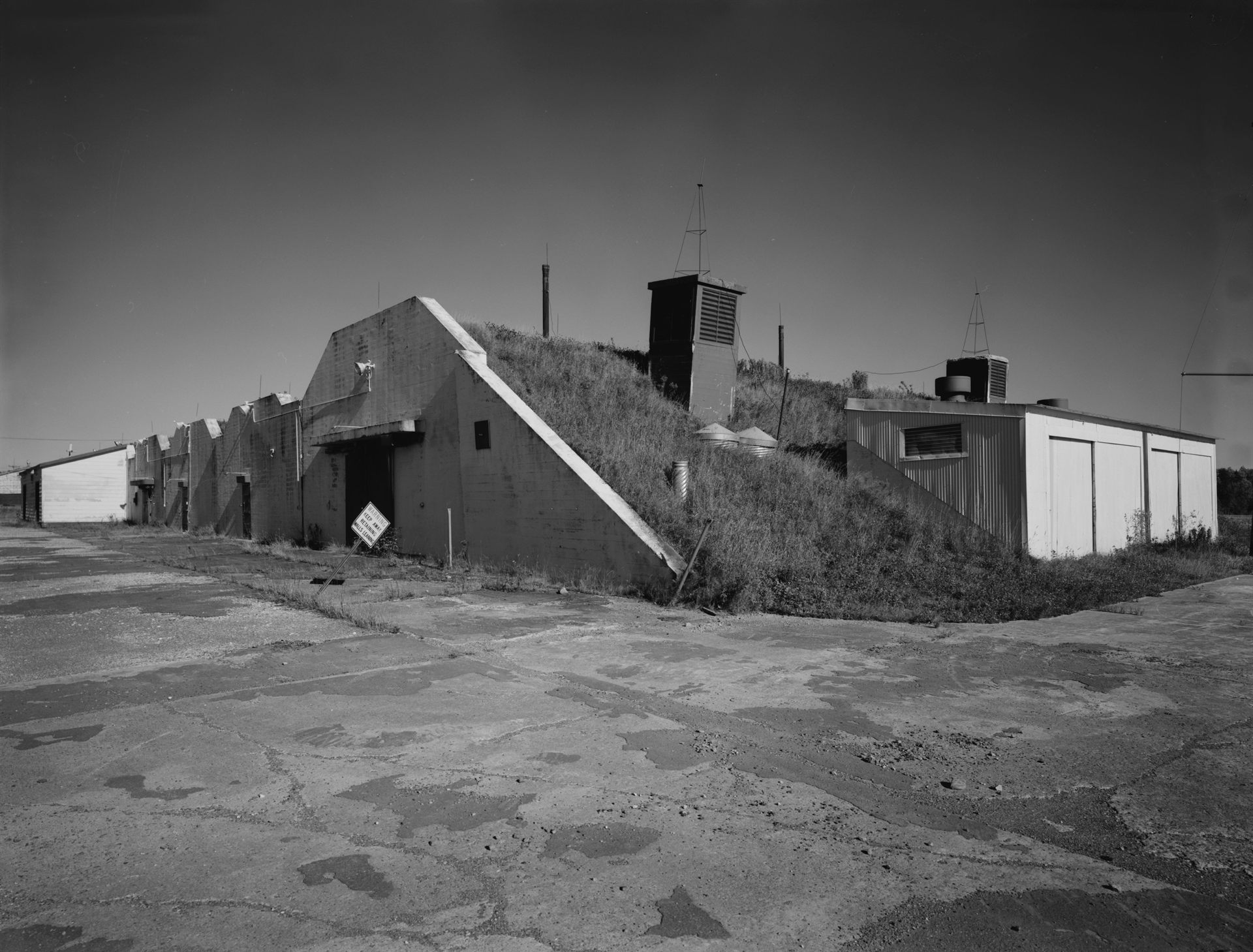
Pictured: the earthen-mound-covered retaining wall of Building 216, an ammunition maintenance shop inside Loring AFB's Weapons Storage Area (WSA) — part of the same restricted nuclear weapons complex the intruding object circled in October 1975 — photographed in 1998 by the National Park Service's Historic American Engineering Record (HAER ME-64-D-20) shortly before the base's structures were surveyed for historic preservation. This is not a photograph of the incident itself: no photograph or radar-scope image of the 1975 object has ever surfaced publicly, and this file's research located no evidence any was ever taken.
Theoretical Alignment
Loring's modest ETH weight rests on genuinely unusual reported performance — a silent object hovering five feet off the ground with no visible rotor, engine, or exhaust, described by one crew chief as capable of vanishing rather than simply flying away — corroborated by professionally trained, on-duty military observers across two separate nights and a base radar track. Its lower weight relative to some cataloged cases reflects that the base's own contemporaneous language consistently described the intruder as an "unknown helicopter," not a structured craft of unconventional design, and that a real Cold War institutional concern about hostile or unauthorized conventional aircraft (addressed at length in the Conventional Explanation Candidate section) drove the actual military response — a shoot-down authorization request, a Security Option 3 alert, and coordination with Canadian authorities for cross-border pursuit. This file scores Psycho-Social weight higher than most Northern Tier wave entries in this catalogue because of how heavily the surviving public record depends on interviews conducted decades after the fact, when institutional memory, wave-era rumor, and the case's own local mythology (Loring's reputation as "Maine's Roswell") had years to shape retelling. Interdimensional framing finds no support in any primary or secondary source reviewed for this file.
Background
Loring Air Force Base began as Limestone Army Air Field, established in 1947 and renamed in 1954 for Major Charles J. Loring Jr., a Korean War fighter pilot posthumously awarded the Medal of Honor for deliberately crashing his damaged F-80 into enemy artillery positions. Built in the far northeastern corner of Aroostook County, Maine specifically because the site was, at the time of its construction, the closest point in the continental United States to Europe, the base was activated as a Strategic Air Command installation and became host, beginning February 1953, to the 42nd Bombardment Wing (Heavy). The wing flew Convair B-36 Peacemakers before converting — the second SAC wing to do so, and the first to convert directly from a propeller-driven bomber — to the Boeing B-52 Stratofortress, and later added Boeing KC-135 Stratotanker aerial-refueling squadrons. What made Loring distinctive within SAC's already-formidable Cold War bomber network was its nuclear weapons storage capacity: the base's original weapons complex began life as the North River Depot and, absorbed into Loring in 1962 as the separately designated Caribou Air Force Station weapons storage area, became by most accounts the largest weapons storage area in the entire Strategic Air Command — the actual nuclear arsenal the intruding object of October 1975 circled and approached to within 300 yards. The igloo-style storage bunkers, low earthen-mound-covered structures built to contain a potential accidental detonation, sat behind a roughly 12-foot chain-link security perimeter topped with barbed wire, patrolled around the clock by the 42nd Security Police Squadron.
The wider Cold War backdrop mattered directly to how the base's chain of command responded in October 1975. Loring's B-52s and their nuclear payloads existed to fly polar routes toward the Soviet Union in the event of general war, and the base's proximity to the Canadian border at Grand Falls, New Brunswick — roughly 12 miles from the weapons storage area — meant that any unidentified low-flying aircraft approaching from the northeast was, institutionally, a plausible foreign-incursion concern before it was ever treated as anything more exotic. That is precisely the posture the surviving message traffic documents: escalating rules of engagement discussed with security police, a Security Option 3 alert, priority notification up through Air Force Chief of Staff channels to the National Military Command Center at the Pentagon, and Royal Canadian Mounted Police coordination specifically to authorize American pursuit across the international border. Nineteen seventy-five was, independently, roughly midway through the last serious decade of manned-bomber strategic anxiety before submarine-launched and land-based intercontinental ballistic missiles fully eclipsed bombers as the priority nuclear deterrent in Pentagon planning — a moment when SAC's dispersed bomber bases, Loring prominent among them, remained genuinely high-value, genuinely closely guarded strategic assets rather than legacy installations.
Chronology of Events
| Date / Time (EST) | Event |
|---|---|
| ~7:45 PM, Oct 27 | First sighting. Staff Sgt. Danny K. Lewis (42nd Security Police Squadron) observes an unidentified aircraft near the weapons storage area's northern perimeter at roughly 150–300 feet altitude, showing a red navigation light and a white strobe. It descends to within 300 yards of the nuclear igloos. |
| ~7:50–8:00 PM, Oct 27 | Staff Sgt. James P. Sampley detects an unknown radar return roughly 10–13 miles east-northeast of the base. Sgts. Clifton W. Blakeslee and William J. Long corroborate the visual sighting; Col. Richard E. Chapman, 42nd Bomb Wing commander, arrives at the weapons storage area and declares a Security Option 3 alert. |
| 8:45 PM, Oct 27 | Sgt. Grover K. Eggleston begins a sustained radar track. The object circles for approximately 40 minutes before abruptly vanishing from the scope on a bearing toward Grand Falls, New Brunswick, roughly 12 miles distant. |
| Night of Oct 27 | Security sweeps are conducted inside and outside the weapons storage perimeter. Priority messages go out to the National Military Command Center, the Air Force Chief of Staff, Fort Ritchie, SAC Headquarters, 8th Air Force, and the 45th Air Division. Requests for NORAD fighter support are, per the surviving message traffic, declined by the 21st and 22nd NORAD Regions — though security police shift commander Arthur Beers separately recalled, in a decades-later interview, an F-106 interceptor being launched without achieving contact; this file cannot resolve the discrepancy (see Conventional Explanation Candidate). |
| ~7:45 PM, Oct 28 | Second sighting. Security personnel report running lights approaching from the north at an estimated 3,000 feet. The base is already at elevated alert from the previous night. |
| ~7:45–8:20 PM, Oct 28 | Sgt. Steven Eichner (B-52 crew chief) and Sgt. R. Jones observe a silent, reddish-orange, cigar-shaped object — a "stretched-out football," roughly four car lengths long — hovering about five feet above the ground near the runway. No doors, windows, propellers, or engines are visible; the object shows a heat-shimmer-like visual distortion around its edges. Base commander and additional security personnel corroborate sightings during this window. The object again departs toward Grand Falls. |
| Following the Oct 28 sighting | An official Operation Report states: "It is our opinion that the unknown helicopter has demonstrated a clear intent in the weapons storage area, is smart and a most capable aviator." |
| Night of Oct 28–29 | Col. Chapman formally requests Army National Guard helicopter support, with constraints (tracking/identification only, no apprehension, and initially no border crossing) approved by Brig. Gen. C.D. Roberts Jr., Deputy Director for Operations, National Military Command Center. Canadian authorities subsequently authorize cross-border pursuit. |
| ~1:00–3:00 AM, Oct 29 | A UH-1 Iroquois helicopter of the Maine Army National Guard, crewed by Chief Warrant Officers Bernard Poulin and Eugene Herrin with Royal Canadian Mounted Police, Maine State Police, and Air Security personnel aboard as observers, flies the first of several roughly 40-minute search sorties. Ground personnel vector the aircraft toward the object's reported position by radio; the crew makes no visual contact, and base radar frequently does not paint a corresponding return. |
| Evening of Oct 29 | The object does not return; the helicopter search stands down for the night. |
| Oct 30 | Per multiple secondary accounts, further incidents and search activity continue at Loring even as similar low-altitude intrusions begin at Wurtsmith AFB, Michigan — the wave's next entry chronologically. |
| Oct 31 | A further sighting is independently tracked by Loring's RAPCON (radar approach control) at altitudes cited between roughly 300 and 5,000 feet. |
| Nov 11, 1975 | A CINCNORAD message names Loring alongside Wurtsmith, Malmstrom, Minot, and CFS Falconbridge as sites of a connected wave of "suspicious object" sightings dating from October 28. |
| 1979 | The New York Times reports that Air Force investigation of the Loring sightings "did not reveal a cause," and that an internal Air Force communications directive instructed staff to avoid publicly linking the wave's incidents unless specifically asked. |
| 1984 | Lawrence Fawcett and Barry Greenwood publish "Intrusions at Loring AFB – 1975" as a dedicated chapter of Clear Intent: The Government Coverup of the UFO Experience, drawing on FOIA-released Air Force message traffic and later interviews with participants including CWO Bernard Poulin. |
| 2009 & 2015 | The Bangor Daily News revisits the case in retrospective pieces, drawing on its own 1975 reporting by Presque Isle bureau chief Dean Rhodes and prompting further reader accounts from base veterans. |
The First Night: October 27, 1975
The Loring intrusions began, as far as the surviving record can reconstruct it, shortly before 8:00 PM on Monday, October 27, 1975, when Staff Sergeant Danny K. Lewis of the 42nd Security Police Squadron was patrolling the perimeter of Loring's weapons storage area — the restricted complex holding the 42nd Bomb Wing's nuclear arsenal, secured behind a chain-link and barbed-wire fence and under continuous armed guard. Lewis spotted an unidentified aircraft approaching the storage area's northern perimeter at an estimated altitude of roughly 150 to 300 feet, showing a red navigational light and a white strobe — on its face, an unremarkable enough profile that a security guard's first assumption, reasonably, would have been an off-course civilian or military aircraft. What made the sighting immediately alarming was where the aircraft was headed: rather than passing over or skirting the base, it descended and began circling within roughly 300 yards of the actual nuclear weapons igloos, at an altitude some accounts place as low as 150 feet — deep inside airspace no unauthorized aircraft had any legitimate reason to occupy.
Lewis's report brought a rapid institutional response. Sergeants Clifton W. Blakeslee and William J. Long, also of the 42nd Security Police Squadron, corroborated the sighting independently, and within minutes Colonel Richard E. Chapman, commander of the 42nd Bomb Wing, arrived personally at the weapons storage area as security police converged on the scene. Chapman's decision to declare a Security Option 3 alert — a heightened defensive posture reserved for a credible threat to the weapons storage area itself, not a routine perimeter anomaly — is one of the case's more concrete institutional signals: a wing commander does not escalate to that level for something his own security force considers a false alarm or an easily explained civilian aircraft.
The Radar Track and the Vanishing Point
While security police worked the ground perimeter, Loring's own base radar picked up the intrusion independently. Staff Sergeant James P. Sampley of the 2192nd Communications Squadron first detected an unknown return roughly 10 to 13 miles east-northeast of the base. At 8:45 PM, Sergeant Grover K. Eggleston picked up a sustained track, watching the target circle for approximately 40 minutes — a genuinely long, continuous engagement with a single unresolved radar contact, comparable in duration to the far more extensively documented six-hour Falconbridge track two weeks later, though tracked on a single base radar set rather than a dedicated NORAD height-finder installation. The target then abruptly disappeared from the scope, departing on a bearing of roughly 065 degrees toward Grand Falls, New Brunswick, about 12 miles away — the same Canadian town the object would reportedly head toward again the following night, a detail that later prompted Royal Canadian Mounted Police involvement and a request for authorization to pursue across the international border.
Loring's own message traffic and the later secondary literature repeatedly note a specific, unresolved feature of the radar picture: ground personnel would report visual or auditory contact with the object at moments when the radar was not simultaneously painting a return at that location, and the radar would in turn show a target when no observer on the ground had it in sight. This inconsistency cuts in more than one interpretive direction. It could indicate an object whose radar cross-section varied with aspect angle or altitude — not unusual for a genuine small aircraft operating at very low level, where ground clutter and radar shadowing from terrain can intermittently mask a real target. It could equally reflect ordinary radar limitations — the base set was not purpose-built height-finding equipment, and low-altitude targets are a documented weak point for radar installations of this era and type. Neither this file nor any source it draws on resolves which explanation is correct, and it remains one of the case's genuine open technical questions.
Chain of Command: From Limestone to the National Military Command Center
The speed and level at which the October 27 sighting traveled up the military chain of command is itself part of the case's evidentiary record. Priority messages went out that night to the National Military Command Center at the Pentagon, the Air Force Chief of Staff, Fort Ritchie in Maryland (site of an alternate national command facility), Strategic Air Command headquarters, 8th Air Force, and the 45th Air Division — a distribution list appropriate to a credible security incident at a nuclear weapons storage site, not a routine local report. At the National Military Command Center, Brigadier General C.D. Roberts Jr., Deputy Director for Operations, Major General Sniffin, the Department of the Army's Director of Operations, and Colonel Bailey, military aide to the Special Assistant to the Secretary and Deputy Secretary of Defense, were all involved in reviewing and authorizing the base's escalating response, according to the message traffic later reproduced by researchers. The surviving record indicates Colonel Chapman requested outside fighter support from NORAD's 21st and 22nd Regions on the night of the first sighting, and that this request was declined through normal channels — a detail that, if accurate, means the base's own security police and later the Army National Guard helicopter search were the entirety of Loring's active response capability on the ground, without an interceptor scramble backing them up, at least on the first night.
The Second Night: "A Stretched-Out Football"
The intruder, or something behaving identically to it, returned the following evening. At approximately 7:45 PM on October 28, security personnel reported what appeared to be the running lights of an aircraft approaching from the north at an estimated 3,000 feet — a higher initial altitude than the previous night's first detection, before it descended. Over the next roughly 35 minutes, the case produced its single most detailed close-range account: Sergeant Steven Eichner, a B-52 crew chief, and Sergeant R. Jones drove toward the reported location and found an object hovering approximately five feet above the ground near the runway end. Eichner described it as a "stretched-out football" — an elongated, cigar-like shape roughly four car lengths long, solid-appearing, reddish-orange in color, with no visible doors, windows, propellers, engines, or any other recognizable aircraft structure. Most strikingly, Eichner described a visual distortion around the object's surface: "The object looked like all the colors were blending together, as if you were looking at a desert scene. You see waves of heat rising off the desert floor" — a heat-shimmer-like effect he and Jones observed at close range, in silence, with no engine noise, rotor noise, or any other sound audible despite their proximity.
Additional security personnel and the base commander corroborated further sightings during the same roughly 35-minute window before the object again departed toward Grand Falls, New Brunswick. In the aftermath, an official Operation Report offered a striking, if institutionally cautious, characterization of what the base believed it was dealing with: "It is our opinion that the unknown helicopter has demonstrated a clear intent in the weapons storage area, is smart and a most capable aviator" — language that treats the intruder as a piloted, purposeful aircraft rather than a malfunctioning instrument or a misidentified natural phenomenon, even as it retains the working "helicopter" label the base had settled on administratively.
The Helicopter Intercept Attempts
Following the second night's sighting, Colonel Chapman formally requested Army National Guard helicopter support, and Brigadier General Roberts at the National Military Command Center approved the request under specific constraints: the helicopter crew was to track and attempt identification only, not apprehend the intruder, and was initially barred from crossing into Canadian airspace even in pursuit. Because both nights' sightings had the object departing toward Grand Falls, New Brunswick, this restriction was operationally significant, and Royal Canadian Mounted Police coordination subsequently secured permission for the American aircraft to cross the border if the pursuit required it.
Beginning in the early morning hours of October 29, a UH-1 Iroquois helicopter of the Maine Army National Guard, launched from Bangor and crewed by Chief Warrant Officers Bernard Poulin and Eugene Herrin, flew a series of search sorties, each lasting roughly 40 minutes, with Royal Canadian Mounted Police, Maine State Police, and Air Security personnel aboard as additional observers. The search followed a frustrating and, by Poulin's own later account, genuinely strange pattern: ground personnel would radio the helicopter crew toward the object's reported location, sometimes reporting they could see or hear it themselves at that moment, and the aircrew — in at least one pass approaching within roughly 100 feet of the reported position — never achieved visual contact. Base radar frequently failed to paint any target corresponding to what ground observers were simultaneously reporting, compounding the disconnect between what different sensors and observers were independently claiming to detect at the same moment. By the evening of October 29, the object did not return, and the helicopter search stood down; further incidents and search activity are documented as continuing into October 30, after which the base's overt search effort appears, per the sources reviewed for this file, to have wound down even as Wurtsmith Air Force Base in Michigan began experiencing its own, separately documented intrusions.
Later Testimony: Beers, Wallace, and Morkavich
Much of the Loring case's most vivid detail comes not from 1975 itself but from interviews conducted decades later, chiefly by researchers Fawcett and Greenwood for Clear Intent and, more recently, by The War Zone's investigative team. Arthur Beers, who served as a security police shift commander at Loring from 1970 to 1976, recalled receiving escalating rules of engagement during the intrusions — first an order to shoot the helicopter down if it attempted another approach, later revised to authorize shooting only if it attempted to land — and stated the craft returned on "three other nights" beyond the two most thoroughly documented in the contemporaneous message traffic before it stopped appearing altogether. Beers also recalled an F-106 interceptor being launched and failing to achieve visual contact with the low-flying, unlit target, a detail that sits awkwardly against the message traffic's own record of a declined NORAD fighter request (discussed further below).
KC-135 tanker pilot Michael Wallace, stationed at Loring in 1975, described being briefed on the incursion over the nuclear-armed B-52s and weapons storage facilities, and on a silent, luminous object capable of moving "very quickly" and "unconventionally" — "rapid, straight-line movements, with straight vertical movements, can turn without any apparent radius in the turn." Wallace recalled personnel using the term "UFO" in official briefings rather than avoiding it, and described hearing "stressed voices" over the radio during interception attempts before a tower controller reported flatly, "We've lost it." Hospital corpsman John E. Morkavich, who served at Loring from 1972 to 1975, recalled overhearing aircrew tell an officer, in blunter terms: "There is NOTHING on THIS PLANET that can do the things this aircraft or damn UFO did." None of these accounts is independently document-corroborated the way the October 27–28 radar and security-police record is, and this file weighs them accordingly — as consistent, colorful, but decades-removed testimony rather than contemporaneous primary evidence.
Connecting to the Broader 1975 Northern Tier Wave
Loring's place within the wider wave of 1975 nuclear-base UFO reports is well established in the documentary record, not merely a pattern researchers imposed after the fact. The November 11, 1975 CINCNORAD message that would, two weeks later, name CFS Falconbridge as the wave's Canadian entry opens by dating the pattern's beginning explicitly to "28 Oct 75" — the day after Loring's first sighting — and names Loring first among the five installations it lists. Author Robert Hastings, whose decades-long research project interviewing more than 150 retired U.S. Air Force missile and security personnel about UAP activity at American nuclear weapons sites is documented in his book UFOs & Nukes: Extraordinary Encounters at Nuclear Weapons Sites, situates the 1975 Northern Tier wave — Loring, Wurtsmith, Malmstrom, Minot, and by extension Falconbridge — within a much longer pattern of reported UAP activity specifically concentrated around U.S. nuclear weapons storage and missile-launch facilities that Hastings has traced from the late 1940s into the 21st century, arguing that nuclear-capable sites appear disproportionately often in credible reports relative to comparable non-nuclear military installations. Whether that broader thesis is correct is a matter of ongoing dispute Hastings himself acknowledges cannot be settled by any single incident; what is not in dispute is that Loring's intrusions occurred at exactly the kind of facility — and in exactly the pattern of near-simultaneous multi-base incursions — his research project was built to document.
The Strategic Air Command's own internal response treated the pattern as connected rather than coincidental: the "Defense Against Helicopter Assault" message circulated to bases across the northern tier, and a declassified Defense Department memorandum from the period records that, wave-wide, "efforts by Air Guard helicopters, SAC helicopters and NORAD F-106s have failed to produce positive ID" — a summary that maps closely onto Loring's own specific, documented outcome: a security-police ground response, a National Guard helicopter search, and (per at least one account) fighter involvement, none of which produced an identification.
The Press and the Official Record
Original coverage of the Loring intrusions came from the Bangor Daily News, reported at the time by the paper's Presque Isle bureau chief, Dean Rhodes, whose archived articles remain the earliest journalistic record of the case. The story did not fade from local memory: the Bangor Daily News revisited it in an October 2009 column by Kent Ward, "The Loring UFO Episode Revisited," which posed the question the paper's own original coverage had left open — "Was it an unannounced test of base security by SAC headquarters? A probe by an unfriendly force? Or… was it a bona fide Unidentified Flying Object?" — and a further November 2015 piece that drew a wave of new reader accounts from other Loring veterans recalling the same period. On the federal side, the clearest on-the-record institutional statement came four years after the fact: The New York Times reported in 1979 that subsequent Air Force investigation into the Loring sightings "did not reveal a cause for the sightings," despite the case having reached the Joint Chiefs of Staff through multiple briefings at the time. The same reporting describes an internal Air Force communications directive instructing public-information staff to avoid publicly linking the various 1975–76 Northern Tier incidents to one another unless a reporter specifically asked — a real, if modest, data point about how the Air Force chose to manage the story's public framing well after the underlying investigation had already gone nowhere.
Key Witnesses
Staff Sgt. Danny K. Lewis
The case's first witness. Patrolling the weapons storage area's northern perimeter on the evening of October 27, 1975, Lewis spotted the intruding object at an estimated 150–300 feet, showing a red navigation light and white strobe, and reported it up the chain of command — the report that triggered Colonel Chapman's Security Option 3 alert within minutes.
Sgt. Grover K. Eggleston & Staff Sgt. James P. Sampley
Sampley first detected the unknown return roughly 10–13 miles east-northeast of the base; Eggleston sustained the resulting track for approximately 40 minutes as the object circled, watching it vanish from the scope on a bearing toward Grand Falls, New Brunswick. Their instrument-literate, on-duty account is the case's primary technical radar record.
Sgt. Clifton W. Blakeslee & Staff Sgt. William J. Long
Corroborated Staff Sgt. Lewis's initial October 27 sighting independently as part of the security sweep that followed, giving the base's first-night account same-shift, multi-witness backing from trained perimeter guards.
Sgt. Steven Eichner
Gave the case's single most detailed close-range account: on October 28, with Sgt. R. Jones, he observed a silent, reddish-orange, cigar-shaped object hovering roughly five feet above the ground near the runway, describing a heat-shimmer-like visual distortion around it and specifically noting the absence of any doors, windows, propellers, or engines — an aircraft-maintenance professional's judgment that the object matched no conventional aviation type he recognized.
Col. Richard E. Chapman
Personally responded to the weapons storage area on the first night and declared a Security Option 3 alert — the base's highest local response short of a full base-wide emergency — and subsequently requested the Army National Guard helicopter search that followed. His decision to escalate is one of the case's clearest institutional signals that Loring's own command structure treated the intrusion as a credible security concern.
CWO Bernard Poulin & CWO Eugene Herrin
Crewed the federalized UH-1 helicopter, launched from Bangor, that flew repeated roughly 40-minute search sorties beginning in the early morning hours of October 29 with RCMP, Maine State Police, and Air Security personnel aboard. Despite being vectored by ground radio operators toward the object's reported position — on one pass approaching within roughly 100 feet — the crew never achieved visual contact. Poulin was later interviewed at length by researchers Fawcett and Greenwood for Clear Intent.
Arthur Beers
Interviewed decades later, Beers recalled receiving escalating shoot orders during the intrusions and stated the object returned on "three other nights" beyond those most thoroughly documented in the contemporaneous message traffic. He separately recalled an F-106 interceptor being launched without achieving contact — a detail this file cannot fully reconcile with the surviving record of a declined NORAD fighter request (see Conventional Explanation Candidate).
Michael Wallace
Recalled being briefed on the incursion over the nuclear-armed B-52s and weapons storage facilities, describing a silent, luminous object capable of rapid straight-line and vertical movement with no apparent turning radius, and personnel using the term "UFO" in official briefings rather than avoiding it.
John E. Morkavich
Recalled overhearing aircrew tell an officer that nothing on Earth could perform the way the intruding object did — a secondhand but vivid piece of base-wide oral testimony about how seriously flight and aircrew personnel treated the intrusion at the time.
NMCC Duty Officers: Brig. Gen. C.D. Roberts Jr., Maj. Gen. Sniffin & Col. Bailey
The senior Washington officials who reviewed and authorized Loring's escalating response as it was reported up the chain of command: Roberts, the NMCC's Deputy Director for Operations, approved the Army National Guard helicopter request under specific tracking-only constraints; Sniffin, the Army's Director of Operations, and Bailey, military aide to the Special Assistant to the Secretary and Deputy Secretary of Defense, are both named in the surviving message traffic reproduced by later researchers.
The Five Observables Assessment
The Five Observables framework, developed by former AATIP director Luis Elizondo, is used to classify UAP encounters by performance characteristics exceeding known technology of their era. Applied to Loring, the framework highlights a case whose strongest evidence is close-range, sustained witness description rather than any single instrumented performance metric:
Assessment: Anti-Gravity Lift is rated speculative: Eichner's account of an object hovering motionless roughly five feet above the ground, with no visible rotor, propeller, or downward air disturbance mentioned in any account, describes hovering flight without an identified conventional support mechanism — but no witness claimed to see a specific lift mechanism of any kind, structured or otherwise, so this file does not rate it "present." Instant Acceleration is rated speculative on the strength of Michael Wallace's secondhand account of "rapid, straight-line movements... can turn without any apparent radius in the turn" and the object's repeated ability to disappear from radar and from pursuing personnel, but no witness gave a precise, first-hand, quantified acceleration or speed figure comparable to more heavily instrumented cases. Hypersonic Velocity is rated absent: nothing in the primary or secondary record describes or implies sustained high-Mach flight; the object's reported behavior was low-altitude, low-speed hovering and circling, not high-speed transit. Low Observability is rated speculative: the object was tracked on radar for a sustained 40-minute period on the first night, arguing against a stealthy profile, yet the same record repeatedly shows the radar failing to correlate with simultaneous ground visual/audio contact — an inconsistency this file cannot cleanly resolve as either evidence of genuine low observability or as an ordinary sensor limitation. Trans-Medium travel is rated absent; no transition between air, water, or space was ever reported. Taken as a whole, Loring's Five Observables profile is built less on any single dramatic instrumented performance claim than on the sustained, close-range, professionally-observed strangeness of an object that hovered silently at head height near a runway, showed no conventional aircraft features, and repeatedly evaded both radar correlation and a dedicated helicopter intercept.
Evidence Assessment
Supporting Anomalous Origin
- A sustained, roughly 40-minute base radar track on the first night, initiated and maintained independently by two trained radar operators, corroborated a genuinely persistent, circling, unresolved contact rather than a brief or ambiguous blip.
- Multiple, professionally trained, on-duty witnesses across separate roles — perimeter security police, radar technicians, and B-52 maintenance aircrew — independently reported compatible observations on two separate nights without evident coordination.
- The object's closest-range description (Sgt. Eichner, Oct 28) specifically and explicitly ruled out conventional aircraft features — no doors, windows, propellers, or engines — from a witness professionally qualified to recognize them.
- The intrusion prompted a rapid, high-level institutional response — a Security Option 3 alert, priority messages reaching the National Military Command Center, and a federalized Army National Guard helicopter search — indicating Loring's own chain of command treated the contact as a credible, serious event rather than dismissing it outright.
- A dedicated helicopter intercept, flown by professional Army National Guard aviators and vectored in real time by ground radio operators, never achieved visual contact with an object ground personnel were simultaneously reporting — a genuine, still-unexplained search-and-fail outcome.
Supporting Conventional Explanation
- The base's own contemporaneous language throughout consistently described the intruder as an "unknown helicopter," not a structured craft of unconventional design — the working assumption of the people closest to the case at the time.
- No independent, cross-confirming radar installation ever verified the same target; Loring's single base radar set is not comparable in either purpose-built capability or corroborative strength to a dedicated NORAD height-finder or an airborne intercept radar.
- The radar's own inconsistent correlation with ground visual/audio reports is at least as consistent with an ordinary low-altitude radar limitation (terrain shadowing, ground clutter) as with a genuinely low-observable craft.
- No photograph, film, physical trace, or independently reviewed instrument recording beyond radar-log summaries has ever been produced, despite extensive later publicity and repeated researcher interest.
- Several of the case's most vivid and specific details — Beers's shoot-order recollections, Wallace's radio-chatter account, Morkavich's overheard quote — were recorded in interviews conducted decades after 1975, introducing real memory-drift and retelling risk that the contemporaneous radar and security-police record does not share.
Why "Disputed"
This file rates the Loring AFB intrusions DISPUTED, placing it slightly above the closely related CFS Falconbridge incident within this catalogue's own scoring, because its institutional weight is, if anything, greater while its unresolved gaps remain just as real. On the strength side: this was not a single ambiguous light reported by one uncorroborated observer. A restricted nuclear weapons storage area was approached to within 300 yards by an unidentified object on two separate nights, independently corroborated by perimeter security police, radar operators, and B-52 maintenance aircrew — three professionally distinct observer groups with no obvious motive to coordinate a story. A wing commander personally responded and escalated to a Security Option 3 alert; the report traveled, within hours, to the National Military Command Center at the Pentagon; and a federalized Army National Guard helicopter search, flown by professional aviators and vectored in real time by ground personnel, came away with nothing despite repeated attempts. The case sits at the documented origin point of a wave later formally connected, in the military's own internal CINCNORAD message traffic, to at least four other Strategic Air Command and NORAD installations across the following two and a half weeks. On the weakness side: the radar picture rests on a single, non-cross-confirmed base radar set that repeatedly failed to correlate with simultaneous ground observations in either direction, an inconsistency this file cannot resolve as either a real technical signature or an ordinary sensor limitation; the base's own working language throughout described the intruder as a "helicopter," not a structured unconventional craft; no photograph, physical trace, or independently reviewed instrument record beyond summarized radar logs has ever surfaced; and a meaningful share of the case's richest, most specific detail comes from interviews conducted twenty, thirty, and forty years after the fact, introducing exactly the kind of memory-drift and wave-era-mythology risk a purely contemporaneous record would not carry. A case this institutionally serious, this multiply corroborated by credentialed on-duty witnesses, and this genuinely unresolved by the Air Force's own later admission — and yet this dependent on decades-old radar equipment, a single sensor, and long-after-the-fact testimony for its most vivid claims — is precisely the profile this site's "Disputed" rating exists to describe.
Sensor & Instrumentation Detection Profile
Detection on the first night rested on Loring's own base surveillance and approach-control radar, operated that evening by Staff Sergeant James P. Sampley, who first detected an unknown return roughly 10 to 13 miles east-northeast of the base, and Sergeant Grover K. Eggleston, who sustained the track for approximately 40 minutes as the target circled before it abruptly disappeared from the scope on a bearing toward Grand Falls, New Brunswick. This was a single-station radar picture, not one cross-confirmed by an independent NORAD-network set the way the November 1975 CFS Falconbridge track would be attempted with airborne intercept radar two weeks later, and multiple sources note a recurring, unresolved mismatch: ground personnel repeatedly reported visual and auditory contact with the object at moments when the base radar was not painting any corresponding return, and radar returns were in turn reported when no ground observer had the object in sight. A follow-up sighting on October 31 was independently tracked by Loring's RAPCON (radar approach control) at altitudes cited between roughly 300 and 5,000 feet, indicating the radar anomaly pattern continued past the two main nights this file focuses on. The only other instrumented sensor deployed was airborne: the Army National Guard UH-1 helicopter's crew flew multiple approximately 40-minute search sorties directed in real time by ground radio operators vectoring them toward the object's reported position, and in at least one account approached within 100 feet of a position where ground personnel insisted the object was hovering, without either the aircrew's own eyes or, per several accounts, the base radar simultaneously confirming a target at that location. No photographic, infrared, or radiation-detection equipment is documented as having been used, and this file located no evidence that any image of the object was ever captured.
Environmental & Geospatial Context
No weather log from either night survives in any source this file's research was able to locate, an evidentiary gap shared with a number of Cold War-era radar-visual files, including Falconbridge. What can be inferred indirectly is that conditions were clear enough for close-range visual detail: Sergeant Eichner's account of the October 28 object specifically described a heat-shimmer-like optical distortion — "waves of heat rising off the desert floor" — around the object's edges, a level of fine visual observation that implies an unobstructed line of sight at short range rather than fog, precipitation, or heavy cloud cover. Geospatially, Loring occupied an unusually exposed strategic position: built in Aroostook County in the far northeastern corner of the continental United States specifically because it was, at the time, the closest point in the country to Europe, the base sat within roughly 12 miles of the Canadian border at Grand Falls, New Brunswick — the same town the intruding object reportedly departed toward on both nights, and the reason Canadian authorities (the Royal Canadian Mounted Police) were looped into the search and, per the declassified message traffic, granted the American helicopter crew border-crossing authorization. This borderland geography is directly relevant to the Conventional Explanation Candidate analysis below: it is the specific factor that made a foreign or unauthorized cross-border aircraft a live institutional concern in a way it would not have been at a base sited deep in the continental interior.
Observer Credibility & Occupational Profile
The witness pool is drawn almost entirely from on-duty military personnel filing real-time reports through the chain of command rather than describing a chance sighting after the fact. Staff Sergeant Danny K. Lewis and Sergeants Clifton W. Blakeslee and William J. Long of the 42nd Security Police Squadron were armed, trained perimeter guards specifically tasked with detecting and reporting exactly this kind of intrusion into a nuclear weapons storage area — arguably as professionally primed an observer group as exists in this catalogue, since their entire job description was to notice unauthorized activity near the igloos. Radar operators Sampley and Eggleston of the 2192nd Communications Squadron brought trained instrument literacy to their account, distinguishing it from an unaided visual impression. Sergeant Steven Eichner, a B-52 crew chief, and Sergeant R. Jones added an aircraft-maintenance perspective specifically qualified to assess whether an object had conventional aviation features — and Eichner's account is notable precisely for stressing the object's absence of any recognizable aircraft structure. Colonel Richard E. Chapman, the 42nd Bomb Wing's commander, personally responded to the weapons storage area and made the real-time decision to escalate to a Security Option 3 alert — an institutional act with career and operational consequences that a commander does not undertake lightly or for something he considers a routine false alarm. On the search side, Chief Warrant Officers Bernard Poulin and Eugene Herrin were professional Army National Guard aviators flying an actual armed intercept mission, not casual observers. The case's weaker credibility layer is chronological rather than professional: several of its richest quotations — from security police shift commander Arthur Beers, KC-135 pilot Michael Wallace, and hospital corpsman John E. Morkavich — were recorded in interviews conducted decades after 1975, subject to the same memory-drift and wave-era-mythology risks that affect any oral-history-dependent case.
Physical & Material Assays
No physical trace, debris, or recovered material connected to the object was ever reported, examined, or tested in any source this file located. There was no landing in the sense of leaving a mark on the ground — the object's closest reported approach was a hover roughly five feet above the runway apron, not a touchdown — and no soil, vegetation, or surface anomaly assessment appears anywhere in the declassified message traffic or the secondary literature. No radiation survey of the weapons storage area following the intrusion is documented, notable given the area's function but consistent with an incident that ended without any confirmed close-range contact between the object and any structure or person. The case's evidentiary weight is therefore built entirely from radar-scope readings, a documented chain of priority military message traffic, and both contemporaneous and later witness testimony — the same evidentiary profile CFS Falconbridge shares within the same broader wave, and one this file's Material Analysis section returns to in more depth below.
Historical Precedents & Archive Matches
Loring did not occur in isolation, and in the documentary record of the broader wave it is, if anything, the pattern's opening chapter. A CINCNORAD (Commander-in-Chief, NORAD) message dated November 11, 1975 stated plainly: "Since 28 Oct 75 numerous reports of suspicious objects have been received at the NORAD COC [Combat Operations Center]. Reliable military personnel at Loring AFB, Maine, Wurtsmith AFB, Michigan, Malmstrom AFB, [Montana], Minot AFB, [North Dakota], and Canadian Forces Station, Falconbridge, Ontario, Canada, have visually sighted suspicious objects." Loring's own intrusions, beginning October 27, predate every other base named in that message by at least three days, and researchers Lawrence Fawcett and Barry Greenwood, who obtained the underlying FOIA releases, devoted a dedicated chapter of their 1984 book Clear Intent — "Intrusions at Loring AFB – 1975" — specifically to this case, treating it as the wave's foundational incident rather than one entry among several. A separate declassified Defense Department memorandum from the same period records that "efforts by Air Guard helicopters, SAC [Strategic Air Command] helicopters and NORAD F-106s have failed to produce positive ID" of the objects being reported across the wave — language that matches, almost point for point, the specific search-and-fail sequence documented in Loring's own record: a federalized Army National Guard helicopter search that made contact with nothing, and unresolved accounts of fighter-interceptor involvement addressed later in this file. Strategic Air Command itself circulated an internal message titled "Defense Against Helicopter Assault" to bases across its northern tier, and secondary compilations of the period identify similar low-altitude intrusion reports at Pease AFB (New Hampshire), Plattsburgh AFB (New York), Wurtsmith AFB (Michigan), K.I. Sawyer AFB (Michigan), Grand Forks AFB (North Dakota), Fairchild AFB (Washington), and Barksdale AFB (Louisiana) in the same general period, with the pattern recurring as far afield as Cannon AFB, New Mexico in January 1976 and Fort Ritchie, Maryland in July 1976. A 1979 internal Air Force communications directive, reported by The New York Times that year and cited in a later investigative account by The War Zone, instructed public-information staff to "avoid linking the scattered sightings unless specifically asked" — itself a small but concrete data point about how the Air Force chose to manage the wave's public narrative well after the fact.
Material Analysis
No physical trace, debris, or recovered material connected to the object was ever reported, examined, or tested in any source this file's research located. The case involved no landing in the conventional sense: the object's lowest and closest reported approach was a stationary hover roughly five feet above the runway apron on October 28, not a touchdown, and no ground disturbance, scorch mark, vegetation damage, or soil anomaly is documented at that or any other reported position. Given the location — the immediate vicinity of a nuclear weapons storage area — the absence of any documented radiological survey following the intrusion is a real, if unremarkable, evidentiary gap: unremarkable because no direct contact between the object and any structure or person was ever reported, and there would have been no specific operational trigger for a radiation check absent such contact. This file located no evidence that any photograph, film, or physical sample connected to the object was ever taken, retained, or entered into any archive, official or private. The case's entire evidentiary weight therefore rests on radar-scope summaries, documented priority message traffic through the military chain of command, and witness testimony — both contemporaneous and, for a meaningful share of the case's richest detail, recorded decades later — the same evidentiary profile shared by CFS Falconbridge and by several of the other Strategic Air Command base intrusions documented in the same wave.
Supporting a Genuinely Unusual Stimulus
- The sustained 40-minute radar track was instrument-recorded by two independent, trained operators, not eyeballed, and describes a genuinely unusual, persistent, circling flight profile inconsistent with a fleeting or ambiguous contact.
- Multiple, institutionally distinct witness groups (security police, radar technicians, aircrew) reported broadly compatible anomalous activity across two separate nights without evident coordination, and a dedicated helicopter intercept failed to resolve what they were reporting.
Supporting a Mundane Origin
- No physical sample, debris, or independently authenticated photograph exists to test against any hypothesis, mundane or otherwise — the case cannot be resolved by physical evidence because none survives, or was apparently ever produced, in reviewable form.
- The single base radar's documented, repeated failure to correlate cleanly with ground visual/audio reports is at least as consistent with an ordinary low-altitude radar limitation as with any unusual physical property of the object itself, and no second radar installation ever confirmed the same track.
The Conventional Explanation Candidate
Four terrestrial explanations deserve serious weight against the Loring record, each accounting for part of the case's evidence while leaving other parts genuinely unaddressed.
Unauthorized or Unidentified Conventional Helicopter
This was Loring's own working assumption throughout the intrusions, expressed most directly in the base's Operation Report language describing "the unknown helicopter" as demonstrating "clear intent" and being "a most capable aviator." It is the single most economical explanation available: a real, physical rotary-wing aircraft, flown by a skilled but unauthorized or disoriented pilot, repeatedly approaching the weapons storage area at night. It struggles against several specific details in the closest-range account: Sergeant Eichner's description of a completely silent object at a range of roughly five feet, with no rotor noise, no visible rotor disc, no landing gear, and no recognizable helicopter silhouette, is difficult to reconcile with any rotary-wing aircraft of the period, all of which produced substantial and distinctive rotor noise audible at far greater distances than five feet. It also does not explain why a National Guard helicopter crew, vectored to the object's reported position and in at least one pass approaching within roughly 100 feet, never achieved visual contact with what would, on this explanation, have been an ordinary aircraft occupying the same airspace.
Soviet or Foreign Reconnaissance Incursion
Given Loring's Cold War role and its position roughly 12 miles from the Canadian border — itself adjacent to the North Atlantic approaches the Soviet Union might plausibly have used to probe North American air defenses — a covert foreign reconnaissance aircraft was a real, institutionally serious working concern, not a speculative afterthought. The documented military response is consistent with treating it as exactly that possibility: escalating rules of engagement discussed with security police, up to and including authorization to fire on the object under specific conditions; a Security Option 3 alert; priority notification reaching the National Military Command Center within hours; and Royal Canadian Mounted Police coordination specifically to authorize American pursuit across the international border, precisely the kind of interagency, cross-border process a suspected hostile incursion would trigger. The candidate struggles badly as an actual explanation, however: no wreckage, no captured or identified aircraft, no diplomatic protest, and no confirmed foreign registration or nationality was ever produced despite a extensive, high-priority, multi-night search involving ground forces, a helicopter, and (per at least one account) a fighter interceptor; a genuine state-sponsored reconnaissance aircraft penetrating a heavily defended U.S. nuclear weapons storage area on two consecutive nights without ever being intercepted, identified, or leaving any trace strains credulity for a Cold War-era rotary or fixed-wing aircraft of any known type; and the reported flight characteristics — complete silence at close range, a stationary five-foot hover, and (per secondhand accounts) instantaneous directional changes — go beyond what any documented Soviet aircraft of the period, reconnaissance or otherwise, is known to have been capable of.
Civilian Aircraft Misidentification
Rural Aroostook County did have genuine civilian and medevac helicopter and light-aircraft traffic in 1975, and the Federal Aviation Administration's Houlton office was in fact contacted during the original investigation in an effort to identify a legitimate flight. This candidate explains, at least in principle, an isolated report of unfamiliar running lights at altitude on the night of October 27. It does not survive contact with the case's better-documented details: no registered civilian flight was ever matched to either night's activity despite the FAA inquiry; no civilian pilot ever came forward in the decades of subsequent publicity the case received, including extensive local newspaper coverage that would have reached exactly the kind of small regional aviation community most likely to recognize its own aircraft in the story; and the specific, close-range, silent, five-foot hover described on October 28 is not consistent with any conventional civilian rotorcraft or fixed-wing aircraft operating in 1975.
Astronomical or Atmospheric Misidentification
No specific planet, star, or documented atmospheric propagation effect is identified in any source reviewed for this file as a candidate explanation for the Loring sightings, and this file located no meteorological or astronomical data for the two nights in question. As a general category, this candidate is weak on its face for the case's most detailed evidence: a stationary point of light at extreme altitude cannot circle for 40 minutes on a base radar screen at a range of 10 to 13 miles, cannot be observed hovering five feet above a runway from a distance close enough to see heat-shimmer-like distortion around its edges, and cannot explain a shape specifically described as an elongated cigar with no doors, windows, propellers, or engines. This file includes the category for completeness, consistent with this site's standard practice, rather than because any specific evidence points toward it.
Unauthorized/Unidentified Conventional Helicopter
InconclusiveThe base's own contemporaneous working assumption, and the single most economical explanation available; undermined by the complete silence, absent rotor structure, and inability of a dedicated helicopter intercept to achieve visual contact at close range.
Soviet / Foreign Reconnaissance Incursion
ImplausibleA genuine, institutionally serious Cold War concern reflected directly in the documented shoot-authorization and cross-border coordination response; implausible as an actual explanation given the total absence of wreckage, identification, or diplomatic fallout after a multi-night, multi-asset search, and reported flight characteristics beyond any known aircraft of the period.
Civilian Aircraft Misidentification
ImplausibleA real category of local air traffic that the original FAA inquiry specifically checked and could not match to either night; no civilian pilot ever came forward despite decades of publicity, and the object's closest-range description does not match any conventional civilian aircraft.
Astronomical / Atmospheric Misidentification
ImplausibleNo specific candidate object or propagation effect is identified in any source; a stationary point of light cannot account for a 40-minute radar-tracked circling pattern or a close-range, structured, silent hover five feet off the ground.
Related Cases
Confirmed Documents & Official Records
Lawrence Fawcett and Barry Greenwood's dedicated chapter on the Loring case, drawing directly on Freedom of Information Act-released Air Force message traffic and later interviews with participants including CWO Bernard Poulin.
Formerly official-use message traffic (declassified/released via FOIA)A reproduction of the underlying Air Force Operation Report and National Military Command Center message traffic, naming the specific officials (Brig. Gen. C.D. Roberts Jr., Maj. Gen. Sniffin, Col. Bailey) who reviewed Loring's escalating response in Washington.
Formerly official-use message traffic (declassified/released via FOIA)The federal government's own architectural and engineering documentation of Loring's facilities, including the nuclear weapons storage area (Building 216 and related structures) central to this case, produced ahead of the base's post-closure historic assessment.
UNCLASSIFIED (public domain, U.S. federal government work)Search Government Archives Directly
Further Reading — Recommended Literature
Clear Intent: The Government Coverup of the UFO Experience
Devotes a dedicated FOIA-sourced chapter, "Intrusions at Loring AFB – 1975," to this exact case — the single most detailed published documentary account of the incident's message traffic and later witness interviews.
UFOs & Nukes: Extraordinary Encounters at Nuclear Weapons Sites
A five-decade research project interviewing over 150 retired U.S. Air Force nuclear-site personnel, situating Loring within the much broader pattern of reported UAP activity at American nuclear weapons facilities.
UFOs and the National Security State: The Cover-Up Exposed, 1973–1991
Covers the 1975 Strategic Air Command bases wave in the context of Cold War military secrecy and institutional handling of unresolved aerial contacts during exactly this period.
High Strangeness: UFOs from 1960 Through 1979
A reference-grade survey of the UFO phenomenon's most active two decades by a former Fate magazine editor and Center for UFO Studies board member, placing the Loring intrusions within the full national context of mid-1970s reporting.
Above Top Secret: The Worldwide U.F.O. Cover-Up
A widely cited survey of government UFO investigation across multiple countries, including U.S. military handling of nuclear-site intrusions during the Cold War, with appended reproduced government documents.
Essential Viewing
No Videos Available
A reasonable search across multiple query angles turned up no video meeting this site's relevance and source-quality standard — directly and primarily about the October 1975 Loring AFB intrusions, from a reputable, non-sensationalized source, with a verifiable YouTube ID. Results found were either general 1975-wave compilation videos not primarily focused on Loring, videos from sources this site does not treat as reputable for UAP analysis, or could not be independently verified via the YouTube oEmbed API. Rather than include an unverified or off-topic video, this section is left honestly marked as having none meeting the bar at this time.
Sources
- NICAP. "Intrusions at Loring AFB – 1975," excerpted from Fawcett, Lawrence & Greenwood, Barry J., Clear Intent. nicap.org
- NICAP. "UFO Report," reproduced Operation Report and National Military Command Center message traffic, October 27, 1975. nicap.org
- NICAP. "Wurtsmith and Others," on the broader Oct–Nov 1975 Northern Tier SAC base wave. nicap.org
- The War Zone (twz.com). "The Mysterious Cold War Case Of Unidentified Aircraft Descending On Loring Air Force Base." twz.com
- Bangor Daily News. Ward, Kent. "The Loring UFO Episode Revisited," October 2, 2009. bangordailynews.com
- Bangor Daily News. "Loring Story Draws More Tales of Nuclear Weapons, UFOs," November 19, 2015. bangordailynews.com
- Gross, Patrick. "UFOs at Close Sight: UFO Intrude Strategic Air Command Base, 1975." ufologie.patrickgross.org
- Strange New England. "UFOs Over Northern Maine – The 1975 Loring UFO Incident," June 26, 2015. strangenewengland.com
- Loring Air Museum. "Loring History." loringairmuseum.com
- "Loring Air Force Base," Wikipedia. en.wikipedia.org
- Wikimedia Commons. "Category: Loring Air Force Base" (HAER photographic survey, incl. LORING AFB WSA 20.jpg). commons.wikimedia.org
- Wikimedia Commons. "File:LORING AFB WSA 20.jpg," Historic American Engineering Record HAER ME-64-D-20 (public domain, U.S. federal government work). commons.wikimedia.org
- f-106deltadart.com. "83 FIS," unit history of the 83rd Fighter-Interceptor Squadron, Loring AFB (confirms no fighter-interceptor squadron was based at Loring by 1975). f-106deltadart.com
- Fawcett, Lawrence & Greenwood, Barry J. Clear Intent: The Government Coverup of the UFO Experience, Prentice-Hall, 1984.
- Hastings, Robert. UFOs & Nukes: Extraordinary Encounters at Nuclear Weapons Sites, Second Edition, 2020.
- Dolan, Richard M. UFOs and the National Security State: The Cover-Up Exposed, 1973–1991, Keyhole Publishing, 2009.
- Clark, Jerome. High Strangeness: UFOs from 1960 Through 1979, Omnigraphics, 1996.
- Good, Timothy. Above Top Secret: The Worldwide U.F.O. Cover-Up, William Morrow, 1988.
- Above the Norm News. "Nuclear Night Watch: The Mysterious 1975 Loring Air Force Base UFO," November 1, 2024. abovethenormnews.com
- NICAP. "CFS Falconbridge, Ontario, Canada" (companion 1975 wave entry naming Loring in the same CINCNORAD message). nicap.org
See something inaccurate? Have additional information or sources?
Suggest an Edit →Last Updated: August 2026