
The Circourt Air Force Officer Sighting
At around 5:42 PM on November 14, 1979, an active officer of the French Air Force (Armée de l'Air), on leave at the time and driving with a passenger near Circourt, a small farming commune in the Vosges, watched two point-source lights — red-orange, fairly close together — stabilize in the clear evening sky at an estimated 100 meters above the woods below. No sound accompanied them. One after another, the two lights extinguished. Thirty seconds later, a double “bang” sounded almost simultaneously; the witness himself — drawing on his own military background — guessed it was probably a high-altitude patrol breaking the sound barrier, a tentative, self-offered hypothesis rather than any conclusion GEIPAN's own investigation ever reached or confirmed. A minute after the first lights had gone dark, a second identical pair appeared at the same altitude and the same distance, but further north; five seconds later, they too extinguished one after the other. The local press reported that several other people across the surrounding area had witnessed the same phenomenon that evening — but the gendarmerie collected no further testimony from any of them, and no other precise details were ever recorded. GEIPAN's own file leaves the case exactly where its investigators found it: unresolved.
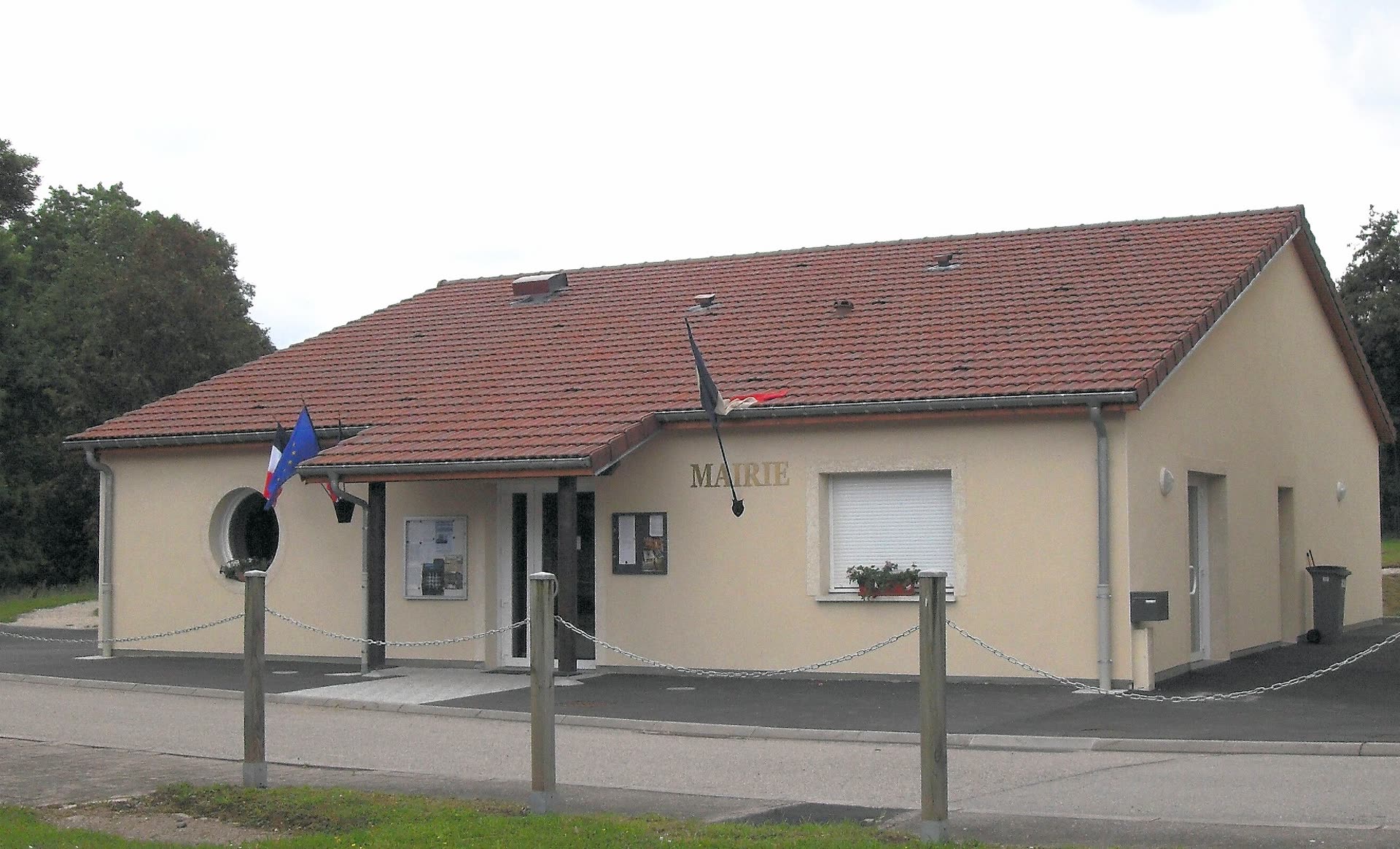
Pictured: the mairie (town hall) of Circourt, Vosges, photographed in 2010 — not the sighting itself, which occurred over nearby woods while the witness was driving through the surrounding countryside. No photograph, film, or other visual record of the 1979 event is known to exist; the entire evidentiary record consists of the officer's and his passenger's testimony and GEIPAN's own case file. Photo by Rauenstein, via Wikimedia Commons, licensed CC BY-SA 3.0.
Theoretical Alignment
This case's weighting sits close to even between Extraterrestrial and Psycho-Social framing, a genuinely different balance than several of this site's other GEIPAN files. The witness's own occupational background — an active-duty French Air Force officer, plausibly familiar with aircraft configurations, flares, and formation lighting from direct professional experience — is a real positive signal for Extraterrestrial framing that this site's methodology weighs seriously. But that same case pulls unusually hard toward Psycho-Social framing for a specific, narrow reason: the witness himself volunteered a conventional, military explanation for part of what he experienced (the double “bang”), which this site's own analysis treats as a meaningfully different situation from a witness who simply reports what they saw and leaves interpretation to investigators. A witness reaching for his own professional frame of reference to explain even part of an anomalous night is not itself evidence the whole event was mundane — but it is evidence that this witness, credentialed as he was, did not experience the night as inexplicable in every respect, which this site's own scoring treats as a real, if partial, tempering factor. Interdimensional framing remains this case's lowest-weighted category, as in nearly every file in this site's published GEIPAN archive, resting only on the sighting's unresolved status rather than on anything distinctly otherworldly in the witness's own account.
Background
Two things need to be understood before this sighting itself makes sense: the character of the small Vosges commune where it happened, and the specific, real military context — both the region's own deep history of war and a very live, ongoing Cold War air-defense mission — that likely shaped how its central witness immediately began trying to explain part of what he saw.
Circourt: A Small Commune in the Vosges
Circourt is a small rural commune in the Vosges department, in what was historically Lorraine and is today part of the Grand Est region of northeastern France. Sitting within the arrondissement of Neufchâteau, roughly 15 kilometers from Épinal, the Vosges department's own capital, Circourt covers barely six square kilometers, with an average elevation around 370 meters above sea level and terrain typical of the region: rolling farmland giving way to forest, exactly the kind of wooded landscape GEIPAN's own file places beneath the two lights this case investigates. The commune's population has remained small and largely static for decades, sitting in roughly the 80-to-100-resident range across recent censuses — the kind of place where an unusual light in the sky on a November evening would be a genuinely rare occurrence, witnessed, if witnessed at all beyond the officer's own car, by people who knew each other and who would have had every reason to compare notes afterward.
A Landscape Still Shaped by War
The Vosges is not an arbitrary backdrop for this case; the department's own 20th-century military history is directly relevant to understanding why a serving Air Force officer, encountering a strange double concussion in its skies barely thirty-five years later, might reach first for a military explanation rather than any other kind. Between September 1944 and February 1945, the Vosges mountains were the site of the Battle of the Vosges, one of the costliest and most protracted campaigns of the liberation of France: American Seventh Army divisions, alongside French troops including General Philippe Leclerc's 2nd Armored Division and General Jean de Lattre de Tassigny's 1st French Army (which had landed in Provence rather than Normandy), fought through narrow, forested valleys against entrenched German defenders in what military historians describe as the first sustained German resistance encountered in France after the collapse of the Normandy front. The fighting dragged on through a brutal winter, incorporated colonial troops and the Japanese-American 442nd Regimental Combat Team, and was not fully resolved until well into 1945. This site's own research treats this history as directly relevant background, not incidental color: the Vosges of 1979 was a department whose living memory, only one generation removed, was saturated with the sound and sight of military aircraft, artillery, and armor moving through exactly the kind of forested terrain the two 1979 lights hovered above, a landscape whose residents — and whose institutions, including its gendarmerie — had every reason to interpret an unexplained aerial phenomenon through a military lens first.
The Force de Frappe and Cold War Skies Over Eastern France
More directly relevant still is the specific, active military mission still operating in French skies at the exact moment of this sighting. By November 1979, France's nuclear deterrent — the Force de Frappe — had relied for roughly fifteen years on the Dassault Mirage IV, a supersonic strategic bomber capable of Mach 2.2, as one leg of its nuclear triad. Through the mid-to-late 1970s, the Mirage IV force was deliberately dispersed across nine squadrons at bases scattered around France specifically to reduce vulnerability to a first strike, and two of those bases — Saint-Dizier, roughly 90 kilometers northwest of Circourt in the Haute-Marne, and Luxeuil, roughly 60 kilometers to the southeast in the Haute-Saône — sat close enough to the Vosges that routine deterrent-patrol and training flights from either could plausibly have passed near the department on any given evening. By the second half of the 1970s, doctrine had also begun shifting the Mirage IV force from high-altitude toward low-level penetration profiles in response to growing Soviet surface-to-air missile capability, but the aircraft's original design mission — and a meaningful share of its ongoing training regime — still centered on sustained high-altitude supersonic flight, exactly the profile the witness himself would invoke as his own explanation for the acoustic half of this sighting. This site's own research treats this as important, verifiable context for weighing that self-offered hypothesis on its own terms later in this file, without treating its plausibility as equivalent to a confirmed finding.
GEIPAN, Two Years Into Its Existence
Institutionally, this sighting falls early in the history of official French UAP investigation. Claude Poher had founded GEPAN, GEIPAN's founding predecessor agency, at Toulouse's CNES only two years before this sighting, in 1977. The agency would not be renamed SEPRA until 1988, nor reach its current name and mandate, GEIPAN, until 2005 — meaning the investigators who handled this specific case in 1979 were working within a genuinely young, still-forming institutional framework, one that had not yet built out the kind of systematic cross-checks against military radar and flight logs that this site's research has documented GEIPAN applying to some of its more recent case files. This site's own analysis treats the case's early institutional context as a real, if modest, contributing factor to why no apparent attempt was made to check the witness's own military-patrol hypothesis against any actual flight-operations record from the period, despite the witness's own professional standing.
Complete Timeline
| Date | Event |
|---|---|
| Sept. 1944 – Feb. 1945 | The Battle of the Vosges: American and French forces fight German defenders through the same forested terrain that would host this sighting 35 years later. |
| 1964 | The Dassault Mirage IV enters service as the airborne leg of France's nuclear Force de Frappe. |
| 1977 | Claude Poher founds GEPAN, GEIPAN's founding predecessor agency, at CNES in Toulouse. |
| Nov. 14, 1979, ~17:42 | Sighting begins. An Air Force officer and a passenger, driving near Circourt, see two red-orange lights stabilize roughly 100m above the woods. |
| Same evening, moments later | Sequential extinguishing. The two lights go dark one after another, with no sound. |
| Same evening, +30 seconds | The double “bang.” A near-simultaneous double concussion is heard; the witness privately attributes it to a high-altitude military patrol breaking the sound barrier — his own hypothesis, unconfirmed by GEIPAN. |
| Same evening, +1 minute | The sequence repeats, further north. Two more lights appear at the same altitude and distance but a different bearing; they extinguish within five seconds of each other. |
| Same evening / following days | Local press reports that other residents across the surrounding area witnessed the same phenomenon; the gendarmerie collects no further testimony from any of them. |
| 1979 (date not published) | GEIPAN classifies the case D: strange to very strange, medium-to-strong consistency, unexplained. |
| 1988 | GEPAN is reorganized as SEPRA. |
| 2005 | SEPRA is reorganized as GEIPAN, with a new public-transparency mandate. |
| June 23, 2021 | GEIPAN's published online case file for 1979-11-00679 is last updated. |
Detailed Narrative
An Officer on Leave, Behind the Wheel
GEIPAN's own case synthesis is unusually specific about its central witness's status: he is described as an “officier de l'armée de l'air en congé” — an Air Force officer on leave — driving a car with a passenger near Circourt at around 17:42 on the evening of November 14, 1979. This site's own research treats that occupational detail as the single most consequential fact in the entire case file, for reasons this file returns to repeatedly: a witness with active military aviation training and experience offers a meaningfully different, and generally more informative, kind of testimony than an equivalent civilian account, both because of what such a witness is more likely to correctly rule out and because of what such a witness might, in turn, be more inclined to explain away using his own professional frame of reference. Mid-November at this latitude places sunset in eastern France at roughly 17:00 to 17:10 local time; a sighting beginning around 17:42 would therefore have unfolded not in full darkness but within the tail end of civil twilight — still enough ambient light in a clear sky to make silhouettes and general shapes visible, while dark enough for two point-source lights above a forest to stand out clearly.
Two Lights, Stabilizing, Then Silence
What the two witnesses first noticed, per GEIPAN's file, were “deux lumières ponctuelles couleur rouge orangé” — two point-source lights, red-orange in color — “assez rapprochées,” fairly close together. Rather than simply crossing the sky, the lights “se stabilisent à une altitude d'environ 100 mètres au-dessus des bois” — stabilized at an altitude of roughly 100 meters above the woods below — before extinguishing “l'une après l'autre,” one after the other. GEIPAN's file specifies that “aucun bruit n'est remarqué” — no sound was noticed — during this entire phase. This site's own analysis treats the stabilization detail as this case's single most distinctive observational feature: rather than a light glimpsed briefly in transit, as in several of this site's other GEIPAN files, this is an explicit, sustained hover at a fixed, estimated altitude, long enough for two observers in a moving vehicle to register both the altitude and the sequential nature of the two lights' extinguishing. A genuinely stationary hover of this kind, sustained without any visible means of aerodynamic lift and without any accompanying engine noise, is a comparatively rare and specific detail within this site's own published GEIPAN archive.
A Double “Bang,” Thirty Seconds Later — and the Witness's Own Theory
GEIPAN's file describes what happened next in careful, almost procedural language: “Trente secondes plus tard, un double « bang » quasi simultané se produit ; le témoin pense qu'il s'agit probablement du passage du mur du son par une patrouille à haute altitude” — thirty seconds later, a nearly simultaneous double “bang” occurred; the witness believes it was probably the passage of a high-altitude patrol through the sound barrier. This site's analysis treats the exact phrasing here as important and worth preserving precisely: this is explicitly the witness's own belief (“le témoin pense”), offered as his own tentative interpretation, not a conclusion GEIPAN's own investigators independently reached, tested, or confirmed anywhere else in the file. It would be a mischaracterization of this case to describe the double bang as “explained” by a military patrol; what actually happened is that one credentialed witness, drawing on his own professional background, offered his own best guess for one specific part of a longer, still-unresolved sequence — a guess this site's own Conventional Explanation Candidate section below examines directly and independently, on its own separate merits, rather than accepting or dismissing at face value simply because it came from a witness with relevant credentials.
The Pattern Repeats, Further North
GEIPAN's file continues: “Une minute plus tard, deux lumières apparaissent à la même altitude et à la même distance, mais plus au nord que les premières ; cinq secondes plus tard, ces lumières s'éteindront l'une après l'autre” — one minute later, two lights appeared at the same altitude and the same distance, but further north than the first pair; five seconds later, these lights extinguished one after the other. This site's own research treats the recurrence of this specific pattern — a paired appearance, a consistent altitude and distance, and a sequential extinguishing — as more analytically significant than either individual phase considered alone. A single unexplained light is more readily attributed to a wide range of ordinary causes; a repeating, structurally consistent pattern, recurring at the same reported altitude and range but shifted geographically, is a meaningfully harder pattern to explain away as two unrelated, coincidental events. This site's analysis also flags a real asymmetry worth noting honestly: GEIPAN's file does not specify how quickly the first pair of lights extinguished relative to each other, only that the second pair did so within five seconds — a level of detail this site's research could not resolve as either a genuine behavioral difference between the two occurrences or simply a gap in how thoroughly the witnesses' testimony was originally recorded.
Local Press, and the Witnesses Nobody Interviewed
GEIPAN's own file adds one further, tantalizing detail: “La presse locale rapporte également que plusieurs personnes du secteur ont été témoins de ce phénomène” — the local press also reported that several people in the area had witnessed this phenomenon. Immediately afterward, however, the file states plainly: “Aucun autre témoignage ou précision ne seront recueillis par la gendarmerie sur ce phénomène” — no further testimony or detail would be collected by the gendarmerie regarding this phenomenon. This site's own research attempted, through multiple search passes across French newspaper archives, regional press indexes, and specialized ufology compilations covering French sightings from the 1970s, to independently locate the specific local press coverage GEIPAN's own file references — and came up empty. No surviving digitized regional paper (successor titles to the era's Vosges press, national UFO-newspaper-clipping archives, or French ufology databases specifically indexing Lorraine-region sightings) could be found naming Circourt, the date, or a matching description. This site's own analysis treats this as a genuine, honestly-reported gap in the public record rather than grounds to doubt GEIPAN's own citation: GEIPAN's investigators, working in 1979 or shortly after, would have had direct access to the actual local paper and its actual reporting in a way no search conducted nearly half a century later can fully replicate or verify independently. The practical result, though, is that this case's most tantalizing corroborating detail — other named or unnamed regional witnesses to the same phenomenon — remains asserted by GEIPAN's own file but neither independently verifiable by this site's research nor, per GEIPAN's own explicit statement, ever actually investigated by the gendarmerie at the time.
What GEIPAN Did, and Did Not, Do
Unlike several of this site's other published GEIPAN files, in which investigators are shown explicitly testing and eliminating a specific list of named conventional candidates (compare this site's Port Vila Fishermen's Sighting file, where GEIPAN's own file states directly that aircraft, boat, weather balloon, and signal lighting were each considered and ruled out), GEIPAN's published file for this case contains no equivalent list of tested and eliminated candidates. What survives is a description of the phenomenon, the witness's own tentative acoustic hypothesis, a note that further corroborating testimony was never gathered, and a closing classification of D: unexplained despite the evidence GEIPAN had in its possession. This site's own research found no indication that GEIPAN, or any other body, ever cross-checked the witness's own military-patrol hypothesis against actual French Air Force flight-operations records for the evening of November 14, 1979 — a real, notable gap given that the witness's own credentials would have made such a cross-check unusually straightforward to request through official channels, at least in principle, even accounting for the genuine sensitivity historically surrounding French military flight-log disclosure.
GEIPAN's own glossary distinguishes two sub-tiers within Class D: D1, covering strange phenomena of moderate consistency, typically resting on a single witness with no photographic or video documentation, and D2, covering very strange phenomena of strong consistency, typically involving multiple independent witnesses and/or photographic or video evidence and/or ground traces. GEIPAN's own published file for this case states only the general classification “D,” without specifying which sub-tier applies, and this site's own analysis found it a genuinely difficult case to place confidently into either bucket using the glossary's own stated criteria. Two witnesses technically exceeds the single-witness profile the glossary associates with D1, but those two witnesses shared one vehicle and one vantage point rather than constituting the kind of separated, mutually independent observation the glossary's own D2 language seems to contemplate, and no photographic, video, or ground-trace evidence of any kind exists to push the case toward D2 on those separate grounds. This site's own assessment treats the case as sitting closer to D1 in practical evidentiary weight despite its two-witness headcount, precisely because that headcount reflects shared rather than independent corroboration — a distinction this site's broader methodology applies consistently whenever a GEIPAN case's raw witness count could otherwise overstate its real corroborative strength.
Key Witnesses
T1 — Air Force Officer, on leave (identity withheld per GEIPAN's standard anonymization practice)
The case's central witness: an active-duty French Air Force officer, on leave at the time, driving near Circourt with a passenger when the sighting began. GEIPAN's file does not specify his rank, unit, aircrew status, or specific role within the Air Force, only his general military occupation — but that occupational detail alone is treated in this site's own analysis as the single strongest credibility factor in the entire case, both for what it lends to his account of the lights themselves and for the specific, tentative military explanation he offered for the acoustic event that followed thirty seconds later.
T2 — Passenger (identity withheld per GEIPAN's standard anonymization practice)
The second witness present for the sighting, riding alongside the officer. GEIPAN's published file offers no individualized detail about this witness's occupation, gender, or relationship to T1, and largely folds this witness's testimony into the officer's own account rather than presenting it as a separately distinguished record — a real limitation on how much independent corroborative weight this site's own analysis can assign to this second witness specifically.
T3 — Unnamed Regional Witnesses (referenced via local press; never formally interviewed)
GEIPAN's own file states that local press reported several other people in the area witnessed the same phenomenon, but the gendarmerie collected no formal testimony from any of them and recorded no further identifying or descriptive detail. This site's own independent research could not locate the specific press coverage GEIPAN's file references. These additional witnesses remain, on the current public record, an asserted but uninvestigated and independently unverifiable detail rather than a confirmed, weighable corroborating account.
The Five Observables Assessment
The Five Observables framework, developed by the Pentagon's Advanced Aerospace Threat Identification Program to describe performance characteristics beyond known conventional technology, is applied here for comparative consistency across this site's case files. This sighting's defining performance characteristic is a sustained, silent hover at a specific, estimated altitude, followed by a sequential extinguishing — a pattern observed twice, at the same altitude and range but a different bearing.
Assessment: This case earns a rare Present rating for Anti-Gravity Lift within this site's own published GEIPAN archive — a distinction from cases like this site's Port Vila file, where the object was continuously in motion and no genuine hover phase was ever described. Here, GEIPAN's own language is explicit and repeated: both light-pairs “stabilized” at a specific estimated altitude before extinguishing, a sustained, silent, apparently unsupported hover this site's research could not match to any conventional aircraft's normal flight behavior. Hypersonic performance earns only a Speculative rating, and only conditionally: if, and only if, the separate double-bang acoustic event thirty seconds later is treated as physically connected to the same phenomenon rather than as a distinct event (which GEIPAN's own file never explicitly asserts), a supersonic object would be a logical implication of a genuine sonic boom. This site's own analysis is careful not to conflate the two: the visual phenomenon (two hovering, then extinguishing, lights) and the acoustic phenomenon (a double bang) are reported sequentially and in proximity, but GEIPAN's file never states they were the same object, leaving Hypersonic performance genuinely speculative rather than confirmed.
Evidence Assessment
Supporting an Anomalous Origin
- The primary witness was an active-duty French Air Force officer, professionally positioned to recognize conventional aircraft lighting, flares, and formation patterns — a real, occupational credibility factor this site's methodology weighs seriously
- The phenomenon displayed a specific, structurally consistent pattern — a paired appearance, a stabilized hover at a fixed estimated altitude, and a sequential extinguishing — that recurred a second time at the same altitude and distance but a different bearing, a harder pattern to dismiss as two unrelated coincidences than a single isolated light would be
- No sound accompanied the lights' hover or extinguishing phase, despite an estimated altitude of only about 100 meters — low enough that a conventional aircraft's engine noise would ordinarily be expected to be clearly audible from the ground
- Local press reportedly recorded additional regional witnesses to the same phenomenon the same evening, per GEIPAN's own file, suggesting the display, if accurately described, was visible well beyond the one vehicle
- GEIPAN's own investigation, working from a genuinely credentialed witness, still closed the file classified D: unexplained, rather than resolving it to any of the ordinary explanations available to a young but functioning federal investigative body
Supporting a Conventional/Mundane or Inconclusive Origin
- Only two primary witnesses exist, both riding in the same vehicle, sharing one vantage point rather than constituting independent, separated observations
- The witness's own tentative explanation for part of the event — a military patrol breaking the sound barrier — is a real, professionally-informed conventional hypothesis for at least the acoustic portion of the sighting, even though GEIPAN never confirmed it and it does not address the lights themselves
- The additional regional witnesses GEIPAN's file references via local press were never interviewed by the gendarmerie, and this site's own independent research could not locate any surviving period press coverage corroborating or detailing that claim
- No photograph, video, radar track, or other instrumented corroboration of any kind exists; the entire evidentiary record rests on testimony recorded 47 years before this case file's publication
- The case sits within the first two years of GEIPAN's founding predecessor agency's existence, before more systematic radar and flight-log cross-checks (of the kind this site's research has documented on some of GEIPAN's more recent case files) were institutionally standard practice
Why “Open”
This case is stamped Open because it combines a genuinely strong occupational credibility factor with a genuinely thin corroborating record, and because its most distinctive analytical wrinkle — a credentialed witness volunteering his own conventional explanation for part of what he experienced — cuts in two directions rather than one. On the positive side: an active French Air Force officer, presumably far better positioned than an average civilian witness to recognize ordinary aircraft, flares, or formation lighting, still described a specific, repeating, silent hover-and-extinguish pattern he apparently could not resolve to anything conventional on his own, and did so alongside a second witness riding in the same vehicle. The recurrence of that pattern — the same altitude, the same distance, a different bearing, a minute later — is a real structural detail that, in this site's own assessment, argues against a simple, single misidentified light.
Working against a higher score are several real, specific limiting factors. First, only two witnesses exist, sharing one vehicle and one vantage point, the same limiting evidentiary pattern this site's research has flagged in several of its other GEIPAN files (compare this site's Étrelles and Palau-del-Vidre files). Second, and more specific to this case: the witness's own tentative acoustic explanation, however professionally informed, is a real conventional-explanation candidate this site cannot simply set aside, even though GEIPAN's file never confirms it and it does not by itself account for the light phenomenon that preceded it. Third, the additional regional corroborating witnesses GEIPAN's own file cites via local press were never actually interviewed, and this site's own dedicated search could not independently locate or verify the underlying press coverage nearly half a century later — leaving what could have been this case's strongest corroborating detail asserted, but not confirmable. Fourth, the case is 47 years old, falls within GEIPAN's founding agency's earliest, least procedurally mature period, and carries no photograph, video, or radar data of any kind. Weighed together — a credentialed witness's structurally consistent, twice-repeating account, against a two-witness shared vantage point, an unconfirmed self-offered partial explanation, an unverifiable corroboration claim, and total absence of instrumented data — this case is scored in the middle of this site's published GEIPAN Open archive: above cases resting on a single uncorroborated civilian witness with no distinguishing structural detail, but below cases carrying either genuine instrumented cross-checks or fully independent, separately-vantaged multiple witnesses.
Sensor & Instrumentation Detection Profile
No photograph, video, radar track, or other instrumented recording of any kind exists for this sighting. This site's own research found no indication that any French Air Force flight-operations log, civil or military radar record, or air-traffic-control record was ever checked against the reported time, location, and altitude — a real, specific investigative gap given that the witness's own military status would, at least in principle, have made requesting such a cross-check more straightforward than for an equivalent civilian witness. GEIPAN's founding predecessor agency was barely two years old at the time of this case, and this site's research found no evidence that the kind of systematic radar or flight-log cross-referencing it has documented on some of GEIPAN's later case files (compare the BOAM meteor-camera cross-check in this site's Étrelles file) was yet standard practice in 1979.
What this case's investigative record does include, in place of any instrumented data, is the witness's own informal acoustic hypothesis — itself a kind of improvised, professionally-informed sensor substitute, given that trained aircrew are taught to recognize the acoustic signature of supersonic flight. This site's own research separately confirms that the physical mechanism the witness invoked is real and well documented: a single supersonic aircraft's bow shock and tail shock can arrive at a ground observer as two distinct, closely-spaced concussions rather than one continuous boom, a documented acoustic phenomenon independent of this specific case. That confirms the witness's hypothesis is physically coherent on its own terms; it does not, on its own, confirm that a supersonic aircraft was actually present over Circourt that evening, a distinction this site's Conventional Explanation Candidate section below examines directly.
Environmental & Geospatial Context
Geographically, the sighting occurred over wooded terrain immediately around Circourt, a small commune roughly 15 kilometers from Épinal, in the Vosges department's rolling, forested countryside at an average elevation around 370 meters. GEIPAN's own file describes the sky as “dégagé” — clear — with no other weather detail specified. Astronomically, mid-November at this latitude (roughly 48.25°N) places sunset at approximately 17:00–17:10 local time; a sighting beginning around 17:42 would therefore have unfolded within the fading window of civil twilight rather than in full darkness — dark enough for two point-source lights against a forested horizon to register clearly, while still retaining enough residual ambient light for the witnesses to make out the woodline itself and estimate the lights' altitude relative to it.
Militarily, the sighting's location sits within reasonable range of two Mirage IV strategic-bomber bases active at the time: Saint-Dizier, roughly 90 kilometers to the northwest, and Luxeuil, roughly 60 kilometers to the southeast, both hosting squadrons of France's nuclear deterrent force through the late 1970s. This site's own research treats this proximity as directly relevant to assessing the plausibility of the witness's own acoustic hypothesis, without treating proximity alone as proof that an aircraft from either base was actually operating over Circourt on this specific evening — no flight-operations record confirming or ruling out such activity on November 14, 1979, was available to this site's research.
Within this site's own published GEIPAN archive, the most relevant points of comparison for this sighting's specific evidentiary shape — a credentialed witness, a shared two-person vantage point, no instrumented corroboration — are this site's Étrelles High-Speed Object (Open, case #265, 2014) and Palau-del-Vidre Black Triangle (Open, case #264, 2008) files, both of which similarly rest on two co-located witnesses observing from one shared vantage point rather than fully independent, separated positions.
Observer Credibility & Occupational Profile
This case's primary witness carries the single strongest occupational credibility factor of nearly any file in this site's published GEIPAN archive: an active-duty officer of the French Air Force, on leave at the time of the sighting. This site's own analysis treats military aviation training and professional experience as directly relevant to weighing a witness's ability to distinguish an unfamiliar aerial phenomenon from a conventional aircraft, flare, or formation-lighting display — precisely the kind of professional frame of reference this site's Theoretical Alignment section above credits for pulling this case's own weighting away from a purely civilian-witness profile. GEIPAN's file, notably, does not specify the officer's exact rank, unit, or role (aircrew, ground officer, or otherwise), which limits how far this site's own analysis can push the credentialing argument beyond the general fact of his military aviation occupation.
The same occupational background cuts in a second, more complicated direction that this site's research treats as this case's most genuinely interesting credibility wrinkle: this witness did not simply report what he saw and defer to investigators for interpretation, as most witnesses across this site's GEIPAN archive do. He actively offered his own tentative, professionally-informed explanation for one specific part of the event — the double bang — drawing directly on his own military background. This site's own methodology treats that fact as double-edged rather than simply positive or negative: on one hand, it is a mark of a genuinely careful, non-sensationalizing witness, unwilling to over-claim mystery where his own professional judgment offered him a plausible mundane account; on the other, it is a reminder that this witness's own interpretive filter was actively engaged throughout the event, and that his silence on any comparable conventional explanation for the lights themselves should be read as a genuine absence of one in his own professional judgment, not merely an oversight.
The second witness, the passenger, receives no comparable individualized profile in GEIPAN's published file, and the unnamed regional witnesses referenced via local press receive none at all, having never been formally interviewed. This asymmetry means the case's entire credibility weighting rests overwhelmingly on one individual's occupational background, a real limitation this site's scoring accounts for directly.
Physical & Material Assays
No physical trace evidence exists in this case, and none would be expected given its circumstances: the phenomenon was observed entirely in the air, above forested terrain the witnesses did not approach or enter, with no landing, no ground-level contact, and no debris or residue of any kind reported. Accordingly, this case has no soil, vegetation, or material sample associated with it, and no metallurgical, isotopic, or trace-chemical assay was performed or would have been applicable given the sighting as described.
Historical Precedents & Archive Matches
This case's most useful points of comparison within this site's own published archive fall into two categories: other GEIPAN sightings resting on a shared, two-person vantage point, and this site's only other file built substantially around a credentialed, occupationally-informed witness.
Étrelles and Palau-del-Vidre: The Shared-Vantage-Point Pattern
The Étrelles High-Speed Object (Open, case #265, 2014) and the Palau-del-Vidre Black Triangle (Open, case #264, 2008) both give this site substantial prior grounding in weighing witnesses who observed together from one shared position rather than from separated, genuinely independent vantage points. Like both of those cases, this file's two witnesses shared a single vehicle and, almost certainly, a single running conversation about what they were seeing in real time — a real corroborative limitation this site's methodology applies consistently across all three files, even while crediting each case's own specific structural or occupational strengths on their own terms.
Port Vila: Occupational Credibility, Compared
This site's Port Vila Fishermen's Sighting (Open, case #268, 1978) remains the closest available comparison for weighing occupational credibility directly: three fishermen, professionally experienced at distinguishing ordinary boat and aircraft lights from the water after dark, versus this case's single Air Force officer, professionally experienced at distinguishing ordinary aircraft and flares from the air or ground. Both witness profiles earn a real, if differently-shaped, credibility premium in this site's own methodology over an equivalent witness with no comparable frame of reference; this case's own credentialing arguably runs deeper for the specific phenomenon in question (aerial lights and an acoustic event, squarely within a serving Air Force officer's own professional domain, rather than a fisherman's necessarily more general familiarity with vessel lighting), but Port Vila's three-witness base offers broader corroboration than this case's two co-located witnesses. So far as this site's own published GEIPAN archive extends, this appears to be its only case centered on an active military aviation professional as primary witness, making it a genuinely distinct entry within that archive's broader occupational-credibility spectrum, alongside Port Vila's civilian-maritime profile.
Set Against the Wider GEIPAN Pattern
GEIPAN's own published statistics classify roughly 3.1% of its full archive of over 3,300 investigated cases as Type D — unidentified despite the evidence GEIPAN had in its possession — against 28% resolved as perfectly identified, 39% as probably identified, and 30% left unanalyzable for lack of sufficient information. As the final entry in this site's current run of published GEIPAN case files, this case's combination of a genuinely credentialed single witness, a structurally consistent, twice-repeating light pattern, an unconfirmed but professionally-informed partial acoustic explanation, and an unverifiable secondhand corroboration claim places it in the middle of that broader Type-D landscape: neither as thinly evidenced as a single, uncorroborated civilian account with no distinguishing structural feature, nor as strongly corroborated as a case with either genuine multi-witness independence or any surviving instrumented data.
Material Analysis
As detailed in the Physical & Material Assays section above, this case involves no physical or trace evidence of any kind. The phenomenon was observed entirely in the air over forested terrain the witnesses never approached, and no landing, debris field, or other ground-level effect was ever reported by either witness.
Supporting Non-Terrestrial Origin
- No confirmed physical evidence exists to test in the first place, so no terrestrial material-composition finding contradicts an anomalous interpretation either
- A professionally credentialed Air Force officer describes a specific, sustained, silent hover at a fixed estimated altitude — a pattern this site's research could not match to any conventional aircraft's normal flight behavior — recurring a second time in structurally identical form
Supporting Terrestrial Origin
- No photograph, video, radar track, or physical trace of any kind exists; the entire evidentiary record rests on testimony recorded 47 years ago, with no surviving primary document this site's research could directly examine beyond GEIPAN's own published synthesis
- The witness's own tentative, professionally-informed acoustic explanation for the double bang is a real, physically coherent conventional hypothesis for at least part of the sighting, even though it remains unconfirmed by GEIPAN and does not address the lights themselves
The Conventional Explanation Candidate: Flares, Aircraft, and the Witness's Own Sonic-Boom Theory
Unlike this site's Port Vila file, GEIPAN's own published record for this case does not list a specific set of tested and eliminated conventional candidates. What follows is this site's own independent analysis of the leading candidates, weighed on their own terms against the details GEIPAN's file does provide.
Military Signal or Parachute Flares
A pair of red-orange lights that stabilize briefly at a fixed altitude before extinguishing sequentially is, in isolation, a reasonably close visual match for military signal or parachute flares, which are commonly deployed in pairs or small groups, burn with a characteristic orange-red glow, and extinguish (or fall below the treeline) at broadly similar intervals to what GEIPAN's file describes. This site's research found no record of any specific military training exercise scheduled in the immediate Circourt area on November 14, 1979, in any source it was able to access, leaving this candidate genuinely plausible on visual grounds but unconfirmed on the specific evidentiary point that would settle it.
A Distant Aircraft's Lighting
A conventional aircraft on a flight path angled toward or away from the witnesses could, in principle, present as a stationary-seeming light for a period before banking away or descending below the treeline. This site's own analysis finds this candidate a comparatively weak fit for the specific reported pattern: an aircraft's lighting does not typically extinguish sequentially in the way GEIPAN's file describes for both light-pairs, nor would a single aircraft easily account for the phenomenon recurring a full minute later at the same altitude and distance but a different bearing, which would require a second, near-identical aircraft on a near-identical profile within the same brief window.
Meteor or Bolide
A bright meteor could plausibly produce a brief flash of red-orange light, but this site's analysis finds it a poor match on duration and behavior grounds: a meteor's visible flight is characteristically a matter of one to a few seconds along a single trajectory, not a sustained stabilization at a fixed altitude, and would not recur as a structurally identical paired event a minute later at a different bearing.
Sky Lanterns or Airborne Debris
This site's research also considered floating sky lanterns, whose slow drift and eventual burnout could superficially resemble a reddish light extinguishing in place. This candidate is weak specifically for its period and location: sky lanterns were not yet a widespread practice in rural 1970s France, and this site's research found no evidence of any local festival, celebration, or similar occasion in the Circourt area on November 14, 1979, that might have involved them.
The Double “Bang”: The Witness's Own Sonic-Boom Hypothesis, Examined on Its Own Terms
Considered strictly as an explanation for the acoustic event alone — and not for the lights that preceded it — the witness's own hypothesis is genuinely well-grounded. A single supersonic aircraft's bow shock and tail shock can reach a ground observer as two distinct, closely-spaced concussions rather than one continuous boom, a documented acoustic phenomenon independent of this specific case, and France's Force de Frappe maintained active Mirage IV squadrons at Saint-Dizier and Luxeuil, both within roughly 60–90 kilometers of Circourt, through the exact period of this sighting. This site's own analysis rates this hypothesis plausible for the acoustic event considered in isolation, while remaining genuinely inconclusive as an account of the sighting as a whole: GEIPAN's file never asserts that the same object produced both the lights and the bang, no flight-operations record confirming activity over Circourt on this specific evening was available to this site's research, and a real, still-unresolved twenty-second gap separates the lights' extinguishing from the bang's arrival, a delay this site's research could not confidently reconcile with any single, simple physical account connecting the two phases into one continuous event.
Military Signal / Parachute Flares
InconclusiveA reasonably close visual match for the paired, sequentially-extinguishing red-orange lights, but no record of a confirmed exercise at this date and location was found.
Distant Aircraft Lighting
ImplausibleA poor fit for a sequential extinguishing pattern recurring twice at the same altitude/distance but a different bearing a minute apart.
Meteor / Bolide
ImplausibleA poor match for a sustained, stabilized hover and a structurally repeating paired pattern.
Sky Lanterns / Airborne Debris
ImplausibleNot yet a widespread practice in rural 1970s France; no local occasion found that would explain their presence.
Double Bang as Military Sonic Boom (Witness's Own Hypothesis)
Plausible InconclusivePlausible as an explanation for the acoustic event alone, given active Mirage IV bases within range; inconclusive as an account of the full sighting, since GEIPAN's file never links the bang to the lights and no flight-log confirmation was available.
Related Cases
Confirmed Documents & Official Records
The official French government case summary: the officer's and his passenger's testimony, the local-press reference to additional witnesses, and the case's D classification.
GEIPAN's own published definitions, including the Class D category (unexplained despite the evidence in GEIPAN's possession) applied to this case, and the D1/D2 sub-tiers distinguishing single- from multi-witness/documented cases.
GEIPAN's own account of its 1977 founding as GEPAN, barely two years before this case, and its later reorganizations into SEPRA (1988) and GEIPAN (2005).
GEIPAN's own live statistics dashboard: roughly 3.1% of its full case archive is classified Type D, the same category applied to this case.
Further Reading — Recommended Literature
Passport to Magonia: On UFOs, Folklore, and Parallel Worlds
Vallée's foundational, internationally-scoped catalog of anomalous aerial phenomena reports provides useful comparative grounding for weighing a single credentialed witness's account against a much wider historical pattern.
UFOs: Generals, Pilots, and Government Officials Go on the Record
A collection built substantially around credentialed military and aviation witnesses — directly relevant to weighing this case's own active-duty Air Force officer witness against a broader international pattern of professional testimony.
UFOs and Government: A Historical Inquiry
Includes a chapter on France's own government UAP-investigation framework, directly relevant to understanding the young GEPAN agency that handled this case just two years after its founding.
A Sword for Peace and Liberty, Volume 1: Force de Frappe — The French Nuclear Strike Force and the First Cold War, 1945–1990
A detailed history of the Mirage IV force and France's nuclear deterrent, directly relevant to independently assessing the plausibility of the witness's own sonic-boom hypothesis for this case's acoustic event.
When the Odds Were Even: The Vosges Mountains Campaign, October 1944–January 1945
A detailed military history of the Battle of the Vosges, providing the regional historical background for understanding the department's deep, living military memory just 35 years before this sighting.
Essential Viewing
No Videos Available
Sources
- GEIPAN (CNES), “CIRCOURT (88) 14.11.1979”, Case 1979-11-00679 — official case summary
- GEIPAN (CNES), official case archive & public portal — geipan.fr
- GEIPAN (CNES), Glossaire du GEIPAN — official classification definitions, A/B/C/D and D1/D2
- GEIPAN (CNES), Son histoire — institutional history: GEPAN (1977), SEPRA (1988), GEIPAN (2005)
- GEIPAN (CNES), Statistiques — official classification statistics (Types A/B/C/D) across GEIPAN's full case archive
- Wikipedia (English), “Circourt” — geography, population, and coordinates
- Wikipedia (English), “Vosges (department)” — departmental geography and history
- Wikipédia (French), “Bataille des Vosges (Seconde Guerre mondiale)” — 1944–45 campaign history
- Persée / Revue historique des armées, “La bataille pour les Vosges (Octobre–Décembre 1944)” — academic military-history account
- Wikipedia (English), “Dassault Mirage IV” — Force de Frappe role, performance, and late-1970s basing (including Saint-Dizier and Luxeuil)
- Avions Légendaires, “Explication du mur du son en images” — the physics of double sonic booms from a single supersonic aircraft
- Wikipedia (English), “Épinal” — the Vosges department's capital, nearest city to Circourt
- Wikimedia Commons, File: Circourt, Mairie.jpg, photo by Rauenstein, CC BY-SA 3.0 — licensing and attribution
- Wikimedia Commons, Category: Circourt — image and map archive for the commune
- This site, case-files/port-vila-fishermens-sighting.html — comparative GEIPAN case on occupational witness credibility
- This site, case-files/etrelles-high-speed-object.html — comparative GEIPAN case on shared-vantage-point witnesses
- This site, case-files/palau-del-vidre-black-triangle.html — comparative GEIPAN case on shared-vantage-point witnesses
- This site, key-figures.html, entry on Claude Poher — GEPAN founding and early institutional history
- This site, locations/index.html, entry on Toulouse — CNES/GEPAN/SEPRA/GEIPAN institutional headquarters
See something inaccurate? Have additional information or sources?
Suggest an Edit →Last Updated: August 2026