
The Port Vila Fishermen's Sighting
Between 7:30 and 8:00 PM on June 7, 1978, three fishermen aboard a boat off Port Vila, the capital of the New Hebrides, watched a white light moving slowly along the coastline. After several minutes it turned and began heading toward them. As it closed the distance, the witnesses reported, it resolved into a craft with colored flames issuing from its rear, moving in total silence — no engine noise, no propeller wash, nothing. Then, just as abruptly, it reversed course back toward the shore and vanished. A separate group of witnesses at Emua, further along Efate's coast, reported their own light that same evening, which GEIPAN's own file treats as probably an unrelated meteor. This sighting reached France's government archive at all only because of a genuine administrative quirk: in June 1978, the New Hebrides was not yet Vanuatu, but a joint Anglo-French Condominium — two colonial powers sharing one territory under separate national administrations, each with its own Resident Commissioner, its own police force, and, on the French side, its own gendarmerie, which is how this remote South Pacific sighting ended up filed, investigated, and eventually classified by the same French government agency that handles sightings from Brittany to the Pyrenees. GEIPAN's investigators tested and ruled out four specific conventional explanations — a conventional aircraft, a boat, a weather balloon, and signal lighting — and concluded that despite a genuinely thorough inquiry, the sighting remains unidentified.
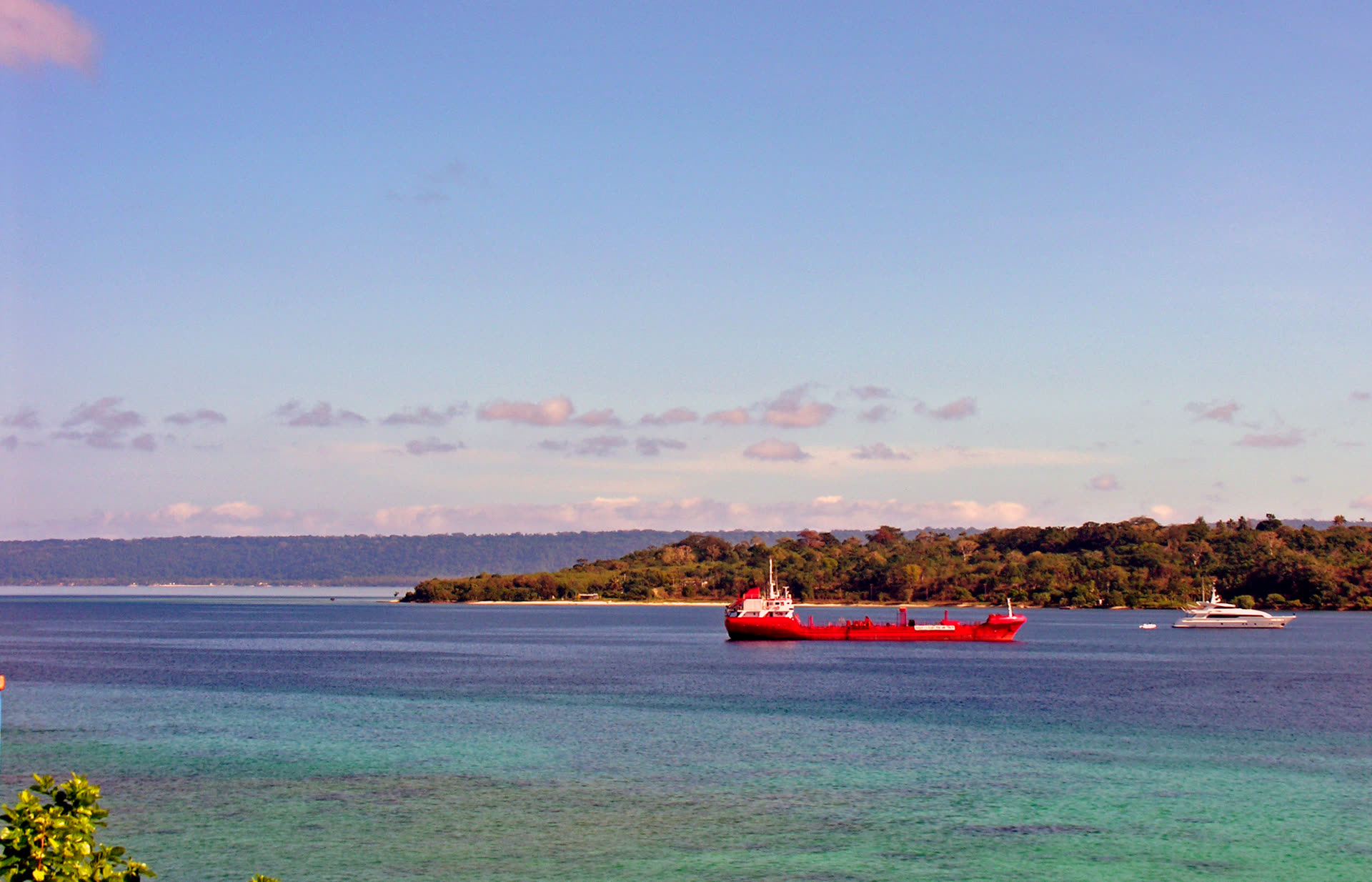
Pictured: Port Vila harbour, Efate Island, photographed in 2006 — not a photograph from 1978, and not of the incident itself, which occurred on open water off this same coastline. No photograph, film, or other visual record of the sighting is known to exist; the entire evidentiary record consists of the fishermen's own testimony and GEIPAN's case file. Photo by Phillip Capper, Wellington, New Zealand, via Wikimedia Commons, licensed CC BY 2.0.
Theoretical Alignment
This case's weighting sits closer to Extraterrestrial framing than several other files in this site's GEIPAN archive, driven mainly by the strength of its witness base: three fishermen, all watching from the same vantage point but constituting a larger corroborating group than the single witnesses or married couples that populate much of this site's other GEIPAN coverage, describing a specific, consistent, and unusual combination — colored flames, total silence, a directed approach, and an abrupt reversal — that survived GEIPAN's own elimination of four separate named conventional candidates. Psycho-Social framing scores lower here than in several comparable files precisely because three broadly independent-seeming observers (even if not fully independent, sharing one small boat) reduces, without eliminating, the likelihood of a purely individual perceptual error. Interdimensional framing remains, as in nearly every file in this site's GEIPAN archive, this case's lowest-weighted category, resting only on the sighting's unresolved status rather than on anything distinctively otherworldly in the fishermen's own account.
Background
Understanding this case requires understanding a genuinely unusual administrative arrangement: in June 1978, the islands now called Vanuatu were neither a French colony, a British colony, nor an independent nation, but a joint Anglo-French Condominium — and that joint structure is the entire reason a South Pacific fishing-boat sighting ended up filed in the same French government UAP archive as a gendarme patrol outside a Breton village.
A Condominium of Two Flags
The New Hebrides Condominium was formalized in 1906, after decades of informal, competing British and French settlement and missionary activity in the archipelago, and it endured for 74 years until independence in 1980. Unlike a conventional shared colony, the Condominium created two fully parallel national administrations operating side by side across the same territory: a British National Service, responsible for British subjects and visitors, with its own British Resident Commissioner and its own police force; a French National Service, responsible for French citizens and subjects, with its own French Resident Commissioner, its own gendarmerie, and its own civil servants; and a small Joint Administration handling only the services genuinely shared between both populations — the post office, public works, customs, and a Joint Court. Two currencies, two education systems, two health services, two prison systems, and even two sets of road laws coexisted under this arrangement, a level of administrative duplication contemporaries and historians alike have described as almost comically cumbersome. At the specific moment of this sighting, the French Resident Commissioner was Bernard Pottier; his successor, Jean-Jacques Robert, would not take up the post until August 9, 1978, exactly two months after this sighting, per the French government's own appointment decree. His British counterpart through this period was Resident Commissioner John Stuart Champion. It was through the French half of this dual structure — specifically, this site's research concludes, the French National Service's own gendarmerie, the direct institutional lineage GEIPAN still relies on today to channel reports from mainland France — that this sighting was first formally recorded, which is the reason it appears in GEIPAN's French government archive at all despite occurring thousands of kilometers from French territory in the ordinary sense.
The Condominium's small Joint Administration, distinct from both national services, deserves its own brief note here, since it is precisely the kind of institution a sighting like this one might otherwise have been expected to pass through. The Joint Court — a tribunal with a president and two judges of neither British nor French nationality, created specifically to hear disputes between the two national communities and to try indigenous New Hebrideans for anything beyond minor offenses — had no evident role in this case, nor did the Joint Administration's other shared functions (the post office, customs, and public works). This site's research treats that absence as consistent with the sighting's own nature: a report from French-registered fishermen, channeled through French national policing, never involved the kind of cross-community legal dispute or shared infrastructure matter the Joint Administration's own narrow mandate was built to handle.
Self-Government, Six Months In
The New Hebrides had become internally self-governing just five months before this sighting, in January 1978, layering a third, indigenous-led tier of authority on top of the dual colonial structure above. George Kalsakau, a moderate, francophone-aligned political figure and former policeman, held the new post of Chief Minister for most of 1978, presiding over a Representative Assembly still bitterly divided between francophone and anglophone, and pro-independence and pro-continuity, factions. That division would not begin to resolve until December 1978, six months after this sighting, when Kalsakau lost a confidence vote and was replaced by Father Gérard Leymang at the head of a Government of National Unity including the anglophone, pro-independence Vanua'aku Pati under Father Walter Lini. Independence itself, and the New Hebrides' renaming as the Republic of Vanuatu, would not arrive until July 1980, two years after this sighting.
Port Vila and Efate: From Cook's Landfall to a Seabee Airfield
Port Vila sits on a natural harbor on the island of Efate, one of the larger islands in the central New Hebrides chain. Captain James Cook, passing through the archipelago in 1774, specifically noted the area's "good harbours and land suitable for European settlement," and by the 1880s the emerging colonial center of the islands had relocated to what was then simply called Vila, after earlier administrative efforts based at Havannah Harbour on Efate's other side were undermined by malaria outbreaks and coastal flooding. The Condominium's 1906 formalization made Vila its official capital. Efate's other defining 20th-century chapter arrived during the Second World War: fearing a Japanese advance toward the sea lanes linking the United States and Australia after the fall of Guadalcanal, the US Navy landed several hundred Marines and Naval Construction Battalion ("Seabee") personnel on Efate beginning in April 1942, rapidly grading a 6,000-foot runway that would become Bauerfield Airfield — named, after the war, for Lieutenant Colonel Harold W. Bauer, a Marine Corps fighter pilot lost over Guadalcanal in November 1942. By 1978, Bauerfield had long since become the New Hebrides' principal civilian airport, still the territory's main gateway 36 years after the Seabees first cleared its runway.
GEIPAN and a Case Filed Under "National (VU)"
GEIPAN's own online database files this sighting under a location field reading "National (VU)," a territory type marked "Autre" (Other), and a specific location code of "Port Vila (988)" — a set of administrative labels this site's research treats as a visible artifact of exactly how anomalous this case is within GEIPAN's own record-keeping. Every other case in this site's published GEIPAN archive carries an ordinary metropolitan French department code; this one does not, because Port Vila was never a French department, an overseas department, or any other ordinary unit of French territorial administration — only, for 74 years, a place where French national law, French national administration, and (crucially for this case) French gendarmerie applied to French subjects and citizens living alongside an equal and entirely separate British administration. This site's own research found no comparable entry anywhere else in GEIPAN's published case archive originating from outside mainland France or France's own overseas departments and territories, making this, so far as this site's research can establish, GEIPAN's only Pacific case, and its only case from a jointly-administered former condominium rather than sole French sovereign or departmental territory. It is worth noting, by way of contrast, that France does maintain several genuine overseas departments and territories elsewhere in the Pacific and Indian Ocean — French Polynesia, New Caledonia, and Wallis and Futuna among them — any of which would represent an entirely ordinary, undisputed piece of French sovereign territory for GEIPAN's purposes. The New Hebrides, by contrast, was never French sovereign territory at all, not even in the qualified sense an overseas department or territory represents; it was, for the entire 74-year span of the Condominium, a territory under the joint and equal sovereignty of two separate states, a genuinely rarer category in twentieth-century colonial history than either a straightforward colony or a straightforward overseas department, and one this site's research found no other parallel to anywhere else in GEIPAN's published archive.
Complete Timeline
| Date | Event |
|---|---|
| 1774 | Captain James Cook visits the New Hebrides, noting Efate's "good harbours and land suitable for European settlement." |
| 1880s | The colonial administrative center of the New Hebrides relocates to Vila on Efate, after earlier efforts at Havannah Harbour are undermined by malaria and flooding. |
| 1906 | The Anglo-French Condominium of the New Hebrides is formally established; Vila is proclaimed the territory's capital. |
| April 1942 | US Marines and Navy Seabees land on Efate and begin building what becomes Bauerfield Airfield, fearing a Japanese advance after the fall of Guadalcanal. |
| 1977 | GEPAN, GEIPAN's founding predecessor agency, is established at CNES under Claude Poher. |
| January 1978 | The New Hebrides becomes internally self-governing; George Kalsakau becomes the territory's first Chief Minister. |
| June 7, 1978, 19:30–20:00 | Sighting begins. Three fishermen off Port Vila watch a white light move slowly along the coast, then turn toward them. |
| Same evening | Close approach and departure. The light resolves into a silent craft with colored flames from its rear; it abruptly reverses toward shore and vanishes. A separate group at Emua reports a light GEIPAN treats as likely a meteor. |
| Date not published | The fishermen's testimony is formally recorded through the French half of the New Hebrides' colonial administration. |
| August 9, 1978 | Jean-Jacques Robert is appointed French Resident Commissioner of the New Hebrides, replacing Bernard Pottier, who held the post at the time of the sighting. |
| December 1978 | Kalsakau is removed as Chief Minister; a Government of National Unity under Father Gérard Leymang and Father Walter Lini takes office. |
| 1978 | Classification. GEIPAN classifies the case D on file 1978-06-00523: aircraft, boat, weather balloon, and signal lighting are all ruled out; the case remains unidentified. |
| July 1980 | The New Hebrides gains independence and becomes the Republic of Vanuatu. |
| March 29, 2022 | GEIPAN's published online case file for 1978-06-00523 is last updated. |
Detailed Narrative
Three Men on a Boat
GEIPAN's own case synthesis places three fishermen aboard a single boat, at sea off Port Vila between 19:30 and 20:00 on the evening of June 7, 1978 — a window that, at Efate's near-equatorial latitude in early June, would have fallen well after sunset, with the tropics' comparatively short, rapid dusk already given way to full darkness. What first caught their attention was unremarkable on its own: "une lumière blanche se déplace lentement en longeant la côte" — a white light moving slowly, hugging the coastline. This site's research treats this opening phase as the single most important descriptive detail for weighing conventional explanations, since a light moving slowly and parallel to a coastline for an extended period is a profile many mundane sources (a boat under way, a vehicle on a coastal road, a fixed light glimpsed through moving foliage) can plausibly produce, at least at first.
Colored Flames, No Sound
What changed the fishermen's assessment, per GEIPAN's file, was what happened once the light turned toward them: "puis vient dans leur direction. Arrivée à leur hauteur, les témoins racontent avoir vu un engin avec des flammes de couleur sortant à l'arrière, sans aucun bruit" — then it came in their direction. Once level with them, the witnesses recount having seen a craft with colored flames coming out of the rear, without any sound at all. This is the same structural pattern this site's research has flagged in other cases across its GEIPAN archive: an object that, at a distance, resembles something ordinary, but that reveals a specific combination of features at close range that resists an easy conventional label — here, flames (plural, and explicitly colored, rather than a single steady exhaust glow) paired with complete silence, a combination no conventional combustion-based propulsion this site's research could identify actually produces. A real internal-combustion or jet engine capable of visible flame emission is, definitionally, also capable of producing audible engine noise; the fishermen's specific pairing of visible colored flame with total silence is the detail GEIPAN's own investigation was ultimately unable to reconcile with any of the conventional candidates it tested.
An Abrupt Reversal
GEIPAN's synthesis describes what happened next in a single, decisive clause: "Effectuant un changement brutal de direction pour repartir vers la côte, il a disparu soudainement, laissant les témoins très impressionnés" — executing an abrupt change of direction to head back toward the coast, it disappeared suddenly, leaving the witnesses deeply impressed. This site's own analysis treats "changement brutal de direction" as functionally distinct from the extreme, near-instantaneous accelerations this site's research has documented in some of its other GEIPAN files (compare the roughly two-second acceleration phase in this site's Étrelles file): what the fishermen describe here is a sharp turn, not necessarily an extreme burst of speed, followed by the object's disappearance from view — plausibly consistent with the object simply moving out of visual range against a dark coastline and a dark sea, rather than a demonstrated instantaneous vanishing in place.
A Second Sighting, Likely a Meteor
GEIPAN's own file records a separate, fourth witness testimony — filed as "EMUA (VU.SEE) 07.06.1978 T4" — from Emua, a village on Efate's coast some distance from Port Vila, describing another light phenomenon that same evening. Rather than treating this as corroboration of the fishermen's own sighting, GEIPAN's investigators explicitly separate the two: "D'autres témoins ont fait une observation ce même soir, mais d'après la description donnée à la gendarmerie, il s'agit probablement de l'observation d'une étoile filante" — other witnesses made an observation that same evening, but based on the description given to the gendarmerie, it probably involved the observation of a shooting star. This site's own analysis treats this as a genuinely useful marker of GEIPAN's investigative discipline: rather than lumping every same-night light report into a single undifferentiated "mass sighting," the agency's own file distinguishes a specific, separately described, and separately (if informally) explained event from the fishermen's own account, leaving the latter as the sole basis for this case's own unresolved classification.
An Investigation Under a Different Flag
What makes this case's investigation itself noteworthy, distinct from the sighting content, is the administrative apparatus that carried it out. Unlike a mainland French case, where GEIPAN's investigators today work from a single national gendarmerie and a unified metropolitan legal and administrative system, this sighting was recorded within the New Hebrides' peculiar dual-flag colonial structure: a report almost certainly first taken by the French National Service's own gendarmerie (the branch of the joint administration responsible for French subjects and citizens, running in parallel to, and organizationally separate from, the British-run National Service police), at a moment when the territory's French Resident Commissioner, Bernard Pottier, was still two months from being replaced, and its indigenous Chief Minister, George Kalsakau, was only five months into the territory's first taste of internal self-government. This site's own research found no indication that the British half of the Condominium's dual administration played any documented role in this case's own investigation, consistent with the case's ultimate filing within a purely French, rather than jointly Anglo-French, government archive.
What Was Ruled Out
GEIPAN's own file states its investigative conclusion plainly: "L'enquête a déterminé que, pour l'observation faite par les pêcheurs, il ne pouvait s'agir ni d'un avion, ni d'un bateau, ni d'un ballon-sonde, ni de lumières de signalisation" — the investigation determined that, for the observation made by the fishermen, it could not have been an aircraft, a boat, a weather balloon, or signal lights. Each of these four eliminated candidates addresses a specific, plausible mundane reading of the fishermen's own account: an aircraft would explain a moving light and an abrupt turn, but not the total silence or the colored-flame detail at close range; a boat would explain a coastal light and, potentially, some form of running lights, but not a craft the fishermen — themselves experienced night-sea observers, well accustomed to distinguishing other vessels' lights and engine sounds — could not identify as another boat at close range; a weather balloon (sondes-ballon, a standard candidate this site's research has seen GEIPAN test in multiple other files) would drift with the wind rather than execute a directed approach and a sharp reversal; and a fixed signal light (a lighthouse, a channel marker, a flare) would not itself move along the coast and then approach the witnesses directly. GEIPAN's own concluding sentence keeps the case formally, deliberately open: "Ce cas malgré une enquête poussée reste non identifié" — this case, despite a thorough investigation, remains unidentified.
Key Witnesses
T1 — Fisherman, Port Vila (identity withheld per GEIPAN's standard anonymization practice)
One of three fishermen aboard a single vessel off Port Vila on the evening of June 7, 1978, whose combined testimony — recorded through the French half of the New Hebrides' colonial administration — forms the entire evidentiary basis of this case. As an experienced night-sea observer, this witness's professional familiarity with ordinary boat lights, running lights, and engine sounds is treated in this site's own analysis as directly relevant to weighing the credibility of his inability to identify the object as any of those things.
T2 — Fisherman, Port Vila (identity withheld per GEIPAN's standard anonymization practice)
Second of the three co-located fishermen witnesses; GEIPAN's file treats the three men's testimony collectively rather than distinguishing significant differences between their individual accounts.
T3 — Fisherman, Port Vila (identity withheld per GEIPAN's standard anonymization practice)
Third of the three co-located fishermen witnesses aboard the same vessel; together, the three men constitute this site's largest single-vantage-point corroborating witness group among its published GEIPAN case files.
T4 — Witness Group, Emua (identity withheld per GEIPAN's standard anonymization practice)
A separate group of witnesses at Emua, a village elsewhere on Efate's coast, reported their own light phenomenon the same evening. GEIPAN's own file treats this as a distinct event, probably a meteor based on the description given to the gendarmerie, rather than corroboration of the fishermen's craft.
The Five Observables Assessment
The Five Observables framework, developed by the Pentagon's Advanced Aerospace Threat Identification Program to describe performance characteristics beyond known conventional technology, is applied here for comparative consistency across this site's case files. This sighting's defining performance characteristic is the specific pairing of visible flame emission with total silence, alongside a directed approach and sharp reversal.
Assessment: This case's Five Observables profile is comparatively restrained next to several of this site's other GEIPAN files: four of the five categories rate Absent or Not Reported, since the fishermen's account emphasizes an unusual visual and acoustic signature — colored flame paired with total silence — over any of the extreme kinematic behaviors (instantaneous acceleration, hypersonic speed, a hover-to-departure transition) that anchor higher ratings elsewhere in this site's archive. Only Instant Acceleration earns even a Speculative rating, and only because GEIPAN's own "changement brutal de direction" phrasing implies a genuinely sharp maneuver rather than a smooth, aircraft-like turn, though without any instrumented data this site's analysis cannot confirm whether that maneuver also involved an extreme change in speed or merely direction. The case's real anomaly, in this site's own assessment, is not fundamentally kinematic at all: it is the combination of visible flame and total silence, a signature this site's research could not match to any conventional combustion-based propulsion system.
Evidence Assessment
Supporting an Anomalous Origin
- Three separate witnesses, all experienced night-sea observers accustomed to identifying ordinary boat and aircraft lights, independently described the same specific, unusual object and could not identify it as any conventional vessel or craft
- GEIPAN's own investigation directly and specifically tested and eliminated four distinct conventional candidates — aircraft, boat, weather balloon, and signal lighting — rather than leaving the case unresolved by default
- The reported combination of visible, colored flame emission with complete silence is difficult to reconcile with any conventional combustion-based propulsion system this site's research could identify
- GEIPAN's own investigators explicitly distinguished this sighting from a separate, same-evening light report at Emua that they attributed to a probable meteor, rather than uncritically treating every same-night report as one undifferentiated event — a marker of investigative discipline this site's research credits directly
- GEIPAN's own concluding language is unusually direct for a 44-year-old case: "malgré une enquête poussée," despite a thorough investigation, the case remains unidentified
Supporting a Conventional/Mundane or Inconclusive Origin
- All three primary witnesses were aboard the same small boat, sharing one vantage point and almost certainly discussing what they saw with each other in real time as it happened, rather than constituting fully independent observations
- No photograph, video, radar track, or other instrumented corroboration of any kind exists; the entire evidentiary record rests on testimony recorded through a remote colonial administration 44 years before this case's publication, with no surviving primary document this site's research could directly examine beyond GEIPAN's own published synthesis
- The New Hebrides in 1978 had minimal civil radar or air-traffic-control infrastructure outside Bauerfield's own immediate control zone, meaning even a genuine but unusual aircraft could plausibly have gone undetected by any instrumented system capable of independently confirming or refuting the sighting
- The sighting's own approach and reversal could, in principle, describe an unfamiliar or foreign aircraft/vessel operating in a manner unfamiliar to three fishermen without formal aviation or naval training, though this site's research found no specific conventional candidate that matches the full reported profile
Why "Open"
This case is stamped Open because GEIPAN's own investigation reached a genuinely tested conclusion, built on real corroboration: three witnesses, sharing enough of a common vantage point to limit but not eliminate their evidentiary value, independently unable to identify a specific, described object, whose account survived GEIPAN's own elimination of four distinct, named conventional candidates rather than being left unresolved through simple lack of effort. Three broadly corroborating witnesses is, within this site's own published GEIPAN archive, a stronger baseline than the single-witness or two-witness accounts that make up the majority of its other files, even accounting for the fact that all three shared one boat and one moment.
Working against a higher score, in this site's own assessment, are three distinct limiting factors specific to this case. First, its age and remoteness: at 44 years old and originating from a since-dissolved colonial administration on the other side of the world from GEIPAN's ordinary metropolitan operating area, this case carries none of the modern instrumented cross-checks (meteor-camera archives, astronomical calculation tools, radar logs) this site's research has documented GEIPAN applying to several of its more recent French mainland files. Second, the total absence of any photograph, video, or surviving primary document beyond GEIPAN's own published summary leaves this site's research unable to independently verify details beyond what that single official synthesis states. Third, the witnesses' shared vantage point aboard one small boat means their corroboration, while real, is not the kind of fully independent triangulation multiple witnesses observing from separated locations would provide. Weighed together — a genuinely tested, multi-witness sighting that survived a real, four-candidate elimination process, against its age, its thin documentary record, and its witnesses' shared (rather than independent) vantage point — this case is scored in the upper-middle range of this site's published GEIPAN Open archive, above cases resting on a single witness or an undocumented, uncorroborated account, but below cases with either instrumented cross-checks or genuinely separated, independent witnesses.
Sensor & Instrumentation Detection Profile
No photograph, video, radar track, or other instrumented recording of any kind exists for this sighting. This site's own research found no indication that Bauerfield Airfield's own limited civil air-traffic infrastructure, or any naval or coast-watch station, was checked against the object's reported time and position, though it also found no evidence such a check was ever attempted or would necessarily have been documented if it had been — a genuine gap in the record rather than a confirmed absence of effort on GEIPAN's part. The New Hebrides in 1978 possessed nothing resembling the amateur meteor-camera networks or astronomical calculation tools this site's research has documented GEIPAN using on more recent mainland French cases (compare the BOAM meteor-camera cross-check in this site's Étrelles file); its only meaningful instrumented infrastructure of any kind, the Bauerfield civil airfield, existed primarily to support the territory's own limited scheduled air service rather than any broader surveillance function.
What this case's investigative record does include, in place of instrumented data, is a real, four-candidate elimination process conducted through witness interview and comparison against known local air, sea, and signaling activity: GEIPAN's own file states plainly that aircraft, boat, weather balloon, and signal-light candidates were each considered and rejected. This site's own research treats this as a genuine, if entirely testimony-based, investigative effort, structurally comparable in spirit (though conducted with far less available instrumented infrastructure) to the drone-operator outreach this site's research has documented in its Douai Prison-Adjacent Sighting file.
Environmental & Geospatial Context
Geographically, the sighting occurred in coastal waters off Port Vila, on the southern coast of Efate Island, within a natural harbor that James Cook himself singled out in 1774 as offering "good harbours and land suitable for European settlement." Efate sits within the central New Hebrides island chain, a volcanic archipelago in the South Pacific's Melanesian region. June falls within Vanuatu's dry season, well outside the November-to-April cyclone season that dominates the region's more hazardous weather; this site's own research found no indication of any unusual meteorological activity on the evening in question, though GEIPAN's own published file does not specify weather conditions directly, and this site's research could not locate a surviving contemporaneous local weather record detailed enough to check the claim the way its research was able to check regional temperature data for the Fontiès-d'Aude case elsewhere in this batch.
Astronomically, the sighting's 19:30–20:00 window fell well after sunset at Efate's near-equatorial latitude (17.7°S), where day length varies far less across the year than at higher latitudes and full darkness arrives comparatively quickly after sunset. This timing context is directly relevant to GEIPAN's own separate treatment of the Emua sighting the same evening, which its investigators attributed to a probable meteor — a plausible reading for a brief, unstructured light report in full darkness, but one GEIPAN's own file explicitly declines to extend to the fishermen's own considerably more detailed and sustained observation.
Within this site's own published GEIPAN archive, the most relevant point of comparison for this sighting's regional and temporal context is the Kaikoura Lights case (Credible, case #60), which occurred in December 1978, six months after this sighting and roughly 2,400 kilometers to the southwest, over New Zealand's South Island — another Southern Hemisphere Pacific sighting from the same calendar year, though far better documented, having been captured on both civilian film and a light aircraft's onboard radar.
Observer Credibility & Occupational Profile
This case's three primary witnesses carry a specific, if modest, occupational credibility factor: all were working fishermen, actively engaged in their trade at sea after dark, rather than passive bystanders encountering something unexpected on land. This site's own analysis treats professional night-sea experience as directly relevant to weighing their inability to identify the object as a conventional boat or aircraft — fishermen who work at night are, as a matter of practical necessity, accustomed to distinguishing other vessels' running lights, engine sounds, and general behavior from a distance, making their specific, detailed description of colored flame combined with total silence a more informative data point than the same description offered by someone with no comparable frame of reference.
Working against this case's credibility, in the same way this site's research has flagged in several of its other multi-witness GEIPAN files, is the witnesses' shared vantage point: three men aboard one small boat, almost certainly reacting to and discussing the object together in real time as it approached, rather than three independently-positioned observers whose accounts could be checked against each other for genuine, un-coached agreement. No occupational credentials beyond "fisherman" are recorded for any of the three, and GEIPAN's own file offers no individual biographical detail distinguishing one witness's account from another's, treating the three men's testimony largely as a single collective account rather than three separately weighted ones.
Fishing itself carried real economic and social weight in the New Hebrides of 1978, as it still does in Vanuatu today: with a small domestic manufacturing base and an economy centered on copra, cocoa, and coastal and reef fishing, working the waters around Efate after dark for reef fish or bait species was ordinary, unremarkable evening labor rather than a specialized or unusual activity. This site's research treats that ordinariness as a modest additional credibility factor in its own right: these were not witnesses drawn out to the water by anything connected to the sighting itself, nor engaged in any activity that would predispose them toward an unusual visual interpretation of what they saw, but simply three men doing routine, repeated work in a setting where they would have had every opportunity, across many previous evenings, to build a reliable baseline sense of what an ordinary boat, aircraft, or fixed light looks and sounds like from the water after dark.
Physical & Material Assays
No physical trace evidence exists in this case, and none would be expected given its circumstances: the entire sighting occurred over open water, with no landing, no ground-level approach, and no physical contact between the object and any recoverable surface. Accordingly, this case has no soil, vegetation, debris, or other material sample of any kind associated with it, and no metallurgical, isotopic, or trace-chemical assay was performed or would have been applicable given the sighting as described.
Historical Precedents & Archive Matches
This case's most useful points of comparison within this site's own published archive fall into two categories: other multi-witness GEIPAN sightings involving shared, non-independent vantage points, and other well-documented Southern Hemisphere Pacific sightings from the same general era.
Étrelles and Palau-del-Vidre: The Shared-Vantage-Point Pattern, Again
The Étrelles High-Speed Object (Open, case #265, 2014) and the Palau-del-Vidre Black Triangle (Open, case #264, 2008) both give this site substantial prior grounding in weighing witnesses who observed together from one shared position rather than from separated, genuinely independent vantage points. Both of those cases involved two co-located witnesses; this case's own three-witness account is, in that specific respect, a stronger version of the same underlying evidentiary shape — more witnesses sharing one vantage point, rather than fewer. This site's own methodology treats three co-located witnesses as offering somewhat more corroborative value than two, simply because a larger group sharing one false impression, while not impossible, is statistically less likely than two people sharing one, even while acknowledging that none of the three can be treated as fully independent of the other two in the way GEIPAN's own file itself makes explicit when withholding its higher D2 tier in comparable French cases.
Kaikoura: The Region's Better-Documented Neighbor
The Kaikoura Lights (Credible, case #60, December 1978, New Zealand) sits geographically and temporally close to this case — the same calendar year, the same broad Southern Hemisphere Pacific region — but with a dramatically stronger documentary record: multiple independent witness groups (an aircrew, ground observers, and a television film crew), an onboard civilian radar contact, and actual motion-picture film of the lights themselves, features that place it in this site's Credible tier rather than the Open tier this Port Vila case occupies. Read side by side, the two cases illustrate how much documentary infrastructure — not merely witness count, but cameras, radar, and rapid professional media response — can separate two broadly similar regional, same-year Pacific sightings in terms of the strength of the surviving evidentiary record, even when neither case's core sighting has ever been conventionally explained. The contrast also illustrates something about infrastructure itself: New Zealand's South Island in December 1978 had operating civilian radar, television news crews capable of scrambling a film unit onto a light aircraft within days, and an established meteorological and aviation press corps ready to cover the story nationally within a week. Efate in June 1978, five years from independence and still governed by a colonial administration explicitly designed around minimal, dual-tracked bureaucracy rather than rapid response capacity, had none of that infrastructure available even if three fishermen's account had generated the same level of official or media interest — a difference in surrounding institutional capacity, this site's research concludes, that likely explains a meaningful share of the gap between the two cases' surviving documentary records, independent of anything about the relative reliability of either sighting's own witnesses.
The Only Entry of Its Kind
This site's own research did not identify another GEIPAN case originating from outside mainland France or a French overseas department or territory anywhere else in the agency's published archive, and found no other case in this site's own published GEIPAN coverage investigated through a colonial condominium's dual-flag administrative structure rather than an ordinary unified national or departmental one. Set against the wider pattern this site's GEIPAN archive has documented — genuinely unexplained cases (Type D) making up only around 3% of GEIPAN's roughly 3,400 classified cases, against 28% perfectly identified, 39% probably identified, and 30% unanalyzable for lack of information — this sighting's combination of a real three-candidate-plus elimination process, three broadly corroborating witnesses, and its genuinely unique administrative origin makes it, in this site's own assessment, one of the most distinctive single entries in its entire published GEIPAN coverage.
Material Analysis
As detailed in the Physical & Material Assays section above, this case involves no physical or trace evidence of any kind. The sighting occurred entirely over open water, and no landing, debris field, or other effect capable of producing testable physical material was ever reported by any of the witnesses.
Supporting Non-Terrestrial Origin
- No confirmed physical evidence exists to test in the first place, so no terrestrial material-composition finding contradicts an anomalous interpretation either
- Three professionally experienced night-sea observers describe a specific, unusual combination — visible colored flame paired with complete silence — that survived GEIPAN's own elimination of four distinct conventional candidates
Supporting Terrestrial Origin
- No photograph, video, radar track, or physical trace of any kind exists; the entire evidentiary record rests on testimony recorded 44 years ago through a since-dissolved colonial administration, with no surviving primary document beyond GEIPAN's own published synthesis
- All three witnesses shared one small boat and one vantage point, limiting the strength of their mutual corroboration even though it remains a genuinely larger witness group than most files in this site's GEIPAN archive
The Conventional Explanation Candidate: Aircraft, Boat, and the Emua Meteor
GEIPAN's own published file names four specific candidates directly and states its own tested conclusion on each; this site's own research adds one further consideration it weighed and found insufficient to resolve the case.
A Conventional Aircraft
GEIPAN's investigation directly eliminated a conventional aircraft as the source of the fishermen's sighting. This site's own research finds this exclusion well-supported by the fishermen's own description: a real aircraft capable of visible flame emission (a genuine, if unusual, feature of certain military afterburner-equipped aircraft, though not typically of the light civil aircraft that would have made up virtually all of Bauerfield's 1978-era traffic) would also produce substantial, audible engine noise, directly contradicting the witnesses' explicit "sans aucun bruit" (without any sound) description. This site's own research also considered, and found no supporting evidence for, whether any French or allied military aircraft might have been operating in the vicinity that evening; France maintained a small permanent military garrison in the New Hebrides as part of its National Service commitments under the Condominium, but this site could locate no record of any French, British, Australian, or American military flight activity over Efate on June 7, 1978, in any source it was able to access.
A Boat
GEIPAN's investigation also eliminated a conventional boat. This site's own analysis treats this as the exclusion best supported by the witnesses' own occupational expertise: three working fishermen, themselves highly familiar with the running lights, engine sounds, and general behavior of other vessels in the same waters, describing an object they could not identify as a boat is meaningfully different from a comparable claim by observers without that specific frame of reference.
A Weather Balloon
GEIPAN's investigation eliminated a weather balloon (sondes-ballon), a candidate this site's research has seen tested in multiple other GEIPAN files across its published archive. A weather balloon drifts passively with prevailing winds rather than executing a directed approach toward specific observers followed by a sharp reversal, making this a comparatively straightforward exclusion on kinematic grounds alone, independent of the flame or silence details.
Signal Lighting
GEIPAN's investigation eliminated signal lighting — a fixed light source such as a lighthouse, channel marker, or handheld flare. A fixed light cannot itself move along a coastline and then approach observers directly, and a flare's brief burn duration is a poor match for a sustained, multi-phase sighting lasting several minutes. This site's research also considered a handheld signal lantern carried aboard another small boat as a variant of this same candidate, but found it no better a fit: a second boat's crew waving or displaying a lantern would still be recognizable to three experienced local fishermen as another vessel, and would not account for the reported flame coloration or the object's own apparently self-propelled, silent motion.
The Emua Meteor, and Whether It Explains Anything Here
This site's own research considered whether the separate Emua sighting GEIPAN attributes to a probable meteor might, despite GEIPAN's own explicit separation of the two events, still bear on the fishermen's own account — for instance, if a meteor's bright trail, seen from a different angle and distance, could account for part of what the fishermen described. This site's analysis finds this unlikely to explain the fishermen's own sighting specifically: a meteor's flight is characteristically brief (seconds, not the several minutes GEIPAN's file implies for the fishermen's own account) and follows a single ballistic trajectory rather than the coastal approach, close pass, and directed reversal the fishermen describe. GEIPAN's own investigators, who had access to both witness accounts directly, appear to have reached the same conclusion by treating the two sightings as separate matters.
Conventional Aircraft
ImplausibleDirectly tested and eliminated by GEIPAN's own investigation; a poor match for the witnesses' explicit description of total silence alongside visible flame emission.
Boat
ImplausibleDirectly tested and eliminated by GEIPAN's own investigation; weighed further against the witnesses' own occupational expertise identifying ordinary vessel lights and sounds.
Weather Balloon
ImplausibleDirectly tested and eliminated by GEIPAN's own investigation; a poor kinematic match for a directed approach and sharp reversal.
Signal Lighting
ImplausibleDirectly tested and eliminated by GEIPAN's own investigation; a fixed light source cannot account for the object's own reported motion.
Meteor (Same As the Emua Sighting)
ImplausibleA poor match for the fishermen's own multi-minute, multi-phase account; GEIPAN's own file treats the Emua meteor as a separate, unrelated event.
Related Cases
Confirmed Documents & Official Records
The official French government case summary: the three fishermen's testimony, the separate Emua sighting, and the four-candidate elimination (aircraft, boat, weather balloon, signal lights) leading to the case's D classification.
GEIPAN's own published definitions, including the Class D category (unexplained despite the evidence in GEIPAN's possession) applied to this case.
GEIPAN's own account of its founding in 1977, the predecessor agency structure active at the time of this 1978 case, and its later reorganizations.
The official French government decree appointing Jean-Jacques Robert as French Resident Commissioner of the New Hebrides, replacing Bernard Pottier, two months after this sighting — primary documentary confirmation of the territory's administrative structure at the time of the case.
Further Reading — Recommended Literature
A Political Memoir of the Anglo-French Condominium of the New Hebrides
Written by a British administrator who served in the New Hebrides' British Residency from 1953 to 1978 — his tenure ending the very year of this sighting — this is the single most directly relevant background source for understanding the exact dual colonial administration that channeled this case into GEIPAN's archive.
Tufala Gavman: Reminiscences From the Anglo-French Condominium of the New Hebrides
A collection of firsthand accounts from Melanesian, British, French, Australian, and New Zealand figures who served in the Condominium's final decades, directly relevant to the administrative and social world this sighting's witnesses and investigators inhabited.
Passport to Magonia: On UFOs, Folklore, and Parallel Worlds
Vallée's foundational, internationally-scoped catalog of anomalous aerial phenomena reports provides useful comparative grounding for a case originating well outside the mainland European context most GEIPAN files share.
UFOs and Government: A Historical Inquiry
Includes chapters on multiple national government UAP-investigation frameworks, directly relevant to understanding how a French institutional apparatus came to investigate a sighting from a jointly-administered Pacific condominium.
UFOs: Generals, Pilots, and Government Officials Go on Record
A collection built substantially around credentialed professional witnesses — directly relevant to weighing this case's own occupationally experienced fishermen witnesses against the site's broader published witness-credibility spectrum.
Essential Viewing
No Videos Available
Sources
- GEIPAN (CNES), "PORT VILA (988)", Case 1978-06-00523 — official case summary
- GEIPAN (CNES), official case archive & public portal — geipan.fr
- GEIPAN (CNES), Glossaire du GEIPAN — official classification definitions, A/B/C/D
- GEIPAN (CNES), Son histoire — institutional history: GEPAN (1977), SEPRA (1988), GEIPAN (2005)
- GEIPAN (CNES), Statistiques — official classification statistics (Types A/B/C/D) across GEIPAN's full case archive
- Journal Officiel / Légifrance, "Décret du 9 août 1978 — M. Jean-Jacques Robert est nommé Commissaire Résident aux Nouvelles-Hébrides en remplacement de M. Pottier Bernard" — official French government appointment decree
- Wikipedia (English), "Port Vila" — history, geography, and coordinates
- Wikipedia (English), "New Hebrides" — Condominium history and administrative structure
- Wikipedia (English), "Bauerfield International Airport" — WWII Seabee construction history and naming
- Wikipedia (English), "List of resident commissioners of the New Hebrides" — French and British Resident Commissioner tenures, including Pottier and Robert
- Wikipedia (English), "New Hebrides Representative Assembly" — 1978 self-government structure and political timeline
- Wikipedia (English), "Walter Lini" — Vanua'aku Pati leadership and the 1978 Government of National Unity
- Wikipedia (English), "Vanuatu" — broader national history and 1980 independence
- UK Parliament, Historic Hansard, "New Hebrides" (House of Commons debate, March 6, 1980) — official UK parliamentary record on the Condominium's dissolution
- ANU Press, A Political Memoir of the Anglo-French Condominium of the New Hebrides by Keith Woodward — publisher's page and author background (British Residency, 1953–1978)
- Wikimedia Commons, File: Port Vila harbour, Vanuatu, 2 June 2006 - Flickr - PhillipC.jpg, photo by Phillip Capper, CC BY 2.0 — licensing and attribution
- Wikimedia Commons, Category: Port Vila — image archive for the city and harbor
- This site, case-files/kaikoura-lights-1978.html — comparative same-year Southern Hemisphere Pacific case
- This site, case-files/etrelles-high-speed-object.html — comparative GEIPAN case on multi-witness corroboration
- This site, case-files/palau-del-vidre-black-triangle.html — comparative GEIPAN case on shared-vantage-point witnesses
- This site, key-figures.html, entry on Claude Poher — GEPAN founding and early institutional history
- This site, locations/index.html, entry on Toulouse — CNES/GEPAN/SEPRA/GEIPAN institutional headquarters
See something inaccurate? Have additional information or sources?
Suggest an Edit →Last Updated: August 2026