
The Palau-del-Vidre Black Triangle
At around 6:00 AM on a morning in late October 2008 — the witnesses themselves no longer remembered the exact date when GEIPAN finally recorded their testimony, thirteen months later, in November 2009 — two colleagues climbing into their utility vehicle to begin a morning delivery round near France's Mediterranean coast noticed a very bright, unblinking point of light toward the eastern horizon, over the sea between Saint-Cyprien and Argelès-sur-Mer. They first took it for a star, then for an aircraft descending to land. Following the N114 through Elne, they kept the light in view as it continued its slow, silent descent — until, arriving at the entrance to Palau-del-Vidre, an enormous black triangular shape, with a single fixed red light glowing at its center, passed almost directly over their vehicle at walking speed, in total silence, low enough and large enough in their field of view to seem the size of a commercial airliner. Neither witness saw a single blinking anti-collision strobe or aviation position light anywhere on the object — the one detail that, more than any other, kept GEIPAN's own investigators from simply closing the case as a landing plane. No report of the object was ever logged by Perpignan–Rivesaltes air traffic control or by the local gendarmerie, and by the time the witnesses' testimony was finally collected, more than a year had passed and even the date itself had blurred. GEIPAN's own file, registered under case ID 2008-10-02513, classified the sighting D1 on January 24, 2013: unexplained, with the two witnesses' independent accounts, examined together, found by investigators to reinforce rather than undercut each other's reliability.
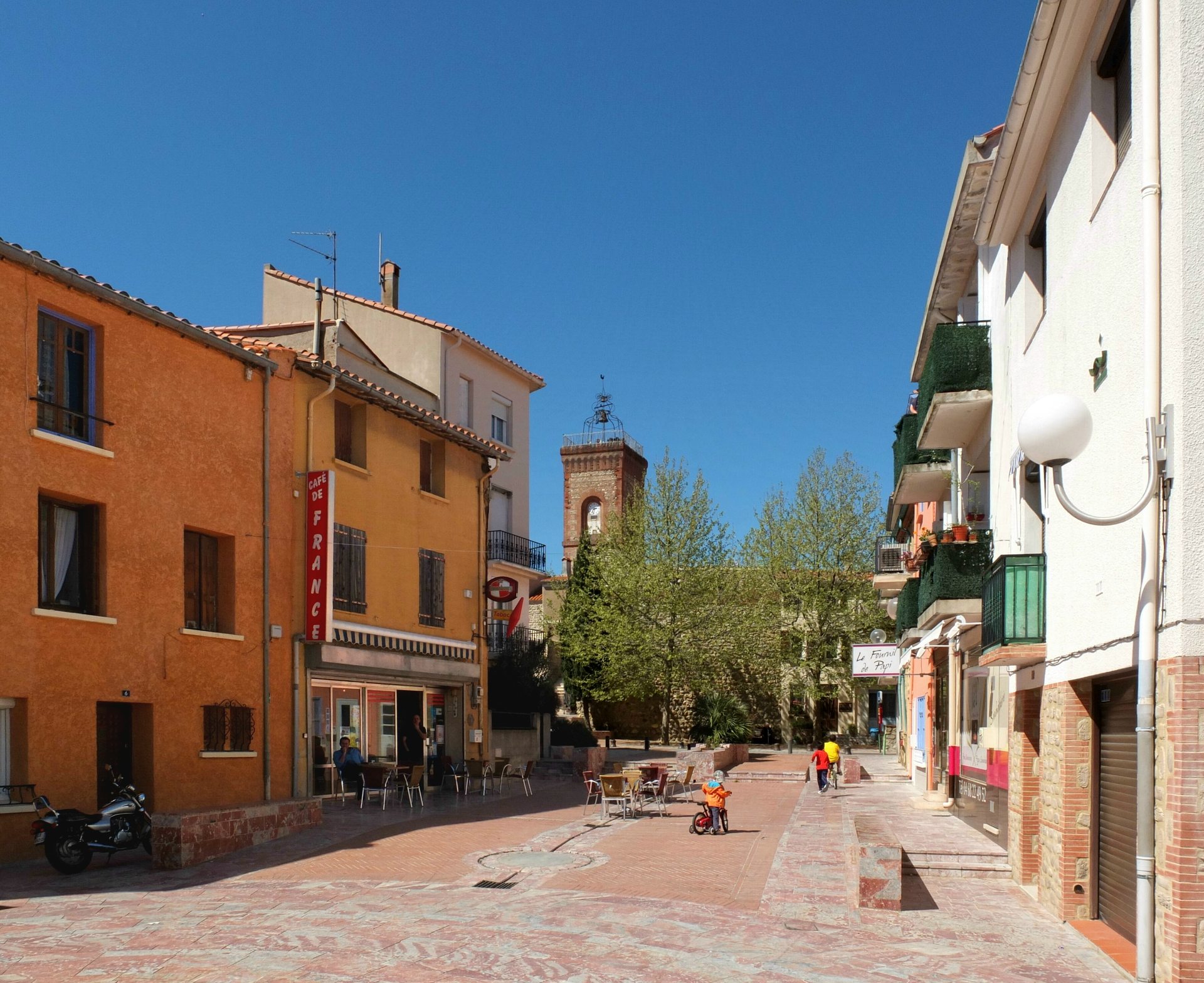
Pictured: the town center of Palau-del-Vidre, Pyrénées-Orientales — not the specific entrance to the village where the witnesses' vehicle passed under the object, whose precise spot GEIPAN's published file does not disclose. No photograph, video, or other direct visual recording of the object itself is known to exist; the entire evidentiary record consists of the two witnesses' own testimony and GEIPAN's own investigation. Photo by Wikimedia Commons contributor Palauenc05 (2015), released under CC BY-SA 4.0.
Theoretical Alignment
This case's Theoretical Alignment weighting leans further toward Extraterrestrial framing than most single-witness entries in this site's GEIPAN archive, for a reason specific to its own evidentiary structure: it is not a single-witness case. Two colleagues, riding together but independently interviewed, described the same specific, unusual combination of details — a structured black triangular shape, a single fixed red light rather than any recognizable aviation lighting pattern, complete silence, and a walking-pace crawl at very low altitude — and GEIPAN's own investigation explicitly found that examining both testimonies together reinforced rather than weakened the account's overall consistency. That two-witness structure, plus the specific, named absence of anti-collision strobes and position lights (details a witness with no reason to know what "should" be there would be unlikely to invent, yet which happen to be exactly the features that separate a real aircraft from what was described), together anchor a meaningfully higher ETH weighting than this site typically assigns to single-witness French cases. Psycho-Social framing still carries real weight, rooted in two structural facts common to nearly every predawn light-in-the-sky report: the witnesses' own initial misidentification of the light as a star, then as a landing aircraft, demonstrates that their perception was actively, iteratively revising itself in real time as the object's true nature became clearer — itself a data point that could cut toward genuine object tracking or toward evolving misperception, depending on which parts of the account are weighted most heavily. Interdimensional framing again draws the least support, resting mainly on the case's total absence of any photographic, radar, or other instrumented corroboration, the same broad pattern this site applies across nearly all of its uncorroborated GEIPAN files rather than anything unique to what was reported over Palau-del-Vidre specifically.
Background
Two threads of context matter for reading this sighting honestly: the small, historically Catalan glassmaking village where the triangle was seen, and the specific, tested celestial candidate — the planet Saturn — that GEIPAN's own investigators considered and excluded for the light phenomenon that preceded it.
Palau-del-Vidre: The "Palace of Glass"
Palau-del-Vidre is a small commune of roughly 3,300 residents in the Pyrénées-Orientales department of the Occitanie region, in the historically Catalan-speaking Roussillon area of southern France, situated about 15 kilometers south of Perpignan and roughly 6 kilometers inland from the resort town of Argelès-sur-Mer. Its Catalan name translates to "Palace of Glass," and both halves of that name have documented medieval origins: "Palau" refers to an early seigneurial residence, with ninth-century records referencing a "Palatium Rodegarium" on the site, while "del Vidre" (of glass) dates to the 13th century, when the Knights Templar, who held Palau as part of their broader Roussillon holdings before ceding it to the Knights Hospitaller, established a glassworks whose products remained a defining local craft tradition into the early 19th century, and which the village's artisans still maintain in smaller form today. The commune preserves a Romanesque church, Saint-Sébastien, notable for its 15th-century retables and a rare "Vierge Ouvrante" (opening Virgin) sculpture, along with remnants of the medieval fortifications that once encircled its old center. Like many communes across the French Mediterranean coastal fringe, Palau-del-Vidre's population grew substantially across the late 20th and early 21st centuries — from roughly 1,330 residents in 1968 to 3,329 by the 2023 census — reflecting the same broad coastal-Roussillon growth pattern affecting its larger neighbors, Argelès-sur-Mer and Perpignan.
Saturn, Ruled Out for Being Too Bright
GEIPAN's own case synthesis records that the very bright, unblinking point of light the witnesses first noticed toward the eastern horizon prompted investigators to check the actual position of Saturn for that pre-dawn hour, since the planet did sit in a broadly similar part of the sky that October. The agency's own conclusion was that Saturn's actual apparent brightness that morning was too faint to plausibly account for a light the witnesses independently described as exceptionally bright — a specific, checkable astronomical comparison GEIPAN's own investigators actually performed, rather than a candidate raised and left untested. This site's own analysis treats that specific test as a genuine mark of investigative rigor: rather than treating "a bright light near the horizon" as an automatically dismissible category, GEIPAN calculated the real, expected brightness of the one bright planetary body that could have been responsible, and found it did not match.
Complete Timeline
| Date | Event |
|---|---|
| 9th century | The earliest documented reference to a seigneurial residence on the site of Palau-del-Vidre, recorded as "Palatium Rodegarium." |
| 13th century | The Knights Templar establish a glassworks at Palau, giving the village the second half of its Catalan name, "del Vidre" (of glass). |
| 1968 | Palau-del-Vidre records a population of roughly 1,330, per INSEE's historical census series. |
| Late October 2008, approx. 6:00 AM | Sighting begins. Two colleagues starting their utility vehicle's morning delivery round notice a very bright, unblinking point of light over the coast between Saint-Cyprien and Argelès-sur-Mer, first mistaking it for a star, then for a landing aircraft. |
| Same morning, continuing along the N114 through Elne | The witnesses continue to track the light as it descends, following their normal route toward Palau-del-Vidre. |
| Same morning, at the entrance to Palau-del-Vidre | The triangle appears. An enormous black triangular object with a single fixed red light passes almost directly over the witnesses' vehicle at walking speed, in total silence, at very low altitude, disappearing behind buildings soon after. |
| November 2009 (thirteen months after the sighting) | GEIPAN formally collects the witnesses' testimony for the first time; neither witness recalls the sighting's exact date, only that it occurred in late October 2008. |
| Date not published | GEIPAN checks Perpignan–Rivesaltes air traffic control and gendarmerie records; neither has any report of the object. |
| Date not published | GEIPAN calculates Saturn's actual position and brightness for the sighting's approximate time and location, and excludes it as the source of the preceding bright light. |
| January 24, 2013 | Final classification. GEIPAN formally classifies the case D1: unexplained, noting that the two witnesses' independent accounts reinforced rather than weakened each other's overall consistency. |
Detailed Narrative
A Star, Then an Airplane, Then Something Else Entirely
According to GEIPAN's own archived case synthesis and corroborating detail preserved in regional French ufology research, the two witnesses were climbing into their utility vehicle at around 6:00 AM to begin their normal morning delivery round when one of them first noticed a very bright point of light toward the eastern horizon, over the sea in the direction between Saint-Cyprien and Argelès-sur-Mer. The light was white, strikingly bright, and did not twinkle the way starlight typically does when observed near the horizon through thicker atmosphere — a detail both witnesses independently registered before settling, briefly, on the belief that they were watching an aircraft on its landing approach. As they pulled onto the N114 and continued through Elne on their normal route, the light held their attention, continuing what appeared to be a slow, steady descent that kept it visible for several minutes rather than the few seconds a genuine meteor or satellite flare would allow.
Arrival at Palau-del-Vidre: The Triangle Passes Overhead
The sighting's character changed entirely as the witnesses' vehicle reached the entrance to Palau-del-Vidre. What had appeared, at a distance, to be a descending point of light resolved, at close range and low altitude, into an enormous black triangular shape with a single fixed red light glowing at its center. GEIPAN's own file and the earliest published account of the sighting both describe the object passing almost directly over the witnesses' vehicle, moving at a speed one witness explicitly compared to a pedestrian's walking pace — an extraordinarily slow airspeed for any object of the size described, which both witnesses judged to be comparable to a commercial airliner. The object made no sound whatsoever throughout this close pass, a detail one witness underscored by noting that someone driving with their head down, or otherwise not looking up at exactly the right moment, could easily have missed its passage entirely, given the complete absence of engine noise, wind noise, or any other acoustic signature. The object continued on, low over the village rooftops, before disappearing from the witnesses' view behind buildings at the village entrance.
What Wasn't There: No Position Lights, No Anti-Collision Strobes
The single detail GEIPAN's own investigation treats as most significant, and which this site's own analysis agrees is the case's genuinely load-bearing anomaly, is what the witnesses did not see rather than what they did. Real aircraft, by international aviation regulation, are required to display a standardized lighting configuration: red and green navigation (position) lights on the left and right wingtips respectively, a white tail light, and, on most aircraft operating after dark or in low-visibility conditions, a blinking white or red anti-collision strobe designed specifically to make the aircraft conspicuous to other pilots and to observers on the ground. GEIPAN's own file states plainly that the witnesses reported none of this: no blinking lights of any kind, and only the single, fixed, non-blinking red light at the object's center. This is precisely the kind of specific, checkable negative detail that separates a witness account genuinely built from careful observation from one reconstructed loosely from memory or expectation — a witness inventing or misremembering a UFO sighting after the fact might easily default to imagining generic "lights," but the specific, correct identification of which real aviation lighting features were absent is a harder detail to produce by confabulation than a vague, embellished description would be.
A Testimony Delayed by Thirteen Months, and a Date Neither Witness Could Recall
This case's single most significant evidentiary complication is not about what the witnesses saw, but about when GEIPAN actually learned of it. The formal testimony underlying this entire case file was not collected until November 2009 — more than a year after the sighting itself, which the witnesses could, by that point, only place in "late October 2008," without being able to specify an exact day. GEIPAN's own file is explicit and unambiguous on this point, and this site's own case metadata reflects it directly: this case file uses "late October 2008" throughout, rather than any single invented date, because that is the genuine limit of what the witnesses themselves, and GEIPAN's own published record, actually establish. This site's analysis treats that thirteen-month gap as the case's most serious, unavoidable weakness — not because delayed reporting automatically invalidates a sighting, but because it foreclosed any realistic chance of obtaining fresh corroborating detail: weather records precise enough to confirm the sky conditions, any contemporaneous local gossip or informal reports from neighbors who might have noticed the same object, or any chance of the witnesses themselves independently verifying small details (the exact minute, the exact stretch of road) against their own contemporaneous memory rather than reconstruction over a year later.
Reinforcement, Not Erosion: How Two Testimonies Held Up Together
GEIPAN's own file states that its investigation "considerably reinforced" this case's consistency, a specific and notable claim given the year-long reporting delay working directly against it. This site's own analysis, working from the structure of the account as published, identifies the most plausible basis for that reinforcement: the two witnesses, while riding together and therefore not fully independent observers in the strictest sense, were nonetheless two separate people capable of being interviewed separately and cross-checked against each other on the specific, granular details of what they saw — the object's shape, its single red light, its total silence, its walking-pace speed, and critically, the shared negative observation that no aviation lighting was present. Two people independently confirming the same specific set of positive and negative details, rather than one recalling a vivid triangle and the other recalling only a vague shape, is exactly the kind of cross-consistency that would justify GEIPAN's own characterization of a "reinforced" account, even after a long reporting delay. This site's analysis is careful to note what this reinforcement does and does not establish: it strengthens confidence that the two witnesses are describing a real, shared external event rather than one person's invention embellished in the retelling, but it does not, on its own, establish what that shared external event actually was.
What "Reinforced Consistency" Cannot Rule Out
This site's own research adds one further, honest caveat to GEIPAN's own "reinforced consistency" finding, precisely because the phrase is easy to over-read as a stronger claim than it actually supports. Two colleagues who work together daily, ride the same route together regularly, and share a genuinely startling experience together have every ordinary opportunity, across the thirteen months between the sighting and GEIPAN's interview, to discuss what they saw with each other informally — comparing notes, settling on a shared description, and unconsciously smoothing over small individual discrepancies long before either of them ever sits down with an investigator. This is a completely different process from two total strangers, with no contact with each other in the interim, independently producing matching accounts, which is the stronger form of corroboration the term "independent witnesses" often implies in casual usage. GEIPAN's own file does not indicate whether its investigators specifically probed for this possibility — asking, for instance, how often and in what detail the two colleagues had discussed the sighting between October 2008 and November 2009 — and its absence from the published record is itself worth flagging as an open question rather than an oversight this site can resolve. None of this is meant to suggest the two witnesses fabricated or over-embellished their account; it is simply a candid acknowledgment that "two witnesses whose stories agree" and "two fully independent witnesses whose stories agree" are not quite the same category of evidence, and this case sits closer to the former than the latter given how the two colleagues actually experienced the sighting together, in the same vehicle, at the same moment.
Key Witnesses
T1 — The Driver (identity withheld per GEIPAN's standard anonymization practice)
Driving the utility vehicle on the pair's normal morning route near Palau-del-Vidre at approximately 6:00 AM in late October 2008, this witness first noticed the bright point of light over the coast and continued tracking it along the N114 before the object resolved into a black triangle passing low overhead at the village entrance. His testimony, collected alongside T2's in November 2009, specifically confirmed the absence of any blinking anti-collision lighting on the object.
T2 — The Passenger (identity withheld per GEIPAN's standard anonymization practice)
Riding alongside T1 on the same morning route, this witness independently corroborated the sequence of the sighting — the initial bright light mistaken first for a star and then an aircraft, the object's resolution into a large black triangle with a single fixed red light, its total silence, and its extraordinarily slow, walking-pace speed at very low altitude over the village. GEIPAN's own investigators found the two testimonies, examined together, to reinforce rather than weaken the account's overall consistency, despite the thirteen-month delay before either was formally recorded.
The Five Observables Assessment
The Five Observables framework, developed by the Pentagon's Advanced Aerospace Threat Identification Program to describe performance characteristics beyond known conventional technology, is applied here for comparative consistency across the site's case files. This sighting's two-witness structure, combined with its specific, structured shape and its close-range, low-altitude observation, gives it a comparatively rich behavioral profile among this site's published GEIPAN files.
Assessment: This case's most genuinely unusual performance characteristic, within the Five Observables framework, is not speed but its near-total absence: an object described as airliner-sized moving at a walking pace, at very low altitude, in complete silence, is a profile that fits poorly against ordinary aerodynamic flight, where an aircraft of that scale requires substantial forward airspeed (or powerful, distinctly audible vertical-lift systems, as in a helicopter or VTOL aircraft) simply to remain airborne. That is precisely why Anti-Gravity Lift is rated Speculative rather than Absent here, even though no witness explicitly described a hovering phase: the reported combination of size, near-zero forward speed, low altitude, and total silence is difficult to reconcile with any conventional means of staying aloft, without invoking some form of unconventional lift. Low Observability is rated a clean Present specifically because the case supplies a rare, doubly-confirmed negative detail — two independent witnesses agreeing that no anti-collision or position lighting was visible — rather than a single witness's impression of silence alone. This site's analysis also notes what the profile does not include: no reported wobble, rotation, or instability of the kind sometimes associated with genuinely uncontrolled or malfunctioning aircraft, and no visible exhaust, contrail, or heat shimmer of the kind a powered conventional aircraft moving that slowly at that altitude would very likely produce, particularly in the cool, still air of a late-October pre-dawn morning.
Evidence Assessment
Supporting an Anomalous Origin
- Two separate witnesses, interviewed and cross-checked individually, independently described the same specific shape, lighting, sound profile, and extraordinarily slow speed — and GEIPAN's own investigation found their accounts reinforced rather than weakened each other's consistency
- Both witnesses specifically and independently confirmed the absence of any blinking anti-collision strobes or standard aviation position lighting — a precise negative detail harder to produce by confabulation than a vague, embellished description
- GEIPAN's own investigators calculated Saturn's real position and brightness for the sighting's time and location and explicitly excluded it as the source of the preceding bright light, rather than leaving the candidate untested
- The object's reported walking-pace speed at very low altitude, combined with total silence and airliner-scale size, is difficult to reconcile with any conventional aerodynamic explanation requiring either forward airspeed or an audible lift mechanism
- No report of the object exists in Perpignan–Rivesaltes air traffic control or gendarmerie records, despite its reported size, low altitude, and proximity to a regional airport's general vicinity
Supporting a Conventional/Mundane or Inconclusive Origin
- The two witnesses were riding together in the same vehicle for the entire sighting, meaning their accounts, however independently interviewed afterward, are not fully independent observations in the strictest methodological sense
- Testimony was not collected until thirteen months after the sighting, and neither witness could recall the exact date — a genuinely long delay that forecloses most avenues for fresh corroborating detail (weather records, other local witnesses, contemporaneous verification)
- GEIPAN's own file states the object's reported movement "serait compatible avec celui d'un aéronef classique" (would be compatible with that of a conventional aircraft) — it is specifically the shape and lighting, not the flight profile itself, that GEIPAN's investigators found genuinely anomalous
- No photograph, video, radar log, or physical trace of any kind exists; the entire evidentiary record rests on two witnesses' testimony collected long after the fact
- The late date of the testimony meant air-traffic and gendarmerie records for the actual sighting window itself could not be meaningfully checked in any case, since GEIPAN did not even know which specific date's records to request
Why "Open"
This case is stamped Open because GEIPAN's own investigation reached a genuinely rigorous negative result on multiple fronts: it specifically tested and excluded Saturn as the source of the preceding light via real astronomical calculation, it confirmed the absence of both Perpignan–Rivesaltes ATC and gendarmerie records for the object, and — most significantly — it found that examining the two witnesses' testimonies together reinforced rather than weakened the account's internal consistency, despite the thirteen-month delay before either was recorded. GEIPAN's own file states directly that none of the usual conventional hypotheses satisfactorily explains the triangular object's appearance, specifically its shape and its lighting configuration, even while conceding that its slow, level flight profile alone would be compatible with a conventional aircraft.
At the same time, this site's own analysis is explicit that this case's real evidentiary weight, while genuinely stronger than several of this site's single-witness GEIPAN files, is still meaningfully limited by its own reporting history. The two witnesses were together in one vehicle, not independently positioned; their testimony was collected more than a year after the fact, and neither could recall the exact date, meaning this case file itself must describe the sighting only as "late October 2008" rather than a specific day — a real, disclosed uncertainty this site treats as a matter of basic accuracy rather than a cosmetic detail. No photograph, video, radar, or physical trace corroborates the account at any point. Weighed together — a genuinely two-witness sighting with a specific, reinforced core description and two real, tested negative results (Saturn excluded, no ATC/gendarmerie report), against a year-long reporting delay, a still-uncertain date, and the witnesses' shared, non-independent vantage point — this case is scored above this site's thinner single-witness GEIPAN files, but still within the lower half of its published archive overall.
Sensor & Instrumentation Detection Profile
No photograph, video, or live sensor recording of any kind captured this phenomenon. GEIPAN's own published file and independent French regional ufology research both confirm that neither Perpignan–Rivesaltes air traffic control nor the local gendarmerie had any report of the object corresponding to this sighting — a genuine, checked negative result, distinct from cases like the Angoulême Daylight Ovoid, where an equivalent check was never even possible due to a reporting delay on the government's side rather than a confirmed absence. Here, the absence of any ATC or gendarmerie record is itself informative, though it cuts in more than one direction: it is consistent with the object genuinely not being a conventional, transponder-equipped aircraft operating within controlled airspace, but it is equally consistent with an aircraft (crewed or otherwise) operating without a functioning or monitored transponder, or simply below the altitude and outside the specific corridor where routine ATC tracking would have captured it.
GEIPAN's own analytical work on this case is best characterized as astronomical rather than instrumented in the strict sensor sense: a calculation of Saturn's real position and apparent magnitude for the approximate time and location of the sighting, checked directly against the witnesses' description of an unusually bright light. That is a genuine, quantitative piece of investigative work, comparable in kind (though narrower in scope) to the solar-geometry calculations this site has documented in the Maffliers Dawn Object and Ruffec Repeating Light Arc files. As with several of this site's other pre-2016 French cases, this sighting predates FRIPON, GEIPAN's automated fireball camera network (operational from May 2016), though FRIPON's relevance here would in any case be limited to the preceding light phenomenon rather than the triangular object itself, whose reported behavior bears no resemblance to a meteor's characteristic streak-and-fade trajectory.
Environmental & Geospatial Context
Geographically, the sighting unfolded along a specific, real, reconstructable route: beginning over the Mediterranean coast between Saint-Cyprien and Argelès-sur-Mer, continuing along the N114 through Elne, and culminating at the entrance to Palau-del-Vidre, roughly 15 kilometers south of Perpignan. This entire corridor sits within the coastal plain of the Roussillon, a low-lying agricultural and increasingly residential strip between the Pyrénées foothills and the Mediterranean, within the general operational vicinity of Perpignan–Rivesaltes Airport well to the north, whose air traffic control records GEIPAN's investigators checked and found no corresponding report.
Astronomically, the sighting's approximate 6:00 AM timing in late October places it in the pre-dawn hours, when the sky would have still been dark or only beginning to lighten toward the east — conditions under which a bright planetary body near the horizon can plausibly be mistaken, at first glance, for a star or a distant aircraft light, exactly as the witnesses themselves initially interpreted the preceding light phenomenon. GEIPAN's own calculation that Saturn's actual brightness that morning was too faint to account for what the witnesses described is the specific astronomical finding this site's research relies on directly; no independent recalculation was attempted for this case file, since GEIPAN's own published conclusion on this narrow, well-defined question is not in dispute.
Within this site's own published GEIPAN archive, the most relevant points of comparison are its other reported black or dark triangular objects — the Villers-lès-Luxeuil Triangle, the Douai Prison-Adjacent Sighting, and the Taverny Triangle — each explored in depth in the Historical Precedents section below.
The broader Roussillon coastal plain in which Palau-del-Vidre sits is itself a heavily agricultural landscape historically built around orchard fruit, vineyards, and market gardening, feeding into the region's long-standing role as one of France's major produce-growing areas; more recently it has also become one of the country's more visited Mediterranean tourist coastlines, with Argelès-sur-Mer alone hosting some of Europe's largest campsite resorts during the summer season. None of that seasonal or agricultural character offers any specific candidate light source, industrial facility, or locally-based explanation for an object reported crossing the sky in the pre-dawn hours of a late-October morning, well outside the peak summer tourist season; this site's research raises the region's economic and land-use profile only to note, as it has for other rural French GEIPAN sightings, that nothing about the immediate surroundings supplies an obvious mundane candidate the witnesses themselves, or GEIPAN's investigators, might otherwise have overlooked.
Observer Credibility & Occupational Profile
Neither witness's specific occupation is disclosed in GEIPAN's published case file beyond the fact that both were riding together in a utility vehicle at the start of a morning delivery round — consistent with, though not confirmed as, a postal, courier, or municipal-service occupation common to this kind of early-morning route work. What matters more directly for assessing this account's credibility is the pair's shared occupational context itself: two people accustomed to the same road, the same early-morning light conditions, and the same daily routine are, if anything, better positioned than an unfamiliar or first-time observer to notice when something in that familiar scene is genuinely out of place, and their initial, sequential misidentifications (star, then aircraft, then neither) reflect an account actively updating in response to new visual information rather than a fixed, pre-formed belief.
The single most consequential credibility fact in this file is the same one this site's analysis returns to throughout: the two witnesses' testimonies, while collected together as colleagues who shared the same vantage point, were nonetheless independently recorded and cross-checked by GEIPAN's own investigators, who explicitly found the two accounts reinforced rather than undercut each other on the specific, granular details — the object's shape, its single red light, its total silence, its walking-pace speed, and the absence of any aviation lighting. This site's analysis treats that cross-consistency as the case's strongest credibility signal, while weighing it honestly against the year-long delay before either testimony was actually recorded, a gap long enough that some refinement or convergence of the two accounts through informal conversation between the witnesses themselves, in the thirteen months before GEIPAN interviewed them, cannot be entirely ruled out.
It is also worth stating plainly what this file does not contain, since GEIPAN's anonymization practice makes it easy to assume more disclosed detail than actually exists: no age, gender, employer, or specific job title for either witness appears anywhere in the published record this site's research could locate, beyond the shared detail that both were beginning a normal utility-vehicle delivery round together at the time of the sighting. This site's analysis treats that thinness as neutral rather than damaging — GEIPAN's standard practice of withholding identifying detail applies just as consistently to this case as to every other file in this site's GEIPAN archive, and its absence here reflects agency policy rather than anything unusual about these two witnesses specifically.
Physical & Material Assays
No physical trace evidence exists in this case, and GEIPAN's own published file gives no indication that any ground-level search for trace material was ever conducted. This is consistent with the nature of the sighting as reported: the object remained airborne throughout its entire observed passage, moving low over the village but never landing or otherwise contacting the ground, and no scorching, vegetation disturbance, or other ground-level physical effect was ever described by either witness. Accordingly, this case has no soil, vegetation, or material sample of any kind associated with it, and no metallurgical, isotopic, or trace-chemical assay was performed or would have been applicable given the sighting as described. The thirteen-month delay before the sighting was even reported to GEIPAN would, in any case, have made a ground search largely moot: any transient surface disturbance, had one existed, would almost certainly have been erased by more than a year of intervening weather, agricultural activity, and ordinary village life long before an investigator could have been dispatched to look for it.
Historical Precedents & Archive Matches
This case's most useful points of comparison on this site are its fellow dark-triangle GEIPAN sightings — a genre this site has now documented in enough depth to draw real, substantive contrasts within — plus one older, unrelated Pyrénées-Orientales case that illustrates how rare a confirmed unexplained sighting actually is within the department's own GEIPAN record.
Villers-lès-Luxeuil: The Closest Structural Match
The Villers-lès-Luxeuil Triangle (Open, case #251) is this site's closest structural match to Palau-del-Vidre, sharing its most important methodological feature: two witnesses, rather than one, whose independently examined testimonies GEIPAN's own investigation treated as mutually reinforcing (there, a married couple driving separate vehicles; here, two colleagues riding together). Villers-lès-Luxeuil's own triangle carried a strong forward white light and a fixed red light, a partial echo of Palau's own single fixed red light, though Villers' object was tested against three specific, named conventional candidates (a light aircraft on approach, a confirmed nearby Mirage 2000 exercise, a military drone) that GEIPAN was able to rule out individually — a level of specific hypothesis-testing this Palau-del-Vidre file's own published record does not reach, likely a direct consequence of its thirteen-month reporting delay foreclosing the kind of contemporaneous cross-checking Villers-lès-Luxeuil's more promptly reported sighting allowed.
Douai and Taverny: Different Triangles, Different Lessons
The Douai Prison-Adjacent Sighting (Open, case #253) and the Taverny Triangle (Open, case #259) both broaden this site's own internal picture of what a "GEIPAN triangle" sighting can look like, and both underscore, by contrast, what makes Palau-del-Vidre's own account distinctive. Douai's triangle was sharp-edged, luminous pink/orange/coral rather than a dark silhouette, with small lights of indeterminate number along its leading edges — a single-witness case where investigators pursued a drone hypothesis specifically, contacting local hobbyist operators and a Marine Nationale drone instructor, none of whom could match the described lighting. Taverny's triangle, closer in color profile to Palau's (a large, dark form, though GEIPAN's own technical file for that case separately records it elsewhere as conical rather than strictly triangular) carried faint yellow-orange lights at its extremities rather than Palau's single central red light, and was observed by a single pedestrian rather than two colleagues. Read together, these three dark/muted-triangle cases — Palau-del-Vidre, Taverny, and, in lighting profile if not overall silhouette, Villers-lès-Luxeuil — suggest no single recurring "black triangle" morphology across GEIPAN's own French case record; each reports a genuinely distinct combination of shape, coloring, and lighting, a caution against treating "black triangle" as a single unified phenomenon rather than a loose descriptive category covering several genuinely different reported objects.
Thuir, 1976: A Rare Earlier D1 Case in the Same Department
Regional French ufology research documenting the Pyrénées-Orientales department's own GEIPAN case history identifies only a small handful of D1-classified (unexplained) sightings in the department across the decades GEIPAN and its predecessor agencies have operated, with no D2 cases (the highest strangeness/consistency tier) on record at all as of that research's publication. The most notable earlier example is the March 25, 1976 sighting at Thuir, roughly 25 kilometers northwest of Palau-del-Vidre, in which three motorists reported a luminous, dome-topped, oval-shaped craft traveling east to west for roughly a minute before vanishing suddenly — also classified D1. That case, like Palau-del-Vidre, rests on multiple witnesses traveling together by vehicle, a genuinely recurring circumstance across the department's rare unexplained files, though separated from Palau-del-Vidre by more than three decades and a completely different reported object morphology (luminous and domed, rather than dark and triangular).
Saint-Laurent-de-la-Salanque, 2001: A Weaker Departmental Cousin
The same regional survey of Pyrénées-Orientales GEIPAN cases documents a third departmental sighting worth naming for contrast rather than similarity: a September 27, 2001 report from Saint-Laurent-de-la-Salanque, in which a single witness described a triangular form with rounded corners and fixed luminous points at each vertex, moving silently at high speed from the direction of Narbonne toward Perpignan. That case was classified only D — the lower, non-strangeness-subdivided tier this site's own Angoulême Daylight Ovoid file also carries — rather than D1, with no corroborating report from air traffic control or the gendarmerie ever obtained. Set beside Palau-del-Vidre's own two-witness, cross-reinforced account, the Saint-Laurent-de-la-Salanque case is a useful negative comparison: it shares the department, the triangular silhouette, and the total absence of instrumented corroboration, but lacks the second independent witness whose testimony GEIPAN's own investigators credited with meaningfully strengthening the Palau-del-Vidre file. Across all three of the department's own named unexplained cases — Thuir (1976), Saint-Laurent-de-la-Salanque (2001), and Palau-del-Vidre (2008) — the pattern this site's research draws out is that witness count and cross-corroboration, not the specific reported shape, appear to be the strongest single differentiator between the department's D1 and plain-D classifications.
Material Analysis
As with the Physical & Material Assays section above, this case involves no physical or trace evidence of any kind. The object remained airborne throughout the entire observation, and no landing, low-altitude ground approach, or other ground-level effect was ever reported that could have produced a testable trace.
Supporting Non-Terrestrial Origin
- No confirmed physical evidence exists to test in the first place, so no terrestrial material-composition finding contradicts an anomalous interpretation either
- Two independently cross-checked witnesses describing the same specific shape, lighting absence, and near-impossible-for-conventional-flight speed/altitude/silence combination remains unresolved by any of GEIPAN's own tested hypotheses
Supporting Terrestrial Origin
- GEIPAN's own file states the object's flight profile itself "serait compatible avec celui d'un aéronef classique" — a real, unresolved point in favor of some form of conventional or quasi-conventional aircraft, however unusual its lighting and silence
- The thirteen-month reporting delay foreclosed the kind of contemporaneous physical, radar, or press corroboration that might otherwise have resolved the case one way or the other
The Conventional Explanation Candidate: Conventional Aircraft, Saturn, and the Reporting Delay
GEIPAN's own published synthesis for this case names two specific candidates directly and reports its own tested conclusions on each; this site's own research adds a third, related consideration — how the year-long reporting delay itself may have shaped what could ever be confirmed.
A Conventional Aircraft
GEIPAN's own file states plainly that the object's reported movement "serait compatible avec celui d'un aéronef classique" — would be compatible with that of a conventional aircraft — a genuinely candid concession that keeps this hypothesis alive rather than dismissing it outright. What GEIPAN's own investigators found did not fit, specifically, was the object's shape and its lighting: no real aircraft, of any type operating in French airspace, flies without the position lights and anti-collision strobes both witnesses independently confirmed were absent, and a rigid black triangular silhouette with a single fixed red center light matches no standard civil or well-documented military aircraft type. This site's own analysis treats the aircraft hypothesis as genuinely tested and genuinely falling short specifically on these two named grounds, rather than excluded by pure incredulity.
Saturn (Preceding Light Only)
GEIPAN's own investigators calculated Saturn's real apparent position and brightness for the sighting's approximate time and location and found it too faint to account for the exceptionally bright, non-twinkling light the witnesses described before the triangle itself appeared. This site's analysis treats this as a specifically and successfully tested candidate, applicable only to the preceding light phenomenon and never intended by GEIPAN to explain the triangular object itself, which is a separate and, per the witnesses' own account, only loosely connected phenomenon.
The Reporting Delay as Its Own Confounding Factor
This site's own research raises, independently of GEIPAN's published file, a structural point about this case's own evidentiary limits: the thirteen-month gap between the sighting and its first formal testimony did not simply weaken the account through fading memory — it foreclosed entire categories of verification GEIPAN could otherwise have pursued had the report reached the agency promptly. A same-week or same-month report could have prompted a direct request to Perpignan–Rivesaltes for that specific date's air-traffic logs, a check of contemporaneous regional weather records for exact visibility and cloud conditions, and an opportunity to solicit other potential witnesses along the same well-traveled N114 corridor while memories were still fresh. None of that was possible once the report finally reached GEIPAN more than a year later, with even the witnesses' own recollection of the date already reduced to "late October." This is not a conventional explanation candidate in the same sense as an aircraft or a planet, but it is a genuine, structural reason this case's own D1 classification rests on a narrower evidentiary base than its two-witness structure alone might suggest.
This site's research also considered, and sets aside, a handful of other generic candidates that a less specific witness description might have left open. A weather balloon or other lighter-than-air craft is a poor match for an object both witnesses described as a rigid, sharp-edged triangular shape rather than a rounded envelope, and for a reported walking-pace horizontal translation rather than the largely wind-driven drift a balloon would exhibit. Ground-based light projection, sometimes raised as an explanation for anomalous sky lights, does not account for the witnesses' clear perception of a large, three-dimensional silhouette passing between them and the pre-dawn sky, nor for its continued, consistent motion along a route the vehicle itself was simultaneously traveling. Neither candidate appears in GEIPAN's own published file, and this site's research did not find sufficient basis in the witness testimony to develop either into a named, tested hypothesis of its own — they are noted here only for completeness, in keeping with this site's standard practice of documenting which conventional categories were considered and found inapplicable, not only the ones that came closest to fitting.
Conventional Aircraft
InconclusiveGEIPAN's own file concedes the flight profile itself would be compatible with a conventional aircraft, but the reported shape and the confirmed absence of any position or anti-collision lighting remain unexplained by this candidate.
Saturn (Preceding Light Phenomenon)
ImplausibleDirectly tested via real astronomical calculation by GEIPAN's own investigators; Saturn's actual brightness that morning was too faint to match the light the witnesses described.
Meteor, Bright Star, or Satellite Flare (Preceding Light)
ImplausibleNot specifically named in GEIPAN's own file, but weighed by this site's research against the light's own reported multi-minute, steady descent — far too sustained for a meteor's near-instantaneous streak or a brief satellite flare.
Fabrication, Confabulation, or Delayed-Memory Distortion
InconclusiveWeakened by the specific, correct, cross-corroborated negative detail (absent aviation lighting) both witnesses independently supplied, but never fully closed off given the genuine thirteen-month gap before either testimony was recorded.
Related Cases
Confirmed Documents & Official Records
The official French government case summary: the two witnesses' testimony, the Saturn exclusion, the absence of ATC/gendarmerie reports, and the Class D1 determination.
GEIPAN's own published definitions, including the D1 category (strange phenomena of medium consistency) applied to reach this case's rating.
GEIPAN's own account of its institutional lineage, the same modern investigative framework applied to this case.
Official French national statistics for the commune, including its historical population series.
Further Reading — Recommended Literature
Passport to Magonia: On UFOs, Folklore, and Parallel Worlds
Vallée's foundational catalog of centuries of French and international sightings offers direct background for reading this case within a much longer national tradition of reported anomalous aerial phenomena.
Triangular UFOs: An Estimate of the Situation
A dedicated, methodical survey of black-triangle UFO reports worldwide, directly relevant to placing this specific sighting within the wider triangular-craft literature this case belongs to.
UFOs and Government: A Historical Inquiry
Includes a dedicated chapter on French government UAP investigation, directly relevant to the GEIPAN institutional framework that investigated this case.
CONFRONTATIONS: A Scientist's Search for Alien Contact
Vallée's personal investigation of forty international UFO cases, useful for its methodological attention to cross-checking multiple witnesses' independent testimony against each other, exactly the process GEIPAN applied here.
Identified Flying Objects: A Multidisciplinary Scientific Approach to the UFO Phenomenon
A methodologically-focused work useful for weighing multi-witness corroboration and the effects of reporting delay on testimony reliability, both directly relevant to how this case was actually investigated.
Essential Viewing
No Videos Available
Sources
- GEIPAN (CNES), "PALAU-DEL-VIDRE (66)", Case 2008-10-02513 — official case summary
- GEIPAN (CNES), official case archive & public portal — geipan.fr
- GEIPAN (CNES), Glossaire du GEIPAN — official classification definitions, A/B/C/D/D1/D2
- GEIPAN (CNES), Son histoire — institutional history: GEPAN (1977), SEPRA (1988), GEIPAN (2005)
- OVNI 66 — Pyrénées-Orientales, "xx/10/2008 — Palau-del-Vidre : triangle noir" — detailed regional account of the sighting and the witnesses' route via Elne and the N114
- OVNI 66 — Pyrénées-Orientales, "GEIPAN : depuis 1976, quelques rares cas demeurent inexpliqués dans le 66" — departmental survey of Pyrénées-Orientales GEIPAN D1 cases, including Palau-del-Vidre and the 1976 Thuir sighting
- Wikipedia (English), "Palau-del-Vidre" — population, geography, and administrative data
- Wikipédia (français), "Palau-del-Vidre" — village history, etymology, glassmaking tradition, and Templar/Hospitaller background
- INSEE, Dossier complet — Commune de Palau-del-Vidre (66133) — official French national statistics for the commune
- Wikimedia Commons, File: Palau-centre.jpg, photo by Palauenc05 (2015), CC BY-SA 4.0 — licensing and attribution
- Wikimedia Commons, Category: Palau-del-Vidre — image archive for the commune
- This site, case-files/villers-les-luxeuil-triangle.html — comparative GEIPAN case, the closest structural match (two mutually-reinforcing witnesses, a fixed red light)
- This site, case-files/douai-prison-adjacent-sighting.html — comparative GEIPAN case, a differently-colored, differently-lit triangle
- This site, case-files/taverny-triangle-sighting.html — comparative GEIPAN case, a single-witness dark triangle with a different lighting pattern
- This site, case-files/angouleme-daylight-ovoid.html — comparative GEIPAN case, published the same batch, with a contrasting (unverifiable rather than confirmed-negative) ATC check
- This site, key-figures.html, entry on Claude Poher — GEPAN founding and early institutional history
- This site, locations/index.html, entry on Toulouse — CNES/GEPAN/SEPRA/GEIPAN institutional headquarters
See something inaccurate? Have additional information or sources?
Suggest an Edit →Last Updated: August 2026