
The Ruffec Repeating Light Arc
At around 9:00 PM on September 13, 2022, a resident of Ruffec, a small commune in the Charente department of southwestern France, was sitting on the concrete steps behind his kitchen, on the phone with his mother as he did most evenings, when he noticed a white point of light to the southwest. It was, he told GEIPAN, about the size and brightness of an aircraft's position lights — and at first he took it for exactly that. But the light moved in a straight line toward the northeast, then vanished abruptly as if it had passed behind a cloud in a patch of sky he knew to be clear, only to reappear moments later at the very same starting point and retrace the identical path. It did this, by his own count, some twenty to thirty times over roughly five minutes, each appearance-and-disappearance cycle lasting about six seconds. GEIPAN's investigators reconstructed the real air-traffic pattern over Charente that evening using Flightradar24, calculated the precise solar geometry required for a satellite "flare" off a Starlink constellation, and pulled regional cloud, humidity, and upper-wind data to test a sky-tracer projector and an ice-crystal reflection — and found that none of the four candidate explanations could be confirmed. The witness's own suggested analogy — a lamp fixed to the surface of a slowly spinning sphere, glimpsed only when it swings back into view — remains, in GEIPAN's own words, an evocative description of the phenomenon's behavior, not an explanation of its cause. The case remains open, classified Class D: unidentified after investigation.
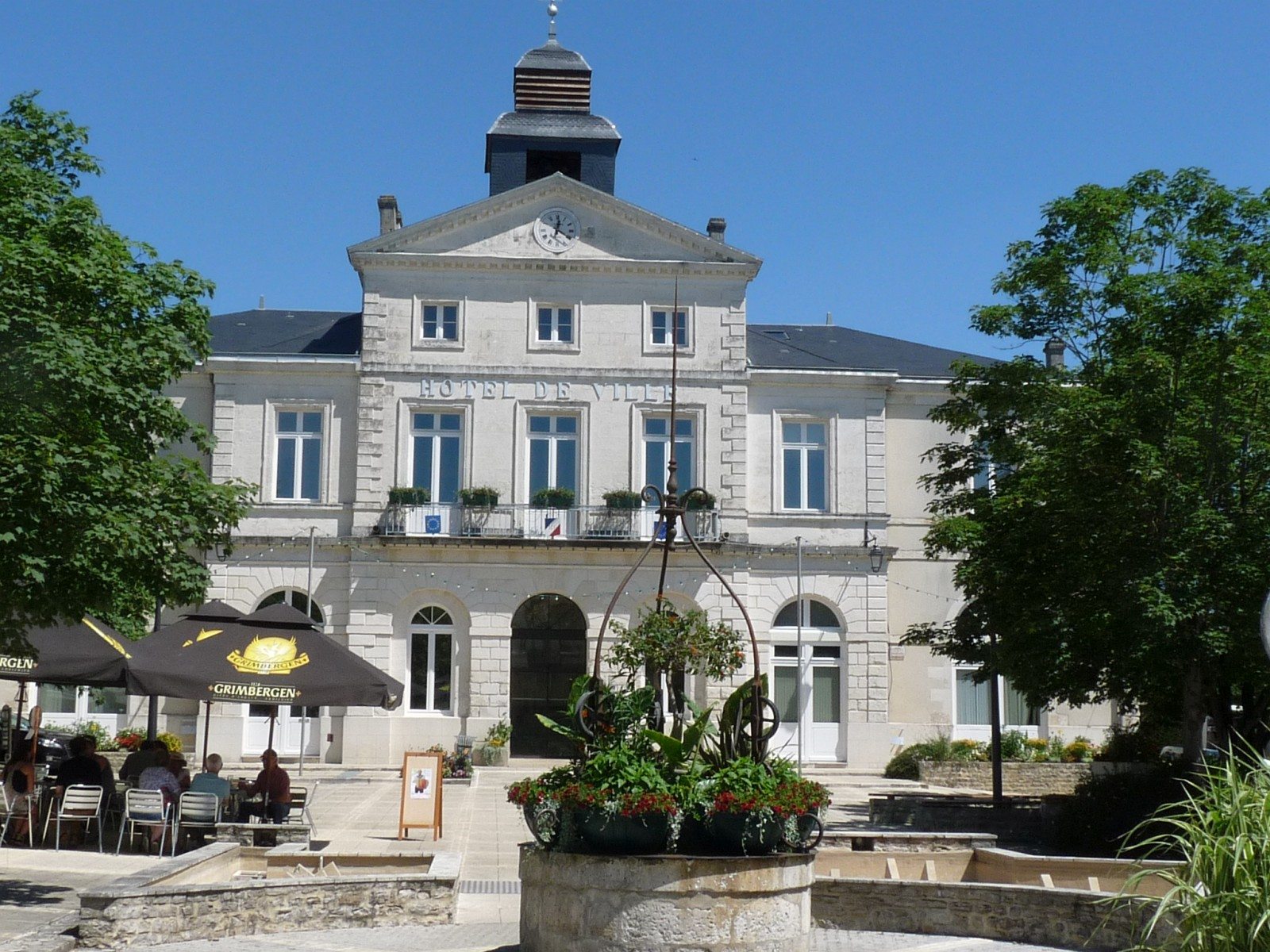
Pictured: the Hôtel de Ville (town hall) of Ruffec, Charente, France. This is not a photograph of the witness's own garden, whose precise address GEIPAN's published summary withholds per its standard anonymization practice, nor of the phenomenon itself, of which no photograph or video is known to exist — the witness's own submitted images are hand-drawn sketches and an annotated photograph reconstructing his sightline, not photographs of the PAN. Photo by Wikimedia contributor Jack ma, taken June 20, 2015, released under CC BY-SA 3.0 via Wikimedia Commons.
Theoretical Alignment
Of the three broad interpretive frameworks this site tracks, this case aligns most strongly with a Psycho-Social reading — not because GEIPAN's investigators found any positive evidence of misperception, but because the leading conventional candidate they tested, a genuine air-traffic pattern of a dozen real aircraft on a broadly matching trajectory, sits close enough to the observed behavior (a 47.5% probability rating in GEIPAN's own internal hypothesis-weighting scheme) that an honest reading of the file cannot rule out some form of perceptual amalgamation, in which several distinct, ordinary aircraft passages were experienced by a single witness as one repeating, rotating light. Extraterrestrial and Interdimensional framings draw what support they have chiefly from the negative space GEIPAN's own rigorous elimination work carved out around the sky-tracer, Starlink-flare, and ice-crystal hypotheses — real, quantitatively tested candidates that failed on specific, checkable grounds rather than on suspicion alone — but neither framework offers a positive, structured account of why a light would repeat a fixed arc with such mechanical regularity for a full five minutes. This is a case whose defining quality is not what the object apparently was, but the sheer, disciplined thoroughness with which GEIPAN checked what it probably was not.
Background
Understanding why a single, undated evening's worth of repeating light drew a full four-hypothesis technical investigation — complete with a regional radiosonde readout, a satellite-flare geometry calculation, and a twelve-aircraft Flightradar24 reconstruction — requires understanding both the town where it happened and the investigative body built specifically to handle exactly this kind of thin, single-witness account without either waving it away or overselling it.
Ruffec: A Crossroads Town on the Road to Spain
The commune of Ruffec sits in the Charente department of the Nouvelle-Aquitaine region, roughly midway between Poitiers and Angoulême on what is today Route Nationale 10 — a position that has defined the town for centuries as a stopover on the historic road linking Paris to Spain. As of the most recent count, Ruffec is home to roughly 3,450 residents, the Ruffécois and Ruffécoises, across an area of just over 13 square kilometers; the population peaked at around 4,240 in 1975 and has declined gradually since, a demographic pattern common to many small towns in rural France that lost population as regional economic activity concentrated in larger cities. The town's most consequential historical role came during the Second World War, when Ruffec's position on a key transit corridor made it a center of French Resistance activity dedicated to moving Allied airmen who had been shot down or forced to bail out over occupied France toward neutral Spain and eventual repatriation — a quiet, dangerous logistics operation rather than a battlefield, but one that placed the town at the center of a real underground network. Ruffec maintains twin-town relationships with Waldsee in Germany and Pásztó in Hungary, and its built landscape today mixes half-timbered houses and a Romanesque parish church with the more utilitarian architecture of a working crossroads town. None of this bears directly on a five-minute light display observed from one resident's back garden in September 2022, but it matters for calibrating the setting: a small, historically significant but otherwise unremarkable rural commune on a major north-south road corridor, not a military installation, not an airbase, and not a location with any obvious institutional source of unusual aerial activity.
GEIPAN's Hypothesis-Weighting Method, Applied to a Thin File
GEIPAN, the Groupe d'Études et d'Informations sur les Phénomènes Aérospatiaux Non-identifiés, operates as a small permanent unit within the Centre National d'Études Spatiales (CNES) in Toulouse, tracing its institutional lineage back to GEPAN, founded within CNES in 1977 by Claude Poher, and later reorganized as SEPRA under Jean-Jacques Velasco before adopting its current name. What distinguishes GEIPAN's methodology from a simple yes/no determination is its explicit, numerically weighted hypothesis-evaluation system: for each candidate explanation considered, GEIPAN's investigators assign a probability rating reflecting how well the available evidence supports that specific hypothesis, based on itemized arguments for and against, each individually scored. In this case, that system produced a genuinely close contest rather than a clean elimination: the aircraft hypothesis received a rating of 0.475 (47.5%) and the sky-tracer hypothesis 0.425 (42.5%) — both substantial, neither reaching GEIPAN's threshold of confidence needed to formally retain an explanation, and neither low enough to be waved away as fanciful. This is a meaningfully different evidentiary profile from several other GEIPAN cases already published on this site, where the leading conventional candidate is tested and cleanly rejected; here, the leading candidate survives serious technical scrutiny and comes startlingly close to crossing the line into an accepted explanation, without ever quite doing so.
The file also reflects GEIPAN's practice of returning to a witness for clarification long after the original report, rather than working solely from the initial questionnaire. The witness submitted his account the day after the sighting, in September 2022, accompanied by three images: a map of his position, an annotated photograph reconstructing the PAN's apparent position and trajectory, and a hand-drawn sketch. GEIPAN sent its acknowledgment of receipt on November 15, and the substantive investigation continued well beyond that, with the witness answering follow-up questions by email in January 2023 (to clarify the storm cell's exact bearing relative to the PAN) and again in March 2023 (to ask whether he could recall the flight paths of other aircraft visible during the sighting) — and, remarkably, a further clarifying email exchange in September 2025, three years after the original sighting, in which the witness confirmed a correction to his own initially stated cardinal direction. That a GEIPAN investigator was still refining the geometric reconstruction of this case a full three years after the sighting, and that the witness remained reachable and cooperative that entire time, is itself a modest but genuine data point in the file's favor, independent of what it ultimately proves about the phenomenon's identity.
Complete Timeline
| Date | Event |
|---|---|
| 1977 | GEIPAN's predecessor, GEPAN, is founded within CNES in Toulouse under Claude Poher. |
| September 13, 2022, approx. 8:30 PM | The witness steps into his garden in Ruffec, on the phone with his mother, and sits on the concrete steps behind his kitchen, facing southwest. He notices a dissipating thunderstorm cell to the west, still producing occasional lightning, along with several ordinary aircraft and stars. |
| September 13, 2022, approx. 9:00 PM | Sighting begins. The witness sees a white point of light, comparable to an aircraft's position lights, moving in a straight line toward the northeast before abruptly vanishing over a patch of sky he judged to be cloud-free. |
| September 13, 2022 (continuing) | The light reappears at the same starting point and retraces the identical path, then disappears again. The cycle repeats an estimated 20 to 30 times, each appearance-and-disappearance cycle lasting approximately 6 seconds, not perfectly constant. |
| September 13, 2022 (end of observation, approx. 9:05 PM) | The phenomenon shifts slightly downward and toward the west-southwest in the witness's field of view before disappearing for good, roughly 5 minutes after it was first noticed. |
| September 14, 2022 | The witness completes and emails GEIPAN's Technical Questionnaire, attaching a position map, an annotated reconstruction photograph, and a hand-drawn sketch. |
| November 15, 2022 | GEIPAN sends the witness a formal acknowledgment of receipt. |
| January 23, 2023 | GEIPAN emails the witness to clarify the storm cell's bearing relative to the PAN; the witness replies the same day. |
| March 9, 2023 | The witness replies to a further GEIPAN inquiry about the flight paths of other aircraft he recalled seeing, noting he did not track their trajectories closely and recalls roughly three aircraft in the sky, without certainty. |
| During the investigation | GEIPAN reconstructs the night's astronomical conditions (Stellarium), meteorological conditions (Infoclimat, Météo France's AROME model, MétéoCiel lightning-strike data), and regional air traffic (Flightradar24), and calculates the precise solar geometry required for a Starlink satellite flare. |
| September 2025 | The witness confirms, by email, a correction to the case's geometry: the PAN was located to the west, drifting toward the south-southwest, rather than the southwest he had initially stated — a correction GEIPAN's investigators had already inferred from his own submitted reconstruction photograph. |
| Following the full investigation | Final classification. GEIPAN concludes that none of the four candidate hypotheses can be confirmed, and classifies the case « D », catalogued as case ID 2022-09-51395, with a formal investigation report issued December 3, 2025. |
Detailed Narrative
An Ordinary Evening on the Phone, an Unusual Light in the Southwest
The witness's own account, preserved by GEIPAN in his original words, begins with a routine: "I was on the phone with my mother like every evening, starting around 8:30 PM; I went out into my garden because it was warm in my house. I sat down on the steps in front of my kitchen while watching the sky." He describes an active sky that evening — a storm formation finishing its dissipation to the west, its lightning still occasionally lighting up the sky, along with various aircraft visible here and there, and stars. Then, around 9:00 PM, facing southwest, he "observed a phenomenon that I first took for an airplane, but which kept coming back cyclically." The light was white, he said, comparable to an aircraft's position lights in both size and intensity, moving toward the northeast in a straight line — and then it disappeared abruptly, "as if the object had passed through a cloud, even though that spot was perfectly clear." Moments later it reappeared at the same location where he had first seen it and retraced the same path, then vanished again. This repeated for roughly five minutes. The witness estimated each appearance-and-disappearance cycle at approximately six seconds, though not perfectly constant — some cycles ran a second or more longer than others. Toward the end of the observation, the phenomenon shifted slightly in his field of view, downward, before disappearing for good.
What makes this witness's account distinctive is the specific, considered analogy he volunteered, unprompted, to describe what he had seen: "If I had to reproduce this phenomenon, I would place a light on the surface of a rotating sphere: a stationary observer would then see the light intermittently, as soon as it enters their field of view, and would have the impression of an object moving in a straight line, looping endlessly through the same path, disappearing and reappearing in the same places." This is a genuinely thoughtful piece of testimony — not a claim about what the object was, but a precise geometric model for how a single, physically simple light source could produce exactly the visual effect he described, without asserting that any such rotating sphere actually existed. GEIPAN's investigators took this model seriously enough to test its most obvious real-world analog: aircraft repeatedly passing along the same corridor, appearing similarly bright and similarly positioned each time, might likewise be strung together by a single observer's memory into the appearance of one repeating, rotating light.
Measuring the Sighting: Angles, Sizes, and a Genuinely Rural Vantage Point
The witness observed from his own property, described in his questionnaire response as a rear garden of roughly 150 square meters, enclosed by walls, outbuildings, and hedges — a detail GEIPAN's investigators used to establish that no streetlight or other ground-level light source was visible from his position, since the surrounding structures blocked the town's own lighting. He gave a careful, if necessarily rough, size estimate: holding a ruler at arm's length, he judged the light's apparent diameter at about three millimeters, traveling roughly fifteen centimeters along its visible path — with an explicit acknowledgment that he had "no idea of the phenomenon's real dimension." He similarly could not estimate distance, though his impression was of "a phenomenon situated at a high altitude." His azimuth and elevation estimates placed the PAN's point of appearance to the southwest at an elevation between 45 and 60 degrees, and its point of disappearance in roughly the same direction but a few degrees lower, at an elevation between 45 and 50 degrees, following what he described as "a straight, rising line, with no curve or change of direction." He estimated the phenomenon crossed roughly ten degrees of sky.
GEIPAN's own later reconstruction, using the witness's own annotated photograph compared against additional photographs taken from the same vantage point, revised the cardinal direction: rather than due southwest as initially stated, the PAN was more precisely to the west, drifting slowly toward the south-southwest — a correction the witness confirmed by email three years later, in September 2025, when re-contacted about the case. This kind of quiet, years-later correction is exactly the sort of detail that separates a genuinely engaged, cooperative witness from one who either stopped responding or began embellishing over time; here, the correction moved the account slightly closer to precision, not further from it.
Testing the Aircraft Hypothesis Against Real Flight Traffic
Because the witness himself repeatedly compared the light to an aircraft's position lights, and because he specifically recalled other aircraft being visible "here and there" during the sighting, GEIPAN's investigators reconstructed the actual regional air traffic for the relevant window using Flightradar24. That reconstruction, spanning ten separate figures in the published report, showed genuinely substantial air traffic: nearly a dozen aircraft passing through the visible sky between 8:55 PM and 9:10 PM local time, nearly all of them — with one exception — traveling from the southwest toward the northeast, a heading broadly consistent with the PAN's own reported trajectory. On its face, this is a striking correlation: real air traffic, moving in the right general direction, at the right general time.
But the reconstruction also surfaced the hypothesis's central problem. The witness estimated 20 to 30 complete appearance-and-disappearance cycles over the roughly five-minute observation — a number consistent with his stated six-second cycle length, but far exceeding the dozen aircraft Flightradar24 actually showed crossing the relevant corridor in that same window. If a single repeating aircraft-light illusion were responsible, it would require either an implausibly dense, tightly clustered sequence of real aircraft passages, or some effect concentrating far more apparent repetitions than actual aircraft. GEIPAN's investigators also pressed on a second, harder problem: the witness was explicit that the sky at the phenomenon's own location was perfectly clear, which leaves unexplained why a real aircraft's steady position lights would repeatedly vanish and reappear at all, rather than simply continuing visibly across the sky, since nothing was there to occlude them.
Investigators followed up directly, asking the witness in March 2023 whether he could recall the specific flight paths of the other aircraft he had mentioned seeing "here and there." His answer was honest rather than convenient: he had not tracked their trajectories closely enough to be certain, though he believed roughly three aircraft were visible in the sky at the time, without confidence in that number. This left GEIPAN unable to directly compare the witness's independently recalled aircraft sightings against the Flightradar24 reconstruction — a comparison that, had it been possible, might have settled the hypothesis in either direction. Because the witness was the sole observer, GEIPAN could not establish the PAN's exact position with the precision needed for a rigorous trajectory match against specific individual flights either. The final assessment was carefully hedged rather than conclusive: the general direction of travel was "entirely consistent" with the real air traffic, but the number and rhythm of the PAN's repetitions were "distinctly greater" than the number of aircraft that actually passed, making an amalgamation of several distinct aircraft passages into one perceived rotating light "improbable, without being able to formally verify this." GEIPAN's own internal probability rating reflected that genuine, unresolved tension: 0.475, just short of what the agency treats as sufficient confidence to retain an explanation.
The Sky-Tracer Hypothesis and the Cloud-Layer Problem
Sky-tracer projectors — ground-based spotlights aimed at the sky, typically used for advertising or event promotion, most often on weekends or during festival periods — presented an appealing structural match for the sighting's most distinctive quality: a light repeating a fixed, cyclical path is exactly what an automated, rotating sky-tracer beam produces, since these fixtures are frequently programmed for looping circular or arc-like sweep patterns. GEIPAN's investigators took this hypothesis seriously enough to note that the sighting's unusually short duration might represent a weekday test run ahead of a more sustained weekend deployment.
But the hypothesis ran into two specific problems tied to what a sky-tracer actually looks like from a distance, and to the physical conditions required for one to be visible at all. First, a sky-tracer typically produces a diffuse patch of illumination where its beam strikes the underside of a cloud layer, not a sharp, star-like point of light — the witness's own description was unambiguously of a point source, closer to what a concentrated LIDAR-type beam might produce, and even that comparison came with the caveat that a LIDAR-style beam typically creates a brighter cloud-base impact than what the witness described. Second, and more fundamentally, a sky-tracer beam requires both a light source strong enough to be visible at range and enough suspended atmospheric microparticles — pollen, water droplets, pollutants — to scatter that light into visibility, or a cloud layer positioned to catch the beam's impact directly; the region's horizontal visibility that evening was measured at an excellent 60 kilometers, which GEIPAN's investigators judged made it unlikely any beam could form and remain visible at all, given how faint the witness described the actual PAN's luminosity.
GEIPAN went further than a simple visibility check, requesting a fine-resolution AROME atmospheric model readout from Météo France specifically to determine whether a thin, hard-to-perceive mid-altitude cloud layer — invisible to the witness at dusk but potentially still sufficient to catch a projector beam — might have been present despite his own report of clear sky at the phenomenon's location. The AROME data showed a genuinely mixed picture: mid-altitude cloud cover in the witness's own direction of observation was low to very low at the relevant hour, while high-altitude cloud cover was total across the entire region. That combination left real, unresolved uncertainty rather than a clean answer: the witness's report of visible stars and a clear sky at the PAN's location was not contradicted by the mid-level cloud data, but nor could that same data confirm enough mid-level cloud to rule a sky-tracer projection in or out with confidence. GEIPAN's investigators also checked for an obvious institutional source and found none: the nearest nightclubs capable of operating such equipment were in Angoulême, more than 40 kilometers away and roughly in the observation's own sightline, which the report judged too distant; no comparable venue existed in what the report describes as a "very rural" area of small hamlets. A private individual operating a projector nearby could not be excluded, but was, in the report's own words, "impossible to demonstrate." The final internal probability rating for this hypothesis came to 0.425 — a genuinely close second to the aircraft hypothesis, and, like it, short of the threshold GEIPAN treats as a confirmed explanation.
The Starlink Flare Calculation: Close in Appearance, Wrong in Geometry
Since the autumn of 2022 — the very season this sighting occurred — GEIPAN has recorded a rising number of witness reports, many from airline pilots, describing white, mobile points of light appearing briefly in a limited patch of sky along an apparently random trajectory, sometimes over observation windows as long as two hours. These are caused by brief solar illumination of Starlink satellites when the sun's geometry aligns precisely enough to reflect sunlight off their surfaces toward a ground observer — a real, well-documented phenomenon GEIPAN has learned to recognize and rule in or out using precise geometric criteria: these flares occur specifically when the sun sits between 30 and 45 degrees below the observer's horizon (that is, well after sunset or well before sunrise) and the satellite itself appears no higher than about 15 degrees above the horizon.
The witness's description bore a real surface resemblance to this phenomenon, and GEIPAN's investigators treated the possibility seriously enough to run the actual numbers for the specific night and location rather than dismissing it on appearance alone. The sun's position at the time of the sighting was calculated at roughly -29 degrees of elevation along a northwest azimuth of approximately 312 degrees — tantalizingly close to satisfying the required depression angle, but falling just short of the -30 to -45 degree window, and, more importantly, on entirely the wrong side of the sky: the witness was looking west, while the sun sat to the northwest. The more decisive problem was elevation: the witness estimated the PAN's own elevation between 45 and 60 degrees above the horizon, far above the roughly 15-degree ceiling (and, GEIPAN's own conclusion specifies, an even tighter maximum of only a few degrees, no more than 5, given the specific solar depression available that night) within which a Starlink flare can physically occur. GEIPAN did not simply accept the witness's own elevation estimate at face value; investigators independently verified it by comparing his annotated reconstruction photograph against additional photographs taken later from the same exact vantage point, arriving at a confirmed elevation range of roughly 34 to 54 degrees — a figure that, if anything, made the mismatch slightly less extreme than the witness's own estimate, but still left the PAN positioned far too high in the sky for the flare geometry to work. This is precisely the kind of careful, checkable rejection the AGENTS documentation for this site singles out as meaningfully different from hand-waving: a real astronomical calculation, independently verified against photographic evidence, that closes off an appealing candidate on its own specific numbers rather than general skepticism.
Ice Crystal Reflections: A Real Storm, but the Wrong Winds
The final hypothesis GEIPAN tested drew directly from a detail the witness himself volunteered: the dissipating thunderstorm cell to the west, still producing intermittent lightning throughout the observation. Confirmed by regional meteorological data, this raised the possibility that the lightning itself might be reflecting off suspended ice microcrystals at high altitude — a mechanism broadly analogous to how "light pillars" form, requiring the crystals to remain relatively static in a localized patch of sky for the visual effect to register as a fixed, repeating point rather than a diffuse flicker. GEIPAN identified the physical conditions such static ice-crystal formation would require: air temperature between -10 and -40 degrees Celsius, humidity at or near saturation, and calm or very light winds at the relevant altitude.
To test these conditions directly, investigators pulled the actual radiosonde weather-balloon profile from the Bordeaux-Mérignac station, roughly 140 kilometers to the southwest, recorded at midnight on September 14 — about three hours after the sighting, with the reasonable assumption that upper-atmosphere conditions would have changed little in that window. The radiosonde data confirmed the temperature criterion (below -10°C above roughly 5,200 meters) but found relative humidity never exceeded 89% at any of the relevant altitudes, meaning the air was not sufficiently saturated to support new ice-crystal condensation. More decisively, the wind data ruled the hypothesis out on its own terms: at the altitudes cold enough for ice crystals to form, wind speeds ran between 70 and 80 km/h around 5,300 meters and climbed to between 125 and 134 km/h around 9,300 meters — speeds confirmed independently through Earthnullschool's own atmospheric wind-layer data for the witness's exact coordinates. Ice crystals cannot remain fixed in one patch of sky, producing a consistent, localized reflection point for a full five minutes, in wind of that magnitude. GEIPAN's investigators also noted, as a secondary objection, that lightning itself is never as mechanically regular over five continuous minutes as the witness's own six-second cycle, and that this hypothesis leaves unexplained why only one such reflection point, rather than several, would have been visible. A search for any comparable documented case of this kind, GEIPAN's report notes plainly, turned up nothing.
Key Witnesses
The Ruffec Primary Witness (identity withheld per GEIPAN's standard anonymization practice)
A resident of Ruffec who, sitting on the concrete steps behind his kitchen at around 9:00 PM on September 13, 2022, watched a white point of light retrace the same arc across the sky roughly 20 to 30 times over about five minutes. He reported the sighting to GEIPAN the very next day, submitting a technical questionnaire alongside a position map, an annotated reconstruction photograph, and a hand-drawn sketch of both the PAN and the wider scene — among the more promptly and thoroughly documented single-witness reports on this site. GEIPAN rated the account's consistency "medium," reflecting the single-witness, no-photo/no-video profile of the file, while noting the phenomenon's own residual strangeness as "fairly strong," chiefly because of its cyclical, repetitive behavior. The witness remained engaged with the investigation for years afterward, answering GEIPAN's clarifying questions by email in January and March 2023 and again, on a fine point of the case's geometry, in September 2025 — three years after the original sighting.
The Five Observables Assessment
The Five Observables framework, developed by the Pentagon's Advanced Aerospace Threat Identification Program to describe performance characteristics beyond known conventional technology, is applied here for comparative consistency across the site's case files. This case registers almost no confident positive match, primarily because its single distinguishing quality — strict, mechanical repetition of an identical path — is not one of the five categories AATIP's framework was built to describe.
Assessment: This case registers a weaker AATIP profile than several other GEIPAN files already published on this site, and that weakness is itself informative: nothing about the witness's description implies exotic propulsion, only an ordinary-looking light behaving in a genuinely strange temporal pattern. Low Observability is rated speculative rather than present specifically because the witness's own account leaves room for a mundane reading GEIPAN's investigators could not fully close off: he reported the PAN's location as clear sky, but regional cloud data left real uncertainty about mid-altitude cloud cover in his exact sightline, meaning the "disappearances" he described as impossible against a clear sky cannot be certified as impossible against the actual, imperfectly documented sky. This case's genuine strangeness, in other words, sits almost entirely in its temporal structure — a fixed, repeating cycle sustained for a full five minutes — rather than in any performance characteristic the Five Observables framework was designed to capture.
Evidence Assessment
Supporting an Anomalous Origin
- A specific, internally coherent single-witness account — a fixed, repeating six-second cycle sustained for roughly five minutes, retracing an identical path each time — that GEIPAN rated as retaining "fairly strong" residual strangeness
- The witness volunteered a specific, thoughtful geometric model (a light on a rotating sphere) to describe the phenomenon's behavior, without asserting it as an explanation — a sign of careful, non-embellishing testimony
- The Starlink satellite flare hypothesis was tested with real astronomical calculations, independently verified against photographic evidence, and rejected on specific, checkable geometric grounds (solar elevation, azimuth, and PAN elevation all falling outside the required ranges)
- The ice-crystal reflection hypothesis was rejected using real regional radiosonde wind and humidity data showing conditions incompatible with static, localized ice-crystal formation
- The witness remained cooperative and reachable for follow-up questions across a three-year span, including a correction offered voluntarily in 2025
- Neither of the two most plausible conventional candidates (aircraft, sky-tracer) reached GEIPAN's own threshold of confidence for a retained explanation
Supporting a Conventional/Mundane or Inconclusive Origin
- This is a single, uncorroborated witness account with no second observer, and no photograph or video of the phenomenon itself — only witness-drawn sketches and an annotated reconstruction photograph of the surrounding scene
- GEIPAN rated the account's consistency only "medium," and classified the case plain "D" rather than the "D1" sub-designation several comparable single-witness cases on this site received
- The aircraft hypothesis reached a 47.5% internal probability rating in GEIPAN's own weighting system — the closest any candidate explanation comes to crossing GEIPAN's confirmation threshold among the site's published GEIPAN files
- Real, substantial regional air traffic (nearly a dozen aircraft) was confirmed moving on a broadly matching heading during the exact observation window
- The witness could not independently confirm the flight paths of the other aircraft he recalled seeing, preventing a direct comparison that might have resolved the aircraft hypothesis in either direction
- Regional cloud data left genuine uncertainty about whether the witness's own "clear sky" assessment at the PAN's specific location was fully accurate
Why "Open"
This case is stamped Open rather than Credible, Disputed, or Debunked because GEIPAN's own investigation produced neither a confirmed conventional explanation nor a case free of real, unresolved competition from one. Two of the four hypotheses tested — the sky-tracer projector and ice-crystal reflection — were rejected on specific, quantitative grounds: real radiosonde and AROME atmospheric data, a genuine geometric calculation, and a documented absence of any nearby institutional source. A third, the Starlink satellite flare, was tested with real astronomical rigor and closed off by a clean, checkable geometric mismatch, independently verified against photographic evidence rather than taken on the witness's estimate alone. That leaves the fourth and strongest candidate, ordinary aircraft traffic, sitting at a genuinely uncomfortable 47.5% internal probability rating — not confirmed, but far from dismissed, and closer to crossing GEIPAN's own threshold than the leading conventional candidate in almost any other GEIPAN file already published on this site.
That specific tension is what earns this case a score toward the lower end of the comparable GEIPAN files this site has published, even while its stamp remains Open rather than Debunked. A single, uncorroborated witness with no photograph or video of the phenomenon itself, a "medium" rather than "good" consistency rating, and a plain "D" classification (rather than the "D1" sub-designation reflecting formally recognized strangeness that several comparable single-witness cases on this site carry) all pull the evidentiary weight downward. Set against that, the case's real strength is not the anomaly itself but the discipline of the investigation: GEIPAN did not simply assert that aircraft, a projector, a satellite flare, and ice crystals were all unlikely; it calculated, measured, and cross-checked each one against real external data before reaching that conclusion, and it explicitly declined to inflate its own confidence in the strongest remaining candidate past the point its own numbers could support. A case whose most persuasive feature is the rigor of its elimination process, rather than any strong positive signal in the sighting itself, is close to the textbook profile Open is built to describe.
Sensor & Instrumentation Detection Profile
This case has no dedicated sensor or instrument record of the phenomenon itself — no radar check, no photograph, no video, and no independent recording device of any kind captured the PAN directly. What exists instead is a substantial body of reconstructed instrumented and archival data assembled after the fact: a Flightradar24 air-traffic reconstruction covering the exact observation window, a Stellarium astronomical reconstruction confirming the absence of the moon and the positions of Saturn, Jupiter, Arcturus, and Vega, an In-The-Sky.org satellite-pass reconstruction, regional meteorological station data from Angoulême–Brie-Champniers, satellite cloud imagery and lightning-strike mapping from Infoclimat and MétéoCiel, a fine-resolution AROME atmospheric cloud model readout obtained specifically for this case from Météo France, and a full radiosonde weather-balloon vertical atmospheric profile from Bordeaux-Mérignac. None of these instruments observed the PAN itself; all of them were used, after the fact, to test whether real, documented conditions at the relevant time and place were compatible with each candidate explanation — a genuinely thorough application of available instrumented data to a case that otherwise rests entirely on one person's unaided visual account.
Environmental & Geospatial Context
The meteorological picture for this sighting is unusually well documented for a single-witness GEIPAN file. The nearest weather station with archived data for the relevant date, Angoulême–Brie-Champniers, roughly 32 kilometers south of the observation site, recorded a temperature of 22°C at 9:00 PM with a light 6 km/h wind from the north; the sky was 6/8-octas covered at 8:00 PM with a thunderstorm present. Higher-resolution data pulled from Météo France's publithèque confirmed excellent horizontal visibility of roughly 60 kilometers at 7:00 PM UTC (9:00 PM local), with cloud cover concentrated at a ceiling around 2,580 meters, and satellite imagery showing a genuine break in the cloud cover to the east of the observation site and another to the south-southwest. A real thunderstorm cell was confirmed sitting almost directly over the observation location at the relevant hour, drifting toward the northeast, with a second cell over the Bay of Biscay likely visible near the west-southwest horizon — a detail that, after some initial ambiguity about exactly which direction the witness meant by "west," was resolved through his own September 2025 clarification, confirming the storm sat to the observation's right and toward the horizon, consistent with a position to the north-northwest through north of the witness, and confirming his sightline was genuinely oriented west rather than southwest as he had first stated.
Astronomically, the sighting occurred during nautical twilight — after the end of civil twilight (8:45 PM) but before the end of nautical twilight (9:21 PM) — meaning residual glow was still visible along the western horizon even as stars became visible overhead, a detail consistent with the witness's own report of seeing stars during the sighting. No moon was above the horizon. Two planets were visible to the naked eye: Saturn at 16 degrees elevation to the southeast, and Jupiter at just 2 degrees elevation to the east; the two brightest stars visible were Arcturus, at 32 degrees elevation to the west, and Vega, at a striking 83 degrees elevation almost directly overhead to the south.
Geographically, Ruffec sits in a genuinely rural stretch of Charente, a landscape of small hamlets and farmland rather than dense population, with the nearest larger town, Angoulême, itself modest by national standards and located roughly 40 kilometers to the south. This absence of a nearby population center or obvious institutional source of unusual lighting cuts in a specific direction for this case's sky-tracer hypothesis, ruling out any commercial venue as the source while leaving a private individual's equipment formally impossible to exclude but equally impossible to demonstrate. The area's position astride a major national road corridor, by contrast, is directly relevant to the aircraft hypothesis, since Route Nationale 10 and the wider southwest-to-northeast air corridor above it carry real, substantial regional air traffic on any given evening, exactly the kind of background activity GEIPAN's Flightradar24 reconstruction confirmed for this specific window.
Observer Credibility & Occupational Profile
The witness's occupation is not disclosed in GEIPAN's published case file, consistent with the agency's standard anonymization practice. What the file does document, at some length, is behavioral: a witness who reported his sighting to GEIPAN the very next day, rather than months or years later; who volunteered a specific, carefully considered geometric analogy to describe the phenomenon's behavior rather than asserting an interpretation; who explicitly disclaimed confidence in details he was genuinely unsure of (his estimate of the number of other aircraft visible, his ability to judge distance or true size); and who remained reachable and cooperative across a genuinely unusual span of follow-up contact — responding to GEIPAN's questions in January 2023, again in March 2023, and once more in September 2025, three full years after the sighting, to confirm a fine correction to his own stated cardinal direction.
The witness's own reflections on the experience, recorded in GEIPAN's questionnaire, read as measured rather than sensationalized: he described his emotional response as intrigue and interest rather than distress, discussed the sighting in real time with his mother on the phone, and stated plainly that he could not interpret what he had seen because it differed from what he normally observes in the night sky — aircraft, stars, and so on. He disclosed, when asked about his prior interest in the topic, a single earlier sighting from roughly 25 years before, as a child riding in a car with his parents, of several luminous spheres moving together that the family never explained — a detail he offered as background rather than as corroboration, and which GEIPAN's file does not treat as evidence for the present case. He said the 2022 sighting had not changed his general view of the subject, and that he believed science would eventually be able to explain such phenomena — a notably measured, non-committal stance for someone describing an event GEIPAN itself could not resolve.
Physical & Material Assays
This case involves no physical or trace evidence of any kind. The phenomenon remained airborne and at a distance throughout the observation, never approaching the witness, the ground, or any structure closely enough to leave a mark, and no biological or physiological effect on the witness is recorded anywhere in the file beyond his own stated feelings of intrigue and curiosity. There is accordingly nothing to sample or test after the fact — only the witness's own visual account, cross-checked against the substantial body of reconstructed astronomical, meteorological, and air-traffic data described above.
Historical Precedents & Archive Matches
This case's most direct point of comparison on this site is not another repeating-light case, but a sighting where the Starlink-flare hypothesis this file so carefully rejected turned out, elsewhere, to be exactly the correct explanation — a genuinely useful pairing for understanding how seriously GEIPAN's rejection here should be taken.
The Vancouver Starlink Satellite Train Sighting (2022) — The Same Phenomenon, Confirmed Rather Than Rejected
The Vancouver Starlink Satellite Train Sighting (Debunked, case #079) documents an August 19, 2022 sighting — barely three weeks before this one — in which hundreds of witnesses across British Columbia watched what genuinely was a fresh Starlink satellite deployment, identified down to the exact launch time, satellite count, and orbital mechanics by independent public records. Reading the two cases side by side is instructive precisely because they show the same underlying astronomical phenomenon — sunlight glinting off Starlink satellites at twilight — being correctly confirmed in one case and correctly rejected in the other, using the same category of evidence: precise, checkable geometry. Vancouver's witnesses saw a "train" of multiple co-moving points at an altitude and solar-illumination geometry that matched a real, dated launch exactly. This witness in Ruffec saw a single point behaving very differently, at a solar elevation and azimuth that came tantalizingly close to satisfying flare conditions but ultimately fell on the wrong side of the required geometry, and at an object elevation dramatically higher than any Starlink flare can physically produce. The contrast underlines that GEIPAN's rejection here was not a reflexive dismissal of an increasingly common modern explanation, but a case-specific calculation that happened to come out the other way.
Montluel (2022) and Sainte-Foy-de-Peyrolières (2021) — Weighing a Genuinely Close Conventional Candidate
The Montluel case (Open, 46/100) offers a useful contrast in how GEIPAN handles a case where a clean radar check is available: there, a negative radar result meaningfully narrowed the field of conventional candidates. This case had no such instrumented check available for its own leading candidate, the aircraft hypothesis, and instead had to rely on the less definitive combination of real air-traffic reconstruction and the witness's own necessarily approximate recollection — a genuinely weaker evidentiary position. The Sainte-Foy-de-Peyrolières case (Open, 47/100), rated "good" for consistency, similarly benefits from a richer body of witness-provided detail across a longer, multi-phase observation than this case's comparatively simpler, if strikingly regular, five-minute repeating cycle.
Hem (2022) — Two Different Kinds of "Close But Not Confirmed" Investigation
The Hem Ring-Light Triangle (Open, 34/100) offers perhaps this case's closest structural analog on this site: another single-witness GEIPAN file in which the leading conventional candidate (there, a civilian drone) was tested with real quantitative rigor — comparing witness size and distance estimates against actual hardware dimensions — and came up short on a specific, checkable detail (no drone documented anywhere is built with matching lighting) rather than on general implausibility. The two cases differ in exactly where that "close but not confirmed" line falls: Hem's drone hypothesis was decisively undermined by a hard technical mismatch, while this case's aircraft hypothesis survived GEIPAN's own numerical weighting at a genuinely uncomfortable 47.5%, only a few percentage points from the threshold of a retained explanation. Read together, the two cases illustrate that "Open" is not a single evidentiary profile but a range — and that this case sits closer to the edge of that range, nearer a conventional resolution, than Hem does.
Material Analysis
As with the Physical & Material Assays section above, this case involves no physical or trace evidence of any kind — no landing marks, no recovered material, no soil or vegetation disturbance, and no equipment malfunction or physiological effect of any kind. The object never approached the ground or the witness's physical position; it remained a distant point of light throughout its brief, cyclical appearances. There is accordingly nothing to sample or test, only the witness's own description, cross-checked against a genuinely extensive body of reconstructed environmental and astronomical data.
Supporting Non-Terrestrial Origin
- No physical evidence exists to test in the first place, so no terrestrial material-composition finding contradicts an anomalous interpretation either
- The object's specific, mechanically regular repeating cycle, if accurately perceived and if genuinely a single coherent phenomenon rather than several distinct aircraft, does not correspond to any of the four conventional candidates GEIPAN's investigators were able to confirm
Supporting Terrestrial Origin
- The complete absence of any physical trace is itself consistent with a purely distant, high-altitude phenomenon that never approached the ground closely enough to leave one
- Real, substantial regional air traffic on a broadly matching heading was independently confirmed for the exact observation window, leaving a genuinely live possibility that repeated aircraft passages, imperfectly tracked by a single observer, account for some or all of the repetition described
The Conventional Explanation Candidate: Aircraft, Sky-Tracer, Starlink Flares, and Ice Crystals
GEIPAN's own file organizes its analysis around four tested hypotheses, each assigned a specific internal probability rating based on itemized supporting and opposing evidence. None reached the confidence threshold GEIPAN requires to formally retain an explanation.
Ordinary Aircraft (0.475 probability rating)
The strongest candidate by a narrow margin. Real, substantial regional air traffic on a broadly matching southwest-to-northeast heading was confirmed via Flightradar24 for the exact observation window, and the witness himself repeatedly compared the light to an aircraft's position lights. But the number and rhythm of the PAN's reported repetitions (20 to 30 cycles) substantially exceeded the roughly dozen real aircraft passages confirmed in the same window, and the hypothesis leaves unexplained why real aircraft position lights would repeatedly vanish over a patch of sky the witness described as cloud-free. GEIPAN judged an amalgamation of multiple distinct aircraft passages into one perceived repeating light "improbable, without being able to formally verify this."
Sky-Tracer Projector (0.425 probability rating)
A close second. The phenomenon's cyclical, repetitive character matches the automated sweep patterns common to sky-tracer equipment, but the witness's description of a sharp point source, rather than a diffuse cloud-base impact patch, is a poor match for how a sky-tracer beam actually appears at range, and the region's excellent 60km visibility argued against a beam being visible at all. A fine-resolution AROME cloud model readout left genuine uncertainty about mid-altitude cloud cover in the witness's exact sightline, and no commercial venue capable of operating such equipment exists within a plausible range; a private individual's equipment could not be excluded but also could not be demonstrated.
Starlink Satellite Flare
Rejected on specific, independently verified geometric grounds: the sun's position (roughly -29° elevation, ~312° azimuth) fell just outside the -30° to -45° depression window required, and on the wrong side of the sky from the witness's westward sightline; the PAN's own elevation (confirmed at 34–54° via photographic verification) was far above the roughly 15°, and for this specific night closer to 5°, ceiling within which a Starlink flare can occur.
Ice Crystal Reflection (Lightning-Sourced)
Rejected on specific meteorological grounds: while the required cold temperatures were confirmed via Bordeaux-Mérignac radiosonde data, relative humidity never reached saturation, and upper-altitude wind speeds (70–134 km/h) were far too strong to allow ice crystals to remain fixed in one patch of sky for a sustained five-minute observation. GEIPAN's report also notes that lightning is never as mechanically regular as the witness's six-second cycle, and that no comparable documented case of this kind could be found.
Ordinary Aircraft
InconclusiveReal matching air traffic confirmed, but repetition count and rhythm exceed actual aircraft passages; unexplained disappearances over reported clear sky. GEIPAN rating: 0.475.
Sky-Tracer Projector
InconclusiveCyclical behavior matches, but point-source appearance and excellent visibility argue against a visible beam; no commercial source identified. GEIPAN rating: 0.425.
Starlink Satellite Flare
ImplausibleSolar depression angle and azimuth fall just outside the required window; PAN elevation far exceeds the maximum possible for this geometry, independently verified via photograph.
Ice Crystal Reflection
ImplausibleRadiosonde data shows insufficient humidity and far too much upper-altitude wind for static ice crystals to form and hold position for five minutes.
Related Cases
Confirmed Documents & Official Records
The official French government investigation summary: the witness's full account, the four hypotheses tested, and the final Class D determination.
GEIPAN's full 30-page field investigation report, including the complete technical questionnaire, the Flightradar24 and Stellarium reconstructions, the AROME cloud-model data, the Bordeaux-Mérignac radiosonde readout, and the itemized hypothesis-weighting tables.
GEIPAN's own published definitions for classifications A, B, C, D, D1, and D2, and its strangeness/consistency scoring methodology, clarifying why this case remained a plain "D" rather than a "D1" designation.
GEIPAN's own account of its investigative structure, its numerical hypothesis-weighting system, and statistical case outcomes.
Further Reading — Recommended Literature
UFOs: Generals, Pilots, and Government Officials Go on the Record
Kean's survey of credentialed witness testimony and official investigative bodies worldwide offers useful comparative context for weighing how GEIPAN's own numerically weighted hypothesis system treats a case where the leading conventional candidate comes this close to confirmation.
Wonders in the Sky: Unexplained Aerial Objects from Antiquity to Modern Times
A catalog of historical aerial anomaly reports useful for weighing how genuinely unusual this case's specific repeating, cyclical light pattern is against the broader historical record of reported aerial phenomena.
The UFO Evidence
The foundational documentary approach to cataloging and cross-referencing witness testimony that GEIPAN's own formal hypothesis-weighting methodology descends from in spirit.
The UFO Experience: A Scientific Inquiry
Hynek's own multi-hypothesis evaluation framework anticipates the itemized, probability-scored elimination methodology GEIPAN applied to this exact case's four candidate explanations.
The Close Encounters Man: How One Man Made the World Believe in UFOs
A biography of Hynek documenting the emergence of rigorous, elimination-based case investigation methodology, directly reflected in GEIPAN's detailed Starlink-flare and ice-crystal calculations in this case.
Essential Viewing
No Videos Available
Sources
- GEIPAN (CNES), "RUFFEC (16) 13.09.2022", Case 2022-09-51395 — official case summary
- GEIPAN (CNES), Compte Rendu d'Enquête, RUFFEC (16) 13.09.2022 — full 30-page investigation report (PDF)
- GEIPAN (CNES), official case archive & public portal — geipan.fr
- GEIPAN (CNES), Glossaire du GEIPAN — official classification definitions, A/B/C/D/D1/D2
- GEIPAN (CNES), "Missions, méthodes et résultats" — investigative structure and statistical case outcomes
- Wikipedia (English), "Ruffec, Charente" — commune history, geography, and population data
- Wikimedia Commons, File: Ruffec hv.JPG, photo by "Jack ma" (June 20, 2015), CC BY-SA 3.0 — licensing and attribution
- Wikimedia Commons, Category: Ruffec (Charente) — image archive for the commune
- Infoclimat, historical station data, Angoulême–Brie-Champniers, September 13, 2022 — regional temperature, wind, and cloud-cover archive referenced in GEIPAN's investigation
- Météo France, Publithèque & AROME mesoscale model — nebulosity and visibility data referenced in GEIPAN's sky-tracer hypothesis analysis
- MétéoCiel, lightning-strike mapping and Bordeaux-Mérignac radiosonde archive, September 13–14, 2022 — upper-atmosphere wind and humidity data referenced in GEIPAN's ice-crystal hypothesis analysis
- Earthnullschool, historical atmospheric wind-layer visualization — independent verification of upper-altitude wind speeds cited in GEIPAN's report
- Flightradar24, historical flight-tracking archive — referenced by GEIPAN for the regional air-traffic reconstruction central to the aircraft hypothesis
- This site, case-files/vancouver-starlink-satellite-train-sighting.html — comparative case in which the Starlink satellite flare hypothesis was confirmed rather than rejected
- This site, case-files/hem-ring-light-triangle.html — comparative single-witness GEIPAN case with a quantitatively rigorous drone-hypothesis rejection
- This site, case-files/montluel-cloud-distorting-object.html — comparative GEIPAN case with a clean radar check
- This site, case-files/sainte-foy-de-peyrolieres-five-phase-sighting.html — comparative single-witness GEIPAN Class D case with a "good" consistency rating
- This site, key-figures.html, entry on Claude Poher — GEPAN founding and early institutional history
- This site, key-figures.html, entry on Jean-Jacques Velasco — SEPRA leadership and methodology evolution
- This site, locations/index.html, entry on Toulouse — CNES/GEPAN/SEPRA/GEIPAN institutional headquarters
See something inaccurate? Have additional information or sources?
Suggest an Edit →Last Updated: August 2026