
The Hem Ring-Light Triangle
At around 9:00 PM on December 16, 2022, a resident of Hem, a small commune in the Nord department of France, was walking his dog when he noticed three reddish, ring-shaped (toroidal) lights arranged in a triangle, drifting slowly on a straight, level path from the west-northwest toward the east. Between the three glowing rings he could just make out a dark, indistinct mass — something solid, he believed, holding the three lights in their fixed triangular arrangement, though he could never resolve its shape. The formation crossed roughly ten seconds of sky in complete silence before it stopped and simply disappeared in place, toward the east-southeast, "as if it had been switched off." The witness did not report the sighting to GEIPAN until roughly a year later, and his account remains the only testimony on file — a real, GEIPAN-acknowledged weakness the agency did not paper over. Even so, a field investigation involving two GEIPAN investigators and a full on-site reconstruction, conducted some eighteen months after the sighting, tested and eliminated a lantern, ruled out a conventional aircraft for lack of any corroborating radar trace, and worked through a detailed, numbers-driven drone hypothesis — only to find that no drone model on record has ever been built with three ring-shaped, toroidal lights of the kind described, and that the area is legally closed to both drone flights and night flying in the first place. GEIPAN closed the case Class D1: unidentified after investigation.
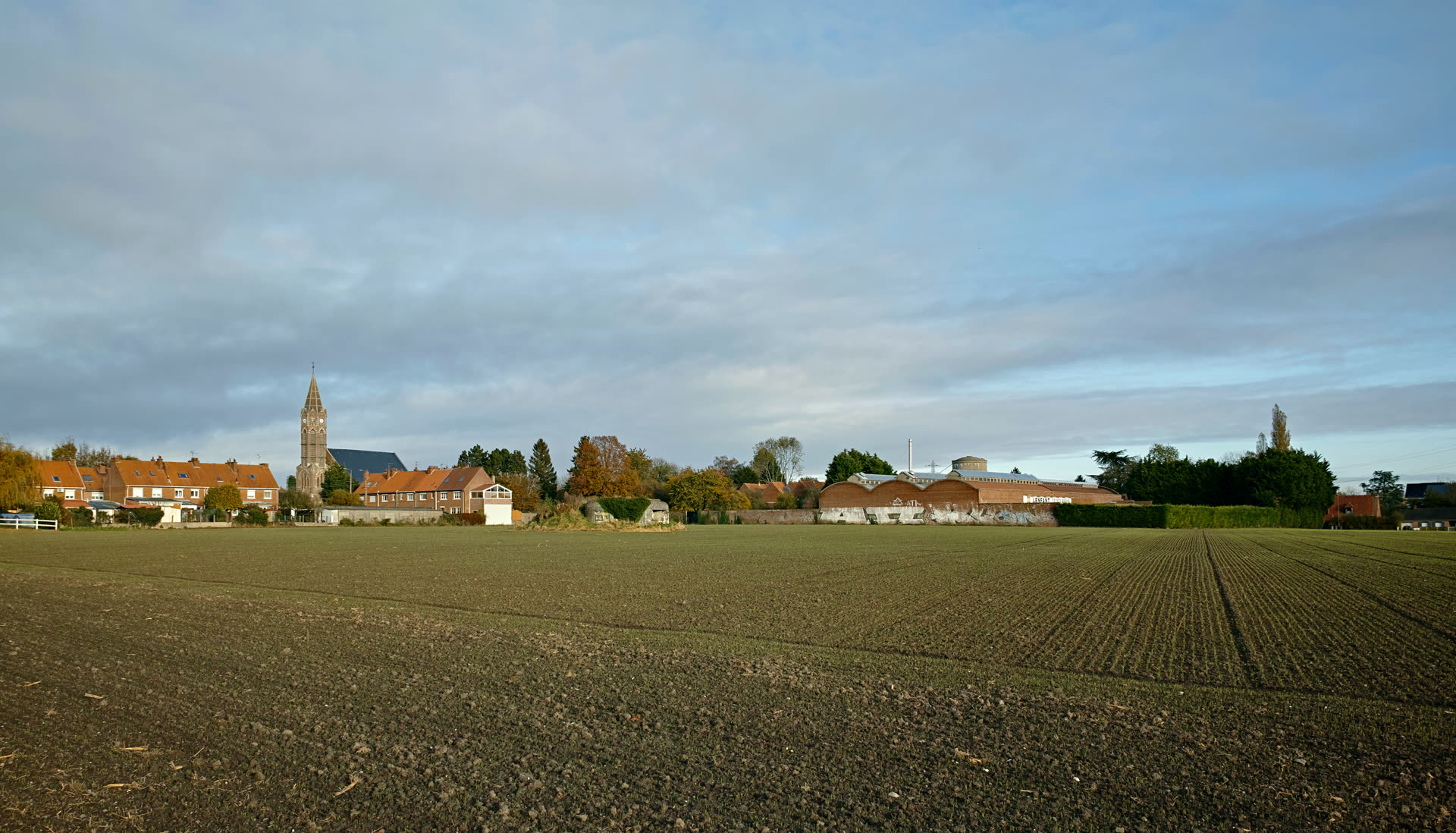
Pictured: a general view of the town of Hem, Nord, France — the commune where the witness was walking his dog at the time of the sighting. This is not a photograph of the phenomenon itself, nor of the specific street or path involved, which GEIPAN's published summary does not name; no photograph or video of the three ring-shaped lights is known to exist. Photo by Wikimedia contributor Velvet, taken November 9, 2021, released under CC BY-SA 4.0 via Wikimedia Commons.
Theoretical Alignment
This case splits its strongest alignment between two competing frameworks rather than settling cleanly on one. The Extraterrestrial Hypothesis draws support from the object's apparently structured, geometrically fixed form — three identically colored, identically shaped ring lights holding an exact triangular arrangement around a dark central mass, moving as a single coherent unit along a level, rectilinear path, exactly the kind of "structured craft" silhouette ETH proponents point to. But the manner of its departure cuts the other way: rather than accelerating away, climbing, or descending through cloud, the object simply stopped and went dark in place, "as if switched off," a description with no obvious propulsive or aerodynamic analog. That specific behavior — a light-form winking out in place rather than departing under any observable motion — is the kind of detail Interdimensional Hypothesis proponents cite as evidence against a solid, conventionally-propelled craft, giving IDH a real, if still secondary, claim on this case relative to most other GEIPAN files this site has published. Psycho-Social framing carries the least weight here specifically because GEIPAN's investigators tested and rejected the most obvious psycho-social candidate — floating lanterns, whose drift should track the prevailing wind — on the specific, checkable ground that the object's actual direction of travel did not match the wind direction recorded for that evening.
Background
Understanding why a single, year-delayed account of three "toric" lights over a small textile town near the Belgian border received a full field investigation, a detailed drone-performance calculation, and a formal, self-critical classification requires understanding both the specific character of Hem itself and the investigative apparatus GEIPAN has built to handle exactly this kind of thin, single-witness report without either dismissing it outright or overselling what it can support.
Hem: An Old Commune Remade by Industry, Then Left Behind by It
The commune of Hem sits in the Nord department of the Hauts-de-France region, immediately east of Roubaix within the Lille metropolitan area, roughly fifteen kilometers from central Lille itself. It is, by its own local history, one of the oldest communes in the north of France, first recorded under the name "Ham" and taking its modern spelling by the fourteenth century — a name rooted in an old Germanic word for a dwelling-place or homestead, suggesting a settlement of substantial, long-established households rather than a recent clearing. For most of its history Hem was a modest agricultural village on Roubaix's doorstep; that changed decisively around 1900, when textile mills, tile works, and breweries began establishing themselves on its land, pulling Hem directly into the industrial expansion transforming the wider Lille-Roubaix-Tourcoing conurbation into one of France's most important textile-manufacturing regions. The town's population reflects that history almost exactly: from just 1,600 residents at the time of the French Revolution, to 4,700 by 1901 as the mills arrived, to a peak of roughly 23,000 inhabitants in 1975 at the height of the postwar industrial boom — a fourfold increase within twenty years of the war's end. The deindustrialization that hit the wider Nord textile belt from the 1970s onward reversed that growth; Hem's population had fallen back under 20,000 by the century's end and stood at 18,582 as of the most recent count, a smaller, quieter town living in the physical footprint of a much larger industrial past.
Hem's most visible modern landmark, the Chapelle Sainte-Thérèse, consecrated in 1958 and designed by the Swiss architect Hermann Baur, is a deliberately modern building known for its stained glass and its appearance in the French film The Dreamlife of Angels — a small but real point of cultural distinction for a town otherwise defined by its industrial and residential character. The commune maintains formal twin-town relationships with Mossley in the United Kingdom, Aljustrel in Portugal, and Wiehl in Germany, and has produced a small number of nationally recognized figures, including the boxer Daouda Sow, an Olympic silver medalist in 2008, and the cyclist Alain Bondue — the kind of unremarkable civic detail typical of a stable, mid-sized French commune rather than any indication of unusual local prominence. None of this bears directly on the December 2022 sighting itself, but it matters for calibrating what kind of place this is: a dense, unremarkable, thoroughly residential and light-industrial suburb of the Lille metropolitan area, not a rural backwater, not a military zone, and not a location with any obvious institutional source — airbase, drone-testing range, industrial light show — that would make an unusual aerial light display an expected, easily-explained local occurrence. That absence of an obvious institutional candidate is itself a meaningful fact GEIPAN's investigators had to reckon with, discussed further in the Environmental & Geospatial Context and Conventional Explanation Candidate sections below.
GEIPAN's Investigative Machinery, Applied to a Thin File
GEIPAN, based at the Centre National d'Études Spatiales (CNES) campus in Toulouse and tracing its institutional lineage back to GEPAN, the unit Claude Poher founded within CNES in 1977, and later reorganized as SEPRA under Jean-Jacques Velasco before adopting its current name and structure, runs on a deliberately small permanent staff: two core CNES positions (a director and deputy) plus the equivalent of roughly 1.5 further staff handling documentation and information systems, multiplied through a network of around twenty trained volunteer field investigators and roughly fifteen outside scientific experts across astronomy, meteorology, aeronautics, and psychology. GEIPAN's own published figures put its annual intake at approximately 500 witness contacts, of which more than half are resolved immediately or referred elsewhere; roughly 200 proceed to a fully investigated, published case file each year, and only around 10% of those receive an actual field investigation involving direct witness contact rather than a desk-based review of the written questionnaire alone. Of everything GEIPAN investigates, its own statistics indicate about 7% remains unexplained across the agency's full history, a share that has fallen to roughly 2% over just the past decade as investigative technique, radar-data access, and public astronomical literacy have all improved.
This case sits, by GEIPAN's own accounting, in a genuinely difficult evidentiary position within that system: a single witness, no photograph or video, and — the detail GEIPAN's own file foregrounds rather than downplays — a full year's gap between the sighting and the witness's first report to the agency, followed by a further roughly six months before the field investigation itself took place, some eighteen months after the original sighting. That is a longer documentation delay than several other single-witness GEIPAN files already published on this site, and GEIPAN's own methodology treats delay of this kind as a genuine, quantifiable risk to testimony reliability, not a neutral administrative fact. That the agency nonetheless dispatched two field investigators, conducted a formal interview, and physically reconstructed the sightline geometry on site — rather than closing the file on paper alone — reflects GEIPAN's general practice of investigating a case on its substantive merits (an unusual, specific, internally detailed description) independent of how quickly or slowly it happened to reach the agency's desk.
GEIPAN's roughly twenty volunteer field investigators are not agency employees but a trained network the agency draws on for exactly this kind of in-person follow-up, and this particular case was assigned two of them rather than one, with both conducting the witness interview and the on-site sightline reconstruction together. Only around 10% of GEIPAN's roughly 200 annually investigated cases receive this level of direct, physical follow-up at all; the decision to commit two investigators' time to a case a full year and a half removed from the original sighting reflects a judgment, made independent of the delay itself, that the account's specificity and internal detail justified the effort. That judgment does not retroactively resolve the delay's own effect on testimony reliability, but it does mean the file in front of readers today is not a thin desk-review summary; it is the product of a genuine, resourced field investigation that happened to begin later than most.
Complete Timeline
| Date | Event |
|---|---|
| 14th century | The settlement of "Ham," on the site of modern Hem, adopts the name it carries today. |
| 1977 | GEIPAN's predecessor, GEPAN, is founded within CNES in Toulouse under Claude Poher. |
| Circa 1900–1975 | Hem industrializes rapidly around textiles, tile works, and breweries; population quadruples in the two postwar decades before deindustrialization sets in from the mid-1970s. |
| December 16, 2022, approx. 9:00 PM | Sighting begins. Walking his dog through Hem, the witness notices three reddish, ring-shaped lights arranged in a triangle, moving slowly on a level, straight path from the west-northwest toward the east. |
| December 16, 2022 (continuing) | The witness can just make out a dark, indistinct mass between the three lights, but cannot resolve its shape; the formation shows no wavering, flashing, or change in relative spacing as it crosses the sky in total silence. |
| December 16, 2022 (approx. 10 seconds after onset) | The PAN disappears. Having tracked toward the east-southeast, the three-light formation stops and vanishes in place, "as if it had been switched off," rather than flying away, dimming gradually, or passing behind any obstruction the witness could identify. |
| Approximately one year later (circa December 2023) | The witness files his account with GEIPAN — the only testimony the agency would ever receive about this sighting. |
| During the investigation | GEIPAN's initial desk-based review formulates the case's leading hypotheses: floating lanterns, a conventional aircraft, and one or more drones fitted with custom LED lighting. |
| Roughly 18 months after the sighting | Two GEIPAN field investigators travel to Hem, interview the witness directly, and physically reconstruct the sightline and geometry of the original observation on site. |
| During the investigation | Investigators compare the witness's size and distance estimates given at the initial questionnaire stage against those given eighteen months later during the field reconstruction, finding little meaningful divergence between the two. |
| During the investigation | The lantern hypothesis is eliminated: the PAN's direction of travel does not match the recorded wind direction for that evening. The aircraft hypothesis is set aside for lack of any radar trace confirming an aircraft's presence, and because it cannot account for the reddish, ring-shaped lighting described. |
| During the investigation | The civilian/military drone hypothesis is developed in detail: a rectilinear trajectory and a speed consistent with a witness-to-object distance of 100 meters or less both fit a drone profile, but no drone model built with three toroidal ("ring") lights is found in GEIPAN's research, and size/distance calculations based on real hobbyist drone dimensions prove incompatible with the witness's estimates unless an exceptionally large drone, or a significant overestimation of the PAN's size by the witness, is assumed. |
| During the investigation | Investigators confirm the area is legally closed to drone flights and to night flying, and note that no engine or motor sound was heard despite a carrying wind late in the observation and an otherwise very quiet setting — at a range that should have been moderate for a standard hobbyist drone. |
| During the investigation | A military-drone hypothesis is considered separately but reaches no definitive conclusion either way. |
| Following the full investigation | Final classification. GEIPAN concludes that no hypothesis conclusively identifies the phenomenon, despite the year-long reporting delay and residual uncertainty over a possible overestimation of the PAN's size, and classifies the case « D1 », catalogued as case ID 2023-12-51504. |
Detailed Narrative
An Ordinary Dog Walk, an Unusual Light in the Sky
The witness's account, as GEIPAN eventually recorded it, begins in circumstances about as mundane as a UAP sighting can begin: a resident of Hem, out walking his dog at around nine in the evening in mid-December, glances up and notices something moving across the sky that does not resemble any aircraft, satellite, or celestial object he recognizes. What he described was neither a single light nor an amorphous glow but a specific, structured pattern: three separate lights, each reddish in color and each distinctly ring-shaped — a torus, or donut shape, rather than a solid disc or point — arranged with geometric precision into the three corners of a triangle. Between the three rings, he told investigators, he could just make out a dark, indistinct mass, something that struck him as solid rather than as empty space between three independently floating lights, though he was never able to resolve its actual outline, size, or shape against the night sky behind it.
The formation moved, but slowly and evenly, tracking a level, straight-line path from the west-northwest toward the east. GEIPAN's file specifically records this as a rectilinear trajectory — a detail that would matter directly to the later drone hypothesis, since a straight, unwavering flight path at a walking or jogging pace is exactly the kind of motion profile a stabilized hobbyist or commercial drone is capable of producing, in a way that a natural phenomenon typically is not. Throughout its roughly ten-second transit, the witness reported no wavering, no flashing, no change in the rings' relative spacing, and — a detail GEIPAN's investigators would return to repeatedly — total silence, despite what he judged to be a fairly close and low-altitude pass.
Vanishing "As If Switched Off"
The sighting's single most distinctive detail is not the shape of the lights but the specific manner of their disappearance. Having tracked from west-northwest toward the east, the three-ring formation shifted further, ending its visible path toward the east-southeast, where — rather than continuing on its course out of view, climbing away, dimming gradually, or passing behind any building, tree line, or cloud the witness could identify — it simply stopped and disappeared in place. The witness's own description, preserved in GEIPAN's file, was that it vanished "as if it had been switched off" (comme s'il s'éteignait): not a departure under any observable motion, but an instantaneous cessation of visibility at a fixed point in the sky. This is a meaningfully different kind of "disappearance" than the sudden accelerative vanishing described in some comparable cases on this site — there is no reported burst of speed, no visible flight away from the observation point, just an abrupt loss of visibility exactly where the object had, a moment before, still been present.
GEIPAN's investigators had to weigh this detail carefully against each hypothesis they tested. A conventional light source — a drone's LEDs, an aircraft's position lights — can certainly be switched off by a human operator, which is precisely why the drone hypothesis remained live long enough to warrant detailed technical analysis rather than immediate dismissal. But it also means the "switching off" detail, by itself, favors an artificial, deliberately-controlled light source over an atmospheric or purely natural explanation, since few natural light phenomena terminate with that specific, instantaneous, at-a-fixed-point character rather than fading, drifting from view, or being progressively obscured.
A Year of Silence, Then a Detailed Field Investigation
What makes this case's investigative record unusual is the gap between the event and its documentation. The witness did not contact GEIPAN until roughly a year after the sighting, and the field investigation itself — involving two GEIPAN investigators traveling to Hem, conducting a direct interview, and physically reconstructing the witness's original vantage point and sightline — did not take place until approximately eighteen months after the original observation. GEIPAN's own file is explicit that this is the only testimony available for the case: no second witness, no corroborating photograph, no video, nothing beyond one man's memory of ten seconds observed more than a year earlier by the time he first described it to anyone in an official capacity.
Rather than treat that delay as disqualifying, GEIPAN's investigators used the field reconstruction specifically to test the witness's own internal consistency over time: comparing the size and distance estimates he gave in his original written questionnaire against the estimates he gave again, in person, during the eighteen-months-later field visit. GEIPAN's file records that the two sets of estimates showed little meaningful divergence — a genuinely useful, if modest, piece of corroborating evidence for the account's basic reliability, even though it obviously cannot substitute for a second independent witness or any form of physical or instrumented record. This is exactly the kind of test a careful investigation applies to a thin, single-source file: not proof that the account is accurate, but a specific, checkable procedure that at least rules out the crudest form of a story changing shape with each retelling.
The Drone Hypothesis, Worked Through in Detail
Of the hypotheses GEIPAN tested, the drone hypothesis received by far the most sustained technical attention, and for good reason: the PAN's rectilinear trajectory and its apparent speed were both, in isolation, consistent with a drone operating within roughly 100 meters of the witness. But GEIPAN's investigators pushed the analysis considerably further than that surface-level compatibility. First, and most simply, no drone model documented in GEIPAN's own research — commercial, hobbyist, or otherwise — has ever been manufactured or modified with three separate ring-shaped, toroidal LED light fixtures of the kind the witness described; drone lighting kits use point LEDs, strip lighting, or occasionally a single illuminated ring around the rotor housing, never three independent torus-shaped lights arranged as a fixed unit. Second, when investigators worked backward from the real physical dimensions of actual hobbyist and commercial drones on the market to calculate how far away such a drone would need to be to produce the apparent size the witness described, the resulting distance estimates proved incompatible with the witness's own reported range — unless one assumes either an exceptionally large drone, well outside the hobbyist category, or a significant overestimation of the PAN's actual size by the witness. The field-reconstruction consistency check discussed above cuts against the second option somewhat, since the witness's size estimates held up reasonably well under retesting eighteen months later — though it cannot rule it out entirely, since a consistently-held but still-mistaken initial impression would reproduce the same pattern.
Beyond the geometry, investigators identified two further, independently damaging facts for the drone hypothesis. The airspace over Hem, like much of the dense Lille-Roubaix-Tourcoing urban area, is legally closed to drone operations and to night flying under French civil aviation rules, meaning any drone matching this description would represent a knowing violation of restricted airspace rather than a routine hobbyist flight. And despite what the witness described as a fairly close, low-altitude pass, in an otherwise very quiet setting, and despite a carrying wind late in the observation that should, if anything, have helped transmit any motor or propeller noise toward him, no sound of any kind was reported at any point during the sighting — a real, unresolved problem for any drone large enough to be visible at the apparent size and distance in question. GEIPAN's investigators also raised, and left formally unresolved, the possibility of a military rather than civilian drone, without finding evidence to confirm or eliminate that narrower possibility.
Key Witnesses
The Hem Primary Witness (identity withheld per GEIPAN's standard anonymization practice)
A resident of Hem who, while walking his dog at around 9:00 PM on December 16, 2022, observed three reddish, ring-shaped lights arranged in a triangle drift silently across roughly ten seconds of sky before disappearing in place. He did not report the sighting to GEIPAN until approximately one year later, and his account remains the only testimony on file for this case. GEIPAN rated the account's consistency "medium" and its perceived strangeness "high," noting that the witness was visibly affected by the encounter — struck in particular by the triangular arrangement, the dark central mass, the apparent size of the formation, the ring-shaped lighting, and the complete absence of sound. A field investigation by two GEIPAN investigators, including a direct interview and a physical reconstruction of the sightline, took place roughly eighteen months after the sighting; investigators noted that the witness's size and distance estimates given at that later stage closely matched those given in his original written questionnaire.
The Five Observables Assessment
The Five Observables framework, developed by the Pentagon's Advanced Aerospace Threat Identification Program to describe performance characteristics beyond known conventional technology, is applied here for comparative consistency across the site's case files. This case's own profile is unusual: it registers no confident positive match at all, largely because its defining feature — an object that vanishes in place rather than departing under any observed motion — does not map cleanly onto any single AATIP category.
Assessment: Unlike several other GEIPAN cases on this site, this file does not register a clean positive match on any of the five AATIP observables. Its single most distinctive behavior — disappearing in place rather than departing under any observed motion — sits outside the "Instant Acceleration" category as AATIP defines it, since acceleration implies continued motion at increasing speed, not a static, at-a-fixed-point loss of visibility; it is rated Absent here specifically to avoid overstating the observable's applicability, not because the disappearance itself was unremarkable. Anti-Gravity Lift is rated speculative rather than present because, while the formation held a rigid triangular shape throughout its slow transit, nothing in the account describes wind resistance, turbulence, or any other environmental interaction with the object that would make its lift mechanism a directly observed rather than merely inferred property. Low Observability is speculative for a genuinely mixed reason: a real radar check was performed and returned no aircraft trace matching the sighting, a meaningful negative result — but the object described, if real and if drone-scale, would likely fall below the reliable detection floor of area radar coverage in the first place, making the negative result less diagnostic than it would be for a larger, aircraft-scale target.
Evidence Assessment
Supporting an Anomalous Origin
- A specific, internally detailed single-witness account — a fixed triangular arrangement of three ring-shaped lights, a barely-resolved dark central mass, complete silence, and a distinctive in-place disappearance — that GEIPAN rated high for perceived strangeness
- The witness's size and distance estimates held up under an independent retest roughly eighteen months later, a modest but real internal-consistency check
- The lantern hypothesis was eliminated on a specific, checkable ground: the PAN's direction of travel did not match the recorded wind direction that evening
- The aircraft hypothesis was set aside for lack of any radar trace confirming an aircraft's presence, and because it cannot explain the reddish, ring-shaped lighting reported
- No drone model documented anywhere in GEIPAN's research has ever been built or modified with three toroidal ("ring") lights matching the witness's description
- The area is legally closed to drone flights and to night flying, and no engine or motor sound was heard despite favorable, quiet conditions and a carrying wind late in the observation
Supporting a Conventional/Mundane or Inconclusive Origin
- This is a single, uncorroborated witness account with no second observer, no photograph, and no video of the phenomenon itself
- The witness did not report the sighting for roughly a year, and the field investigation did not occur until roughly eighteen months after the event — a longer documentation gap than most comparable cases on this site, and one GEIPAN's own file explicitly does not minimize
- GEIPAN rated the account's consistency only "medium," a lower rating than several comparable single-witness cases already published on this site
- Size and distance calculations based on real hobbyist drone dimensions cannot be reconciled with the witness's reported range unless an exceptionally large drone, or a meaningful overestimation of the PAN's size by the witness, is assumed — and the latter cannot be ruled out
- A military-drone hypothesis was raised and left formally unresolved rather than eliminated outright
Why "Open"
This case is stamped Open rather than Credible, Disputed, or Debunked because that is precisely where GEIPAN's own investigation left it: a thin, single-witness file with real, acknowledged weaknesses — a year-long reporting delay, only "medium" consistency, and a residual, unresolved possibility that the witness overestimated the object's true size — that nonetheless survived a genuine, detailed attempt at conventional explanation. The lantern hypothesis was eliminated on a specific, testable ground rather than assumed away. The aircraft hypothesis was checked against radar data and found unsupported. The drone hypothesis, the most substantive candidate by far, was worked through with real quantitative rigor — comparing the witness's own size and distance estimates against the real physical dimensions of hobbyist drone hardware, checking the area's actual airspace restrictions, and weighing the total absence of any operating noise against a genuinely close, quiet observation — and still came up short on the single most distinctive detail: no drone, in any category GEIPAN could document, has ever been built with three ring-shaped lights of the kind this witness described.
Set against that, a stronger designation than Open would overstate what a single, year-delayed, uncorroborated account can support. This case scores toward the lower end of the comparable GEIPAN files already published on this site specifically because its evidentiary base is thinner in two compounding ways at once: a "medium" rather than "good" consistency rating, and a documentation delay measured in a full year rather than the several months seen in most other single-witness cases here. The field-reconstruction consistency check is a real, positive data point, but it tests only whether the witness told the same story twice, not whether the story itself was accurately perceived in the first place. A case whose most persuasive evidence is the elimination of specific alternative explanations, rather than any positive corroboration of the anomalous account itself, is exactly the profile Open is built to describe.
Sensor & Instrumentation Detection Profile
This case's instrumented record is genuinely mixed rather than entirely absent. GEIPAN's investigators did check available radar data as part of eliminating the conventional aircraft hypothesis, and that check returned no trace of any aircraft correlating with the sighting's time and location — a real, if narrow, negative result comparable in kind to the clean radar checks obtained in the Montluel case elsewhere on this site, though considerably less diagnostic here, since a small, low-altitude, drone-scale object would likely sit below the reliable detection floor of the radar systems used for civil and military aircraft surveillance regardless of whether anything unusual was actually present. No dedicated drone-detection sensor, acoustic array, or ground-based camera network covers the area, and no photograph, video, or audio recording of the phenomenon itself exists; the sighting rests entirely on one witness's unaided visual observation, tested only through the eighteen-months-later field reconstruction of his sightline and stated distance/size estimates.
Environmental & Geospatial Context
GEIPAN's published case file does not specify the meteorological conditions at the time of the sighting, an honest gap in the record rather than an omission this site can responsibly fill with invented detail. What is documented is more indirect but still evidentially useful: investigators recorded the prevailing wind direction for that evening specifically in order to test it against the PAN's own observed direction of travel, and found the two did not match — the basis on which the lantern hypothesis was eliminated. A carrying wind was also noted late in the observation, a detail investigators weighed against the total absence of any engine or motor noise, since wind moving from the object's direction toward the witness should, if anything, have helped rather than hindered sound transmission from any mechanical source large enough to be visible at the reported range.
Geographically, Hem sits within the dense, continuously built-up Lille-Roubaix-Tourcoing urban area near France's border with Belgium — a heavily populated, thoroughly civilian suburban landscape with no nearby military airbase, drone-testing facility, or other obvious institutional source of unusual aerial activity comparable to what investigators found on the Crozon peninsula elsewhere on this site. That absence cuts in a specific direction for this case: where Crozon's investigators had a specific, named institution (the Lanvéoc-Poulmic naval air base) to contact directly for a dated negative confirmation, no comparable single candidate source exists for Hem, meaning the drone hypothesis here had to be evaluated purely on physical and regulatory grounds — airspace restrictions, real hardware dimensions, acoustic plausibility — rather than through a direct institutional check of the kind available in a more militarized location.
The area's legal airspace status is itself a directly relevant environmental fact GEIPAN's investigators specifically documented: the Hem area, consistent with much of the dense Lille metropolitan region, is closed to drone operations and to night flying under French civil aviation rules. This does not make an illegal drone flight impossible — hobbyist drone operators do fly in restricted zones, and knowingly or not — but it does mean any drone matching this description would represent a genuine violation rather than a routine, legally sanctioned local activity, a meaningfully different evidentiary weight than would apply in open countryside with no such restriction.
Observer Credibility & Occupational Profile
The witness's occupation is not disclosed in GEIPAN's published case file, consistent with the agency's standard anonymization practice. What the file does document is behavioral: a willingness to file a detailed account with GEIPAN even a full year after the fact, and to cooperate fully with a field investigation roughly six months after that, including an in-person interview and a physical walk-through reconstruction of his original sightline. The specific, internally coherent details he provided — the triangular arrangement, the distinct ring shape of each light, the barely-resolved dark mass between them, the direction of travel, the total silence, and the precise, unusual character of the disappearance — are the kind of details GEIPAN's methodology treats as evidence of a genuinely observed event rather than a vague or generic report, even while the agency rated the overall consistency only "medium" given the delay and the single-source nature of the account.
The most useful, if modest, credibility signal in this case is the field-reconstruction consistency check: the witness's size and distance estimates, given first in his original written questionnaire and again roughly eighteen months later during the in-person field investigation, showed little meaningful divergence. That is a genuinely different kind of evidence than simple internal narrative consistency (the story not changing), since it involves a specific, quantifiable estimate being independently reproduced under different circumstances and after significant time had passed. It does not, and cannot, establish that the original estimate was itself accurate — a witness can misjudge a distance once and then consistently recall that same mistaken impression — but it does rule out the crudest form of memory drift or narrative embellishment over time, which is a real, if limited, point in the account's favor.
It is worth being explicit about the two separate kinds of delay compounding one another in this file, since they are easy to conflate but carry different evidentiary weight. The first delay — roughly a year between the sighting and the witness's initial report to GEIPAN — affects how much confidence can be placed in the original written questionnaire itself, since a full year of ordinary memory decay had already elapsed before that document was ever created. The second delay — a further roughly six months before the field investigation — affects only the reliability of the later, in-person retelling relative to that already-once-delayed questionnaire, which is precisely what the consistency check discussed above was designed to test. A witness whose account survives that second test intact has demonstrated stability in his own retelling over an additional half-year, but has not thereby demonstrated that the original, year-delayed questionnaire itself accurately captured what happened in real time. Both delays matter, but they are not interchangeable, and GEIPAN's own file appears to treat them as the compounding, rather than redundant, sources of uncertainty they actually are.
Historical Precedents & Archive Matches
This case's most direct point of comparison on this site is not a triangle case at all, but another GEIPAN file built around unusual ring-shaped, or "toric," lighting — and the comparison illuminates just how genuinely unusual that specific detail is across the published GEIPAN record.
The Crozon Peninsula Red Rectangles (2020) — Two Different "No Matching Drone" Findings
The Crozon Peninsula Red Rectangles (Open, 45/100) is this case's closest analog on this site: another single-witness French sighting in which GEIPAN's own drone-hypothesis research turned up no matching lighting configuration on any documented drone platform — there, three fixed red rectangular light-forms rather than three ring-shaped ("toric") ones. The two cases reached that same negative finding through different investigative routes: Crozon's investigators secured a direct, named consultation with a Marine Nationale drone instructor who confirmed no known military drone signage matched the reported lights; Hem's investigators worked the problem from the opposite direction, using real hobbyist drone dimensions to calculate size-versus-distance incompatibilities and confirming the area's airspace restrictions rather than consulting a named military specialist. Both approaches converge on the same underlying conclusion — that a coherent, geometrically structured, multi-light aerial phenomenon with a specific, unusual lighting morphology (rectangular rings of red light in one case, toroidal rings of red light in the other) does not correspond to any documented drone product on the civilian or military market — which, appearing independently across two unrelated cases in different parts of France, is itself a modest but genuine piece of corroborating pattern evidence for how seriously GEIPAN's drone-hypothesis research is actually conducted, rather than treated as a rote formality.
Montayral (2015) and Bornel (2014) — Weighing a Single Witness Against Documentation Delay
The Montayral aerodrome object (Open, 28/100) remains the single-witness GEIPAN case on this site with the thinnest overall consistency rating, described by GEIPAN as only "just sufficient." This case's own account, rated "medium," sits meaningfully above that floor but still well below cases like the Crozon file's "good" (0.65) rating or the Sainte-Foy-de-Peyrolières file's "good" 0.72 rating — a genuine middle-to-lower position among the site's published single-witness files. The year-long reporting delay in this case is itself a distinguishing weakness even against that comparison set: Crozon's own five-month and roughly year-long delays (before its questionnaire and field reconstruction respectively) drew explicit GEIPAN caution, and this case's delay is comparable in the questionnaire stage and longer still before the field investigation, compounding rather than easing the credibility question. The Bornel conservatory fireball (Open, 51/100), by contrast, benefits from two corroborating witnesses and an inconclusive but real photograph, corroboration this single-witness Hem file simply lacks regardless of how carefully its drone hypothesis was ultimately worked through.
Villers-lès-Luxeuil (2019) — A Different Kind of "Impossible Drone" Argument
The Villers-lès-Luxeuil Triangle (Open, 50/100) offers a useful contrast in how a drone hypothesis can fail for entirely different reasons: there, GEIPAN ruled out a drone primarily on the grounds of the object's large apparent size and its two independent witnesses driving separate cars, rather than on any specific lighting-configuration mismatch. This case's drone hypothesis failed on the opposite basis — the size and distance estimates were, on their face, broadly compatible with a drone, and the real obstacle was the specific, undocumented "triple ring light" configuration and the total absence of engine noise at a distance that should have carried it. Read together, the two cases show GEIPAN applying the same underlying skepticism toward the drone hypothesis through two genuinely different, case-specific evidentiary routes rather than a single templated argument reused case to case.
Material Analysis
This case involves no physical or trace evidence of any kind — no landing marks, no recovered material, no soil or vegetation sample, and no biological or physiological effect on the witness beyond his own visual observation. The object never approached the ground or came within the witness's physical reach at any point in the account; it remained airborne throughout its brief, roughly ten-second transit before disappearing in place. There is accordingly nothing to sample, test, or physically examine after the fact — only the witness's own description, tested for internal consistency across two separate tellings roughly eighteen months apart, and GEIPAN's own physical and regulatory analysis of the drone hypothesis.
Supporting Non-Terrestrial Origin
- No physical evidence exists to test in the first place, so no terrestrial material-composition finding contradicts an anomalous interpretation either
- The object's reported triple ring-shaped lighting, fixed triangular geometry, total silence, and its distinctive in-place disappearance, if accurately perceived, do not correspond to any conventional aircraft, drone, or natural light source GEIPAN's investigators were able to identify
Supporting Terrestrial Origin
- The complete absence of any physical trace is itself consistent with a purely distant, airborne phenomenon that never approached the ground closely enough to leave one
- No mechanical, electromagnetic, or biological secondary effect on the witness or any nearby structure is recorded anywhere in the file
The Conventional Explanation Candidate: Lanterns, Aircraft, and Drones
GEIPAN's own file organizes its analysis around three principal candidates — floating lanterns, a conventional aircraft, and one or more drones — with the drone hypothesis further split between a civilian and an unresolved military variant. None, in GEIPAN's own final assessment, conclusively identifies the phenomenon.
Floating Lanterns
Eliminated on a specific, checkable ground: sky lanterns drift with the prevailing wind, and the PAN's actual direction of travel did not match the wind direction recorded for that evening. The hypothesis also does not obviously account for a fixed, rigid triangular arrangement of three separate ring-shaped lights holding constant relative spacing throughout the transit, a very different visual signature from the irregular, independently drifting motion multiple lanterns released together would typically display.
Conventional Aircraft
Set aside for lack of any radar trace confirming an aircraft's presence at the relevant time and location. Even setting the radar result aside, a conventional aircraft's position and anti-collision lighting does not produce three separate, ring-shaped (toroidal) red lights, and cannot easily explain the object's silent, in-place disappearance rather than a continued, visible departure from view.
Civilian Drone with Custom LED Lighting
The most substantively tested hypothesis. The PAN's rectilinear trajectory and its speed, if the witness-to-object distance was 100 meters or less, are both broadly compatible with a stabilized hobbyist or commercial drone. But no drone model documented in GEIPAN's research has ever been built or modified with three toroidal ("ring") lights matching the description; working backward from real hobbyist drone dimensions to the witness's reported size and distance estimates produces a result incompatible with any standard drone size, unless an exceptionally large drone or a significant witness overestimation of the PAN's size is assumed; the area is legally closed to drone operations and to night flying; and no engine or motor sound was heard despite a carrying wind late in the observation and an otherwise quiet setting, at a range that should have made such noise audible for a drone of the size implied.
Military Drone (Unresolved)
Raised as a distinct possibility separate from the civilian drone hypothesis, on the reasoning that a state or defense-related operator might field non-standard lighting configurations, fly in restricted airspace legitimately, or use quieter propulsion systems than civilian hobbyist models. GEIPAN's investigators reached no definitive conclusion on this specific variant, leaving it neither confirmed nor eliminated.
Floating Lanterns
ImplausibleThe PAN's direction of travel did not match the recorded wind direction; a rigid three-light triangular formation is also a poor match for independently drifting lanterns.
Conventional Aircraft
ImplausibleNo radar trace confirms an aircraft's presence; standard aircraft lighting cannot explain three ring-shaped red lights or a silent, in-place disappearance.
Civilian Drone (Custom LEDs)
InconclusiveTrajectory and speed fit, but no matching triple-ring lighting exists on record, size/distance math is strained, the area bans night/drone flights, and no motor noise was heard.
Military Drone
UnresolvedConsidered separately from the civilian drone hypothesis; GEIPAN's investigators reached no definitive conclusion either confirming or eliminating it.
Related Cases
Confirmed Documents & Official Records
The official French government investigation summary: the witness's full account, the lantern/aircraft/drone hypotheses tested, and the final Class D1 determination.
GEIPAN's full field investigation report, including the technical questionnaire responses and the hypothesis-by-hypothesis analysis of the drone-lighting and distance calculations.
GEIPAN's own published definitions for classifications A, B, C, D, D1, and D2, distinguishing this case's D1 rating (medium consistency) from a D2 rating (strong consistency).
GEIPAN's own account of its investigative structure and statistical case outcomes, providing institutional context for how a thin, single-witness, year-delayed file like this one still receives a full field investigation.
Further Reading — Recommended Literature
UFOs: Generals, Pilots, and Government Officials Go on the Record
Kean's survey of credentialed witness testimony and official investigative bodies worldwide offers useful comparative context for weighing how GEIPAN's own institution-driven investigative standard treats a thin, single-witness file like this one.
Wonders in the Sky: Unexplained Aerial Objects from Antiquity to Modern Times
A catalog of historical aerial anomaly reports useful for weighing how genuinely unusual this case's specific ring-shaped ("toric") triple-light configuration is against the broader historical pattern of reported aerial phenomena.
The UFO Evidence
The foundational documentary approach to cataloging and cross-referencing witness testimony that GEIPAN's own case-file methodology, including its formal consistency and strangeness ratings, descends from in spirit.
The UFO Experience: A Scientific Inquiry
Hynek's own multi-hypothesis evaluation framework anticipates the lantern/aircraft/drone elimination methodology GEIPAN applied to this exact case, making it a natural comparative reference.
The Close Encounters Man: How One Man Made the World Believe in UFOs
A biography of Hynek documenting the emergence of rigorous, elimination-based case investigation methodology, directly reflected in GEIPAN's detailed drone-hypothesis analysis of this case.
Essential Viewing
No Videos Available
Sources
- GEIPAN (CNES), "HEM (59) 16.12.2022", Case 2023-12-51504 — official case summary
- GEIPAN (CNES), Compte Rendu d'Enquête, HEM (59) 16.12.2022 — full investigation report (PDF)
- GEIPAN (CNES), official case archive & public portal — geipan.fr
- GEIPAN (CNES), Glossaire du GEIPAN — official classification definitions, A/B/C/D/D1/D2
- GEIPAN (CNES), "Missions, méthodes et résultats" — investigative structure and statistical case outcomes
- Wikipedia (English), "Hem, Nord" — commune history, geography, and population data
- Wikimedia Commons, File: Hem vue generale.jpg, photo by "Velvet" (November 9, 2021), CC BY-SA 4.0 — licensing and attribution
- Wikimedia Commons, Category: Hem (Nord) — image archive for the commune
- This site, case-files/crozon-peninsula-red-rectangles.html — comparative GEIPAN case with no matching drone lighting found for a structured multi-light PAN
- This site, case-files/villers-les-luxeuil-triangle.html — comparative GEIPAN case in which the drone hypothesis was ruled out on size/witness grounds
- This site, case-files/montayral-aerodrome-object.html — comparative single-witness GEIPAN D1-family case
- This site, case-files/bornel-conservatory-fireball.html — comparative two-witness GEIPAN case with inconclusive photograph
- This site, case-files/sainte-foy-de-peyrolieres-five-phase-sighting.html — comparative single-witness GEIPAN Class D case with a "good" consistency rating
- This site, key-figures.html, entry on Claude Poher — GEPAN founding and early institutional history
- This site, key-figures.html, entry on Jean-Jacques Velasco — SEPRA leadership and methodology evolution
- This site, locations/index.html, entry on Toulouse — CNES/GEPAN/SEPRA/GEIPAN institutional headquarters
See something inaccurate? Have additional information or sources?
Suggest an Edit →Last Updated: August 2026