
The Montayral Aerodrome Object
Late in the afternoon of October 23, 2015, a man drove to the small Fumel–Montayral aerodrome in Montayral, Lot-et-Garonne, to walk his dog. He parked near a row of surveyor's stakes, opened the door, let the dog out — and when he turned back toward the sky, he saw what he would later describe to French investigators as "a black spot in a black fog," high and distant, motionless, utterly silent, with a strange arc-shaped handle at its lower left. It held its position for roughly twenty minutes under a clear, haze-free blue sky. He looked away for a few seconds. When he looked back, it was gone. GEIPAN, the French national agency that investigates such reports, tested a planet, an aircraft, a helicopter, his own eyesight, three kinds of balloon, and finally a hot-air balloon specifically — the closest fit of all of them, and still assessed at well under 50% probability. Unable to retain any hypothesis with confidence, and impressed enough by the single witness's precision to submit the file to its own college of outside experts, GEIPAN closed the case as Class D1: a strange phenomenon of medium consistency, genuinely unexplained.
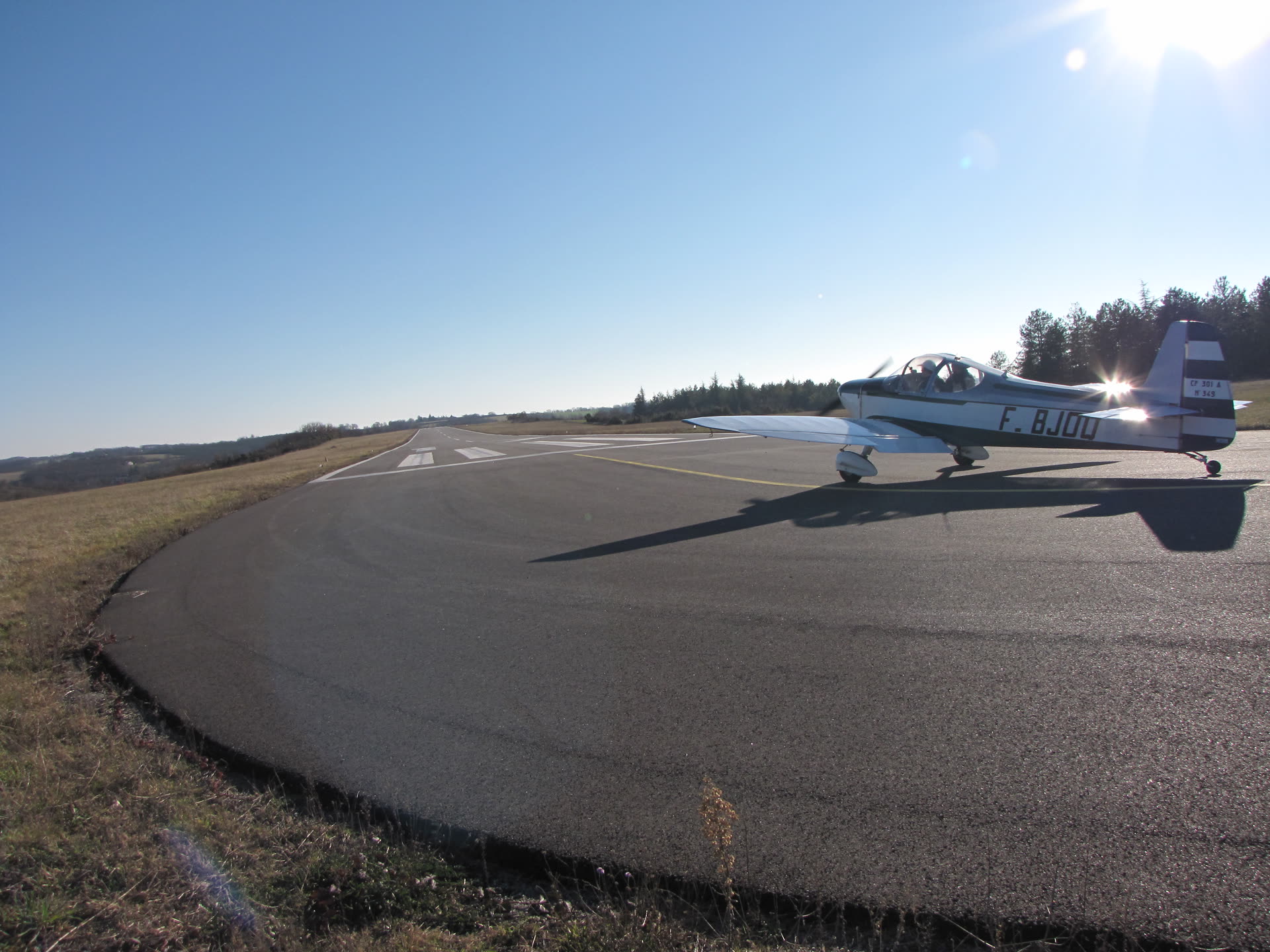
Pictured: the Fumel–Montayral aerodrome (ICAO code LFDX), the small general-aviation airfield where the witness had parked to walk his dog, photographed in January 2011 — not a photograph of the object itself, and roughly four years removed from the October 2015 sighting. The witness took no photograph or video of the phenomenon; no image of the object is known to exist in any form. This photograph is included only to ground the case's real, verifiable location. Photo: Paternel 1, 2011, licensed CC BY-SA / GFDL via Wikimedia Commons.
Theoretical Alignment
The case aligns only weakly with the Extraterrestrial Hypothesis: nothing in the account describes structure, propulsion, or purposeful behavior beyond stillness followed by an unexplained absence — a featureless dark mass is compatible with dozens of mundane readings before it is compatible with a piloted craft. It aligns somewhat more strongly, though still short of a confident reading, with Psycho-Social framing, given the single-witness, no-photograph evidentiary profile and GEIPAN's own explicit consideration (and explicit rejection, on the specific grounds of the reported immobility) of an ophthalmological explanation for the witness's own visual field. Interdimensional framing finds essentially no support anywhere in the primary record. None of the three framings describes the case well; GEIPAN's own D1 classification — unexplained, but only moderately strange, resting on a single account — is itself a more precise description than forcing the case into any hypothesis built around a piloted craft.
Background
The Montayral aerodrome sighting is, in almost every respect that matters for assessing it, the opposite kind of case from a headline-grabbing multi-witness event with instrumented corroboration. It is a single man, alone with his dog, at an underused general-aviation airfield in rural southwestern France, on an ordinary autumn afternoon. Understanding why GEIPAN nevertheless treated the report seriously enough to submit it to its own outside expert panel requires understanding three things: the place itself, the witness's own account in its full specificity, and the demanding internal logic GEIPAN's methodology applies before it will accept that a report is genuinely, rather than merely apparently, unexplained.
Fumel, Montayral, and a Runway Built on a Steelworks' Foothills
Montayral is a commune of roughly 2,600 residents in the Lot-et-Garonne department of Nouvelle-Aquitaine, in the Agenais district on the hills above the Lot, Thèze, and Lémance river valleys. It sits immediately across the river from the larger town of Fumel, whose own history is inseparable from a single industrial enterprise: the Société Minière et Métallurgique du Périgord (SMMP), an iron-and-steel works established on the banks of the Lot in 1847 to exploit local iron-ore deposits and the river's hydraulic power. For a century and a half the Fumel foundry was the largest single industrial employer in the Aquitaine region, casting metalwork that ranged from ordinary industrial components to, memorably, structural elements for the Centre Pompidou in Paris. The plant closed for good on June 4, 2018 — not quite three years after this sighting — ending a defining chapter of the town's economic identity and leaving Fumel, like many French industrial towns of its era, in the middle of a long, still-ongoing process of redefining itself around tourism, heritage, and smaller-scale enterprise.
The Fumel–Montayral aerodrome (ICAO code LFDX) sits on the Montayral side of that river valley, roughly five kilometers southeast of central Fumel. It is a modest facility by any standard: a single bituminous runway oriented 17/35, 720 meters long and 18 meters wide, unattended and uncontrolled, used almost entirely for light leisure aviation through the local Aeroclub Fumel-Montayral. It is exactly the kind of quiet, low-traffic general-aviation field — open countryside, a scatter of hangars, wide sky, virtually no ambient light or noise pollution once the day's few flights are done — that makes it a genuinely good location for an uninterrupted twenty-minute sky observation, and a genuinely poor location for that observation to be independently corroborated by a second person, since almost nobody else is ever there.
The witness's own reason for being there was entirely mundane: he had driven out, by his own account, simply "to get some air with his dog" (prendre l'air avec son chien), an ordinary late-afternoon errand with no connection to aviation, astronomy, or any anticipation of seeing anything unusual. He drove along the row of hangars and parked in a small open space near a set of surveyor's stakes (balises de géomètre) — a detail GEIPAN's file preserves with the same precision it applies to every other element of the account, and one worth noting for what it establishes about the witness's own attentiveness to his surroundings: this is not a vague, generic description of "a field," but a specific, checkable physical location within the aerodrome's grounds.
GEIPAN's Classification Architecture: Why D1 Is Not a Compromise Verdict
To understand what GEIPAN's eventual D1 classification for this case actually asserts — and, just as importantly, what it does not assert — requires understanding the agency's classification methodology in some structural detail, since it is easy to misread D1 as a kind of hedge or a polite way of avoiding a more definite conclusion. It is not. GEIPAN's published methodology defines five outcome categories: A (an observation explained without any ambiguity), B (an observation for which GEIPAN's retained hypothesis is considered very probable), C (an observation that cannot be analyzed at all for lack of information), and D (an observation left unexplained despite the evidence GEIPAN actually has in hand) — with D itself split into two further tiers based on how much evidentiary weight the case carries. D1 designates "strange phenomena, but described as being of medium consistency, for example associated with a single testimony, without photographic or video recording"; D2 designates "very strange phenomena of strong consistency: several independent witnesses and/or photographic or video recordings and/or ground traces." The distinction is not about how bizarre a report sounds — it is about how much corroborating evidentiary weight backs it up. A case can be extremely strange and still only reach D1 if it rests on one uncorroborated account; a case can be more mundane-sounding and still reach D2 if multiple witnesses or hard physical/photographic evidence back it. This case, precisely because it is a single, photograph-less testimony, was always structurally capped at D1 even before any hypothesis was tested — the classification describes the evidentiary category the report falls into, not a judgment call about how believable GEIPAN found the witness.
GEIPAN's own statistical publications underline just how selective this D outcome actually is in practice. Across the twenty years from January 1, 1975 to December 30, 2014, only around 227 of 2,292 published cases — roughly ten percent, averaging 6.8 per year — were ever classified D. In the ten years immediately preceding that endpoint (2005–2014), even as the total number of submitted reports roughly tripled and the proportion of cases fully explained (A+B) rose to around 70%, the D rate fell to barely 2% of published cases, an average of only 2.4 D classifications per year nationwide. A case reaching D1 or D2 status, in other words, is not routine agency output; GEIPAN's own published methodology states that D1/D2 candidates are systematically subjected to a full field investigation — including a witness meeting and a structured cognitive interview — and, for the more difficult cases, referred to a standing panel of roughly thirty volunteer, multidisciplinary scientific experts who convene once or twice a year specifically to review and finalize the most contested classifications. GEIPAN's own file for this case states plainly that it "was submitted to GEIPAN's college of experts" (ce cas a été soumis au collège d'experts du GEIPAN) — meaning this ordinary-sounding dog-walk sighting at a small regional aerodrome received the same institutional-level scrutiny GEIPAN reserves for its most genuinely difficult cases nationwide, not a quick administrative sign-off.
It is also worth situating this case within GEIPAN's own broader institutional lineage, discussed at greater length in this site's coverage of an earlier French case, the Fauville-Évreux radar sighting of 1978. The agency that investigated Montayral in the mid-2010s is the direct institutional descendant of the body Claude Poher founded in 1977 as GEPAN, reorganized as SEPRA in 1988 under Jean-Jacques Velasco and then as GEIPAN in 2005 — by 2015, a nearly forty-year-old institution with a mature, standardized questionnaire process, published statistical self-audits, and a formal expert-review structure that Poher's original ten-person unit in 1978 simply did not yet possess. The methodological rigor on display in the Montayral file — systematically testing and individually documenting the rejection of six distinct candidate explanations before conceding the case as unresolved — is the direct, matured product of that four-decade institutional development.
Complete Timeline
| Date | Event |
|---|---|
| 1847 | The Société Minière et Métallurgique du Périgord establishes its ironworks at Fumel, on the river across from Montayral — the industrial anchor of the local area for the next 171 years. |
| March 23, 1977 | GEPAN, GEIPAN's founding predecessor agency, is established at CNES under Claude Poher. |
| 2005 | SEPRA is reorganized as GEIPAN, adopting the modern D1/D2 sub-classification scheme and expert-college review process applied to this case. |
| October 23, 2015, late afternoon | Sighting begins. The witness drives to the Fumel–Montayral aerodrome to walk his dog, parks near surveyor's stakes, and upon turning back to the sky sees a motionless dark shape with an arc-like lower-left protrusion, high and distant against a clear blue sky. |
| October 23, 2015 (continuing) | The object remains stationary and silent for approximately 20 minutes. The witness, without binoculars or a camera, studies it directly; only after roughly 10 minutes of sustained concentration does he register the protrusion's specific shape with any confidence. |
| October 23, 2015 (end of observation) | Disappearance. The witness looks away from the object for a few seconds; when he looks back, it is gone. He is unable to relocate it anywhere in the sky. |
| October 24, 2015 (expected, per witness) | The witness anticipates that the sighting will be reported by other observers in local press the following day. No such report ever surfaces, and no corroborating witness is ever identified. |
| Date not specified in public file | The witness formally reports the sighting to GEIPAN, completing GEIPAN's standard structured "Questionnaire Terre" witness intake form. |
| Date not specified in public file | GEIPAN investigation. Analysts test and individually document the rejection of a celestial body, an aircraft, a helicopter, an ophthalmological artifact, a toy/party balloon, and a solar balloon; the hot-air balloon (montgolfière) hypothesis is identified as the strongest candidate but assessed at well under 50% probability. Local balloon pilots are contacted for corroboration and do not respond. |
| Date not specified in public file | The case is referred to and reviewed by GEIPAN's college of outside scientific experts (collège d'experts), per GEIPAN's standard protocol for difficult D1/D2 candidates. |
| Date not specified in public file | Final classification. GEIPAN closes the case as Class D1: "Phénomène inexpliqué d'étrangeté moyenne" — catalogued as case ID 2015-10-09361. |
| Present day | The case remains published on GEIPAN's official online archive, unrevised, its investigation report and witness questionnaire available for direct download. |
Detailed Narrative
A Dog Walk, Not an Expedition
Every detail GEIPAN's file preserves about how this sighting began reinforces the same basic point: nothing about the witness's state of mind or purpose that afternoon primed him to look for, expect, or want to see anything unusual. He drove to the Fumel–Montayral aerodrome for a routine, low-stakes errand — letting his dog stretch its legs in open country — a type of outing he had, by clear implication, made unremarkably many times before given his evident familiarity with exactly where to park near the hangars and the surveyor's stakes. He carried no binoculars and no camera, equipment a genuine UFO-hunter or an aviation enthusiast watching for aircraft at a working airfield might plausibly have brought. He was, in the specific psychological sense that matters most for assessing a report's reliability, an entirely unprimed observer: someone whose attention was captured by something unexpected in his peripheral field of view during an ordinary task, rather than someone who had gone looking skyward with any expectation in mind.
The sequence GEIPAN's file records is precise and mundane right up until the moment it isn't: he drove along the hangar row, parked in the small space near the surveyor's stakes, opened his car door, let his dog out — and it was only when he turned back around, GEIPAN's summary specifies, that he first noticed the object already present in the sky. This detail matters for a reason that recurs across many single-witness sighting reports: because he did not see the object appear, arrive, or begin its observed stationary phase, there is no data at all about how long it might have already been present, motionless, before he happened to turn and look in its direction. His own twenty-minute observation window describes only the portion of the object's presence that he personally witnessed, not necessarily its total duration in the sky.
"A Black Spot in a Black Fog": Describing an Almost Featureless Object
The witness's own phrase for what he saw — "une tâche noire dans un brouillard noir," a black spot within a black fog — is unusual enough, and specific enough in its own strange internal logic, that GEIPAN's summary preserves it verbatim rather than paraphrasing it into more conventional descriptive language. The phrase describes something closer to a visual paradox than a simple silhouette: not merely a dark shape against a bright sky (which would be an ordinary backlit silhouette, common to countless mundane aerial objects), but a comparatively darker, more defined mass sitting within a surrounding zone that was itself already dark or hazy relative to the rest of the sky — even though GEIPAN's own environmental metadata for the case records the sky that afternoon as clear blue with no haze or fog of any kind. This apparent contradiction between the witness's own description of localized "fog" around the object and the documented absence of any real atmospheric haze that day is one of the case's more genuinely puzzling specific details, and it is not resolved anywhere in the public file.
Positionally, the object appeared "haut et loin" — high and far — placing it well up in the sky at considerable, though unmeasured, distance, with no reference aircraft, landmark, or comparison object available to let the witness (or, later, GEIPAN's investigators) derive a reliable angular size or range independently. Structurally, its one distinguishing feature was what the witness described as a "sorte d'anse" — a kind of handle or loop — taking the form of an arc of a circle, positioned at the object's lower left. GEIPAN's file is careful to record exactly how confidently the witness perceived this specific detail: he registered it only after roughly ten minutes of sustained, effortful concentration and focus, not immediately, and it was, in GEIPAN's own characterization, "not the element most clearly detected" by the witness relative to the object's overall dark mass and stillness. This graduated confidence — strong certainty about the object's presence, position, color, and immobility from the very first moment; comparatively weaker, effort-dependent certainty about the specific shape of its one protruding feature — is exactly the kind of honestly reported perceptual nuance that makes a witness account harder to dismiss as fabricated or exaggerated, since a witness inventing detail typically presents every element of a description with uniform confidence rather than flagging which parts required real effort to resolve.
Twenty Minutes of Total Stillness and Silence
The object's defining behavioral characteristic, more than its shape or its "black fog" appearance, was its complete immobility: GEIPAN's file states it "remained perfectly motionless" (il reste parfaitement immobile) throughout the roughly twenty minutes the witness watched it, producing no sound of any kind (ne produit aucun bruit). Twenty minutes of sustained, undeviating stillness is, on its own, a genuinely unusual behavioral profile to attribute to almost any conventional flying object. A fixed-wing aircraft cannot loiter motionless in one visual position for twenty minutes without either circling (which would be visually obvious as directional movement even if the aircraft's net position didn't change much) or descending toward a landing; a helicopter can hover, but not silently, and not typically for twenty uninterrupted minutes at altitude without an audible engine and rotor signature reaching a ground observer even at some distance. This is precisely the reasoning GEIPAN's own file applies when it lists "immobility over 20 minutes" (l'immobilité sur 20mn) as one of the three specific factors that, individually or in combination, undercut every conventional hypothesis considered — a category error running directly through the aircraft, helicopter, and celestial-body hypotheses alike, each rejected in part or in whole on exactly this ground.
The Vanishing: A Look Away, and Then Nothing
The sighting's ending is, in its own way, as evidentially significant as its twenty minutes of stillness. GEIPAN's file records that the witness, at some point, "turned his eyes away from the phenomenon for a few seconds" (il détourne les yeux du phénomène quelques secondes) — an entirely ordinary, involuntary kind of visual break, the sort any person watching anything in the sky for twenty continuous minutes would eventually take — and then attempted to find the object again, without success (puis tente de revoir le PAN mais en vain, il a disparu). The object was, simply, gone: not receding, not fading, not descending toward the horizon in a way that might have let the witness track its departure, but absent from the entire visible sky by the time he looked back.
GEIPAN's own analysis treats this specific detail — "la disparition soudaine," the sudden disappearance — as the single hardest evidentiary obstacle facing every hypothesis it tested, including the balloon hypothesis it ultimately judged strongest. A slow-drifting balloon does not typically vanish from an unbroken sky within the few seconds a person's gaze is averted; it would ordinarily still be findable somewhere nearby, simply displaced by whatever wind was moving it, unless it had descended dramatically or moved an implausible distance in that brief interval. GEIPAN's file explicitly acknowledges this tension when weighing the balloon hypothesis, noting that reconciling the object's sudden disappearance with a montgolfière's much more gradual, wind-driven descent profile "is difficult to appreciate" and would require favorable assumptions on several uncertain variables at once (the balloon's exact size, the witness's own angular-estimation margins of error, and the precise duration of his brief look-away) all resolving in the same convenient direction simultaneously.
A Report Made Alone: No Second Witness, No Photograph, No Press
The witness's own reaction after the sighting ended is a small but genuinely telling detail: GEIPAN's file notes that, astonished by what he had observed, he expected the event would be reported the next day by other witnesses in the local press — and that this expectation, in the file's own dry summary, "will likely not be the case" (ce qui ne sera vraisemblablement pas le cas). No such press coverage, and no corroborating witness of any kind, was ever identified. GEIPAN's own file offers a plausible, non-dismissive explanation for this absence rather than treating it as suspicious: given the rural setting of a lightly used aerodrome on an ordinary weekday afternoon, "it is entirely possible that the phenomenon was not seen by other people" (il est tout à fait possible que le phénomène n'ait pas été vu par d'autres personnes) — an acknowledgment that a low-traffic location's evidentiary thinness is itself an ordinary, expected feature of that kind of location, not necessarily evidence against the account's reliability.
The witness had no camera and no binoculars with him during the sighting, meaning no photographic, video, or even magnified-visual documentation of any kind exists for this case in any form — a limitation GEIPAN's own file states plainly and without euphemism: "il s'agit d'un témoignage unique, et sans photographie" (this is a single testimony, without photography). Every fact this case file can assert about the object's appearance, position, and behavior traces back to one person's unaided, unmagnified, undocumented visual recollection, given some unspecified interval after the fact when he completed GEIPAN's structured witness questionnaire. This is the single most important limitation shaping the case's entire evidentiary profile, and it is the direct reason the case was structurally capped at D1 rather than D2 regardless of how strange its content sounded on its own terms.
GEIPAN's Elimination Process: Six Hypotheses, Six Specific Failures
What distinguishes this case's investigation from a merely cursory dismissal is the specificity with which GEIPAN's file documents exactly why each candidate explanation failed, rather than gesturing vaguely at "no conventional explanation found." The file identifies three recurring structural factors — the twenty-minute immobility, the sudden disappearance, and the distant, round, protuberance-bearing appearance — and states explicitly that these three factors, "in isolated or combined fashion" (de manière isolée ou combinée), individually undercut each hypothesis considered in turn.
Against a celestial body (astre) — the natural first candidate for any distant, motionless point of light or dark mass held at a fixed elevation — two problems arise together: its reported appearance (aspect) as a defined dark mass with a specific protruding feature does not match any star, planet, or other astronomical body's actual visual profile, and its sudden disappearance (disparition) is entirely incompatible with how celestial objects behave, since they set gradually toward the horizon over an extended period rather than vanishing instantaneously from an open sky. Against a conventional fixed-wing aircraft (avion), the object's total immobility (immobilité) is disqualifying on its own terms: no aircraft can sustain a fixed visual position for twenty minutes without either directional movement or a landing approach, neither of which was reported. Against a helicopter (hélicoptère), three separate problems compound: its appearance (aspect) does not match a helicopter's visually distinctive rotor-and-fuselage silhouette even at distance; its complete silence (bruit) is incompatible with helicopter noise carrying to a ground observer, especially over a sustained twenty-minute hover; and, critically, no helicopter matching this profile was detected by radar (non détection par le radar) — a specific, checkable negative finding GEIPAN's investigators were evidently able to verify against regional air-traffic and/or military radar records, even though the case file's public summary does not further elaborate on which specific radar source was consulted or how the check was performed.
Against an ophthalmological problem affecting the witness himself (problème ophtalmique du témoin) — a candidate explanation GEIPAN takes seriously enough to test explicitly, covering phenomena like eye floaters, vitreous debris, or other visual-field artifacts originating in the eye rather than the external world — the same immobility factor argues against it, for a specific and instructive reason: genuine ocular artifacts of this kind characteristically move with the eye itself, drifting or shifting position within the visual field as the eye moves or the head turns, rather than remaining independently fixed at one specific position against the external sky regardless of the observer's own eye movements. A witness who spent twenty minutes actively studying an object — including, per the file, straining with focused concentration to resolve its specific protrusion shape after roughly ten minutes — would very plausibly have moved his eyes and head at least somewhat during that period; an object that stayed fixed in the external sky throughout, rather than trailing the observer's own eye movements, is more consistent with something genuinely external than with an ocular floater.
The Balloon Hypotheses: Three Candidates, One Serious Contender
Having exhausted the celestial, aircraft, helicopter, and ophthalmological candidates, GEIPAN's investigation turned to balloons — and treated this as three genuinely distinct sub-hypotheses rather than one undifferentiated category. A simple rubber party/toy balloon (ballon de baudruche) was excluded essentially on grounds of scale: such a balloon is far too small to remain visible with any resolvable detail (let alone a specific protrusion shape) at the "high and far" distance the witness reported. A solar balloon (ballon solaire — a black or dark balloon that rises purely on solar heating of the air inside it, with no burner) was excluded on grounds of both its cause of disappearance and its general plausibility at this specific location: GEIPAN's file is not fully explicit about the precise technical reasoning, but flags real doubt about what would explain a solar balloon's sudden vanishing and expresses limited confidence that this specific type of craft realistically operates in this rural area at all.
That left the hot-air balloon (montgolfière) hypothesis, which GEIPAN's file treats at considerably greater length and with real technical seriousness — identifying it, in the end, as the strongest single candidate of everything tested, while still explicitly declining to accept it. The hypothesis has real situational plausibility: late-afternoon sunny conditions are a classic hot-air ballooning window (thermal conditions are typically calmer and more favorable for launch and flight near sunset than at midday), and the general Lot-et-Garonne/Dordogne region, well beyond just this specific case, is genuine hot-air ballooning country with a long-standing tourism-flight tradition. Working backward from the witness's estimated apparent size, GEIPAN's investigators calculated that a balloon consistent with his description would need to be roughly 10 to 20 meters across — a genuinely balloon-scale figure — which in turn implies a minimum viewing distance of several kilometers in order for an object of that real size to appear as small, indistinct, and "high and far" as the witness described; that inferred distance is also broadly consistent with the blurred, hazy "black fog" quality the witness attributed to the object's edges, since real atmospheric haze and simple resolution limits both increase with distance even under a nominally clear sky.
Even so, GEIPAN's file identifies two specific difficulties serious enough to keep the montgolfière hypothesis below the 50% probability threshold GEIPAN requires before it will retain any explanation as the case's official resolution. First, the reported protrusion is hard to reconcile with a hot-air balloon's actual physical layout: a balloon's gondola or basket hangs directly beneath the envelope, and would not naturally present as an arc-shaped feature specifically at the lower left rather than oriented straight downward — though the file also notes this specific detail was the one the witness perceived with the least confidence, registered only after ten minutes of concentrated effort, which somewhat (though not fully) softens how much weight this discrepancy alone should carry. Second, and more decisively in GEIPAN's own weighing, is the same sudden-disappearance problem already discussed: a real hot-air balloon descending out of sight, or drifting behind terrain, over the course of a few seconds of the witness's averted gaze is difficult to reconcile with normal montgolfière flight dynamics, which are characteristically slow and gradual rather than abrupt. GEIPAN's own conclusion states this with careful, quantified honesty rather than a simple yes-or-no verdict: reconciling the balloon hypothesis with every reported detail "would be compatible only on condition of taking several unknowns (balloon size) or margins of error (the witness's own angular data on size and elevation) in the favorable direction" — alongside, of course, the temporal coincidence of the balloon's hypothetical descent lining up exactly with the witness's brief look-away. Stacking several independently uncertain assumptions all in the same convenient direction is precisely the kind of reasoning GEIPAN's own methodology is designed to flag as insufficient for a confident B-level "probable identification," rather than accept at face value simply because it is the best available mundane candidate.
GEIPAN's investigators went a step further than simply calculating the balloon hypothesis's plausibility on paper: they attempted to contact hot-air balloon pilots operating in the department to ask whether any of them had a flight in progress near Fumel-Montayral that afternoon. None responded to the inquiry. GEIPAN's file is careful, and methodologically honest, to note explicitly that this non-response does not itself constitute evidence against the balloon hypothesis (ce qui en soit ne constitue pas un argument en défaveur de l'hypothèse) — pilots may simply not have seen or replied to the request for entirely unrelated reasons, and their silence proves nothing either way. This is a small but genuinely important piece of intellectual honesty: a lazier or less careful write-up might have treated the pilots' non-response as tacit confirmation that no balloon was flying, when in fact it establishes nothing at all.
A Credible Witness, a Consistency That Is "Just Sufficient"
GEIPAN's own concluding characterization of the witness is worth quoting closely, because its precise, qualified language is the difference between a case validated as genuinely unexplained and one dismissed as merely unresolved for lack of information (which would instead have earned a C classification): "the witness is precise and credible, the consistency (level of information and credibility) of the testimony is just sufficient (given the level of strangeness) to validate the unexplained character of the observation" (le témoin est précis et crédible, la consistance... du témoignage est juste suffisante... pour valider le caractère non expliqué de l'observation). The word "juste" (just, or barely) is doing real analytical work in that sentence: GEIPAN is not describing an overwhelming, ironclad account, but one that clears the specific evidentiary bar required for its D1 designation by a real if modest margin — precise enough in its internal detail (the graduated confidence about the protrusion shape, the specific parking location, the exact described behavior) to be taken seriously as a genuine perceptual report, but resting on exactly the kind of single, undocumented testimony that keeps its overall evidentiary weight modest no matter how sincere or careful the witness himself appears to have been.
Key Witnesses
The Aerodrome Witness (identity withheld per GEIPAN's standard anonymization practice)
An unnamed man who drove to the Fumel–Montayral aerodrome on the afternoon of October 23, 2015 to walk his dog, and upon turning back toward the sky after letting the dog out of his car, observed a motionless, silent dark object with an arc-shaped lower-left protrusion for approximately twenty minutes before it vanished during a brief moment his eyes were turned away. He had neither binoculars nor a camera, and no other witness to the sighting was ever identified. GEIPAN's own investigators, after a structured intake process and full case review, characterized him as "precise and credible," and found the specific, graduated confidence in his description (strong certainty about the object's presence, position, and stillness; markedly weaker, effort-dependent certainty about its one distinguishing shape detail) consistent with a genuine, carefully self-reported perceptual account rather than an embellished or fabricated one. His own expectation that the sighting would be corroborated by other observers in the local press the following day was not borne out.
The Five Observables Assessment
The Five Observables framework, developed by the Pentagon's Advanced Aerospace Threat Identification Program to describe performance characteristics beyond known conventional technology, is applied here for comparative consistency across the site's case files — though, as with several other single-witness GEIPAN cases on this site, this case's evidentiary base offers essentially no data of the kind the framework was built to describe.
Assessment: Only one of the Five Observables carries even speculative relevance here, and even that is deeply ambiguous. The object's sudden disappearance, while genuinely unexplained, has no directly observed acceleration, flash, streak, or departure trajectory attached to it — the witness did not see it leave, only that it was absent when he looked back. This is fully consistent with an instant, high-performance departure, but it is equally consistent with a mundane object descending behind unseen terrain, entering a cloud bank (though none was reported that day), or any number of ordinary explanations for something briefly leaving an observer's field of view. No performance envelope beyond total stillness for twenty minutes can be responsibly attributed to this case from the available data.
Evidence Assessment
Supporting an Anomalous Origin
- GEIPAN's own field investigation and expert-college review found the witness precise and credible, and judged the report's consistency "just sufficient" to validate its unexplained character
- Six distinct conventional hypotheses (celestial body, aircraft, helicopter, ophthalmological artifact, toy balloon, solar balloon) were individually tested and individually rejected on specific, documented grounds rather than dismissed in general terms
- The strongest remaining candidate, a hot-air balloon, was calculated in detail (10–20m size, multi-kilometer minimum range) yet still assessed at well under 50% probability given the difficulty reconciling both the reported protrusion and, especially, the sudden disappearance
- The witness's graduated confidence — certain about the object's presence, position, and stillness; markedly less certain, and only after real effort, about its one distinguishing shape detail — is a naturalistic reporting pattern more consistent with genuine perception than fabrication
- The case was referred to and reviewed by GEIPAN's own outside scientific expert panel, a level of institutional scrutiny reserved for genuinely difficult classification decisions
- No helicopter matching the description was detected by radar, a specific negative instrumented check rather than a mere assumption
Supporting a Conventional/Mundane or Inconclusive Origin
- This is a single, uncorroborated witness account with no photograph, video, radar contact, or physical trace of any kind
- No second witness was ever identified, despite the witness's own expectation of press coverage the next day, in a rural setting where GEIPAN's own file concedes it is "entirely possible" nobody else was present to see it
- The hot-air balloon hypothesis, while ultimately rejected, remains GEIPAN's own identified strongest candidate, situationally plausible for the time of day, season, and region
- The object's precise size, distance, and altitude were never independently measured; every descriptive detail rests on unaided, unmagnified visual estimation under field conditions
- The one distinguishing structural detail (the arc-shaped protrusion) was registered with markedly lower witness confidence than the object's general presence and stillness
- Local balloon pilots contacted for corroboration never responded, leaving that specific line of inquiry genuinely unresolved rather than closed in either direction
Why "Open"
This case is stamped Open rather than Credible, Disputed, or Debunked because that is the most accurate available description of what GEIPAN's own investigation actually concluded: not that a mundane explanation is contested by skeptics on one side and defenders on the other (which "Disputed" would describe), but that GEIPAN's own investigators, working with every conventional hypothesis available to them, could not find one that cleared their own 50% confidence threshold — while simultaneously being unable, given the case's single-witness, no-photograph evidentiary limits, to treat the account as confirming anything beyond "genuinely unexplained." The case earns real, specific credit: a witness whom trained investigators judged precise and credible after a full field investigation; six individually tested and individually rejected conventional hypotheses, each with documented, case-specific reasoning rather than generic dismissal; a quantified best-candidate explanation (the montgolfière hypothesis) that GEIPAN itself calculated in real detail before declining to accept it; and a referral to GEIPAN's own outside expert panel, reserved for its most genuinely difficult classification calls.
Set against that, the case's limitations are serious enough that "Credible" would substantially overstate it: a single, uncorroborated witness with no photograph, video, or instrumented data of any kind; no second observer despite a rural setting where the absence of one is unsurprising rather than suspicious; and a leading conventional candidate (the hot-air balloon) that GEIPAN itself describes as falling short of confidence only because several independently uncertain factors would all need to align favorably at once — a real, calculated near-miss rather than a decisively ruled-out possibility. A case where the investigating agency's own best available conventional explanation comes close, but not close enough by its own explicit numerical standard, to being accepted, is precisely the profile "Open" is meant to capture: not confirmed as anomalous, not resolved as mundane, and referred to the agency's own highest level of internal scientific review specifically because it could not confidently be placed in either category.
Sensor & Instrumentation Detection Profile
This case has no instrumented data of any kind supporting the sighting itself — no radar contact, no photograph, no video, no audio recording, and no independently calibrated measurement of the object's size, distance, altitude, or speed. The single instrumented data point in the entire file is a negative one: GEIPAN's investigators checked regional radar coverage specifically to test the helicopter hypothesis, and found no helicopter contact matching the reported time, location, and profile, which is part of why that hypothesis was rejected. The case's public file does not specify which radar source (civil air-traffic control, military, or both) was consulted for that check, nor does it indicate that radar data was reviewed for any purpose beyond the helicopter-specific question. Every other descriptive detail about the object — its color, shape, position, apparent size, protrusion, stillness, and disappearance — rests entirely on the single witness's unaided, unmagnified visual account, recorded after the fact through GEIPAN's standard structured witness questionnaire process rather than through any independently verifiable sensor or recording device.
Environmental & Geospatial Context
The sighting occurred in late afternoon under a clear blue sky with no cloud and no haze — conditions GEIPAN's file explicitly notes ("le ciel est bleu, il n'y a pas de brume") as offering genuinely unobstructed, high-quality viewing conditions, which cuts in an interesting double direction for the case's analysis. On one hand, a haze-free sky removes one of the most common sources of ordinary visual distortion or misidentification, meaning the witness's description is less likely to have been corrupted by atmospheric refraction, mirage effects, or reduced visibility. On the other hand, it makes the witness's own description of the object as sitting within "a black fog" specifically at its own location, when no fog or haze existed anywhere else in the sky that day, a genuinely unresolved internal tension in the account — not necessarily a mark against the witness's honesty, but a specific descriptive detail the file does not explain away.
Geographically, the sighting took place over the hills and river valleys of the Lot-et-Garonne department in rural southwestern France, an agricultural and light-industrial region with low ambient light pollution and comparatively sparse population density outside the main towns of Fumel and nearby Villeneuve-sur-Lot — a setting broadly consistent with GEIPAN's own acknowledgment that a genuine sighting here could plausibly go uncorroborated by any second witness. Late October in this part of France (roughly 44.5°N) places sunset in the early-to-mid evening; a "late afternoon" sighting would have occurred while the sun was already lowering toward the horizon but well before full darkness, consistent with the kind of favorable, low-turbulence late-day thermal conditions genuinely conducive to hot-air ballooning that GEIPAN's own investigation cited as part of what made the montgolfière hypothesis situationally plausible in the first place. No meteor shower, solar event, or other space-weather trigger is noted anywhere in the case's available record for this date.
Observer Credibility & Occupational Profile
The witness's occupational background is not specified anywhere in GEIPAN's published case summary; unlike the Fauville-Évreux case's professionally credentialed military duty officer, this witness's credibility rests entirely on the internal characteristics of his own account and GEIPAN's structured evaluation of it, rather than on any external professional training or institutional role that might independently vouch for his powers of observation. What the file does establish is a specific, self-consistent behavioral profile: a person calm enough to continue actively studying an unexplained object in the sky for a full twenty minutes rather than fleeing or panicking, methodical enough to keep trying (with real effort, over roughly ten minutes) to resolve a specific structural detail he wasn't initially certain of, and honest enough, when reporting after the fact, to distinguish clearly between what he was confident about and what he was less sure of. GEIPAN's own trained investigators, after a full field investigation and structured cognitive interview process specifically designed to test witness reliability, characterized him as "precise and credible" — a professional judgment call made by people trained to evaluate exactly this kind of report, even in the absence of any independent credential attached to the witness himself.
The case's central credibility limitation is structural rather than personal: no matter how credible any single, uncorroborated witness is judged to be, one person's unaided visual account can never carry the same evidentiary weight as multiple independent witnesses, an instrumented recording, or a physical trace. GEIPAN's own D1 classification exists specifically to describe reports that clear a real bar for internal credibility and strangeness while still being honestly bounded by that single-witness limitation — which is exactly the position this case occupies.
Historical Precedents & Archive Matches
This site has published several other GEIPAN/GEPAN-investigated French cases, and comparing them directly is instructive precisely because GEIPAN's own D1/D2 sub-classification scheme is designed to make exactly this kind of comparison meaningful and structured, rather than a matter of impressionistic judgment.
Port-Gentil, Gabon (1952) — A Second Witness, and Still Only D1
The Port-Gentil, Gabon sighting (Disputed, 33/100) is GEIPAN's own D1-classified case most directly comparable to this one in evidentiary structure, and the comparison is genuinely instructive: Port-Gentil had two witnesses (a ship's captain and his second officer) independently observing the same silent orange halo reverse course twice near their vessel, one full witness more than Montayral's single account — and yet it still only reached D1, not D2, because neither photographic nor video documentation, nor any third corroborating account, ever emerged. The comparison illustrates just how demanding GEIPAN's D2 threshold actually is: even two independent, simultaneous witnesses to the same anomalous event are not automatically enough to clear it without photographic, video, or ground-trace evidence as well.
Fauville-Évreux (1978) — Instrumented Corroboration, Still Capped by Its Own Gaps
The Fauville-Évreux radar sighting (Open, 48/100) offers a useful contrast in the opposite direction: it had a genuine (if weak, uncorroborated) instrumented radar contact roughly matching the visual sighting's bearing and timing, plus a second group of observers (the base's lookout personnel) whose corroboration GEIPAN's own file acknowledges even though it was never separately documented. Montayral has neither of those things — no instrumentation of any kind beyond the single negative helicopter-radar check, and no acknowledged second observer at all. That relative evidentiary gap is the central reason this case is scored meaningfully lower than Fauville-Évreux despite both carrying the same institutional "Open"/D-family designation: Fauville-Évreux's radar contact and undocumented second witness give it real, if imperfect, corroborating structure that Montayral's file simply does not have.
Trans-en-Provence (1981) and Air France Flight 3532 (1994) — What D2-Caliber Evidence Actually Looks Like
The Trans-en-Provence sighting (Disputed, 64/100) and the Air France Flight 3532 / Capt. Duboc sighting (Disputed, 62/100) both illustrate, from opposite evidentiary directions, what it actually takes to approach GEIPAN's D2 tier or its equivalent evidentiary weight: Trans-en-Provence through laboratory-tested physical ground traces (soil compaction, heating, and biochemical changes in surrounding vegetation) that gave GEPAN's investigators hard material evidence no single testimony could ever provide, and Air France 3532 through a multi-person flight crew's account paired with a near-simultaneous French military radar track. Montayral has neither a physical trace nor a positive instrumented contact — only a single, careful, internally consistent testimony. Placed alongside these four comparison cases, Montayral sits clearly and honestly at the thinner end of GEIPAN's own D-family evidentiary spectrum: genuinely unexplained by the agency's own rigorous elimination process, but resting on real evidentiary limits that these other cases, each in a different way, do not share.
Material Analysis
This case involves no physical or trace evidence of any kind — no landing marks, no recovered material, no soil, vegetation, or metallurgical sample, no biological effect on the witness or his dog, and no photograph or video from which any physical measurement could even in principle be derived. The witness's encounter, from beginning to end, was a distant aerial observation with the object described as "high and far" throughout; nothing in the account places the phenomenon anywhere near ground level or within reach of any physical investigation, and none was attempted or would have been possible given the available information.
Supporting Non-Terrestrial Origin
- No physical evidence exists to test in the first place, so no terrestrial material-composition finding contradicts an anomalous interpretation either
Supporting Terrestrial Origin
- The complete absence of any physical trace is itself fully consistent with an ordinary distant aerial object (balloon, aircraft, or otherwise), which would be expected to leave no material trace whatsoever from this distance and altitude
- No physiological, mechanical, or electromagnetic secondary effect on the witness, his vehicle, or his dog is recorded anywhere in the file
The Conventional Explanation Candidate: The Hot-Air Balloon Hypothesis
Of every conventional explanation GEIPAN's investigators tested, the hot-air balloon (montgolfière) hypothesis is both the most carefully developed in the case file and the one that comes closest — without ever actually clearing the bar — to accounting for what the witness described. The late-October, late-afternoon timing sits squarely within a favorable ballooning window; the general region has a genuine hot-air ballooning presence; and GEIPAN's own backward calculation from the witness's apparent-size estimate produces an internally consistent picture of a real, balloon-scale object (10–20 meters) at a real, multi-kilometer range, which in turn is broadly compatible with the blurred, indistinct "black fog" quality the witness attributed to the object's edges. This is a considerably more rigorous treatment than a simple "it was probably a balloon" dismissal; it is a quantified hypothesis, tested against the specific numbers the witness's own account implies.
Why the Balloon Hypothesis Still Falls Short
Two specific problems keep this hypothesis below GEIPAN's own 50% retention threshold. The reported lower-left arc-shaped protrusion sits awkwardly against a real montgolfière's actual physical layout, in which the gondola hangs directly beneath the envelope rather than presenting as an off-center arc — though this is meaningfully softened by the fact that this was the one detail the witness himself registered with the least confidence, only after real effort. Far more decisive is the sudden disappearance: a hot-air balloon's flight dynamics are characteristically slow and gradual, and reconciling that with an object vanishing from an open, unobstructed sky within a few seconds of averted attention requires several independently uncertain variables (the balloon's true size, the witness's angular-estimation margins of error, and the exact timing of a hypothetical descent behind unseen terrain) to all resolve simultaneously in the hypothesis's favor. GEIPAN's own file states this explicitly rather than glossing over it, and it is the single largest reason the agency — despite identifying this as clearly its strongest candidate — declined to accept it as a confirmed explanation.
Toy Balloon and Solar Balloon
A simple rubber toy or party balloon is excluded on a straightforward scale argument: an object that small could not remain visible with resolvable structural detail at the "high and far" distance implied by the sighting. A solar balloon — a sealed, sun-heated dark envelope with no burner — was considered and set aside on grounds of both general implausibility for this specific rural location and an unclear mechanism for its own sudden disappearance; GEIPAN's file does not develop this rejection with the same numerical detail it applies to the montgolfière hypothesis, but treats it as a genuinely secondary, less plausible candidate from the outset.
Celestial Body, Aircraft, Helicopter, and Ophthalmological Artifact
Each of the remaining four candidates fails on specific, individually documented grounds rather than generic dismissal. A celestial body cannot account for either the object's defined dark appearance or its sudden, rather than gradual, disappearance. A fixed-wing aircraft cannot sustain twenty minutes of total positional immobility without either circling or landing, neither of which was reported. A helicopter is excluded by its silence, its non-matching visual profile, and a specific negative radar check that found no corresponding contact. An ophthalmological artifact in the witness's own eye is undercut by the same immobility that defeats the aircraft hypothesis, since a genuine ocular floater or visual-field artifact would be expected to move with the observer's own eye and head movements over twenty minutes of active study, rather than remaining independently fixed against the external sky throughout.
Hot-Air Balloon (Montgolfière)
InconclusiveGEIPAN's own identified strongest candidate, with a real quantified size/distance calculation behind it, but explicitly assessed at well under 50% probability due to the reported protrusion's poor fit with a real gondola and, especially, the difficulty reconciling any balloon's slow, gradual flight dynamics with the object's sudden, few-second disappearance.
Toy / Party Balloon
ImplausibleExcluded on a simple scale argument: too small to remain visible with any resolvable structural detail at the reported "high and far" distance.
Solar Balloon
ImplausibleJudged unrealistic for this specific rural location and unable to account cleanly for the sudden disappearance; treated by GEIPAN as a secondary, less plausible candidate from the outset.
Celestial Body
ImplausibleCannot account for either the object's defined dark appearance or its sudden, rather than gradual, disappearance from the sky.
Fixed-Wing Aircraft
ImplausibleNo aircraft can sustain twenty minutes of total positional immobility without circling or landing, neither of which was observed or reported.
Helicopter
ImplausibleExcluded by its non-matching silhouette, the total absence of any engine/rotor noise over twenty minutes, and a specific negative radar check that found no corresponding contact.
Ophthalmological Artifact
ImplausibleUndercut by the same twenty-minute immobility that defeats the aircraft hypothesis: a genuine ocular floater would be expected to drift with the observer's own eye and head movements, not remain independently fixed against the external sky throughout.
Related Cases
Confirmed Documents & Official Records
The official French government investigation summary: witness account, GEIPAN's hypothesis-by-hypothesis analysis, and the final D1 classification. Includes a downloadable investigation report (Compte rendu enquête.pdf) and witness questionnaire (Questionnaire terre-R.pdf).
GEIPAN's own published definitions for classifications A, B, C, D, D1, and D2, including the exact criteria (consistency and residual strangeness) that determined this case's D1 designation.
The full public archive of French government UAP case investigations, searchable by date, location, and classification, including this and every other GEPAN/SEPRA/GEIPAN case since 1977.
Further Reading — Recommended Literature
The UFO Evidence
NICAP's foundational, data-dense compilation of single- and multi-witness reports remains the standard reference for how much (or how little) evidentiary weight a lone, uncorroborated testimony like Montayral's can responsibly carry.
Ballooning: A History, 1782–1900
A detailed history of hot-air and gas ballooning from the Montgolfier brothers onward, useful background for weighing GEIPAN's own detailed montgolfière-hypothesis calculation against how balloons actually behave in flight.
The Close Encounters Man: How One Man Made the World Believe in UFOs
A biography of J. Allen Hynek documenting the shift toward rigorous, hypothesis-by-hypothesis case investigation methodology — the same elimination-based approach GEIPAN's own file applies across this case's six tested candidates.
The UFO Encyclopedia, 4th Edition
The standard English-language reference on the global history of UFO investigation, including GEPAN/GEIPAN's founding and its distinctive, structured classification methodology.
Forbidden Science 2: California Hermetica, The Journals of Jacques Vallee 1970–1979
Vallée's own contemporaneous journals covering the French ufological and scientific establishment during GEPAN's founding era, useful institutional background for the agency that would, decades later, investigate this case.
Essential Viewing
Sources
- GEIPAN (CNES), "MONTAYRAL (47) 23.10.2015", Case 2015-10-09361 — official case summary
- GEIPAN (CNES), official case archive & public portal — geipan.fr
- GEIPAN (CNES), Glossaire du GEIPAN — official classification definitions, A/B/C/D/D1/D2
- GEIPAN (CNES), "La méthodologie de classification au GEIPAN" — classification methodology, consistency and strangeness criteria
- GEIPAN (CNES), "Forte baisse des CAS D sur les 10 dernières années" — statistical rarity of Class D outcomes, 1975–2014
- GEIPAN (CNES), "Mission, méthodes et résultats" — investigative mandate, expert-college process
- Wikipédia (français), "Aérodrome de Fumel – Montayral" — aerodrome history, ICAO code LFDX, runway specifications
- Aeroclub Fumel-Montayral, official site — current aerodrome operations
- Wikipedia (English), "Montayral" — commune geography, population, coordinates
- Wikipedia (English), "Fumel" — commune history and geography
- France 3 Nouvelle-Aquitaine, "J'ai toujours la chair de poule": des anciens ouvriers font revivre le glorieux passé de leur usine de métallurgie — Fumel steelworks (SMMP) history and 2018 closure
- Wikipédia (français), "Groupe d'études et d'informations sur les phénomènes aérospatiaux non identifiés" — GEIPAN institutional history
- Wikipedia (English), "GEIPAN" — organizational evolution, GEPAN → SEPRA → GEIPAN
- This site, case-files/fauville-evreux-radar-sighting.html — comparative GEPAN/GEIPAN case, institutional methodology and 1970s-era investigative baseline
- This site, case-files/port-gentil-gabon-sighting.html — comparative GEIPAN D1 case, two-witness evidentiary structure
- This site, case-files/trans-en-provence-1981.html — comparative GEPAN case, physical-trace evidentiary standard
- This site, case-files/air-france-flight-3532-duboc-sighting.html — comparative French radar-visual case
- Wikimedia Commons, File: Aérodrome de Fumel-Montayral 1.JPG, photo by Paternel 1 (2011), CC BY-SA/GFDL — licensing and attribution
- YouTube (L'Esprit Sorcier TV), "GEIPAN : qui étudie les ovnis ? — Science En Questions" — oEmbed-verified video, general GEIPAN institutional coverage
- This site, key-figures.html, entry on Claude Poher — GEPAN founding and early institutional history
- This site, key-figures.html, entry on Jean-Jacques Velasco — SEPRA leadership and methodology evolution
- This site, locations/index.html, entry on Toulouse — CNES/GEPAN/SEPRA/GEIPAN institutional headquarters
See something inaccurate? Have additional information or sources?
Suggest an Edit →Last Updated: August 2026