
The Fauville-Évreux Radar Sighting
On the evening of April 23, 1978, an operational duty officer at Évreux Air Base 105 in Normandy, responding to a phone call, watched a fading red light hang at 10–15° elevation for sixteen minutes while lookout personnel independently saw the same thing. Nine minutes in, he requested radar assistance — and the base's own scope logged a faint, matching echo moving on a compatible bearing for the rest of the sighting. GEPAN, not yet a year old, tested and rejected helicopter, balloon, and Venus. The one radar station that could have settled the question, forty kilometers away at Cinq-Mars-la-Pile, was never asked to confirm it — or never could. No tape survives. The case remains exactly what France's official investigators called it in 1978 and still call it today: genuinely unresolved.
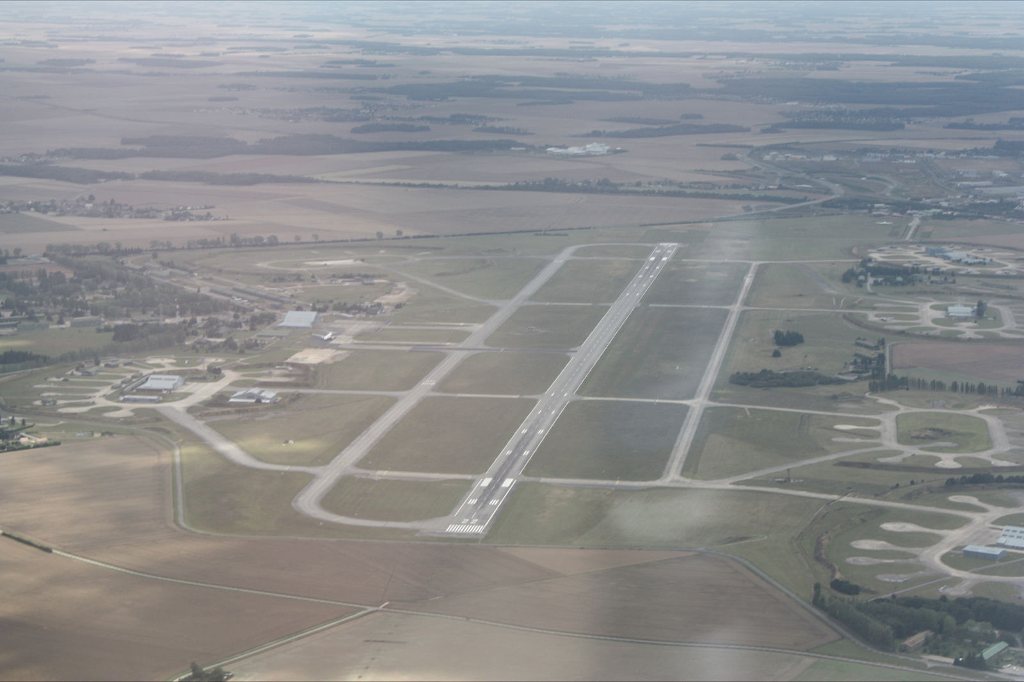
Pictured: the airfield of Évreux Air Base 105 (Base aérienne 105 d'Évreux-Fauville), photographed in 2011 — not a photograph of the 1978 sighting itself, and more than three decades removed from the night in question. No photograph of the base as it appeared in 1978, of the duty officer, or of anything resembling the observed phenomenon is known to exist; GEIPAN's own case file (case ID 1978-04-01879) contains no photographic or scanned documentary evidence beyond its written summary. This image is included only to ground the case's real, verifiable location. Photo: Ascobole, 2011, licensed CC BY-SA 3.0 via Wikimedia Commons.
Theoretical Alignment
The case aligns weakly with the Extraterrestrial Hypothesis: it offers a rare instrumented radar-visual pairing, but the radar return itself was faint (1/5 intensity), came from a single uncorroborated station, and carried no shape, size, or acceleration data — nothing in the record describes performance beyond a slow, roughly linear 30–40 knot drift. It aligns more strongly, if still moderately, with Psycho-Social framing once the evidentiary gaps are weighed: a single officer's account stands in for what was reportedly a two-witness event, the corroborating "vigie" testimony was never separately recorded, and GEIPAN's own file flags the radar contact as possibly a false echo. Interdimensional framing finds no support anywhere in the primary record.
Background
The Fauville-Évreux sighting sits at the intersection of two institutional histories that were themselves both barely underway in the spring of 1978: France's newly created state UAP investigation unit, and a French Air Force air base whose primary mission had nothing to do with radar surveillance or air defense. Understanding the case at all — why it was investigated the way it was, why certain questions were asked and others were not, and why the surviving record looks the way it does — requires understanding both institutions in some detail first.
Évreux Air Base 105: From Pilot School to Cold War Airlift Hub
Évreux Air Base 105 (Base aérienne 105 d'Évreux-Fauville, ICAO code LFOE) sits roughly two kilometers northeast of the city of Évreux in the Eure department of Normandy, adjoining the small commune of Fauville — population in the low hundreds even today — from which the base and this case both take half their name. The airfield's military history runs back to 1912–1913, when it began as a civilian aviation ground, before the Air Ministry formally opened a military pilot training school there in 1937, relocating the airfield itself nearer to Fauville in the process. The base then endured a genuinely violent Second World War: occupied and used by the Luftwaffe from 1940, it was heavily bombed by Allied aircraft in December 1942, April 1943, and again in August 1944, before German forces finally withdrew on August 18, 1944 as Allied ground forces advanced through Normandy.
Postwar, the base's identity shifted entirely. Reconstruction began in 1952 under NATO's basing negotiations, with the airfield rebuilt to the era's standard "marguerite" (daisy) dispersal pattern — hardstands arranged with roughly 150 feet of separation between parked aircraft, a Cold War design specifically meant to limit the damage a single nuclear or conventional strike could inflict on a concentrated air wing. Évreux then operated for the next decade and a half as a U.S. Air Force-tenanted NATO installation: the 465th Troop Carrier Wing arrived in May 1955 flying Fairchild C-119 "Flying Boxcar" transports across three squadrons, earning Air Force Outstanding Unit Awards in 1956 for humanitarian airlift work including relief flights supporting United Nations forces in the Middle East and the evacuation of Hungarian refugees following that year's failed uprising; the 317th Troop Carrier Wing relocated from Germany in April 1958, eventually transitioning to Lockheed C-130A Hercules aircraft; and the 322nd Air Division, established August 12, 1955, coordinated broader European airlift operations from the base until 1964. At the height of this period, more than 9,000 American military personnel were stationed at Évreux — a scale of foreign military presence that is easy to forget when looking at the comparatively modest French transport base that occupied the same runways in 1978.
That change came in 1966, when President Charles de Gaulle announced France's withdrawal from NATO's integrated military command structure (while remaining a NATO member state in the broader political sense). American forces departed Évreux by April 1967, and the base passed back to full French Air Force control, formally redesignated BA 105. From that point on, Évreux became — and remains today — a French tactical airlift hub, never a fighter-interceptor base and never a dedicated air-defense radar station. Initial French operations flew the Nord N2501 Noratlas, the same twin-boom, twin-engine transport type that would still be in frontline service there more than a decade later, on the night of this sighting. In the autumn of 1978, the base's Escadre de transport 64 comprised three Noratlas-equipped squadrons — Escadron de transport 1/64 Béarn, 2/64 Anjou (which had just arrived to reinforce the base on June 13, 1978, two months after this sighting), and 3/64 Bigorre — alongside the mixed Groupement aérien 1/56 Vaucluse, itself flying a diverse fleet of Aérospatiale SA-330 Puma helicopters, de Havilland Canada DHC-6 Twin Otters, and further Noratlas airframes. The base would not receive its now-signature Transall C-160 tactical transports in large numbers until later years; in April 1978, the flight line at Évreux was still overwhelmingly a Noratlas operation.
This detail matters directly for understanding what kind of radar the base's duty officer actually had access to that night: it would have been an airfield approach/control radar serving cargo-transport traffic patterns, not a purpose-built air-defense search radar feeding into France's national STRIDA network the way a dedicated Centre de Détection et de Contrôle (CDC) station like Cinq-Mars-la-Pile would have been. That distinction — a transport base's own local radar picking up an anomalous contact, versus the national air-defense radar chain independently confirming it — sits at the center of why this case was never more thoroughly corroborated, a point developed at length in the Detailed Narrative below.
GEPAN's First Year: A Very New Institution
On the investigative side, the sighting arrived at almost exactly the moment France's Groupe d'études des phénomènes aérospatiaux non identifiés (GEPAN) was completing its first full year of operation. CNES astrophysicist Claude Poher had spent much of the mid-1970s lobbying CNES leadership to create a permanent, scientifically staffed state body for investigating UAP reports, building his case in part on a statistical study of the UFO phenomenon that he presented to the American Institute of Aeronautics and Astronautics in 1975 — an unusual move for a subject more commonly relegated to the fringes of aerospace institutions, and a sign of how deliberately Poher tried to frame the proposal in mainstream scientific terms rather than as fringe research. That advocacy ultimately won the backing of CNES director general Yves Sillard, and GEPAN was formally authorized on March 23, 1977, making France, by most accounts, the first country in the world to establish a permanent state body, attached to a recognized scientific agency, specifically to study UAP reports on an ongoing basis.
For its first months GEPAN was, in the most literal sense, Poher and a secretary, doing what statistical and case-file work they could manage with essentially no dedicated staff, though with informal, off-the-books help from other CNES personnel including a young engineer named Jean-Jacques Velasco, who would go on to direct GEPAN's successor unit SEPRA through the 1990s. Even in that skeletal first year, GEPAN moved quickly to establish a real intake pipeline: 1977 records show the unit already processing statistics on more than 300 reports transmitted through the Gendarmerie nationale, which had itself been tasked since 1974 with collecting UFO-related witness statements from the public on the state's behalf. By 1978, the unit had grown to roughly ten members, formally overseen by a seven-person scientific council that included physicist Hubert Curien — later CNES's own president and eventually France's minister of research under President François Mitterrand — lending the young unit real scientific and institutional weight even while its day-to-day operational staff remained tiny by any modern standard.
April 1978 was, in fact, an unusually active month for Poher personally, which is worth noting simply to establish how genuinely busy GEPAN's caseload already was barely a year into its existence. That same April, Poher personally led a four-person GEPAN team to Cussac, Cantal, to reconstruct a decade-old 1967 close-encounter case involving child witnesses on a remote plateau — a labor-intensive field investigation running in parallel with whatever attention the Fauville-Évreux report was simultaneously receiving back at CNES's Toulouse offices. The Fauville-Évreux sighting therefore landed on the desk of an organization that was still defining its own working methods in real time, juggling a genuinely active caseload with a handful of staff — a formative-era case in the most literal sense, and one of the earliest instances of GEPAN applying an instrumented radar cross-check to a military-sourced report rather than a purely testimonial civilian sighting.
Complete Timeline
| Time (UTC) | Event |
|---|---|
| March 23, 1977 | GEPAN founded. CNES formally establishes the Groupe d'études des phénomènes aérospatiaux non identifiés under Claude Poher, with the approval of CNES director general Yves Sillard — the world's first permanent state scientific body dedicated to investigating UAP reports. |
| Sometime before 20:35, Apr 23, 1978 | A telephone call reaches the operational duty officer at Évreux Air Base 105, prompting him to look outside. |
| 20:35 UTC | Visual observation begins. The duty officer sees a red point of light at 10–15° elevation, azimuth approximately 300° from the base. Lookout ("vigie") personnel independently see the same phenomenon. |
| ~20:35–20:44 UTC | The light's luminous intensity is observed decreasing over several minutes. At some point in this window the officer requests radar assistance. |
| 20:44 UTC | Radar contact. Évreux's own radar detects a weak echo (intensity 1/5) at bearing 300°, 18 nautical miles out, moving toward bearing 330° at an estimated 30–40 knots. |
| 20:44–20:51 UTC | The radar echo is tracked continuously for approximately 7 minutes, in step with the ongoing visual observation. |
| 20:51 UTC | Both observations end. The visual sighting and the radar contact terminate simultaneously. |
| April 24, 1978 | The duty officer files his written report the following day — a report that, per GEPAN's own later analysis, contains a typographical slip listing the 24th rather than the 23rd as the observation date. |
| 1978 (year, exact date not on public record) | GEPAN investigation. Analysts test and reject the helicopter and balloon hypotheses, calculate Venus's actual position for the exact time/date/location and find it does not match the reported bearing/elevation, and flag the radar echo itself as possibly, though not confirmedly, a false echo. |
| December 30, 1978 | Claude Poher resigns as GEPAN's director, succeeded by mathematician Alain Esterle — closing out the unit's first, foundational year, of which this case is a part. |
| 1988 | GEPAN is reorganized as SEPRA (Service d'expertise des phénomènes de rentrée atmosphérique). |
| 2005 | SEPRA is reorganized again as GEIPAN (Groupe d'études et d'informations sur les phénomènes aérospatiaux non identifiés), which digitizes and republishes the historical GEPAN case archive — including this case, catalogued as case ID 1978-04-01879 — for public online access. |
| Present day | The case remains published on GEIPAN's official site with final classification D (D1 in the narrative conclusion) and no upgrade, downgrade, or reinvestigation recorded since. |
Detailed Narrative
A Call to the Duty Officer
The available record of this case begins, deliberately, with an institutional detail rather than a dramatic one: the duty officer did not simply notice something odd in the sky on his own initiative. GEIPAN's own case summary specifies that he was "responding to a phone call" (répondant à un appel téléphonique) when he first looked outside and saw the light. The call's source and content are not part of the public record — whether it came from the lookout post itself, from another section of the base, or from a member of the public is not stated — but its presence in GEIPAN's own summary means the sighting did not originate as a single individual's private impression. Someone else, prior to and independent of the officer's own observation, had already noticed something worth telephoning about. This is a small detail, but it is a genuine evidentiary point often missed in secondhand retellings of the case: the officer was, from the very first minute, the second person to notice the phenomenon, not the first, even though he became the only person whose account was ever formally written down.
The witness himself is identified in GEIPAN's structured metadata only by function and gender — "opérateur de permanence," male — consistent with GEIPAN's standing practice of anonymizing individual witnesses in its public case files, especially military personnel reporting in a professional capacity. His role placed him, by definition, on duty and responsible for the base's operational awareness during the shift in question; a "duty officer" at a French Air Force transport base in this era would ordinarily be tasked with monitoring communications, coordinating with air traffic control elements, and responding to any operational anomaly, which is precisely the professional context that led him to request a radar check once the visual observation had continued for several minutes rather than dismissing it immediately.
The Visual Observation, 20:35–20:51 UTC
At 20:35 UTC (22:37 local French time, which in late April uses Central European Summer Time, UTC+2), the officer observed what GEIPAN's structured record describes precisely: a single, point-like ("1D — ponctuelle") object of red color, positioned at 10–15 degrees of elevation above the horizon, on a bearing of approximately 300 degrees from the base — roughly northwest. Its apparent size was recorded as comparable to a planet ("estimée à celle d'une planète"), meaning it presented no resolvable disc, structure, or extended shape; from the base, it looked like an unusually placed bright star or planet, distinguished from the ordinary night sky primarily by its color, its position, and — critically — by the fact that its brightness was observed to fade over the course of the sighting.
That fading intensity is one of the case's more specific and harder-to-dismiss details. A fixed star or planet does not meaningfully change in brightness over a sixteen-minute observation window under normal atmospheric conditions; a conventional aircraft's navigation or landing lights do not typically fade in this way either, though a receding light source, an object banking away from the observer, or a light source being progressively obscured by the evening's "quelques éclaircies ou nuageux" (partial clearing or cloudy) conditions could all plausibly produce a gradual dimming. GEIPAN's environmental metadata for the case explicitly records the sky as partly cloudy with intermittent clearing that evening — a condition that cuts in two directions at once for later analysis: it is compatible with a genuinely fading distant light source of unknown origin, but it also means the viewing conditions were not the pristine, cloudless sky that a fully confident astronomical identification would ideally require.
The observation lasted, by both the visual and radar record, from 20:35 to 20:51 UTC — sixteen minutes total, of which the radar independently tracked the final seven. Sixteen minutes is a substantial observation window by the standards of most UAP reports, which frequently run to seconds or at most a few minutes; a witness given sixteen minutes to study a light's position, color, and brightness trend has considerably more opportunity to notice genuine behavioral detail (and, weighed the other way, considerably more opportunity for ordinary explanations like a slowly moving aircraft, a descending flare, or an astronomical body sinking toward the horizon to plausibly account for what was seen) than a witness reporting a five-second flash.
The Vigie's Silent Corroboration
GEIPAN's case summary states plainly that lookout personnel — "la vigie," the base's watch post — also observed the phenomenon, independently of the duty officer. This detail deserves its own sustained treatment, because it represents a specific and recurring evidentiary problem in military UAP reporting generally, not just a footnote to this one case: a second, independent set of eyes confirmed the sighting in real time, and yet only one account, the duty officer's, was ever converted into the kind of formal, individually attributed testimony that GEIPAN's investigative and archival process is built around.
The reasons for this gap are not spelled out in the public case file, but the operational logic is not hard to infer. A base's lookout watch exists as a standing function, not a named individual whose statement gets separately taken down each time something is reported; whoever staffed the vigie that night was, in institutional terms, part of the base's routine watch-keeping apparatus rather than a person whom anyone thought to formally debrief once the more senior duty officer's report was already being filed. The effect, whatever the cause, is that this case's real evidentiary base rests on more independent observation than its formal documentation reflects: GEIPAN's own file effectively concedes a second corroborating witness existed while being unable to present that witness's account as separately verified testimony with its own detail, phrasing, or possible discrepancies from the officer's version.
This is a pattern worth naming precisely because it recurs, in different specific forms, across military-sourced UAP reporting more broadly: chains of command and institutional reporting procedures are generally built to produce one authoritative account per incident, funneled through whichever individual holds the relevant reporting responsibility, rather than to independently canvass every person present. A commanding officer's report stands in for a flight crew's collective observation; a single logged radar contact stands in for however many controllers were watching the same scope. When the institutional record consolidates in this way, genuine corroboration — a second, third, or fourth person who saw the same thing — can exist in reality while remaining functionally invisible to the outside researcher relying only on the surviving paperwork. GEIPAN's own file is, in this instance, unusually candid about the gap rather than papering over it: it states the vigie saw the object too, even though it cannot substantiate that claim with the vigie's own words. That kind of institutional honesty about an evidentiary limitation is itself a small positive data point for the file's overall credibility, even as the missing corroborating statement is a real limitation on how much independent weight the sighting can bear.
Requesting Radar Support: Évreux's Scope and the STRIDA Network
At some point during the visual observation — GEIPAN's summary does not specify the exact minute, only that it happened before the 20:44 UTC contact — the duty officer requested that the base's radar be used to check for a corresponding return. This decision, ordinary as it might sound, is the single action that transformed this case from an uncorroborated visual sighting into a radar-visual case, and it is worth being precise about exactly what kind of radar capability Évreux actually had to offer in April 1978, and how that capability related to the wider national system France had built for exactly this kind of airspace-monitoring problem.
France's national air-defense radar network in this era operated under the STRIDA system (Système de Traitement et de Représentation des Informations de Défense Aérienne — System for the Processing and Display of Air Defense Information), a centralized, semi-automated architecture first deployed from 1960 and integrated with NATO's Air Defence Ground Environment (NADGE) framework, which by the 1960s and 1970s was steadily pushing French air defense toward more automated, digitally networked tracking rather than isolated, manually plotted stations. STRIDA linked a chain of dedicated Centres de Détection et de Contrôle (CDCs) across French territory, each progressively modernized through a series of named hardware generations as the decade wore on: Mont-de-Marsan in the southwest moved into its "Antigone" control room running STRIDA CAPAC II in 1969; Doullens in the north transitioned to STRIDA Visu 3 in 1971, installing SAFARE multifunctional radio equipment as part of the same upgrade, with the North Zone Operations Center relocating there from Romilly in the process; and Lyon/Mont Verdun in the east stood up its own STRIDA CAPAC III Visu 3 installation by the end of 1973, drawing on a Palmier radar sited on Mont Thou and a separate 23cm radar on Mont Verdun itself. Each of these centers functioned as a genuine node of national air defense, feeding automatically digitized track data (via the network's own "Liaison 1" data links) to higher command echelons for real-time threat assessment — a fundamentally different category of system from a single airfield's own local approach radar.
Évreux Air Base 105 was not one of these stations, and was never intended to be. As established above, Évreux in 1978 was a tactical transport hub — home to Noratlas-flying squadrons under the Commandement du Transport Aérien Militaire — and its radar, whatever specific set it operated, would have been an airfield-level asset intended to support approach and departure control of the base's own transport traffic, not a STRIDA-network air-defense search radar with the range, sensitivity, or institutional connectivity of a dedicated CDC. This is not a criticism of the officer's decision to use it; on the contrary, requesting a check from whatever radar capability was actually on hand, immediately, while the visual sighting was still in progress, was exactly the right instinct for capturing corroborating data in real time, and it is precisely the kind of improvised but sound field decision that produced this case's one piece of instrumented evidence at all. But it means the resulting detection, however genuine, came from a radar system never designed or positioned to serve as an authoritative air-defense-grade confirmation of an unidentified contact — which is precisely why GEPAN's investigators would have wanted, and did not get, a cross-check from the nearest actual node of the national air-defense chain, at Cinq-Mars-la-Pile.
The 20:44 UTC Contact
Nine minutes into the visual observation, at 20:44 UTC, Évreux's radar detected an echo at bearing 300° — the same direction as the visually observed light — at a range of 18 nautical miles, moving toward bearing 330° at an estimated 30 to 40 knots. The echo's intensity was recorded as very weak: 1 on a 5-point scale. It was tracked continuously for approximately seven minutes, terminating at 20:51 UTC in step with the end of the visual sighting.
Several features of this contact are worth isolating individually, because they cut in different directions for the case's overall credibility. In favor of a genuine correlation: the radar bearing (300°) matches the visually reported azimuth exactly; the contact appeared roughly nine minutes into a sighting already in progress, exactly when one would expect if the officer requested the check partway through rather than immediately, and it terminated at precisely the same minute the visual sighting ended, a simultaneity GEPAN's investigators treated as significant enough to specifically address the report's dating discrepancy (below) in order to preserve. Against a fully confident reading: the intensity of 1/5 is about as weak as a return can register while still being logged at all, well within the range where a real but marginal radar target and a spurious, borderline-noise-level artifact can be difficult to distinguish after the fact from a written description alone; the 30–40 knot estimated speed is unremarkable and consistent with almost any slow-moving airborne object, offering no distinctively anomalous performance data the way a sudden high-speed maneuver or instantaneous stop would; and the contact was never independently confirmed by a second radar station, discussed at length in the next section, which is the single largest open question the case leaves unresolved.
No recording or tape of the radar return survived into GEPAN's investigation or the modern GEIPAN archive. The entirety of what is known about the contact's parameters — bearing, range, heading, speed, duration, intensity — comes from the operator's written description in the case file, not from an independently reviewable radarscope photograph, magnetic tape, or printout. This is consistent with how ground radar operations at a 1978-era French transport base would ordinarily have functioned (routine air-traffic radar returns were not typically preserved as a matter of course once a shift ended, absent a specific reason to retain them), but it also means that everything asserted about the radar contact's specific numbers rests on the same single chain of testimony — the duty officer's own account — that the visual sighting itself rests on. The radar corroborates the direction and timing of the visual sighting; it does not independently corroborate itself.
Cinq-Mars-la-Pile and the Absent Second Opinion
Cinq-Mars-la-Pile, a commune in the Indre-et-Loire department roughly 200 kilometers south of Évreux near Tours, has hosted one of France's principal air-defense Centres de Détection et de Contrôle since the CDC relocated there from the Ramolo site at Tours-Saint-Symphorien. In its 1978-era configuration — predating the station's move into its current underground STRIDA Visu 4 facility (equipped with the more advanced METEOR radio system), which did not happen until 1980, two years after this sighting — the Cinq-Mars-la-Pile CDC operated at ground level from a manual operations room equipped with vertical-filter plotting boards and IP7A display consoles, drawing on a radar suite of one AN/110 long-range set and two AN/7B sets. This was, in other words, a real and already well-established air-defense control facility in April 1978, if a technologically earlier generation of one than the underground, more automated station that exists at the same site today — and its radar coverage, per its role within the STRIDA network described above, extended across a substantial portion of northern France, encompassing the general airspace around Évreux.
Today, the site's successor facility — now housed 36 meters underground at the end of a 17-kilometer gallery, one of only two such national-scale air-defense control centers in France alongside Lyon/Mont Verdun — continues around-the-clock monitoring of the entire northern half of French airspace, using five external antennas and a staff of roughly 40 controllers and 60 mechanics working continuous rotating shifts, an arrangement local French media (both regional outlets covering the Tours area and the national ici.fr, formerly France Bleu, network) have profiled repeatedly as a kind of "police of the sky" for the region's airspace, guiding both wayward civilian aircraft and military intercept missions alike. Controllers there are trained through dedicated military schools, with career paths ranging from directly commissioned engineers to enlisted personnel who complete controller training straight out of secondary school — a workforce profile that, while describing the modern facility rather than its 1978 predecessor specifically, illustrates the kind of sustained, professionally staffed institutional capability the station represents within France's air-defense structure across multiple decades.
GEIPAN's own case file states, without further elaboration, that the Évreux radar contact was "not confirmed by the Cinq-Mars-la-Pile secondary radar station" (non confirmé par la station radar secondaire de Cinq-Mars-la-Pile). This single sentence carries considerable evidentiary weight, and it is important to be precise about what it does and does not establish. It does not establish that Cinq-Mars-la-Pile actively looked for the target and failed to find it — that would be a meaningfully stronger statement, since a dedicated air-defense station's own null result, positively confirmed, would argue against the reality of a target at that bearing and range. Nor does it establish that Cinq-Mars-la-Pile was asked and never responded, or that its own scope for that time period was reviewed and simply showed nothing, or that a formal request for cross-confirmation was ever actually transmitted from Évreux in the first place. GEPAN's contemporaneous case file, as reflected in what GEIPAN's modern published summary preserves, appears to record the absence of confirmation as a documented fact of the investigation record, not to specify which of these underlying scenarios produced it — a genuine limit on how far this case file can responsibly interpret that single sentence.
What can be said with confidence is why investigators would have wanted that second station's input at all: Cinq-Mars-la-Pile's CDC, whatever its exact 1978 technical configuration, was a proper air-defense-grade STRIDA node with radar coverage over a wide swath of northern France, exactly the kind of independent, higher-capability system that could have either strengthened the case dramatically (an independent detection on a compatible bearing and time, from a totally separate radar site, would be very hard to explain away) or resolved it cleanly in the other direction (a definitive absence of any contact at all, on a properly functioning search radar covering the relevant airspace, would argue strongly that Évreux's own weak 1/5-intensity return was spurious). Neither happened. The case sits, instead, in the specific evidentiary limbo of a single, uncorroborated, low-confidence radar target — not confirmed, but also not affirmatively ruled out by the one system that plausibly could have settled the matter either way. This is, in miniature, exactly the same structural weakness that runs through the visual side of the case: a real, independent second source of confirmation appears to have existed in principle (another radar network covering the same airspace, just as a second human witness watched the same sky) without ever actually producing a usable, separately documented result.
A Clerical Error, Not a Second Date
The duty officer wrote his formal report the day after the sighting, on April 24, 1978 — and that report, per GEPAN's own later review, listed the 24th rather than the 23rd as the date of the observation itself. On its face, a date discrepancy between an incident and its own paperwork is exactly the kind of small inconsistency that can either be dismissed as trivial or, depending on one's priors, treated as grounds for broader suspicion about the reliability of the whole account. GEPAN's investigators explicitly addressed the question and treated it as a simple clerical slip — the natural error of a person filing a same-week report and momentarily writing down the date he was writing on, rather than the date he was writing about — rather than as evidence of a second, distinct observation event.
The reasoning behind that conclusion, as GEIPAN's file preserves it, is a small but genuine piece of internal cross-checking: treating the 23rd as the true date of the sighting is what allows the visual observation (20:35–20:51 UTC) and the radar contact (20:44–20:51 UTC) to align as a single continuous, mutually corroborating event on the same evening, exactly as both the officer's account and the radar's timestamped log describe. Had the 24th been the real date of the sighting, the report's own internal timeline would need to be reconciled with whatever radar logs existed from that separate night instead — and no second, parallel visual-plus-radar narrative for April 24 appears anywhere in the case file. The simplest, most internally consistent reading of the full record is that one continuous sixteen-minute event took place on the evening of April 23, and the following day's paperwork simply mistimed itself by twenty-four hours, an unremarkable category of clerical error that shows up regularly across many kinds of same-week administrative reporting and carries no particular implication about the underlying reliability of the sighting itself.
GEPAN in Its First Year: Founding, Mandate, and Method
Understanding how seriously — and how — this case was actually investigated requires understanding what GEPAN was, structurally and methodologically, in the specific months surrounding April 1978. The unit was, by any standard, still in its institutional infancy. It had existed formally for barely thirteen months by the time of the Fauville-Évreux sighting, having been authorized on March 23, 1977 following Claude Poher's multi-year advocacy campaign within CNES, built substantially on a statistical study of the UFO phenomenon he had presented to the American Institute of Aeronautics and Astronautics in 1975. For its earliest months, GEPAN's entire staff was, functionally, Poher and a secretary, with informal, off-the-books assistance from other CNES personnel including a young engineer named Jean-Jacques Velasco, who would go on to direct GEPAN's successor unit SEPRA through the 1990s and manage the far more physically evidenced Trans-en-Provence case in 1981. By 1978 the unit had grown to roughly ten members, formally overseen by a seven-person scientific council that included Hubert Curien, later CNES's own president and eventually France's minister of research.
Crucially, GEPAN did not generate its own raw case intake independently; its reports arrived primarily through a standing arrangement with the Gendarmerie nationale, which had already been tasked since 1974 with collecting UFO-related witness statements from the public and forwarding them to CNES for scientific evaluation, a pipeline GEPAN inherited and formalized. This gendarmerie-fed, centrally analyzed intake model — a state law-enforcement body serving as first-contact witness interviewer, with a scientific unit doing the subsequent technical evaluation — was, and largely remains today under GEIPAN, structurally distinct from how most other countries' military or civilian UFO-investigation programs of the era operated, including the U.S. Air Force's own Project Blue Book, which folded in 1969 having relied far more on direct military-channel reporting and internal Air Force technical review rather than a national police intake system paired with an independent civilian space-agency evaluation unit. The Fauville-Évreux case, notably, did not arrive through that gendarmerie channel at all: it came directly from a French Air Force base's own internal reporting chain, a reminder that GEPAN's remit, even in its first year, extended beyond civilian gendarme-relayed sightings to include military-sourced reports investigated with the same methodology.
That methodology, as it existed in 1977–1978, is documented well enough — both by GEIPAN's own later technical publications and by contemporaneous French media coverage — to describe with some confidence. An October 1978 French television segment on GEPAN's work, later archived by France's national audiovisual institute (the Institut national de l'audiovisuel, INA), captured the unit's investigative posture at almost exactly the moment of this case: analysts and affiliated amateur investigator networks alike are shown applying site mapping, physical measurement, witness sketching and structured questionnaires, and systematic cross-referencing of witness accounts against known local air traffic and, where relevant, weather station data — the same general cross-referencing logic (checking a report's claimed position and timing against independently knowable facts about what else was actually in the sky or on the ground at that moment) that underlies both the Venus calculation and the Cinq-Mars-la-Pile radar cross-check performed for this specific case. GEPAN's structured, forms-based approach to witness intake — the ancestor of the detailed "questionnaire technique" GEIPAN still requires of every witness submission today — was already taking shape in this period, even though the unit's later, more elaborate astronomical-position calculation tools and multi-laboratory physical-evidence protocols (used to dramatic effect on Trans-en-Provence three years later) had not yet been developed to their mature form. In other words: this case was investigated using a methodology that was itself still being built, by an organization one year into its existence, working a case type — a radar-corroborated military sighting with no physical trace — that was different in kind from both the mostly rural civilian sightings that dominated GEPAN's early gendarme-fed caseload and the elaborate landed-craft investigations, like Trans-en-Provence, that would later define the unit's public reputation for rigor.
Modern GEIPAN, by contrast, operates a considerably more elaborate and standardized version of the same basic logic: a formal multi-tier classification system (A through D, with sub-classifications), a mandatory structured witness questionnaire required before any testimony is formally logged, dedicated astronomical calculation tools and published guidance directing witnesses and investigators alike toward tools like Stellarium or Ciel des Hommes for verifying celestial-object positions, and a fully digitized, publicly searchable online case archive — the very archive, in fact, through which this 1978 case file survives and remains accessible today. The core investigative instincts on display in the Fauville-Évreux file — check the astronomy, check the radar, check the conventional explanations, document what could and could not be confirmed rather than reaching for a premature conclusion in either direction — are recognizably the same instincts modern GEIPAN still applies four and a half decades later; what has changed most is the systematization, the digitization, and the sheer accumulated case-comparison base a modern investigator can draw on that a ten-person unit little more than a year old, in 1978, simply did not yet have.
Ruling Out Venus
Because the observed object was a red, point-like light sitting low on the horizon (10–15° elevation) at dusk, and because Venus is by far the single most common real astronomical cause of exactly this category of UAP report, GEPAN's investigators specifically checked the planet's actual position for the precise date, time, and location of the sighting. This is not a speculative or approximate exercise: an object's azimuth (compass bearing) and elevation (angular height above the horizon) at a given moment, from a given point on Earth's surface, is a matter of deterministic celestial mechanics — the same calculation GEIPAN's own published methodology, and the dedicated "questionnaire astronomique" investigative form it still uses today, direct investigators to perform using ephemeris data or modern planetarium software such as Stellarium, cross-checked against sky charts from tools like Ciel des Hommes.
GEIPAN's file records the result of that calculation: Venus was indeed visible from Évreux on the evening of April 23, 1978, at a position of roughly azimuth 296–299 degrees and elevation 1.5 to 4 degrees. At first glance, an azimuth in the high 290s might look tantalizingly close to the reported 300° bearing — but the elevation comparison is where the identification decisively fails. The reported phenomenon sat at 10 to 15 degrees of elevation; Venus, at the same moment, sat at only 1.5 to 4 degrees — a gap of roughly 8 to 13.5 degrees, which is a substantial, naked-eye-obvious difference in how high above the horizon an object appears, not a marginal or easily-confused discrepancy. An object at 10–15 degrees elevation sits noticeably higher in the sky — several times its own angular separation from the horizon — than an object at 1.5 to 4 degrees, which would sit almost skimming the horizon itself, likely to be at least partially obscured by any terrain, trees, or buildings along that sightline, and often reddened and distorted by atmospheric extinction at that shallow an angle. GEIPAN's own conclusion, that mistaking the reported object for Venus is "extremely unlikely" given how different the two positions actually were, follows directly and soundly from this comparison; it is a genuine example of a specific, checkable astronomical claim being tested against real data and coming out negative, rather than a generic dismissal of the Venus hypothesis on principle.
It's worth adding the observation that the officer himself never mentioned Venus at all in his own account — he did not, for instance, report "a very bright light near where Venus normally appears" or express any uncertainty about whether he might be looking at a planet, the way many witnesses whose sighting really is a Venus misidentification often do describe some version of an unusually bright, unmoving light low in the west or northwest. The complete absence of any such hedging in his account is a small piece of corroborating context for GEPAN's calculated conclusion, though it is necessarily weaker evidence than the position calculation itself, since a witness's subjective impression of a light's brightness and position is exactly the kind of judgment an objective calculation is designed to check rather than simply trust.
Ruling Out Helicopter and Balloon
GEIPAN's case summary states that the helicopter and balloon hypotheses were both explicitly tested and rejected, without elaborating on the specific reasoning in the portion of the file publicly summarized. Both candidates are, nonetheless, worth taking seriously on their face precisely because of Évreux's own operational profile: the base's Groupement aérien 1/56 Vaucluse flew SA-330 Puma helicopters as part of its mixed transport fleet in this era, meaning a helicopter misidentification is not an arbitrary or generic candidate explanation invented after the fact — it is exactly the kind of aircraft the base itself was flying, at the same location, in the same period.
Against the helicopter hypothesis, several elements of the reported observation cut the other way: a helicopter's navigation lights, unlike the steadily fading single red point described, would ordinarily present a more complex lighting pattern (position lights, anti-collision strobe, and often a distinguishable engine/rotor sound at 18 nautical miles' distance closing or opening, depending on flight path); a helicopter maintaining a slow, level cruise at 30–40 knots for sixteen continuous minutes on a steady compass heading is an unusual, though not impossible, flight profile for a genuine cross-country transport leg, and would ordinarily be a matter of record on the base's own flight schedule for that evening — a record GEPAN's investigators, working directly with Évreux's own personnel, would have been well positioned to check and, evidently, did check closely enough to rule the hypothesis out. Weather balloons, similarly, drift with prevailing wind rather than holding a directionally consistent track toward a specific bearing, and a French meteorological balloon of the era would not typically present as a red point source specifically; a fading intensity is more consistent with a balloon's illumination source (if lit at all) dimming as it either drifted away or lost altitude, which may be part of why GEPAN's investigators considered and then excluded it, though again the file's public summary does not preserve the specific technical reasoning for either rejection in full detail. What can be said with confidence is that both hypotheses represent exactly the kind of mundane, locally-plausible explanations a careful investigation is obligated to test first, given the base's own operational context, and that GEPAN's file states plainly that neither survived that testing.
Searching the French Ufological Record
France's specialist ufology press was, by 1978, a genuinely active and well-established field: Lumières dans la nuit (LDLN), founded by amateur astronomer Raymond Veillith in February 1958 and by the late 1970s widely regarded as the principal specialized French UFO journal, had seen its subscriber base swell dramatically in the wake of France's major 1974 sighting wave, climbing toward roughly 4,750 subscribers by 1980, with an extensive network of regional delegates and volunteer investigators feeding it case material throughout this exact period. A genuinely thorough research pass on this case therefore has to ask whether LDLN, or comparable French ufological publications and archives active in this era, ever covered the Fauville-Évreux sighting independently of GEPAN's own file.
Honestly stated: no such independent secondary coverage of this specific case turned up in this research. Extensive searching located substantial general material on GEPAN's founding, mandate, and 1970s-era methodology, on LDLN's own institutional history, and on French ufology's broader activity in exactly this period — but nothing identifiably discussing the April 23, 1978 Évreux radar-visual sighting by name, whether in LDLN's archived back issues, in later French skeptical or academic retrospectives on GEPAN's early case history, or in any other identifiable published source outside GEIPAN's own official case file. This is, on its own, a meaningful and unsurprising finding rather than a gap to paper over: a single military-sourced sighting that generated no press coverage, no landing, no physical trace, and no public witness statement (the officer's report went directly into GEPAN's internal case file through military and CNES channels, not through the gendarme-and-press pipeline that put many of the era's more famous French cases into wider circulation) is exactly the profile of case that would plausibly escape independent ufological attention entirely, however genuinely and rigorously it was investigated internally. The absence of secondary literature here says something real about how this case reached the public record at all — quietly, institutionally, and only decades later through GEIPAN's own digitization of its historical archive — rather than reflecting any failure of this research pass to look. Readers should treat this case's evidentiary record as resting entirely on GEPAN/GEIPAN's own official file, with no independent journalistic, ufological, or academic cross-check available anywhere in the public record to corroborate or challenge it from outside the investigating agency itself.
Key Witnesses
Évreux Air Base Duty Officer (name withheld per GEIPAN's standard anonymization practice)
The sole formally recorded witness. Responding to a phone call, he observed a red point-source light at 10–15° elevation, azimuth ~300°, for sixteen minutes, noting its decreasing intensity, and made the operationally sound decision to request a radar check partway through the sighting — the action that produced the case's one piece of instrumented corroboration. GEIPAN's structured metadata records his reaction as "emotion — curiosity, interest — active," a notably measured, professional response profile rather than a fear- or panic-driven account. He filed a written report the next day containing a minor, later-explained dating slip, and never invoked or expressed uncertainty about Venus, despite the planet being visible nearby that evening. As a professional operational officer reporting through a military chain of command in the course of his own duty shift, rather than a member of the public submitting an unsolicited account, his testimony carries the specific institutional credibility of a trained observer with no evident motive to fabricate or embellish — balanced against the equally real limitation that his account is the case's only formally attributed testimony for what was, by his own service's admission, at least a two-witness event.
Évreux Air Base Lookout Personnel ("la vigie") — individual identities not recorded
GEIPAN's own case summary states that lookout personnel independently observed the same phenomenon the duty officer reported. No individual name, statement, or separately recorded testimony from anyone staffing the vigie survives in the public file — their observation is acknowledged by the investigating agency itself but was never captured as its own piece of formal evidence, a genuine corroboration that the case's documentation cannot fully exploit. See the dedicated discussion above ("The Vigie's Silent Corroboration") for a full treatment of why this gap matters and how it recurs across military UAP reporting generally.
The Five Observables Assessment
The Five Observables framework, developed by the Pentagon's Advanced Aerospace Threat Identification Program to describe performance characteristics beyond known conventional technology, is applied here for comparative consistency across the site's case files — though this case's evidentiary base (a fading point-source light and a single weak, low-resolution radar echo) offers very little of the kind of high-fidelity performance data the framework was originally built to describe.
Assessment: None of the Five Observables are affirmatively present in this case. The radar-derived speed estimate (30–40 knots) is well within the range of ordinary aircraft, and no maneuver, acceleration, or directional reversal of any kind was reported by either the visual witness or the radar log. The only Observable with even speculative relevance is Low Observability, on the strength of the radar echo's very weak (1/5) intensity — but this is at least as consistent with a marginal, borderline-detectable conventional target (or a spurious echo) as with a genuinely low-reflectivity object, and the case file offers no way to distinguish between those readings from the data available.
Evidence Assessment
Supporting an Anomalous Origin
- A trained military duty officer, reporting through an internal Air Force channel rather than as an unsolicited public account, observed the phenomenon continuously for sixteen minutes with a measured, non-panicked reaction profile
- A second, independent observer group (the base's lookout/"vigie" personnel) reportedly saw the same phenomenon at the same time, corroborating the sighting even though their own account was never separately documented
- The radar contact appeared on the same bearing (300°) as the visual sighting, began partway through the observation consistent with when the officer likely requested it, and ended at precisely the same minute the visual sighting ended
- GEPAN's own investigation, applying its standard methodology, explicitly tested and rejected the two most locally plausible conventional explanations (helicopter and balloon), given the base's own helicopter-operating unit
- A specific, calculated astronomical check ruled out Venus with a clear, non-marginal positional discrepancy (roughly 8–13.5 degrees of elevation difference), rather than the identification being dismissed by assumption
- The witness never mentioned or hedged toward Venus in his own account, despite the planet's proximity in azimuth that evening
Supporting a Conventional/Mundane or Inconclusive Origin
- The radar return was very weak (1/5 intensity) from a single station, and no independent second radar — including the nearby national air-defense network node at Cinq-Mars-la-Pile — ever confirmed it
- No recording, tape, or radarscope photograph of the contact survives; every numeric detail about the radar return rests solely on the same officer's written description
- Only one witness's account was ever formally taken, despite the case being, per the investigating agency's own file, a multi-witness event
- GEIPAN's own published case file explicitly flags the possibility that the radar return was a "faux écho" (false echo, e.g. a secondary reflection) and does not rule this out
- The reported speed (30–40 knots) and general behavior (a slow, roughly linear drift) show no performance characteristic that a conventional slow-moving aircraft, drifting balloon, or radar artifact could not in principle produce
- Évreux's own radar was an airfield-support asset, not an air-defense-grade search radar, meaning even a positive local detection lacks the sensor pedigree of a fully validated national-network contact
Why "Open"
This case is stamped Open rather than Credible, Disputed, or Debunked because its own investigating agency's final classification is, itself, explicitly and deliberately unresolved — GEIPAN's narrative conclusion describes the phenomenon as "moderately strange, distant, but [with] testimony of good consistency" (D1), a classification that is not a synonym for "probably genuine" or "probably explained," but a formal acknowledgment that neither reading can be confidently sustained on the available evidence. The case earns real credit on several fronts: a professionally measured witness reporting through a military channel with no evident motive to embellish; a second, independently corroborating group of observers whose existence the investigating agency itself documents; a radar contact whose bearing, timing, and termination align tightly with the visual account; and a genuinely rigorous elimination of the two most locally obvious mundane explanations (helicopter, balloon) plus a specific, checkable astronomical calculation that convincingly rules out Venus rather than merely assuming it away.
Set against that, however, are weaknesses substantial enough that "Credible" would overstate the case: the radar detection is single-station, very weak, and was never cross-checked by the one air-defense-grade radar network node that could plausibly have settled the question either way; no recording of that radar return survives, leaving every technical detail dependent on one person's written account; the case's real multi-witness character never converted into more than one piece of formal testimony; and GEIPAN's own file explicitly leaves open the possibility that the radar contact itself was a false echo, a caution the investigating agency chose to publish rather than omit. A case where the agency that spent the most time with the primary evidence still declines to resolve it, more than four decades and one full institutional reorganization later, is exactly what "Open" is meant to describe: not dismissed, not confirmed, and not likely to move in either direction without evidence that, at this remove, is unlikely to surface.
Sensor & Instrumentation Detection Profile
This case's only instrumentation is the single ground radar operated at Évreux Air Base 105, which logged the 20:44–20:51 UTC contact at bearing 300°, range 18 nautical miles, heading toward bearing 330°, speed 30–40 knots, intensity 1/5. No airborne radar, no gun-camera or photographic equipment, no radiation-detection instrument, and no independently instrumented meteorological sensor data beyond the general "partly cloudy" conditions recorded in GEIPAN's structured metadata played any role in this case. Critically, the one additional sensor system that plausibly could have contributed — the STRIDA-network air-defense radar at Cinq-Mars-la-Pile, roughly 200 kilometers to the south — is explicitly recorded by GEIPAN as not having confirmed the Évreux return, without the file specifying whether it was actively checked and returned a null result or simply never produced usable corroborating data. No physical trace, no photographic record, and no recording of the radar signal itself exist in any form; the entire technical record of the sighting survives only as descriptive text in the duty officer's written report and GEPAN's subsequent case analysis, with GEIPAN's own file explicitly flagging that the single available radar reading cannot be fully distinguished from a false echo on the evidence retained.
Environmental & Geospatial Context
The sighting took place over Normandy's Eure department in late April, under partly cloudy skies with some clearing ("quelques éclaircies ou nuageux" per GEIPAN's structured metadata) — conditions compatible with clear sightlines during the clearer intervals but not the fully unobstructed sky an unambiguous astronomical identification would ideally want. The observation occurred just after local sunset in this season and latitude (dusk in late April at roughly 49°N falls in the early-to-mid evening local time, consistent with the 22:37–22:51 local-time window under Central European Summer Time), placing the sighting in genuine darkness rather than twilight, which is itself relevant to why a red point-source light would have been readily visible and distinguishable from the daytime sky's ordinary contents.
Geographically, the sighting's reported bearing (300°, roughly northwest of the base) and range (18 nautical miles for the radar contact) place the phenomenon over a mixed rural-and-small-settlement landscape typical of this part of Normandy — consistent with GEIPAN's own environmental classification of the setting as "territoires artificialisés, zones urbanisées" (urbanized/artificial land), reflecting the base's own developed character and its proximity to Évreux itself (a city of several tens of thousands) rather than deep open countryside. Évreux Air Base 105 sits within regular transport-aviation traffic patterns given its role as a Noratlas/Transall airlift hub, meaning the surrounding airspace was not unused or unfamiliar territory for the base's own radar and flight-following personnel — a relevant baseline for assessing how unusual an unidentified slow-moving contact at 18 nautical miles would have appeared against the base's normal traffic picture. No solar or geomagnetic anomaly, no documented meteor shower active on this date, and no other space-weather trigger is noted anywhere in the case's available record; late April carries no major annual meteor shower peak comparable to, for instance, August's Perseids, removing one of the more common mundane explanations that complicates many other radar-visual cases from consideration here.
Observer Credibility & Occupational Profile
The case's sole formally documented witness was a military duty officer on active shift at a French Air Force base — a professional, operationally responsible role rather than a private individual reporting an unsolicited observation. Duty officers in this kind of posting are trained to maintain situational awareness, respond to anomalies through defined procedures, and communicate clearly and precisely up an established chain of command; the officer's own decision to request a radar check partway through an ongoing visual sighting, rather than either dismissing it or waiting until it concluded, reflects exactly that kind of trained operational instinct. GEIPAN's structured metadata records his emotional reaction as "curiosity, interest — active" rather than fear, distress, or panic, a comparatively calm, engaged response profile consistent with a professional observer methodically tracking something unusual rather than reacting to a perceived threat.
Weighed against this credential-based strength is the case's central structural limitation: this is the only formally recorded account for what the investigating agency's own file describes as a multi-witness sighting. The lookout personnel who reportedly saw the same phenomenon independently were never individually identified, interviewed, or credited with their own separate statement — meaning the case's occupational-credibility profile, however strong for the one witness it does have, cannot be broadened to draw on whatever additional corroborating detail a second or third professional observer's account might have contributed. No civilian witnesses, and no witnesses outside the base's own military personnel, are recorded anywhere in the file; this is, in that specific sense, a purely military-internal sighting from intake through investigation, evaluated entirely within an institutional chain rather than surfacing through public reporting, press coverage, or independent civilian corroboration at any stage.
Historical Precedents & Archive Matches
Radar-visual corroboration — an independent instrument reading that lines up with a human observer's account of the same object, at the same time, on a compatible bearing — is widely treated within UAP research as one of the strongest categories of evidence available, precisely because it removes the sighting from the realm of a single person's subjective perception and ties it to a physical instrument's own independently generated data. The category is also, however, one where the specific quality of the corroboration varies enormously from case to case: a single weak return from one uncross-checked station is a fundamentally different evidentiary object than four independent radar systems tracking the same non-ballistic maneuvers, or two independent detection channels aboard the same aircraft cross-confirmed by a wholly separate ground station. This site has published several of the most significant radar-visual cases in the historical record; setting the Fauville-Évreux sighting against them is instructive precisely because of how differently their evidentiary weight breaks down.
The Lakenheath–Bentwaters Radar-Visual Incident (1956)
The Lakenheath–Bentwaters case (stamped Disputed, 73/100 on this site) represents the high end of instrumented redundancy: four physically independent radar systems across two separate airfields, ground-level visual sightings, a passing aircrew's own corroborating account, and an RAF Venom night-fighter that achieved an actual weapons-radar lock on the target. Yet even that far larger evidentiary base did not settle the case cleanly — a 2000s re-investigation tracked down the actual surviving Venom aircrews, who directly disputed the dramatic decades-later "chase" narrative that had entered the case's popular retelling through a single 1968 letter. The lesson for Fauville-Évreux is a cautionary one in the opposite direction: even a case with vastly more instrumented redundancy than this one can still collapse into genuine dispute once the underlying testimony is checked closely, which argues for real caution in how much weight Fauville-Évreux's single, much weaker radar return should be given on its own.
The RB-47 Bomber Chase (1957)
The RB-47 Bomber Chase (Open, 82/100) offers perhaps the closest structural parallel worth drawing, and the contrast is telling. There, three physically distinct detection systems — the bomber's own visual crew, two independent airborne ELINT receivers, and an entirely separate Air Defense Command ground radar station near Duncanville, Texas — reported the same target with repeated, simultaneous appearance-and-disappearance correlation over more than an hour. That is exactly the kind of independent, cross-system confirmation that Fauville-Évreux never obtained: where the RB-47 case's ground radar (Site Utah) independently validated what the aircraft's own instruments were already reporting, Cinq-Mars-la-Pile's silence left Évreux's single weak return exactly where it started, uncorroborated by the wider national radar network. Both cases share an important intellectual honesty, though: RB-47's own most serious skeptical rebuttal (the Kessler Air Force Base reception-artifact hypothesis) remains genuinely unresolved for lack of surviving primary duty logs, in the same way GEIPAN's own file leaves the "faux écho" possibility explicitly and honestly open for Fauville-Évreux rather than resolving it either way.
The Tehran UFO Incident (1976)
The Tehran UFO Incident (Verified, 88/100), which took place barely eighteen months before Fauville-Évreux and was itself reviewed at the time by the U.S. Defense Intelligence Agency, involved two scrambled fighter interceptors experiencing documented weapons and communications systems failures on approach to the target — instrumented anomalies affecting multiple separate aircraft systems, not merely a passive radar echo. The comparison underscores just how much further along the evidentiary spectrum a case needs to sit before "instrumented corroboration" becomes difficult to explain conventionally: Tehran's radar-visual pairing came with active systems interference across two aircraft; Fauville-Évreux's came with a single passive 1/5-intensity ground return that never triggered any comparable instrument anomaly anywhere else in the encounter.
The USS Nimitz / Tic Tac Encounter (2004)
The USS Nimitz encounter (Verified, 96/100), the highest-scored radar-visual case on this site, benefits from a scale of technical documentation entirely unavailable to any 1978 French case: the most advanced radar system fielded by the U.S. Navy at the time, infrared video recording, and multiple independent aircrew witnesses, later officially acknowledged as authentic by the Pentagon. Fauville-Évreux, investigated by a ten-person unit little more than a year old with none of that instrumentation, was never going to reach a comparable evidentiary tier — the comparison exists here specifically to illustrate the enormous range the "radar-visual case" category actually spans, from a passive, single-station 1/5-intensity ground echo at one end to multi-sensor, video-recorded, officially authenticated military intercepts at the other.
A Domestic French Parallel: Air France Flight 3532 (1994)
Perhaps the most directly relevant comparison, because it involves the exact same French air-defense radar station, is the Air France Flight 3532 / Capt. Duboc sighting of January 28, 1994, in which the airliner crew's own visual sighting was compared against a near-simultaneous unidentified track logged by Cinq-Mars-la-Pile's radar, relayed through the CODA air-defense command center at Taverny — sixteen years after Cinq-Mars-la-Pile's silence on the Évreux case. In the 1994 case, the same station that produced no confirming data for Évreux in 1978 did generate its own independent radar track for a different sighting entirely, though even there the aircraft's reported position and the radar's logged track disagreed on which side of the aircraft the object actually was — a reminder that even when Cinq-Mars-la-Pile's radar does produce a contact for a French UAP case, reconciling it precisely with an independent visual account is not automatically straightforward. Read together, the two cases suggest a station that is a genuinely active, capable node of France's air-defense radar network across at least two different decades, but one whose data, when it exists at all for a given UAP report, still requires careful independent reconciliation rather than treatment as an automatic, clean confirmation.
Taken as a set, these five comparisons place Fauville-Évreux clearly and honestly toward the weaker end of the radar-visual case spectrum: real, professionally sourced, and internally consistent, but resting on a single weak instrumented reading that never received the kind of independent second-system confirmation that elevates the strongest cases in this category into the "verified" or "credible" tier.
Material Analysis
This case involves no physical or trace evidence of any kind — no landing marks, no recovered material, no soil or vegetation anomaly, no metallurgical or isotopic sample, and no biological effect on any witness. That absence is itself informative context for how this case differs in kind from GEPAN's later, more elaborate physical-evidence investigations: the same organization that would, three years later, commission multi-laboratory soil and plant analysis for the Trans-en-Provence landing case simply had no comparable physical substrate to work with here. The Fauville-Évreux sighting was, from beginning to end, a distant aerial observation — nothing about the reported encounter (a light seen at 10–15° elevation, 18 nautical miles away at its radar-confirmed range) placed the phenomenon anywhere near the witnesses or the ground, so no material-evidence investigation was ever a realistic possibility for this specific case type, and none was attempted.
Supporting Non-Terrestrial Origin
- No physical evidence exists to test in the first place, so no terrestrial material-composition finding contradicts an anomalous interpretation either
Supporting Terrestrial Origin
- The complete absence of any physical trace is itself consistent with an ordinary distant aerial light source or radar artifact, which would be expected to leave no material trace whatsoever
- No physiological, mechanical, or electromagnetic secondary effect on any person, vehicle, or equipment beyond the radar detection itself is recorded anywhere in the file
The Conventional Explanation Candidate: Venus Misidentification
Because the phenomenon was a red, low-elevation point of light at dusk, Venus is the natural first candidate for any skeptical review — and it is the candidate GEPAN's own investigators most rigorously tested using a specific, reproducible astronomical calculation rather than a general assumption. As detailed above, Venus's calculated position that evening (azimuth 296–299°, elevation 1.5–4°) sat close in bearing but dramatically lower in elevation than the reported object (azimuth ~300°, elevation 10–15°), a gap of roughly 8 to 13.5 degrees that is not a marginal or easily-confused discrepancy for a trained observer looking directly at the object in question.
Helicopter Misidentification
Given that Évreux's own Groupement aérien 1/56 Vaucluse operated Puma helicopters from the base in this era, a helicopter misidentification is a locally grounded, non-arbitrary candidate — and one GEIPAN's file states was explicitly tested and rejected, though without preserving the specific technical reasoning in the portion of the record publicly summarized.
Weather or Research Balloon
A drifting balloon, potentially with an attached light or instrument package, is another mundane candidate consistent with a slow, low-intensity radar return and a fading visual light source — and, like the helicopter hypothesis, GEIPAN's file records this as explicitly tested and rejected.
Radar False Echo / Anomalous Propagation ("Faux Écho")
Distinct from a misidentified physical object, this candidate holds that the radar return itself — independent of whatever the duty officer actually saw in the sky — may not represent a real airborne target at all. Ground radar systems are subject to a range of well-documented artifact sources: secondary/multipath reflections off terrain or structures, anomalous atmospheric propagation (temperature-inversion ducting) that can deliver spurious or displaced returns, and simple receiver noise presenting as a marginal target at very low signal intensity. GEIPAN's own case file explicitly raises this possibility and does not resolve it, which is precisely why it remains a live, unresolved candidate rather than a rejected one.
Venus Misidentification
ImplausibleGEPAN's own calculated position for Venus (azimuth 296–299°, elevation 1.5–4°) differs from the reported object's position (azimuth ~300°, elevation 10–15°) by a substantial, non-marginal elevation gap of roughly 8–13.5 degrees — large enough that GEIPAN's own investigators judged misidentification "extremely unlikely." The witness also never referenced or hedged toward Venus in his own account.
Helicopter Misidentification
ImplausibleA locally grounded candidate given Évreux's own helicopter-operating unit, but explicitly tested and rejected by GEPAN's investigation, who had direct access to the base's own flight records and personnel to check against.
Weather or Research Balloon
ImplausibleA mundane candidate consistent in general terms with a slow, fading light source, but likewise explicitly tested and rejected by GEPAN's contemporaneous investigation.
Radar False Echo / Anomalous Propagation
InconclusiveGEIPAN's own case file explicitly raises this possibility for the radar return specifically (independent of the visual sighting) and does not rule it out. With no surviving recording of the radar signal and no second-station confirmation, this remains a genuinely open, unresolved question rather than a rejected or confirmed one.
Related Cases
Confirmed Documents & Official Records
The official French government investigation summary: witness account, radar detection parameters, and GEPAN's conclusions on the Venus, helicopter, and balloon hypotheses. No scanned primary document or photograph is attached to this case (hasDocuments=false); the summary text is the complete public record.
GEIPAN's structured metadata record for the duty officer's testimony: witness demographics, apparent size, reaction, environmental setting, weather, and the recorded "material/electronic recording" environmental effect corresponding to the radar detection.
The full public archive of French government UAP case investigations, searchable by date, location, and classification, including this and every other GEPAN/SEPRA/GEIPAN case since 1977.
Further Reading — Recommended Literature
UFOs: Generals, Pilots, and Government Officials Go on the Record
Kean's investigation devotes substantial attention to France's GEPAN/SEPRA/GEIPAN lineage and the COMETA report, situating this case's institutional home within the broader landscape of government-sponsored UAP investigation worldwide.
Forbidden Science 2: California Hermetica, The Journals of Jacques Vallee 1970–1979
Vallée's own contemporaneous journals from exactly this period, including his direct correspondence and dealings with the French ufological and scientific establishment as GEPAN was being founded and finding its footing.
The UFOs That Never Were
A skeptically-minded deconstruction of several famous radar-visual and military UFO cases, useful comparative reading for weighing how even well-corroborated-seeming military sightings can unravel under close re-investigation, as this site's own Lakenheath–Bentwaters file discusses.
Clear Intent: The Government Coverup of the UFO Experience
A foundational survey of government radar and military UFO case files, useful for understanding the general category of radar-corroborated sightings this case belongs to, and how governments elsewhere handled comparable reports in the same era.
The UFO Encyclopedia, 4th Edition
The standard English-language reference work covering the global history of UFO investigation, including GEPAN/GEIPAN's founding and France's distinctive gendarme-fed, state-scientific approach to case intake.
Essential Viewing
Sources
- GEIPAN (CNES), "FAUVILLE (27) 23.04.1978", Case 1978-04-01879 — official case summary
- GEIPAN (CNES), Testimony Detail, Témoignage 2096, Case 1978-04-01879 — structured witness metadata
- GEIPAN (CNES), official case archive & public portal — geipan.fr
- GEIPAN (CNES), "Comprendre un Phénomène" — investigative methodology, astronomical position-checking guidance
- GEIPAN (CNES), Questionnaire astronomique — standardized astronomical observation form (PDF)
- Wikipédia (français), "Groupe d'études des phénomènes aérospatiaux non identifiés" — GEPAN founding and early institutional history
- Wikipedia (English), "GEIPAN" — organizational evolution, GEPAN → SEPRA → GEIPAN
- Wikipédia (français), "Claude Poher" — biography and role in founding GEPAN
- CarteOVNI, "Petite histoire de l'ufologie en France: GEPAN, SEPRA, GEIPAN" — institutional methodology evolution, 1977–present
- Institut national de l'audiovisuel (INA), "1978: le GEIPAN «en quête» d'ovnis" — archived 1978 French television coverage of GEPAN's contemporaneous methodology
- Wikipédia (français), "Base aérienne 105 Évreux-Fauville" — base history, 1978-era squadrons
- Wikipedia (English), "Évreux-Fauville Air Base" — Cold War operational history, NATO tenancy, return to French control
- avionslegendaires.net, "L'Armée de l'Air à l'automne 1978: organigramme et unités" — confirmed 1978 squadron assignments at Évreux BA 105
- EPR 118, "Une petite histoire de la Défense Aérienne française" — STRIDA network history and Cinq-Mars-la-Pile's 1970s-era CDC configuration
- Wikipedia (English), "French air defence radar systems" — STRIDA/CDC network overview, Cinq-Mars-la-Pile's designation
- ici.fr (formerly France Bleu), "Au centre de Cinq-Mars-la-Pile, les militaires inspectent le ciel français" — CDC role, staffing, and ongoing operations
- Wikipedia (English), "Cinq-Mars-la-Pile" — commune geography and CDC 07.927 designation
- Wikipédia (français), "Lumières dans la nuit" — LDLN institutional history, 1970s–1980s readership and role
- Wikipedia (English), "Fauville, Eure" — commune geography, coordinates, population
- Wikimedia Commons, Category: Base aérienne 105 Évreux-Fauville — image archive, including this file's hero photograph
- Wikimedia Commons, File: Aéroport militaire d'Evreux.jpg, photo by Ascobole (2011), CC BY-SA 3.0 — licensing and attribution
- This site, key-figures.html, entry on Claude Poher — GEPAN founding, 1977–1978 activity including the concurrent Cussac, Cantal reconstruction
- This site, case-files/trans-en-provence-1981.html — comparative reference for GEPAN's later, physical-evidence-based methodology under Jean-Jacques Velasco
- This site, case-files/lakenheath-bentwaters.html — comparative radar-visual case, multi-radar corroboration and its later re-investigation
- This site, case-files/rb-47-bomber-chase.html — comparative radar-visual case, multi-sensor independent corroboration model
- This site, case-files/tehran-1976.html — comparative radar-visual case, instrumented systems-failure corroboration
- This site, case-files/uss-nimitz.html — comparative radar-visual case, modern multi-sensor documentation standard
- This site, case-files/air-france-flight-3532-duboc-sighting.html — comparative case sharing the same Cinq-Mars-la-Pile radar station, 1994
- This site, locations/index.html, entry on Toulouse — CNES/GEPAN/SEPRA/GEIPAN institutional headquarters
- YouTube (AFP), "Ovnis: le Geipan, au CNES, enquête sur ces phénomènes" — oEmbed-verified video, general GEIPAN institutional coverage
- metar-taf.com, Évreux-Fauville (BA 105) Air Base, LFOE — aviation reference, base coordinates and identifiers
- Wikipédia (français), "Groupe d'études des phénomènes aérospatiaux non identifiés", section on Alain Esterle succession — Poher's December 1978 resignation and handover
See something inaccurate? Have additional information or sources?
Suggest an Edit →Last Updated: August 2026