
Air France Flight 3532 / Capt. Duboc Sighting
At 13:14 on January 28, 1994, the cockpit crew of Air France Flight AF 3532 — Captain Jean-Charles Duboc and First Officer Valérie Chauffour — watched a huge, dark reddish-brown, shape-changing mass hang near their Airbus A320 as it cruised toward London above Coulommiers, Seine-et-Marne. French Air Force radar at the Cinq-Mars-la-Pile detection center, relayed through the CODA (Centre d'Opérations de la Défense Aérienne) command post at Taverny, logged an unidentified track for roughly 50 seconds in the same general time and airspace, matching no filed flight plan and vanishing at essentially the same moment the object disappeared from the crew's view. Duboc did not file a written report for three years, fearing professional ridicule; once he did, the case was investigated by CNES's SEPRA unit and became one of the signature civil-aviation cases the 1999 COMETA Report cited directly. GEIPAN, the French space agency's successor UAP-study office, still carries the case on its own public register as classification D1 — genuinely unexplained. This file corrects nothing in the "Coming Soon" queue's placeholder date or location, both of which check out against the record, but sharpens its description of "CODA radar": CODA was the air-defense command center that received and correlated the actual radar returns, not a radar system in its own right — and, as this file details at length, the investigating agency's own analyst has publicly doubted that the radar track it logged is even geographically consistent with what the crew reported seeing.
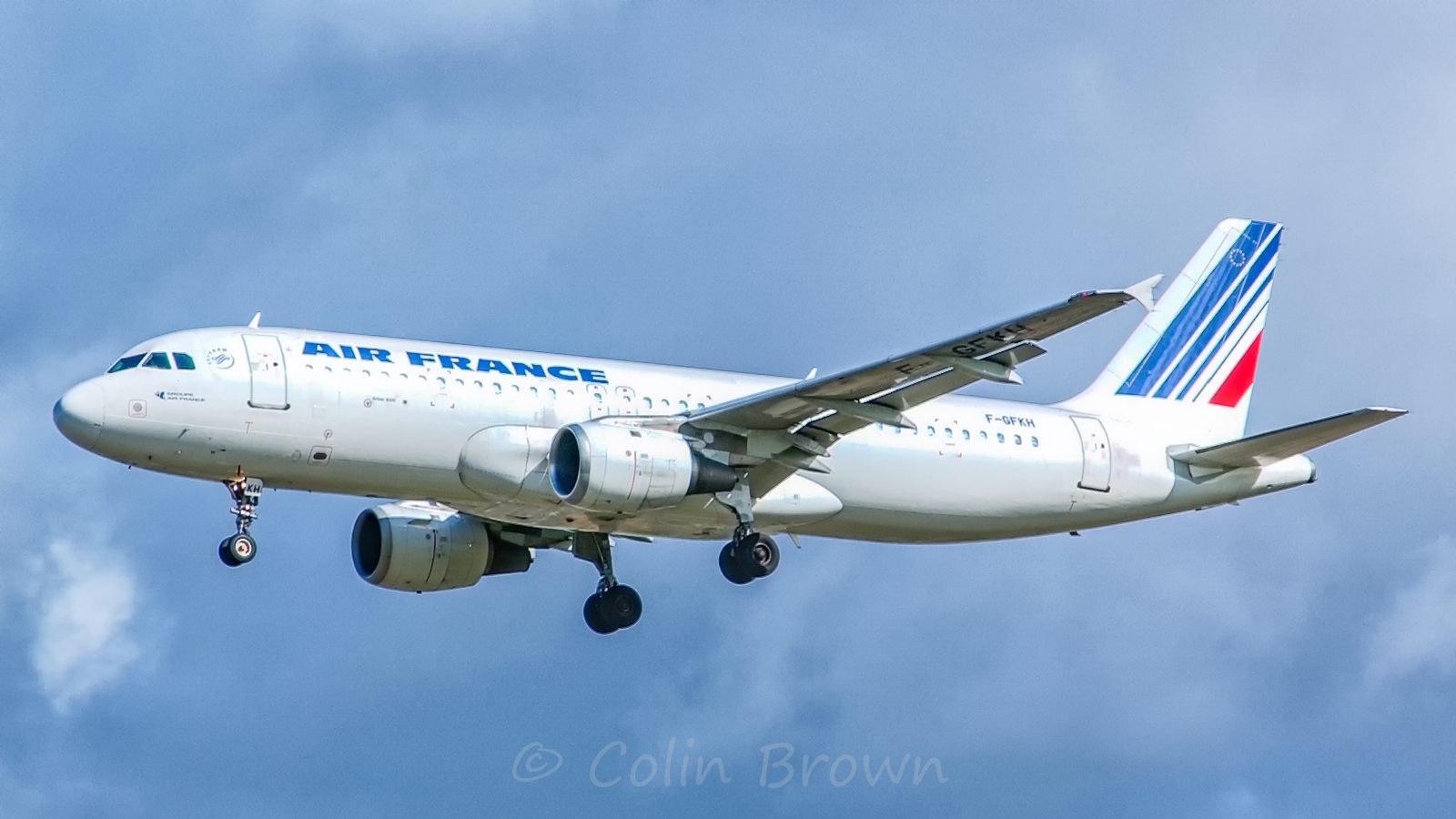
Pictured: an Air France Airbus A320-211, registration F-GFKH, photographed at London Heathrow on March 18, 2007 (Colin Brown Photography, CC BY 2.0). This is not the actual aircraft involved — Flight AF 3532 on January 28, 1994 was flown by a sister airframe, F-GFKG, an Airbus A320-111 delivered to Air France in February 1989 — and this photograph shows Air France's later corporate livery, not the livery the fleet wore in 1994. No photograph of the specific aircraft, its 1994-era paint scheme, or the object itself is known to exist; this image is included only to illustrate the general type of aircraft the crew was flying.
Theoretical Alignment
This case sits closer to the middle of this catalogue's spectrum than either its ETH champions or its harshest skeptics tend to present it. The Extraterrestrial Hypothesis reading draws real support from a genuinely difficult-to-explain core: two credentialed, trained professional observers, on duty and reporting through a regulated aviation channel, independently describing an enormous object with no conventional silhouette, and an independent military radar track appearing in the same airspace at essentially the same moment and vanishing simultaneously with the visual sighting. That is a combination this catalogue treats seriously wherever it recurs. But the Psycho-Social/Mundane reading carries slightly more weight here specifically because of what this case file's own research into the radar record found: SEPRA's own investigator has stated in writing that the radar trace has "little chance" of corresponding to the object as described, based on which side of the aircraft each source places it, and a real weather balloon is independently confirmed to have crossed the same flight path that same day — just, per Meteo-France's own 2012 check, roughly an hour too early to be the object itself. The Interdimensional Hypothesis finds no real support in the record: nothing described suggests trans-dimensional passage, only an anomalous aerial object and a contested, possibly unrelated radar return.
Background
By January 1994, France had operated the world's longest-running government UAP investigation effort of any nation, a fact this catalogue's own COMETA Report case file documents in detail: CNES engineer Claude Poher founded GEPAN inside the national space agency in 1977, and by the early 1990s its successor unit, SEPRA (Service d'Expertise des Phénomènes de Rentrée Atmosphérique), operated under Jean-Jacques Velasco as the designated government office for scientifically evaluating UAP reports referred through the French national gendarmerie. Civil airline pilots in France, as in most countries, operate under a specific regulatory obligation: any object or phenomenon that could pose a collision hazard, or that is otherwise operationally unusual, must be reported to the relevant air traffic control center as it happens — a real-time, professional-duty channel entirely separate from, and typically far less exposed than, any subsequent decision about whether to file a formal written UFO report afterward. That distinction between the mandatory in-flight radio call and the optional, reputation-risking paperwork that might follow is central to understanding why this case's documentary record has the unusual two-stage shape it does.
Air France in the early 1990s operated a large, relatively new Airbus A320 fleet; the type had entered Air France service only a few years earlier; F-GFKG, the specific airframe flying as AF 3532 that day, was an A320-111 delivered to the airline in February 1989. The Nice–London route was, and remains, a standard short/medium-haul city pair, typically cruising in the high-30,000-foot range over central France before descending into the London terminal area — placing the flight, at the moment of the sighting, roughly over Coulommiers in Seine-et-Marne, an agricultural market town about 60 km east of Paris, itself not far from Reims, the air traffic control center the crew were operating under and would radio with their report.
The broader institutional backdrop that gives this case its later prominence is COMETA itself: a private committee of roughly thirty retired and serving French generals, admirals, engineers, and officials, chaired by General Denis Letty, that spent 1996–1999 reviewing what its members judged the best-documented French and international UAP cases before publishing its 1999 report. As this catalogue's own COMETA case file establishes at length, COMETA was never a government commission — it was a private nonprofit association whose members happened to be drawn overwhelmingly from the alumni network of the Institut des Hautes Études de Défense Nationale (IHEDN) at the École Militaire in Paris. The Duboc sighting is one of a small number of case studies COMETA's finished report presents in its Part One, alongside Trans-en-Provence, Tehran 1976, and the RB-47 bomber chase — and it is, notably, the only one of that small set built primarily around a commercial airline crew's own testimony rather than a military crew, a physical ground trace, or a Cold War signals-intercept record.
Complete Timeline
| Date | Event |
|---|---|
| February 17, 1989 | Airbus A320-111 F-GFKG, the aircraft that would fly as AF 3532 five years later, is delivered new to Air France. |
| January 28, 1994, 13:14 local | A flight attendant in the cockpit of AF 3532 (Nice–London) points out an object he initially compares to a weather balloon to First Officer Valérie Chauffour, near Coulommiers, Seine-et-Marne, at roughly 11,700–11,900 m (FL 390). |
| January 28, 1994, ~13:14–13:15 | Capt. Jean-Charles Duboc observes the object, initially taking it for an aircraft banked 45°, then for an immense, dark reddish-brown, lens-shaped mass with fuzzy edges; visual contact lasts roughly one minute before the object appears to become transparent and dissolve. |
| January 28, 1994, ~13:14–13:15 | Cinq-Mars-la-Pile's detection and control center logs an unidentified azimuth-radar track, relayed through the CODA command post at Taverny, lasting approximately 50 seconds, matching no filed flight plan, and disappearing at essentially the same moment as the visual sighting. |
| January 28, 1994 | Duboc radios Reims Control per aviation reporting regulations; Reims confirms no known air traffic in the sector. No written report is filed at this time. |
| 1994–1996 (approx.) | Duboc discusses the sighting informally but declines to file a written report, citing fear of professional ridicule — a concern this case file's Observer Credibility section examines directly. |
| c. 1997 | After encountering press coverage (a Paris Match feature is repeatedly cited as the trigger) of a separate, unrelated UFO sighting over Paris, Duboc is prompted to file a formal report with the Gendarmerie Nationale, roughly three years after the event. |
| 1997 | The gendarmerie report is forwarded to SEPRA at CNES; Jean-Jacques Velasco's unit opens a formal investigation, retrieving the archived Cinq-Mars-la-Pile/CODA radar data and beginning repeated interviews with Duboc and Chauffour. |
| 1996–1999 | COMETA's private committee, chaired by General Denis Letty, reviews the case as part of its broader survey of well-documented UAP files, personally interviewing Duboc for roughly ninety minutes and independently estimating the object at approximately 300 meters across. |
| July 16, 1999 | The COMETA Report is publicly released, presenting the AF 3532 sighting as one of its principal Part One case studies. |
| 1999–June 2000 | SEPRA investigator Dominique Weinstein conducts repeated, standardized-questionnaire interviews with both Duboc and Chauffour, formally recording their statements and beginning the technical radar-correlation analysis that would later become the case's central point of dispute. |
| 2004 & 2007 | Duboc gives further public interviews and television appearances (including a March 21, 2007 France 2 broadcast) revising his own angular-size estimate of the object between a "small finger" and a "thumb" held at arm's length — a shift independent researchers have flagged as one of several inconsistencies in the size estimates across the case's documentary history. |
| 2005 | SEPRA is reorganized into GEIPAN (Groupe d'Études et d'Informations sur les Phénomènes Aérospatiaux Non identifiés), which inherits the AF 3532 case file. |
| 2007 (August) | Independent French researcher Patrick Gross publishes a detailed technical critique arguing the radar track's own geometry — approaching from the aircraft's right — cannot be rationally reconciled with a stationary object all three witnesses placed on the aircraft's left. |
| September 1, 2007 | CODA's parent command, headquartered at Taverny since the Cold War, relocates to the Balard complex in Paris as part of a broader French Air Force reorganization into the CDAOA (Commandement de la Défense Aérienne et des Opérations Aériennes). |
| 2012 | Météo-France, tasked with checking archived weather-balloon launch and tracking data against the sighting, confirms a real balloon crossed the aircraft's flight path that day — but finds it had already burst and was descending southeast of the aircraft's position roughly one hour before the 13:14 sighting, ruling it out as a direct, contemporaneous match. |
| 2010s | GEIPAN formally logs the case in its public online case register as No. 1994-01-01345, retaining the classification D1: unexplained, of moderate consistency, with marked strangeness. |
| 2026 | This case file is published, replacing the "Coming Soon" queue's placeholder entry and clarifying the CODA/Cinq-Mars-la-Pile radar terminology against the documented record. |
Thirteen Fourteen Local: What the Cockpit Crew Actually Reported
The most heavily cited primary account of the sighting itself comes from a November 22, 1999 interview Duboc gave to researcher Thierry Whatelet of UFOCOM, conducted five years after the event but before the case's later public prominence via COMETA had fully crystallized his own retelling. By that account, AF 3532 had been airborne roughly twenty minutes out of Nice, cruising near Coulommiers at an altitude sources place between 11,700 and 11,900 meters (Flight Level 390, roughly 38,000–39,000 feet), when a flight attendant present in the cockpit — standard practice on many Air France flights of the era during quieter cruise segments — pointed out an object he thought might be a weather balloon, a short distance away on the aircraft's left side. First Officer Valérie Chauffour looked and confirmed seeing something.
Duboc's own first impression, per his account, was that he was looking at another aircraft in a steep bank, roughly 25 nautical miles (about 45 km) away. As he continued watching, that identification collapsed: "Cet objet nous a semblé ensuite absolument anormal par sa taille qui semblait immense" ("This object then seemed absolutely abnormal to us because of its apparently immense size"), he told Whatelet, describing "une gigantesque lentille en évolution" (a gigantic lens in evolution) — dark red in color, with blurred, indistinct edges, resembling, in his words, nothing he had encountered anywhere in his flying career. The object remained essentially stationary relative to the aircraft's own motion for approximately one minute, in his account, before gradually becoming transparent and dissolving into the sky.
Chauffour's own account, independently recorded later by SEPRA, differs in a specific and disclosed way from Duboc's: rather than a single evolving lens, she described the object exhibiting "variable geometry," changing from a disc shape to a chevron shape while remaining stationary relative to the aircraft. This is a real, documented divergence in the case's core evidentiary record, not a detail this case file's research is introducing for effect — two trained professional observers, on the same flight deck, seconds apart, describing genuinely different transformations for what both agree was a single, very large, anomalous object. The flight attendant who first spotted the object is the case's least-documented witness: despite serving as the observation's actual trigger, no source consulted for this case file names him, and he was never independently located or interviewed by any subsequent investigation, meaning his own specific account exists only secondhand, through Duboc's and Chauffour's later retellings of what he said in the moment.
Per standard aviation reporting procedure, Duboc radioed the object to Reims Area Control Center as the encounter was unfolding — not as an optional UFO report, but as the mandatory real-time notification any unidentified object presenting a potential traffic hazard requires. Reims confirmed it held no flight-plan data for any aircraft in that sector at that time. No written report followed this radio call; that decision, and its three-year reversal, is itself one of the case's more revealing threads, discussed below.
Three Years of Silence, and Why It Ended
One of this case's more human, and more diagnostic, details is the gap between the January 1994 sighting and Duboc's first written report, filed with the Gendarmerie Nationale around 1997. By his own later account, Duboc chose not to file paperwork immediately specifically because he feared professional ridicule — a concern this case file's research treats as entirely plausible and well-precedented rather than a red flag on its own: airline pilots occupy a position of considerable public trust and are professionally vulnerable to exactly the kind of reputational risk that voluntarily reporting a UFO encounter, however honestly described, can invite from employers, regulators, and the flying public alike. This is a real, recurring pattern across this catalogue's aviation-related cases, not unique to Duboc.
What appears to have ended the silence, per multiple secondary accounts, was Duboc's own exposure to press coverage of an unrelated Paris-area UFO sighting reported in the magazine Paris Match, which prompted him to conclude that going on the record himself was less professionally risky than he had originally judged, and to file the gendarmerie report he had withheld for three years. That report was then forwarded, through the ordinary administrative channel, to SEPRA at CNES, triggering the case's first formal government investigation under Jean-Jacques Velasco.
This three-year gap carries real, disclosed evidentiary costs that this case file does not minimize: human memory for exact angular sizes, precise durations, and fine sequencing details degrades over even a much shorter interval than three years, and several of the specific inconsistencies later investigators flagged — particularly the object's estimated size, which moved across multiple re-tellings between roughly 200 meters and 1,000 meters depending on the source and the specific method used to derive it — are exactly the kind of drift a delayed, memory-dependent account would be expected to show, independent of whether the underlying sighting was genuinely anomalous. The case's investigators, to their credit, did not paper over this: SEPRA's later interviews used standardized data-collection questionnaires specifically designed to control for this kind of drift as much as a three-years-later interview reasonably can.
The Angular Size Problem
Independent French researcher Patrick Gross's detailed technical review of the case's size estimates documents what he calls a "curiously problematic" pattern: Duboc's own original 1994-era report form describes an angular size of roughly half the Moon's diameter (about 0.25°, or 15 arcminutes) — already a very large apparent size for a distant aerial object — but later re-tellings, translated through hand-gesture comparisons Velasco elicited in 2004 and 2007 interviews ("a little finger's width at arm's length," then "a thumb's width at arm's length"), imply angular sizes that had roughly doubled between those two later interviews alone. No investigator in any source consulted for this case file offers a clear methodological account of why the estimate grew across successive retellings, rather than simply being re-measured the same way each time. This case file treats that pattern as a genuine, disclosed weakness in the size data specifically — not proof the sighting itself is fabricated, but a real caution against treating any single quoted size figure (200 m, 250 m, 300 m, or 1,000 m, all of which appear somewhere in this case's literature) as more precise than the underlying measurement method actually supports.
The Radar Puzzle: Cinq-Mars-la-Pile, CODA, and the Correlation Dispute
The single fact most responsible for this case's prominence — and, on closer examination, the fact most responsible for the serious doubts specialists have raised about it — is the radar track. Reims Control's referral of Duboc's real-time report reached the CODA (Centre d'Opérations de la Défense Aérienne), the French Air Force's air-defense command post then headquartered at Taverny air base in Val-d'Oise (relocated to the Balard complex in 2007 as part of the CODA's reorganization into today's CDAOA, the Commandement de la Défense Aérienne et des Opérations Aériennes). It is important to state precisely what CODA actually was, since the "Coming Soon" queue's original placeholder description — "French military CODA radar" — slightly mischaracterizes it: CODA was not itself a radar or a radar network. It was the air-defense command and control center that received, correlated, and acted on data from France's actual military radar stations, of which Cinq-Mars-la-Pile, near Tours, was (and remains, under its successor Air Base 705 detection and control center) one of the primary sites covering the northern half of French airspace. The unidentified track this case is built on was recorded by Cinq-Mars-la-Pile's own radar and relayed through CODA at Taverny, not generated by CODA itself.
That track, per the consistent core of multiple independent accounts, lasted approximately 50 seconds, crossed the general path AF 3532 had been flying, corresponded to no filed flight plan, and disappeared at essentially the same moment the crew's own visual sighting ended. Taken at face value, this is exactly the kind of independent instrumented corroboration this catalogue treats as a strong positive signal wherever it holds up — and it is the specific detail that made this case COMETA's preferred civil-aviation example, and the reason it continues to be cited internationally as one of the strongest available radar-visual UAP cases.
It does not, on the best available technical analysis, hold up cleanly. Patrick Gross's detailed 2007 review of the declassified radar documentation makes a specific, geometrically precise objection: the crew consistently placed the visual object on the aircraft's left, while the Cinq-Mars-la-Pile track shows traffic approaching from the aircraft's right — a discrepancy Gross characterizes bluntly: "a stationary visual OVNI on the left cannot rationally be claimed corroborated by radar coming from the right." Different secondary sources describe the resulting geographic gap differently — one placing the radar track's closest approach to the aircraft's actual position at only 1–1.8 km, another describing a separation as large as roughly 40 km with no true overlap between the two tracks at all — a spread this case file's own research could not fully reconcile from the public record, and treats as itself a further, disclosed sign of how unsettled the specific radar-correlation question remains even among researchers working from the same underlying declassified data. Dominique Weinstein, the SEPRA investigator who conducted the case's formal 1999–2000 interviews, went further, stating plainly of the radar trace: "the radar trace has little chance of corresponding to the observation as described." That is a serious, credentialed, institutionally-positioned skeptical judgment — not an outside critic's opinion, but the assessment of the investigator SEPRA itself assigned to the case.
Separately, the radar record has its own internal puzzles: it was detected by Cinq-Mars-la-Pile's azimuth (bearing) radar but not by its altitude-finding radar, meaning no independent height confirmation for the tracked object exists at all; its estimated speed (variously given as roughly 100 knots/185 km/h, or 180 km/h in a separate account) is far below the aircraft's own cruising speed, consistent with something other than a comparably-sized airliner but not, on its own, diagnostic of anything specific; and successive re-analyses have revised the implied physical size of whatever the radar tracked downward, from an initial figure as large as 250 meters (the number COMETA's own report repeats, derived from the radar trajectory crossing calculation) to later estimates in the 200–300 meter range. Jean-Jacques Velasco's own investigation at Taverny's radar facility did conclude that the specific weather-balloon hypothesis then under consideration could be excluded on the radar return's own characteristics (speed and track behavior inconsistent with a balloon drifting on the prevailing wind) — a genuine, positive finding, but one that rules out one specific mundane candidate for the radar track without thereby proving that same track is the object the crew saw.
Duboc's Own Counter-Hypothesis: Electronic Countermeasures
Confronted with the geographic mismatch skeptics have raised, Duboc has himself proposed a specific technical explanation preserving both the visual sighting and the radar's genuine anomalousness: that the visual object was real, and that a separate military aircraft, employing standard electronic-warfare countermeasure equipment, generated an artificial decoy radar echo elsewhere in the area — a real, if speculative, capability in modern air-defense electronic warfare, deployed (in Duboc's own reading) either coincidentally or deliberately in the same airspace and window as his own sighting. This case file's research treats this hypothesis as available but unconfirmed: it would, if true, cleanly explain why the radar and visual tracks disagree on geometry while preserving the reality of both underlying phenomena, but no source consulted offers any independent evidence — a flight log, a squadron deployment record, or a corroborating radar signature consistent with jamming — that any such military exercise or countermeasure deployment actually occurred over Seine-et-Marne that day. It remains, on the present record, the witness's own preferred reconciliation rather than an independently documented finding.
SEPRA, COMETA, and the Skeptical Response
The case's formal government investigation, once Duboc's 1997 gendarmerie report reached SEPRA, was substantial by the standards of most cases this catalogue documents: Dominique Weinstein conducted repeated, standardized-format interviews with both Duboc and Chauffour through at least June 2000, independently recording their statements on SEPRA's own data-collection forms rather than relying solely on prior press or ufological retellings, and Velasco personally pursued the radar data at its Taverny source. That level of direct, repeated, government-conducted witness interview is itself a meaningful positive signal this catalogue weighs across its cases; many "Disputed" and lower-tier files elsewhere in this archive have no comparable formal investigation behind them at all.
COMETA's own treatment of the case, three to five years after SEPRA's investigation began, added prominence more than new primary evidence: General Denis Letty's committee interviewed Duboc directly for approximately ninety minutes, and the finished 1999 report repeats a size estimate of roughly 300 meters derived from the earlier radar-trajectory calculation, presenting the case as one of its principal illustrations of a civilian, non-military UAP encounter with instrumented corroboration. As this catalogue's own COMETA case file establishes, that report's citation of a case functions as endorsement of the case's seriousness by a credentialed private committee, not as an independent re-investigation or new evidentiary contribution — COMETA reviewed SEPRA's existing file rather than generating its own primary data, a distinction this case file's research treats as important given how often COMETA's citation is popularly mistaken for a stronger institutional validation than it actually represents.
The most sustained skeptical technical work on the case has come from French researchers working independently of both SEPRA and COMETA. Beyond Patrick Gross's radar-geometry critique detailed above, skeptic Éric Maillot — a self-described zetetician (skeptical inquirer) — has separately argued that Duboc may have misidentified a large, unusually-shaped conventional aircraft: specifically, an Airbus Beluga (or a broadly similar oversized-fuselage transport/cargo type) whose bulbous profile, seen at an unusual angle or against particular lighting, could plausibly account for an experienced pilot nonetheless describing something entirely unfamiliar. This case file's research could not confirm any specific Beluga or comparable aircraft movement recorded in that airspace at that time in any source consulted, and notes that the hypothesis, while a serious and specifically-argued attempt at a conventional identification rather than a dismissive wave, remains itself unconfirmed against actual flight-tracking records from the period. Maillot's separate, geometry-based objection to the radar correlation — that the Cinq-Mars-la-Pile track approached from the aircraft's right while all three witnesses placed the object on the left — is the same core objection Gross documents, arrived at independently.
Key Witnesses
Captain Jean-Charles Duboc
The flight's commander and principal witness, an experienced Air France line captain who went on to fly Boeing 747s later in his career. Duboc's own account evolved in specific, documented ways between his initial 1994 radio report, his 1999 UFOCOM interview, and his later 2004 and 2007 public television appearances — particularly regarding the object's precise angular size, discussed above. He has remained a public advocate for the case's genuineness into the 2000s, proposing his own electronic-countermeasure hypothesis to reconcile the disputed radar correlation, and continues to be interviewed by French media and researchers about the encounter.
First Officer Valérie Chauffour
Duboc's co-pilot, who independently observed the object after it was first pointed out by the flight attendant. Her account of a "variable geometry" object shifting from a disc to a chevron shape diverges in specific descriptive detail from Duboc's own account of a single evolving "lens" — a genuine, disclosed inconsistency in the case's core testimony that this case file treats as a real feature of the record rather than a discrepancy to explain away. SEPRA investigator Dominique Weinstein independently recorded her statement using the same standardized questionnaire used for Duboc's.
Unnamed Flight Attendant
The individual who first noticed the object and drew it to First Officer Chauffour's attention, initially comparing it to a weather balloon. Despite being the sighting's actual trigger, this witness is not named in any source consulted for this case file and was never independently located or interviewed by SEPRA, GEIPAN, or COMETA; everything attributed to his observations survives only secondhand, through Duboc's and Chauffour's later retellings.
The Five Observables Assessment
Assessment: This case's Five Observables profile is genuinely mixed rather than one-sided, which is itself part of why it sits in this catalogue's mid-range rather than at either extreme. Anti-Gravity Lift is rated Speculative rather than clearly Present: the object held a fixed position relative to a fast-moving aircraft for roughly a minute with no described ascent, descent, or hover behavior distinguishable from simple distant stationarity, which is consistent with anti-gravity lift but does not positively demonstrate it. Instant Acceleration and Hypersonic performance are both Absent: nothing in either pilot's account, nor in the radar's own modest estimated speed, describes any rapid directional change or extreme velocity — if anything, the radar-derived speed is unusually slow, well below the aircraft's own cruising speed. Low Observability is rated Present on a specific, technical basis: the object (assuming the disputed radar correlation holds at all) registered on Cinq-Mars-la-Pile's azimuth radar but not on its altitude-finding radar, an asymmetric detection signature genuinely harder to produce with a conventional, radar-reflective airframe than with either a stealthy craft or, on the more mundane reading, an unusual atmospheric or balloon-like target with poor vertical radar cross-section. Trans-Medium travel is rated Speculative: the object's reported transition to "transparency" before disappearing is a genuinely strange descriptive detail with no clean precedent elsewhere in this catalogue, but it does not describe passage between two physical media (air, water, or space) in the sense this framework's Trans-Medium category is built to capture, so this case file declines to rate it Present outright.
Evidence Assessment
Supporting Anomalous Origin
- Two credentialed, on-duty professional aviators — a captain and a first officer — independently observed an object with no conventional silhouette, reported it through a real-time regulatory aviation channel, and later gave separately recorded, formal statements to a government investigative body
- An unidentified military radar track appeared in the general time and airspace of the sighting, matched no filed flight plan, and disappeared at essentially the same moment as the visual sighting
- GEIPAN, the French government's own current UAP-study office, continues to carry the case in its public register as classification D1 — genuinely unexplained, not resolved to any conventional cause
- SEPRA's own on-site investigation at Taverny concluded the specific contemporaneous weather-balloon hypothesis then under review could be excluded as an explanation for the radar return's own flight characteristics
- Météo-France's 2012 archival check found the one real weather balloon confirmed to have crossed the flight path that day had already burst and was descending roughly an hour before the sighting occurred — ruling out the single cleanest conventional candidate rather than confirming it
- The case was judged serious enough by a private committee of credentialed retired French defense and scientific officials (COMETA) to be presented as one of a small number of principal illustrative cases in their 1999 report to the French government
Supporting Conventional Explanation
- SEPRA's own formally assigned investigator, Dominique Weinstein, has stated in writing that the radar trace has "little chance" of actually corresponding to the object as visually described
- Independent researcher Patrick Gross's geometric analysis finds the radar track approaching from the aircraft's right while all three witnesses placed the visual object on the left — a direct, unresolved directional contradiction, not a minor discrepancy
- Duboc did not file any written report for three years, and the object's own estimated size grew across his successive retellings (from roughly half a lunar diameter to, eventually, a full lunar diameter or more) in a pattern independent researchers have specifically flagged as methodologically unexplained
- The two pilots' own accounts of the object's specific behavior diverge in a disclosed, substantive way — a single evolving "lens" per Duboc versus a disc-to-chevron "variable geometry" object per Chauffour
- The flight attendant who first spotted the object, and whose "weather balloon" comparison opens the entire account, was never independently named, located, or interviewed by any investigation
- No photograph, film, sketch, or any form of physical trace exists for this case; its entire evidentiary record is witness testimony (delayed by three years) plus a radar track whose own correlation to that testimony is seriously disputed
- Skeptic Éric Maillot has proposed a specific, if unconfirmed, conventional identification (an unusually-shaped large cargo/transport aircraft, such as an Airbus Beluga) that could account for an experienced pilot describing an unfamiliar large object
Why "Disputed"
This case earns a DISPUTED classification with a credibility score of 62/100, placing it above Gorman Dogfight (Disputed, 58) and Fort Worth AFB (Disputed, 60) but below Oscoda AFB (Disputed, 70) and well below Coyne Helicopter (Credible, 81). That placement reflects a case with real, substantial strengths that a careless retelling — including, at times, this case's own popular reputation as "the pilot case that proved radar corroboration" — tends to overstate, and real, substantial weaknesses that same popular reputation tends to omit entirely.
On the strength side: this is a genuine event, not a fabricated queue entry, involving two named, credentialed, on-duty professional witnesses who reported it through a real, regulated aviation channel rather than only a private ufological account; it received a real, sustained government investigation (SEPRA, later inherited by GEIPAN) that conducted formal, standardized-format interviews with both pilots; a real unidentified radar track really was logged by a real French Air Force detection station in the same general time and place; and the French government's own current UAP-study office continues, as of this case file's research, to carry the case as genuinely unexplained rather than resolved. Those are not small things, and this catalogue's scoring reflects them.
Weighed against that: the specific claim that gives this case its outsized reputation — that military radar independently corroborated the visual sighting — is exactly the claim SEPRA's own assigned investigator has publicly doubted on geometric grounds, and independent technical analysis from multiple researchers working separately has reached the same conclusion: the radar track's own direction of approach does not sit easily with where the witnesses placed the object. A real weather balloon crossed the same airspace the same day, missing the sighting window by roughly an hour rather than by nothing, which is a much closer near-miss on the mundane side of the ledger than this case's advocates typically emphasize. The three-year reporting delay, the documented growth in the object's estimated angular size across re-tellings, and the specific, disclosed divergence between the two pilots' own descriptions of the object's behavior are all real, acknowledged features of the record, not manufactured objections. A case this genuinely well-documented, this institutionally investigated, and this still-officially-unresolved — but whose single most distinctive evidentiary claim does not survive the investigating agency's own technical scrutiny intact — is precisely the profile this catalogue's mid-to-upper "Disputed" tier exists to describe.
Sensor & Instrumentation Detection Profile
This case's only instrumented data is the Cinq-Mars-la-Pile radar track, relayed through CODA at Taverny, whose disputed correlation to the visual sighting is examined at length above. Beyond that single track, no other sensor of any kind was involved: no camera, no film, no infrared or multispectral imaging device, and no secondary radar site independently cross-checking Cinq-Mars-la-Pile's own return. The track itself carries a genuinely unusual technical signature — detection by azimuth (bearing) radar but not by altitude-finding radar — which this case file's Five Observables section rates as a positive Low Observability signal on its own narrow technical terms, while noting that an asymmetric detection profile of this kind is also consistent with several mundane explanations (a balloon or debris target with a poor vertical radar cross-section, or a processing/correlation artifact in a 1994-era military detection system) that this case file's research could not rule out from the available public documentation. The aircraft's own onboard instruments — altimeter, weather radar, TCAS-era traffic systems where fitted — are not reported in any source consulted as having registered anything unusual; the entire cockpit-side account rests on the crew's own naked-eye observation.
Environmental & Geospatial Context
Coulommiers sits in Seine-et-Marne, roughly 60 km east of Paris, in the agricultural Brie plain of the Île-de-France region — open, largely flat countryside directly beneath one of France's busier internal air corridors linking the south of France to London and the near Continent. The sighting occurred at cruise altitude (FL 390, roughly 11,700–11,900 m) under reported excellent visibility, with witnesses describing sight lines of 150–300 km and an altocumulus cloud layer well below the aircraft's own flight level — conditions this case file's research treats as consistent with a genuine, unobstructed, multi-minute sighting rather than one compromised by haze, low cloud, or poor light. The area lies within the operational coverage of the Cinq-Mars-la-Pile detection and control center near Tours, one of the French Air Force's principal air-surveillance sites for the northern half of the country, and was, in 1994, within the broader air-defense responsibility of CODA at Taverny, roughly 30 km northwest of central Paris. No specific solar, geomagnetic, or unusual atmospheric-electrical data for the exact date and hour was located in any source consulted for this case file; nothing in the record suggests any environmental factor beyond ordinary clear-sky, high-altitude flying conditions.
Observer Credibility & Occupational Profile
This case's central credibility asset is occupational: both principal witnesses were professional airline pilots, trained specifically to observe, describe, and report aerial phenomena with precision as part of their ordinary duties, and both made their initial report through a mandatory, regulated aviation reporting channel rather than a voluntary ufological one. That combination — trained observers, real-time regulatory reporting, and subsequent formal government interview — is a genuinely strong occupational-credibility profile by this catalogue's own standards, broadly comparable in kind to the weight given elsewhere in this archive to control-tower personnel, radar operators, and other credentialed professional witnesses.
Set against that: the credibility picture is complicated by several specific, disclosed factors this case file does not minimize. Duboc's own decision to withhold a written report for three years, while an entirely understandable professional choice, means the case's most detailed documentary record was not created until well after the fact, with all the memory-drift risk that implies — a risk this case file's research treats as most plausibly responsible for the growing size estimates documented above, independent of the sighting's underlying reality. The two pilots' accounts diverge on a specific point of the object's own behavior (evolving lens versus disc-to-chevron), a genuine inconsistency between two otherwise credible witnesses rather than a simple corroboration. And the flight attendant whose observation opened the entire sighting was never independently identified or interviewed, removing what would otherwise have been a third, potentially corroborating professional account. Taken together, this case file rates the witnesses' occupational credentials as genuinely strong, while rating the overall reliability of the specific testimonial details as moderate, reflecting the real, disclosed effects of a three-year reporting delay on an otherwise credible pair of professional accounts.
Physical & Material Assays
No physical evidence of any kind exists for this case. Nothing was recovered, no ground trace is applicable (the object, per every account, remained airborne at cruise altitude throughout), and no photograph, film, or sketch survives from the day of the sighting itself. The case's entire evidentiary substance is testimonial (the two pilots' delayed written and later formally recorded statements) and instrumented in only the single, disputed radar sense already examined at length above; no laboratory sample, metallurgical assay, or trace residue of any kind was ever collected or could have been, given the nature of an airborne sighting with no landing or debris component.
Historical Precedents & Archive Matches
Within this catalogue's own coverage of French UAP cases, the Duboc sighting is best understood alongside the other case studies COMETA's 1999 report presented as its principal illustrations: Trans-en-Provence (a landed-craft case with genuine physical ground-trace and laboratory data, investigated directly by GEPAN under Jean-Jacques Velasco), Tehran 1976 (a military jet-intercept case with instrument-malfunction and near-collision elements), and the RB-47 bomber chase (a Cold War-era U.S. military case combining visual, radar, and signals-intelligence detection). Set against those three, the Duboc case is COMETA's one genuinely civilian aviation illustration — no military crew, no government-commissioned ground investigation team on-site within hours, and no signals-intelligence apparatus, only a commercial airline crew's own testimony and a military radar track whose correlation to that testimony remains, as this case file documents at length, seriously disputed even within the French government's own investigative record. This distinguishes it structurally from Trans-en-Provence's far stronger physical-evidence profile, and this case file's research treats that structural difference — rather than any question about the witnesses' honesty — as the principal reason this case, despite its prominence, does not score as highly in this catalogue's own scheme as Trans-en-Provence's landed, physically-sampled case does.
More broadly within this catalogue's civil-aviation radar-visual category, this case invites direct comparison to West London/Heathrow (Alitalia) (Disputed, 56), another European commercial-airline sighting with a partial, geographically offset radar correlation (a return logged ten nautical miles behind the aircraft, rather than coincident with it) and a same-night crew report. Both cases share the same underlying evidentiary shape — credentialed civilian pilots, a same-window radar anomaly that does not cleanly match the visual account's own geometry — and this case file's own comparative scoring places the Duboc sighting modestly higher, reflecting its considerably more extensive multi-year government investigation (SEPRA's repeated formal interviews, GEIPAN's continuing D1 classification, and COMETA's independent review) relative to Heathrow's comparatively shorter-lived Civil Aviation Authority and Ministry of Defence inquiry.
Material Analysis
No physical object, debris, or trace sample of any kind is connected to this case at any point in its documentary history. "Material" here refers instead to the case's own surviving evidentiary substrate: the written witness statements (Duboc's and Chauffour's, both the delayed 1997 gendarmerie report and SEPRA's later standardized interview records) and the archived Cinq-Mars-la-Pile radar recording itself, the two documentary artifacts this case file's research was able to trace to primary or near-primary sources.
The Radar Recording as the Case's Central Artifact
Unlike most of this catalogue's radar-visual cases, where the radar recording (if it survives at all) is typically treated as straightforward corroboration once its existence is confirmed, this case's radar recording is itself the object of the most serious technical dispute in its entire history. The recording's basic existence and its gross characteristics (approximate 50-second duration, no matching flight plan, simultaneous disappearance with the visual sighting) are not contested by any source consulted; what is seriously and specifically contested is whether its recorded geometry — the direction from which the tracked object approached the aircraft — is even compatible with the visual sighting it is popularly cited as corroborating. This case file's research treats the radar recording as a real, archived government document whose existence is well-established, while treating its interpretive use as corroboration for the visual sighting as a genuinely open, unresolved technical question rather than a settled fact.
What Does Not Survive
No photograph, film, or contemporaneous sketch of the object exists in any archive consulted for this case file. The flight attendant's own original, in-the-moment description was never independently recorded; everything attributed to him survives only secondhand. No cockpit voice recorder or flight data recorder information from the flight is cited in any source consulted, consistent with standard aviation data-retention practices that would not have preserved either past a routine overwrite cycle long before the case was ever formally reported. No independent Tunisian-style diplomatic cable, press photograph, or third-party ground observation corroborates the sighting from outside the aircraft itself.
Supporting Non-Terrestrial or Unexplained Origin
- Two independently-interviewed, credentialed professional witnesses gave formally recorded government statements describing an object with no conventional silhouette
- A real, archived French military radar recording exists, logged in the same general time and place, matching no known flight plan
- GEIPAN's own current, official case register still lists the case as unexplained (D1), not resolved to any specific conventional cause, after multiple rounds of government investigation spanning more than two decades
Supporting Terrestrial or Mundane Origin
- The radar recording's own geometry — approach from the aircraft's right — is difficult or impossible to reconcile with the witnesses' consistent placement of the visual object on the aircraft's left, per both SEPRA's own investigator and independent researchers
- A confirmed real weather balloon crossed the same flight path the same day, missing the sighting window by only about an hour according to Météo-France's own 2012 check
- No physical trace, photograph, or independently-corroborating third-party observation of any kind exists to test the testimonial account against
- The three-year reporting delay and the documented growth in the object's estimated size across re-tellings are consistent with ordinary memory drift rather than a fixed, stable underlying record
The Conventional Explanation Candidate (CEC): Balloon, Aircraft, Decoy, or Genuine Anomaly
Because this case received a genuine, multi-year government investigation, more of the conventional-explanation work has already been done by SEPRA, GEIPAN, and independent French researchers than this case file's own research needed to do from scratch. What follows synthesizes that existing analysis against the full record documented above, rather than proposing new candidates SEPRA or GEIPAN did not already consider.
Weather Balloon
This was the first, most obvious candidate — prompted directly by the flight attendant's own initial comparison — and it is also the candidate for which this case file's research found the most specific, dated disconfirming data. Météo-France's 2012 archival check, conducted specifically to test this hypothesis against the case's own timeline, confirmed a real weather balloon did cross AF 3532's flight path on January 28, 1994 — but found it had already burst and was descending southeast of the aircraft's position roughly one hour before the 13:14 sighting, ruling it out as the direct, contemporaneous object the crew watched for a full minute. Separately, Velasco's own radar analysis at Taverny concluded the specific radar track's flight characteristics (its recorded speed and track behavior) were inconsistent with a balloon drifting on the day's prevailing winds. Taken together, this candidate is unusually well-tested and unusually clearly ruled out relative to most conventional candidates this catalogue examines — a genuine point in the case's favor, not against it.
Misidentified Conventional Aircraft (the Beluga/Large-Transport Hypothesis)
Skeptic Éric Maillot's proposal that the crew may have misidentified an unusually large, bulbous-fuselage transport aircraft (an Airbus Beluga or broadly comparable type) at an unfamiliar angle or lighting condition is a serious, specifically-argued hypothesis rather than a dismissive wave, and this case file's research takes it seriously on those terms. It struggles against two specific features of the record: neither Duboc, an experienced professional pilot who would have flown alongside or observed a wide range of conventional aircraft types throughout his career, nor Chauffour ever revised their account toward "we now believe this was an aircraft" once shown such comparisons in later interviews, and this case file's research located no independent flight-tracking or airspace-movement record confirming any Beluga or comparable large transport was actually operating in that specific airspace at that specific time. This case file rates the hypothesis as a serious, unconfirmed candidate rather than either a confirmed explanation or a refuted one.
Electronic Countermeasure Decoy (Duboc's Own Hypothesis)
Duboc's own proposed reconciliation — that the visual object was real and a separate military aircraft's countermeasure equipment generated an unrelated, geographically offset decoy radar return — would, if true, resolve the geometric contradiction between the visual and radar tracks without requiring either witness's account to be mistaken. It is, on the evidence available to this case file's research, entirely speculative: no flight log, squadron record, or corroborating technical signature consistent with jamming was located in any source consulted, and the hypothesis exists at present only as the principal witness's own preferred explanation for a discrepancy independent investigators have raised against his account.
Genuine Unidentified Phenomenon
This remains GEIPAN's own official position: the case is presently classified D1, unexplained, in the French government's current public case register, more than three decades after the sighting and after multiple rounds of formal investigation by two successive government agencies (SEPRA, then GEIPAN) plus an independent private review by COMETA. That official non-resolution is a real, meaningful fact this case file's scoring gives weight to — but it coexists, in the same official record, with that same government's own investigator publicly doubting the radar correlation that is popularly treated as this case's strongest evidence. Both things are true simultaneously: GEIPAN has not identified a specific conventional cause, and GEIPAN's own past investigator has separately cast serious doubt on the case's single most distinctive claimed evidentiary strength.
Weather Balloon
ImplausibleIMPLAUSIBLE as a direct match. A real balloon crossed the flight path that day, but Météo-France's own 2012 check places it roughly one hour before the sighting, already burst and descending — and Velasco's radar analysis separately found the radar track's own characteristics inconsistent with a drifting balloon.
Misidentified Large Transport Aircraft (Beluga Hypothesis)
InconclusiveINCONCLUSIVE. A serious, specifically-argued skeptical hypothesis that neither witness has ever endorsed and that no independent flight-tracking record confirms or refutes for the specific time and airspace involved.
Electronic Countermeasure Decoy Radar Return
ImplausibleIMPLAUSIBLE as presently supported. A coherent hypothesis that would resolve the radar/visual geometry conflict, but entirely speculative — no flight log, deployment record, or technical signature corroborates it in any source consulted.
Genuine Unidentified Phenomenon
InconclusiveINCONCLUSIVE. GEIPAN's own current classification, but one that coexists with its own past investigator's serious, published doubts about the radar correlation this case is most often cited for.
Related Cases
Confirmed Documents & Official Records
The French government's own current official case file, maintained by GEIPAN (successor to SEPRA and GEPAN) inside CNES. Confirms the classification (D1: unexplained, moderate consistency, marked strangeness), the radar detection by Cinq-Mars-la-Pile, and the 2012 Météo-France weather-balloon check.
CLASSIFICATION: D1 (Unexplained — Public Register)This case file's research could not locate a publicly released, unredacted scan of the underlying Cinq-Mars-la-Pile/CODA radar recording itself, nor SEPRA investigator Dominique Weinstein's full original technical report, beyond the summaries and direct quotations preserved in independent researchers' published analyses cited throughout this file and listed below.
Search Government & Official Archives Directly
Further Reading — Recommended Literature
UFOs: Generals, Pilots, and Government Officials Go on the Record
A New York Times bestseller built around exactly this case's evidentiary category — credentialed pilots and officials going on record about radar-corroborated encounters — situating the Duboc sighting within a broader international pattern of similarly-structured cases.
Confrontations: A Scientist's Search for Alien Contact
Computer scientist and longtime UFO researcher Jacques Vallée's own firsthand investigations of international cases, including several French encounters investigated through the same GEPAN/SEPRA institutional lineage that took up the Duboc case.
UFOs and Government: A Historical Inquiry
A scholarly, multi-author history of official government UAP investigation programs worldwide, including detailed treatment of France's GEPAN/SEPRA/GEIPAN lineage — the exact institutional chain that investigated this case from 1994 through today.
Wonders in the Sky: Unexplained Aerial Objects from Antiquity to Modern Times
A global historical catalog of anomalous aerial reports, useful for situating a radar-visual aviation case like this one within the much longer historical pattern of similarly structured accounts.
The UFO Encyclopedia, 4th Edition (2-Volume Set)
The standard comprehensive reference for cataloged UFO cases, useful for cross-checking this case's core facts against the broader documented pattern of radar-visual aviation encounters worldwide.
Essential Viewing
No Videos Available
Several French-language interview clips with Capt. Duboc circulate online, including footage from a March 2007 France 2 broadcast, but this case file's research could not verify any of the versions found through this site's oEmbed and channel-reputability protocol as originating from a clearly identifiable, highly reputable production source rather than an unofficial ufology-channel re-upload of uncertain provenance. Consistent with this site's video verification standard, no unverified or recycled video has been substituted in its place.
Sources
- GEIPAN (CNES). Official case register, Case No. 1994-01-01345, "AF3532" (Coulommiers, 28.01.1994), classification D1. cnes-geipan.fr
- Gross, Patrick. "Vol Air-France 3532, 28 janvier 1994, le dépistage radar associé à l'incident" (technical analysis of the radar-visual correlation dispute). ufologie.patrickgross.org
- Gross, Patrick. "UFOs at close sight: Air-France flight 3532 sighting, January 28, 1994, the radar track" (English translation). ufologie.patrickgross.org
- Gross, Patrick. "L'OVNI du vol AF-3532 de 1994, interview du pilote" (1999 UFOCOM interview with Capt. Jean-Charles Duboc, conducted by Thierry Whatelet). ufologie.patrickgross.org
- Gross, Patrick. "UFO sighting of flight AF-3532 in 1994, interview of the pilot" (English translation). ufologie.patrickgross.org
- Gross, Patrick. "Air-France 3532, 28 janvier 1994, taille angulaire" (analysis of the object's angular- and physical-size estimates across sources). ufologie.patrickgross.org
- RR0 (Reopen 911 / science-history archive). "L'observation du vol AF 3532" (case dossier: timeline, crew, radar analysis, skeptical criticism). rr0.org
- Ufo-Scepticisme forum. "Cas AF3532 - J-C Duboc" (thread documenting Éric Maillot's skeptical technical analysis, including the radar-geometry and misidentified-aircraft hypotheses). ufo-scepticisme.forumactif.com
- This site's own case file, "COMETA Report Context" (1999), for the committee, chairman General Denis Letty, and this case's role as one of COMETA's principal Part One illustrations. The Omni Ledger
- This site's own case file, "Trans-en-Provence Sighting" (1981), for the GEPAN/SEPRA/GEIPAN institutional lineage and the contrasting physical-trace evidentiary profile. The Omni Ledger
- This site's own case file, "West London / Heathrow UFO Sighting" (1991), for the closest comparable European civil-aviation radar-visual case. The Omni Ledger
- Wikipedia. "Commandement de la Défense Aérienne et des Opérations Aériennes" (for CODA/CDAOA's organizational history and 2007 relocation from Taverny). en.wikipedia.org
- Wikipedia. "Cinq-Mars-la-Pile" (for the detection and control center's location, role, and history). en.wikipedia.org
- Kean, Leslie. UFOs: Generals, Pilots, and Government Officials Go on the Record (2011), for the case's place within the broader international pattern of credentialed-pilot testimony this catalogue tracks.
- Vallée, Jacques. Confrontations: A Scientist's Search for Alien Contact (1990; reissued 2015).
- Swords, Michael, Robert Powell, et al. UFOs and Government: A Historical Inquiry (2012), for the GEPAN/SEPRA/GEIPAN institutional history.
- Vallée, Jacques, and Chris Aubeck. Wonders in the Sky: Unexplained Aerial Objects from Antiquity to Modern Times (2010).
- Clark, Jerome. The UFO Encyclopedia, 4th ed. (2 vols.).
- Wikimedia Commons. "File:F-GFKH - Airbus A320-211 - Air France.jpg," photograph by Colin Brown Photography (CC BY 2.0), source of this case file's hero image. commons.wikimedia.org
- Airfleets Aviation. "Air France F-GFKG (Airbus A320 - MSN 21)" (aircraft delivery date and registration history for the actual incident airframe). airfleets.net
See something inaccurate? Have additional information or sources?
Suggest an Edit →Last Updated: August 2026