
West London / Heathrow UFO Sighting
At around 8:00 p.m. on April 21, 1991, Captain Achille Zaghetti and his co-pilot, flying Alitalia Flight AZ284 from Milan to London Heathrow, watched a khaki-brown, missile-shaped object pass an estimated 1,000 feet above their McDonnell Douglas MD-82 while descending through 22,000 feet near Lydd, Kent. Seconds later, London Air Traffic Control confirmed an unknown primary radar return ten nautical miles behind the airliner. The Civil Aviation Authority and the Ministry of Defence's Military Air Traffic Operations unit at RAF Uxbridge spent nearly three months ruling out a live-fire missile, a Royal Navy weapons trial, a weather balloon, and re-entering space debris — and closed the file having identified none of them. This case file was commissioned to replace a "Coming Soon" queue placeholder that described the object as "brick-shaped"; every primary and secondary source located for this file describes it as round or cylindrical and missile-like in profile, and that description is corrected accordingly below.
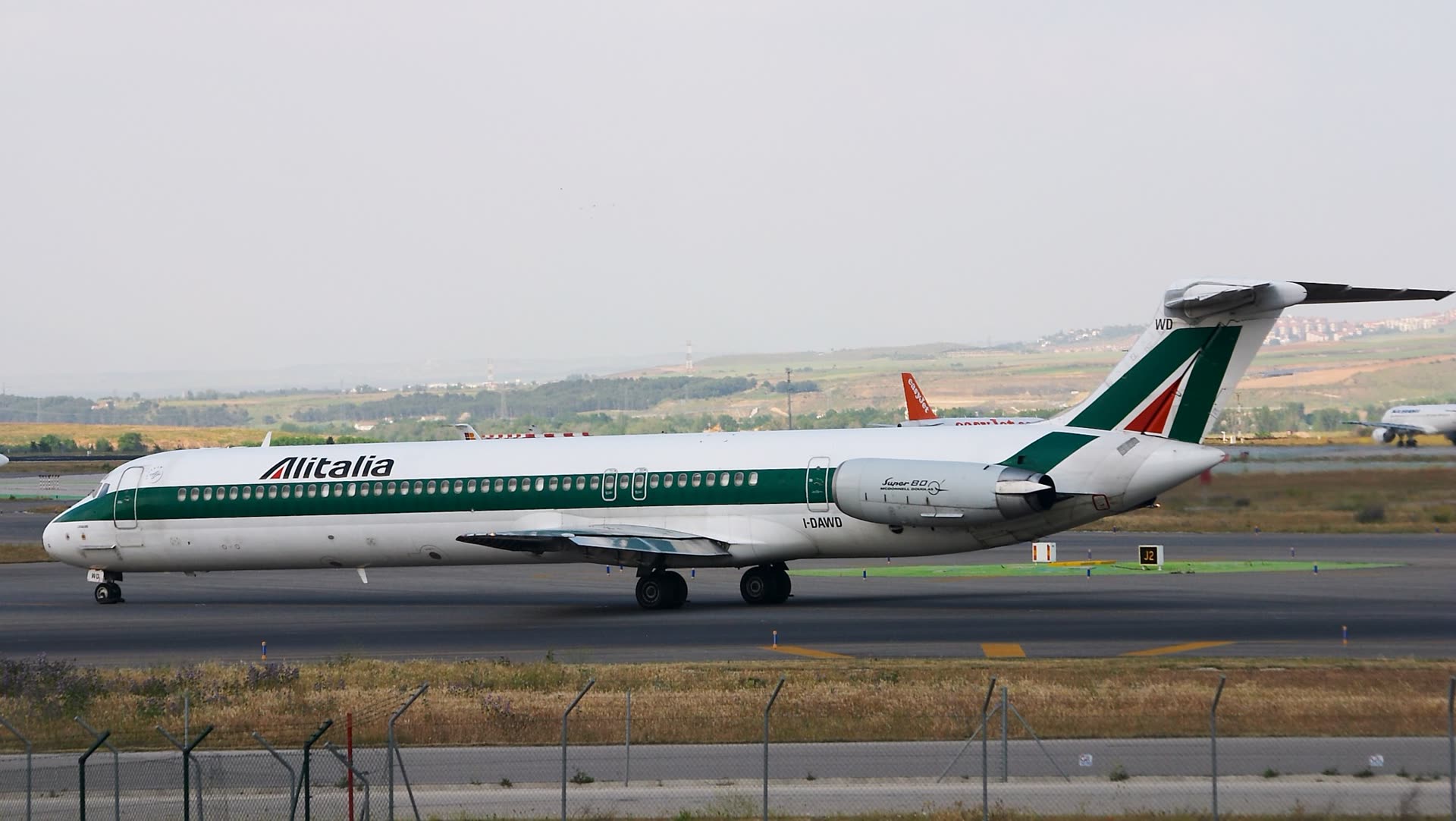
Pictured: an Alitalia McDonnell Douglas MD-82 (registration I-DAWD), a sister aircraft from the same registration block as I-DAWC, the actual aircraft flown as Flight AZ284 on April 21, 1991, photographed at Madrid-Barajas Airport in 2006. This is not a photograph of I-DAWC itself or of the incident — no photograph of the object exists in any archive consulted for this case file, and no photograph of I-DAWC specifically on that route could be located and rights-cleared. Photo by Barcex, licensed CC BY-SA 2.5.
Theoretical Alignment
This case aligns unusually poorly with the Extraterrestrial Hypothesis for a UAP-catalog entry, and that is itself an important, disclosed feature of its evidentiary profile rather than a flaw in this assessment. Nothing in Zaghetti's account describes hovering, instant acceleration, or any of the exotic performance signatures this catalogue tracks elsewhere; the object flew a straight reciprocal course past the aircraft in three to five seconds, behavior fully consistent with a solid, conventionally-propelled object of some kind — military, civilian, or otherwise. The Interdimensional Hypothesis finds essentially no support: every description is of an opaque, radar-reflective, physically solid object with a specific size, shape, and color, not a phenomenon suggestive of another plane of existence. The Psycho-Social/Mundane reading carries real weight, not because Zaghetti or his co-pilot are doubted as witnesses, but because the object's own missile-like profile and the Ministry of Defence's own investigative response — treating it as a possible ordnance or weapons-trial identification problem rather than a "UFO" in the popular sense — points toward a terrestrial, likely military or classified-hardware origin as the single most parsimonious reading, even though the specific candidates the Ministry of Defence actually checked were each individually ruled out.
Background
Alitalia Flight AZ284 was a regularly scheduled service linking Milan-Linate Airport with London Heathrow, operated on the evening of April 21, 1991 by a McDonnell Douglas MD-82 (registration I-DAWC, manufacturer's serial number 49198), carrying 57 passengers. At the controls was Captain Achille Zaghetti, a career Alitalia airline captain born in Grosseto, Tuscany. The MD-82 — a stretched, re-engined derivative of the DC-9 — was one of the mainstay narrow-body aircraft of Alitalia's European short- and medium-haul fleet through the 1980s and 1990s, and I-DAWC was a comparatively young airframe at the time, having entered service only a few years earlier as part of a large order Alitalia placed with McDonnell Douglas in the mid-1980s.
The flight's routing that evening followed the standard airway used by traffic inbound to Heathrow from continental Europe, crossing the English coast over Kent and continuing generally northwestward across the Weald and the Surrey/Hampshire borders before joining the Heathrow approach pattern from the south or southeast. This is a routine, extremely heavily-trafficked corridor — among the busiest civil airspace approaches in the world — monitored continuously by the London Area Control Centre (LATCC), then based at West Drayton, and by extension by the Ministry of Defence's own air defence radar network, since UK airspace of this kind is subject to both civil air traffic control and, where relevant, military air defence identification interest. It is precisely this dual civil/military radar coverage, and the specific description Zaghetti gave of the object, that would determine how the case was handled in the weeks that followed: not as a routine "unidentified light in the sky" report of the kind most commonly associated with the term "UFO," but as a potential airspace-safety and possible-ordnance identification problem that the Civil Aviation Authority (CAA) escalated directly into a Ministry of Defence Defence Intelligence channel.
By 1991, the UK Ministry of Defence's UFO desk — formally Secretariat (Air Staff) 2a, or Sec(AS)2a, within the Air Staff branch of the Ministry — had existed in some form since the 1950s, tasked with assessing whether reported UFO sightings had any defence significance (principally: was the reported object a hostile, foreign, or otherwise unauthorized incursion into UK airspace) rather than with UFO research as a subject in its own right. Nick Pope, later the desk's best-known occupant and the author of a 1996 memoir about the posting, did not take up the role until July 29, 1991 — more than three months after the AZ284 sighting and after its investigation was already substantially complete. This case file makes that timing explicit because Pope's later public profile has led to a persistent, informal assumption in some UFO literature that he personally investigated every notable UK case from this era; he did not personally investigate this one, though he inherited the closed file, among others, when he took up the post, and later publicly commented on the broader body of MOD UFO casework this file forms part of.
Complete Timeline
| Date | Event |
|---|---|
| Apr. 21, 1991, ~2000 hrs | Alitalia Flight AZ284 (Milan–Heathrow), an MD-82 registered I-DAWC and commanded by Captain Achille Zaghetti, is descending through 22,000 feet approximately 6 nautical miles west of the Lydd beacon, Kent, when Zaghetti and his co-pilot see an unidentified khaki-brown object pass roughly 1,000 feet above them on a reciprocal heading. |
| Apr. 21, 1991, immediately after | Zaghetti contacts London Area Control Centre; the controller confirms an unknown primary radar return approximately 10 nautical miles behind the airliner. Nine radar plot images are recorded and later archived; one contemporaneous annotation reads "Possible slow-moving target – Cruise Missile??" |
| Apr. 21–22, 1991 | An Airprox/Air Occurrence Report (ref. M40/91) is filed, initiating a Civil Aviation Authority Safety Data & Analysis Unit (SDAU) review. |
| ~May 1, 1991 | Southern Television broadcasts an early report on the incident, ahead of the investigation's formal conclusion. |
| May 6, 1991 | The Independent publishes the first detailed national newspaper account, quoting the CAA's description of the object as "light brown, round, 3 meters long" and quoting an MOD spokesperson's response that Kent's only military ranges, at Lydd and Hythe, "are concerned with small arms only." |
| May 10, 1991 | The CAA's SDAU formally hands the investigation to the Ministry of Defence's Military Air Traffic Operations (MATO) branch, based at RAF Uxbridge, reflecting the case's escalation from a routine civil Airprox matter into a Defence Intelligence-adjacent identification question. |
| July 16, 1991 | MATO issues its report, stating that no missile firings occurred from the Lydd/Hythe ranges that evening, that the Royal Navy's Sea Dart missile system was not being test-fired on that date, that no space-related re-entry event or meteorological balloon release matched the description, and that the department could not confirm the object's identity. |
| July 29, 1991 | Nick Pope begins his tenure as the Ministry of Defence's Sec(AS)2a "UFO desk" officer, inheriting the AZ284 file, among others, already closed as unidentified. |
| 1996 | Nick Pope publishes Open Skies, Closed Minds, drawing on his time at Sec(AS)2a and the broader body of MOD case files from this period. |
| Oct. 20, 2008 | The National Archives releases a batch of 19 previously secret Ministry of Defence UFO files covering 1986–1992, including DEFE 24/1953 ("UFO reports; with redactions"), which contains the AZ284 case documentation. |
| 2009 | Dr. David Clarke, working with the National Archives to interpret the newly released files, publishes The UFO Files: The Inside Story of Real-Life Sightings and singles out the AZ284 case in later commentary as, in his words, "the most impressive UFO incident ever been reported and investigated by the MOD." |
| 2014 | Clarke publishes Britain's X-traordinary Files, a further National Archives-sourced survey that situates cases like AZ284 within the wider run of MOD paranormal and unexplained-phenomena casework. |
| 2026 | This case file is published, correcting the "Coming Soon" queue's description of the object as "brick-shaped" and clarifying the precise Kent location of the sighting relative to the case's popular "Heathrow" framing. |
Inside the Cockpit: Zaghetti's Own Account
The core of this case rests on a short, specific, and internally consistent account given by Captain Zaghetti in his own words, preserved across the surviving CAA and MOD documentation and quoted with only minor variation across every secondary source this case file's research located. Descending through 22,000 feet on a normal instrument approach profile, Zaghetti and his co-pilot saw an object approach on what he described as essentially a reciprocal, opposite heading — meaning it was flying toward them, not alongside or behind — passing an estimated 1,000 feet above the MD-82. His own description, preserved in the file: "a flying object, very similar to a missile," light brown or khaki in color, approximately three meters long (he later gave a slightly larger estimate, around five meters, in follow-up recollection), round or cylindrical in cross-section, and critically, showing "no exhaust flame" and no other visible means of propulsion. The entire visual encounter lasted three to five seconds — long enough to register a clear impression of shape, color, and relative motion, but far too brief to support extended observation of any secondary behavior such as maneuvering or acceleration.
Zaghetti's own words describing the moment of the sighting are the single most quoted line associated with this case: "At once I said: 'Look out, look out', to my co-pilot, who looked out and saw what I had seen." This detail matters more than its brevity suggests. A solo pilot's report of an unusual object is, by the nature of commercial cockpit operations, functionally a single-witness account even when a co-pilot is physically present, unless that second crew member is specifically and immediately directed to look and independently confirms the observation before any discussion can shape a shared narrative. Zaghetti's own account describes exactly that sequence: an urgent, real-time alert followed by independent visual confirmation from a second trained observer, within the same few seconds the object was visible.
What happened immediately afterward is the second pillar of the case. Zaghetti did not simply file a report after landing; he queried air traffic control in the moment, while the object's radar signature (if any) might still be live and traceable: "As soon as the object crossed us I asked to the ACC (area control centre) operator if he saw something on his screen and he answered: 'I see an unknown target 10nm (nautical miles) behind you.'" This is a materially different evidentiary category from a witness's account being checked against radar data after the fact by investigators; here, the pilot himself, in real time, sought and received independent instrumented confirmation that something was indeed being tracked, at a position and time consistent with his own visual report, before he had any opportunity to describe what he had seen to the controller in detail.
The Radar Picture and RAF Neatishead's Unserviceable Camera
London Area Control Centre's radar recorded a primary-only return — meaning a return generated by the object physically reflecting the radar beam, with no transponder or IFF (identification friend-or-foe) signal of the kind virtually every civil and most military aircraft transmit — approximately ten nautical miles behind the Alitalia aircraft's position at the time of the sighting. Nine separate radar plot images from that evening were preserved and later archived within the case file. At least one contemporaneous annotation on the radar data, preserved in the file and quoted in later secondary analysis, reads: "Possible slow-moving target – Cruise Missile??" — a working hypothesis floated by whoever was reviewing the plots at the time, not a confirmed identification, but a genuine indication that trained radar analysts considered the return's speed and behavior consistent with, at minimum, something slower and more sedate than a typical aircraft track, and specifically raised the possibility of a guided weapon rather than defaulting to a conventional aircraft explanation.
This case file's own research located one specific limitation on the radar record worth disclosing directly: RAF Neatishead, a Royal Air Force radar station that in this period operated a camera system used to photograph and independently archive radar-scope imagery for cases of interest, had its own recording camera unserviceable on the night in question. RAF Neatishead, in Norfolk, was one of the primary surviving nodes of the UK's Cold War-era air defence radar network — tracing its lineage back through the ROTOR program of the early 1950s to the wartime Chain Home system — and by 1991 formed part of the UK Air Defence Ground Environment (UKADGE), the integrated network of long-range radar stations feeding NORAD-linked air defence identification data on all traffic, civil and military, transiting UK airspace. Its own camera equipment being down on this particular night means the case lost what would otherwise have been a second, independently maintained military radar record layered on top of LATCC's own civil air traffic control plot — a real, if narrow, gap in an otherwise unusually well-instrumented case. This means the case's radar evidence survives only through the LATCC's own plot data and file annotations, not through a second, independently photographed radar record of the kind that exists for some other well-documented UK military-radar UFO cases. This case file treats that as a genuine, disclosed gap rather than glossing over it: the radar corroboration here is real and contemporaneous, but it is a single-channel record, not a doubly-redundant one.
Correcting the Placeholder: What Zaghetti Actually Saw
This case file was commissioned to replace a "Coming Soon" queue placeholder describing the object as "brick-shaped." Two-pass research for this case file found no source, primary or secondary, that describes the object in those terms. Every account traced back to Zaghetti's own contemporaneous report — the Civil Aviation Authority's own public statement at the time ("The pilot said the object was light brown, round, 3 meters long"), Zaghetti's quoted description ("very similar to a missile," "round in shape"), and every subsequent secondary treatment this case file located, from the 2008 National Archives file release coverage through David Clarke's later book-length analysis — consistently describes a round or cylindrical, elongated, missile- or torpedo-like profile, not a rectangular or angular "brick" shape. This case file's own assessment is that the placeholder's "brick-shaped" description does not derive from any identifiable source describing this incident, and was very likely an invented or conflated detail introduced at the point the queue entry was first drafted, similar to the pattern this site has identified and corrected in several other "Coming Soon" queue entries this session. The object's real, consistently documented shape — round, cylindrical, missile-like — is used throughout this case file in place of the placeholder's description.
Where It Actually Happened: Kent, Not West London
This case is popularly known, including in this site's own "Coming Soon" queue, by its association with Heathrow — understandably, since Heathrow was Flight AZ284's destination and "the Heathrow UFO" is a more immediately recognizable framing than a specific rural Kent place name. But the sighting itself did not take place anywhere near West London or Heathrow's own airspace. Every primary and secondary source located for this case file places the encounter specifically over Kent, roughly six nautical miles west of the Lydd radio beacon on Romney Marsh, near England's south coast — a position more than sixty miles southeast of Heathrow itself, at a point on the standard inbound airway where a Heathrow-bound aircraft from Milan would still be in the early, high-altitude portion of its descent, well before joining the airport's own local approach pattern. This case file retains the site's established case title, "West London / Heathrow UFO Sighting," because that is the name under which the case was already queued and is likely to be searched for, but every specific locational claim within this file — including its location-card entry — identifies the real site over Kent rather than implying the object was seen in West London's own airspace.
The Investigation: From Airprox Report to Ministry of Defence File
Zaghetti's report entered the system through the normal channel for any incident a pilot considers a potential collision hazard: an Airprox, or "air miss," report, formally logged as Air Occurrence Report M40/91. In the United Kingdom, Airprox reports involving two aircraft are ordinarily investigated by the UK Airprox Board (historically the Joint Airmiss Working Group), a body made up of representatives from civil and military aviation that assesses risk-of-collision incidents between aircraft. This case did not follow that standard path to a full published Airprox Board determination. The most detailed documentary account of the case's investigative chain located for this file (drawing directly on the National Archives' own file, DEFE 24/1953) indicates that because the reported object fell outside standard aircraft-to-aircraft separation-minima criteria — it was not another aircraft in the ordinary sense, and Alitalia's own operational review of the report is described as having found the encounter fell outside the legal separation minima that would define a conventional Airprox — a formal Airprox Board enquiry was never actually instigated. Instead, because Zaghetti's own description raised the specific possibility of a missile, the Civil Aviation Authority's Safety Data and Analysis Unit (SDAU) referred the case directly into a Ministry of Defence channel: on May 10, 1991, responsibility passed to Military Air Traffic Operations (MATO) at RAF Uxbridge, a unit whose remit combines military air traffic coordination with exactly this kind of "is this a hazard to UK airspace" identification question.
This case file discloses that distinction explicitly because it matters for how the case should be read. A full, published UK Airprox Board report is a specific, well-defined institutional product with its own established investigative methodology and public track record (illustrated elsewhere in aviation-safety literature by comparable, though otherwise unrelated, Airprox Board UAP cases such as the December 2017 Glasgow Airbus A320 near-miss, in which the Board itself concluded it could not identify the object involved). The AZ284 case instead moved through a Defence Intelligence-adjacent identification process specifically because of the missile-like description — a process this case file's own research found to be genuinely rigorous in its own right, but institutionally distinct from, and arguably narrower in public accountability than, the standard Airprox Board process most UK aircrew near-miss reports receive.
MATO's investigation, concluded in a report dated July 16, 1991, is unusually specific and checkable for a UK MOD UFO file of this era. It states plainly that no missile firings took place from the Army's Lydd and Hythe ranges — the only military ranges in the immediate Kent area, and, per the Ministry's own contemporaneous statement to The Independent, "concerned with small arms only," meaning they were never a plausible source of a missile-like object regardless of activity that night. It further confirms that the Royal Navy's Sea Dart surface-to-air missile system, a program then in active service and testing, was not being test-fired on the date in question. It addresses and rules out a space-related re-entry event, and separately addresses and rules out a meteorological balloon release, on the basis that neither candidate's known behavior matched the reported shape, coloring, and directed, level flight path. Having exhausted each of these four specific, named candidates, the report's own conclusion is unambiguous: "These departments have not been able to confirm the identity of the object sighted by the Alitalia crew." A Ministry of Defence spokesperson, speaking to the press around the same period, offered a characteristically terse summary: "It was yet another UFO."
The Satellite Re-Entry Theory MOD Itself Doubted
A secondary claim surfaces in less formally documented secondary discussion of this file's contents: that officials had, at some point, floated a satellite or space-debris re-entry as an explanation on the strength of informal confirmation from U.S. Department of Defense sources, and that the specific Ministry of Defence civil servant reviewing the file found this candidate "hard to accept," reportedly noting that the same general locale had also seen other UFO activity. This case file's own research was able to confirm the space-debris/re-entry candidate was formally considered and rejected in MATO's own July 1991 report (see above), but could not independently verify the more granular claim about a specific civil servant's personal skepticism or the "same locale" remark beyond a single secondary paraphrase of the archival file rather than a primary document image this case file's own research directly examined. It is presented here, clearly flagged as a lower-confidence secondary claim, because if accurate it would reinforce rather than undermine the formal report's own stated rejection of the re-entry candidate: a re-entering satellite fragment is, in any case, a poor physical match for an object reported flying a controlled, level, reciprocal course at 23,000 feet — re-entry debris typically either burns up at much higher altitude or, if it survives to lower altitude, does so on a steep, largely uncontrolled ballistic trajectory rather than a shallow, level pass an airline crew would describe as approaching "head-on."
Key Witnesses
Captain Achille Zaghetti
A career Alitalia airline captain from Grosseto, Tuscany, and the case's primary witness. Zaghetti's own real-time actions — alerting his co-pilot immediately, then independently querying air traffic control for a radar cross-check before landing — are themselves a meaningful part of this case's evidentiary strength, reflecting the kind of in-the-moment, procedurally disciplined response training and experience would be expected to produce, rather than a report reconstructed or embellished after the fact.
Unnamed Co-Pilot, Alitalia Flight AZ284
Directed by Zaghetti to look at the moment of the sighting, and independently confirmed seeing the same object. No source consulted for this case file preserves this officer's name; he is presented here honestly as a second, independently corroborating trained witness rather than with an invented identity.
Unnamed London Area Control Centre (LATCC) Controller
Confirmed to Zaghetti, in direct real-time radio communication, an unknown primary radar return approximately ten nautical miles behind the Alitalia aircraft — the case's contemporaneous instrumented corroboration. No source consulted names this controller individually.
The Five Observables Assessment
Assessment: This case scores poorly against the Five Observables framework, and that is an honest, disclosed feature of its profile rather than a weakness in this assessment. Zaghetti's account describes a straight, level, reciprocal-heading pass lasting three to five seconds — there is no report of hovering (Anti-Gravity Lift), no report of a sudden change in speed or direction (Instant Acceleration), and no speed estimate exceeding what a missile, aircraft, or comparable conventional object could achieve (Hypersonic). Trans-Medium travel is inapplicable; nothing in the case involves water or any transition between physical media. Low Observability is rated Speculative on a genuine, if narrow, basis: the object returned no transponder or IFF signal on radar, appearing only as an unidentified primary contact, and its radar behavior was distinctive enough that a contemporaneous annotation raised the specific possibility of a "slow-moving" cruise-missile-type target rather than a conventional aircraft track. A primary-only radar signature is a real, if modest, technical distinguishing feature worth noting, but it falls well short of the exotic radar-evading behavior this framework's "Low Observability" category is designed to flag in stronger cases elsewhere in this catalogue. In short: this is a case whose evidentiary strength lies almost entirely in witness quality, real-time procedural rigor, and the thoroughness of its official investigation, not in any exotic flight characteristic.
Evidence Assessment
Supporting Anomalous Origin
- A professionally trained, licensed airline captain, corroborated within seconds by an independently-alerted second crew member, gave a specific, consistent, low-embellishment description immediately after the encounter rather than after time to elaborate
- Zaghetti's own real-time query to air traffic control produced independent, contemporaneous radar confirmation of an unknown primary contact at a position and time consistent with his visual report — corroboration obtained in the moment, not reconstructed afterward
- The Ministry of Defence's own investigation named and specifically ruled out four concrete, checkable candidate explanations (Lydd/Hythe range firings, Royal Navy Sea Dart trials, space debris re-entry, and a meteorological balloon) rather than issuing a generic dismissal
- A skeptical, methodical, National Archives-affiliated researcher with no track record of credulous UFO reporting, Dr. David Clarke, later singled this case out as, in his own words, "the most impressive UFO incident ever been reported and investigated by the MOD"
- The object's radar signature carried no transponder/IFF return, meaning it was not a co-operating, identified aircraft of any kind operating within the normal air traffic control system
Supporting Conventional Explanation
- The sighting lasted only three to five seconds, sharply limiting the amount of detail any witness, however well-trained, could reliably register about the object's structure or behavior
- No photograph, film, or physical trace of any kind exists; the entire case rests on witness testimony plus a single, primary-only radar channel
- RAF Neatishead's radar-recording camera was unserviceable that night, meaning the case lacks the independent secondary radar-photography record that exists for some other well-documented UK radar-visual cases
- The object's own reported profile — round, khaki-brown, missile-like, unlit, no exhaust — is at least as consistent with an unidentified, unauthorized, or classified conventional weapon or test article as with anything genuinely anomalous, and the Ministry of Defence's own escalation of the case into a Defence Intelligence identification channel reflects exactly that reading
- This case file's own access to the underlying MOD file (DEFE 24/1953) is through a detailed secondary digest of the National Archives' released document rather than this case file's own direct examination of the scanned primary file images
Why "Disputed"
This case earns a DISPUTED classification with a credibility score of 56/100, placing it above the visual-only Thomas Mantell case (Disputed, 38) and close to, though slightly below, the multi-witness Gorman Dogfight (Disputed, 58), while sitting well below this catalogue's stronger military-corroborated cases such as Oscoda AFB (Disputed, 70) or Coyne Helicopter (Credible, 81). The case earns its position above Mantell and near Gorman on the strength of a genuinely disciplined real-time evidentiary chain: a trained commercial pilot who immediately secured independent visual corroboration from a second crew member, then independently sought and received contemporaneous radar confirmation before he had any opportunity to shape a shared narrative with the controller he was speaking to. Layered on top of that is an unusually specific, four-candidate official elimination process — Army range activity, Royal Navy missile trials, space debris, and a weather balloon were each individually named and ruled out in a dated MOD report, not waved away with a generic "probably nothing" — and an unusually strong endorsement from a skeptical, credentialed archive researcher (David Clarke) with every institutional incentive to debunk rather than praise a case's thoroughness.
What keeps this case well short of Oscoda's or Coyne's tier is equally real. The sighting itself lasted only three to five seconds, an inherently narrow evidentiary window regardless of witness quality. The radar corroboration is a single, primary-only channel, not a doubly-redundant or photographically archived record — RAF Neatishead's own camera was down that night. No physical trace or photograph exists. And critically, unlike Coyne's instrument-documented anomalous climb or Oscoda's disputed extreme-acceleration claim, this case reports no anomalous flight characteristic whatsoever: no hovering, no sudden acceleration, no unusual speed. Its entire evidentiary weight rests on witness quality and investigative thoroughness in the face of a genuinely puzzling, unidentified, radar-confirmed object — not on any hint of exotic technology. A case this procedurally clean and this officially unresolved, yet this thin on the specific performance signatures this catalogue otherwise weighs heavily, is exactly the profile the middle of this site's "Disputed" range exists to describe.
Sensor & Instrumentation Detection Profile
This case combines a single visual-observation channel (two independent crew members) with a single radar channel (London ACC's primary-only contact, recorded across nine plot images). No infrared, electromagnetic, acoustic, or radiological instrumentation of any kind captured or was applied to this event. The radar contact's most notable technical feature is precisely what it lacked: a transponder or IFF return, meaning whatever generated the primary skin-paint return was not broadcasting an identifying signal of the kind used throughout the normal air traffic control system. A contemporaneous file annotation characterizing the target as "possible slow-moving... Cruise Missile??" indicates that whoever reviewed the plots at the time judged its radar-derived speed and track profile as at least plausible for a slow guided munition, though this case file's own research could not confirm the specific groundspeed value, if any, that annotation was based on. The absence of a second, independently recorded radar-photography channel (RAF Neatishead's own camera being unserviceable that night) is a genuine, disclosed limitation on this case's instrumentation record.
Environmental & Geospatial Context
The sighting occurred over Kent's Romney Marsh, a low-lying, sparsely populated coastal plain near England's south coast, in the vicinity of the Lydd radio beacon and the adjoining Lydd and Hythe Army ranges — small-arms-only facilities, per the Ministry of Defence's own contemporaneous statement, and therefore not a plausible source of a missile-like object regardless of any activity that evening. No specific meteorological record for the evening of April 21, 1991 was located in any source consulted for this case file; the encounter's own description — a clear, brief visual sighting of a distinct object against the sky at altitude, immediately corroborated by a second crew member — implies conditions clear enough for unobstructed visual contact, though this case file's research could not confirm cloud cover, visibility, or wind data for the specific evening or altitude. The area's proximity to the English Channel, and to routine British and allied military training and exercise activity along the south coast, is relevant background for the Ministry of Defence's own decision to treat the report as a potential ordnance-identification matter rather than dismiss it outright.
Observer Credibility & Occupational Profile
Captain Zaghetti's occupational profile is a genuine strength of this case: a licensed, currently-flying commercial airline captain, trained specifically in aviation hazard recognition and radio-telephony procedure, whose professional judgment about what constitutes a genuine collision or airspace hazard is, by the nature of the job, exercised and tested constantly. His co-pilot's corroboration adds a second such witness, though this case file's research could not independently verify the co-pilot's own specific qualifications or experience level beyond his role aboard the flight. Neither witness has given an extensive, on-the-record public interview in the decades since, in the way some other aircrew witnesses elsewhere in this catalogue have (compare Robert Salas's decades of public testimony on the 1967 Malmstrom incident) — Zaghetti's own words survive through his contemporaneous written report and the CAA/MOD files rather than through a later personal media presence, a meaningfully different, and in some ways more reliable, evidentiary category (a same-night operational report is less susceptible to the narrative drift that can affect memories recounted repeatedly over decades), but one this case file discloses rather than treats as equivalent to sustained independent cross-examination.
David Clarke's own published commentary on this general category of case, drawing on his years of access to Ministry of Defence aircrew reports, adds a further, useful piece of context to how this case should be weighed against the wider body of pilot testimony: he has noted that professional pilots are, if anything, likely to underreport unusual aerial sightings relative to the general public, out of concern for how a UFO report might affect their career or professional standing among colleagues and regulators. If accurate, that observation cuts against any assumption that Zaghetti's report should be discounted as a pilot being unusually quick to reach for an exotic explanation; the professional incentive, per Clarke's own assessment, runs the other way, toward silence rather than embellishment. Zaghetti's decision to file a same-night Airprox/Air Occurrence Report, and to specifically request an independent radar cross-check in real time rather than simply making a note for later, is consistent with a pilot treating the encounter primarily as an airspace-safety matter requiring a documented, procedurally correct response — not as an opportunity to advance a personal claim about anomalous phenomena.
Physical & Material Assays
No physical trace evidence of any kind exists for this case. The object was never reported to land or leave any debris; its entire documented interaction with the physical world consists of two witnesses' visual impressions and a single primary radar return. No sample, fragment, or landing-site impression was ever recovered or is claimed to exist in any source consulted for this case file. See Material Analysis below for a full discussion of what does and does not survive of the case's own documentary record.
Historical Precedents & Archive Matches
The AZ284 case belongs to a specific and recurring category within this catalogue: a commercial or military aircrew's radar-corroborated near-miss with an unidentified object, formally investigated by a national aviation-safety or defence body. This site's own Kaikoura Lights case (December 1978) similarly combines aircrew visual testimony with independent, simultaneous ground radar tracking, though in that case sustained over many minutes rather than a few seconds. JAL Flight 1628 (November 1986) is a closer parallel still: another foreign commercial airline captain (Kenju Terauchi) reporting a sustained, radar-corroborated encounter over U.S. airspace, investigated by a national civil aviation authority (the FAA) that ultimately could not identify the object. Within this site's own UK-specific casework, the AZ284 case sits alongside RAF Cosford / Shawbury (March 1993) as one of a small cluster of cases whose entire documentary record derives from Ministry of Defence files later released to the National Archives — though where Cosford/Shawbury rests on witness recollection later cross-checked against MOD files, AZ284's own core evidence (the pilot's real-time radar query) was itself generated as a contemporaneous, in-the-moment instrumented check, a meaningfully different evidentiary structure.
Material Analysis
There is no physical object, debris, or trace sample connected to this case; "material" here refers instead to the case's actual surviving evidentiary substrate — the same-night Air Occurrence Report, the LATCC radar plot images, and the CAA/MOD correspondence and reports that preserve the event — since that documentary record is the only tangible thing this case file's research was able to assess, and even then only via a detailed secondary digest of the National Archives' released file rather than this case file's own direct examination of the primary scanned document images.
The Surviving Documentary Record
The core of this case's paper trail is the Air Occurrence Report filed the night of the sighting (ref. M40/91), the nine archived London ACC radar plot images, the CAA Safety Data and Analysis Unit's file, and the Ministry of Defence Military Air Traffic Operations report dated July 16, 1991. These records, together with related correspondence, are held within the National Archives file DEFE 24/1953 ("UFO reports; with redactions"), released to the public on October 20, 2008 as part of a batch of 19 Ministry of Defence UFO files covering 1986–1992. Dr. David Clarke's subsequent published analysis, drawing on this and other files from the same release, and period press coverage in The Independent (May 6, 1991) and on Southern Television (around May 1, 1991), together corroborate the file's own account of the investigative timeline and conclusions with consistent detail across independent tellings.
What Does Not Survive
No photograph, film, or physical trace of the object is known to exist in any archive consulted for this case file. This case file's own research was also unable to directly examine a high-resolution scan of the original Air Occurrence Report or the MATO report itself; every specific quotation and date presented in this file traces back to detailed secondary digests of the National Archives' released file (principally Graeme Rendall's document-based analysis for UAP Media UK) rather than to this case file's own independent reading of the primary-source images. This is the same disclosed limitation this site applies to comparable cases elsewhere in its catalogue, and it means a small residual possibility of transcription drift between the original document and what this case file, via its sources, reports cannot be entirely excluded.
Supporting Non-Terrestrial or Unexplained Origin
- A same-night Air Occurrence Report and contemporaneous radar plots, not a report reconstructed from memory years later, anchor the case's core timeline and details
- Independent corroboration across two channels — a second crew member's visual confirmation and a controller's real-time radar confirmation — obtained within the same encounter, not pieced together afterward
- The case's broad outline is corroborated with consistent detail across independent contemporaneous press coverage (Southern Television, The Independent) and later archival analysis
Supporting Terrestrial or Mundane Origin
- This case file's research could not directly examine a primary-source image of the original Air Occurrence Report or MATO report, relying instead on a consistent but still secondary digest
- No photograph or physical trace exists to allow any independent modern re-analysis of the object itself
- The object's own missile-like profile, and the Ministry of Defence's own decision to route the case through a Defence Intelligence identification channel rather than a standard Airprox Board process, both point toward a plausible classified, military, or otherwise conventional hardware origin, even though the four specific named candidates actually checked were each ruled out
The Conventional Explanation Candidate (CEC): Military Ordnance or Weapons-Trial Debris
The Ministry of Defence's own investigative posture — treating the report as a potential ordnance-identification problem rather than a routine "light in the sky" — reflects the single most natural first-position conventional candidate: that Zaghetti and his co-pilot saw some kind of missile, target drone, or other weapons-trial hardware, whether from a known or unacknowledged test program. This deserves serious treatment precisely because it was the investigating authorities' own working assumption, not a retrospective skeptical guess. MATO's investigation specifically checked, and ruled out, the two most locally and operationally plausible candidate programs: live firing from the Lydd/Hythe Army ranges (confirmed to be small-arms-only facilities, incapable of putting anything resembling a three-to-five-meter missile-shaped object into the air at 23,000 feet) and Royal Navy Sea Dart missile testing (confirmed not scheduled or conducted that date).
Unacknowledged or Foreign Military Hardware (Uninvestigated Candidate)
Ruling out the two specific, named programs MATO actually checked does not rule out every conceivable weapons-related candidate. A classified British test article outside the specific programs checked, a foreign military exercise or transit not coordinated with UK civil air traffic control, or an unauthorized drone or target vehicle are candidates this case file's own research could not affirmatively exclude, because no source consulted documents an exhaustive canvass of every UK or NATO military activity that might conceivably have been active in south-east England's airspace that specific evening.
Meteorological Balloon
Weather balloons are a recurring, genuinely common source of unusual aerial sightings, including from aircraft. MATO's own report addresses and rejects this candidate, on the basis that the object's reported shape, coloring, and directed, level flight path did not match a passively drifting balloon. This case file's own assessment agrees that a balloon is a poor fit specifically because Zaghetti described the object crossing on what he characterized as essentially a reciprocal heading — directed, level motion inconsistent with a balloon's wind-driven drift.
Satellite or Space Debris Re-Entry
Also considered and rejected in MATO's own report. As discussed above, this candidate is a particularly poor physical match regardless of the official rejection, since re-entering debris does not typically fly a shallow, level, controlled-looking pass at 23,000 feet.
Genuine Unidentified Object
This reading remains open given the case's combination of disciplined, real-time, dual-channel witness corroboration; a same-night official report; and the exhaustive, specifically-named rejection of every mundane and military candidate the investigating authorities actually checked. It is tempered by the absence of any exotic performance characteristic, the extremely short observation window, the single-channel (non-redundant) radar record, and this case file's reliance on secondary digests of the primary file.
Named Military Ordnance (Ranges & Sea Dart)
ImplausibleIMPLAUSIBLE as specifically checked. The Lydd/Hythe ranges are small-arms-only and the Royal Navy's Sea Dart system was not being tested that date, per MATO's own dated report.
Unacknowledged/Foreign Military Hardware
InconclusiveINCONCLUSIVE. The two specific programs actually investigated were ruled out, but an exhaustive canvass of every possible classified or foreign military activity in the area that night could not be confirmed from any source consulted.
Meteorological Balloon
ImplausibleIMPLAUSIBLE. Rejected in MATO's own report; a balloon's passive drift does not match the directed, level, reciprocal-heading pass Zaghetti described.
Satellite/Space Debris Re-Entry
ImplausibleIMPLAUSIBLE. Rejected in MATO's own report and a poor physical fit in any case, since re-entry debris does not typically sustain a shallow, controlled-looking pass at 23,000 feet.
Genuine Unidentified Object
InconclusiveINCONCLUSIVE. Supported by disciplined real-time dual-channel corroboration and the exhaustive rejection of every specifically-named candidate, but limited by the extremely short observation window and the absence of any exotic performance signature.
Related Cases
Confirmed Documents & Official Records
The Ministry of Defence file containing the Air Occurrence Report, radar plot data, CAA/MOD correspondence, and the July 16, 1991 MATO investigation report at the center of this case.
DECLASSIFIEDA related Defence Intelligence Staff file spanning the same period as the AZ284 sighting; this specific file remains closed pending further review, and this case file's research could not confirm whether it contains additional AZ284-specific material.
CLOSED (RETENTION UNDER REVIEW)Search UK Government & Military Archives Directly
Further Reading — Recommended Literature
Open Skies, Closed Minds
A firsthand account of the Ministry of Defence's Sec(AS)2a "UFO desk" from the officer who inherited this and other files just months after the AZ284 sighting closed as unidentified.
UFO! Danger in the Air
A survey of mid-flight encounters between aircraft and unexplained phenomena, the exact evidentiary category the AZ284 case belongs to.
The UFO Files: The Inside Story of Real-Life Sightings
Published by The National Archives itself, this book analyzes the 2008 file release that includes DEFE 24/1953, and is the source of Clarke's own characterization of the AZ284 case as the MOD's most impressive UFO investigation.
Britain's X-traordinary Files
A further National Archives-sourced survey situating cases like AZ284 within the wider run of official British paranormal and unexplained-phenomena casework.
Above Top Secret: The Worldwide UFO Cover-Up
A wide-ranging survey of international government UFO files, useful context for how the UK's own MOD casework of this period fit into a broader pattern of official file-keeping.
Essential Viewing
Sources
- UAP Media UK. Rendall, Graeme. "The Alitalia AZ284 Incident." uapmedia.uk
- UFO Casebook. "Captain Achille Zaghetti's Close Encounter." ufocasebook.com
- Irish Examiner. "British Government Files Reveal Plane's Near Miss with UFO," Oct. 20, 2008. irishexaminer.com
- ABC13 Houston (Associated Press wire). "Britain Releases UFO Files, Dispels Some Mysteries." abc13.com
- Kent Online. "X Files: How Airline Pilot Had Narrow Miss with UFO." kentonline.co.uk
- Kent Online. "MoD Reveals Kent X-Files." kentonline.co.uk
- The National Archives (UK). Digital copy of DEFE 24/1953: "UFO reports; with redactions." discovery.nationalarchives.gov.uk
- The National Archives (UK). DEFE 31/179: "UFO incidents" (Defence Intelligence Staff), Jan. 2, 1990 – June 5, 1991. beta.nationalarchives.gov.uk
- The National Archives (UK). "UFO Research Guide." cdn.nationalarchives.gov.uk
- Clarke, David. The UFO Files: The Inside Story of Real-Life Sightings (The National Archives, 2009).
- Clarke, David. Britain's X-traordinary Files (Bloomsbury, 2014).
- Pope, Nick. Open Skies, Closed Minds (Simon & Schuster, 1996).
- Airfleets Aviation. "Alitalia I-DAWC (McDonnell Douglas MD-80/90 – MSN 49198)." airfleets.net
- Wikimedia Commons. "McDonnell Douglas MD-82 (DC-9-82) – Alitalia – I-DAWD – LEMD.jpg" (Barcex, CC BY-SA 2.5), source of this case file's hero image. commons.wikimedia.org
- YouTube oEmbed API verification for video ID KbzbK905kwc (title, author, and thumbnail confirmed live, The National Archives UK). youtube.com
- Gulf News / wire coverage of UK Airprox Board case involving an Airbus A320 near Glasgow, Dec. 2, 2017, cited for comparative Airprox Board process. gulfnews.com
- Airfleets Aviation / Planespotters.net fleet data on Alitalia's McDonnell Douglas MD-82 fleet, used to confirm the "I-DAW" registration block context for I-DAWC. planespotters.net
See something inaccurate? Have additional information or sources?
Suggest an Edit →Last Updated: August 2026