
RAF Cosford / Shawbury Sighting
On the night of March 30–31, 1993, over a hundred witnesses across a broad swath of western Britain — from the Quantock Hills of Somerset to South Wales and the West Midlands — reported bright lights and, in several accounts, a large triangular craft moving low and near-silently. The two most famous sightings, at RAF Cosford and RAF Shawbury in Shropshire, were investigated in detail by the Ministry of Defence's Nick Pope and produced some of the most substantial declassified UFO files in British government archives — a case now popularly nicknamed "Britain's Roswell."
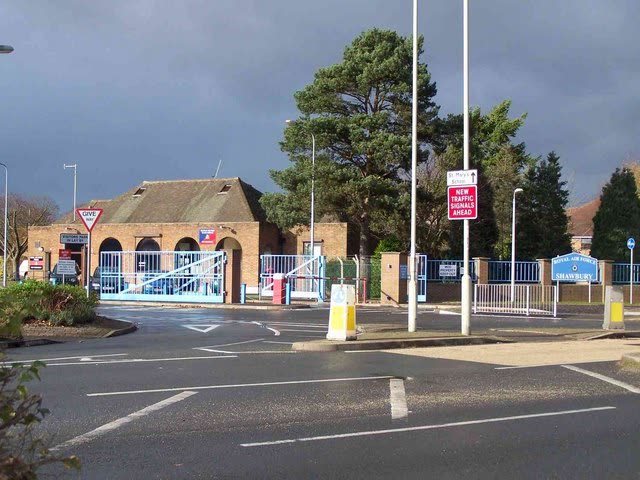
Pictured: the entrance to RAF Shawbury, Shropshire, photographed by Geoff Pick in 2007 (CC BY-SA 2.0, via Geograph/Wikimedia Commons) — not a photo of the object itself, of which no photograph exists. RAF Shawbury is where the case's most detailed sighting, by meteorological observer Wayne Elliott, took place in the early hours of March 31, 1993. No rights-clear photograph of RAF Cosford's 1993-era guardroom or of any witness survives in the public record, and the object was never photographed by anyone on the night.
Theoretical Alignment
The case's own resolution history argues against exotic explanations: the two flagship sightings that made "the Cosford Incident" famous have each been persuasively tied to identifiable mundane sources — a satellite rocket-body re-entry and a police helicopter searchlight — by independent researchers working from primary trajectory and radar data. What remains genuinely open is a residue of earlier-evening, single-witness reports that neither explanation covers, which is why this file is rated Disputed rather than Debunked.
Background
By March 1993, the Ministry of Defence's UFO desk — formally Secretariat(Air Staff)2, or Sec(AS)2 — had existed in one form or another since 1950, tasked with assessing whether reported unidentified aerial phenomena represented a threat to UK airspace. Since taking over the desk in 1991, Nick Pope had processed a steady trickle of several hundred reports a year, the overwhelming majority explained by aircraft lights, satellites, meteors, or Venus. Public and media interest in UFOs was running unusually high across Britain in the early 1990s, fed in part by ongoing fascination with the December 1980 Rendlesham Forest incident and by the 1990 Belgian wave, in which the Belgian Air Force scrambled F-16s against a mass triangle sighting corroborated by military radar — a case widely discussed in British UFO circles as a template for what a genuinely well-documented military encounter might look like.
Shropshire itself was, and remains, a county with an unusually dense concentration of active RAF stations for its size. RAF Cosford, near Albrighton, functioned primarily as a technical training station (and is today home to the Royal Air Force Museum Midlands); RAF Shawbury, roughly twelve miles to the north, was a helicopter aircrew training base with its own resident Meteorological Office observing post, staffed around the clock. Both stations maintained routine overnight security patrols and weather-observation duties that placed trained personnel outdoors, watching the sky, in the exact predawn hours when the most detailed sightings of the night occurred. It was this combination — ordinary duty personnel, doing ordinary jobs, filing immediate and largely unprompted reports through official channels — that gave the Cosford Incident its unusual institutional weight from the outset, distinguishing it from the far larger number of UK UFO reports the MoD routinely filed and closed without further comment.
The MoD's UFO desk itself had a much longer institutional history than its low public profile in the early 1990s suggested. The department traced its lineage back to a 1950 Air Ministry "Flying Saucer Working Party," and by the time Pope took over Sec(AS)2 in 1991, the section had spent four decades quietly triaging several hundred civilian and occasional military reports a year, almost all resolved as aircraft, satellites, astronomical objects, or atmospheric phenomena. What made Sec(AS)2 unusual was not that it investigated UFOs as a matter of belief, but that any report touching UK airspace had, by policy, to be assessed for its potential defence significance — if something genuinely uncontrolled and unidentified was operating in British airspace, that was a question the Ministry of Defence could not simply wave away regardless of whether it turned out to have anything to do with extraterrestrial visitation. That policy framing is what elevated the Cosford Incident above the routine caseload: not a decision that UFOs were "real" in some exotic sense, but a judgment, later stated plainly in Pope's own report, that whatever RAF Cosford's and RAF Shawbury's personnel had encountered had evaded UK radar coverage, which was itself the defence-relevant fact.
The case also arrived at a distinctive moment in Pope's own career and in British ufology more broadly. Pope has said repeatedly, in later interviews and in his own book Open Skies, Closed Minds, that the Cosford Incident functioned as a personal turning point — the case that moved him from a largely skeptical civil servant processing a routine workload toward someone convinced that at least some UAP encounters likely involved genuinely novel technology. That personal transformation, occurring inside the very government office responsible for assessing these reports, is itself part of why the case carries more cultural weight than the great majority of contemporaneous UK sightings: it is not simply a story about what members of the public claimed to see, but a story about how convinced the government's own investigator became, and why later researchers working the same file reached a considerably more measured conclusion.
Complete Timeline
| Date | Event |
|---|---|
| Mar 30, ~20:30 GMT | First reported sighting of the night, in Somerset. |
| Mar 30, ~21:00 GMT | An off-duty police officer and a group of scouts in the Quantock Hills, Somerset, watch an object they describe as resembling "two Concordes flying side by side and joined together." |
| Mar 30, late evening | Further scattered reports come in from Devon, Cornwall, and Staffordshire as the evening progresses. |
| Mar 31, ~01:07 GMT | The spent Tsyklon rocket booster that launched the Russian Cosmos 2238 satellite begins re-entering the atmosphere, first crossing visibly over Ireland. |
| Mar 31, ~01:10–01:15 GMT | Burning re-entry debris crosses Devon, Cornwall, Wales, and the English Channel; roughly 70 witnesses, including police officers in multiple force areas and an Irish Air Corps helicopter crew, report bright lights with luminous trails. |
| Mar 31, ~01:15 GMT | An RAF Police patrol at RAF Cosford reports two very bright white lights, one trailing a faint red glow, passing overhead at roughly 1,000–2,000 feet and high speed; the patrol alerts RAF Shawbury by phone. |
| Mar 31, ~01:15–01:30 GMT | A family near Rugeley, Staffordshire, reports pursuing by car an object they describe as roughly 200 feet across before it appears to descend into a field and vanish. |
| Mar 31, ~02:40–02:50 GMT | Duty meteorological observer Wayne Elliott at RAF Shawbury reports a large triangular object approaching the station at roughly 30–40 mph and low altitude, sweeping a narrow light beam across a field beyond the perimeter fence, before accelerating away at speed. |
| Mar 31, morning | Nick Pope arrives at the MoD's UFO desk to find reports already accumulating, several relayed overnight by private investigator Doug Cooper of DUFORO/BUFORA. |
| Apr 19, 1993 | An internal MoD memo notes that RAF Shawbury's own radar showed a conventional aircraft above 20,000 feet directly over the station at the approximate time of Elliott's sighting. |
| Apr 22, 1993 | Pope briefs the Assistant Chief of the Air Staff that the reported characteristics resemble those rumored of the classified "Aurora" hypersonic aircraft program. |
| Apr 1993 | Air Marshal Sir Anthony Bagnall reports that the British Air Attaché in Washington drew a blank inquiring about "Aurora" at the Pentagon; Pope is told to drop the subject. |
| May 26, 1993 | Doug Cooper writes to the MoD stating he is confident the majority of the ~01:10 GMT sightings were re-entering space debris. |
| Mar 21, 1994 | Spanish researcher Vicente-Juan Ballester Olmos sends Pope a NORAD/NASA trajectory statement and computer simulation identifying the Cosmos 2238 rocket-body re-entry as the source of the main sighting cluster. |
| 1990s–2000s | David Clarke and BUFORA consultant Gary Anthony independently reinterview Wayne Elliott, who concludes his own sighting was most likely a Dyfed-Powys Police helicopter using its NiteSun searchlight during an unrelated vehicle pursuit roughly ninety minutes after the Cosford patrol's sighting. |
| Aug 17, 2009 | The MoD's file DEFE 24/2086 on the incident is formally opened to the public at The National Archives, Kew. |
| Mar 30, 2023 | David Clarke publishes a detailed 30th-anniversary re-examination of the case, "Case Closed." |
The Wider Wave: Somerset to South Wales
Although the incident is remembered by the names of two Shropshire air bases, the reports that make up the Cosford Incident began hours earlier and hundreds of miles away. The first report of the night came from Somerset at around 8:30 p.m. on March 30, followed roughly half an hour later by one of the wave's most quoted accounts: an off-duty police officer, out with a group of scouts in the Quantock Hills, watched a large object he could only compare to "two Concordes flying side by side and joined together." Through the rest of the evening, further scattered reports reached police control rooms in Devon, Cornwall, and Staffordshire.
The wave's largest single cluster came shortly after 1:10 a.m. on March 31, when dozens of witnesses across Devon, Cornwall, South Wales, and the English Channel independently reported bright lights crossing the sky from northwest to southeast, trailing luminous vapor. Police officers with Devon and Cornwall Police and Gwent Police filed near-identical reports within minutes of each other; a South Wales force control room told investigator Doug Cooper it had separately logged a report of two very large bright white lights approaching from the north across the Bristol Channel. An Irish Air Corps helicopter crew, airborne at the time, also reported two bright lights passing overhead. Investigator Doug Cooper, working through the Devonshire UFO Research Organisation and BUFORA, had begun collecting reports from police control rooms before dawn broke, well before Nick Pope arrived at his MoD desk the following morning — giving independent ufological researchers a head start on the government's own investigation that would prove significant months later. It was this same few minutes, at the eastern edge of the same sighting cluster, that produced the report which gave the whole night its name.
The sheer geographic spread of the roughly 1:10–1:15 a.m. cluster is itself part of what made the wave so striking to contemporary investigators. A single object, or a small number of related objects, being independently reported within minutes of one another by unconnected police control rooms in Devon and Cornwall, in South Wales, and by an airborne military helicopter crew over the Irish Sea approaches, describes a track consistent with something crossing the width of the country at considerable altitude and speed — a profile that, as later analysis would show, matches a re-entering piece of orbital debris far better than it matches a single low-flying craft making repeated, independent local appearances. At the time, though, with no such explanation yet in hand, the geographic breadth read to investigators as evidence of something large-scale and coordinated, rather than as the signature of a single fast-moving natural phenomenon visible across a very wide area simultaneously.
The RAF Cosford Overflight
At approximately 1:15 a.m., a Ministry of Defence Police patrol on routine duty at RAF Cosford reported two very bright, creamy-white lights moving southeast at an estimated altitude of around 1,000 to 2,000 feet, with a faint red glow visible at the rear as they receded over the horizon. Some retellings describe the object passing "directly overhead ... at great velocity"; the officers' own contemporaneous report, filed the same night through the base's normal security channels, is more measured, but it was filed immediately, by trained on-duty personnel, and it named a precise time and bearing — precisely the kind of institutionally credible report that got MoD attention that a member of the public's account rarely could. The patrol's supervisor telephoned RAF Shawbury, roughly twelve miles to the north, to ask whether anything similar had been seen there. It had not been — yet. Radar logs pulled afterward showed nothing unusual in the area at the reported time.
The RAF Shawbury Encounter
The night's most detailed and most consequential account came about ninety minutes later, at around 2:40–2:50 a.m., from Wayne Elliott, the duty meteorological observer at RAF Shawbury. Alerted by the earlier call from Cosford, Elliott had been watching the sky when he saw a light in the distance drawing steadily closer until, in his words, it "resolved itself into a solid structured craft." He described a large triangular or wedge-shaped object, its size somewhere between a C-130 Hercules transport and a Boeing 747, approaching the station at an altitude he put at no more than 200 to 500 feet and a speed of only 30 to 40 mph — remarkably slow for a large aircraft. As it neared the perimeter, Elliott reported, it projected a narrow beam of light downward and swept it back and forth across a field beyond the fence, "as if it was looking for something," accompanied by a low-frequency hum he said he felt as much as heard. After a couple of minutes it accelerated away to the north at a speed he could not estimate.
Elliott's account reached Nick Pope directly and became, in Pope's own later description, "the most high-profile and compelling UFO incident" of his time on the MoD's UFO desk. Pope's report up his own chain concluded starkly that "an unidentified object of unknown origin was operating in the UK Air Defence Region without being detected on radar," calling this "of considerable defence significance" and recommending further investigation — language endorsed, in substance, by his own head of division. Pope later described the sighting, in his own retrospective writing and in television interviews, as the single case that did more than any other to convince him the UFO phenomenon deserved to be taken seriously as a potential technological, rather than purely psychological or misidentification-based, mystery — a characterization his own later chain of command's response to the "Aurora" inquiry would go on to complicate rather than confirm.
The Ministry of Defence Investigation
Pope's investigation, opened as MoD file DEFE 24/2086 (with a related Defence Intelligence Staff file, DEFE 24/1993, tracking associated correspondence), was unusually thorough by the standards of the UFO desk's normal workload. Investigators cross-checked known aircraft movements, satellite passes, airship and weather-balloon flights, and meteor activity for the relevant hours; they had the RAF review recorded radar tapes covering the region; and they consulted RAF Fylingdales, whose ballistic-missile early-warning radars are also used to track re-entering space debris. On April 22, 1993, Pope briefed the Assistant Chief of the Air Staff that the reported flight characteristics — slow, near-silent, low-altitude flight by something roughly aircraft-sized — matched some of the rumored characteristics of "Aurora," a classified American hypersonic aircraft program then the subject of considerable aviation-press speculation, with some reports linking it to Scotland's RAF Machrihanish. Air Marshal Sir Anthony Bagnall's response the same month recorded that the British Air Attaché in Washington had "drawn a blank" making inquiries at the Pentagon, and Pope was told to drop the line of inquiry — though he has returned to it repeatedly in interviews and writing ever since, and has more recently suggested the case may have fed into the Pentagon's own post-2007 Advanced Aviation Threat Identification Program, a claim that remains his own and is not independently documented in the released British files.
The investigation's own internal timeline reveals how much genuine uncertainty the MoD was working through in real time. RAF Fylingdales, whose ballistic-missile early-warning radars double as the UK's primary space-object tracking system, did not immediately settle on a re-entry time for the object that would later be identified as the Cosmos 2238 rocket booster: an initial internal estimate placed the re-entry around midnight, a subsequent revision moved it to roughly 2:20 a.m. with a stated margin of error of about an hour, and only later analysis converged on the correct time of approximately 1:15 a.m. — almost exactly matching the wave's largest cluster of civilian and RAF Cosford reports. That the government's own specialist space-tracking unit took real time and multiple revisions to pin down the re-entry window helps explain why Pope, working the case as it unfolded rather than with the benefit of hindsight, did not immediately connect the two threads himself; the eventual identification came from BUFORA's outside researchers working independently, not from Fylingdales' own contemporaneous analysis.
Reassessment: Debris, a Searchlight, and a Change of Mind
The explanation that ultimately accounted for most of the wave's largest cluster came not from the MoD but from ufologists working the case independently. BUFORA investigator Doug Cooper, who had gathered dozens of reports overnight through the Devonshire UFO Research Organisation, wrote to the MoD on May 26, 1993, stating he was already confident that most of the roughly 1:10 a.m. sightings were re-entering space debris. Independently, BUFORA's astronomical consultant Gary Anthony obtained a NASA/US Space Command trajectory computation, and Spanish researcher Vicente-Juan Ballester Olmos separately supplied Pope with a NORAD statement and simulation in March 1994: both showed that the spent Tsyklon rocket booster which had launched the Russian Cosmos 2238 satellite the previous evening re-entered the atmosphere at almost exactly 1:10–1:15 a.m., its track running from Ireland across Devon, Cornwall, Wales, and the Channel — a near-perfect match, in both timing and geography, for the wave's largest single cluster of reports, including the RAF Cosford patrol's sighting. Even Pope, who had staked considerable professional credibility on the case, ultimately conceded that "most of the UFO sightings that occurred on the night in question can be attributed to this event."
The Shawbury sighting, roughly ninety minutes later and well outside the debris re-entry's actual timeframe, needed a separate explanation — and one eventually emerged from the witness himself. An airman at RAF Shawbury identified a plausible candidate: a Dyfed-Powys Police helicopter, in the area on an unrelated stolen-vehicle pursuit along the A5, using its powerful NiteSun searchlight to sweep the ground below. Years later, speaking with researcher David Clarke, Elliott confirmed he had reached the same conclusion himself, and told Clarke he had in fact been considerably more ambivalent about the experience at the time than Pope's subsequent retelling of it suggested. "It's clear in hindsight," Elliott said, "that what I saw was not the same object seen at Cosford as it was much later." A separate April 19, 1993 internal memo, meanwhile, noted that Shawbury's own radar had shown a conventional aircraft above 20,000 feet directly overhead at the approximate time of the sighting, offering Anthony's alternative note that "lights have a tendency to merge into singular form" when viewed from directly below at altitude.
Key Witnesses
Wayne Elliott
An eight-year veteran Met Office observer whose job was, quite literally, watching and recording the sky. Elliott's roughly 2:40–2:50 a.m. sighting on March 31 — a large triangular craft approaching at low altitude and low speed, sweeping a ground-searching light beam and emitting a low hum — is the single most detailed and most cited account from the entire wave, and the one that most impressed Nick Pope at the time. Elliott's later, more measured reassessment — concluding the object was most likely a Dyfed-Powys Police helicopter using its NiteSun searchlight during an unrelated pursuit — is itself an unusually candid piece of the case's evidentiary record, offered by the witness whose account carried the case's greatest weight.
RAF Cosford Police Patrol (names withheld in the official file)
The uniformed patrol whose 1:15 a.m. report of two bright white lights with a faint red glow, moving southeast at low altitude, lent the wider wave its popular name. Filed immediately through normal security-incident channels by personnel with no ufological interest or motive to embellish, the report's institutional origin was central to the MoD taking the wider wave as seriously as it did. Because Ministry of Defence Police reports of this kind were routinely logged and preserved as a matter of station procedure, this account also proved to be one of the more precisely time-stamped in the entire wave — a detail that later proved essential to matching it against the independently computed Cosmos 2238 re-entry trajectory.
Peter Brookesmith
A working UFO author and long-time skeptical contributor to Fortean Times, Brookesmith happened to be outdoors in the Welsh foothills the same night and watched lights crossing the sky himself — briefly taking them for fast jets before their complete silence convinced him otherwise. His account is notable less for its content than for its source: an experienced professional skeptic of UFO claims, personally observing the same wave he would later help analyze. That his own first instinct — reaching for a mundane explanation, fast military jets, before the total absence of engine noise at the apparent distance and altitude ruled it out — mirrors the pattern of reasoning the case's other witnesses went through is itself a small but genuine piece of corroboration for how the wider wave was actually experienced on the ground that night.
Family Near Rugeley, Staffordshire (name not publicly released)
A family who reported pursuing by car an object they described as roughly 200 feet across, low and slow-moving, before it appeared to descend into a field near their home and vanish from sight. Investigators found no landing traces at the site afterward. Nick Pope has cited this account as one that neither the Cosmos 2238 re-entry nor the Shawbury police-helicopter explanation adequately covers. Because the family's identity was never released to the public, later researchers have had no way to conduct a follow-up interview of the kind that resolved the Shawbury sighting, leaving this account effectively frozen at its original 1993 level of detail.
Off-Duty Police Officer, Quantock Hills, Somerset (name not publicly released)
Reported, around 9:00 p.m. on March 30 — more than four hours before the wave's main cluster — a large object he could only compare to "two Concordes flying side by side and joined together," witnessed alongside a group of scouts. As with the Rugeley sighting, the early hour places this account outside the window the rocket re-entry can explain.
The Five Observables Assessment
The Five Observables framework is applied to the performance characteristics reported in this case:
Assessment: The Cosford Incident maps poorly onto the classic "five observables" profile associated with the most compelling military UAP cases. No witness reported anti-gravity lift, trans-medium travel, or genuinely hypersonic speed — the Shawbury object was, if anything, notable for moving unusually slowly. "Instant acceleration" is reported only in the Shawbury account's final departure, and only as a subjective impression rather than a measured value. The one observable that is robustly present is low observability: nothing anomalous was detected on any radar system consulted, despite the objects allegedly passing directly over two active RAF stations at low altitude. Reviewed against the two identified conventional explanations, however, that same radar-negative result reads less as evidence of exotic stealth and more as consistent with both a small, fast-burning re-entering rocket fragment (too brief and too high for ground radar to register cleanly) and a civilian police helicopter (which, flying under its own transponder in controlled local airspace, would not have generated an anomalous military radar contact at all).
Evidence Assessment
Supporting Anomalous Origin
- Over a hundred witnesses across multiple, independent locations reported broadly consistent phenomena on the same night, including several trained occupational observers (RAF Police, a Met Office observer, civilian police officers) acting in the course of their duties.
- The RAF Cosford and RAF Shawbury reports were filed immediately, through official channels, by personnel with no ufological interest and no evident motive to fabricate.
- Wayne Elliott's description of a large, low, slow-moving triangular object with a ground-sweeping light beam does not have an unambiguous single conventional match confirmed by direct physical evidence (only a plausible, witness-endorsed candidate).
- The Rugeley, Staffordshire family's account and the earlier Quantock Hills sighting both fall well outside the timing window that the Cosmos 2238 re-entry can explain, and remain without a specific identified conventional source.
- The MoD's own contemporaneous internal assessment, at the time, concluded that "an unidentified object (or objects) of unknown origin was operating over the UK" — a genuine, non-public judgment by the government's own investigators, not a claim manufactured after the fact by UFO proponents.
Supporting Conventional Explanation
- A NASA/US Space Command trajectory simulation, independently obtained by both Gary Anthony and Vicente-Juan Ballester Olmos, shows the Cosmos 2238 rocket booster's re-entry track passing directly over the exact geography and at almost exactly the time of the wave's largest sighting cluster, including the RAF Cosford patrol's report.
- The witness whose account carried the case's greatest evidentiary weight, Wayne Elliott, personally reassessed his own sighting and concluded it was most likely a police helicopter using a searchlight during an unrelated pursuit.
- No radar system anywhere in the region recorded an unexplained contact at any point during the night, despite the objects allegedly overflying two active military airfields at low altitude.
- No physical trace evidence — landing marks, vegetation damage, debris, or otherwise — was recovered at any reported sighting location.
- Investigator Doug Cooper had independently reached the space-debris conclusion for the main cluster within weeks of the event, well before Ballester Olmos's simulation formally confirmed it.
Why "Disputed"
The Cosford Incident earns its reputation honestly: it is one of the best-documented, most multiply-corroborated UFO waves in British government history, generating real, substantial declassified MoD files and drawing direct, sustained attention from the government's own UFO investigator. That institutional weight is genuine and sets it apart from the great majority of single-witness reports this site catalogs. But "well documented" and "unexplained" are not the same thing, and on the specific question of what was actually seen, the case's own subsequent investigation record cuts strongly toward mundane answers. The two sightings that made the case famous — the RAF Cosford overflight and Wayne Elliott's RAF Shawbury encounter — have each been persuasively tied to an identifiable conventional source by independent researchers working from primary data: a NASA/NORAD-confirmed satellite rocket-body re-entry for the former, and a Dyfed-Powys Police helicopter searchlight, endorsed by the primary witness himself, for the latter. What survives that resolution is a real but thinner residue — the early-evening Quantock Hills and Rugeley reports — that neither explanation covers and that were never independently corroborated by radar, photography, or physical trace evidence. A case this well-investigated, with its two flagship sightings this convincingly resolved by named researchers using primary trajectory and radar data, cannot honestly be rated above Disputed; but the genuine, still-open residue, and the sheer institutional seriousness with which the MoD treated it at the time, keeps it well above Debunked. It is also worth weighing how the resolution actually happened: not through official MoD debunking or bureaucratic dismissal, but through years of patient, independent legwork by ufological researchers — Doug Cooper's overnight report-gathering, Gary Anthony's and Vicente-Juan Ballester Olmos's trajectory analysis, and David Clarke's own follow-up interview with Wayne Elliott decades after the fact. That the strongest skeptical case was built by people working inside UFO research itself, rather than by government dismissal, is part of what keeps this file from being rated Debunked outright: the process by which the case was resolved was itself a genuine piece of careful, primary-source investigation, deserving the same respect this site extends to any other well-documented resolution.
Sensor & Instrumentation Detection Profile
No radar system tracked an anomalous object at any point during the night. The Ministry of Defence had the Royal Air Force impound and review videotaped radar recordings from stations covering the region, and RAF Fylingdales' ballistic-missile early-warning radars were separately consulted for space-object tracking; none showed an unexplained primary or secondary return coincident with the visual sightings. RAF Fylingdales did independently confirm the re-entry of a Cosmos 2238 rocket-body fragment in the correct general timeframe, though its first internal estimate of the re-entry time was revised twice before settling on 01:15 GMT. At RAF Shawbury, a 1993 memo notes that station radar showed a conventional aircraft above 20,000 feet directly over the base at the approximate time of the second sighting — not confirmation of the object, but a data point weighed by later researchers. The absence of any anomalous radar return, at two active military airfields specifically equipped and staffed to detect unauthorized aircraft, is one of the case's most-debated single facts: proponents of an anomalous interpretation have argued it points to genuine low-observability; researchers who have looked at the underlying explanations note that neither a small, fast-burning re-entering rocket fragment at high altitude nor a civilian police helicopter flying under normal air-traffic procedures would necessarily register as an anomalous military contact in the first place, making the radar-negative result equally consistent with either account.
Environmental & Geospatial Context
RAF Cosford and RAF Shawbury sit roughly twelve miles apart in the flat, low-lying farmland of north Shropshire, within a broader stretch of English and Welsh countryside that also includes the Quantock Hills of Somerset, the Bristol Channel coast of Devon and Cornwall, and the Gwent and Dyfed-Powys police force areas of South Wales — all of which reported sightings the same night. The night was clear and cold, conditions that both allowed the very wide-area visibility of a bright, high-altitude satellite re-entry and made ordinary aircraft, helicopter searchlights, and other conventional lights unusually conspicuous against a dark, largely rural sky. Shropshire's own airspace in 1993 was itself busy in ways not always obvious to a casual observer: both RAF Cosford and RAF Shawbury generated their own routine flying and ground-support traffic, the wider Midlands region sat under several civil and military low-level flying corridors, and the county's police force, like most rural UK constabularies of the period, operated its own helicopter for emergency and pursuit taskings — the exact kind of asset that would ultimately be identified as the most likely source of the case's most famous single sighting.
Observer Credibility & Occupational Profile
The case draws unusual weight from its witnesses' occupations: a uniformed RAF Police patrol on active duty at RAF Cosford; an eight-year veteran Met Office observer, Wayne Elliott, trained in systematic visual observation of the sky as his actual job; multiple on-duty civilian police officers across four separate force areas; and an Irish Air Corps helicopter crew. Several witnesses, including Elliott himself, were also notably reflective and self-critical about their own testimony after the fact — a trait that strengthens rather than weakens the case's overall credibility even where it ultimately favors a mundane explanation. This combination is unusual in ufological case files generally: it is far more common for a case's central witness to become more, not less, certain of an exotic interpretation as years pass and the story is retold; Elliott's trajectory ran the opposite way, from initial impressions relayed enthusiastically up an official chain of command, to a more careful, hedged, and ultimately conventional personal conclusion reached only after independent researchers brought him new information (the police helicopter's presence) he had not had access to on the night itself. That pattern is itself a data point in favor of the witness's basic honesty, whatever it implies about the sighting's ultimate cause.
Physical & Material Assays
No physical trace evidence of any kind was recovered. No landing marks, burn patterns, vegetation damage, or metallic debris were found at RAF Cosford, RAF Shawbury, or any of the other reported sighting locations, despite at least one report (the Rugeley, Staffordshire family) describing the object appearing to descend into a field. No soil, water, or vegetation samples were ever submitted for laboratory analysis in connection with this case.
Historical Precedents & Archive Matches
The wave fell almost exactly three years after the most dramatic sighting of the 1989–1990 Belgian UFO wave, in which Belgian Air Force F-16s attempted and failed to lock onto large triangular objects tracked visually and on airborne radar. It also sits within a broader run of British military-adjacent triangle and light sightings this site has separately documented, including the 1977 RAF Boulmer Sighting and the 1990 Calvine UFO Incident — both, like this case, formally logged and investigated by the MoD's UFO desk under Nick Pope. The nickname "Britain's Roswell," which has followed the case in popular coverage ever since, reflects less a genuine structural similarity to the American case (there is no crash, no recovered debris, and no claimed biological material here) and more the fact that it is one of the very few UK incidents to combine multiple credentialed military and police witnesses with a large volume of substantive, subsequently declassified government paperwork — the same combination of ingredients, on a British scale, that gave Roswell its own outsized reputation.
Material Analysis
No physical or trace evidence connected to this case has ever been recovered, tested, or archived. Despite one account (the Rugeley, Staffordshire family) describing the object descending into a field, no landing impressions, scorch marks, vegetation damage, or metallic fragments were found there or at any other reported sighting location. Because the case's two flagship sightings both took the form of brief, moving overflights rather than landings or close physical encounters, there was never an obvious site to search in the first place — a structural feature of the case, not an investigative oversight. No soil, water, or biological samples were ever submitted to any laboratory in connection with this incident, and no metallurgical or isotopic assay of any kind exists. This stands in contrast to a small number of other UK cases this site catalogs where genuine physical trace evidence was collected and tested — underscoring that the Cosford Incident's evidentiary weight rests entirely on the quality and volume of its testimony and on the strength of the trajectory and radar-log analysis performed after the fact, not on any laboratory finding. This absence of physical evidence is itself a meaningful data point: it leaves the entire case resting on testimony and instrumentation records alone, which is precisely why the successful identification of a real, trackable physical object — the Cosmos 2238 rocket booster — for the largest cluster of sightings carries so much evidentiary weight in the final assessment.
Supporting Non-Terrestrial Origin
- No conventional physical explanation was ever proposed or found for the Rugeley family's report of the object descending into a specific field.
- The absence of any recovered debris, while explicable, means the case cannot be positively closed on physical grounds — only on the strength of the testimonial and trajectory evidence.
Supporting Terrestrial Origin
- No landing traces, burn marks, or debris were found despite a specific, searchable location being named by the Rugeley witnesses.
- The total absence of any physical evidence across every reported location, including the two military bases, is more consistent with fleeting aerial phenomena (a re-entering rocket fragment, a helicopter) than with a structured craft making close, low-altitude passes.
The Conventional Explanation Candidate: Cosmos 2238 Rocket-Body Re-Entry
Cosmos 2238 Rocket-Body Re-Entry
Highly PlausibleThe single best-evidenced conventional explanation in this case covers its largest cluster of sightings. On the evening of March 30, 1993, Russia launched the Cosmos 2238 signals-intelligence satellite aboard a Tsyklon rocket. The spent booster stage re-entered the atmosphere at approximately 1:07–1:15 a.m. on March 31, first becoming visible over Ireland before its burning debris crossed Devon, Cornwall, Wales, and the English Channel — precisely the geography and timing of the wave's largest sighting cluster, including the RAF Cosford patrol's report. This is not a speculative retrofit: a NASA/US Space Command trajectory simulation independently obtained by BUFORA's Gary Anthony, and a separate NORAD statement and simulation supplied to Nick Pope directly by Spanish researcher Vicente-Juan Ballester Olmos, both confirm the match, and Pope himself ultimately accepted it as accounting for most of the night's reports. The explanation also has the merit of being reached independently by two different research routes — Doug Cooper's own field-gathered timing analysis in May 1993, and Anthony's and Ballester Olmos's formal trajectory computations nearly a year later — converging on the same conclusion without either having coordinated with the other. Confirmed by independent NASA/NORAD trajectory data matching the timing and geography of the wave's largest sighting cluster and accepted even by the MoD's own lead investigator, this candidate is plausible for the ~1:10–1:15 a.m. cluster only; the earlier Somerset/Quantock and Rugeley reports remain unaccounted for by any candidate.
Dyfed-Powys Police Helicopter (NiteSun Searchlight)
PlausibleThe separate, later, and most famous sighting — Wayne Elliott's encounter at RAF Shawbury around 2:40–2:50 a.m. — falls well outside the rocket re-entry's timeframe and required its own explanation. A Dyfed-Powys Police helicopter is known to have been operating in the wider area that night on an unrelated stolen-vehicle pursuit along the A5, using its NiteSun searchlight to illuminate the ground. Elliott himself, on reflection and after discussion with researcher David Clarke, concluded this was almost certainly what he saw, noting the timing gap from the Cosford sighting made it clear the two were unconnected events. This candidate accounts economically for several of the sighting's most distinctive details at once: the slow ground speed (consistent with a helicopter making search passes rather than an aircraft in transit), the narrow beam sweeping back and forth across a field "as if looking for something" (precisely how a NiteSun searchlight is used during a ground search), and the low hum (consistent with rotor and engine noise heard from a distance, muffled by the intervening terrain). An RAF Shawbury radar log placing a conventional aircraft above 20,000 feet over the station at roughly the same time is a separate, secondary data point that does not itself identify the object, but is consistent with ordinary air traffic being present in the vicinity that night. Corroborated by a known, unrelated police helicopter operation in the area at the matching time, and endorsed by the primary witness's own later reassessment — though not proven with certainty, since no independent flight log has been published matching it minute-for-minute.
Classified "Aurora" Hypersonic Aircraft
UnprovenNick Pope's own working hypothesis at the time — that the reports matched rumored characteristics of a secret American hypersonic aircraft program — was pursued through official channels, including a direct inquiry by the British Air Attaché in Washington to the Pentagon. That inquiry found nothing, and Pope was instructed to drop the line of investigation. No physical, documentary, or testimonial evidence beyond Pope's own characterization of the flight profile has ever surfaced to support this candidate, and the "Aurora" program's very existence as a flying hypersonic aircraft (rather than a black-budget code name for something else entirely) has never been confirmed by any government. The candidate is also poorly matched to Wayne Elliott's own description: a genuinely hypersonic aircraft would be an odd fit for an object he consistently described as moving at only 30–40 mph, well below highway speed, for most of its time over the field. Even taken at face value, the "Aurora" hypothesis explains at most the Shawbury sighting alone; it offers no account whatsoever for the geographically dispersed, multi-county 1:10 a.m. cluster, which is a further mark against treating it as the case's leading candidate. Actively pursued by the MoD itself through a direct Pentagon inquiry that turned up nothing, this candidate rests entirely on a subjective similarity in flight profile with no supporting documentary or physical evidence.
Neither the rocket re-entry nor the police-helicopter explanation accounts for the reports made well before either event, most notably the roughly 9:00 p.m. Quantock Hills sighting and the Rugeley, Staffordshire family's account of an object descending into a nearby field. These reports remain the case's genuinely open residue: too early for Cosmos 2238, unconnected to the Shawbury area's helicopter activity, and never independently corroborated by radar or physical trace evidence. Their number is small relative to the roughly 100-plus total witnesses, but their existence is the specific reason this file is rated Disputed rather than Debunked. Future research able to identify the Rugeley family, or to locate any surviving contemporaneous police log of the Quantock Hills sighting, would be the single most useful next step toward closing this case's remaining gap — and would either extend the Cosmos 2238/police-helicopter resolution to cover the whole night, or confirm that a genuine, still-unexplained residue survives it.
Related Cases
Confirmed Documents & Official Records
The core Ministry of Defence file on the incident, covering more than 30 individual sighting reports gathered over the six-hour wave, including the RAF Cosford and RAF Shawbury reports and Nick Pope's own investigation notes.
Related Defence Intelligence Staff correspondence file from the same period, part of the wider set of UFO-desk records released to the public alongside the main Cosford Incident file.
The National Archives' own guide to its full holdings of declassified MoD UFO files, including the DEFE 24 series that contains the Cosford Incident records.
Further Reading — Recommended Literature
Open Skies, Closed Minds
The MoD UFO desk officer's own first-hand account of running Britain's government UFO project from 1991–1994, including his direct, personal telling of the Cosford Incident investigation.
Out of the Shadows: UFOs, the Establishment and the Official Cover-Up
The definitive scholarly examination of Britain's declassified MoD UFO files by the academic historian whose later research helped resolve the Wayne Elliott/RAF Shawbury sighting.
The UFO Files: The Inside Story of Real-Life Sightings
Published in partnership with The National Archives, this official history draws directly on the declassified DEFE-series files, including those covering the March 1993 wave.
Above Top Secret: The Worldwide UFO Cover-Up
A wide-ranging survey of official government UFO investigations worldwide, useful for placing the MoD's Cosford Incident file in the context of comparable programs elsewhere.
UFOs and Ufology: The First 50 Years
A history of UFO research co-authored by Peter Brookesmith, who personally witnessed lights from the Welsh foothills during the same March 1993 wave discussed in this case file.
Essential Viewing
Sources
- David Clarke, "Case Closed: 30th Anniversary of the Cosford UFO Flap", Substack, March 2023 — the most detailed independent research account, including the Cosmos 2238 trajectory match and Wayne Elliott's reassessment.
- The National Archives, "DEFE 24/2086: UFO reports sightings, 30/31 March 1993; with redactions", catalogue record, opened Aug. 17, 2009.
- The National Archives, "DEFE 24/1993: UFO correspondence; with redactions", catalogue record.
- The National Archives, "UFO Reports", official collection guide.
- UFO Casebook, "1993 – Flying Triangle Seen Over RAF Cosford & Shawbury", case summary compiling witness reports and MoD file excerpts.
- Nick Pope, "The Cosford Incident", first-hand investigator account republished by UFO Casebook.
- UFO Insight, "The Cosford Incident – 'The British UFO Mystery!'", case overview and chronology.
- The UFO Chronicles (reprinting Shropshire Star), "20 Years Since Cosford UFO Mystery", March 2013.
- Enigma Labs, "Cosford, Shropshire, England, March 1993", compiled witness testimony database entry.
- Podcast UFO, "The 1993 Cosford Incident", case research summary.
- Shropshire Star, "Was One of the Midlands' Most Notorious UFO Incidents Secretly Investigated by the Pentagon?", January 3, 2018 — on the "Aurora" hypothesis, Air Marshal Sir Anthony Bagnall's response, and Nick Pope's AATIP speculation.
- Wikipedia, "RAF Cosford", for station history and coordinates.
- Wikipedia, "RAF Shawbury", for station history and coordinates.
- Wikimedia Commons, "Entrance To RAF Shawbury", photograph by Geoff Pick (CC BY-SA 2.0), 2007 — this case file's hero image.
- Wikipedia, "Berwyn Mountain UFO incident", for comparative British MoD case background.
- Nick Pope, Open Skies, Closed Minds: Official Reactions to the UFO Phenomenon, Simon & Schuster, 1996.
- David Clarke & Andy Roberts, Out of the Shadows: UFOs, the Establishment and the Official Cover-Up, Piatkus, 2002.
- David Clarke, The UFO Files: The Inside Story of Real-Life Sightings, The National Archives, 2009.
- Timothy Good, Above Top Secret: The Worldwide UFO Cover-Up, William Morrow, 1988.
- Paul Devereux & Peter Brookesmith, UFOs and Ufology: The First 50 Years, Facts on File, 1997.
- YouTube (Eyes On Cinema, oEmbed-verified), "The 1993 Cosford Incident: Nick Pope's Turning Point on UFOs".
See something inaccurate? Have additional information or sources?
Suggest an Edit →Last Updated: August 2026