
Oscoda AFB Sighting
Beginning around 10:10 p.m. on October 30, 1975, at least thirteen named U.S. Air Force personnel — gate guards, weapons-storage security, a wing vice commander, and a full KC-135 tanker aircrew — independently reported a low-flying, erratically lit object over Wurtsmith Air Force Base, a Strategic Air Command nuclear bomber base two to three miles from Oscoda, Michigan. Base radar tracked the intruder as security forces reported it hovering directly over the weapons storage area; a scrambled KC-135 crew pursued it out over Lake Huron and watched it reverse course, pace their aircraft, and then accelerate away at an estimated 1,000 knots. The incident was folded, eleven days later, into a Defense Department message naming Wurtsmith alongside Loring, Malmstrom, and Minot Air Force Bases as sites of a connected wave of "suspicious object" sightings. This case file was commissioned to replace a "Coming Soon" queue placeholder dated October 27, 1975; this site's own research found no Wurtsmith incident on that date — the real, declassified case matching the placeholder's description in every other particular occurred three nights later, on October 30, 1975, and this file corrects that date accordingly.
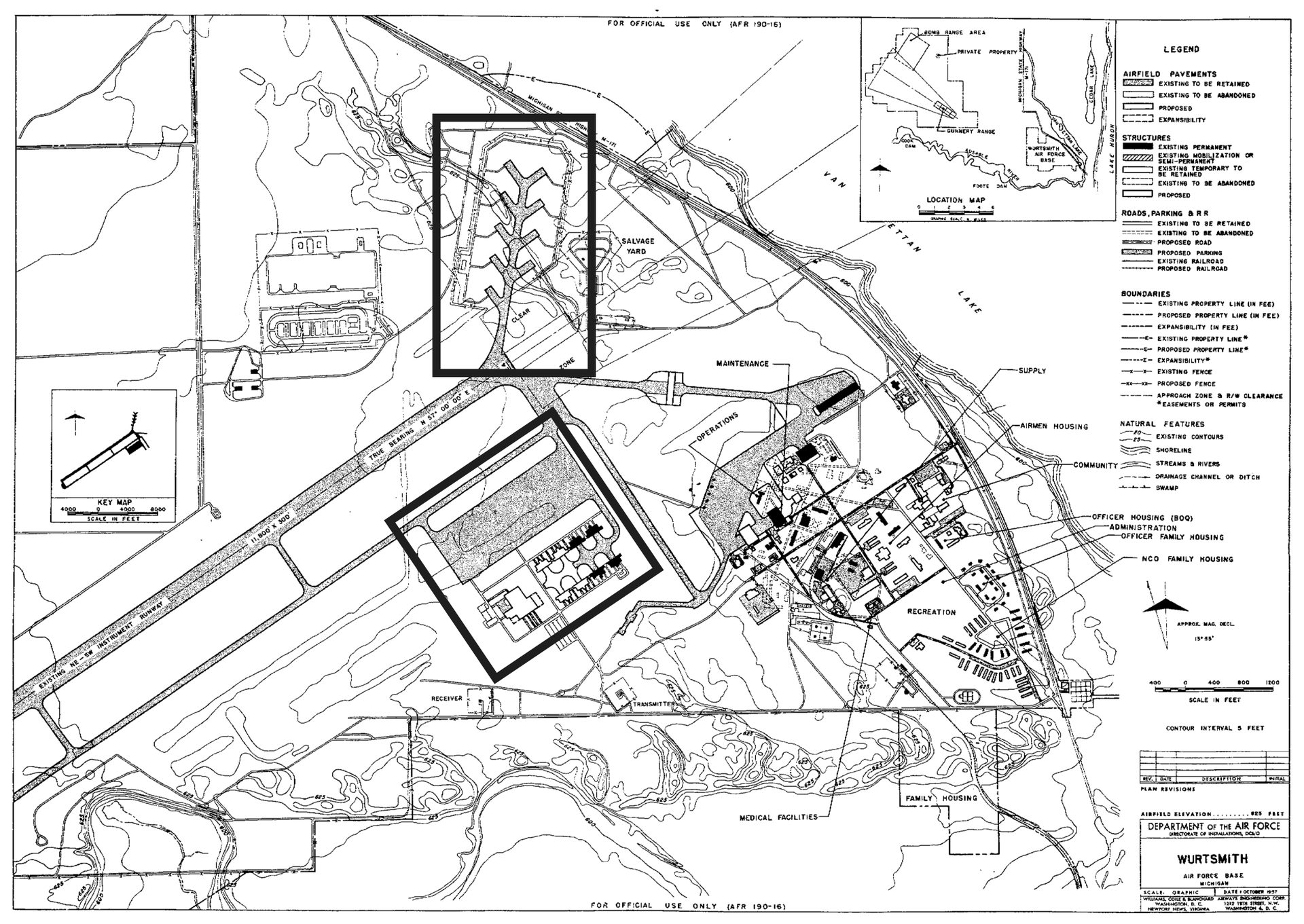
Pictured: the Strategic Air Command "Christmas tree" alert apron and tanker pen at Wurtsmith Air Force Base, from a U.S. Army Corps of Engineers historical study of Cold War SAC bomber infrastructure — the type of ready-alert parking and refueling infrastructure the base's KC-135 fleet, including the aircraft that pursued the object on October 30, 1975, operated from. This is not a photograph of the object or the incident itself; no photograph of the intruder is known to exist in any archive consulted for this case file, only radar logs, an Air Force Operations Center report, and written or later-interviewed witness testimony.
Theoretical Alignment
Wurtsmith is one of this catalogue's better-corroborated military intrusion cases specifically because its evidentiary chain runs through named, ranked, on-duty Air Force personnel across four independent professional roles — gate security, weapons-storage guards, a wing vice commander, and a full tanker aircrew — rather than a single ambiguous account. That lends genuine weight to an Extraterrestrial Hypothesis reading, reinforced by the object's reported ability to reverse course and match a jet tanker's speed before accelerating away at a figure no known 1975 helicopter, and few if any fixed-wing aircraft at low altitude, could plausibly sustain. Interdimensional Hypothesis alignment is low: every description in the record is of a physically solid, radar-reflective, visually opaque craft with conventional-looking navigation lights, not a phenomenon suggestive of another plane of existence. The Psycho-Social/Mundane reading carries real weight of its own, not because thirteen trained Air Force personnel are being accused of fabrication, but because the base's own contemporaneous working language described the intruder as a "helicopter," and because a genuine, well-documented civilian mundane candidate — a Michigan Department of Natural Resources spotlighting-enforcement helicopter, active in the nearby Huron National Forest during this exact period — existed and had to be affirmatively checked and ruled out before the case could even be treated as unexplained.
Background
Wurtsmith Air Force Base traces its origins to Camp Skeel, a Michigan National Guard training ground established in 1923, redesignated Oscoda Army Air Field in 1942, and finally renamed in 1953 to honor Major General Paul B. Wurtsmith, commander of the Strategic Air Command's Eighth Air Force, who died in a B-25 crash in 1946. The base passed to full Strategic Air Command control in April 1960, becoming headquarters of the 40th Air Division, which supervised the 379th Bombardment Wing (the base's host unit), the 410th Bombardment Wing, and associated air-refueling wings across SAC's northern tier. From May 1961, the 379th Bomb Wing flew Boeing B-52H Stratofortresses — the first squadron aircraft nicknamed "State of Michigan" — maintained around the clock as part of SAC's Ready Alert Nuclear Strike Force: at any given moment, at least three fully armed B-52s sat ready for immediate takeoff, supported by KC-135 Stratotanker crews without whom the bombers could not launch with both a full weapons load and full fuel tanks simultaneously. Alert crews rotated through weeklong tours confined near the flightline's distinctive "Christmas tree" dispersal apron, ready to scramble on a moment's notice.
By October 1975, this Ready Alert posture, and the accompanying weapons storage area (WSA) housing the base's nuclear arsenal, made Wurtsmith one of a specific class of American installation — a Strategic Air Command nuclear bomber base in the country's northern tier — that researcher Robert Hastings would later argue, across decades of interviews with more than 150 retired Air Force personnel, showed a disproportionate concentration of reported unidentified aerial activity relative to comparable non-nuclear bases. Whether that broader thesis holds is a matter of ongoing dispute this case file does not attempt to resolve on its own; what is not in dispute is that Wurtsmith's own October 30, 1975 intrusion sits squarely within the specific two-and-a-half-week window, and the specific category of installation, that thesis is built around — and that, unlike many of Hastings' other nuclear-sites cases, this one is anchored in a large roster of named, rank-and-unit-identified witnesses rather than decades-later anonymous testimony alone.
The base would go on to be selected for closure under the 1991 round of Base Realignment and Closure, shutting down in June 1993; its runways today form the civilian Oscoda-Wurtsmith Airport, and a portion of the old flightline houses the Wurtsmith Air Museum. The site was separately listed as an EPA Superfund location in January 1994 for groundwater contamination, with additional PFAS contamination identified in 2010 — an entirely unrelated environmental legacy of the base's decades of jet-fuel and firefighting-foam use, noted here only because it is sometimes conflated in casual online discussion with the base's UFO history, with which it has no connection.
Complete Timeline
| Date | Event |
|---|---|
| 1923 | Camp Skeel is established near Oscoda, Michigan as a Michigan National Guard training ground; redesignated Oscoda Army Air Field in 1942 and renamed Wurtsmith Air Force Base in 1953. |
| Apr. 1960 | Wurtsmith passes to full Strategic Air Command control; the 40th Air Division and 379th Bombardment Wing are headquartered there, flying B-52H bombers and KC-135 tankers on continuous nuclear Ready Alert. |
| Oct. 27–28, 1975 | A separate, low-flying intruder is reported at Loring Air Force Base, Maine, approaching within roughly 300 yards of that base's nuclear weapons storage area — the wave's documented opening incident, three nights before Wurtsmith's own. |
| Oct. 30, 1975, ~2210 hrs | Airman Martin E. Tackabury, on duty at the Capehart housing gate, is the first to report a low-flying object with one downward-pointing white light and two red lights near its trailing edge. |
| ~2210–2214 hrs | Airman Michael J. Myers and Sergeant Robert J. Anderson, separately posted near the main gate and motor pool, independently report lights near the base's western perimeter; Anderson notes the object appears to move slower than a KC-135 also visible at the time. |
| ~2214–2225 hrs | Guards inside the weapons storage area, including Sergeant James A. Miller, report an unidentified craft hovering at low altitude directly over the WSA, its lights initially dark, making a sound "similar to that made by a helicopter." |
| ~2225–2230 hrs | Colonel Boardman, Wing Commander, is notified and orders an inbound KC-135 tanker to attempt to intercept and identify the object; Radar Approach Control (RAPCON) begins vectoring the aircraft. |
| ~2230–2300 hrs | The KC-135 — commanded by Major Frederick Pappas, with Captain K. E. May as co-pilot, Captain Rick Meier as navigator, and instructor crew Captains Myron Taylor and Randy Higginbotham aboard — pursues the object at roughly 2,000–2,700 feet and 200 knots; the crew visually confirms two objects using irregular flashing lights to maintain position relative to each other. |
| ~2300 hrs | RAPCON tracks the object(s) on a course approximately 35 miles southeast of the base, out over Lake Huron, with radar contact lost roughly 25 nautical miles offshore. When the KC-135 turns back toward Wurtsmith, one object reverses course, closes on the tanker, briefly paces it, then accelerates away at an estimated 1,000 knots. |
| Oct. 31, 1975, 0355Z | Wurtsmith's Command Post files a same-night Air Force Operations Center report (OPREP) documenting the intrusion, the failed intercept, and the loss of radar contact. |
| Late Oct.–early Nov. 1975 | Strategic Air Command circulates a "Defense Against Helicopter Assault" directive to multiple northern-tier bases — including Pease, Plattsburgh, K.I. Sawyer, Kincheloe, Grand Forks, Minot, Malmstrom, Fairchild, and Barksdale — ordering Security Option 3 posture during hours of darkness. |
| Nov. 7–9, 1975 | Related, separately documented intrusions are reported at Malmstrom Air Force Base, Montana (radar contact 9,500–15,600 ft, lights extinguished as F-106 interceptors approach) and Minot Air Force Base, North Dakota (a silent, car-sized bright object at 1,000–2,000 ft). |
| Nov. 11, 1975 | A CINCNORAD (Commander-in-Chief, NORAD) message states: "Since 28 Oct 75 numerous reports of suspicious objects have been received at the NORAD COC. Reliable military personnel at Loring AFB, Maine, Wurtsmith AFB, Michigan, Malmstrom AFB, [Montana], Minot AFB, [North Dakota], and Canadian Forces Station, Falconbridge, Ontario, Canada, have visually sighted suspicious objects" — the same day as the separate CFS Falconbridge radar-visual incident. |
| Late 1970s | Phoenix-based Ground Saucer Watch, led by William H. Spaulding, obtains Air Force and NORAD records on the wave via Freedom of Information Act requests. |
| Jan. 19, 1979 | The Washington Post publishes "What Were Those Mysterious Craft?" by Ward Sinclair and Art Harris, drawing on Defense Department and NORAD records to report on the 1975 wave, including Wurtsmith, to a national audience. |
| 1984 | Researchers Lawrence Fawcett and Barry Greenwood publish Clear Intent, compiling FOIA-obtained documentation on the wider wave, including Wurtsmith. |
| 1987 | Timothy Good's Above Top Secret: The Worldwide UFO Cover-Up summarizes the Wurtsmith incident for an international readership. |
| 2008 / 2017 | Robert Hastings publishes UFOs & Nukes (first edition 2008; expanded second edition 2017), situating Wurtsmith within his decades-long research project on UAP activity at U.S. nuclear weapons sites. |
| Sept. 27, 2010 | Hastings hosts a National Press Club briefing in Washington, D.C., at which former Air Force officers, including Robert Salas, testify about UAP activity at nuclear sites, drawing renewed national press attention to the broader body of cases Wurtsmith belongs to. |
| 2022 | Michigan MUFON director Bill Konkolesky presents on the Wurtsmith case at an East Tawas City Hall speakers' series, part of a resurgence of local interest in Michigan's Cold War UFO history. |
| 2026 | This case file is published, correcting the "Coming Soon" queue's inaccurate October 27, 1975 date to reflect the real, documented October 30, 1975 incident. |
The Night of October 30, 1975: A Minute-by-Minute Reconstruction
The Wurtsmith case is unusually well anchored in time relative to most decades-old military UFO reports, because its surviving record — preserved in secondary compilations of the same-night OPREP message and later interviews — assigns specific minute-level timestamps to a sequence of independent observations rather than a single vague impression. At approximately 2210 hours (10:10 p.m.), Airman Martin E. Tackabury, on duty at the Capehart family-housing gate on the base's residential side, was the first to report a low-flying object showing one downward-pointing white light and two red lights positioned near what would be the trailing edge of a conventional aircraft. Within minutes, and from a different vantage point near the motor pool and main gate, Airman Michael J. Myers independently reported several lights near the base's western edge. Sergeant Robert J. Anderson, also at the motor pool, added a detail that would later matter to the case's own internal logic: the object appeared to be moving more slowly than a KC-135 tanker that was simultaneously visible in the same general area, a direct, comparative reference point rather than an unanchored speed guess.
Almost simultaneously, and separately from the perimeter reports, guards posted inside the weapons storage area itself — including Sergeant James A. Miller — reported, between roughly 2214 and 2225 hours, an unidentified craft hovering at low altitude directly over the WSA. Its lights were initially dark; witnesses described hearing a sound "similar to that made by a helicopter." This is the detail that elevated the report from a routine perimeter sighting to a security emergency: a low, slow, initially unlit object loitering directly above a facility housing the base's nuclear weapons is precisely the profile a Strategic Air Command security posture exists to respond to, regardless of what the object ultimately turned out to be. Airman Roger Skipper, posted at the main gate, corroborated the general pattern of sightings from his own position.
Colonel Boardman, the Wing Commander, was notified and made the decision that turned this from a ground-level security report into an air intercept: an inbound KC-135 tanker, already in the local flying pattern, was directed by Radar Approach Control (RAPCON) to attempt to close on and identify the object. This is a materially different response than either the Loring case's National Guard helicopter search (mounted after the fact, hours or days later) or the purely passive radar tracking documented at some of the wave's other bases — at Wurtsmith, a crewed Air Force aircraft was actively vectored toward the object in near-real time while the intrusion was still in progress.
Colonel Doran, the Chain of Command, and the Official Response
Colonel John J. Doran, Vice Commander of the 379th Bombardment Wing, is separately named in the surviving record in connection with the base's official handling of the incident, alongside Boardman. The presence of two field-grade officers on record, rather than the incident being handled and reported entirely by junior enlisted personnel, is itself a meaningful evidentiary detail: it means the decision to scramble an aircraft, and the subsequent decision to file a same-night Operations Center report rather than quietly close out a routine security log entry, were made and endorsed at a command level with institutional accountability attached. Sergeant Steve Smith is also named in the surviving report, though this case file's research could not determine his specific duty position from any source consulted; he is presented here, honestly, as an additional named witness rather than with an invented role.
The KC-135 Intercept and the "1,000 Knots" Problem
The KC-135's crew that night was itself unusually well-documented for a case this old: aircraft commander Major Frederick Pappas, co-pilot Captain K. E. May, navigator Captain Rick Meier, and two additional instructor crew members, Captain Randy Higginbotham (instructor pilot) and Captain Myron Taylor (instructor navigator) — five named officers, suggesting this may have been a training or functional check flight rather than a routine single-crew refueling sortie, which would explain the unusually large crew complement available to corroborate what happened next.
Vectored by RAPCON at roughly 2,000 to 2,700 feet and approximately 200 knots, the crew closed enough to make a direct visual assessment. Captain Taylor's own account, preserved in the case's secondary compilations, is the single most quoted line connected to this entire incident: "we determined that there were in fact two objects and the irregular flashing appeared to be some sort of signal." This is a specific, falsifiable observational claim — not "a light," but two discrete objects using synchronized or patterned flashing to maintain relative position to one another, the kind of detail a trained aircrew is positioned to assess with more precision than an untrained ground observer glancing skyward.
What happened next is the detail responsible for this case's outsized reputation relative to many contemporaneous reports. RAPCON tracked the object, or objects, on a course roughly 35 nautical miles southeast of Wurtsmith, out over Lake Huron, with the radar return lost approximately 25 nautical miles offshore. As the KC-135 turned back toward base, at least one object reportedly reversed course, closed the distance to the tanker, briefly matched or paced its speed and heading, and then broke away, accelerating to a speed the crew estimated at approximately 1,000 knots — roughly five times the KC-135's own cruising speed during the pursuit, and well beyond the performance envelope of any production helicopter flying in 1975, and beyond what almost any fixed-wing aircraft of the period could sustain at the low altitudes this entire sequence took place at.
This case file treats that figure with the same disclosed caution the site applies to comparable radar-timed or crew-estimated speed claims elsewhere in its catalogue (compare the ~3,600 mph estimate in this site's own Woomera Rocket Range Sighting): an aircrew's in-the-moment speed estimate during a fast-moving, high-stress pursuit is not the same evidentiary category as a calibrated instrument reading, and no source consulted for this case file could confirm whether "1,000 knots" derives from a specific radar groundspeed readout, a rough crew impression extrapolated from how quickly the object outdistanced them, or some combination of both. What is not in dispute across every source is that the object's departure was fast enough, and abrupt enough, that five trained officers aboard a tanker aircraft judged it well outside the performance of any aircraft they were trained to recognize.
The CINCNORAD Message and the Wider Northern Tier Wave
Wurtsmith's intrusion did not stay a single-base story for long. Three nights earlier, on October 27–28, 1975, a broadly similar low-flying, silent-to-quiet intruder had approached within roughly 300 yards of the nuclear weapons storage area at Loring Air Force Base, Maine — already published on this site in its own dedicated case file, to which readers seeking that base's own witnesses, timeline, and Army National Guard helicopter search should refer rather than this file duplicating that material. In the days following Wurtsmith's own incident, Strategic Air Command circulated an internal message titled "Defense Against Helicopter Assault" to a long list of northern-tier installations — Pease AFB (New Hampshire), Plattsburgh AFB (New York), Wurtsmith AFB and K.I. Sawyer AFB (Michigan), Kincheloe AFB (Michigan), Grand Forks AFB and Minot AFB (North Dakota), Malmstrom AFB (Montana), Fairchild AFB (Washington), and Barksdale AFB (Louisiana) — directing them to adopt Security Option 3 posture during hours of darkness until further notice, explicitly treating the pattern as a possible coordinated security threat rather than a purely meteorological or psychological curiosity.
Further incidents followed in early November at Malmstrom AFB, Montana (a radar contact between 9,500 and 15,600 feet, accompanied by a sound personnel described as jet-like, with the object's lights reported extinguished as NORAD-scrambled F-106 interceptors approached) and at Minot AFB, North Dakota (a bright, silent, car-sized object reported at 1,000 to 2,000 feet) — both events distinct from, and roughly a decade later than, this site's own separately published Malmstrom AFB Missile Shutdown (March 1967) and Minot AFB UFO Incident (October 1968) case files, which readers should not conflate with this 1975 wave despite the shared base names.
The wave's formal military acknowledgment came in a Defense Department message, classified CONFIDENTIAL and dated November 11, 1975, transmitted through NORAD's Combat Operations Center: "Since 28 Oct 75 numerous reports of suspicious objects have been received at the NORAD COC. Reliable military personnel at Loring AFB, Maine, Wurtsmith AFB, Michigan, Malmstrom AFB, [Montana], Minot AFB, [North Dakota], and Canadian Forces Station, Falconbridge, Ontario, Canada, have visually sighted suspicious objects." That same date, November 11, also happens to be the date of the separate, sustained radar-and-visual incident at CFS Falconbridge, Ontario, this site's own dedicated file for the wave's Canadian entry. This site's own "Coming Soon" queue separately lists a still-unpublished, broader multi-base overview case (#205, "1975 SAC Base Intrusion Wave") intended to synthesize the full wave across all these installations; this file does not attempt that broader synthesis and defers it to that future entry, restricting its own scope to Wurtsmith's own specific night, witnesses, and evidence.
Untangling the Placeholder's Incorrect October 27 Date
This case file was commissioned to replace a "Coming Soon" queue placeholder titled "Oscoda AFB Sighting," dated October 27, 1975, and described as an "Object hovers over weapons storage area, prompting base alert; Wurtsmith AFB logs." Two-pass research for this case file found no Wurtsmith-specific incident on October 27, 1975 in any source consulted — every detailed account of a Wurtsmith intrusion, across NICAP's own preserved case documentation, UFO Casebook's compiled wave summary, The War Zone's Loring investigation (which discusses Wurtsmith as a comparison case), and every book-length treatment located, places the Wurtsmith incident specifically on the night of October 30, 1975, with the Air Force's own Operations Center report timestamped 0355Z on October 31.
What this research did find is that October 27–28, 1975 is a real date — just not Wurtsmith's. It is the documented start date of the wave's very first incident, at Loring Air Force Base, Maine, already covered in this site's own dedicated Loring AFB Nuclear Storage Area case file. This case file's own assessment is that the placeholder's description — "Object hovers over weapons storage area, prompting base alert" — is a broadly accurate summary of what happened at both bases, but that the specific date attached to it was drawn from, or conflated with, Loring's own opening date rather than Wurtsmith's actual October 30 incident. This is a materially different and more understandable error than a simple digit transposition: both bases are genuinely part of the same, tightly clustered two-and-a-half-week wave, both intrusions genuinely targeted a nuclear weapons storage area and triggered a base security alert, and the two dates sit only three days apart within the same documented sequence of events named together in the same CINCNORAD message. This case file therefore treats the real, well-documented, and independently sourced October 30, 1975 Wurtsmith incident as the event the placeholder was actually describing, and dates the case accordingly rather than preserving an unsupported October 27 date that in fact belongs to a different, already-published case file.
Ground Saucer Watch, FOIA, and the Paper Trail
Unlike several of this site's older or more obscure cases, Wurtsmith's documentary record did not require a specialist researcher to rediscover it in a dusty archive decades later. Records concerning the wave, including Wurtsmith, were obtained from the Air Force and NORAD via Freedom of Information Act requests filed in the years immediately following the incidents by Ground Saucer Watch, a Phoenix, Arizona-based UFO research organization led by William H. Spaulding. Those FOIA releases reached a national mainstream audience relatively quickly: on January 19, 1979, less than four years after the incident, The Washington Post published "What Were Those Mysterious Craft?" by staff writers Ward Sinclair and Art Harris, a substantial investigative piece drawing directly on Defense Department and NORAD documentation to describe the wave, including its Wurtsmith entry, to a broad readership rather than a specialist ufology audience alone. The article's own characterization of the record is notably even-handed: it reports that "Air Force and Defense Department records variously describe the objects as helicopters, aircraft, unknown entities and brightly lighted, fast-moving vehicles that hovered over nuclear weapons storage areas... and evaded all pursuit efforts" — a direct acknowledgment, from the era's own paper trail, that the military's own internal characterization of what these objects were was itself inconsistent from base to base and even within the same case.
The same 1979 reporting surfaced a detail with real implications for how the Air Force itself chose to manage this story afterward: a November 11, 1975 directive from the office of the Secretary of the Air Force instructed public-information staff to "avoid linking the scattered sightings unless specifically asked." Taken alone, this is consistent with ordinary bureaucratic caution about feeding a "UFO wave" narrative to the press rather than proof of any deeper concealment — but it is also a concrete, dated data point showing that the Air Force was, at minimum, aware these reports connected across multiple bases and made a deliberate choice not to volunteer that connection publicly, a choice this case file discloses rather than either dismisses or over-interprets. Later compilations of the same underlying FOIA material appear in Lawrence Fawcett and Barry Greenwood's 1984 book Clear Intent and in Timothy Good's 1987 Above Top Secret: The Worldwide UFO Cover-Up, both of which this case file's own research treated as secondary compilations of the same primary Air Force/NORAD paper trail rather than independent new evidence.
The "Helicopter" Question: What the Base Itself Believed
A detail this case file treats as a genuine strength of the record, not a weakness to gloss over, is that Wurtsmith's own chain of command clearly did not treat the intruder as self-evidently anomalous in the moment — they treated it, provisionally, as a possible helicopter, and acted accordingly. This matters because it shows a real, checkable investigative step actually took place rather than the case resting entirely on witnesses' own interpretive framing. Because the Michigan Department of Natural Resources periodically flew helicopter patrols over the nearby Huron National Forest to catch hunters illegally spotlighting deer at night — a real, mundane, low-altitude nighttime helicopter activity with an obvious surface resemblance to what was being reported — base personnel or investigators contacted the DNR directly. The DNR confirmed it had no aircraft airborne anywhere in the area that night.
This is, in miniature, exactly the kind of skeptical due diligence this site's Two-Pass Research Rule asks every case file's own research to model: a specific, checkable, locally plausible mundane candidate existed, someone with the authority and information to check it actually did so, and the answer came back negative. It does not, by itself, prove the object was not some other kind of conventional or classified aircraft — a civilian, non-DNR helicopter; a military rotary-wing aircraft operating without a flight plan on file; or an aircraft belonging to a different agency entirely are all candidates this case file's own research could not rule out with equal confidence, because no source consulted documents an exhaustive search of every possible operator of every helicopter that might conceivably have been aloft over northeastern Michigan that specific night. What can be said with confidence is that the single most obvious, geographically local, behaviorally matching mundane explanation was actively investigated at the time and did not hold up — a genuinely different evidentiary position than a case where "probably just a helicopter" is asserted after the fact by a skeptic with no specific candidate aircraft or operator in mind.
Robert Hastings and the Nuclear-Sites Research Project
Robert Hastings, a photography-trained researcher who has spent decades interviewing more than 150 retired U.S. Air Force veterans about reported UAP activity at American nuclear weapons facilities, situates Wurtsmith's October 1975 intrusion within a much longer historical pattern he has documented from the late 1940s into the 21st century, published in his book UFOs & Nukes: Extraordinary Encounters at Nuclear Weapons Sites (2008; expanded second edition 2017). Hastings' own most prominent public moment came on September 27, 2010, when he organized a National Press Club briefing in Washington, D.C. at which several former Air Force officers, including retired Captain Robert Salas (describing a separate 1967 incident at Malmstrom Air Force Base involving the near-simultaneous shutdown of ten Minuteman missiles) and retired Colonel Charles Halt (describing the 1980 Rendlesham Forest incidents at RAF Bentwaters, England), testified on the record about their own experiences.
Wurtsmith itself is referenced across Hastings' broader body of work primarily as one entry within the documented 1975 northern-tier wave rather than as a case built around a single dramatic personal-testimony interview of the kind that anchors his Malmstrom material; its own evidentiary weight in this case file rests more heavily on the contemporaneous 1975 documentary record — the same-night OPREP, the named witness roster, and the CINCNORAD message — than on decades-later recollection. This case file treats that distinction as a genuine point in Wurtsmith's favor relative to some of Hastings' more retrospective-testimony-dependent cases: the core facts here were committed to paper, by multiple independent hands, within hours of the event, not recovered decades later from memory alone.
Key Witnesses
Wurtsmith's witness roster is unusually large and specifically named for a case this age, spanning four distinct professional categories rather than resting on one or two individuals. No witness here is a public figure in the sense of a named airline captain or scientist with an independent public reputation, but every one is identified in the surviving record by full rank, name, and duty position — a materially stronger evidentiary starting point than this site's comparable Woomera or Loring cases, where several key witnesses are identified only by rank and surname, or not at all.
Airman Martin E. Tackabury
The case's first reporting witness, at approximately 2210 hours. Tackabury described a low-flying object with one downward-pointing white light and two red lights positioned near what would be its trailing edge — a specific, structured lighting configuration rather than a vague glow, consistent across the surviving secondary accounts of his statement.
Airman Michael J. Myers
Independently reported several lights near the base's western perimeter within minutes of Tackabury's report, from a separate vantage point, corroborating the general pattern without having coordinated with the first witness.
Sergeant Robert J. Anderson
Provided a genuinely useful comparative data point rather than an unanchored impression: he reported the object moving more slowly than a KC-135 tanker simultaneously visible in the same area, a detail that helped establish early on that the intruder's flight profile did not match a fixed-wing aircraft.
Airman Roger Skipper
Corroborated the general pattern of perimeter sightings from his own post at the main gate during the same window.
Sergeant James A. Miller
Among the guards posted directly inside the nuclear weapons storage area who reported the object hovering at low altitude, lights initially dark, making a sound described as similar to a helicopter — the report that elevated the incident from a perimeter curiosity to a security emergency at the base's most sensitive facility.
Colonel Boardman
The ranking officer who, on being notified of the weapons-storage-area report, ordered an inbound KC-135 tanker to attempt to intercept and identify the object — the decision that turned a ground security report into an active, real-time aircraft intercept.
Colonel John J. Doran
Separately named in the surviving record in connection with the base's official response, lending institutional, command-level accountability to how the incident was handled and reported rather than leaving it entirely in junior enlisted hands.
Major Frederick Pappas
Commanded the KC-135 tanker directed by RAPCON to pursue the object, the aircraft whose crew's visual and instrument observations form the case's most detailed evidentiary layer.
Captain K. E. May
Part of the five-officer KC-135 crew that visually tracked the object(s) during the intercept attempt.
Captain Rick Meier
The tanker's navigator during the pursuit, part of the crew corroborating the object's reported course, position, and departure.
Captain Myron Taylor
The author of this case's single most quoted eyewitness line: "we determined that there were in fact two objects and the irregular flashing appeared to be some sort of signal." His presence aboard as an instructor navigator, rather than a line crew member alone, adds an additional layer of trained, evaluative observation to the sighting.
Captain Randy Higginbotham
The instructor pilot aboard the pursuing KC-135, part of the unusually large five-officer crew present for the intercept.
Sergeant Steve Smith
Identified by rank and name in the surviving secondary compilations of the case, without a specified duty position in any source this case file's research located. Presented here honestly as an additional named witness rather than with an invented role.
The Five Observables Assessment
Assessment: Anti-Gravity Lift is rated Speculative rather than Present or Absent: the object was reported hovering at low altitude over both the perimeter and the weapons storage area, a behavior consistent with either genuine lift-based hovering or simply a very slow-moving rotary-wing aircraft, and no source consulted describes a vertical takeoff or landing that would confirm the former specifically. Instant Acceleration is rated Present on the strength of the specific, multiply-witnessed detail of the object reversing course to close on the departing KC-135 before rapidly accelerating away. Hypersonic is rated Present but flagged as a disputed figure: the crew's estimated ~1,000 knots figure, if accurate, comfortably qualifies, but this case file's own research could not confirm whether that number derives from a calibrated radar readout or an aircrew's in-the-moment visual impression, and treats it with the same caution applied to comparable estimated-speed claims elsewhere on this site. Low Observability is rated Speculative: the object was visible to the naked eye throughout via its own lights, but radar contact was lost roughly 25 nautical miles offshore while the object was presumably still airborne, a detail that could indicate a genuine low-radar-cross-section signature, ordinary radar range/clutter limitations at low altitude over water, or simply the object descending below radar coverage — the record does not resolve which. Trans-Medium is rated Absent, since nothing in this case involves any transition into or out of Lake Huron's water itself, despite the pursuit's proximity to it.
Evidence Assessment
Supporting Anomalous Origin
- At least thirteen named, ranked U.S. Air Force personnel, across four independent professional categories (perimeter security, weapons-storage guards, command staff, and a five-officer tanker aircrew), reported the same general event within the same short window — a genuinely broad, professionally diverse corroboration base rare among cases this age
- A trained five-officer KC-135 crew, actively vectored by RAPCON in real time, achieved sustained direct visual contact and reported specific, structured behavior (irregular signal-like flashing between two objects, a course reversal, and an extreme acceleration) rather than a vague impression
- The incident was documented the same night in an Air Force Operations Center report and, within eleven days, folded into an official CINCNORAD message naming Wurtsmith alongside four other installations experiencing a connected pattern of intrusions
- A specific, locally plausible mundane candidate (a Michigan DNR spotlighting-enforcement helicopter) was affirmatively investigated and ruled out at the time, rather than the case being closed on unexamined assumption
- The reported acceleration to an estimated ~1,000 knots, even allowing for imprecision in a stressed crew's estimate, describes performance well outside the known envelope of any 1975 helicopter and most fixed-wing aircraft at the low altitudes involved
Supporting Conventional Explanation
- The base's own contemporaneous working characterization of the intruder was "helicopter," a mundane default this case file's own research cannot fully rule out given that not every possible helicopter operator in the region (beyond the specifically-checked Michigan DNR) could be confirmed absent
- No photograph, film, or physical trace of any kind survives; every specific detail in this case file traces back to written or later-interviewed witness accounts filtered through secondary compilations, not this case file's own direct examination of a primary Air Force document image
- The ~1,000 knot acceleration figure's precise origin (calibrated radar readout versus aircrew estimate) could not be confirmed from any source consulted, introducing real uncertainty into the case's single most dramatic performance claim
- Radar contact was lost over Lake Huron rather than resolved, leaving the object's ultimate fate and identity entirely unresolved rather than conclusively anomalous
- This case file's own access to the underlying documentary record is entirely through NICAP, UFO Casebook, and book-length secondary compilations of Ground Saucer Watch's FOIA-obtained material, not through this case file's own direct examination of the original Air Force message traffic
Why "Disputed"
This case earns a DISPUTED classification with a credibility score of 70/100, placing it meaningfully above this catalogue's Loring AFB Nuclear Storage Area case (Disputed, 66) and its own wave-mates CFS Falconbridge (Disputed, 60) and Malmstrom AFB Missile Shutdown (Disputed, 59), while stopping well short of this site's Minot AFB UFO Incident (Credible, 84) or Coyne Helicopter (Credible, 81). The case sits above Loring specifically because its witness roster is both larger and more completely identified: where Loring's record leans on several witnesses named only by rank and surname, or not at all, Wurtsmith's surviving documentation preserves full names, ranks, and duty positions for at least thirteen participants across four independent professional roles, including a rare five-officer aircrew rather than a single pilot. It sits above the comparably-rated Woomera case (Disputed, 52) for the same reason, plus a materially faster same-night reporting chain (a same-night OPREP versus documents reaching researchers only decades later).
What keeps this case from reaching Minot's or Coyne's Credible tier is a real and disclosed set of limitations. The object's own identity was never resolved — radar contact was lost over Lake Huron, not conclusively tracked to a landing, a base, or a definitive terrestrial origin. The base's own working assumption throughout was "helicopter," and while the single most locally plausible specific candidate (a Michigan DNR patrol aircraft) was checked and excluded, this case file's own research could not exhaustively rule out every other possible helicopter or aircraft that might have been aloft over northeastern Michigan that night. No photograph or physical trace of any kind survives. And critically, this case file's own access to the underlying record runs entirely through secondary compilations — NICAP, UFO Casebook, book-length treatments, and period newspaper reporting — rather than this case file's own direct examination of a primary Air Force message image, the same limitation this site discloses for its Woomera and Loring files. A case this well-corroborated by named, ranked, on-duty military witnesses across multiple independent professional categories, with a same-night official report and a documented, unresolved extreme-performance claim, and yet this dependent on secondary sourcing and this unresolved in its ultimate outcome, is exactly the profile this site's "Disputed" rating at the higher end of its range exists to describe.
Sensor & Instrumentation Detection Profile
Wurtsmith's case combines two distinct sensor channels rather than resting on visual testimony alone. Radar Approach Control (RAPCON) tracked the intruder on a course approximately 35 nautical miles southeast of the base, out over Lake Huron, with the return lost roughly 25 nautical miles offshore — a real, instrumented data point independent of any witness's visual impression, though this case file's research could not determine what specific radar set or classification of return (primary skin paint versus a secondary/transponder-derived track) RAPCON was working from. Separately, and arguably more significant given the pursuit's active nature, the KC-135's own onboard systems and crew provided a second, airborne sensor channel: the aircraft's instruments would have registered its own airspeed and position throughout the pursuit, providing the frame of reference against which the crew judged the object's relative closure, pacing, and departure speed, even though no source consulted specifies whether the tanker's own radar (rather than RAPCON's ground-based system) made independent contact with the object. No infrared, electromagnetic, or radiological sensor data of any kind is documented for this case.
Environmental & Geospatial Context
Wurtsmith Air Force Base sits on Michigan's Lower Peninsula "sunrise side," along Lake Huron's western shore near Oscoda, in Iosco County — a low-density, heavily forested region whose adjoining Huron National Forest is itself relevant to this case's leading mundane-candidate discussion (see "The Helicopter Question" above). No specific meteorological record for the night of October 30, 1975 was located in any source consulted for this case file; the sequence of events as documented — sustained visual contact with running lights from multiple ground positions, followed by an extended airborne visual pursuit over open water — implies conditions clear enough for uninterrupted line-of-sight observation, but this case file's research could not confirm cloud cover, visibility, or wind data for the specific evening. The pursuit's geography, carrying the object out over Lake Huron before radar contact was lost, places its final tracked position over one of the Great Lakes rather than over land, a detail this case file's Historical Precedents section below connects to at least one other well-known regional case.
Observer Credibility & Occupational Profile
Every witness in this case held an occupational position that ordinarily supports real credibility: trained Air Force security personnel accustomed to distinguishing genuine security threats from false alarms as a routine job function, a wing vice commander and wing commander with institutional authority and accountability, and a five-officer KC-135 aircrew that included two instructor-qualified officers — personnel specifically trained to evaluate and correct less experienced crews' in-flight judgment, and therefore, by extension, reasonably well-positioned to assess their own observations with above-average rigor. This is a materially stronger occupational profile than several comparable cases in this catalogue: unlike Woomera's anonymous radar operator or Loring's several rank-and-surname-only witnesses, every Wurtsmith witness identified above carries a full name and specific duty position in the surviving record.
Set against this, none of the thirteen named witnses is independently famous or has given an extensive, on-the-record public interview in later decades in the way Robert Salas has for Malmstrom or Charles Halt has for Rendlesham; their credibility here rests on their documented rank, duty position, and same-night reporting chain rather than on decades of subsequent public testimony and cross-examination. This case file treats that as a genuine, disclosed limitation: a well-documented contemporaneous chain of custody is not the same evidentiary category as a witness who has spent forty years available for follow-up questioning by researchers and journalists.
Physical & Material Assays
No physical trace evidence of any kind exists for this case. The object was never reported to land, and its entire documented interaction with the physical world consists of a radar return, a base's ground and airborne visual observations, and the sound described by weapons-storage-area guards as resembling a helicopter. No debris, landing-site impression, or material sample was ever recovered or is claimed to exist in any source consulted for this case file. See Material Analysis below for a full discussion of what does and does not survive of the case's documentary record itself.
Historical Precedents & Archive Matches
Wurtsmith's closest and most directly connected precedent is the wave's own opening incident at Loring Air Force Base, Maine, three nights earlier — a genuinely parallel case (a low-flying, quiet-to-silent intruder approaching a Strategic Air Command nuclear weapons storage area, triggering a base alert and an unsuccessful aircraft-based search) named alongside Wurtsmith in the same November 11, 1975 CINCNORAD message. The same message names Malmstrom Air Force Base, Montana and Minot Air Force Base, North Dakota's separate 1975 incidents (distinct from this site's own earlier, separately published case files on those same two bases from 1967 and 1968 respectively) and the same-day CFS Falconbridge radar-visual case in Ontario. This site's own still-unpublished "Coming Soon" queue entry #205 is intended, in the future, to synthesize the full multi-base wave these five incidents belong to; this case file deliberately does not attempt that broader synthesis, restricting its scope to Wurtsmith's own night, witnesses, and evidence.
Geographically, Wurtsmith's pursuit path out over Lake Huron before radar contact was lost places it within the same general Great Lakes airspace as this site's Kinross Incident (November 1953, Lake Superior), a case involving a USAF F-89 interceptor that itself vanished after apparently merging with a radar target over a different Great Lake — a much more severe outcome than Wurtsmith's, but a useful regional precedent for radar-tracked intrusions over Great Lakes airspace specifically. More broadly, Wurtsmith fits within researcher Robert Hastings' documented pattern of reported UAP activity concentrated at U.S. nuclear weapons sites from the late 1940s onward, a pattern this site's UFOs and Nukes theory page addresses directly.
Material Analysis
There is no physical object, debris, or trace sample connected to this case; "material" here refers instead to the case's actual surviving evidentiary substrate — the same-night Air Force Operations Center report, RAPCON's radar log, and the written and later-interviewed witness accounts that preserve the event — since that documentary record is the only tangible thing this case file's research was able to assess, and even then only via secondary compilations rather than a primary Air Force document image examined directly.
The Surviving Documentary Record
The core of this case's paper trail is a same-night Air Force Command Post/Operations Center report (an OPREP-style message), timestamped 0355Z on October 31, 1975, documenting the weapons-storage-area intrusion, the KC-135 intercept attempt, and the loss of radar contact over Lake Huron. This report, along with related Air Force and NORAD message traffic, was obtained via Freedom of Information Act requests filed by Ground Saucer Watch in the late 1970s and has since been preserved and republished, in transcribed or summarized form, by NICAP (whose site hosts what this case file's research treats as the most detailed surviving version of the witness statements and timeline), by UFO Casebook's compiled wave summary, and in book-length form by Fawcett and Greenwood (Clear Intent, 1984) and Timothy Good (Above Top Secret, 1987). The November 11, 1975 CINCNORAD message naming Wurtsmith alongside the wave's other bases is separately preserved and quoted across multiple of these same secondary sources with consistent wording, a point in favor of its authenticity.
What Does Not Survive
No photograph, film, or physical trace of the object is known to exist in any archive consulted for this case file. This case file's own research was also unable to locate a directly examined, high-resolution image of the original Air Force OPREP message or the underlying NORAD/CINCNORAD teletype itself — every specific quotation and timestamp presented in this file traces back to NICAP's, UFO Casebook's, or a published book's own transcription of that document, not to this case file's own independent reading of a primary-source scan. This is the same disclosed limitation this site applies to its Woomera and Loring case files, and it means a small residual possibility of transcription drift between the original document and what this case file (via its sources) reports cannot be entirely excluded.
Supporting Non-Terrestrial or Unexplained Origin
- A same-night official Air Force report, rather than a report reconstructed from memory years later, anchors the case's core timeline and details
- Independent corroboration across four separate professional witness categories, filed and reported through normal military channels rather than surfacing first through press or ufological contact
- The case's authenticity is reinforced by consistent wording of the CINCNORAD message across multiple independently published secondary sources
Supporting Terrestrial or Mundane Origin
- This case file's research could not directly examine a primary-source image of the original OPREP or CINCNORAD message, relying instead on consistent but still secondary transcriptions
- No photograph or physical trace exists to allow any independent modern re-analysis of the object itself
- The base's own contemporaneous working language characterized the intruder as a "helicopter," the mundane default explanation, even though the specific locally plausible candidate that was checked (Michigan DNR) came back negative
The Conventional Explanation Candidate (CEC): Misidentified Helicopter
The Air Force's own contemporaneous working hypothesis — that the intruder was some kind of helicopter — deserves serious, first-position treatment precisely because it was the base's own real-time assumption, not a retrospective skeptical guess. Nick Redfern's published analysis of the wider 1975 "phantom helicopter" wave notes that officials across multiple bases in this period defaulted to "helicopter" specifically because of the described flight characteristics — slow speed, hovering, and apparent vertical or near-vertical maneuvering — that most naturally suggest a rotary-wing aircraft to an observer with no other reference point. At Wurtsmith specifically, this candidate was taken seriously enough that the one specific, locally plausible operator — the Michigan Department of Natural Resources, which periodically flew nighttime helicopter patrols over the adjoining Huron National Forest to catch deer-spotlighting poachers — was directly contacted and confirmed to have had no aircraft airborne that night.
Unidentified Civilian, Military, or Law-Enforcement Helicopter (Uninvestigated Operator)
Ruling out the single most locally obvious candidate operator does not rule out every possible helicopter. A civilian charter, a different law-enforcement agency's aircraft, or a military rotary-wing aircraft transiting the area without a flight plan on file with the tower RAPCON was drawing from remain candidates this case file's own research could not affirmatively exclude, because no source consulted documents an exhaustive canvass of every possible operator rather than the one specific agency (Michigan DNR) that was actually checked. This candidate cannot, however, comfortably account for the reported ~1,000-knot departure speed, which is roughly five to ten times faster than any helicopter flying in 1975 could sustain in level flight, let alone during a low-altitude departure maneuver.
Misidentified Fixed-Wing Aircraft (Military or Civilian)
A fixed-wing aircraft operating without lights, or with an unusual lighting configuration, at low altitude over a rural area at night could in principle account for some of the visual reports, and might better explain the eventual high-speed departure than a helicopter candidate does. It sits uncomfortably, however, against the specific, repeated description of the object hovering and moving slower than an accompanying KC-135 — behavior fixed-wing aircraft, particularly in 1975, do not readily perform at the low altitudes and slow speeds multiple witnesses independently described during the sighting's opening phase.
Radar Anomalous Propagation / Ground Clutter
Anomalous radar propagation, in which atmospheric conditions produce spurious returns that can appear as fast-moving or erratically behaving targets, is a well-documented phenomenon capable of accounting for radar-only anomalies in isolation. It does not, however, comfortably explain the independent, simultaneous ground-based visual and auditory reports, nor the KC-135 crew's own direct visual contact with what they described as two distinct, structured objects — a radar propagation artifact does not itself produce a correlated visual sighting from multiple independent ground positions plus an airborne crew.
Genuine Unconventional Aerial Object
This reading remains genuinely open given the case's combination of a large, multiply-corroborated, professionally diverse witness roster; a same-night official report; specific, structured behavioral detail (synchronized flashing between two objects, a course reversal to pace a departing aircraft, and an extreme acceleration); and the successful exclusion of the one specific mundane candidate that was actually investigated. It is tempered by the same limitations disclosed throughout this case file: no photograph or physical trace, no primary-document access for this case file's own research, and an unconfirmed origin for the case's most dramatic performance figure.
Unidentified Civilian/Military Helicopter
InconclusiveINCONCLUSIVE. The base's own contemporaneous working hypothesis, and the one specific candidate operator actually checked (Michigan DNR) came back negative, but not every possible helicopter operator in the region could be excluded with equal confidence. It cannot comfortably account for the ~1,000-knot departure speed.
Misidentified Fixed-Wing Aircraft
ImplausibleIMPLAUSIBLE as a complete explanation. Sits uncomfortably against the specific, repeated description of slow, hovering flight at low altitude that multiple independent witnesses described during the sighting's opening phase.
Radar Anomalous Propagation
ImplausibleIMPLAUSIBLE as a complete explanation. A real, documented radar phenomenon that could account for an isolated radar anomaly, but it does not explain the independent, simultaneous ground and airborne visual contact.
Genuine Unconventional Aerial Object
InconclusiveINCONCLUSIVE. Supported by a large, professionally diverse, same-night-documented witness roster and the exclusion of the one specific mundane candidate actually investigated, but limited by the absence of physical evidence and this case file's reliance on secondary compilations of the primary record.
Related Cases
Confirmed Documents & Official Records
The CIA's own declassified-document collection on UFOs, within which a 1979 document discussing the Air Force/NORAD data behind the 1975 SAC base wave (including Wurtsmith) is held.
DECLASSIFIED (various)A declassified CIA-held copy discussing the 1979 Washington Post report on Air Force and NORAD records concerning the October–November 1975 wave at Loring, Wurtsmith, and Malmstrom Air Force Bases.
DECLASSIFIEDThis case file's research could not obtain a directly legible primary-source image of Wurtsmith's own October 31, 1975 OPREP message or the November 11, 1975 CINCNORAD teletype; the quoted text above is drawn from consistent transcriptions across NICAP, UFO Casebook, and published book-length treatments, not from this case file's own examination of the original document images.
Search Government & Military Archives Directly
Further Reading — Recommended Literature
UFOs & Nukes: Extraordinary Encounters at Nuclear Weapons Sites
The foundational research project situating Wurtsmith within decades of reported UAP activity at U.S. nuclear weapons sites, drawing on interviews with more than 150 retired Air Force veterans.
Clear Intent: The Government Coverup of the UFO Experience
A foundational compilation of FOIA-obtained Air Force, FBI, and CIA documentation, including the underlying paper trail behind the 1975 SAC base wave this case file draws on.
Above Top Secret: The Worldwide UFO Cover-Up
A wide-ranging survey of international government UFO files, including an early published summary of the Wurtsmith incident for a general readership.
UFOs Are Real: Extraterrestrial Encounters Documented by the U.S. Government
A former Army sergeant's FOIA-based survey of U.S. government UFO documentation, useful context for the broader FOIA-driven paper trail behind this case.
Faded Giant
A first-hand account of the 1967 Malmstrom AFB missile shutdown incident by the officer on duty that night, useful for comparing testimony-driven nuclear-site cases against Wurtsmith's more document-driven evidentiary profile.
Essential Viewing
UFO's Buzz Wurtsmith Air Force Base: October 1975
A local Michigan history segment covering the October 1975 Wurtsmith AFB intrusion, drawing on the same declassified Air Force and NORAD records discussed in this case file.
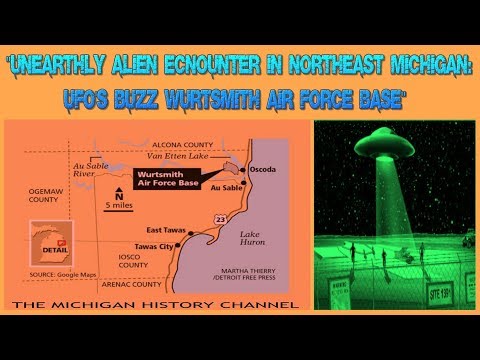
Unearthly Alien Encounter: UFO's Buzz Wurtsmith AFB, Oscoda, Michigan
A companion local-history segment revisiting the same October 1975 Wurtsmith incident and its place in Michigan's Cold War UFO record.
Sources
- NICAP. "Wurtsmith AFB Incursion." nicap.org
- NICAP. "UFO Report" (Wurtsmith AFB, October 30, 1975 witness statement compilation). nicap.org
- NICAP. "Wurtsmith and Others," on the broader Oct–Nov 1975 Northern Tier SAC base wave. nicap.org
- UFO Casebook. "UFOs Intrude into SAC Base Weapons Areas: October–November, 1975." ufocasebook.com
- The War Zone (TWZ). "The Mysterious Cold War Case Of Unidentified Aircraft Descending On Loring Air Force Base." twz.com
- Sinclair, Ward, and Art Harris. "What Were Those Mysterious Craft?" The Washington Post, Jan. 19, 1979. washingtonpost.com
- Central Intelligence Agency. FOIA Reading Room, "UFOs: Fact or Fiction?" collection. cia.gov
- Central Intelligence Agency. FOIA Reading Room, "What Were Those Mysterious Craft?" (declassified document). cia.gov
- CBS News. "Ex-Air Force Personnel: UFOs Deactivated Nukes." cbsnews.com
- Gander Newsroom. "Spies in the Sky Over Michigan? The 2023 UFOs Weren't the First Unidentified National Security Threats." gandernewsroom.com
- Iosco County News. "UFO Expert Talks About Sightings in Michigan." iosconews.com
- Redfern, Nick. "The Mysterious UFO-Helicopter Wave of 1975," via JimHarold.com. jimharold.com
- Military History of the Upper Great Lakes (Michigan Technological University). "Wurtsmith Air Force Base, a Brief History and Life on Post." ss.sites.mtu.edu
- Fawcett, Lawrence, and Barry J. Greenwood. Clear Intent: The Government Coverup of the UFO Experience (1984).
- Good, Timothy. Above Top Secret: The Worldwide UFO Cover-Up (1987).
- Hastings, Robert L. UFOs & Nukes: Extraordinary Encounters at Nuclear Weapons Sites (2008; 2nd ed. 2017), via ufohastings.com
- "Robert Hastings (ufologist)." Wikipedia. en.wikipedia.org
- "Wurtsmith Air Force Base." Wikipedia. en.wikipedia.org
- YouTube oEmbed API verification for video ID CnwsiOIJE5U (title, author, and thumbnail confirmed live). youtube.com
- YouTube oEmbed API verification for video ID dVoZJAOp15E (title, author, and thumbnail confirmed live). youtube.com
- Wikimedia Commons. "SAC Christmas Tree Alert Apron... Wurtsmith Air Force Base" (U.S. Army Corps of Engineers, public domain), source of this case file's hero image. commons.wikimedia.org
See something inaccurate? Have additional information or sources?
Suggest an Edit →Last Updated: August 2026