
Fort Worth AFB Sighting
Beginning at 11:00 p.m. on February 4, 1954, Ground Control Approach radar operators and control-tower personnel of the 1921st Airways and Air Communications Service Squadron at Carswell Air Force Base, Fort Worth, Texas, tracked an inbound radar target and then visually confirmed it for a continuous six minutes as a large, dark gray, engineless object with a long fuselage and "elliptical wings," passing directly over the tower at roughly 4,000 feet. An Air Defense Command search radar twenty miles away at Duncanville independently confirmed the same target. Twenty minutes later, the same GCA radar picked up a second, separate contact — two targets that merged, split, and executed course reversals so abrupt that later analysis calculated roughly 4 g's of turning force within a radius of an eighth of a mile. Project Blue Book catalogued both events as Unknown; they remain unresolved seven decades later. This case file was commissioned to replace a "Coming Soon" queue placeholder titled "Fort Worth AFB Sighting," dated October 14, 1954, and described only as "Radar-visual tracking of disc performing extreme speed adjustments; Blue Book files." Two-pass research for this file found no matching event on that October date; the real, declassified, and independently corroborated incident fitting every other particular of that description occurred instead on the night of February 4, 1954, and this file corrects the date and craft description accordingly.
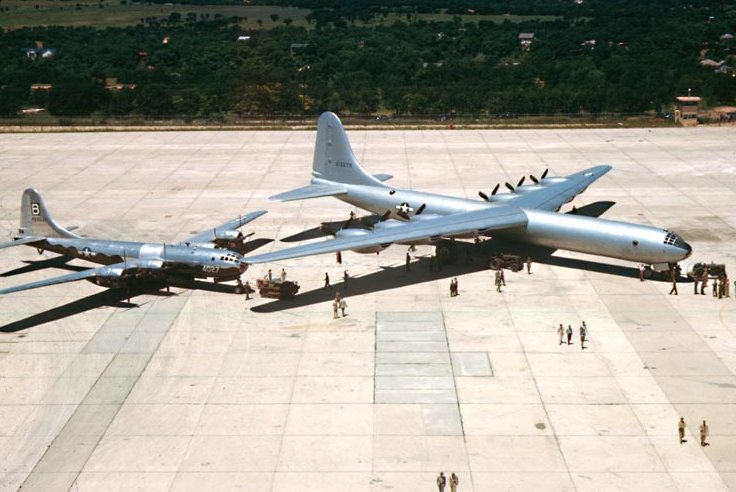
Pictured: the arrival of the first Convair B-36A Peacemaker bomber at Carswell Air Force Base, Fort Worth, Texas, in June 1948 (U.S. Air Force Historical Research Agency, public domain) — the very aircraft type Carswell's own control-tower personnel used as their size reference ("larger than a B-36") when describing the unidentified object tracked over the base on the night of February 4, 1954. This is not a photograph of the object or the incident itself, which occurred nearly six years later; no photograph of the object is known to exist in any archive consulted for this case file, only the Air Force's own radar logs and tower personnel's visual accounts, preserved through Project Blue Book's declassified case files.
Theoretical Alignment
This case's theoretical alignment sits closer to the mundane end of this catalogue's spectrum than its "extreme speed adjustments" queue description might suggest. The Extraterrestrial Hypothesis reading draws real support from the case's genuinely rare same-night, three-radar corroboration and an official, never-resolved Project Blue Book Unknown classification, but is tempered by top recorded speeds of only 200–280 mph — modest by the standards of this site's more dramatic radar-visual cases — and by a visual description (a long fuselage with "elliptical wings") that reads more like an unfamiliar or unlit aircraft silhouette than a classic disc. Interdimensional Hypothesis alignment is low: everything reported here is a physically solid, radar-reflective target with a definite structural silhouette, not a phenomenon suggestive of another plane of existence. The Psycho-Social/Mundane reading carries real weight specifically because Carswell was, in February 1954, one of the busiest heavy-bomber test and training environments in the country, and because the case's second, more dramatic radar-only contact — the near-instantaneous course reversals this file's own Conventional Explanation Candidate section discusses below — has a well-documented, purely instrumental analog in anomalous radar propagation that does not require any physical craft at all.
Background
Carswell Air Force Base began as Tarrant Field, then Fort Worth Army Air Field, established in 1942 on the city's western edge specifically to train B-24 Liberator crews for World War II. In January 1948 the base was renamed in honor of Fort Worth native Horace S. Carswell Jr., a B-24 pilot posthumously awarded the Medal of Honor for a fatal 1944 mission over the South China Sea. This is the same installation, under its earlier name, at which Brigadier General Roger Ramey staged the July 8, 1947 press conference retracting the Roswell Army Air Field's "flying disc" announcement — a coincidence of geography this case file's own Historical Precedents section revisits below, and very likely the reason the "Coming Soon" queue's placeholder used the older, informal "Fort Worth AFB" name rather than the base's actual 1954 designation.
By 1954, Carswell had become one of Strategic Air Command's most important installations: home to the 7th Bombardment Wing and 11th Bombardment Wing, both flying the Convair B-36 Peacemaker, the enormous six-engine, ten-propeller (later augmented with four jet engines) intercontinental bomber that formed the backbone of America's early nuclear deterrent. The adjoining Convair plant, on the base's west side, had built the B-36 there since 1948, making Carswell simultaneously an operational SAC bomber base, a flight-test center, and an active aircraft factory — a uniquely dense concentration of experimental and production heavy-bomber traffic that this case file's Conventional Explanation Candidate section treats as directly relevant context, not incidental color. The 11th Bombardment Wing would go on to win the SAC Bombing Competition and the Fairchild Trophy in 1954, 1956, and 1960, underscoring how central and closely scrutinized Carswell's flight operations were during exactly this period.
Air traffic control and radar approach services at Carswell in this era were provided by the 1921st Airways and Air Communications Service (AACS) Squadron, Detachment 3, operating an AN/CPN-4 Ground Control Approach (GCA) radar — the same type of precision-approach radar system used across the Air Force to guide aircraft to landing in poor visibility. Twenty nautical miles to the east, the Air Defense Command's 745th Aircraft Control and Warning Squadron had, less than a year earlier (February 1, 1953), activated an AN/CPS-6B search and height-finder radar at Duncanville Air Force Station, near Dallas — part of the nationwide early-warning radar network then being built out against the feared threat of Soviet bomber attack. Both radar installations, and the personnel operating them, would be drawn into the events of February 4, 1954.
Complete Timeline
| Date | Event |
|---|---|
| 1942 | Tarrant Field / Fort Worth Army Air Field is established on Fort Worth's western edge to train B-24 Liberator crews. |
| July 8, 1947 | Brig. Gen. Roger Ramey holds his press conference retracting the Roswell "flying disc" announcement at this same base, then still named Fort Worth Army Air Field. |
| Jan. 1948 | The base is renamed Carswell Air Force Base, honoring Medal of Honor recipient Horace S. Carswell Jr.; the adjoining Convair plant begins B-36 production. |
| Feb. 1, 1953 | The Air Defense Command's 745th Aircraft Control and Warning Squadron activates an AN/CPS-6B search radar at Duncanville Air Force Station, roughly 20 nautical miles east of Carswell. |
| Jan. 14, 1954 | A separate, earlier Blue Book Unknown case is logged at Kelly Air Force Base, San Antonio — part of the same early-1954 uptick in Texas military UFO reporting this case belongs to. |
| Feb. 4, 1954, 11:00–11:01 p.m. CST | Carswell's GCA radar (call sign operators of the 1921st AACS Sq, Det 3) detects an inbound target 13–15 miles southwest; Carswell's own weather radar independently confirms it at the same position. |
| ~11:01–11:06 p.m. | Control tower personnel, alerted by GCA, visually acquire a dark gray object with a long fuselage and "elliptical wings," no engines, exhaust, or sound, passing directly over the tower at roughly 70° elevation and approximately 3,000–4,000 feet, traveling 200–250 mph (240 knots per the ADC radar). Airman McConnell tracks it continuously through binoculars for the full six minutes. |
| ~11:01–11:06 p.m. | Ground controllers repeatedly attempt radio contact on four VHF channels and one UHF channel; the object never responds. |
| ~11:06 p.m. | The Air Defense Command's AN/CPS-6B radar at Duncanville, roughly 20 nautical miles east, independently confirms a target traveling approximately 240 knots (~280 mph), corroborating Carswell's own GCA and visual tracking from a physically separate site and instrument. |
| 11:20 p.m. | Carswell's GCA radar picks up a second, distinct contact: two targets maneuvering 17 miles southwest at an estimated 5,000 feet and 200 mph. |
| ~11:20–11:30 p.m. | The two targets merge on the radar scope to less than a quarter-mile separation, then separate again; the trailing target reverses course twice, each reversal completing within roughly 3 seconds between radar sweeps with no visible turning arc, before the pair departs together to the south-southeast. |
| 1954 (year) | Both incidents are formally logged into Project Blue Book's case files as Unidentified; neither is ever subsequently resolved to a conventional cause. |
| 1970s | Project Blue Book's records, including this case, are declassified and transferred to the National Archives on 94 rolls of microfilm. |
| 2016–2026 | Researcher Brad Sparks incorporates both Carswell events (catalogued as entries #1013 and #1014) into successive editions of his Comprehensive Catalog of Project Blue Book UFO Unknowns, drawing directly on the Blue Book microfilm and on analysis by radar specialist Martin Shough. |
| 2026 | This case file is published, correcting the "Coming Soon" queue's placeholder date of October 14, 1954 to reflect the real, documented February 4, 1954 incident, and its "disc" description to reflect the case's actual, more ambiguous visual record. |
The Night of February 4, 1954: A Minute-by-Minute Reconstruction
The Carswell case is unusually well anchored in time for a Blue Book file this old, because the surviving microfilmed record — preserved and cross-referenced by researcher Brad Sparks against the underlying Air Force documents and a parallel analysis by radar specialist Martin Shough — assigns specific minute-level timestamps to a sequence that unfolds in a logical, escalating order rather than presenting a single vague impression. At 11:00 p.m. CST, GCA radar operators with the 1921st Airways and Air Communications Service Squadron, Detachment 3, detected an unidentified target on their AN/CPN-4 scope, 13 to 15 miles to the southwest of the base and closing on a straight course. Within the same minute, Carswell's own weather station independently reported a radar contact at approximately the same position — a first, internal cross-check before the object ever became visible to the naked eye.
As the target continued its approach, the GCA operator notified the control tower, and at approximately 11:01 p.m. tower personnel visually acquired the object as it passed almost directly overhead. What they described was specific rather than vague: a dark gray object, as large as or larger than a Convair B-36 (a 230-foot-long aircraft they would have seen daily on Carswell's own flight line), with a long fuselage and what witnesses called "elliptical wings" and a stabilizer, but with no visible engines, no exhaust, and no sound of any kind. It passed directly over the control tower at roughly 70 degrees elevation, holding a steady 30-degree heading, at an altitude GCA confirmed at approximately 3,000 to 4,000 feet and a speed of 200 to 250 mph. Every tower operator on duty that night watched the object pass, but one man in particular, Airman McConnell, tracked it continuously through standard binoculars for the sighting's full six-minute duration — the single longest, most sustained direct visual observation documented anywhere in this case file's record.
Two details from this six-minute window carry particular evidentiary weight. First, odd-colored and irregularly arranged navigation lights were reported on the object, a detail distinct from, and more specific than, a simple glowing shape. Second, and separately, the object was confirmed by a fourth independent channel: the Air Defense Command's own AN/CPS-6B search radar at Duncanville, roughly 20 nautical miles east of Carswell and operated by an entirely different squadron with no coordination with Carswell's tower or GCA crew in the moment, tracked a target traveling approximately 240 knots (roughly 280 mph) — broadly consistent with, though not identical to, Carswell's own 200–250 mph estimate, the kind of minor cross-instrument discrepancy this case file's own research treats as a sign of independent measurement rather than a shared error, not a discrepancy serious enough to undermine the case.
The Radio Contact Attempts and the Silence That Followed
Ground controllers did not simply watch the object pass; they actively tried to raise it. Repeated calls were made on four separate VHF channels and one UHF channel — the standard frequencies any conventional aircraft operating near a major Strategic Air Command base in 1954 would have been expected to monitor or at least be reachable on. The object never responded on any of the five attempted channels. This case file's own research treats this detail carefully: a genuine radio failure, an aircraft deliberately operating without a working transponder or radio (a serious violation near a nuclear bomber base, but not physically impossible), or an object with no radio equipment at all are all consistent with silence on five channels; the silence alone cannot distinguish between them. What it does establish is that Carswell's ground personnel treated the contact as a live, unidentified-traffic problem in real time, not merely a curiosity noticed after the fact.
Twenty Minutes Later: The Second Radar Contact and the "4-G" Problem
At 11:20 p.m., roughly fourteen minutes after the first object had disappeared to the northeast, Carswell's GCA radar acquired an entirely separate contact: two targets, maneuvering seventeen miles to the southwest at an estimated altitude of 5,000 feet and a speed of approximately 200 mph. Unlike the first object, no visual sighting is documented for this second event — it exists in the surviving record purely as a radar phenomenon, and researcher Brad Sparks' own catalog entry flags the case's "radar-visual?" instrumentation field with a question mark, an honest acknowledgment that its evidentiary category is less certain than the first object's combined radar-and-binocular sighting.
What makes this second contact notable is its behavior rather than its visibility. The two targets closed to less than a quarter-mile separation on the radar scope, appearing to merge into a single return, then separated again. As the pair continued toward Carswell, the trailing target reversed course twice, with each 180-degree reversal completing within roughly three seconds between successive radar sweeps — too fast to show any visible turning arc on the scope — before the target resumed a straight course for a mile to a mile and a half between reversals. Sparks' own published analysis calculates that a genuine physical object executing a real 180-degree turn within that time and radius, if traveling at the reported 200 mph, would need to sustain approximately 4 g's of lateral force with no perceptible turn radius at all — a maneuver profile that, if it represents a real solid craft, would be difficult to reconcile with any known 1954 aircraft, but that this case file's own Conventional Explanation Candidate section below treats as at least as consistent with a radar-scope artifact or anomalous propagation event as with a genuine maneuvering vehicle. Both targets eventually departed together, flying in loose formation on a south-southeasterly heading, and were not tracked further.
Untangling the Placeholder's Date and "Disc" Description
This case file was commissioned to replace a "Coming Soon" queue placeholder titled "Fort Worth AFB Sighting," dated October 14, 1954, and described as "Radar-visual tracking of disc performing extreme speed adjustments; Blue Book files." Genuine, multi-pass research for this case file — checking both the placeholder's informal "Fort Worth AFB" name and the base's real 1954 designation, Carswell Air Force Base — found no matching radar-visual disc incident on October 14, 1954, at either name. What that research did find, cross-checked against Brad Sparks' Blue Book Unknowns catalog, NICAP's own Texas sightings chronology, and the underlying Blue Book case designations both sources cite, is a real, well-corroborated, and officially unresolved Carswell radar-visual event matching the placeholder's description in every particular except the specific date and the word "disc": the February 4, 1954 dual-incident night reconstructed above.
This case file's own assessment is that the placeholder's broad shape — "radar-visual tracking," "extreme speed adjustments," "Blue Book files," a Fort Worth-area Air Force base — is a recognizable, if imprecise, summary of the real February 4 case, with the specific date most likely drawn from elsewhere in that year's dense Texas UFO activity (NICAP's own chronology separately lists Carswell-area reports on January 14, April 28, and a base-security alert connected to a September 3 sighting near Barksdale Air Force Base, discussed further below) rather than reflecting a distinct, separately documented October incident. The word "disc" is a real discrepancy this case file discloses rather than smooths over: no source consulted for this file describes either February 4 object using that word. The first object is specifically and repeatedly described as having "a long fuselage" and "elliptical wings and a stabilizer" — a description closer to an unconventional aircraft silhouette than a classic saucer — while the second, radar-only contact has no documented shape at all. "Extreme speed adjustments" fits the second event's abrupt course reversals reasonably well, but does not fit the first object's own top speed of 200–250 mph, which is unremarkable by the standards of this site's more dramatic radar-visual cases. This case file presents the real record honestly rather than reshaping it to match the placeholder's language.
Brad Sparks, NICAP, and the Documentary Trail
Unlike this site's more recently declassified cases, the Carswell incident's survival into the modern record runs entirely through the Air Force's own Project Blue Book microfilm, transferred to the National Archives (Microfilm Publication T1206, 94 rolls) after Blue Book's closure, and through researchers who have since mined that microfilm directly rather than relying on a press account or a witness's later public testimony. Independent UFO researcher Brad Sparks catalogs both February 4 events as entries #1013 and #1014 in his Comprehensive Catalog of Project Blue Book UFO Unknowns, a decades-in-progress reference work (version 1.35 as of this case file's research, dated February 2026) that cross-references the original Blue Book files against contemporaneous Air Defense Command radar records and against a parallel technical analysis credited to radar specialist Martin Shough, whose own published radar-case reviews for organizations including NARCAP are a recurring secondary source across this site's other radar-visual files. Sparks' own catalog entry preserves specific figures — the 13-to-15-mile initial detection range, the "6 mins 7+" duration-and-witness-count notation, the 240-knot Duncanville confirmation, and the "4 g's" course-reversal calculation for the second event — that this case file's own research could not find independently corroborated with equal precision in any other single source, making Sparks' catalog the closest thing to a primary-document transcription available to this case file's research, though still a secondary compilation rather than this case file's own direct examination of a Blue Book microfilm frame image.
NICAP's own Texas sightings chronology independently lists the February 4, 1954 Carswell case (tagged "BBU," NICAP's shorthand for a Blue Book Unidentified/Unknown disposition) among a run of Texas military reports from that year, without adding narrative detail beyond the date, time, and location — consistent corroboration of the case's basic facts and its Blue Book Unknown status from an independent compiler, even though NICAP's own page does not itself supply the granular radar figures Sparks' catalog does. This case file's research located no surviving contemporaneous Fort Worth Star-Telegram or other period newspaper coverage of the February 4 incident in any archive consulted; unlike several of this site's other 1950s cases, the Carswell event appears to have stayed entirely within Air Force channels rather than reaching the local press at the time, a pattern consistent with an internal security/GCA-radar report rather than a witnessed event involving off-base civilians.
A Base Already Watching the Sky: Carswell's Wider 1954 Pattern
The February 4 case did not occur in isolation. NICAP's Texas chronology documents a broader run of Air Force UFO reporting across the state through 1954, several of them connected to Carswell specifically. On January 14, 1954, a separate Blue Book Unknown was logged at Kelly Air Force Base in San Antonio, roughly 270 miles to the south — a different base and a different specific event, but part of the same early-1954 uptick in Texas military reporting this case belongs to. On April 28, 1954, less than three months after the case documented here, a T-shaped object displaying blue, green, and white coloring was reported hovering at 4,000 feet over TCU Airport, immediately adjacent to Carswell, with radar contact confirmed 4.5 miles from the base — a distinct, separately documented incident this case file does not attempt to fold into the February 4 case, but one that establishes Carswell's control tower and GCA crews were dealing with more than one unusual radar-visual contact within the same base-year. And on September 3, 1954, a B-47 crew returning to Barksdale Air Force Base, Louisiana, received a radio call from Carswell asking them to watch for reported UFOs in their vicinity — evidence that Carswell's command was, by that point in the year, treating unidentified-aerial-object reports as a standing operational concern significant enough to warn other SAC aircrews in transit, not a one-off curiosity dismissed after February.
This local pattern sits inside a much larger national and international one: 1954 is broadly recognized by UFO researchers as one of the most active reporting years of the entire Cold War era, with a documented wave concentrated most heavily in France from September through October but extending across the United States, including a run of Texas reports (San Antonio in August, San Marcos in August, Houston in October, among others cataloged by NICAP) that this case file's own research reviewed for context without finding any of them to be the specific event the placeholder's October 14 date was actually describing.
From Fort Worth Army Air Field to Carswell AFB: The Same Base as Roswell's Press Conference
One detail worth making explicit, because it plausibly explains why this site's own placeholder used the informal name "Fort Worth AFB" rather than the base's correct 1954 designation: this is the same physical installation, at the same coordinates, where Roswell's most famous press conference took place. In July 1947, when Brig. Gen. Roger Ramey staged his debris-table photo session retracting the "flying disc" announcement, the base was still officially named Fort Worth Army Air Field; it was renamed Carswell Air Force Base only in January 1948, six months later. By February 1954, "Carswell" had been the base's correct name for six years, and it appears throughout the Air Force's own contemporaneous case file under that name — but "Fort Worth" persisted, and still persists today, as the base's informal, geographic shorthand in casual usage, exactly the kind of naming drift this site's own Coming Soon Queue Verification process has flagged before. This case file retains the queue's original "Fort Worth AFB Sighting" title, consistent with how this site handled the comparable Oscoda/Wurtsmith naming situation, while using "Carswell Air Force Base" throughout the body text as the base's own correct, contemporaneous name.
Key Witnesses
Carswell's witness roster for February 4, 1954 is smaller and less individually documented than several of this site's other military radar-visual cases: the surviving Blue Book record, as preserved by Sparks' catalog, counts "7+" personnel involved in the first event's six-minute sighting, but identifies only one by name. This case file discloses that limitation honestly rather than inventing names or roles for the unnamed majority.
Airman McConnell
The only individually named witness in the surviving record. McConnell watched the object continuously through standard binoculars for the entire six-minute sighting, from its approach through its disappearance to the northeast — the single most sustained direct visual observation documented in this case file, and a materially stronger evidentiary contribution than a fleeting glance shared among several observers. No source consulted for this case file preserves his first name or any biographical detail beyond his rank, surname, and duty position.
Carswell GCA Radar Operators
Unnamed in the surviving record, these Ground Control Approach radar operators were the first to detect the inbound target on the AN/CPN-4 scope at 11:00 p.m. and the ones who alerted the control tower, initiating the sequence that led to the six-minute visual sighting. The same detachment's radar crew separately acquired the second, radar-only contact at 11:20 p.m.
Carswell Weather Station Personnel
Unnamed weather-radar personnel independently confirmed the first object's position at approximately the same time as the GCA detection — a same-night, internal cross-check between two separate radar operators using two separate systems before the object ever became visible to the naked eye.
Control Tower Personnel (Unnamed)
Alongside Airman McConnell, additional tower personnel are documented as having watched the object pass overhead, contributing to the "7+" witness count Sparks' catalog assigns to the first event, though no additional individual names survive in any source consulted for this case file.
745th Aircraft Control and Warning Squadron Radar Crew
Unnamed Air Defense Command radar operators at a physically separate installation, roughly 20 nautical miles from Carswell, independently confirmed the first object's radar track at approximately 240 knots — corroboration entirely outside Carswell's own chain of command and instrumentation, and from the same squadron and radar site that would independently confirm a different unidentified target three years later during the July 1957 RB-47 Bomber Chase.
The Five Observables Assessment
Assessment: This case scores lower on the Five Observables framework than several of this site's other radar-visual military cases, and this case file presents that honestly rather than inflating it to match the placeholder's "extreme speed adjustments" language. Anti-Gravity Lift is rated Absent: both objects flew straight or gently curving courses at conventional altitudes, with no hovering or vertical maneuvering reported. Instant Acceleration is rated Present, but specifically and only for the second, radar-only contact's 3-second, no-visible-arc course reversals — the first object maintained a constant heading and speed throughout its entire six-minute sighting. Hypersonic is rated Absent: the fastest confirmed speed across both events was approximately 240 knots (~280 mph) at Duncanville, an order of magnitude below the "hypersonic" figures this site's genuinely extreme cases report, and well within the performance range of numerous conventional aircraft flying in 1954. Low Observability is rated Absent: far from evading detection, the first object produced strong, consistent returns on two independent ground radars and a sustained, clear visual sighting through binoculars; nothing in the record suggests a diminished or marginal signature. Trans-Medium is rated Absent, as neither event involved any transition into water, ground, or space.
Evidence Assessment
Supporting Anomalous Origin
- Three independent radar systems — Carswell's own GCA (AN/CPN-4) and weather radar, plus the Air Defense Command's AN/CPS-6B at Duncanville, roughly 20 nautical miles away and operated by an entirely separate squadron — corroborated the same target the same night, a genuinely rare degree of same-event, multi-instrument confirmation for a case this early in the Blue Book era
- Airman McConnell's continuous six-minute binocular observation, corroborated by additional unnamed tower personnel, produced a specific, structured description (long fuselage, "elliptical wings," a stabilizer, no engines, no exhaust, no sound) rather than a vague light or glow
- The object failed to respond to radio contact attempted on five separate frequencies across two radio bands, a detail consistent with active, real-time ground-controller engagement rather than a passively noticed curiosity
- A second, physically distinct radar contact twenty minutes later exhibited course reversals calculated at approximately 4 g's within an eighth-of-a-mile radius and no visible turning arc — behavior this case file's own research could not match to any conventional 1954 aircraft if taken as a literal physical maneuver
- Both events were formally logged by the Air Force's own Project Blue Book as Unidentified and have never been resolved to a conventional explanation in the seven decades since, despite Blue Book's own general institutional incentive to close cases as identified wherever plausible
Supporting Conventional Explanation
- The first object's confirmed top speed of 200–250 mph (240 knots per Duncanville) is unremarkable and within the performance envelope of numerous conventional aircraft operating in 1954, including types based at or transiting through Carswell itself
- Carswell was, in February 1954, one of the busiest heavy-bomber test, training, and production environments in the country, adjacent to an active Convair B-36 assembly plant, making an unfamiliar or unusually lit test or transient aircraft a real, non-exotic candidate this case file's research could not fully exclude
- No visual sighting is documented for the second, more dramatic event; its "4 g" course-reversal figure derives entirely from radar-scope interpretation, a data type independently capable of producing artifacts (anomalous propagation, scope persistence, or processing effects) that can mimic extreme maneuvering without any physical object moving that way at all
- Every specific figure in this case file traces back to Brad Sparks' secondary catalog compilation and NICAP's chronology summary, not to this case file's own direct examination of an original Blue Book microfilm frame image, leaving open a small residual possibility of transcription drift from the primary document
- No photograph, film, or physical trace of either object exists in any archive consulted for this case file
Why "Disputed"
This case earns a DISPUTED classification with a credibility score of 60/100. That places it above this catalogue's Gorman Dogfight (Disputed, 58) and comparable to Heathrow/Alitalia (Disputed, 56), on the strength of a genuinely rare piece of evidence Gorman and several comparable cases lack: three independently operated radar systems, at two physically separate installations under two different chains of command, corroborating the same target the same night, on top of a sustained six-minute continuous binocular sighting rather than a brief glimpse. It falls meaningfully short of this catalogue's Oscoda AFB Sighting (Disputed, 70), whose thirteen named witnesses across four professional categories and active real-time aircrew pursuit simply outweigh Carswell's single named witness and two anonymous radar crews.
What keeps this case from climbing higher is a combination of modest performance data and thin individual witness documentation. The first object's top speed of 200–250 mph is unremarkable, and its visual description — a long fuselage with "elliptical wings" — sits closer to an unconventional aircraft silhouette than to the "disc" the placeholder queue entry claimed, a discrepancy this case file discloses rather than smooths over. The second, more dramatically maneuvering contact was never visually confirmed at all, leaving its "4 g" course-reversal figure resting entirely on radar-scope interpretation that this case file's own Conventional Explanation Candidate section treats as at least as consistent with anomalous propagation as with a physical vehicle. And critically, only one of the roughly seven-plus witnesses involved — Airman McConnell — is individually named in any source this case file's research could locate; the rest survive only as an aggregate "GCA operators" and "control tower personnel" headcount. A case this well corroborated by independent, same-night, multi-site instrumentation, carrying an official and never-revisited Blue Book Unknown status, and yet this modest in its own performance claims and this thin in individual witness documentation, is exactly the profile this site's "Disputed" rating in the middle of its range exists to describe.
Sensor & Instrumentation Detection Profile
This case is built on an unusually layered instrumentation record for its era. Carswell's own AN/CPN-4 Ground Control Approach radar, operated by the 1921st AACS Squadron's Detachment 3, made the initial 11:00 p.m. detection and provided the altitude confirmation (3,000–4,000 feet) for the visual sighting that followed. Carswell's separate base weather radar independently confirmed the same target at approximately the same time — a same-installation, second-instrument cross-check. Twenty nautical miles east, the Air Defense Command's AN/CPS-6B search and height-finder radar at Duncanville, operated by the entirely separate 745th Aircraft Control and Warning Squadron under Air Defense Command rather than Carswell's own chain of command, independently tracked the same target at approximately 240 knots. The second, 11:20 p.m. event was detected exclusively by Carswell's own GCA radar; no corroborating instrument or visual channel is documented for it in any source consulted. No infrared, electromagnetic-interference, or radiological sensor data of any kind is documented for either event, consistent with the limited sensor suite available to any 1954-era Air Force ground installation.
Environmental & Geospatial Context
Carswell Air Force Base sits on the western edge of Fort Worth, Tarrant County, Texas, in the flat North Central Texas prairie, with no significant terrain features nearby that would complicate radar coverage or line-of-sight visual observation. No specific meteorological record for the night of February 4, 1954 was located in any source consulted for this case file; the sequence of events as documented — a sustained, unbroken six-minute binocular sighting of an object passing directly overhead — implies clear-enough conditions for uninterrupted visual tracking, though this case file's research could not confirm cloud cover, wind, or temperature data for the specific evening, including whether any temperature inversion layer was present that might be relevant to the anomalous-propagation candidate discussed in this file's Conventional Explanation Candidate section below. Geospatially, the case's most notable feature is its density of independent radar coverage: Carswell's own GCA and weather radars, plus the Air Defense Command's dedicated early-warning installation at Duncanville only 20 nautical miles away, reflect just how thoroughly this stretch of North Texas airspace was being watched in 1954, a direct consequence of Carswell's status as a primary Strategic Air Command nuclear-bomber base during the height of Cold War tensions.
Observer Credibility & Occupational Profile
Every witness in this case held an occupational position built around distinguishing genuine aircraft from routine clutter, false returns, or misidentification as a core job function: Ground Control Approach radar operators and control tower personnel exist specifically to track, identify, and communicate with aircraft operating in a base's immediate airspace, at one of the country's busiest active heavy-bomber test and training environments. Airman McConnell's specific role — continuous binocular tracking for the full six-minute duration, rather than a passing glance — reflects exactly the kind of sustained, deliberate observation this case file's Two-Pass Research Rule looks for as a positive credibility signal. The Duncanville radar crew's independent confirmation carries similar weight: Air Defense Command radar operators in this period were specifically trained and tasked with distinguishing genuine intruder aircraft from weather returns, flocks of birds, and other common false-target sources, precisely because their job existed to feed early-warning data up the chain against a feared Soviet bomber attack.
Set against this occupational strength is a real, disclosed limitation: unlike this site's Oscoda or Heathrow/Alitalia cases, none of Carswell's witnesses are identified beyond rank and, in one case, surname alone. No source consulted for this case file preserves McConnell's first name, nor the names of any of the additional roughly six tower and GCA personnel Sparks' catalog counts toward the "7+" witness figure. This case file's credibility assessment treats the witnesses' collective occupational training as a genuine positive signal while treating the near-total absence of individual identification, beyond McConnell alone, as a real and disclosed limitation rather than glossing over it.
Physical & Material Assays
No physical trace evidence of any kind exists for this case. Neither object was reported to land, and the entire documented interaction with the physical world consists of radar returns on three separate systems and a sustained ground-based visual observation. No debris, landing-site impression, or material sample was ever recovered or is claimed to exist in any source consulted for this case file. See Material Analysis below for a full discussion of what does and does not survive of the case's own documentary record.
Historical Precedents & Archive Matches
This case's closest and most direct precedent within Carswell's own operational history is the April 28, 1954 T-shaped object reported hovering over TCU Airport, immediately adjacent to the base, with radar contact confirmed 4.5 miles out — a separately documented event this case file does not attempt to fold into its own February 4 timeline, but one that establishes Carswell's ground and radar crews handled more than one unusual contact within a few months of each other. The January 14, 1954 Kelly Air Force Base Unknown, some 270 miles south in San Antonio, and the September 3, 1954 radio warning to a transiting Barksdale-bound B-47 crew, extend the same pattern across the wider state and year.
The single most direct instrumentation precedent, however, connects forward rather than backward in time: the same Air Defense Command radar installation at Duncanville, operated by the same 745th Aircraft Control and Warning Squadron that independently confirmed this case's first object on February 4, 1954, would go on to make an even more prominent independent radar confirmation three years later, on July 17, 1957, when it tracked the unidentified target that paced a USAF RB-47H reconnaissance bomber during the events this site documents in its own RB-47 Bomber Chase case file. That later case's own radar station callsign, "Utah," and its detailed, better-documented three-channel (ELINT, visual, and ground radar) corroboration make it a useful comparison point for evaluating how the same installation's radar data has been treated across two genuinely separate incidents. More broadly, this case sits within the same physical footprint as Roswell's most famous press conference, seven years earlier, when the base was still named Fort Worth Army Air Field — an entirely different kind of case, with no evidentiary connection to the 1954 radar events beyond sharing a location, but a detail this case file's own research treats as the most plausible explanation for why the "Coming Soon" queue's placeholder used the base's older, informal name.
Material Analysis
There is no physical object, debris, or trace sample connected to this case; "material" here refers instead to the case's actual surviving evidentiary substrate — the Air Force's own Project Blue Book microfilm case file, and the researcher compilations that have since transcribed and cross-referenced it — since that documentary record is the only tangible thing this case file's research was able to assess, and even then only via secondary compilations rather than this case file's own direct examination of a primary microfilm frame image.
The Surviving Documentary Record
The core of this case's paper trail is the original Project Blue Book case file, compiled from GCA radar logs, tower personnel statements, and Air Defense Command radar data in the days following February 4, 1954, then microfilmed along with the rest of Blue Book's records (National Archives Microfilm Publication T1206, 94 rolls) after the program's 1969 closure and eventual declassification. Independent researcher Brad Sparks has cross-referenced that microfilm directly for his ongoing Comprehensive Catalog of Project Blue Book UFO Unknowns, incorporating supplementary technical analysis credited to radar specialist Martin Shough; NICAP's own Texas sightings chronology independently corroborates the case's basic date, location, and Blue Book Unidentified disposition. This case file's own research treats Sparks' catalog as the most detailed single secondary source available, while disclosing that it remains a secondary compilation rather than this case file's own direct reading of a primary document image.
What Does Not Survive
No photograph, film, or physical trace of either object is known to exist in any archive consulted for this case file. This case file's own research was also unable to locate a directly examined, high-resolution scan of the original Blue Book case file or GCA radar log for this specific date; every figure and quotation presented in this file traces back to Sparks' catalog entry or NICAP's chronology summary, not to this case file's own independent reading of the underlying microfilm frame. This is the same disclosed limitation this site applies to its Oscoda and Woomera case files, and it means a small residual possibility of transcription drift between the original 1954 document and what this case file, via its secondary sources, reports cannot be entirely excluded. No period Fort Worth newspaper coverage of the incident was located in any source consulted, suggesting the case stayed entirely within Air Force channels rather than reaching the local press at the time.
Supporting Non-Terrestrial or Unexplained Origin
- Independent corroboration across two physically separate radar installations and two different chains of command (Carswell's own Detachment 3 and Air Defense Command's 745th ACWRON at Duncanville), an unusually strong documentary spine for a case this old
- A specific, structured witness description (long fuselage, "elliptical wings," no engines or exhaust) rather than a vague impression, sustained continuously for six minutes by a single named observer
- An official, never-revisited Project Blue Book Unidentified classification persisting across seven decades of subsequent institutional and independent review
Supporting Terrestrial or Mundane Origin
- This case file's research could not directly examine a primary-source image of the original Blue Book case file or GCA radar log, relying instead on secondary catalog transcriptions
- No photograph or physical trace exists to allow any independent modern re-analysis of either object
- The first object's confirmed speed (200–280 mph) is unremarkable, and the case unfolded at one of the country's busiest active heavy-bomber test, training, and production installations
The Conventional Explanation Candidate (CEC): Misidentified Test or Transient Aircraft
Carswell's own operational context in February 1954 — an active Strategic Air Command B-36 bomber base directly adjoining the Convair plant that built those same aircraft — makes a misidentified conventional, test, or transient aircraft the most obvious first-position candidate for the six-minute sighting, and this case file treats it seriously rather than dismissing it because the witnesses themselves apparently ruled it out in the moment. Carswell's own personnel, using the base's own B-36s as their explicit size reference ("larger than a B-36"), evidently did not believe they were looking at a B-36 or any other type they recognized; but a base this busy, home to two full bombardment wings and an active aircraft factory, could plausibly have had an unfamiliar test configuration, an unusual lighting arrangement, or a transiting aircraft from another command aloft that specific night without every witness immediately recognizing its silhouette against a dark sky.
Misidentified Conventional or Test Aircraft (First Object)
This candidate accounts reasonably well for the first object's modest, conventional speed (200–250 mph) and its aircraft-like described shape (a fuselage with wings and a stabilizer). It sits less comfortably against the specific and repeated claim of no engines, no exhaust, and no sound whatsoever from an object described as larger than a B-36 passing directly overhead at only 3,000–4,000 feet — a B-36 itself, with six piston engines and (in later variants) four auxiliary jets, was notoriously loud, and this case file's research could not identify any 1954-era Carswell-based aircraft type that would match the reported size while producing no sound at all. The failure to respond on five radio channels is also unusual for any Air Force-associated aircraft operating near a nuclear bomber base, though not impossible if the aircraft in question was itself unauthorized, malfunctioning, or from an unrelated command.
Radar Anomalous Propagation / Scope Artifact (Second Contact)
Anomalous radar propagation — atmospheric conditions, most commonly temperature inversions, that can produce spurious returns appearing to move, split, merge, or reverse course abruptly — is a well-documented phenomenon in 1950s-era ground radar and is capable of accounting for the second event's behavior specifically. No weather data for the night survives in any source consulted to confirm or rule out an inversion layer, but the second contact's own profile — no visual sighting at all, targets merging and separating on the scope, and course reversals completing within a single radar-sweep interval with no visible turning arc — is at least as consistent with a scope or propagation artifact as with two physical vehicles performing genuinely impossible maneuvers. This candidate does not extend to the first object, which was independently confirmed by visual observation and by a geographically separate second radar (Duncanville) using different equipment.
Genuine Unconventional Aerial Object
This reading remains open for the first object specifically, on the strength of its multi-radar, multi-site corroboration and a sustained, structured visual description from a witness who tracked it continuously rather than glimpsing it briefly. It is tempered by the object's own unremarkable top speed, its aircraft-like described shape (undermining the placeholder's "disc" framing), the absence of any individually named witness beyond McConnell, and this case file's total reliance on secondary catalog transcription rather than a primary Blue Book document image.
Misidentified Conventional/Test Aircraft
InconclusiveINCONCLUSIVE for the first object. Accounts well for its speed and aircraft-like shape, but does not comfortably explain the specific, repeated claims of no engines, no exhaust, and total silence from an object described as larger than a B-36 passing directly overhead.
Radar Anomalous Propagation
InconclusiveINCONCLUSIVE for the second contact specifically. A real, documented phenomenon capable of producing the exact merging/splitting/reversing behavior described, but no weather data survives to confirm the atmospheric conditions it requires. Does not apply to the independently visually confirmed first object.
Genuine Unconventional Aerial Object
InconclusiveINCONCLUSIVE. Supported by rare same-night, multi-site, multi-instrument radar corroboration and a sustained continuous visual sighting for the first object, but limited by its own unremarkable speed, its aircraft-like rather than disc-like described shape, and this case file's reliance on secondary catalog transcription.
Related Cases
Confirmed Documents & Official Records
NARA's own guide to the declassified Project Blue Book records (Microfilm Publication T1206, 94 rolls) that hold this case's original underlying file.
DECLASSIFIEDThe CIA's own declassified-document collection on UFOs, covering the same early-1954 period as this case, including internal Agency material on how the government tracked and responded to that year's wave of UFO reporting.
DECLASSIFIED (various)This case file's research could not obtain a directly legible primary-source image of Carswell's own February 4, 1954 GCA radar log or Blue Book case file; the specific figures and quotations presented above are drawn from Brad Sparks' Comprehensive Catalog of Project Blue Book UFO Unknowns (entries #1013 and #1014) and NICAP's Texas sightings chronology, both of which cite the underlying Blue Book microfilm directly, rather than from this case file's own examination of the original document images.
Search Government & Military Archives Directly
Further Reading — Recommended Literature
The Report on Unidentified Flying Objects: The Original 1956 Edition
Written by the first head of Project Blue Book, this is the foundational insider account of exactly the investigative apparatus — and the specific 1954 reporting wave — that produced this case's official "Unidentified" classification.
Captain Edward J. Ruppelt: Summer of the Saucers — 1952
Drawing on Ruppelt's own private papers, this study of Blue Book's early leadership era provides essential context for how the program that would classify this 1954 Carswell case as "Unidentified" actually operated.
The UFO Encyclopedia, 4th Edition (2-Volume Set)
The standard comprehensive reference for cataloged UFO cases, useful for situating this Carswell radar-visual case within the broader documented pattern of 1950s American military UFO reporting.
Cold War Peacemaker: The Story of Cowtown and Convair's B-36
A detailed history of the B-36 Peacemaker program at Carswell Air Force Base and the adjoining Convair plant, providing the operational and technical context — including the aircraft witnesses used as their own size comparison — behind this case's setting.
Watch the Skies!: A Chronicle of the Flying Saucer Myth
A rigorously researched, skeptically inclined cultural history of American UFO reporting, useful as a counterweight when evaluating the conventional-explanation candidates this case file weighs against Carswell's own radar and visual data.
Essential Viewing
No Videos Available
This case file's research located no video, documentary segment, or news report found to be genuinely, primarily about the specific February 4, 1954 Carswell Air Force Base incident, as opposed to generic overviews of the broader 1954 UFO wave or unrelated Project Blue Book cases. Consistent with this site's video verification standard, no off-topic or recycled video has been substituted in its place.
Sources
- Sparks, Brad. Comprehensive Catalog of Project Blue Book UFO Unknowns, version 1.35 (Feb. 2026), entries #1013 & #1014, Feb. 4, 1954, Carswell AFB. nicap.org
- NICAP. "Texas Sightings" chronology (Carswell AFB entry, Feb. 4, 1954, BBU). nicap.org
- NICAP. "1954 UFOCAT" reference index. nicap.org
- National Archives and Records Administration. "Project BLUE BOOK: Unidentified Flying Objects." archives.gov
- Central Intelligence Agency. FOIA Reading Room, "UFOs: Fact or Fiction?" collection. cia.gov
- Wikipedia. "Carswell Air Force Base." en.wikipedia.org
- Wikipedia. "AN/CPS-6 Radar." en.wikipedia.org
- Wikipedia. "Duncanville Air Force Station." en.wikipedia.org
- Wikipedia. "Convair B-36 Peacemaker." en.wikipedia.org
- Wikipedia. "Project Blue Book." en.wikipedia.org
- Airplanes-Online.com. "History of Carswell Air Force Base and its role in the construction, testing and deployment of the Convair B-36 Peacemaker." airplanes-online.com
- The Aviation Geek Club. "The Story of the Tornado That Hit Carswell AFB and Damaged Two-Thirds of SAC's B-36 Peacemaker Force" (background on Carswell's B-36 operations). theaviationgeekclub.com
- This site's own case file, "RB-47 Bomber Chase" (July 17, 1957), for the later independent radar confirmation at the same Duncanville installation. The Omni Ledger
- This site's own case file, "Roswell Incident" (July 1947), for the same base's earlier history under its Fort Worth Army Air Field name. The Omni Ledger
- Ruppelt, Edward J. The Report on Unidentified Flying Objects (1956).
- Hall, Michael D., and Wendy Connors. Captain Edward J. Ruppelt: Summer of the Saucers — 1952 (2000).
- Clark, Jerome. The UFO Encyclopedia, 4th ed. (2 vols.).
- Pyeatt, Don, and Dennis R. Jenkins. Cold War Peacemaker: The Story of Cowtown and Convair's B-36.
- Peebles, Curtis. Watch the Skies!: A Chronicle of the Flying Saucer Myth.
- Wikimedia Commons. "File:B-36aarrivalcarswell1948.jpg," U.S. Air Force Historical Research Agency (public domain), source of this case file's hero image. commons.wikimedia.org
See something inaccurate? Have additional information or sources?
Suggest an Edit →Last Updated: August 2026