
The Montluel Cloud-Distorting Object
At around 3:10 a.m. on May 14, 2022, a lone resident of Montluel, Ain, stepped onto his apartment balcony and, looking south, watched a dark, anthracite-grey rectangular object cross the sky from west to east in about eight seconds — silent, trailing no light and no exhaust, emerging from behind one hill and vanishing behind another at the exact same 15° elevation. He described two details GEIPAN's investigators could not explain away: the clouds behind the object visibly deformed as it passed, "comparable to the effects observed around black holes," and a faint white halo surrounded it throughout. A field investigation conducted more than a year later upgraded the case's evidentiary consistency from moderate to good, and a quantified engineering analysis — correcting for the witness's likely overestimate of the object's apparent size — concluded the real object measured at least 15 meters and moved at a minimum of 130 km/h. French air-defense radar and command-center tracking recorded no corresponding aircraft. GEIPAN's own investigator formally tested and rejected a waking dream and a negative retinal afterimage, in addition to aircraft, airship, insect swarm, and low-cloud hypotheses, before closing the case as Class D: unidentified after investigation.
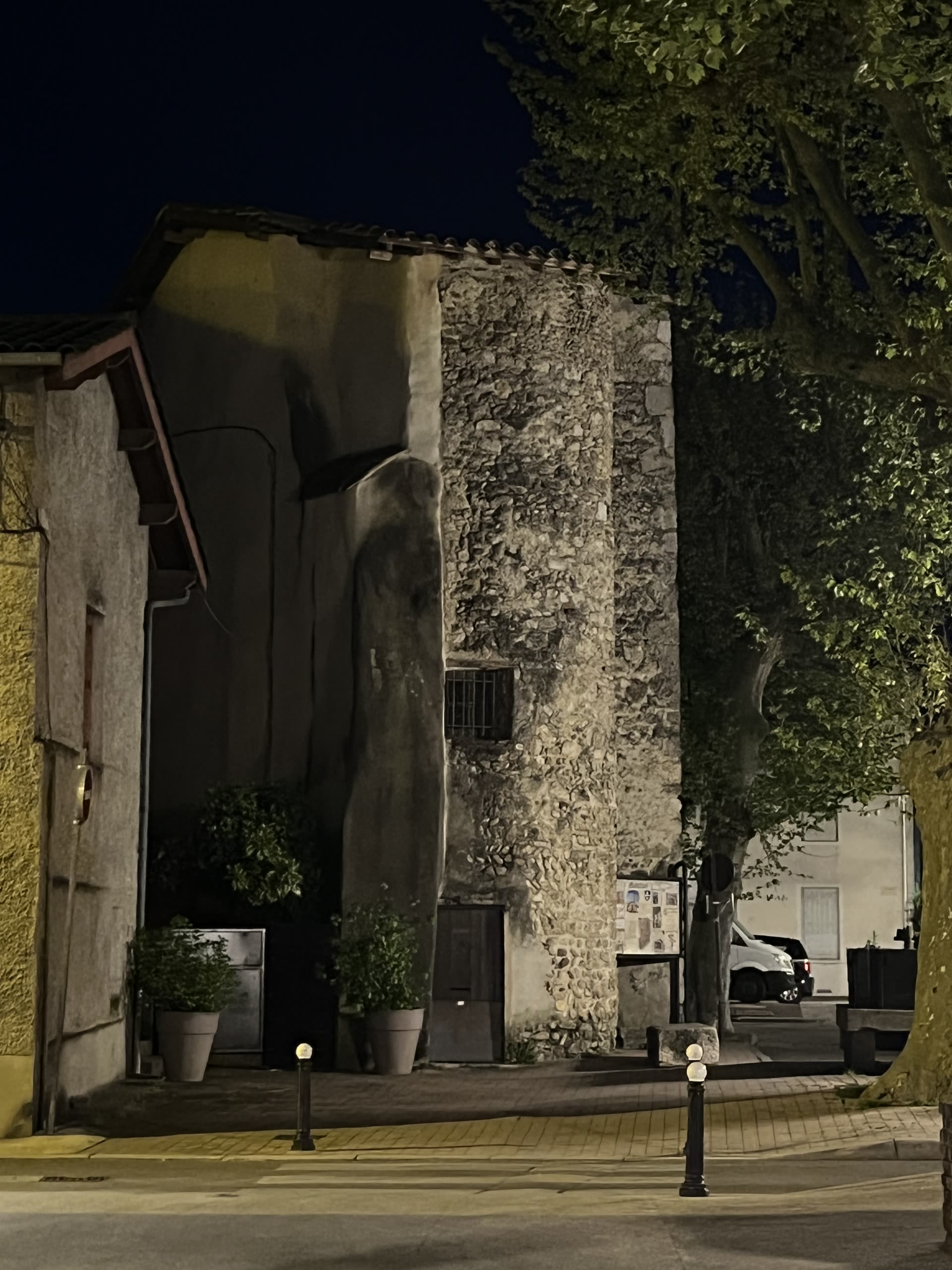
Pictured: the Tour carrée (Square Tower), a 14th-century keep in the medieval upper town of Montluel, photographed at night on April 19, 2022 — just twenty-five days before the sighting, and roughly a kilometer from the residential balcony where it occurred. This is not a photograph of the object itself; the witness had no camera and took no image of the phenomenon, and no photograph or video of it is known to exist in any form. This image is included only to ground the case's real, verifiable location, at approximately the same time of year and under similar nighttime conditions. Photo: Benoît Prieur, April 19, 2022, released CC0 (public domain) via Wikimedia Commons.
Theoretical Alignment
The case aligns more strongly with the Extraterrestrial Hypothesis than most single-witness GEIPAN files on this site, largely on the strength of one specific, hard-to-explain detail: the reported deformation of the background clouds as the object passed, a claimed physical interaction with the surrounding atmosphere that neither a mundane aircraft nor a psychological artifact straightforwardly produces. It carries real, if lower, Interdimensional alignment on the same basis — the cloud-warping detail is the kind of anomaly IDH proponents point to as evidence of localized spacetime or energy-field effects, though nothing else in the account (no missing time, no dimensional-boundary imagery) supports that framing beyond the one detail. Psycho-Social framing carries real weight specifically because GEIPAN's own investigator tested it directly: a witness with a self-reported disrupted sleep schedule, alone at night, staring at rectangular light sources for long stretches before the sighting, is exactly the kind of profile PSH explanations are built around — but GEIPAN's own field investigation examined and rejected both the specific hypnagogic and retinal-afterimage variants of that framing, for reasons detailed at length below.
Background
The Montluel sighting is unusual among the GEIPAN cases published on this site for a specific structural reason: it is one of the very few where a formal field investigation, conducted well over a year after the original report, actually increased the case's assessed evidentiary weight rather than leaving it unchanged or downgrading it. Understanding why requires understanding both the town where it happened and the specific investigative process GEIPAN applied to it.
Montluel: A Medieval Border Town on the Côtière
Montluel is a commune of roughly 6,900 residents in the Ain department, sitting on the Côtière — the low ridge of communes strung along the Rhône's eastern bank — just south of the Dombes plateau and within the greater Lyon metropolitan orbit, roughly 20 kilometers east of central Lyon. It is a genuinely old town: its upper quarter, including the 14th-century Tour carrée (Square Tower) pictured above, preserves the medieval core built under the lords of Montluel, and the Knights Templar maintained a commandery here from the 13th century, a dependency of the powerful Lyon commandery, holding buildings, vineyards, pastureland, and tithe income in the surrounding hamlets until the order's suppression in the early 14th century. The town's position on the Côtière — a natural corridor between the Dombes plateau to the north and the Rhône valley to the south and west — put it astride regional trade and military routes for centuries, and its surrounding topography of low, rolling hills is directly relevant to this case: the witness's own account places the object emerging from behind one such hill to the southwest and disappearing behind another to the southeast, at a matched 15-degree elevation on both ends.
The residential apartment from which the witness observed the object sits, by the case's own geography, within easy sight of open country to the south — consistent with a town whose built-up center remains compact and historically dense (the medieval Tour carrée sits barely a kilometer from the balcony in question) while quickly giving way to the same rolling agricultural hill country that has defined the Côtière landscape since the Middle Ages.
GEIPAN's Consistency Reassessment: A Rare Upgrade
GEIPAN's own file is explicit that the case's evidentiary rating changed over time, and explicit about why. At intake, the report's "consistance" — GEIPAN's technical term, defined in its own methodology as the quantity of reliable, objectified information gathered for a given testimony — was judged merely "moyenne" (moderate). Following a full field investigation, it was formally reassessed upward, to "bonne" (good). GEIPAN's file attributes this upgrade to a specific, named cause: "the witness's perfect cooperation with the investigators, despite the absence of visual documentation (photo or video) and the singular nature of the observation" (la parfaite collaboration du témoin avec les enquêteurs, malgré l'absence de documentation visuelle... et le caractère unique de l'observation). In practical terms: the witness completed GEIPAN's structured technical questionnaire (questionnaire technique, QT) only three days after the sighting — while his memory was still fresh — and then, when field investigators finally visited in person roughly thirteen months later, provided data detailed and internally consistent enough for those investigators to characterize as both "very complete" and "reliable" on review.
This is a meaningfully different evidentiary trajectory from most single-witness cases, where consistency ratings tend to stay fixed or drift downward as memories fade and re-interviews surface inconsistencies. Here, the combination of an unusually prompt initial written report and a witness who remained fully cooperative more than a year later produced the opposite effect — a genuine upgrade based on the quality of the data actually collected, not a lowering of GEIPAN's own evidentiary bar.
Complete Timeline
| Date | Event |
|---|---|
| 13th century | The Knights Templar establish a commandery at Montluel, a dependency of the Lyon commandery, marking the town's medieval prominence on the Côtière corridor. |
| 14th century | The Tour carrée is built in Montluel's upper town — the structure pictured as this case file's hero image. |
| December 2021 | The witness begins working a self-described shifted sleep schedule, going to bed around 6:00 a.m. and staying awake through the night, a pattern he maintains for roughly a year — a detail that becomes central to GEIPAN's later psychological hypothesis testing. |
| May 14, 2022, approx. 03:10 | Sighting begins. The witness, on his apartment balcony facing south, observes a silent, anthracite-grey rectangular object emerge from behind a hill to the southwest at 15° elevation. |
| May 14, 2022 (continuing, ~8 seconds) | The object crosses the sky on a straight, horizontal, west-to-east path. The witness notes a faint white halo around it and observes visible deformation of the clouds in its background as it passes. |
| May 14, 2022 (end of observation) | Disappearance. The object disappears behind a hill to the southeast, at the same 15° elevation at which it first appeared. |
| May 17, 2022 (approx., 3 days later) | The witness completes GEIPAN's structured technical questionnaire (Questionnaire technique) while his recollection is still fresh — a promptness GEIPAN's own file later credits as part of why the case's consistency was upgraded. |
| Approx. June 2023 (approx. 13 months later) | Field investigation. GEIPAN investigators travel to Montluel, interview the witness in person, and conduct on-site measurements, including elevation profiles of the two hills the object passed behind. |
| Following the field investigation | GEIPAN reassesses the case's consistency rating upward from "moderate" to "good." Engineering analysis, correcting for likely overestimation of apparent size, calculates a minimum real object length of 15 meters and a minimum speed of 130 km/h. A check against CAPCODA's air-defense radar and track-reconstruction data finds no matching registered aircraft. |
| Following the field investigation | The lead investigator formally tests and rejects a hypnagogic/hypnopompic waking-dream hypothesis and a negative retinal-afterimage hypothesis, alongside aircraft, airship, insect-swarm, and low-cloud hypotheses. |
| Date not further specified in public file | Final classification. GEIPAN closes the case as Class D: "phénomène non identifié après enquête" — catalogued as case ID 2022-05-51350. |
| March 3, 2026 | GEIPAN's public case page is last updated, per its own displayed metadata, using the modern CAPCODA designation for the air-defense radar/tracking check — a unit formally created in October 2024, more than two years after the sighting itself. |
Detailed Narrative
An Ordinary Night, an Unusual Schedule
The witness's own account of his circumstances that night is unusually candid, and GEIPAN's investigators treated that candor as directly relevant to the case rather than incidental background. He reported having adopted an inverted sleep rhythm for roughly a year at the time of the sighting — from December 2021 through around December 2022 — going to bed around 6:00 a.m. and remaining awake through the overnight hours, with (per his own description) no periods of dozing or drifting off during his nightly waking stretch, and a self-reported rapid adaptation to this schedule rather than ongoing sleep disruption or distress. He was, in other words, fully and reliably awake at 3:10 a.m. by his own established routine, not someone catching an unusual, disorienting late-night moment outside his normal pattern.
This detail matters because it is precisely the kind of biographical fact that could, in a lazier investigation, be seized on as an easy dismissal — "he was awake at 3 a.m., therefore he was probably not fully alert" — without the deeper, more careful reasoning GEIPAN's actual investigator applied to it, discussed at length below in the psychological-hypothesis section. The witness volunteered this information himself as part of his own effort to consider every possible explanation for what he saw, including explanations centered on his own physiological or perceptual state rather than an external object — a sign of exactly the kind of self-skeptical, non-self-serving reporting that strengthens rather than undermines a witness's overall credibility.
Eight Seconds: Emergence, Crossing, Disappearance
The sighting itself, as GEIPAN's file reconstructs it, unfolded with unusual geometric precision for an event lasting only about eight seconds. Looking south from his balcony, the witness saw the object emerge silently from behind a hill to the southwest, at 15 degrees of elevation above the horizon. It then followed what he described as a straight, horizontal path (trajectoire rectiligne horizontale) directly across his field of view, west to east, before disappearing behind a second hill to the southeast — at the identical 15-degree elevation at which it had first appeared. This start-and-end symmetry (same elevation, opposite horizon points, dead-straight path between them) is itself a specific, checkable geometric claim, one field investigators were later able to test directly by surveying the actual elevation profiles of both hills relative to the witness's balcony — work reflected in the "Profils de dénivelé" (elevation profile) document GEIPAN's file lists among its supporting technical materials.
The witness described the object's apparent size as roughly 20 by 40 millimeters held at arm's length — a specific, concrete self-measurement rather than a vague verbal estimate, and exactly the kind of quantifiable detail GEIPAN's later engineering analysis needed in order to back-calculate a real-world size and speed. Critically, GEIPAN's investigators did not simply accept this apparent-size figure at face value; their own analysis explicitly corrects for a documented, common tendency of eyewitnesses to overestimate the apparent size of an unfamiliar aerial object, a correction discussed further in the Physical & Material Assays section below.
No Lights, No Trail, But a Halo and a Warped Sky
The object itself, per the witness's account, showed no navigation lights, no strobe, and no visible exhaust trail or contrail — a plain anthracite-grey rectangular silhouette against the night sky, distinguished from a simple dark shape by two specific additional features. First, a faint white halo (un halo blanc ténu) surrounded the object throughout its passage, a detail suggesting either some form of light emission or reflection at the object's edges, atmospheric interaction with the object's surface or propulsion, or an optical effect of some kind — GEIPAN's file does not commit to a specific mechanism for the halo, treating it as an observed feature to be explained rather than explaining it directly. Second, and far more significant for the case's overall evidentiary weight, the witness reported that the clouds visible behind the object visibly deformed as it passed, a phenomenon he himself likened, in his own words, to "the effects observed around black holes" (comparable aux effets observés autour des trous noirs) — not a claim that he saw an actual black hole, but a deliberate visual analogy meant to convey a specific kind of localized, warping distortion in the background clouds' apparent shape or position, rather than the clouds simply being partially obscured or occluded by a plain opaque object passing in front of them.
This cloud-deformation detail deserves sustained attention, because GEIPAN's own file treats it as the single hardest piece of the account to explain away under any tested hypothesis, psychological or physical alike. A plain opaque object crossing in front of clouds would simply block them from view along its own silhouette — an ordinary occlusion effect with a hard, static edge that everyone has seen when any object passes between an observer and the sky. A genuine deformation of the clouds' own visible shape, as opposed to mere occlusion, implies something actively displacing, refracting, or otherwise altering how the surrounding atmosphere or its water-vapor content appeared, which is a substantially more specific and unusual claim. As detailed in the Psychological Hypotheses section below, GEIPAN's investigator explicitly cites this specific detail as the decisive reason a purely optical/perceptual explanation (the negative-retinal-afterimage hypothesis, specifically) could not account for the full sighting, since a retinal artifact exists only within the observer's own eye and cannot alter how independently real, externally present clouds appear.
The Engineering Analysis: Correcting for Apparent-Size Overestimation
What distinguishes this case's investigation most sharply from a typical single-witness report is the amount of quantified analytical work GEIPAN's field team performed on the raw data, rather than treating the witness's own size and distance impressions as final numbers to simply repeat. GEIPAN's file states plainly that eyewitnesses systematically tend to overestimate an unfamiliar aerial object's true apparent size — a well-documented perceptual tendency independent of this specific case — and that its own calculations explicitly corrected for this tendency rather than taking the witness's 20×40mm arm's-length estimate as a literal, uncorrected input.
Working from the corrected geometry — the object's elevation, its measured angular size, and the surveyed distance to the two hills it passed behind and in front of — GEIPAN's investigators calculated that the object must have measured at least 15 meters in length, and, given that it crossed the roughly matching angular distance between its emergence and disappearance points in approximately eight seconds, that it was moving at a minimum speed of roughly 130 km/h. Both figures are explicitly presented as minimums, not best estimates or midpoints — the true values could well be larger or faster, but not smaller or slower, given the surveyed geometry and the witness's own timing. This is a substantively more rigorous quantitative treatment than most single-witness UAP reports receive anywhere, and it is a direct product of the field investigation's site visit and elevation-profile survey work, conducted specifically to convert a verbal description into checkable physical numbers.
Checking the Skies: CAPCODA and the Absent Aircraft
GEIPAN's investigators did not stop at calculating what kind of object the sighting was consistent with; they explicitly checked whether any known, registered aircraft matched it. The case file states that "no aircraft was recorded by radar, nor does one appear on CAPCODA's reconstruction maps" (aucun aéronef n'a été enregistré par les radars ni n'apparaît sur les cartes de restitution du CAPCODA) — a specific, named negative instrumented check, not a general assumption that nothing was flying. CAPCODA, the Centre Air de Planification et de Conduite des Opérations et de la Défense Aérienne, is the French Air and Space Force's unified air-operations-planning and air-defense command-and-control center, based at Lyon-Mont Verdun Air Base (BA 942); it synthesizes radar and track data feeding into France's national air-defense picture, drawing on the same lineage of Centres de Détection et de Contrôle (CDCs) — including Cinq-Mars-la-Pile, discussed at length in this site's coverage of the 1978 Fauville-Évreux radar sighting — that has anchored French air-defense radar coverage for decades.
One genuinely important technical nuance is worth stating explicitly, because it is easy to miss and matters for reading the case file accurately: CAPCODA, under that exact name, was not actually created until October 10, 2024, when the French Air and Space Force merged the previously separate Centre National des Opérations Aériennes (CNOA) and Centre Air de Planification et de Conduite des Opérations (CAPCO) into a single unified command-and-control structure at Lyon-Mont Verdun — more than two years after this May 2022 sighting. GEIPAN's own case page, per its displayed metadata, was last substantively updated March 3, 2026, well after CAPCODA's creation; it is all but certain that the radar/track check performed around the time of the 2023 field investigation was actually run against whichever predecessor unit (CNOA and/or CAPCO) held that specific national air-picture data at the time, with GEIPAN's public write-up simply using the current, post-2024 institutional name for clarity when it was later published or revised. This does not change the substance of the finding — no matching aircraft track exists in the relevant French air-defense record for the time and location in question — but it is a small, honest technical correction worth making explicit rather than silently repeating an institutional name that did not yet exist at the moment of the actual sighting.
What this negative radar check actually establishes, and what it does not, is worth being precise about. It does not, on its own, prove the object was not a conventional aircraft of any kind whatsoever — small, low-flying, or otherwise marginal targets can sometimes escape radar detection or registration depending on altitude, radar cross-section, and coverage gaps. What it does establish is that no known, tracked, registered aircraft matches this sighting in France's national air-defense picture, which is precisely the finding GEIPAN's own investigator relied on when concluding that, even though the calculated size and speed figures are not physically incompatible with some kind of aircraft, "the significant difference between the object's appearance and that of a plane or drone" made an aircraft explanation unlikely on its own separate grounds — discussed further in the Conventional Explanation Candidate section below.
The Witness's Own Hypotheses
GEIPAN's file records that the witness himself, entirely independent of the agency's later formal investigation, considered and weighed a genuinely wide range of explanations for what he had seen — a level of self-directed critical reflection that GEIPAN's own write-up treats as a further, independent mark in favor of his credibility. His own list ranged from a natural phenomenon evoking "a rectangular black hole in motion," to a military aircraft equipped with stealth/concealment capabilities, to a dirigible or airship emitting heat, to a swarm of insects, to a low-lying cloud, to the possibility of what he himself termed a "mental projection." GEIPAN's file states plainly that none of these self-generated hypotheses satisfactorily explained the object's specific characteristics as he had described them — not because the witness failed to think broadly or critically about alternatives, but because, in the agency's own assessment, each candidate conflicted with some specific, well-observed detail of the sighting (the aircraft/drone candidates against the object's visual appearance; the insect-swarm and low-cloud candidates against its geometric straight-line trajectory and matched entry/exit elevations; the airship candidate against its silence and lack of any visible propulsion or structure).
The Investigator's Additional Hypotheses: Hypnagogic Dream and Negative Retinal Afterimage
Beyond the candidates the witness himself proposed, GEIPAN's lead investigator formulated and tested two further, more technical psychological hypotheses of their own initiative — a level of investigative thoroughness this site's coverage of other GEIPAN cases has not generally seen applied with this much specificity, and one that deserves detailed treatment here.
The first was a hypnagogic or hypnopompic waking-dream hypothesis — the phenomenon in which vivid, dreamlike perceptual content intrudes briefly into waking consciousness during the transitional states just before falling asleep (hypnagogia) or just after waking (hypnopompia), often triggered or made more likely by irregular or fragmented sleep patterns. Given the witness's self-reported inverted sleep schedule, this was a genuinely reasonable candidate to test rather than a reach. GEIPAN's investigator, however, judged it unlikely for a specific reason directly tied to that same biographical detail: the witness reported no periods of dozing or drifting off during his established nightly waking stretch, and had, by his own account, adapted rapidly and stably to the inverted schedule over the better part of a year. A genuine hypnagogic/hypnopompic intrusion tied to a disrupted sleep-wake transition would plausibly be expected to recur, at least occasionally, across many nights of an ongoing irregular schedule — not manifest as a single, one-time event in an otherwise stable, adapted routine. GEIPAN's file states this conclusion directly: it appears unlikely that the witness experienced this kind of waking dream, given that it would have occurred only once under conditions that persisted, largely unchanged, for roughly a year.
The second, more elaborate hypothesis was negative retinal-afterimage persistence (la persistance rétinienne négative) — the phenomenon in which prolonged exposure to a bright light source can desensitize specific retinal photoreceptors, producing a color-inverted afterimage that persists briefly in the visual field once the eyes move to a darker or differently lit scene. The investigator developed this hypothesis with real specificity: the witness, by his own account, spent much of his overnight waking hours in front of screens, facing rectangular illuminated windows, during the same period covering this sighting. A sharp transition from that sustained bright, rectangular light exposure to the comparatively dark ambient conditions of his balcony, the reasoning goes, could theoretically generate a negative afterimage that itself appeared as a dark rectangular shape — matching, at least superficially, the object's reported form.
GEIPAN's investigator reconstructed the actual timeline involved: roughly thirty seconds elapsed between the witness leaving his workstation and stepping onto the balcony where the sighting occurred — a genuinely short interval, though the file notes real uncertainty about how long a retinal afterimage of this kind can persist, since sustaining one typically requires prolonged, fixed staring with the eyes held still, a condition favored specifically when the eyes remain closed rather than open and scanning a new scene. Three separate arguments, laid out explicitly in GEIPAN's file, ultimately weighed against this hypothesis being the correct explanation. First, regularity: the witness had worked under essentially the same conditions and followed the same nightly break routine for several months without ever reporting this kind of experience before, making a single, isolated occurrence without any prior or subsequent recurrence considerably less plausible as a recurring physiological phenomenon. Second, absence in darkness: if the effect were genuinely retinal in origin, the witness should also have been expected to observe it during his walk through his own darkened apartment on the way to the balcony — a comparably dim transition — and no such observation was ever reported at that earlier point. Third, and by GEIPAN's own explicit framing the most decisive factor of all: the deformation of the background clouds, the central and most distinctive strangeness in the entire sighting, "cannot be explained by a simple optical illusion" (ne peut être expliquée par une simple illusion d'optique) — because a retinal afterimage exists entirely within the observer's own eye and visual cortex, and has no mechanism whatsoever by which it could alter how a real, external, independently present cloud formation actually appears. A perceptual artifact confined to the witness's own retina simply cannot warp real clouds; whatever the clouds' visible deformation actually was, it could not have originated inside the witness's own eye.
The Verdict: No Reduction in Strangeness
GEIPAN's own closing language for this case is worth quoting precisely, because its structure mirrors the agency's formal classification logic exactly: "no hypothesis involving a known phenomenon allows for a reduction in the perceived strangeness, and given the consistency of the testimony judged satisfactory, GEIPAN classifies this case as 'D,' namely an unidentified phenomenon after investigation" (aucune hypothèse de phénomène connu ne permettant de réduire l'étrangeté perçue... et compte tenu de la consistance du témoignage jugée satisfaisante, le GEIPAN classe ce cas en « D »). Every one of the eight distinct explanations considered — the witness's own six (black hole analogy, stealth aircraft, heat-emitting airship, insect swarm, low cloud, mental projection) plus the investigator's two additional psychological hypotheses (hypnagogic dream, negative retinal afterimage) — was tested against the account's specific details and found wanting on some specific, documented ground. This is a genuinely comprehensive elimination process, applied to a case whose evidentiary consistency the same investigation had itself upgraded from moderate to good.
Key Witnesses
The Montluel Balcony Witness (identity withheld per GEIPAN's standard anonymization practice)
An unnamed resident of Montluel, awake by his own established overnight schedule, who observed a silent, anthracite-grey rectangular object with a faint white halo cross the sky in roughly eight seconds from his apartment balcony at approximately 3:10 a.m. on May 14, 2022, noting the object's apparent deformation of the background clouds. He completed GEIPAN's structured technical questionnaire only three days later, and cooperated fully with a field investigation conducted roughly thirteen months after the sighting — a combination of promptness and sustained cooperation GEIPAN's own file credits directly for upgrading the case's consistency rating from moderate to good. He proactively proposed and weighed six of his own candidate explanations, including several that reflected critically on his own possible physiological or perceptual state, rather than defaulting to an anomalous interpretation. No second witness to the sighting was ever identified.
The Five Observables Assessment
The Five Observables framework, developed by the Pentagon's Advanced Aerospace Threat Identification Program to describe performance characteristics beyond known conventional technology, is applied here for comparative consistency across the site's case files. Unlike several other single-witness GEIPAN cases on this site, this one carries at least one observable with genuine, if limited, positive relevance.
Assessment: This case's most genuinely unusual observable is not speed or maneuverability but the reported cloud deformation, which does not map cleanly onto any of AATIP's original five categories but sits closest to a "trans-medium"-adjacent claim of direct atmospheric interaction — an object apparently altering the visible state of the air/moisture around it in a way distinct from a simple wake, contrail, or turbulence signature any conventional aircraft would produce. Low Observability carries real speculative weight given the tension between a calculated minimum real size of 15 meters (large enough that a conventional aircraft of that scale should register on air-defense radar) and CAPCODA's confirmed absence of any matching track — though, as discussed above, a true negative-detection finding for a genuinely small, low, or marginal target cannot be entirely ruled out from the public file alone. No observable here suggests the extreme kinematic performance (instant acceleration, hypersonic speed) that defines the strongest AATIP-style cases; this object's most anomalous quality is qualitative (its interaction with its surroundings) rather than kinematic (how fast or abruptly it moved).
Evidence Assessment
Supporting an Anomalous Origin
- A rare field investigation conducted more than a year after the sighting formally upgraded the case's evidentiary consistency from "moderate" to "good," rather than leaving it unchanged or downgrading it as memories faded
- A quantified engineering analysis, explicitly correcting for typical eyewitness overestimation of apparent size, calculated a minimum real object size of 15 meters and a minimum speed of 130 km/h from surveyed site geometry, not from the witness's raw impressions alone
- A specific negative radar/track check against CAPCODA's (and its predecessor units') air-defense picture found no matching registered aircraft
- GEIPAN's own investigator went beyond the witness's six self-proposed hypotheses to independently formulate and test two further, technically specific psychological hypotheses (hypnagogic dream, negative retinal afterimage), both explicitly rejected on documented grounds
- The reported deformation of background clouds is, by GEIPAN's own explicit reasoning, incompatible with a purely retinal/optical-illusion explanation, since a perceptual artifact confined to the observer's own eye cannot alter how real, external clouds appear
- The witness's own proactive, self-skeptical consideration of six separate explanations (several reflecting on his own possible physiological or perceptual state) is a strong positive credibility signal
Supporting a Conventional/Mundane or Inconclusive Origin
- This remains a single, uncorroborated witness account with no photograph, video, or any independent recording of the object itself
- The witness's calculated size/speed figures, while methodically derived, remain minimum estimates dependent on the accuracy of his own reported elevation, timing, and angular-size figures, corrected but not independently verified by any second source
- A negative radar/CAPCODA check cannot fully rule out a small, low-flying, or otherwise radar-marginal conventional aircraft, drone, or other craft that simply escaped registration
- The witness's admittedly irregular sleep schedule and screen-heavy overnight routine, even though GEIPAN's own investigator ultimately rejected both psychological hypotheses tested, remain real, documented risk factors for altered perception that a single account alone cannot fully rule out
- The reported white halo's cause is never resolved to any specific mechanism, conventional or otherwise, leaving one distinctive descriptive detail genuinely unexplained rather than explained in either direction
Why "Open"
This case is stamped Open rather than Credible, Disputed, or Debunked because GEIPAN's own investigation reached precisely that state: a genuinely elevated evidentiary rating (upgraded, not merely sustained, after real field work) combined with a comprehensive, honestly documented failure to find any conventional explanation that survives scrutiny — without ever crossing into the kind of multi-witness or physical-trace corroboration that would justify a stronger "Credible" designation. The case earns real, substantial credit: a witness whose prompt, three-day-later written report and full cooperation with a field investigation conducted more than a year afterward earned an explicit upward consistency revision from GEIPAN's own investigators; a rigorous, quantified engineering analysis converting a verbal description into checkable minimum size and speed figures; a specific, named negative radar/track check against CAPCODA's national air-defense picture; and two additional, technically sophisticated psychological hypotheses formulated and tested by the investigator's own initiative, each rejected on specific, well-reasoned grounds rather than dismissed casually.
Set against that, "Credible" would still overstate the case: it remains, in the end, a single uncorroborated witness with no photographic, video, or ground-trace evidence of any kind, and a negative radar check that — however specifically named and genuinely performed — cannot rule out every possible conventional explanation with absolute certainty. The reported cloud deformation and white halo are the case's most distinctive and least explainable details, but "distinctive and unexplained" is not the same evidentiary category as "independently confirmed." A case in which the investigating agency's own field work made the account stronger over time, while still concluding that no hypothesis it could test actually reduces the phenomenon's perceived strangeness, is exactly the state "Open" describes: genuinely, carefully investigated, and genuinely unresolved.
Sensor & Instrumentation Detection Profile
This case's only instrumented data is a negative one: a specific check against CAPCODA's (and, at the actual time of the sighting, its CNOA/CAPCO predecessor units') national air-defense radar and track-reconstruction data found no aircraft registered on the relevant bearing, time, and location. No photograph, video, audio recording, or independent optical instrument of any kind was used during the sighting itself; the witness had no camera or binoculars on his balcony. The case's one genuinely quantitative instrumented-style output — the calculated minimum size (15m) and minimum speed (130 km/h) figures — was derived not from any sensor reading of the object itself, but from a field-surveyed geometric reconstruction (the elevation profiles of the two hills involved, cross-referenced against the witness's own reported angular size, elevation, and timing, with an explicit correction applied for known eyewitness size-overestimation bias). This is a meaningfully more rigorous analytical process than a witness's raw impression alone, but it remains a reconstruction built from testimony and terrain survey, not a direct instrumented capture of the object.
Environmental & Geospatial Context
The sighting occurred at night, with clouds present in the sky — specifically the same clouds the witness described as visibly deforming during the object's passage, making the cloud cover itself an active evidentiary element of the case rather than incidental weather context. No precipitation, storm activity, or other severe weather is noted in the available file. Geographically, the object's reported path crossed the hill country immediately south of Montluel's built-up center, consistent with the Côtière's characteristic rolling topography between the Dombes plateau and the Rhône valley — terrain irregular enough to plausibly explain why the object's visibility window was bounded so precisely by two specific hills at matching elevations, but also terrain that would not obviously explain away the reported cloud-deformation effect through any simple topographic or atmospheric optical trick.
The region sits within the broader operational reach of Lyon's air-defense infrastructure: Lyon-Mont Verdun Air Base (BA 942), roughly 35 kilometers to the west, has hosted French air-defense radar and command functions since the base first became active in 1960, including a landmark 44-meter "boule" radar dome installed in 1970 and only fully decommissioned in 2024–2025 in favor of a newer Thales Ground Master 406 system — meaning the same general regional radar infrastructure that failed to register this object had, at the time of the 2022 sighting, been continuously watching this stretch of French airspace for over five decades. No meteor shower or other space-weather trigger is noted anywhere in the case's available record for mid-May 2022.
Observer Credibility & Occupational Profile
The witness's specific occupation is not stated in GEIPAN's published case summary, but the file establishes a detailed behavioral and circumstantial profile in its place: someone maintaining a stable, adapted inverted sleep schedule for the better part of a year, spending substantial overnight hours at a workstation in front of screens, who completed a detailed written report only three days after an unusual sighting and remained fully cooperative through a field investigation conducted more than a year later. GEIPAN's own investigators, after that direct, in-person interview process, characterized his data as "very complete" and reliable enough to justify the case's upward consistency revision — a professional judgment specifically informed by watching how the witness responded to detailed, structured follow-up questioning rather than a snap assessment from the written report alone.
The witness's own proactive generation of six separate candidate explanations for what he saw — including several unflattering to himself, such as a possible "mental projection" — is a genuinely strong positive credibility indicator independent of any professional credential. A witness primarily motivated to claim an extraordinary encounter typically does not spontaneously propose and take seriously the possibility that the sighting originated in his own mind. This case's structural limitation remains the same one common to nearly every single-witness UAP report: however credible the one witness is judged to be, and however much the field investigation strengthened the file's internal data, one person's account can never carry the same evidentiary weight as independent multi-witness corroboration.
Historical Precedents & Archive Matches
Comparing this case against the other GEPAN/GEIPAN-investigated French sightings already published on this site highlights exactly what makes its evidentiary profile distinctive.
Fauville-Évreux (1978) — A Positive Radar Contact, Versus Montluel's Negative One
The Fauville-Évreux radar sighting (Open, 48/100) is the most directly comparable French radar-linked case already on this site, and the comparison highlights a fundamental structural difference: Fauville-Évreux's own weak, single-station radar contact was a positive detection roughly matching the visual sighting's bearing and timing, even though it was never independently confirmed by a second radar station. Montluel's CAPCODA check produced the opposite kind of result — a clean negative, finding no registered aircraft at all. A positive-but-uncorroborated contact and a clean negative check are different categories of evidence entirely: Fauville-Évreux's radar hints at something being present on-scope, however marginally; Montluel's radar check instead helps rule out the specific hypothesis (a conventional tracked aircraft) it was tasked with testing, strengthening the case's "genuinely anomalous, not simply an unreported flight" reading without providing any positive instrumented confirmation of the object itself.
Montayral (2015) — Two Single-Witness D-Family Cases, Two Different Trajectories
The Montayral aerodrome object (Open, published alongside this case) offers the closest direct structural parallel anywhere on this site: another single-witness, no-photograph GEIPAN case, investigated with the same rigorous, hypothesis-by-hypothesis elimination methodology. The two cases diverge in an instructive way. Montayral's consistency was judged "just sufficient" to validate its D1 classification and never formally revisited upward or downward after the initial investigation; Montluel's consistency was explicitly reassessed upward, from moderate to good, following a dedicated field investigation more than a year after the fact. Montluel also carries a quantified physical-geometry analysis (the 15m/130 km/h minimums) and a named instrumented negative check (CAPCODA) that Montayral's file simply does not have, beyond its own single negative helicopter-radar check. Both cases nonetheless share the same fundamental limitation — one uncorroborated witness, no photograph or video — which is precisely why both are scored in a broadly similar range despite Montluel's stronger supporting analysis.
Trans-en-Provence (1981) and Air France Flight 3532 (1994) — The D2-Caliber Tier Montluel Does Not Reach
The Trans-en-Provence sighting (Disputed, 64/100) and Air France Flight 3532 / Capt. Duboc sighting (Disputed, 62/100) both illustrate what GEIPAN's own D2 threshold, or evidentiary weight comparable to it, actually requires: physical, laboratory-tested ground traces in the first case, and a multi-person aircrew's corroborating account paired with a near-simultaneous positive military radar track in the second. Montluel has neither a physical trace nor a second witness nor a positive instrumented contact — its evidentiary strength comes entirely from the quality and consistency of one witness's account and the rigor of GEIPAN's own subsequent analytical work on that testimony, which is real and genuine, but structurally a different, lighter-weight category of evidence than either comparison case provides.
Material Analysis
This case involves no physical or trace evidence of any kind — no landing marks, no recovered material, no soil or vegetation sample, and no biological or physiological effect on the witness beyond his own visual observation. Nothing in the account places the object anywhere near ground level or within reach of any physical investigation; the object was airborne throughout its entire eight-second visible passage, at an elevation and range that placed it well beyond the hills bounding the witness's sightline. The reported cloud deformation, while genuinely anomalous, is itself an atmospheric-visual phenomenon rather than a recoverable physical trace — there is nothing to sample, test, or physically examine after the fact, only the witness's own description of what he saw happen to the clouds in real time.
Supporting Non-Terrestrial Origin
- No physical evidence exists to test in the first place, so no terrestrial material-composition finding contradicts an anomalous interpretation either
- The reported cloud deformation, if accurately perceived, describes an active physical interaction with the surrounding atmosphere that no simple occlusion or reflection effect from an ordinary object would produce
Supporting Terrestrial Origin
- The complete absence of any physical trace is itself consistent with a purely distant aerial phenomenon that never approached the ground closely enough to leave one
- No mechanical, electromagnetic, or biological secondary effect on the witness, his apartment, or any nearby infrastructure is recorded anywhere in the file
The Conventional Explanation Candidate: Aircraft, Airship, and the Insect/Cloud Hypotheses
GEIPAN's own file treats a conventional aircraft or drone as a genuinely serious candidate, in a way distinct from how it dismisses the more clearly implausible alternatives. The calculated minimum figures — 15 meters, 130 km/h — are not physically incompatible with a real, if unusual, aircraft or large drone. What makes GEIPAN's own investigators judge this hypothesis unlikely, despite that numerical compatibility, is a separate and more qualitative objection: "the significant difference between the object's appearance and that of a plane or drone" (l'importante différence entre l'apparence du PAN et celle d'un avion ou d'un drone). A real aircraft of that scale would ordinarily present recognizable structural features — wings, a fuselage, visible control surfaces, or, at minimum, some navigation lighting required under standard aviation regulations for night flight — none of which the witness reported. Compounding this, the specific negative CAPCODA/radar check found no registered aircraft matching the sighting's profile at all.
Stealth Military Aircraft
The witness's own proposed hypothesis of a stealth-capable military aircraft deserves separate treatment from a generic aircraft candidate, since stealth aircraft are specifically designed to minimize radar cross-section and could, in principle, explain the negative CAPCODA finding differently than an ordinary aircraft would. Even so, this candidate faces the same appearance-mismatch objection as any other aircraft hypothesis, and known operational stealth aircraft (the profile most publicly documented ones present) do not match a plain rectangular silhouette with a visible halo and no lighting; nor does it explain the reported cloud deformation through any established stealth-technology mechanism.
Heat-Emitting Airship or Dirigible
An airship or dirigible, potentially with a heat source contributing to the reported halo, is a physically coherent candidate for a large, slow-moving, silent object — airships genuinely can be quiet and can appear rectangular or blimp-like in silhouette under certain lighting and viewing angles. However, this candidate does not explain the object's specific matched-elevation, straight-line crossing between two named hills in only eight seconds, a flight profile faster and more geometrically precise than typical airship operations, nor does it offer any mechanism for the cloud deformation.
Insect Swarm and Low Cloud
Both candidates, while worth taking seriously as the kind of mundane explanation that genuinely does account for some UAP reports elsewhere, conflict directly with this sighting's specific reported geometry: a swarm of insects or a low cloud formation would not present the sharply defined rectangular silhouette, the precisely matched 15-degree entry and exit elevations at two distinct, named hills, or the steady, undeviating straight-line crossing the witness described. Neither hypothesis offers any mechanism for the reported deformation of the (separate) background clouds, since the candidate object in each case would itself simply be indistinguishable from, or a part of, the cloud layer rather than something visibly warping it from in front.
Conventional Aircraft / Drone
InconclusiveCalculated size/speed figures are not physically incompatible with an aircraft, but GEIPAN's own investigators judged this unlikely given the significant mismatch between the reported appearance and any known plane or drone silhouette, compounded by a specific negative CAPCODA radar/track check.
Stealth Military Aircraft
ImplausibleCould theoretically explain the negative radar finding, but does not match known stealth-aircraft silhouettes, offers no mechanism for the reported halo or cloud deformation, and was not corroborated by any military source.
Heat-Emitting Airship / Dirigible
ImplausiblePhysically coherent for a large, slow, silent object, but does not match the sighting's fast, geometrically precise eight-second crossing between two specific hills, and offers no mechanism for the cloud deformation.
Insect Swarm
ImplausibleConflicts with the sharply defined rectangular silhouette, the matched 15° entry/exit elevations, and the steady straight-line trajectory; offers no mechanism for a separate cloud-deformation effect.
Low Cloud Formation
ImplausibleDoes not match the object's defined edges and precise geometric crossing, and cannot account for a distinct deformation effect in the separate clouds visible behind it.
Hypnagogic/Hypnopompic Waking Dream
ImplausibleExplicitly tested and rejected by GEIPAN's investigator: the witness's inverted sleep schedule was already stable and adapted, with no reported dozing during his nightly waking hours, making a single, non-recurring episode unlikely under otherwise unchanged conditions sustained for roughly a year.
Negative Retinal Afterimage
ImplausibleExplicitly tested and rejected: the witness never reported the effect during his many prior, similarly-timed breaks, never observed it during his darker walk to the balcony, and — most decisively — a retinal artifact confined to the witness's own eye cannot explain the reported deformation of real, external clouds.
Related Cases
Confirmed Documents & Official Records
The official French government investigation summary: witness account, the field-investigation consistency upgrade, the quantified size/speed calculation, the CAPCODA radar check, and the two rejected psychological hypotheses. Includes downloadable investigation report, elevation-profile survey, witness reconstitution, and technical questionnaire documents.
GEIPAN's own published definitions for classifications A, B, C, D, D1, and D2, clarifying why this case's single-witness, no-photo profile placed it in the D (rather than D2) tier despite its upgraded consistency rating.
Reporting on the French Air and Space Force's October 10, 2024 creation of CAPCODA from the merger of CNOA and CAPCO — the institutional context needed to correctly read GEIPAN's own use of the CAPCODA name in a case file describing a 2022 sighting.
Further Reading — Recommended Literature
Passport to Magonia
Vallée's foundational study of anomalous aerial phenomena and folklore, useful background for a case whose most distinctive feature — a physical-seeming interaction with the surrounding atmosphere — sits outside the more familiar "craft with lights" reporting pattern.
Why People Believe Weird Things: Pseudoscience, Superstition, and Other Confusions of Our Time
A skeptical framework for evaluating exactly the kind of psychological hypotheses (hypnagogic states, perceptual artifacts) GEIPAN's own investigator tested and ultimately rejected in this case.
Hallucinations
Sacks's clinical survey of hallucination, afterimage, and altered-perception phenomena directly informs how to weigh — and, in this case, why GEIPAN's investigator ultimately rejected — the negative retinal-afterimage hypothesis tested against the witness's account.
The Close Encounters Man: How One Man Made the World Believe in UFOs
A biography of J. Allen Hynek documenting the emergence of rigorous, multi-hypothesis case investigation methodology, the same elimination-based approach reflected in GEIPAN's handling of this case's eight tested explanations.
Clear Intent: The Government Coverup of the UFO Experience
A foundational survey of government radar and military UFO case files, useful comparative context for weighing what a negative air-defense radar/track check like CAPCODA's actually does and does not establish.
Essential Viewing
Sources
- GEIPAN (CNES), "MONTLUEL (01) 14.05.2022", Case 2022-05-51350 — official case summary
- GEIPAN (CNES), official case archive & public portal — geipan.fr
- GEIPAN (CNES), Glossaire du GEIPAN — official classification definitions, A/B/C/D/D1/D2
- GEIPAN (CNES), "La méthodologie de classification au GEIPAN" — consistency and strangeness evaluation criteria
- GEIPAN (CNES), "Mission, méthodes et résultats" — investigative mandate and field-investigation process
- Zone Militaire / Opex360, "L'armée de l'Air crée une nouvelle unité dédiée à la planification et à la conduite des opérations aériennes" — CAPCODA's October 2024 creation from CNOA/CAPCO merger
- Ministère des Armées, "30 ans d'interventions aériennes rapides et efficaces pour le CDAOA" — French air-defense command structure
- Wikipedia (English), "French air defence radar systems" — CDC network overview
- Wikipédia (français), "Base aérienne 942 Lyon-Mont Verdun" — base history, CNOA/CAPCO functions, 1970 "boule" radar and 2024–2025 decommissioning
- Le Bonbon Lyon, "Ce célèbre monument bien connu des Lyonnais depuis 1970 va totalement disparaître" — Mont Verdun "boule" radar decommissioning, replacement by Thales Ground Master 406
- Wikipedia (English), "Montluel" — commune geography, population, Côtière region
- Ville de Montluel, "Histoire et patrimoine" — medieval town history, Tour carrée, Templar commandery
- Société d'Emulation de l'Ain, "Les Templiers dans l'Ain" — Templar commandery history in the Ain department
- This site, case-files/fauville-evreux-radar-sighting.html — comparative GEPAN/GEIPAN radar-visual case
- This site, case-files/montayral-aerodrome-object.html — comparative single-witness GEIPAN D-family case
- This site, case-files/trans-en-provence-1981.html — comparative GEPAN physical-evidence case
- This site, case-files/air-france-flight-3532-duboc-sighting.html — comparative French radar-visual case
- Wikimedia Commons, File: Tour carrée de Montluel de nuit en avril 2022.jpg, photo by Benoît Prieur (April 19, 2022), CC0 — licensing and attribution
- YouTube (Ouest-France), "Sciences : les enquêteurs du Geipan traquent les ovnis dans le ciel français" — oEmbed-verified video, general GEIPAN institutional coverage, 2022
- This site, key-figures.html, entry on Claude Poher — GEPAN founding and early institutional history
- This site, key-figures.html, entry on Jean-Jacques Velasco — SEPRA leadership and methodology evolution
- This site, locations/index.html, entry on Toulouse — CNES/GEPAN/SEPRA/GEIPAN institutional headquarters
See something inaccurate? Have additional information or sources?
Suggest an Edit →Last Updated: August 2026