
The Sainte-Foy-de-Peyrolières Five-Phase Sighting
At around 11:30 p.m. on July 8, 2018, a single witness in Sainte-Foy-de-Peyrolières, a small commune roughly 36 kilometers southwest of Toulouse, watched an aerial sequence unfold in the night sky that GEIPAN's own investigators would later describe as one of the most structurally detailed single-witness accounts in their archive. In only about twenty seconds, spread across five distinct phases, five or six intensely luminous points appeared and cascaded downward before dimming; four of them re-formed into an aligned row across a dark, orange-tinted rectangular shape; the shape's motion pivoted from vertical to horizontal as it morphed into a triangle and gathered speed; it then underwent a burst of silent, trail-less acceleration the witness described as the strangest moment of the entire event; and finally slowed, reverted to a rectangle, and faded into the night. No photograph or video exists — the witness had no camera to hand and the event was over before one could have helped — and a second person present that evening saw nothing at all, the sequence having unfolded too quickly for them to register it. Two months later the witness completed GEIPAN's structured technical questionnaire in extensive detail, and a subsequent field investigation, including a site reconstruction and a formal cognitive interview, judged the account's consistency "good" despite the total absence of visual documentation. GEIPAN tested seven separate hypotheses and convened its own expert committee twice on this case — consulting it not once but a second time — before concluding that no known phenomenon reduced the sighting's underlying strangeness, and classifying it Class D: a phenomenon of unexplained nature and origin.
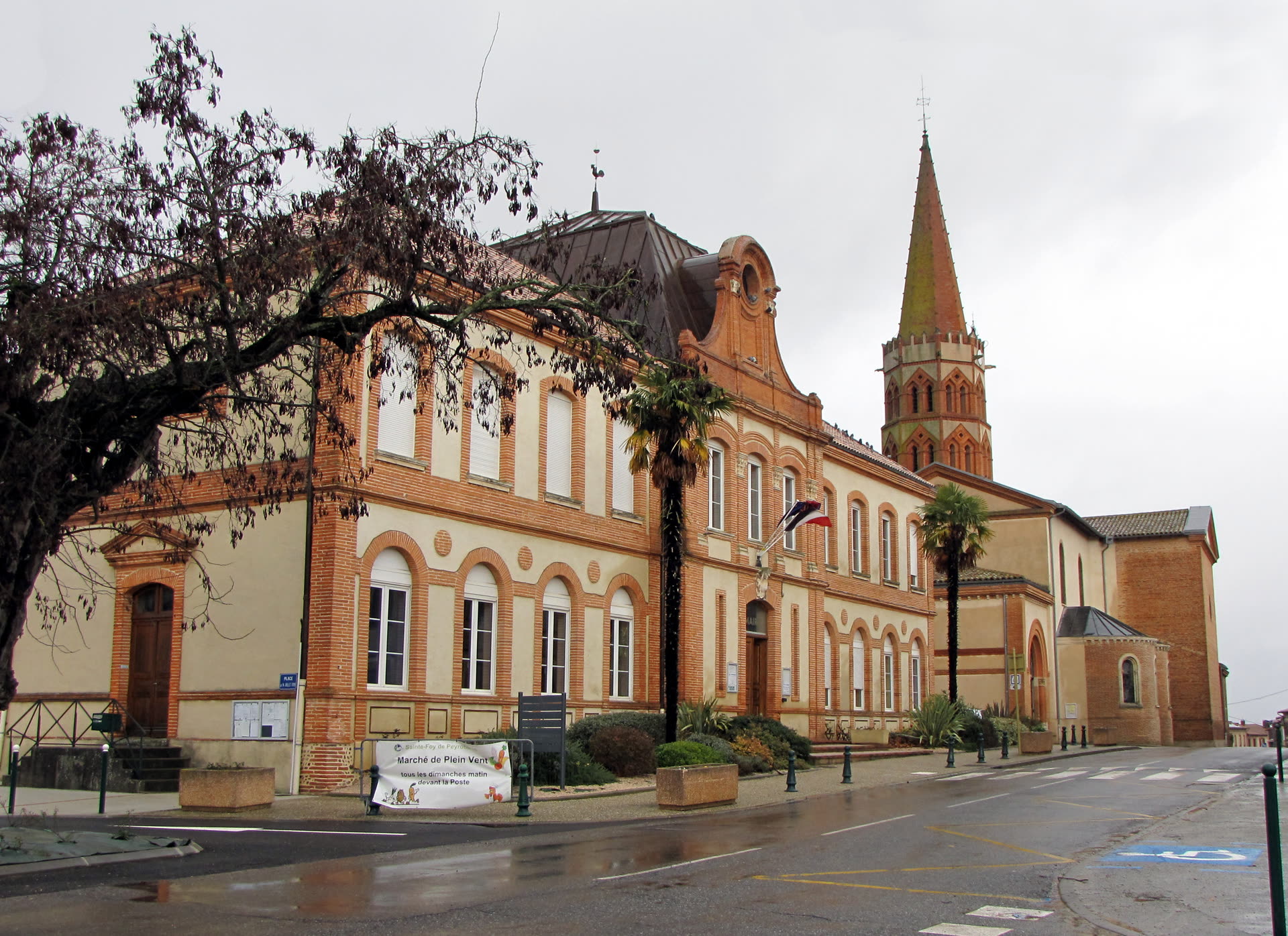
Pictured: Sainte-Foy-de-Peyrolières, the Haute-Garonne commune where the sighting occurred, roughly 36 kilometers southwest of Toulouse. This is not a photograph of the phenomenon itself; the witness had no camera on hand, and no photograph or video of the object or lights is known to exist in any form — the entire sequence lasted only about twenty seconds and was over before any documentation was possible. This image is included only to ground the case's real, verifiable location. Photo by Wikimedia contributor "Paternel 1," taken January 6, 2016, released under CC BY-SA 4.0 / GFDL via Wikimedia Commons.
Theoretical Alignment
This case aligns most strongly with the Extraterrestrial Hypothesis among the frameworks this site tracks, largely on the strength of its structured-craft imagery: a coherent geometric object — first rectangular, then triangular — marked by evenly spaced lights, capable of both a slow, controlled descent and a sudden, silent, trail-less burst of acceleration unlike anything in the conventional aircraft or drone inventory GEIPAN checked against. It carries real, if secondary, Interdimensional alignment on the basis of the object's fluid morphological transformation — a rectangle becoming a triangle and then a rectangle again is the kind of non-fixed physicality IDH proponents cite as evidence against a simple, solid, terrestrial craft. Psycho-Social framing carries genuine, non-trivial weight specifically because GEIPAN's own investigators formulated and tested it directly as one of their seven formal hypotheses: a witness who had been looking at illuminated lights on his own house facade in the minutes before the sighting is exactly the profile a retinal-persistence explanation is built around — but GEIPAN's own comparison of the persistence hypothesis against the sighting's specific reported geometry and duration led its investigators to treat it as one of the weaker candidates, discussed at length below.
Background
Understanding why GEIPAN treated this case with such unusual investigative intensity — two separate expert committee reviews, a full field reconstruction, and a formal cognitive interview for what remains, on paper, a single uncorroborated witness account — requires understanding both the specific richness of what was reported and the institutional machinery France has built to investigate exactly this kind of account.
Sainte-Foy-de-Peyrolières: A Fortified Refuge on the Gascon Plain
Sainte-Foy-de-Peyrolières is a commune of roughly 2,100 residents in the Haute-Garonne department, sitting on the plain southwest of Toulouse near the border with the Gers, within the Cazères canton. Its own municipal history traces its founding to around 1050, when Hélie, the lord of Samatan, donated forested land to Benedictine monks from the Abbey of Conques; the monks cleared the woods, built a church, and laid out a fortified, square-shaped settlement on raised ground for defense. A generation later, around 1070–1100, Hélie's son Odon de Samatan made a further donation that allowed the creation of a second settlement, a sauveté — a refuge zone offering peasants specific legal privileges and physical security in exchange for settling and working the land — which drove real population growth in the centuries that followed. The town's fortunes then followed the broader arc of medieval Gascon history: the Black Death of 1348 killed roughly two-thirds of the population, the Hundred Years' War brought the passage of the Black Prince's forces through the region in 1355, and the Wars of Religion in the 1560s–1590s brought a further quarter-century of pillaging and terror before the community formally recognized Henri IV as its legitimate king around 1595. The town's Église Sainte-Foy, a 13th-century brick construction preserving earlier Romanesque elements, still bears the scars of that turbulent history. Population recovered to around 1,500 by 1860; a railway line opened in 1900; the commune lost 47 men in the First World War and saw local resistance activity, without direct combat, during the Second.
What makes the commune's location notable for this specific case is less its own history than its proximity to one particular institution: Sainte-Foy-de-Peyrolières sits within the same department, Haute-Garonne, that has hosted Toulouse's Centre National d'Études Spatiales (CNES) campus — and, within it, GEIPAN itself — continuously since the agency's 1977 founding. The sighting occurred, in other words, well within GEIPAN's own home department, a detail that in principle should have made rapid follow-up and thorough field investigation more logistically straightforward than for a case reported from a more distant region of France.
GEIPAN's Investigative Machinery: Volunteers, Experts, and a Two-Person Core
GEIPAN's own published account of its methodology describes an organization built around a genuinely small core: just two CNES staff positions plus limited administrative support, multiplying its actual investigative reach through a network of roughly twenty trained volunteer field investigators recruited nationally, and around fifteen scientific experts across relevant specialties — astronomy, meteorology, aeronautics, psychology, and others — who form the "comité des experts" (expert committee) consulted on the agency's most complex or strangest cases. Field investigations, which are reserved for cases likely to reach a D classification, typically involve an in-person witness meeting, a cognitive interview — a structured, non-leading interview technique developed in cooperation with a CNRS cognitive psychology laboratory in Toulouse specifically to maximize accurate recall without introducing false memories — and, where the terrain and timeline allow it, a physical reconstruction of the sightline and geometry involved. This case received essentially the full version of that process: a technical questionnaire completed by the witness within two months, a field visit with reconstruction and cognitive interview conducted by trained investigators, and — unusually — two separate consultations of the full expert committee rather than the more typical single review, reflecting how much difficulty GEIPAN's own investigators had in settling on a single leading explanation.
GEIPAN's own published statistics give useful scale to how unusual that level of scrutiny actually is. The agency receives on the order of 500 witness contacts a year, of which roughly 200 proceed to a published, investigated case file; across its full caseload, GEIPAN's own figures indicate about 59% of investigated sightings are ultimately explained as straightforward misidentifications, with only around 3% remaining unexplained (Type D) overall and just 2% remaining unexplained over the past decade specifically — a figure that has fallen over time as investigative technique, radar-data access, and public astronomical literacy have all improved. A case receiving not one but two separate expert-committee reviews, out of only a few hundred investigated annually and a shrinking single-digit-percentage share ending in a genuine D classification, sits toward the rarer end of GEIPAN's own internal distribution of investigative effort, independent of whatever explanation, if any, is eventually found.
Complete Timeline
| Date | Event |
|---|---|
| c. 1050 | Hélie, lord of Samatan, donates forested land to Benedictine monks from Conques, founding the fortified settlement of Sainte-Foy-de-Peyrolières. |
| 1977 | GEIPAN's predecessor structure is founded within CNES in Toulouse — the same department in which this sighting later occurs. |
| July 8, 2018, approx. 23:29 | A shooting star crosses the night sky over the witness's location, roughly one minute before the sighting sequence begins. |
| July 8, 2018, approx. 23:30 (Phase 1, ~4–5 seconds) | Sighting begins. Five or six intensely luminous points appear and descend a short distance with a "cascade" effect, then dim. |
| July 8, 2018 (Phase 2, ~5 seconds) | Four of the points, now in an aligned formation, move slowly downward, revealing a dark, rectangular shape on which they sit in geometric alignment; the witness distinguishes dark orange hues on the shape. |
| July 8, 2018 (Phase 3) | The shape's motion shifts from vertical to horizontal; the rectangle progressively morphs into a triangle and begins gaining speed. |
| July 8, 2018 (Phase 4, ~1–2 seconds) | The shape undergoes a burst of blinding, silent, trail-less acceleration — the moment the witness later described as the strangest part of the entire event. |
| July 8, 2018 (Phase 5) | The shape reverts to a rectangle, slows, and fades into the night sky. Total observation duration: approximately 20 seconds. |
| July 8, 2018, minutes after the sighting | The witness telephones GEIPAN directly to report the sighting while it is still fresh in memory. A second person present that evening did not perceive the phenomenon at all, the event having unfolded too quickly to register. |
| c. September 2018 (approx. 2 months later) | The witness completes GEIPAN's structured technical questionnaire (questionnaire technique), providing a detailed, phase-by-phase description of the sighting. |
| Following the questionnaire | Field investigation. GEIPAN investigators conduct an on-site reconstruction and a formal cognitive interview with the witness, confirming the account's overall coherence and noting one minor internal contradiction (a possible one-second lapse in visual contact that the witness elsewhere denied experiencing). |
| During the investigation | GEIPAN convenes its expert committee (comité des experts) on the case — and, unusually, convenes it a second time as investigators worked through seven separate hypotheses. |
| During the investigation | GEIPAN obtains partial radar reconstruction data via Toulouse-Blagnac's air traffic control center, covering a time window investigators note may have started slightly too late; the recovered traces do not match the witness's description in aircraft count or spatial distribution. Investigators are unable to obtain the fuller Centre National des Opérations Aériennes (CNOA) restitution in time. |
| Following the full investigation | Final classification. GEIPAN closes the case as Class D: a phenomenon of unexplained nature and origin, catalogued as case ID 2018-07-50618, with a strangeness rating of 0.55 and a consistency rating of 0.72. |
Detailed Narrative
Twenty Seconds, Five Phases: What the Witness Described
What distinguishes this case from the great majority of single-witness UAP reports GEIPAN handles is not any one dramatic detail but the sheer structural granularity of the account as a whole. Most brief nighttime sightings, when GEIPAN's investigators reconstruct them carefully, resolve into a single continuous action — a light crossing the sky, a shape passing overhead. This witness instead described a sequence with five internally distinct phases, each with its own duration, motion characteristics, and visual details, unfolding across a total of roughly twenty seconds. Phase one, lasting some four to five seconds and beginning about a minute after a shooting star had crossed the same patch of sky, consisted of five or six intensely bright points of light appearing and then descending a short vertical distance with what the witness called a "cascade" effect — a term suggesting a staggered, waterfall-like sequential dimming rather than all points moving in lockstep — before their brightness faded. Phase two, roughly five seconds long, saw four of those points, now arranged in an aligned formation, continue a slow downward movement that gradually revealed a solid dark shape behind them: a rectangle, on which the four lights sat in clear geometric alignment, with the witness able to make out dark orange tones on the body of the shape itself.
Phase three marked the account's first major transition: the object's motion shifted from primarily vertical to primarily horizontal, and its shape began progressively changing from a rectangle into a triangle, gaining speed as the transformation completed. Phase four, compressed into just one or two seconds, was the moment the witness singled out afterward as the strangest part of the entire experience: a burst of extremely rapid, almost instantaneous acceleration, with no accompanying sound and no visible trail or exhaust of any kind. Phase five closed the sequence out: the shape reverted to a rectangular outline, slowed its motion, and simply faded away into the night sky, bringing the total observed duration to approximately twenty seconds from first light to final disappearance. GEIPAN's own written case summary treats this five-phase structure as the single most evidentially significant feature of the report — not because any individual phase is impossible to explain in isolation, but because the specific, consistent, phase-by-phase sequence is difficult to reconcile with any single simple, conventional stimulus misperceived under poor viewing conditions.
A Second Witness Who Saw Nothing
A detail GEIPAN's file is careful to record honestly, rather than omit or downplay, is that a second person was present alongside the primary witness that evening and did not see the phenomenon at all. This is not, on its own, a mark against the primary witness's credibility — GEIPAN's own investigators treated it instead as a plausible and unremarkable consequence of the sighting's extreme brevity and the likely difference in where each person happened to be looking in the seconds before it began. A twenty-second event, arriving without warning in a specific patch of sky, is exactly the kind of sighting a second person can easily miss entirely if their attention was directed elsewhere even briefly. The absence of a corroborating witness therefore does not, in GEIPAN's own assessment, constitute active counter-evidence against the sighting having occurred as described; it does, however, mean the case retains the single most common structural limitation of UAP reports generally — no independent second account exists to cross-check the primary witness's specific details against.
Two Months Later: The Technical Questionnaire
The witness's first contact with GEIPAN came within minutes of the sighting itself, by direct telephone call — establishing a documented, time-stamped point of first report before any memory decay could set in, even though that initial call captured only the broad outline of what had happened. The far more detailed account GEIPAN's file relies on came roughly two months later, when the witness completed the agency's structured questionnaire technique in full, phase-by-phase detail. A two-month gap between event and detailed written account is not unusual in GEIPAN's caseload — many witnesses take time to decide to formally document an experience, or simply take that long to receive and return the paperwork — and it introduces the ordinary risks of memory decay and reconstruction any delayed account carries. What GEIPAN's investigators appear to have found reassuring, per the case's ultimately "good" consistency rating, was the sheer internal structure and specificity of what came back: a five-phase account with clearly differentiated durations, motions, and visual details for each phase is a substantially more information-dense report than the vague, single-action descriptions typical of memory-degraded recall, suggesting the underlying visual impression had been unusually vivid and well-encoded at the time, whatever its ultimate cause.
The Field Investigation: Reconstruction and Cognitive Interview
GEIPAN's field investigation went beyond simply reviewing the completed questionnaire on paper. Investigators visited the site, conducted a physical reconstruction of the witness's original vantage point and sightline, and carried out a formal cognitive interview — the structured, non-leading recall technique GEIPAN's investigators are trained in specifically to elicit maximum accurate detail without contaminating memory with suggested content. That interview process, per the case file, confirmed the overall coherence of the witness's account across the full sequence, while surfacing exactly one minor internal contradiction worth noting honestly rather than glossing over: a possible one-second lapse in continuous visual contact with the object at some point during the sequence, which the witness, when the specific possibility was raised directly, denied having experienced. GEIPAN's investigators treated this as a minor, non-disqualifying discrepancy rather than a serious credibility problem — the kind of small inconsistency cognitive-interview methodology is specifically designed to surface in any account, including entirely truthful ones, since human visual attention over any multi-second span is rarely perfectly continuous and rarely perfectly self-reported after the fact. Its presence, rather than undermining the case, is arguably a point in the account's favor: a fabricated or badly reconstructed narrative interrogated this closely would more plausibly reveal either no discrepancies at all (a suspiciously too-clean account) or several larger ones, rather than exactly one small, plausible lapse the witness pushed back against when asked.
Seven Hypotheses, Two Expert Committee Reviews
What sets this case apart procedurally from most single-witness GEIPAN files on this site is the sheer breadth of formal hypothesis testing applied to it. GEIPAN's investigators formulated and tested seven distinct explanatory hypotheses: a passing train of satellites; fragmentation during atmospheric reentry of space debris or a meteoroid; fireworks; a single aircraft; a squadron or formation flight of several aircraft with navigation lights illuminated; retinal persistence carried over from the witness having looked at illuminated lights on his own house facade shortly before the sighting began; and a coordinated "ballet" of multiple drones. Investigators consulted GEIPAN's full expert committee not once but twice over the course of the investigation — a level of internal deliberation this site has not documented on any other single-witness GEIPAN case published so far, reflecting genuine difficulty settling on a single best explanation even among the trained specialists reviewing it.
The Leading Candidate: A Squadron in Formation
Of the seven hypotheses tested, GEIPAN's own file identifies the formation-flight hypothesis — several civilian or military aircraft flying together at night with navigation lights illuminated — as the one most coherent with the specific elements the witness described: multiple aligned light points, a a shape with hard edges, and a transition in apparent formation geometry over the course of the sighting could plausibly map onto several aircraft flying in changing relative positions, their individual lights merging visually into what looked like a single structured object from the witness's distant vantage point. Despite judging it the most coherent candidate, GEIPAN's investigators ultimately invalidated the hypothesis for two specific, independently sufficient reasons.
First, the geometry and timing simply don't work without producing a detectable side effect the witness never reported. The witness's own account implies the object traversed roughly 90 to 110 degrees of angular distance across the sky in about four seconds during the sequence's fastest phase — a rate of angular travel that, at any plausible real-world altitude and distance for a formation of aircraft, would require the aircraft to be moving at very high true speed and, more importantly, to be relatively close to the witness for that angular rate to be achievable at all. Aircraft flying fast and close enough to produce that kind of apparent motion should be audible, especially given that a carrying wind was present that evening — conditions that, if anything, should have made engine noise more likely to reach the witness's position, not less. No sound of any kind was reported at any point during the sighting.
Second, and independently sufficient on its own even setting the acoustic problem aside, the radar evidence recovered doesn't support the hypothesis either. GEIPAN obtained partial radar reconstruction data via Toulouse-Blagnac's civilian air traffic control center, but investigators note real limitations with what they were able to recover: the time window covered by the available reconstruction may have begun slightly too late relative to the actual sighting time, and even within that window, the traces recovered show neither the number of aircraft nor the spatial distribution the witness's account would require for a genuine multi-aircraft formation. GEIPAN's file explicitly registers regret at not having been able to obtain, in time, the fuller national air-defense picture — the Centre National des Opérations Aériennes (CNOA) restitution, the same kind of national-level air-picture reconstruction that has anchored other GEIPAN radar checks on this site, including the negative CAPCODA/CNOA check performed for the Montluel cloud-distorting object case — which might have either confirmed or more conclusively ruled out a wider set of aircraft than Blagnac's civilian approach-control radar alone could see. On top of both objections, GEIPAN's own in-house aeronautical expert separately judged a coordinated night formation flight of the kind implied by the witness's account to be operationally improbable in the first place, for reasons of standard flight discipline and lighting configuration that a genuine squadron exercise would not typically produce in this manner over civilian airspace.
The Other Six Hypotheses
Each of the remaining candidates was tested and set aside on its own specific grounds. A passing train of satellites — the same general category of stimulus responsible for a large and growing share of modern UAP misidentifications — does not match the account's core structural claim: satellite trains move in a single, slow, uniform line across the sky and do not descend in a "cascade," resolve into a solid rectangular body, transform into a triangle, or execute a sudden silent burst of acceleration. Fragmentation during atmospheric reentry of space debris or a meteoroid was considered specifically because it can produce multiple simultaneous points of light with varying brightness, but a genuine reentry event follows a single ballistic trajectory and does not reverse or change shape mid-sequence the way this witness described across five separate phases. Fireworks were tested and rejected for lacking any of fireworks' characteristic color variation, burst-and-fade pattern, or any corroborating report of a local pyrotechnic event that evening. A single aircraft, considered as the simplest possible explanation, cannot account for the object's described transformation between two distinct geometric shapes or its multi-phase motion profile.
The retinal-persistence hypothesis — that residual visual impressions from lights on the witness's own house facade, seen shortly before the sighting, produced or contaminated what he subsequently perceived in the sky — received real, dedicated consideration precisely because the witness's own account supplied the specific triggering circumstance investigators needed to test it seriously, the same general category of explanation GEIPAN's investigator tested and ultimately rejected in the Montluel case discussed above. Here, too, the hypothesis struggled against the account's own specific structure: a genuine retinal artifact is a static or slowly fading afterimage tied to the observer's own eye movements, not a five-phase sequence with distinct, independently describable motion and shape changes sustained over twenty full seconds. Finally, a coordinated ballet of multiple drones was tested and set aside for reasons GEIPAN's investigators have applied consistently across comparable cases on this site: the specific lighting configuration, synchronized formation flying, and instantaneous high-speed acceleration described do not match any drone technology that existed and was legally operable in French airspace at night in 2018.
The Verdict: Classification D
Having tested and set aside all seven hypotheses on independently sufficient grounds — and having consulted its own expert committee twice in the process — GEIPAN classified the Sainte-Foy-de-Peyrolières sighting as Class D: a phenomenon of unexplained nature and origin, with an official strangeness rating of 0.55 and a consistency rating of 0.72. That consistency figure, rated "good," reflects the unusually dense, internally structured nature of the single witness's account, confirmed under a formal cognitive interview and reconstruction, weighed against the case's two structural limitations shared with most single-witness UAP reports: no second corroborating account, and no photographic or video documentation of any kind.
Key Witnesses
The Sainte-Foy-de-Peyrolières Primary Witness (identity withheld per GEIPAN's standard anonymization practice)
A resident of Sainte-Foy-de-Peyrolières who observed the full five-phase sequence and telephoned GEIPAN directly within minutes of the event, while it was still fresh in memory. Two months later he completed GEIPAN's full technical questionnaire, providing an unusually detailed, phase-by-phase account of the object's changing shape, motion, and lighting. He cooperated fully with a subsequent field investigation, including an on-site reconstruction and a formal cognitive interview, which confirmed the overall coherence of his account while surfacing one minor discrepancy — a possible one-second lapse in visual contact, which he denied experiencing when asked directly. GEIPAN's investigators rated the consistency of his testimony 0.72 ("good"), an unusually strong rating for a single, uncorroborated, no-photo account.
The Companion Witness (identity withheld; present but did not observe the phenomenon)
A second person present alongside the primary witness that evening who did not see any part of the five-phase sequence. GEIPAN's file attributes this to the sighting's extreme brevity — approximately twenty seconds in total — rather than treating the absence of corroboration as evidence against the primary account. No independent second description of the object exists as a result, leaving the case with the single-witness limitation common to the large majority of UAP reports GEIPAN investigates.
The Five Observables Assessment
The Five Observables framework, developed by the Pentagon's Advanced Aerospace Threat Identification Program to describe performance characteristics beyond known conventional technology, is applied here for comparative consistency across the site's case files. This case registers a genuinely strong positive match on one specific observable, with real ambiguity on two others.
Assessment: This case's clearest positive observable is Instant Acceleration: the witness singled out Phase 4's silent, trail-less burst of speed as the single strangest moment of the entire sequence, and it maps directly onto AATIP's canonical "instant acceleration" category with none of the ambiguity that hedges most of this case's other observables. Hypersonic performance is only speculative rather than confirmed because GEIPAN's own file does not establish a fixed range to the object at any point, making a literal velocity calculation impossible from the public record alone — but the angular rate reported is difficult to reconcile with any conventional aircraft close enough to be seen with this much shape detail. Low Observability is speculative for a different reason than in most comparable cases: rather than a clean negative radar check (as in the Montluel case), this file has a partial, incomplete radar picture that neither confirms nor rules out a conventional low-altitude aircraft or drone target escaping full detection.
Evidence Assessment
Supporting an Anomalous Origin
- An unusually detailed, internally structured five-phase account, confirmed under a formal field reconstruction and cognitive interview, earning a "good" (0.72) consistency rating rare among single-witness, no-photo GEIPAN cases
- GEIPAN tested seven distinct hypotheses and consulted its own expert committee twice, without settling on any explanation that survived scrutiny
- The leading candidate — a formation flight of aircraft — was independently invalidated on two separate grounds: an angular-speed/no-sound contradiction, and a non-matching partial radar reconstruction
- GEIPAN's own in-house aeronautical expert judged a coordinated night formation flight operationally improbable on independent grounds
- The reported Phase 4 acceleration — sudden, silent, and trail-less — maps cleanly onto the AATIP Five Observables framework's "instant acceleration" category
- The witness's prompt initial phone call, made within minutes of the sighting, established a time-stamped point of first report before any memory decay could occur
Supporting a Conventional/Mundane or Inconclusive Origin
- This remains a single, uncorroborated witness account, with a companion present who did not see the phenomenon at all and no photograph or video of any kind
- The detailed technical questionnaire was completed roughly two months after the sighting, introducing the ordinary risks of memory reconstruction over that gap
- The radar check performed was partial and possibly mistimed — a genuine data gap, not a clean negative result, leaving real room for an undetected conventional aircraft or drone
- A minor internal contradiction (a possible one-second lapse in visual contact) was noted during the cognitive interview, even though the witness denied it when asked directly
- The retinal-persistence hypothesis, while ultimately rejected by GEIPAN, was at least directly supported by a real triggering circumstance the witness himself reported (recently looking at illuminated house-facade lights)
Why "Open"
This case is stamped Open rather than Credible, Disputed, or Debunked because GEIPAN's own investigation reached exactly that state: an unusually rigorous, multi-hypothesis, twice-expert-reviewed investigation that nonetheless failed to find any conventional explanation that survives its own scrutiny, without ever reaching the kind of multi-witness or physical-trace corroboration that would justify a stronger designation. The case earns real, substantial credit on the strength of its investigative process: a witness whose prompt phone call and later, richly detailed technical questionnaire earned a "good" (0.72) consistency rating from GEIPAN's own field investigators; a field reconstruction and formal cognitive interview that confirmed the account's overall coherence; seven independently tested hypotheses, including a genuinely strong leading candidate (aircraft formation flight) that was invalidated on two separate, specific grounds rather than dismissed casually; and two separate expert-committee consultations, reflecting real investigative difficulty rather than a rubber-stamped conclusion.
Set against that, "Credible" would still overstate the case as it stands in the public record: it remains, in the end, a single witness with no photographic or video evidence and no second corroborating observer, and the radar check performed — unlike the clean negative result in the comparable Montluel case — was itself incomplete, leaving a genuine evidentiary gap rather than a confirmed absence of conventional air traffic. A case whose own investigating agency ran an unusually thorough process, twice consulted its full panel of outside experts, and still concluded that nothing it could test reduces the account's underlying strangeness is exactly the state "Open" is meant to describe: genuinely, carefully investigated, and genuinely unresolved.
Sensor & Instrumentation Detection Profile
This case's only instrumented data is partial and inconclusive rather than a clean positive or negative result. GEIPAN obtained a radar reconstruction from Toulouse-Blagnac's civilian air traffic control center, but investigators note the recovered time window may have begun slightly too late relative to the actual sighting, and that the aircraft traces it does contain do not match the witness's account either in number or in spatial distribution. GEIPAN's file explicitly registers regret at being unable to obtain, within the investigation's working timeframe, the fuller national air-defense picture from the Centre National des Opérations Aériennes (CNOA) — the same category of national-level radar restitution that produced a clean negative result in the comparable Montluel case discussed elsewhere on this site. No photograph, video, or audio recording of any kind was captured during the sighting itself; the witness had no camera to hand, and the entire sequence was over in roughly twenty seconds, well before any documentation could plausibly have been arranged.
Environmental & Geospatial Context
The sighting occurred at night under otherwise unremarkable conditions, with one specific detail on record: a shooting star crossed the same general area of sky roughly one minute before the five-phase sequence began. Two minor meteor showers, the Alpha Capricornids and Alpha Cygnids, were active (at low, sub-hourly rates well before their respective late-July peaks) on the date in question, making a sporadic or shower-associated meteor a perfectly ordinary explanation for that specific preceding event — but GEIPAN's file treats the meteor and the five-phase sequence that followed as two separate, sequential phenomena rather than a single continuous misidentification, since the witness described a distinct roughly one-minute gap between the shooting star's passage and the sighting's own Phase 1 onset, and because a meteor's brief, unidirectional streak bears no resemblance to a twenty-second, five-phase sequence involving shape transformation and reversed motion.
Geographically, Sainte-Foy-de-Peyrolières sits on open Gascon plain roughly 36 kilometers southwest of central Toulouse and around 18 kilometers from Muret, within reach of civilian air traffic converging on Toulouse-Blagnac Airport as well as the former Francazal military and civil aerodrome closer to Toulouse's southwestern suburbs. This places the sighting within a genuinely active regional aviation corridor — a relevant fact for weighing the aircraft-formation hypothesis GEIPAN's investigators ultimately invalidated, since ordinary civil air traffic in the area is dense enough that a coordinated multi-aircraft formation flight, had one actually occurred, should in principle have left some trace in either radar records or ordinary air-traffic logs, neither of which materialized in a form matching the witness's account.
Observer Credibility & Occupational Profile
The witness's specific occupation is not disclosed in GEIPAN's published case summary, consistent with the agency's standard anonymization practice, but the file otherwise documents a credibility profile built from behavior rather than credentials: a decision to telephone GEIPAN directly within minutes of the sighting, well before any memory decay could set in; a willingness, two months later, to complete the agency's full structured technical questionnaire in unusually granular, phase-by-phase detail rather than a vague summary; and full, sustained cooperation with a subsequent field investigation, including an in-person reconstruction and a formal cognitive interview specifically designed to surface inconsistencies. That interview process did surface one, and the witness pushed back on it directly rather than simply accepting whatever the investigator suggested — itself a modest positive credibility signal, since a witness purely eager to have his account validated might be expected to more readily agree with any proposed detail an investigator raised.
The case's structural limitation is the same one shared by the majority of single-witness UAP reports: however internally consistent and well-documented one account is judged to be, it cannot carry the same evidentiary weight as independent corroboration from a second observer. That limitation is made more visible, not less, by the fact that a second person actually was present that evening and simply did not happen to be looking in the right direction during the roughly twenty seconds the sequence lasted — a plausible, mundane explanation for the lack of corroboration, but one that leaves the case's evidentiary foundation resting on a single account regardless.
Historical Precedents & Archive Matches
Comparing this case against the other GEPAN/GEIPAN-investigated French sightings already published on this site highlights both what makes it distinctive and where its evidentiary profile sits relative to comparable files.
Montluel (2022) — A Clean Negative Radar Check, Versus an Incomplete One Here
The Montluel cloud-distorting object (Open, 46/100) offers the closest direct structural parallel on this site: another single-witness, no-photograph GEIPAN case investigated with a comparably thorough hypothesis-elimination methodology, including a formally tested and rejected retinal/optical-perception hypothesis. The two cases diverge sharply on their radar evidence specifically: Montluel's investigators obtained a clean, if incomplete-coverage, negative result from CAPCODA's (and its predecessor units') air-defense radar picture, finding no matching aircraft at all. This case's Toulouse-Blagnac civilian radar check instead returned a partial, mistimed, non-matching data set — a genuine gap in the instrumented record rather than a confirmed absence of air traffic, and one GEIPAN's own file explicitly regrets not being able to close with the fuller CNOA national air-defense restitution.
Montayral (2015) — Consistency Ratings at Opposite Ends of the Single-Witness Spectrum
The Montayral aerodrome object (Open, 28/100) is instructive by contrast: another single-witness, no-photograph case whose consistency was judged only "just sufficient" to validate its D1 classification, with no upward revision at any point in its investigation. This case's own consistency rating of 0.72 ("good") sits meaningfully higher, reflecting the additional structural richness of a five-phase, internally differentiated account versus Montayral's comparatively simpler single-action sighting — a genuine difference in the density and checkability of the underlying testimony, not merely a difference in how each file happens to be written up.
Fauville-Évreux (1978) and Bornel (2014) — Positive Radar and Photographic Evidence This Case Lacks
The Fauville-Évreux radar sighting (Open, 48/100) carries a genuine, if uncorroborated, positive radar contact roughly matching its visual sighting's bearing and timing — a different category of instrumented evidence than either this case's partial, non-matching Blagnac data or Montluel's clean negative. The Bornel conservatory fireball (Open), published alongside this case, carries two corroborating witnesses and an inconclusive but real photograph, illustrating the specific kind of multi-source corroboration this Sainte-Foy-de-Peyrolières file simply does not have, however unusually detailed its single account is judged to be.
Material Analysis
This case involves no physical or trace evidence of any kind — no landing marks, no recovered material, no soil or vegetation sample, and no biological or physiological effect on the witness beyond his own visual observation. Nothing in the account places the object anywhere near ground level or within physical reach of the witness at any point during the sequence; the phenomenon was airborne and, per the witness's own description, at a substantial distance throughout its roughly twenty seconds of visibility. There is accordingly nothing to sample, test, or physically examine after the fact — only the witness's own detailed verbal and questionnaire-based description of what he observed.
Supporting Non-Terrestrial Origin
- No physical evidence exists to test in the first place, so no terrestrial material-composition finding contradicts an anomalous interpretation either
- The object's reported shape transformation (rectangle → triangle → rectangle) and silent, trail-less acceleration, if accurately perceived, describe a performance envelope and structural flexibility outside any conventional aircraft or drone GEIPAN identified
Supporting Terrestrial Origin
- The complete absence of any physical trace is itself consistent with a purely distant aerial phenomenon that never approached the ground closely enough to leave one
- No mechanical, electromagnetic, or biological secondary effect on the witness or any nearby structure is recorded anywhere in the file
The Conventional Explanation Candidate: A Night Formation Flight, and Six Rejected Alternatives
GEIPAN's own file treats a night formation flight of two or more aircraft, flying with navigation lights illuminated, as the single most coherent conventional candidate among the seven hypotheses it tested — and, despite ultimately invalidating it, this is the candidate that deserves the most careful separate treatment. Multiple aircraft flying in changing relative positions could, from a distant civilian vantage point, visually merge into what looks like a single structured object with aligned lights, and a coordinated maneuver by several aircraft could conceivably account for at least part of the object's apparent shape change. What ultimately sinks the hypothesis, per GEIPAN's own investigators, is not any single flaw but two independently sufficient ones: the angular speed implied by the witness's account requires either an implausibly close approach (which should have been audible, especially with a carrying wind present) or an implausibly high true velocity for any conventional aircraft formation; and the partial radar data actually recovered from Toulouse-Blagnac's civilian control center does not show the number or spatial distribution of aircraft the hypothesis would require, even allowing for the possibility that the recovered time window started slightly too late.
Satellite Train
A passing train of satellites was tested specifically because this category of misidentification has become increasingly common as commercial satellite constellations have grown. It fails to match this case's core structural claim: a satellite train is a single, slow, uniform line of points crossing the sky in one direction, and cannot descend in a staggered "cascade," resolve into a solid rectangular body with orange coloring, transform into a triangle, or execute a sudden silent acceleration burst.
Atmospheric Reentry Fragmentation
Fragmentation during the atmospheric reentry of space debris or a meteoroid can genuinely produce multiple simultaneous points of light at varying brightness, matching at least the surface description of Phase 1. It fails, however, to explain any of the sequence's later phases: a reentry event follows a single, continuous ballistic trajectory and does not reverse direction, resolve into a solid geometric body, or transform shape across multiple subsequent phases the way this account describes.
Fireworks
Fireworks were tested and rejected for lacking the characteristic color variation and burst-and-fade pattern of a genuine pyrotechnic display, and no corroborating report of any local fireworks event that evening was found.
Single Aircraft
A lone conventional aircraft, considered as the simplest possible candidate, cannot account for the object's reported transformation between two distinct geometric shapes (rectangle and triangle) or its multi-phase motion profile, which is well outside any conventional aircraft's flight envelope.
Retinal Persistence from House-Facade Lights
This hypothesis received genuine, dedicated consideration because the witness's own account supplied a real, specific triggering circumstance: he had recently been looking at illuminated lights on his own house facade before the sighting began. It struggles against the same objection that sank a comparable hypothesis in the Montluel case: a retinal artifact is a static or slowly fading afterimage, not a twenty-second, five-phase sequence with distinct, independently describable shape and motion changes.
Coordinated Drone Ballet
A synchronized formation of multiple drones was tested and set aside because no drone technology that existed and was legally operable in French airspace at night in 2018 matches the specific lighting configuration, shape transformation, and instantaneous high-speed acceleration the witness described.
Night Formation Flight of Aircraft
Rejected (Most Coherent, But Contradicted by Radar)Judged the most structurally coherent candidate by GEIPAN's own investigators, but invalidated on two independent grounds: an angular-speed/no-sound contradiction, and partial Blagnac radar data that does not match the required aircraft count or distribution.
Satellite Train
ImplausibleA single, uniform line of points cannot cascade, resolve into a solid rectangular body, or transform shape the way the witness described.
Atmospheric Reentry Fragmentation
ImplausibleMatches Phase 1's multiple light points superficially, but a single ballistic reentry trajectory cannot reverse, resolve into a geometric body, or transform shape across later phases.
Fireworks
ImplausibleLacks fireworks' characteristic color variation and burst-and-fade pattern; no corroborating local event was found.
Single Aircraft
ImplausibleCannot account for the object's transformation between two distinct geometric shapes or its multi-phase motion profile.
Retinal Persistence (House-Facade Lights)
ImplausibleA real triggering circumstance existed, but a retinal artifact cannot produce a twenty-second, five-phase sequence with distinct shape and motion changes.
Coordinated Drone Ballet
ImplausibleNo 2018-era drone technology, legally operable at night in French airspace, matches the described lighting, shape transformation, and acceleration.
Related Cases
Confirmed Documents & Official Records
The official French government investigation summary: the five-phase witness account, the field reconstruction and cognitive interview, the seven tested hypotheses, the partial Toulouse-Blagnac radar data, and the final Class D determination with published strangeness (0.55) and consistency (0.72) ratings. Note: GEIPAN's own published case title contains an internal typo rendering the commune name "Sainte-Foy-de-Pérollière"; the correct commune name, used throughout this case file, is Sainte-Foy-de-Peyrolières.
GEIPAN's own published definitions for classifications A, B, C, D, D1, and D2, and the strangeness/consistency evaluation criteria applied to this case.
GEIPAN's own account of its investigative structure — the roughly twenty trained field investigators and fifteen-member scientific expert committee — and its statistical case outcomes, providing the institutional context for this case's unusually thorough, twice-expert-reviewed investigation.
Further Reading — Recommended Literature
UFOs: Generals, Pilots, and Government Officials Go on the Record
Kean's survey of credentialed witness testimony and official investigative bodies worldwide provides useful comparative context for weighing GEIPAN's own unusually thorough, twice-expert-reviewed process against how other national UAP investigation programs operate.
Wonders in the Sky: Unexplained Aerial Objects from Antiquity to Modern Times
A catalog of historical aerial anomaly reports useful for weighing how genuinely unusual this case's specific five-phase, shape-transforming sequence is against the broader historical pattern of reported aerial phenomena.
The UFO Evidence
The foundational documentary approach to cataloging and cross-referencing witness testimony that GEIPAN's own case-file methodology, including its formal consistency and strangeness ratings, descends from in spirit.
The UFO Experience: A Scientific Inquiry
Hynek's own multi-hypothesis evaluation framework anticipates the seven-hypothesis, expert-committee-reviewed methodology GEIPAN applied to this exact case, making it a natural comparative reference.
The Close Encounters Man: How One Man Made the World Believe in UFOs
A biography of Hynek documenting the emergence of rigorous, elimination-based case investigation methodology, directly reflected in GEIPAN's seven-hypothesis, twice-expert-reviewed handling of this case.
Essential Viewing
Sources
- GEIPAN (CNES), "SAINTE-FOY-DE-PEYROLIERES (31) 08.07.2018", Case 2018-07-50618 — official case summary
- GEIPAN (CNES), official case archive & public portal — geipan.fr
- GEIPAN (CNES), Glossaire du GEIPAN — official classification definitions, A/B/C/D/D1/D2
- GEIPAN (CNES), "Missions, méthodes et résultats" — investigative structure, expert committee, and cognitive-interview methodology
- American Meteor Society, "Meteor Activity Outlook for July 14–20, 2018" — Alpha Capricornid minor shower activity context
- Mairie de Sainte-Foy-de-Peyrolières, "Histoire" — commune founding, medieval history, Wars of Religion
- Mairie de Sainte-Foy-de-Peyrolières, "Présentation & chiffres clés" — present-day commune profile
- INSEE, "Dossier complet — Commune de Sainte-Foy-de-Peyrolières (31481)" — official population and demographic statistics
- Wikipedia (English), "Sainte-Foy-de-Peyrolières" — commune geography and overview
- Opex360 / Zone Militaire, "L'armée de l'Air crée une nouvelle unité dédiée à la planification et à la conduite des opérations aériennes" — CNOA/CAPCODA institutional background
- This site, case-files/montluel-cloud-distorting-object.html — comparative GEIPAN single-witness case with a clean negative radar check
- This site, case-files/montayral-aerodrome-object.html — comparative single-witness GEIPAN D-family case
- This site, case-files/fauville-evreux-radar-sighting.html — comparative GEPAN/GEIPAN positive radar case
- This site, case-files/bornel-conservatory-fireball.html — comparative two-witness GEIPAN case published alongside this one
- Wikimedia Commons, File: Sainte-Foy-de-Peyrolières 1.JPG, photo by "Paternel 1" (January 6, 2016), CC BY-SA 4.0 / GFDL — licensing and attribution
- YouTube (france tv), "GEIPAN : dans les coulisses de l'organisme qui étudie les phénomènes aérospatiaux non identifiés" — oEmbed-verified video, general GEIPAN institutional coverage
- This site, key-figures.html, entry on Claude Poher — GEPAN founding and early institutional history
- This site, key-figures.html, entry on Jean-Jacques Velasco — SEPRA leadership and methodology evolution
- This site, locations/index.html, entry on Toulouse — CNES/GEPAN/SEPRA/GEIPAN institutional headquarters, within the same department as this sighting
See something inaccurate? Have additional information or sources?
Suggest an Edit →Last Updated: August 2026