
The Villers-lès-Luxeuil Triangle
On the evening of November 26, 2019, a married couple drove home in separate cars from Vesoul to Villers-lès-Luxeuil, a small farming commune in the Haute-Saône. Shortly after 5 p.m., the husband ("T1"), following his wife ("T2"), saw a white light near the village of Saulx-de-Vesoul appear to move beneath the cloud base; after roughly fifteen seconds it climbed vertically and vanished into the clouds at an estimated ten to twelve kilometers away, only to reappear above the same area less than ten seconds later. T1 tried repeatedly to alert T2 by flashing his headlights and phoning her, but she never perceived the light at all. Later, arriving home in Villers-lès-Luxeuil, the couple — T2 first, T1 moments after — independently observed a large, dark triangular structure hanging almost motionless above the village, a strong white light glowing at its front and a fixed red light beside it. T1 stopped his car, switched off the radio, and rolled down his windows to listen for any sound. There was none. The object drifted slowly through the air at what he judged to be under a hundred meters of altitude, and after about twenty seconds — per T2 — it tilted on itself and disappeared toward the north-northwest. GEIPAN rated the case's consistency "good," despite the two accounts not being fully independent, and tested three specific, real candidates against it: a Robin DR400 light aircraft genuinely on approach nearby, a confirmed Mirage 2000-5F exercise flying out of the region's own air base, and a documented military drone transit notice covering the airspace that month. Each came close. None actually fit.
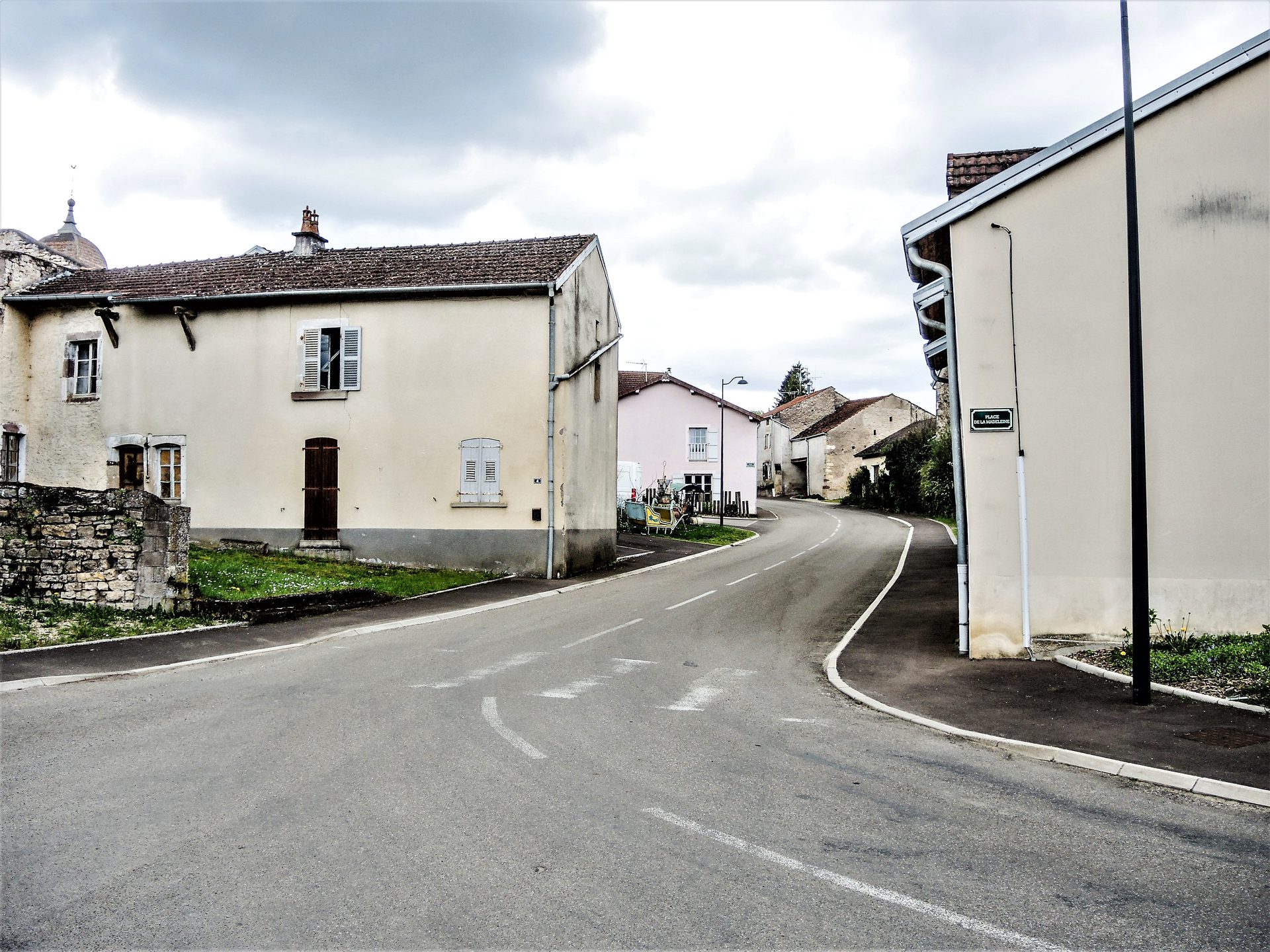
Pictured: Place de la Madeleine in the village of Villers-lès-Luxeuil, Haute-Saône, France — the commune the two witnesses were arriving home to when they saw the triangular object hovering above it. This is not a photograph of the object itself; no photograph or video of the phenomenon is known to exist. Photo by Wikimedia contributor Espirat, uploaded 2023, released under CC BY-SA 4.0 via Wikimedia Commons.
Theoretical Alignment
This case aligns most strongly with the Extraterrestrial Hypothesis among the frameworks this site tracks, on the strength of its central image: a large, solid, dark triangular structure with fixed, patterned lighting, gliding at treetop height in total silence — the archetypal "black triangle" morphology reported worldwide since the 1980s, here reinforced by a second, quasi-independent witness and by GEIPAN's own inability to make any of three specific, individually plausible-looking conventional aircraft actually fit the reported geometry. It carries comparatively little Interdimensional alignment, since nothing in either witness's account describes shape transformation, medium transition, or any of the fluid, non-solid physicality IDH proponents typically cite; a rigid, fixed-shape triangular object that simply glides and then departs is, if anything, one of the more "conventional-craft-like" morphologies this site catalogs. Psycho-Social framing carries real, non-trivial weight here specifically because of the case's own witness structure: T1 followed T2's car and tried, unsuccessfully, to alert her to a separate light phenomenon minutes before either of them saw the triangle, meaning the two triangle sightings, however independently each witness describes experiencing it, did not occur in full isolation from each other — a genuine methodological complication GEIPAN's own consistency rating (0.64, short of the 0.72 earned by a comparable fully independent single-witness account elsewhere on this site) implicitly reflects.
Background
Understanding why GEIPAN spent as much analytical effort as it did on this case — testing not one but three specific, individually well-documented conventional aircraft candidates, two of them tied to a real, confirmed flight in the relevant time window — requires understanding the unusually dense military aviation geography of the area the couple was driving through that evening.
Villers-lès-Luxeuil and Vesoul: A Small Commune in a Military Corridor
Villers-lès-Luxeuil is a modest farming commune of roughly 310 residents in the Haute-Saône department of Bourgogne-Franche-Comté, within the Lure arrondissement and the canton of Saint-Loup-sur-Semouse. Its most notable built landmark is the 18th-century Église Saint-Pierre, rebuilt between 1765 and 1767 to the plans of local architect Jean Gruyer and listed as a historic monument in 1995; otherwise the village is characteristically rural, low-density, and agricultural. The couple at the center of this case had been driving home from Vesoul, the préfecture of Haute-Saône roughly twenty kilometers to the southwest, passing near the commune of Saulx-de-Vesoul along the way — the location of the evening's first, separate light phenomenon.
What makes this otherwise unremarkable rural commute analytically significant is a single nearby institution: BA116, the Luxeuil-Saint-Sauveur air base, sits only about six kilometers from Villers-lès-Luxeuil itself. Few civilian sighting locations this site has documented sit this close to an active fighter base — a fact that cuts in two directions for evaluating the case. On one hand, it means genuine, mundane military and civil aviation activity tied to that base is an unusually strong background candidate for any unusual light or shape reported near the village, which is precisely why GEIPAN's investigators pursued not one but two separate BA116-linked hypotheses in real depth. On the other, it means the witnesses themselves — described in the case file as long-term local residents — were, per GEIPAN's own reasoning, unusually well-positioned to recognize the base's routine aircraft activity for what it normally looks and sounds like, making their specific inability to identify what they saw as any of it a genuinely more informative negative than it would be from an unfamiliar visitor.
BA116 Luxeuil-Saint-Sauveur: From the Lafayette Escadrille to the Mirage 2000
Few French military airfields carry as long or as storied a history as BA116. The site was first used for military aviation in April 1916, during the First World War, and hosted the original American volunteer unit that would become famous as the Escadrille La Fayette, alongside further American training and reconnaissance squadrons through 1918. The base entered continuous, near-uninterrupted service afterward, becoming, through the Cold War, one of France's principal nuclear-capable strike bases — a mission the base held until it was formally withdrawn in 2011, when the nuclear-armed Mirage 2000N squadron based there relocated to BA125 Istres. In its place, BA116 received twenty-three Mirage 2000-5F interceptors transferred from Dijon-Longvic, becoming, and remaining as of this sighting, the primary home of Escadron de Chasse 1/2 "Cigognes" and, more broadly, the world training center for Mirage 2000 mechanics, pilots, and technicians of any nationality. French President Emmanuel Macron later announced, in 2025, that BA116 would resume a nuclear deterrence role with new squadrons, and that Rafale F5 aircraft carrying the new ASN4G nuclear missile are slated to arrive at the base by 2036 — underlining just how central this specific, small air base remains to French national defense more than a century after its founding, and how routine a fixture Mirage 2000 overflights near Villers-lès-Luxeuil genuinely are for anyone living nearby.
The unit itself has a specific, well-documented founding story worth recounting in full, since it underlines just how long this particular airfield has hosted foreign volunteers, elite pilots, and symbolically named squadrons. French escadrille N°124 was formally created on April 18, 1916, and its first American volunteer pilots joined the unit two days later; based initially at Luxeuil-les-Bains, at the foot of the Vosges, the squadron was ordered to Verdun that May for critical observation missions before returning to its Luxeuil base that September. On December 16, 1916, the unit was formally christened "Escadrille La Fayette," adopting a Sioux chief's head as its emblem — chosen, per its own official history, to symbolize strength, combativeness, and courage. Seven young American pilots were ultimately selected for the founding roster: Norman Prince, William Thaw, and Elliot Cowdin, who had initiated the project, joined by Victor Chapman, James McConnell, Kiffin Rockwell, and Bert Hall. Kiffin Rockwell scored the unit's first confirmed aerial victory on May 18, 1916. The unit's most celebrated pilot, Raoul Lufbery, had already enlisted in the French Foreign Legion in August 1914 before transferring to the Escadrille La Fayette on May 24, 1916, ultimately becoming one of America's leading aces of the entire war with seventeen officially credited victories. This is the specific historical pedigree behind the airfield GEIPAN's investigators would, more than a century later, be cross-referencing flight logs against in order to test whether a real Robin DR400 or a real Mirage 2000-5F exercise explained what two drivers saw over Villers-lès-Luxeuil on a November evening in 2019.
GEIPAN's Investigative Machinery
GEIPAN, based at the Centre National d'Études Spatiales (CNES) campus in Toulouse and descended from the GEPAN unit founded in 1977 under astrophysicist Claude Poher, and later reorganized as SEPRA under Jean-Jacques Velasco, receives on the order of 500 witness contacts a year, of which roughly 200 proceed to a full published investigation; of those, GEIPAN's own figures indicate about 59% end up explained as straightforward misidentifications, with only around 3% remaining unexplained (Type D) across the agency's history and 2% over the past decade specifically. This case's own investigation involved a specific, unusually concrete form of hypothesis-testing: rather than reasoning abstractly about what kind of aircraft might explain a triangular shape with two lights, investigators identified and checked three named, dated, and in two cases directly confirmed candidates — a specific Robin DR400 aircraft on a real landing approach, a specific four-jet Mirage 2000-5F exercise that had genuinely launched from BA116 that day, and a specific, documented temporary restricted-airspace notice covering possible military drone transits — against the precise timing, elevation, and apparent size each witness reported.
Complete Timeline
| Date | Event |
|---|---|
| April 1916 | Military aviation begins at what becomes BA116 Luxeuil-Saint-Sauveur, initially home to the Escadrille La Fayette. |
| 1977 | GEIPAN's predecessor, GEPAN, is founded within CNES in Toulouse under Claude Poher. |
| 2011 | BA116's nuclear-capable Mirage 2000N squadron relocates to Istres; the base receives twenty-three Mirage 2000-5F interceptors from Dijon-Longvic, forming EC 1/2 "Cigognes." |
| November 7, 2019 | A SUP AIP (supplementary aeronautical information publication) notice, 299/19, establishes a temporary restricted zone tied to possible military drone transits, effective through May 6, 2020. |
| November 26, 2019, shortly after 17:00 | First phenomenon begins. Driving from Vesoul, T1 (following T2's car) sees a white light near Saulx-de-Vesoul appear to move beneath the cloud base. |
| November 26, 2019 (~15 seconds later) | The white light rises vertically and disappears into the clouds, at an estimated distance of 10–12 kilometers. |
| November 26, 2019 (<10 seconds later) | The light reappears above the same general area. T1 flashes his headlights and telephones T2 to alert her, but she does not perceive the phenomenon at any point. |
| November 26, 2019, later that evening | Second phenomenon begins. Arriving at Villers-lès-Luxeuil, T2 is the first to see a large, dark triangular structure, quasi-stationary above the village, with a strong white light at its front and a fixed red light; T1 sees it moments later. |
| November 26, 2019 | T1 stops his car, switches off the radio, and opens the windows to listen for sound. The object glides slowly and silently at an altitude he judges under 100 meters. |
| November 26, 2019 (~20 seconds) | Per T2, the object tilts on itself, then disappears toward the north-northwest. Total triangle observation: approximately 20 seconds. |
| During the investigation | GEIPAN confirms a Robin DR400 aircraft was genuinely airborne at low altitude in the relevant time window, on a landing approach to BA116. |
| During the investigation | GEIPAN confirms a military exercise involving four Mirage 2000-5F aircraft launched from BA116 that day, with one jet's tracked trajectory broadly consistent with the reported sighting. |
| During the investigation | Investigators examine SUP AIP 299/19's temporary restricted zone for possible military drone transits, then rule it out on altitude grounds (authorized flight levels of 14,935–16,764 meters, incompatible with a naked-eye ground sighting under total cloud cover and a reported PAN altitude under 3,000 meters). |
| Following the full investigation | Final classification. GEIPAN concludes the persistent strangeness of the phenomenon after investigation, combined with the consistency of the testimony, warrants classifying the case « D1 »: observation of an unidentified phenomenon, catalogued as case ID 2019-11-50872, with a strangeness rating of 0.55 and a consistency rating of 0.64. |
Detailed Narrative
The First Phenomenon: A Light That Rose, Vanished, and Returned
The evening's events unfolded in two clearly separated phases, involving the same two witnesses but, notably, only partial mutual corroboration. Driving home to Villers-lès-Luxeuil from Vesoul in two separate vehicles — T2 leading, T1 following a short distance behind — the couple passed near the commune of Saulx-de-Vesoul shortly after five in the evening. It was T1 alone who first noticed a white light that appeared to be moving beneath the base of the cloud layer. After roughly fifteen seconds of this low, apparently sub-cloud motion, the light rose sharply on a vertical path and disappeared into the clouds themselves, at a distance T1 estimated at ten to twelve kilometers. Less than ten seconds later, it reappeared, now above the cloud layer in the same general area. T1's response was immediate and specific: he flashed his headlights and telephoned his wife's car directly, trying to draw her attention to what he was watching. T2, despite these efforts, never perceived the light at all — whether because her attention was directed elsewhere, because the light was not visible from her specific position or angle in the lead vehicle, or simply because the window during which it was visible was too brief for a phone call and a glance to align. GEIPAN's file records this first phenomenon as observed only by T1, a detail with direct consequences for how independently the evening's two witnesses can be treated as corroborating each other overall, discussed further below.
The Second Phenomenon: A Black Triangle Over the Village
The evening's second and evidentially central phenomenon began only after both vehicles had reached Villers-lès-Luxeuil itself. This time it was T2, arriving first, who initially spotted a large, dark triangular structure hanging in a quasi-stationary position above the village, marked by a strong white light glowing at what both witnesses took to be its front, alongside a separate, fixed red light. T1, arriving moments after, independently saw the same object himself — giving this second phenomenon a genuine, if closely time-linked, second observation rather than a single account relayed secondhand. T1's response was immediate and methodical: he brought his car to a stop, switched off the car radio specifically to eliminate any interior noise that might mask a faint sound from outside, and rolled down his windows to listen directly for any engine, rotor, or other mechanical noise the object might be producing. He heard nothing at all.
The object itself, per both witnesses, moved slowly and deliberately through the air, gliding rather than flying in any conventional sense, at an altitude T1 judged to be under one hundred meters — low enough, given the object's already-substantial apparent size, to leave a striking visual impression. T1 later put that size in vivid, specific terms during GEIPAN's questioning: his own outstretched hand, held up against the sky, would not have been sufficient to fully cover the triangle from view, and he described its body as uniformly dark rather than reflective or metallic in appearance. The observation continued for roughly twenty seconds in total before, per T2's account specifically, the object tilted on itself — a rotation or banking motion rather than a simple fade or a straight-line departure — and disappeared toward the north-northwest, the encounter ending as abruptly and as silently as it had begun.
A Consistency Rating with an Honest Asterisk
GEIPAN's own file rates the overall consistency of this case as good, a judgment resting substantially on the fact that two separate people, in two separate vehicles, independently reported seeing the same large, dark, silent triangular object over the same village within moments of each other. That said, GEIPAN's investigators were explicit that the two testimonies cannot be treated as entirely independent evidence in the strictest sense: T1 had been following T2's vehicle throughout the drive, the two had already been in direct telephone contact minutes earlier over the first, unrelated light phenomenon, and by the time the triangle appeared they were arriving at the same destination within the same short window of time rather than observing from two genuinely separated, unconnected vantage points. This is precisely the kind of nuance that distinguishes this case's evidentiary profile from, say, two strangers independently reporting the same object from different towns: real, but qualified, corroboration. No photographic or video evidence exists from either witness; the encounter's brevity and its unfolding at the end of a long drive home left no opportunity for either to retrieve a camera or phone before the object had already departed.
What the Case File Does Not Contain
As with several other GEIPAN files this site has documented, it is worth being explicit about what the published case summary does not include, since the gaps are themselves informative rather than simply an absence of information. The file does not disclose either witness's occupation, does not name a precise minute for either phenomenon beyond "shortly after 17:00," and does not describe a formal cognitive interview or a physical field reconstruction of the sighting geometry of the kind applied in some other single-witness cases on this site. Nor does it indicate whether GEIPAN investigators visited Villers-lès-Luxeuil in person at all, as opposed to conducting the entire investigation by questionnaire and flight-record correspondence with BA116. These omissions are consistent with GEIPAN's standard anonymization and proportionality practice — not every case receives the same depth of field investigation, and a two-witness, no-photograph case with two real, checkable flight-record candidates to test may simply have been judged not to require an in-person site visit the way a more ambiguous single-witness case might. Readers comparing this case against others on this site should weigh its investigative profile on its own specific terms: heavy on flight-record cross-referencing against two named, real aircraft, comparatively light on the field-reconstruction and cognitive-interview techniques applied elsewhere.
Key Witnesses
T1 — The Husband (identity withheld per GEIPAN's standard anonymization practice)
Driving home to Villers-lès-Luxeuil from Vesoul a short distance behind his wife's car, T1 was the only witness to the evening's first phenomenon — a white light near Saulx-de-Vesoul that rose vertically into cloud cover and reappeared moments later — and tried unsuccessfully to alert his wife to it by headlight signal and phone call. On arriving home, he independently observed the same large, dark, silent triangular object his wife had already spotted moments earlier, stopping his car, cutting the radio, and opening his windows specifically to listen for sound. He provided GEIPAN with a detailed size estimate (his outstretched hand insufficient to cover the object) and altitude judgment (under 100 meters), contributing directly to the case's consistency rating of 0.64, "good."
T2 — The Wife (identity withheld per GEIPAN's standard anonymization practice)
Driving ahead of her husband on the same route home from Vesoul, T2 did not perceive the evening's first light phenomenon near Saulx-de-Vesoul despite T1's attempts to alert her by headlight and telephone. She was, however, the first of the two to spot the large, dark triangular object over Villers-lès-Luxeuil, and her account is the source for the case's most specific closing detail — that the object tilted on itself before departing toward the north-northwest. Her independent sighting of the triangle, arriving at the village moments ahead of her husband, is the strongest single piece of corroboration in the case file.
The Five Observables Assessment
The Five Observables framework, developed by the Pentagon's Advanced Aerospace Threat Identification Program to describe performance characteristics beyond known conventional technology, is applied here for comparative consistency across the site's case files. This case registers its strongest signal not in speed or acceleration but in acoustic anomaly, with the remaining observables largely absent or unconfirmed.
Assessment: This case's clearest positive observable is Low Observability, rated Present rather than merely speculative because of a specific, unusually strong piece of context: T1 didn't simply fail to hear anything by chance, but actively eliminated the most likely masking factors (turning off his own car radio, opening his windows) specifically in order to listen, and both witnesses' long-term residence near an active fighter base means their baseline expectation for what a nearby aircraft sounds like was unusually well-calibrated. Instant Acceleration and Hypersonic performance are both rated Absent rather than speculative — a genuine point of contrast with several other GEIPAN cases on this site — because both witnesses consistently describe slow, controlled, unhurried motion throughout, including the closing "tilt and depart" maneuver, with nothing resembling a sudden burst of speed at any point. Anti-Gravity Lift remains speculative rather than present because, while a large, apparently solid object holding a low, near-stationary hover is itself unusual, neither witness described any visible means by which that hover was being achieved.
Evidence Assessment
Supporting an Anomalous Origin
- Two separate witnesses, in two separate vehicles, independently observed the same large, dark, silent triangular object over the same village within moments of each other, earning a "good" (0.64) GEIPAN consistency rating
- GEIPAN identified and tested three specific, real, dated candidates — a confirmed Robin DR400 approach, a confirmed four-jet Mirage 2000-5F exercise, and a documented drone-transit airspace notice — rather than reasoning about generic aircraft categories, and still found none that fit
- The Mirage 2000-5F candidate, while genuinely tracked and timed close to the sighting, disagreed with the witnesses' reported elevation by more than double (14° tracked vs. >30° reported) and arrived roughly ten minutes off the established sighting time
- Total silence was reported despite T1 actively eliminating masking noise (stopping the car, cutting the radio, opening the windows) specifically to listen, from witnesses already familiar with the area's routine military aircraft sounds
- The reported dark triangular shape itself has no logical explanation under the Robin DR400 hypothesis "hormis une possible illusion d'optique" (other than a possible optical illusion), per GEIPAN's own file
Supporting a Conventional/Mundane or Inconclusive Origin
- The two witnesses' testimonies are not fully independent: T1 followed T2's vehicle throughout the drive and had already contacted her directly by phone minutes before the triangle sighting, over a separate, unrelated phenomenon
- No photograph or video of either phenomenon exists
- A real Robin DR400 aircraft was confirmed airborne at low altitude in the relevant window, on a genuine landing approach to BA116, with a white forward light and red left-wingtip position light that could in principle correspond to the two lights reported
- A real four-aircraft Mirage 2000-5F exercise had genuinely launched from BA116 that day, with one jet's tracked trajectory broadly consistent with the sighting, even though its specific timing, elevation, and size did not fully match
- The first light phenomenon near Saulx-de-Vesoul was seen by only one of the two witnesses, leaving that specific portion of the evening's events entirely uncorroborated
Why "Open"
This case is stamped Open rather than Credible, Disputed, or Debunked because GEIPAN's own investigation produced a genuinely close-but-not-quite result on two separate, real, named conventional candidates, without either fully explaining or fully ruling out an anomalous interpretation. The case earns real credit specifically because it has more corroboration than the majority of GEIPAN files on this site: two witnesses, arriving at the same location within moments of each other, independently reported seeing the same large, dark, silent triangular object, and GEIPAN rated the resulting testimony 0.64, "good." It earns further credit from the specificity of its investigative process — rather than testing an abstract "aircraft" hypothesis, investigators identified and checked a real Robin DR400 confirmed on approach to BA116 and a real four-jet Mirage 2000-5F exercise confirmed to have launched from the same base that day, and found that even these two genuine, dated, trackable candidates disagreed with the witnesses' account on elevation, timing, or size specifically, rather than being dismissed on vague or unfalsifiable grounds.
Set against that, this case does not rise to "Credible" for two specific reasons this site weighs consistently across its GEIPAN files. First, the two witnesses, while genuinely corroborating each other on the triangle sighting itself, are not fully independent overall: T1's earlier attempt to alert T2 to the unrelated light phenomenon, and the fact that both were traveling the same route home minutes apart, mean this case's corroboration is real but qualified, not the fully separate, unconnected double-witness account that would justify a stronger rating. Second, no photograph, video, or radar data of any kind exists for either phenomenon, leaving the case resting entirely on testimony, however consistent. A case with genuinely close-fitting, real, named conventional candidates that GEIPAN's own investigators could not quite make fit — on elevation, timing, and size specifically, not vague generalities — combined with qualified but real two-witness corroboration and zero physical or instrumented evidence, is exactly the balance "Open" at a moderate score is meant to capture.
Two Related Phenomena, One Investigation
It is worth pausing on how GEIPAN's own file treats the relationship between the evening's two separate phenomena, since the case's title and public framing center on the triangle alone even though the file itself documents both. The white light near Saulx-de-Vesoul and the black triangle over Villers-lès-Luxeuil are geographically close, temporally close (minutes apart, on the same drive), and share at least one witness in common, yet GEIPAN's investigators never treat them as necessarily the same object performing two different phases of one continuous encounter. The file's own three tested hypotheses — the Robin DR400, the Mirage 2000-5F exercise, and the drone notice — are all applied specifically to the triangle sighting, not to the earlier light; no equivalent named-aircraft cross-check is documented for the Saulx-de-Vesoul phenomenon, which remains, in effect, a separate, still entirely unexplained single-witness sub-case nested inside this larger two-witness file. That asymmetry is itself a useful reminder that a single case file can legitimately contain more than one open question, investigated with different levels of rigor, rather than a single unified mystery with one clean answer.
Sensor & Instrumentation Detection Profile
No radar, air-traffic-control, or air-defense data specific to the triangle sighting itself is cited in GEIPAN's published file; the agency's investigation instead relied on flight-record and exercise confirmation from BA116 to establish that a real Robin DR400 and a real four-jet Mirage 2000-5F formation were genuinely airborne near Villers-lès-Luxeuil within the relevant time window, cross-referenced against each witness's own reported timing, elevation, and apparent size. That cross-reference is itself a form of instrumented evidence, distinct from a radar track but drawing on the same underlying flight-operations records a radar reconstruction would rely on. No photograph, video, or audio recording of either phenomenon exists; T1's decision to switch off his car radio and open his windows functioned as an informal, deliberate acoustic check, the result of which — total silence — is itself the closest thing this case has to an instrumented negative finding, notable precisely because it was actively sought rather than merely assumed after the fact.
Environmental & Geospatial Context
The sighting occurred under total cloud cover, a detail GEIPAN's investigators cited directly against the military-drone hypothesis: the SUP AIP 299/19 notice's authorized flight levels (14,935 to 16,764 meters) are far above where any naked-eye ground observer could see a small drone-sized object through a fully overcast sky, especially one the witnesses judged to be flying under 3,000 meters. The same total cloud cover is also the reason the evening's first phenomenon — the white light seen by T1 alone near Saulx-de-Vesoul — behaved the way it did: rising into and briefly disappearing behind the cloud base before reappearing above it is exactly the kind of visual sequence a genuine light source passing through an overcast layer would produce, regardless of what that light source ultimately was.
Geographically, this sighting sits within one of the more militarily active small-town corridors this site has documented in France: BA116 lies only about six kilometers from Villers-lès-Luxeuil, close enough that routine Mirage 2000-5F training flights and general aviation traffic using the base are, per GEIPAN's own reasoning, a genuinely familiar background presence to residents rather than a rare event. That proximity is precisely why GEIPAN's investigators were able to identify two specific, real, dated candidate aircraft rather than reasoning purely hypothetically — and precisely why the witnesses' inability to match what they saw to either one, despite that familiarity, carries more evidentiary weight than the same negative would from observers unfamiliar with the base's routine air traffic.
The area's climate and airspace character are also worth setting out plainly, since both bear on how the case should be read. Haute-Saône in late November typically sits under the kind of persistent, low, unbroken cloud cover the case file describes as a routine feature of the department's continental-transitional climate at that time of year, rather than an unusual meteorological event requiring its own separate explanation. The department's airspace, meanwhile, is shaped almost entirely by BA116's own operational tempo: Mirage 2000-5F training sorties, in-flight refueling support missions, and general aviation traffic supporting the base's role as the Mirage 2000's worldwide training center make this one of the busier stretches of military airspace in eastern France relative to the size and density of the civilian population living beneath it. That combination — persistent cloud cover limiting visibility to nearby, low-altitude objects, and unusually dense military air traffic passing beneath that same cloud base — is precisely the environment in which a genuine misidentification of a real aircraft becomes both more plausible in principle and, per GEIPAN's own specific elevation and timing mismatches, harder to actually pin down in practice.
Observer Credibility & Occupational Profile
Neither witness's occupation is disclosed in GEIPAN's published case file, consistent with the agency's standard anonymization practice, but the file's procedural record documents a credibility profile built from specific, checkable behavioral details rather than credentials alone: T1's real-time attempt to alert T2 to the first light phenomenon by both headlight signal and telephone call, made while the sighting was still in progress rather than reconstructed afterward; his deliberate, methodical response to the triangle itself (stopping the car, cutting the radio, opening the windows specifically to listen); and his specific, checkable size comparison (an outstretched hand insufficient to cover the object). T2's own contribution — being first to see the triangle, and providing the account's most specific closing detail, the tilt-and-departure maneuver — complements rather than merely repeats her husband's testimony.
The case's structural limitation is the qualified nature of its two-witness corroboration: because T1 followed T2's vehicle throughout the drive and had already been in direct telephone contact with her minutes before the triangle appeared, the two accounts cannot be treated as though they came from two entirely separate, disconnected observers encountering the object independently of any shared context. GEIPAN's own 0.64 consistency rating, notably lower than the 0.72 earned by a fully independent single-witness account elsewhere on this site, appears to reflect exactly this nuance rather than any weakness in either witness's individual credibility.
Historical Precedents & Archive Matches
Comparing this case against the other GEPAN/GEIPAN-investigated French sightings already published on this site, and against France's broader "black triangle" sighting record, highlights both what makes it distinctive and where its evidentiary profile sits relative to comparable files.
The Wider "Triangle Noir" Pattern in French Ufology
Large, dark, silent triangular objects form one of the most persistent and internationally reported morphological categories in UAP literature, and France's own record includes several GEIPAN-investigated cases beyond this one. At Ussy-sur-Marne in 1994, gendarmes — themselves trained, professional observers rather than casual passersby — reported a massive, silent, low-altitude triangular object hovering over a highway, a case whose witness credentials arguably strengthen it relative to this one even as this case benefits from two independent civilian observers rather than one professional crew. At Sélestat, Bas-Rhin, that same year, two separate couples independently described a triangular form accompanying their vehicles over several kilometers — a genuinely stronger corroboration structure than this case's own, since those four witnesses were reportedly unconnected to each other, unlike T1 and T2's shared drive home. And at Buchelay, Seine-et-Marne, in 2003, witnesses described a large triangular object marked by nine orange-colored rings arranged across its body, observed for several continuous minutes before departing — a far longer observation window than this case's roughly twenty seconds, though with a more elaborate and arguably harder-to-corroborate lighting pattern.
This case shares the core "black triangle" morphology with all three precedents — a large, dark, silent, low-altitude structure with patterned lighting — while contributing its own distinctive elements to the broader French record: a preceding, separate light phenomenon witnessed by only one of the two people present, and an unusually specific pair of named, dated, individually confirmed conventional aircraft candidates (a real Robin DR400, a real four-jet Mirage 2000-5F exercise) that came close without actually fitting the reported geometry. None of the three precedent cases, per the sources this site has reviewed, involved this same degree of specific, dated flight-record cross-referencing against two named real aircraft; most rely more heavily on witness testimony alone, weighed against generic aircraft or drone categories rather than individually confirmed flights. That difference is itself informative: it suggests this case's proximity to an unusually well-documented, continuously active military airfield gave GEIPAN's investigators an evidentiary opportunity — specific flight logs to check against — that most black-triangle cases elsewhere in France simply don't have available, regardless of how strange the underlying sighting itself may have been.
Bornel (2014) and Fauville-Évreux (1978) — Multi-Witness and Instrumented Comparisons
The Bornel conservatory fireball (Open, 51/100) is this site's other GEIPAN case built on two witnesses rather than one, and its own two-witness corroboration is fuller and more independent than this case's — a retired couple observing the same event from the same room, rather than two drivers arriving from different points along the same route. That difference plausibly explains why Bornel's consistency profile supports a modestly higher score despite this case's stronger conventional-candidate testing. The Fauville-Évreux radar sighting (Open, 48/100) offers the clearest instrumented-evidence contrast: a genuine, if uncorroborated, positive radar contact, a different category of evidence entirely from this case's flight-record cross-referencing of two real, named aircraft.
Sainte-Foy-de-Peyrolières (2018), Montluel (2022), and Montayral (2015) — Single-Witness Comparisons
Against the site's single-witness GEIPAN cases — the Sainte-Foy-de-Peyrolières Five-Phase Sighting (Open, 47/100), the Montluel cloud-distorting object (Open, 46/100), and the Montayral aerodrome object (Open, 28/100) — this case's qualified two-witness structure represents a genuine, if partial, step up in corroboration, reflected in this site's own score for it sitting above all three despite lacking any radar or photographic evidence of its own. The specific, named-aircraft CEC testing this case received also has no exact precedent among those three, each of which tested more generic aircraft, drone, or optical-illusion categories rather than two individually confirmed, dated flights.
Material Analysis
This case involves no physical or trace evidence of any kind — no landing marks, no recovered material, no soil or vegetation sample, and no biological or physiological effect on either witness beyond their own visual and auditory observations. Nothing in either account places the object at ground level or within physical reach of either witness at any point; despite its low reported altitude of under 100 meters, the triangle remained airborne throughout its roughly twenty seconds of visibility, and the earlier light phenomenon near Saulx-de-Vesoul was, per T1's own estimate, ten to twelve kilometers distant. There is accordingly nothing to sample, test, or physically examine after the fact — only the two witnesses' own detailed verbal descriptions, and the flight records GEIPAN cross-referenced against them.
Supporting Non-Terrestrial Origin
- No physical evidence exists to test in the first place, so no terrestrial material-composition finding contradicts an anomalous interpretation either
- The object's reported large apparent size, uniformly dark and non-reflective surface, quasi-stationary low-altitude hover, and complete silence, if accurately perceived, describe a combination GEIPAN's investigators could not attribute to either of the two real, confirmed aircraft they identified as flying nearby that evening
Supporting Terrestrial Origin
- The complete absence of any physical trace is itself consistent with a purely airborne phenomenon that never approached the ground closely enough to leave one
- No mechanical, electromagnetic, or biological secondary effect on either witness, their vehicles, or the village itself is recorded anywhere in the file
The Conventional Explanation Candidate: Two Real Aircraft That Didn't Quite Fit
What sets this case apart from most on this site is that GEIPAN's leading conventional candidates were not hypothetical categories of aircraft but two specific, named, dated flights confirmed to have genuinely occurred near Villers-lès-Luxeuil that evening, plus a third documented airspace restriction. Each came close enough to warrant serious, extended analysis in GEIPAN's own file; each ultimately failed to fit on specific, falsifiable grounds rather than vague suspicion.
Robin DR400 Light Aircraft
This hypothesis is reinforced by the confirmed presence of a real Robin DR400 aircraft at low altitude in the relevant time window, on a genuine landing approach to BA116, with a flight trajectory GEIPAN's investigators judged broadly concordant with the sighting. The Robin DR400, a widely used French-built four-seat light touring aircraft common at civil and military-adjacent airfields across the country, is exactly the kind of small, ordinary aircraft that might reasonably be overlooked as a candidate at first glance and then found, on closer inspection, to have genuinely been airborne at the right place and time — which is precisely what happened here. The aircraft's landing light and left-wingtip position light could, in principle, correspond to the white forward light and fixed red light both witnesses described. The hypothesis fails, however, on two specific and independently sufficient grounds: the apparent size of a DR400 at any plausible viewing distance, compared to the full Moon as a reference, does not match the "impressive" and specifically "dark" size the witnesses described (T1's own words, per GEIPAN's file: "ma main tendue n'aurait pas suffi à cacher le triangle... sombre"); and the dark triangular shape itself finds no logical explanation under this hypothesis except a possible optical illusion, which GEIPAN's own file treats as a genuine, acknowledged weakness rather than a satisfying resolution.
Mirage 2000-5F Fighter Jet
This hypothesis is supported by the confirmed occurrence of a military exercise that day involving four Mirage 2000-5F aircraft departing from BA116, one of which followed a tracked trajectory GEIPAN's investigators judged coherent with the reported sighting, and whose triangular planform is a substantially better visual match for the witnesses' described shape than a light aircraft's silhouette. It nonetheless carries several specific inconsistencies GEIPAN's file does not gloss over: a roughly ten-minute discrepancy between the tracked jet's timing and the established sighting time; a calculated elevation angle of only 14 degrees, far below the greater than 30 degrees both witnesses reported; a size that does not fully correspond to the witnesses' description; and, perhaps most tellingly, the total absence of any perceived engine or afterburner noise despite the witnesses' long residence in the village and their existing familiarity with the routine sound of Mirage overflights from the nearby base.
Military Drone (SUP AIP 299/19)
This hypothesis was prompted by a real, documented notice — SUP AIP 299/19 — establishing a temporary restricted airspace zone tied to possible military drone transits, in effect from November 7, 2019 through May 6, 2020, squarely covering the date of this sighting. On paper, this looked like a promising lead: a genuine, dated, officially published airspace restriction, active on the exact day of the sighting, explicitly tied to drone operations rather than a generic catch-all notice. It was set aside once investigators established that the zone's authorized flight altitudes, 14,935 to 16,764 meters — roughly ten times the cruising altitude of a commercial airliner — are entirely incompatible with a naked-eye ground sighting under total cloud cover of an object both witnesses judged to be flying under 3,000 meters, and in T1's case specifically under 100 meters. A drone operating within its own authorized envelope at that height would, in total cloud cover, have been not merely difficult but functionally impossible to see from the ground at all, let alone resolve into a large, dark, sharply defined triangular shape with two distinct lights.
Robin DR400 Light Aircraft
Genuinely Close, Ultimately RejectedA real DR400 was confirmed on approach to BA116 with a plausible light configuration, but its apparent size doesn't match the witnesses' "dark," size-impressive description, and the triangular shape has no explanation besides a possible optical illusion.
Mirage 2000-5F Fighter
Genuinely Close, Ultimately RejectedA real 4-jet exercise from BA116 matches the triangular shape better, but disagrees on timing (~10 min), elevation (14° vs. >30°), size, and produced no audible noise the witnesses, familiar with Mirages, would have expected to hear.
Military Drone (SUP AIP 299/19)
ImplausibleThe notice's authorized altitudes (14,935–16,764m) are incompatible with a ground sighting under total cloud cover of an object reported under 100–3,000m.
Related Cases
Confirmed Documents & Official Records
The official French government investigation summary: both witnesses' accounts, the three tested hypotheses, the confirmed Robin DR400 and Mirage 2000-5F flight cross-checks, the SUP AIP 299/19 drone-notice analysis, and the final Class D1 determination with published strangeness (0.55) and consistency (0.64) ratings.
GEIPAN's full field investigation report, including the hypothesis-by-hypothesis flight-record cross-referencing against the witnesses' testimony.
GEIPAN's own published definitions for classifications A, B, C, D, D1, and D2, and the strangeness/consistency evaluation criteria applied to this case.
GEIPAN's own account of its investigative structure and statistical case outcomes, providing institutional context for this case's flight-record-based investigation.
Further Reading — Recommended Literature
UFOs: Generals, Pilots, and Government Officials Go on the Record
Kean's survey of credentialed witness testimony and official investigative bodies worldwide provides useful comparative context for weighing GEIPAN's flight-record cross-referencing approach against how other national UAP investigation programs test named conventional candidates.
Wonders in the Sky: Unexplained Aerial Objects from Antiquity to Modern Times
A catalog of historical aerial anomaly reports useful for weighing how this case's large, dark, silent triangular morphology fits within the broader historical "black triangle" reporting pattern.
The UFO Evidence
The foundational documentary approach to cataloging and cross-referencing multi-witness testimony that GEIPAN's own two-witness case methodology descends from in spirit.
The UFO Experience: A Scientific Inquiry
Hynek's own multi-hypothesis evaluation framework anticipates GEIPAN's practice of testing specific, named, dated conventional aircraft candidates against reported sightings, as applied to this exact case.
The Close Encounters Man: How One Man Made the World Believe in UFOs
A biography of Hynek documenting the emergence of rigorous, elimination-based case investigation methodology, directly reflected in GEIPAN's aircraft-by-aircraft handling of this case.
Essential Viewing
Sources
- GEIPAN (CNES), "VILLERS-LES-LUXEUIL (70) 26.11.2019", Case 2019-11-50872 — official case summary
- GEIPAN (CNES), Compte Rendu d'Enquête, Villers-lès-Luxeuil (70) 26.11.2019 — full investigation report (PDF)
- GEIPAN (CNES), official case archive & public portal — geipan.fr
- GEIPAN (CNES), Glossaire du GEIPAN — official classification definitions, A/B/C/D/D1/D2
- GEIPAN (CNES), "Missions, méthodes et résultats" — investigative structure and methodology
- Wikipedia (English), "Luxeuil - Saint-Sauveur Air Base" — base history, Escadrille La Fayette, Mirage 2000-5F, nuclear mission
- Wikipédia (français), "Base aérienne 116 Luxeuil-Saint-Sauveur" — French-language base history and unit detail
- Ministère des Armées, "Retour de la dissuasion nucléaire à Luxeuil-Saint-Sauveur" — 2025 nuclear-mission return announcement
- macommune.info, "La BA 116 de Luxeuil rend hommage aux 40 années de vie opérationnelle du Mirage 2000" — Mirage 2000 unit history at BA116
- Wikipedia (English), "Villers-lès-Luxeuil" — commune geography and demographics
- Wikipédia (français), "Église Saint-Pierre de Villers-lès-Luxeuil" — village landmark and construction history
- Wikipédia (français), "Triangle noir (ufologie)" — general "black triangle" phenomenon overview
- CarteOvni.fr, "OVNI triangulaires : observations et enquêtes du GEIPAN" — comparative French GEIPAN triangle cases (Ussy-sur-Marne, Sélestat, Buchelay)
- This site, case-files/bornel-conservatory-fireball.html — comparative two-witness GEIPAN case with inconclusive photograph
- This site, case-files/sainte-foy-de-peyrolieres-five-phase-sighting.html — comparative single-witness GEIPAN Class D case
- This site, case-files/montluel-cloud-distorting-object.html — comparative GEIPAN case with a clean negative radar check
- This site, case-files/crozon-peninsula-red-rectangles.html — comparative single-witness GEIPAN Class D case published alongside this one
- Wikimedia Commons, File: Place de La Madeleine. Villers-lès-Luxeuil.jpg, photo by "Espirat" (uploaded 2023), CC BY-SA 4.0 — licensing and attribution
- YouTube (Le Foutoir d'AstronoGeek), "Témoin d'un OVNI, le GeiPAN enquête." — oEmbed-verified video, general GEIPAN institutional coverage
- This site, key-figures.html, entry on Claude Poher — GEPAN founding and early institutional history
- This site, key-figures.html, entry on Jean-Jacques Velasco — SEPRA leadership and methodology evolution
- This site, locations/index.html, entry on Toulouse — CNES/GEPAN/SEPRA/GEIPAN institutional headquarters
See something inaccurate? Have additional information or sources?
Suggest an Edit →Last Updated: August 2026