
The Angoulême Daylight Ovoid
At 1:15 PM on August 15, 2009, a single witness standing in the garden of his own home in Angoulême, the historic prefecture of the Charente department in southwestern France, watched a matte-brown, egg-shaped object cross the sky in a straight, level line, moving from east to west in the general direction of Cognac. The object made no sound of any kind, and it passed clearly above the surrounding rooftops — too high and too far to be one of the everyday, human-scale objects a garden might otherwise produce. No other witness to the sighting was ever identified. The man himself ruled out an aircraft or a helicopter, but that exclusion could never be independently checked against regional air-traffic control, because the gendarmerie's own report of the incident reached GEIPAN too late for the agency to request the relevant flight data. Investigators went on to test and reject four small, nearby objects — a rugby ball, a clay-pigeon-trap target, a frisbee, a radio-controlled model aircraft — each ruled out because none could plausibly have been seen passing so far above the roofline. A rising atmospheric meteorite, raised because the sighting fell just three days after that August's Perseid meteor shower peak, could not be confirmed or dismissed without a second, corroborating witness. GEIPAN's own file, registered under case ID 2009-08-02385, closes the sighting as Class D: a phenomenon rated strange to very strange, of medium to strong consistency, left formally unexplained for the simple reason that no single hypothesis GEIPAN examined ever actually fit the account.
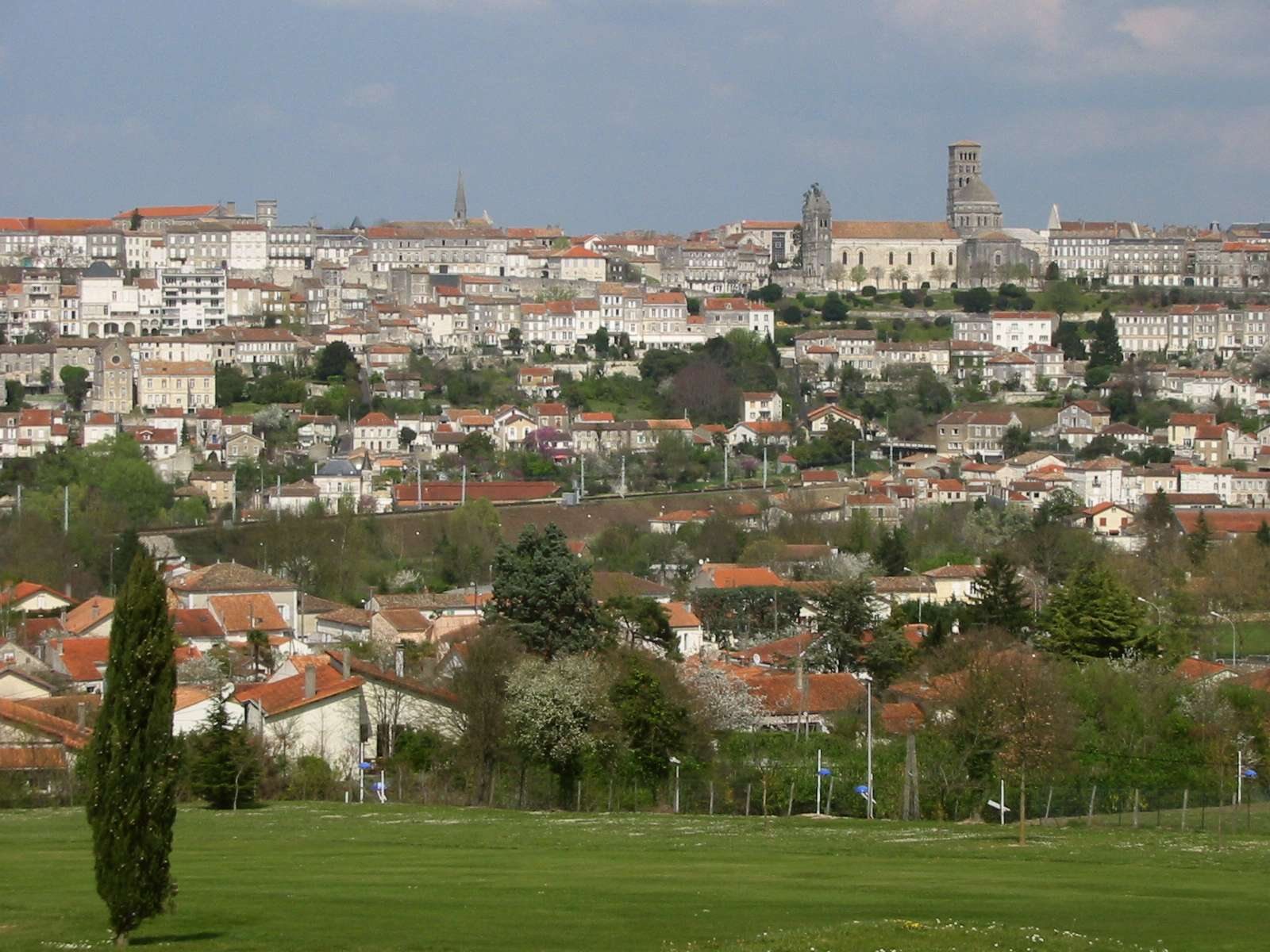
Pictured: Angoulême and its cathedral, seen from the golf course of l'Hirondelle on the opposite hillside — not the specific garden where the witness stood, whose precise address GEIPAN's published file does not disclose. No photograph, video, or other direct visual recording of the object itself is known to exist; the entire evidentiary record consists of the witness's own testimony and GEIPAN's own case file. Photo by Wikimedia Commons contributor Jack ma (2006), released into the public domain.
Theoretical Alignment
This case earns a Theoretical Alignment weighting dominated by Psycho-Social framing, but for a genuinely different reason than most single-witness sightings in this site's GEIPAN archive. In several comparable files — the Maffliers Dawn Object chief among them — PSH draws its weight from a specific, well-understood conventional phenomenon that closely resembles the report. Here, no such resemblance exists: GEIPAN's own investigators tested four small, physically plausible candidate objects and a meteorite hypothesis, and none of them actually fit the witness's account on its own terms. PSH nonetheless carries the largest share of this case's weighting for the oldest and simplest reason in the framework's toolkit — a single, brief, uncorroborated daylight observation, unaided by any instrument, is inherently vulnerable to misjudgment of an object's true size, distance, altitude, and shape, independent of whether any specific misidentification candidate can be named after the fact. Extraterrestrial framing draws real but modest weight from the account's own internal consistency — a described structural shape (ovoid) rather than a vague point of light, a silent and level flight profile inconsistent with the small objects GEIPAN tested, and the witness's own confident exclusion of the one conventional aviation candidate that could have covered the reported altitude and trajectory. That confidence is capped, however, by the fact that his aircraft/helicopter exclusion was never independently verified against actual air-traffic data, for reasons entirely outside his control. Interdimensional framing again draws the least support, resting mainly on the case's total absence of any instrumented or photographic corroboration — the same broad, non-case-specific pattern IDH proponents invoke across nearly every uncorroborated sighting in this site's archive, rather than anything unique to what was actually reported over Angoulême.
Background
Two separate threads of context matter for reading this sighting honestly: the historic regional capital where it occurred, and the specific astronomical event — the Perseid meteor shower — that fell just days before it and that GEIPAN's own investigators flagged as a live, if ultimately unconfirmable, candidate explanation.
Angoulême: The "Balcony of the Southwest"
Angoulême is the prefecture (administrative capital) of the Charente department in the Nouvelle-Aquitaine region of southwestern France — a region known as Poitou-Charentes until France's 2016 regional mergers, and the period name this site's research uses when discussing the department's identity at the time of this 2009 sighting. The city itself is a compact commune of a little under 42,000 residents (41,908 at the 2023 census), sitting at the center of the wider Grand Angoulême agglomeration of roughly 110,000 people spread across more than 15 kilometers. Its most distinctive geographic feature is the plateau it occupies, overlooking a meander of the Charente river below — a position that has earned the city its long-standing regional nickname, "le balcon du Sud-Ouest" (the balcony of the southwest). Angoulême's recorded history reaches back to its status as the historic capital of the Angoumois region; its fortified old town was besieged repeatedly across the medieval and early modern periods, and its formal commune charter dates to May 18, 1204, when King John of England — ruling Angoumois as part of the Angevin Empire before its loss to the French crown a decade later — granted the town's residents specific freedoms and legal protections. In the modern era, Angoulême has built a second, very different civic identity: it is officially designated "Ville de l'Image" (City of the Image) and has hosted the Festival International de la Bande Dessinée d'Angoulême, one of the largest and most prestigious comics festivals in the world, since 1974, drawing hundreds of thousands of visitors each year. The city's regional airport, Angoulême–Cognac International Airport, sits at Brie-Champniers just northeast of the city center, and the well-known brandy-producing town of Cognac itself lies roughly 38 kilometers away along the Charente valley, to the west-northwest — a detail with direct relevance to this case, since the witness described the object's trajectory as heading due west, "en direction de Cognac" (in the direction of Cognac), a description that aligns closely with Cognac's real bearing from Angoulême.
The Perseids: Peaking Three Days Before the Sighting
The Perseid meteor shower is one of the most reliable and best-observed annual meteor showers visible from the Northern Hemisphere, produced by Earth's passage through the debris trail left by Comet 109P/Swift–Tuttle. In 2009, the shower's activity peaked on the night of August 12–13, with astronomers noting a particularly active, double-peaked display that year. This sighting occurred on August 15, 2009 — just two to three days after that peak, while elevated Perseid meteor activity would still have been readily detectable, even though the shower's very highest hourly rates had already passed. GEIPAN's own investigators explicitly connected the timing of this sighting to that broader meteor activity when they raised an atmospheric meteorite entry as one candidate explanation for what the witness described. This site's own research, discussed in full in the Conventional Explanation Candidate section below, finds that timing coincidence alone is a considerably weaker basis for the meteorite hypothesis than it might first appear, once the specific visual characteristics of an actual meteoric fireball are checked directly against what the witness reported.
Complete Timeline
| Date | Event |
|---|---|
| 1204 | Angoulême's formal commune charter is granted by King John of England, ruling Angoumois as part of the Angevin Empire. |
| 1974 | The Festival International de la Bande Dessinée d'Angoulême is founded, establishing the city's modern identity as "Ville de l'Image." |
| October 26, 1954 | A separate, much earlier UFO sighting occurs roughly 18 km outside Angoulême on Route Nationale 10, when a truck driver and his wife report a bowl-shaped object rising from a meadow; later researchers classify it a probable meteor. |
| August 12–13, 2009 | The Perseid meteor shower reaches its annual peak, with a notably active, double-peaked display recorded that year. |
| August 15, 2009, 1:15 PM | Sighting begins. A single witness, standing in the garden of his home in Angoulême, observes a matte-brown, ovoid object crossing the sky on a straight, level trajectory, moving east to west toward Cognac, passing clearly above the surrounding rooftops in complete silence. |
| August 15, 2009 (same observation) | The witness himself excludes the possibility of an aircraft or helicopter, based on his own assessment of the object's appearance and behavior. |
| Following the sighting | The witness's account is formally recorded via a gendarmerie procès-verbal (official report). No other witness or press report of the same event is ever identified. |
| Date not published | The gendarmerie's procès-verbal reaches GEIPAN only after a significant delay — late enough that the agency's own file states it could no longer meaningfully request air-traffic control data for the sighting window. |
| Date not published | GEIPAN's investigation tests and excludes four small, nearby candidate objects — a rugby ball, a ball-trap (clay pigeon) target, a frisbee, and a model aircraft — each ruled out as inconsistent with an object described passing clearly above rooftop level. |
| Date not published | GEIPAN raises, but cannot confirm or exclude without a second witness, the hypothesis of an atmospheric meteorite entry, given the sighting's proximity to that August's Perseid peak. |
| Case status as maintained (last updated June 23, 2021, per GEIPAN's own published metadata) | Final classification. GEIPAN records the case as Class D: a strange to very strange phenomenon of medium to strong consistency, unexplained for lack of a consolidated hypothesis. |
Detailed Narrative
A Silent Shape Crossing the Sky Toward Cognac
According to GEIPAN's own archived case synthesis, the witness was in the garden of his own home in Angoulême at 1:15 PM on August 15, 2009, when he noticed an object crossing the sky above him. He described it in specific, physical terms rather than as a vague point of light: an ovoid shape — egg-like, rounded at both ends — and a matte brown color, meaning dull and non-reflective rather than glossy, metallic, or luminous. The object moved along what GEIPAN's file describes as a "trajectoire rectiligne" — a straight, level line — traveling from east to west, in the general direction of Cognac, the well-known Charente town roughly 38 kilometers to the west-northwest. Throughout the entire observation, GEIPAN's file records that no sound whatsoever was heard. The witness specifically noted that the object passed clearly above the rooftops of the surrounding buildings — a detail that, on its face, seems almost incidental, but which became the single most important piece of testimony in the entire investigation, because it is the detail investigators used to rule out every small, human-scale, close-range object they subsequently considered. No other witness to any part of this sighting was ever identified, despite it occurring at 1:15 PM — the middle of a summer afternoon, hardly a time of minimal outdoor activity — in a residential area of a city of tens of thousands of people.
An Aircraft or Helicopter, Excluded by the Witness — But Never Actually Checked
GEIPAN's own file records that the witness himself excluded the possibility that he had seen a conventional aircraft or helicopter. This is worth stating plainly for what it is: a witness's own subjective judgment, based on his own assessment of the object's appearance, size, altitude, and silent, level flight profile, not an independently verified finding. This site's own analysis treats that distinction as genuinely important, because GEIPAN's own file is explicit that the agency could never actually test this exclusion against real air-traffic data. The reason given is procedural rather than evidentiary: the gendarmerie's official report of the sighting (the procès-verbal) reached GEIPAN only after a delay long enough that requesting and receiving the relevant regional air-traffic control records for the exact time and location of the sighting was no longer practical. This is a real, honestly disclosed limitation in the investigation — not a case where investigators tried to check flight data and came up empty, but one where the opportunity to check it at all had already closed by the time the case reached GEIPAN's desk. This site's analysis is careful not to treat the witness's own aircraft/helicopter exclusion as more solid than it actually is: a single, non-expert witness identifying what an object was not, under brief daylight observation conditions, is a meaningfully weaker form of evidence than an independently verified absence of any matching flight in the relevant air-traffic corridor. The case's central evidentiary gap is exactly this one, and GEIPAN's own file states it candidly rather than glossing over it.
Four Small Objects, Each Excluded on the Same Basis
GEIPAN's own investigation explicitly considered, and explicitly rejected, four specific close-range, human-scale objects as candidates for what the witness saw: a rugby ball, a ball-trap (clay pigeon shooting) target, a frisbee, and a radio-controlled model aircraft. GEIPAN's file describes this case as "atypique" (atypical) precisely because these are the kinds of nearby, ordinary objects an investigator might reasonably consider for a sighting occurring over a residential garden in the middle of the day — and precisely because none of them held up. The stated reason for rejecting all four together is the same detail already discussed above: the witness described the object passing clearly above the rooftops, meaning it was seen at a height and distance well beyond where a thrown rugby ball, a fired clay-pigeon target, a tossed frisbee, or (implicitly) a typical hobbyist's model aircraft would normally be found. This site's own research adds further, independently-sourced context supporting GEIPAN's own reasoning on each candidate specifically. Rugby is a genuinely popular sport across southwestern France, the broader region in which Charente sits, and a kicked or thrown rugby ball, however enthusiastically launched, simply does not sustain flight at rooftop-clearing altitude over any meaningful horizontal distance — it follows a short, steeply arced trajectory governed by ordinary human throwing or kicking force, nothing like a "trajectoire rectiligne" crossing the visible sky. Ball-trap (the French term for clay-target/skeet shooting) launches a flat, saucer-shaped clay disc from a mechanical trap, typically to modest heights well within line of sight of the shooter and far short of rooftop-clearing altitude over a populated residential area; the sport is also practiced at dedicated ranges rather than in ordinary garden settings, a further mismatch with the reported context. A thrown frisbee, similarly, is a close-range recreational object whose flight envelope tops out at a small fraction of the altitude described. A radio-controlled model aircraft can, in principle, achieve real altitude and cover real horizontal distance, but hobbyist models of the era almost universally used either a distinctly audible internal-combustion or electric motor, or a recognizable winged silhouette, both of which are conspicuously absent from a witness description built around a matte brown ovoid shape moving in complete silence. GEIPAN's own decision to name and individually address all four candidates, rather than gesture vaguely at "some nearby object," is itself a small but genuine mark of investigative thoroughness in a case this thinly evidenced.
A Meteorite Entry During Elevated Perseid Activity — Raised, But Never Resolved
Having excluded the four close-range candidates, GEIPAN's own file explicitly raises a fifth and more exotic possibility: the atmospheric entry of a meteorite, motivated directly by the sighting's timing just three days after the 2009 Perseid meteor shower's annual peak. GEIPAN's own synthesis is candid about the limits of this hypothesis, however: with only a single witness and no second, independent observation to triangulate against, the agency states plainly that the meteorite hypothesis "reste impossible à vérifier sans autre témoignage recueilli" — remains impossible to verify without another testimony having been collected. This site's own research, developed independently of GEIPAN's published file and discussed in full in the Conventional Explanation Candidate section below, goes a step further than simply noting the absence of a second witness: it finds specific, checkable reasons within the established physical behavior of meteoric fireballs themselves to treat this candidate with real skepticism, reasons that would apply even if a second witness had come forward. That analysis does not appear in GEIPAN's own published synthesis, and this site's research flags it as a genuine, additive finding rather than a restatement of the agency's own reasoning.
A Sighting With No Second Witness, No Press Coverage, and No Physical Trace
This site's own research, conducted independently of GEIPAN's file, specifically searched regional French press archives (Charente Libre and Sud Ouest, the two principal newspapers of record for the Charente department) for any contemporaneous coverage of this sighting. None was found. This absence is itself a data point worth stating honestly rather than passing over: a genuinely spectacular daylight UFO sighting witnessed by multiple people in a city of this size would be a natural candidate for local press pickup, in the same way the October 1954 Angoulême-area sighting discussed in the Historical Precedents section below drew wire-service coverage reaching as far as American newspapers. The complete absence of any such coverage here is consistent with — though does not on its own prove — a genuinely single-witness event that never became widely known outside the formal gendarmerie/GEIPAN reporting channel. No physical trace, photograph, video, or radar log of any kind exists in the published record either; the entirety of the case rests on one witness's own testimony and GEIPAN's subsequent investigation of the candidates it could test.
Why the Middle of a Summer Afternoon Cuts Both Ways
This site's own analysis returns more than once to the fact that this sighting occurred at 1:15 PM, in the middle of a summer afternoon in mid-August — a period of peak outdoor activity in a French provincial city, when gardens, terraces, streets, and the riverside paths along the Charente below Angoulême's plateau would ordinarily be in active use. That timing cuts in two directions, and it is worth separating them explicitly rather than leaving the tension implicit. On one hand, it makes the total absence of any second witness genuinely more notable than it would be for a sighting in the middle of the night, when most of a city's population is indoors and asleep; if a large, silent, rooftop-clearing object truly crossed a meaningful stretch of open August afternoon sky over a city of nearly 42,000 people, the fact that only one person is recorded as having noticed it is a real, if inconclusive, data point. On the other hand, mid-August in France coincides with the peak of the country's summer holiday period (the traditional "grandes vacances"), when a very large share of any provincial city's normal daytime population is away, and when many residents who remain are more likely to be indoors avoiding the day's heat during the early afternoon hours than in previous decades' more outdoor-oriented daily rhythms. Neither consideration resolves the question on its own, and GEIPAN's own published file does not address the point at all; this site's analysis flags it as exactly the kind of honest, unresolved ambiguity that belongs in a rigorous account of this case rather than being quietly smoothed over in either direction.
Key Witnesses
Angoulême Primary Witness (identity withheld per GEIPAN's standard anonymization practice)
Standing in the garden of his own home in Angoulême at 1:15 PM on August 15, 2009, this witness watched a matte-brown, ovoid object cross the sky on a straight, level path from east to west, toward Cognac, passing clearly above the surrounding rooftops in complete silence. He personally ruled out an aircraft or helicopter based on his own observation, an exclusion GEIPAN's investigators were never able to independently verify against air-traffic control data because the gendarmerie's report of his account reached the agency too late for such a request to be practical. No other witness to this sighting was ever identified, despite the observation occurring in the middle of a summer afternoon in a populated residential setting.
The Five Observables Assessment
The Five Observables framework, developed by the Pentagon's Advanced Aerospace Threat Identification Program to describe performance characteristics beyond known conventional technology, is applied here for comparative consistency across the site's case files. This sighting's single-witness structure and its lack of any duration, distance, or altitude figures limit how much can be concluded with real confidence about the object's performance, though its reported shape and silent, level flight profile still provide a usable baseline.
Assessment: This case's Five Observables profile is unusually thin and consistent, in a way that actually distinguishes it from several of this site's other GEIPAN files. Where cases like Maffliers or Choisy-le-Roi report a distinct behavioral sequence — a hover, a tilt, a sudden acceleration — this sighting describes a single, unbroken, constant-velocity, level crossing from one side of the sky to the other, with no reported change in speed, altitude, or heading at any point. That simplicity cuts in two directions at once, and this site's analysis treats both readings as legitimate. On one hand, it is exactly the kind of unremarkable flight profile a genuinely mundane object — whether an aircraft too distant for its engine to be heard, or a natural phenomenon like an unusually slow-moving or distant meteor — would be expected to produce, offering little of the "impossible maneuver" signature this framework is built to flag. On the other hand, the specific combination actually reported — a described solid, non-luminous, structured shape, producing genuinely zero sound despite passing at an altitude and distance clearly above a residential rooftop line — is a real, if modest, point of tension with the leading candidate explanations GEIPAN's own investigators tested, none of which cleanly reproduce that same combination of total silence and rooftop-clearing altitude in a small, close-range object.
Evidence Assessment
Supporting an Anomalous Origin
- The witness described a specific, structured shape (a matte brown ovoid) rather than a vague point of light, moving on a clean, straight, level trajectory in complete silence
- GEIPAN's own investigation individually tested and excluded four distinct, physically plausible close-range candidates (rugby ball, ball-trap target, frisbee, model aircraft), each specifically because none matched the reported rooftop-clearing altitude
- The witness's own exclusion of an aircraft or helicopter, whatever its evidentiary weight, is at least consistent with the object's reported total silence and lack of any conventional aviation lighting or structure
- No conventional light source, industrial activity, or locally-known phenomenon has been identified in the published record that would explain a silent, structured, rooftop-height object crossing the sky at 1:15 PM in clear daylight
- GEIPAN's own classification places this case at Class D — formally unexplained — rather than closing it under any of the conventional hypotheses actually tested
Supporting a Conventional/Mundane or Inconclusive Origin
- This is a single, uncorroborated witness account with no photograph, video, radar log, or physical trace of any kind — the entire evidentiary record rests on one person's brief daylight observation
- The single most consequential investigative gap in this case — the inability to check the witness's own aircraft/helicopter exclusion against real air-traffic control data — exists purely because of a reporting delay, not because such data was checked and found not to match
- GEIPAN's own file explicitly raises a meteorite hypothesis, tied to the sighting's proximity to that year's Perseid peak, that remains genuinely open (if unconfirmed) for lack of a second witness
- No second witness of any kind ever came forward, despite the sighting occurring at 1:15 PM in a populated residential area of a city of nearly 42,000 residents — a detail at least as consistent with a brief, easily-missed natural phenomenon as with a genuinely rare structured object
- GEIPAN's own classification is the lower "D" tier without a specific D1/D2 strangeness sub-rating in the source language provided, reflecting a case whose evidentiary base its own investigators regard as comparatively thin even among the agency's already-modest "unexplained" archive
Why "Open"
This case is stamped Open because GEIPAN's own investigation did real, specific, falsifiable work rather than settling for a vague shrug: it named and individually tested four distinct close-range candidate objects, and it named a fifth, more exotic candidate (a Perseid-period meteorite) tied to a specific, checkable astronomical event. None of the five candidates it examined were ever confirmed, and the case remains formally unexplained on GEIPAN's own terms — not merely under-investigated, but genuinely examined and still unresolved.
At the same time, this site's own analysis is explicit that this case's real evidentiary weight is thin, and its score reflects that honestly. This is a single, uncorroborated witness, observed for an unspecified duration, with the single most important piece of independently verifiable evidence — a check against regional air-traffic control — foreclosed by a reporting delay rather than genuinely tested and found not to match. No second witness, no photograph, no physical trace, and no press coverage of any kind corroborates the account. GEIPAN's own classification places the case at the lower "D" tier described in its own file as strange to very strange with medium to strong consistency, a genuinely lower evidentiary bar than the specific, quantified anomalies (a calculated directional gap, a documented size discrepancy, a confirmed nearby exercise ruled out) that anchor several of this site's higher-scoring GEIPAN files. Weighed together — a genuinely tested, genuinely unresolved sighting, against a single brief daylight observation with no corroboration and one crucial verification opportunity lost to procedural delay rather than genuine investigation — this case is scored toward the lower end of this site's published GEIPAN archive.
Sensor & Instrumentation Detection Profile
No photograph, video, or live sensor recording of any kind captured this phenomenon, and GEIPAN's own published file does not indicate that any radar, satellite, or other instrumented data source was ever actually consulted for this specific sighting — a genuine contrast with some of this site's other GEIPAN files, such as the Fauville-Évreux Radar Sighting, where a real regional radar log was checked directly against the witness's account, or the Montluel Cloud-Distorting Object, where French air defense radar (CAPCODA) was formally queried and returned no matching track. This case's own single most important potential instrumented cross-check — regional air-traffic control data for the exact sighting window, which could have either confirmed or contradicted the witness's own aircraft/helicopter exclusion — was never obtained, not because it was requested and came back empty, but because the gendarmerie's report reached GEIPAN too late in the investigative process for the request to be practical. This is a materially different, and more limiting, gap than a negative instrumented result: it means this case's central uncertainty was never actually tested by any sensor system at all.
It is also worth noting, as this site's research does for its other pre-2016 French cases, what modern GEIPAN instrumentation this sighting predates. FRIPON (Fireball Recovery and InterPlanetary Observation Network), GEIPAN's automated meteor and fireball camera network built specifically to detect and triangulate exactly the kind of atmospheric meteorite entry GEIPAN's own file raises as a candidate here, only began operating in May 2016 — nearly seven years after this sighting. Had a comparable automated fireball-detection network existed and been operating over the Charente region in August 2009, it could in principle have independently confirmed or ruled out the meteorite hypothesis without requiring any second human witness at all. Its absence at the time is a genuine, if unavoidable, historical limitation on what this case could ever have been proven or disproven with.
Environmental & Geospatial Context
Geographically, the sighting occurred within the residential fabric of Angoulême itself, a city built on a plateau overlooking a meander of the Charente river, roughly 38 kilometers east-southeast of Cognac along the same river valley the witness described the object heading toward. Angoulême–Cognac International Airport sits at Brie-Champniers, a few kilometers northeast of the city center — a detail this site's research flags for completeness, though GEIPAN's own published file raises no air-traffic hypothesis connected to that airport specifically, likely because the witness's own object description (a silent, non-luminous, structurally distinct ovoid) does not resemble a conventional aircraft profile in the first place, independent of the separate, unresolved question of whether ATC data could have been checked at all.
Seasonally and astronomically, mid-August in the Charente region is reliably warm and settled, with clear or lightly clouded skies typical for the period — conditions consistent with a 1:15 PM sighting under direct daylight, unaided visual observation. As discussed above, the sighting's timing, just two to three days after the 2009 Perseid meteor shower's August 12–13 peak, is the specific astronomical detail GEIPAN's own investigators cited when raising the meteorite hypothesis; this site's own research finds that timing alone is a considerably weaker basis for that hypothesis than it might first appear, for reasons detailed in the Conventional Explanation Candidate section below, which examines the actual visual physics of meteoric fireballs against what was reported.
Within this site's own published GEIPAN archive, the closest points of regional comparison both geographic and departmental is the Ruffec Repeating Light Arc (Open, case #254), roughly 65 kilometers north of Angoulême within the same Charente department — a case explored further in the Historical Precedents section below.
Observer Credibility & Occupational Profile
The witness's occupation and other personal identifying details are not disclosed in GEIPAN's published case file, consistent with the agency's standard anonymization practice. What can be assessed from the published record is narrower but still meaningful: the witness was observing from a familiar, personal setting — his own home garden — in broad daylight, which removes several of the specific perceptual risk factors (darkness, unfamiliar surroundings, sudden fright) present in a number of this site's other GEIPAN files. He also offered a specific, structured description (an ovoid shape, a matte brown color, a straight trajectory, a directional bearing toward a real, named town) rather than a vague account, and he actively reasoned about what the object was not, rather than simply reporting confusion. This site's analysis treats a witness's willingness to name and rule out a specific conventional candidate (aircraft/helicopter) as a mild positive credibility signal in general, reflecting active, rather than purely passive, engagement with the sighting — while still weighing that signal honestly against the fact that his exclusion was never independently checked, and that a single non-expert observer's confidence in ruling out a category of object is not the same evidentiary weight as an actual air-traffic control record showing no matching flight.
The case's single most consequential credibility-adjacent fact, however, is not about the witness himself at all, but about the investigative record: GEIPAN's own file is explicit that the delayed arrival of the gendarmerie's report foreclosed the one verification step that could have moved this case's evidentiary status meaningfully in either direction. This site's analysis treats that disclosed limitation as a mark of honesty in GEIPAN's own published methodology — the agency does not claim to have checked something it did not actually check — even as it means this case's central open question was never subjected to the kind of independent, instrumented verification several of this site's other GEIPAN files (Ruffec, Villers-lès-Luxeuil, Montluel) did receive.
Physical & Material Assays
No physical trace evidence exists in this case, and GEIPAN's own published file gives no indication that any ground-level search for trace material was ever conducted. This is consistent with the nature of the sighting as reported: the object remained airborne throughout, crossing the sky well above rooftop level, and no landing, hovering-at-low-altitude, or ground-level approach of any kind was ever described. Accordingly, this case has no soil, vegetation, or material sample of any kind associated with it, and no metallurgical, isotopic, or trace-chemical assay was performed or would have been applicable given the sighting as described. This absence would also apply to the meteorite hypothesis specifically: no fragment, meteorite find, or ground impact of any kind was ever reported or recovered in connection with this sighting, which is itself a small additional data point against that candidate, discussed further below.
Historical Precedents & Archive Matches
This case's most useful points of comparison on this site are, first, another Charente-department GEIPAN file with a very different profile, and second, a much older, genuinely striking sighting from the immediate Angoulême area itself — plus a broader, non-GEIPAN comparison to the classic "daylight disc" tradition in international UFO history, a category this sighting belongs to more naturally than most of this site's other French cases.
Ruffec: Same Department, a Completely Different Case Type
The Ruffec Repeating Light Arc (Open, case #254), roughly 65 kilometers north of Angoulême within the same Charente department, is worth naming specifically for how little the two cases resemble each other despite their shared geography. Ruffec's object was a single white point of light, observed after dark repeatedly arcing across the same patch of sky over several minutes; Angoulême's object was a solid, matte-brown, structurally distinct shape, observed once in broad daylight crossing the sky in a single straight pass. Charente's own GEIPAN case record, on the strength of these two files alone, shows the same lesson this site's research has drawn from comparing other same-department pairs elsewhere in France (see Val-d'Oise's Maffliers and Taverny files): shared administrative geography carries no implication of a shared craft morphology or recurring local phenomenon.
October 1954: An Earlier, Internationally-Reported Angoulême-Area Sighting
Fifty-five years before this 2009 sighting, the immediate Angoulême area produced a considerably more dramatic and, at the time, far more widely reported UFO case. On October 26, 1954, at approximately 6:00 AM, a truck driver named Vincent Casamajou and his wife, driving toward Angoulême on Route Nationale 10 roughly 18 kilometers outside the city, reported seeing a bright white light in their rear-view mirror; stopping to look, they described a large, bowl-shaped object — roughly the size of a five-ton truck — rising at a 45-degree angle from a nearby meadow, ascending silently while leaving a distinct white trail, before disappearing into cloud cover after roughly thirty seconds. That sighting was reported widely across French regional and national press (including Le Parisien and La Croix) and via Agence France-Presse wire dispatches that reached American newspapers as well — a sharp contrast with this 2009 case's complete absence of any press coverage this site's own research could locate. Later researchers examining the 1954 case, per this site's research, concluded a "probable météore" (probable meteor) explanation, despite the witnesses' own description of a large, structured, bowl-shaped craft rather than a simple streak of light — a useful, concrete illustration of how differently the same broad astronomical candidate (a meteor or fireball) can be judged to fit two different witness accounts, and a caution against assuming this site's own skepticism toward the 2009 meteorite hypothesis (discussed below) generalizes automatically to every meteor-adjacent French sighting.
The Broader "Daylight Disc" Tradition
Outside this site's own GEIPAN archive, this sighting's basic profile — a solid, structured, silently moving object observed once, briefly, in broad daylight — places it within a much older and broader tradition in international UFO history generally associated with the term "daylight disc," even though this object's own reported shape (ovoid, not disc-shaped) is distinct from the classic silvery saucer of that tradition's best-known cases. This site's own McMinnville, Oregon (1950) file remains its most detailed published example of a genuinely photographed daylight disc sighting, offering a useful methodological contrast: where McMinnville's evidentiary record centers on two disputed photographs whose authenticity has been argued for over seven decades, this Angoulême case has no visual record at all, resting entirely on a single witness's verbal description. The comparison illustrates a broader pattern this site's research has observed across its daylight-sighting cases: photographic evidence, however contested, tends to keep a case actively debated for decades, while a purely testimonial daylight sighting like this one tends to fade quickly into a brief, thinly-documented agency file with little enduring public profile.
Material Analysis
As with the Physical & Material Assays section above, this case involves no physical or trace evidence of any kind. The object remained airborne throughout the entire observation, and no landing, low-altitude approach, or ground-level effect was ever reported that could have produced a testable trace — and, specifically relevant to the meteorite hypothesis GEIPAN's own file raises, no meteorite fragment, ground impact, or recovered material of any kind was ever reported in connection with this sighting.
Supporting Non-Terrestrial Origin
- No confirmed physical evidence exists to test in the first place, so no terrestrial material-composition finding contradicts an anomalous interpretation either
- Four distinct, specifically-named conventional close-range candidates were each individually tested and excluded by GEIPAN's own investigators, rather than dismissed as a single vague category
Supporting Terrestrial Origin
- The single most consequential potential terrestrial explanation — a conventional aircraft or helicopter — was never actually checked against air-traffic control data, meaning its exclusion rests on witness judgment alone rather than a confirmed negative instrumented result
- The sighting's timing, close to that August's Perseid meteor shower peak, keeps a mundane atmospheric-entry explanation genuinely open, even though this site's own research (below) finds real reasons to doubt it fits the specific visual description given
The Conventional Explanation Candidate: Meteorite Entry, Close-Range Objects, and an Unverified Aircraft Exclusion
GEIPAN's own published synthesis for this case names five specific candidates and honestly reports why each falls short of a confirmed explanation. This site's own research follows the same candidates closely, while adding independent physical-science reasoning on the meteorite hypothesis that GEIPAN's own file does not appear to develop in full.
A Rugby Ball, Ball-Trap Target, Frisbee, or Model Aircraft
GEIPAN's own investigators individually tested and excluded all four of these close-range, human-scale candidates, each specifically because none is physically capable of sustaining flight at the altitude the witness described — clearly above the surrounding rooftops, on a straight, level path. This site's own analysis, drawing on independent knowledge of each activity's real physical envelope (detailed in the Detailed Narrative section above), finds GEIPAN's exclusion of all four candidates well-supported and does not find any basis to second-guess it.
A Conventional Aircraft or Helicopter
This is the single candidate this site's own analysis treats with the most caution regarding its exclusion, precisely because that exclusion was never independently tested. The witness himself ruled out an aircraft or helicopter, and his description — a non-luminous, matte-colored, silent, structurally distinct shape — is a genuinely poor visual match for a conventional aircraft profile at any reasonable viewing distance. But GEIPAN's own file is explicit that the gendarmerie's delayed report meant the agency could never request or review actual air-traffic control data for the sighting window, meaning this candidate's exclusion rests entirely on one non-expert witness's own judgment, never on a confirmed negative instrumented check. This site's analysis treats the aircraft/helicopter hypothesis as genuinely weakened by the witness's own detailed description, but formally unresolved rather than confidently excluded, given that the one verification step capable of actually closing the question was never performed.
An Atmospheric Meteorite Entry During Elevated Perseid Activity
This is GEIPAN's own most exotic named candidate, and the one this site's independent research develops furthest beyond what GEIPAN's own published file states. GEIPAN's file raises the hypothesis on the strength of the sighting's timing — two to three days after the 2009 Perseid shower's peak — and states candidly that it cannot be verified or excluded without a second witness. This site's own research, examining the established physical behavior of meteoric fireballs independently of GEIPAN's own stated reasoning, finds several specific points of mismatch worth stating plainly, all of which would apply even if a second witness had come forward. First, meteors and fireballs are, without exception, luminous phenomena: they are visible specifically because superheated, ablating material is incandescent, typically appearing white, yellow, orange, or green depending on composition and atmospheric interaction, and a "fireball" bright enough to be visible at all against a full daylight sky (as opposed to the pre-dawn hours when the Perseids are normally observed) would need to be exceptionally bright, brighter than the planet Venus by the American Meteor Society's own definition of the term. A witness describing a matte, non-luminous, dull brown object is describing something close to the visual opposite of an incandescent meteoric fireball. Second, meteors entering the atmosphere at typical Perseid entry speeds (roughly 60 kilometers per second) burn up and become visible for a matter of seconds at most — an essentially instantaneous streak, not an object whose crossing of the sky was substantial enough for a witness to register a defined shape, a specific matte color, a lack of sound, and a directional bearing toward a named town 38 kilometers away. Third, the Perseids (like nearly all meteor showers) are conventionally observed and are far more numerous during the pre-dawn hours, when the shower's radiant point sits highest in a dark sky; a bright fireball is visible in full daylight only exceedingly rarely, and GEIPAN's own file does not indicate that any other daylight fireball reports were received anywhere in France around this date, which a genuinely bright, atmosphere-penetrating meteorite event of that scale might plausibly have also produced elsewhere. None of these three points individually disproves the meteorite hypothesis outright — extremely bright daylight fireballs, while rare, are a real, documented phenomenon — but together they represent a substantive, physically-grounded basis for treating this candidate with meaningfully more skepticism than "unverifiable for lack of a second witness" alone conveys, and this site flags that analysis as a genuine, additive finding beyond GEIPAN's own published reasoning.
Rugby Ball / Ball-Trap Target / Frisbee
ImplausibleIndividually tested and excluded by GEIPAN's own investigators; none of these close-range objects can sustain flight at the reported rooftop-clearing altitude on a straight, level path.
Radio-Controlled Model Aircraft
ImplausibleExcluded by GEIPAN on the same altitude basis; further weakened by the near-universal audibility or recognizable winged silhouette of era-typical hobbyist models, neither matching the reported silent, matte ovoid shape.
Conventional Aircraft or Helicopter
InconclusiveExcluded by the witness's own judgment, and a poor visual match for his description, but never independently checked against air-traffic control data because the gendarmerie's report reached GEIPAN too late — a real, disclosed investigative gap rather than a confirmed negative result.
Atmospheric Meteorite Entry (Perseid-Period)
ImplausibleRaised by GEIPAN on timing alone and left formally unverifiable for lack of a second witness; this site's own independent analysis of meteor/fireball physics (luminosity, near-instantaneous duration, predominantly pre-dawn visibility) finds the candidate a poor match for a matte, non-luminous, sustained daylight crossing, regardless of witness corroboration.
Related Cases
Confirmed Documents & Official Records
The official French government case summary: the witness's account, the four excluded close-range candidates, the unverifiable aircraft/helicopter exclusion, the meteorite hypothesis, and the Class D determination.
GEIPAN's own published definitions of the D classification and its consistency/strangeness methodology, applied to reach this case's rating.
GEIPAN's own account of its institutional lineage, the same modern investigative framework applied to this 2009 case.
Official French national statistics for the commune, including population figures.
Further Reading — Recommended Literature
Passport to Magonia: On UFOs, Folklore, and Parallel Worlds
Vallée's foundational catalog of centuries of French and international sightings offers direct background for reading this case within a much longer national tradition of reported anomalous aerial phenomena.
Bad Astronomy: Misconceptions and Misuses Revealed, from Astrology to the Moon Landing "Hoax"
Includes a dedicated chapter on misidentified flying objects and illusions of the mind and eye, directly relevant to weighing a single daylight witness account against natural and conventional explanations.
Field Guide to Meteors and Meteorites
A practical, technical reference on the actual visual behavior, luminosity, and duration of meteors and fireballs — directly relevant to this site's own independent analysis of why the Perseid-period meteorite hypothesis is a poor fit for a matte, non-luminous, sustained daylight object.
UFOs and Government: A Historical Inquiry
Includes a dedicated chapter on French government UAP investigation, directly relevant to the GEIPAN institutional framework that investigated this case.
Identified Flying Objects: A Multidisciplinary Scientific Approach to the UFO Phenomenon
A methodologically-focused work useful for weighing single-witness testimony and the limits of unaided daylight observation, both directly relevant to how this case was actually investigated.
Essential Viewing
No Videos Available
Sources
- GEIPAN (CNES), "ANGOULEME (16) 15.08.2009", Case 2009-08-02385 — official case summary
- GEIPAN (CNES), official case archive & public portal — geipan.fr
- GEIPAN (CNES), Glossaire du GEIPAN — official classification definitions, A/B/C/D/D1/D2, and consistency/strangeness methodology
- GEIPAN (CNES), Son histoire — institutional history: GEPAN (1977), SEPRA (1988), GEIPAN (2005)
- Wikipedia (English), "Angoulême" — population, geography, history, and the "balcony of the southwest" nickname
- Wikipedia (English), "Angoulême–Cognac International Airport" — regional airport location at Brie-Champniers
- Wikipedia (English), "Cognac, Charente" — geographic relationship to Angoulême along the Charente valley
- INSEE, Dossier complet — Commune d'Angoulême (16015) — official French national statistics for the commune
- NASA Science, "Perseid Meteor Shower" — official background on Perseid activity, radiant, and typical viewing conditions
- Universe Today, "2009 Perseid Meteor Shower — Double Peaks This Year!" — documentation of the 2009 Perseid shower's specific double-peak timing, August 12–13
- American Meteor Society, "Fireball FAQs" — official definitions of fireball luminosity thresholds, duration, and visibility conditions, used in this site's independent analysis of the meteorite hypothesis
- NBC DFW, "The Perseids are here. Here's how to see the 'fireballs' of summer's brightest meteor shower" — general background on Perseid fireball color and visibility characteristics
- Patrick Gross, ufologie.patrickgross.org, "26 octobre 1954 Angoulême, Charente" — documentation of the earlier, internationally-reported 1954 Angoulême-area sighting and its later "probable météore" assessment
- Wikimedia Commons, File: Angouleme.jpg, photo by Jack ma (2006), public domain — licensing and attribution
- Wikimedia Commons, Category: Angoulême — image archive for the city
- This site, case-files/ruffec-repeating-light-arc.html — comparative GEIPAN case, same department, an entirely different craft profile
- This site, case-files/maffliers-dawn-object.html — comparative GEIPAN case, another single-witness sighting testing a specific conventional/astronomical hypothesis
- This site, case-files/mcminnville-1950.html — comparative historical case, the classic photographed "daylight disc" tradition
- This site, case-files/montluel-cloud-distorting-object.html — comparative GEIPAN case where air-defense radar was actually queried and returned a checked negative result
- This site, key-figures.html, entry on Claude Poher — GEPAN founding and early institutional history
- This site, locations/index.html, entry on Toulouse — CNES/GEPAN/SEPRA/GEIPAN institutional headquarters
See something inaccurate? Have additional information or sources?
Suggest an Edit →Last Updated: August 2026