
The Maffliers Dawn Object
At approximately 6:06 AM on June 29, 2012, a man walking his dog on the edge of Maffliers, a small commune in the Val-d'Oise department roughly 30 kilometers north of Paris, was alerted by his frightened animal to something hovering silently over a nearby field. What he described afterward to investigators was a large, luminous white object — flat on its underside, concave across its top — sitting motionless at low altitude at the edge of the forest. The entire observation lasted less than twenty seconds. As rain began to fall, the object rose a little, tilted, and departed rapidly toward the clouded sky, leaving no sound and no trace of smoke behind it. No other witness to the event was ever identified. GEIPAN's own investigation is unusually candid about what makes this case difficult: the sighting closely resembles a well-known, entirely mundane phenomenon — the rising sun glimpsed between two cloud layers — and investigators visited the site twice specifically to test that possibility. What kept the case open was not a lack of effort to explain it away, but three specific details that would not resolve: a 54-degree discrepancy between the witness's stated direction of observation and the sun's true position that morning, which the agency's own on-site verification found could not be attributed to simple estimation error; an apparent size the witness placed at nearly ten times the solar disk; and the object's reported tilt just before it vanished. GEIPAN's own file, registered under case ID 2012-06-08256, closes the sighting as Class D1: a strange phenomenon of medium consistency, unexplained.
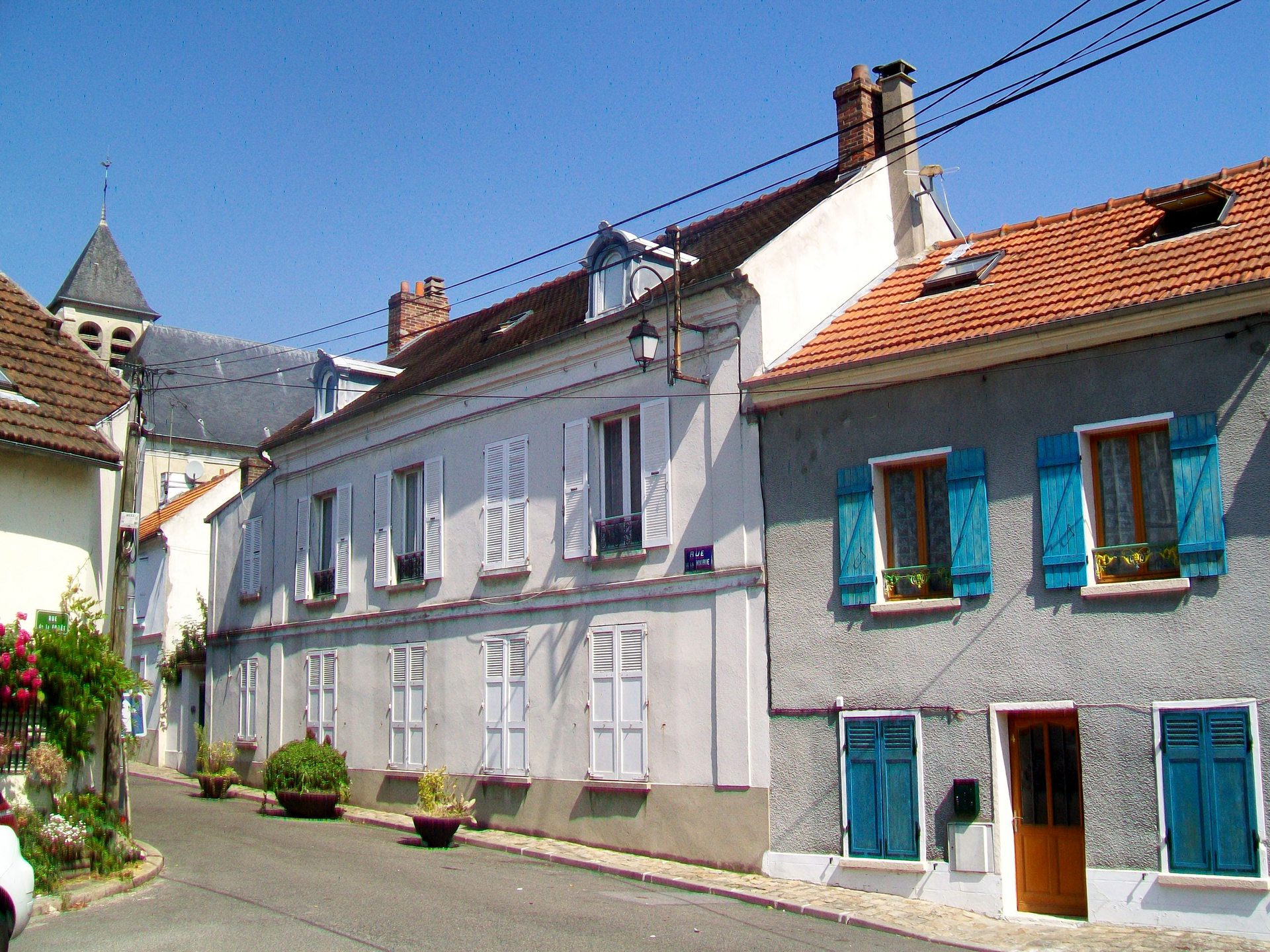
Pictured: the Rue de la Mairie in Maffliers, Val-d'Oise, looking toward the village church — not the actual field at the forest's edge where the witness was walking his dog, whose precise location GEIPAN's published file does not disclose. No photograph, video, or other direct visual recording of the object itself is known to exist; the entire evidentiary record consists of the witness's own testimony and GEIPAN's own reconstruction and site-verification materials. Photo by Wikimedia Commons contributor P.poschadel (2012), released under CC BY-SA 3.0 / GFDL.
Theoretical Alignment
This case sits in a genuinely different category from most of this site's published GEIPAN archive, and the Theoretical Alignment weighting reflects that directly. GEIPAN's own investigators did not describe this sighting as resembling a structured craft that happened to defy explanation; they described it as looking almost exactly like a well-understood natural phenomenon — the sun rising between two cloud layers — and then spent two separate site visits trying to make that explanation fit. Psycho-Social framing draws the largest single share of weight specifically because of that framing: a solitary, frightened witness at dawn, in low light, watching a bright object for under twenty seconds, is a textbook scenario for misperceiving a genuinely mundane light source, and GEIPAN's own candid admission that the resemblance to a mundane sunrise was "extreme" is a real, substantive piece of evidence pointing that way. What keeps PSH capped well short of a governing majority, and what keeps this case classified as unexplained rather than closed as solved, are two specific, quantified details GEIPAN's own on-site verification could not explain away: a 54-degree gap between the witness's stated viewing direction and the sun's actual position that morning, which investigators explicitly ruled out as attributable to simple directional estimation error, and an apparent size nearly ten times the solar disk, which is a far larger overestimation than the well-documented (and much more modest) tendency for observers to overstate the apparent size of a rising sun or moon. Extraterrestrial framing draws real, if still modest, weight from those same two anomalies — a directional discrepancy investigators call impossible to attribute to error, and a size discrepancy an order of magnitude beyond the ordinary illusion, are both genuinely unusual data points for a sighting this brief. Interdimensional framing retains the least direct support here, resting mainly on the case's total absence of instrumented or photographic corroboration — the same generic "left no trace" pattern IDH proponents apply broadly rather than anything unique to what was actually reported at Maffliers.
Background
Two threads of context matter for reading this sighting honestly: the ordinary, historically layered Val-d'Oise commune where it occurred, and the specific, well-understood natural phenomenon GEIPAN's own investigators treated as the leading candidate before finding it did not quite fit.
Maffliers: An Old Seigneurial Village on the Edge of the Forest
Maffliers is a small commune of roughly 1,800 residents in the Val-d'Oise department of Île-de-France, sitting at the edge of the Forêt de l'Isle-Adam, about 30 kilometers north of central Paris. Its population has grown steadily and substantially over the past century and a half — from a few hundred residents in the late 19th century to under 600 as recently as 1968, then roughly doubling through the postwar suburban growth of the Île-de-France region to reach its current size. The commune's recorded history reaches back to the High Middle Ages: Maffliers was the seat of its own feudal châtellenie, which the medieval lord Mathieu IV de Montmorency granted to his brother Érard in 1286 on the occasion of his marriage. Its most visible historic landmark, the Château de Maffliers, later passed into the hands of the Talleyrand-Périgord family: Augustin-Hélie-Charles de Talleyrand-Périgord (1788–1879) owned the château, and the commune's central square, place Talleyrand de Périgord, still bears the family's name today. A stone bridge, the Pont d'Arcole, was built nearby in 1830 by the neighboring Count of Choiseul specifically to give himself direct access to his neighbor, the Duke of Talleyrand-Périgord, at the château. By the early 21st century, Maffliers had settled into the same broad pattern as dozens of other communes ringing the northern edge of the Paris metropolitan area: a mix of historic châteaux and farmhouses, postwar residential growth, and open agricultural fields running up against the tree line of the surrounding forest — exactly the kind of field-and-forest edge where this sighting's own witness happened to be walking his dog at dawn. INSEE's own historical census series traces that growth in detail: 553 residents in 1968, 790 in 1975, 903 in 1982, 1,168 in 1990, 1,369 in 1999, and roughly 1,620 to 1,631 by 2007–2008 — a documented 19 percent increase in that single decade alone — reaching approximately 1,800 residents by the most recent published figures. That trajectory is a fairly ordinary one for the outer Île-de-France region generally, reflecting decades of Parisian suburban expansion pushing steadily outward into what had, for centuries before, been small agricultural and seigneurial villages; it is worth noting specifically because it means the field where this sighting occurred sits within a commune that has been quietly but continuously densifying for the better part of six decades, even as its historic core and its immediate agricultural and forest fringe have remained largely intact.
The Conventional Candidate GEIPAN Took Seriously: A Sunrise Between Cloud Layers
What distinguishes this file most clearly from the majority of this site's other published GEIPAN cases is the specific conventional phenomenon its own investigators treated as a genuine, leading candidate rather than a token gesture toward skepticism. A rising or setting sun, viewed through a break between two layers of cloud, is a well-documented and surprisingly common source of anomalous-looking sky reports: the visible solar disk can appear to take on unusual, non-circular outlines when partially obscured by cloud structure, its true brightness can be masked enough by the intervening cloud layer to make it comfortable to look at directly (something the true, unobscured sun almost never permits), and its color can shift toward white, yellow, or orange depending on the thickness and composition of the atmosphere it is being viewed through at a very low angle above the horizon. GEIPAN's own case synthesis states plainly that this sighting's resemblance to that phenomenon was "extreme" and "synchronous" — meaning the timing, the general appearance, and the low-altitude, near-horizon geometry of what the witness described lined up closely with what a partially cloud-obscured dawn sun would actually look like from that field, at that hour, on a morning GEIPAN's own file explicitly notes had heavy cloud cover. This is not a hypothesis this site's own research is reconstructing after the fact from general principles; it is the specific comparison GEIPAN's own investigators reached for first, and took seriously enough to send a field team back to the site twice to test.
Complete Timeline
| Date | Event |
|---|---|
| 1286 | Mathieu IV de Montmorency grants the seigneurial châtellenie of Maffliers to his brother Érard, the commune's earliest documented feudal record. |
| 1788–1879 | Augustin-Hélie-Charles de Talleyrand-Périgord, later owner of the Château de Maffliers, gives his family name to the commune's central square. |
| 1830 | The Pont d'Arcole is built by the neighboring Count of Choiseul to reach the Talleyrand-Périgord château directly. |
| 1968 | Maffliers records a population of roughly 553, per INSEE's historical census series. |
| June 28, 2012 | The day before the sighting: GEIPAN's own file records intense heat and heavy rainfall in the area. |
| June 29, 2012, approx. 6:06 AM | Sighting begins. A dog-walker in Maffliers, alerted by his frightened dog, observes a large white luminous object, flat underneath and concave on top, hovering motionless and silently over a field at the edge of the forest. As rain begins to fall, the object rises slightly, tilts, and departs rapidly toward the cloudy sky. Total observation time: under 20 seconds. |
| Following days | The witness's report reaches GEIPAN; a technical questionnaire and formal testimony are recorded. No other witness or press report of the same event is ever identified. |
| First site visit (date not published) | GEIPAN investigators travel to Maffliers to verify the exact site and the witness's stated directions of observation, ruling out involuntary directional estimation error. |
| Second site visit (date not published) | GEIPAN investigators return to study whether a complex solar reflection could account for observing the sun's image from a direction other than its true position; no satisfactory mechanism is identified. |
| June 16, 2026 | GEIPAN's published case page for this sighting is last updated, per the site's own metadata, reflecting the agency's ongoing maintenance of its public archive. |
| Case status as maintained | Final classification. GEIPAN records the case as Class D1: a strange phenomenon of medium consistency, unexplained, with a strangeness index of 0.62. |
Detailed Narrative
A Dog's Alarm, and a Silent White Shape Over the Field
According to GEIPAN's own archived case synthesis, the witness was out walking his dog in the early morning hours of June 29, 2012, when the animal's own evident alarm drew his attention to the sky above a nearby field, at the edge of the forest. What he then saw, for a duration he estimated at under twenty seconds, was a large object, luminous and white, hovering completely motionless at low altitude. He described its shape in specific, structural terms rather than as a vague glow: flat on its underside, and concave — curved inward, like the inside of a shallow bowl — across its top. GEIPAN's file records no sound of any kind accompanying the object during this stationary phase, and no smoke or vapor of any description. As rain began to fall — the case file's own detail, and a small but concrete piece of independently checkable weather information — the object responded: it rose a short distance, tilted at an angle, and then departed rapidly, heading toward the cloud-covered sky. GEIPAN's own case summary describes the witness, by this point, as "apeuré" — frightened. No other witness to any part of this sequence was ever identified, despite the object's reported size and its position over open, visible ground at the edge of a field rather than concealed by trees or structures.
An Investigation That Named Its Own Leading Hypothesis — And Then Tested It on the Ground, Twice
What sets this file apart within this site's published GEIPAN archive is the specificity and the field-verified rigor of the conventional hypothesis GEIPAN's own investigators pursued. Rather than a generic acknowledgment that "some mundane explanation might exist," the agency's own synthesis names its candidate directly: the rising sun, observed between two layers of cloud, a phenomenon it explicitly characterizes as "extremely similar and synchronous" with what the witness described. Investigators did not stop at noting the resemblance from their desks. They traveled to the actual sighting site not once but twice. The first visit had a narrow, falsifiable purpose: to verify the physical location and the exact compass direction the witness indicated he had been facing, specifically in order to test — and, as it turned out, to exclude — the possibility that he had simply misjudged or misremembered which way he was looking. Investigators confirmed his stated direction was accurate to the site's own geography. That confirmation is precisely what turned a simple, dismissible mismatch into the file's central, unresolved anomaly: once the witness's own direction was independently verified as reliable, the fact that the true sun was 54 degrees away from where he had been looking stopped being explainable as a slip of memory or a vague estimate, and became a specific, calculated discrepancy GEIPAN's own file states plainly "cannot be attributed to uncertainty."
The Second Visit: Chasing (and Failing to Find) a Complex Reflection
Having ruled out simple directional error, GEIPAN's investigators did not abandon the sunrise hypothesis outright; they returned to the site a second time to test a more sophisticated version of it — whether some complex reflection of the actual sun, off water, glass, a reflective surface, or some other intervening medium, could have redirected its image into the witness's actual field of view, 54 degrees from where the true sun itself stood that morning. This is a genuinely rigorous next step, and its documentation in GEIPAN's own file is worth taking at face value: investigators went looking for a specific physical mechanism, on the actual ground, rather than treating "maybe it was some kind of reflection" as a hand-waved catch-all. They did not find one. GEIPAN's own synthesis states directly that its investigators "could not identify a satisfactory hypothesis," a conclusion reached only after two dedicated field visits and a specific, tested attempt to salvage the sunrise explanation via reflection geometry, not a default fallback after a single desk review.
The Second Anomaly: An Apparent Size Nearly Ten Times the Sun's Disk
GEIPAN's own analysis treats the sighting's second major discrepancy with the same care it gives the first. The witness's description implied an apparent size for the object roughly ten times larger than the sun's own visible disk. GEIPAN's file is careful and precise on this point, and this site's research treats that precision as a genuine credit to the investigation rather than a throwaway detail: the agency explicitly acknowledges that overestimating the apparent size of a rising or setting sun (or moon) is a well-known and common perceptual effect, sometimes called the "moon illusion" when applied to the moon, tied to how the human visual system judges the size of an object near the horizon differently than the same object higher in the sky. But GEIPAN's own file is equally explicit that this well-known illusion is "rarely" responsible for an overestimation anywhere near the roughly tenfold factor implied by this witness's account. In other words, investigators did not treat the size discrepancy as automatically anomalous — they checked it specifically against the known behavior of a real, documented perceptual bias, and found the reported figure still stood well outside what that bias could plausibly explain on its own.
The Third Anomaly: A Tilt Before Departure
The object's reported inclination just before it accelerated away is the detail GEIPAN's own file treats with the most epistemic caution, and this site's research follows that same caution rather than overstating it. The agency's synthesis offers two possible, non-anomalous readings of the tilt, both explicitly framed as speculative: it could reflect a genuine perceptual illusion produced by the object's own brightness (a very bright light source near the horizon can visually appear to shift position or orientation as a viewer's eye adapts, particularly in the seconds before it is lost from view against a bright or changing sky), or it could reflect the witness's own prior exposure, conscious or not, to widely circulated media depictions of UFOs performing exactly this kind of tilt-and-depart maneuver, subtly shaping how he interpreted or later described an ambiguous instant. GEIPAN itself does not resolve which reading, if either, applies here — and this site's own analysis treats the tilt as the file's single softest data point, genuinely interesting but explicitly not treated by GEIPAN's own investigators as carrying the same evidentiary weight as the 54-degree directional gap or the tenfold size discrepancy.
An Unusual, Unrepeatable Morning
GEIPAN's own file makes a specific point of flagging the morning's meteorological conditions as themselves genuinely unusual: intense heat and heavy rainfall the day before, and heavy cloud cover on the morning of the sighting itself. Investigators explicitly describe these conditions as "not reproducible" — language this site's research reads as a deliberate acknowledgment that whatever combination of atmospheric conditions actually produced what the witness saw, testing or replicating it under controlled or comparable circumstances would not be straightforward. This is a genuinely honest note for an investigating body to include: rather than implying the sighting could be casually reproduced or dismissed as an everyday occurrence, GEIPAN's own file states the conditions were distinctive enough that a repeat observation under the same circumstances should not be expected.
Key Witnesses
Maffliers Primary Witness (identity withheld per GEIPAN's standard anonymization practice)
Walking his dog at the edge of a field near Maffliers at approximately 6:06 AM on June 29, 2012, this witness was alerted by his dog's own alarm to a large, motionless white object with a flat underside and concave top, hovering silently at low altitude. As rain began to fall, he watched it rise slightly, tilt, and depart rapidly toward the cloudy sky, all within under twenty seconds. GEIPAN's own investigators verified his stated viewing direction against the actual site geography and found it reliable, which is precisely what turned the 54-degree gap between that direction and the sun's true position into the case's central, unresolved anomaly. No other witness to this sighting was ever identified.
The Five Observables Assessment
The Five Observables framework, developed by the Pentagon's Advanced Aerospace Threat Identification Program to describe performance characteristics beyond known conventional technology, is applied here for comparative consistency across the site's case files. This sighting's brevity and single-witness structure limit how much can be concluded with confidence, but its reported hover-then-departure sequence gives it a somewhat richer behavioral profile than several other single-witness GEIPAN files in this site's archive.
Assessment: This case earns a more mixed Five Observables profile than a simple silhouette sighting would, precisely because it reports both a genuine hover phase and a subsequent rapid departure — two distinct behavioral phases rather than one continuous, unremarkable motion. At the same time, this site's analysis is careful not to overweight that apparent richness: a low sun glimpsed through a break in the clouds would also appear stationary over a twenty-second window (the sun's own apparent motion across the sky is far too slow to notice on that timescale), which is exactly why Anti-Gravity Lift is rated Speculative rather than a clean Present here, unlike a case where hovering is reported over minutes rather than seconds. The reported rapid, silent departure remains a genuinely distinctive data point regardless of that caveat, as does the total absence of sound or smoke throughout — both real, if modest, points of divergence from the leading conventional candidate GEIPAN's own investigators worked hardest to substantiate.
Evidence Assessment
Supporting an Anomalous Origin
- GEIPAN's own field investigators independently verified the witness's stated direction of observation against the actual site geography and found it reliable — specifically excluding involuntary directional estimation error as the source of the 54-degree gap from the sun's true position
- That 54-degree directional discrepancy is explicitly described in GEIPAN's own file as impossible to attribute to simple uncertainty
- The object's apparent size, at roughly ten times the solar disk, exceeds what GEIPAN's own investigators state the well-documented sunrise/moon size-overestimation illusion can plausibly account for
- A dedicated second field visit to test a complex solar-reflection hypothesis, capable in principle of explaining the directional mismatch, found no supporting physical mechanism
- No sound or smoke was reported despite the object's proximity and reported size, a poor match for any conventional powered aircraft or ground-based light source at comparable range
Supporting a Conventional/Mundane or Inconclusive Origin
- This is a single, uncorroborated witness account, observed for under twenty seconds, from a self-described frightened observer under low dawn light — conditions well suited to misperception even before any specific illusion is invoked
- GEIPAN's own investigators describe the sighting's resemblance to a mundane sunrise between cloud layers as "extreme" and "synchronous," a strong starting-point resemblance that the case's anomalies only partially, not wholly, displace
- The reported tilt just before the object's disappearance is explicitly flagged by GEIPAN itself as potentially explainable by a brightness-driven perceptual illusion or by the witness's own prior familiarity with popular UFO imagery, rather than as a confirmed anomaly
- No photograph, video, or physical trace of any kind exists; the entire evidentiary record rests on a single witness's verbal account and GEIPAN's own after-the-fact site verification and reflection-geometry analysis
- The morning's own genuinely unusual atmospheric conditions — heavy heat and rain the day before, heavy cloud cover that morning — are exactly the kind of circumstances capable of producing atmospheric optical effects (unusual refraction, looming, or mirage-like distortion of a low sun) well outside GEIPAN's own baseline assumptions about ordinary sunrise appearance, a possibility the published file does not appear to have explored as its own distinct hypothesis
Why "Open"
This case is stamped Open because GEIPAN's own investigation did something genuinely unusual within this site's published archive: it identified a specific, well-understood, and highly plausible conventional explanation early, took that explanation seriously enough to send a field team to the actual site not once but twice, and still could not close the case, because two independently checkable details — a 54-degree directional gap the agency's own on-site verification ruled out as estimation error, and an apparent size discrepancy well beyond the known bounds of the ordinary solar-size illusion — refused to resolve. That is a meaningfully different, and in some respects more rigorous, outcome than a case left open simply for lack of any investigation at all.
At the same time, this site's own analysis is explicit that this case's real strength is narrower, and its scoring reflects that honestly rather than rounding up. The sighting itself lasted under twenty seconds, came from a single, self-described frightened witness, and describes an object whose overall profile — a bright, motionless, roughly disc-like white shape near the horizon at dawn, followed by a departure as weather changed — overlaps substantially with what a partially cloud-obscured sunrise can genuinely look like, a resemblance GEIPAN's own file itself calls extreme. The case's anomalies, while specific and quantified rather than vague, are also narrow in number: essentially two hard data points (direction and size) and one soft, explicitly caveated one (the tilt). No instrumented, photographic, or corroborating testimony exists anywhere in the record. Weighed together — genuine investigative rigor and two specific, checked anomalies, against a brief, single-witness sighting whose base resemblance to a common, well-understood natural phenomenon its own investigators call extreme — this case is scored toward the lower end of this site's published GEIPAN archive: a real, honestly unresolved near-miss against a conventional explanation, rather than a strongly anomalous structured-craft encounter.
Sensor & Instrumentation Detection Profile
No photograph, video, or live sensor recording of any kind captured this phenomenon, and GEIPAN's own published file does not indicate that any radar, satellite, or other instrumented data source was consulted for this specific sighting — unlike some of this site's other GEIPAN files (compare, for instance, the Fauville-Évreux Radar Sighting, where a real regional radar log was checked directly, or the Ruffec Repeating Light Arc, where investigators calculated exact solar and satellite geometry against a specific witness account). The closest thing to instrumented analysis in this file is GEIPAN's own solar-position and reflection-geometry work: a calculation of the sun's true azimuth and elevation for the witness's location, date, and time, checked directly against his own verified viewing direction, and a subsequent on-site assessment of whether any complex reflective surface near the sighting location could account for the mismatch. That is a genuine, quantitative piece of investigative work, but it is analytical rather than observational — built from astronomical calculation and site inspection, not from any independent recording device that captured the object itself.
It is also worth noting, as this site's research does for its other pre-2016 French cases, what modern GEIPAN instrumentation this sighting predates. FRIPON (Fireball Recovery and InterPlanetary Observation Network), GEIPAN's automated meteor and fireball camera network, only began operating in May 2016, nearly four years after this sighting — and would in any case have limited relevance here, since the object's reported hovering, tilting, and controlled departure bear no resemblance to a meteor or bolide's characteristic streak-and-fade trajectory. IPACO (Ingestion et Post-traitement Automatisé des Clichés Ovnis), GEIPAN's dedicated photographic and video analysis toolkit, similarly has no material to process in a case with no image or footage of any kind. Both absences reflect the case's own evidentiary structure rather than any investigative shortfall: this file's entire analytical weight rests on witness testimony, cross-checked against real astronomical calculation and physical site verification, not on any instrumented capture.
Environmental & Geospatial Context
GEIPAN's own file is unusually specific about the meteorological backdrop to this sighting, and this detail carries real analytical weight rather than being incidental color: intense heat and heavy rainfall the day before, June 28, 2012, followed by heavy cloud cover on the morning of the sighting itself. Investigators explicitly characterize this combination as genuinely unusual and not reproducible under ordinary circumstances. This site's own research adds a further, independently verifiable piece of astronomical context that GEIPAN's published summary does not itself spell out in full: June 29 falls just eight days after the northern summer solstice, when sunrise in the Île-de-France region occurs at its most extreme north-of-due-east azimuth of the year — commonly cited, for locations at this latitude, as falling in the upper-40s to low-50s degrees measured clockwise from true north (that is, notably north of due east, in the east-northeast quadrant of the horizon). A genuine 54-degree deviation from that azimuth, as GEIPAN's own file describes, would place the witness's actual stated line of sight well outside that east-northeast quadrant entirely — a substantial, easily distinguishable difference in the sky, not a marginal one, which underscores why investigators treated the gap as significant enough to warrant two dedicated field visits rather than a desk dismissal.
Geographically, the sighting occurred at the edge of a field bordering the Forêt de l'Isle-Adam, within the rural-suburban fringe of the Val-d'Oise department, roughly 30 kilometers north of central Paris and, as with several other Val-d'Oise GEIPAN files this site has documented (see the Taverny Triangle, roughly 13.4 kilometers to the south), within the broader outer ring of Paris-area airspace, including the general vicinity of Paris–Charles de Gaulle Airport well to the southeast. GEIPAN's own published file for this case makes no reference to CDG's airspace or any air-traffic hypothesis whatsoever, however — unlike Taverny's drone/model-aircraft analysis, this sighting's own leading candidate was purely astronomical and atmospheric, not aviation-related, and this site's research found no indication that any radar or flight-track data was ever sought for this specific morning.
The broader Val-d'Oise department, of which Maffliers forms a part, is a mixed commuter-suburban and agricultural department on the northern edge of the Paris metropolitan area, its landscape a patchwork of historic châteaux, working farmland, and remnant woodland — the Forêt de l'Isle-Adam among the largest of the latter. Nothing in that broader regional character offers any specific candidate light source, industrial facility, or other locally-based explanation for this sighting; GEIPAN's own analysis remained focused throughout on the sun itself as the leading, if ultimately unconfirmed, explanatory candidate.
Observer Credibility & Occupational Profile
The witness's occupation is not disclosed in GEIPAN's published case file, consistent with the agency's standard anonymization practice. What the file does record, and what this site's analysis treats as directly relevant to weighing his account, is his emotional state during the observation: GEIPAN's own synthesis describes him as frightened. That detail cuts in more than one direction, and this site's own analysis treats both readings as legitimate rather than favoring one. On one hand, a spontaneous fear reaction, triggered in real time by an animal's own alarm rather than by any prior expectation of seeing something unusual, is consistent with a genuine, unscripted encounter with something the witness found startling — not the kind of embellished account a witness seeking attention or building a story after the fact would typically produce. On the other hand, fear and adrenaline are also well-documented to affect perception under exactly these conditions: heightened arousal, a brief observation window, low dawn lighting, and a genuinely startling initial cue (the dog's own alarm) are all factors independently associated with reduced perceptual accuracy, particularly for fine spatial judgments like precise direction and comparative size — the very two details GEIPAN's own investigation ultimately found the least explicable away.
The single most consequential credibility fact in this file, however, is not about the witness's state of mind at all: it is GEIPAN's own independent, on-site verification of his stated viewing direction against the real geography of the sighting location. That verification is what elevates the 54-degree discrepancy from an unfalsifiable claim resting on one person's memory into a specific, checked, and still-unresolved anomaly. This site's analysis treats that field verification as the case's single strongest piece of evidence, precisely because it does not depend on trusting the witness's memory of which way he was facing — investigators went to the actual field and checked it against the actual sightlines available from that position.
Physical & Material Assays
No physical trace evidence exists in this case, and GEIPAN's own published file gives no indication that any ground-level search for trace material was conducted, despite two separate field visits to the site. This is consistent with the nature of the sighting as reported: the object remained airborne throughout, hovering above rather than upon the field in question, and no landing, scorching, vegetation disturbance, or other ground-level physical effect was ever described by the witness. Accordingly, this case has no soil, vegetation, or material sample of any kind associated with it, and no metallurgical, isotopic, or trace-chemical assay was performed or would have been applicable given the sighting as described.
Historical Precedents & Archive Matches
This case's most useful points of comparison on this site are not other reports of large, structured craft, but other GEIPAN files where a specific astronomical or atmospheric candidate was tested rigorously and either confirmed, rejected, or left genuinely unresolved — along with one other Val-d'Oise sighting that shares this file's department but almost nothing else about its actual profile.
Ruffec: The Closest Methodological Match on This Site
The Ruffec Repeating Light Arc (Open, case #254) is this site's closest methodological parallel to the Maffliers file, even though the two sightings look nothing alike on their surface. In that case, GEIPAN's own investigators calculated exact solar and satellite geometry to test, and ultimately rule out, a Starlink satellite flare as the source of a repeating arc of light — the same basic investigative move (compute the real astronomical position of a candidate light source, then check it directly against the witness's reported geometry) that drives this Maffliers file's entire 54-degree analysis. Read together, the two cases show GEIPAN applying the same rigorous astronomical cross-checking method to genuinely different kinds of sightings, in each case reaching a specific, quantified mismatch rather than a vague dismissal.
Taverny: Same Department, an Entirely Different Profile
The Taverny Triangle (Open, case #259), roughly 13.4 kilometers south of Maffliers within the same Val-d'Oise department, is worth naming specifically because of how little the two cases actually resemble each other despite their shared geography. Taverny's object was dark, silent, and triangular, crossing the sky at a constant altitude and speed at night; Maffliers's object was bright, white, and rounded, stationary at dawn before a rapid departure. Val-d'Oise's own GEIPAN case record, on the strength of these two files alone, shows no single recurring craft morphology tying its reports together — a useful caution against reading too much into shared department or regional boundaries on their own.
Bornel and Bonilla: Bright Objects Against a Bright Sky
The Bornel Conservatory Fireball (Open, case #249) offers a different but related comparison: a bright, glowing object observed drifting silently across a cloud-covered sky, initially mistaken by its own witness for a mundane phenomenon (a crashing aircraft) before its behavior diverged from that explanation. Both Bornel and Maffliers involve a single witness assessing a bright aerial phenomenon against an overcast sky and reaching, independently, a "this looks almost exactly like something ordinary, except" conclusion — a recurring investigative shape across separate GEIPAN files even where the phenomena themselves differ substantially. Further afield, and far outside this site's GEIPAN archive, the 1883 Bonilla Solar Transit Photographs (Disputed, case #219) stand as a much older, unrelated reminder that observations made in or near the sun's own vicinity carry a long, documented history of interpretive difficulty, from José Bonilla's photographed "objects" crossing the solar disk in 1883 to this 2012 case's own struggle to separate an anomalous object from the sun itself.
Material Analysis
As with the Physical & Material Assays section above, this case involves no physical or trace evidence of any kind. The object remained airborne throughout the entire observation, and no landing, hover-and-touch, or ground-level approach was ever reported that could have produced a testable trace.
Supporting Non-Terrestrial Origin
- No confirmed physical evidence exists to test in the first place, so no terrestrial material-composition finding contradicts an anomalous interpretation either
- GEIPAN's own field-verified 54-degree directional discrepancy and the object's reported near-tenfold apparent size relative to the sun remain unresolved by the agency's own best conventional candidate
Supporting Terrestrial Origin
- GEIPAN's own investigators identify a specific, well-understood conventional candidate — the rising sun viewed between cloud layers — and describe the sighting's resemblance to it as extreme; the case's anomalies narrow, rather than eliminate, that resemblance
- The morning's own genuinely unusual weather (heavy heat and rain the day before, heavy cloud cover that morning) creates real potential for atmospheric optical distortion of a low sun that GEIPAN's published file does not appear to have modeled as its own distinct hypothesis
The Conventional Explanation Candidate: Sunrise Between Cloud Layers, Atmospheric Mirage, and Residual Alternatives
GEIPAN's own published synthesis for this case names its leading candidate directly and tests it with genuine field rigor, which this site's analysis follows closely, while also adding a small number of residual candidates GEIPAN's own file does not explicitly explore.
The Rising Sun, Seen Between Two Cloud Layers
This is GEIPAN's own stated leading candidate, and the one its investigators worked hardest, and most concretely, to substantiate: two separate field visits, an independent verification of the witness's stated viewing direction, and a real astronomical calculation of the sun's true position for that place, date, and time. The candidate ultimately falls short specifically because the calculated 54-degree directional gap and the near-tenfold apparent-size discrepancy remain unexplained by the phenomenon on its own terms — not because the underlying resemblance was ever weak. This site's own analysis finds GEIPAN's handling of this candidate to be a model of how a conventional explanation should be tested: taken seriously, checked against real data, and honestly reported as insufficient once the data failed to support it, rather than either dismissed prematurely or forced to fit.
A Complex Solar Reflection
GEIPAN's second field visit tested this specific refinement of the sunrise hypothesis directly: could some reflective surface near the sighting site have redirected the sun's actual image into the witness's stated 54-degree-offset field of view? Investigators found no supporting physical mechanism at the site. This site's own analysis treats this as a genuinely tested and genuinely rejected candidate, rather than one abandoned for lack of effort.
Atmospheric Mirage or Looming of the Low Sun
This is a candidate this site's own research raises independently, building on but distinct from GEIPAN's own published analysis, which does not appear to explore it as its own named hypothesis. Under specific atmospheric conditions — notably a temperature inversion, where a layer of unusually warm or cool air sits atop air of a different temperature near the ground — light from a low-elevation source such as a rising sun can be bent (refracted) in ways that distort its apparent position, shape, and size, producing effects generally grouped under the terms "looming" or atmospheric mirage. GEIPAN's own file's specific description of the morning's weather as genuinely unusual (intense heat and heavy rain the day before, heavy cloud cover that morning) describes exactly the kind of atmospheric instability — a recently rain-soaked, still-warm ground beneath a newly overcast sky — that can support this kind of temperature-layering effect. This site's own analysis flags atmospheric mirage as a serious, if unconfirmed, candidate specifically because it could, in principle, account for both of the case's hard anomalies simultaneously: a genuinely displaced apparent solar position (addressing the 54-degree gap) and genuine apparent magnification (addressing the size discrepancy) are both well-documented consequences of strong atmospheric refraction under the right conditions. This site's research found no indication that GEIPAN's own investigation modeled or tested this specific mechanism, which this site flags as a genuine, honest gap in the published record rather than a claim that the mirage hypothesis has been confirmed. It is also worth being precise about what this candidate can and cannot explain on its own: an atmospheric mirage or looming effect displaces and distorts the apparent image of a genuinely existing light source, but it does not, by itself, explain the reported flat-bottomed, concave-topped structural shape, nor the witness's description of a subsequent tilt and rapid, silent departure once rain began to fall. A displaced, magnified solar disk glimpsed through shifting cloud could plausibly account for an unusual apparent shape and a false sense of directional displacement, and its progressive obscuration behind thickening rain clouds could plausibly be misread, in a brief and frightened observation, as the object itself "departing." But this remains, honestly, an inference this site's own research is constructing from general atmospheric-optics principles rather than a documented, site-specific finding, and it should be weighed as exactly that: a genuinely plausible, unconfirmed candidate, not a solved case GEIPAN's own investigators simply failed to notice.
A Ground-Based Light, Aircraft, or Early-Generation Civilian Drone
GEIPAN's own published file raises no conventional-aircraft or drone hypothesis for this sighting at all, in contrast to several of this site's other GEIPAN files (compare Taverny's explicit drone analysis). This site's own analysis treats that absence as informative: unlike Taverny's dark, silent, level-flying triangle, this sighting's reported stationary hover, luminous white coloring, structured flat-bottomed/concave-topped shape, and dawn timing align far more naturally with GEIPAN's own solar hypothesis than with any aircraft profile, and this site's research found no basis to second-guess GEIPAN's implicit decision not to pursue an aviation-based explanation here. It is nonetheless worth noting, as period context this site's research adds independently, that France's first civil drone regulatory framework (the arrêté du 11 avril 2012) had taken effect barely two and a half months before this sighting — meaning that even had a drone hypothesis been raised, the country's drone-hobbyist community and its associated registration/permitting apparatus were still in their earliest infancy at the time, a weak fit for an object described as far larger than any hobbyist drone of that era could plausibly have been.
Rising Sun Between Cloud Layers
InconclusiveGEIPAN's own leading candidate, tested with genuine field rigor; the base resemblance is extreme, but the 54° directional gap and near-tenfold size discrepancy remain unexplained by the phenomenon alone.
Complex Solar Reflection
ImplausibleDirectly tested on a dedicated second GEIPAN field visit; no supporting reflective mechanism was found at the site.
Atmospheric Mirage / Looming of the Low Sun
InconclusiveNot addressed as a named hypothesis in GEIPAN's published file; a genuinely plausible mechanism given the morning's own documented atmospheric instability, but unconfirmed by any specific modeling on record.
Conventional Aircraft or Civilian Drone
ImplausibleNot raised by GEIPAN's own investigators; the object's reported stationary hover, luminous coloring, and structured shape align far better with the solar hypothesis than any aviation profile, and France's civil drone framework was barely two months old at the time.
Related Cases
Confirmed Documents & Official Records
The official French government case summary: the witness's account, GEIPAN's two site visits, the sunrise and reflection hypotheses, and the Class D1 determination.
GEIPAN's own published definitions, including the D1 category and strangeness-index methodology applied to reach this case's rating.
GEIPAN's own account of its institutional lineage, the same modern investigative framework applied to this 2012 case.
Official French national statistics for the commune, including its historical population series.
Further Reading — Recommended Literature
Passport to Magonia: On UFOs, Folklore, and Parallel Worlds
Vallée's foundational catalog of centuries of French and international sightings offers direct background for reading this case within a much longer national tradition of reported anomalous aerial phenomena.
Bad Astronomy: Misconceptions and Misuses Revealed, from Astrology to the Moon Landing "Hoax"
Includes a dedicated chapter, "Misidentified Flying Objects: UFOs and Illusions of the Mind and Eye," directly relevant to this case's own central question of how a real astronomical object can be misjudged in direction and size.
UFOs and Government: A Historical Inquiry
Includes a dedicated chapter on French government UAP investigation, directly relevant to the GEIPAN institutional framework that investigated this case the same year it was published.
Identified Flying Objects: A Multidisciplinary Scientific Approach to the UFO Phenomenon
A methodologically-focused work useful for weighing witness credibility, comparative-size estimation, and the limits of single-witness testimony, all directly relevant to how this case was actually investigated.
UFOs and the National Security State: Chronology of a Coverup, 1941–1973
A U.S.-focused history of military and national-security institutions handling UAP reports, a useful comparative lens for a case investigated entirely outside any military or security context.
Essential Viewing
No Videos Available
Sources
- GEIPAN (CNES), "MAFFLIERS (95) 29.06.2012", Case 2012-06-08256 — official case summary
- GEIPAN (CNES), official case archive & public portal — geipan.fr
- GEIPAN (CNES), Glossaire du GEIPAN — official classification definitions, A/B/C/D/D1/D2
- GEIPAN (CNES), Son histoire — institutional history: GEPAN (1977), SEPRA (1988), GEIPAN (2005)
- France 3 Régions / France Info, "OVNI : 9 cas 'inexpliqués' en région parisienne" — regional press coverage naming this case among nine unexplained Île-de-France GEIPAN files, including the direction/size discrepancy and the drone hypothesis raised in the neighboring Taverny file (title/content independently confirmed via search; direct fetch blocked by the outlet's own access controls)
- Wikipédia (français), "Maffliers" — commune geography, population history, and feudal châtellenie background
- Wikipedia (English), "Maffliers" — commune summary and location within Val-d'Oise
- Wikipédia (français), "Château de Maffliers" — history of the château and its Talleyrand-Périgord ownership
- INSEE, Dossier complet — Commune de Maffliers (95353) — official French national statistics for the commune
- Légifrance, Arrêté du 11 avril 2012 (drone design/use/operator regulation) — official text establishing France's first civil drone regulatory framework, barely two and a half months before this sighting
- Wikipedia (English), "Sunrise" — general background on sunrise azimuth variation by latitude and season, and the solar/lunar size-overestimation illusion near the horizon
- Wikimedia Commons, File: Maffliers (95), rue de la Mairie, vue vers l'église.jpg, photo by P.poschadel (2012), CC BY-SA 3.0 / GFDL — licensing and attribution
- Wikimedia Commons, Category: Maffliers — image archive for the commune
- Wikimedia Commons, Category: Buildings in Maffliers — architectural and streetscape image archive
- This site, case-files/ruffec-repeating-light-arc.html — comparative GEIPAN case, the closest methodological match (calculated astronomical geometry checked against testimony)
- This site, case-files/taverny-triangle-sighting.html — comparative GEIPAN case, same department, an entirely different craft profile
- This site, case-files/bornel-conservatory-fireball.html — comparative GEIPAN case, a bright object initially mistaken for a mundane phenomenon
- This site, case-files/bonilla-solar-transit-photographs.html — comparative historical case, interpretive difficulty near the sun's own disk
- This site, case-files/fauville-evreux-radar-sighting.html — comparative GEIPAN case with an actually-checked instrumented cross-reference
- This site, key-figures.html, entry on Claude Poher — GEPAN founding and early institutional history
- This site, locations/index.html, entry on Toulouse — CNES/GEPAN/SEPRA/GEIPAN institutional headquarters
See something inaccurate? Have additional information or sources?
Suggest an Edit →Last Updated: August 2026